Arend Lijphart’s path-breaking Patterns of Democracy distinguishes between majoritarian and consensus democracies.Footnote 1 One seminal idea behind this distinction is that countries differ in the inclusiveness of their democratic process. Lijphart measures countries’ democratic inclusiveness along two empirical dimensions, the executives-parties and the federal-unitary dimension, each consisting of five variables. The executives-parties dimension includes an indicator for the inclusiveness of cabinets, which Lijphart considers to be ‘conceptually close to the essence’ of the majoritarian-consensus contrast.Footnote 2 I offer a reinterpretation of some of Lijphart’s empirical patterns in the hope of advancing our understanding of democratic inclusiveness. Three interrelated arguments are developed in turn.
First, Lijphart claims that cabinet inclusiveness follows rather directly from a high effective number of parties and that it is the empirical core of the executives-parties dimension.Footnote 3 I argue that these claims are based on incoherent and invalid measurement, which leads to a misinterpretation of the executives-parties dimension. I suggest that executive inclusiveness cannot be coherently included into this dimension at all (section 2).
Secondly, Lijphart advances the important conjecture that powerful legislative veto points are conducive to executive inclusiveness. I agree and argue that because such veto points are part of his federal-unitary dimension, executive inclusiveness is not a definitional component of one of his two dimensions but a causal consequence of their interaction. I provide evidence for this claim using Lijphart’s original dataset.Footnote 4 Moreover, whilst Lijphart largely neglects the costs of inclusive coalitions, I argue that the costliness of building and maintaining ideologically heterogeneous coalitions explains why party systems and veto points have an interactive effect on executive inclusiveness (section 3).
Finally, since inclusive coalitions are costly and legislative veto points are conducive to forming such coalitions, parties have incentives to economize on costs by avoiding strong legislative veto points. I argue that these incentives are greater in parliamentary than in presidential systems and that Lijphart’s data reveal this difference. This implies that the form of government is of greater and somewhat different importance to a country’s democratic type than Lijphart suggests and that his favourite version of consensus democracy, characterized by a parliamentary system and a high degree of executive inclusiveness, is unlikely to be a behavioural-institutional equilibrium (section 4).
Concepts and measures of democratic inclusiveness
A Basic Problem in Conceptualizing and Measuring Democratic Inclusiveness
Before I can develop my critique of Lijphart’s measurement of cabinet inclusiveness, we first have to understand a basic problem in the conceptualization and measurement of democratic inclusiveness. Let us start by defining a democratic process as maximally inclusive if all relevant groups have a say in it. ‘Having a say’ is less than having a veto but more than simply having one’s interests taken into account. It means that groups themselves have resources to further their interests, the most important resources being votes, seats and cabinet portfolios.
In representative democracies, inclusiveness can be subdivided into three main components corresponding to three main stages of a democratic process: (1) the inclusiveness of the electoral process, (2) the inclusiveness of cabinets and (3) the inclusiveness of legislative coalitions. Inclusiveness at the electoral stage and the legislative stage is necessary for overall democratic inclusiveness. If a group is not represented in the assembly at all, it has no resources to influence the formation of portfolio and legislative coalitions. Neither does it have a say if it is represented in the assembly but completely excluded from the legislative coalition writing and passing the law. In contrast, inclusiveness at the cabinet stage is neither a necessary nor a sufficient condition for democratic inclusiveness. It is not necessary because the inclusiveness of legislative coalitions can compensate for a lack of executive inclusiveness. For instance, a minority government controlling 30 per cent of the seats in parliament is very exclusive at the executive stage, but it must build at least minimal winning coalitions in the legislature in order to change the status quo. Executive inclusiveness is also not sufficient for overall democratic inclusiveness because members of executive coalitions may be excluded from the legislative coalition. An important case in point is Switzerland, where a voting coalition of the four permanent cabinet parties is the exception rather than the rule.Footnote 5
These observations suggest that the best stand-alone indicator of democratic inclusiveness, proposed by Jack Nagel, is popular legislative support, i.e. the combined vote share of legislative coalitions.Footnote 6 Since it measures the inclusiveness of legislative coalitions in terms of votes, it combines information on the two crucial stages of the democratic process. Unfortunately, putting this measure to work in comparative studies is difficult. A core problem is the distinction between routine/technical and important/politicized legislation. Since the former is passed with rather broad majorities in virtually all advanced democracies, adequate measurement would have to focus on the latter. No comparable data on popular legislative support currently exist.
Lijphart’s Approach to Democratic Inclusiveness
A crucial feature of Lijphart’s conceptual approach to democratic inclusiveness is that he focuses strongly on the executive stage but neglects the legislative stage. Lijphart conceptualizes democratic types in terms of two latent meta-principles, a consensus and a majoritarian principle. Two of the indicators derived from the consensus principle measure the inclusiveness at the electoral stage: the disproportionality of the electoral system and the effective number of parliamentary parties.Footnote 7 A third indicator is meant to capture the inclusiveness at the cabinet stage, where ‘the consensus principle is to let all or most of the important parties share executive power in a broad coalition’.Footnote 8 Lijphart states that this inclusiveness at the cabinet level is the ‘first and most important characteristic of consensus democracy’.Footnote 9
I do not wish to criticize Lijphart’s conceptual focus on executive inclusiveness as such. One could argue, e.g., that being included in the executive gives parties a greater say on policy than merely being included in the legislative coalition. Moreover, the study of executive inclusiveness is certainly interesting in its own right. The problem, however, is that Lijphart implicitly acknowledges the crucial importance of the final legislative stage for overall democratic inclusiveness and therefore selectively includes aspects of legislative inclusiveness into his measure of cabinet types.
Note first that Lijphart rejects the arguably best indicator of executive inclusiveness: popular cabinet support, i.e., cabinet parties’ combined vote share.Footnote 10 He admits that this indicator is ‘simple and straightforward’ and ‘directly and closely linked to the basic conceptual distinction’ between majoritarian and consensus democracies. He rejects it because he thinks it makes minority cabinets in multiparty systems appear too exclusive.Footnote 11 But they simply are exclusive at the executive stage. The rejection is thus based on the implicit and selective consideration of legislative inclusiveness.
To find a different indicator, Lijphart distinguishes exclusive (majoritarian) from inclusive (consensual) cabinet types and uses the frequency with which exclusive cabinets are built as an indicator of cabinet exclusiveness. He relies on the standard classification of five cabinet types: minimal winning one-party cabinets (MW 1), minimal winning multiparty cabinets (MWm), one-party minority cabinets (m 1), multiparty minority cabinets (mm) and oversized cabinets (OS).Footnote 12 If we let ‘<’ stand for ‘less consensual than’ and ‘=’ for ‘as consensual as’, Lijphart’s indicator is based on the following ranking:Footnote 13

Thus, Lijphart distinguishes three groups of cabinets: exclusive, inclusive and in-between. This ranking is translated into numerical values by computing the percentage of the three exclusive cabinets in all cabinets for the period from 1945 to 1996, but giving MW 1 twice the weight of MWm and m 1.Footnote 14 Lijphart calls this indicator the frequency of minimal winning and one-party governments (MW/OP). Based on this indicator he develops one of his crucial empirical claims: that a representative (inclusive) party system tends to translate rather directly into inclusive cabinets.Footnote 15 This claim is based on the fact that MW/OP is highly correlated with the effective number of parties (N). In his sample of thirty-six established democracies, N accounts for roughly three-quarters of the cross-sectional variation in MW/OP.Footnote 16 Moreover, MW/OP is empirically the central and most important of the five variables constituting the executives-parties dimension.Footnote 17
The problem with MW/OP is that Ranking 1 cannot be derived from any coherent concept of executive inclusiveness. With respect to their seat share, minority cabinets are clearly exclusive, oversized cabinets are inclusive and minimal winning cabinets are in-between. Lijphart might object that the number of cabinet parties also matters because multiple parties negotiate as equals, whereas intra-party groups negotiate in the shadow of hierarchy. Yet even if this number is also taken into account, Ranking 1 does not follow: one-party minority governments are still the most exclusive cabinet type and minimal winning coalitions are still more inclusive than minority coalitions.
To get to Ranking 1, therefore, Lijphart must again implicitly shift his conceptual focus to legislative inclusiveness, but only for minority governments. Ranking 1 assumes that one-party minority cabinets tend to build minimal winning coalitions in the legislature and multiparty minority cabinets tend to build oversized legislative coalitions.Footnote 18 This selective conceptual shift shows in other ways as well: minimal winning coalitions that pass some arbitrary threshold of legislative cabinet support (80 per cent) are coded as oversized coalitions,Footnote 19 and in one and only one case, Japan, clear-cut majority cabinets are recoded as minority cabinets based on the qualitative inference that the governing party usually tried to build more inclusive legislative coalitions.Footnote 20 Hence, Lijphart’s indicator is conceptually incoherent: some cases and cabinet types are ranked according to their executive inclusiveness, others according to their (partly assumed) legislative inclusiveness.
What, then, does Lijphart’s indicator MW/OP measure? An analysis by Taagepera is instructive.Footnote 21 It shows that N imposes logical constraints on the feasibility of one-party majority cabinets: if N is below 2, one party must have more than 50 per cent of the seats, and therefore this cabinet type must be possible. If N is above 4, this type is logically impossible.Footnote 22 Since Lijphart mistakenly treats this cabinet type as being the most exclusive, the logical analysis suggests that his indicator is a complicated proxy for N itself.Footnote 23 As Taagepera states, it ‘supplies a way to visualize the meaning of the effective number of parties’.Footnote 24
But this means that the correlation between the two indicators tells us little about the causal relationship between party systems and executive inclusiveness. In fact, while N is highly correlated with the frequency of oversized cabinets as the most inclusive cabinet type (Pearson’s r = 0.67), it is even more highly correlated with the frequency of one-party minority governments as the most exclusive type (r = 0.84). A high N alone is thus clearly insufficient to make executive inclusiveness very likely. All it does is make majority governments of only one party impossible. Yet this information is already contained in N itself. Hence, Lijphart’s incoherent indicator does not add new systematic information to the executives-parties dimension.
This insight is important because a parallel argument can be made with respect to this dimension’s fourth important variable: the indicator cabinet duration has nothing to do with the theoretical concept cabinet dominance,Footnote 25 but it is highly correlated with N, at least in parliamentary democracies.Footnote 26 This suggests that Lijphart’s executives-parties dimension is typically misunderstood, as it does not contain the information on executives it is supposed to contain.Footnote 27 Instead, the attempt to include aspects of the cabinet into the executives-parties dimension in effect leads to a repeated measurement of N.
How to Measure Executive Inclusiveness with Lijphart’s Data
Two implications follow from this critique of Lijphart’s indicator. First, if we cannot ignore inclusiveness at the legislative stage, it must also be included into the conceptual discussion of democratic types and its empirical measurement must be consistent. Secondly, if we do want to study executive inclusiveness independently of legislative inclusiveness, our measures should consistently focus on the executive stage. In what follows, I want to explore the causes of inclusiveness at this stage based on Lijphart’s dataset. The question thus is: how are we to measure executive inclusiveness based on these data?
I contend that the best, albeit imperfect, measure is the frequency of oversized cabinets. Only this cabinet type is consistent with Lijphart’s consensus principle ‘to let all or most of the important parties share executive power’.Footnote 28 The main problem with this measure is that oversized cabinets can be rather narrow in terms of their seat and vote share. But this problem cannot be solved with Lijphart’s data, which only contain information on cabinet types rather than cabinet support. The next section shows that if we focus on oversized cabinets, executive inclusiveness is best explained by the interaction of a high effective number of parties and the existence of at least one powerful legislative veto point.
The causes and costs of executive inclusiveness
The previous section argued that Lijphart’s indicator of cabinet types does not measure executive inclusiveness and thus does not add systematic information to the executives-parties dimension. In this section I argue that executive inclusiveness should be excluded from this dimension because it is not only influenced by the party system but also by powerful legislative veto points. And since veto points such as strong second chambers are part of Lijphart’s federal-unitary dimension, it follows that executive inclusiveness cannot be a definitional component of one of his two dimensions but is a causal consequence of both.Footnote 29 I present evidence for this conclusion on the basis of Lijphart’s original data.
Theory
In the theoretical and qualitative part of his study, Lijphart suggests that the institutional veto power of minorities is conducive to oversized cabinets.Footnote 30 This important idea has come to be known as the ‘Lijphart–Sjölin conjecture’ in coalition research.Footnote 31 I specify this conjecture by postulating a causal interaction between the effective number of parties and legislative veto points.Footnote 32 Moreover, I argue that the interaction effect and its component parts can be explained in terms of the costliness of building and maintaining inclusive coalitions. This analytical focus on the costs of inclusiveness is important because it also provides an explanation for the causal relevance of the effective number of parties. I start with this explanation and then move on to the importance of veto points and the interaction effect.
In Patterns of Democracy, Lijphart does not discuss causal mechanisms that could explain the hypothesized correlation between N and executive inclusiveness.Footnote 33 Rather, he seems to derive this hypothesis from his foundational idea that countries follow one of two latent meta-principles, a majoritarian or a consensus principle, and that the latter implies both a high number of parties and inclusive cabinets. I contend that it is the costliness of very inclusive coalitions that explains why N is positively associated with the frequency of oversized cabinets. Two types of cost seem most important. First, the higher N is, the easier it will be for potential minimal winning coalitions to include a small surplus party that cannot demand many portfolios and does not add much or anything to the ideological heterogeneity of the coalition. This is most obvious in the limiting case of a legislature in which each party consists of one legislator: the difference between a minimal winning and an oversized cabinet can then be only one legislator, so that the marginal cost of forming an oversized coalition in terms of portfolio allocation and ideological heterogeneity tends to be low.Footnote 34
Secondly, when N is small, oversized cabinets tend to reduce democratic opposition and the saliency of elections. In the case of a pure two-party system, an oversized cabinet equals an all-party cartel, which would likely be associated with significant costs such as intra-party factionalization, public discontent and low turnout. The Colombian two-party cartel during the Frente National government (1958 to 1974) seems to be an instructive example. Despite the initial success in pacifying the country, the cartel proved to be ‘unsustainable’, partly because the ‘left did not have access to a democratic channel for participating in the political process, weakening the legitimacy of the Frente National and resulting in high rates of abstention’.Footnote 35 In contrast, a high effective number of parties allows for the combination of an oversized coalition and significant opposition in parliament.
The costliness of inclusive coalitions also explains the relevance of veto points. If institutional constraints make it more likely that parties build inclusive cabinets, these parties must have reason to avoid such cabinets without the constraints. In the absence of veto points, parties often choose less inclusive coalitions in order to reduce costs. Yet if veto points require inclusive coalitions in order to change the legislative status quo, parties have no alternative. They only have the choice between building the more inclusive coalition earlier, at the executive stage, or later at the legislative stage. Including as many veto players as possible into the cabinet may have the benefit of making these players more accommodating.Footnote 36
Since the causal effects of the effective number of parties and veto points are both based on parties’ cost–benefit calculus, we can expect them to interact. Oversized cabinets are most likely when veto points require oversized legislative coalitions and when a high effective number of parties reduce the costs of building and maintaining oversized coalitions. This interactive specification of the Lijphart–Sjölin conjecture contrasts with the additive understanding of it that is prevalent in the literature.Footnote 37 I submit the following proposition:
PROPOSITION 1. The effective number of parties and significant legislative veto points have an interactive positive effect on the frequency of oversized cabinets, everything else being equal.
Empirical Analysis
I evaluate Proposition 1 with a dummy variable (VETO) that takes the value of 1 if a country has at least one powerful legislative veto point and 0 otherwise. It is important to include all potentially relevant types of legislative veto points. The coalition literature focuses only on second chambers and Lijphart’s more comprehensive study also neglects many types of legislative veto points, most notably unicameral minority vetoes, presidential vetoes with supermajoritarian veto override, and referendum vetoes. His omission of Finland’s unicameral minority veto is particularly noteworthy because Lijphart uses this case to develop the Lijphart–Sjölin conjecture.Footnote 38 Prior to 1992 the Finnish constitution had given one-third of the members of its unicameral parliament a legislative veto. While it was technically only a suspensive veto, Lijphart emphasizes that laws could, in part, be deferred until after the next election.Footnote 39 This made the veto comparable to an absolute veto, especially with respect to cabinet formation. I include the following veto points:
— Strong bicameralism: Australia, Germany, Switzerland and the United States are counted as strongly bicameral based on Lijphart.Footnote 40
— Supermajority decision rules in at least one ‘strong’ chamber: Such rules are very rare, but exist in the United States (Senate filibuster) and used to exist in Colombia (1958–74) as well as in Finland (prior to 1992), as explained above.Footnote 41
— Presidential veto: Colombia, Costa Rica and the United States are counted as having strong presidential veto rights in ordinary (non-financial) legislation, i.e. vetoes that can only be overridden by supermajorities.Footnote 42 In Colombia, the override requirement was abolished in 1991, but at the same time the second chamber became strong.Footnote 43
— Referendum vetoes: Certain forms of referendums allow voters to veto parliamentary decisions. However, only in Switzerland is voters’ veto power sufficiently strong to be counted as a legislative veto point.Footnote 44
The seven cases with at least one significant veto point fortunately also have very different party systems: Australia, Costa Rica and the United States have few parties, Switzerland and Finland have many parties, and Colombia and Germany are in-between. This enables us to investigate Proposition 1.
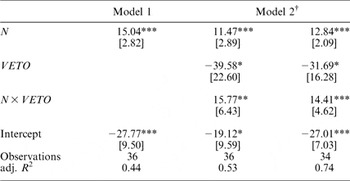
Table 1 presents the results of cross-section regressions, using average values for the period from 1945 to 1996.Footnote 45 Model 1 shows that 44 per cent of the frequency in oversized cabinets can be accounted for by the effective number of parties alone. Model 2 introduces the veto point dummy and an interaction term, which increases the explained variance to 53 per cent. Two cases have a large effect on the fit of the model. One is Austria, all of whose ‘oversized cabinets’ in the dataset are in fact minimal winning but have been reclassified by Lijphart on account of their high share of seats in the legislature.Footnote 46 The other country is Mauritius – an unusual case that is also a clear outlier in the correlation between N and Lijphart’s indicator of cabinet types (MW/OP).Footnote 47 The fairly high share of oversized cabinets in this country seems to result mainly from pre-electoral coalition-building in response to a highly disproportional electoral system.Footnote 48 If these two cases are dropped, explained variance jumps to 74 per cent, as shown in the final column.
Explaining the Frequency of Oversized Coalitions

Notes: Ordinary least squares estimation. Standard errors in parentheses. *p < 0.1, **p < 0.05, ***p < 0.01.
†The third column shows Model 2 excluding Austria and Mauritius.
Sources: See text.
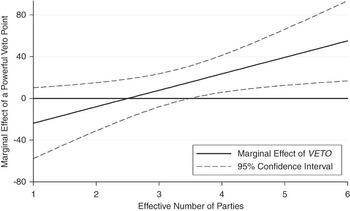
To explore the interaction effect in more detail, it is prudent to use the results for the entire sample. N has a statistically significant positive effect for both values of VETO. However, in the absence of a powerful veto point, one additional effective party increases the frequency of oversized cabinets by 11.5 percentage points, whereas a powerful veto point increases this effect to 27.3 percentage points (11.5 + 15.8). To interpret the effect of VETO, a marginal effects plot is useful (Figure 1). When N is around 2, the effect of a strong legislative veto point is indistinguishable from zero and statistically insignificant. As N increases, however, so does the positive effect of VETO, reaching statistical significance when N is around 3.5 or greater.
The marginal effect of VETO on the frequency of oversized coalitions

Qualitative evidence also corroborates the interaction effect. The two countries combining strong legislative veto points with a high effective number of parties are Finland (until 1992) and Switzerland. Country experts agree that powerful veto points were a crucial contributing cause of very frequent oversized cabinets in both countries.Footnote 49 Finland also contrasts nicely with other Nordic cases which share many of Finland’s political and institutional features but are set apart by the absence of a significant veto point and a high frequency of minority rather than oversized cabinets.Footnote 50 Australia represents the combination of few parties and a powerful veto point, the Senate, in which the government typically lacks a majority. Contrary to what additive specifications of the Lijphart–Sjölin conjecture would lead one to expect, parties in the House of Representatives do not form oversized cabinets in order to absorb the Senate as an institutional veto player. Instead, they build flexible legislative coalitions in the Senate, often relying on minor parties not represented in the House.Footnote 51
Inclusive equilibria?
The previous section treats legislative veto points as exogenous. The empirical results support the assumption that inclusive coalitions tend to be costly. Yet this costliness assumption has a further testable implication: if legislative veto points are constraints that require parties to build costly coalitions, we can expect that rational parties avoid veto points from the start or try to weaken them as their experience accumulates. In this section I argue that this expectation is borne out by Lijphart’s data once we recognize the form of government as a crucial contextual factor.
Theory
To develop the argument, the relationship between electoral and party systems provides a helpful analogy. Josep Colomer conceptualizes this relationship as a behavioural-institutional equilibrium. Parties do not only change their behaviour in response to constraining electoral institutions, they also try to change the very institutions that constrain them. Behavioural changes include the merging of parties or the formation of pre-electoral coalitions, whereas institutional changes mean electoral reform. The mutual adjustment of institutions and behaviour leads to two polar equilibria: in one, a two-party system and a pluralitarian or majoritarian electoral system are mutually stabilizing, and the other is characterized by a multi-party system and proportional representation. A crucial thesis of Colomer is that the first equilibrium is more fragile so that the long-run trend in democracies is towards the second.Footnote 52 In other words, the removal of institutional constraints may in the long run be more important than the costly behavioural adjustment to these constraints.
I suggest that we can apply the idea of a behavioural-institutional equilibrium not only to electoral and party systems but to democratic types in general. To develop such a perspective, the first and crucial step is to apply it to the mutual relationship between legislative institutions and coalition-building. Just as parties often have incentives to remove institutional constraints on their pre-electoral behaviour, they may also have incentives to remove institutional constraints on their post-electoral behaviour, i.e. to avoid, weaken or abolish veto points. The strength of these incentives depends on the extent to which legislative veto points do indeed imply the requirement of inclusive coalitions. I submit that a crucial contextual factor in this regard is the form of government.
Powerful legislative veto points are likely to be a more severe constraint on coalition-building in parliamentary systems, for two reasons. First, the most important decision rule in a parliamentary democracy is the one applied to the vote of non-confidence procedure. The easiest way to induce inclusive cabinets would, therefore, be to give a minority a veto over the cabinet. Yet since inclusive cabinets are costly, and since cabinet instability is a major problem in parliamentary democracies, the vote of no confidence procedure is everywhere based on majority rule. But this implies that a minority veto in ordinary legislation creates severe tension: it either turns into a de facto veto over the cabinet, leading to cabinet instability, or it creates a sort of democratic deficit, as a cabinet having a clear popular mandate and enjoying assembly confidence may see its legislative programme blocked by a legislative minority.
Secondly, the disunity of parties and coalitions tends to be greater in presidential systems, and this disunity can be a different mechanism to reduce the inclusiveness and hence the costliness of legislative coalition-building. It allows for inter-party and inter-branch coalitions of like-minded legislators, whilst excluding less like-minded legislators in all parties.Footnote 53 A certain degree of party disunity may be an important part of the behavioural-institutional equilibrium in presidential democracies with significant legislative veto points.
With respect to Lijphart’s sample, two main implications follow. One, parliamentary systems were less likely to have powerful legislative veto points, because constitutional designers had either avoided them from the start or weakened them prior to 1945, the starting year of Lijphart’s period of investigation. Two, if a parliamentary democracy did have a powerful institutional veto point, a strong reform stimulus was likely and more likely than in presidential systems. These two implications can be combined as follows:
PROPOSITION 2. Parliamentary systems are less likely to have legislative veto points that give veto power to minorities. If they do have them, the resulting reform stimulus will be greater than in presidential systems, everything else being equal.
Empirical Analysis
Proposition 2 is also corroborated by Lijphart’s data. Consider first the distribution of veto points. Of thirty-six cases only five were presidential,Footnote 54 but four of them (80 per cent) had at least one strong legislative veto point and three of them had more than one.Footnote 55 In contrast, of the thirty-one parliamentary systems only three (roughly 10 per cent) had a strong veto point throughout most of the period under consideration: Australia, Finland and Germany. Moreover, the Australian Senate does not usually work like a minority veto. Since both chambers are directly elected and electoral rules are more proportional for the Senate, majority cabinets in the House that lack a Senate majority can usually rely on minimal winning coalitions in the Senate to pass legislation.Footnote 56 These minimal winning coalitions ‘absorb’ the House as a veto player, so that the institutional requirements for legislative inclusiveness are typically not different from those in unicameral proportional representation systems with legislative majority rule.Footnote 57
Secondly, all cases for which Lijphart reports a reduction in the formal power of the second chamber during the period under consideration are parliamentary: New Zealand (1950), Denmark (1953), Sweden (1970) and Iceland (1991) abolished their second chambers, and Belgium reduced the veto power of its second chamber in 1993.Footnote 58 In contrast, the only case for which he reports an increase in the strength of the second chamber is presidential Colombia, which moved from medium strength to a strong second chamber in 1991. To be sure, all of the parliamentary cases of institutional reform had not been, according to Lijphart, in the ‘strong’ bicameralism category prior to the reforms.Footnote 59 The clear trend is nevertheless noteworthy, especially since Denmark, Sweden and Belgium had been among the rare parliamentary democracies in which the cabinet also depended on the confidence of the second chamber. The costliness of the second chamber’s veto power contributed to the institutional reforms in these countries.Footnote 60
The third observation concerns the only two parliamentary cases in which legislative veto points often functioned like a minority veto: Finland and Germany. Since Lijphart neglects the Finnish veto in his quantitative measurement of democracies, he also does not comment on the fact that Finland abolished it in 1992. This is unfortunate, because Finland is an excellent example for the idea of a behavioural-institutional equilibrium in post-electoral coalition-building. Although parties had responded to the veto by forming broader cabinets, they eventually decided, in broad agreement, to abolish the veto and thus be free to build less inclusive executive and legislative coalitions, if necessary. Their explicit goal was to end ‘extreme consensual parliamentarism’.Footnote 61 A few years after Lijphart’s study was published, in 2003, Germany also embarked on a constitutional reform whose most important aim was to reduce the share of legislation on which the second chamber has absolute veto power.Footnote 62 The outcome of the reform disappointed many observers, but the problem was not disagreement between the parliamentary parties: all of them preferred weaker veto rights for the second chamber. It was rather the technical difficulty of dividing powers between federal and state levels and the veto power of a subset of states. The parties in parliament did not choose to commit themselves to inclusive coalitions, but the complexity and constitutional rigidity of German federalism trap all of them in a situation they dislike.Footnote 63
In sum, these findings corroborate Proposition 2 and the idea that inclusive coalitions are costly. They also suggest that the parliamentarism–presidentialism contrast plays a greater and somewhat different role for democratic types than Lijphart acknowledges. He neglects the contrast in conceptualizing his two models of democracy, but ends his study with the suggestion that a parliamentary system is ‘of crucial importance’ to consensus democracy.Footnote 64 In contrast, the equilibrium perspective sketched here suggests that the form of government is an integral part of a particular equilibrium of inclusiveness and that a cabinet dependent on assembly confidence makes it more difficult to sustain an equilibrium with a significant legislative veto point. Finland’s constitutional reform exemplifies this difficulty. Conversely, the unique non-parliamentary form of government in Switzerland seems much more central to this country’s behavioural-institutional equilibrium than Lijphart admits. On the one hand, the collegial executive elected by the assembly creates greater incentives to respond to powerful legislative veto points by forming oversized cabinets than in pure presidential systems with one-person executives.Footnote 65 On the other hand, the executive’s fixed term eliminates the problem of cabinet instability and allows for some democratic opposition from within the broad portfolio coalition in the form of coalition and party disunity. Legislative coalitions can be formed on an issue-by-issue basis and legislative inclusiveness can be significantly lower than executive inclusiveness.
Much work remains to be done to work out a consistent equilibrium perspective on democratic inclusiveness. The findings presented here suggest that this would be a worthwhile project.