INTRODUCTION
All organisms have limited energy resources that must be divided between key biological functions such as reproduction and growth (Simkova et al. Reference Simkova, Jarkovsky, Koubkova, Barus and Prokes2005). Commonly, parasites negatively impact the fitness of their host (e.g. body condition, growth rate, reproductive status, reproductive output), increasing the evolutionary pressure on hosts to select for an effective immune system, which acts in defence of the invading organism (Simkova et al. Reference Simkova, Lafond, Ondrackova, Jurajda, Ottova and Morand2008). Energetically, this anti-parasite immune defence is costly (Connors and Nickol, Reference Connors and Nickol1991; Lochmiller et al. Reference Lochmiller, Vestey and Boren1993; Sheldon and Verhulst, Reference Sheldon and Verhulst1996) with expected knock-on effects on life-history traits such as growth and reproduction (Simkova et al. Reference Simkova, Lafond, Ondrackova, Jurajda, Ottova and Morand2008). Simultaneously, an increased investment in reproduction, for example, may decrease the immune defence efficiency and thus facilitate parasite infection (Sheldon and Verhulst, Reference Sheldon and Verhulst1996; Skarstein and Folstad, Reference Skarstein and Folstad1996; Skarstein et al. Reference Skarstein, Folstad and Liljedal2001; Simkova et al. Reference Simkova, Jarkovsky, Koubkova, Barus and Prokes2005, Reference Simkova, Lafond, Ondrackova, Jurajda, Ottova and Morand2008).
Seasonal changes in immunocompetence, i.e., the ability to produce an effective immune response, and parasitism have been observed across numerous taxa, including birds and fish (Hamilton and Zuk, Reference Hamilton and Zuk1982; Nelson and Demas, Reference Nelson and Demas1996; Sheldon and Verhulst, Reference Sheldon and Verhulst1996). Specifically, down regulation (decrease) of immunocompetence during the reproductive period has been well documented in fish such as roach Rutilus rutilus L., chub Leuciscus cephalus L. and Arctic charr, Salvelinus alpinus L. (Skarstein and Folstad, Reference Skarstein and Folstad1996; Skarstein et al. Reference Skarstein, Folstad and Liljedal2001; Kortet et al. Reference Kortet, Taskinen, Sinisalo and Jokinen2003; Vainikka et al. Reference Vainikka, Jokinen, Kortet and Taskinen2004; Lamkova et al. Reference Lamkova, Simkova, Palikova, Jurajda and Lojek2007; Simkova et al. Reference Simkova, Jarkovsky, Koubkova, Barus and Prokes2005, Reference Simkova, Lafond, Ondrackova, Jurajda, Ottova and Morand2008). Male and female fish usually invest differently in reproduction, with males placing a higher investment in mate attraction through the exaggeration of sexual ornamentation during spawning, while females invest more in gamete production (Simkova et al. Reference Simkova, Lafond, Ondrackova, Jurajda, Ottova and Morand2008).
Sexual ornamentation in males has been associated with increased steroid sexual hormones (such as testosterone) that can negatively influence the immune system (Slater and Schreck, Reference Slater and Schreck1993; Kurtz et al. Reference Kurtz, Kalbe, Langefors, Mayer, Milinski and Hasselquist2007). The impact of steroid sexual hormones on male immunity is known as the immunohandicap hypothesis (Hamilton and Zuk, Reference Hamilton and Zuk1982). Evidence for this includes the negative effect of high testosterone levels on spleen weight (Fange and Nilsson, Reference Fange and Nilsson1985), negative impact on innate immunity (Kurtz et al. Reference Kurtz, Kalbe, Langefors, Mayer, Milinski and Hasselquist2007) and significantly higher parasite infection in testosterone-treated fish (Buchmann, Reference Buchmann1997). Examples from the field include reproductive male S. alpinus being more heavily infected with macroparasites compared to ‘resting’ (non-reproductive mature S. alpinus), suggesting a reproductive cost to immunity (Skarstein et al. Reference Skarstein, Folstad and Liljedal2001).
The energetic cost of high investment in gametes (also known as the energetic hypothesis) is expected to create a trade off between reproduction and quality of the immune system in females (Simkova et al. Reference Simkova, Lafond, Ondrackova, Jurajda, Ottova and Morand2008). This has been confirmed for 17 species of cyprinid females including bream Abramis brama L., R. rutilus and topmouth gudgeon Pseudorasbora parva Temminck and Schlegel (see Simkova et al. Reference Simkova, Lafond, Ondrackova, Jurajda, Ottova and Morand2008). Therefore, as females invest more in reproduction by producing larger gametes, they are expected to be more susceptible to infection compared to males (i.e. sperm is energetically less costly) (Nordling et al. Reference Nordling, Andersson, Zohari and Gustafsson1998; Sanz et al. Reference Sanz, Arriero, Moreno and Merino2001). For example, female stone loach, Barbatula barbatula L., were more heavily parasitized with Gyrodactylus spp. and Raphidascaris acus during their reproductive season compared to male B. barbatula (Simkova et al. Reference Simkova, Jarkovsky, Koubkova, Barus and Prokes2005).
An additional high energetic cost to reproduction is also expected for the sex which provides parental care and nest defence (Simkova et al. Reference Simkova, Jarkovsky, Koubkova, Barus and Prokes2005). In the three-spined stickleback Gasterosteus aculeatus L., where males provide parental care and nest defence, males were more heavily parasitized with Glugea anomala cysts compared to females (Reimchen and Nosil, Reference Reimchen and Nosil2001; Arnold et al. Reference Arnold, Adam, Orr, Griffiths and Barber2003). Arnold et al. (Reference Arnold, Adam, Orr, Griffiths and Barber2003) suggested that the observed sex biased parasitism could be the result of intense nest defence and parental care. Sex-biased parasitism would thus be expected in the sex providing parental care and nest defence.
Sunbleak Leucaspius delineatus is a small nest guarding cyprinid native to continental Europe and the only representative of its genus. L. delineatus has experienced significant declines in its native range and is currently listed on the IUCN red list of threatened species (WCMC, 1996). In L. delineatus, the cost of parental care, high courtship and aggression during reproduction in males and the high reproductive investment in females (i.e. batch spawning) could lead to reduced immunocompetence in reproductive individuals. L. delineatus has been found to be highly susceptible to the rosette agent Sphaerothecum destruens during its reproductive period with complete inhibition of L. delineatus spawning (Gozlan et al. Reference Gozlan, St-Hilaire, Feist, Martin and Kent2005). However, infection of non-reproductive L. delineatus with S. destruens has not been investigated. S. destruens has been identified as a high-risk parasite for L. delineatus and a plausible cause for species decline throughout its native range (Gozlan et al. Reference Gozlan, St-Hilaire, Feist, Martin and Kent2005, Reference Gozlan, St-Hilaire, Feist, Longshaw and Peeler2006, 2009). It is thus important to better understand this host-parasite association and, in particular, the effect of reproduction, as it can have direct implications for the species’ conservation.
As an intracellular and unicellular parasite, the enumeration of individual S. destruens spores per host within fish tissues is particularly challenging. Currently, there is no established method to determine the parasite infection load. The only available method includes an estimation of infection severity in organ impression smears (Arkush et al. Reference Arkush, Mendoza, Adkison and Hedrick2003) and histological sections. Molecular tools such as real time quantitative PCR have been used to estimate infection load of microparasites in aquatic organisms (Jones et al. Reference Jones, Prosperi-Porta, Dawe and Barnes2003; Hallett and Bartholomew, Reference Hallett and Bartholomew2006; Funk et al. Reference Funk, Raap, Sojonky, Jones, Robinson, Falkenberg and Miller2007; Phelps and Goodwin, Reference Phelps and Goodwin2007). For example, Phelps and Goodwin (Reference Phelps and Goodwin2007) used quantitative PCR to detect and quantify the microsporidian Ovipeistophora ovariae in the golden shiner Notemigonus crysoleucas Mitchill and showed an increase in spore release by O. ovariae during N. crysoleucas’ spawning.
In this study, the effect of L. delineatus’ reproductive state on S. destruens prevalence and infection level was investigated. A real time quantitative PCR was designed and optimized in order to detect and quantify infection levels of S. destruens. From the work by Gozlan et al. (Reference Gozlan, St-Hilaire, Feist, Martin and Kent2005) and the energetic trade off between immunity and reproduction, it was predicted that the host's reproductive state should play an important role on the prevalence and infection level of S. destruens in L. delineatus. Higher prevalence and infection levels in reproductive L. delineatus were predicted. In addition, the difference in infection with S. destruens between the sexes was also investigated. No significant difference in S. destruens prevalence and infection levels between male and female L. delineatus was predicted, as both sexes experience high energy costs during their reproductive period (nest guarding and batch spawning respectively).
MATERIALS AND METHODS
Molecular analysis and light microscopy
DNA extraction
DNA was extracted using the Rodent tail protocol of the Qiagen DNeasy 96 Blood & Tissue kit. Extracted DNA from fish tissues was quantified in a spectrophotometer at 260 nm (NanoDrop ND-1000; Labtech). The extracted DNA was then diluted to 125 ng μl−1 and was stored at −70°C until further analysis by real time PCR.
Real time PCR primer selection
In order to detect and quantify the parasite's infection levels, a real time quantitative PCR was designed and optimized for S. destruens. Oligonucleotides for the qPCR were designed using small subunit ribosomal DNA (18S rRNA gene) sequences of the 3 S. destruens isolates (SK-AY267346; BML-AY267345; WA-AY267344), Dermocystidium salmonis (U21337), Ichthyophonus hoferi (U25637) and Diaphanoeca grandis (DQ059033). These sequences were obtained from GenBank and aligned with Clustal X (Thompson et al. Reference Thompson, Gibson, Plewniak, Jeanmougin and Higgins1997). The 18S rRNA gene sequence of Cyprinus carpio (AF133089) was used as an out-group and a cyprinid reference. Primers were visually selected to regions of 18–19 nucleotides showing 100% complementarily to the 3 S. destruens isolate sequences. Primer sequences had a minimum of 3 mismatches with sequences of related organisms. The melting temperatures, percentage guanine and cytosine content and potential to form secondary structures were evaluated for each primer. A single primer pair was then subjected to a basic local-alignment-search-tool (BLAST) search against all the nucleotide sequences stored in GenBank to confirm its specificity to S. destruens. The selected primer pair included the forward primer 5′-GGA TTT TGG GAT AAG CTT-3′ and reverse primer 5′-GT AAA AGT CCC AAA CTC-3′.
qPCR reaction conditions
The Platinum® SYBR® Green qPCR SuperMix-UDG kit (Invitrogen) was used for this assay. The reaction conditions included 20 μl reaction volumes containing 10 μl of Platinum® SYBR® Green qPCR SuperMix-UDG kit mix, 1 × bovine serum albumin, 0·4 μ m of each primer and 250 ng of template DNA.
Cycling conditions
All reactions were performed in a Rotor Gene™ 6000 (Corbett Research) and were analysed with Rotor Gene™ 6000 version 1.7.75 software. A standard curve was generated from a 1 in 10 serial dilution of purified S. destruens DNA (10 ng to 1 fg) obtained from cell culture. Cycling conditions consisted of an initial denaturation cycle at 95°C for 2 min followed by 45 cycles of 95°C for 30 sec and 35 sec at 53°C. A melting temperature curve was calculated at the end of the run at a temperature range of 55 to 99°C.
Limits of detection
In order to quantify the amount of genomic S. destruens in samples and determine the detection limit of the qPCR, a standard curve was generated using a 10-fold serial dilution of S. destruens genomic DNA extracted from cell culture. Serial dilutions were prepared in sterile water to produce template concentrations of 10 ng to 1 fg. To simulate the screening of S. destruens-infected samples, an additional standard curve was produced by spiking serial dilutions of genomic S. destruens DNA (10 ng to 1 fg) with 270 ng ml−1 carp Cyprinus carpio kidney genomic DNA. qPCR was also performed on 270 ng and 540 ng of C. carpio genomic DNA to detect possible non-specific amplification by the qPCR primers. The correlation coefficient was calculated for both standard curves (Rotor-Gene 6000 v 1.7). Negative controls used in this assay included genomic C. carpio DNA and sterile water. For the purpose of this study, the detection limit was defined as the lowest genomic S. destruens DNA concentration in the PCR reaction. The optimal fluorescent threshold was determined automatically by the Rotor Gene™ 6000 version 1.7.75 (Corbett research) with a set upper bound threshold of 0·38. This threshold varied for each reaction (minimum value: 0·0056 and maximum value: 0·379) but did not alter the PCR efficiency and detection limits.
qPCR specificity
The specificity of the two qPCR primer pairs was tested using a PCR amplified D. salmonis DNA section inserted in the pGEM® – T (Promega). The D. salmonis insert had a length of 830 bp and included the binding areas of the two primer sets designed for S. destruens. Cross-amplification of the S. destruens-specific real time primers was tested on 4 ng of D. salmonis DNA.
qPCR detection capacity
The detection capacity of the S. destruens-specific qPCR was tested further through the analysis of genomic DNA samples from 10 S. destruens-positive organs confirmed through histological examination (Gram's and Haematoxylin & Eosin stain).
Light microscopy
All fish classified as positive by real time PCR were also assessed by light microscopy in order to (a) visually confirm the presence of the parasite and (b) determine the level of agreement between real time PCR and histology. Histological analysis consisted of staining with Haematolylin & Eosin and Gram's stain.
Determinination of the effect of the reproductive state of Leucaspius delineatus on Sphaerothecum destruens
Co-habitation experiments were carried out in 2006 for a total of 60 days each during L. delineatus’s reproductive (May–July) and non-reproductive season (October–December). In total, 250 L. delineatus were collected by seine netting from Stoneham lakes (Eastleigh, England: 50°57′14″N; 1°22′56″W) on each of 2 occasions in May 2006 and October 2006. L. delineatus were transferred to the laboratory in 90 L bins of water with a supply of oxygen. The maximum transport time was 2 h. On arrival, L. delineatus were sorted by sex (through visual inspection: females are larger than males and have a prominent ovipositor) and were then placed in 70 L aquaria (length × width × height=90 × 30 × 30 cm). The sex ratio per aquarium was approximately 1:1 (this was confirmed through histological examination of the gonad at the end of the experiment). Maximum stocking density per aquarium was 35 fish. The weight (measured to the nearest 0·1 g) and fork length (measured to the nearest 0·1 cm) of 70 L. delineatus (35 females and 35 males) was recorded prior to the experiments’ onset.
In order to determine the prevalence of S. destruens in Stoneham Lakes, an additional 100 L. delineatus were randomly collected and euthanized straight after capture following Home Office (HO) guidelines using a lethal overdose of 2-phenoxyethanol anaesthetic and severance of the spinal cord using a sterile blade. These samples were stored at −70°C for further molecular analysis.
Leucaspius delineatus co-habitation set-up
A sample of 100 L. delineatus from Stoneham Lakes was co-habited in 2×3-tank re-circulating 70 L aquaria on 2 occasions; during the reproductive and non-reproductive season of L. delineatus (n=2 groups of fish per season). The water used in the re-circulating systems was dechlorinated tap water and fish were introduced into the system after being rinsed with clean water. The flow rate was approximately 2 L/min. Water was filtered through a biological filter with gravel substrate, and was then redistributed to the aquaria. In this experiment, fish in different tanks shared the same water supply but remained physically isolated from one another. Fish were fed twice a day with commercial flake food (Nutrafin MAX, Hagen) and kept under natural light conditions at room temperature. Temperature was recorded hourly using a temperature recorder (Tinytag Splash and Aquatic, OmniInstruments, Dundee, UK). Each re-circulating system had its own nets and cleaning devices. Water temperature in the aquaria was monitored throughout the duration of the experiments. Mean water temperature was 25 °C±1·5 during the reproductive season and 19 °C±1·3 during the non-reproductive period.
Sampling and sample processing
The fish were checked twice daily, at which time any mortalities present were collected and dissected. At 14-day intervals, 10 non-moribund L. delineatus were randomly sampled across the 3 tanks of each re-circulating system. In order to keep the number of fish sampled from each tank equal, tanks from which 4 fish were sampled were alternated with each sampling period. Fish were euthanized according to HO guidelines. The weight and fork length of each fish were recorded prior to dissection. Each fish was dissected using individual dissecting boards. Dissection tools were thoroughly wiped with 90% ethanol and flamed between dissections. Tissues collected included the gill, liver, kidney, gonad and posterior intestine of sampled and dead fish. Each organ sample was divided, preserving one half at −70°C for molecular analysis (DNA extraction and qPCR) and the other half in 10% neutral-buffered formalin for histological analysis.
The Fulton's condition factor (KF) was used to determine the somatic condition of L. delineatus and was calculated according to Ostlund-Nilsson et al. (Reference Ostlund-Nilsson, Curtis, Nilsson and Grutter2005): KF=(W/FL)*105. W was the weight in grams and FL the fork length of the fish in millimeters. Fish condition was considered separately for each sex as they were expected to naturally differ, especially during the reproductive season of L. delineatus when female fish were gravid with eggs.
Statistical analysis
All statistical analyses were performed using SPSS 14.0 (SPSS Inc., Chicago, Illinois, USA). Data are given as means±standard deviation (s.d.) unless otherwise stated. The Mann-Whitney U-test was used to test for differences in S. destruens’ prevalence, infection level and fish condition between L. delineatus in the reproductive season and L. delineatus in the non-reproductive season. Difference in prevalence and infection level between the sexes was also investigated.
Disease prevalence was calculated as: (number of S. destruens-positive fish / total number of fish tested)×100. Parasite infection levels were quantified using real time PCR as picograms (pg) of S. destruens DNA per 250 ng of L. delineatus DNA. The total infection level per fish was calculated as the sum of all infection levels across the 5 organs considered here.
RESULTS
Real time PCR optimization
Using a 10-fold serial dilution of genomic S. destruens DNA, the detection limit of the S. destruens-specific qPCR was determined to be 1 pg of purified S. destruens genomic DNA both in the presence and absence of C. carpio genomic DNA. The PCR amplicon was 83 bp long with a melting temperature of 86°C. Mean correlation coefficients were high both in the presence and absence of common carp DNA (0·99 and 0·97 respectively). The inclusion of C. carpio genomic DNA did not interfere with the amplification of S. destruens genomic DNA. There was no observable non-specific amplification when the qPCR was performed on 270 ng of C. carpio genomic DNA and D. salmonis DNA.
Six of the 10 S. destruens positive by histology samples were also confirmed as positive by qPCR and 4 of the 5, S. destruens negative by histology samples were detected positive by qPCR. Real time PCR was successfully performed on the DNA of 460 organs, with a mean R2 value of 0·99±0·01. All extraction-negative samples were detected as negative during PCR.
Light microscopy
Only 15% of reproductive L. delineatus (n=13) and 33% of non-reproductive L. delineatus (n=6) that had tested positive using qPCR were also found to be positive by light microscopy. Overall, qPCR detected 3 times more positive samples in non-reproductive L. delineatus and 6 times more in reproductive L. delineatus compared to histological methods.
Sphaerothecum destruens prevalence in the wild source population
In order to determine an increase in parasite prevalence as a result of the experimental treatment, S. destruens prevalence in L. delineatus (using the kidney as the organ of choice) was determined at the start of each experiment. S. destruens prevalence in L. delineatus was found to be 2% (95% Confidence Intervals (CI): −0·8 to 5) during the reproductive season and 1% (95% CI: 1 to 2) during the non-reproductive season by real time PCR. Prevalence in the two sampling periods did not significantly differ (Mann-Whitney U-test; n =200, P=0·56).
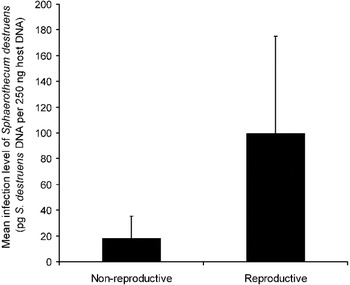
Under experimental conditions, reproductive L. delineatus had a significantly higher S. destruens prevalence (Mann-Whitney U-test; n=72, P<0·05) and infection levels (Mann-Whitney U-test; n=72, P<0·01) compared to non-reproductive L. delineatus. S. destruens prevalence was 19% (n=40) in non-reproductive L. delineatus and 41% (n=32) in reproductive L. delineatus. Mean S. destruens infection levels were 18 and 99 pg S. destruens DNA per 250 ng of L. delineatus DNA for non-reproductive and reproductive L. delineatus respectively (Fig. 1). There was no significant difference in S. destruens prevalence (Mann-Whitney U-test; n=13, P=0·13) and infection level (Mann-Whitney U-test; n=13, P=1) between infected reproductive female and male L. delineatus.
Mean infection level (pg Sphaerothecum destruens per 250 ng sunbleak Leucaspius delineatus DNA) for reproductive and non-reproductive parasitized L. delineatus. Infection levels were determined by real time PCR of the 18S rRNA gene of S. destruens for the kidney, liver, posterior intestine, gonad and gill of L. delineatus. Means±s.e. are given (n=6 and n=13 for non-reproductive and reproductive L. delineatus respectively).

Overall, female and male L. delineatus in the reproductive season had significantly lower condition factors when compared to their non-reproductive counterparts (Females: Mann-Whitney U-test; n= 38, P=0·01. Males: Mann-Whitney U-test; n=34, P<0·05). However, there was no significant difference in the condition factor of parasitized reproductive male and reproductive female L. delineatus (Mann-Whitney U-test; n=13, P=0·23). When the condition factor of parasitized reproductive female and male L. delineatus were compared to their respective non-infected reproductive counterparts there was no significant difference in condition (Reproductive females: Mann-Whitney U-test; n=14, P=1. Reproductive males: Mann-Whitney U-test; n=18, P=0·437).
S. destruens prevalence and infection levels differed between reproductive and non-reproductive L. delineatus (Tables 1 and 2). The parasite was present in all 5 organs in reproductive fish with varying prevalence whereas it was only present in 3 organs with equal prevalence in the non-reproductive fish (Table 2). The highest infection level was in the gill for non-reproductive L. delineatus and the kidney for reproductive fish.
Percentage of Sphaerothecum destruens infected organs in non-reproductive and reproductive sunbleak Leucaspius delineatus

Mean infection level (pg Sphaerothecum destruens DNA per 250 ng sunbleak Leucaspius delineatus DNA) in non-reproductive and reproductive L. delineatus’ organs

DISCUSSION
Determining the infection level of intracellular parasites is particularly difficult and infection estimates are limited to arbitrary infection categories following examination of histological sections or impression smears. This study describes the first real time quantitative PCR developed for the detection and quantification of S. destruens infections. The real time PCR developed here was capable of detecting 1 pg of purified genomic S. destruens DNA both in the presence and absence of C. carpio genomic DNA. This was equivalent to the detection limit of the nested PCR developed for S. destruens by Mendonca and Arkush (Reference Mendonca and Arkush2004). The lack of non-specific amplification when the qPCR was performed on 270 ng and 540 ng of common C. carpio genomic DNA and D. salmonis DNA supported the specificity of the reaction to S. destruens genomic DNA.
The qPCR developed here detected S. destruens in 6 of the 10 L. delineatus samples that were previously determined positive for S. destruens (by histology). The discrepancy between the histology and qPCR for 4 of the 10 S. destruens-positive samples can be explained by: (a) very little available fish tissue, as each organ was halved for histology and qPCR analysis, (b) unequal distribution of the parasite within the organ, and (c) the possible misidentification of other Dermocystidium spp. as S. destruens in histological sections (Mendonca and Arkush, Reference Mendonca and Arkush2004). Small tissue samples, in some cases below 5 mg, showed non-homogeneous distribution of the parasite in the organ as well as low extraction efficiencies. This could lead to very low parasite genomic DNA available for PCR. As a result, such samples may test negative by PCR (i.e. false negative).
Discrepancies between histology-positive samples and PCR analysis have also been reported in other studies involving aquatic organisms (Jones et al. Reference Jones, Prosperi-Porta, Dawe and Barnes2003; Kozubikova et al. Reference Kozubikova, Petrusek, Duris, Martin, Dieguez-Uribeondo and Oidtmann2008; True et al. Reference True, Purcell and Foott2009). Jones et al. (Reference Jones, Prosperi-Porta, Dawe and Barnes2003) and True et al. (Reference True, Purcell and Foott2009) failed to detect the parasite Parvicapsula minibicornis in Oncorhynchus tshawytscha with histological evidence of infection. This was attributed to either misidentification of the parasite in histological sections, mislabelling of samples or PCR false negatives due to the presence of PCR inhibitors. The difficulty of detecting low parasite numbers in histological sections (Mendonca and Arkush, Reference Mendonca and Arkush2004) is also evident in the detection of S. destruens in 4 of the 5 histologically negative samples. Discordance is typical for samples with low parasite quantities (True et al. Reference True, Purcell and Foott2009).
Only 15% of reproductive L. delineatus (n=13) and 33% of non-reproductive L. delineatus (n=6) that were detected as positive using qPCR were also found to be positive using light microscopy, reflecting the low agreement between these methods. In O. tshawytscha challenged with S. destruens by bath immersion, the percentage agreement between nested PCR (with 1 pg purified genomic S. destruens DNA detection limit) of the kidney and Gram-stained kidney smears was 33% (Mendonca and Arkush, Reference Mendonca and Arkush2004). More fish were positive by PCR perhaps because PCR has a lower detection limit than histology of kidney smears.
Reproductive L. delineatus experienced significantly higher prevalence and infection levels of S. destruens compared to non-reproductive L. delineatus. Although these results indicate that L. delineatus’ reproductive state influences S. destruens prevalence and infection levels, other potentially explanatory factors also need to be considered. Firstly, the mean water temperature between the two experiments significantly differed (by 6°C) and variation in temperature is known to affect fish metabolism (Wang et al. Reference Wang, Xu and Kestemont2009). Moreover, seasonality in temperature has also been associated with variation in immunocompetence (Bowden, Reference Bowden2008).
Parasites have a range of permissive temperatures at which they complete their life cycle with some temperatures being more permissive than others (Fels and Kaltz, Reference Fels and Kaltz2006; Kerans et al. Reference Kerans, Stevens and Lemmon2005; Wolinska and King, Reference Wolinska and King2009). For example, experimental infection with proliferative kidney disease Tetracapsuloides bryosalmonae in rainbow trout O. mykiss was more severe at 18°C compared to 12°C possibly due to greater proliferation of the parasite in the host at higher temperatures (Bettge et al. Reference Bettge, Wahli, Segner and Schmidt-Posthaus2009). Temperature dependence in S. destruens spore survival and production of zoospores has been observed (Andreou et al. Reference Andreou, Gozlan and Paley2009).
The influence of temperature on S. destruens prevalence and infection level cannot be excluded and it would be interesting for future work to control for its effect. However, it should be noted that the observed S. destruens prevalence in reproductive L. delineatus was quite similar to that reported by Gozlan et al. (Reference Gozlan, St-Hilaire, Feist, Martin and Kent2005), in reproductive L. delineatus co-habited in the presence of S. destruens at a mean temperature of 20°C. It is also important to note that higher temperatures are naturally experienced by wild populations of L. delineatus during their reproductive season between spring and summer (Pinder and Gozlan, Reference Pinder and Gozlan2004).
A natural infection method was used, with co-habitation of test fish with individuals originating from an infected natural population. Although the difference in time between the two treatments (4 months) could have resulted in differences in the initial dose of S. destruens it is unlikely that such differences could have confounded the results. Specifically, the prevalence of S. destruens in the population of origin was determined at the beginning of both treatments and was not found to significantly differ (2% and 1% for reproductive and non-reproductive L. delineatus, respectively). However, since higher doses of an infectious agent are more likely to cause infection and disease, future work should control for initial dose of S. destruens.
Some parasites have been reported to increase in prevalence during their host's reproductive season (Simkova et al. Reference Simkova, Jarkovsky, Koubkova, Barus and Prokes2005), whilst others have been shown to synchronize the shedding of infectious stages with reproduction (Browne et al. Reference Browne, Li and Vaughan2006). S. destruens spores have been reported from seminal fluids of reproductive O. tshawytscha and it has been hypothesized that release through seminal fluids is one possible route of the parasite's dissemination (Arkush et al. Reference Arkush, Frasca and Hedrick1998, Reference Arkush, Mendoza, Adkison and Hedrick2003). The hypothesis that S. destruens, a freshwater parasite, synchronizes its release with O. tshawytscha reproduction is likely as the host's return to freshwater is marked with spawning followed by mortality (Quinn, Reference Quinn2004). Accordingly, the possibility that the observed increase in prevalence and infection level of S. destruens during L. delineatus’s reproduction is the result of the parasite's interaction with hormonal changes during reproduction cannot be excluded.
The high reproductive investment experienced by both sexes in L. delineatus has led to the hypothesis that male and female L. delineatus would not differ in the level of parasitism by S. destruens. In line with this prediction, sex-biased parasitism has not been observed here as reproductive female and male L. delineatus did not differ in the prevalence and infection level of S. destruens. This suggests that the species high reproductive investment has resulted in an immunocompromised state.
The reproductive state of L. delineatus appeared to influence fish condition. In particular, reproductive L. delineatus had significantly lower condition factors compared to non-reproductive L. delineatus. In the reproductive state, parasitized male and female L. delineatus did not have significantly different condition factors suggesting that there was no apparent cost of parasitism, at least as measured by fish condition, between the sexes. Poor fish condition, specifically emaciation was reported for dead and moribund L. delineatus that were infected with S. destruens during L. delineatus’ reproductive season (Gozlan et al. Reference Gozlan, St-Hilaire, Feist, Martin and Kent2005). Emaciation was also observed in L. delineatus mortalities during the reproductive period experiment. However, when non-moribund parasitized fish were compared to their non-parasitized counterparts, there was no significant difference in their condition factors. Nevertheless, the possibility that advanced S. destruens infections could result in decreases in fish condition during spawning cannot be excluded. Emaciation was not observed in the non-reproductive period experiment.
DNA-based technologies for detecting parasites are becoming commonplace and the use of real time quantitative PCR can provide additional information such as infection levels. The development of a quantitative PCR for S. destruens provides an improved method for detecting the parasite and quantifying infection levels and can be used as a tool to address questions on the parasite's life-history traits. The present work indicates that S. destruens infection in L. delineatus can be influenced by the latter's reproductive state or temperature. Future work should include the monitoring of S. destruens infection level in pre-spawning, spawning and post-spawning wild L. delineatus while measuring reproductive hormone levels in each group.
ACKNOWLEDGEMENTS
We would like to thank Dr Stephen W. Feist for acting as a second reader for the histological slides; Dr Richard Paley for providing samples of D. salmonis; Matthew Green for preparing histological slides; and the management of Stoneham Lakes for allowing access to and fishing of the lakes. This work was funded by the Department for Environment, Food and Rural Affairs (DEFRA), contract FC1176.