Research on interpersonal discussion networks has moved steadily toward embracing the deliberative framework.Footnote 1 This framework assesses citizens’ potential to acquire high-quality information across lines of political disagreement – information that can enable political action and choice.Footnote 2 MutzFootnote 3 has offered a particularly potent formulation, arguing that we face a trade-off between an informed and tolerant public versus an active one; disagreement with others creates significant opportunities for increased learning and tolerance, but simultaneously suppresses political participation. Underlying a rapidly maturing literature on this potential ‘democratic dilemma’ are long-simmering questions about whether networks yield similar effects for all types of people.Footnote 4
In this context, we ask whether women and men face the democratic dilemma differently – that is, whether the trade-off between an informed and participatory citizenry is universal. While there is agreement that (on average) men and women experience different kinds and degrees of social influence, there are conflicting expectations about how such dynamics should manifest. We examine these expectations by revisiting prominent, network-based models of political participation to determine whether established findings hold across the sexes.Footnote 5 Our purpose is not to criticize these models and their relationship to each other, but to demonstrate that the received wisdom about their conclusions may differ as a function of gender.
Our results point toward the existence of varied ‘social logics’ for men and women that change how we think about the efficacy of discussion and disagreement in a democratic society. Across studies, we find that exposure to socially supplied expertise is a more consistent benefit to women than men. However, we uncover inconsistent gender-based differences in effects from interpersonal disagreement. Thus the findings present a different sort of ‘mixed bag’ for democratic functioning: we do not necessarily observe a fundamental trade-off between disagreement and participation,Footnote 6 but also cannot claim that social expertise is a universal ‘good’ when it comes to addressing participatory deficits.Footnote 7 This leads us to consider how social environments intersect with ascriptive characteristics to ameliorate or exacerbate political inequality.
Ultimately, our effort is important for two reasons. First, while previous empirical work shows substantial, gender-based political inequities in information stocksFootnote 8 and rates of participation,Footnote 9 our findings demonstrate that social ties are not automatic barriers to greater female involvement in politics. If women reacted negatively to social network stimuli and men did not, it would be yet another barrier to gender equity in the (American) political system. But this is not what we find. Instead, we find women drawing on political expertise at higher rates than men, which helps remediate the gender gap. Secondly, we demonstrate that network models need to consider the interaction between receiver traits and social environments. To date, the literature has focused attention on demonstrating differences in the construction of men’s and women’s networksFootnote 10 – that is, in the particular supply of discussion partners in networks. Though we are not the first to consider heterogeneous responses to social stimuli,Footnote 11 we bring gender squarely into focus by documenting the degree to which men and women respond differently to socially supplied information.
SOCIAL COMMUNICATION AND THE FOUNDATIONS OF THE DEMOCRATIC DILEMMA
Communication in personal discussion networks is hypothesized to hold important consequences for participation in politics. As noted, the important questions have been framed most prominently by Diana Mutz,Footnote 12 who calls attention to conversations that cross lines of political difference in the United States (she labels these ‘cross-cutting discussions’, though elsewhere they are called political disagreements).Footnote 13 Mutz concludes that there is a democratic dilemma in which exposure to disagreement assists opinion formation, moderation and tolerance, but does so at the expense of participation due to the creation of ambivalence and social pressures.
While there is some debate about whether,Footnote 14 and under what conditions, socially experienced disagreement tends to depress participation,Footnote 15 others have found that different elements of network interactions increase participation. The central argument along these lines has been a recognition that networks facilitate participation by giving people opportunities to learn about politics through political talk,Footnote 16 especially with people who know a lot about politics.Footnote 17
Underlying this research is a single-minded focus on how people’s behavior is a consequence of characteristics of personal discussion networks, such as how much political disagreement and expertise they involve. That is, most network approaches to understanding citizen politics depend on information flow, and in particular, focus on the availability of specific types of information.Footnote 18 This research devotes considerable attention to issues of network construction – studying discussant selection,Footnote 19 network size,Footnote 20 discussion frequency,Footnote 21 communication quality,Footnote 22 disagreementFootnote 23 and network structure.Footnote 24 Less attention has been given to the study of response – that is, the impact of such communication conditional on types of people with different characteristics.Footnote 25 Few scholars have focused on how people may respond differently to the information contained in their personal discussion networks. Some work has added levels of complexity, observing at least some of the interactions between network exposure and responsiveness to social information.Footnote 26 However, most efforts have mainly focused on interaction among aspects of the network, rather than on heterogeneous individual responses to networks grounded in personal characteristics.
THE GENDER BASIS OF SOCIAL INFLUENCE
To better understand the role that recipient characteristics play in conditioning network effects, we focus on the differences between men and women. We make this choice for two reasons. First and most simply, gender gaps in engagement are an important and interesting political phenomenon in politics. Secondly, gender is an especially promising avenue for studying the interaction between networks, recipient characteristics and political participation. This is supported by empirical research from across the social sciences, which finds that men and women have differently composed social worlds, and that they experience these worlds differently. These differences – demonstrated in terms of personality and patterns of social, economic and political engagement – should be closely connected with the forces of social influence experienced by men and women. In the following sub-sections, we discuss two ways in which heterogeneity in political participation by men and women may be the result of interpersonal discussion networks.
Exposure to Social Information
The first way that networks may variously affect the behavior of men and women is through the information contained in them. On this point, work from across the social and behavioral sciences complements extant political science efforts.Footnote 27 Men and women have equally sized ‘important matters’ support networks,Footnote 28 but women’s core networks tend to be populated with family at higher rates. From this perspective, differences in the composition of the network are driven by a combination of the structural locations of men and women,Footnote 29 and differences in the priority (or choice) of maintaining close relationships.Footnote 30 Evidence supporting this statement is extensive. Generally speaking, women’s social networks are more homophilous,Footnote 31 as are their associational connections.Footnote 32 These patterns appear to be related to findings that women tend to trust those with whom they have direct relationships, while men display more trust of those with whom they share group affiliations.Footnote 33
More directly connected to politics, Huckfeldt and SpragueFootnote 34 examine spousal pairs, presenting a blended structural-choice perspective on gendered network construction. Among spouses, men are less likely than women to name their spouse as a discussant, and tend to perceive their spouse as less politically competent – a finding that holds beyond spousal pairs.Footnote 35 This translates into reduced political discussion rates with women, since the political expertise of a discussant is a strong predictor of whether a discussion takes place.Footnote 36 Note, however, that while husbands may not name wives, wives still name husbands. One consequence of women having high numbers of men as political discussion partners is that women also tend to have greater access to (at least perceived) political experts than men.Footnote 37 Thus if women can borrow the network of a ‘strategic partner’, they can still gain access to participatory resources.Footnote 38 The larger point is that women may have access to political resources via their networks that they might not otherwise choose, and hence men’s and women’s political networks may not be as distinct as they might otherwise be, based on choice alone.
Responses to Social Networks
Just as men’s and women’s networks may have different compositions, men and women may respond differently to the information provided by these social contacts. A promising avenue of research highly relevant to this idea of a gender-based response comes from studies of personality. Numerous scholars have found gender differences in the ‘Big 5’ inventory of personality traits.Footnote 39 Men tend to score higher on assertiveness and openness to ideas, whereas women tend to score higher on agreeableness, extraversion, openness to feelings and anxiety.Footnote 40 Importantly, the traits on which women score higher, especially agreeableness and extraversion, are the same ones that would predict sensitivity to social pressure.Footnote 41 A wide variety of supportive evidence buoys this perspective in other literatures, including strands of feminist theory,Footnote 42 research on gender and public opinion,Footnote 43 and studies of risk takingFootnote 44 and negotiation.Footnote 45
Based on this literature, there are three reasonable – and at times conflicting – conclusions to draw from these assessments of personality difference. First, women may be more susceptible to social influence since men are more willing to take social risks, fight and brook disagreement. Consequently, we might expect to see larger network effects for women across the board. Secondly, given their personality differences with respect to agreeableness, women may be particularly sensitive to disagreement. Therefore we might expect women to experience a larger suppressing effect from network disagreement when it comes to political participation. However, contrary to the last hypothesis, it is possible that women’s conflict avoidance will translate into a reduced susceptibility to disagreement. That is, a drive to avoid conflict may entail ignoring dissonant signals. Thus we might expect women to experience a smaller suppressing effect of disagreement when it comes to participation. Thirdly, since men downplay expertise (especially women’s), and because women might be more susceptible to social influence more generally, we might expect that the positive effects of network expertise on participation should be greater for women.
ANALYSIS OVERVIEW
We examine whether the construction of (and responses to) social networks follow gendered patterns in the context of three previous, high-profile studies. After first examining the construction of men’s and women’s social networks, we replicate and extend Mutz’s analysis of the American component of the 1992 Cross-National Election Study (CNES).Footnote 46 This early study was important because it called attention to the impact of political disagreement on participation. We then replicate and extend McClurg’s investigation of participation using 1996 Indianapolis–St. Louis Study data, in which the concept of network expertise is introduced as a counterweight to political disagreement.Footnote 47 Finally, we look for additional confirmation of gender dynamics with the more contemporary data of the 2008–09 American National Election Studies (ANES) panel study, following Klofstad, Sokhey and McClurg’s discussion of different measures of disagreement.Footnote 48 In each case, we interact gender with the key social network variables so we can assess whether the effects for men and women are different from 0, and whether they are different from one another.Footnote 49
Our primary focus in replicating and extending these studies is to advance a conversation about gender and social influence. In that sense, looking for the presence and significance of gendered patterns across three very different, prominent studies is a strength of our approach. Since the datasets span different elections, use different name generators, contain different measures of disagreement and expertise, and represent different populations (the Indianapolis-St. Louis (ISL) study is from two communities), they allow us to reconsider claims of sample-level effects. Thus our focus is on the contribution of gender and its interaction with networks, not whether the measures of network traits yield the same effects across the models. Indeed, the considerable data and design differences require us to exercise caution in making any conclusive statements about network effects in mass publics more generally.
RESULTS: NETWORK CONSTRUCTION
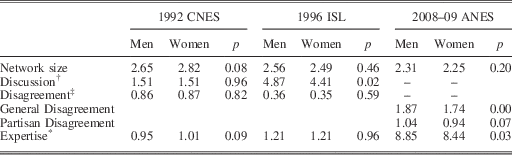
We begin with a brief comparison of the construction of men’s and women’s networks using these three datasets. Table 1 shows the differences in the number of discussion partners (network size), levels of discussion, levels of disagreement and access to political expertise across the three datasets used.Footnote 50 The results do not consistently support the notion that men’s and women’s networks are differently composed. Women’s political networks are not significantly smaller – they are statistically indistinguishable from men’s in two datasets and marginally larger in the 1992 CNES. There is suggestive evidence that women’s networks host less political discussion, but this is only statistically significant in the 1996 ISL (and was not asked in the 2008–09 ANES). Perhaps most interestingly, we see that women seem to generally face as much disagreement as men do, though in the 2008–09 ANES, men’s networks contain just a bit more disagreement, regardless of the measurement strategy (we discuss these measures below). We see these patterns despite consistent findings that women have higher levels of conflict avoidance and agreeableness.Footnote 51 The results are equivocal about women’s access to socially supplied expertise: it is higher in 1992, indistinguishable in 1996 and lower in 2008 (though this too is a bit different – a measure of the formal education of discussants and not their perceived political expertise – please see the Appendix). Further, Djupe and Sokhey report that women’s access to expertise is higher in the 2000 ANES sample.Footnote 52 Together, these inconsistent findings do not support a conclusion that women and men purposefully construct their social worlds differently – women’s networks do not appear to be smaller and more homogenous in these studies. Instead, this pattern is consistent with work on the ‘gender system’, which notes that interaction across genders is extensive, even as it justifies inequality to some participants.Footnote 53 Of course, these results do not eliminate the possibility that men and women respond to their networks differently, which is what the following replications and extensions are designed to assess.
Men’s and Women’s Political Networks in Three Samples

Sources: 1992 CNES, 1996 ISL, 2008–09 ANES.
Note: p-values are for t-tests.
† The 2008–09 ANES did not ask about the frequency of network discussion. Estimates presented are from unweighted t-tests. Weighted bivariate regressions produce similar patterns, both in terms of substance and statistical significance.
‡ For 1992, higher denotes more disagreement, following Mutz (Reference Mutz2002); for 1996, this is the portion of agreeing dyads, following McClurg (2006). The 2008–09 ANES measures are presented in a lower row and higher indicates more disagreement.
* For the CNES, this is the number of experts in the network; for 2008–09, this is the average level of formal education (0–14) in the network.
STUDY 1: CROSS-CUTTING TALK AND POLITICAL PARTICIPATION
In Mutz’s original investigation of the participatory consequences of networks, she argues that disagreement depresses political involvement by creating ambivalence about political choices and stimulating feelings of conflict avoidance and social accountability.Footnote 54 She tests this theory with several datasets, including a study funded by the Spencer Foundation and the American component of the 1992 CNES. We focus on the second dataset, which is publically available.
To test her hypothesis, she created a measure of cross-cutting talk based on each survey respondent’s perceptions of how people in their network voted.Footnote 55 For each discussion partner identified by the respondent, the relationship was coded 0 if the respondent believed they preferred the same presidential candidate, 1 if either the respondent or her discussant did not vote or was indifferent, and 2 if they had different preferences altogether. This measure was summed across all discussants named by the respondent to create a measure of the volume of cross-cutting discussion and served as the principal independent variable in her analysis.Footnote 56 The principal dependent variable is based on standard ANES questions that ask (separately) whether a respondent worked on a campaign, displayed a sign or bumper sticker, donated money, tried to persuade another person how to vote or attended any meetings/rallies. Summary statistics on all variables are reported in the Appendix.
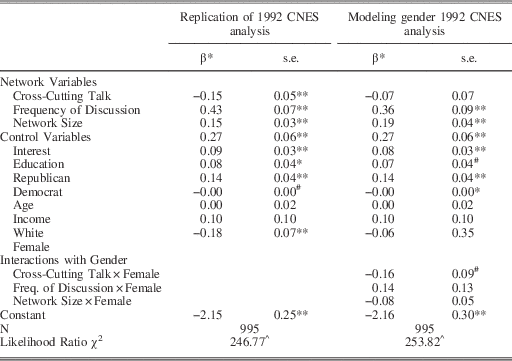
Our replication of Mutz’s analysis, estimated with a Poisson count model, is recorded in the first column of Table 2.Footnote 57 The results support precisely the same conclusions as her original article – as she hypothesized, respondents who report higher levels of exposure to ‘cross-cutting’ talk are less likely to participate, while those embedded in larger and more politically oriented networks (gauged with more frequent discussion) have a higher probability of involvement. Consistent with years of research, education, interest and partisan preferences affect participation (in sensible ways). Also consistent with what we know about participation,Footnote 58 we observe that females are less likely to participate than men.
Effect of Network Disagreement on Participation in Electoral Activities, Replication of Mutz (1992)

Source: 1992 CNES. Unweighted estimates.
*p≤0.05, **p≤0.01, #p≤0.10, all two tailed tests (Poisson). ^p<0.01, one-tailed Chi-Square test.
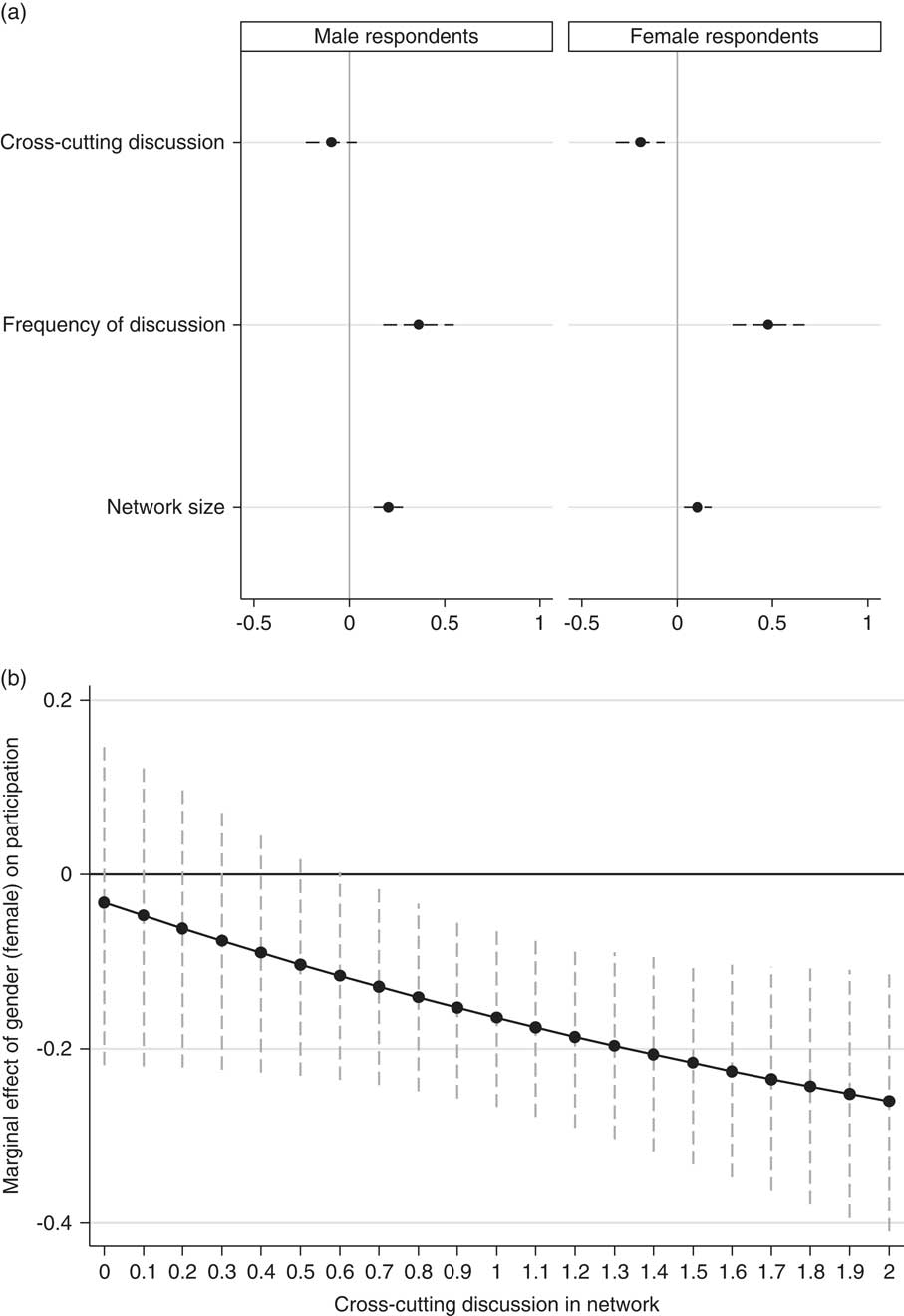
Of greater interest to us are the results in the second column, which presents the estimates from Mutz’s original model, but includes interactions between gender and the three network variables. To properly test and interpret the dimensions of the network interactions with gender, we present Figure 1. Though not all the interaction terms themselves are significant in the Table 2 models, this does not preclude significance at some portion of their ranges, or more general support for interactive effects in the case of a limited dependent variable.Footnote 59 Indeed, further exploration of interaction terms beyond the product term is always necessary.Footnote 60 Thus, Figure 1 shows the marginal effects of each network variable for men and women (Panel A), and the marginal effect of gender across the range of cross-cutting talk (that is, network disagreement) in Panel B.Footnote 61 In other words, Panel A shows whether the network effects are distinguishable from 0 for men and women, and Panel B shows whether the network effects of cross-cutting discussion for men and women are distinguishable from one another.
Examining gender×network interactions, 1992 CNES

For men, the effect of cross-cutting talk is almost 0 and fails to achieve statistical significance (Panel A). For women, the effect is larger, statistically significant and in the expected negative direction. That is, in this sample we see evidence that cross-cutting talk has little effect on the participatory behavior of men, but depresses it for women. There is also a difference in the effect of the frequency of political talk. Although the effect is positive for both men and women, it is larger for women.Footnote 62
Panel B allows us to assess whether the effects of cross-cutting talk are distinguishable between men and women and across what range of the measure. In short, the effects of cross-cutting talk are distinguishable for women and men in all but the most agreeable networks (leftmost part of the figure) – the distinguishable range accounts for 51 per cent of the data. The most disagreeable networks, of which there are relatively few (hence the large confidence intervals), reduce women’s political activity by 0.26 acts compared to men.Footnote 63
The results provide initial evidence that social communication affects men and women differently. Of course, this also raises interesting questions about the source of the gender gap in political participation. Burns, Schlozman and Verba argue that much of the inequality stems from differential individual resources in the form of civic skills.Footnote 64 And while they also emphasize the importance of ‘institutional treatment’ – such as the structure of family life – in producing differences in resource stocks, their handling does not consider the receipt and use of information from a social network. Our findings suggest that the gender gap in participation is related to an interaction between gender and the social information environment beyond civic skill development. This supports previous work indicating that network effects on the development of skills and the receipt of recruitment efforts are differentiated by gender and can constrain women’s resource acquisition.Footnote 65
STUDY 2: SOCIALLY SUPPLIED POLITICAL EXPERTISE AND POLITICAL PARTICIPATION
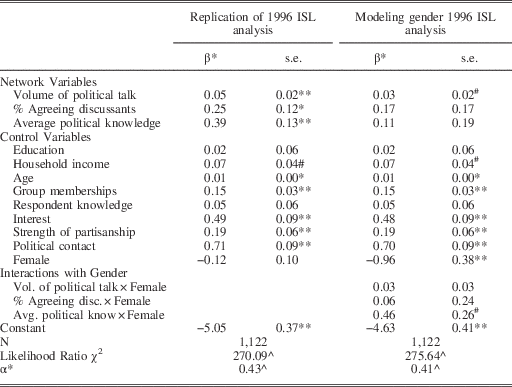
In response to Mutz’s argument that there is a potential trade-off between a tolerant versus a participatory citizenry, McClurg offers an additional hypothesis about social networks.Footnote 66 He suggests that people who have more political expertise in their social network are more likely to participate, and that this positive effect should be larger than, and hence more than make up for, the negative consequences of political disagreement. To test his argument, he draws on data from the 1996 ISL study. The principal independent variable for his analysis is based on respondents’ perceptions of how much each of their discussants knows about politics, the answers to which are averaged across all discussants named by the respondent.Footnote 67 He also controls for political agreement by measuring the percentage of dyads that shares the respondent’s vote preference (in his original analysis, lower scores indicate more disagreement) and levels of political talk by summing the frequency of political discussion across discussants (this is highly correlated with network size).Footnote 68 The principal dependent variable in his analysis is similar to Mutz’s, except that he does not include whether respondents reported attempting to persuade someone how to vote as part of his participatory index. The results of our replication and extension – a negative binomial model (following McClurg’s modeling strategy in the original article) – appear in Table 3.
Effect of Network Disagreement and Sophistication on Participation in Electoral Activities, Replication of McClurg (1996)

Source: 1996 Indianapolis-St. Louis Study. Unweighted estimates.
*p≤0.05, **p≤0.01, #p≤0.10, all two tailed tests. ^p<0.001, one-tailed Chi-Square test.
Again our replication (first column) reaches the same conclusions as the original analysis. Respondents exposed to greater political knowledge (sophistication) in the network are more likely to participate, as are those who experience greater levels of political talk and lower levels of disagreement. The strength of a respondent’s partisan predilections, the number of groups to which she belongs,Footnote 69 her interest in politics, her level of contact from campaignsFootnote 70 and her household income are also important. Gender is not significant in this specification.
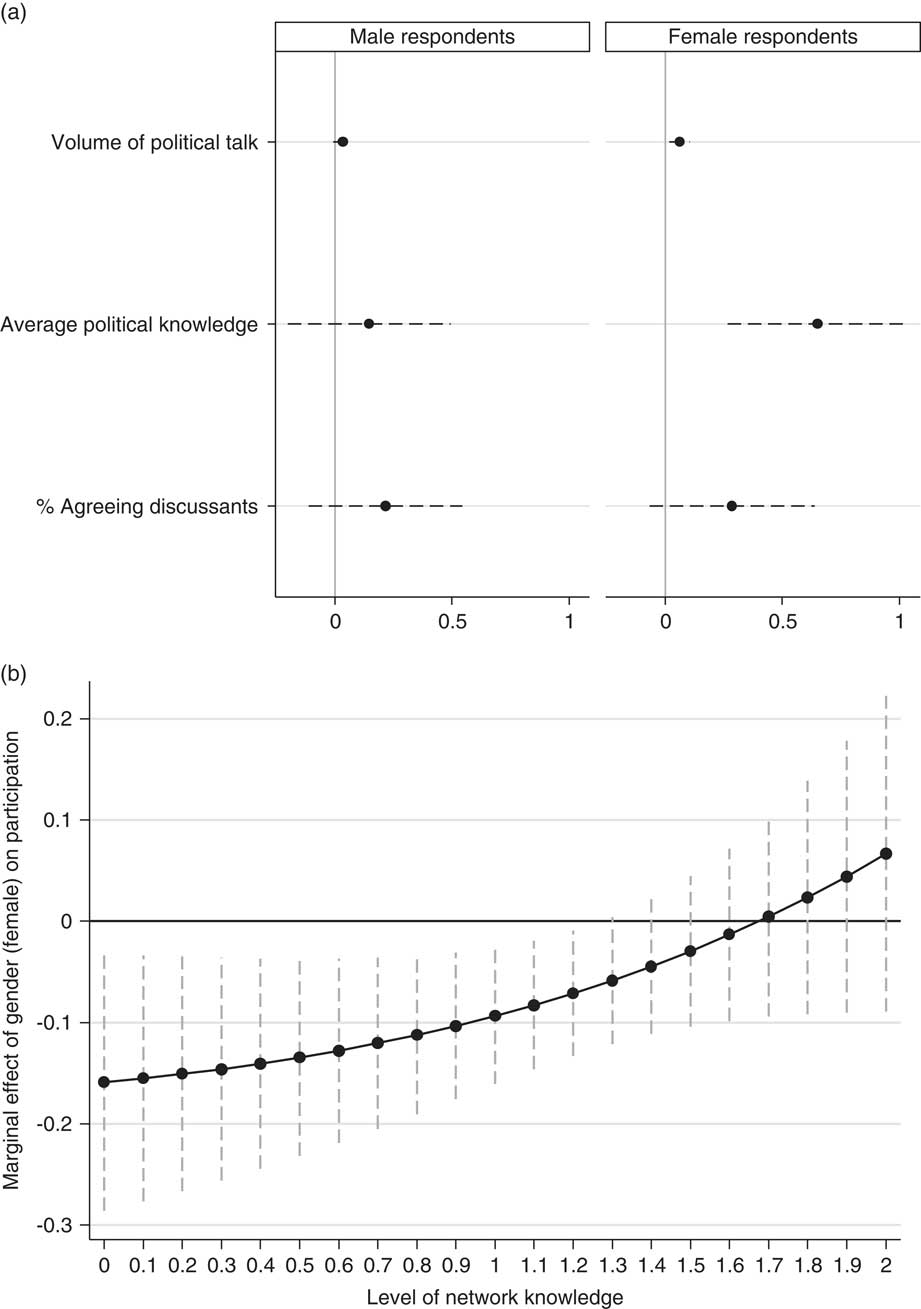
Of course, we are more interested in what happens when we allow for the possibility that these network effects vary on the basis of the respondent’s gender – these results appear in the second column of Table 3. Following the same practice of focusing on the marginal effects (and not just the significance of the product terms), we present Figure 2, which shows network effects for men and women compared to 0 (Panel A) and compared to each other for the key variable of network expertise (Panel B). From Panel A we can see that agreementFootnote 71 is not distinguishable from 0 for either men or women; moreover, expertise and the volume of political talk have insignificant effects for men. Among women, the effect of expertise is positive and statistically distinct from 0, while political talk has a small effect that is distinguishable from 0.
Examining gender by network interactions, 1996 ISL

The notable conclusion from this model is that women appear to benefit from greater exposure to political information (talk) and from higher-quality socially supplied information (expertise). Importantly, the effect of expertise is clearly statistically distinguishable between men and women: women benefit from socially supplied expertise, while men do not. Panel B of Figure 2 confirms that these effects are different for men and women. Women engage in fewer political acts when they have low expertise levels in their networks (covering 61 per cent of the data), and this effect is indistinguishable only at the upper range of the measure. Put another way, socially supplied expertise acts as a significant subsidy for women, serving to equalize participation rates between the sexes. Again, we see that a central finding from an important piece of social network research breaks down by gender. And although we do not find a similar effect of gender and disagreement as we did above, we note that this is consistent with McClurg’s original idea: that expertise is more important than disagreement when it comes to the social foundations of participation.
STUDY 3: THE 2008–09 ANES PANEL STUDY
Because the two datasets employed thus far are somewhat dated, we examine men’s and women’s responses to their networks with a more contemporary study. A social network battery was added to the September 2008 wave of the 2008–09 ANES Panel Study, which included questions that vary from those traditionally asked in studies such as the 2000 ANES, 1996 ISL, 1992 CNES and 1984 South Bend Study. Though these differences make comparability with prior datasets more difficult, these data remain quite useful for our principal concern: checking the robustness of gendered patterns of social influence.
The 2008–09 study also has its own set of advantages.Footnote 72 Chief among these is that the network battery contains two measures of disagreement: one generated by asking respondents about the partisanship of their named discussants, and the other by asking them about the overall difference between their named discussants’ opinions and their own. Klofstad, Sokhey and McClurg refer to these measures as ‘partisan’ and ‘general’ disagreement, respectively, and find that the measures yield distinct patterns of effects (in terms of direction, size and statistical significance) on engagement, preferences and political participation.Footnote 73
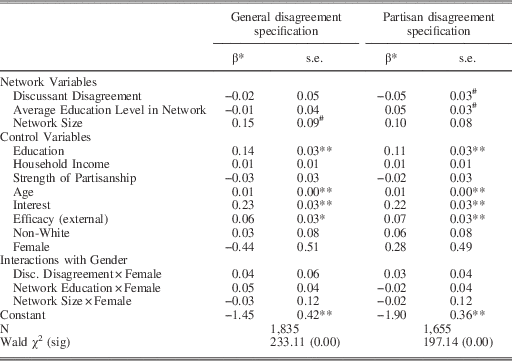
We follow Klofstad, Sokhey and McClurg in how we construct the network measures and in our presentation of separate models for each type of network disagreement. Aside from this, we diverge from their effort as we attempt to specify models that are as consistent as possible with those employed by Mutz and McClurg. There are unavoidable differences: weights are available for this study (though not for the two previous ones). Some measures used in the 1992 CNES and 1996 ISL are not available in the 2008–09 ANES study (namely, frequency of political discussion in networks and a conventional measure of network expertise), and a few measures included in the 2008–09 study are not available in either the 1992 CNES or the 1996 ISL (for example, political efficacy). The participation index is similar to those presented in the previous section,Footnote 74 and Poisson regression results appear in Table 4.Footnote 75 We present separate models for ‘general’ (first column) versus ‘partisan’ disagreement (second column), including interactions between gender and the network variables in both models. As with the other sets of analyses, summary statistics for all variables, additional specifications and additional graphs of substantive effects appear in the Appendix.
The Effect of Two Types of Network Disagreement and Network Sophistication on Political Participation – 2008–09 ANES

Source: 2008–09 ANES Panel Study. Weighted estimates (cumulative late panel), per ANES documentation.
Note: respondents reporting no discussants (networks of size 0) are excluded. Both negative binomial and Poisson models were estimated; diagnostics indicate that the Poisson models are more appropriate. #p≤0.10, *p≤0.05, **p≤0.01, all two-tailed tests.
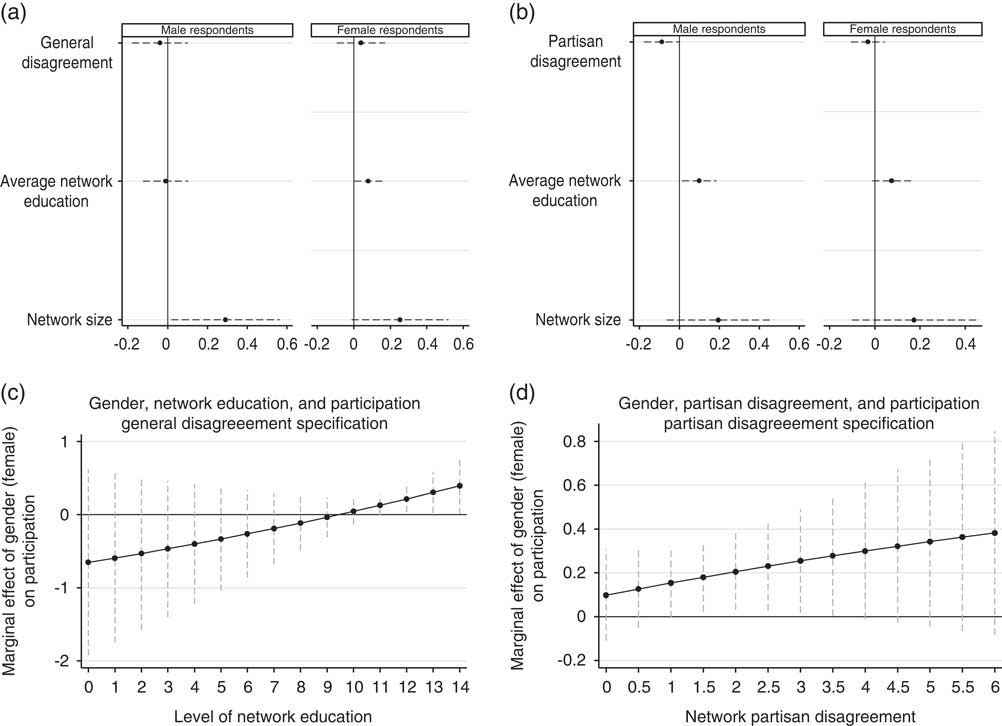
The results reflect a blend of the previous sets of estimates. Network size exerts a similar pull on political activity in the models;Footnote 76 disagreement (regardless of type) predicts less participation, while network education (the proxy for expertise in these models) is positively signed for the partisan disagreement specification. To fully test and interpret the gender interactions, we follow the previous routine and present Figure 3 – this shows whether the effects for men and women are distinguishable from 0 (Panels A and B), as well as whether they are distinguishable from each other (Panels C and D).
Examining gender×network interactions, 2008–09 ANES Note: estimates from Table 4 with 90 per cent CIs.

The effects of network size are similar between men and women across the two models; consistent with the results from previous years, a larger network boosts political activity. However, also consistent with the 1996 results, we see that for the general disagreement specification (Panel A), the marginal effect of network education on participation is only distinguishable from 0 for female respondents. Panel C assesses whether these effects of network education (first column of Table 3) are statistically distinguishable between men and women. The plot reveals that they are at the high end of network education (notably, a portion of the range where roughly 75 per cent of cases fall), suggesting that women receive a distinct boost in their political activity from more educated discussants.
‘General disagreement’ does not emerge as statistically significant for either men or women (Panel A), but the negative effects of ‘partisan disagreement’ (Panel B) are distinguishable from 0 among men, but not women. This suppressing effect of partisan disagreement for men is consistent with the ISL findings (Table 3), and both of these results stand in contrast to the patterns revealed in the 1992 CNES (Table 2). Panel D tests whether this effect is distinguishable by gender. Again we find men and women distinguishable across a portion of the range of interaction (specifically, most of the lower half of the disagreement measure, where about 50 per cent of cases fall) – this suggests the potential for men’s political participation to be suppressed in the face of even relatively low levels of disagreement.
DISCUSSION AND CONCLUSION
Multiple generations of research have found persuasive evidence that citizens’ political choices cannot be understood without considering social sources of information. Many scholars press the argument that individuals are socially embedded, that they exercise imperfect control over their information sources and that this makes them pervious to the political cues constantly available to them. To be sure, people are not defenseless against the onslaught of socially supplied communication, and a number of studies have documented how personal commitments, network composition and social contexts serve to moderate the influence of discussion partners.
However, research in this area has largely avoided considering how the sociology and psychology of gender may constrain social influence. Despite powerful evidence from across the social sciences suggesting that gender will affect how social influence works, quite a bit of the extant research on political networks has not taken gender seriously, and some studies have not even controlled for it.Footnote 77 And, what research exists in political science has been focused more on network construction – on the different social experiences men and women are exposed to – than on men’s and women’s differential responses to such socially supplied information. Drawing on a considerable body of research from sociology, psychology, economics, women’s studies and our own discipline, we argue that this is a serious oversight with serious potential implications for democratic practice.
Scholars studying social influence continue to be concerned with two essential characteristics of networks: their levels of disagreement and levels of political expertise. We have revisited prominent studies linking these concepts to rates of political participation, and these second looks reveal evidence that men and women respond to their social networks in different ways. Distinctions emerge in different samples, with different measures, and appear not to be limited by time or politics – they are present across a decade and a half, and across three distinct electoral contexts (the 1992, 1996 and 2008 presidential elections).
These results do not support any sort of blanket hypothesis generated from personality differences – namely, that women are more susceptible to social influence than men and will display consistently larger network effects. We also do not find consistent evidence that women are more strongly affected by disagreement; instead we find that in some instances men are more demobilized by disagreement. These inconsistencies may be the result of varying ways of capturing disagreement, not to mention the effects of time and model specification. Indeed, this set of findings keeps a directional conclusion about gender and interpersonal political disagreement out of reach. We are not yet able to comment on whether conflict avoidance weakens the role of network effects on women, or whether other mechanisms may be at play.
Instead, we find that across very different operationalizations, network expertise operates in a generally consistent manner, boosting the political activism of women to a greater degree than it does for men. Therefore, the one reasonable – if still tentative – conclusion to draw is that while the ‘gender system’ may perpetuate the perceived inequalities between men and women,Footnote 78 women are able to draw on this imbalance to greater participatory effect.
In our view, these results point to an overdue reconciliation of social network and social psychological approaches.Footnote 79 While pioneering work in the social sciences recognized the importance of both social pressures and individuals’ psychological orientations to those pressures,Footnote 80 work in political science distanced itself from the consideration of social communication by the time of The American Voter.Footnote 81 Recent studies of social network effects have paid more explicit attention to the response-side of social influence,Footnote 82 but considerable work remains. It is undeniable that gender underlies commonly observed social network effects, but the constellation of mechanisms needs further attention. Personality batteries hold some promise,Footnote 83 though the related expectations considered here found little support. Instead, perhaps concepts more closely tied to politics – such as conflict avoidance – could be given more attention.Footnote 84
In closing, we return to what Mutz labeled the democratic dilemma – the notion that exposure to diverse political views induces higher levels of political tolerance and more moderate opinions, but at the same time inhibits participation in the political process. Although subsequent work has qualified this claim,Footnote 85 our investigation suggests that an important part of the story has been missed. Looking at gender and civic skill acquisition in the institutions of adult life, Djupe, Sokhey and Gilbert note that ‘[i]f exposure to political difference produces a gendered response, the resulting representational problem is specific, group-centered, and even more troubling than the one previously advanced, which is diffuse and pluralist’.Footnote 86
We do find a gendered response to political discussion that undercuts a confident claim in the dangers of disagreement. Exposure to knowledgeable discussants is a consistent facilitator of women’s participation, but not men’s. In some studies, disagreement suppresses women’s participation, while its results either disappear or work to disadvantage men in others. Taking gender seriously means that we do not necessarily observe a fundamental trade-off between disagreement and participation,Footnote 87 but it also means that we cannot claim that social expertise is a universal ‘good’ when it comes to addressing participatory deficits.Footnote 88
Research from across the social and behavioral sciences points to the need to examine gendered patterns of social influence, but does not provide clear theoretical expectations. We answer this call, but leave with additional questions. What emerges is a need to consider why we sometimes observe differences, and to examine the conditions that serve to create differences in the responses to social information. Fully understanding why women seem to benefit from socially supplied expertise, but understanding why the effects of disagreement sometimes break out by gender, necessitates resolving the tensions between: (1) the traits of men and women themselves (shaped by socialization, personality and genes); (2) the implications of different conceptualizations and measurements of core network concepts;Footnote 89 (3) the constraints imposed by semi-voluntary structural locations and different institutional treatments,Footnote 90 some of which serve to maintain the ‘gender system’Footnote 91 and (4) the demands and opportunities of different electoral conditions/environments. Resolving this tension is beyond the scope of this article, but we urge researchers to design studies with this in mind, to further explore the mechanisms involved, and above all, to take gendered social dynamics seriously.