1. INTRODUCTION
In recent years, extensive research has been done toward the excitation of surface plasma wave (SPW) both experimentally and theoretically. The properties of SPW strongly depend on the properties of the interface along which it propagates. It can be excited by an electron beam (Liu & Tripathi, Reference Liu and Tripathi2000; Prakash & Sharma, Reference Prakash and Sharma2009; Girka et al., Reference Girka, Girka and Pavlenko2011a; Reference Girka, Girka and Pavlenko2011b), by an ion beam (Girka et al., Reference Girka, Girka and Pavlenko2011a; 2011b), by attenuated total reflection (ATR) configuration (Kretschmann & Raether, Reference Kretschmann and Raether1968; Kretschmann, Reference Kretschmann1971; Fink & Schneider, Reference Fink and Schneider1975), by ripples of suitable wave number over the metallic interface (Liu & Tripathi, Reference Liu and Tripathi2000), by light via prism coupling (Chen et al., Reference Chen, Lien, Liu, Huang, Liu, Chou, Chang and Ho2011), or by laser (Anisimov et al., Reference Anisimov, Baranov, Derkach, Dykhne, Malyuta, Pismennyi, Rysev and Sebrant1988; Parashar et al., Reference Parashar, Pandey and Tripathi1998; Bouhelier et al., Reference Bouhelier, Ignatovich, Bruyant, Huang, Francs, Weeber, Dereux, Wiederrecht and Novotny2007). The interaction of laser beam with plasma eigenmodes is also an important area of research (Ghorbanalilu, Reference Ghorbanalilu2012; Verma & Sharma, Reference Verma and Sharma2011; Sharma et al., Reference Sharma, Monika, Sharma, Chauhan and Ji2010; Saini & Gill, Reference Saini and Gill2006; Anderson et al., Reference Anderson, Garate, Rostoker, Song, Van Drie and Bystritskii2005; Paknezhad & Dorranian, Reference Paknezhad and Dorranian2011) in recent years.
The presence of dust grains in the medium can further modify the properties of these waves. In laboratory dusty plasma discharges, new effects are introduced by the dust charge fluctuation dynamics, dust-dust interactions, dust grain rotation, and the plasma boundary, which are unique for dusty plasma (Shukla & Mamun, Reference Shukla and Mamun2002; Shukla & Eliasson, Reference Shukla and Eliasson2009). Theoretically, dust effects have been investigated by extending the usual two-fluid treatment of plasmas with the addition of a third component — the dust (Sharma & Sugawa, Reference Sharma and Sugawa1999; Sharma & Srivastava, Reference Sharma and Srivastava2001; Lee & Jung, Reference Lee and Jung2005; Sharma & Walia, Reference Sharma and Walia2008; Prakash & Sharma, Reference Prakash and Sharma2009; Gupta et al., Reference Gupta, Sharma and Prakash2010). Ostrikov et al. (Reference Ostrikov, Yu and Sugai1999) have studied the effect of dust on surface wave produced microwave discharges and found that the dust can lead to a modification of the electromagnetic field structure in the discharge by shifting the originally excited operating mode out of resonance. Cramer et al. (Reference Cramer, Yeung and Vladimirov1998) have considered propagation of surface waves in a magnetized plasma with mobile dust grains and showed that for a range of frequencies above the dust cyclotron frequency, the surface plasma waves can propagate undamped by resonance absorption.
In order to use the beam as an antenna radiating on plasma modes, the density of the beam was modulated to study electrostatic and electromagnetic wave emissions by the electron beam. Lavergnat et al. (Reference Lavergnat, Lehner and Matthieussent1984) have proposed the use of a beam as an antenna for electromagnetic radiation. They showed that an appreciable fraction of the initial kinetic energy of artificially modulated injected beams can be spontaneously radiated in a coherent way and found that electromagnetic waves can be significantly excited by electron beams. Krafft et al. (Reference Krafft, Thevenet, Matthiessent, Lundin, Belmont, Lembege, Solomon, Lavergnat and Lehner1994) have studied whistler wave excitation in magnetized laboratory plasma by a density modulated electron beam for frequency modulation below but in the range of the electron cyclotron frequency. In this case, the maximum emission of the whistler waves occurred when the phase velocity of the whistler wave was equal to the beam velocity. Trivelpiece and Gould (Reference Trivelpiece and Gould1959) first reported the experimental observations of SPWs using a cylindrical plasma column enclosed in a glass tube that was coaxial with a circular metallic waveguide. A lot of interest has been shown in studying the SPW excitation due to their applications in various fields like magneto-optic data storage, microscopy, and solar cells (Barnes et al., Reference Barnes, Dereux and Ebbesen2003; Genet & Ebbesen, Reference Genet and Ebbesen2007; Klimov et al., Reference Klimov, Ducloy and Letokhov2002; Smolyaninov et al., Reference Smolyaninov, Elliott, Zayats and Davis2005), generation of steady magnetic field (Bigongiari et al., Reference Bigongiari, Raynaud and Riconda2011), infrared photo detectors (Lee et al., Reference Lee, Krishna and Brueck2010) and in liquid sensor to distinguish methyl alcohol from ethyl alcohol (Cheng et al., Reference Cheng, Su and Liou2000). Welsh et al. (Reference Welsh, Hunt and Wynne2007) have recently employed large amplitude SPW pulses for terahertz radiation generation via field emission of electrons. Irvine et al. (Reference Irvine, Dechant and Elezzabi2004) and Irvine and Elezzabi (Reference Irvine and Elezzabi2005) have succeeded in producing energetic electrons by SPWs. Large amplitude SPWs over conductor surface has found importance due to its applications in material ablation (Ezaki et al., Reference Ezaki, Kumagai, Toyoda and Obara1995) and plasma diagnostics and for sustaining plasma suitable for plasma processing. Recently, Gupta et al. (Reference Gupta, Sharma and Prakash2010) have studied the excitation of SPWs by a density modulated electron beam in a magnetized plasma cylinder without dust environment.
In this paper, we study the effect of dust grains on excitation of SPW by a density-modulated electron beam propagating in a magnetized plasma cylinder. In Section, 2 we obtain the expression for the growth rate using first order perturbation theory. The variation of the growth rate of the unstable mode as a function of relative density δ(= n i0/n eo, where ni0 is the ion plasma density and n e0 is the electron plasma density) of negatively charged dust grains and also as a function of normalized frequency ω/ωpe has been discussed in Cerenkov and fast cyclotron interactions. Results and discussions are given in Section 3.
2. INSTABILITY ANALYSIS
Consider a plasma cylinder of radius a 1, equilibrium electron density n e0 and equilibrium ion density n i0 immersed in a static magnetic field Bs parallel to the axis (z-direction) of the cylinder. An electron beam with velocity  ${v_{{\rm b}0} \hat {\rm Z}( = \omega_0 /k_{0{\rm z}})}$ and density n b0 + n bm exp{−i(ω0t − k 0z)}(where ω0 is the modulation frequency, k 0z is the modulation wave vector, n bm = Δb0, Δ being the modulation index and radius r b propagates through the plasma. We assume the t, z variations of fields as E, B ~ exp[−i(ωt – k zz)] and consider E field to be polarized in the x-z plane. The response of plasma electrons to the perturbation can be obtained by solving the fluid equations of motion and continuity:
 $$\displaystyle{{{\rm d}\left({{\rm {\rm \gamma} }{\bf v}} \right)} \over {{\rm dt}}}=- \displaystyle{{\rm e} \over {\rm m}}\left( {\bf E+}\displaystyle{1 \over {\rm c}}{\bf v} \times {\bf B}_{\rm s} +\displaystyle{1 \over {\rm c}}{\bf v} \times {\bf B}_{\rm w} \right) \comma \;$$
or
 $$\displaystyle{{\partial \left({{\rm {\rm \gamma} }{\bf v}} \right)} \over {\partial {\rm t}}}+{\bf v} \cdot {\bf \nabla }\left({{\rm {\rm \gamma} }{\bf v}} \right)=- \displaystyle{{\rm e} \over {\rm m}}\left( {\bf E+}\displaystyle{1 \over {\rm c}}{\bf v} \times {\bf B}_{\rm s} {\bf+}\displaystyle{1 \over {\rm c}}{\bf v} \times {\bf B}_{\rm w} \right) \comma \;$$
and
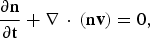 $$\displaystyle{{\partial {\rm n}} \over {\partial {\rm t}}}+{\bf \nabla }\,\cdot \,\lpar {\rm n}{\bf v}{\rm \rpar }=0\comma \;$$
where  ${\bf v}={\rm v}_{{\rm b0}} \hat{\rm z}+{\bf v}_{{\rm b1}} \exp \lsqb - {\rm i\lpar {\rm \omega} t} - {\rm k}_{\rm z} {\rm z\rpar }\rsqb $, and
 ${\rm n}={\rm n}_{{\rm b0}} +$
 ${\rm n}_{{\rm b1}} \exp \lsqb - {\rm i\lpar {\rm \omega} t} - {\rm k}_{\rm z} {\rm z\rpar }\rsqb {\rm+n}_{{\rm bm}} \exp \left\{{\left. { - {\rm i\lpar {\rm \omega} }_{\rm o} {\rm t} - {\rm k}_{{\rm oz}} {\rm z\rpar }} \right\}} \right.$, v b1 refers to perturbed velocity, n b1 refers to perturbed beam density, γ = γ0 + (γ03/c2)(v b0 × v b1) is the relativistic gamma factor and the magnetic field of the wave is
 $${\bf B}_{\rm w} = \left( {\rm c}/{\rm i}{\rm \omega } \right)\left( {\bf \nabla } \times {\bf E} \right) = \left( {\rm ck}_{\rm z} /{\rm \omega } \right)\left( 1 - {\rm k}_{\rm 1}^2 / {\rm k}_{\rm z}^2 \right){\rm E}_{\rm r} \hat {\rm \theta}.$$
Here 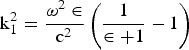 ${\rm k}_{\rm 1}^2=\displaystyle{{{\rm {\rm \omega} }^2 \in } \over {{\rm c}^2 }}\left({\displaystyle{1 \over { \in+1}} - 1} \right)$ and
 ${\rm E}_{\rm z}=\left( - {\rm k}_{\rm 1} /{\rm ik}_{\rm z} \right)$ since ∇ × E − 0 for surface plasma waves (Liu & Tripathi, Reference Liu and Tripathi2007). Eqs. (1) and (2) on linearization yield the perturbed beam velocities and perturbed beam density as
 $${\rm v}_{{\rm b1r}} = \displaystyle{{{\rm e}\left( {\rm \omega } - {\rm k}_{\rm z} {\rm v}_{{\rm b0}} \right){\rm \gamma }_{\rm o} \left[ 1 - \left( {\rm k}_{\rm z} {\rm v}_{\rm b0}/\omega \right)\left( 1 - {\rm k}_1^2 /{\rm k}_{\rm z}^2\right) \right]{\rm E}_{\rm r} } \over {{\rm im}\left[ ({\rm \omega } - {\rm k}_{\rm z} {\rm v}_{{\rm b0}} )^2 {\rm \gamma }_{\rm o} ^2 - {\rm \omega }_{{\rm ce}}^2 \right]}},$$
 $${\rm v}_{{\rm b1\theta }} = \displaystyle{{{\rm e }\left[ 1 - \left( {\rm k}_{\rm z} {\rm v}_{{\rm b0}}/\omega \right)\left( 1 - {\rm k}_1^2 /{\rm k}_{\rm z}^2 \right) \right]{\rm \omega }_{{\rm ce}} {\rm E}_{\rm r} } \over {{\rm m}\left[ ({\rm \omega } - {\rm k}_{\rm z} {\rm v}_{{\rm b0}} )^2 {\rm \gamma }_{\rm o} ^2 - {\rm \omega }_{{\rm ce}}^2 \right]}}$$
 $${\rm v}_{{\rm b1z}}=\displaystyle{{{\rm eE}_{\rm z} } \over {{\rm im}\left({\rm \omega} - {\rm k}_{\rm z} {\rm v}_{{\rm b0}} \right)\left({\rm \gamma} _{\rm o}+{\rm \gamma} _1 \right)}}\comma \;$$
and
 $${\rm n}_{{\rm b1}} = - \displaystyle{{{\rm n}_{{\rm b0}} {\rm e k}_{\rm z} {\rm \gamma }_{\rm o} \left[ 1 - \left( {\rm k}_{\rm z} {\rm v}_{{\rm b0}}/\omega \right)\left( 1 - {\rm k}_1^2 /{\rm k}_{\rm z}^2 \right) \right]\left( 1 + \Delta \right){\rm E}_{\rm z} } \over {{\rm im}\left[ ({\rm \omega } - {\rm k}_{\rm z} {\rm v}_{{\rm b0}} )^2 {\rm \gamma }_{\rm o} ^2 - {\rm \omega }_{{\rm ce}}^2 \right]}} + \displaystyle{{{\rm n}_{{\rm b0 }} {\rm e }\left[{{\rm k}_{\rm z}+\left({{\rm k}_{\rm z}+{\rm k}_{{\rm oz}} } \right)\Delta } \right]{\rm E}_{\rm z} } \over {{\rm im \lpar {\rm \omega} } - {\rm k}_{\rm z} {\rm v}_{{\rm b0}} {\rm \rpar }^2 \left({{\rm \gamma} _{\rm o}+{\rm \gamma} _1 } \right)}}\comma \;$$
and
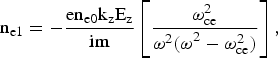 $${\rm n}_{{\rm e1}}=- \displaystyle{{{\rm en}_{{\rm e0}} {\rm k}_{\rm z} {\rm E}_{\rm z} } \over {{\rm im}}}\left[{\displaystyle{{{\rm {\rm \omega} }_{{\rm ce}}^2 } \over {{\rm {\rm \omega} }^2 {\rm \lpar {\rm \omega} }^2 - {\rm {\rm \omega} }_{{\rm ce}}^2 \rpar }}} \right]\comma \;$$
where ωce = (eB/mc) is electron cyclotron frequency and γ1 = (γ03/c2)(v b02. The z-component of perturbed beam current density is
 $${\rm J}_{{\rm 1z}} = - {\rm e n}_{{\rm b0}} {\rm v}_{{\rm b1z}} - {\rm e n}_{{\rm b1}} {\rm v}_{{\rm b0}} - {\rm e n}_{{\rm bm}} {\rm v}_{{\rm b1z}}.$$
Using Eqs. (5) and (6) into Eq. (8), and retaining only those terms which contain (ω – k zv b0)−2, we get
 $${\rm J}_{{\rm 1z}} =\displaystyle{{{\rm n}_{{\rm b0}} {\rm v}_{{\rm b0}} {\rm e}^2 } \over {{\rm im}}} \left[ \displaystyle{{{\rm k}_{\rm z} {\rm \gamma }_{\rm o} \left[ 1 - \left( {\rm k}_{\rm z} {\rm v}_{{\rm b0}}/\omega \right)\left( 1 - {\rm k}_1^2 /{\rm k}_{\rm z}^2 \right) \right]\left( 1 + \Delta \right)} \over {\left[ ({\rm \omega } - {\rm k}_{\rm z} {\rm v}_{{\rm b0}} )^2 {\rm \gamma }_{\rm o} ^2 - {\rm \omega }_{{\rm ce}}^2 \right]}} - {\displaystyle{{{\rm k}_{\rm z}+\left({{\rm k}_{\rm z}+{\rm k}_{{\rm oz}} } \right)\Delta } \over {{\rm \lpar {\rm \omega} } - {\rm k}_{\rm z} {\rm v}_{{\rm b0}} {\rm \rpar }^2 \left({{\rm \gamma} _{\rm o}+{\rm \gamma} _1 } \right)}}} \right]{\rm E}_{\rm z}.$$
Assuming that the dust grains are present in plasma with density n d0 and a charge Q d0. Following Jana et al. (Reference Jana, Sen and Kaw1993) the perturbed dust grain charge is given as
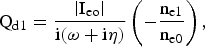 $${\rm Q}_{{\rm d1}}= \displaystyle{{\left\vert {{\rm I}_{{\rm eo}} } \right\vert } \over {{\rm i\lpar {\rm \omega}+i{\rm \eta} \rpar }}}\left({ - \displaystyle{{{\rm n}_{{\rm e1}} } \over {{\rm n}_{{\rm e0}} }}} \right)\comma \;$$
where we have neglected the effect of ions because of the presence of high frequency SPWs. Equilibrium electron current on the dust grain surface is given as
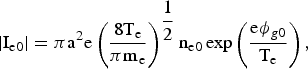 $$\left\vert {{\rm I}_{{\rm e}0} } \right\vert ={\rm {\rm \pi} a}^2 {\rm e}\left({\displaystyle{{8{\rm T}_{\rm e} } \over {{\rm {\rm \pi} m}_{\rm e} }}} \right)^{\displaystyle{1 \over 2}} {\rm n}_{{\rm e0}} \exp \left({\displaystyle{{{\rm e{\rm \phi} }_{g0} } \over {{\rm T}_{\rm e} }}} \right)\comma \;$$
where a is the dust grain sphere radius and ϕg0 is the dust grain surface potential. Assuming ∇ × E = −4πn d0Q d1 due to the presence of dust grains and using Eqs. (7) and (10), we obtain
 $${\bf \nabla } \cdot {\bf E}{\rm={\rm \omega} }_{{\rm pe}}^2 \displaystyle{{\rm {\rm \beta} } \over {{\rm \lpar {\rm \omega}+i{\rm \eta} \rpar }}}{\rm k}_{\rm z} {\rm E}_{\rm z} \left[{\displaystyle{{{\rm {\rm \omega} }_{{\rm ce}}^2 } \over {{\rm {\rm \omega} }^2 {\rm \lpar {\rm \omega} }^2 - {\rm {\rm \omega} }_{{\rm ce}}^2 \rpar }}} \right]\comma \;$$
where
 $${\rm {\rm \omega} }_{{\rm pe}}^2 =\displaystyle{{4{\rm {\rm \pi} n}_{{\rm e0 }} {\rm e}^2 } \over {\rm m}}\comma \; {\rm {\rm \eta} }=\displaystyle{{\left\vert {{\rm I}_{{\rm e}0} } \right\vert {\rm e}} \over {{\rm C}_{\rm g} }}\left[{\displaystyle{1 \over {{\rm T}_{\rm e} }}+\displaystyle{1 \over {{\rm T}_{\rm i} - {\rm e{\rm \phi} }_{{\rm g}0} }}} \right]\comma \;$$
C g[= a(1 + (a/λDe)] is the capacitance of dust grains, λDe is the electron debye length and  ${\rm {\rm \beta}=}\displaystyle{{\left\vert {{\rm I}_{{\rm eo}} } \right\vert } \over {\rm e}}\displaystyle{{{\rm n}_{{\rm d0}} } \over {{\rm n}_{{\rm e0}} }}$ is the coupling parameter. β can be rewritten after using the charge neutrality condition and the value of equilibrium electron current as
 $${\rm {\rm \beta} }=0.397\left({1 - \displaystyle{1 \over {\rm {\rm \delta} }}} \right)\left({\displaystyle{{\rm a} \over {{\rm v}_{{\rm te}} }}} \right){\rm {\rm \omega} }_{{\rm pi}}^2 \left({\displaystyle{{{\rm m}_{\rm i} } \over {{\rm m}_{\rm e} }}} \right)\comma \;$$
where 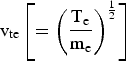 ${\rm v}_{{\rm te}} \left[{=\left(\displaystyle{{{{\rm T}_{\rm e} } \over {{\rm m}_{\rm e} }}} \right)^{{1 \over 2}} } \right]$ is the electron thermal velocity and
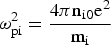 ${\rm {\rm \omega} }_{{\rm pi}}^2=\displaystyle{{{\rm 4{\rm \pi} n}_{{\rm i0}} {\rm e}^2 } \over {{\rm m}_{\rm i} }}$. η can also be rewritten in the limit namely T e >> T i, i.e., electron temperature is much greater than the ion temperature, for example, in glow discharge plasmas (a more common laboratory configuration) as,
 $${\rm {\rm \eta} }=0.4{\rm {\rm \omega} }_{{\rm pi}}^2 \left({\displaystyle{{\rm a} \over {{\rm v}_{{\rm te}} }}} \right)\left({\displaystyle{{{\rm {\rm \lambda} }_{{\rm De}} ^2 } \over {{\rm {\rm \lambda} }_{{\rm Di}} ^2 }}} \right)\left({\displaystyle{1 \over {\rm {\rm \delta} }}} \right)\left({\displaystyle{{{\rm v}_{{\rm ti}} } \over {{\rm v}_{{\rm te}} }}} \right)\left({\displaystyle{{{\rm m}_{\rm i} } \over {{\rm m}_{\rm e} }}} \right)\comma \;$$
where 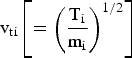 ${\rm v}_{{\rm ti}} \left[{=\left({\displaystyle{{{\rm T}_{\rm i} } \over {{\rm m}_{\rm i} }}} \right)^{1/2} } \right]$ is the ion thermal velocity and λDi is the ion debye length. Using Eq. (11) in the z-component of wave equation.
 $${\bf \nabla }^2 {\bf E} - {\bf \nabla }\left({{\bf \nabla } \cdot {\bf E}} \right)+\displaystyle{{{\rm {\rm \omega} }^2 } \over {{\rm c}^2 }} \in _{\rm p} {\bf E}=- \displaystyle{{4{\rm {\rm \pi} }i{\rm {\rm \omega} }} \over {{\rm c}^2 }}{\bf J}\comma \;$$
we get
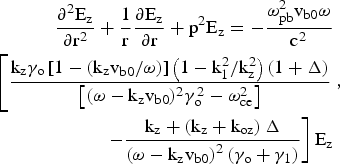 $$\eqalign{\displaystyle{{\partial ^2 {\rm E}_{\rm z} } \over {\partial {\rm r}^2 }} + \displaystyle{1 \over {\rm r}}\displaystyle{{\partial {\rm E}_{\rm z} } \over {\partial {\rm r}}} + {\rm p}^2 {\rm E}_{\rm z} = -\displaystyle{{{\rm \omega }_{{\rm pb}}^2 {\rm v}_{{\rm b0}} {\rm \omega }} \over {{\rm c}^2 }} \cr \left[ \displaystyle{{{\rm k}_{\rm z} {\rm \gamma }_{\rm o} \left[ 1 - \left( {\rm k}_{\rm z} {\rm v}_{\rm b0}/{\rm \omega} \right) \right]\left( 1 - {\rm k}_1^2 /{\rm k}_{\rm z}^2 \right)\left( 1 + \Delta \right)} \over {\left[ ({\rm \omega } - {\rm k}_{\rm z} {\rm v}_{{\rm b0}} )^2 {\rm \gamma }_{\rm o} ^2 - {\rm \omega }_{{\rm ce}}^2 \right]}} \right. \cr \quad \left.{ - \displaystyle{{{\rm k}_{\rm z}+\left({{\rm k}_{\rm z}+{\rm k}_{{\rm oz}} } \right)\Delta } \over {{\rm \lpar {\rm \omega} } - {\rm k}_{\rm z} {\rm v}_{{\rm b0}} {\rm \rpar }^2 \left({{\rm \gamma} _{\rm o}+{\rm \gamma} _1 } \right)}}} \right]{\rm E}_{\rm z}}\comma \;$$
where
 $${\rm p}^2=\displaystyle{{{\rm {\rm \omega} }^2 \in _{\rm p} } \over {{\rm c}^2 }} - {\rm k}_{\rm z}^2 \left\{{{\rm 1+}\displaystyle{{{\bf }{\rm i{\rm \beta} }} \over {{\rm \lpar {\rm \omega}+i{\rm \eta} \rpar }}} \left[{\displaystyle{{{\rm {\rm \omega} }_{{\rm pe}}^2 {\rm {\rm \omega} }_{{\rm ce}}^2 } \over {{\rm {\rm \omega} }^2 {\rm \lpar {\rm \omega} }^2 - {\rm {\rm \omega} }_{{\rm ce}}^2 \rpar }}} \right]} \right\}$$
and 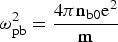 ${\rm {\rm \omega} }_{{\rm pb}}^2 =\displaystyle{{4{\rm {\rm \pi} n}_{{\rm b0}} {\rm e}^2 } \over {\rm m}}$. Now, we attempt a solution of Eq. (12) and evaluate the growth rate of the unstable mode in the beam plasma system using perturbation theory. In the absence of beam
 ${\rm {\rm \omega} }_{{\rm pb}}^2 $= 0, and Eq. (12) reduces to
 $$\displaystyle{{\partial ^2 {\rm E}_{\rm z} } \over {\partial {\rm r}^2 }} +\displaystyle{1 \over {\rm r}}\displaystyle{{\partial {\rm E}_{\rm z} } \over {\partial {\rm r}}}+{\rm p}_{\rm m}^2 {\rm E}_{\rm z} = 0.$$
Eq. (13) is a Bessel equation giving a well-known solution and eigen value EZ = AJ 0(p mr). E Z must vanish at the boundary of plasma cylinder at r = a 1, therefore
 $${\rm J}_0 ({\rm p}_{\rm m} {\rm a}_1 ) = 0{\rm or p}_{\rm m} = \displaystyle{{{\rm X}_{\rm n} } \over {{\rm a}_{\rm 1} }}({\rm n} = 1,2,3, \ldots ),$$
where X n are the zeros of the Bessel function J 0. If J 0(x 1) = 0, x 1 = 2.404 for first zeroes of the Bessel function, therefore 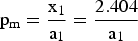 ${\rm p}_{\rm m} = \displaystyle{{{\rm x}_1 } \over {{\rm a}_1 }}=\displaystyle{{{\rm 2}{\rm .404}} \over {{\rm a}_1 }}$. In the presence of beam, EZ can be expanded in a series of orthogonal sets of wave functions
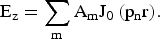 $${\rm E}_{\rm z}= \sum\limits_{\rm m} {{\rm A}_{\rm m} {\rm J}_0 \left({{\rm p}_{\rm n} {\rm r}} \right)}.$$
Substituting the value of E Z from Eq. (14) in Eq. (12), multiplying both sides by rJ 0(p mr), integrating over r from 0 to a 1 on the left-hand side and over r from 0 to r b on the right-hand side, and using Eq. (13), we obtain
 $${\rm p}^2 - {\rm p}_{\rm m}^2 = -\displaystyle{{{\rm \omega }_{{\rm pb}}^2 {\rm v}_{{\rm b0}} {\rm \omega }} \over {{\rm Ic}^2 }} \left[ \displaystyle{{{\rm k}_{\rm z} {\rm \gamma }_{\rm o} \left[ 1 - \left( {\rm k}_{\rm z} {\rm v}_{\rm b0}/{\rm \omega} \right) \left( 1 - {\rm k}_1^2 /{\rm k}_{\rm z}^2 \right)\right]\left( {1 + \Delta } \right)} \over {\left[ ({\rm \omega } - {\rm k}_{\rm z} {\rm v}_{{\rm b0}} )^2 {\rm \gamma }_{\rm o} ^2 - {\rm \omega }_{{\rm ce}}^2 \right]}} -{{ {{\rm k}_{\rm z}+\left({{\rm k}_{\rm z}+{\rm k}_{{\rm oz}} } \right)\Delta } \over {{\rm \lpar {\rm \omega} } - {\rm k}_{\rm z} {\rm v}_{{\rm b0}} {\rm \rpar }^2 \left({{\rm \gamma} _{\rm o}+{\rm \gamma} _1 } \right)}}} \right]\comma \;$$
where
 $$I = \displaystyle{{\vint_0^{{\rm a}_1 } {\sum\limits_{\rm m} {{\rm J}_0 \left({{\rm p}_{\rm m} {\rm r}} \right) } {\rm J}_0 \left({{\rm p}_{\rm n} {\rm r}} \right){\rm r dr}} } \over {\vint_0^{{\rm r}_{\rm b} } {\sum\limits_{\rm m} {{\rm J}_0 \left({{\rm p}_{\rm m} {\rm r}} \right) } {\rm J}_0 \left({{\rm p}_{\rm n} {\rm r}} \right){\rm r dr}} }}.$$
Substituting the value of p 2, we get
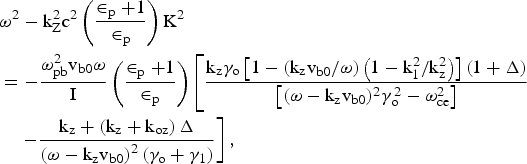 $$\eqalign{& {\rm \omega }^2 - {\rm k}_{\rm Z}^{\rm 2} {\rm c}^2 \left( \displaystyle{ \in _{\rm p} + 1 \over \in _{\rm p} } \right){\rm K}^{\rm 2} \cr & = -\displaystyle{ {\rm \omega }_{{\rm pb}}^2 {\rm v}_{{\rm b0}} {\rm \omega } \over {\rm I}}\left( \displaystyle{ \in _{\rm p} + 1 \over \in _{\rm p} } \right) \left[ \displaystyle{ {\rm k}_{\rm z} {\rm \gamma }_{\rm o} \left[ 1 - \left( {\rm k}_{\rm z} {\rm v}_{\rm b0}/{\rm \omega} \right) \left( 1 - {\rm k}_1^2 /{\rm k}_{\rm z}^2 \right)\right]\left( 1 + \Delta \right) \over \left[ ({\rm \omega } - {\rm k}_{\rm z} {\rm v}_{{\rm b0}} )^2 {\rm \gamma }_{\rm o} ^2 - {\rm \omega }_{{\rm ce}}^2 \right]} \right. \cr & \quad \left. {- \displaystyle{{{\rm k}_{\rm z}+\left({{\rm k}_{\rm z}+{\rm k}_{{\rm oz}} } \right)\Delta } \over {{\rm \lpar {\rm \omega} } - {\rm k}_{\rm z} {\rm v}_{{\rm b0}} {\rm \rpar }^2 \left({{\rm \gamma} _{\rm o}+{\rm \gamma} _1 } \right)}}} \right]\comma }\;$$
where 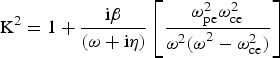 ${\rm K}^{\rm 2}=1+\displaystyle{{{\rm i{\rm \beta} }} \over {{\rm \lpar {\rm \omega}+i{\rm \eta} \rpar }}}\left[{\displaystyle{{{\rm {\rm \omega} }_{{\rm pe}}^2 {\rm {\rm \omega} }_{{\rm ce}}^2 } \over {{\rm {\rm \omega} }^2 {\rm \lpar {\rm \omega} }^2 - {\rm {\rm \omega} }_{{\rm ce}}^2 \rpar }}} \right]$. Eq. (15) can be rewritten as
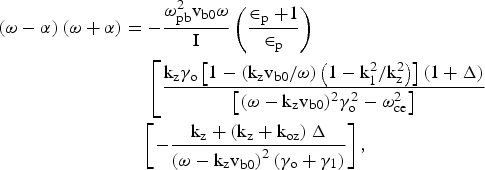 $$\eqalign{\left( {\rm \omega } - {\rm \alpha } \right)\left( {\rm \omega} + {\rm \alpha } \right) & = -\displaystyle{{{\rm \omega }_{{\rm pb}}^2 {\rm v}_{{\rm b0}} {\rm \omega }} \over {\rm I}}\left( \displaystyle{{ \in _{\rm p} + 1} \over { \in _{\rm p} }} \right) \cr & \hskip 3pt\quad \left[ \displaystyle{{{\rm k}_{\rm z} {\rm \gamma }_{\rm o} \left[ 1 -\left( {\rm k}_{\rm z} {\rm v}_{\rm b0}/{\rm \omega} \right) \left( 1 - {\rm k}_1^2 /{\rm k}_{\rm z}^2 \right)\right]\left( 1 + \Delta \right)} \over {\left[ ({\rm \omega } - {\rm k}_{\rm z} {\rm v}_{{\rm b0}} )^2 {\rm \gamma }_{\rm o} ^2 - {\rm \omega }_{{\rm ce}}^2 \right]}} \right. \cr & \quad \left[{ - \displaystyle{{{\rm k}_{\rm z}+\left({{\rm k}_{\rm z}+{\rm k}_{{\rm oz}} } \right)\Delta } \over {{\rm \lpar {\rm \omega} } - {\rm k}_{\rm z} {\rm v}_{{\rm b0}} {\rm \rpar }^2 \left({{\rm \gamma} _{\rm o}+{\rm \gamma} _1 } \right)}}} \right]\comma }\;$$
where α is the root of ω, given as
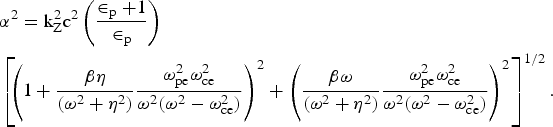 $$\eqalign{& {\rm \alpha }^2 = {\rm k}_{\rm Z}^{\rm 2} {\rm c}^2 \left( \displaystyle{ \in _{\rm p} + 1 \over \in _{\rm p} } \right) \cr & \left[\!\! \left( 1 + \displaystyle{ {\rm \beta \eta } \over ({\rm \omega }^2 + {\rm \eta }^2 )} \displaystyle{ {\rm \omega }_{{\rm pe}}^2 {\rm \omega }_{{\rm ce}}^2 \over {\rm \omega }^2 ({\rm \omega }^2 - {\rm \omega }_{{\rm ce}}^2 )} \right)^2 + \left( \displaystyle{ {\rm \beta}{\rm \omega } \over ({\rm \omega }^2 + {\rm \eta }^2 )} \displaystyle{ {\rm \omega }_{{\rm pe}}^2 {\rm \omega }_{{\rm ce}}^2 \over {\rm \omega }^2 ({\rm \omega }^2 - {\rm \omega }_{{\rm ce}}^2 )} \right)^2 \right]^{1/2}.}$$
In Cerenkov interaction (ω − k zv b0)2 ≈ 0, therefore neglecting first term on right-hand side of Eq. (16), and assuming perturbed quantities ω = α+ δ1 and ω = k zv b0 = δ1, we get the growth rate as
 $${\rm \gamma } = \displaystyle{{\sqrt 3 } \over 2}\left[ {\displaystyle{{{\rm \omega }_{{\rm pb}}^2 {\rm v}_{{\rm b0}} } \over {2{\rm I}\left( {{\rm \gamma }_{\rm o} + {\rm \gamma }_1 } \right)}}\left( {\displaystyle{{ \in _{\rm p} + 1} \over { \in _{\rm p} }}} \right)\left[ {{\rm k}_{\rm z} + \left( {{\rm k}_{\rm z} + {\rm k}_{{\rm oz}} } \right)\Delta } \right]} \right]^{1/3} .$$
The real part of frequency ωr is obtained from the real part of δ as
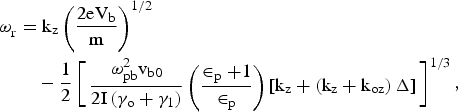 $$\eqalign{{\rm \omega }_{\rm r}^{} & = {\rm k}_{\rm z} \left( {\displaystyle{{{\rm 2eV}_{\rm b} } \over {\rm m}}} \right)^{1/2} \cr & \quad- \displaystyle{1 \over 2}\left[ \matrix{\displaystyle{{{\rm \omega }_{{\rm pb}}^2 {\rm v}_{{\rm b0}} } \over {2{\rm I}\left( {{\rm \gamma }_{\rm o} + {\rm \gamma }_1 } \right)}}\left( {\displaystyle{{ \in _{\rm p} + 1} \over { \in _{\rm p} }}} \right) \left[ {{\rm k}_{\rm z} + \left( {{\rm k}_{\rm z} + {\rm k}_{{\rm oz}} } \right)\Delta } \right]} \right]^{1/3},}$$
where v b is the beam potential.
In cyclotron interaction  ${\rm \lpar {\rm \omega} } - {\rm k}_{\rm z} {\rm v}_{{\rm b0}} \rpar ^2 {\rm \gamma} _{\rm o} ^2 \approx {\rm {\rm \omega} }_{{\rm ce}}^2 \comma \; $ therefore second term on right-hand side of Eq. (16) can be neglected and can be written as
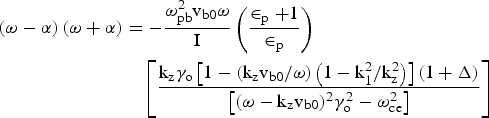 $$\eqalign{\left( {\rm \omega } - {\rm \alpha } \right)\left( {\rm \omega} + {\rm \alpha } \right) & = -\displaystyle{ {\rm \omega }_{{\rm pb}}^2 {\rm v}_{{\rm b0}} {\rm \omega } \over {\rm I}}\left( \displaystyle{ \in _{\rm p} + 1 \over \in _{\rm p} } \right) \cr & \quad \left[ \displaystyle{ {\rm k}_{\rm z} {\rm \gamma }_{\rm o} \left[ 1 - \left( {\rm k}_{\rm z} {\rm v}_{\rm b0}/{\rm \omega} \right) \left( 1 - {\rm k}_1^2 /{\rm k}_{\rm z}^2 \right) \right]\left( 1 + \Delta \right) \over \left[ ({\rm \omega } - {\rm k}_{\rm z} {\rm v}_{{\rm b0}} )^2 {\rm \gamma }_{\rm o} ^2 - {\rm \omega }_{{\rm ce}}^2 \right]} \right]}$$
where (ω – k zv b0)γ0 + ωce corresponds to slow cyclotron interaction, and (ω – k zv b0)γ0 − ωce corresponds to fast cyclotron interaction. For slow cyclotron interaction, assuming perturbed quantities ω = k zv b0 − (ωce/γ0) + δ1 and ω = α+ δ1, we get the growth rate, i.e., the imaginary part of δ1, as
 $${{\rm \gamma} = 0}.$$
The phase velocity of the mode is obtained by using the real part of δ1 as
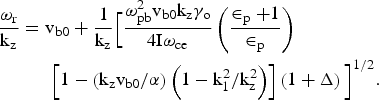 $$\eqalign{\displaystyle{ {\rm \omega }_{\rm r} \over {\rm k}_{\rm z} } & = {\rm v}_{{\rm b0}} + \displaystyle{1 \over {\rm k}_{\rm z} } \Big[ \displaystyle{ {\rm \omega }_{{\rm pb}}^2 {\rm v}_{{\rm b0}} {\rm k}_{\rm z} {\rm \gamma }_{\rm o} \over 4{\rm I}{\rm \omega }_{{\rm ce}} } \left( \displaystyle{ \in _{\rm p} + 1 \over \in _{\rm p}} \right) \cr & \quad \hskip 5pt \left[ 1 - \left( {\rm k}_{\rm z} {\rm v}_{{\rm b0}} /{\rm \alpha }\right)\left( 1-{\rm k}_{1} ^2/{\rm k}_{\rm z}^2\right) \right]\left( 1 + \Delta \right) \Big]^{1/2}.}$$
That is, in case of slow cyclotron interaction there is no growing mode as the phase velocity exceeds the beam velocity. For fast cyclotron interaction, assuming perturbed quantities ω = k zv b0 + (ωce/γ0) + δ1 and ω = α+ δ1, we get the growth rate as
 $${\rm \gamma } = {\rm Im} ({\rm \delta }_1 ) = \left[ \displaystyle{ {\rm \omega }_{{\rm pb}}^2 {\rm v}_{{\rm b0}} {\rm k}_{\rm z} {\rm \gamma }_{\rm o} \over 4{\rm I}{\rm \omega }_{{\rm ce}} } \left( \displaystyle{{ \in _{\rm p} + 1} \over { \in _{\rm p} }} \right) \left[ 1 - \left( {\rm k}_{\rm z} {\rm v}_{{\rm b0}}/{\rm \alpha } \right)\left( 1-{\rm k}_{1} ^2/{\rm k}_{\rm z}^2\right) \right]\left( 1 + \Delta \right) \right]^{1/2}.$$
In the absence of modulated beam, i.e.,  $ {\rm \omega} _{{\rm pb}}^2 $= 0 and without dust grains δ(= n i0/n e0) = 1, i.e, β = 0 or K = 1, Eq. (15) gives
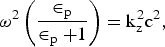 $ {\rm \omega} ^2 \left(\displaystyle{{ \in _{\rm p} } \over { \in _{\rm p}+1}} \right) = {\rm k}_{\rm z}^2 {\rm c}^2 \comma \; $ which is the dispersion relation for surface plasma waves (Liu & Tripathi, Reference Liu and Tripathi2007).
3. RESULTS AND DISCUSSIONS
In the numerical calculations, we use typical parameters of the SPWs: ion plasma density n i0 = 1015cm−3, electron plasma density n e0 = 1015–1014cm−3 (δ = 1–10), mass of ion m i = 40 × 1836m e (Argon plasma), temperature of electron T e = 1 eV, temperature of ion T i = 0.1 eV, such that T i/T e = 0.1, beam velocity v b0 = 2.5 × 1010 cm/s, beam density n b0 = 3.6 × 109cm−3 and dust grain size a = 10−4 cm. The relative density of negatively charged dust grains δ(= n i0/n e0) has been varied from 1.0 to 10.0 in steps of 1.0. We have discussed the application of the orbit motion limited (OML) theory to magnetized plasma in which SPWs propagate using standard model in which dust particle size and shape effects have been neglected. Such a model is reasonably valid in the limit a << λDe << λ (where a is the dust grain size, λDe is the electron Debye length, and λ is the wavelength of the fluctuations provided that the spread in Q d/m d (dust charge to mass ratio) for the dust particles in the equilibrium plasma may be neglected. Moreover, Jana et al. (Reference Jana, Sen and Kaw1993) have given the limits of the OML theory for magnetized dusty plasma, that the charging equation for dust grains can be valid if a  $ \ll {\rm {\rm \rho} }_{\rm L}$ (where
 ${\rm \rho} _{\rm L} =\left({\rm v}_{{\rm te}} / {\rm \omega} _{{\rm ce}} \right)$ is the electron Larmor radius, v te is the electron thermal velocity, and ωce is the electron cyclotron frequency). We have chosen parameters in such a way that both the above mentioned conditions are satisfied.
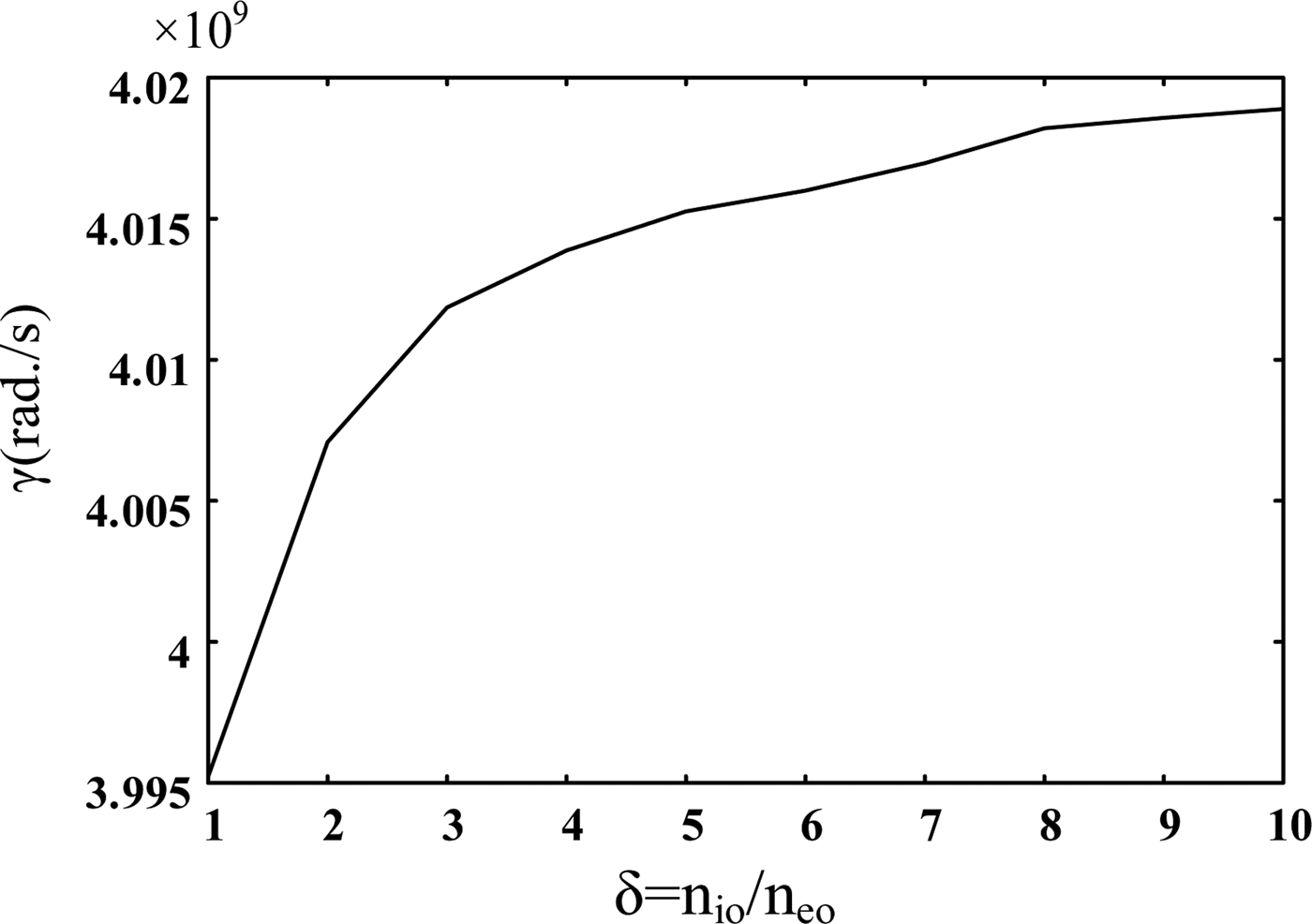
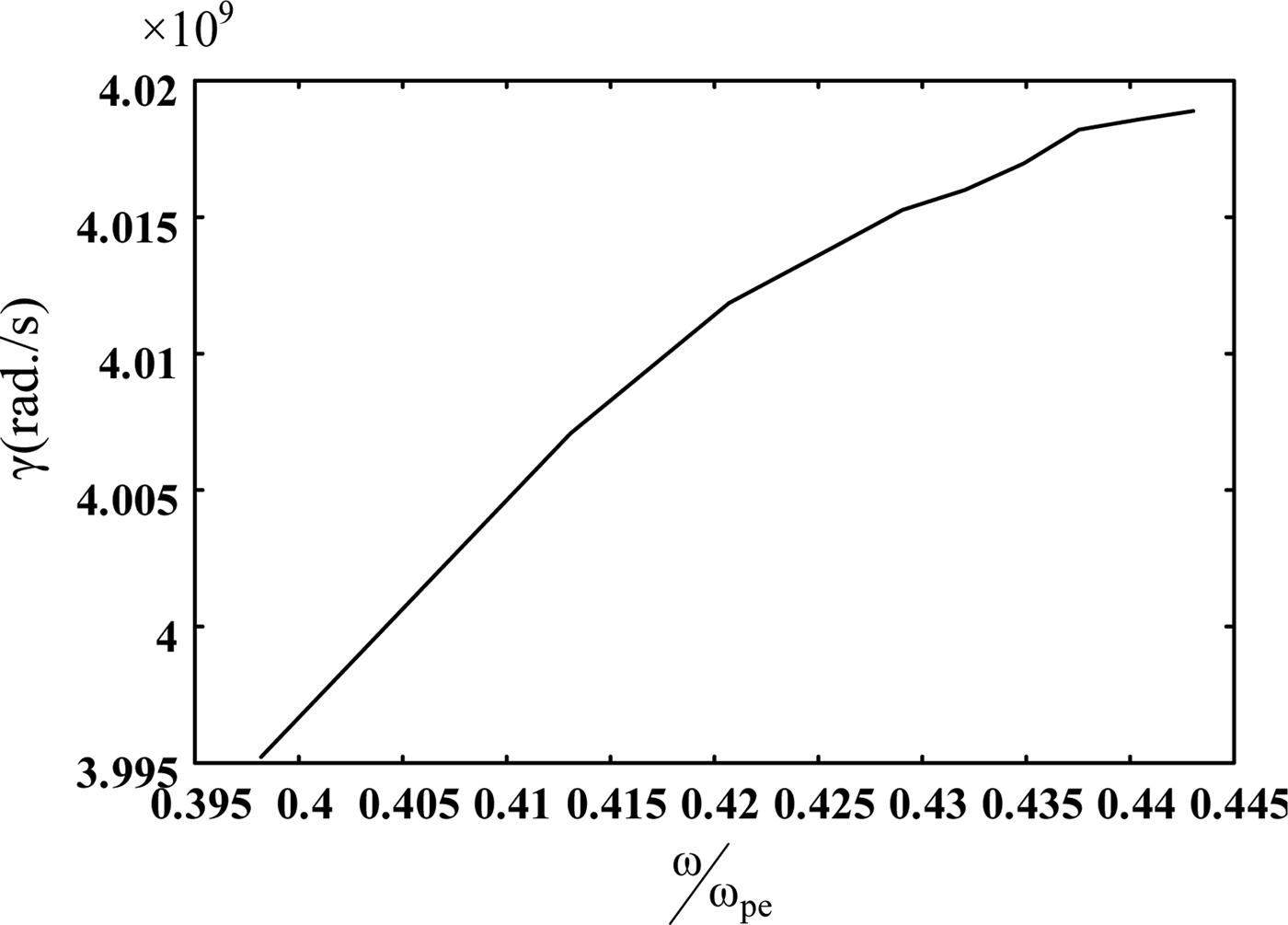
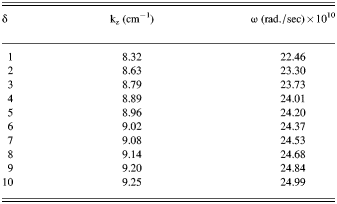
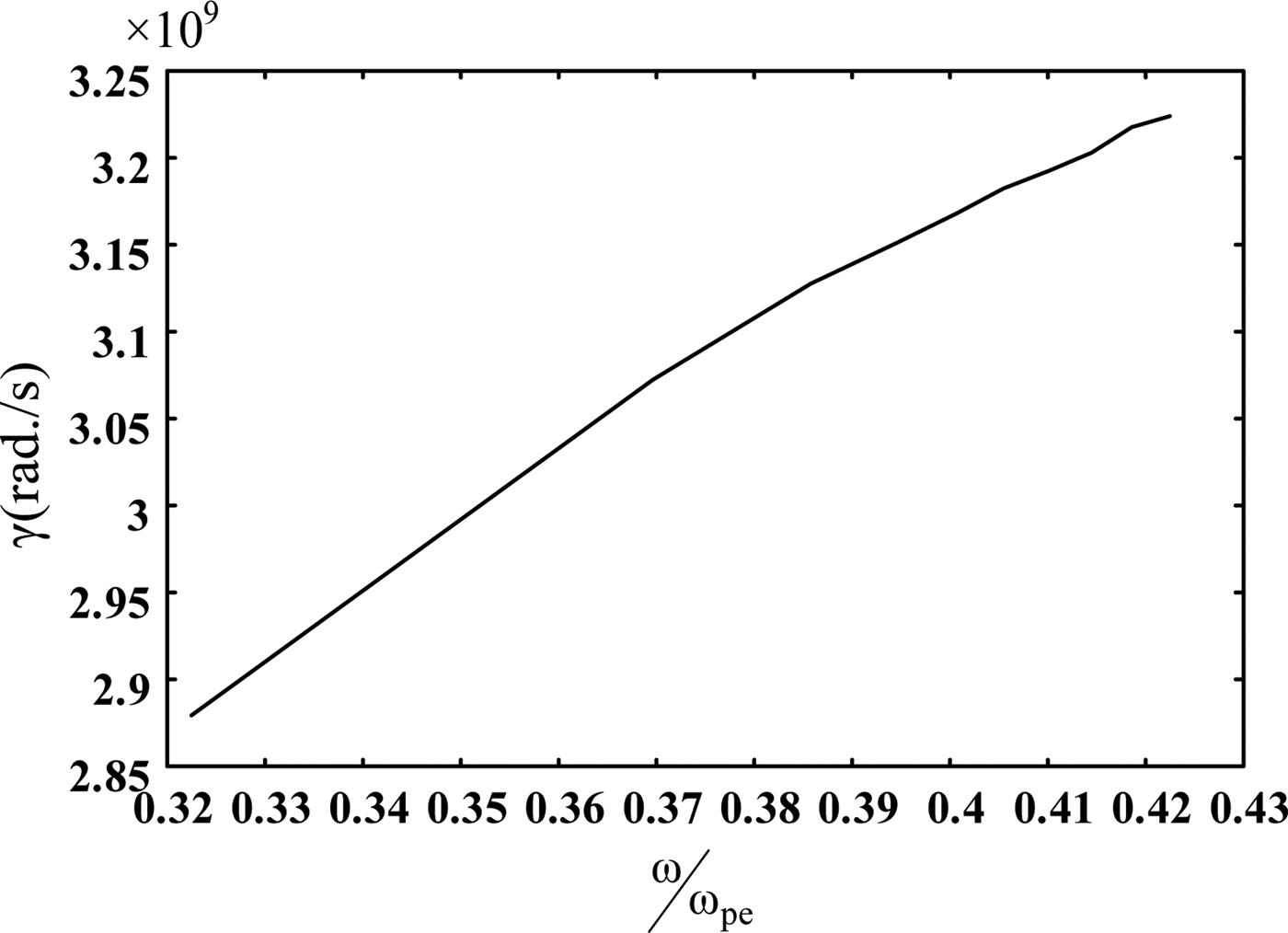
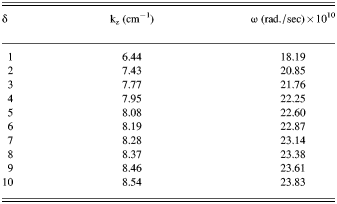
We have plotted the dispersion curves of SPWs (cf. Fig. 1) over a magnetized dusty plasma cylinder using Eq. (17). We have also plotted the beam mode via Cerenkov interaction for the pre-modulated electron beam traveling inside the dusty plasma cylinder. The pre-modulated electron beam radius is taken as 0.8 cm, which is less than the radius of dusty plasma cylinder taken as 1.0 cm. The frequencies and the corresponding wave vectors of the unstable mode obtained by the points of intersection between the beam mode and the plasma modes are given in Table 1. From Table 1, we can say that the unstable wave frequencies and the axial wave vector k z (cm−1) of the SPWs in presence of dust grains increase with δ. The growth rate γ (rad./s) of the SPWs has been plotted using Eq. (18) and Table 1, as a function of δ in Figure 2 and with modulation index Δ = 1.0 (100% beam modulation). From Figure 2, it can be seen that the growth rate increases almost linearly from a value of 3.995 × 10⁹ rad./s to 4.012 × 10⁹ rad./s as δ changes from 1 to 3 and then increases slowly to a maximum value of 4.019 × 10⁹ rad./s at δ = 10. The growth rate of the unstable mode also increases with the beam density and scales as the one-third power of the beam density (cf. Eq. (18)). We have also plotted the variation of the growth rate of unstable wave as a function of normalized frequency ω/ωpe in Figure 3, for the same parameters used for plotting Figure 2. The growth rate of the unstable mode increases with frequency and has a maximum value of 4.019 × 10⁹ rad./s at ω/ωpe = 0.44.
Dispersion curves of SPWs over a magnetized dusty plasma cylinder for different values of  ${\rm {\rm \delta} }$ (= n i0/n e0) and a modulated beam mode via Cerenkov interaction.

Growth rate γ (rad./sec) of the unstable mode over a magnetized dusty plasma cylinder via Cerenkov interaction as a function of  ${\rm {\rm \delta} }$ (= n i0/n e0)for
 $\Delta $ = 1.0.
Growth rate γ (rad./sec) of the unstable mode over a magnetized dusty plasma cylinder via Cerenkov interaction as a function of normalized frequency  ${\rm \omega }/{\rm \omega }_{{\rm pe}} $ for Δ = 1.0.
Unstable wave frequencies ω(rad./s) and axial wave vectors k z(cm−1) for different values of δ from Figure 1
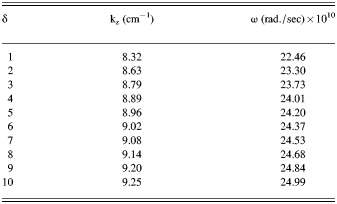
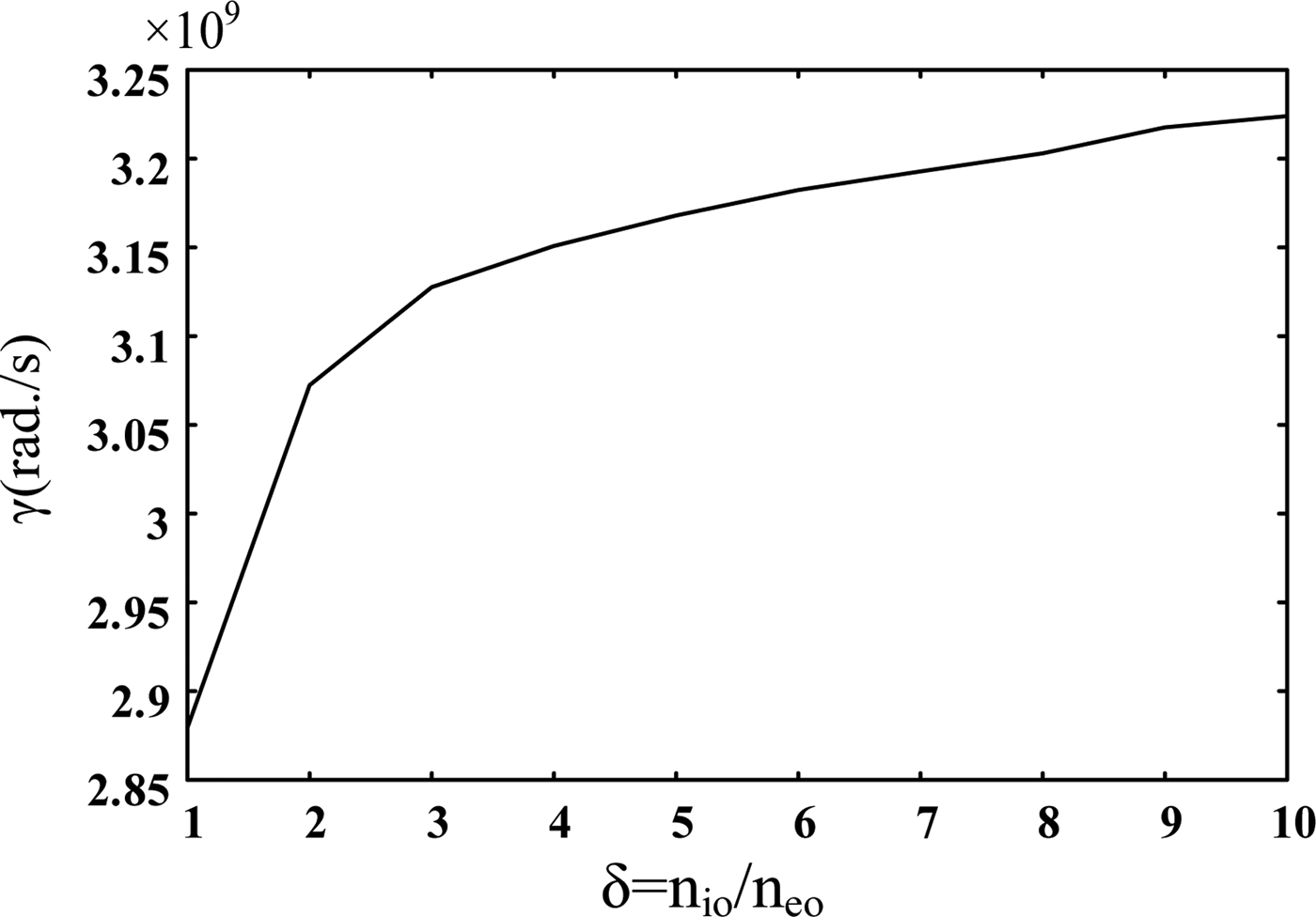
In Figure 4, we have plotted the dispersion curves of SPWs over a dusty plasma cylinder via fast cyclotron interaction and the beam mode for same beam velocity and with static magnetic field B s = 1 kG. The frequencies and the corresponding wave vectors of the unstable mode are given as Table 2. From Table 2, we can say that the unstable wave frequencies and the axial wave vector k z of the unstable wave in presence of dust grains increase with increasing δ. Using Eq. (23) and Table 2 with Δ = 1.0, we have plotted the growth rate γ(rad./s) of unstable wave as a function of δ in Figure 5. From Figure 5, it can be seen that the growth rate of the unstable mode increases with δ. Moreover, the growth rate of the unstable wave increases with beam density and scales as square root of the beam density. In Figure 6, we have plotted the variation of the growth rate γ(rad./s) of SPW as a function of normalized frequency ω/ωpe. The growth rate of the unstable mode increases with frequency and modulation index, as is observed in Cerenkov interaction. In case of slow cyclotron interaction there is no growing mode as the phase velocity exceeds the beam velocity (cf. Eq. (22)). Anisimov et al. (Reference Anisimov, Baranov, Derkach, Dykhne, Malyuta, Pismennyi, Rysev and Sebrant1988) have studied the excitation of surface waves by a moving laser beam both theoretically and experimentally and have also found an increase in growth rate depending on beam velocity. Boyd et al. (Reference Boyd, Gould and Field1961) experimentally observed exponentially growing wave amplification along the modulated electron beam on interaction with plasma. Bouhelier et al. (Reference Bouhelier, Ignatovich, Bruyant, Huang, Francs, Weeber, Dereux, Wiederrecht and Novotny2007) have also demonstrated experimentally that tightly focused laser beams can excite surface plasmon polaritons.
Dispersion curves of SPWs over a magnetized dusty plasma cylinder for different values of  ${\rm {\rm \delta} }$ and a modulated beam mode via fast cyclotron interaction.
Growth rate γ (rad./sec) of the unstable mode over a magnetized dusty plasma cylinder via fast cyclotron interaction as a function of δ (=n i0/n e0).
Growth rate γ (rad./sec) of the unstable mode over a magnetized dusty plasma cylinder via fast cyclotron interaction as a function of normalized frequency  ${\rm \omega }/{\rm \omega }_{{\rm pe}} $.
Unstable wave frequencies ω(rad./s) and axial wave vectors k z(cm−1) for different values of δ from Figure 4
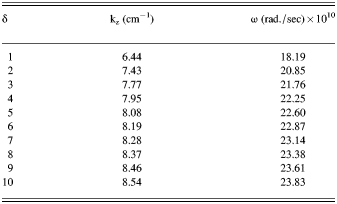
To summarize, in this paper we have considered the effect of charged dust particles on the excitation and growth rate of SPWs over a dusty plasma cylinder in the presence of an external magnetic field parallel to the direction of propagation of SPWs. It has been shown that the presence of dust grains modifies the dispersion properties of SPWs. A density modulated electron beam can interact with the SPWs via Cerenkov interaction and fast cyclotron interaction. The dust causes an increase of the SPW phase velocity and a dust-induced wave growth. The unstable wave frequencies in both the interactions increase with the relative density of negatively charged dust grains δ. The growth rate of unstable wave also increases with δ and normalized frequency ω/ωpe.