Research is increasingly examining the interplay between children's genetic predispositions and familial influences in predicting psychopathology later in life. An evocative gene–environment correlation (rGE) is one such mechanism in which children's genetic predispositions evoke reactions from their environment (Scarr & McCartney, Reference Scarr and McCartney1983). Seminal literature proposes that negative evocative rGEs, in which genetic predispositions manifesting as negative child behavior evoke negative reactions from their family environment, are more common than positive evocative rGEs (Plomin, DeFries, & Loehlin, Reference Plomin, DeFries and Loehlin1977). In line with this theory, emerging research examining evocative rGE has found that adolescents’ genetic predispositions for behavioral disinhibition can evoke more negative family environments, which subsequently increases risk for later psychopathology and substance use (Elam et al., Reference Elam, Chassin, Lemery-Chalfant, Pandika, Wang, Bountress and Agrawal2017). In particular, low family cohesion, that is low emotional and physical closeness, is one aspect of the family environment that is associated with greater alcohol use in adolescence and early adulthood (Foxcroft & Lowe, Reference Foxcroft and Lowe1991; Gutman, Eccles, Peck, & Malanchuk, Reference Gutman, Eccles, Peck and Malanchuk2011; Smart, Chibucos, & Didier, Reference Smart, Chibucos and Didier1990; Wagner et al., Reference Wagner, Ritt-Olson, Chou, Pokhrel, Duan, Baezconde-Garbanati and Unger2010). However, cultural and ethnic differences, and similarities, are known to exist in parenting and the family environment (Darling & Steinberg, Reference Darling and Steinberg1993; Steinberg, Dornbusch, & Brown, Reference Steinberg, Dornbusch and Brown1992), and research investigating these processes in gene–environment interplay within the family is nearly nonexistent. Racial and ethnic minorities have traditionally been underrepresented, and misrepresented in developmental psychology, developmental psychopathology, and behavior genetics research (Causadias, Reference Causadias2013; Garcia Coll, Akerman, & Cicchetti, Reference Garcia Coll, Akerman and Cicchetti2000). Therefore, it is important to integrate ethnicity and culture into developmental psychopathology and behavior genetics research (Causadias, Telzer, & Gonzales, Reference Causadias, Telzer, Gonzales, Causadias, Telzer and Gonzales2018). The current study contributes to this goal by examining the role of Mexican American and European American children's genetic predisposition for aggression in evocative rGE with family cohesion during adolescence in pathways to alcohol use in early adulthood.
Aggression, Family Cohesion, and Substance Use
Family cohesion is characterized by emotional and physical closeness among family members, which manifests as warmth, support, and stable family interactions in which there are strong perceived familial ties embodied within close daily family interactions (Manzi, Vignoels, Regalia, & Scabini, Reference Manzi, Vignoles, Regalia and Scabini2006; Olson, Sprenkle, & Russell, Reference Olson, Sprenkle and Russell2004). During adolescence, family cohesion and adolescent behavior are particularly intertwined. Adolescence is a period of heightened conflict in the family, in which adolescent aggression and hostility contribute to increases in family conflict and decreases in family cohesion (Conger, Ge, Elder, Lorenz, & Simons, Reference Conger, Ge, Elder, Lorenz and Simons1994; Henderson, Dakof, Schwartz, & Liddle, Reference Henderson, Dakof, Schwartz and Liddle2006; Rabinowitz, Osigwe, Drabick, & Reynolds, Reference Rabinowitz, Osigwe, Drabick and Reynolds2016). Poor family functioning during adolescence, including low family cohesion and greater disorganization, is associated with greater adolescent drinking and substance use (Bray, Adams, Getz, & Baer, Reference Bray, Adams, Getz and Baer2001; Foxcroft & Lowe, Reference Foxcroft and Lowe1991; Gutman et al., Reference Gutman, Eccles, Peck and Malanchuk2011; Lloyd-Richardson, Papandonatos, Kazura, Stanton, & Niaura, Reference Lloyd-Richardson, Papandonatos, Kazura, Stanton and Niaura2002; Smart et al., Reference Smart, Chibucos and Didier1990; Wagner et al., Reference Wagner, Ritt-Olson, Chou, Pokhrel, Duan, Baezconde-Garbanati and Unger2010). In particular, when families are less cohesive and more conflicted during adolescence, this can lead to greater drinking in adolescence and into adulthood (Gutman et al., Reference Gutman, Eccles, Peck and Malanchuk2011; Herrenkohl, Lee, Kosterman, & Hawkins, Reference Herrenkohl, Lee, Kosterman and Hawkins2012; Nomura, Wickramaratne, Warner, Mufson, & Weissman, Reference Nomura, Wickramaratne, Warner, Mufson and Weissman2002). This is proposed to occur as cohesive family interactions act as a form of social control by limiting involvement and engagement in delinquent behaviors, such as drinking, during adolescence (Amato & Fowler, Reference Amato and Fowler2002). An additional, but not mutually exclusive, explanation is that greater family cohesion may engender adolescent responsiveness to positive parent values, reducing substance use (Baumrind, Reference Baumrind1991). Conceptually, family cohesion is a familial process that is common across cultural and ethnic groups, rather than a specific cultural process. However, family cohesion may be more valued in Latino cultures, emphasizing the particular role it may play in offspring alcohol use.
Literature suggests that Latino families have a strong family bond, placing value in the family unit over individualism (Comas-Diaz, Reference Comas-Díaz2006; Halgunseth, Ispa, & Rudy, Reference Halgunseth, Ispa and Rudy2006; Santisteban, Coatsworth, Briones, Kurtines, & Szapocznik, Reference Santisteban, Coatsworth, Briones, Kurtines and Szapocznik2012). This emphasis on family cohesion has a buffering effect on delinquent behavior of adolescents in Mexican American families including less conduct problems, rule breaking, and deviant behavior (Germán, Gonzales, & Dumka, Reference Germán, Gonzales and Dumka2009; Marsiglia, Parsai, & Kulis, Reference Marsiglia, Parsai and Kulis2009). Family cohesion and family-level functioning in Latino families also buffer against drinking and substance use. Broadly, low levels of positive family functioning (e.g., cohesion, warmth, and routine) have been found to predict drinking in Mexican American, Cuban, and Guatemalan adolescents (Mouttapa, Weiss, & Hermann, Reference Mouttapa, Weiss and Hermann2009). Similarly, negative family functioning (e.g., family conflict and harsh parenting) predicts greater externalizing symptoms in Mexican American adolescents, which are subsequently associated with greater drinking (Gonzales et al., Reference Gonzales, Liu, Jensen, Tein, White and Deardorff2017). In particular, low and high family cohesion have been found to predict greater and lower respective risk for drinking during adolescence in Mexican American adolescents (Marsiglia, Kulis, Parsai, Villar, & Garcia, Reference Marsiglia, Kulis, Parsai, Villar and Garcia2009). This finding is supported by intervention research that has found that improved family cohesion in Latino families, the majority of whom were Cuban and Nicaraguan, is associated with reduced adolescent behavior problems and substance use (Santisteban, Coatsworth, Perez-Vidal, Kurtines, & Schwartz, Reference Santisteban, Coatsworth, Perez-Vidal, Kurtines, Schwartz, LaPerriere and Szapocznik2003). Family cohesion therefore appears to serve as a buffer against adolescent and early adult drinking in Latino offspring.
Similar results are found in samples of European American and predominantly European American adolescents. In a study of primarily European American adolescents (97%), low cohesion was associated with greater substance use at age 11 (Duncan, Duncan, & Hops, Reference Duncan, Duncan and Hops1994). In another primarily European American sample (83%), moderate levels of family cohesion were protective against alcohol and substance use across adolescence (Smart et al., Reference Smart, Chibucos and Didier1990). Finally, in a sample of European American adolescents, low family cohesion at age 17 was associated with greater rates of substance use disorder 10 years later in adulthood (Nomura et al., Reference Nomura, Wickramaratne, Warner, Mufson and Weissman2002).
As an extension of this research, a handful of studies have examined whether family cohesion is similarly beneficial for Latino adolescents and European American adolescents. In a study of various measures of family functioning, low levels of family pride, family cohesion, and family communication all increased risk for substance use initiation in Latino adolescent boys (primarily Cuban, Nicaraguan, Colombian, and Puerto Rican), whereas only low family pride and communication were associated with substance use initiation in European American adolescents (Gil, Vega, & Biafora, Reference Gil, Vega and Biafora1998). Contrary to these findings, a study of European American and Mexican American adolescents found family cohesion negatively associated with trajectories of drinking across early adolescence for both groups (Bray et al., Reference Bray, Adams, Getz and Baer2001). Similarly, a more recent study found family cohesion associated with reduced drug and alcohol use in both Mexican American and European American adolescents (Kopak, Chen, Haas, & Gilmore, Reference Kopak, Chen, Haas and Gillmore2012).
Broadly, this literature illustrates that family cohesion is common to both Latino and European American families and beneficial for adolescents from both backgrounds. The protective role of family cohesion for adolescents in Latino families may not lie in purely greater levels of family cohesion, but in the greater emphasis placed upon it as a central value to the family. There is value in examining common familial processes across ethnicities to inform equality and strengths-based models (Causadias, Vitriol, & Atkin, Reference Causadias, Vitriol and Atkin2018a, Reference Causadias, Vitriol and Atkin2018b), as compared to deficit models that conceptualize racial/ethnic minorities as disadvantaged (Garcia Coll et al., Reference Garcia Coll, Akerman and Cicchetti2000; Gaylord-Harden, Burrow, & Cunningham, Reference Gaylord-Harden, Burrow and Cunningham2012; Tucker & Herman, Reference Tucker and Herman2002). The current study takes this approach in examining a family process, family cohesion, which is present across ethnicities, rather than a specific cultural process that may exist in only one group. This approach addresses deficit models by considering differences in family process, rather than cultural disadvantage, integrated within a longitudinal, multilevel framework to examine genetic influences on individual and family functioning over time in developmental cascades to alcohol use (Masten & Cicchetti, Reference Masten and Cicchetti2010).
Genetics of Aggression, Family Functioning, and Substance Use
There is accumulating evidence of genetic main effects on aggression in childhood and adolescence (Lubke, McArtor, Boomsma, & Bartels, Reference Lubke, McArtor, Boomsma and Bartels2018; Pappas et al., Reference Pappa, St. Pourcain, Benke, Cavadino, Hakulinen, Nivard and Tiemeier2016; Porsch et al., Reference Porsch, Middeldorp, Cherny, Krapohl, van Beijsterveldt, Loukola and Bartels2016; van Beijsterveldt, Bartels, Hudziak, & Boomsma, Reference van Beijsterveldt, Bartels, Hudziak and Boomsma2003). Research has also investigated the interplay between children's genetic predispositions and the family environment in predicting adolescent externalizing and disinhibited behavior. This interplay has primarily been examined using models of gene–environment interaction in which genetic effects are buffered, or exacerbated, by the quality of the family environment (e.g., Salvatore et al., Reference Salvatore, Aliev, Bucholz, Agrawal, Hesselbrock, Hesselbrock and Dick2015). A complementary conceptualization is when a child's genetic predisposition evokes a systematic reaction from their environment, known as an evocative rGE (Plomin et al., Reference Plomin, DeFries and Loehlin1977; Scarr & McCartney Reference Scarr and McCartney1983). Emerging research provides evidence that genetic predispositions for aggression and behavioral disinhibition in childhood can evoke negative parenting that subsequently contributes to psychopathology in adolescence and adulthood (Elam et al., Reference Elam, Chassin, Lemery-Chalfant, Pandika, Wang, Bountress and Agrawal2017). Evocative rGE has primarily been investigated in relation to single genetic polymorphisms, but in more recent years cumulative measures of genetic predisposition have been examined. One such approach is aggregating across a number of single nucleotide polymorphisms (SNPs) to form a polygenic risk score. In particular, a recent study formed a polygenic risk score for behavioral disinhibition that was found to be associated with parental monitoring in early adolescence via child impulsivity, indicative of an evocative rGE (Elam et al., Reference Elam, Chassin, Lemery-Chalfant, Pandika, Wang, Bountress and Agrawal2017). Poor parental monitoring was subsequently associated with adolescents’ affiliation with substance-using peers a year later, a significant risk factor for substance use.
These studies demonstrate that gene–environmental interplay, and evocative rGE in particular, is one mechanism within the family underlying adolescent and early adult risk for substance use. However, as previously discussed, the influence of family functioning on offspring outcomes can be related to differences in cultural and ethnic values, validating the integration of cultural and/or ethnic processes in genetically sensitive research (Causadias et al., Reference Causadias, Telzer, Gonzales, Causadias, Telzer and Gonzales2018; Oquendo, Canino, Lehner, & Licino, Reference Oquendo, Canino, Lehner and Licinio2010). There is a particular underrepresentation of racial/ethnic minorities in genomics research, including genome-wide studies (Popejoy & Fullerton, Reference Popejoy and Fullerton2016) and in examining developmental gene–environment interplay (Dick, Barr, Guy, Nasim, & Scott, Reference Dick, Barr, Guy, Nasim and Scott2017; Scott, Reference Scott2017). Previous genetic research has tended to limit studies to a single population (see Dick et al., Reference Dick, Barr, Guy, Nasim and Scott2017; Oquendo et al., Reference Oquendo, Canino, Lehner and Licinio2010). Other genetically sensitive studies combine across ethnically diverse samples and control for population stratification. Only a handful of studies have investigated gene–environment interplay with parenting in non-European American populations. One approach has been to examine ethnicity as a moderator of genetic effects. Whereas examining group differences can be problematic (Causadias, Reference Causadias2013; Medin, Bennis, & Chandler, Reference Medin, Bennis and Chandler2010), it can also serve as a first step to integrate two disparate domains.
For example, warm-responsive parenting was associated with less externalizing behavior in African American children with the risk polymorphism (7-repeat) of the DRD4 gene, but not in European American children (Propper, Willoughby, Halpern, Carbone, & Cox, Reference Propper, Willoughby, Halpern, Carbone and Cox2007). Gene–environment interaction in pathways to adolescent and early adult substance use and psychopathology have also been examined solely within a single ethnic group. Studies by Gene Brody and Steven Beach in adolescent African American samples have provided evidence of gene–environment interactions with parenting, as well as family-based interventions, in predicting substance use and risky behavior. For example, in a rural African American sample, involved-supportive parenting moderated the influenced of the 5-HTTLPR gene on an adolescent's substance use over time (Brody, Beach, Philibert, Chen, Lei, et al., Reference Brody, Beach, Philibert, Chen, Lei, Murry and Brown2009). Similarly, interactive effects have been found in adolescent African American samples between family-based interventions and a number of genes including DRD4, 5-HTTLPR, and other dopaminergic and GABAergic genes in predicting alcohol use, substance use, and risk behavior in adolescence (Beach, Brody, Lei, & Philibert, Reference Beach, Brody, Lei and Philibert2010; Brody, Beach, Philibert, Chen, & Murry, Reference Brody, Beach, Philibert, Chen and Murry2009; Brody, Chen, & Beach, Reference Brody, Chen and Beach2013). Most recently a family-based intervention was found to buffer the putative risk allele of the DRD4 gene and family risk (indexed by caregiver depression, home disruption, and low parental support) in predicting substance use during adolescence (Brody, Yu, & Beach, Reference Brody, Yu and Beach2015). Collectively these studies demonstrate that elements of the family environment can moderate the influence of candidate genes on substance use.
However, candidate gene research has well documented limitations including a lack of replicability, underpowered research designs, and issues of multiple testing conflated with publication bias (Dick et al., Reference Dick, Agrawal, Keller, Adkins, Aliev, Monroe and Sher2015; Duncan & Keller, Reference Duncan and Keller2011). In addition, examination of single candidate genes captures little genetic variance. One new approach that can begin to address these limitations is the use of a polygenic risk score as a measure of aggregate genetic predisposition. Polygenic risk scores represent greater genetic variance than single genes and can be well powered based upon the genome-wide association study (GWAS) from which the included SNPs were drawn (Belsky & Israel, Reference Belsky and Israel2014; Dick et al., Reference Dick, Agrawal, Keller, Adkins, Aliev, Monroe and Sher2015; Ware et al., Reference Ware, Schmitz, Faul, Gard, Mitchell, Smith and Kardia2017). Some studies have also begun to replicate genetic associations using polygenic risk scores (Salvatore et al., Reference Salvatore, Aliev, Bucholz, Agrawal, Hesselbrock, Hesselbrock and Dick2015), although future work replicating scores is needed. The current study used a polygenic risk score to capture genetic predisposition for aggression.
Studies examining candidate genes within a single ethnic group, or in comparing groups, represent a first step in the new field of cultural genomics (Causadias et al., Reference Causadias, Telzer, Gonzales, Causadias, Telzer and Gonzales2018). This is an important endeavor as genes and culture are both embedded within the family in shaping offspring behavior (Boyd & Richerson, Reference Boyd and Richerson1985). There is also emerging evidence of gene–culture interplay, including evocative gene–culture correlations in which genetic predispositions evoke culturally embedded familial processes (Causadias & Korous, Reference Causadias, Korous, Causadias, Telzer and Gonzales2018). Within this framework, psychopathology can result from the multilevel interplay between genetic, individual, familial, and cultural influences (Cicchetti & Dawson, Reference Cicchetti and Dawson2002). However, despite growing research in this area, no studies exist on gene–environment interplay within the family in Latino children. The present study attempts to move toward this goal by examining polygenic risk relative to a common family process, family cohesion, in an effort to extend genetics research on culture, using ethnicity as a proxy.
The Present Study
Collectively, research supports the association between aggression and family cohesion in adolescence (Conger et al., Reference Conger, Ge, Elder, Lorenz and Simons1994; Henderson et al., Reference Henderson, Dakof, Schwartz and Liddle2006; Rabinowitz, Reference Rabinowitz, Osigwe, Drabick and Reynolds2016). Greater conflict and low levels of family cohesion in adolescence are also associated with greater concurrent drinking and substance use, as well as greater drinking later in life (Gutman et al., Reference Gutman, Eccles, Peck and Malanchuk2011; Herrenkohl et al., Reference Herrenkohl, Lee, Kosterman and Hawkins2012; Nomura et al., Reference Nomura, Wickramaratne, Warner, Mufson and Weissman2002). What emerges is a pattern in which poor family functioning and adolescent aggression serve as risk factors for drinking. This pattern has been found in European American adolescents (Gutman et al., Reference Gutman, Eccles, Peck and Malanchuk2011) and also when comparing Latino and European American samples (Kopak et al., Reference Kopak, Chen, Haas and Gillmore2012), with some evidence that it may be a key mechanism for adolescent drinking in Latino families given the greater value placed on family cohesion (Gil et al., Reference Gil, Vega and Biafora1998; Marsiglia, Kulis, et al., Reference Marsiglia, Kulis, Parsai, Villar and Garcia2009). Adolescents’ genetic predispositions can also be associated with aggression, resulting in increased risk for alcohol use (Vrieze, McGue, Miller, Hicks, & Iacono, Reference Vrieze, McGue, Miller, Hicks and Iacono2013). However, differential patterns of gene–environment interplay have never been examined in Latino and European American adolescents. The current study addresses this gap in the literature by examining the role of Mexican American and European American children's genetic predisposition for aggression in evocative rGE with family cohesion during adolescence in pathways to substance use in early adulthood. We make the following hypotheses:
1. There will be a small positive association between polygenic risk for aggression and aggression in early adolescence.
2. There will be moderate negative reciprocal associations between family cohesion and aggression across early adolescence.
3. There will be a moderate negative association between adolescent family cohesion and early adult alcohol use and a moderate positive association between adolescent aggression and alcohol use in early adulthood.
4. Family cohesion in adolescence will more strongly predict alcohol use in early adulthood for Mexican American adolescents compared to European American adolescents.
Method
Participants
Participants were from a larger longitudinal three-generation study of risk for alcohol use disorder (Adolescent/Adult Family Development Project [AFDP]; Chassin, Rogosch, & Barrera, Reference Chassin, Rogosch and Barrera1991). Children in the current sample (n = 479; Mexican American n = 157, European American = 322), were from the third generation of the study who were living with their two parents. The current analyses only included families with a child who was 15 years of age or younger at the early adolescent assessment of either European American or Mexican American ethnicity, and who was living in a two-parent household. Adolescents were 46.7% female and were assessed in early adolescence (Time 1 [T1]: M age = 11.67, SD = 1.18), a year later (Time 2 [T2]: M age = 12.86, SD = 1.40), and in early adulthood (Time 3 [T3]: M age = 19.66, SD = 1.70). The majority of the child sample was European American (67.2%), and the remaining proportion was Mexican American (32.8%). At the early adolescent assessment, parents were on average 35.59 years old (SD = 4.43) and the majority of the parent sample was European American (66%) and the remaining proportion was Mexican American (34%). Parents in the sample had a household median income of $60,000–$70,000, and a median education of “some college.” Few differences were observed in mother and father demographics; European American mothers had greater income and greater rates of lifetime substance use disorder diagnosis compared to Mexican American mothers. Mexican American fathers had greater rates of lifetime substance use disorder diagnosis compared to European American fathers.
Biological samples (buccal and saliva) containing DNA were collected from children and parents. Genotyping was completed at the Washington University Genome Sequencing Center. The Illumina Golden Gate technology was used to genotype 1536 SNPs from a previous array designed for the candidate gene study of addictions (Hodgkinson et al., Reference Hodgkinson, Yuan, Xu, Shen, Heinz, Lobos and Goldman2008). Quality controls included cluster plots to exclude ambiguous genotype calls, examining for Mendelian inconsistencies, improper sex assignments and sample swaps, cryptic relatedness, and flagging SNPs with low call rates (p < 10−6).
The larger study focused on the intergenerational transmission of familial alcoholism, resulting in elevated rates of parental lifetime alcohol and drug disorder diagnoses in the present sample. In the current sample, 30% of mothers had either a lifetime alcohol or drug disorder diagnosis, and 45% of fathers had either a lifetime alcohol or drug disorder diagnosis. Parent lifetime substance use disorder diagnoses were included as distal predictors in the present study.
Measures
Polygenic risk
SNPs for the current polygenic risk scores were drawn from a large meta-GWAS of childhood and adolescent aggression (Pappa et al., Reference Pappa, St. Pourcain, Benke, Cavadino, Hakulinen, Nivard and Tiemeier2016). SNPs were matched across those in the meta-GWAS and available SNPs in the AFDP sample. In forming the polygenic risk scores, SNPs were screened based on a number of criteria. Linkage disequilibrium was accounted for through clumping at a threshold of r 2 = .10 (Vilhjalmsson et al., Reference Vilhjálmsson, Yang, Finucane, Gusev, Lindström, Ripke and Do2015). Missing gene data thresholds were set at .1 within SNP and within individual. SNPs minor allele frequency threshold were screened at .02, and Hardy–Weinberg equilibrium was screened for at p < .000001.
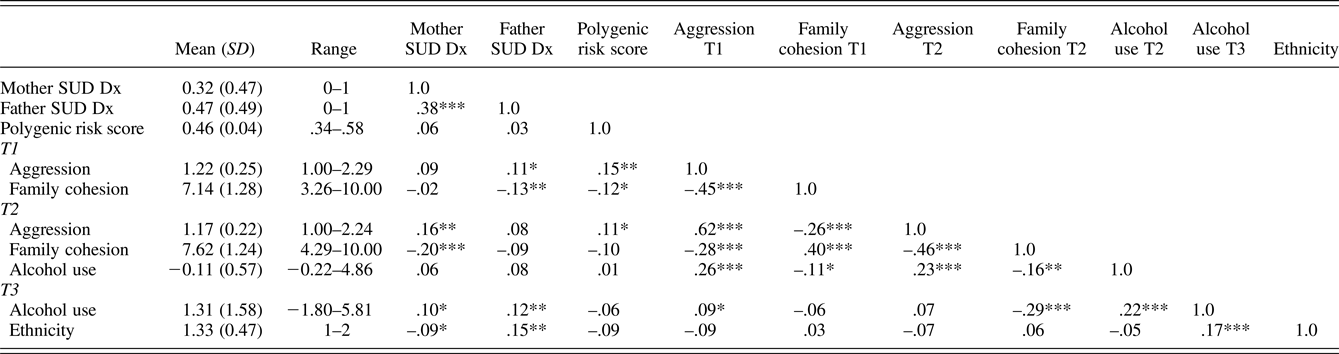
The resulting SNPs were combined into polygenic risk scores using the score procedure in PLINK (Purcell et al., Reference Purcell, Neale, Todd-Brown, Thomas, Ferreira, Bender and Daly2007). We utilized a unit-weighted additive coding approach, such that for each SNP, participants could obtain scores between 0 and 2 (i.e., 0, 1, or 2 “risk” alleles). Scores were created at significance bands of p < .01, .05, .10, and .20. To determine which score explained the greatest variation in aggression, polygenic risk scores were first validated in the second generation of subjects and a p < .10 cutoff composed of 54 SNPs explained the most variance in aggressive behavior in early adolescence (R 2 = .03, p = .005). The same polygenic risk score based on the p < .10 cutoff was subsequently created for children (third generation) in the current study (see supplemental Table S1 for a list of SNPs). Children's polygenic risk scores for aggression were correlated with fathers’ (r = .45, p < .001), and mothers’ (r = .51, p < .001) polygenic risk scores. Children's polygenic risk scores ranged from 0.34 to 0.58 (skew: 0.16; kurtosis: –0.03; means and standard deviations can be found in Table 1).
Means, standard deviations, and correlations among primary constructs

Note: SUD Dx, substance use disorder diagnosis. T1, Time 1 (early adolescence). T2, Time 2 (1 year after T1). T3, Time 3 (early adulthood). Alcohol use at T2 and T3 are factor scores. Ethnicity was coded 1 = European American, 2 = Mexican American. *p < .05. **p < .01. ***p < .001.
We would like to clarify that the meta-GWAS from which the current SNPs were drawn pertain to youth of European ancestry. As such, polygenic risk scores created for the current Mexican American sample should be interpreted with caution. In particular, recent work indicates that when SNPs derived from GWAS in one ethnic group are applied to a polygenic score in another ethnic group, the association of these polygenic scores are likely lower in magnitude due to genetic drift (Martin et al., Reference Martin, Gignoux, Walters, Wojcik, Neale, Gravel and Kenny2017). Given the absence of any GWAS of related phenotypes in Latino samples, we addressed this limitation with the following measures. SNPs were excluded when the minor allele frequency differed across Mexican American and European American subjects. In addition, we controlled for genetic ancestry in analyses combined across Mexican American and European American subjects, which has shown to account for genetic heterogeneity associated with ethnic differences and increase power to detect genetic associations when using diverse samples (Peterson et al., Reference Peterson, Edwards, Bacanu, Dick, Kendler and Webb2017).
Ancestry informative markers
The larger data set of all participants who provided genetic data included 32 ancestry marker SNPs, which in previous literature (Tian et al., Reference Tian, Hinds, Shigeta, Adler, Lee, Pahl and Seiden2007) have differentiated Hispanics from non-Hispanic Caucasians. We included these 32 SNPs in a factor analysis in Mplus, using maximum likelihood estimation. These factor scores significantly correlated with self-reported ethnicity in the larger data set (r = .86, p < .001), suggesting that this ancestry gene score significantly differentiated between European Americans and Mexican Americans. Higher scores indicated lower levels of Hispanic ancestry.
Family cohesion
Family cohesion was conceptualized using a composite of two subscales from the Family Process Scale (Bloom, Reference Bloom1985). Child report was used for both subscales because adolescent substance use should be influenced more by the child's than the parents’ perceptions of parenting behavior (e.g., Chassin et al., Reference Chassin, Presson, Rose, Sherman, Davis and Gonzalez2005).
At T1and T2 children reported on five items (1 = strongly agree to 5 = strongly disagree) regarding levels of conflict, hostility, and low warmth in the family environment (e.g., “We fight a lot in our family” and “Family members rarely criticized each other”; αs = 0.75 and 0.80, respectively). Items were coded to reflect low levels of conflict and hostility in the family environment and were averaged into a single measure.
At T1 and T2 children reported on seven items (1 = strongly agree to 5 = strongly disagree) regarding levels of family organization and cohesion in the family environment (e.g., “When someone in our family promised to do something, you could count on it being done” and “We could never be sure or count on what could happen in our family”; αs = 0.70 and 0.72, respectively). Items were coded to reflect high levels of family organization and cohesion and were averaged into a single measure.
The two measures were correlated within time (T1: r = .53, p < .001; T2: r = .50, p < .001) and were summed into respective T1 and T2 measures conceptually representing family cohesion.
Child aggression
At T1 and T2 children reported on 17 items (1 = not often to 3 = very often) from the aggression subscale of Achenbach's Youth Self-Report Scale (Achenbach & Rescorla, Reference Achenbach and Rescorla2001; e.g., “Gets in fights” and “Threatens others”). Items were coded to reflect high levels of aggression and averaged into a single measure within each time (αs = 0.85 and 0.84).
Offspring alcohol use
At T3 children rated three items assessing their alcohol use. The first two items (rated 0 = never to 7 = everyday) asked how often in the past year they had consumed alcohol, and how often in the past year they had three or more drinks at one time. The third item (rated 0 to 9 or more) asked how many drinks they typically consumed when drinking. These three items were conceptualized as a latent variable at T3. At T2 the same three items were assessed and similarly conceptualized as a latent variable, which was used to control for previous levels of alcohol use.
Parent substance disorder diagnoses
Mothers’ and fathers’ lifetime alcohol and drug abuse and dependence diagnoses were included at T1 using the Substance Abuse Module of the CIDI (World Health Organization, 1990). Diagnoses for abuse and dependence were based on DSM-IV criteria. In the present study, mothers and fathers were individually coded as having no previous lifetime diagnosis (0), or having had either an alcohol or substance disorder diagnosis (1).
Covariates
Covariates were child age and sex. Two-way interactions among covariates were also included.
Statistical analyses
Structural equation modeling with full information maximum likelihood for missing data was used to conduct all primary statistical analyses using a maximum likelihood estimator. We examined all relevant statistical assumptions inherent to the application of structural equation modeling (e.g., multivariate normality) and affirmed a priori. All variables were normally distributed (West, Finch, & Curran, Reference West, Finch, Curran and Hoyle1995) except for child aggression at T1 and T2, which were positively skewed, indicating relatively low levels of aggression. Skewed data were addressed using maximum likelihood estimation with robust standard errors (MLR) in Mplus.
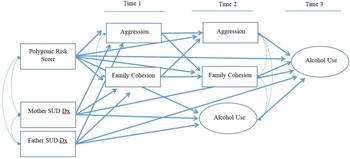
All models were tested using Mplus 7.11 (Muthén, & Muthén, Reference Muthén and Muthén2007). All models used full information maximum likelihood to account for missing data. The full theoretical model was first examined (see Figure 1). Hypothesized pathways were then probed for significant differences by ethnicity (Mexican American vs. European American) using multigroup modeling. The multigroup model was run unconstrained across the two groups, and differences in pathway estimates by ethnicity were tested using the Wald chi-square test of parameter equalities using the MODEL TEST command in Mplus. Indirect effects were estimated using the VIA command in Mplus.
Full theoretical model.

Children's polygenic risk scores were included as predictors of T1 and T2 aggression and family cohesion, and T3 alcohol use. Cross-lagged and autoregressive paths were included between aggression and family cohesion at T1 and T2 (see Figure 1). Aggression and family cohesion at T2 were included as predictors of T3 alcohol use. Alcohol use at T2 was included as a control for alcohol use at T3. Alcohol use at T2 and T3 were modeled as latent variables based on the three respective alcohol items. Correlations were included among distal predictors. All within-time correlations were modeled. Child age, sex, and ancestry scores were included as covariates and mother and father lifetime substance use disorder diagnoses were included as distal predictors.
As part of the AFDP sample, multiple members were assessed from the same family at both the parent level (siblings) and at the child level (siblings and cousins). To account for this interdependence, clustering at the family level was included in Mplus, which adjusts standard errors for multilevel data.
Results
Descriptive analyses
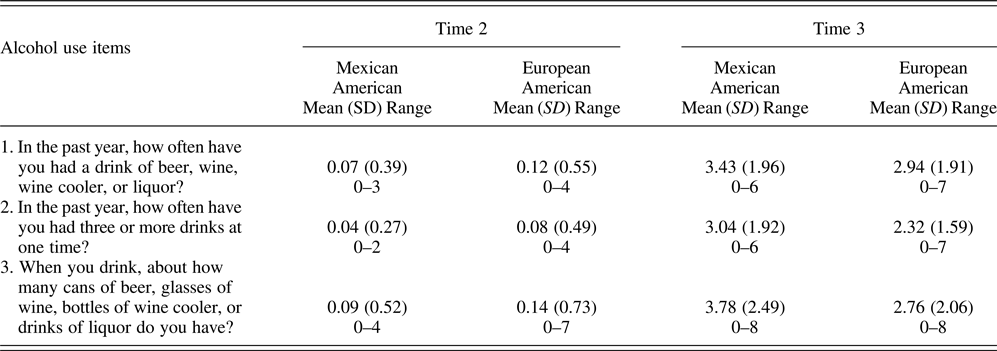
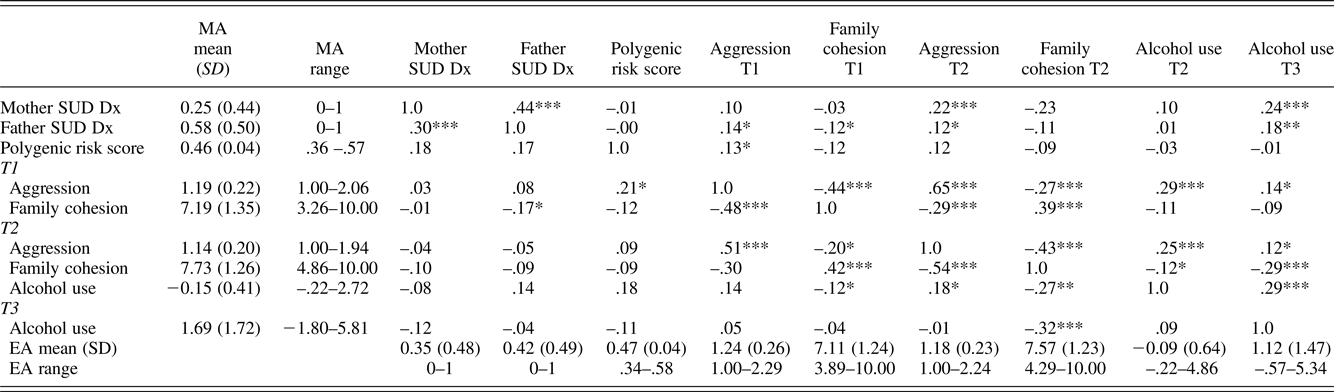
Means, standard deviations, and correlations for the whole sample are presented in Table 1. At both time points levels of aggression were relatively low and there were average levels of family cohesion. At T2 there were low levels of alcohol use and average levels of alcohol use at T3 in early adulthood for both Mexican American and European American adolescents (see Table 2). Differences between the Mexican American and European American subsamples in mean levels of polygenic risk, T1 and T2 family cohesion and adolescent aggression, and T3 alcohol use were examined. The only difference found was a slightly higher level of T3 alcohol use, based on the factor score derived from the latent variable, in Mexican American participants, F (1, 477) = 14.16, p < .001; M = 1.69, SD = 1.72, compared to European American participants (M = 1.12, SD = 1.47). The correlations for the overall sample largely supported the theoretical model. The polygenic risk score was positively associated with aggression at T1 and T2, and negatively associated with family cohesion at T1. Family cohesion and aggression were negatively associated at both times and across time. Only family cohesion at T2 was negatively associated with alcohol use at T3. Means, standard deviations, and correlations are presented separately for Mexican American and European American adolescents in Table 3. Patterns of association partially supported those in the overall sample. Polygenic risk scores were positively associated with T1 aggression in both subsamples but were not significantly associated with T2 aggression in either subsample. Broadly, aggression was negatively associated with family cohesion at both times and across time in both subsamples. Alcohol use at T3 was negatively associated with family cohesion in both subsamples but only aggression in the European American subsample.
Means, standard deviations, and ranges for item-level indicators of alcohol use at Time 2 and Time 3

Note: Item 1 and 2 were rated: 0 = never, 1 = 1–2 times, 2 = 3–5 times, 3 = more than 5 times, less than once a month, 4 = 1–3 times a month, 5 = 1–2 times a week, 6 = 3–5 times a week, 7 = everyday. Item 3 was rated to reflect number of drinks for responses 0–6 (e.g., 1 = 1 drink, 2 = 2 drinks), 7 = 7–8 drinks and 8 = 9 or more.
Means, standard deviations, and correlations among primary constructs for Mexican American (below diagonal) and European American (above diagonal) subsamples

Note: MA, Mexican American. EA, European American. SUD Dx, substance use disorder diagnosis. T1, Time 1 (early adolescence). T2, Time 2 (1 year after T1). T3, Time 3 (early adulthood). Alcohol use at T2 and T3 are factor scores. *p < .05. **p < .01. ***p < .001.
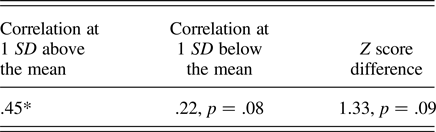
In addition, we examined the possibility that children's aggression led to biased reports of family cohesion. To address this possibility, we compared the correlation between child-reported family cohesion and parent-reported family cohesion (only available at T1) for those adolescents at 1 SD above the mean versus 1 SD below the mean on aggression at T1 using Fisher's r to z transformation and testing the z score difference. We found these correlations did not differ as a function of children's aggression (see Table 4).
Comparison of correlations between parent and child report of family cohesion at Time 1 by adolescent aggression 1 SD above (+1) and below (–1) the mean

*p < .001.
Finally, a post-hoc power analysis indicated that for the effect size of the association between the polygenic risk score and aggression in the second generation of subjects (R 2 = .03), that power was .82 to detect the same effect size in the present third-generation adolescent sample (Cohen, Cohen, West, & Aiken, Reference Cohen, Cohen, West and Aiken2003; Soper, Reference Soper2018).
Full theoretical model
Prior to the structural model, confirmatory factor analysis was used to create separate latent variables of alcohol use with the three alcohol use items at T2 and T3, respectively. The T2 model consisted of an unconstrained latent variable with the three alcohol use items included as uncorrelated indicators. This model had a good fit (root mean square error of approximation [RMSEA] = 0.0, comparative fit index [CFI] = 1.0), with item loadings ranging from .87 to .90. The T3 model was similarly specified, an unconstrained latent variable with the three alcohol use items included as uncorrelated indicators. This model also had a good fit (RMSEA = 0.0, CFI = 1.0), with item loadings ranging from .78 to .97. The highest loading item for the T3 alcohol use latent variable, number of times in the past year having had 3 or more drinks, contributed substantial variance relative to the other two items, indicating this item is foremost representative of this latent variable. These two latent variables were subsequently used within the structural model.
Prior to examining the full structural model, unconstrained associations were examined between the polygenic risk score and family cohesion at T1 and T2. The association with T1 family cohesion was significant but not with T2 family cohesion such that greater genetic risk was associated with lower family cohesion, providing evidence of evocative rGE, T1: B = –.11, SE = .05, p = .029, 95% confidence interval [CI] [–.21, –.012]; T2: B = –.10, SE = .05, p = .060, 95% CI [–.20, .004]. Next, the full structural equation model was tested.
Figure 2 presents standardized results for the full model, χ2 (57) = 164.77, RMSEA = 0.06, CFI = 0.93, Tucker–Lewis index (TLI) = 0.90, for ease of presentation only significant paths are shown. Autoregressive paths were significant between T1 and T2 aggression, B = .63, SE = .05, p < .001, 95% CI [.53, .73], and family cohesion, B = .38, SE = .06, p < .001, 95% CI [.27, .49]. Aggression and family cohesion were significantly correlated at T1, B = –.49, SE = .03, p < .001, 95% CI [–.56, –.43], and T2, B = –.38, SE = .05, p < .001, 95% CI [–.47, –.28].
Theoretical model with standardized results presented. Slash indicates significant difference across Mexican American (before slash) and European American (after slash) adolescents. Analyses control for age, sex, and their interactions. SUD Dx, substance use disorder diagnosis. *p < .05. **p < .01. ***p < .001.
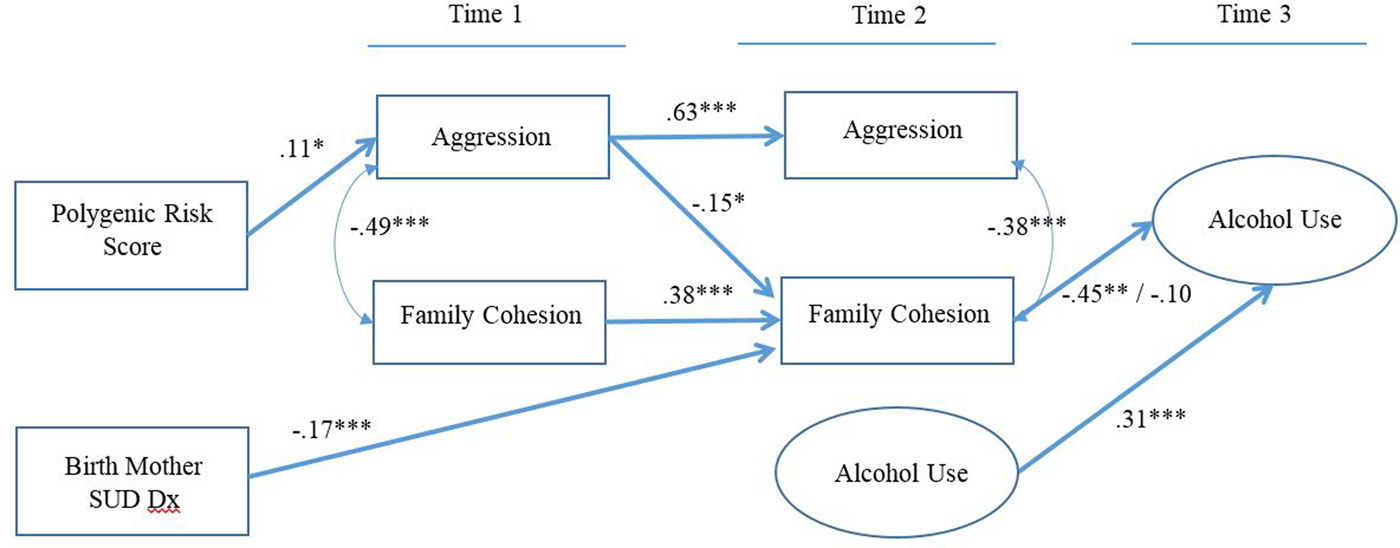
Significant associations were found for substantive paths of interest. A significant association was found between the polygenic risk score and T1 aggression, B = .11, SE =.05, p = .027, 95% CI [.016, .20]. A cross-lagged association was present between T1 aggression and T2 family cohesion, B = –.15, SE = .06, p = .019, 95% CI [–.27, –.022]. Mother's lifetime substance use diagnosis was also associated with T2 family cohesion, B = –.17, SE = .05, p < .001, 95% CI [–.26, –.07]. Family cohesion at T2 was associated with the latent measure of alcohol use at T3, B = –.18, SE = .07, p = .011, 95% CI [–.31, –.05]. Alcohol use at T2, used as a control, was associated with T3 alcohol use, B = .31, SE = .07, p < .001, 95% CI [.19, .44].
These pathways were subsequently examined for significant differences by ethnicity. Only one difference emerged. The association between T2 family cohesion and T3 alcohol use was stronger for Mexican American adolescents, B = –.45, SE = .14, p = .002, 95% CI [–.74, –.18], as compared to European American adolescents, B = –.10, SE = .08, p = .18, 95% CI [–.26, .05; Wald χ2 (1) = 4.31, p = .038. Indirect tests indicated a significant effect for Mexican American adolescents of T1 aggression on T3 alcohol use via T2 family cohesion, B = .12, p = .047; SE = .061, 95% CI [.00, .24], but not for European American adolescents, B = .01, p = .31; SE = .01, 95% CI [–.01, .03].
Discussion
The present study investigated the role of Mexican American and European American adolescents’ genetic predisposition for aggression in evocative rGE with family cohesion during adolescence in pathways to alcohol use in early adulthood. Within this model we considered parents’ lifetime substance use disorder diagnoses as distal predictors and controlled for alcohol use during adolescence. This research adds to the growing number of studies on gene–environment interplay by examining these processes in different ethnic groups.
We hypothesized that there would be a small positive association between our polygenic risk score and aggression in early adolescence. Previous studies have found polygenic risk scores associated with externalizing behavior (Salvatore et al., Reference Salvatore, Aliev, Bucholz, Agrawal, Hesselbrock, Hesselbrock and Dick2015) and behavioral disinhibition (Vrieze et al., Reference Vrieze, McGue, Miller, Hicks and Iacono2013). In creating the polygenic risk scores, we found parents’ scores associated with their own aggression during early adolescence in the overall sample. In the current study we found a positive association between children's polygenic risk scores and their aggression in early adolescence in the overall sample, explaining 1% of the variance in aggression. This validates the current polygenic risk score and reinforces the use of more stringent statistical thresholds when creating such scores. In addition, parents’ and children's polygenic risk scores were highly correlated, indicating intergenerational transmission of genetic predisposition for aggression.
In unconstrained initial direct tests, the polygenic risk score for aggression was related to T1 family cohesion but not related to T2 family cohesion. This association provides evidence for evocative rGE between polygenic risk for aggression and early adolescent family cohesion (T1). In the full theoretical model, the polygenic risk score was associated with T1 aggression, and T1 aggression was correlated with T1 family cohesion. Whereas this reinforces the initial evidence of evocative rGE, the child process implicated in this evocative effect should be viewed as preliminary as these associations exist via the correlation between family cohesion and aggression at the same time point. It is therefore not possible to infer directionality between these constructs. This is supported by previous theories that propose reciprocal effects between adolescent aggression and poor parenting and family processes in the moment (e.g., Klahr, Thomas, Hopwood, Klump, & Burt, Reference Klahr, Thomas, Hopwood, Klump and Burt2013; Patterson, Reference Patterson1982). The trend toward an association between the polygenic risk score and T2 family cohesion precludes firm evidence of evocative rGE later in adolescence, which may represent decreasing evocative effects with age due to adolescents’ increasing independence. As adolescents get older, they may spend less time at home and family cohesion may be less dependent on their behavior. Collectively, these results suggest evocative rGE occurs between polygenic risk for aggression, adolescent aggression, and family cohesion during early adolescence.
It is interesting to note that the effect of the polygenic risk score on aggression, and on family cohesion, did not differ by ethnicity. This finding may indicate similarity in genetic (evocative) processes underlying both child behavior and family functioning across different ethnic groups. This explanation is in line with recent literature finding a tendency to attribute cultural explanations to developmental processes rather than to psychological phenomena, which has led to exaggeration of differences between European Americans and racial/ethnic minorities (Causadias, Reference Causadias, Vitriol and Atkin2018a, Reference Causadias, Vitriol and Atkin2018b). In the present study, it appears that similar evocative genetic processes underlie adolescent aggression and family cohesion for Mexican Americans and European Americans. This highlights that common genetic and child characteristics similarly contribute to developmental family processes in these groups defined by ethnic differences. This study extends previous literature by considering ethnicity, as a proxy for culture, in a genetically sensitive design examining familial pathways to alcohol use. In particular, previous research has examined polygenic risk scores in evocative rGE underlying children's disinhibition in familial pathways to alcohol and substance use (Elam et al., Reference Elam, Wang, Bountress, Chassin, Pandika and Lemery-Chalfant2016, Reference Elam, Chassin, Lemery-Chalfant, Pandika, Wang, Bountress and Agrawal2017). A separate body of literature has examined gene–environment interactions between single candidate genes and parenting in predicting substance use within racial/ethnic minority groups (Brody, Beach, Philibert, Chen, Lei, et al., Reference Brody, Beach, Philibert, Chen, Lei, Murry and Brown2009) and in predicting externalizing behavior across European American and racial/ethnic minority groups (Propper et al., Reference Propper, Willoughby, Halpern, Carbone and Cox2007). This study advances research on gene–environment interplay by examining differences and similarities in genetic processes within the family in Mexican American and European American adolescents.
We next hypothesized there would be moderate cross-lagged associations between family cohesion and aggression across adolescence. In partial support of this hypothesis aggression at T1 was associated with family cohesion at T2 in which greater levels of child aggression contributed to poorer family cohesion over time. This outcome is in line with previous literature showing that adolescent aggression contributes to decreases in family cohesion (Conger et al., Reference Conger, Ge, Elder, Lorenz and Simons1994; Henderson et al., Reference Henderson, Dakof, Schwartz and Liddle2006; Rabinowitz et al., Reference Rabinowitz, Osigwe, Drabick and Reynolds2016). Conversely, family cohesion at T1 was not associated with aggression at T2. The lack of a longitudinal effect from family cohesion to aggression is contrary to some previous literature (e.g., Marsiglia, Parsai, et al., Reference Marsiglia, Parsai and Kulis2009), and may reflect continuity in aggression across early adolescence (Bongers, Koot, Van Der Ende, & Verhulst, Reference Bongers, Koot, Van Der Ende and Verhulst2004; Broidy et al., Reference Broidy, Nagin, Tremblay, Bates, Brame, Dodge and Vitaro2003). This is reflected in the current model by the high stability between T1 and T2 aggression. Stability in aggression can, in part, be due to genetic contributions, which may make aggression less flexible to environmental influences within the family (Salvatore et al., Reference Salvatore, Aliev, Bucholz, Agrawal, Hesselbrock, Hesselbrock and Dick2015; Tuvblad, Raine, Zheng, & Baker, Reference Tuvblad, Raine, Zheng and Baker2009).
Next, we hypothesized that alcohol use in early adulthood would be moderately associated with family cohesion and aggression. In the overall model, aggression at T2 was not associated with alcohol use at T3. There was a small, negative association between family cohesion at T2 and alcohol use at T3. Finally, we hypothesized that family cohesion would more strongly predict alcohol use in early adulthood for Mexican American adolescents compared to European American adolescents. This hypothesis was supported as the pathway from family cohesion at T2 to alcohol use at T3 was stronger for Mexican American adolescents compared to European American adolescents. This was found controlling for alcohol use at T2. We would like to clarify that there were relatively low levels of drinking at T2 given the age of participants, which likely led to a lack of correlation with T2 family cohesion and T2 aggression. Despite this, T2 alcohol use was predictive of T3 alcohol use.
Broadly, past literature indicates that greater family conflict and low levels of family cohesion are related to greater concurrent drinking and substance use, as well as greater drinking later in life for both Latino and European American adolescents (Gutman et al., Reference Gutman, Eccles, Peck and Malanchuk2011; Herrenkohl et al., Reference Herrenkohl, Lee, Kosterman and Hawkins2012; Nomura et al., Reference Nomura, Wickramaratne, Warner, Mufson and Weissman2002). Previous evidence has indicated that greater family cohesion is beneficial for Latino families in reducing substance use (Gil et al., Reference Gil, Vega and Biafora1998; Marsiglia, Kulis, Parsai, et al., Reference Marsiglia, Kulis, Parsai, Villar and Garcia2009; Santisteban et al., Reference Santisteban, Coatsworth, Perez-Vidal, Kurtines, Schwartz, LaPerriere and Szapocznik2003), with mixed evidence that it is preferentially protective for Latino compared to European American adolescents (Bray et al., Reference Bray, Adams, Getz and Baer2001; Kopak et al., Reference Kopak, Chen, Haas and Gillmore2012). Evidence from the current study indicates that family cohesion was more beneficial for Mexican American adolescents. This is in line with previous research showing that family cohesion buffers against adolescent alcohol use in Latino families (Marsiglia, Kulis, Parsai, et al., Reference Marsiglia, Kulis, Parsai, Villar and Garcia2009; Mouttapa et al., Reference Mouttapa, Weiss and Hermann2009). This may reflect that family cohesion is a more central value in Latino families (Comas-Diaz, Reference Comas-Díaz2006; Halgunseth et al., Reference Halgunseth, Ispa and Rudy2006, Santisteban et al., Reference Santisteban, Coatsworth, Briones, Kurtines and Szapocznik2012). This in turn may serve as a form of social control, in which greater cohesion limits adolescents’ exposure to alcohol use (Amato & Fowler, Reference Amato and Fowler2002), through less exposure to deviant peers (German et al., Reference Germán, Gonzales and Dumka2009). A complementary explanation is that family cohesion may create a sense of warmth and support for the adolescent, in which family and cultural values are more readily accepted (Kwak, Reference Kwak2003), and these internalized values contribute to less alcohol use. Less clear is the role of parent substance use disorder in family cohesion as past literature indicates that parents in cohesive families are less likely to have alcohol use disorders (Fraunglass, Routh, Pantin, & Mason, Reference Fraunglass, Routh, Pantin and Mason1997). This was partially supported in the present study through the association between mothers’ substance use disorder and family cohesion at T2, as well as lower mean levels of mothers’ lifetime substance use disorder in Mexican American mothers. However, mothers’ substance use disorder was not associated with T1 family cohesion, and Mexican American fathers had higher mean levels of substance use disorder. Thus, future research should investigate the influence of mother and father substance use disorder on family cohesion.
Collectively, these results support a developmental cascade in which genetic risk for aggression in early adolescence evokes poorer family cohesion (Masten & Cicchetti, Reference Masten and Cicchetti2010). Both previous levels of family cohesion and aggression contributed to family cohesion a year later, which buffered against alcohol use in early adulthood. Within this cascade family cohesion appears to play a greater protective role for Mexican American adolescents compared to European American adolescents. This study contributes to the growing literature attempting to integrate biological and cultural domains in examination of normal and abnormal development (Causadias et al., Reference Causadias, Telzer, Gonzales, Causadias, Telzer and Gonzales2018). It does so by examining polygenic risk for aggression relative to a common family process in both Mexican American and European American adolescents. Results support past literature showing that individual and family-level effects may operate similarly across ethnicity (Barrera, Gonzalez, Lopez, & Fernandez, Reference Barrera, Gonzales, Lopez, Fernandez, Velásquez, Arellano and McNeill2004), and that familial processes should be considered similarly for different groups (Causadias et al., Reference Causadias, Vitriol and Atkin2018a, Reference Causadias, Vitriol and Atkin2018b).
Despite these advances, there are limitations to the present study. First, this study used child report on all measures, raising the possibility of common-method variance. Second, there is also the possibility that children's aggression led to biased reports of family cohesion. We found the correlation between child-reported family cohesion and parent-reported family cohesion did not differ as a function of children's aggression (see Table 4). The latent variable of alcohol use at T3 had one indicator that loaded very highly (number of times in the past year having had three or more drinks at one time), indicating this item is foremost representative of this latent variable. Third, the current sample only included children in two-parent households, so these results may not reflect parent–child transactions in single-parent households or alternative household structures in which parenting may be reliant on a sole caregiver and negative family functioning may be more deleterious to child functioning. Fourth and finally, this study used ethnicity as a proxy for culture in examining different familial patterns to alcohol use. As such, the present sample was fairly acculturated as the sample has lived in the Phoenix metro area for at least two generations. In addition, in examining the only measure of acculturation available, 85% of Mexican American parents spoke only English or more English than Spanish at home when they were children. This presents an opportunity for future research to examine gene–environment interplay relative to more refined measures of cultural processes.
In particular, future research could integrate more explicit measures of culture in examining family processes common to different groups. It would be useful to examine levels of acculturation relative to family cohesion in explaining the current results. Future research could also examine children's genetic predispositions in evocative gene–culture correlations and how they may evoke culturally specific behaviors (Causadias et al., Reference Causadias, Telzer, Gonzales, Causadias, Telzer and Gonzales2018). For instance, familism is a more ethnically bound cultural value embodied in Latino culture, which may influence more general family processes, such as family cohesion (Santisteban et al., Reference Santisteban, Coatsworth, Briones, Kurtines and Szapocznik2012). Taking a strengths-based approach, it would be of value to examine adherence to familism within Latino families (rather than comparing across ethnic groups), and whether it is affected by child aggression and also buffers against alcohol use (Fuller & Garcia Coll, Reference Fuller and García Coll2010). In addition, cultural orientations toward family cohesion, although different, are present in all groups. More research is therefore needed to examine how these cultural processes unfold among European American families as well.
The current findings have important implications for family-based interventions focused on adolescent alcohol use. In particular, it may be beneficial to intervene early in developmental cascades associated with genetic risk through the family (Masten & Cicchetti, Reference Masten and Cicchetti2010). One way this could be accomplished is by improving family cohesion in culturally informed interventions (Santisteban, Mena, & Abalo, Reference Santisteban, Mena and Abalo2013). Current family-based intervention research has found improved family cohesion in Latino families is associated with reduced adolescent behavior problems and substance use (Santisteban et al., Reference Santisteban, Coatsworth, Perez-Vidal, Kurtines, Schwartz, LaPerriere and Szapocznik2003). In line with the current results, it could be helpful to also focus on maintaining a cohesive family environment in the presence of adolescent aggression as a way to decrease risk for alcohol use later in life. These interventions could also target parent risk for substance use given maternal substance disorder contributed to lower family cohesion, helping to prevent the intergenerational transmission of substance use problems.
Supplementary Material
To view the supplementary material for this article, please visit https://doi.org/10.1017/S0954579418000901.