Mastitis is recognised as one of the most important diseases affecting dairy ewes worldwide. The high incidence and prevalence of the subclinical form of mastitis in sheep dairy flocks in Europe affects the yield and quality of the milk, with negative impact on animal health, farm income and public health (Burriel Reference Burriel1997; Saratsis et al. Reference Saratsis, Alexopoulos, Tzora and Fthenakis1999; Bergonier et al. Reference Bergonier, De Cremoux, Rupp, Lagriffoul and Berthelot2003; Leitner et al. Reference Leitner, Chaffer, Shamay, Merin, Saran and Silanikove2004; Kiossis et al. Reference Kiossis, Brozos, Petridou and Boscos2007). The major pathogens causing subclinical mastitis (SM) in sheep are coagulase-negative Staphylococcus spp. (CNS), even though Staphylococcus aureus, Streptococcus uberis and Entetrobacteriaceae have been detected in milk samples from subclinical intramammary infections (Pengov Reference Pengov2001; Contreras et al. Reference Contreras, Sierra, Sanchez, Corrales, Marco, Paape and Gonzalo2007; Vautor et al. Reference Vautor, Cockfield, Le Marechal, Le Loir, Thiery and Lindsay2009).
The scarce bibliographic data regarding SM in ewes and the proved limited use of the available tools for diagnosis of mastitis in cows continue to make SM a diagnostic problem in sheep (Bergonier et al. Reference Bergonier, De Cremoux, Rupp, Lagriffoul and Berthelot2003). Sheep with clinical mastitis are easily detected by inspection and palpation of the teats and udder, and are thus treated (Mork et al. Reference Mork, Waage, Tollersrud, Kvitle and Sviland2007). By contrast, animals with SM remain untreated because the disease may not be observed, owing to the absence of macroscopic abnormalities in the udder and milk. Therefore, the use of laboratory assays is necessary to avoid persistent udder infection and the spread of the disease in dairy flocks. Conventional methods for diagnosis of SM associate clinical evaluation of the udder with cyto-bacteriological examination of milk (Fruganti et al. Reference Fruganti, Ranucci, Tesei and Valente1985; Menzies & Ramanoon, Reference Menzies and Ramanoon2001; Kiossis et al. Reference Kiossis, Brozos, Petridou and Boscos2007). Udder half milk samples with an increase in somatic cell count (SCC) and positive bacteriology for mastitis pathogens are indicative of subclinical inflammation of the mammary gland, but the evidence of only an increased SCC or a positive bacteriology must suggest a uncertain SM (Bergonier et al. Reference Bergonier, Van de Wiele, Arranz, Barillet, Lagrifoull, Condorcet and Berthelot1994, Reference Bergonier, De Cremoux, Rupp, Lagriffoul and Berthelot2003; Fthenakis, Reference Fthenakis and Rubino1996).
Nevertheless, SCC and bacteriological examination are expensive, time-consuming and are not yet in use at the farm level, especially in dairy ewes (McDougall et al. Reference McDougall, Murdough, Pankey, Delaney, Barlow and Scruton2001). Furthermore, even if the SCC in milk from individual quarters is considered a standard indicator of SM in cows (Pyörälä, Reference Pyörälä2003), it may not be a specific sign of the inflammatory status of the udder-halves of ewes, owing to variability due to numerous factors other than intramammary infections such as age, breed, milking management, physiological stage of the animal (lactation stage, dry period), season, numbers of lambs born and stressors (Peris et al. Reference Peris, Molina, Fernandez, Rodriguez and Torres1991; Mavrogenis et al. Reference Mavrogenis, Koumas, Kakoyiannis and Taliotis1995; Leitner et al. Reference Leitner, Chaffer, Caraso, Ezra, Kababea and Saran2001; Bergonier et al. Reference Bergonier, De Cremoux, Rupp, Lagriffoul and Berthelot2003). Thus there is a need to identify and evaluate other specific and rapidly assessable biomarkers that can be used to assess both SM and unfavourable changes in milk quality.
Recently, the acute phase proteins (APPs) have been well investigated as a marker of mastitis in cows (Karreman et al. 2000; Eckersall Reference Eckersall2001; Eckersall et al. Reference Eckersall, Young, McComb, Hogarth, Safi, Weber, McDonald, Nolan and Fitzpatrick2001; Murata et al. Reference Murata, Shimada and Yoshioka2004; Nielsen et al. Reference Nielsen, Jacobsen, Anderson, Niewold and Heegaard2004; O'Mahony et al. Reference O'Mahony, Healy, Harte, Walshe, Torgerson and Doherty2006) but only in a very few studies in sheep (Winter et al. Reference Winter, Fuchs, Walseh and Colditz2003, Reference Winter, Miny, Fuchs and Baumgartner2006).
Nowadays, the limited literature indicates serum amyloid A (SAA) as the most sensitive acute phase protein in ewes, whose concentration increases in the extracellular body fluid mostly in response to inflammatory and infectious conditions both acute and subclinical (Winter et al. Reference Winter, Fuchs, Walseh and Colditz2003; Eckersall et al. Reference Eckersall, Lawson, Bence, Waterston, Lang, Donachie and Fontaine2007; Eckersall & Bell, Reference Eckersall and Bell2010; Ceciliani et al. Reference Ceciliani, Ceron, Eckersall and Sauerwein2012). This protein is produced by the liver and, subsequently, secreted in blood serum in response to pro-inflammatory cytokines (Gronlund et al. Reference Gronlund, Hulten, Eckersall, Hogarth and Persson Waller2003).
Nevertheless, in the case of mastitis, even if the concentration of SAA has been demonstrated to increase over 200-times during acute mammary infection (Winter et al. Reference Winter, Fuchs, Walseh and Colditz2003) it does not seem to be significantly correlated with SM (Winter et al. Reference Winter, Fuchs, Walseh and Colditz2003; Miglio, A et al. unpublished data). In this regard, Winter et al. (Reference Winter, Fuchs, Walseh and Colditz2003) showed that concentration of SAA in sheep with SM experimentally induced, reached rapidly high levels after intramammary infection; these levels were maintained for a short period of time (approximately 2–7 d) and quickly returned to physiological levels even if the ewes continued to have SM.
Recently, in ruminants has been discovered the presence of different isoforms of AA due to its extra-hepatic synthesis in various tissues by macrophages, endothelial cells, smooth-muscle cells and intestinal and mammary epithelium (McDonald et al. Reference McDonald, Larson, Mack and Weber2001; Larson et al. Reference Larson, Weber, Weber and McDonald2005). Particularly, the secretion of mammary-associated AA isoforms (milk amyloid A) has been detected in normal ovine and bovine colostrum, and in milk experimentally and naturally infected with mastitis pathogens (Winter et al. Reference Winter, Fuchs, Walseh and Colditz2003, Reference Winter, Miny, Fuchs and Baumgartner2006; Nielsen et al. Reference Nielsen, Jacobsen, Anderson, Niewold and Heegaard2004; Kovacevic-Filipovic et al. Reference Kovacevic-Filipovic, Ilic, Vujcic, Dojnov and Bozic2012). In this regard, a few studies in ewe (Winter et al. Reference Winter, Fuchs, Walseh and Colditz2003, Miglio, A et al. unpublished data) demonstrate the absence of a significant correlation between the concentrations of AA in serum and milk in course of SM, thus supporting the idea that AA can be synthesised locally in the inflamed ovine mammary gland and proposing milk amyloid A as a more useful diagnostic marker of mastitis in sheep.
The aim of this study was to determine the AA concentrations in milk of single udder-halves in ewes with healthy udder-halves, naturally occurring SM and uncertain SM for monitoring udder health, because of the scarce literature on this topic. Furthermore we investigated, for the first time in ewes, the reliability and the potential value of measuring milk amyloid A with a new milk ELISA kit (MAA) as a more sensitive diagnostic marker for the detection of SM in sheep flocks.
Materials and methods
Animals and milk samples
The study was carried out in 2011 at a dairy farm located in the province of Perugia, Region of Umbria (Central Italy). The farm reared 900 lactating Lacaune sheep kept in an open-sided barn. A total of 500 sheep were in lactation and the animals were milked twice a day in a milking parlour with a milking machine. The animals were fed with mixed hay supplemented with cereal grains. On 8 different days of a 3-month experimental period, 77 mid-lactating sheep (lactation months 3–7), ranging from 2 to 6 years old, were selected based on the absence of overt signs of mastitis (absence of abnormalities in the udder on inspection and palpation as well as of macroscopic changes in the mammary secretion). In addition, a complete clinical examination was performed in order to confirm the sheep were healthy. Given that the apparent healthy clinical status of every sheep was checked, a single milk sampling was performed in each udder-half by using sterile plastic vials at the beginning of the morning milking. Milk samples were refrigerated and analysed within 2 h for bacteriological examination, total microbial count (TMC) and SCC, and then immediately stored at −30 °C until they were analysed for milk amyloid A (MAA).
Case definition (experimental groups)
Three udder-halves groups were categorised based on the single udder-half health status and the analysis of its milk sample. SCC data of each milk sample were analysed according to the cut-off value chosen at 500 000 cells/ml, consistent with the literature pertaining to mammary udder-half milk samples of adult multiparous mid-lactating sheep (Green, Reference Green1984; Bergonier et al. Reference Bergonier, Van de Wiele, Arranz, Barillet, Lagrifoull, Condorcet and Berthelot1994, Reference Bergonier, De Cremoux, Rupp, Lagriffoul and Berthelot2003; Fthenakis et al. Reference Fthenakis, Marples, Richardson and Jones1994; Mavrogenis et al. Reference Mavrogenis, Koumas, Kakoyiannis and Taliotis1995; Waage et al. Reference Waage, Skei, Rise, Rogdo, Sviland and Odegaard2000; Kiossis et al. Reference Kiossis, Brozos, Petridou and Boscos2007; Radostits et al. Reference Radostits, Gay, Hinchcliff and Constable2007).
The udder-halves of all groups showed no abnormalities on inspection and palpation and their milk was not grossly altered (absence of clots in milk).
The subclinical mastitis status of an udder-half (SM group) was confirmed by positive bacteriological examination (presence of mastitis pathogens) and increase of SCC in milk (>500 000 cells/ml).
An udder-half with uncertain subclinical mastitis (UM) was defined based on positive bacteriological examination or SCC>500 000 cells/ml in milk. These changes in milk composition have been indicated as latent subclinical mastitis (Latent-SM group) and nonspecific subclinical mastitis (non-specific-SM group), respectively (Fruganti et al. Reference Fruganti, Ranucci, Tesei and Valente1985; IDF, 1987; Albenzio et al. Reference Albenzio, Taibi, Muscio and Sevi2002).
According to the parameters of the SM and UM experimental groups, a healthy udder-half (HU group) was defined when it did not show overt signs of mastitis (absence of abnormalities in the udder on inspection and palpation as well as of macroscopic changes in the mammary secretion) and milk showed negative bacteriological examination and SCC⩽500 000 cells/ml (control group).
Bacteriological examination and SCC
Bacteriological analysis and somatic cell count (SCC) were performed to establish the HU, UM (Latent SM and non-specific SM) and SM groups.
Bacteriological examination of the udder-half milk samples was carried out in accordance with National Mastitis Council standards (Harmon et al. Reference Harmon, Eberhart, Jasper, Langlois and Wilson1990; Hogan et al. Reference Hogan, Gonzalez, Harmon, Nickerson, Olivers, Pankey and Smith1999). For each sample, about 10 μl of milk were plated into 5% sheep blood agar and then incubated aerobically at 37 °C for up to 48 h. Colonies were isolated and identified by gross morphology and haemolysis. Appropriate biochemical tests were further performed on the colonies isolated to identify the pathogens (API Systems; bioMerieux, Marcy, France).
In each culture, the number of colony-forming units (cfu) per ml were determined for every colony type. The cut-off to categorise a milk sample as positive to mastitis pathogen was defined as growth of five or more identical colonies (⩾500 cfu/ml). Growth of two or more different colonies of environmental bacteria (⩾500 cfu/ml per type) was considered as a contaminated sample.
SCC was assessed in fresh milk by fluoro-opto-electronic cell counting (Fossomatic 5000, Foss Electric, Hillerφd, Denmark).
Amyloid A in udder-half milk samples
Concentration of AA was determined in udder-half milk samples using a specific commercially available milk ELISA kit (Mast ID RANGE, Milk Amyloid A-MAA Assay kit – Tridelta Development Ltd., Wicklow, Ireland; cat. TP-807) as first described by Gerardi et al. (Reference Gerardi, Bernardini, Elia, Ferrari, Iob and Segato2009). The milk ELISA kit is a modified version of the serum ELISA kit (PHASE™ RANGE, Serum Amyloid A-SAA Assay kit – Tridelta Development Ltd., Wicklow, Ireland; cat. TP-802) used to detect amyloid A in blood serum (McDonald et al. Reference McDonald, Weber and Smith1991). The milk ELISA kit is based on different dilutions both of the calibration standards and of streptavidin peroxidase, according to the manufacturer. Milk samples were diluted 1 : 500 with buffer solution according to the manufacturer's instructions for sheep mammary secretion, and all the samples, including the standards, were tested in duplicate. Samples with an optical density outside the range of the standard curve were diluted further and reanalysed. Optical densities were read on an automatic plate reader (model Sunrise; Tecan, Salzberg, Austria) at 450 nm using 630 nm as reference. The limit of detection (LOD) of the ELISAs was 0·10 mg/l for milk (MAA) samples analysed with ELISA kit cat. TP-807, according to the manufacturer.
Statistical analysis
The prevalence of the SM, Non-specific SM, Latent SM and HU, and the confidence intervals (95% CI) were calculated. Mean values and sd of the MAA were calculated to describe the central location and the spread of the data of the concentration into the udder-half groups. The 95% confidence intervals of the MAA mean concentrations of experimental groups were calculated.
The normality of the distribution of the MAA data was assessed by the Shapiro-Wilk test. Data were transformed to a log scale in order to balance the distribution. MAA (mg/l of milk) was transformed as natural log (ln). One-way ANOVA was applied to compare the health status of udder halves, and P<0·05 was considered statistically significant. Bonferroni's multiple comparison test was applied for post hoc comparison.
All the statistical analyses were carried out using Stata 9.1 software.
Results
Bacteriological examination and SCC
A total of 154 udder-half milk samples were collected from the 77 Lacaune sheep considered in the trial. Because in one udder-half milk sample it was not possible to determine the SCC, 153 udder-half milk samples were examined. No contaminated sample was recorded.
The number of udder-halves with SM (presence of mastitis pathogens and SCC >500 000 cells/ml in milk) was 25 and the overall prevalence was 16·3% (CI: 11·0–23·4%). The following pathogens were detected: coagulase-negative Staphylococcus spp. (Staph. epidermidis and Staph. chromogenes), Staph. aureus, Enterococcus faecalis and Streptococcus uberis.
The number of udder-halves with UM was 40 (26·1%): 11 (7·2%) with Latent-SM (presence of mastitis pathogens and SCC ⩽500 000 cells/ml in milk) and 29 (19%) with Non-specific-SM (absence of mastitis pathogens and SCC >500 000 cells/ml in milk). CNS spp. (Staph. epidermidis and Staph. chromogenes) were the only organisms isolated in the milk samples with Latent SM.
The number of healthy udder halves (HU) was 88 (57·5%).
In our investigation the ewes with SM were 22 (28·6%): 3 (3·9%) from both the udder-halves and 19 (12·4%) from one udder-half with the contralateral healthy (14 animals) or with Non-specific SM (5 animals).
The sheep with both the udder-halves healthy (HU) were 23.
The remaining animals (31) had at least one udder-half with UM (44·1%): 11 (44·1%) ewes with Latent SM (all from one udder half) and 20 sheep with Non-specific SM (18 from one udder-half and 3 from both udder-halves).
Amyloid A in udder-half milk samples
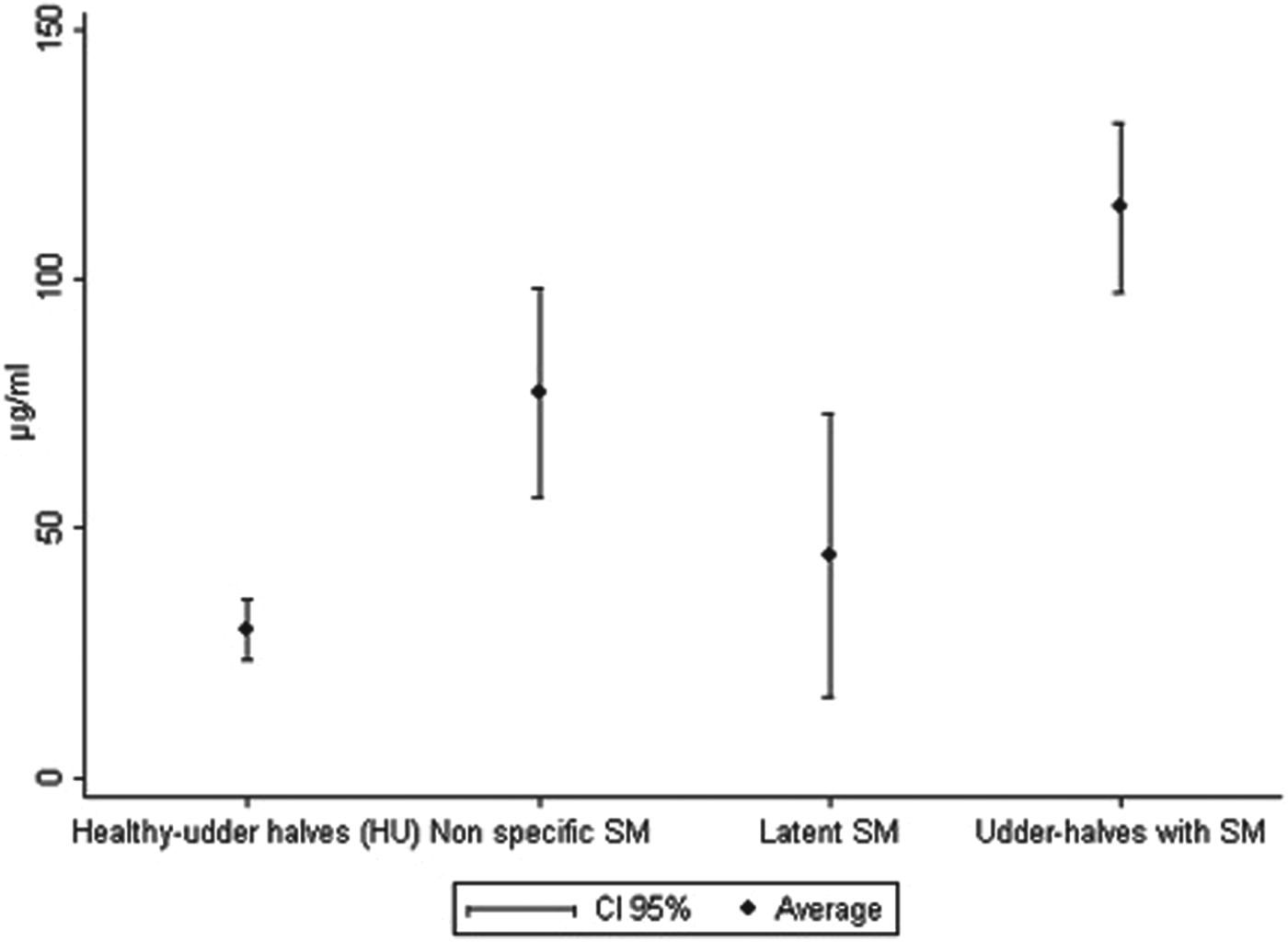
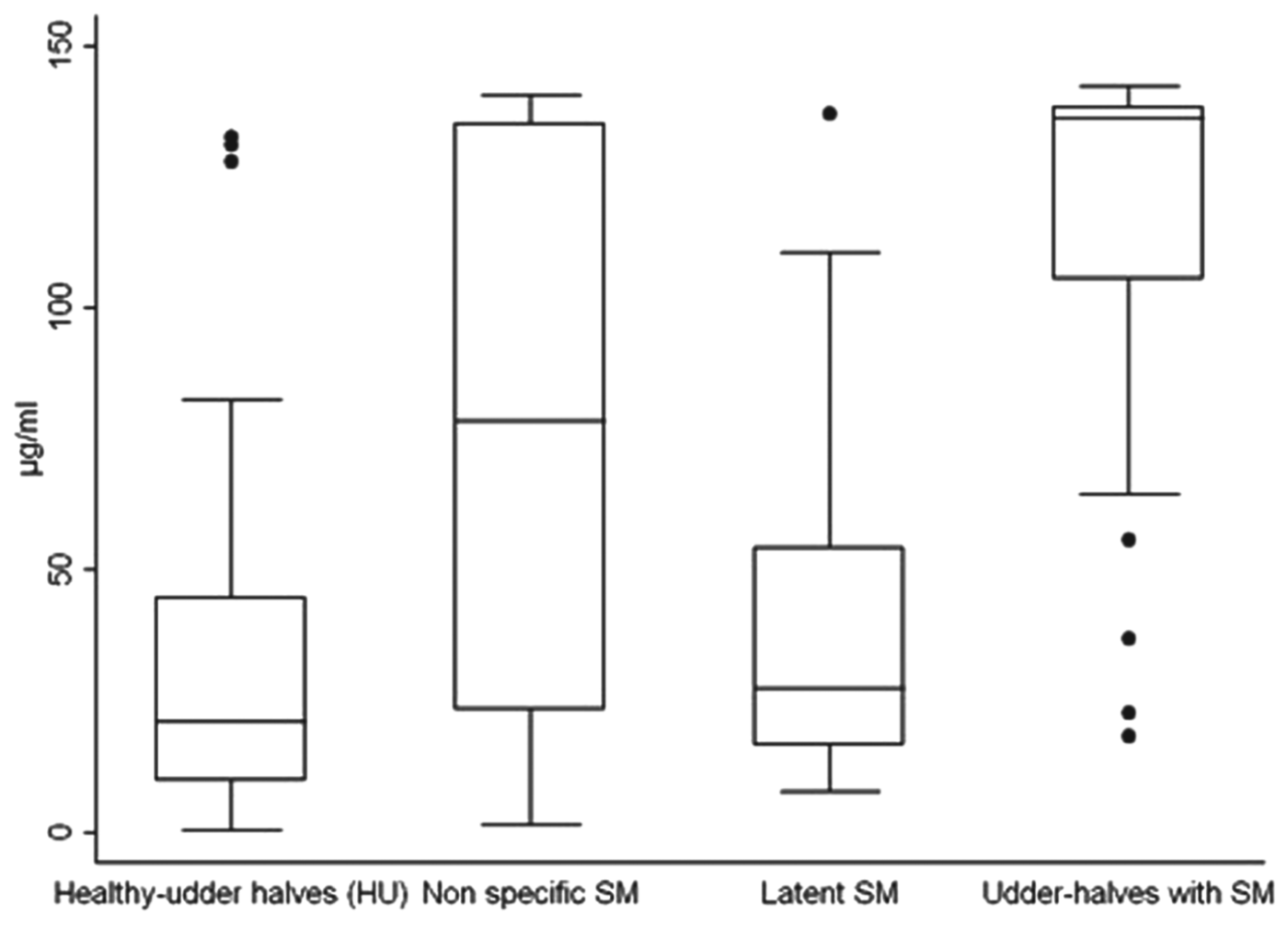
Average values±sd, CI and median values for the MAA were calculated (Table 1, Figs. 1 & 2). MAA concentrations (average and 95% CI) were affected by the healthy udder-half status of sheep (Fig. 1).
Mean and 95% confidence interval for MAA concentration in milk from dairy ewes with udder-halves with subclinical mastitis (SM), uncertain subclinical mastitis (non-specific SM and latent SM) and healthy udder-halves (HU).

Measures of variability [mean, sd, se, minimum (Min), maximum (Max)] and 95% confidence interval for MAA concentration in milk of sheep with udder-halves with subclinical mastitis (SM), uncertain subclinical mastitis (non-specific SM and latent SM) and healthy udder-halves (HU)

Milk amyloid A data were not normally distributed. A log transformation was necessary in order to normalise the distribution of data before carrying out the ANOVA.
MAA data showed a detectable difference in content in the comparison between mastitic (SM group), suspected mastitic (Non-specific SM group) and healthy udder-halves (HU group).
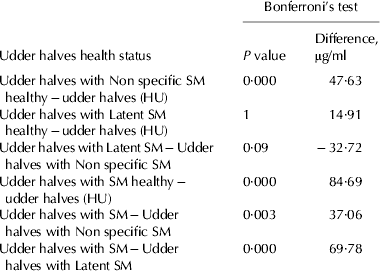
Application of Bonferroni's test between each of all possible pairwise comparisons showed a statistically significant (P<0·05) effect of MAA concentrations and healthy status of the mammary gland (Table 2). Particularly, significant (P<0·05) differences were detected among experimental groups SM, Non-specific SM and HU with SM having the highest level and HU the lowest level. A significant difference was also detectable in the comparison between SM and Latent SM groups, but not between Latent SM and Non-specific SM, and Latent SM and HU groups.
Bonferroni adjustment in pairwise comparisons. Concentration of Milk Amyloid A in milk samples from udder-halves with subclinical mastitis (SM), uncertain subclinical mastitis (non-specific SM and latent SM) and healthy udder-halves (HU)
Discussion
The prevalence of subclinical mastitis in the flock investigated was similar to those reported in the literature regarding lactating ewes from different geographical areas (Watkins et al. Reference Watkins, Burriel and Jones1991), especially with reference to countries in the Mediterranean basin (Italy, Greece, France and Spain) (De La Cruz et al. Reference De La Cruz, Serrano, Montoro, Marco, Romeo, Baselga, Albizu and Amorena1994; Gonzalez-Rodriguez et al. Reference Gonzalez Rodriguez, Gonzalo, San Primitivo, Carmenes and Rodriguez1995; Albenzio et al. Reference Albenzio, Taibi, Muscio and Sevi2002; Bergonier et al. Reference Bergonier, De Cremoux, Rupp, Lagriffoul and Berthelot2003; Contreras et al. Reference Contreras, Sierra, Sanchez, Corrales, Marco, Paape and Gonzalo2007; Kiossis et al. Reference Kiossis, Brozos, Petridou and Boscos2007).
On the other hand, the high percentage of UM found in this study, in agreement with previous reports on lactating ewes (Fthenakis et al. Reference Fthenakis, Marples, Richardson and Jones1994; Albenzio et al. Reference Albenzio, Taibi, Muscio and Sevi2002), emphasises the importance of early identification of this condition in sheep flocks, in view of the higher susceptibility to develop mammary infection in the affected udder-half.
Furthermore, it is important to notice the possible spread of the infection from the affected udder-half to the contralateral gland, as demonstrated in the 3 animals showing both the udder halves with SM. Nevertheless this phenomenon is not commonly detected as suggested by the considerable percentage (25/88; 28%) of milk samples from healthy udder-halves originating from ewes that have the contralateral infected (SM or Latent SM).
Consistent with the results of several studies (Las Heras et al. Reference Las Heras, Dominguez and Fernandez1999; Albenzio et al. Reference Albenzio, Taibi, Muscio and Sevi2002; Al-Majali & Jawabreh Reference Al-Majali and Jawabreh2003; Leitner et al. Reference Leitner, Chaffer, Shamay, Merin, Saran and Silanikove2004; Contreras et al. Reference Contreras, Sierra, Sanchez, Corrales, Marco, Paape and Gonzalo2007; Vautor et al. Reference Vautor, Cockfield, Le Marechal, Le Loir, Thiery and Lindsay2009), in this study environmental pathogens such as CNS and Str. uberis, as well as Staph. aureus and Ent. faecalis, were the prevalent pathogens isolated from the milk of sheep with SM. Similarly, CNS, which are mostly the cause of opportunistic mastitis and are normally found on teat skin, were the only bacteria isolated from the udder-halves with latent SM, as found previously (Fruganti et al. Reference Fruganti, Ranucci, Tesei and Valente1985; Radostits et al. Reference Radostits, Gay, Hinchcliff and Constable2007).
It should be taken into account that the occurrence of latent SM in 11 udder halves tested in our study could be related to cutaneous contamination and subsequent multiplication of bacteria in the udder, chronic CNS infection, initial or final stage of udder inflammation, mastitis with an acute phase of short duration or infection with low pathogenic bacterial strain (Fruganti et al. Reference Fruganti, Ranucci, Tesei and Valente1985; Saran & Leitner, Reference Saran, Leitner and Zecconi2000).
Similarly, in the 29 udder-halves with non-specific SM detected, even if the SCC was high, it may not have been possible to isolate the aetiological agent owing to a number of causes: its poor concentration or intermittent excretion, the mastitis pathogens were not detectable using the conventional bacteriological tests, the infection was supported by endotoxins, or the biomarkers of the immunity response (lysozyme, lactoferrin and neutrophil granulocytes) may have thwarted the pathogen detection or elimination (Fruganti et al. Reference Fruganti, Ranucci, Tesei and Valente1985; Saran & Leitner, Reference Saran, Leitner and Zecconi2000; Albenzio et al. Reference Albenzio, Taibi, Muscio and Sevi2002).
Sheep with both these alterations should necessarily be identified, isolated, properly treated and then re-examined to avoid the spread of the infection in the flock.
Recent reports demonstrate that AA concentrations, evaluated in ovine milk with a serum ELISA kit (mAA), reflect the severity of mastitis; the increase in mAA levels during experimentally induced Staph. epidermidis (Winter et al. Reference Winter, Fuchs, Walseh and Colditz2003) and naturally occurring (Winter et al. Reference Winter, Miny, Fuchs and Baumgartner2006) SM in ewes has been demonstrated. To our knowledge, this is the first study to report the use of a more sensitive assay (milk ELISA kit TP-807, Milk Amyloid-MAA) to determine amyloid A in sheep udder-half milk samples.
The results indicate that there were different concentrations of MAA in the experimental groups, although a statistically significant difference (P<0·05) was observed only between udder-halves with SM, Non-specific SM and HU.
Particularly, MAA concentrations were significantly higher in the SM group (mean±se: 114·37±8·23 μg/ml) compared with Non-specific SM (77·31±10·27 μg/ml), Latent SM (44·59±7·77 μg/ml) and HU (29·68±2·98 μg/ml) groups.
In our study the mean MAA concentration of the udder-halves with SM was similar to what recorded by Winter et al. (Reference Winter, Fuchs, Walseh and Colditz2003) (171±141·7 μg/ml) and Winter et al. (Reference Winter, Miny, Fuchs and Baumgartner2006) (121±25·3 μg/ml) in the same animal species and tends to be higher than those reported in affected bovine quarters (Eckersall Reference Eckersall2001; Gronlund et al. Reference Gronlund, Hulten, Eckersall, Hogarth and Persson Waller2003, Reference Gronlund, Hallen Sandgren and Persson Waller2005; Nielsen et al. Reference Nielsen, Jacobsen, Anderson, Niewold and Heegaard2004; Gerardi et al. Reference Gerardi, Bernardini, Elia, Ferrari, Iob and Segato2009; Safi et al. Reference Safi, Khoshvaghti, Reza, Bolourchi and Nowrouzian2009; Kovacevic-Filipovic et al. Reference Kovacevic-Filipovic, Ilic, Vujcic, Dojnov and Bozic2012). This finding could be explained because mastitis in dairy ewes is characterised by AA concentrations in milk that peak at least 10-fold higher than in cows in the acute form and remain at higher levels in the subclinical form (Winter et al. Reference Winter, Miny, Fuchs and Baumgartner2006).
Interestingly, in this trial the healthy udder-halves showed MAA concentrations higher than those found by Winter et al. (Reference Winter, Fuchs, Walseh and Colditz2003) (mean 1·4 μg/ml) and Winter et al. (Reference Winter, Miny, Fuchs and Baumgartner2006) (mean 8·6 μg/ml) in ewes of the same breed. It could be due to the more sensitive assay we used to determine MAA that has a lower LOD (0·10 mg/l), which allows it to detect lower quantities of amyloid A than the serum ELISA kit TP-802 (mAA).
In our study, values of MAA identified in healthy udder-halves ranged from 23·75 to 35·61 μg/ml (CI) and were higher than the reference range (0–7·5 μg/ml) identified in healthy bovine quarter milk with the same ELISA kit by Gerardi et al. (Reference Gerardi, Bernardini, Elia, Ferrari, Iob and Segato2009) and than those found using the serum ELISA kit by other authors (Eckersall Reference Eckersall2001; Gronlund et al. Reference Gronlund, Hulten, Eckersall, Hogarth and Persson Waller2003; Nielsen et al. Reference Nielsen, Jacobsen, Anderson, Niewold and Heegaard2004; Gerardi et al. Reference Gerardi, Bernardini, Elia, Ferrari, Iob and Segato2009). This suggests that normal ovine milk contains a greater amount of this APP than bovine milk.
Additionally, in our study MAA concentrations of udder-halves with SM and Non-specific SM were in the range 97·39–131·35 μg/ml (CI) and 56·28–98·35 μg/ml (CI), respectively. Surprisingly, these results show that the detection of the marker MAA with the Milk ELISA kit is also useful to differentiate the healthy udder-half from those with high SCC and to distinguish between a highly cellular milk sample with mastitis pathogen and one with high SCC but not pathogens.
Furthermore, in the present study, there was a tendency for higher MAA concentration in udder-halves with Latent SM compared with HU and a higher MAA concentration in udder halves with Non-specific SM compared with Latent SM, even though these differences were not significant (P=1 and P=0·09, respectively). The lack of significant differences among the groups Latent SM and the Non-specific SM, and between the groups Latent SM and HU may be related both to the limited number of cases of Latent SM and to the small concentration of bacteria they contain. Indeed, recently, it has been demonstrated that levels of MAA seem to be associated even with the quantity of bacterial DNA in the milk sample (Kalmus et al. Reference Kalmus, Simojoki, Pyörälä, Taponen, Holopainen and Orro2013).
In conclusion, this study contributes to supporting the importance of the acute phase protein MAA as a sensitive diagnostic marker of SM in ewes, with particular emphasis on the use of the specific milk ELISA assay. Furthermore, we consider that the concentration of MAA can be a useful indicator of mammary gland inflammation and of unfavourable changes in milk quality in sheep, although a clear and standardised cut-off value for the healthy udder-half should be confirmed. These results encourage further study on the physiology of MAA in sheep breeds different from the Lacaune included in our trial, and which is considered one of the most resistant to mastitis (Barillet et al. Reference Barillet, Rupp, Mignon-Gasteau, Astruc and Jacquin2001; Rupp et al. Reference Rupp, Bergonier, Dion, Aurel, Robert-Granier and Foucras2009). More studies are also needed to confirm the usefulness of MAA to detect milk samples with mastitis pathogens but not high SCC (latent SM). Although MAA determination requires an ELISA method that is carried out routinely only in reference laboratories, systematic control of this biomarker on dairy farms could reduce the laboratory costs and the time required for milk analysis. The online measurement of this protein with automated milking systems could enable early detection of mammary inflammation and infection, reducing the economic impact and improving the health and welfare of dairy ewes as well as public health. Moreover, even the determination of MAA in a given period of time could be useful in monitoring the health status of the ovine mammary gland.
Difference between concentrations of Milk Amyloid A in milk from dairy ewes with udder-halves with subclinical mastitis (SM), uncertain subclinical mastitis (non-specific SM and latent SM) and healthy udder-halves (HU). The plots show the median (line within box), 25th and 75th percentiles (box), 10th and 90th percentiles (whiskers) and outliers (dots).
None of the authors of this paper has a financial or personal relationship with other people or organisations that could inappropriately influence the content of the paper.