Introduction
It is an important aspect to improve the separation efficiency of excitons in the bulk heterojunction active layer of organic solar cells (OSCs).[Reference Clarke and Durrant1–Reference Zhang, Chen, Ma, Xie, Liu, Yu and Han4] During the process of exciton separation, the excitons migrate to the interface of the donor and the acceptor due to the concentration gradient. In organic semiconductor materials, singlet excitons binding energy is about 0.5 eV, while thermal energy at normal temperature is only about 25 meV, so it is impossible to drive exciton separation to generate free carriers.[Reference Clarke and Durrant1,Reference Cao, Zhang, Zhou, Yu, Liu, Han and Xie5,Reference Vandewal, Tvingstedt, Gadisa, Inganas and Manca6] Therefore, the heterojunction in the active layer film serves to promote efficient separation of excitons. At the interface, due to the different electron affinity between the two materials and the existence of the ionization potential, the energy offset is generated, thus creating the necessary conditions for exciton separation. To achieve exciton separation at the interface, the energy offset should be greater than the Coulomb binding energy of the exciton, thereby resulting in the charge transfer (CT) states. When the energy is sufficient to cause the electron–hole pair spacing to gradually increase until it is larger than the Coulomb capture radius, the CT state gradually separates.[Reference Holliday, Li and Luscombe7]
In the previous research, it has been found that in the model of bulk heterojunction, in addition to the pure phases, there are also mixed phases of the donor and the acceptor.[Reference Sweetnam, Graham, Ngongang Ndjawa, Heumuller, Bartelt, Burke, Li, You, Amassian and McGehee8–Reference Zhang, Liu, Yu and Han11] The presence of the mixed phase can promote the performance of the device and not the strong crystallization is better.[Reference Osaka, Benten, Ohkita and Ito12,Reference McDowell, Abdelsamie, Toney and Bazan13] When there are more amorphous phases in the system, it is still possible to obtain a higher device performance.[Reference Jamieson, Domingo, McCarthy-Ward, Heeney, Stingelin and Durrant14,Reference Bartelt, Beiley, Hoke, Mateker, Douglas, Collins, Tumbleston, Graham, Amassian, Ade, Fréchet, Toney and McGehee15] Relative to the pure phases, due to intermolecular interactions and the changes in the conjugation length, the positions of the valence bands for pure and mixed phases have a difference, resulting in a decrease in the highest occupied molecular orbital (HOMO) level. Thus, this contributes to the construction of the donor–cascade–acceptor structure, which encourages the separation of excitons and also helps to reduce bimolecular recombination. Groves used kinetic Monte Carlo (KMC) simulations to simulate the effect of energy cascade in the system (cascade may be mixed phases or ternary component), and it was found that cascade can effectively promote exciton separation, and the HOMO edge offset had an important influence on separation.[Reference Groves16] Therefore, in the optimization of OSCs, the important role of the mixed phases should be considered.
How to make rational use of the energy cascade brought by the mixed phases and effectively realize that the charge separation is still a problem worth exploring.[Reference Huang, Kramer, Heeger and Bazan17–Reference Huang, Amonoo, Li, Chen and Green19] McGehee and coworker demonstrated by KMC simulations of a three-phase model that the presence of mixed phases can bring energy offsets of up to 200 meV.[Reference Burke and McGehee20] They also found the presence of a suitable amorphous phase may result in energetic offsets due to bandgap widening of the donor, thereby promoting exciton separation and reducing charge recombination.[Reference Holliday, Li and Luscombe7] On the other hand, excessive mixed phases hinder the improvement of device performance, and the presence of a large number of amorphous phases leads to severe charge recombination in the system.[Reference Tsoi, Spencer, Yang, Ballantyne, Nicholson, Turnbull, Shard, Murphy, Bradley, Nelson and Kim21] Collins and coworkers found that in the small molecule system, it is necessary to balance the pure phase and the mixed phases. When the DIO additive was used to enhance the crystallinity of the small molecule, the charge carrier collection is poor, and there are more charge traps.[Reference Alqahtani, Babics, Gorenflot, Savikhin, Ferron, Balawi, Paulke, Kan, Pope, Clulow, Wolf, Burn, Gentle, Neher, Toney, Laquai, Beaujuge and Collins22] A lot of works have confirmed that the mixed phases in the three-phase model are effective to charge separation, but few people have studied the content of mixed phases.
In this article, we studied the different content of mixed phases and their effects on an all-small-molecule system. We first formed the largest extent amount of mixed phases by the additive cinene (2%), and then we obtained different content of mixed phases through solvent vapor annealing (SVA) for different times.[Reference Liang, Han, Song, Wang, Xin, Yu, Xie, Ma, Liu and Han23–Reference Yang, Zhang, He, Zhang, Yang, Zhu, Cui, Zhao, Zhang, Zhang, Wei and Hou28] As the content of the mixed phases changed, the device performance showed a regular change. Finally, we obtained an optimized content of mixed phases to confirm that the content of mixed phases has a significant impact on device performance.
Results and discussion
Different content of mixed phases
In the all-small-molecule system DRTB-T(5Z,5'E)-5,5'-((4,4',4'',8,8',8''-hexakis(5-(2-ethylhexyl)thiophen-2-yl)-[2,2':6',2''-terbenzo[1,2-b:4,5-b']dithiophene]-6,6''-diyl)bis(methanylylidene))bis(3-ethyl-2-thioxothiazolidin-4-one) and IDIC (2-((Z)-2-((7-(((1E,2Z)-1-(cyano(isocyano)methylene)-3-oxo-1,3-dihydro-2H-inden-2-ylidene)methyl)-4,4,9,9-tetrahexyl-4,9-dihydro-s-indaceno[1,2-b:5,6-b']dithiophen-2-yl)methylene)-3-oxo-2,3-dihydro-1H-inden-1-ylidene)malononitrile), the crystallinity of the donor and acceptor is strong, and the content of the mixed phase in the system is low, which is not conducive to promoting the separation of the CT state to generate free carriers. To achieve a suitable content of the mixed phase, we first inhibit the crystallization of the materials by additives, form a large number of mixed phases in the system, and then promote the crystallization of the donor and acceptor by SVA. Thus, the content of the mixed phases decreases accordingly.
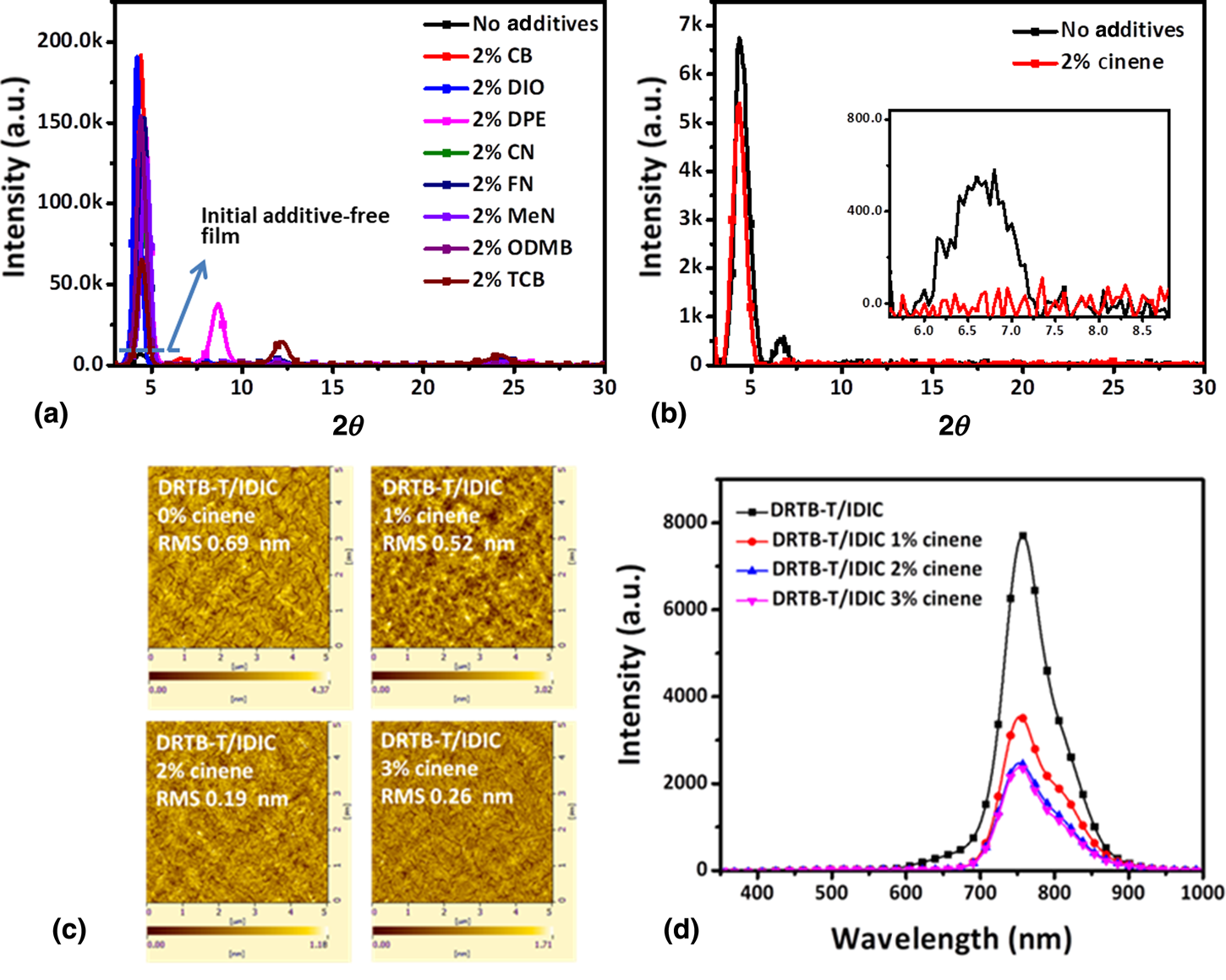
First, we tried to select an additive to achieve inhibition of the crystallization of the DRTB-T/IDIC. We selected the additives, such as chlorobenzene (CB), 1,8-diiodooctane (DIO), diphenyl ethers (DPE), chloronaphthalene (CN), fluoronaphthalene (FN), methylnaphthalene (MeN), o-dimethoxybenzene (ODMB), 1,2,3-trichlorobenzene (TCB), and cinene. Figures 1(a) and 1(b) show the corresponding GIXD diffraction peak intensity with several common additives. The GIXD diffraction peaks of the (100) plane of the donor DRTB-T located at around 4.5°, and the GIXD diffraction peaks of the (010) plane of the acceptor IDIC located at around 25.5° (Supplementary Fig. S1). The variation of the diffraction peak intensity of DRTB-T under additive treatment was the most significant. As shown in the figure, the untreated blended film has a diffraction peak intensity of about 6700. By adding a certain amount of the above additives except cinene to the solvent of the acceptor blending solution, the diffraction peak intensity of DRTB-T at about 4.5° is increased to 50k or more. Where DIO and CB additives are used, their strength was even close to 200k. After adding cinene, the intensity of the DRTB-T crystallization peak represented by 2θ = 4.5° decreased from 6700 to 5500, and the crystallization peak of IDIC at 2θ = 6.7° disappeared. Different from other additives, we found that when the cinene was used as an additive in the system, a distinct effect from the above-mentioned common additives can be obtained. After the addition of cinene, both the crystallinity of DRTB-T and IDIC decreased, and the ordered aggregation was inhibited to a certain extent, and the phase size of the film became smaller. But the other additives promoted the further crystallization of the materials. The crystallization further reduced the content of the mixed phase in the system and runs counter to the regulation we want. In the process of crystallization-induced phase separation, the phase region size of the system was improved. The film's roughness became larger and showing a state of matte. Too high crystallinity will inevitably lead to a reduction of the content of mixed phases. Under such conditions, it is difficult to achieve effective regulation of the mixed phases. Therefore, we believe that the cinene additive makes the crystallinity of the acceptor in the blended film lower, and there are more amorphous states, which makes a large number of mixed phases formed in the system so that different contents can be achieved in the subsequent treatment process. The reduction in the domain size also indicates that the crystallization of the material is inhibited, resulting in more mixed phases. The atomic force microscopic (AFM) images can effectively confirm the reduction of the domain size of the film after the introduction of the cinene. Figure 1(c) shows the morphology of the initial blended film and the addition of 1%, 2%, and 3% of the cinene additives. It can be seen that the roughness of the film in the presence of the additive is reduced from 0.69 to 0.52, 0.19, and 0.26 nm, respectively. In the case of the additive solution, the spin-coated active layer morphology tends to be smoother, and there may be more mixed phases rather than crystallization, resulting in a decrease in the size of the phase region. A series of PL of the film can also demonstrate the variation of the content of mixed phases. Figure 1(d) shows the fluorescence spectrum of the initial film with the addition of 1%, 2%, and 3% of cinene additive. It can be seen from the PL that after adding the cinene additive, the fluorescence intensity in the film range is weakened, and as the cinene content increases, the fluorescence intensity decreases, indicating that the content of mixed phases increased. When 2% or 3% cinene was added, there is little difference in the PL intensity. Therefore, by optimizing the morphology of the film, small surface roughness and domain size can be achieved by adding 2% cinene, so we chose 2% cinene as the additive. It is an additive that meets our requirements and can greatly inhibit the crystallization of materials, allowing them to be more fully blended in an amorphous state, thereby forming the largest content of mixed phases in the system.
(a) GIXD profiles of the blend film under several additives. (b) GIXD profiles of DRTB-T/IDIC without cinene and with 2% cinene. (c) AFM images of DRTB-T/IDIC without cinene and with 1% cinene, 2% cinene, and 3% cinene. (d) PL of DRTB-T/IDIC without cinene and with 1% cinene, 2% cinene, and 3% cinene.

As mentioned above, by adding additives, the largest amount of mixed phases in the DRTB-T/IDIC blends was obtained. Next, we tried to regulate the content of the mixed phases by SVA (Supplementary Fig. S2). Supplementary Figure S3(a) shows the corresponding GIXD diffraction peak intensity of DRTB-T/IDIC with 2% cinene under different times of SVA. The GIXD diffraction peaks of the (100) plane of the donor DRTB-T located at around 4.5°, and the acceptor IDIC located at around 7°. With the time of SVA from 0 to 50 s, the diffraction peak intensity of DRTB-T increased, and the diffraction peak intensity of IDIC increased. As the time of SVA increasing, the content of mixed phases decrease. Besides, the reduction in the mixed phases due to crystallization can also be reflected in the morphology of the blend film. As the molecules were orderly aggregated during the SVA process, the content of mixed phases was reduced, and the domain size was also increased. The morphology of the active layer film before and after SVA can be characterized by AFM. As shown in Supplementary Fig. S3(b), the active layer film with 2% cinene and without SVA has a roughness of only 0.19, showing a relatively smooth structure. After DCM SVA for 50 s, the content of mixed phases further decreased, and the film roughness was significantly increased to 2.39. Also, the transmission electron microscropic images can achieve the same conclusion as the AFM (Supplementary Fig. S4). Therefore, different content of the mixed phases was produced by using DCM SVA at different times.
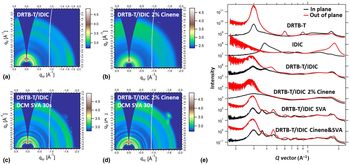
Changes in the content of the mixed phases are also indirectly reflected in the crystallographic data. To laterally reflecting our regulation effects on the content of mixed phases, grazing-incidence wide-angle x-ray scattering (GIWAXS) was carried out to monitor the variation of the crystallinity of the film under four conditions. It was shown in Figs. 2(a)–2(d), with the corresponding line cuts for the diffraction features presented in Fig. 2(e). The neat DRTB-T film has obvious diffraction peaks at 0.30 A−1. At the same time, there was an obvious π−π stacking peak in the out-of-plane direction at 0.38 A−1 in neat IDIC film. After we added 2% cinene additive to the solution, the diffraction peaks of DRTB-T and IDIC both have fallen, indicating that the materials hardly crystallized in such an environment and were inclined to form an amorphous state, thus producing a large number of mixed phases. In the subsequent SVA process, DRTB-T and IDIC continued to move under the action of DCM vapor, and the crystallization continued to increase, and the diffraction peaks of both are enhanced, the content of the mixed phases decreased with the SVA process. It can be seen from Fig. 2(e) that the crystallinity of DRTB-T did not change greatly compared with the film under direct SVA conditions by the treatment of the prior additive. Therefore, it can be demonstrated by the present data that in the case of a blend film with a large number of mixed phases, we can control the content of the mixed phase by DCM SVA, thereby obtaining a suitable content of mixed phases.
GIWAXS diffraction profiles of (a) DRTB-T/IDIC, (b) with 2% cinene, (c) with DCM SVA 30 s, and (d) with 2% cinene and with DCM SVA 30 s. (e) The line cuts for the diffraction features for DRTB-T and IDIC and blend films.

In addition, after adjusting the content of mixed phases, we expect that the domain purity will not be affected. In order to verify that the treatment did not have a major impact on the domain purity, we conducted the resonant soft x-ray scattering (RSoXS) test, and the results were shown in Supplementary Fig. S5. The photon energy was 284.2 eV. The relative domain purity can be achieved by calculating the total scattering intensity through the integration of the scattering profiles over the q range and taking film thickness into account. We set DRTB-T/IDIC with DCM SVA to 1.0; in the calculation, we found that the domain purity of DRTB-T/IDIC was 0.85, the domain purity of DRTB-T/IDIC with 2% cinene decreased to 0.57, and the domain purity of DRTB-T/IDIC with 2% cinene and with DCM SVA 30 s was 0.99, which was close to 1.0. The addition of cinene reduced the content of the mixed phases, resulting in a decrease in the domain purity, so the domain purity of the blend film with the addition of 2% cinene was lowest. The DCM SVA process can effectively improve domain purity. Finally, the blend film with 2% cinene and with DCM SVA 30 s can also achieve a higher domain purity.
Energy cascade of different mixed phases
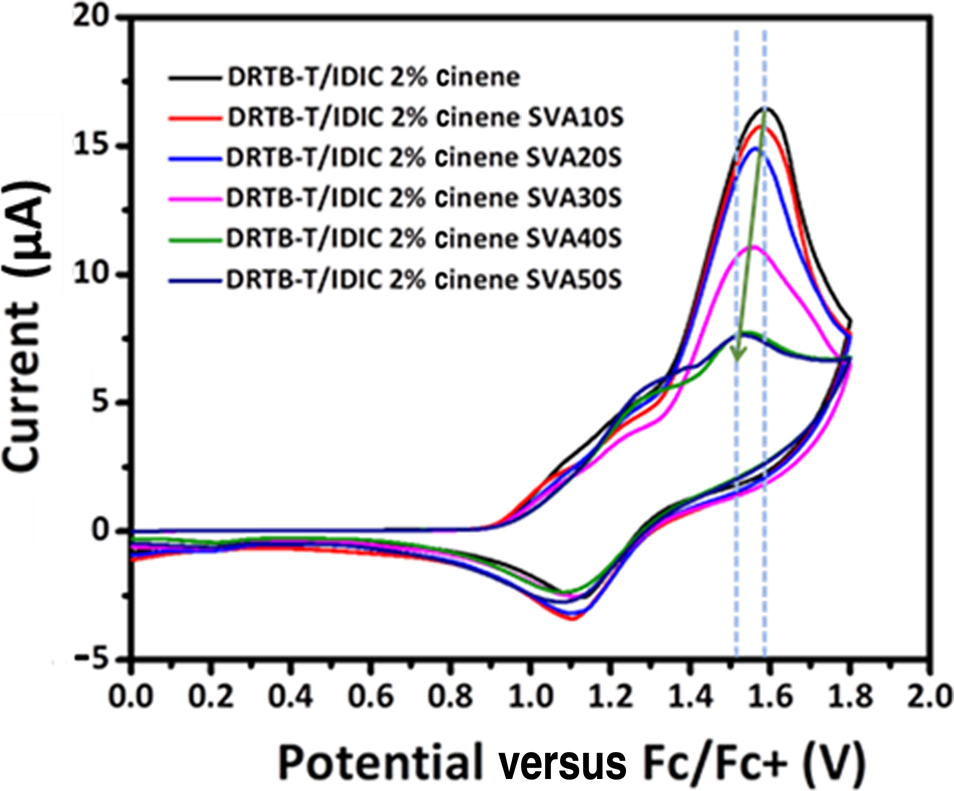
By achieving different contents of mixed phases in the system, ΔE will become smaller as the content of the mixed phases decreased. In order to illustrate the difference energetic offsets caused by the change in the content of mixed phases, we characterized the film under different times of SVA by cyclic voltammetry (CV) (see Fig. 3). The aggregated phases and the mixed phases cause a change in the bandgap due to the variety in the conjugation length. A disorder-induced increase in bandgap corresponds to the deeper valence bands of the materials and results in an energetic offset between aggregated phases and mixed phases. The shift in material level has a critical impact on the power conversion efficiency (PCE) of the device. The reduction of the HOMO energy level of the donor makes the CT state easier to separate, and the resulting energy level shifting makes it easier to migrate free carriers from the mixed phases into the crystalline material, thereby facilitating the reduction of bimolecular recombination and improved charge separation and migration. The oxidation peak of the aggregated donor and acceptor locates at 1.0 and 1.3 V, respectively. The highest potential oxidation peak represents the mixed phases in the system. As the SVA proceeds, the content of the mixed phases in the system decreased, the energetic offsets caused by disorder states decreased, and the oxidation peak of the mixed phases moved toward a low potential. The ΔE at different content of mixed phases can be inferred by the change in the peak position of the mixed phases. ΔE was calculated by the equation ΔE = e(P 3−P 1), where P 3 and P 1 represent the peak of the mixed phases and the peak of the aggregated DRTB-T, respectively. The oxidation peak of the CV curves of SVA treatment for 10–50 s can be seen in Table I. The calculated ΔE is also shown in Supplementary Table S1. By calculation, the ΔE of SVA treatment for 0–30 s were 0.529, 0.518, 0.507, 0.498, 0.485, and 0.477 eV. It can be verified that we have established a large number of mixed phases by using additives first and then promoted crystallization of the materials by SVA, effectively altered the content of mixed phase, thereby achieving different ΔE.
CV curves of DRTB-T/IDIC film with DCM SVA 0–50 s.

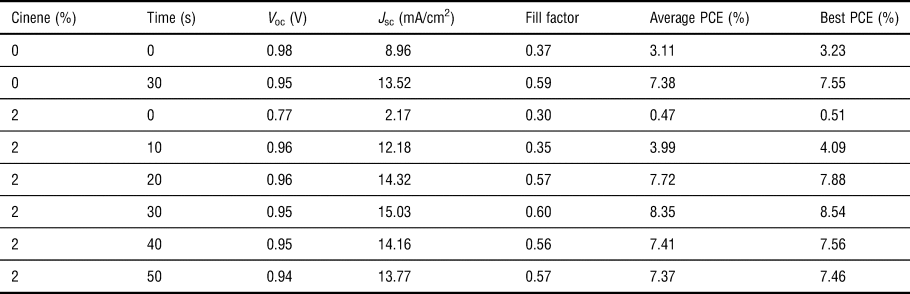
Devices of DRTB-T/IDIC with DCM SVA at different times.

The average PCE values with standard deviations were obtained from 10 devices.
Device performances
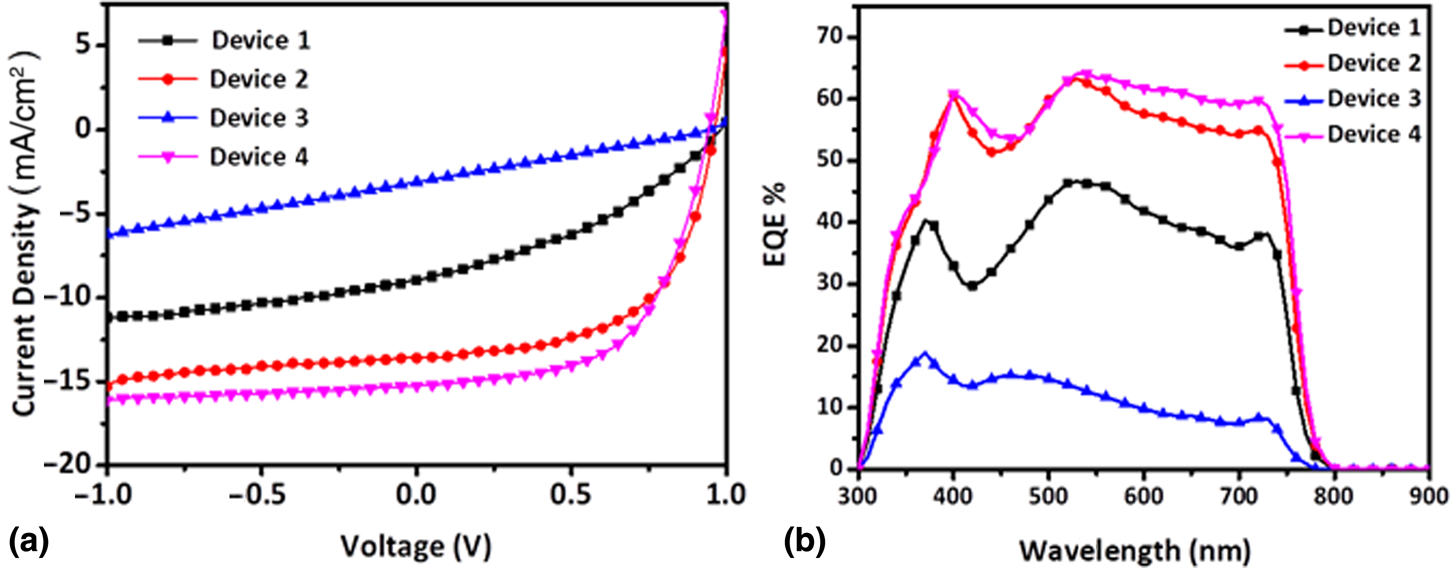
It can be reflected by the performance of the device that maintaining a suitable content of mixed phases is beneficial to the device. We characterized the device performance prepared by the device structure described above. With the increase of SVA time, the content of the mixed phases and the crystallization were regulated at the same time, which is reflected in the performance of the device. Table I shows the electrical data of the device after the regulation of the content of the mixed phase and the unregulated initial device. The J–V and EQE curves are shown in Fig. 4. By comparing the electrical parameters of the devices with different SVA time, it can be seen that different content of mixed phases will affect the device. Among them, when the processing time is 30 s, we can achieve a ΔE of 0.498 eV, the highest J sc and device PCE. The J sc for the initial film without treatment was 8.96 mA/cm2 with a fill factor (FF) of 0.37. After we adding the cinene and then DCM SVA 30 s, the J sc of the device increased to 15.03 mA/cm2 with a FF of 0.60. The final PCE increased from 3.23% to 8.54%. The increase in current may be due to adequate mixed phases in the system produced an energy cascade and increased the separation efficiency of the CT state so that generated more free carriers. At the same time, this regulation hardly affects the crystallinity and domain purity of the final system and facilitates the transport of free charge. In addition, if the content of mixed phases was not regulated, and direct DCM SVA for 30 s, there was a significant gap in device performance, and the PCE was only 7.55%.
(a) J–V and (b) EQE curves of initial DRTB-T/IDIC (Device 1), DCM SVA30 s (Device 2), with 2% cinene (Device 3), and with 2% cinene and with DCM SVA 30 s (Device 4).

Conclusion
In summary, based on the fact that the mixed phases can form energy cascade to promote charge separation, we discuss the effect of the content of mixed phases in the all-small-molecule system of DRTB-T/IDIC. In order to obtain a suitable content of mixed phases, we first inhibited the crystallization DRTB-T and IDIC, and the largest amount of mixed phases was formed by the additive cinene (2%), and then different content of mixed phases was obtained by different times of DCM SVA. As the time of SVA increased from 0 to 50 s, ΔE decreased from 0.529 to 0.477 eV. At the time of SVA for 30 s, the optimized content of mixed phases can obtain and ΔE of it is 0.498 eV. The J sc was increased from the initial 8.96 to 15.03 mA/cm2, and the PCE was increased from 3.23% to 8.54%. The final result confirmed that the optimized content of the mixed phases is critical to device performance.
Supplementary material
The supplementary material for this article can be found at https://doi.org/10.1557/mrc.2019.139.
Acknowledgments
This work was supported by the National Natural Science Foundation of China (51890871, 91833306, and 51573185). W.M. thanks for the support from the Ministry of Science and Technology (No. 2016YFA0200700), NSFC (21875182), and 111 Projects 2.0 (BP2018008). X-ray data were acquired at beamlines 7.3.3 and 11.0.1.2 at the Advanced Light Source, which is supported by the Director, Office of Science, Office of Basic Energy Sciences, the U.S. Department of Energy under Contract No. DE-AC02-05CH11231. The authors thank Chenhui Zhu at beamline 7.3.3 and Cheng Wang at beamline 11.0.1.2 for assistance with data acquisition.