In most scripts, continuous texts are written with spaces between words. With distinct low spatial frequency information afforded by these spaces, readers can relatively easily shift their attention to an upcoming word and select its center as their intended fixation location, where lexical processing is optimal (O’Regan et al., Reference O’Regan, Lévy-Schoen, Pynte and Brugaillère1984). As can be reasonably expected, removal of spaces between words in English introduces a dramatic reading cost (e.g., Rayner et al., Reference Rayner, Fischer and Pollatsek1998). In contrast, there are a number of writing systems in which texts are written naturally without word spacing or other types of explicit word-boundary information, such as Chinese, Japanese, Thai, and Tibetan. Readers of these unspaced writing systems are capable of processing and understanding their texts without any difficulty. Given such a background and taking Chinese for example, the concept of word and its psychological reality have been under a long theoretical debate. Recently, a novel approach to understand the importance of word in unspaced texts has been introduced: studies using alternating text colors showed certain benefits when the color alternation was consistent with word boundary, indicating that such color-based word boundary enhances perceptual grouping during reading among native Chinese readers and facilitates lexical access (Perea & Wang, Reference Perea and Wang2017; Zhou et al., Reference Zhou, Wang, Shu, Kliegl and Yan2018). The present study was undertaken to follow up prior research and to investigate eye-movement characteristics among second-language (L2) readers of Chinese when silently reading sentences with alternating-color words.
During the reading of naturally spaced texts such as English, readers are quite sensitive to space information. Classic experiments demonstrate that reading performance can be severely impaired when spaces between words are removed (e.g., Epelboim et al., Reference Epelboim, Booth and Steinman1994; Fisher, Reference Fisher1975; Malt & Seamon, Reference Malt and Seamon1978; McConkie & Rayner, Reference McConkie and Rayner1975; Pollatsek & Rayner, Reference Pollatsek and Rayner1982). However, historically, the word spacing is known as a relatively late invention. According to Manguel (Reference Manguel1996) and Saenger (Reference Saenger1997), word spacing was invented around the eighth century and became popular in the European continent only in the late tenth century, long after the concept of writing was conceived and developed. Nowadays, many scripts are still written naturally with no word spacing. It remains an interesting question how native speakers of these scripts read without word spacing.
One straightforward prediction is that, if word boundary is language-universally important, inserting word spacing in naturally unspaced texts, should improve reading performance. However, empirical evidence suggests that its effect is rather limited. For instance, Chinese readers did not benefit from the insertion of interword spaces for normal sentences, and a benefit was limited to ambiguous and difficult sentences (Hsu & Huang, Reference Hsu and Huang2000a, Reference Hsu and Huang2000b; Liu et al., Reference Liu, Yeh, Wang and Chang1974). Reading benefits were also reported among L2 learners of Chinese (Shen et al., Reference Shen, Liversedge, Tian, Zang, Cui, Bai, Yan and Rayner2012). Arguably, interword space can potentially reduce readers’ uncertainty about word boundary (Inhoff & Wu, Reference Inhoff and Wu2005). In Japanese, reading facilitation due to the insertion of interword spaces was limited to sentences purely consisting of syllabic kana characters, and no facilitation was found for sentences with a mixture of kanji (logographic) and kana characters (Kajii et al., Reference Kajii, Nazir and Osaka2001; Sainio et al., Reference Sainio, Hyönä, Bingushi and Bertram2007). In Thai reading, Kasisopaa et al. (Reference Kasisopa, Reilly, Luksaneeyanawin and Burnham2013) found that reading behavior was largely unaffected by spaces.
There are several reasons for the limited role of the artificially inserted word spacing across unspaced scripts. Arguably, first, it interferes with the well-established behavior of the readers of unspaced scripts over years (Kohsom & Gobet, Reference Kohsom and Gobet1997). As a consequence, benefit in lexical access and cost due to unfamiliar spatial distribution of texts may cancel each other (Bai et al., Reference Bai, Yan, Liversedge, Zang and Rayner2008; Hsu & Huang, Reference Hsu and Huang2000a, Reference Hsu and Huang2000b). In addition, the insertion of interword spaces makes upcoming words more eccentric and thus reduces their parafoveal processing efficiency (Perea et al., Reference Perea, Tejero and Winskel2015). Given these disadvantages and based on the fact that colors can induce perceptual grouping (e.g., Treisman & Gelade, Reference Treisman and Gelade1980), alternative methods of proving explicit word-boundary information without inserting spaces have been proposed. For instance, Häikiö et al. (Reference Häikiö, Bertram and Hyönä2016) found that alternating colors of syllables facilitated word recognition during reading than did hyphenation in Finnish texts. Similarly, Perea et al. (Reference Perea, Tejero and Winskel2015) developed a color demarking method to segment words in unspaced Spanish texts. Apparently, color alternation provides “a less intrusive visual cue than inserting interword spaces” for naturally unspaced scripts such as Chinese (Perea & Wang, Reference Perea and Wang2017, p. 1165).
It is noted that Bai et al. (Reference Bai, Yan, Liversedge, Zang and Rayner2008) used a gray-color background highlighting for word segmentation in their Experiment 2 and did not find a significant effect for this manipulation. The variability in luminance and the addition of exogenous background makes such a manipulation distinct from typical texts in Chinese. In contrast, colored texts appear more often in daily life, especially in cases of advertisements and websites (Perea et al., Reference Perea, Tejero and Winskel2015). Perea and Wang (Reference Perea and Wang2017) compared reading speed among native speakers of Chinese when they were instructed to read aloud mono-color text or text with alternating-color words. Their results showed somewhat limited benefit for adults: Word-boundary information afforded by color facilitated reading only for text with unfamiliar words, replicating early findings (Hsu & Huang, Reference Hsu and Huang2000a, Reference Hsu and Huang2000b). Using the eye-tracking technique, Zhou et al. (Reference Zhou, Wang, Shu, Kliegl and Yan2018) reported more fine-grained analyses of eye-movement parameters. In addition, they included a new alternating-color nonword condition. The rationale is that, if Chinese readers are not sensitive to information concerning how characters are grouped into words, reading and eye-movement performance should not differ among alternating-color word, alternating-color nonword, and uniform color conditions. Alternatively, if Chinese readers can employ such color-based word-boundary information for reading, they should benefit from correct information in the alternating-color word condition and in the meanwhile, perceive interference from incorrect information in the alternating-color nonword condition. Indeed, such a pattern of result with respect to saccade generation was observed by Zhou et al. for both foveal and parafoveal manipulations in their two experiments.
Overall, the somewhat limited effect of word boundary among Chinese adults (e.g., Bai et al., Reference Bai, Yan, Liversedge, Zang and Rayner2008; Perea & Wang, Reference Perea and Wang2017; Zhou et al., Reference Zhou, Wang, Shu, Kliegl and Yan2018) may suggest that they do not necessarily rely on visual cues for word segmentation. Indeed, it has been hypothesized that skilled readers of unspaced scripts utilize some nonvisual cues to determined word boundaries during reading (Kasisopa et al., Reference Kasisopa, Reilly, Luksaneeyanawin and Burnham2013; Perea et al., Reference Perea, Tejero and Winskel2015). In the case of Chinese, due to accumulated reading experience across years, skilled readers are assumed to make use of statistical information to achieve word segmentation (Richter et al., Reference Richter, Yan, Engbert and Kliegl2010; Yen et al., Reference Yen, Radach, Tzeng, Hung and Tsai2009). In contrast, because of their limited reading experience and its consequence of unreliable statistical knowledge, unskilled L2 readers of Chinese may still not be able to do so. In addition, the perceptual span (the spatial extent within which useful visual information can be processed during a single fixation; McConkie & Rayner, Reference McConkie and Rayner1975) of skilled Chinese readers allows them to effectively process up to four upcoming characters for words (Inhoff & Liu, Reference Inhoff and Liu1998; Pan et al., Reference Pan, Laubrock and Yan2016; Yan et al., Reference Yan, Zhou, Shu and Kliegl2015). In contrast, the perceptual span is known to be smaller for L2 than for L1 readers (Wang et al., Reference Wang, Zhou, Shu and Yan2014; Whitford & Titone, Reference Whitford and Titone2015), preventing them from perceiving useful upcoming information. Therefore, it is reasonable to predict that unskilled L2 readers of Chinese rely more on visual cues than do skilled readers. The effect of word boundary, as afforded by a relatively natural manipulation of alternating text color, likely leads to reading and saccadic facilitation, although such effects were absent among skilled native Chinese readers.
The main novelty of the present study is that it is conducted with L2 Chinese learners. We take a further step to explore reading and eye-movement characteristics of L2 Chinese readers during the reading of natural sentences with color-based word boundary. So far no evidence for the importance of word-boundary information has been reported from a second language learning perspective when reading naturally unspaced text. Given such a background, we predict that L2-Chinese readers behave similar to developing Chinese readers (e.g., Perea & Wang, Reference Perea and Wang2017, Experiment 3), with high sensitivity toward low-level chromatic similarity for word boundary. Therefore, benefits in the alternating-color word condition as well as costs in the alternating-color no-word condition over the uniform color baseline are strongly expected.
Method
Participants
Thirty-three L2 Chinese students (native Korean; 16 males), who were on average 23 years old (SD = 2.7) and had studied Chinese for 6.0 years (SD = 3.3), participated in the eye-tracking experiment. They had normal or corrected-to-normal vision and passed the Chinese Proficiency Test Grade 4, which is the official standardized test of Chinese language level for nonnative speakers in China. Two independent groups of 16 native Chinese and 10 L2 Chinese students, who did not participate in the eye-tracking experiment, were tested for a norming of word boundary and for a rating of comprehension difficulty. The 10 L2 Chinese students for difficulty rating were also native Koreans enrolled in the same Chinese class as the 33 native Korean L2 Chinese participants. All three groups of participants were undergraduate students from Beijing Normal University. None of them had been diagnosed of any type of vision-related, reading-related, or attention-related deficiencies.
Materials and design
Ninety sentences were selected and edited from Chinese textbooks used in grades 1 to 5 of primary school, with as little word-boundary ambiguity as possible. Chinese readers often experience difficulty in agreeing on which characters comprise a certain word (Hoosain, Reference Hoosain, Chen and Tzeng1992). As a further test, agreement on word boundaries was tested in a pretest of word-boundary judgment, using the coding method described in detail by Yan et al. (Reference Yan, Kliegl, Richter, Nuthmann and Shu2010). Sixteen Chinese college students coded 90 sentences into word units and their result showed a high degree of agreement (M = 94%, ranging from 91% to 96%). The sentences were 14 to 29 characters (M = 16.2, SD = 1.3) or 7 to 12 words (M = 9.0, SD = 1.0) in length and were comprised of 806 tokens of 538 words (types). Comprehension difficulty for each sentence was assessed on a 4-point scale (1 = “completely unintelligible,” 2 = “somewhat unintelligible,” 3 = “basically intelligible,” and 4 = “completely intelligible”). The mean score was 3.4 (SD = 0.3), indicating that our materials were suitable.
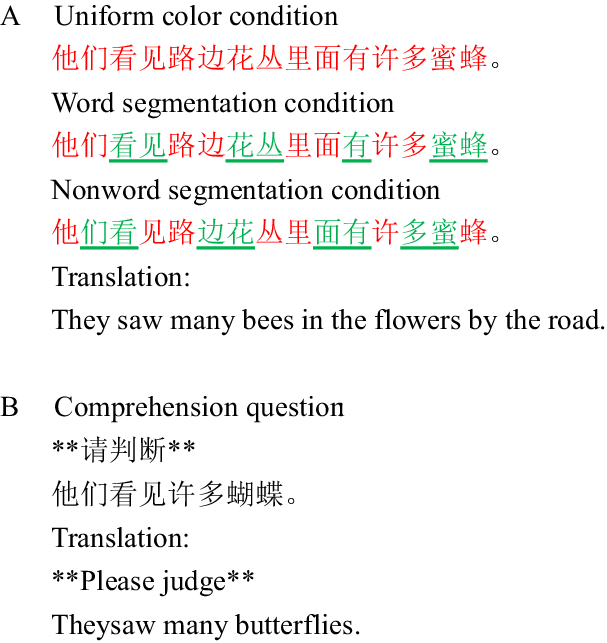
The three experimental conditions were illustrated in Figure 1. In the baseline uniform condition, the sentences were presented in mono-colors. In the word segment condition, the alternating colors were assigned according to the word boundaries. In the nonword segment condition, the alternating colors were assigned to groups of characters that formed a nonword. We created two different versions of sentences that began with either green or red color; therefore there were equal numbers of characters and words in each color overall. There is no significant difference in the number of segmentations between the word condition and nonword condition (M word = 9.0, SD word = 1.0, M nonword = 9.2, SD nonword = 1.4; t = –1.525, p = .129). The conditions were presented in blocks and the order of the conditions was counterbalanced over participants.
An illustration of experimental stimuli in different conditions (A, upper) and its comprehension question (B, lower). Characters presented in an alternative color are highlighted by underline only for the purposed of illustration but not during the experiment.

Apparatus
An EyeLink CL desktop system running at a sampling rate of 1,000 Hz were used to record participants’ eye movements. The stimuli were presented on a vertical position one third from the top of a 21-inch DELL P1130 CRT monitor (resolution, 1024 × 768 pixels; frame rate, 100 Hz). The distance between the monitor and subjects’ eyes was set to 65 cm. Each character occupied a 32 × 32 pixel grid with one character equal to approximately 1.1 degrees of visual angle. All recordings and calibrations were done monocularly based on the right eye and viewing was binocular.
Procedure
Participants were instructed to read the sentences silently. Participants completed the calibration and validation with a nine-point grid. The success in detecting participants’ eye around the fixation point, which appeared on the left side of the monitor, initiated presentation of the next sentence, with its first character occupying the position of the fixation point. Thirty (i.e., 30%) sentences were randomly followed by a yes–no comprehension question, primarily to ensure their engagement with the reading task. The participants were instructed to press one of two joystick buttons to judge the correctness of the probe sentence (in the example provided in Figure 1, a participant should press the button for “No”) and had a good comprehension rate (average comprehension rate among all participants: 76%, SD = 2.7%).
Data analysis
Fixations were defined using an algorithm for saccade detection (Engbert & Kliegl, Reference Engbert and Kliegl2003). Sentences containing blinks, extremely low numbers of effectively fixated words (i.e., less than 3), coughs or body movements during data collection were deleted (n = 150, 5%). For the analyses of all eye-movement measures, the first and last words as well as the first and last fixated words in a trial were removed. First-fixation durations (FFDs; the first fixation on a word, irrespective of the number of fixations) shorter than 60 ms or longer than 800 ms and gaze durations (GDs; the sum of fixations during the first pass reading of a word) longer than 1000 ms were excluded from the analyses of FFD, first-fixation location (FL), GD, refixation probability (RP; how likely a word is fixated more than once during the first-pass reading). Because most of the fixated words were of two-characters in length (i.e., 74%), we focused on these words for eye-movement measure analyses. Observations with extremely far launch site (i.e., more than four characters; 0.1%) were not included. To sum up, eye-movement measure analyses were based on 12,003 fixated two-character words.
Estimates were based on linear mixed models (LMMs) for fixation location and duration analyses, and on generalized linear mixed model (GLMMs) for refixation rate analysis, with variance components estimated for participants and for items (i.e., varying intercepts and slopes), using the lmer program of the lme4 package (version 1.1-18-1; Bates et al., Reference Bates, Maechler, Bolker and Walker2015) in the R environment for statistical computing and graphics (version 3.5.1; R Core Team, 2018). Inferential statistics were based on a treatment contrast with the uniform color condition as a reference for the other two conditions. As the launch site (i.e., the location of the fixation prior to landing on the target word; e.g., Kliegl et al., Reference Kliegl, Nuthmann and Engbert2006) was an important factor to determine eye-movement parameters, we included it as a covariate (centered on its grand mean) in the following LMMs for FL, RP, FFD, and GD. In LMMs, estimates 1.96 times larger than their standard errors are interpreted as significant at the 5% level, this is because given the number of subjects and the large number of observations for each subject, the t-statistic in LMMs (i.e., M/SE) effectively corresponds to the z-statistic. Log-transformed dependent variables of fixation durations were used in the models to fit model assumption (Kliegl et al., Reference Kliegl, Masson and Richter2010).
Results
Reading speed
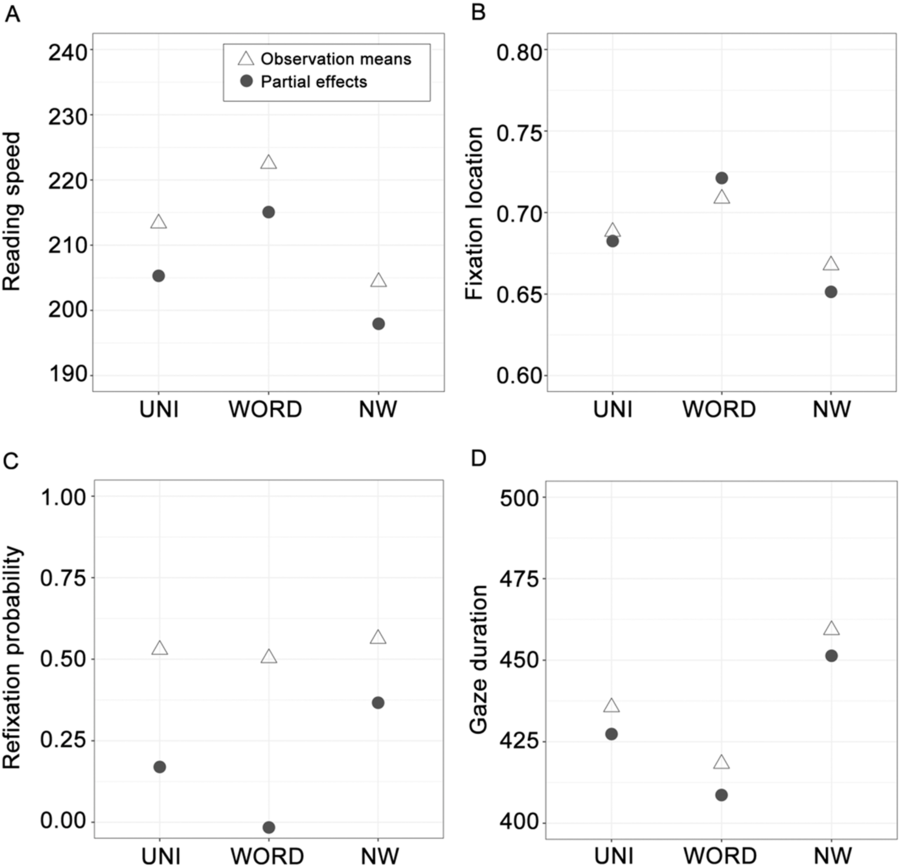
Reading speed in the uniform, word segment, and nonword segment conditions were 213 (SE = 10), 222 (SE = 9), 204 (SE = 9) characters per minute, respectively (Table 1 and Figure 2A). Reading speed in the word segment condition was significantly faster than that in the uniform condition (b = 0.047, SE = 0.013, t = 3.55). Reading speed in the nonword segment condition was significantly slower than that in the uniform condition (b = –0.038, SE = 0.016, t = –2.39).
Reading and eye-movement measures

Note: Means (and standard errors, in parentheses) of reading speed (RS) in characters per minute, first-fixation location (FL) in characters, first-fixation duration (FFD) in ms, gaze duration (GD) in ms, and refixation probability (RP) in percent for the experimental conditions. Values are computed across subjects’ means.
Experimental effects on reading speed (A, upper left), first-fixation location (B, upper right), refixation probability (C, lower left), and gaze duration (D, lower right). Triangles are observation means and dots are partial effects (i.e., LMM estimates after statistical control of other variables and also after control for between-subject and between-sentence differences) using the remef package (version 0.6.10; Hohenstein & Kliegl, Reference Hohenstein and Kliegl2015). Graphics were generated using the ggplot2 package (version 2.1.0; Wickham, Reference Wickham2009).

First-fixation duration
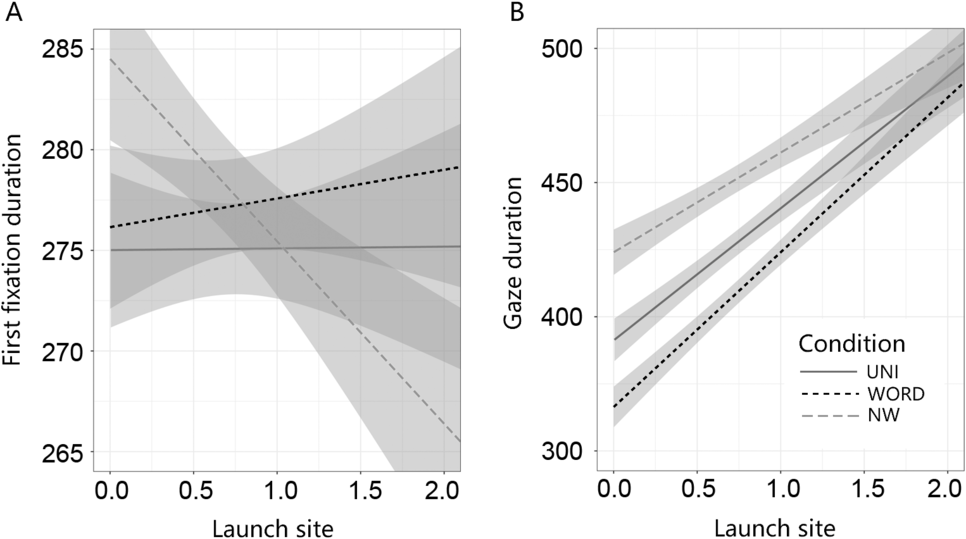
The experimental manipulation significantly interacted with launch site (b = –0.036, SE = 0.013, t = –2.71): as shown in Figure 3A, FFD was longer in the nonword segment condition than that in the uniform condition when the launch site was close (i.e., less than 0.5 character space; number of observations = 4488; b = 0.026, SE = 0.012, t = 2.21), but the difference in FFD between these two conditions was not significant when the launch site was far (i.e., more than 0.5 character space; number of observations = 7496; b = –0.006, SE = 0.011, t = –0.59). When perceptually grouped units and conceptually segmented words are inconsistent, a stronger conflict when located less eccentrically leads to a reading cost. All other fixed effects were not significant.
Partial effects of interactions between experimental condition and launch site in first-fixation duration (A, left) and gaze duration (B, right).

First-fixation location
As shown in Figure 2B, FLs were closer to the word center in the word segment condition than in the uniform color condition (b = 0.039, SE = 0.014, t = 2.73). However, FLs were closer to the word beginning in the nonword segment condition than in the uniform color condition (b = –0.031, SE = 0.015, t = –2.08). FLs shifted further away from word beginning with decreasing launch site (b = –0.43, SE = 0.012, t = –36.92).
Gaze duration
As compared to the uniform color condition, readers had shorter GD in the word segment condition (b = –0.041, SE = 0.016, t = –2.51) and longer GD in the nonword segment condition (b = 0.052, SE = 0.016, t = 3.34; Figure 2D). GD increased with increasing launch site (b = 0.112, SE = 0.013, t = 8.32). The experimental manipulation significantly interacted with launch site (b = –0.042, SE = 0.019, t = –2.17): as shown in Figure 3B, the interference effect of the nonword segment condition on GD was relatively larger when the launch site was close (i.e., less than 0.5 character space, number of observations = 4,488; b = 0.068, SE = 0.020, t = 3.46) than when the launch site was far (i.e., more than 0.5 character space, number of observations = 7,496; b = 0.038, SE = 0.018, t = 2.09). All other fixed effects were not significant.
Refixation probability
We found that relative to the uniform color condition, readers produced fewer refixations in the word segment condition (b = –0.172, SE = 0.050, z = –3.48, p < .001) and they were more likely to refixate a word in the nonword segment condition (b = 0.179, SE = 0.050, z = 3.56, p < .001; Figure 2C). In addition, refixation probability increased with increasing launch site (b = 0.732, SE = 0.067, z = 10.88, p < .001).
Extended models
Using comprehension accuracy as a covariate, results showed that participants with higher comprehension accuracy produced fixations further into the word (b = 0.774, SE = 0.315, t = 2.45), less refixations (b = –4.44, SE = 1.934, z = –2.30, p = .022), and shorter GDs (b = –0.861, SE = 0.413, t = –2.08), showing a typical reading skill difference. Neither the remaining main effects of comprehension accuracy in other measures, nor any interactions, was significant, indicating that the effect of experimental manipulation was fundamentally identical among all participants.
DISCUSSION
In the present study, we used a manipulation of alternating-color words during the natural, silent reading of Chinese sentences and aimed at understanding the effects of explicit word boundary among second-language learners, without compromising the unspaced spatial layout of texts. The results are noticeably clear cut: across different behavior and eye-movement measures, we observed very consistent evidence for benefit of alternating-color word, as well as cost of alternating-color nonword, over the baseline mono-color condition. These results are in nice agreement with a notion that color information can induce visual grouping (e.g., Pinna et al., Reference Pinna, Uccula and Tanca2010). Among skilled adult readers, color information has been shown to facilitate reading in different spaced alphabetic scripts (e.g., Häikiö et al., Reference Häikiö, Bertram and Hyönä2016; Perea et al., Reference Perea, Tejero and Winskel2015). In contrast, such benefit is rather limited in unspaced scripts such as Chinese among skilled readers (Perea & Wang, Reference Perea and Wang2017; Zhou et al., Reference Zhou, Wang, Shu, Kliegl and Yan2018). We hypothesized that the manipulation should be more beneficial among L2 Chinese learners due to their language proficiency and exposure. We noted ourselves in Zhou et al. (Reference Zhou, Wang, Shu, Kliegl and Yan2018, p. 738) that “[i]t will be of great theoretical interests to generalize the effect of word boundary to readers with different reading abilities.” The present study is conducted with L2 Chinese learners to make a novel progress for this prospect.
In many cases, naturally unspaced Chinese text can lead to uncertainty concerning where a word begins and ends. More than 80% Chinese characters can involve word-boundary ambiguity (Yen et al., Reference Yen, Radach, Tzeng, Hung and Tsai2009). Such structurally ambiguous strings can lead to completely different meanings. For instance, the string of “从小学” can be understood as since elementary school when the latter two characters are treated as a two-character word. Alternatively, it can also mean to study something from youth, when the first two characters combine a word. An equivalent example in English can be, when written without space, the string of “sealair” can be parsed into either “sea lair” or “seal air.” Apparently, demarking word boundaries reduces Chinese readers’ uncertainty and thus promotes lexical identification (Inhoff & Wu, Reference Inhoff and Wu2005). In the meanwhile, with clear knowledge about word boundary, Chinese readers can generate saccades more efficiently toward word centers (Yan et al., Reference Yan, Kliegl, Richter, Nuthmann and Shu2010; Yan & Kliegl, Reference Yan and Kliegl2016), where lexical processing is known to be optimal (Nuthmann et al., Reference Nuthmann, Engbert and Kliegl2005; O’Regan et al., Reference O’Regan, Lévy-Schoen, Pynte and Brugaillère1984; Vitu et al., Reference Vitu, McConkie, Kerr and O’Regan2001). In the present study, we observed clear evidence for benefits with respect to both decreased lexical identification time as reflected by fixation duration and more efficient saccade as reflected by fixation location.
Kasisopa et al. (Reference Kasisopa, Reilly, Luksaneeyanawin and Burnham2013) tested eye movements when reading Thai, and reported overall little effect of adding spaces. They hypothesized that skilled Thai readers use certain statistical information, such characters that are diagnostic of word boundaries, to generate saccades more efficiently. This result confirms and extends similar findings (see also, Reilly et al., Reference Reilly, Radach, Corbic and Luksaneeyanawin2005). In Chinese, the effect of such character positional probability has also been documented (Yen et al., Reference Yen, Radach, Tzeng, Hung and Tsai2009). In addition, the Chinese adaptation of SWIFT, a computation model of eye movement in reading (e.g., Engbert et al., Reference Engbert, Nuthmann, Richter and Kliegl2005), implemented an online word segmentation mechanism based on character positional probability (Richter et al., Reference Richter, Yan, Engbert and Kliegl2010). Apparently, such statistical information is more valid for skilled readers with much larger reading database as compared to unskilled readers. In this case, it is not surprising to see that L2 readers of Chinese rely more on low-level visual cues of colors for word boundary than skilled Chinese readers (Perea & Wang, Reference Perea and Wang2017; Zhou et al., Reference Zhou, Wang, Shu, Kliegl and Yan2018).
Some previous studies reported benefits in reading speed and some eye-movement measures when adding interword spaces to natural, unspaced Chinese sentences among unskilled Chinese readers (Blythe et al., Reference Blythe, Liang, Zang, Wang, Yan, Bai and Liversedge2012; Shen et al., Reference Shen, Liversedge, Tian, Zang, Cui, Bai, Yan and Rayner2012). Although these studies indeed promoted our understanding about the importance of word-boundary information in Chinese, it is fair to point out that there are several theoretical limitations of this approach. First, artificially introduced interword spaces interfere with the well-established reading behavior of unspaced texts. Second, upcoming words are pushed into more eccentric positions, reducing parafoveal processing efficiency and also increasing launch site of these words. Finally, when comparing words with correctly and incorrectly added spaces, within-word spaces in the latter case apparently make the words physically longer, causing a confounding. As a consequence, alternating-color manipulation has achieved much clearer patterns of results. For instance, reading benefit with respect to saccade generation is documented both by Zhou et al. (Reference Zhou, Wang, Shu, Kliegl and Yan2018) as well as in the present study, whereas studies adding interword spaces typically reported very similar saccade mechanisms under spaced and unspaced conditions (e.g., Shen et al., Reference Shen, Liversedge, Tian, Zang, Cui, Bai, Yan and Rayner2012).
Comparison across different groups of readers provides interesting information. First, concerning eye-movement measures, facilitation effects in the alternating-color word condition are consistently larger for L2 learners: The differences across conditions are larger in the present study than in Zhou et al. (Reference Zhou, Wang, Shu, Kliegl and Yan2018, Experiment 1) who reported reading data among Chinese adults, as measured in gaze duration (i.e., 17 ms vs. 3 ms for facilitation effect and 40 ms vs. 20 ms for interference effect, for L2 and native Chinese readers, respectively) and refixation probability (3% ms vs. 1.2% for facilitation effect and 6% vs. 4.6% for interference effect, for L2 and native Chinese readers, respectively). Second, as far as reading speed is concerned, the present study demonstrates the first reliable evidence for facilitation effect due to alternating-color word manipulation for L2 Chinese readers, whereas such effects among Chinese adults only appeared in numerical trends (Perea & Wang, Reference Perea and Wang2017, Experiments 1 and 2; Zhou et al., Reference Zhou, Wang, Shu, Kliegl and Yan2018, Experiment 1).
The reading costs in the alternating-color nonword condition serve as a further validation of the importance of word-boundary knowledge in reading and of the validity of the manipulation. Notice that a blocked designed of the three experimental conditions was utilized. In principle, the readers could have completely ignored the incorrect color information in the alternating-color nonword condition. Apparently, reading costs in this condition strongly imply that they were incapable of doing so. Arguable, color-based perceptual grouping occurs highly automatically and overrides readers’ conscious. This further indicates the effectiveness of the manipulation.
To conclude, explicit word-boundary knowledge afforded by alternating colors can facilitate reading for L2 learners while keeping the unspaced spatial layout intact. In contrast to adding interword spaces, more natural-looking colored texts manipulation may also have better applied values. We propose that using alternating colors for word segmentation can be developed as a training program to efficiently help Chinese L2 learners. The practical values and generalizability of the current manipulation remains to be established in larger scales and in teaching scenarios.
Acknowledgments
Data and R scripts are available on reasonable request. This research was supported by the National Natural Science Foundation of China (31500886), Start-up Research Grant of University of Macau (SRG2019-00148-FSS), and Talent Support Foundation of Beijing Municipal University (CIT$TCD201904084).
APPENDIX
Complete experimental sentences.
阿姨坐在钢琴前面教小孩子唱歌
班上同学在运动会取得优秀的成绩
保持健康的一个方法就是坚持运动
北京有许多名胜古迹和风景美丽的公园
大家觉得这件事情做起来有点困难
大家考试的时候应该保持卷子整洁
哥哥和姐姐看见他回家都十分高兴
家里常用的电器包括洗衣机以及电冰箱等
科学家反复进行各种试验最终解决了问题
老师带领我们依依不舍地离开了这个水电站
美丽的公鸡渐渐学会帮助人们做事
美术老师教孩子们画美丽的风景
鸟儿在枝叶茂盛的树林里面唱歌
农民盼望自己地里那些庄稼赶快长大
农民整天静坐在树干旁边等待野兔
气候突然发生变化使恐龙灭绝了
汽油遇到火花就会剧烈燃烧起来
森林为人们提供了许多水果和药材
山峰上面的石头好像一个神仙一样
哨所前面的那些白杨显得非常挺拔
书架上面整齐排列着成千上万本书籍
私自到水库游泳是非常危险的事情
他从小喜欢做那些需要动脑筋的事情
他们看见路边花丛里面有许多蜜蜂
他们看见远处的清洁工人正在清扫街道
他们在办公室拟定了很多重要文件
他在上课的时候向旁边同学借笔记本
天花板上面悬挂着很多水晶玻璃灯
我和姐姐把隔壁屋子打扫得干干净净的
我们可以利用阳光来预防或者治疗疾病
我们喜欢在宽敞明亮的教室上课
喜鹊十分礼貌地向他们点头问好
许多鸟儿冬天从北方来到南方过冬
学校操场北边的围墙旁边到处都是茉莉花
医生和护士迅速到达现场开展救护工作
这个精致的盒子里面装有各种石头
这个医生给穷人看病常常不收取费用
整个冬天青蛙都在山洞里面睡觉
值日同学正在公共笔记本里面记录班级日志
中华传统文化好像一座巨大的宝库
自古称作天险的长江被我们完全征服
爸爸昨天买的红色金鱼受到儿子喜爱
傍晚的天空因为夕阳照射而发出红色的光
北半球的白天在每年夏至达到最长时间
博物馆的文物都是研究古代文化的重要资料
船长立刻通知全体船员为出发做准备
春天田里面禾苗高度超过了一个大人
村民们在秋天尽情享受丰收的喜悦和欢乐
典礼当天参加升旗仪式的人都非常兴奋
父母希望孩子根据自身兴趣选择暑假班
父母希望他通过上学读书改变自己的命运
湖泊是在多种自然因素综合作用下形成的
检查和清理这些货物需要很长的时间
今年过年我们全家乘坐飞机到海南去玩
军队的长官命令士兵帮助人民群众
考试不及格的学生名单已经粘贴在公告栏
可怕的狂风掀起巨浪淹没了那只小船
老师告诉大家制定目标应该切合实际
老师建议同学们及时复习当天学习的课程
两个王子为争夺王位互相陷害对方
民警使出全身力气抓紧想要逃跑的小偷
明天的春游活动由于天气原因被取消了
农夫建议树苗间隔不能太大也不能太小
乞丐为灾区捐钱的场面令人感动得流下泪来
人们在公共场所竖立标语来禁止吸烟
受到表扬的孩子心里充满了无限希望
受到惊吓的同学们拼命向前奔跑和喊叫
他的哥哥将在今年九月参加全国钢琴比赛
他们发现这家公司工作人员都非常勤奋
他抬头突然看见云朵好像棉花糖一样
他向父母提出无礼要求之后被拒绝了
他已经养成了坚持早晨锻炼的好习惯
他在傍晚看到东北方向有一颗明星
天空中的各种五彩烟花十分引人注目
同学们积极向老师申请加入少年队
同学们正在学习究竟如何制作风筝
同学朋友或者兄弟姐妹之间应该相亲相爱
图书馆向参观者提供午饭以及各种饮料
无数的小鱼在河流干枯过后渴死了
一般人都习惯使用右手吃饭和写字
因为下雨而取消户外活动的消息令人失望
遇到危险情况要根据具体情况想办法
在场所有人围绕冠军欢呼和庆祝胜利
在期末考试过后我们可以尽情玩耍
在商场购买一个宝石戒指需要花不少钱
这段连续的文字缺少句号作为间隔的标志
这个地区含有异常丰富的石油和天然气
这个教育机构能帮助儿童提高阅读的能力
这个小岛上的人们使用贝壳代替钱的功能
这位著名画家带领徒弟前往北京参加比赛