Introduction
Schizophrenia is a chronic and severe mental illness (McGrath et al. Reference McGrath, Saha, Chant and Welham2008; National Institute of Mental Health, 2009), resulting in high economic costs (Wu et al. Reference Wu, Birnbaum, Shi, Ball, Kessler, Moulis and Aggarwal2005). People with schizophrenia tend to have a high rate of unemployment (Ramsay et al. Reference Ramsay, Stewart and Compton2012), an unhealthy lifestyle (e.g. smoking and physical inactivity) (De Leon & Diaz, Reference De Leon and Diaz2005; Wichniak et al. Reference Wichniak, Skowerska, Chojnacka-Wojtowicz, Taflinski, Wierzbicka, Jernajczyk and Jarema2011; Yamamoto et al. Reference Yamamoto, Yamamoto, Miyaji, Yukawa-Inui, Hori, Tatematsu, Yutani, Tanaka and Miyaoka2011) and poor physical health status (Hausswolff-Juhlin et al. Reference Hausswolff-Juhlin, Bjartveit, Lindström and Jones2009). Side effects of antipsychotic drugs may contribute to an elevated risk of weight gain and the development of metabolic disturbances in schizophrenia (Hägg et al. Reference Hägg, Lindblom, Mjörndal and Adolfsson2006; Rege, Reference Rege2008; Malchow et al. Reference Malchow, Reich-Erkelenz, Oertel-Knöchel, Keller, Hasan, Schmitt, Scheewe, Cahn, Kahn and Falkai2013; Marder et al. Reference Marder, Essock, Miller, Buchanan, Casey, Davis, Kane, Lieberman, Schooler and Covell2014). Moreover, the presence of the metabolic syndrome limits physical activity in schizophrenia (Vancampfort et al. Reference Vancampfort, Sweers, Probst, Maurissen, Knapen, Minguet and De Hert2011), leading to a vicious self-perpetuating cycle of increasing metabolic syndrome and decreasing physical activity among patients with schizophrenia.
The physical health problems and physical activity levels of people with schizophrenia have been widely studied (Vancampfort et al. Reference Vancampfort, Sweers, Probst, Maurissen, Knapen, Minguet and De Hert2011; Ratliff et al. Reference Ratliff, Palmese, Reutenauer, Liskov, Grilo and Tek2012; Vancampfort et al. Reference Vancampfort, De Hert, Sweers, De Herdt, Detraux and Probst2013). Another critical issue in schizophrenia is cognitive impairment. Cognitive capacity is crucial for functioning in everyday life, since ability to attend to stimuli selectively, maintain concentration on tasks over prolonged periods, use language for communication and self-expression, learn new skills, make decisions, and execute actions are all important (Sharma & Antonova, Reference Sharma and Antonova2003; Glisky, Reference Glisky and Riddle2007). These abilities are impaired to some extent in patients with schizophrenia, with deficits in attention, executive function, verbal and visuospatial working memory, and learning and memory having been reported (Sharma & Antonova, Reference Sharma and Antonova2003). Cognitive deficits are also associated with impaired functional status, work capacity, social behaviour and activities of daily living (Green, Reference Green1996; Matza et al. Reference Matza, Buchanan, Purdon, Brewster-Jordan, Zhao and Revicki2006).
The benefits of physical activity for cognitive performance are well documented in healthy populations (Angevaren et al. Reference Angevaren, Aufdemkampe, Verhaar, Aleman and Vanhees2008; McMorris & Hale, Reference McMorris and Hale2012; Guiney & Machado, Reference Guiney and Machado2013; Verburgh et al. Reference Verburgh, Königs, Scherder and Oosterlaan2014). However, the impact of physical activity on individuals with mental illness has only recently been examined (Richardson et al. Reference Richardson, Faulkner, McDevitt, Skrinar, Hutchinson and Piette2005; Holley et al. Reference Holley, Crone, Tyson and Lovell2011; Zschucke et al. Reference Zschucke, Gaudlitz and Ströhle2013). The available evidence suggests that high physical fitness or more physical activity are associated with better cognitive performance, including executive functioning, verbal working memory, and speed of processing among patients with schizophrenia (Kimhy et al. Reference Kimhy, Vakhrusheva, Bartels, Armstrong, Ballon, Khan, Chang, Hansen, Ayanruoh and Smith2014; Leutwyler et al. Reference Leutwyler, Hubbard, Jeste, Miller and Vinogradov2014). These findings indicate that physical activity might have potential benefits for some domains of cognition in people with schizophrenia.
However, most studies have used self-report measures of physical activity, and these are subject to recall bias (Lindamer et al. Reference Lindamer, McKibbin, Norman, Jordan, Harrison, Abeyesinhe and Patrick2008). The few studies examining associations between objectively measured physical activity and cognition in people with schizophrenia have been small scale (Lindamer et al. Reference Lindamer, McKibbin, Norman, Jordan, Harrison, Abeyesinhe and Patrick2008; Leutwyler et al. Reference Leutwyler, Hubbard, Jeste, Miller and Vinogradov2014). Moreover, potentially confounding factors, such as education levels, body mass index (BMI), metabolic syndrome parameters, antipsychotic medication, smoking and drinking status have not been controlled (Leutwyler et al. Reference Leutwyler, Hubbard, Jeste, Miller and Vinogradov2014). This study was therefore designed to examine the association between actigraphy-derived physical activity and cognitive performance while adjusting for multiple confounders in people with schizophrenia.
Method
Participants
Participants were recruited from the chronic psychiatric wards at Jianan Mental Hospital, Taiwan. The diagnosis of schizophrenia was verified by psychiatrists based on the Diagnostic and Statistical Manual Disorders, fourth edition (American Psychiatric Association, 1994). Patients were included if they were stable on antipsychotic medicine and had used the same dosage for at least 3 months prior to inclusion. Those who were unable to communicate, unable to walk independently and had neurological disorders were excluded. A total of 200 potential in-patients were suitable for the study. Among them, 199 in-patients provided their written informed consent.
Age-, sex- and BMI-matched comparison participants were recruited from the staff of two hospitals and universities. Individuals who had no present or past history of psychiatric disorder and were not taking any psychoactive medicines were invited. A total of 60 participants were selected to ensure comparable sex balance, age and BMI ranges to the schizophrenia group. The study was approved by the Institutional Review Board of Jianan Mental Hospital.
Measures
Physical activity
The wActiSleep-BT ActiGraph (USA) was used to assess physical activity levels objectively. This is a tri-axial accelerometer that has been validated and used in previous studies (García-Ortiz et al. Reference García-Ortiz, Recio-Rodríguez, Martín-Cantera, Cabrejas-Sánchez, Gómez-Arranz, González-Viejo, Nicolás, Patino-Alonso and Gómez-Marcos2010; Hansen et al. Reference Hansen, Kolle, Dyrstad, Holme and Anderssen2012; Cain et al. Reference Cain, Conway, Adams, Husak and Sallis2013; De Moura et al. Reference De Moura, Marins, Franceschini Sdo, Reis and Amorim2015). Standardized instructions of wearing an accelerometer were provided by research assistants. Participants were asked to wear the accelerometer all day on the wrist of the non-dominant hand for 1 week and to remove it during bathing or water activities. The accelerometers were initialized, downloaded and analysed using ActiLife software version 6 (ActiGraph LLC, USA). The sleep period was excluded and the levels of physical activity were defined according to the cut-off points outlined by Freedson et al. (Reference Freedson, Melanson and Sirard1998). Light physical activity was defined as between 101 and 1951 counts per min, and time in moderate-vigorous physical activity (MVPA) was defined as activities ≧1952 counts per min (Lindamer et al. Reference Lindamer, McKibbin, Norman, Jordan, Harrison, Abeyesinhe and Patrick2008; Cain et al. Reference Cain, Conway, Adams, Husak and Sallis2013). Participants were excluded if the accelerometers were not worn for at least 10 h per day (excluding sleep period) for at least 5 days (n = 38). The mean wear time was 13.9 (S.D. = 2.1) h per day for the schizophrenia group and 16.3 (S.D. = 1.4) h per day for the healthy controls.
Cognitive function
Vienna Test System (VTS)
The VTS is a computerized neurocognitive function assessment battery consisting of various tests of personality, intelligence and cognitive function (Schuhfried, 2013). It has been used in previous studies of healthy individuals, people with depression (Deijen et al. Reference Deijen, Orlebeke and Rijsdijk1993; Lee et al. Reference Lee, Kim and Suh2003) and people with schizophrenia (Klasik et al. Reference Klasik, Krysta, Krzystanek and Skałacka2011). The Cognitrone (COG) test used in this study is a general ability test assessing attention and concentration. Participants are presented with a series of abstract figures on the computer screen, and make judgments concerning their congruence (Schuhfried, 2013). The number of responses made within the total working time of 7 min was recorded.
Grooved Pegboard Test (GPT)
The GPT is regarded as a test of manual dexterity, upper-limb motor speed, hand–eye coordination, and speed of processing and has been widely used in previous research (Nuechterlein et al. Reference Nuechterlein, Barch, Gold, Goldberg, Green and Heaton2004; Wang et al. Reference Wang, Magasi, Bohannon, Reuben, Mccreath, Bubela, Gershon and Rymer2011; Bezdicek et al. Reference Bezdicek, Nikolai, Hoskovcová, Štochl, Brožová, Dušek, Zárubová, Jech and Růžička2014; Belsky et al. Reference Belsky, Caspi, Israel, Blumenthal, Poulton and Moffitt2015). It consists of 25 holes with randomly positioned slots. The task involves inserting pegs into the board in a fixed order and in the correct direction using only one hand. Participants are encouraged to perform the task as quickly as possible, and the total time needed for the test is recorded. In this study, participants were tested twice, once with the dominant hand and once with the non-dominant hand, and the average time taken for the two tests was calculated.
Covariates
Positive and Negative Syndrome Scale (PANSS)
The PANSS was developed to assess the severity of positive and negative symptoms and to measure general psychopathology in schizophrenia (Kay et al. Reference Kay, Flszbein and Opfer1987). It was completed by the registered nurses looking after each patient with schizophrenia. The 30-item rating scale consists of three subscales: seven-item Positive Symptoms, seven-item Negative Symptoms, and 16-item General Psychopathology. Each item is assessed on a seven-point rating scale ranging from 1 (asymptomatic) to 7 (extremely symptomatic). The PANSS was summed across items, so could range from 7 to 49 for the Positive and Negative Scales and 16–112 for the General Psychopathology Scale. Higher scores indicate more severe symptoms.
Medication use
Information about years since illness onset, duration of hospitalization, and the use of antipsychotic medication and sleeping pills was collected from hospital records. Antipsychotic medication use was converted into a daily equivalent dosage of chlorpromazine (Gardner et al. Reference Gardner, Murphy, O'Donnell, Centorrino and Baldessarini2010), while sedatives were converted to the daily equipotent dosage of Lorazepam, according to the defined daily dose of World Health Organization Collaborating Centre for Drug Statistics Methodology (http://www.whocc.no/ddd/definition_and_general_considera/).
Metabolic parameters
Waist circumference, systolic/diastolic blood pressure, serum triglycerides (TG), high-density lipoprotein cholesterol (HDL-C) and fasting glucose (FG) were obtained through regular health checks in the hospital.
Demographic variables
Data on age, sex, smoking habits, alcohol consumption and years of schooling were collected. Participants were categorized into two groups: ‘yes (current/former smoker or drinker)’ and ‘no’ (never). Groups of current and former smoker or alcohol consumer were combined, due to there being few current smokers (n = 18) or current alcohol consumers (n = 2). Body weight and height were measured in light clothes and BMI was calculated.
Psychiatric nurse practitioners who had completed psychiatric professional training and research ethics training to degree level or higher administered the tests.
Statistical analyses
Descriptive statistics were calculated and χ2 tests and t tests were performed to compare schizophrenia and comparison groups. Pearson correlations were used to test the univariate associations between physical activity levels and cognitive performance in each group. To examine the independent association between physical activity levels and cognition, multivariable linear regression analyses were conducted. Separate regressions were conducted for each of the cognitive measures and groups. Results are presented in terms of standardized (β regression coefficients and associated p values). All models were adjusted with demographic variables (age, sex, education), behavioural variables (smoking and alcohol consumption), metabolic parameters and accelerometer wear time in the comparison group. Clinical factors (years since illness onset, duration of hospitalization, medication use, and PANSS) were additional covariates in patients with schizophrenia. All analyses were performed with IBM SPSS statistics 20 (USA) and a p value less than 0.05 was considered as statistically significant in this study.
Ethical standards
All procedures contributing to this work comply with the ethical standards of the relevant national and institutional committees on human experimental and with the Helsinki Declaration of 1975, as revised in 2008.
Results
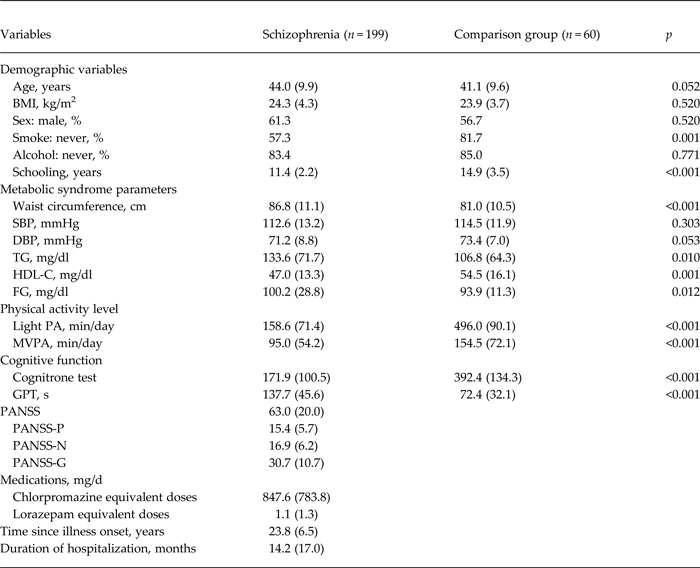
Table 1 shows the descriptive statistics for participants with and without schizophrenia. It can be seen that patients with schizophrenia were aged 44 years on average, with a slight majority of men. They were long-term patients averaging 23.8 years since diagnosis, and had been hospitalized for an average of 14.2 months. There was no significant difference between the patients with schizophrenia and the non-psychiatric comparison group in respect to age, sex and BMI. However, patients with schizophrenia had poorer performance on the GPT and the COG test than the comparison group (all p < 0.001).
Characteristics of individuals with and without schizophrenia

Data are given as mean (standard deviation) unless otherwise indicated).
BMI, Body mass index; SBP, systolic blood pressure; DBP, diastolic blood pressure; TG, triglycerides; HDL-C, high-density lipoprotein-cholesterol; FG, fasting glucose; PA, physical activity; MVPA, moderate-vigorous physical activity; GPT, Grooved Pegboard Test; PANSS, Positive and Negative Syndrome Scale; PANSS-P, Positive and Negative Syndrome Scale positive symptoms; PANSS-N, Positive and Negative Syndrome Scale negative symptoms; PANSS-G, Positive and Negative Syndrome Scale general symptoms.
Participants with schizophrenia spent 158.6 min/day in light physical activity, which was significantly less time than the comparison group (496.0 min/day). The time spent in MVPA was also less in the schizophrenia group (95.0 min/day) than the comparison group (154.5 min/day). The remaining time was spent in sedentary activities. These findings indicate that patients with schizophrenia were less active than the comparison group. Additionally, the schizophrenia group had greater waist circumference, higher TG and FG, and lower HDL-C than the non-psychiatric comparison group (Table 1).
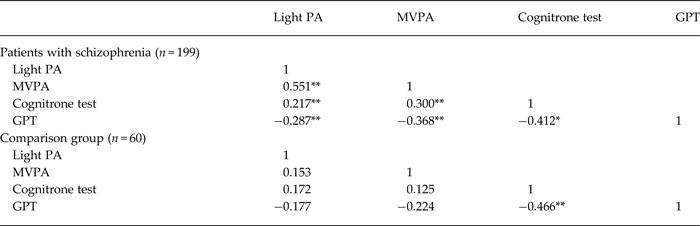
The univariate associations between physical activity levels and cognitive performance among patients with schizophrenia and the comparison group are shown in Table 2. Significant associations were found between each level of physical activity and all cognitive measures among the patients with schizophrenia, so spending more time in any intensity of physical activity was related to better performance on the GPT and COG test. However, no significant association was found between any level of physical activity and the cognitive measures in the comparison group.
Correlations of PA with cognitive performance in people with and without schizophrenia

PA, Physical activity; MVPA, moderate-vigorous physical activity; GPT, Grooved Pegboard Test.
Significant correlation: * p < 0.05, ** p < 0.01 (two-tailed).
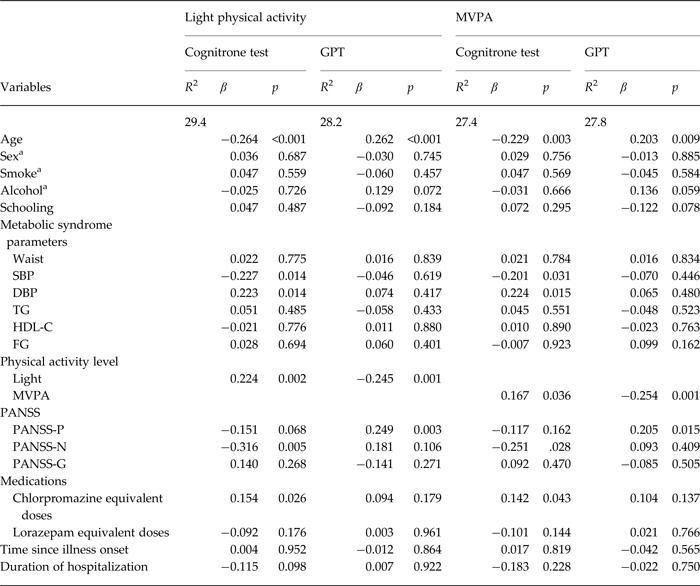
The fully adjusted linear regressions relating physical activity with cognitive performance in the patients with schizophrenia are presented in Table 3. Light physical activity and MVPA were entered separately into regression models. Significant associations were found between the amount of activity at each level of physical activity and the two cognitive measures even after multivariable adjustments (light: β = 0.224, p = 0.002 in the COG test; β = −0.245, p = 0.001 in the GPT; MVPA: β = 0.167, p = 0.036 in the COG test; β = −0.254, p = 0.001 in the GPT, respectively). The results suggest that participating in more light physical activity or MVPA was associated with better cognitive performance among patients with schizophrenia.
Multivariable linear regressions relating cognitive function with physical activity levels in participants with schizophrenia

MVPA, Moderate-vigorous physical activity; GPT, Grooved Pegboard Test; SBP, systolic blood pressure; DBP, diastolic blood pressure; TG, triglycerides; HDL-C, high-density lipoprotein-cholesterol; FG, fasting glucose; PANSS, Positive and Negative Syndrome Scale; PANSS-P, Positive and Negative Syndrome Scale positive symptoms; PANSS-N, Positive and Negative Syndrome Scale negative symptoms; PANSS-G, Positive and Negative Syndrome Scale general symptoms.
a Dummy variable.
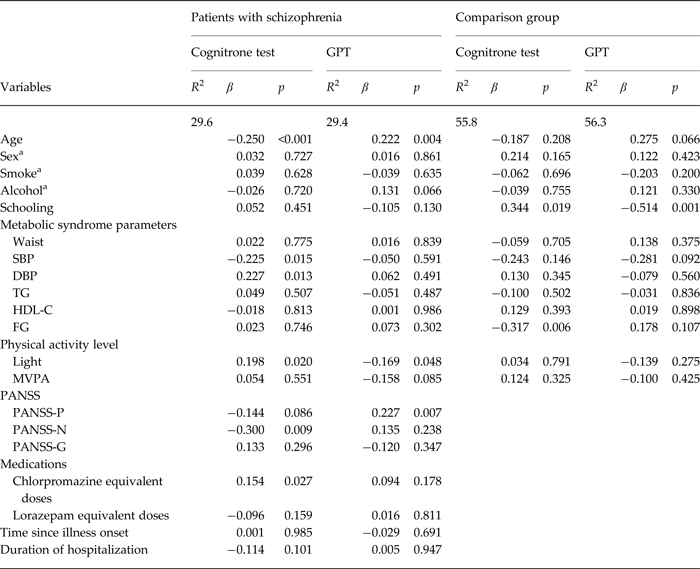
In order to determine the relative contributions of physical activity levels to cognitive performance, light physical activity and MVPA were simultaneously entered as independent variables into regression models with multivariable adjustments (Table 4). Interestingly, the relationship was stronger for light activity than for MVPA in the schizophrenia group. Patients with schizophrenia who spent more time doing light activity had better performance on the COG test (β = 0.198, p = 0.020) and the GPT (β = −0.169, p = 0.048). However, MVPA was not associated with any cognitive measures in the presence of light physical activity and other covariates.
Multivariable linear regressions relating cognitive function in participants with and without schizophrenia

GPT, Grooved Pegboard Test; SBP, systolic blood pressure; DBP, diastolic blood pressure; TG, triglycerides; HDL-C, high-density lipoprotein-cholesterol; FG, fasting glucose; MVPA, moderate-vigorous physical activity; PANSS, Positive and Negative Syndrome Scale; PANSS-P, Positive and Negative Syndrome Scale positive symptoms; PANSS-N, Positive and Negative Syndrome Scale negative symptoms; PANSS-G, Positive and Negative Syndrome Scale general symptoms.
aDummy variable.
No significant association was found in multivariable regression models between levels of physical activity and cognitive performance in the comparison group. The fully adjusted models are shown in Table 4.
Discussion
This study showed lower physical activity levels in patients with schizophrenia compared with a non-psychiatric comparison group. Within the schizophrenia group, higher levels of objectively measured light physical activity were associated with better performance on both cognitive tests independently of demographic factors such as age, sex and schooling, physiological risk factors, schizophrenia symptoms, duration of illness and hospitalization, or medication. The amount of MVPA was also associated with cognitive performance, but not after light activity and other covariates were included in the models.
The difference in physical activity between patients with schizophrenia and healthy controls is consistent with the findings from previous research (Wichniak et al. Reference Wichniak, Skowerska, Chojnacka-Wojtowicz, Taflinski, Wierzbicka, Jernajczyk and Jarema2011; Yamamoto et al. Reference Yamamoto, Yamamoto, Miyaji, Yukawa-Inui, Hori, Tatematsu, Yutani, Tanaka and Miyaoka2011). However, Lindamer et al. (Reference Lindamer, McKibbin, Norman, Jordan, Harrison, Abeyesinhe and Patrick2008) found no significant difference in physical activity measured with accelerometry between the two groups. One of the reasons might be the age difference of the sample between studies. Lindamer et al. (Reference Lindamer, McKibbin, Norman, Jordan, Harrison, Abeyesinhe and Patrick2008) included older adults (mean age = 50.7, S.D. = 6.4 years), while the mean age of the participants in our study was younger. Moreover, participants in the earlier study were out-patients, whereas our study only included in-patients. The small sample size with valid accelerometry data in the earlier study (16 from people with schizophrenia and six from the comparison group) may have resulted in a lack of statistical power to make the comparison. Hospitalization and duration of illness might also contribute to the different findings of other studies (Wichniak et al. Reference Wichniak, Skowerska, Chojnacka-Wojtowicz, Taflinski, Wierzbicka, Jernajczyk and Jarema2011).
It should be noted that the participants with schizophrenia in this study were all in-patients, while the comparison group was free living. This makes it difficult to conclude whether differences are the result of the mental illness of the patient group, or whether differences are due to restrictions in activity in the hospital environment. The hospital which housed the patients has an indoor gym where patients can play table tennis, basketball and snooker, and stationary bikes and treadmills are also available. Patients were also encouraged to attend 20-min stretching and walking sessions in the morning and afternoon. However, with hundreds of patients and limited facilities, patients may be restricted in the space and time available to engage in physical activity.
The current study also indicated that spending more time on light activity was associated with better cognitive performance on attention/concentration and processing speed in patients with schizophrenia. The relationship was stronger for light activity than for MVPA. A similar study using objective physical activity measures found significant associations of moderate physical activity with speed of processing and verbal working memory among 30 older schizophrenia participants; however, no significant association between other cognitive measures and physical activity was found (Leutwyler et al. Reference Leutwyler, Hubbard, Jeste, Miller and Vinogradov2014). The inconsistent findings may be due to difference in physical activity categorization. Sedentary and light activities were combined into one level by Leutwyler et al. (Reference Leutwyler, Hubbard, Jeste, Miller and Vinogradov2014). It is more appropriate to separate sedentary from light physical activity, since low activity is commonly found in patients with schizophrenia (Yamamoto et al. Reference Yamamoto, Yamamoto, Miyaji, Yukawa-Inui, Hori, Tatematsu, Yutani, Tanaka and Miyaoka2011), and the association of sedentary and light activities with cognitive performance might differ (Steinberg et al. Reference Steinberg, Sammel, Harel, Schembri, Policastro, Bogner, Negash and Arnold2015). We further tested the associations of sedentary and light activity with cognitive performance in the present study (results not shown). The findings confirm that light activity but not sedentary activity was associated with better cognitive performance.
Additionally, no significant association was found between any level of physical activity and either cognitive test in the non-psychiatric comparison group. This contrasts with substantial literature showing positive relationships (Angevaren et al. Reference Angevaren, Aufdemkampe, Verhaar, Aleman and Vanhees2008; McMorris & Hale, Reference McMorris and Hale2012; Guiney & Machado, Reference Guiney and Machado2013; Verburgh et al. Reference Verburgh, Königs, Scherder and Oosterlaan2014). One of the reasons might be the small size of the comparison group. Moreover, individuals in the comparison group generally had good cognitive performance, leaving little scope for observing any effects of physical activity.
Physical activity interventions may be particularly appealing for individuals with mental illness in hospital settings, since they are relatively safe, low cost and easily integrated into daily schedules (Richardson et al. Reference Richardson, Faulkner, McDevitt, Skrinar, Hutchinson and Piette2005). Studies have shown enhancement in composite cognitive test scores (Kimhy et al. Reference Kimhy, Vakhrusheva, Bartels, Armstrong, Ballon, Khan, Chang, Hansen, Ayanruoh and Lister2015), hippocampal volume, short-term memory (Pajonk et al. Reference Pajonk, Wobrock, Gruber, Scherk, Berner, Kaizl, Kierer, Müller, Oest and Meyer2010), working memory and speed of processing (Oertel-Knöchel et al. Reference Oertel-Knöchel, Mehler, Thiel, Steinbrecher, Malchow, Tesky, Ademmer, Prvulovic, Banzer, Zopf, Schmitt and Hänsel2014) in patients with schizophrenia after aerobic exercise training, although not all results have been positive (Falkai et al. Reference Falkai, Malchow, Wobrock, Gruber, Schmitt, Honer, Pajonk, Sun and Cannon2013; Scheewe et al. Reference Scheewe, Van Haren, Sarkisyan, Schnack, Brouwer, De Glint, Pol, Backx, Kahn and Cahn2013). However, previous research has mainly focused on the effects of MVPA. Promoting light physical activity might be more feasible than MVPA among patients with schizophrenia, since they spend much of the time in sedentary activities. This study has demonstrated that even light physical activity is associated with better cognitive performance in people with schizophrenia.
The current study provides evidence of positive associations between light physical activity and cognitive performance in patients with schizophrenia after taking multiple potential confounders into account. However, interpretation of the results is limited by the cross-sectional design, which is not able to determine causal relationships. All the participants with schizophrenia were long-term psychiatric in-patients, and findings might not generalize to less severe out-patients. Moreover, this study only included two cognitive tests and did not collect information about menstrual status, which may affect cognitive performance and physical activity in female patients. Well-designed prospective cohort studies or randomized controlled trials are needed to establish whether light and moderate physical activity can improve cognitive function among patients with schizophrenia.
Acknowledgements
This work was in part supported by the National Taiwan University of Sport and the Taiwan Ministry of Science and Technology (102-2410-H-018-041-MY2).
Declaration of Interest
None.