Introduction
People with intellectual disabilities (ID), and in particular with Down's syndrome (DS), have a greater age-specific risk for developing a primary dementia syndrome compared to the general population (Strydom et al., Reference Strydom2009).
Dementia in ID may be associated during the course of the disease with maladaptive behaviors and neuropsychiatric symptoms, defined in the general population as behavioral and psychological symptoms of dementia (BPSD; Finkel and Burns, Reference Finkel and Burns2000). There has been considerable variability in the prevalence rates, severity, and profile of BPSD in ID for several reasons. In many studies the non-cognitive domain of dementia was a secondary outcome of larger programs or the studies failed to document the stage of dementia severity (for a review see Urv et al., Reference Urv, Zigman and Silverman2008; Reference Urv, Zigman and Silverman2010). Inconsistencies in findings may also derive from the use of informant-based questionnaires which were originally designed to rate psychiatric and behavioral problems in ID individuals without dementia – for example, the Reiss Screen for Maladaptive Behavior (Reiss, Reference Reiss1994) and the Aberrant Behavior Checklist (Aman and Singh, Reference Aman and Singh1994) – or BPSD in the general population, as in the Behavioral and Emotional Activities Manifested in Dementia questionnaire (Sinha et al., Reference Sinha1992) and the Columbia University Scale for Psychopathology in Alzheimer's Disease (Devanand, Reference Devanand1997).
On the basis that assessment tools developed expressly for recognizing and rating dementia-associated behavioral and psychiatric deficits and excesses in adults with both ID and dementia might provide prevalence rates and profiles of BPSD with greater accuracy, a new scale was developed called the Assessment for Adults with Developmental Disabilities (AADS) by Chris Oliver and his research team at the University of Birmingham, UK. This is an informant-based questionnaire whose item selection was based both on a literature review (Aylward et al., Reference Aylward, Burt, Thorpe, Lai and Dalton1997; Moss and Patel, Reference Moss and Patel1997) and on clinical experience with ID persons presenting with varying degrees of dementia (Kalsy et. al., Reference Kalsy, McQuillan, Oliver, Hall and Oyebode2002). In contrast to the aforementioned measures, the AADS scale rates operationally defined observable BPSD in terms of frequency of occurrence in the past two weeks, care management difficulties and quality of life (QoL) effects on the individual concerned.
This multifaceted evaluation represents important progress in the care of ID individuals with dementia. Indeed, the AADS scale has the potential for a more accurate assessment of the dichotomy between negative and positive BPSD, allowing for a person-centered implementation of behavioral intervention strategies (Millichap et al., Reference Millichap, Oliver, McQuillan, Kalsy, Lloyd and Hall2003) and for verification of their efficacy from the perspective of the patients themselves.
Like BPSD in the general population, BPSD in ID individuals are associated with increased burden of care, higher rates of anticipated institutionalization and more intensive management and incremental use of chemical and physical restraints, which combine to worsen the QoL of the patients overall (Strydom et al., Reference Strydom2009).
We therefore argue that BPSD should be considered one of the primary aims of treatment and care management procedures in people with ID and dementia. A psychometric evaluation of the Italian translation of the AADS scale (henceforth called AADS-I) appears to be warranted in order to better meet the specific needs of clinicians, mental health care professionals and families of persons with ID and dementia in Italy.
Method
Study population
The subjects for the present study were selected from a larger sample of adults with ID attending day and residential services specialized in the care and management of aging people with ID in the region of Trento, Italy. All sites are currently involved in a multicenter multidisciplinary prospective project examining the effects on aging and development of dementia in ID, called the DAD project (http://www.validazione.eu/dad/). This longitudinal project has been approved by the Directory Board of the Association of Intellectual and Relational Disabilities of Trento (ANFFAS Trentino Onlus, Protocol No. 005932 of 15 September 2005), which is one of the major Italian parental associations of people with ID. The project is entirely financed with the private funds of ANFFAS Trentino Onlus. Following permission from all centers willing to participate in the DAD project, explicit verbal, but not written, informed consent was obtained from those subjects who were able to consent. Where such consent was not possible, family members or guardians provided the subject's willingness to participate in the study. All participants were given the opportunity to withdraw from the DAD project at any stage.
The participants comprised 63 subjects with ID aged from 21 to 64 years (M ± SD = 48.86 ± 9.28). The diagnosis of ID was principally made by medical record review and examination of clinical phenotype. All participants were fully or partly able to speak and functionally sighted and hearing, without current clinically relevant psychiatric or organic comorbidity as documented by medical records, and without a recent history of potentially psychological or social stressors (e.g. bereavement, removal, change in work activity). The distribution of the degree of severity of ID according to the DSM-IV-TR criteria (American Psychiatric Association, 2000) was as follows: mild (N = 11; 17.4%), moderate (N = 17; 27%), severe (N = 19; 30.1%) and profound (N = 16; 25.5%). Fifteen subjects, 13 of whom had DS (86.6%), received a clinical diagnosis of Alzheimer's disease (AD) according to the guidelines produced by an international consensus panel established under the auspices of the Ageing Special Interest Group of the International Association for the Scientific Study of Intellectual Disabilities (Aylward et al., (Reference Aylward, Burt, Thorpe, Lai and Dalton1997). A validated Italian version (De Vreese et al., Reference De Vreese, Mantesso, Scarazzini, Menegatti and Gomiero2007) of the Dementia Questionnaire for Persons with Intellectual Disabilities (DMR; Evenhuis et al., Reference Evenhuis, Kengren and Eurlings2004) was applied in 66.7% of the study sample, to support or exclude the presence of dementia. Briefly, the DMR is a 50-item questionnaire with two types of scores: those related to cognitive function “Sum of Cognitive Scores” (DMR/SCS; score range 0–44) and those related to social scores “Sum of Social Scores” (DMR/SOS; score range 0–60). Higher DMR scores represent a higher frequency of behaviors that are considered to be indicative of dementia. Staging of dementia severity was undertaken by means of the Functional Assessment Staging procedure (FAST; Reisberg, Reference Reisberg1988). This scale delineates the progressive deterioration in universal functional abilities along a continuum of 16 successive stages and substages from normality to the most severe dementia of the AD type. The FAST stages have been enumerated to be optimally concordant with Global Deterioration Scale stages ranging from 1 (no deterioration) to 7 (severe AD) in which subjects require continuous assistance in basic daily living (Reisberg et al., Reference Reisberg, Ferris, de Leon and Crook1982).
Instrument and translation procedure
The AADS contains 28 items with a response format consisting of a seven-point Likert type rating scale. The questionnaire has two subscales that assess the presence of Behavioral Excesses (11 items) and Behavioral Deficits (17 items) commonly related to dementia status in ID. The frequency of each BPSD in the preceding two weeks is rated on the scale as follows: 0 = “has not occurred in the past two weeks”; 6 = “occurs more than once an hour/all of the time”. If an item is endorsed, a rating is then made on the scale to appraise management difficulty (“no difficulty” = 0 to “severe difficulty” = 6). Those BPSD which are most difficult to manage may require intervention by an outside agency or may place the patient at high risk of institutionalization. Finally, the informant is asked to rate the effect of their behavior upon the person and his or her QoL (“no effect” = 0 to “extremely severe effect” = 6). Examples of an extremely severe effect are a lack of interaction with others, disruption of friendships, missing out on work or leisure activities, and hospital admission. Six scores are thus obtained and the maximum possible score for frequency, management difficulty and effect of behavioral deficits is 102 for each, and frequency, management difficulty and effect of behavioral excesses is 66 for each.
For the current study, an iterative process of forward translations, back translations and evaluation of translation correspondence by a bilingual expert was conducted to achieve conceptual equivalence between the original English version and Italian translation of the AADS scale, according to the procedures recommended for translation of psychometric scales (Streiner and Norman, Reference Streiner and Norman1995).
Interviewing procedure
The AADS-I scale was administered by psychologists and professional educators with long experience in the care and management of adults with ID. All raters attended a three-hour briefing aimed at achieving a general consensus on test administration by using practical examples before the interviews. In order to be selected as informants, professional caregivers needed to be well acquainted with the subjects’ general behavior, and to have spent a sufficient amount of time (night shift included) with the subject during the two weeks previous to the AADS-I assessment. The questionnaire was administered in a structured interview format in a quiet room and the average time of administration was about 20 minutes.
Inter-rater reliability was examined by assessing the subjects’ Behavioral Excesses and Deficits twice on the same day by two independent informants. To assess intra-rater reliability, the interviewer submitted one of the two informants again to the AADS-I scale two weeks after the initial interview. A history of negative life events since the initial interview was obtained at the time of the second interview so as to identify possible factors contributing to any significant change that might have been observed in the AADS-I scale.
To reduce transcription errors and counting, informants’ responses were entered directly in electronic format via a protected gateway to the website www.validazione.eu/dad, created ad hoc for data gathering from all the sites involved in the DAD project and only accessible to the authors of this study.
Statistical analysis
The data were analyzed using SPSS (Statistical Program for Social Science) package version 15.01 for Windows. Internal consistency reliability of the two subscales of the AADS-I was examined separately for frequency, management difficulty and effect of the behavior, using Cronbach's α coefficient, taking a coefficient of ≥0.70 for summary scores as the criterion (Streiner and Norman, Reference Streiner and Norman1995). Item-scale correlations were also computed, taking a correlation coefficient of ≥0.40 as the criterion (Streiner and Norman, Reference Streiner and Norman1995).
Inter-rater and test-retest (intra-rater) reliabilities were assessed with the intraclass correlation (ICC), taking a correlation coefficient ≥0.70 as the criterion (Streiner and Norman, Reference Streiner and Norman1995). Convergent validity was tested by calculating Pearson correlations among the AADS-I subscale of frequency and the “Sum of Cognitive Scores” and the “Sum of Social Scores” of the DMR. Known-group validity was assessed by comparing the AADS-I subscale for frequency between subjects with and without a clinical diagnosis of a primary dementia syndrome. The relationship between the six AADS-I subscales and age, gender and ID severity, was evaluated with a Pearson correlation analysis.
Results
Study population
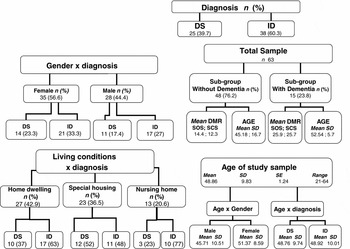
Sociodemographic and general clinical characteristics of the study sample are provided in Table 1.
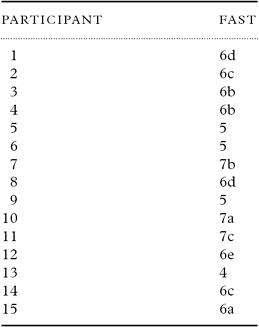
Levels of dementia in participants with clinically diagnosed AD

FAST = Functional Assessment Staging (of dementia of the Alzheimer's type)
None of the comparisons between the variables shown in Figure 1 reached the level of statistical significance, except for a higher mean age of female subjects (F (1,61) = 5.53; p = 0.022). As might be expected, institutionalized subjects were significantly older than those living at home (M = 55.26 vs. 42.19; F (2,62) = 17; p < 0.0001) and the subjects with dementia were older than those without (M = 52.54 vs. 45.18; F (1,48) = 11.29; p = 0.002). According to the literature, subjects with dementia also scored significantly higher on both DMR subscales compared to the subgroup without dementia. Table 1 shows the individual FAST stages of the 15 ID subjects with clinically diagnosed AD according to the classification of Zigman et al. (Reference Zigman2004).
Sociodemographic and general clinical characteristics of the study sample.
ID = Intellectual Disability; DS=Down's Syndrome;
DMR=Dementia Questionnaire for people with ID, comprising:
SOS = Sum Social Scores; SCS = Sum Cognitive Scores;
SD=standard deviation; SE=Standard Error.

Descriptive analyses on the AADS-I scale
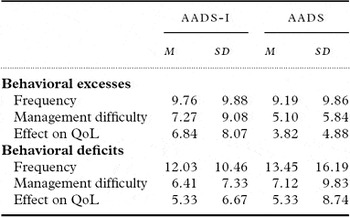
Table 2 shows the mean (± DS) scores and ranges of the six AADS-I subscales and the original AADS scores for comparison.
AADS-I scores compared with the original AADS

AADS-I = Assessment for Adults with Developmental Disabilities (Italian version); QoL = quality of life
There were no significant differences with regard to gender nor between subjects with DS and other types of ID (data not shown). The item “Behaved as though they were living in the past” of the Deficit subscale was never endorsed. In accordance with the extreme individual variability of maladaptive behaviors and neuropsychiatric symptoms in ID, the distribution was normally distributed only for one subscale, namely frequency of deficits as indicated by the proximity of the mean and median, as well as by the low skewness and kurtosis coefficients (data not shown). Proportions of subjects rated lowest for frequency of Excesses and Deficits were 4.8% and 7.9%, respectively.
Internal consistency
All Cronbach's α coefficients of the six AADS-I subscales were above the criterion of 0.70, suggesting a high level of internally consistent reliability of the AADS-I. Cronbach's α coefficient was 0.77 for frequency of Excesses, whereas those for management difficulty and behavioral effect of Excesses were 0.83 and 0.82, respectively. For the Deficits subscales, coefficients were 0.82, 0.76 and 0.79 for frequency, management difficulty and effect, respectively. Mean total-item correlations for the Excesses subscales were 0.47 (range 0.11–0.76), 0.56 (range 0.25–0.83) and 0.54 (range 0.28–0.73) for frequency, management difficulty and effect, respectively.
Items that correlated less strictly with the total subscale scores were “nocturnal wandering” (0.30, 0.38, 0.28) and “sexually inappropriate behavior” (0.11, 0.25, 0.12). For the Deficits subscales, mean total-item correlations for frequency, management difficulty and effect were 0.43 (range 0.28–0.61), 0.39 (range 0.10–0.68) and 0.43 (range 0.14–0.80), respectively.
Items that never reached the criterion of 0.40 were “withdrawal from communicating”, “confusion about themselves and others” and “topographic incontinence”.
Reliability
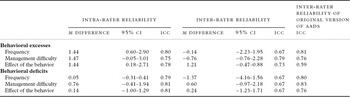
Inter-rater and intra-rater reliabilities of the AADS-I, estimated by ICC, are shown in Table 3. Inter-rater reliability was satisfactory for the six subscales with coefficients ranging from 0.67 to 0.79, whereas ICCs for the intra-rater reliability were all above the 0.70 criterion. In the original study, inter-rater ICC coefficients were 0.81, 0.76 and 0.59, respectively for frequency, management difficulty and effect of behavioral excesses, and 0.80, 0.83 and 0.76 for the corresponding Behavior Deficits subscales. Intra-rater reliability indices have not been reported in the original study.
Inter-rater and intra-rater reliability of AADS-I

AADS = Assessment for Adults with Developmental Disabilities; ICC = intra-class correlation coefficients.
Validity tests
Pearson correlations between the excesses and deficits frequency subscales and the DMR/SCS and DMR/SOS were significant, after Bonferroni's correction, only for the Deficits subscale, with coefficients of 0.63 (p < 0.001) and 0.55 (p < 0.001), respectively.
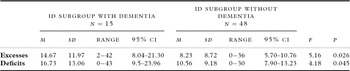
An analysis of variance with the presence or absence of AD as dependent variable, showed significantly higher frequency of both Behavioral excesses and Deficits probed by the AADS-I scale in the subgroup of ID subjects with dementia compared to those without dementia (Table 4).
Frequency subscale scores of “behavioral excesses” and “behavioral deficits” of AADS-I in ID subjects with and without dementia

AADS-I = Assessment for Adults with Developmental Disabilities (Italian version); ID = intellectual disabilities.
Co-varying for age, gender, type and severity of ID, the difference between the two subgroups increased in statistical significance for the Deficits subscale (F (5,56) = 3.86; p = 0.004), whereas it fell short of statistical significance for the Excesses subscale (F (5,56) = 2.358; p = 0.052).
Relationships with sociodemographic factors and ID severity
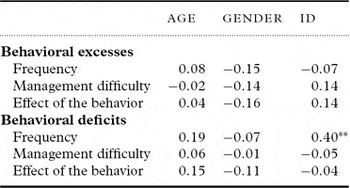
A Pearson correlation matrix was calculated to explore the relationships among age, gender and ID severity and the six AADS-I subscales. As may be seen in Table 5, demographic variables did not significantly relate to the AADS-I subscales. The inverse relationship between management difficulty and age is of interest. ID severity was positively and significantly related to the Deficits subscale for frequency, i.e. more severe ID was associated with more frequent behavioral deficits as measured by the AADS-I.
Pearson correlations among the six AADS-I subscales and demographic variables and ID severity of the study population.

**Correlation significant at the 0.01 level (2-tailed).
Discussion
In this paper, we report the psychometric properties of the Italian translation of the AADS informant-based questionnaire, which was administered to 63 adult subjects with ID attending day and residential services in the region of Trento. The study population was selected from a larger sample, who are participating in a longitudinal project on aging and dementia (www.validazione.eu/dad), based on the following exclusion criteria: no severe sensory or language deficits, no current clinically relevant organic or psychiatric comorbidity and no recent socio-psychological stressful life events. In 15 subjects a diagnosis of a primary dementia syndrome of the Alzheimer type was made by means of clinical examination and/or DMR criteria.
Internal consistency can be considered excellent for three out of the six AADS-I subscales (Deficit subscale for frequency, and the Excesses subscales for management difficulty and effect) and good for the remaining subscales. Overall this means that AADS-I measures different aspects of dementia-related behaviors in terms of frequency, their impact on assistance and QoL of the person concerned rather than different constructs. Acceptable internal consistency of the six AADS-I subscales was also corroborated by mean total-item correlations which were all above the 0.40 criterion, except for the Deficit subscale for management difficulty (0.39). Some single items that correlate less well with the total subscale scores are in accordance with most previous research on BPSD in the general population, such as “nocturnal wandering” (e.g. Selbæk et al., Reference Selbæk, Kirkevold, Sommer and Engedal2008), whereas for other items below the criterion of 0.40, the interpretation is less straightforward. A bias in selection of the participants, for instance, may be excluded since post hoc analyses computed separately for subgroups in the function of gender, ID type, and concomitant dementia or of the three living conditions provided substantially the same results (data not shown).
Inter-rater reliability was satisfactory, with ICCs very similar to those found in the original version. The good concordance between two independent informants in interpreting the effect of BPSD on the QoL of the individual concerned is of interest. It confirms the finding that potential biases of proxy ratings on subjective aspects of QoL in aging subjects with mental disorders (Rabins and Black, Reference Rabins and Black2007) can be minimized when the items target observable and concrete aspects of life (Novella et al., Reference Novella2001), which is clearly the case with AADS-I. Moreover, intra-rater agreement, which was not mentioned in the original study, was good for all six subscales with ICCs always superior to the 0.70 criterion, indicating that the AADS-I scale is a stable measure over a short interval and that items are easily interpretable even those where subjects’ experience has to be filtered through the opinion of another person. Because important clinical or organizational decisions may derive from perceived QoL effects, it is crucial that data are reliable at least when collected from professional caregivers.
The AADS-I scale was able to detect the occurrence of a variety of dementia-associated behavioral excesses and deficits. Only a few subjects did not experienced any of the 28 operationally defined observable behaviors during the previous two weeks and only one item (“behavior as though the subject was living in the past”) was never endorsed. In accordance with previous studies (Huxley et al., Reference Huxley, Van-Schalk and Witts2005; Jozsvai, Reference Jozsvai2005; Urv et al., Reference Urv, Zigman and Silverman2008; Reference Urv, Zigman and Silverman2010), the dementia subgroup manifested more frequent occurrences of both behavioral excesses and deficits compared to subjects without clinically manifested dementia, though the difference only remained statistically significant for behavioral deficits after controlling for age, gender and type and severity of premorbid ID. Behavioral deficits but not excesses significantly correlated with DMR/SCS and DMR/SOS, suggesting that negative rather than disruptive behavior symptoms are more frequently associated with cognitive decline in aging subjects with ID, at least in the present study sample. In a post hoc analysis confined to the dementia subgroup, Pearson's r coefficients between the frequency score of the Deficit subscale and the DMR/SCS and DMR/SOS increased up to 0.78 and 0.70, respectively, whereas those for the Excess subscale remained far below the level of statistical significance.
We did not observe a significant correlation among the six AADS-I subscales and either age or gender because maladaptive behaviors and neuropsychiatric symptoms might be independent of demographic variables. This lack of correlation has already be shown in both the general (Camozzato et al., Reference Camozzato2008) and ID (Urv et al., Reference Urv, Zigman and Silverman2008) older adult dementia literature. The negative correlation between age and the management difficulty scale for Behavioral Excesses is noteworthy, as it presumably indicates that the care staff have less difficulty managing disruptive behavior in older than in younger adults with ID.
In contrast to the widespread opinion that the prevalence of behavioral excesses increases with ID severity (Emerson, Reference Emerson2001), in our study sample only the frequency of occurrence of behavioral deficits correlated with the level of ID severity. This finding presumably derives from having excluded from the present study subjects with clinically relevant psychiatric comorbidity.
Further research is needed with the AADS questionnaire. As many aging ID individuals continue to live with their family, AADS's reliability has also to be probed with family members as proxy informants. The clinical importance of each of the six subscales in terms of the type and stage of dementia needs to be established too. Perhaps the most important topic that warrants further investigation is the AADS's sensitivity to change following behavioral, environmental or pharmacological intervention procedures.
Conclusion
To our knowledge this is the first psychometric evaluation of the AADS informant-based questionnaire in a language other than English. There was a good agreement in the distribution of the six subscale scores and in the inter-rater reliability indices between the original and the Italian version of AADS. These data are therefore promising in making AADS a valuable measure that provides objective and quantitative information on observable dementia-related behavioral excesses and deficits and their effect on care and QoL in adults with ID and dementia. In addition, and as recently stressed by McCallion et al. (Reference McCallion, McCarron and Force2005), instruments such as AADS should encourage the development of psychosocial interventions and training/educational approaches that are targeted at care staff, and also provide the means to test their effectiveness as has been the case in recent years with BPSD scales in the general population with dementia.
Conflict of interest
None.
Description of authors' roles
Luc P. De Vreese, Tiziano Gomiero and Ulrico Mantesso designed the study and drafted the paper. The first author translated AADS into Italian. Tiziano Gomiero supervised the data collection by Elisa De Bastiani and Annachiara Marangoni. Luc P. De Vreese developed the statistical design of the study and carried out the statistical analysis. All authors contributed to completing the paper.
Acknowledgment
We thank ANFFAS Trentino, and the Social Cooperative Villa Maria for participating in this study, and also the patients and informants. We are grateful to Professor Chris Oliver who kindly authorized the use of the AADS questionnaire for this study. Thanks also to Professors Abi Rayner and Paola Bergamaschi for their valuable assistance.