1 Introduction
In recent times, the study of wave scattering by breakwaters with improved design has received increasing interest from investigators because new configurations have been found to outperform conventional breakwaters that have simple configurations. The improved designs of breakwaters involve multiple solid or thin-plate structures or their combinations with permeable and/or impermeable features. The addition of thin plates to rectangular structures is a current study of the wave protection performance of breakwaters. Vertical thin plates increase wave reflection and dissipate turbulent energy [Reference Ruol, Martinelli and Pezzutto32], and horizontal thin plates (or bilge keels) reduce the rolling motion of breakwater and the amplitude of radiated waves [Reference Christensen, Bingham, Friis, Larsen and Jensen2]. For example,
 $\large \boldsymbol {\sqcap }$
and T-shaped breakwaters fall under this category. Furthermore, the H-shaped breakwater is a typical one and was investigated experimentally as a free-surface breakwater by Neelamani and Vedagiri [Reference Neelamani and Vedagiri25] for regular and irregular wave scattering. In their study, the H-shaped breakwater was found to reduce the wave transmission coefficient by up to 0.2 in the regular wave regime and at different locations of the submerged barrier closer to deep-water conditions. In addition, this type of breakwater was not allowed in shallow-water conditions. Nishad et al. [Reference Nishad, Vijay, Neelamani and Chen26] developed a dual boundary element method (BEM) for a porous H-shaped breakwater to study wave scattering. Their findings indicate that the H-shaped breakwater increases wave transmission, and reduces wave reflection and forces. It was also found that the breakwater reduces wave transmission by twenty percent without an increase in horizontal force in shallow water. Panda et al. [Reference Panda, Karmakar and Rao27] used multi-domain BEM to investigate wave trapping and dissipation performance of the H-shaped breakwater combined with two vertical/inclined barriers. The width of the flange in the breakwater was found to control wave transmission, and thus optimal wave trapping and maximum wave energy dissipation were achieved. Neelamani and Rajendran [Reference Neelamani and Rajendran24] studied wave scattering by a submerged T-type breakwater and found that it reduces wave transmission effectively in regions close to deep-water conditions. Günaydın and Kabdaşlı [Reference Günaydın and Kabdaşlı9] tested experimentally the scattering performance of the U-shaped breakwater (
 $\large \boldsymbol {\sqcup }$
) in different submerged regimes for regular and irregular waves. The study of Gesraha [Reference Gesraha8] for the
 $\large \boldsymbol {\sqcap }$
-shaped breakwater and that of Deng et al. [Reference Deng, Wang, Zhao and Huang5] for the T-shaped breakwater show directives for lower wave transmission and reductions in wave-induced motions. In general, a rectangular box-type breakwater with inclined attached plate plays a crucial role in reducing wave transmission [Reference Masoudi and Gan17]. The angle of inclination of the attached plates may suitably be chosen for engineering applications. Furthermore, the study of Kaligatla et al. [Reference Kaligatla, Singh and Mandal12] and Singh et al. [Reference Singh, Kaligatla and Mandal33] on wave scattering by
 $\large \boldsymbol \sqcap $
-shaped breakwaters in deep and finite depth water again confirmed the findings of Gesraha [Reference Gesraha8] for wave scattering employing a different method. Teh [Reference Teh34] made a comprehensive comparison with respect to the scattering performance between many different types of breakwater. In addition, some new cross-sectional shapes of the breakwater and their utility are illustrated by Wang and Nguyen [Reference Wang and Nguyen37]. The study of Mohapatra et al. [Reference Mohapatra, da Silva Bispo, Guo and Guedes Soares21] concerning wave scattering and radiation by a simple conventional three-dimensional (3D) rectangular box offers future directions for considering improved designs with a 3D rectangular box as in the preceding literature.
The conversion of mixed boundary value problems that arise in water wave problems, assuming linear theory, to integral equations has been a long practice since the time of Ursell [Reference Ursell36]. Ursell derived elegantly first-kind Cauchy-type singular integral equations to obtain wave reflection and transmission coefficients of surface piercing and fully submerged vertical thin barriers in deep water. Subsequently, wave scattering by vertical barriers of several configurations has been treated by integral equation methods in finite and infinite depth of water (for example, see [Reference Chakrabarti, Banerjea, Mandal and Sahoo1, Reference Evans6, Reference Porter29, Reference Porter and Evans30]). Wave scattering by inclined barriers was treated by hypersingular integral equations (see [Reference Midya, Kanoria and Mandal20, Reference Parsons and Martin28] and others).
The integral equation method has been widely used not only for several single-barrier scattering problems, but also for multiple-barrier scattering problems. The methods developed by investigators are indeed assisting us in deriving integral equations for newly designed breakwaters and serving as benchmark results to check the correctness of the developed methods. Here, we discuss some useful integral equation methods applied to multiple barriers. The scattering of water waves by two vertical barriers that pierce the free surface of deep water was treated by Levine and Rodemich [Reference Levine and Rodemich14] employing the Schwarz–Christoffel transformation from complex-variable theory. They derived the reflection and transmission coefficients with cumbersome analysis. In a similar fashion, Jarvis [Reference Jarvis11] derived an explicit expression of the reflection and transmission coefficients arising from two fully submerged parallel barriers extending infinitely downward from a fixed point below the free surface. Evans and Morris [Reference Evans and Morris7] derived complementary approximations of the scattering coefficients of two-surface piercing barriers in infinite depth water and showed that complete reflection could be possible at certain incident wavelengths. De et al. [Reference De, Mandal and Chakrabarti3] and [Reference De, Mandal and Chakrabarti4] alternatively proposed an Abel integral equation approach to obtain simple explicit forms of the reflection and transmission coefficients of two surface-piercing barriers and two fully submerged barriers. Their integral equation formulation is much simpler than that of Levine and Rodemich [Reference Levine and Rodemich14], and Jarvis [Reference Jarvis11], and the explicit forms of the derived scattering coefficients are easy to compute. Two vertical parallel barriers with equal lengths were reported to produce zero reflection or total transmission for certain incident wavelengths. However, this is not the case with vertical barriers of unequal lengths, that is, nonzero reflection occurs for these type barriers (see [Reference McIver18] for the matched eigenfunction expansion and [Reference Roy, Basu and Mandal31] for the first-kind Fredholm-type integral equations in the mathematical analysis).
Many human activities have been shifted to offshore regions due to high wave agitations by sloshing effects in shallow-water regions. As a result, the number of offshore structures increases and the diversity of designs is rapidly growing. Nowadays, many breakwater structures have been located in deep-water locations to protect offshore operations. A breakwater in deep water is meant to be considered deep-water breakwater, but not for the breakwater in shallow-water regions at greater depths. The necessity of designing deep-water breakwaters in the present environmental conditions is emphasized and illustrated by Nederstigt [Reference Nederstigt23] for several reasons. In this article, we study wave scattering by an H-shaped breakwater submerged in deep water, taking into account the advantages of horizontal and vertical plates discussed above. The H-shaped breakwater is designed by two identical thin plates in vertical position connected by a thin horizontal plate. The velocity potential formulation for fluid motion and the linear theory for wave motion are adopted. The method of integral equation constructed in this article closely follows the method in [Reference Kaligatla, Singh and Mandal12]. The H-shaped breakwater is impermeable and has geometrical symmetry. The symmetry enables us to limit the mathematical analysis to a half-domain and to a half-plane. The velocity potential is expressed by the Havelock expansion in each region within and outside the breakwater. Using the continuity of fluid velocity and pressure at the interface, integral equations are derived for the horizontal component of fluid velocity across the gaps above and below the breakwater. Explicit expressions of the wave reflection and transmission coefficients are derived. These involve the solution of integral equations. The solutions are obtained by employing the method of the Galerkin approximation [Reference Kaligatla, Singh and Mandal12]. Furthermore, submerged
 $\large \boldsymbol {\sqcup }$
- and
 $\large \boldsymbol {\sqcap }$
-shaped breakwaters are considered limiting cases. The wave reflection and transmission coefficients of all these breakwaters are analysed for different wave and breakwater parameters to determine their scattering performance. Also, the proposed method is validated with the pre-established benchmark results. The results derived from this study may be useful for the design of breakwaters in water regions where low wave transmission is required.
2 Mathematical formulation
Figure 1 shows the schematic of the H-shaped breakwater submerged in deep water. The impermeable H-shaped breakwater comprises two vertical thin plates connected by a horizontal thin plate. To avoid edge effects, the breakwater is assumed to be indefinitely long in the z-direction. In other dimensions, the breakwater has width
 $2b$
, depth of submersion c and the breakwater occupies up to d. Thus, the wave-scattering problem in this article is formulated as a two-dimensional problem rather than a three-dimensional problem. Since the H-shaped breakwater has a symmetrical configuration, the entire fluid region is split into three regions, as shown in Figure 1. Waves on the water surface shall impinge on the breakwater either from the positive x-direction or negative x-direction, and the wave scattering is identical by the symmetrical breakwater. The fluid motion is governed by the Laplace equation, which results from the equation of continuity under the assumptions of an incompressible and inviscid fluid with irrotational motion. Furthermore, waves are assumed to have small wave steepness. When a train of monochromatic waves, incoming from the positive x-direction, impinge on the fixed H-shaped breakwater obliquely at an angle
 $\alpha $
, they will be scattered in different directions. So, the problem involves determining the wave reflection and transmission amplitudes. Because the geometry of the breakwater is invariant in the z-direction, we seek a periodic solution in the
 $ z$
-direction. The z part can be separated from the solution in this case.
Sketch of an H-shaped breakwater submerged in deep water. Region 1:
 $\{(x,y): b<x<\infty , 0<y<\infty \}$
and
 $\{(x,y):-\infty <x<-b, 0<y<\infty \}$
; Region 2:
 $\{(x,y): 0<x<b, 0<y<h\}$
and
 $\{(x,y):-b<x<0, 0<y<h\}$
; Region 3:
 $\{(x,y): 0<x<b, h<y<\infty \}$
and
 $\{(x,y):-b<x<0, h<y<\infty \}$
. In each region,
 $-\infty <z<\infty $
is assumed.

Based on the fluid and wave assumptions, we write the velocity potential in the form  , where
 $\mathit {i}=\sqrt {-1}$
. Here,
 $\upsilon =K\sin {\alpha }$
with wavenumber K, and
 $\omega $
is the angular frequency and t is time. In deep water, the wavenumber
 with gravitational constant
 . The expression
 $\mathit {e}^{\mathit {i}(\upsilon z-\omega t)}$
is suppressed throughout the analysis. Since the breakwater has an invariant configuration in the z-direction, matching of the solutions at the interface between regions is possible by Snell’s law [Reference Kirby and Dalrymple13].
The entire fluid motion is governed by the modified Helmholtz equation

where
 $\partial ^2_{x}$
and
 $\partial ^2_{y}$
are the second-order partial derivatives with respect to variables x and y, respectively. The free-surface boundary condition is

Conditions on each vertical side of the breakwater are


Conditions on the horizontal side of the breakwater are


The deep-water condition is

The edge conditions [Reference Mandal and Chakrabarti16] are

where
 $r=\sqrt {(x\mp b)^2+(y-c)^2}$
and
 $s=\sqrt {(x\pm b)^2+(y-d)^2}$
.
The far-field conditions are

where the incident wave  with
 . The constants R and T are the coefficients of wave reflection and transmission to be determined.
3 Reduction to integral equations
When the breakwater geometry is symmetric with respect to some coordinate axis, the velocity potential  is usually split into symmetric and antisymmetric functions (see [Reference Linton and McIver15, Ch. 2]). Here, we write the function
 as the sum of symmetric and antisymmetric parts
 and
 , respectively. That is,

where

Thus, the domain of the scattering problem is restricted to the region
 $x \geq 0$
only. Now,
 and
 satisfy (2.1)–(2.7). From (3.1),


Let the behaviour of  be represented by

where  is read as
 . The constants
 $R^s$
and
 $R^a$
are to be determined. From (2.10) and (3.4), we find that

Now, the Havelock expansions [Reference Havelock10] of  satisfying (2.1)–(2.8), (3.2) and (3.3) (for
 $x \geq 0$
) are the following. The expansions are usually deduced by means of separation of variables in each region.
Region 1
 $(x> b,\; 0 < y < \infty )$
:

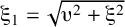
where  and
 .
Region 2
 $(0 < x < b,\; 0 < y < h)$
:

where
 $\alpha _0,\pm \mathit {i}\alpha _n\; (n=1,2,3,\ldots ) $
satisfy
 $\alpha \tanh {\alpha h}-K=0$
,
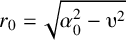 ,
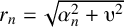 ,
 $n=1,2,3,\ldots .$
Region 3
 $(0 < x < b,\; h < y < \infty )$
:

Let  be the horizontal component of fluid velocity across the line
 $x=b$
, that is,

then

Also, since

we find that

From the edge condition (2.9), we find that

On using the expansion (3.5) for  in (3.8) and by Havelock’s inversion formula,

In the same way, on using the expansion (3.6) for  in (3.9) and by Havelock’s inversion formula, we obtain the integral relations

Substituting the expansion (3.7) for  into (3.9) and using Fourier cosine transformation, we find the integral relations


Fluid pressure is continuous across the line
 $x=b$
for all
 $y\in (0,c)\cup (d,\infty )$
, that is,

This matching condition ultimately yields the first-kind Fredholm-type integral equations

where


with

It should be noted that the expression of
 $\mathcal {M}^{a}(y,u)$
is obtained by replacing “
 $\cot $
” by “
 $-\tan $
” and “
 $\coth $
” by “
 $\tanh $
” in
 $\mathcal {M}^{s}(y,u)$
. Next, the substitution of the solution
 into (3.10) gives rise to

where
 $$ \begin{align*} \mathcal{P}^{s,a}=-\displaystyle\frac{\mathit{i}\cos{\alpha}}{2} \frac{1-R^{s,a}}{1+R^{s,a}}. \end{align*} $$
The real valued nature of the kernels
 $\mathcal {M}^{s,a}(y,u)$
implies that
 have a similar nature to the integral equation (3.11). As such, the relation (3.12) shows that
 $\mathcal {P}^{s,a}$
are also real valued. The integral expressions of
 $\mathcal {P}^{s,a}$
shall be evaluated once the solutions of the integral equation (3.11) are obtained. Subsequently, the required wave reflection and transmission coefficients can be estimated from the expressions
 $$ \begin{align*} |R|=\frac{|1+(2 \sec{\alpha})^2\mathcal{P}^s \mathcal{P}^a|}{\sqrt{\{1+(2 \mathcal{P}^s \sec{ \alpha})^2\} \{(1+(2 \mathcal{P}^a \sec{\alpha})^2 \}}}, \end{align*} $$
 $$ \begin{align*} |T|=\frac{2 |\mathcal{P}^s -\mathcal{P}^a| \sec{ \alpha}}{\sqrt{\{1+(2\mathcal{P}^s \sec{ \alpha})^2\} \{(1+(2 \mathcal{P}^a \sec{\alpha})^2 \}}}, \end{align*} $$
satisfying the energy conservation equation
 $|R|^2+|T|^2=1$
.
3.1 Limiting cases
From the wave scattering problem of the H-shaped breakwater, two different shapes of the breakwater are deduced by applying certain limits in the breakwater’s parameters.
-
(i) When
 $c\to h$
, the breakwater changes to a submerged
$\large \boldsymbol {\sqcap }$
-shaped breakwater for which the integral equations (3.11) shall be solved for solution in the domain
$(0,h)\cup (d,\infty )$
.
-
(ii) When
$d\to h$
, the breakwater changes to a submerged
$\large \boldsymbol {\sqcup }$
-shaped breakwater for which the integral equations (3.11) shall be solved for solution in the domain
$(0,c)\cup (h,\infty )$
.






The water-wave scattering by these breakwaters is also investigated in this paper.
4 Approximate solution of the integral equations
In this section, the Galerkin approximation technique is illustrated to solve the integral equations (3.11) associated with wave scattering by the H-shaped breakwater. This approximation is constructed by using simple polynomials multiplied by a suitable weight function. We choose  as

where
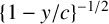 $ \{1-{y}/{c}\}^{-{1}/{2}}$
and
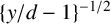 $ \{{y}/{d}-1\}^{-{1}/{2}}$
are the weight functions, N is any nonnegative integer, and
 $\alpha ^{s,a}_p$
and
 $\beta ^{s,a}_p$
are unknown constants. Here,
 $ ({y}/{c})^p \mathit {e}^{-K (p+1) y}$
and
 $ ({y}/{d})^p \mathit {e}^{-K (p+1) y}$
are the basis functions. The approximation is chosen based on the behaviour of
 at the edges
 $y=c \; \mbox {and}\; y=d$
. Note that the exponential term
 $\mathit {e}^{-K (p+1) y}$
in the expansion preserves the decay properties of Laguerre functions, which can be used alternatively. With this exponential term, rapid convergence of the series shall be achieved with a few terms in the expansion (4.1) which, in turn, shows the accuracy of the method.
We rewrite  as

where
 $$ \begin{align} \psi_{1p}(y)=\bigg\{1-\bigg(\frac{y}{c}\bigg)\bigg\}^{-{1}/{2}}\mathit{e}^{-K (p+1) y} \bigg(\frac{y}{c}\bigg)^p, \quad \psi_{2p}(y)=\bigg\{\bigg(\frac{y}{d}\bigg)-1\bigg\}^{-{1}/{2}}\mathit{e}^{-K (p+1) y} \bigg(\frac{y}{d}\bigg)^p. \end{align} $$
We substitute the expansion (4.2) in (3.11) and then multiply by
 $\psi _{1q}(y)$
and integrate from
 $0$
to c to obtain the linear system of equations
 $$ \begin{align} \sum_{p=0}^{N} \alpha^{s,a}_p \mathcal{A}^{s,a}_{pq}+\sum_{p=0}^{N} \beta^{s,a}_p \mathcal{B}^{s,a}_{pq}=\mathcal{H}_{1q}, \quad (q = 0, 1,\ldots, N), \end{align} $$
where

with

Similarly, we substitute the expansion (4.2) in (3.11) and then multiply by
 $\psi _{2q}(y)$
, and integrate from d to
 $\infty $
to obtain the linear system of equations
 $$ \begin{align} \sum_{p=0}^{N} \alpha^{s,a}_p \mathcal{C}^{s,a}_{pq}+\sum_{p=0}^{N} \beta^{s,a}_p \mathcal{D}^{s,a}_{pq}=\mathcal{H}_{2q}, \quad (q = 0, 1,\ldots, N), \end{align} $$
where

with

The expression for
 $\mathcal {A}^{a}_{pq}$
and
 $\mathcal {C}^{a}_{pq}$
shall be obtained by simply replacing “
 $\coth $
” by “
 $\tanh $
” and “
 $\cot $
” by “
 $-\tan $
” in
 $\mathcal {A}^{s}_{pq}$
and
 $\mathcal {C}^{s}_{pq}$
, respectively. The expression for
 $\mathcal {B}^{a}_{pq}$
and
 $\mathcal {D}^{a}_{pq}$
shall be obtained by simply replacing “
 $\coth $
” by “
 $\tanh $
” in
 $\mathcal {B}^{s}_{pq}$
and
 $\mathcal {D}^{s}_{pq}$
, respectively.
Next, the substitution of the expansion equation (4.2) in (3.12) yields
 $$ \begin{align} \mathcal{P}^{s,a} \approx \mathcal{P}_N^{s,a} = \sum_{p=0}^N \alpha_p^{s,a} \mathcal{H}_{1p}+\sum_{p=0}^N \beta_p^{s,a} \mathcal{H}_{2p}. \end{align} $$
Thus, after solving the system of equations (4.4) and (4.5) for the unknown constants
 $\alpha _p^{s,a}$
and
 $\beta _p^{s,a}$
(
 $p = 0, 1,\ldots , N$
), these solutions can be used to obtain
 $\mathcal {P}^{s,a}$
from (4.6). In addition, numerical estimates of the reflection and transmission coefficients
 $|R|$
and
 $|T|$
can be found subsequently.
5 Computational results
The solution method with two-term Galerkin approximation (that is,
 $N=1$
) is considered as it appears to be sufficient here. The computation is carried out with MATHEMATICA programming. The wave reflection and transmission coefficients
 $(|R|\;\mathrm {and} \;|T|)$
are computed and illustrated graphically with various values of the nondimensional parameters:
 $Kd$
,
 $b/d$
,
 $c/d$
for H-shaped breakwater, where d is the total length of the breakwater;
 $Kd$
,
 $b/d$
,
 $h/d$
for submerged
 $\large \boldsymbol {\sqcap }$
-shaped breakwater, where d is the total length of breakwater;
 $Kh$
,
 $b/h$
,
 $c/h$
for submerged
 $\large \boldsymbol {\sqcup }$
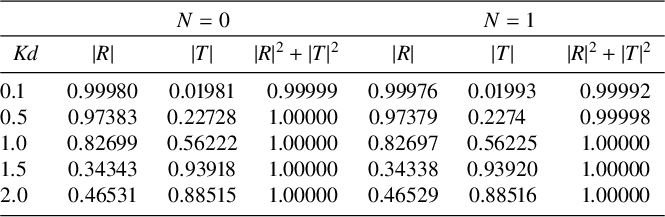
-shaped breakwater having the total length h. The effect of these relative parameters on wave scattering is studied. We show the convergence of scattering coefficients with
 $N=1$
for different wavenumbers
 $Kd$
in Table 1. It may be noted that the values of the wavenumber
 $Kd$
are kept moderate here. For a very high value of the wavenumber (high frequency), the waves will be confined within a thin layer below the free surface (and well above the submerged breakwater) so that most of the incident wave energy will be transmitted and very little will be reflected back. The gravitational constant
 is fixed in the calculation. The integrals that arise in the approximate solution of integral equations are evaluated by applying the Gauss–Laguerre quadrature with 11 points. In addition, the horizontal wave force (
 $F_x$
), vertical wave force (
 $F_y$
) on the breakwater and the overturning moment (OTM) of the breakwater are calculated in magnitude by using the nondimensional formulae [Reference Naftzger and Chakrabarti22]

where A is the incident wave amplitude and


Convergence in
 $|R|$
and
 $|T|$
of H-shaped breakwater when
 $h/d=0.5$
,
 $c/d=0.01$
,
 $b/d=1.0$
and
 $\alpha =30^\circ $
. Three decimal places of accuracy is achieved with
 $N=1$
.

Note that the symmetric potential function has no effect on the horizontal wave force and the OTM, whereas the vertical wave force depends only on the symmetric potential function.
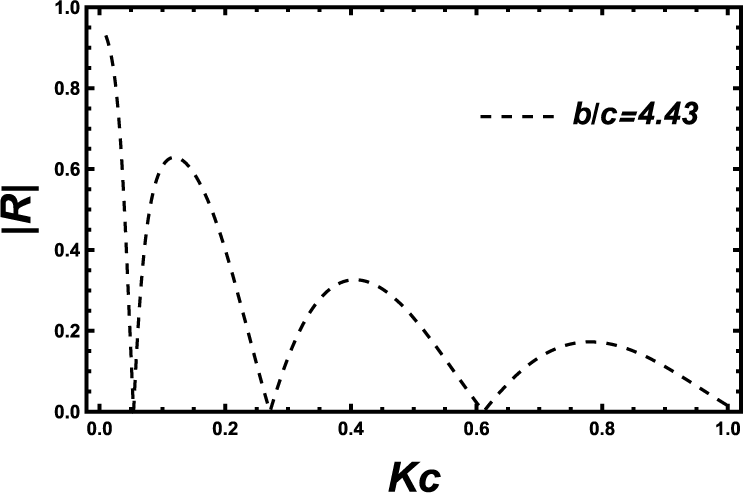
First, we validate the developed method of solution by producing a known benchmark reflection coefficient
 $(|R|)$
of a fully submerged breakwater of a rectangular cross section whose length is infinite, established by Mei and Black [Reference Mei and Black19]. This case is considered with the H-shaped breakwater taking into account
 $h/c=1.0$
and a large value of
 $d(=150\;\mbox {m})$
. This limiting case is reasonable with the H-shaped configuration. The reflection coefficient
 $|R|$
, depicted in Figure 2, almost matches that of [Reference Mei and Black19, Figure 2] concerning a bottom-standing breakwater of infinite length. Thus, the accuracy of the proposed Galerkin approximation is assured with a single term and the correctness of the computation is justified.
Reflection coefficient of Mei and Black [Reference Mei and Black19] for a fully submerged breakwater of rectangular cross section versus wavenumber
 $Kc$
when
 $h/c=1.0$
,
 $\alpha =0^{\circ }$
,
 $d=150\;\mbox {m}$
.

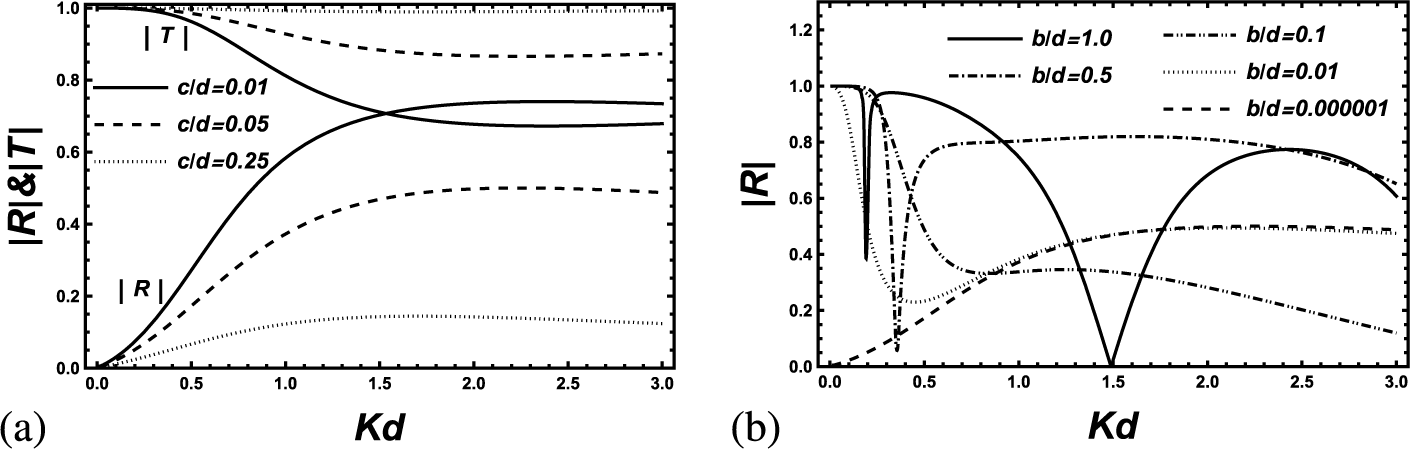
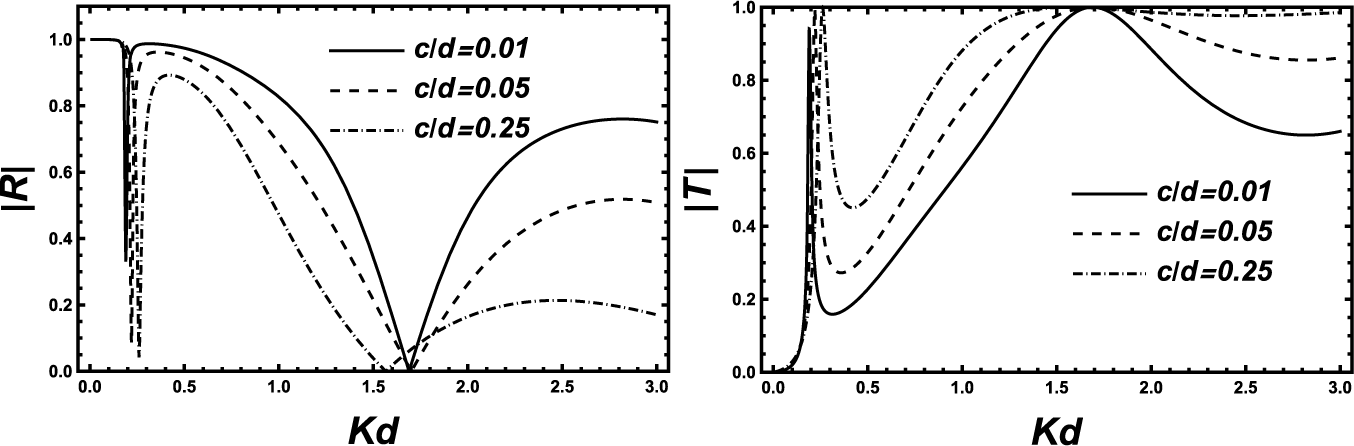
Next, we validate our solution method again in a different limiting case that illustrates wave scattering by a thin vertical barrier of finite length fully submerged below the free surface of deep water. This case is concerned with Evans [Reference Evans6], who demonstrated water-wave scattering by a thin submerged vertical plate for normal incident waves (
 $\alpha =0^\circ $
). We used his wave reflection and transmission coefficients (
 $|R|$
,
 $|T|$
) to validate our method, illustrated in Figure 3(a). The H-type breakwater shrinks to a thin barrier when
 $b/d=10^{-6}$
, which is sufficient to show Evans’ [Reference Evans6] scattering coefficients for
 $c/d=0.01,0.05, 0.25$
, where
 $d=10\;\mbox {m}$
. In Figure 3(a), the present method is proved to show the reflection and transmission coefficients of Evans exactly. Thus, the correctness of the computation is confirmed from Figure 3(a) in the case of a thin submerged barrier as well.
(a) Reflection and transmission coefficients as in [Reference Evans6] when
 $b/d=10^{-6}$
. (b) Reflection coefficients when
 $c/d=0.05$
versus wavenumber
 $Kd$
with
 $h/d=0.5$
and
 $\alpha =0^\circ $
.

In addition, Figure 3(b) shows how a variation in the reflection coefficient
 $|R|$
occurs when the H-shaped breakwater gradually shrinks to a thin vertical barrier (
 ${b/d=10^{-6}}$
). This demonstrates that
 $|R|$
starts from one for the H-shaped breakwater having a certain width, and zero or minimum in
 $|R|$
occurs for some incident wavelengths. It is to be noticed here that so long as the gap
 $(b/d)$
remains moderate but small, the H-shaped barrier consists of a pair of thin vertical barriers for which the reflection coefficient
 $|R|$
is very near to unity for very long waves (
 $ Kd\rightarrow 0$
) as is well known for two submerged thin vertical barriers [Reference De, Mandal and Chakrabarti3]. The incident wavelengths of zero reflection gradually vanish as the H-shaped breakwater becomes a thin vertical barrier, and
 $|R|$
ultimately tends to Evans’ reflection curve for
 $b/d=10^{-6}$
, which starts from zero value. Somewhat analogous behaviour of
 $|R|$
in the very low wavenumber (
 $ Kd\rightarrow 0$
) range was observed by Tuck [Reference Tuck35] as the depth of the water changes from finite to infinite. Thus, from these observations, we point out that the H-shaped breakwater results in higher wave reflection for the most incident wavelengths.
In the following, we show the computational results of the H-,
 $\large \boldsymbol {\sqcap }$
- and
 $\large \boldsymbol {\sqcup }$
-shaped breakwaters. The parameter
 $d=10\;\mbox {m}$
is fixed for all the results presented here.
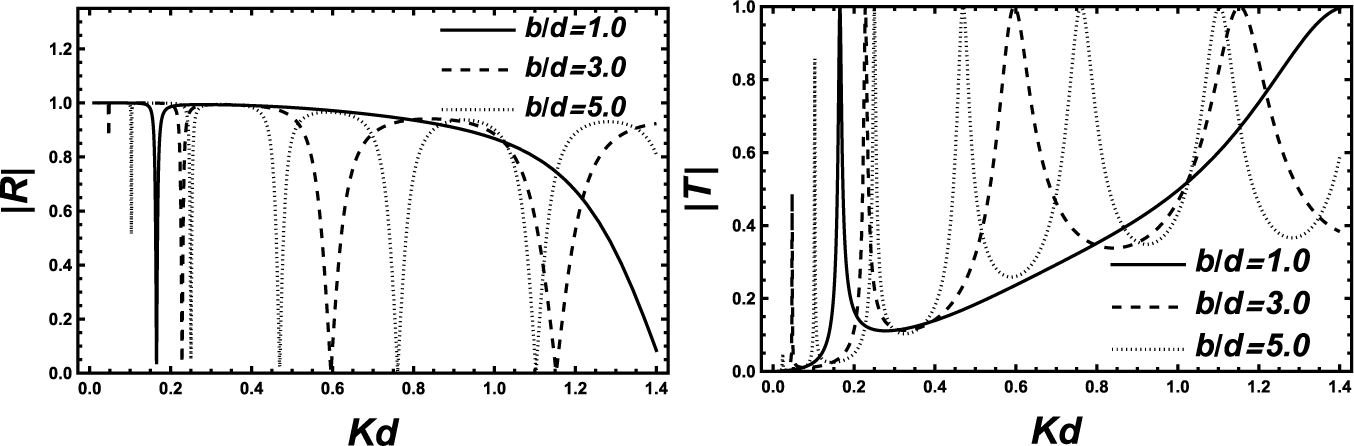
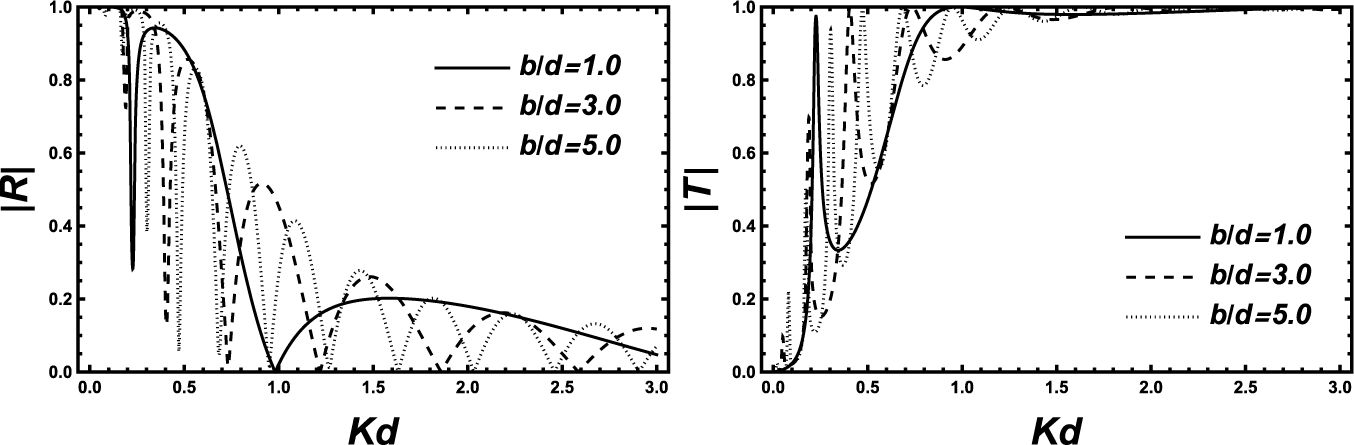
Considering the gap between the H-shaped breakwater and the free surface is very small, the reflection and transmission coefficients
 $(|R|\;\mathrm {and}\;|T|)$
are shown in Figure 4 as functions of wavenumber
 $Kd$
to study the effect of width
 $b/d$
. Here, we compared our results with that of De et al. [Reference De, Mandal and Chakrabarti4], who reconsidered the problem of wave scattering by a breakwater consisting of two thin vertical barriers piercing the free surface of deep water without a horizontal plate between them. For numerical results, we set
 $h/c=0.5$
,
 $\alpha =0^\circ $
and
 $b/d=1,3,5$
as in [Reference De, Mandal and Chakrabarti4]. According to De et al. [Reference De, Mandal and Chakrabarti4], increased space between vertical barriers leads to increased oscillation behaviour in the wave reflection coefficient. The breakwater was shown to reflect short waves considerably, but not long waves in deep water. However, the surface-piercing H-shaped breakwater considerably reflects both long and short waves. The horizontal plate between the two vertical plates accounts for this higher reflection. Since more oscillations arise in
 $|T|$
as the width
 $b/d$
widens, and cause zero wave reflection or full wave transmission at some wavelengths, the H-shaped breakwater with smaller values of
 $b/d$
may be employed to achieve low wave transmission.
Reflection and transmission coefficients of the surface piercing H-shaped breakwater versus wavenumber
 $Kd$
for
 $c/d=10^{-4}$
,
 $h/d=0.5$
and
 $\alpha =0^\circ $
.

In Figure 5, we plot the reflection and transmission coefficients
 $(|R|\;\mathrm {and}\;|T|)$
versus wavenumber
 $Kd$
for the effect of the gap (
 $c/d$
) between the H-shaped breakwater and the free surface when
 $b/d = 1.0$
and
 $h/d = 0.5$
. As expected, wider gaps allow more waves to be transmitted, and, as a result, they yield less wave reflection. Furthermore, it reveals that a few incoming long waves fully transmit over the H-type breakwater. In spite of this, incoming waves of almost all wavelengths are greatly attenuated by this breakwater.
Reflection and transmission coefficients of the submerged H-shaped breakwater versus wavenumber
 $Kd$
for
 $b/d=1.0$
,
 $h/d=0.5$
and
 $\alpha =30^\circ $
.

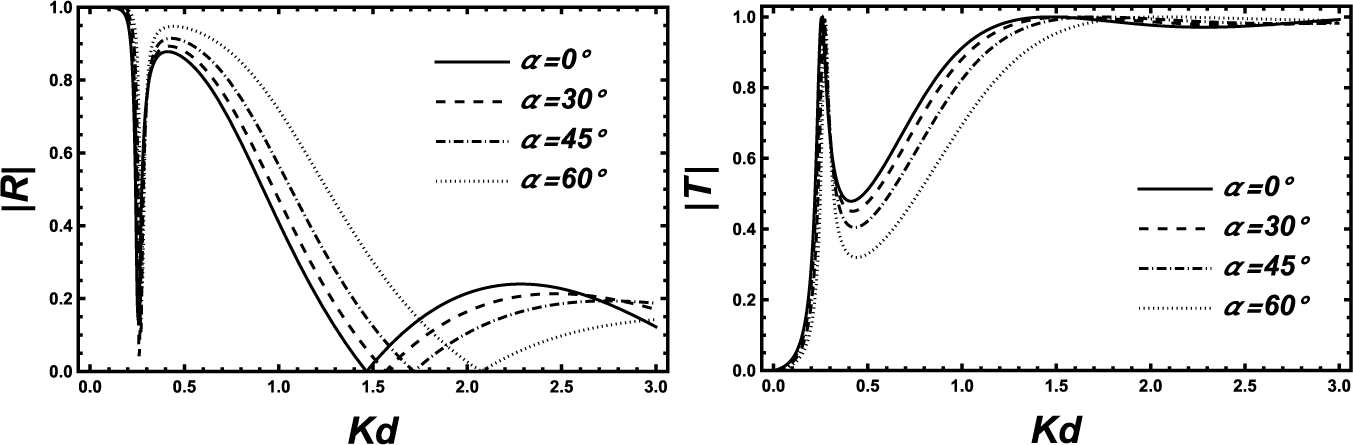
Figure 6 depicts the reflection and transmission coefficients
 $(|R|\;\mathrm {and}\;|T|)$
versus the wavenumber
 $Kd$
for different incident wave angles
 $\alpha $
when
 $b/d = 1.0$
,
 $c/d = 0.25$
and
 $h/d = 0.5$
. It illustrates that incident waves of higher angles are reflected greatly, except at a few wavelengths.
Reflection and transmission coefficients of the submerged H-shaped breakwater versus wavenumber
 $Kd$
for
 $b/d=1.0$
,
 $c/d=0.25$
and
 $h/d=0.5$
.

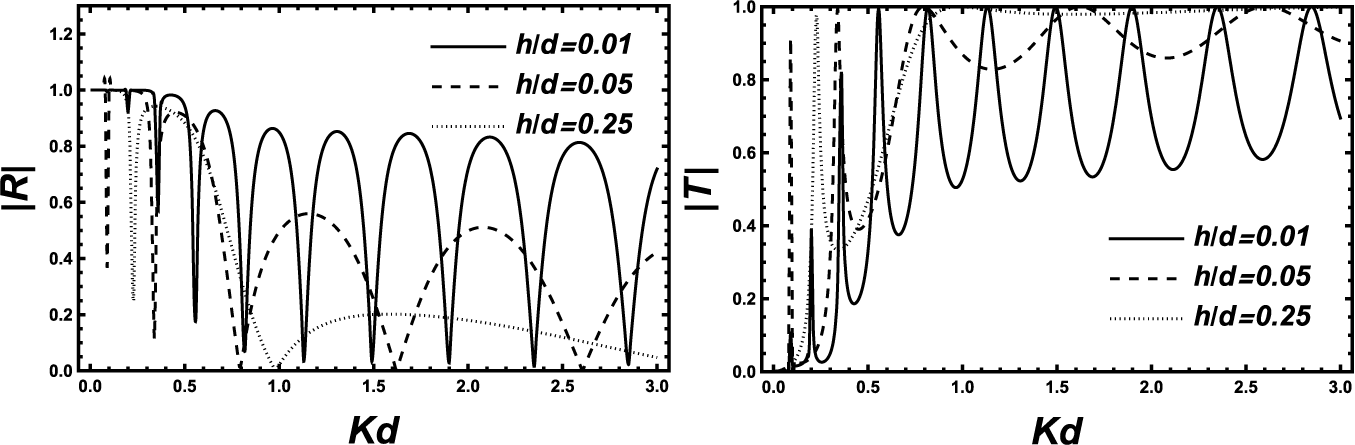
Figures 7 and 8 demonstrate the reflection and transmission coefficients of submerged
 $\large \boldsymbol {\sqcap }$
-shaped breakwater versus wavenumber
 $Kd$
when the width
 $b/d$
varies, and the gap
 $h/d$
between the free surface and the breakwater varies, respectively. Like the H-shaped breakwater, the
 $\large \boldsymbol {\sqcap }$
-shaped breakwater shows higher wave reflection and lower wave transmission in an oscillatory manner with varying width
 $b/d$
. However, the
 $\large \boldsymbol {\sqcap }$
-shaped one shows the scattering coefficients in an oscillatory manner when
 $h/d$
also changes. This is not the case with the H-shaped breakwater. Furthermore, a comparison of Figure 7 with Figure 8 reveals that the change in
 $h/d$
is apparently more effective than the change in width
 $b/d$
of this type of breakwater for wave attenuation.
Reflection and transmission coefficients of submerged
 $\large \boldsymbol {\sqcap }$
-shaped breakwater versus wavenumber
 $Kd$
for
 $h/d=0.25$
,
 $\alpha =30^\circ $
.

Reflection and transmission coefficients of submerged
 $\large \boldsymbol {\sqcap }$
-shaped breakwater versus wavenumber
 $Kd$
for
 $b/d=1.0$
,
 $\alpha =30^\circ $
.

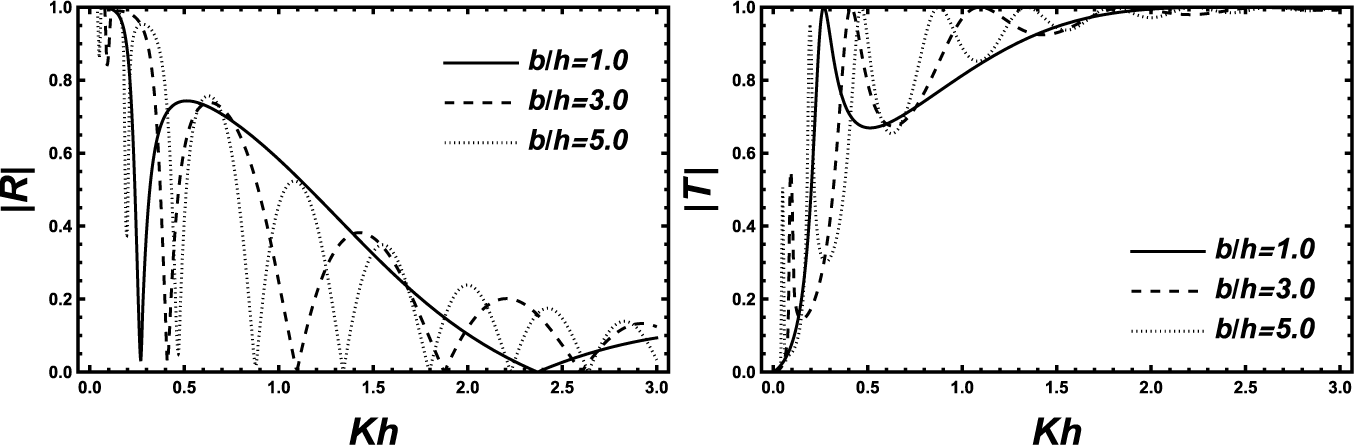
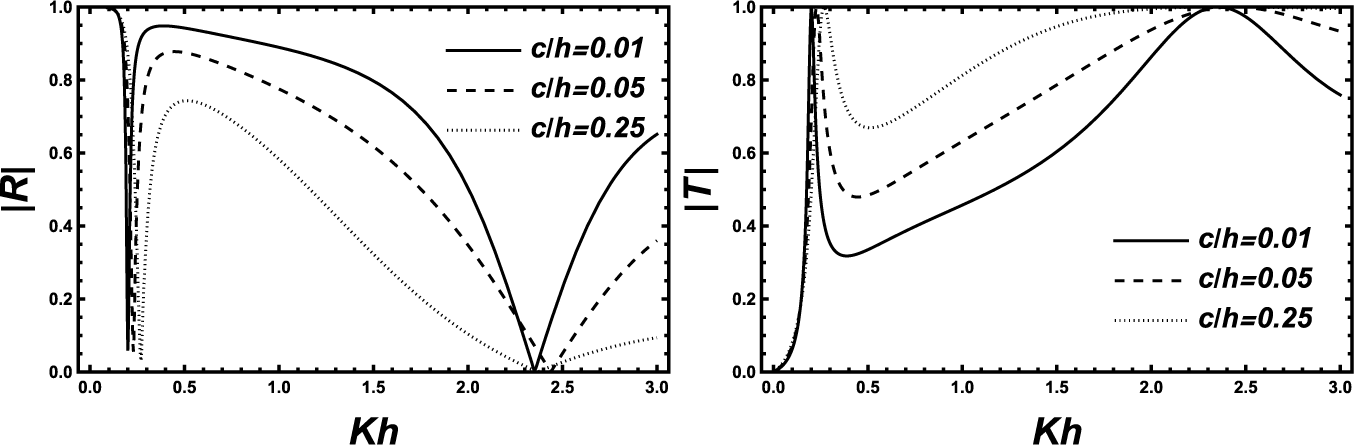
The reflection and transmission coefficients of
 $\large \boldsymbol {\sqcup }$
-shaped breakwater are depicted with wavenumber
 $Kh$
for the varying width
 $b/h$
in Figure 9 and for the varying gap
 $c/h$
in Figure 10. The scattering performance of
 $\large \boldsymbol {\sqcup }$
-shaped breakwater is similar to that of H-shaped breakwater. However, a comparison of Figure 10 with Figure 5 reveals that the
 $\large \boldsymbol {\sqcup }$
-shaped breakwater reflects short waves considerably more than the H-shaped breakwater. This results in even more reduction in wave transmission.
Reflection and transmission coefficients of submerged
 $\large \boldsymbol {\sqcup }$
-shaped breakwater versus wavenumber
 $Kh$
for
 $c/h=0.25$
,
 $\alpha =30^\circ $
.

Reflection and transmission coefficients of submerged
 $\large \boldsymbol {\sqcup }$
-shaped breakwater versus wavenumber
 $Kh$
for
 $b/h=1.0$
,
 $\alpha =30^\circ $
.

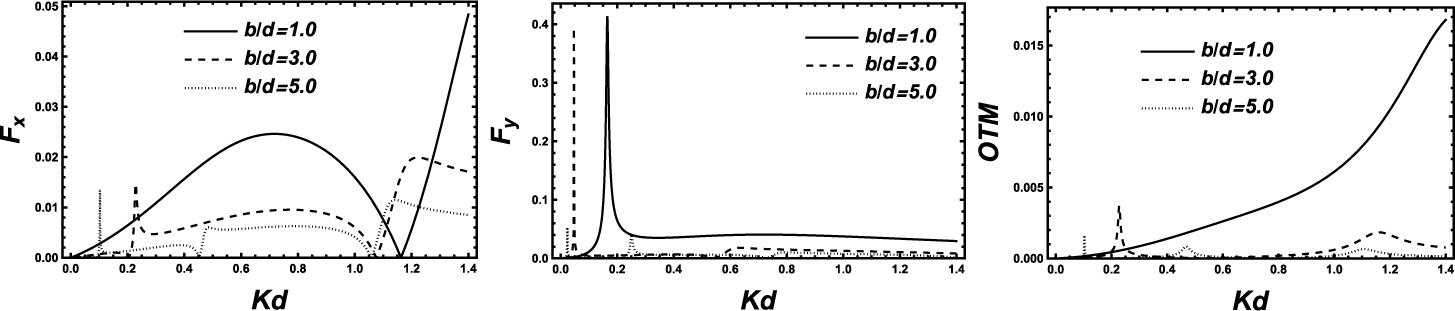
Figure 11 shows the wave forces and the overturning moment when the width of the H-shaped piercing surface breakwater (
 $b/d$
) changes. These physical quantities correspond to the wave scattering coefficients described in Figure 4. It reveals that the wider H-breakwater undergoes a lesser horizontal force (
 $F_x$
) and vertical force (
 $F_y$
) due to the oscillatory behaviour of the scattering coefficients shown in Figure 4. The incident wavelengths of a minimum wave reflection account for zero horizontal force. Furthermore, only smaller frequency waves cause a higher vertical force. The consequent OTM of the H-breakwater reduces with the increase in its width. Hence, a wider H-breakwater has lesser OTM, which is evident from the fact that a larger-size object needs much effort to spin. Generally, high-frequency waves cause a higher OTM, and low-frequency waves cause a lower OTM. Figure 11 is consistent with this fact. Ultimately, it turns out that the overall OTM of the free-surface H-breakwater with larger widths is much less.
Horizontal force (
 $F_x$
), vertical force (
 $F_y$
) and OTM of the surface piercing H-shaped breakwater associated with Figure 4.

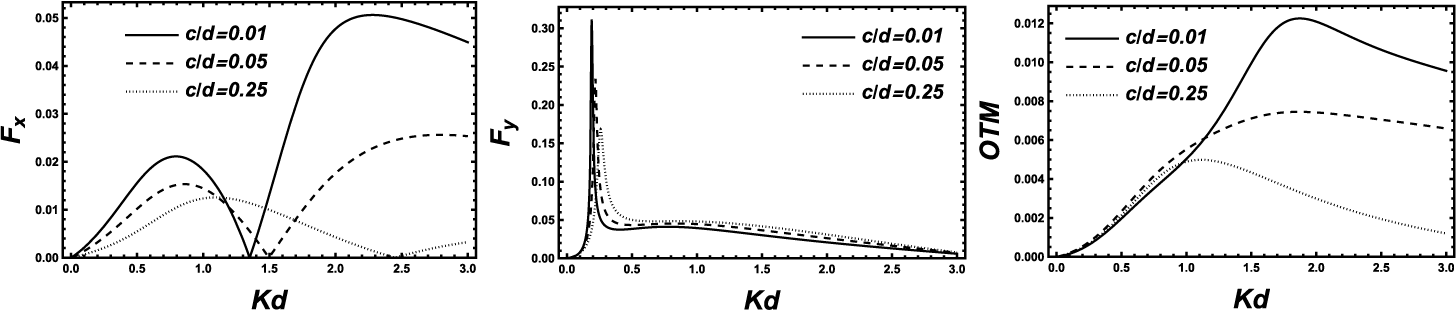
Figure 12 shows the wave forces and OTM when the submerged gap of H-shaped breakwater (
 $c/d$
) changes. These physical quantities correspond to the wave scattering coefficients described in Figure 5. An increase in the submergence gap (
 $c/d$
) leads to a reduction in the horizontal force (
 $F_x$
) and an increment in the vertical force (
 $F_y$
), which is due to the reduction in wave reflection or increased transmission in waves as is evident from Figure 5. Furthermore, the breakwater does not undergo horizontal force where the wave reflection coefficient is zero or minimum. In other words, the breakwater undergoes a higher vertical force where the wave transmission coefficient tends to a maximum. This situation is consistent with wave scattering and wave forces. The resulting OTM reduces with the submergence gap (
 $c/d$
) since the horizontal force (
 $F_x$
) reduces. Higher horizontal wave force leads to higher OTM.
Horizontal force (
 $F_x$
), vertical force (
 $F_y$
) and overturning moment (OTM) of the submerged H-shaped breakwater associated with Figure 5.

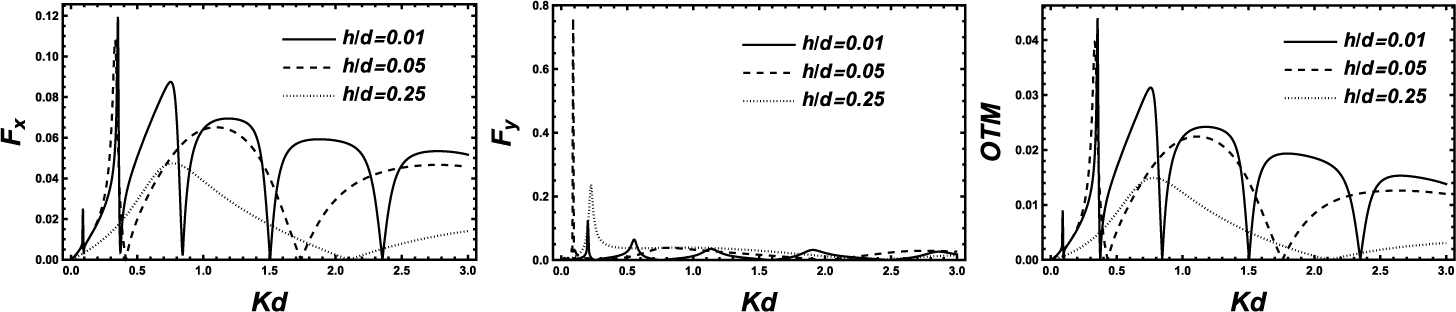
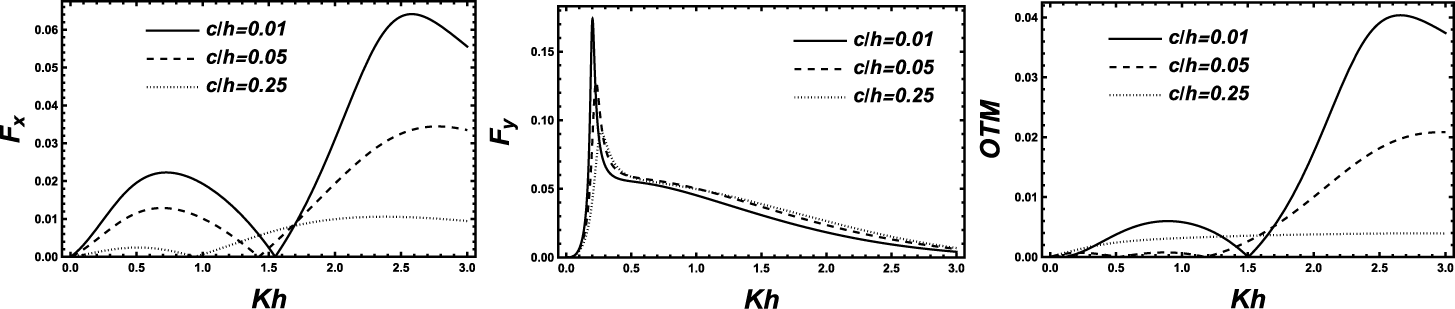
Figures 13 and 14 present the effect of the submerged gap lengths of
 $\large \boldsymbol {\sqcap }$
- and
 $\large \boldsymbol {\sqcup }$
-shaped breakwaters on wave forces and OTM in the wave scattering situation illustrated in Figures 8 and 10, respectively. The variations in the physical quantities of
 $\large \boldsymbol {\sqcup }$
-breakwater are analogous to those of the H-breakwater as in Figure 12. However, these physical quantities possess an oscillatory nature in the case of
 $\large \boldsymbol {\sqcap }$
-breakwater because of the highly oscillatory reflection coefficient, depicted in Figure 8. In addition, these quantities are higher at low-frequency incident waves and lower at high-frequency incident waves, which account for the reversed breakwater configuration.
Horizontal force (
 $F_x$
), vertical force (
 $F_y$
) and overturning moment (OTM) of the submerged
 $\large \boldsymbol {\sqcap }$
-shaped breakwater associated with Figure 8.

Horizontal force (
 $F_x$
), vertical force (
 $F_y$
) and overturning moment (OTM) of the submerged
 $\large \boldsymbol {\sqcup }$
-shaped breakwater associated with Figure 10.

Finally, from the above results, one can determine the effect of wave incident angles on wave forces and OTM. Since the increase in wave angle results in higher wave reflection or lower wave transmission, as shown in Figure 6, higher wave angles account for a higher horizontal force and a lower vertical force, and therefore a higher OTM.
6 Conclusions
In this paper, wave scattering by an H-shaped breakwater submerged in water of infinite depth is studied by integral equation formulation. An approximate solution of the first-kind Fredholm-type integral equation is obtained through the Galerkin approximation. The coefficients of wave reflection and transmission are calculated by using the approximate solution of integral equations. These scattering quantities are graphically depicted with breakwater parameters against the wavenumber. First, the developed method replicates the known results in limiting cases associated with water-wave scattering by a thin submerged finite plate and a submerged long rectangular beam. Next, the wave scattering performance of H-,
 $\large \boldsymbol {\sqcap }$
- and
 $\large \boldsymbol {\sqcup }$
-shaped breakwaters is investigated. The H-shaped breakwater, whether in a surface-piercing or fully submerged position, considerably reflects both long and short waves. It is in contrast to the traditional breakwater system, which consists of two vertical barriers without a horizontal plate that reflects short waves in the surface piercing position and long waves in the fully submerged position. When the width of the breakwater is greater than the total submergence length of the H-shaped breakwater, the waves are strongly reflected for most incident wavelengths. The shorter submerged lengths of the H-type breakwater from the free surface show higher wave reflection. However, zero or minimum reflection still occurs for certain incident wavenumbers in the case of H-shaped breakwater, as in the case of dual vertical barriers without a horizontal plate. Such wavenumbers may disappear for asymmetric H-shaped breakwater as in the case of vertical barriers of unequal length.
In limiting cases, wave scattering by submerged
 $\large \boldsymbol {\sqcup }$
- and
 $\large \boldsymbol {\sqcap }$
-shaped breakwaters is also studied. The
 $\large \boldsymbol {\sqcup }$
-shaped breakwater has reflective characteristics similar to the H-shaped breakwater. However, the submerged
 $\large \boldsymbol {\sqcap }$
-shaped one shows oscillations in the wave reflection coefficient when its width and submergence gap change. In addition, the wave forces and the resulting OTM are also calculated. A reduction in horizontal and vertical forces and OTM is observed with an increase in the width of the breakwater. However, the horizontal force is reduced and the vertical force is enhanced when the submergence gap of the breakwater increases. OTM is proportional to the horizontal force in all cases, as expected. Depending on site locations and wave scattering requirements, these structures may be opted for as breakwaters.
Acknowledgments
R. B. Kaligatla acknowledges the funding support of the Science and Engineering Research Board, Government of India, under the MATRICS project with grant No. MTR/2022/000113. The authors thank anonymous reviewers for their comments and suggestions for improving the presentation of the manuscript.