Introduction
Worthen and Miller (Reference Worthen and Miller1883, p. 328) based the new genus and type species Cholaster peculiaris on a single specimen from the Late Mississippian (Chesterian) of southwestern Illinois. As the name suggests, Cholaster peculiaris was thought by its authors to be unusual among ophiuroids. Although the original discussion was quite extensive, illustration was limited to two figures subsequently reproduced in Spencer and Wright (Reference Spencer, Wright and Moore1966, fig. 83.1a, 1b). Well-preserved new specimens recovered from a small area at a lakeshore outcrop of the Bangor Limestone on Cedar Creek Reservoir in northern Alabama enable description of the new species Cholaster whitei and reinterpretation of the Cholaster generic concept.
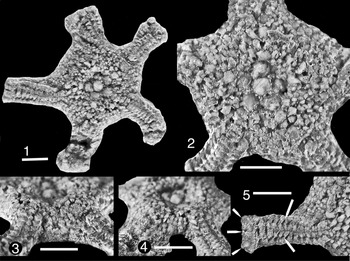
Cholaster peculiaris Worthen and Miller, Reference Worthen and Miller1883; PRIP 2480. (1) Entire specimen; (2) disk rotated ≈ 72° from Figure 1.1, enlarged mid-disk ossicles enclosed by irregular smaller ossicles, the latter not as uniform as those of C. whitei n. sp.; (3) interbrachium between two arms to right of Figure 1.1; (4) interbrachium between two arms to lower right of Figure 1.1; (5) arm to left of Figure 1.1, upturned arm cross-section to left, medial arrow at midline of vertebra, bracketing arrows at laterals; podial basins at arrows to right. Scale bars = 3 mm.

Description of new taxa is an important goal in paleontology, and particularly so if the new taxa document similarities and differences among major clades. Interpretation of comparative morphology and relationships between the asterozoan classes Asteroidea and Ophiuroidea has been debated in the literature, and the new species Cholaster whitei enables further comparison of similarities of overall form and body wall (i.e., extraxial) ossicular development, whereas essential axial (i.e., ambulacral) and to a lesser extent adaxial (i.e., asteroid adambulacral and ophiuroid lateral) expressions remained comparatively stable after class-level differentiation had taken place by early in the Ordovician.
Comprehensive literature review of middle and later Paleozoic ophiuroids was provided by Hunter et al. (Reference Hunter, Rushton and Stone2016). Hunter and McNamara (Reference Hunter and McNamara2017) presented an overview of the Paleozoic history of ophiuroids and the ophiuran transition into the Mesozoic. Shackleton (Reference Shackleton2005), although focused on Ordovician occurrences, surveyed ophiuroid morphology and provided a phylogenetic treatment of early ophiuroid history. O'Hara et al. (Reference O'Hara, Stöhr, Hugall, Thuy and Martynov2018) revised the classification and phylogeny of surviving ophiuran families. Crucial background information was provided in the compilations of Spencer (Reference Spencer1914–1940, Reference Spencer1951) together with the supplement of Owen (Reference Owen1965).
Geologic setting
Strata of Late Mississippian age in northern Alabama have long yielded a variety of well-preserved crinoids and blastoids; asterozoan remains, however, are relatively rare (Waters et al., Reference Waters, Maples, Horowitz and Pashin1993). More than 20 specimens of the new ophiuran species Cholaster whitei and a single specimen of the asteroid Delicaster? sp. have been collected from outcrop of the lower part of the Bangor Limestone (Mississippian, Chesterian) exposed at the edges of Cedar Creek Reservoir in Franklin County, northern Alabama. The Bangor Limestone at the reservoir is well exposed, especially so during low-water stands. The collector of these specimens, Larry White, considers the exposure yielding the fossils to be stratigraphically in the position of unit 2 or 3 of the lower part of the Bangor Limestone as presented in a stratigraphic column of Puckett and Rindsberg (Reference Puckett and Rindsberg2014, fig. 5). The holotype of Cholaster peculiaris was collected from strata of similar age (Mississippian, Chesterian) in Randolph County, southwestern Illinois (Worthen and Miller, Reference Worthen and Miller1883).
Materials
Repository and institutional abbreviation
The holotype of C. peculiaris, all described specimens of C. whitei n. sp., and the specimen of Delicaster? sp. are housed in the collections of the Prairie Research Institute Center for Paleontology (PRIP), Urbana, Illinois.
Systematic paleontology
Terminology
Terminological usage follows Spencer and Wright (Reference Spencer, Wright and Moore1966).
Class Ophiuroidea Gray, Reference Gray1840
Order Ophiurida Müller and Troschel, Reference Müller and Troschel1840
Family Ophiuridae Lyman, Reference Lyman1865
Remarks
Worthen and Miller (Reference Worthen and Miller1883, p. 328) found Cholaster to be “so widely different from those (i.e., ophiuroids) heretofore discovered” that although familial recognition was thought appropriate, the authors did not take this step because of a lack of specimens “showing other parts of the body.” The new Alabama specimens enable a better understanding of Cholaster that, with comprehensive revision of the Paleozoic Ophiuroidea, might allow the familial recognition suggested by Worthen and Miller, but such an undertaking is beyond the scope of the present study.
Based on complex phylogenetic argumentation, O'Hara et al. (Reference O'Hara, Stöhr, Hugall, Thuy and Martynov2018, fig. 3) proposed restriction of the Ophiuridae to Mesozoic and Cenozoic occurrences. The O'Hara study did not include Paleozoic ophiurans beyond a Permian first-recognized record of the crown group. Assignment of Cholaster to the Ophiuridae herein is for reference convenience to the older literature and does not otherwise address interpretations of O'Hara et al. (Reference O'Hara, Stöhr, Hugall, Thuy and Martynov2018).
Genus Cholaster Worthen and Miller, Reference Worthen and Miller1883
Type and only previously described species
Cholaster peculiaris Worthen and Miller, Reference Worthen and Miller1883 from the Chesterian of southwest Illinois, by original designation.
Diagnosis
Disk subcircular, probably somewhat thickened in life with central area depressed. Central portion of disk plated with enlarged ossicles; these can consist of a clearly defined central ossicle with a well-defined enclosing ossicular ring, or alternatively, the central ossicle not clearly differentiated and the enlarged ossicles more irregular in configuration. Central enlarged dorsal disk ossicles braced and supported by enlarged tori? in disk interior in at least C. whitei n. sp. Remainder of dorsal disk ossicles varied, more irregular in form and arrangement (C. peculiaris), or less so (C. whitei n. sp.). Granules can be present.
Arms elongate, rectangular in cross-section, strap-like, straight-sided, known taper gradual. Ambulacrals robust, fused to form “vertebrae,” boundary between fused ambulacrals can be grooved. Laterals robust, upright, extending full arm thickness, re-curved as to overlap distally along abradial edges; one or more spines on dorsal and ventral adradial edges. Podial basins large, shared between vertebrae and laterals, on distal sides of vertebrae and laterals.
Remarks
Because of data limitations for the type species, the generic diagnosis as emended from Worthen and Miller (Reference Worthen and Miller1883) is limited to expressions of the dorsal disk and the ventral surfaces of the arms.
Cholaster peculiaris Worthen and Miller, Reference Worthen and Miller1883
Figure 1
Holotype and only known specimen
Prairie Research Institute Center for Paleontology, PRIP 2480. The specimen rests on a small slab with only the dorsal surface exposed. All arms are truncated, remnant R ≈ 11–12 mm, r ≈ 6 mm. Gradual taper of remnants suggests arms were elongate in life.
Diagnosis
Cholasterid in which the disk as preserved is thickened and appearing ring-like toward the edge with the central area depressed. Central area plated by an enlarged central ossicle surrounded by a well-defined ring of five enlarged ossicles, these approximately aligned with arm midlines. A few remaining ossicles suggest enlarged central ossicles were at least partially covered by small, granular ossicles. Remainder of disk ossicles generally small and varied in shape and arrangement, more nearly equidimensional nearer to disk center, transiting toward disk margin to ossicles more elongate in radial direction and approximately aligned in radial series. Small, scattered ossicles suggest presence of granules in life. One, or more, enlarged ossicles beyond the medial ring might occur in radial positions, but these not recognized in all interbrachia, nor is branching of any series suggested.
Occurrence
“Okaw bluffs, between Chester and Kaskaskia, Randolph county, Illinois; from the second division of the Chester limestone” (Worthen and Miller, Reference Worthen and Miller1883, p. 329, quoting their own citation of data for another taxon on p. 328). Randolph County borders the Mississippi River, to the southeast of St. Louis, Missouri.
Remarks
Diagnosis emended and augmented, and from Worthen and Miller, Reference Worthen and Miller1883.
Holotype
Specimen in dorsal aspect, R range 12–13 mm, r ≈ 5 mm; Late Mississippian, Bangor Limestone, Cedar Creek Reservoir, northern Alabama.
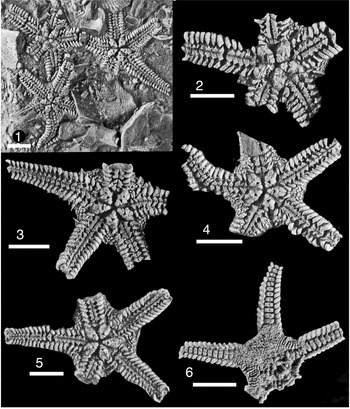
Cholaster whitei n. sp., Bangor Limestone, Mississippian, Alabama. (1) The three specimens of Figure 2.2–2.4 clustered on a small block; (2) paratype PRIP 20002, specimen to upper left of Figure 2.1, rotated slightly counterclockwise; (3) paratype PRIP 20004, specimen to upper right of Figure 2.1, rotated ~180°; (4) paratype PRIP 20003, specimen to lower left of Figure 2.1, rotated ~90° counterclockwise; (5) paratype PRIP 20001; (6) paratype PRIP 20008, a portion of the disk surface has been removed to expose the interior; material at base of arms is thought to be original, suggesting presence of delicate ossicles more distally on the arm during life; see Figure 4.9, 4.10. Scale bars = 5.0 mm.

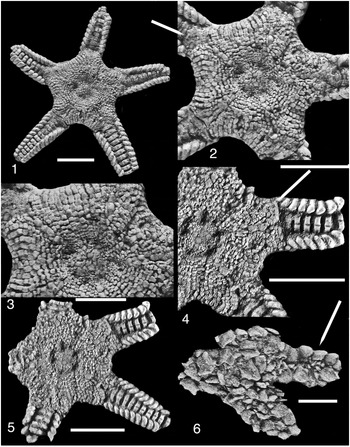
(1–5) Cholaster whitei n. sp. (1–3) holotype PRIP 20000, form and arrangement of dorsal disk extraxials and central disk ossicles; (1) smaller ossicles at tip of upper arm suggest truncation and regeneration during life, see Figure 4.8; (2) delicate dorsal arm ossicles at arrow; (3) arrangement of disk ossicles; (4, 5) paratype PRIP 20005; (4) apparently bifurcating series of enlarged extraxials at disk margin (arrow), these less clear in adjacent arm and in the holotype; (5) form and arrangement of dorsal ossicles. (6) Delicaster? sp., hypotype PRIP 20009, shield-like overlapping marginals (arrow) are typical of Delicaster. Scale bars are (3) 5.0 mm; (1, 2, 4–6) 3 mm.

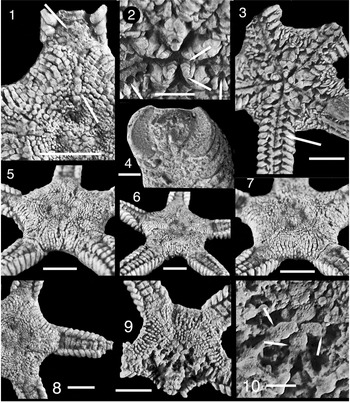
Cholaster whitei n. sp. (1, 5–8), holotype PRIP 20000, see also Figure 3.1–3.3; (1) arrangement of dorsal disk ossicles, central enlarged ossicles not as clearly enlarged as in C. peculiaris; smaller ossicles around central grouping transiting to aligned series of enlarged ossicles; a radial series of enlarged ossicles is aligned with arm axis (lower arrow); ossicles of adjacent series diverge near base of arm although the enlarged series does not continue as clearly as in Figure 3.4; very delicate ossicles remain at base of arm (upper arrow); (5–7), three interbrachia of holotype, smaller dorsal ossicles toward interior bordered by larger aligned series near disk edge; (8) configuration of dorsal disk ossicles, arm with likely regenerated tip; (2), paratype PRIP 20004, arrangement of mouth frame, with sequence of five oral papillae on torus (medial arrows); podial basins (lateral arrows) similar to those of C. peculiaris; (3) paratype PRIP 20003, ossicular arrangement of ventral disk and proximal arms, podial basins (arrow) as in C. peculiaris; (4) paratype PRIP 20006, cross-section of distal side of arm, enlarged laterals border central vertebra; (9, 10) paratype PRIP 20008 in dorsal aspect, (9), overall form and (10), details of central disk area rotated clockwise a few degrees from (9); abutments between tori? and central dorsal disk ossicles marked by arrows; mouth angle ossicles in V-shaped configuration distal to tori?. Scale bars are (1–3, 5–9) 3.0 mm; (4, 10) 1 mm.

Paratypes
Specimen in ventral aspect, R range 6–14 mm, r ≈ 5 mm. Three specimens are adjacent on a single block, all in ventral aspect: PRIP 20002 is to the upper left of Figure 1.1, R range 5–12 mm, r ≈ 5 mm; is to the lower left of Figure 1.1, R range 4–11 mm, r ≈ 5 mm; and PRIP 20004 is to right of Figure 1.1, R range 5–15 mm, r ≈ 5 mm. PRIP 20005, specimen in dorsal aspect, R range 7–12 mm, r ≈ 6 mm. Arms are straight-sided, breadth of the longest remaining arm at base ≈ 4 mm, in 7 mm of free arm tapering to a width of 2.5 mm. PRIP 20006, specimen in ventral aspect, portion of the disk and three arms, R range 10–13 mm, r ≈ 6 mm. PRIP 20007, specimen in dorsal aspect, portion of the disk and three arms, R range 7–12 mm, r ≈ 4 mm PRIP 20008, specimen in dorsal aspect, portion of the disk and three arms, R range 9–12 mm, r ≈ 4 mm.
Diagnosis
Cholasterid in which the disk is relatively weakly thickened and ring-like toward the edge; disk central area probably somewhat depressed in life. Dorsal disk ossicles at disk center somewhat enlarged, plate-like, somewhat irregular in form; central ossicle not clearly differentiated from remainder; enlarged disk ossicles aligned with tori? and interbrachial. Central enlarged ossicles partially covered by small, granular ossicles. Ossicles of remainder of disk consisting of two groups, those closer to the center the smaller, quite uniform and approximately rectangular in outline, elongate transversely, and aligned in radial series; the field of smaller ossicles transiting quite abruptly into a lateral field of larger ossicles arranged in radial series; these ossicles tall, pillar-like, weakly overlapping toward disk center; exposed dorsal outlines rectangular, elongate in radial direction; series extending around arm margins to form relatively small ventral interbrachia. Series of enlarged ossicles aligned with arm axes extend from near the disk center, the series forking near the disk margin. Accessory granules probably common.
Occurrence
From the lower part of the Bangor Limestone, cropping out on the margins of Cedar Creek Lake, one of three TVA lakes under management of the Bear Creek Development Authority, Franklin County, northern Alabama. Additional locality data available to qualified researchers from the repository. The C. whitei n. sp. specimens were found on the lower surface of a single stratum that was excavated at the outcrop.
Description
Disk relatively small as compared to probable arm length, interbrachial intervals as preserved weakly convex to weakly concave; disk low arched in life at disk margins, central area probably somewhat depressed. Arms elongate, strap-like, straight-sided, taper of proximal arm intervals gradual, arm cross-section approximately rectangular.
Dorsal disk surface constructed of abundant, closely fitted ossicles that are differentiated sub-concentrically about the medial specimen vertical axis. Larger, polygonal, plate-like ossicles at disk center, these somewhat varied in size and shape, not clearly differentiated into central ossicle and enclosing ring; ossicular edges overlapping. In disk interior as preserved, apparent mouth-frame tori? of three available interbrachia closely aligned and fitted against dorsal ossicles (Fig. 4.9, 4.10), suggesting natural (i.e., life) positioning rather than taphonomic change. Central disk area surrounded by and partially overlapped by small, granular ossicles of circular outline. Ossicles immediately beyond disk center ossicles small, subrectangular to polygonal in outline, wider than long, arranged in radiating series; surfaces at least in many areas appearing rugate. Ring of smaller ossicles transiting fairly abruptly into a second ring, it of somewhat irregular larger rectangular ossicles, these with long axes radial and aligned in radial series; at disk edge, ossicles closely fitted, forming sturdy disk margin. Series extending around disk margin to form ventral interbrachia; ventral interbrachia relatively small, ossicles uniform.
On dorsal surface, a series of somewhat enlarged, polygonal, distally overlapping, plate-like ossicles radiates across dorsal disk along axial midlines from near margin of central ossicular cluster, the series appearing to terminate near the disk margin of one specimen (Figs. 3.1, 3.2, 4.1, 4.8), but appearing to bifurcate near the disk margin in a second specimen (Fig. 3.4, 3.5); immediately adjacent radial series arcing parallel to the enlarged series (Fig. 4.1, 4.5–4.8).
Small, delicate ossicles at base of arms and immediately adjacent to disk (Figs. 3.2, 4.1) probably representing dorsal arm ossicles, but dorsal arm surfaces beyond arm bases of available specimens devoid of ossicles; if present in life, these lost in preservation.
In dorsal aspect, vertebrae (i.e., fused ambulacrals) approximately rectangular in outline, dorsal surfaces curved, dorsal proximal and distal margins separated by rectangular gaps for inter-ossicular tissues. In ventral aspect, vertebrae appearing approximately triangular or weakly hammer-shaped, “handles” of hammers forming boundaries between large, semicircular podial basins, ventral edges of laterals curved to form part of podial basins. “Heads” of hammers robust, articular surfaces closely fitted, sequential ossicles weakly overlapping. Inter-vertebral surfaces broadly similar to corresponding surfaces of taxa of other ages (e.g., Spencer, Reference Spencer1925, p. 246, figs. 177, 178, 184). Vertebrae approximately circular in outline (Fig. 4.4), bilateral, with a linear, vertical groove marking position of ambulacral fusion. Ossicular surfaces dominated by abradial, deep, arced, dorsal and ventral muscle scars, the ventral the smaller, it ridged seemingly to separate muscle and podial tissues. Tissue depressions border medial, upright, ridge-like inter-vertebral articular facets that extend essentially full ossicular height and bearing a prominent articular projection at base of ossicle. Articular facets enclose a well-defined, circular water-vascular channel; a smaller tissue pit within the facet outline is near the water-vascular channel.
Lateral ossicles large, massive, outlines nearly semicircular. Laterals upright, arced as to overlap distally; adradial lateral margins abut vertebrae, abradial edge ridged, forming inter-lateral contact surfaces and partially enclosing a deep tissue depression. In dorsal and ventral views, successive laterals expose interossicular articulation tissue gaps. Abradially directed outer surfaces finely spinulose; lower, ventrally directed surface at edge of disk and at least proximal arm intervals bearing three? spine bases; at least one larger base can occur at the dorsal adradial edge of lateral. Three or four laterals of disk appearing little-differentiated in ventral aspect from those of arms except inter-lateral articular surfaces are inset from ossicular edge. Short, conical spines remain on disks.
Mouth frame dominated by two sequential ossicular pair, in turn followed distally on the disk by three or four lateral ossicular pair, these in ventral view similar to arm laterals. Ossicles of the more proximal mouth-frame pair robust and enlarged, their outer, ventral surfaces forming a semi-circular mouth-frame ring. Overall appearance of enlarged ossicles more or less typical of ophiuroid mouth-angle ossicles (MAO). Ossicles of more distal mouth-frame pair sub-rectangular, shield-like, surfaces arched, inclined ventrally toward the mouth area, overlapping MAO; a curved reentrant marks positioning of a distally-abutted lateral, it in ventral aspect similar in form to subsequent ossicles of lateral series; recognition of MAO argues subsequent pair are much differentiated laterals. In available material, neither MAO nor adjacent laterals bear spine bases or spinelets. Torus unpaired, abutting proximal edges of MAO; torus shield-like, upright, semi-ovate in outline. Proximal face of torus weakly concave, bearing vertical series of at least five papillae (Fig. 4.2, 4.3), these progressively increasing in size into disk interior, the outer-most papilla more or less triangular or semi-ovate in outline, the proximal margin of the more interior papillae flattened or truncated rather than triangular.
Etymology
The species name is in honor of Larry White, who originally discovered and subsequently collected the C. whitei n. sp. suite.
Remarks
Although C. whitei n. sp. is considered readily assigned to Cholaster Worthen and Miller, the type species, C. peculiaris, was described from a single poorly preserved example employing problematic and potentially misleading expressions that can be clearly evaluated only with access to the specimen itself. Worthen and Miller (Reference Worthen and Miller1883) evaluations are discussed herein, and new illustrations are included (Fig. 1). The specimen of C. peculiaris rests on a sediment block and exposes the disk in dorsal aspect; in contrast, eight specimens of C. whitei n. sp. were available, and others now in private collections were reviewed. The C. pecularis specimen was subjected to outcrop weathering, whereas the Alabama fossil-bearing horizon was excavated at the outcrop; the C. whitei n. sp. specimens did not suffer weathering from exposure.
For the generic name of their new ophiuroid, Worthen and Miller (Reference Worthen and Miller1883, p. 328) selected cholos, “defective,” combining it with aster for star. The authors did not precisely identify reasoning behind their “defective” interpretation nor provided specific discussion for their choice of peculiaris; nevertheless, arms were described as “short, abruptly truncated, and slightly expanded at the apices by reason of an enlargement of the terminal plates. They (i.e., the arms) are widely separated from each other, though not at uniform distances, and present the appearance of having been stuck on the central disc, instead of having grown from it” (Worthen and Miller, Reference Worthen and Miller1883, p. 329). Worthen and Miller (Reference Worthen and Miller1883, p. 329) continued “One of the interradial spaces is much greater than the others…a line may be drawn across the disc, leaving three entire rays upon the smaller half,” and go on to describe the “back” of each ray as having been covered by “transversely elongated plates,” the description identifying the ossicles as vertebrae and laterals, but using the authors’ terminology, the usage not of concern here.
Presence of enlarged central dorsal disk ossicles rather than those of the mouth frame demonstrate that it is the dorsal surface of the disk of the holotype that is exposed, whereas comparative evaluation with the Alabama specimens indicates that all five arm remnants of the C. peculiaris specimen have been inverted and folded over the disk as to expose ventral rather than “back,” or dorsal surfaces. In the description quoted above, Worthen and Miller (Reference Worthen and Miller1883) accurately described positioning of the arms on the disk surface; further, there is no indication of disk rupture that would indicate extrusion of life-positioned arms onto the dorsal surface. In comparison with the Alabama specimens, it is the podial basins that are exposed rather than the uniform transverse “back” surfaces of the vertebrae, and the laterals appear deflected toward the disk because they are exposed in ventral aspect rather than toward the arm tips, as seen in the Alabama specimens.
The suggested peculiarities of overall disk symmetry noted by Worthen and Miller (Reference Worthen and Miller1883) resulted from the positioning of the reflected remaining arm intervals, these not fully aligned with natural positioning within the disk, together with likely partial distortion resulting from burial and compaction. One arm terminus appears upturned to expose small ossicles at the tip, one ossicle of which could be a regenerated terminal, but otherwise ossicular sizes are more or less uniform to the arm termini, thereby suggesting breakage rather than life appearance.
The apparent bracing of the dorsal disk surface by the tori?, which likely led to the medial disk depression noted by Worthen and Miller (Reference Worthen and Miller1883), perhaps is “peculiar,” as is the upright series of oral papillae not available to these authors in the holotype of C. pecularis, but neither expression departs significantly from generally recognized ophiuran configurations.
All of the new, C. whitei, specimens are on carbonate sediment blocks, three exposing dorsal surfaces, the remaining five the ventral. Although both surfaces are not exposed for any one specimen, enough exposure is available to allow assignment of all to a single species. Distal tips of available arms are abruptly terminated, although most specimens otherwise show little evidence of the ossicular displacement that typically accompanies tissue decay.
The two species of Cholaster differ primarily in dorsal disk expression. Interbrachial disk margins of the Alabama specimens range from weakly convex to weakly concave; however, allowing some distortion during preservation, C. whitei n. sp. disks probably were sub-circular in life. As in the holotype of C. peculiaris, arms of most of the Alabama fossils appear “short and abruptly truncated” (Worthen and Miller, Reference Worthen and Miller1883, p. 328); nevertheless, an incomplete specimen, now in a private collection, exhibits the elongate, tapering arm more typical of ophiurans. Also, as in the C. peculiaris holotype, the discontinuity of ossicular sizes of one or two adjacent arms of an Alabama specimen suggests arm breakage and regeneration (Fig. 2.1), although no terminal ossicle is clearly in evidence. Regeneration is common among extant asterozoans, and occurrences also have been recorded among Paleozoic exemplars (Spencer, Reference Spencer1918, p. 160; Lehmann, Reference Lehmann1951). Further arguing breakage, arm remnant lengths differ.
The simplest explanation for the origin of the vertical series of small ossicles proximal to the torus is derivation from spinelets rather than either as differentiated ossicles of the axial or adaxial series, or as a new ossicular type. Interpretation of a spinelet source for the series is supported by absence of any apparent spine bases on the MAO and their immediately adjacent, shield-like laterals, whereas spines occur on more distal laterals. The papillae series would appear to have been more effective for selective smaller particle feeding rather than as a tool for the manipulation of active prey.
Closely fitted alignment of the enlarged dorsal disk ossicles and the three better-exposed tori? of the disk interior (Fig. 4.9, 4.10) suggest natural or life positioning rather than taphonomic reconfiguration that, if indeed natural, suggests the depressed central disk area noted by Worthen and Miller (Reference Worthen and Miller1883) also was natural, the life configuration likely serving to support and reinforce disk structure, which was also reinforced by the study interbrachial disk margin. The more dorsal portions of disk laterals might also be expanded and contributing to a sturdy disk, all perhaps limiting soft-organ disk capacity that in turn would appear to have favored feeding selectivity rather than bulk feeding. The remainder of the disk interior as preserved appears of conventional ophiuran form.
The fine ossicular accumulations at the disk termini of the arms appear fitted as if representing life occurrences rather than as chaotic arrangements suggestive of post-mortem events, and therefore during life fine plating is likely also to have been present more distally on the arms.
Class Asteroidea de Blainville, Reference Blainville1830
Order Kermasida? Blake, Reference Blake2018
Family Permasteridae? Blake, Reference Blake2018
Genus Delicaster Blake and Elliott, Reference Blake and Elliott2003
Type species
Neopalaeaster enigmaticus Kesling, Reference Kesling1967, from the Paint Creek Formation, St. Claire Co., Illinois.
Remarks
Delicaster was based on the single species Neopalaeaster enigmaticus; however, a second species, D. hotchkissi, was recognized by Blake and Koniecki (Reference Blake and Koniecki2018), and the genus was further discussed by Blake (Reference Blake2018).
Delicaster? sp.
Figure 3.6
Hypotype
Only specimen exposed in apparent dorsal aspect, PRIP 20009, it collapsed and the ossicles displaced and partially leached; remaining arm intervals R ≈ 10, 9, and 7 mm; r ≈ 4 mm.
Occurrence
PRIP 20009 was a float specimen recovered slightly away from the C. whitei n. sp. specimens, and thought to have been derived from a slightly different horizon.
Remarks
Ossicles were disrupted and partially displaced during tissue decay, burial, and sediment compaction, although the disk ossicles are robust and plate-like as expected of a dorsal surface rather than ventral mouth frame ossicles. Overall specimen shape and marginal ossicular configuration with apparent small arm abactinals allow tentative assignment to Delicaster.
Complexities among early asterozoans and their interpretation
Background
Many recognized genera of the subphylum Asterozoa, including Cholaster Worthen and Miller, are variously morphologically ambiguous, the ambiguities leading to the uncertainties that have surrounded asterozoan ancestry, subdivision, and relationships among the posited major subdivisions. Although assignment difficulties result in part from ambiguous morphology, also important is whether what has been treated as class-level diversification followed, or preceded, origin of the robust, readily preserved asterozoan skeleton (Blake and Guensburg, Reference Blake and Guensburg2015, p. 483), a perspective anticipated in interpretation of the problematic Echmatocrinus (Sprinkle and Collins, Reference Sprinkle and Collins2011) from the Middle Cambrian Burgess Shale.
Spencer (Reference Spencer1914, Reference Spencer1916, p. 39–59) summarized the history of study of fossil asterozoans to dates of these publications. In his monograph, Spencer (Reference Spencer1914–1940) repeatedly returned to similarities between early ophiuroids and asteroids and resultant difficulties of taxon interpretation, suggesting, for example, that both the Asteroidea and Ophiuroidea diverged from a more primitive class (Spencer, Reference Spencer1914, p. 19), and “that among the earliest Asterozoa the impulse to become definitely either Asteroidea or Ophiuroidea was not fixed” (Spencer, Reference Spencer1919, p. 170). Reflecting these uncertainties, early asterozoans were subdivided into “sections” in the Spencer monograph rather than assigned to traditional Linnaean categories, some of the “sections” not aligned with either ophiuroids or asteroids. Similarities between ophiuroids and asteroids were discussed in some detail, for example in the treatment of the Eoactinidae (Spencer, Reference Spencer1919, p. 178). In noting that the then-new Somasteroidea “members show the first stages in the differentiation of a starfish,” and that “these first stages show no sign of an ambulacral groove,” Spencer (Reference Spencer1951, p. 87) appears to have found his more primitive class (i.e., Reference Spencer1914, p. 19–20). Spencer and Wright (Reference Spencer, Wright and Moore1966) retained the Somasteroidea in a basal positioning, thereby arguing resolution of many taxonomic and phylogenetic issues, although similarities between early asteroids and ophiuroids remained and still remain incompletely understood. The Spencer and Wright (Reference Spencer, Wright and Moore1966) assignment of the Somasteroidea to a basal positioning within the Asterozoa incorporated research results of H.B. Fell (e.g., Reference Fell1963), who argued that crinoids are in turn basal to asterozoans. The publications of Fell came well after the 1955 death of W.K. Spencer (Cox, Reference Cox1955); however, Spencer's Reference Spencer1951 discussions documented his essential view of the significance of the Somasteroidea within the Asterozoa, regardless of subsequent interpretations of H.B. Fell.
Since Fell (Reference Fell1963) and Spencer and Wright (Reference Spencer, Wright and Moore1966), additional and commonly divergent viewpoints on asterozoan classification and phylogeny have been offered by Kesling (Reference Kesling1969), McKnight (Reference McKnight1975), Shackleton (Reference Shackleton2005), Blake (Reference Blake2013, Reference Blake2014, Reference Blake2018), and Villier et al. (Reference Villier, Brayard, Bylund, Jenks, Escarguel, Olivier, Stephen, Vennin and Fara2017). Blake et al. (Reference Blake, Zamora and García-Alcalde2015), augmented in Blake and Guensburg (Reference Blake and Guensburg2015), included overview phylogenetic analyses of the Asterozoa, but these phylogenetic interpretations are not revisited in part because the ophiuran affinities of Cholaster are clear and in part because the approach here is directed toward specific morphologies and taxa.
Cholaster and other genera of complex morphology
To a point, recognition of similarities among taxa is subjective, and the ecologic implications difficult to prove or disprove. Because specific somasteroid sources for the surviving asterozoan classes have not be identified, phylogenetic pathways are unavailable, and it is unclear whether posited similarities might be plesiomorphic, convergent, or both.
In Cholaster, form and arrangement of axial or ambulacrals, form of the adaxial laterals, and what is available of the axial/adaxial mouth frame are typically ophiuran, whereas the extraxial comparatively broad, strap-like arms and the small, uniform ossicles beyond the laterals are reminiscent of those of certain asteroids; for example, extraxial marginals are not recognized in either the asteroid Illusioluidia Blake and Guensburg, Reference Blake and Guensburg1989, nor most ophiuroids including Cholaster; however, rectangular laterals reminiscent of the adambulacrals and marginals of asteroids are typical of the ophiuran Encrinasteridae (sensu Spencer and Wright, Reference Spencer, Wright and Moore1966, p. U83). Axials of asteroids and ophiuroids were distinct from the time of their first occurrences, although representatives of both retained similarities with somasteroids. Like the extraxial skeleton, adaxials are under the more immediate influence of environmentally imposed selective pressures, these ossicles less clearly differentiated in Stenaster and encrinasterids.
In addition to Cholaster, Stenaster Billings, Reference Billings1858 has been aligned with both asteroids and ophiuroids; Spencer (Reference Spencer1914, p. 22) emphasized an ophiuran assignment, a view later elaborated on by Shackleton, nee Dean (Reference Dean1999). Additional asteroid-like ophiuran genera are Schoenaster Meek and Worthen, Reference Meek and Worthen1860, redescribed by Jell (Reference Jell1997), it of an overall configuration suggestive of the asteroid genus Schuchertia Gregory, Reference Gregory1899 (Palasterinidae sensu Blake, Reference Blake2018); and secondly, Ophiocantabria Blake, Zamora, and García-Alcalde, Reference Blake, Zamora and García-Alcalde2015 (Encrinasteridae), it suggestive of the asteroid Xenasteridae. In contrast, the subcircular disk with robust dorsal ossicles and attenuated arms of the Devonian asteroid Clarkeaster Ruedemann, Reference Ruedemann1916, are suggestive of many ophiuroids (see Blake, Reference Blake2018, pl. 14.3, 14.4). Phragmactis Spencer, Reference Spencer1940, was treated as of uncertain affinities when described, and later differently interpreted (Spencer and Wright, Reference Spencer, Wright and Moore1966; Shackleton, Reference Shackleton2005; Blake, Reference Blake2014). Other genera of a problematic nature include Catervapermaster Blake, Reference Blake2000, reviewed by Blake and Guensburg (Reference Blake and Guensburg2015), and Swataria Blake, Reference Blake2014.
Conclusions
The new Carboniferous ophiuroid species Cholaster whitei n. sp. is based on unusually well-preserved material from Alabama. Cholaster is important because although clearly ophiuran, it documents morphologic expressions that are plesiomorphic or convergent with corresponding expressions found among asteroids, thereby enabling some broadening of interpretation of asterozoan history. Examples of other Paleozoic asterozoans exhibiting comparable complex morphologies are cited.
Acknowledgments
The site of the Alabama specimens was discovered and collected by L. White and his colleagues, who generously allowed the writers to select the specimens here recognized as Cholaster whitei n. sp. from the full suite before placing the remainder on the open market. S.W. Heads and M.J. Thomas of the Prairie Research Institute Center for Paleontology loaned the holotype of C. peculiaris, and M.J. Thomas photographed the arm cross-section of figure 4.4. J. Koniecki prepared specimen interiors, advised the writers on specimen occurrence, and donated a specimen. G. Nestell made editorial suggestions, T.E. Guensburg and A.W. Hunter reviewed the manuscript, and S. Zamora provided editorial services. We are indebted to all.