INTRODUCTION
EoL care is an important aspect of healthcare worldwide that is becoming increasingly more vital and is emphasized by healthcare and social care professionals, dying persons, family members, and the general public (Department of Health, 2008). However, many issues and challenges may exist in providing quality EoL care to individuals with a terminal illness, including accessibility, coverage, care quality, knowledge and skills, competency, decision making, and psychosocial and spiritual concerns. Given the nature of terminal illnesses, palliative care rather than curative care at the end of life has been highlighted and promoted in recent years, which is an approach that can improve the quality of life (QoL) of patients and their families facing the problems associated with a life-threatening illness through prevention and relief of suffering as well as treatment of pain and other physical, psychosocial, and spiritual problems (WHO, 2002). With the rapidly aging population, improving EoL care has become a priority of public policy and healthcare strategies in many countries (Department of Health, 2008; 2011; Giovanni, Reference Giovanni2012), not so much from a cost perspective but more in terms of quality (Carlson, Reference Carlson2010).
Hong Kong is a highly developed metropolitan area. However, a report by the Economist Intelligence Unit (2010) indicates that the quality of death in Hong Kong ranks 20th among 40 selected locations from around the world. So there is plenty of room for improvement. Hong Kong is also embracing a rapidly aging population with limited resources. The number of persons aged 65 and above accounts for 13% of its population, and this number is expected to increase to 30% by 2041 (Census and Statistics Department, 2014). Compared to 2011, Hong Kong's elderly dependency ratio will double by the year 2026 (18.8 vs. 37.5%) and almost triple by the year 2041 (54.9%) (Cheng et al., Reference Cheng, Lum and Lam2013). Demand for long-term care services will rise considerably for the foreseeable future (Social Work Department, 2013). Increased numbers of older persons and extended life expectancy coupled with the impact of chronic illness on individuals' physical, psychological, and social well-being suggest that the demand for EoL palliative care services will increase not only in terms of quantity but also quality (Williams et al., Reference Williams, Crooks and Whitfield2010). Though there are many cases of clinically relevant, collaborative, interdisciplinary, and strategic approaches to palliative care research in Hong Kong, this information is greatly fragmented. To inform evidence-based practice and policy making, an examination of the available evidence generated from scientific research conducted in the region seems necessary, since the state of EoL care research is closely linked to the development of EoL care services (Sigurdardottir et al., Reference Sigurdardottir, Haugen and van der Rijt2010).
The purpose of our review was thus to provide a systematic and thematic analysis of peer-reviewed journal articles that describe EoL care or palliative care studies undertaken in Hong Kong and to examine the characteristics of the studies in terms of venue, sample, research methodology, and outcomes. Not only would such an analysis be helpful for improving EoL care services and identifying priority areas for future research, but the findings may provide lessons for other regions or nations that share similar EoL care challenges.
METHODS
Search Strategy
The following electronic databases were searched from their respective inception through August of 2014: AMED, CINAHL, PubMed, MEDLINE, SocINDEX, PsychINFO, and Web of Science. The search terms used included: “palliative care,” “hospice care,” “terminal care,” “end-of-life care,” “advance directive,” “advance care plan,” “dying,” “death,” “end of life,” “terminal,” “terminally ill,” “palliative,” “hospice,” “Chinese,” and “Hong Kong.” We searched the electronic databases for titles and abstracts containing these terms. No limits were imposed on participant characteristics, research design, outcome measures, or language. In addition, Google Scholar was searched using Chinese translations of the aforementioned terms for relevant articles published in Chinese. The reference lists of all included studies and other archives of the located publications were searched by hand for further relevant articles.
Inclusion and Exclusion Criteria
Given the volume of documents initially generated, the search was restricted to full-text articles that were published or might be published in peer-reviewed journals. Publications were selected based on the following inclusion criteria: (1) original studies relevant to EoL care or palliative care; (2) studies conducted among Chinese participants in Hong Kong; (3) unpublished theses examined by reviewers; and (4) research outputs with either qualitative or quantitative data. In order to maximize the type and range of relevant research, studies drawing on subsamples in Hong Kong were also included. The exclusion criteria included: (1) nonoriginal publications such as editorials, commentaries, newsletters, literature reviews, and discussion documents; (2) biomedical studies; (3) studies on animals; (4) studies on mortality and associated factors; (5) studies neither related to death and dying nor caregiving; (6) studies on bereavement or grief that occurred after death; (7) studies conducted among Chinese outside of Hong Kong; (8) case reports or conference proceedings; and (9) duplicates.
Data Extraction
All references generated through the searches were exported into EndNote, and duplicates were eliminated. The titles and abstracts were manually reviewed. Irrelevant items were excluded according to the exclusion criteria. If a reference was potentially eligible for inclusion, the full text was retrieved for further screening. For each of the included studies, data were extracted onto a customized data-extraction sheet, including the following information: research aims, study design, participants, sample size, outcome measures (where applicable), and major findings. The included studies were categorized according to the types of study design, samples, and outcomes or research themes. Given that some studies may have had multiple themes, the primary aim and major outcomes of the study were utilized for categorization. A very few studies were allocated into multiple categories. Where uncertainty existed, the full text of the article was carefully reexamined and recategorized.
RESULTS
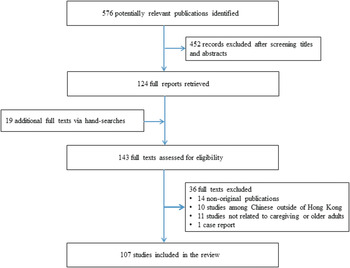
Our searches identified 595 potentially relevant publications, and 452 records were removed after screening the titles and abstracts. Full reports of 143 publications pertaining to EoL care or palliative care issues were acquired, and 36 articles were further excluded as they were nonoriginal publications, studies not related to EoL care, or studies outside of Hong Kong. Consequently, 107 articles were included for the final review (Figure 1).
Selection process for included studies.

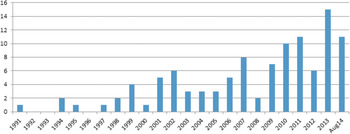
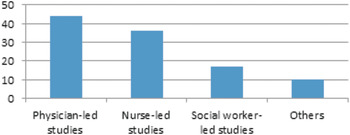
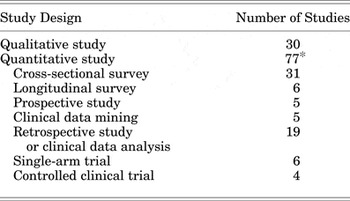
Figure 2 depicts the number of publications in different years. Of the included studies, 44 were led by physicians, 36 by nurses, 17 social workers, and 10 by other professionals (including psychologists, physical therapies, occupational therapies, and counselors) (Figure 3). In terms of research design, 72 studies were quantitative and 30 qualitative in nature (Table 1). Five studies were conducted with mixed methods. Questionnaire surveys and clinical records were the primary quantitative research methods employed, while the most frequently employed qualitative methods were individual and focus-group interviews. The vast majority of included studies were descriptive. Such studies included qualitative studies, cross-sectional surveys, longitudinal surveys, retrospective data analyses, and clinical data mining. Some 19 studies evaluated the effectiveness of different intervention or education programs, of which 9 focused on healthcare delivery or services, 5 on supportive care, 2 on psychoeducation, and 3 on education and training. These studies included single-arm studies, controlled trials, some retrospective studies or audits, and a few qualitative studies.
Number of publications in different years.

Number of studies led by different care professionals.

Research methods applied in the included studies

* Including five studies with mixed-methods design.
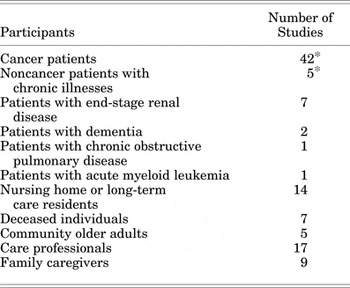
A range of samples were investigated in the included studies, including both inpatients and outpatients with different illnesses (most of the studies focused on cancer and a small number on noncancer illnesses, including end-stage renal disease, chronic obstructive pulmonary disease, and acute myeloid leukemia), care home residents, older community-dwelling adults, deceased individuals, healthcare professionals or students, and family caregivers (Table 2). There was wide variation in terms of sample size. For qualitative studies, sample sizes ranged from 6 to 96, with a median of 23. For quantitative studies, the sample sizes ranged between 10 and 2874, with a median of 121. These studies were undertaken in a broad spectrum of settings, including hospitals, hospice units, nursing homes, care homes, the community or homes, and generalist and specialist services.
Participants in the included studies

* Including three studies on both cancer and noncancer patients.
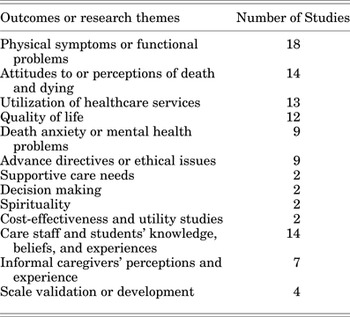
Table 3 presents the research themes that emerged in the included studies, which were based on research focuses and primary outcome measures. As can be seen, 13 themes could be identified. Specifically, 18 studies examined physical symptoms or medical/functional problems, with pain and fatigue being the two most common symptoms. Some 14 studies examined older adults' attitudes to or perceptions about death and dying, most with a qualitative research design. The research concepts emerged in these studies included “good death,” “dying with dignity,” “expected beneficial outcomes from palliative care,” “end-of-life choices,” “life-sustaining treatments,” and “emotional states.” Nine studies examined death anxiety or mental health problems among terminally ill patients or community-dwelling older adults. The findings indicated that cancer patients had either very high or very low death anxiety levels (Ho & Shiu, Reference Ho and Shiu1995). A high level of death anxiety was associated with younger age (Wu et al., Reference Wu, Tang and Kwok2002). Patients who did not have a clear awareness of their prognosis were more likely to experience anxiety and difficulty communicating with family members (Chan, Reference Chan2011). Depressive symptoms were evident among 43.9% of the patients. Up to 46.3% reported the presence of suicidality (Cheng et al., Reference Cheng, Chan and Sham2014a ). Some patients might be situated in a “support paradox,” in which they desire family support but also worry about care burden on family members (Chan et al., Reference Chan, Epstein and Reese2009). Some 12 studies examined the QoL of patients with terminal illnesses in different settings. Overall, the results indicated substantially impaired quality of life among terminally ill patients, with two domains (physical symptoms and existential distress) scoring particularly low (Yan & Cheng, Reference Yan and Cheng2006). Four additional studies focused on validation of QoL or psychological well-being scales.
Research themes that emerged from the included studies

Nine studies examined the preference for advance directives (ADs) or advance care planning (ACP) among institutionalized and noninstitutionalized older persons and medical students. The findings suggested that 96% of nursing home residents (Chu et al., Reference Chu, Luk and Hui2011a ) and 81% of elderly inpatients with chronic disease (Ting & Mok, Reference Ting and Mok2011) had not previously heard of the term “advance directive.” However, 87.9% of nursing home residents preferred to have ADs regarding future medical treatment (Chu et al., Reference Chu, Luk and Hui2011a ; Reference Chu, McGhee and Luk2011b ), and 78% of community-dwelling older persons with multiple medical problems accepted ACP (Tsang et al., Reference Tsang, Yeung and Wong2013). About half (49%) of elderly inpatients with chronic disease said they would consider using an AD if it was legalized in Hong Kong (Ting & Mok, Reference Ting and Mok2011). Among patients with advanced malignancy who were newly referred to the hospice service (Wong et al., Reference Wong, Lo and Chan2012), 63% had ADs, while 37% did not. The vast majority of medical students (90%) felt that their knowledge of ADs was inadequate, and 90% of students felt unprepared to deal with ADs and EoL issues (Siu et al., Reference Siu, Cheung and Chiu2010).
A total of 14 studies examined healthcare staff and students' knowledge, beliefs, and experiences. The research themes merged in the field included a problem-based learning approach for nurse students, the experiences of nurses caring for dying patients, nurse–patient relationships, medical students' attitudes toward EoL decisions, knowledge and attitudes of all ranks of old age home staff (nurses, physiotherapists, occupational therapists, and social workers), beliefs about death and dying or EoL care preferences among social work students, and the emotional competence of social workers. Seven studies examined the experience or perceptions of family caregivers of patients with a terminal illness. Other research themes included supportive care needs, decision making, spirituality, and cost-effectiveness (Table 3).
DISCUSSION
Our systematic review was the first to summarize EoL care research conducted within an Eastern cultural context. The results of this review will add additional information to the findings of a recent pan-European survey across 41 countries (Sigurdardottir et al., Reference Sigurdardottir, Haugen and van der Rijt2010) and a systematic review of palliative care research in Ireland, where the quality of death ranks fourth globally (McIlfatrick & Murphy, Reference McIlfatrick and Murphy2013).
In our review, a diverse range of research activities relevant to EoL care were identified. These research activities were undertaken at different locations, using a range of methods, for varied subjects, with a wide range of outcome measures. This diversity is indicative of the different disciplines involved in EoL care research. Such diversity could be considered as a strength rather than a weakness (McIlfatrick & Murphy, Reference McIlfatrick and Murphy2013). With a mixture of findings and perspectives from different disciplines, evidence-based policy making might be better informed, evidence-based guidelines to inform clinical practice could be developed, and healthcare services and social resources could be mobilized.
EoL Care Research in Hospital Settings
Our review indicated that palliative care services played an important role in improving EoL care in Hong Kong and had been successful in maintaining patients' QoL during the process of dying since the development of the local hospice service in 1987 (Tse et al., Reference Tse, Chan and Lam2007; Lo et al., Reference Lo, Woo and Zhoc2002). Seven strategies were implemented between 2004 and 2009 to optimize the use of inpatient beds due to the increasing need for palliative care services (Lam et al., Reference Lam, Ma and Ng2011). An integrated EoL care pathway modified from the Liverpool Care Pathway for the Dying Patient was implemented in Hong Kong in 2007. It improved the quality of care in both palliative care units (Lo et al., Reference Lo, Chan and Chan2009) and acute-care hospital settings (Siu et al., Reference Siu, Liu and Cheung2011). A collaborative model of care was established in 2011 between the acute geriatrics unit and the palliative medical unit in response to the growing palliative care needs among older adults (Cheng et al., Reference Cheng, Li and Chan2014b ).
According to a study conducted in 2010, palliative care services covered 79.2% of cancer patients but only 1.4% of noncancer patients in Hong Kong (Lau et al., Reference Lau, Tse and Tsan Chen2010). Compared to some other countries, palliative care for noncancer patients lags far behind in Hong Kong (Lau et al., Reference Lau, Tse and Tsan Chen2010). In the United States, 63.1% of hospice admissions in 2012 were noncancer patients (National Hospice and Palliative Care Organization, 2013). In the United Kingdom, noncancer diagnoses accounted for 11% of all hospice admissions in 2011–2012 (National Council for Palliative Care, 2013). There seems to be a pressing need to develop palliative care services for terminally ill noncancer patients in Hong Kong. Given the greater prevalence of chronic terminal illnesses with extended dying trajectories, such measures could economize the use of healthcare resources. Though there are some practical barriers to implementing palliative care for patients with noncancer terminal illnesses, it may be possible to improve the quality of EoL care for these patients by means of staff education and training, formulation of practical guidelines, establishment of care pathways, and systemic changes, without expenditure of additional resources (Woo et al., Reference Woo, Cheng and Lee2011a ; Reference Woo, Lo and Cheng2011b ). None of the included studies focused on EoL care for children, younger adults, or persons with intellectual disabilities or psychiatric illnesses. Further studies on specific groups of people with life-limiting illnesses are certainly warranted.
In Hong Kong, nearly all older adults with terminal diseases received EoL care in hospital settings, and most of them died at the hospital (Chu et al., Reference Chu, McGhee and Luk2011b ). This situation may be unique. According to a systematic review, the proportions of dying and deaths occurring at hospitals in other countries range from 11% in Albania to 78% in Japan (Broad et al., Reference Broad, Gott and Kim2013). Given the high cost of medical care and the increased burden induced by the aging population, the hospital-inclined model of EoL care may not be sustainable. Perhaps it will be necessary for the government of Hong Kong to make an effort to reduce the proportion of hospital deaths.
EoL Care Research in the Community
In traditional Chinese society, death is a taboo subject. It is believed that talking about death in daily life, mentioning it in conversation, and sharing fears of death may bring bad luck (Xu, Reference Xu2007; Hsu, Reference Hsu, O'Connor and Lee2009). Even for those who are dying, discussions about death are often avoided because of the fear that such discussions could hasten the pace of dying or cause death prematurely (Xu, Reference Xu2007). It goes without saying that this taboo may be a barrier to delivering EoL care in the community. Consequently, many of the included studies conducted in the community focus on the attitudes to or perceptions about death and dying. The findings of these studies may be essential to finding the best way to change people's attitudes and beliefs and improve the quality of dying and death.
Unlike other countries, where the proportions of death and dying occurring at home range from 17% in Japan to 89% in Albania (Broad et al., Reference Broad, Gott and Kim2013), few natural and expected deaths occur at home in Hong Kong. There are various potential barriers to individuals dying at home here, including the crowded living environment, the perceived threat to real estate values if death occurs at home, and social and cultural taboos (Luk et al., Reference Luk, Liu, Beh and Chan2011), not to mention legal encumbrances (Tong, Reference Tong, Tong and Fong2014). Accordingly, studies on delivering EoL care in the home setting and relevant supportive care programs are very limited in Hong Kong. In 2000, Wong and colleagues (Reference Wong, Liu and Szeto2004) launched a home care program from a hospital palliative care unit. Some 32 dying patients were recruited who were receiving home care and were followed until death. Their physical symptoms were generally well controlled, while the psychological aspects caused the most concern for patients, families, and healthcare professionals. The mean number of home visits was 6.1, with a range of 1–21 and a mean time spent on each patient of 9.9 hours (range 2–38). However, few such programs or similar studies have been reported since then. In recent years, some palliative home visits and palliative day care services have been provided by the Hospital Authority of Hong Kong. The conditions under which these services were provided and the problems for which the home visits and day care services were offered remain poorly understood, though. It is also unclear whether these services met the EoL care needs or demands in the home settings. More study of these aspects is definitely required.
EoL Care Research in Residential Care Settings
Currently, about 7% of the older population in Hong Kong is cared for in residential care homes (Census and Statistics Department, 2009). These patients tend to be frail, with multiple comorbidities, dependent, and cognitively impaired (Woo & Chau, Reference Woo and Chau2009). However, 33.5% of all deaths are care home residents (Hospital Authority of Hong Kong, 2013). Unlike other countries, the laws of Hong Kong have made dying at home the exception rather than the rule, and care home residents usually die in hospital (Tong, Reference Tong, Tong and Fong2014). As a result, as death approaches or one's physical condition becomes unstable, the resident undergoes frequent transitions between hospital and care facility (Lee et al., Reference Lee, Cheng and Au2013). The residents are usually transferred to emergency rooms and then acute medical wards, followed by transfer to an extended-care unit if indicated. A new model has been introduced recently, where older nursing home residents are transferred to an extended-care unit either directly through liaison with the Community Geriatrics Outreach Service (pathway A) or from the emergency room (pathway B) according to their advance care plans. The evidence indicates that 39% could be admitted to the extended-care unit through the new pathways, with their survival and quality of care uncompromised and intact (Hui et al., Reference Hui, Ma and Tang2014).
In Hong Kong, about 35% of respondents prefer EoL care or to die in their care homes (Chu et al., Reference Chu, Luk and Hui2011a ; Reference Chu, McGhee and Luk2011b ; Reference Chu, So and Wong2014). EoL care service in the care home setting was begun in Hong Kong in 2000 (Chu et al., Reference Chu and Christine2013). The average length of stay in hospital during the last 30 days of life was only 1.3 days for residents receiving EoL care, compared to an average of 16 days for residents not receiving EoL care (Chu et al., Reference Chu and Christine2013). Unfortunately, EoL care services have not yet been generalized among care homes in Hong Kong. Well-known barriers to good EoL care in the care home setting include inadequate staffing; a lack of supervision; inadequate knowledge regarding EoL care issues among staff, residents, and family members; and interference caused by the personal attitudes and beliefs of staff members about death and dying (Lee et al., Reference Lee, Cheng and Au2013; Lo et al., Reference Lo, Kwan and Lau2010; Mak et al., Reference Mak, Chiang and Chui2013). Both the availability of a doctor and the attitudes of nursing home staff members are also important factors (Chu et al., Reference Chu, So and Wong2014). To date, intervention or education programs to overcome these barriers are still limited. More relevant studies are warranted. Appropriate health policy to promote implementation of community EoL care among elderly people living in subsidized old age homes are also needed. A local study suggested that the early (28 days) unplanned readmission rate to acute medical units of public hospitals among institutionalized older people is twice (36 vs. 18%) that of those living in the community (Hui et al., Reference Hui, Ma and Tang2014). Developing EoL care programs in care home settings could lead to a large reduction in unplanned hospital readmissions and lowered hospital care costs (Chu et al., Reference Chu, McGhee and Luk2011b ).
ADs and ACP
Most EoL care preferences can be indicated in advance in the form of ADs or ACP. ADs and ACP are two different but overlapping concepts. “Advance directive” is a term generally used in medical settings to refer to decision making on such life-sustaining therapies as cardiopulmonary resuscitation, artificial ventilation, oral or intravenous antibiotics, and artificial fluids or nutrition. “Advance care planning” is a concept that allows individuals to choose whether or not to be hospitalized (Silveira et al., Reference Silveira, Wiitala and Piette2014). According to ACP, individuals can decide how they are to be cared for, where they are to be cared for, and where they will die. Of the nine relevant studies examined in our review, most focused on ADs. A form of ACP was recently introduced in Hong Kong where the patient is given a choice of whether or not to be transferred to an acute-care hospital in case of deterioration while residing in a care facility (Hui et al., Reference Hui, Ma and Tang2014).
A law regulating ADs has been available for more than two decades in such countries as Australia, Canada, the United Kingdom, the United States, and Singapore (Chu et al., Reference Chu, Luk and Hui2011a ; Reference Chu, McGhee and Luk2011b; Ting & Mok, Reference Ting and Mok2011). However, there is no case law on the validity of an AD in Hong Kong (Chu et al., Reference Chu, Luk and Hui2011a ). Consequently, relevant studies conducted in Hong Kong focus only on knowledge, attitudes, and preference for ADs or ACP. In the United States, the proportion of decedents with an AD has increased from 47% in 2000 to 72% in 2010 (Silveira et al., Reference Silveira, Wiitala and Piette2014). However, awareness of ADs or ACP is still poor among the elderly population of Hong Kong, as demonstrated in our review. More programs and research on promotion and implementation of the concepts of ADs and ACP in different patient groups and for different end-stage illnesses are surely necessary. Apart from studying the uptake and associated contributory factors for ADs, the effectiveness of AD implementation strategies and their impact on hospitalizations and medical expenditure should be investigated (see Chu, Reference Chu2012). Because of the uncertainty with ADs, many patients and older adults are uncertain about their end-of life care preferences and prefer their physician to be their surrogate (Chan & Pan, Reference Chan and Pang2007), which places a great burden on physicians. There is a need to reconsider AD legislation to facilitate implementation of the practice among older adults or patients with a terminal illness in Hong Kong. This would constitute a major step toward improving and promoting the quality and dignity of death and dying.
Family Caregivers and Care Staff
The evidence indicated that 95% of informal caregivers in Hong Kong perceive difficulties in rendering care for terminally ill patients (Loke et al., Reference Loke, Liu and Szeto2003), and the younger the caregiver, the more difficulty he or she may experience (Chan & Chang, Reference Chan and Chang2000). Although traditional filial beliefs provide motivation for family caregiving, the regrets that come with unfulfilled filial responsibilities may create emotional distress among adult Chinese caregivers (Chan et al., Reference Chan, Ho and Leung2012). The evidence also indicated insufficient knowledge and skills necessary for palliative care among some care staff and relevant students. Thus, more supportive programs for family caregivers and educational programs for relevant care staff, especially those working in care homes, are certainly required.
Methodological Issues for the Included Studies
Among the included studies, some methodological issues were identified. First, most of the included studies were descriptive. Of the limited number of intervention-oriented studies, many were conducted without a control group. The number of randomized controlled trials was particularly limited (only two). Second, there was a wide variation in sample size among the included studies, and few of them justified the small sample size. Small samples most likely are not representative, and the results obtained are often biased. Third, there was a significant difference in care delivery related to the nature of the samples in studies conducted in different settings by different professionals. Unlike the overemphasis on needs-based palliative care research in Ireland (McIlfatrick & Murphy, Reference McIlfatrick and Murphy2013), the number of needs-based EoL care studies (especially in primary care settings) seems to be insufficient in Hong Kong. Studies on the economic aspects are also limited. Finally, numerous outcomes were assessed with a range of measures. This is a strength for the research agenda as a whole but a limitation for psychosocial and mental health studies. Some psychometric outcome measures may not be culturally sensitive, as they were developed in a Western cultural context. Thus, interpretation of the results of particular studies should be undertaken cautiously. Recognized standard, valid, culturally applicable, and reliable measures are required for further studies.
LIMITATIONS OF THIS REVIEW
In our systematic review, study quality was not ranked for the included studies due to the heterogeneity of research designs. We regarded the quality of all included studies, however, as acceptable since they were published after going through the peer-review process. A major limitation of our review may be that the keywords we employed to select publications may not have captured all the studies that used different terminology in their titles and abstracts but were in fact relevant. Another limitation of our review may be that exclusion of non-peer-reviewed publications may have resulted in over- or underrepresentation of certain themes. Such limitations are also notable in other reviews (McIlfatrick & Murphy, Reference McIlfatrick and Murphy2013).
CONCLUSIONS AND RECOMMENDATIONS
Our review not only demonstrated a wide and diverse range of research activities related to EoL care, but it also indicated that EoL care services at primary care settings are underdeveloped in Hong Kong. As reported by the Economist Intelligence Unit (2010), the quality of EoL care in Hong Kong is quite good, but the scores on three other indicators (basic EoL care environment, availability of EoL care, and cost of EoL care) of the Quality of Death Index were much lower. With a growing elderly population, an increase in the prevalence of chronic illness, and increased medical expenditures, the care burden on our healthcare system is increasing rapidly. There is a pressing need to move from a hospital-inclined model to a community-shared model of care so as to design an integrated EoL care system involving hospitals, the long-term care sector, and families. Although EoL care services in primary care settings are also underdeveloped in European countries (Murray et al., Reference Murray, Firth and Schneider2015) and in other regions, the challenges may be significantly greater in Hong Kong because of its lack of infrastructure and the cultural barriers. The increased need for EoL palliative care will result in a greater need for research in this area.
On the basis of evidence summarized in the present review, several research priorities specific to EoL care in Hong Kong are recommended. First, there is a need to initiate studies to establish models and components of EoL care in the community in order to improve service delivery and optimize the quality of life and quality of death for terminally ill patients. Second, there is a need for studies to explore the best strategies for collaboration between the medical and social care sectors. Third, more vigorously designed evaluation studies or interventional programs are needed in order to provide reliable scientific evidence. In addition, studies on the economics of EoL care are also warranted, as the importance of the economic aspects of EoL care research cannot be underestimated. This is of great significance within the context of rising healthcare costs. Finally, future studies could extend palliative care services to the earlier stages of terminal illness and for a wider range of conditions.
CONFLICTS OF INTERESTS
The authors hereby state that they have no conflicts of interest to declare.
ACKNOWLEDGMENTS
No funding was received for our study. The authors would like to thank Dr. Rainbow Ho and Dr. Christine Fang for their support and to acknowledge the assistance of Ms. Yee-Wa Hong for searching the electronic databases.