Cholera is an acute enterotoxin-mediated intestinal infection that causes copious, watery diarrhea after an incubation period of 1 to 5 days.Reference Sack, Sack, Nair and Siddique1 Untreated, the mortality rate can approach 50% to 60%.Reference Todar2 It is caused by the bacterium Vibrio cholerae and, although it is a classic water-borne illness, it is also transmitted via contaminated food and, rarely, between infected persons. Cholera has been endemic to south Asia since recorded history, and the world at large is now experiencing its seventh cholera pandemic.Reference Sack, Sack, Nair and Siddique1 Identified risk factors for cholera include lack of clean drinking water, poor hygiene, and high population densities. In regions where cholera is endemic, the illness is known to be associated with rainy seasons and flooding.
In late June 2006, there were reports of cases of acute watery diarrhea (AWD) in Ethiopia's Oromiya Region. Cases were first noted in the town of Shashemane, the western part of the Arsi Zone. (Ethiopia is divided into 9 regions, and each region is further subdivided into zones.) Shashemane is located along a major river system, allowing for quick spread of the disease. Stool specimens collected from patients from the western part of the Arsi zone confirmed Vibrio cholera O1 serotype Inaba to be the causative agent, a significant finding given that cholera is not known to be endemic to Ethiopia.
Despite the efforts of the regional government and the district health bureaus, the disease quickly spread from the original 3 districts to 10 districts within the western part of the Arsi zone and from there to the neighboring zones of Guji, Bale, and East Shewa. The outbreak swiftly crossed regional boundaries and spread into the Southern Nations Nationalities and Peoples Region and into the northern regions of Tigray and Amhara.
The situation in Oromiya was particularly concerning. By mid September, there had been more than 19 000 reported AWD cases, and the United Nations Office for the Coordination of Humanitarian Affairs reported unacceptably high case fatality rates (CFRs; >1%) in 3 of the 5 affected Oromiya zones (Guji, East Shewa, and Bale). These reports were all the more concerning because the numbers represented only the cases and deaths occurring at health care facilities and likely accounted for only a fraction of what was actually occurring in the community. Because Ethiopia is a large country with 85% of its population living in rural areas,3 community-based surveillance is irregular.
The Oromiya Health Bureau, although working to contain the cholera epidemic, did not have the public health capacity to properly investigate the extent of the outbreak. The number of cholera cases and deaths in the community remained largely unknown. Essential supplies, such as oral rehydration salts, intravenous Ringer's lactate, chlorine, and antibiotics, were lacking at some health posts. Although multiple nongovernmental organizations were responding to the outbreak, leadership, coordination, and communication were lacking.
The ability of the Oromiya Health Bureau to respond to the outbreak was also constrained by the Government of Ethiopia. Despite laboratory identification of V cholerae as the cause of the AWD, the Government of Ethiopia decided not to declare a “cholera outbreak” for fear of economic repercussions resulting from trade embargos and decreased tourism. Because it continued to refer to the outbreak as AWD rather than cholera, the Oromiya Health Bureau was unable to marshal the support and resources that it might have otherwise received. To assist in the efforts, a team of public health professionals provided an epidemiological investigation of the outbreak, identified possible causes, and assessed the response.
METHODS
This study was carried out between September 15 and October 9, 2006. After briefing with key stakeholders, the public health field team, led by a physician-epidemiologist (S.A.B.) and including an Amharic translator and an Ethiopian Red Cross Society logistician, surveyed the zones of Guji, Bale, and East Shewa because these 3 zones were reporting unacceptably high CFRs. The physician-epidemiologists collected data from cholera treatment center (CTC) records and interviewed CTC staff, community leaders, and community members and systematically inspected CTC facilities. The Ethiopian Red Cross Society, a local public health partner, had intimate knowledge of the zones investigated and was responsible for determining travel routes and identifying key informants. Interviews performed in Amharic were translated into English for coding and analysis. The study was approved by the Brigham and Women's Hospital Institutional Review Board, Boston, Massachusetts.
The public health team surveyed a purposive sample of health bureau staff, CTC staff, nongovernmental organization staff, and community workers in each of the 3 affected zones; the team also assessed CTCs. Difficult travel conditions, limited time, and lack of human resources made it impossible to fully survey each zone. Data collected included the number of cholera cases in each zone, the age and sex distribution of cases, and the number of cholera deaths. Outcomes assessed for the outbreak response included the adequacy of CTCs, the availability of supplies, levels of staffing, water and sanitation practices, and levels of community awareness. Attack rates and CFRs were calculated, and the demographics of the outbreak were described. By using multiple data sources, the public health team could triangulate information across location. Microsoft Excel, version 11.5.3 (Microsoft Corp, Redmond, Washington), was used for database development and analysis.
RESULTS
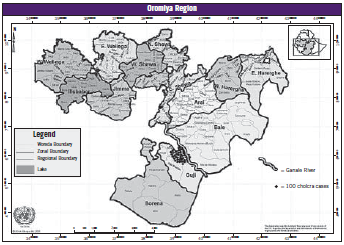
The cases mapped along the Ganale River, which runs between the zones of Guji and Bale to the lakes at the southern tip of East Shewa (Figure 1 4). East Shewa and Bale had similar numbers of cases, 233 and 223, respectively, whereas Guji had a significantly higher number of reported cases—3848. These cases reflected CTC registration logs only and not community cases.
Mapping of cholera cases in Ethiopia's Oromiya Region. Map adapted from the United Nations Office for the Coordination of Humanitarian Affairs.

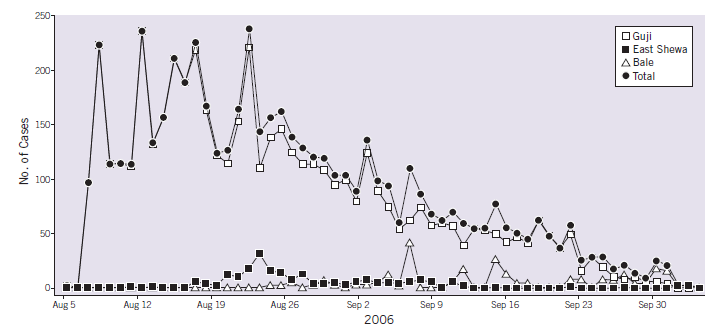
The epidemic curve (Figure 2) shows that the outbreak began rapidly on August 5, when 97 cases were reported in the Guji Zone. There were 5 peaks overall: August 8 (223 cases), August 12 (236 cases), August 15 (210 cases), August 17 (219 cases), and August 22 (220 cases). The number of cases steadily declined thereafter, and, by the end of September, the outbreak was nearing its end. The number of cases in Guji was so disproportionately high that the curve for the total number of cases closely approximates the curve for the Guji zone.
Epidemic curve for the Guji, East Shewa, and Bale zones in Ethiopia.

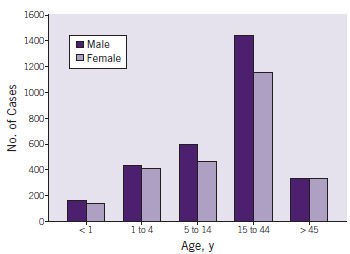
Figure 3 gives the age and sex distribution of the patients with cholera going to CTCs for treatment. There seem to be fewer reported cases among infants and children. Furthermore, frontline health care workers indicated that there were more cases among men. The age categories given here represent the categories used for data collection at the CTCs. Available demographics for Oromiya were not detailed enough to determine age- and sex-specific attack rates.
Demographics for cholera cases in Bale, East Shewa, and Guji zones in Ethiopia.

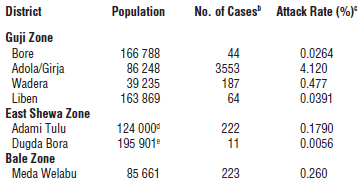
Attack rates were calculated for the regions within each of the zones (Table 1). The attack rates ranged from a low of about 0.03% in Bore to a high of about 4.12% in the Girja and Adola districts. The overall attack rate for all 3 zones was almost 0.50%. These rates do not include community cases and, therefore, likely underestimate the true attack rate for the entire population.
Attack Rates for the Guji, East Shewa, and Bale Zones

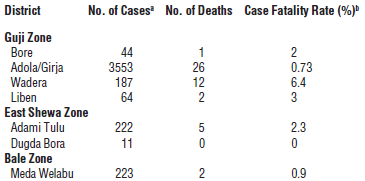
To assess the adequacy of the epidemic response and to evaluate the quality of medical care at the CTCs, CFRs were calculated for each of the districts. The CFRs ranged from 0% in Dugda Bora to 6.4% in Wadera (Table 2). The overall CFR for all 3 zones was 1.11%. The numbers of deaths represent only deaths that occurred at a CTC or were reported to health care authorities; community deaths were not included.
Case Fatality Rates for the Guji, East Shewa, and Bale Zones

Sanitation and access to clean water were both assessed because deficiencies are known risk factors for cholera transmission. Some of the larger towns in Oromiya had communal wells, and a few scattered villages had boreholes or wells, typically built with the support of a nongovernmental organization. However, most people in rural Oromiya drank unsafe, open-source water, putting themselves at risk for cholera and other water-borne illnesses. In the town of Ganale, Guji Zone, the United Nations had established a safe water point, where water was chlorinated, stored in bladders, and then gravity fed to taps for distribution. This intervention was temporary; it was to be terminated once the cholera outbreak had tapered. In the early emergency response, WaterGuard and WaterMaker (chlorine-based water purification solutions) were distributed. Boiling of water was encouraged but did not seem to be an accepted practice within the community.
Sanitation was also lacking in Oromiya. Rural residents typically defecated in the field. In Guji, latrine coverage was estimated at 2% in the rural villages and 25% in the towns (personal oral communication from Guji Zonal Health Bureau staff, October 2006). The community response to the cholera outbreak included a campaign to build household latrines, and in East Shewa, almost 2400 household and 650 communal latrines were constructed during several weeks.
Sanitation was also essential to the safe operation of a CTC, and zonal health bureau staff expressed concern that CTCs were a source of disease transmission. The CTC assessments confirmed that water and disinfectant were lacking in many facilities. Some sites did not have a separate latrine for patients, were lacking a shower, and did not have a designated site for washing linens.
Medical management was based on Médecins Sans Frontières GuidelinesReference Bauernfeind, Croisier and Fesselet5 and seemed to be appropriately implemented at most CTCs. Staff were encouraged to be more assertive in initiating intravenous access and treating with sufficient amounts of Ringer's lactate. Antibiotics were generally used appropriately, and staff were knowledgeable of the criteria for mild, moderate, and severe dehydration. Of medical supplies, oral rehydration salts and Ringer's lactate were in shortest supply. In East Shewa, the first recognized cholera patient died because only 2 L of Ringer's lactate was available at the health post. In all 3 zones, doxycycline or tetracycline was the antibiotic used to treat severe adult cases, and ampicillin or erythromycin was used to treat severe pediatric cases.
DISCUSSION
The Ganale River was widely speculated to be the source of V cholerae during this outbreak. The cholera cases mapped along the river, and the river served as the primary source of drinking water for the population who lived within walking distance. As is often the case in less developed countries, a major river serves multiple purposes for the many families who live along its banks; the Ganale River is used for bathing, washing clothes, cleaning cookware, drinking and cooking, and watering livestock. Although the Government of Ethiopia had reportedly taken water samples from the Ganale River for analysis at the national laboratory, the test results were never released.
The vast majority of residents in rural Oromiya lack access to safe drinking water, putting them at risk for transmission of water-borne illnesses. Although water purification solutions were being distributed to affected communities, there was concern among nongovernmental organizations that the solutions were not being used appropriately. Unfortunately, the practice of boiling water was not widely accepted by the communities. Regardless, boiling water and water purification solutions are only temporary fixes to the ongoing challenge of providing safe drinking water. According to the Millennium Development Goals,6 the long-term solution must be to provide communities with improved water sources such as wells and boreholes.
The sanitation response was commendable in East Shewa, where a total of 3000 latrines were constructed during the course of the epidemic. There were also mass community awareness campaigns to improve sanitation and hygiene. Of course, awareness raising and latrine construction do not necessarily translate into behavior change. Whether these interventions are effective preventions for water-borne illness will require ongoing monitoring and evaluation.
This cholera outbreak was brought under fairly rapid control, lasting approximately 2 months in total. By September 30, 2006, there had been a total of 4304 reported cases, giving an overall attack rate of about 0.50% for all 3 zones. In a rural cholera outbreak, one would expect an attack rate in the order of 0.1% to 2%.Reference Bauernfeind, Croisier and Fesselet5 All individual zonal attack rates fell within this range except for that in Adola/Girja, which was higher than expected at 4.120%. There were a total of 48 deaths in the 3 zones, giving an overall CFR of 1.11%. In a rural setting, CFRs (with treatment) are generally less than 5%.Reference Bauernfeind, Croisier and Fesselet5 The individual zonal CFRs ranged from 0% in Dugda Bora to 6.4% in Wadera. It was not possible to visit Wadera because of poor road conditions, and, therefore, we cannot comment on the cause of the higher CFR. In Adola/Girja, which had the highest number of cases and the best established CTCs, the CFR was low at 0.73%.
There may have been a trend toward men being disproportionately affected by this cholera outbreak. Unfortunately, this discrepancy could not be evaluated statistically because Oromiya demographic data were not detailed enough to permit the calculation of age- and sex-specific attack rates. When local health care providers and villagers were asked about this discrepancy, they often speculated that there were more cases among men because men tended to be more mobile and were more likely to eat and drink outside the home. However, because the available data were obtained almost exclusively from CTCs, it may be that men were seeking care more often than were women. Perhaps women were less likely to speak up about symptoms or were less likely to leave their homes and family responsibilities to travel to a CTC. Alternatively, there may have been less effort on the part of the family and/or village to arrange transport for women to CTCs. All explanations are speculative, and it remains unclear whether there was a discrepancy between the attack rates for men and women.
At the time of this outbreak, cholera was not endemic to Oromiya. Therefore, one would have anticipated that adults and children would be equally affected.Reference Sack, Sack, Nair and Siddique1 Although the demographics in Figure 3 might seem to illustrate the contrary, the age group categories vary in length, making age distribution difficult to interpret. The data were collected by individual CTCs using these specific age categories, and the available demographics did not permit calculation of age-specific attack rates.
The overall response to this cholera outbreak was most impressive at the community and zonal levels. Once the cholera outbreak had been identified in western region of Arsi Zone, health care providers and health bureau staff in Bale, Guji, and East Shewa seized the opportunity to prepare for such an epidemic in their own respective zones. This action resulted in a timelier and better coordinated response. Multiple nongovernmental organizations responded to the outbreak by supplying tents, providing medical supplies, and performing community outreach. The CTCs varied greatly with regard to their facilities and supplies. The single factor that distinguished well-functioning CTCs from suboptimal CTCs was the availability of external assistance at the centers that were functioning well.
A combination of community and health-facility surveillance aided the response. At the district level, Kebele chairmen, local community members appointed by the government to act as village administrators, were targeted for an educational campaign, which included recognition of AWD and early transport of all patients with AWD to a CTC. Kebele chairmen were provided with oral rehydration salt sachets and were instructed to provide oral rehydration salts to all patients with AWD during transport to a CTC. Their role also included a community awareness campaign that focused on personal hygiene, sanitation, water purification, and the need to rapidly identify and transport all patients to a CTC. Also included in this educational message was information about the highly infectious nature of a cholera-infected corpse and about the need to maintain precautions during body preparation and burial. In addition, Kebele chairmen were responsible for reporting the number of AWD cases to the district health bureau on a regular basis.
Certainly not every case of cholera was being reported using this surveillance system, and there were likely unreported deaths in the community. However, our assessment indicated a high degree of community awareness and reassurance that the majority of cases were being captured and that trends could be established over time. Staff at district and zonal health bureaus were confident that most cases were being recorded because they believed that all recognized cases were examined at a CTC. This belief was reiterated by health care providers at the CTCs. Kebele chairmen confirmed that they were indeed monitoring their villages for AWD and that identified cases were provided with oral rehydration salts during transport to a CTC. Speaking to community members triangulated this information; villagers were instructed to inform the Kebele chairman of any AWD cases such that rapid transport to a CTC could be arranged. Using Kebele chairmen to educate the community about AWD, to recognize AWD cases, and to arrange transport to CTCs greatly enhanced the accuracy of health facility–based surveillance.
At baseline, lack of sufficient health care is a reality for much of Oromiya's chronically distressed population. The frequency and severity of recent emergencies has not provided an opportunity for the system to fully recover before crisis strikes again. Coping mechanisms are becoming exhausted. This particular epidemic response was further limited by the Government of Ethiopia's decision not to declare a cholera outbreak. Despite the morbidity and mortality associated with the outbreak and despite UN laboratory tests confirming V cholerae O1 as the causative agent, the government denied that cholera was the causative agent. The ministry of health conducted its own laboratory tests, but the results were never released.
The failure to acknowledge a cholera outbreak had several important implications. First, it meant that the World Health Organization could not assume responsibility for managing the epidemic because this requires that the state declare a cholera outbreak and request assistance. Under the World Health Organization International Health Regulations, 2005, cholera is considered a disease “with demonstrated ability to cause serious public health impact and to spread rapidly internationally.”7 As a signatory to this agreement, the Government of Ethiopia had the obligation to report the outbreak because cholera is not endemic to the country. Second, without official declaration of a cholera outbreak, there was a delay in accessing donor funds. Declaration of a cholera outbreak might have resulted in a much more vigorous international response, and resources might have been mobilized much more rapidly. Also, refusing to acknowledge a cholera epidemic weakens the chances for ongoing surveillance to recognize the potential for cholera endemicity in the region.
In 2008, Zimbabwe was battling its own cholera epidemic. The outbreak in Ethiopia and the outbreak in Zimbabwe share common causes: unsafe drinking water, poor sanitation, and lack of health care infrastructure.8 However, the 2 outbreaks differ in multiple ways. First, the CFRs were significantly higher in Zimbabwe than they were in Ethiopia, with 5.7% being reported for the outbreak overall in Zimbabwe and rates of up to 50% being reported in some rural regions of Zimbabwe.8 Second, although there was a delay before the announcement, the Zimbabwean government finally declared a cholera epidemic on December 4, 2008, and requested international assistance.9 This contrasts with events in Ethiopia, where the government, in disregard of International Health Regulations, continually refused to declare a cholera epidemic and largely declined international assistance. And finally, the high CFRs in rural Zimbabwe suggest that the Zimbabwean community response is not as expeditious or as effective as it was in Ethiopia.
This study has several limitations. All data were collected using a purposive sample, and all interviews were conducted through a translator. Data included only cases and deaths from CTCs and, therefore, cannot be interpreted to the entire community. As a result, the calculated attack and CFRs likely underestimate the true rates. In addition, the limited demographic information available for Oromiya did not permit calculation of age- and sex-specific attack rates.
CONCLUSION
This cholera outbreak resulted primarily from insufficient access to clean water and poor sanitation. Future epidemics will undoubtedly occur unless these basic deficiencies are properly addressed. In this particular instance, the outbreak was brought under control by a prompt and effective response at the community level. The medical management was generally appropriate, although CTC resources depended largely on external assistance. The use of community-based workers was a success and likely contributed significantly to the tapering of the outbreak. Future efforts should focus on how to best use community-based workers in outbreak and routine health care settings. The fact that cholera is not endemic to the region should prompt ongoing surveillance and adherence to International Health Regulations mandatory reporting.
Author Disclosures:
The author reports no conflicts of interest.