Implications
The diet based on grass-clover silage made from the primary growth (PG) provided most feed energy. However, feeding a moderate inclusion of silage made from the regrowth (RG) herbage increased rumen ammonia and improved digestion of fiber, which resulted in similar yields of milk, and milk fat and protein.
Introduction
Grassland legumes are important in organic livestock production because of their ability to fix atmospheric N2 and high productivity without N fertilization and because of their high feeding value. The clover species, white clover (Trifolium repens L.) and red clover (Trifolium pratense L.), are the most common cultivated legumes in Fennoscandia. Clovers have slower spring growth rates than grasses, and their proportion generally increases from PG to RG in organic grass-clover leys (Steinshamn and Thuen, Reference Steinshamn and Thuen2008). Further, fiber properties are different in PG and RG as well as between grasses and legumes (Kuoppala et al., Reference Kuoppala, Rinne, Nousiainen and Huhtanen2009, Reference Kuoppala, Rinne, Ahvenjarvi, Nousiainen and Huhtanen2010). Knowledge of the differences in fiber properties between species and cuts are important in dietary ration planning in ruminant production.
The concentrations of NDF and indigestible NDF (iNDF) increase with advancing maturity in grasses and legumes (Kuoppala et al., Reference Kuoppala, Rinne, Nousiainen and Huhtanen2009; Bayat et al., Reference Bayat, Rinne, Kuoppala, Ahvenjärvi and Huhtanen2011), but to a lesser extent in clover compared with grasses (Bertilsson and Murphy, Reference Bertilsson and Murphy2003; Dewhurst, Reference Dewhurst2013). Pure grass silage from RG has normally higher iNDF concentration in NDF, and lower digestibility and energy concentration compared with PG (Khalili et al., Reference Khalili, Sairanen, Nousiainen and Huhtanen2005; Kuoppala et al., Reference Kuoppala, Ahvenjarvi, Rinne and Vanhatalo2008). Legumes contains less NDF, have a higher iNDF proportion in NDF and the rumen degradation rate (k d ) of potentially degradable NDF (pdNDF) is faster compared with grasses (Kuoppala et al., Reference Kuoppala, Rinne, Nousiainen and Huhtanen2009; Kammes and Allen, Reference Kammes and Allen2012). Increasing proportions of clover with lower NDF concentrations in grass-clover silage is expected to increase dry matter intake (DMI), and thereby milk production, as suggested by Bertilsson and Murphy (Reference Bertilsson and Murphy2003) and Dewhurst et al. (Reference Dewhurst, Evans, Scollan, Moorby, Merry and Wilkins2003a). Previous reports have shown faster particle breakdown and reduced rumen load when feeding legume-based silages compared with grass-based silages (Bertilsson and Murphy, Reference Bertilsson and Murphy2003; Dewhurst et al., Reference Dewhurst, Fisher, Tweed and Wilkins2003b; Kuoppala et al., Reference Kuoppala, Rinne, Nousiainen and Huhtanen2009). However, diets with increasing proportions of legumes as normally found in the RG, may accumulate iNDF in rumen due to the lower digestibility of RG compared with PG of grass-clover leys (Kuoppala et al., Reference Kuoppala, Rinne, Nousiainen and Huhtanen2009). Different properties of PG and RG, and dietary effects on intake and milk production by dairy cows are relatively well established for silages made of pure stands of grass and clover leys. However, few feeding trials with dairy cows have investigated the effects of different proportions of silages made from PG and RG of mixed grass and clover leys on fiber digestion and metabolism in dairy cows. The objective of the present study was to compare rumen fiber kinetics in lactating dairy cows-fed diets based on PG and RG grass-clover silages produced from the same sward. We hypothesized that increasing dietary proportions of grass-clover silage made from RG compared with PG would increase digestion rate of pdNDF, and increase ruminal accumulation of iNDF. Diets based on grass-clover silage made of RG herbage will potentially restrict intake and milk production due to increased rumen accumulation of iNDF.
Material and methods
Experimental design and animals
Laws and regulations controlling experiments with live animals by Norwegian University of Life Sciences Animal Care and Use Committee and the Norwegian Animal Research Authority were implemented in the experiment. An experiment consisting of two replicated 4×4 Latin squares, each with four Norwegian Red cows, and four 21-day periods consisting of 9 days of adaption and 12 days of sampling, was conducted, with the first square in fall 2012 and the second square in spring 2013. The experimental treatments were four diets made of organic grass-clover silage from PG and RG harvested from the same field. Cows were equipped with rumen cannulae (Bar Diamond Inc., Parma, ID, USA) and entered the experiment at (mean±SD) 56±19 days in milk and BW 622±83 kg. One cow was excluded from the experiment in two periods due to indigestion. Cows were housed in a tie-stall with continuous access to water and feed, and they were fed equal proportions of the diets three times daily at 0630, 1415 and 2200 h. Milking was conducted daily at 0700 and 1700 h.
Grass-clover silages and experimental diets
One PG and one RG silage were prepared from organically managed leys in Ås, Norway (59°40'N, 10°46'E) in 2012 (Council of the European Union, 2007). The ley mainly consisted of grass species like timothy (Phleum pratense L. cv. ‘Grindstad’) and meadow fescue (Festuca pratensis Huds. cv. ‘Fure’) together with white clover (‘Hebe’) and red clover (‘Bjursele’). The PG was harvested on 7 June 2012 and the RG was harvested on 26 July 2012. The PG and the RG contained, respectively, 11.3% and 39.3% white clover and 6.5% and 1.4% red clover. The proportion of the different grass species in the PG was 42% timothy (P. pratense L. cv. ‘Grindstad’), 25% meadow fescue (F. pratensis Huds. cv. ‘Fure’), 8% smooth meadow grass (Poa pratensis L.). Other species including herbs accounted for 7% of total dry matter (DM) yield. The RG contained 29% timothy, 14% meadow fescue, 5% smooth meadow grass, 6% couch grass (Elytrigia repens L.) and 5% other species including herbs. A detailed description of silage production was reported in Naadland et al. (Reference Naadland, Steinshamn and Randby2015). Experimental treatments comprised diets with replacement of PG with RG silage in the proportions 0, 0.33, 0.67 and 1 (treatments D1, D2, D3 and D4, respectively) on DM basis. Cows were offered silage ad libitum allowing daily refusals of 10%. Silages were chopped using a roundbale chopper (Serigstad RBK 1202; Serigstad Agri, Bryne, Norway) and further with Epple Blasius 940 (Epple Maschinen GmbH, Wiesensteig, Germany) to a median chop length of 4.6 cm. Dry matter was determined daily. For cows offered the mixed diets, the portions of PG and RG silages were weighed separately and then thoroughly mixed by hand to minimize feed selection. Cows were additionally fed 8 kg (as-fed basis) daily of a concentrate mixture containing peas (26.8%), oats (16.8%), wheat (16.5%), barley (15.0%), rapeseed cake (10.0%), molasses (5.5%), rapeseeds (5.0%) and a vitamins and mineral mixture (4.4%).
Sampling, recordings and chemical analyses
Daily samples of 1 kg PG and RG silage were collected separately every week in all periods. The samples were pooled within each period to four samples of both silages. Digesta flow was estimated using the triple marker method described by France and Siddons (Reference France and Siddons1986). Rumen marker infusion started on day 4 at 0800 h in each period with a priming dose of 2.80 g Cr (Cr-ethylenediaminetetraacetic acid) and 2.46 g Yb (Yb-acetate). This was directly followed by the start of a continuous infusion using a peristaltic pump (Cenco Instruments MIJ N.V., Breda, the Netherlands) giving 2.80 g Cr/day and 2.46 g Yb/day. The infusion lasted until day 14 at 1500 h in all periods. The third marker was indigestible NDF (iNDF) that with Yb and Cr differentiated digesta into a large particle (LP), small particle (SP) and fluid phase (FP), respectively. Samples of reticular digesta were collected manually using a 250 ml wide-necked plastic bottle with a rubber stopper repeatedly to a total 1200 ml. The reticular sampling technique was used to collect nine digesta samples from the reticulum on day 12 to day 14 with 4.5 h interval between the three sampling occasions each day to cover sampling hourly during a complete 12-h feed cycle. On the last 2 days, sampling occasions were moved 1.5 h later than on previous day. This sampling over a 12-h daytime period was assumed to be representative for the complete 24-h period. Samples of 600 ml of each time point were pooled to a total of 5400 ml from each period. Pooled samples were frozen at −20°C in the same container directly after sampling. After thawing the pooled samples were filtered and centrifuged at 1000×g for 10 min at 5°C to separate the digesta into LP, SP and FP with the method described by Krizsan et al. (Reference Krizsan, Ahvenjärvi, Volden and Broderick2010). Total collection of feces to measure total digestibility was conducted from day 10 to 12. To assess ruminal fermentation, liquid samples of 250 ml were collected on day 17 at 0600, 0730, 0900, 1030, 1200, 1330, 1500 and 1630 h. Directly after sampling pH was measured. From each sampling, 9.5 ml ruminal liquid was filled in a 15 ml test tube with 0.5 ml formic acid for NH3 analysis. In addition, 5 ml ruminal fluid was collected for volatile fatty acids (VFA) analyses. The 11 daily samples were pooled in a 50 ml test tube containing 2 ml formic acid. Samples were kept at 4°C until analyses. Rumen evacuations were conducted on day 19 and 21 at 0600 and 0930 h, at expected maximum and minimum rumen fill, respectively. From each Latin square, two cows were evacuated at 0600 h and two other cows at 0930 h on day 19. On day 21, cows and times were changed. Organic matter (OM), DM, CP, NDF and iNDF were analyzed from the rumen contents.
Aliquot milk samples from each period were collected with fractional sampling milk meters (Tru-Test Industries Ltd, Auckland, New Zealand) and collected weekly in six subsequent milkings on day 11 to 14 and repeated on day 18 to 21. Milk samples were analyzed for fat, protein and milk urea with IR spectrophotometer (MilkoScan 6000, Foss Electric, Hillerød, Denmark). Blood samples were collected on day 18 at 0600, 0900 and 1200 h from the coccygeal vessels, which were considered similar to arterial blood entering the mammary gland. Blood collection tubes (Vacuette®; Greiner Bio-One, Frickenhausen, Germany) containing Li-heparin was used for glucose, non-esterified fatty acids and β-hydroxybutyric acid (BHBA) analyses. In addition serum tubes were used for urea analyses. Li-heparin tubes were immediately cooled and centrifuged (3000×g for 10 min). Serum tubes were stored at room temperature to coagulate for 2 h and centrifuged (3000×g for 10 min). All samples were pooled across sampling times to provide one sample per cow per period. Chemical analyses of feeds are described in detail in Naadland et al. (Reference Naadland, Steinshamn and Randby2015). The same methods were used to assess chemical composition of digesta and fecal samples. The NDF was determined with an ANKOM220 fibre analyzer (ANKOM Technology, Fairport, NY, USA) using sodium sulfite, α-amylase and ash correction. Rumen fluid was analyzed for VFA with gas chromatography Finnigan Focus GC (Thermo Fisher Scientific, Waltham, MA, USA) and NH3–N using flow injection analyzer FIAstar 5010 (Tecator AB, Höganäs, Sweden). The markers Cr and Yb in reticular contents and feces were analyzed in an atomic absorption spectrophotometer (GBC SavantAA Ser. No A6990; GBC Scientific Equipment, Hampshire, IL, USA) as described by Njåstad et al. (Reference Njåstad, Adler, Hansen-Møller, Thuen, Gustavsson and Steinshamn2014).
Calculations and statistical analysis
Fecal recovery of markers and marker concentrations in the digesta phases were used for the mathematical reconstitution of a ‘true’ digesta sample as described by Krizsan et al. (Reference Krizsan, Ahvenjärvi, Volden and Broderick2010). Flows of OM were corrected for VFA (Ahvenjarvi et al., Reference Ahvenjarvi, Vanhatalo and Huhtanen2002) and microbial OM to assess the true OM digestibility. Results of rumen evacuations were based on the mean of both evacuations in each period. These results provided the basis for calculations of fractional rates of intake (k i ), passage (k p ) and digestion (k d ):
 $$\matrix{ {k_{i} {\,\equals\,}1\,/\,24{\times}\left( {{\rm intake},\,{\rm kg}\,/\,{\rm day}} \right)\,/\,\left( {{\rm rumen}\,{\rm pool}\,{\rm size},\,{\rm kg}} \right)} \cr {k_{p} {\,\equals\,}1\,/\,24{\times}\left( {{\rm omasal}\,{\rm canal}\,{\rm flow,}\,{\rm kg}\,/\,{\rm day}} \right)\,/\,\left( {{\rm rumen}\,{\rm pool}\,{\rm size},\,{\rm kg}} \right)} \cr {k_{d} {\,\equals\,}k_{i} {\minus}k_{p} } \cr } $$
Mean values of measurements from day 10 to 15 and 16 to 21 in each period were used for feed intake and milk volumes. The data were analyzed statistically using the MIXED procedures of the SAS software (SAS Institute Inc., 2012) with the model:
 $$Y_{{ijkl}} {\,\equals\,}\mu {\plus}c_{i} {\plus}D_{j} {\plus}P\left( S \right)_{{kl}} {\plus}S_{l} {\plus}e_{{ijkl}} $$
where µ is the overall mean, c the random effect of cow (i=1 through 8) and D (j=1 through 4), P(S) (k=1 through 4) and S (l=1 and 2) are the fixed effects of diet, period within square and square. Sum of squares were divided into orthogonal contrasts to assess linear, quadratic and cubic effects of the diets. No cubic effects were found and they are therefore not presented. The following model for repeated measures with the MIXED model of SAS was used to assess the effect of experimental diets on diurnal variation in rumen fermentation:
 $$Y_{{ijklm}} {\,\equals\,}\mu {\plus}c_{i} {\plus}D_{j} {\plus}P\left( S \right)_{{kl}} {\plus}T_{m} {\plus}\left( {PT} \right)_{{km}} {\plus}\left( {DP} \right)_{{jk}} {\plus}e_{{ijklm}} $$
where T is fixed effect of time after morning feeding. Other letters have the same meaning as mentioned above. Results were considered significant at P<0.05, and P-values between 0.05 and 0.1 were considered trends, whereas P⩾0.1 were considered non-significant.
Results
Grass silages, feed intake and fiber kinetics
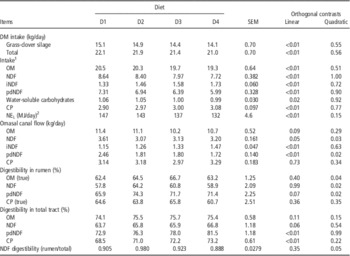
The silage chemical composition and pH is given in Table 1. The silages were well preserved, with restricted fermentation no butyric acid and low concentration of NH3 (Naadland et al., Reference Naadland, Steinshamn and Randby2015). In addition silage pH was low. Intake of DM, OM, pdNDF and water-soluble carbohydrates (WSC) decreased with increasing proportions of RG in the diet, whereas intake of iNDF and CP increased with increasing proportions of RG (Table 2). Flows of OM tended (P=0.09) to decrease linearly with increasing RG proportion (Table 2). There were linear and quadratic responses to increasing RG proportion in the diet on omasal flow of NDF and pdNDF, with the highest values observed for D1, and the lowest values for D2 and D4, respectively. The flow of iNDF increased linearly with increasing proportion of RG in the diet. There was a quadratic response to diet on rumen true OM, NDF and pdNDF digestibility with the highest values observed for the mixed diets, D3 and D2, respectively (Table 2). Total tract digestibility of NDF tended to increase (P=0.06) and that of pdNDF increased linearly with increasing RG proportion.
The chemical composition of organic grass-clover silages (n=16) and concentrate (n=4)

DM=dry matter; iNDF=indigestible NDF; pdNDF=potentially degradable NDF.
Silages were used in diets to dairy cows with regrowth replacing primary growth in the DM ratio 0, 0.33, 0.67 and 1 (treatments D1, D2, D3 and D4, respectively) in diets for dairy cows.
Effect of organic grass-clover silages on dairy cows with regrowth replacing primary growth in the dry matter (DM) ratio 0, 0.33, 0.67 and 1 (treatments D1, D2, D3 and D4, respectively) on daily basis feed intake, omasal flow and digestibility with orthogonal contrasts (n=16)

OM=organic matter; iNDF=indigestible NDF; pdNDF=potentially degradable NDF.
1 kg/day unless else is stated.
2 NEL, calculated according to Van Es (Reference Van1978).
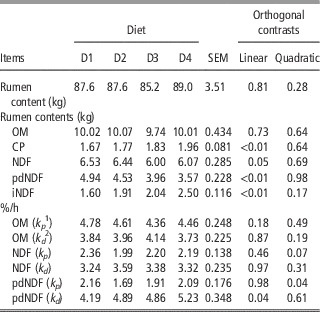
Silage type had no effect on rumen pool sizes of DM and OM (Table 3). Pool size of NDF tended to decrease (P=0.05), whereas pdNDF decreased with increasing proportions of RG. On the other hand, pool sizes of iNDF and CP increased (P<0.001) with increasing proportions of RG. There was a quadratic response of diet on k p of pdNDF, with the lowest rate in D2 and the highest rates in D1 and D4. A similar response (P=0.07) to diet was observed for NDF. The k d of pdNDF increased linearly with increasing proportions of RG.
Effect of organic grass-clover silages on dairy cows with regrowth replacing primary growth in the dry matter ratio 0, 0.33, 0.67 and 1 (treatments D1, D2, D3 and D4, respectively) on rumen pool size, passage and digestion kinetics with orthogonal contrasts (n=8)

OM=organic matter; pdNDF=potentially degradable NDF; iNDF=indigestible NDF.
1 Rate of passage.
2 Rate of digestion.
Rumen fermentation
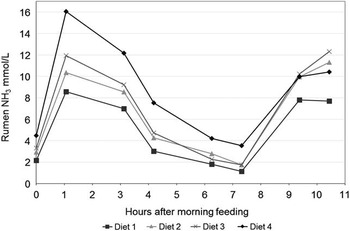
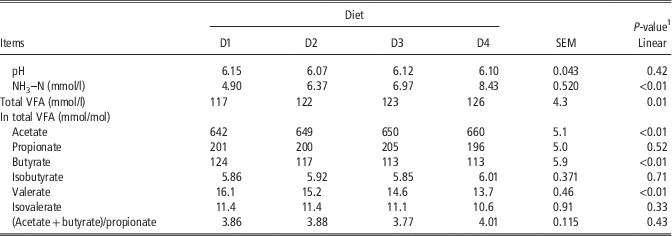
Dietary effects in daily average rumen pH were similar among diets, with the highest values before morning feeding (average value 6.35) and the lowest values 4.5 h after morning feeding (average value 5.95; not presented). Ammonia concentrations increased linearly with increasing proportions of RG in the diet (Table 4). The dietary effect on ruminal NH3 diminished around and after the afternoon feeding (Figure 1). Total VFA concentrations increased linearly with increasing RG proportion in diet (Table 4). Acetic acid was the main contributor to that result, as D4 had significantly higher concentrations than all other diets. Butyrate and valerate decreased significantly with increasing RG proportion.
Effect of organic grass-clover silages in dairy cow diets where regrowth replaced primary growth in the DM ratio 0, 0.33, 0.67 and 1 (treatments D1, D2, D3 and D4, respectively) on the course of NH3 concentrations after morning feeding (n=8).

Effect of organic grass-clover silages on dairy cows with regrowth replacing primary growth in the dry matter ratio 0, 0.33, 0.67 and 1 (treatments D1, D2, D3 and D4, respectively) on rumen fermentation with orthogonal contrasts (n=8)

VFA=volatile fatty acids.
1 Probability of significant effect of linear response to diet. The quadratic response to diet was not significant for any trait (P⩾0.25).
Milk production and blood metabolites
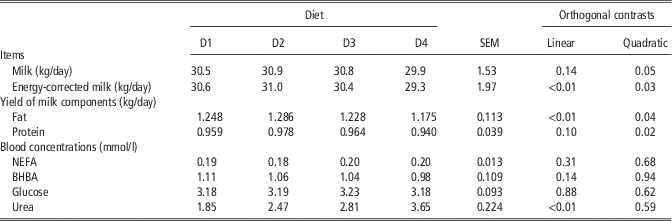
Diets containing PG promoted similar milk yields and milk fat yields (Table 5), and the same tendency was found for milk protein yield. This gave significant quadratic effect for daily energy-corrected milk yield, with the highest yield for D2 and the lowest for D4. There were few detectable differences between diets on the measured blood parameters. The BHBA decreased numerically while urea increased with increasing RG proportion in the diet (Table 5).
Effect of organic grass-clover silages on dairy cows with regrowth replacing primary growth in the dry matter ratio 0, 0.33, 0.67 and 1 (treatments D1, D2, D3 and D4, respectively) on milk production (n=16) and blood metabolites from a coccygial blood vessel (n=8) with orthogonal contrasts

NEFA=non-esterified fatty acids; BHBA=β-hydroxybutyric acid.
Discussion
Properties of the two experimental silages
The purpose of the present study was to compare the effects of replacing organic grass-clover silage from PG with the first RG prepared from the same field on rumen fiber kinetics. Other studies have mainly focused on pure stands of legumes and grasses (Dewhurst et al., Reference Dewhurst, Evans, Scollan, Moorby, Merry and Wilkins2003a; Halmemies-Beauchet-Filleau et al., Reference Halmemies-Beauchet-Filleau, Vanhatalo, Toivonen, Heikkilä, Lee and Shingfield2013). The interpretation of results are simpler when plant species are grown and fed individually, as the effect of cut may be confounded with species effect when species are mixed and their relative proportion changes between cuts. However, species in pure stands may give the herbage different properties than when they grow in mixtures. Especially grasses increase their CP concentrations when growing with legumes (Gierus et al., Reference Gierus, Kleen, Loges and Taube2012). The clover content of the total yield increased from 18% to 41% from PG to RG in the present study, which realistically is achieved in organically managed mixed grass-clover leys (Steinshamn and Thuen, Reference Steinshamn and Thuen2008; Alstrup et al., Reference Alstrup, Søegaard and Weisbjerg2016). Thus, the observed increased clover proportion from the PG to the RG gives the results from the present study applied relevance for organic dairy production. The differences in chemical composition between PG and RG were as expected, and can be seen as typical representatives of organic forages in Fennoscandia. There are two main causes for the higher iNDF concentration in the RG compared with PG: a significantly higher proportion of clover and a higher concentration of iNDF in the grasses (Nousiainen et al., Reference Nousiainen, Ahvenjärvi, Rinne, Hellämäki and Huhtanen2004; Kuoppala et al., Reference Kuoppala, Ahvenjarvi, Rinne and Vanhatalo2008). Grasses increase iNDF more than red clover from PG to RG (Bertilsson and Murphy, Reference Bertilsson and Murphy2003), and red clover has shown a greater iNDF increase than white clover (Kornfelt et al., Reference Kornfelt, Nørgaard and Weisbjerg2013). Compared with the observation in the referred studies, the actual difference in iNDF between RG and PG silages was relatively small, probably because white clover was quantitatively the dominating legume in our study.
Rumen fermentation
The rumen pH did not fall below six for >3 h between morning and afternoon feeding for any diet. That makes it unlikely that rumen pH inhibited fiber digestion (Calsamiglia et al., Reference Calsamiglia, Ferret and Devant2002). Higher intake of CP with increasing proportions of RG resulted in significantly higher NH3–N concentrations in rumen even before morning feeding, which may have influenced fiber digestion. Fiber digestion is impaired by too low NH3–N rumen concentrations, and it is suggested that NH3–N concentrations should not fall below 4.1 mmol/l (Broderick et al., Reference Broderick, Huhtanen, Ahvenjarvi, Reynal and Shingfield2010). All diets except the one with pure RG fell below 4.1 mmol/l for around 5 of the 8 h interfeeding, whereas the pure RG diet was in suboptimal NH3–N concentrations around 3 h interfeeding. When feeding the pure PG silage, the microbial growth in rumen may have been inhibited for several hours due to rumen NH3–N concentrations <4.1 mmol/l (Broderick et al., Reference Broderick, Huhtanen, Ahvenjarvi, Reynal and Shingfield2010). However, the rumen microbes seem to adapt to the diet as other experiments including diets with far greater dietary CP levels ended up with similar ruminal NH3–N concentrations as shown here (Sannes et al., Reference Sannes, Messman and Vagnoni2001; Kuoppala et al., Reference Kuoppala, Rinne, Nousiainen and Huhtanen2009). Rumen acetate is mainly derived from fermentation of fiber and molar acetate proportion increases with dietary NDF concentrations (Vanhatalo et al., Reference Vanhatalo, Kuoppala, Ahvenjärvi and Rinne2009). The observed increased rumen molar proportions of acetate and decreased rumen butyrate with increasing RG proportion were likely caused by more rapid digestion of pdNDF. A poorer NDF digestion would have been expected in a RG of only grass compared with its PG, but the increasing proportion of clover promoted a faster digestion (Kuoppala et al., Reference Kuoppala, Rinne, Nousiainen and Huhtanen2009, Reference Kuoppala, Rinne, Ahvenjarvi, Nousiainen and Huhtanen2010). Lower WSC concentration in RG than in PG silage might be the reason for the decreasing ruminal butyrate concentrations with increasing dietary RG proportion (Khalili and Huhtanen, Reference Khalili and Huhtanen1991; Oba, Reference Oba2011). The dietary effect on rumen butyrate concentrations were also reflected in the numerical differences in venous BHBA concentrations. Higher rumen butyrate concentrations in cows receiving PG diets may have contributed to the linearly increased milk fat production with increasing proportions of PG (Van Soest, Reference Van Soest1994). Feeding silage produced from grass harvested at increasing maturity has shown increased concentrations of acetate and decreased concentrations of butyrate (Vanhatalo et al., Reference Vanhatalo, Kuoppala, Ahvenjärvi and Rinne2009), similar to the effects in the present study with different cuts. Feeding legumes also results in higher rumen concentrations of both total VFA and a higher acetate to butyrate ratio than grasses (Bertilsson and Murphy, Reference Bertilsson and Murphy2003; Dewhurst et al., Reference Dewhurst, Fisher, Tweed and Wilkins2003b; Vanhatalo et al., Reference Vanhatalo, Kuoppala, Ahvenjärvi and Rinne2009). Those previous experiments focused on plant species and maturity, but not the effect of different cuts from mixed grass-clover, as in the present study. Rumen total VFA concentrations from PG and RG in pure grass silage are found to differ very little (Kuoppala et al., Reference Kuoppala, Rinne, Ahvenjarvi, Nousiainen and Huhtanen2010).
Digestion of NDF and flow rates
Rumen pool sizes in dairy cows are found to decrease when silages contain >50% legumes in the silage DM (Dewhurst et al., Reference Dewhurst, Fisher, Tweed and Wilkins2003b). In this experiment, all diets contained <50% legumes. This may have contributed to the similar quantities of rumen contents and the DM pool size found in all diets. A smaller rumen DM pool would have been expected with a pure clover forage, but there is likely a synergistic effect of grass-clover silages to maintain a greater DM pool (Moseley and Jones, Reference Moseley and Jones1984; Dewhurst et al., Reference Dewhurst, Fisher, Tweed and Wilkins2003b; Kuoppala et al., Reference Kuoppala, Rinne, Nousiainen and Huhtanen2009). Differences in NDF quality in rumen may explain the tendencies seen in the OM digestibility, in other words an apparent positive synergistic effect of PG and RG mixes compared with pure diets on rumen digestibility of OM. Rumen accumulation of pdNDF with increasing proportions of PG was observed due to a proportional slower omasal canal flow compared with feed intake. Grasses dominated in the PG and the even distribution of lignin in the grass tissue makes the rate of cell wall digestion slower than in legumes (Wilson and Kennedy, Reference Wilson and Kennedy1996). The digestibility of pdNDF increased with increasing proportions of RG in both rumen and total tract. The mixed diets had slower pdNDF k p compared with the two pure diets. However, the k d of pdNDF increased linearly with increasing proportions of RG with more legumes, which was probably due to lower NDF concentrations in the forage (Weisbjerg and Søegaard, Reference Weisbjerg and Søegaard2008). At the same time, iNDF seemed to accumulate in rumen with increasing proportions of RG due to the rigid lignification in the xylem stratum of legume stems. Other legume stem strata contained no or very little iNDF and were more easily digested. This may be more obvious when the leaf to stem ratio declines with advanced maturity (Wilson and Kennedy, Reference Wilson and Kennedy1996). Findings are in line with others (Kuoppala et al., Reference Kuoppala, Rinne, Nousiainen and Huhtanen2009; Halmemies-Beauchet-Filleau et al., Reference Halmemies-Beauchet-Filleau, Vanhatalo, Toivonen, Heikkilä, Lee and Shingfield2013). White clover has a higher fermentation rate in rumen compared with other grasses and legumes, which gives a higher SP fraction and higher outflow rate (Dewhurst et al., Reference Dewhurst, Fisher, Tweed and Wilkins2003b). These characteristics can explain the higher digestion rates of RG in spite of higher indigestible concentrations compared with PG. Inferior digestibility in RG determined DMI more than the clover proportion in the silages (Huhtanen et al., Reference Huhtanen, Rinne and Nousiainen2007).
The higher rumen NDF digestibility in the mixed than the pure diets suggests greater microbial activity in the mixed diets. The pure RG diet may have suffered of an increasing accumulation of iNDF in rumen, whereas the accumulation diminished with a 0.33 inclusion of PG. Increasing proportions of RG gave increasing total tract digestibility of NDF and pdNDF, probably caused by the increasing clover proportion (Kuoppala et al., Reference Kuoppala, Rinne, Nousiainen and Huhtanen2009). Bigger quantities of NDF was digested with increasing proportions of PG, but the proportion of digested NDF was greater with increasing proportions of RG. The decreased total tract digestibility of pdNDF with increasing proportions of PG suggested an unused potential for better NDF digestion. Increasing dietary proportions of PG gave a higher omasal pdNDF flow and the lowest rumen digestibility. Little pdNDF is digested in the intestine, which indicates a correlation between total digestibility and rumen digestibility (Kuoppala et al., Reference Kuoppala, Rinne, Nousiainen and Huhtanen2009). Despite this, cows that consumed the diet based on pure RG silage produced the lowest amount of milk. That is explained by the greater intake and amount of digested pdNDF with increasing proportion of PG silage in the diet. Dietary effects on energy corrected milk were small with diets containing PG, but overall the mixed diets were preferable. In line with the hypothesis, increasing dietary proportions of organic RG increased digestion rate of pdNDF, assumingly due to its significant clover proportion. The PG offered a higher feed energy concentration and consumption compared with the RG, and resulted in higher daily production of milk solids. The hypothesis of increased k p of pdNDF with increasing dietary RG proportion was not confirmed. The k p of pdNDF was lowest for the mixed diets, and contributed to highest rumen NDF digestion, which further may have contributed to similar daily milk solid production with the mixed diets as with pure PG, in spite of slightly lower daily OM intake.
Conclusion
Although rumen DM pool sizes were similar among diets, its composition differed: Increasing dietary RG proportion decreased pool sizes of NDF and pdNDF, whereas pool sizes of iNDF and CP increased. A greater digestion rate of NDF gave a more complete total tract fiber digestion, with lower excretion of pdNDF, with increasing RG proportion. The improved NDF digestion by cows offered 0.33 or 0.66 of RG was the most probable reason for similar or higher milk fat and protein yields compared with pure PG diet, where the highest net energy intake was calculated.
Acknowledgments
The project was funded by the Norwegian Agricultural Agreement Research Fund (Project number 207755 in The Research Council of Norway), the County Governors of Sør- and Nord-Trøndelag, the Sør- and Nord-Trøndelag County Authorities, TINE SA and the Norwegian Agricultural Extension Service. The authors have no financial or other conflict of interest in the manuscript. Further, the authors acknowledge Torstein Garmo for his help with botanical composition and the always helpful staff at the experimental unit led by Dag Kristoffer Forberg.