At 2:46 pm (Tokyo time) on March 11, 2011, the Great East Japan Earthquake measuring 9.0 on the Richter scale, striking East Japan and followed by devastating tsunami waves of up to 40.5 meters high. In September 2013, revised numbers of 18 703 deaths, 2674 missing, and 6220 injured in the earthquake were reported. 1 Furthermore, 1706 children lost a parent. 2 The earthquake and following tsunami destroyed almost 272 000 homes and approximately 69 000 people were evacuated. Furthermore, a nuclear power plant exploded. 1
Previous studies have reported the increase of post-traumatic stress disorder (PTSD) among adolescent populations after earthquakes.Reference Goenjian, Walling and Steinberg 3 - Reference Fan, Long and Zhou 7 However, few studies have investigated the prevalence of PTSD symptoms among “preschoolers,” children ages 3-6 years, after natural disasters.Reference Scheeringa and Zeanah 8 This is likely because verbal development is limited in preschoolers, which makes it difficult to diagnose PTSD because the DSM-IV requires a verbal description of the child’s feelings.Reference Scheeringa, Zeanah and Drell 9 , Reference Scheeringa, Peebles and Cook 10 To that end, Scheeringa et al. suggested alternative criteria that place less emphasis on verbalization and more focus on behavioral observation to diagnose PTSD in preschool children,Reference Scheeringa, Zeanah and Drell 9 - Reference Scheeringa, Myers and Putnam 12 and the DSM-5 PTSD included specific criteria as subtype for preschool children. 13 PTSD symptoms can be expressed symptomatically by nightmares, disturbed sleep patterns, or developmental regression, which can be observed by parents. In fact, the utility of parental observation has been reported.Reference Scheeringa, Peebles and Cook 10 Furthermore, re-experiencing trauma may be expressed as the appearance of threats, such as monsters in a nightmare, or threats to self or others, which can be revealed only through a psychiatric interview.Reference Yule 14 Thus, it is necessary to assess PTSD symptoms in multiple dimensions, that is, using interviews with child psychiatrists or psychologists, and parental reports based on the child’s trauma response-related behavior. The relationship between PTSD symptoms measured by both parental reports and psychiatric interviews among young children after natural disasters warrants further exploration.
Studies have yielded inconsistent results on the association between trauma exposure after a natural disaster and PTSD symptoms among children. After the tsunami and Sumatra earthquake in Thailand, the following were positively and independently associated with PTSD symptoms: experiences of delayed evacuation, an event that threatened the life of a family member, feeling extreme panic or fear, and loss of a close family member or friend. However, seeing tsunami waves, seeing a dead person, or loss of the home or important belongings were not associated with PTSD symptoms in children ages 7-14.Reference Thienkrua, Cardozo and Chakkraband 15 However, in adolescent survivors of the Ano Liosia earthquake in Greece, PTSD was positively associated with damage to the home but not with death or injury among family members.Reference Roussos, Goenjian and Steinberg 4 Nonetheless, home damage as well as injury to self and family members were positively associated with PTSD in adolescents in the Wenchuan earthquake,Reference Ma, Liu and Hu 16 yet in a 1-year follow-up study, only parent injury and severe property damage were associated with PTSD symptoms.Reference Liu, Yang and Ye 6 These findings were based on relatively older children and, to the best of our knowledge, no study has investigated the impact of natural disasters on PTSD symptoms in preschool-aged children. Further studies are needed to elucidate the association between trauma exposure related to natural disaster and PTSD in young children.
Moreover, multiple traumatic events occurred over time due to the Great East Japan Earthquake, such as the threat of death due to the earthquake itself, seeing the tsunami, seeing someone swept away by the tsunami, separation from family members, seeing fire, home damage, living in a shelter, living in temporary house, loss of family or friends, and threat of radiation after the nuclear explosion. Thus, it is possible to assess the association between exposure to multiple traumatic events due to a natural disaster and PTSD symptoms (ie, dose-response associations) among young children, an age group that few studies have investigated.
The aim of this study is to investigate the prevalence of PTSD and its association with each traumatic experience and the number of traumatic experiences in young children 2 years after the Great East Japan Earthquake.
METHODS
Sample
Children were recruited through a multistage sampling method in Iwate, Miyagi, and Fukushima prefectures (see details in previous studyReference Fujiwara, Yagi and Homma 17 ). First, municipalities severely affected by the tsunami (coastal side) and radiation caused by the nuclear power plant explosion in Fukushima prefecture were selected within each prefecture. Second, preschools were approached in the selected municipalities to request participation. Third, children who were in class and were ages 3-5 in the 2010 fiscal year (ie, children who were 4-6 years old when they experienced the earthquake on March 11, 2011) were approached. Then, from September 2012 to June 2013, caregivers of the targeted children were asked to participate in the study through preschool principals or staff. Parents of 205 children consented, and 178 children completed the questionnaire or interview.
For the unaffected area, Mie prefecture was selected, which was unharmed by the earthquake and tsunami. Similar to the sampling strategy in the affected area, 2 municipalities were selected in Mie prefecture and 1 preschool agreed to participate. The class that included children ages 3-6 years in the 2010 fiscal year was selected, and 30 children participated in the study. Two additional communities were selected in the municipalities, and 52 eligible children were recruited, resulting in a sample of 82 children from unaffected areas.
Measures
Trauma exposure related to the physical environment, such as home damage or the experience of staying at a shelter, was assessed through a questionnaire between September 2012 and June 2013 (around 2 years after the earthquake). Trauma exposure related to the physical environment was defined as follows: lost or completely damaged home, partially damaged home, or undamaged home, the experience of staying at a shelter immediately after the earthquake, living in temporary housing, evacuating to a relative’s house, and family members living in different places.
The details of the interview procedure were as follows: Each pair of interviewer, child psychiatrist or clinical psychologist, and the child interviewee met at a separated booth to maintain privacy. The interview composed of 4 parts: behavior during interview, daily life such as appetite or sleep, traumatic experiences related to the Great East Japan Earthquake, and mental health condition in the child including PTSD symptoms (ie, re-experiencing, avoidance, and hyperarousal), depressive symptoms, and developmental disorders. The interview process took 45-60 minutes to complete. We referred to a previous study that assessed children’s mental healthReference Thienkrua, Cardozo and Chakkraband 15 and the experiences reported in the area affected by the tsunami to define trauma exposure. Trauma exposure included separation from parents, loss of a close family member or relative, loss of distant relatives or friends, seeing the tsunami waves, seeing someone swept up by the tsunami, witnessing a fire, seeing a dead person, hearing the nuclear power plant explosion, and lifestyle restrictions due to radiation (eg, unable to play outside, drink tap water, or eat local food).
PTSD symptoms were assessed by interview and questionnaire. During the interview, child psychiatrists and psychologists checked for PTSD symptoms, such as re-experiencing, avoidance, and hyperarousal. Children who exhibited one of those symptoms—especially dissociation due to re-experience (included in DSM-5 13 )—as assessed by a trained physiatrist or psychologist from the interview were considered to have PTSD symptoms. In addition, to assess PTSD symptoms observed by parents, we used the Japanese short and modified version of the Parent Report of the Child’s Reaction to StressReference Fletcher 18 consisting of 28 items. These 28 items include a re-experiencing cluster (posttraumatic play, nightmares, and distress at exposure to reminders of the event), avoidance/numbing of responsiveness cluster (socially more withdrawn, restricted range of affect, and loss of acquired developmental skills measured as regression), hyperarousal cluster (difficulty going to sleep, decreased concentration, hypervigilance, and exaggerated startle response), and new fears and aggression cluster (new aggression, such as feelings of obligation of the onset of disaster, aggression to others or lack of empathy), which are similar to the criteria proposed by Scheeringa et al.Reference Scheeringa, Zeanah and Drell 9 There was an additional item on fear of death and having dreams for the future. Alternatively, these 28 items can be compared with DSM-V PTSD subtype for preschool children, 13 that is, intrusion symptoms (play enactment, recurrent distressing dreams, distress at exposure to internal or external cues, and marked physiological reactions to reminders of the traumatic events), persistent avoidance of stimuli and negative alterations in cognition, and alteration in arousal and reactivity (irritable behavior and angry outbursts, hypervigilance, exaggerated startle response, problem with concentration, and sleep disturbance), as well as additional items on fear of death, regression (behaves like a baby), and having dreams for the future. The test was comprised of 6 possible responses (1=Never; 2=Rarely; 3=Sometimes; 4=Often; 5=Always; 6=Do not know) and was administered by parents. Response item scores were calculated, with “Do not know” responses treated as missing. The total score was distributed normally and reliability was high (Cronbach’s alpha=0.86). The cut-off score for having PTSD symptoms (56.3) was calculated from the mean score (39.9) plus two standard deviations (16.4) from children living in the unaffected area. Children who exhibited PTSD symptoms according to the interview or questionnaire were categorized as having PTSD symptoms.
Analysis
First, to assess the overlap among traumatic experiences, a Pearson correlation analysis was conducted on the 15 traumatic experiences. Then, the associations between trauma exposure and PTSD symptoms were analyzed using a bivariate Poisson regression model because of high prevalence.Reference Zhang and Yu 19 , Reference Barros and Hirakata 20 Furthermore, a stepwise backward multivariate Poisson regression (P<0.05) (age and sex were force-entered) was used to examine the independent associations between trauma exposure variables and behavior problems. Then, to observe the cumulative effect of traumatic experiences, the number of traumatic experiences was categorized into 4 groups (0, 1-2, 3-5, 6+) and dose-response associations with PTSD symptoms were investigated with bivariate and multivariate Poisson regressions. Stata MP 12 was used to conduct the analyses.
RESULTS
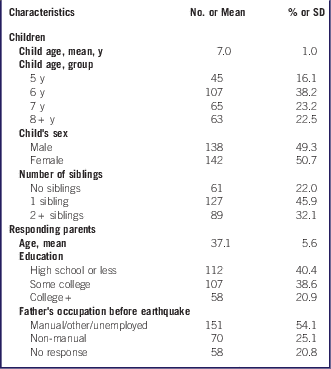
Table 1 shows the demographic characteristics of children and parents who responded to the questionnaire. Mean child age was 7 years, there was an equal sex distribution, and 22.0% of participants had no siblings. Responding parents (mostly mothers, 94.2%) were around 37 years old, 20.9% of whom had graduated from college or had an advanced degree. More than half of the fathers’ occupations were manual, other, or unemployed, which was underestimated because 20.8% of parents did not respond to this question.
Demographic Characteristics of Children and Responding Parents (N=280)

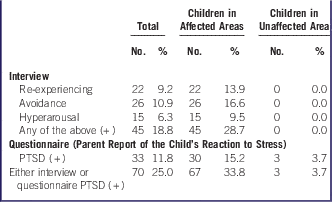
The distribution of PTSD symptoms is shown in Table 2. Of the children in affected areas, 16.6% showed avoidance, followed by re-experiencing (13.9%) and hyperarousal (9.5%), and 28.7% of symptoms were observed by child psychiatrists or psychologists. No children in the unaffected area exhibited these symptoms. According to the parent-administered questionnaire, 15.2% of children in the affected area and 3% of children in the unaffected area showed positive symptoms of PTSD. According to both child psychiatrist or psychologist interviews and the parent-administered questionnaire, 33.8% of children in affected areas and 3.7% of children in the unaffected area exhibited PTSD symptoms. Thus, 25.0% of the children in this sample displayed symptoms of PTSD.

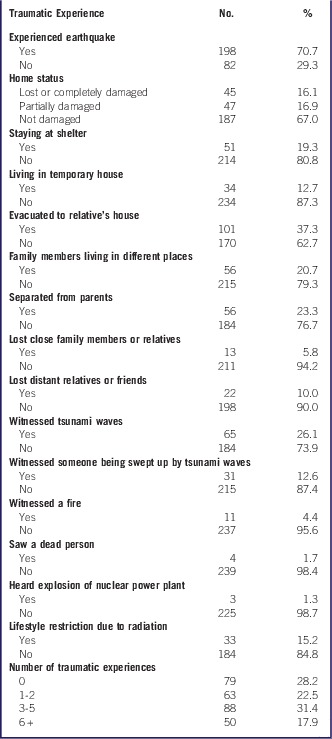
Table 3 shows the distribution of traumatic experiences. Because sampling was biased toward the affected area, 70.7% of children experienced the earthquake, 16.1% lost their homes, and the homes of 16.9% were completely or partially damaged. In terms of evacuation, 37.3% were evacuated to a relative’s house, 19.3% stayed in a shelter, and 12.7% lived in temporary housing. In terms of traumatic events revealed by the interview, the greatest percentage of children saw tsunami waves (26.1%), were separated from parents (23.3%), experienced a restricted lifestyle due to radiation (15.2%), witnessed someone being swept up by the tsunami (12.6%), lost distant relatives or friends (10.0%), lost close family or relatives (5.8%), witnessed a fire (4.4%), saw a dead person (1.7%), and heard the nuclear power plant explosion (1.3%). A total of 49.3% of the children were exposed to multiple traumatic experiences (3 or more events).
Distribution of Traumatic Experiences Related to the Great East Japan Earthquake Among Children (N=280)

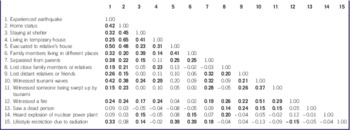
The correlations (Pearson’s r) among these traumatic experiences were calculated (Table 4). As expected, the experience of the earthquake and home status—which include two aspects, that is, damage to home and living away from home—were positively and significantly associated with other traumatic experiences, with the exception of seeing a dead person and hearing the nuclear power plant explosion, as these events were rare. Separation from parents and losing distant relatives or friends were also significantly associated with most of the other traumatic experiences. Family members living in different places (for example, the father having to move to a different place for employment) and lifestyle restrictions due to radiation were significantly associated, suggesting that the head of the household had to move for work while the rest of the family, including children, had to stay in the area affected by radiation.

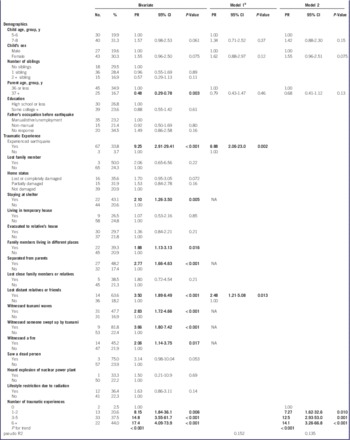
The associations between demographic information and traumatic experiences with PTSD symptoms are shown in Table 5. Using a bivariate model, we found that children who experienced the earthquake were 9.25 times more likely to have PTSD symptoms (95% CI: 2.91-29.41). Of the traumatic experiences, staying at a shelter, living in different places away from other family members, being separated from parents, losing distant relatives or friends, seeing tsunami waves, witnessing someone being swept up by the tsunami waves, and witnessing a fire were significantly associated with PTSD symptoms. PTSD symptoms were more prevalent in older children and girls, but these differences were not statistically significant. PTSD symptoms were less prevalent in children with older parents because parents in the unaffected area were older. In addition, according to the multivariable stepwise Poisson regression, in which child age and sex and other significant covariates were force-entered as explanatory variables, experiencing the earthquake (PR: 6.88, 95% CI: 2.06-23.0) and losing distant relatives or friends (PR: 2.48, 95% CI: 1.21-5.08) remained significantly associated with PTSD symptoms, suggesting that these experiences were significant, independent, traumatic events that induced PTSD symptoms among children ages 5-8 years old 2 years after the Great East Japan Earthquake.
Bivariate and Multivariate Analyses of Prevalence Ratios of PTSD Symptoms Induced by Great East Japan Earthquake by Traumatic ExperiencesFootnote a

a Bold signifies P<0.05.
bStepwise Poisson regression model was used with backward elimination (P<0.05), but demographic variables were forced-entered. Independent variables that showed significant associations (P<0.1) with PTSD symptoms according to the bivariate model.
Finally, a dose-response association was observed between the number of traumatic experiences and PTSD symptoms. Compared to children without traumatic experiences, children with 1-2, 3-5, and 6+ traumatic experiences showed 8.15, 14.8, and 17.4 times higher prevalence of PTSD symptoms, respectively, and the trend was significant (P<0.001). This association remained significant in a multivariate model adjusted for child age, sex, and other covariates.
DISCUSSION
This is the first study to assess the prevalence of PTSD symptoms among children 5-8 years old 2 years after the Great East Japan Earthquake. Of children living in affected areas, 33.8% exhibited PTSD symptoms, as assessed by either child psychiatrists or psychologists, or parents. Furthermore, as the Great East Japan Earthquake led to multiple traumatic events—including the earthquake itself, tsunami, fire, and nuclear power plant explosion—we were able to show that exposure to multiple traumatic experiences was associated with a higher prevalence of PTSD symptoms, suggesting a dose-response association between traumatic experiences and PTSD symptoms.
The prevalence of PTSD symptoms among children and adolescents after traumatic events varies between 3% and 95%, depending on sex, age, the nature of the event, and the population studied.Reference Salcioglu and Basoglu 21 - Reference Davis and Siegel 23 In Japan, it was reported that 25% of preschool children showed PTSD symptoms, (as defined by the DSM-IV alternative criteria) 6 months after a gas explosion.Reference Ohmi, Kojima and Awai 24 In addition, 50% of preschool children showed PTSD symptoms when assessed using the same alternative criteria 6 months after Hurricane Katrina.Reference Scheeringa and Zeanah 8 Although the PTSD symptom criteria differed from our study, the prevalence of PTSD symptoms was relatively similar to what we found here (33.8%), suggesting that our PTSD criteria is plausible.
We also found a dose-response association between the number of traumatic experiences and PTSD symptoms. It was also reported that the severity of home damage was associated with PTSD symptoms among young children after the Hanshin-Awaji earthquake in Japan.Reference Takada 25 The importance of polyvictimization resulting from traumatic events after natural disasters has not been well described compared to complex trauma, such as child maltreatment.Reference Finkelhor, Ormrod and Turner 26 To lessen the impact of traumatic events for children, disaster preparedness needs to consider how administration for relief activities prevents exposure to multiple traumatic events.
Further, we observed that experiencing the earthquake was a significant independent risk factor for PTSD symptoms among young children. This implies that the earthquake was a “life-threatening” experience for children. In other words, traumatic experiences after the earthquake, such as home damage, staying at a shelter, or living in a temporary house were not independently associated with PTSD symptoms, suggesting that psychiatric treatment is needed to deal with the experience of a life-threatening earthquake to avoid further PTSD symptoms. Moreover, we found that loss of distant relatives or friends was a significant independent risk factor for PTSD symptoms. This is consistent with a study conducted after the Sumatra tsunami in Thailand, revealing that losing a close family member or friend was independently associated with PTSD symptoms in children ages 7-14.Reference Thienkrua, Cardozo and Chakkraband 15 The mechanism underlying these results is unclear; however, it is plausible that losing a friend may lead to fear of death. The lack of independent association between loss of family members in our study and PTSD symptoms might be due to a lack of statistical power.
Several limitations need to be addressed: First, the participants were not a representative sample of children affected by the earthquake. Furthermore, among the target population, children with severe mental disorders may be less likely to participate because they may already receive care through psychiatric or psychological counseling services. Alternatively, parents with concerns about their children’s mental health may have been more likely to join this study. Second, PTSD symptoms were not assessed by structured interviews using the DSM-5, and the Japanese short and modified version of the Parent Report of the Child’s Reaction to Stress was not validated. However, the prevalence of PTSD symptoms among young children was similar to that reported in other studies.Reference Scheeringa and Zeanah 8 , Reference Ohmi, Kojima and Awai 24 The combination of interviews by child psychiatrists or psychologists and parental questionnaires is unique because we were able to detect PTSD symptoms in preschool children. Third, exposure to traumatic experience was assessed through interviews, but some of the children may not have voiced their true experience to the interviewer. We double-checked the reported experiences during interviews with parents and preschool teachers, but we assumed that traumatic experiences described by the children reflected meaningful traumatic experiences. Fourth, although the sample size was sufficient to detect the association between traumatic experiences and PTSD symptoms, it was relatively small for detecting significant associations with specific traumatic experiences and PTSD symptoms.
In conclusion, the prevalence of PTSD symptoms among young children in a community sample 2 years after the Great East Japan Earthquake was 33.8%, which is consistent with previous studies. Children who experienced the Great Earthquake and lost distant relatives or friends showed a significantly higher prevalence of PTSD symptoms, even 2 years after the earthquake. The dose-response association between number of traumatic exposures and PTSD symptoms was confirmed, suggesting that more serious exposure is correlated with PTSD symptoms 2 years later, whereas less severe exposures are not. Further, we found that some specific traumatic experiences were significantly associated with PTSD symptoms, despite the small sample size. These findings suggest possible ways to prevent PTSD after natural disasters. These data may be useful for preventing PTSD symptoms after natural disasters and providing appropriate mental health services that target children.
Acknowledgments
We thank the participants who contributed to this study. We also thank the child psychiatrists and psychologists who provided extra mental health support to participants when requested during interviews. In addition, we thank the research coordinators who coordinated the logistics for this study, and Ms Emma Barber for her editorial assistance. The Great East Japan Earthquake Follow-up for Children Study Team is comprised of Dr Takehito Yambe and Ms Mitsuko Miura (Iwate Medical University), Dr Hirokazu Yoshida (Miyagi Prefectural Comprehensive Children’s Center), Dr Yoshiko Yamamoto (Iwaki Meisei University), Ms Noriko Ohshima (Fukushima Gakuin University), Dr Keiichi Funahashi and Ms Mai Kuroda (Saitama Children’s Hospital), Dr Takahiro Hoshino (Musashino Gakuin School), Ms Rie Mizuki, Dr Lena Akai, and Dr Yoshiyuki Tachibana (National Center for Child Health and Development), led by Dr Makiko Okuyama (okuyama-m@ncchd.go.jp).
Funding
Supported by a grant from the Ministry of Health, Labour and Welfare (H24-jisedai-shitei-007).