Introduction: Dual system of welfare provisioning
This article examines the scope and content of welfare commitments at a large Indian state-owned manufacturing company, Indian Telephone Industries (ITI), over a period of roughly half a century (1948–2002). The benefits offered might not have been as all-encompassing as the ‘iron rice bowl’ forged by state-owned enterprises in China,Footnote 1 or the cradle-to-grave arrangements found in the former Soviet UnionFootnote 2 and certain large Western corporations,Footnote 3 or, for that matter, even in other Indian public sector companies like the giant Bhilai steel plant, which assumed the mantle of raja as ‘mother and father of his people’.Footnote 4 Still, ITI formed part of a small vanguard of socially enlightened Indian employers who spurned a limited, utilitarian conception of the wage contract.Footnote 5
Two objectives underpin this article. First, it argues that the conventional framework of explanations proposed by scholars as to why employers choose to establish social benefit programmes is inadequate to explain the implementation of similar measures at ITI, and by extension, the Indian public sector at large. The answers need to be found in other factors related to the developmental ideology of the post-colonial state coupled with the ‘commanding heights’ position occupied by public enterprises over the domestic economy.
Second, the article shows that the welfare system as it progressively emerged at ITI was quite unique, standing not on one but two parallel legs. Employers, particularly in large firms, can be expected to offer extra wage incentives, but in the case of ITI, in addition to corporate-sponsored services, the trade union played an active part in financing and administering a complementary social security net. Through the vehicle of a credit cooperative society that it had set up, it disbursed a string of incentives in the form of soft loans to workers. A major outcome of the dual entitlement structure, one piloted by the management and the other by the union, was that it further reinforced the legitimacy of the enterprise as the primary source for the satisfaction of a broad range of worker needs.
ITI employees sought to further protect themselves from the vicissitudes of life by throwing up various informal systems of risk-pooling. While there was no question of competing with the formalized dual-benefit configuration devised by the company and the trade union, these forms of mutualism provided spaces for workers to assert their autonomy, to provisionally ease the hold exercised by management and union officials over their lives.
It is worth noting here that knowledge of welfare entitlements in the public sector is largely restricted to anecdotal evidence of the kind that most big Indian enterprises controlled well-equipped company towns, offered generous perks and benefits to their workforces, and that collusion by managers, trade union officials, and labour resulted in rampant misuse of these advantages. Even the handful of scholars who have focused on state-owned companies have addressed this question only in passing.Footnote 6 The same holds good for research on the private sector. The absence of any full-length studies devoted to the issue of welfare provision therefore makes the task of establishing meaningful comparisons between ITI and other large Indian public and private firms a difficult one. As a result, the more general conclusions of this article must necessarily remain provisional.
Independent India's first public sector enterprise, established in 1948, ITI manufactures a wide range of telecommunications equipment from its base in the southern city of Bangalore. (It would be more appropriate to say manufactured, given that the firm's increasing inability to compete from the late 1990s onwards in the new deregulated market environment has all but put an end to its production activities.) For approximately the first four decades of its existence, it was not only protected from all forms of competition, internal and external, it even stood totally outside the market nexus supplying practically its entire output to a single customer, the Post and Telegraphs department (later rechristened the Department of Telecommunications), which remains its parent authority. This monopoly-monopsony relationship started to unravel in 1984 with the suppression of entry barriers to certain segments of the telecommunications equipment market, before completely collapsing in 1991 under the impact of economic liberalization.Footnote 7
Since then, ITI has struggled to adjust to the radically altered business climate, its restructuring efforts handicapped by all sorts of constraints, including an obsolete technology base and over staffing. Haemorrhaging cash for a number of years, an erratic trickle of financial assistance from the public exchequer combined with intermittent orders from other state-run firms and defence contracts alone has prevented its closure. On the eve of economic reforms in 1990, the company maintained 32,298 employees on its payrolls, including 16,494 at the flagship Bangalore factory.Footnote 8 Most of them were semi-skilled men, with women never accounting for more than 4–5 per cent of the total workforce at any time. A decade later, the workforce had shrunk by almost a third to 23,567 employees, a vivid illustration of the downturn in the company's fortunes.Footnote 9
This article will embrace both the pre-reform and the post-reform period, the consolidation, and decline of social security provisions at the company. For just as a well-endowed benefit programme derived its motive force from exclusive market power, so too did its partial dismantling result from the loss of this power. Once the Indian ruling elite moved from the ‘quest for state-led capitalism to a world of market driven capitalism’, and the economic foundations on which ITI stood started to collapse, the ideological bedrock underpinning the welfare programme rapidly eroded.Footnote 10 To illustrate this argument, the article will focus mainly on developments at the main Bangalore plant, probing diverse aspects of the operation of the welfare system in its totality.
Following this introductory section, the article is structured in three parts, each addressing one component of the overall welfare regime.Footnote 11 The first, and largest, section discusses different dimensions of the company-regulated social security net, and the way workers tried to appropriate it to serve their own ends. It also addresses the impact of the cost-cutting drive, which was pushed through by management in response to the challenges of liberalization, on the collective institutions of welfare distribution, and shows how their costs were partially transferred to the workforce. The second section is devoted to the functioning of the union-controlled credit cooperative society and analyses the reasons for its impressive performance. The final section explores the dynamics of the multiple mutuality mechanisms that workers fashioned themselves to better their lives. The article concludes with a few comments on the similarities and differences among social welfare programmes in public sector firms in India and the pertinence of the notion of ‘paternalism’ when applied to state-owned enterprises.
Public sector managements directed to act as ‘model employers’
Explanations as to why corporate-sponsored social security systems flourished, and employers acted in exactly contrary ways to laissez faire doctrines enjoining them to pay labour no more than a money wage, can, schematically speaking, be collapsed into four separate categories.Footnote 12 First, concerns about the problem of labour turnover prompted employers to attract and attach the services of highly skilled workers in particular. A close variant of this needs-of-capital grounded reasoning argues that extra-wage incentives helped to socialize workers, and their families, in the values and ways of industrial society, secured the acceptance of managerial authority and, concomitantly, built a harmonious workplace culture by fostering loyalty to the company. Third, employers were determined to forestall the emergence of trade unions which might challenge their unilateral right to manage. Finally, satisfying a broad range of employee needs allowed companies to counter growing demands for government regulation of the workplace and the introduction of state-subsidized welfare schemes.
Mutually non-exclusive, all these objectives have often been pursued in tandem. While economic, technical, and social control considerations definitely loomed large, the solicitude of employers could not be reduced to the compulsions of narrow self-interest alone. It was equally inspired by religious morality and duty, prevailing definitions of community obligations and accountability, ethical convictions, and rational calculations, as several studies have made clear.Footnote 13
In the case of ITI, practically none of the justifications commonly advanced for proposing welfare entitlements, however, hold good. Slack labour market conditions, as reflected in the growing rates of unemployment in urban centres after Independence, guaranteed it a virtually bottomless pool of unskilled labour.Footnote 14 Questioned by the National Commission of Labour in 1967, the company confidently replied that ‘we do not find shortage of labour in any category’, adding that resignation rates stood at a lowly 2 per cent.Footnote 15
So if the welfare package was not designed to retain labour, in contrast, say, to the strategy adopted by Bhilai management, could it then be regarded as a pre-emptive strike against the threat of unionization?Footnote 16 This explanation is equally untenable. For one thing, the dispensing of largesse by ITI post-dated the birth of the union. For another, far from opposing workers’ rights to representation, management wholeheartedly backed this initiative, first, by immediately granting recognition to the union, and, then, by creating the conditions for it to take root and mature into a countervailing force. One could, however, contend that corporate benevolence gave management the kind of compliant or ‘responsible’ union leadership it wanted, regardless of whether it consciously pushed for this goal or not. Similarly, the line of reasoning stating that business leaders voluntarily implement employee benefits with the objective of staving off statutory reforms and government interference in internal corporate affairs made little sense in the Indian context, and even less so in the case of ITI, controlled as it was directly by the state.
Only the argument linking the provision of social benefits to the preservation of industrial peace could, to some extent, apply to ITI. Since the unique yardstick by which parent authority P&T evaluated the performance of top management was its ability to fulfil annual output targets, keeping workers contented ranked as a crucial precondition for success. As a company document pointed out, it was imperative ‘to strive at all means to develop a sense of belonging and an inner urge amongst its workers to improve their performances and thereby enable them to actively cooperate in the Company's objectives’ (sic).Footnote 17 One way of realizing this was, of course, through extra wage incentives. To quote one former senior executive:
We looked after them [workers] very well, providing lots of benefits . . . Successive managements pursued these policies without ever thinking of cutting back. The area of conflict was thus reduced . . . We made sure that there was no labour trouble that could affect production.Footnote 18
So, given the limited capacity of conventional interpretations to decode the underlying rationale of welfare arrangements in ITI, how then are we to make sense of the firm's actions? The answer to this question lies in a complex of ideological and material considerations informing the type of policies and institutional arrangements pursued towards labour by management. As recent research on the steel towns in particular has demonstrated,Footnote 19 much the same dynamic was arguably at work in the public sector at large (and in certain big, modern, profitable private firms as well).Footnote 20
Actively enjoined by the state to behave as ‘model employers’, state firms were required to set an example for private players in all spheres related to the wage contract. Underlining the mission of the public sector, the First Five-Year Plan, for instance, clearly stated that it ‘should set the pace and serve as models’ with respect to welfare amenities in order to ‘have a cooperative and contented labour force’.Footnote 21 This need to live up to its obligations partly explained why ITI management, apparently of its own accord, started a gratuity scheme a decade and a half before it became a mandatory requirement.Footnote 22 We should not, though, ignore the fact that what enabled the company to act as a trendsetter was the financial clout assured by its monopoly position.
Expressing a high degree of commitment to its workforce was therefore consistent with the role the public sector was directed to assume. Treating its employees equitably and humanely served to propagate the message that it contributed just as much to the social welfare of the people as to the economic advancement of the nation. As a consequence, it was legitimately entitled to dominate the ‘commanding heights’ of the Indian economy. In other words, the task of the new infrastructural industries set up after 1947 was not just to produce a wide array of essential public goods, it was also to create a new kind of worker, a modern worker assured of material well-being and security, and thus better able to serve the nation.
As Partha Chatterjee has argued, delivering on the promise of social amelioration conditioned, in good measure, the ability of the post-colonial developmental state to achieve its fundamental objective of advancing capital accumulation through the mechanism of centralized planning and a strong public sector.Footnote 23 Because it had come to be ‘identified as the embodiment of the general’, the state sector had perforce to ensure social and distributive justice both towards the nation at large and its own workforce.Footnote 24 Living up to this latter obligation entailed at least the establishment of a relatively comprehensive social security net in addition to guarantees of implicit lifetime employment, decent wages, and a risk-free working environment.
If the model employer ideal constituted one element in the ideology of the developmental state, the figure of the ‘patriot-producer’ formed another.Footnote 25 It is worth recalling that during the Nehruvian era, official rhetoric repeatedly underscored the importance of industry in the nation-building process. Given the centrality of their position in the post-colonial economy, state-run enterprises served as beacons of the ‘Nehruvian vision of modernity’.Footnote 26 Work was equated with patriotism. The protagonist of the planned industrialization model embraced after Independence became the patriot-producer, the epitome of which was by definition the public sector worker. Official pronouncements on the role of state firms were copiously sprinkled with injunctions urging management and labour to behave responsibly in the larger interests of the nation.
Expressing dissatisfaction at the lack of dialogue between the two sides, one parliamentary report categorically declared that there was ‘no room for class struggle in these national undertakings’ since workers were ‘equal partners’ and exhorted them to ‘give their best’ so that the ‘benefit of their labour will accrue to them and to the whole nation’.Footnote 27 Amplifying the theme of the patriot-producer, such appeals, when incorporated into and rearticulated by company officials in their own discourse, seem to have struck a responsive chord among employees, albeit temporarily, as the following lines suggest.
Workers [at ITI] like management were imbued by the nationalist spirit. If we told them that [a telephone] exchange had to be urgently commissioned somewhere and that a minister was going to inaugurate it, workers would get on with their jobs . . . When workers would complain sometimes of poor quality indigenous material, we would tell them to take a bit more time to get the job done because the cost of imported material was very high and using indigenous material would provide jobs to their own relatives. We would also ask jokingly when workers expressed a preference for imported material whether they wanted to drink only foreign whisky or to marry only foreign girls . . . Workers would respond positively to our incitements. But this spirit gradually eroded over time.Footnote 28
Motivating the workforce to strive for the common national good, though, could not be achieved merely by mobilizing ideological values. Appealing to employees’ patriotic sentiments to inculcate a strong work ethic, and overcome, at least temporarily, the constraints flowing from import-substitution policies, carried with it inherent limitations. This was even more true once the hegemony of the developmental state came to be increasingly contested by regional, linguistic, religious, and caste forces, and in a context where the living standards of even organized labour remained depressed.Footnote 29 For ideology to bite, the promise of material rewards over and above the payment of wages was also required, hence the utility of company towns, low cost meals, medical care, and the like.
Bureaucratic character of welfare provisions
From its inception, ITI readily assumed overall responsibility for the well-being of its employees. The centrepiece of its initiative was a spacious, well-planned township, capable of housing around 1,700 employees and their families, and equipped with a fully fledged hospital, a school for resident children, playgrounds, and other recreational facilities.Footnote 30 All medical treatment delivered at the hospital was free of cost (both to township residents and other employees) as was schooling. To assist employees in emergencies and other unforeseen circumstances, management also established savings-and-loan associations.
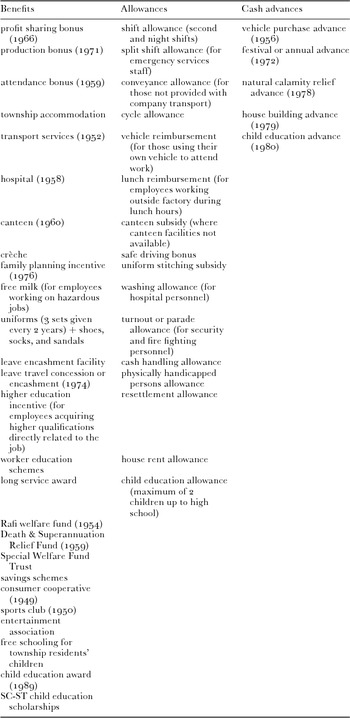
At the same time, it subsidized transport services, distributed low-cost meals, free uniforms, as well as a raft of fringe benefits and cash advances destined for various purposes such as festival expenses, children's education, and the like (see Annex A). Introduced either directly by management or in response to union demands, the various welfare measures were progressively implemented over a period of roughly three decades. For example, advances for vehicle purchase were granted from 1956 onwards; four years later a canteen was established; in 1971 a production bonus system was initiated, followed in 1976 by a family planning incentive. During the initial years of the factory's existence, many of these perks could plausibly have been viewed as a social wage designed to compensate for relatively low levels of monetary remuneration. But this interpretation no longer remained valid from the early 1970s onwards when collective bargaining agreements yielded regular pay increases.
Two features of the ITI social safety net merit emphasis. First, in tune with the overall style of functioning of the public sector, the provisioning of social needs in ITI tended to be extremely bureaucratic and impersonal in character.Footnote 31 The distribution of benefits was in no way subject to the personal discretion of managers. Instead, workers’ entitlements were rigorously encoded by the personnel department in an elaborate framework of rules and regulations. This had the effect, intended or otherwise, of transforming unilaterally instituted benefits into de facto contractual guarantees without the union or workers having to exert any pressure.
Suspicions of irregularities surfacing at the level of individual shops or departments, where officials and foremen might have been expected to act arbitrarily, show favouritism or demand bribes, are also not borne out by the evidence at our disposal. Company records contain few complaints from workers and/or their representatives accusing superiors of twisting regulations to suit their interests and convenience. Nor did this issue crop up during discussions with the union and employees. One plausible explanation for this surprising situation is that ITI was a publicly owned company, and as such answerable to a host of watchdog bodies, its top management strove to avoid all accusations of impropriety in the administration of the welfare system. Workforce-related grievances generally tended to attract far greater public attention, and consequently criticism of management, than did production and allied operational problems.
Second, the distribution of corporate largesse at ITI rested on relatively egalitarian and inclusive foundations. Scholarship in this domain has shown that the scope of employer social safety nets did not always cover all sections of the workforce uniformly.Footnote 32 Skilled, older male workers of native origin together with those deemed reliable and/or obedient by employers were quite often the primary or sole recipients of extra-wage incentives. In contrast to this restrictive focus, at ITI the ambit of welfare facilities covered the entire permanent workforce. Barring certain advantages, such as gratuity and soft loans for home ownership where a minimum length of service was necessary, none of the others had any eligibility conditions attached to them. Welfare services once introduced were also never suppressed, even when their provision was not compulsory under the law. Monopolistic privileges meant management could easily afford such displays of generosity, at least until the advent of economic reforms in 1991.
True, the advantages of company-built accommodation and free education at the ITI school were available only to a fraction of the employees. At the peak of the Bangalore plant's strength in 1980, for instance, no more than 10 per cent of the total workforce lived in the township. These figures could perhaps suggest a more qualified assessment of the inclusive nature of the ITI welfare programme. However, non-township residents were hardly discriminated against. They received a monthly house rent allowance (which was deducted from the salaries of township residents) as part of the overall pay package, besides being eligible for soft loans to construct their own house.
Rules restricting some cash benefits (vehicle purchase, annual advance, and leave encashment) only to those employees who met the prescribed attendance norms were never enforced. Nor were employees with poor disciplinary records penalized in any manner.Footnote 33 Families of workers living in the township were not neglected either: health care and birth control programmes, as we shall discover, targeted all household members while a company-run school in the township dispensed free education to residents’ children (non-residents were paid an education allowance for their children).
Paradoxically, the only category to be excluded from this protective embrace was the one most in need of it, the casual workers. However, their numbers were relatively insignificant even during the post-1991 reform era when public and private sector firms alike embarked on a massive casualization drive in a bid to exploit cheaper labour costs.Footnote 34 For ITI this did not represent a viable strategy option: a near-empty order book meant that non-permanent workers would have often remained just as idle as regular hands. Casual labourers thus rarely averaged more than 3.5 per cent of the total workforce at any given time at the main Bangalore factory.Footnote 35 So leaving aside the employment contract, other discriminatory markers grounded in trade, gender, age, ethnicity, or personal conduct played no role whatsoever in specifying the beneficiaries. Once again we can see the crucial bearing the legal status of ITI had in determining its obligations. As a state-run enterprise, it had at once to ensure that its social provisions were spread as equitably and broadly as possible, and to guarantee free and fair access to these provisions.
As well as a potent safeguard against managerial arbitrariness, the bureaucratic operation of the welfare package had another important consequence. In conjunction with state ownership, and the rapid turnover of chairmen, it prevented officials from invoking conventional family imagery with a view to dissolving hierarchical divisions and fostering greater worker allegiance to company objectives. Whereas private firms, irrespective of their size, could try and elevate the proprietor or boss to the position of paterfamilias, provider, and benevolent protector of the interests of all those gathered under his wing, the very nature of the public sector militated against such a strategy. Not only were these enterprises defined as the property of the nation at large, but the locus of authority, resting as it did outside the enterprise in the hands of the administrative ministry rather than management, impeded efforts at cultivating a paternalist ethos.
Indeed, several of the workers I interviewed were firm in asserting that non-wage benefits were not a gift or a concession from management. Instead, they claimed them as their legitimate right or entitlement because, as they pointed out, the public sector belonged first and foremost to those who spent their lives contributing to its development.Footnote 36 Worker perceptions of free uniforms, vehicle purchase advances, and so forth as their rightful due also stemmed from the fact that these advantages represented an inherent component of the overall employment package and carried the force of legally recognized rights as they came to be progressively incorporated in collective bargaining agreements which were ratified by the government.
In other words, in the context of a state-run enterprise, social welfare entitlements were defined by anything but their exceptionality; on the contrary, they were firmly grounded in a bureaucratic structure of industrial jurisprudence.Footnote 37 It is worth noting that this embedding of social provisioning in contractual regulations is also what differentiates it from the notion of customary rights as defined by Eric Hobsbawm, that is, rights endorsed not by the sanction of the statute books, but by the ‘sanction of precedent, social continuity and natural law as expressed in history’.Footnote 38
This said, claims to welfare as their legitimate due did not preclude the first generation of workers in particular, who joined the Bangalore plant during the first 15 years of its existence, from invoking the ma-baap (mother-father) idiom. Their sense of obligation and loyalty towards the company for having made them a ‘respectable member of society’, by providing them with a job despite lacking ‘even a high school certificate’, often expressed itself in the familiar terms of filial gratitude.Footnote 39 As one operative spontaneously told me, ‘I might have some complaints against ITI, but it is like my mother. On holidays when I go past the front of the factory, I automatically bow my head in gratitude (sic) . . .’Footnote 40 What these lines reveal is that generational differences are likely to have played a considerable role in moulding workers’ perceptions of the corporate social security net, so much so that no straightforward conclusions can be drawn on this point. Entitlements or justly deserved for some, completely decoupling company-delivered welfare protection from the gift-counter-gift principle might have proved a more complicated exercise for others.
Welfare policies target township residents’ bodies
The impersonal character of the welfare programme, built essentially around subsidized services and the cash nexus, did not mean it was completely unintrusive. Certainly, the company did not strive to use its personnel policies to reshape workers’ dispositions so that they conformed to some imagined ideal of the ‘committed worker’. As the overall architecture of the benefits package illustrates (see Annex A), it was largely free of moralistic or manipulative intent. Individual and monetized forms of security took precedence over ‘soft’ or in-kind services and group uplift. We know from the historical record that it was these latter perks, offered collectively, which typically served as the Trojan horses by which employers sought to exercise control over their workforces. In other words, social control imperatives by and large took a back seat to the primary goal of bettering employees’ material conditions.
Nevertheless, there were two distinct areas, both touching predictably enough on health or bodily issues, where the welfare scheme at ITI definitely impinged on workers’ intimacy. The first concerned the prevention of a variety of epidemics within the township, the second involved family planning where management threw its weight enthusiastically behind government policies, as discussed below.
At regular intervals, but particularly following the outbreak of diseases like smallpox, typhoid, cholera, diphtheria, and so forth in areas neighbouring the ITI township, circulars were issued informing township residents of the launch of vaccination campaigns and urging them to get themselves and their families inoculated as soon as possible. Auxiliary medical personnel from the ITI hospital made house visits in order to ‘intensify propaganda regarding paramount need for preventive vaccinations. . .’(sic)Footnote 41 They were also instructed to maintain records on each family so as to ensure that all household members were vaccinated. A specially equipped clinic for infant children started functioning later in the hospital where women doctors gave employees’ wives advice on baby care and vaccinations.Footnote 42
Yet these precautionary measures remained inadequate. A circular dated January 1963 noted that despite the ‘repeated publicity’ given to fighting whooping cough, it was a ‘pitiable thing to see babies and small children suffering from this disease’, especially when the ITI hospital had ample stocks of the vaccine.Footnote 43 More alarmingly, in 1966, twelve cases of smallpox were reported among children living in the township, six of which proved fatal. In the wake of these deaths, after pointing out that quite a few children had still not received even primary vaccinations and that it was essential they did so in the interests of all residents, the company said it would be compelled to take action against those who disregarded this warning.Footnote 44
The nature of these sanctions, however, went unspecified. Two years later, when announcing the start of a new house-to-house vaccination drive as part of a national effort to eradicate smallpox, management again felt it necessary to repeat this threat.Footnote 45 Whether it did so as a mere formality or because of continued resistance from certain employees is a matter of conjecture. Going by the records, though, the township seems to have been spared epidemic attacks thereafter, proof perhaps of the efficacy of the sanitizing policies pursued by the company.
An even deeper intrusion into workers’ private lives related to the measures adopted by ITI to promote birth control. With the perils of unbridled population growth a recurrent theme in government discourse, and with official reports exhorting employers to make family planning ‘part and parcel of labour welfare activities’, a good deal of attention and resources was devoted to this question from the outset.Footnote 46 For, as the company reminded employees, ‘family planning stands not merely for the limitation to the size of the family, but for the health, happiness and prosperity of the family as a whole’ (sic).Footnote 47
To achieve this goal, the ITI hospital conducted sterilization operations free of cost for male employees and their wives, and for female employees. A special family planning clinic was opened inside the hospital staffed by both female and male doctors to advise employees and their wives. During the course of their house visits, the pace of which was significantly stepped up from the mid-1960s onwards, paramedical staff handed out ‘motivational pamphlets’ specifying the cash and other incentives awarded by both the government and the company.
A register of all eligible or target couples residing in the township was also maintained in accordance with the instructions of the health and family planning ministry.Footnote 48 Educational visits to the factory by personnel from the family planning clinic soon became a daily occurrence. In December 1966, as part of the ‘Family Planning Fortnight’ activities, which were celebrated throughout the country, the company screened educational films daily at various locations in the township, plied employees with condoms and oral contraceptive pills, and bombarded them with a steady flow of slogans and announcements through the public address system during the lunch break.Footnote 49
With the Indira Gandhi regime placing fertility control high on its list of priorities in the aftermath of the imposition of a state of emergency in 1975, ITI predictably enough announced that it would be intensifying its family control programme. ‘It need hardly be mentioned that in a country like India, keeping an eye on the birth rate is as essential as planning for more food and more goods.’Footnote 50 A family planning committee which included union representatives was constituted and a questionnaire distributed to all employees to collect information regarding their family situation and size. To what extent ‘every employee . . . filled up the questionnaire without fail’ and what purpose the questionnaires really served remains unknown.Footnote 51 Nevertheless, we may presume that much like the registers maintained on target couples in the township, the responses to the questionnaire helped the company establish a list of potentially ‘sterilizable’ candidates.
At the same time, much publicity was given to different government initiatives such as the organization of vasectomy camps and exhibitions. With the national Family Planning Fortnight now enshrined as an annual fixture, theatre shows and discussions, involving worker representatives, union leaders, and public officials, were arranged both inside the factory and in the township. For the year 1975–76, ITI boasted of having exceeded all the family planning goals fixed by the health authorities, performing in particular 100 sterilizations as against the target of 80.Footnote 52 For vasectomy operations, it paid compensation of Rs 150 and for tubectomies Rs 110, besides granting a week's leave. As a further inducement, it promised a special increment, varying between Rs 200 and Rs 300, to all employees younger than 50 who had three or fewer children, and who had agreed, or ensured their wives had agreed, to be sterilized.Footnote 53
Even after the withdrawal of the state of emergency, management continued to energetically champion the cause of birth control.Footnote 54 In one circular it declared that public enterprises ‘should play a vital role in motivating employees to accept the concept voluntarily in their own interest and in the interest of their children, as well as in the larger interests of the Nation’.Footnote 55 This ‘vital role’ prompted it to announce a reward of Rs 100 for workers over and above the sum of Rs 175 that the government had already proposed to give in order to attract sufficient volunteers for a family planning camp organized in October 1984 in the township.Footnote 56
Whether or not this and the other measures devised by management succeeded in converting employees to the credo, tirelessly reiterated by the official propaganda, that a ‘small family is a happy family’ is a question difficult to answer in full. Given the gaps in the sources, all that is clear is that 2,757 employees out of a total of about 8,000 were still receiving the small family increment in July 2000. The statistical information available on the number of sterilization cases also shows that the ITI hospital performed 682 operations between 1976 and 1979; a further 561 sterilizations were carried out between 1989 and 1990, and between 1994 and 1995.
More to the point, out of this total of 1,243 operations, nearly 95 per cent were tubectomies.Footnote 57 In other words, those willing to be sterilized were not male employees, but their wives, and female employees. The above figures speak volumes for the gender bias embedded in family planning programmes across the country. Because of the stigma attached to vasectomies, an upshot of the coercive methods applied by the Indira Gandhi regime during the Emergency, when men were forcibly sterilized, government officials primarily targeted women, despite being aware that tubectomies tended to be more expensive, more complicated, and riskier compared with vasectomies.Footnote 58
There is no doubt that these experiments in social engineering designed to produce healthier and smaller worker families represented a profound intrusion into employees’ intimate lives. On the other hand, it must be remembered that only a relatively small fraction of the factory population experienced the impact of these measures, namely township residents. At the peak of the Bangalore plant's strength in 1980, for instance, no more than one in ten workers lived in the township. The design and implementation of the company's family planning policy was also free of all coercive intent. In distinct contrast to the forced sterilization excesses of the Emergency years, all those who underwent operations here did so of their own volition.
At the same time, it is worth recording that the ‘regimes of justification’ mobilized by ITI to legitimate its violation of workers’ privacy both with respect to the eradication of contagious diseases and birth control, pertained to the ‘civic world’ as opposed to the ‘industrial world’.Footnote 59 It was not with an eye to achieving productivity increases that these actions had been undertaken. Instead, they stemmed from a concern for the greater ‘good’ of each worker family, the local township community, and the larger community of the nation. The company itself stood to gain little directly from the measures it sought to push through.
Outside of this realm of ‘body power’, we do not find any other overt moves on the part of ITI to restructure the lifestyles of the township's inhabitants. Management officials remained by and large respectful of their privacy. No form of surveillance was exercised over workers and their families, nor were any restrictions imposed on their movements.Footnote 60 Their leisure time was also very much their own, totally preserved from company interference. If the periodic organization of good housekeeping and gardening competitions furnished an occasion for company executives to inspect living spaces and check whether or not workers complied with regulations, participation in such events was wholly voluntary.Footnote 61 Malaria control measures gave management another pretext to scrutinize domestic conditions since all houses were sprayed daily with anti-mosquito insecticide by the maintenance department. Cost-cutting constraints, however, put a stop to this practice, the task being entrusted directly to residents who were provided with the materials.Footnote 62
As a top union delegate remarked, not without reason,
Workers are like kings once they move into the township. They have independent houses; they are like virtual owners, and never vacate the house until they die or retire.Footnote 63
This is an opinion confirmed by one long-time township resident:
When I rent a house in the city and want to put a picture on the wall and hammer a nail, I have to ask the permission of the owner. Here I can do anything. It is quite my own house. I can consider it as my own house.Footnote 64
While company security guards frequently intervened to settle neighbourhood disputes or family quarrels, they seldom set foot inside workers’ houses without permission. Workers guilty of mistreating or neglecting their wives were sometimes interviewed by welfare officers and either verbally warned or charge-sheeted when the offence was considered to be serious. Thus following a complaint from Venkamma that she was being harassed by her husband, Byranna, and his concubine, a charge-sheet was issued to him. Interestingly, five of Byranna's neighbours also submitted a signed petition to management where they accused him of ‘beating and torturing’ his wife and urged it to ‘take necessary corrective action’.Footnote 65 Alcoholics were also sporadically called in and advised to mend their ways. Nevertheless, going by the available records, the counselling cell in the personnel department does not appear to have suffered from overwork. This suggests that the company, unenthusiastic about reforming workers’ morals, was not too keen to interfere in their domestic affairs, preferring the local police to handle such problems.Footnote 66
The self-restraint exercised by ITI officials appears quite surprising. Personnel departments at other big public and private enterprises such as the Bhilai Steel Plant and the Tatas had far fewer qualms about prying into the domestic sphere, refusing to prioritize the provisioning of social needs over the imposition of new moral codes and sensibilities.Footnote 67 So why did ITI decline to adopt similar practices? The answer can perhaps be traced more to an interweaving of spatial and social considerations than ideological ones. Writing about the pressure exerted by the personnel department at Bhilai on bigamist employees to get them to mend their ways, Parry rightly argues that managerial interventionism stemmed from a melange of ‘paternalistic Nehruvian modernism’ and the desire to uphold traditional, middle-class Brahmanical family values.Footnote 68 To these two determinants, ideological in nature, he could have added a third, namely geography.
Situated in remote rural areas, Bhilai and Jamshedpur, the city established by the Tata family, bore close resemblance to the archetypal company town where a single employer, by virtue of the fact that it monopolizes the most desirable employment opportunities, is in a position to exert considerable influence over workers’ professional and personal lives as well as over the affairs of local governance. Such control was likely to have been even greater in some, but not all, state firms where customary rights ensured that jobs were like a family inheritance being handed down from one generation to the next.Footnote 69
None of these factors applied in the case of ITI. An examination of recruitment records throws up no evidence of a formal or informal corporate policy systematically privileging the second generation during the hiring process, the sole exception to this rule being the dependants of workers who had died in service (even this measure ceased after the enforcement of a recruitment freeze in the early 1990s). More significantly, ITI's location in a metropolitan centre not only meant, at least in theory, that its workforce enjoyed access to alternative employment avenues. It also meant that the ability of management officials to determine whether workers’ worldviews and actions conformed to the company's interests was likely to have been checked and challenged by a host of competing forces, be they political parties, trade unions or cultural and religious organizations.
Workers could have turned to these countervailing forces to help them resist attempts on the part of management to intervene in their private affairs far more easily than might have been the case in a company town where local political and civic institutions were likely to have been no less reliant than the workforce on corporate patronage for their well-being, thereby undermining their scope for independent action.Footnote 70 It would therefore be safe to state that the ties of dependency sustaining management-worker relations at ITI did not run as deep as they did at Bhilai, Jamshedpur or Durgapur, which in turn could have exercised a restraining influence on managerial behaviour.
Workers subvert welfare benefits
At the same time, township residents fully capitalized on lax administration to contravene the rules of conduct and carve out greater spaces of freedom for themselves. Though houses had to be vacated within three months of an individual leaving the company's services, employees and/or their families stayed on for much longer periods, often even without paying rent, due to official negligence. A list drawn up by the personnel department in January 1997 referred to 24 cases of extended occupation (an earlier estimate had placed the figure as high as 100) by workers, one of whom had retired as early as June 1994.Footnote 71
Subletting of houses, another proscribed practice, was not uncommon either. In one such instance, we learn that Pilappa, a telephone division operative, not only infringed rules by concealing ownership of a house in the city when being allotted company-built accommodation; he also set up his second ‘wife’ in the township while he himself continued to live elsewhere with his first wife and children.Footnote 72 A few workers even converted their houses into temporary brothels leading to police searches and arrests.Footnote 73 Others opted to run more respectable business ventures (travel agencies, crèches, tailoring, photo processing, sofa repair, petty commerce, etc.), but which were no less proscribed.
Virtually every shopkeeper who leased commercial space in the township was paying rent several months late, and one of them had decamped without settling arrears of Rs 15,615.66.Footnote 74 Officials from the ITI sanitation department railed incessantly against the poor hygienic conditions prevailing in the hairdresser's but to little avail.Footnote 75 Workers, no doubt emboldened by the fact that offenders invariably escaped punishment, repeatedly flouted regulations prohibiting the keeping of cows, goats, and chickens; constructing additional fixtures to houses or parking commercial vehicles inside the township.
Rules say that company can take action and evict people if they quarrel with their neighbours. But it never happens. To my knowledge, no evictions ever happened here. We are also supposed to keep things (supplied by the company) in good condition, like the grinding stone. But nobody comes to verify. Rules are all for naam sake.Footnote 76
Company officials, for instance, turned a blind eye to the installation of a makeshift shrine dedicated to Adiparashakti, a fertility divinity, by a worker in his front courtyard. Though the presence of the shrine caused some amount of disturbance as it attracted crowds, it was pulled down only after the worker's death and his family's departure from the township. A group of residents who put up a statue of Vinayaka (one of the several names bestowed on the god Ganesh) on a vacant plot of land, however, enjoyed less luck; they were ordered to remove it, albeit not immediately.Footnote 77
The township administration's lack of apprehension of incurring divine and human wrath on this occasion perhaps stemmed from the fact that the statue was erected on ‘public’ company property rather than on ‘private’ space inside a worker's house as in the case of the Adiparashakti shrine. Permitting the Vinayaka icon to stand, one official document warned, would inevitably trigger demands from other religious communities for similar concessions. On the whole then, Dooravani Nagar, as the locality was baptized, could hardly be likened to a feudal company town where an omnipotent management imposed its writ on the inhabitants by controlling all aspects of their lives.Footnote 78
Moreover, after losing a long-running battle with local government authorities, ITI was also forced to surrender the administrative powers it exercised over the township whose juridical status underwent a change in 1992. From a ‘notified area’ directly administered by the company, which had successfully lobbied to shut out outside interference from ‘uneducated and faction-minded’Footnote 79 elected officials so that it could run things as it saw fit, Dooravani Nagar finally passed under the formal jurisdiction of the Bangalore City Municipal Corporation.Footnote 80 Complaining of the consequences of this decision to state authorities, management wrote that since the municipality was distinctly unlikely to ‘provide any facilities or civic amenities’ to township residents, ITI would have to continue assuming this responsibility even as it paid extra taxes.Footnote 81
Township residents were not alone in misusing the welfare benefits extended by the company. Other employees behaved in an identical fashion as well. Quite a few of them attempted to pass off non-family members as dependants so as to avail themselves of free medical treatment or at concessional rates. One worker was dismissed after having fraudulently admitted the wife of a washerman to the ITI hospital, claiming she was his sister.Footnote 82 Another worker was found to have passed off the son of a retired colleague as his own child.Footnote 83
A far more widespread occurrence was the misuse of soft loans disbursed by the company either as aid to reconstruct employees’ houses damaged in natural disasters or to purchase a two-wheeled vehicle. By the early 1990s, sums as high as Rs 9,500 were advanced towards the acquisition of a motorcycle or scooter. To prove that they had spent the money for the stated purpose, employees drawing these advances were required to produce documents within a stipulated period of time. A number of them, however, failed to do so and appropriated the cash for other ends. In such cases, apart from recovering the money in accelerated instalments and charging penalty interest rates, management punished offenders by postponing their annual increments. The sanctions, though, were unsuccessful in dissuading individuals from breaking the rules. For even under these conditions, borrowing money from the company was an infinitely simpler and less expensive affair than it was from banks or the local moneylender.
Workers also went to great lengths to try and exploit the leave travel concession scheme to their advantage. Under the terms of the scheme, all workers and their dependants were entitled to first-class train travel once every two years to their home town and once every four years to any destination in India, the fares being paid in full by the company, subject to certain conditions. This benefit had been introduced, noted the company, ‘. . . so that employees after their hard work can take leave and spend the same leisurely by visiting many places of religious and also of tourist resort with their families so that monotony of work is released’ (sic).Footnote 84 Subsequently, workers not availing themselves of the facility were permitted to cash it in. While several people chose this option, others sought more profitable but questionable alternatives.
According to the company, 651 instances of abuse had already come to light in the seven years following the implementation of the scheme in 1974.Footnote 85 Some infringed the rules by putting the cash advance allotted for purchasing train tickets to other uses. Others furnished false railway ticket numbers or receipts when asked to corroborate having undertaken the journey. Yet others submitted fraudulent claims with respect to their families. Thus one worker inflated the size of his family, drawing money for three children when in reality he had only two.Footnote 86 Another filed a claim for seven children, but omitted to mention that two of them were already married and therefore no longer qualified as dependants.Footnote 87
In their ploys to hoodwink management, employees were sometimes abetted by more enterprising colleagues. From the security department records, we learn of the dismissal of Babu, a machine tender, who had collected kickbacks amounting to nearly Rs 7,000 from eight workers. In return, he not only supplied them with authentic train ticket numbers, obtained through his contacts in the railways, but made sure that their leave travel payments were cleared by, what he called, his ‘friends’ in the factory administration department.Footnote 88 Similar rackets were operated by other workers too, who, unlike Babu, apparently had few scruples about supplying their clients with fictitious ticket numbers. All these examples attest to the wide variety of ways in which certain sections of the workforce appropriated and subverted the social benefits provided by the company, putting them to radically different uses than those for which they had been intended.
High financial costs of welfare provision prompt cutbacks
Company size, market configurations, and the overall economic scenario all have a decisive bearing on the distribution of corporate largesse. Not unsurprisingly, therefore, the advent of neoliberal reforms in 1991 triggered significant transformations in corporate policy orientations. Companies hitherto renowned for their commitment to corporate social responsibility such as the Tatas and Bhilai seized this opportunity to dismantle the internal welfare state they had established, even when, as in the case of Bhilai, bottom-line constraints were absent.Footnote 89
Prior to 1991, a determining factor in ITI's ability to offer its workforce an extensive range of services and facilities was its exclusive market power which endowed it with considerable financial resources. Protected from all forms of internal and external competition, its position was further bolstered by the expanding and unbroken demand it enjoyed for its products. This in turn greatly facilitated the allocation of even greater sums of money for welfare programmes. Only a large, profitable company like ITI could, first, generate the capital needed to construct physically substantive amenities such as a company town, a hospital, a canteen, or to acquire a fleet of buses to transport workers to and from their homes and, then, meet the constant operating costs. The telecommunications manufacturer, for instance, maintained a fleet of over 70 buses and covered a radius of 50 km, penetrating even beyond the limits of the city corporation. Monopoly privileges thus coalesced with an enviable tariff structure for its products and buoyant market conditions to furnish the material preconditions for sustaining generosity.
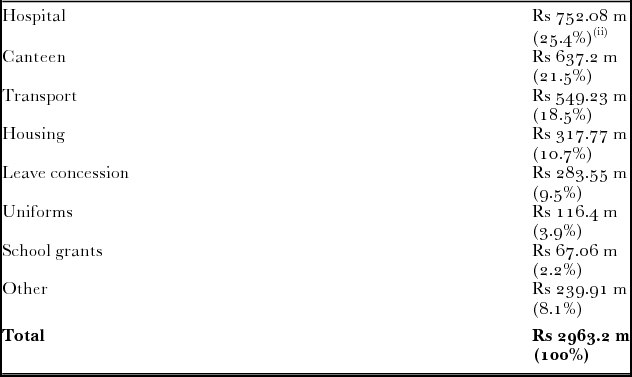
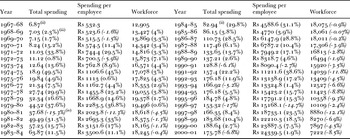
This underlying economic logic becomes all the more transparent upon examining the statistical evidence. Between 1967–68 and 2000–01, data for the intervening years being unavailable, spending on extra-wage incentives at the main Bangalore plant of ITI amounted to a massive Rs 2,963.2 millionFootnote 90 while per capita expenditure averaged Rs 7,246.80. Annual investments jumped from Rs 6.87 million in 1967–68 to Rs 44.52 million in 1979–80, and then to Rs 137.21 million a decade later before reaching Rs 175.78 million in 2000–01 (see Annex B). Paradoxically, the welfare benefit least appreciated by employees—the ITI hospital, widely denounced for providing very poor quality service—was also the one which absorbed the lion's share of the money (see Table 1). The progression in per capita costs was equally impressive: between 1967–68 and 1979–80, the figure rose fourfold to reach Rs 2,283.5; a decade later it stood at Rs 8,378.7 and then shot up to Rs 24,339.5 by 2000–01 (see Annex B).
ITI Bangalore welfare expenditures (1967–68 to 2000–01)(i)
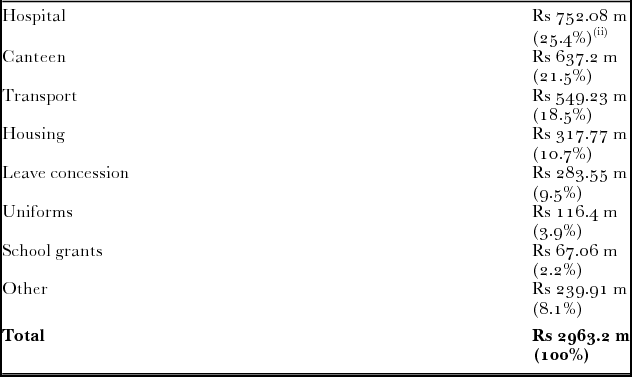
i) Figures pertain only to non-mandatory benefits and do not include any capital expenditure.
ii) Percentage figures in brackets indicate share of total expenditures.
(Source: ITI Personnel Dept.)
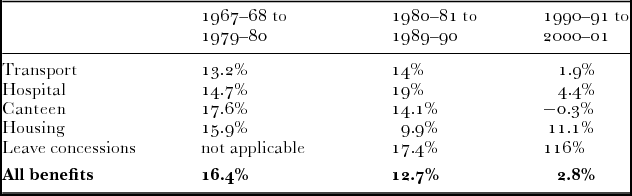
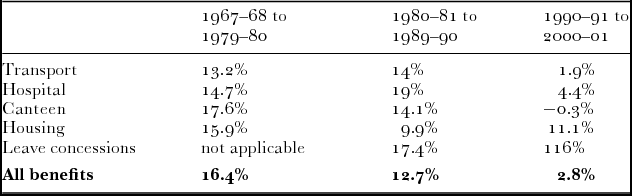
The aggregate picture, though, concealed important variations from one chronological period to another, particularly with respect to annual investments. While expenditures under this heading certainly registered a tremendous increase in absolute terms over the three decades odd as a whole, a distinct waning in the company's enthusiasm and support could be discerned from the 1990s onwards (see Table 2). In the first phase from 1967–68 to 1979–80, funds channelled into welfare rose more or less steadily with average yearly increases of 16.4 per cent.
Welfare spending growth rates at ITI Bangalore
(Source: ITI Personnel Dept.)
A more or less similar trend prevailed in the following decade, though growth slipped to 12.7 per cent annually, which in a way was only to be expected as investments had already climbed to fairly high levels by now. The years from 1990–91 to 2000–01, however, not only witnessed sharp swings in spending patterns from one year to the next, but a dramatic contraction in the volume of investment: growth rates for this period averaged a meagre 2.8 per cent per annum. With the advent of competition and the attendant financial crisis faced by ITI, management sorely lacked the means to play the role of model employer.
Interestingly, even prior to the removal of all entry barriers to the telecommunications equipment market in 1991, the company had started to explore ways of downscaling its welfare activities, finding the burden of social costs an increasingly onerous one to bear. As early as June 1978, it informed union officials at the Bangalore plant of its desire to stabilize canteen and transport subsidies at existing levels. The union was therefore asked to back plans to charge employees higher rates for these services as well as automatically review rates subsequent to each new wage agreement.Footnote 91
The management repeated its demand a few years later, but in what would develop into a familiar pattern of declarations chasing inaction, no concrete steps were taken to implement these changes. In February 1989, at the time of negotiating a fresh wage settlement, the company not only renewed its call for a reduction in subsidy levels particularly for canteen services, it also wanted to revise the definition of a worker household in order to restrict medical and leave travel privileges to the nuclear family alone, which, to boot, would comprise only two children.Footnote 92
Once again nothing more was heard of these proposals until April 1993 when the ITI chairman instructed top executives in all units to address themselves to, among other things, the question of mounting welfare expenditures.Footnote 93 Specific recommendations were therefore tabled before the unions with respect to areas where spending had been rising the fastest and where misuse of facilities was suspected: health care, transport, canteen, and leave travel concessions.Footnote 94 In the first three areas, at the Bangalore plant notably, the company claimed it was barely able to recover between 2 and 14 per cent of its total costs, and in the case of the township, this was just 16 per cent. It went on to add that, since services like transport, hospital, and canteen were ‘not directly connected with production’, the company ‘would not like directly to get involved in the(se) activities’, or, in other words, that it wished to outsource them.Footnote 95
Top executives expressed particular concern about the growing costs incurred by medical insurance because employees were under no obligation to go to the ITI hospital, and could obtain treatment elsewhere. Hence, even as the ITI hospital kept absorbing substantial investments, many of its 200 beds lay unoccupied, and the 30 doctors on its payroll ‘lack(ed) sufficient work’, a reflection of its dismal reputation.Footnote 96 Efforts to try and remedy this state of affairs by making outside consultations conditional upon the prior approval of company doctors also proved rather ineffective. Pressured by union officials, the doctors readily gave their consent even when the necessary facilities and expertise existed internally. Other proposals to rationalize the provision of medical care never saw the light of day either, and the threat to outsource certain services remained an empty one.
Reluctant to antagonize the union and the workforce by jettisoning various benefits, which, as the former pointed out, had been ‘provided for the well-being of employees and greatly influence motivation and morale’, the company struggled to contain costs throughout the 1990s.Footnote 97 While it succeeded periodically in reducing investments, accomplishing this feat on a sustained basis appeared to have been beyond its capacities. Thus, the figures for Bangalore for the period 1990–91 to 2000–01 reveal a drop in spending only during four years, never consecutively, while registering double-digit growth on three occasions (see Annex B). Despite raising tariffs, canteen subsidies, for example, still worked out on average at almost 80 per cent for non-officer categories in 1999.Footnote 98 Water subsidies for township residents stood even higher at 96 per cent.Footnote 99
Nevertheless, during the course of wage negotiations in the year 2000, the unions agreed to a certain number of concessions. As a consequence, the company ended the practice of supplying uniforms, and cancelled all leave encashment facilities as well as the education allowance for children. More schemes were axed after management, alarmed by the magnitude of the losses ITI was expected to post that year, declared a financial emergency in January 2003. The festival or annual advance that entitled non-officers to receive a sum of Rs 2,000 yearly was discontinued as was the annual performance award. Transport and canteen subsidies were partly withdrawn, while employees living in the township, in Bangalore at least, were required to pay market rates for water and electricity, though this latter measure would only be implemented a few years later.
At a time when cutting costs on all fronts was imperative for the survival of ITI, curtailing the scope of welfare activities is estimated to have netted economies of around Rs 80 million, or roughly half the overall sum expected to be saved across the different units for the year 2003–04. The results would, of course, have been more satisfying had management succeeded in pushing through the reform of health care benefits as well, notably by augmenting the share of employee contributions. Aware that the unions were in no mood to make further concessions, and unwilling to extract these by entering into a full-blown confrontation with them, it was, however, forced to keep its plans in abeyance.Footnote 100 So from the foregoing we can see that ITI stopped short of pulling down the social security net root and branch, and retained its fundamental role in the delivery of a broad range of social amenities and services to the workforce. Nevertheless, it strove to reconfigure the foundations on which the different welfare institutions rested, acting to transfer a greater portion of the costs of sustaining them to employees.
Workers’ union forms credit cooperative society
Pivotal as its position was in guaranteeing the reproduction of the workforce, ITI management did not enjoy a monopoly over this function at the Bangalore plant; trade union representatives also assumed considerable responsibility for the well-being of employees. Their ability to do so stemmed essentially from the fact that only one union existed throughout the history of the Bangalore unit, a development that ran counter to the widespread phenomenon of multiple trade unionism in the Indian context.Footnote 101 ITI stood out as an exception even within the public sector where, as scholarship, albeit limited, on the trade union movement has shown, worker disunity rather than unity represented the norm.Footnote 102 Created in 1950, the union was promptly granted recognition by ITI management, in keeping with its image as a ‘model employer’. In another significant departure from the broader national trend, the rank-and-file had declined to seek affiliation with a national politically aligned federation in order to preserve organizational unity. This credo of independence would be further strengthened by the progressive development of a culture of internal leadership.
Designed not so much to rival company-backed welfare initiatives as to supplement them, the union's involvement took the form of the creation of a credit cooperative society. As its name indicated, its function was to extend loans ‘at normal reasonable interest to needy members’ for a variety of purposes: education, medical treatment, marriage, house repairs, and the like.Footnote 103 Membership was open to all employees who purchased a minimum of one share worth Rs 101, but the rules clearly stipulated that they had to belong to the official union.
In effect, the premier objective of the union leadership in floating the cooperative was to preserve the cohesion of the organization in the face of persistent personal and political rivalries, even as it consolidated its authority over the rank-and-file. Tying membership of the cooperative to that of the union held out the advantage of defeating divisive manoeuvres. Potential dissidents would be disinclined to establish a rival union as it would mean having to forgo the financial benefits the cooperative offered. The creation of the cooperative society as well as the clause restricting membership to union members could thus be interpreted as a good illustration of Mancur Olson's celebrated thesis. The provision of selective private incentives, in the form of financial benefits, was intended to reward ‘rational, self-interested individuals’ for remaining within the union in order ‘to achieve their common or group interests’, while dissidents, or ‘free riders’, to employ Olson's terminology, would be punished by excluding them from the same incentives.Footnote 104
At the same time, given the limited contacts between the union and the mass of workers, plus the instrumental nature of their relations, the leadership clearly envisaged the cooperative society as an integrative mechanism. By rendering monetary services of immediate value, it would facilitate a sense of closer identification between workers and the union, enabling the latter in turn to mobilize more extensively in crisis situations. All of this tends to suggest that social control considerations influenced the conception of the union's welfare programme to a far stronger extent than it did the company’s.
The formation of the cooperative did succeed in preserving the unity of the ITI Bangalore union. Whether it had the desired effect of stimulating greater involvement in and commitment to the union, though, is open to doubt. Unlike the union, to which workers turned essentially in times of trouble, the cooperative rendered tangible services, allowing them to better cope with the everyday dilemma of trying to make ends meet. Whereas the achievements of the union acquired visibility only every four years or so at the time of wage negotiations, the cooperative held out the promise of immediate benefits; it renewed its utility on a daily basis. Workers therefore operated a clear distinction as much in their perception as in their appreciation of the two bodies, tending to differentiate between them on the basis of an informal hierarchy of utility which resulted in their valuing the cooperative more than the union.
Plans to form a worker cooperative first germinated in the 1960s, but it was not until March 1974 that it saw the light of day. From the perspective of the union leadership, mutualism represented the ideal vehicle for propagating ideas of worker self-improvement. By grouping themselves into a cooperative, employees would come to appreciate the virtues of thrift, understand the importance of solidarity, and liberate themselves from the thrall of moneylenders and pawn brokers, even as they displayed their skills for self-organization. All these objectives were graphically enunciated in a union flyer which carried the slogans ‘Only We Can Save Ourselves!’ followed by ‘Together We Can DEFEAT Moneylenders, Merchants, etc.!!’Footnote 105
Emphatic though the prose might have been, it hardly exaggerated the picture. Charging usurious rates of interest fluctuating between 100 and 120 per cent per annum, which they never wrote down on promissory notes so as to avoid entanglements with the legal machinery,Footnote 106 ‘money lending sharks’ effectively exercised an ‘iron grip’ over the lives of many ITI workers.Footnote 107 As Michael Fernandes, architect of the cooperative's foundation in his role as president of the ITI Bangalore union from the early 1970s until the late 1990s, stated:
. . . many workers would lose their jobs because they would stay away from the factory in order to avoid harassment by agents of money lenders who would be waiting for them outside the gates on pay day.Footnote 108
Precise statistics on the incidence of indebtedness are incomplete. However, the available data show that, acting on legal orders, the company deducted a portion of employees’ salaries and handed it over to their creditors in 688 instances in 1991, 408 in 1995, 341 the following year, and 331 in 1997.Footnote 109 These figures reveal the relative failure of the union cooperative to fully accomplish its mission since a number of workers continued to remain in the clutches of moneylenders. In fact, as Fernandes acknowledged, its creation might in some cases have even given an added fillip to usurious practices within the factory, with employees borrowing money from the cooperative in order to lend it at much higher rates of interest to colleagues.
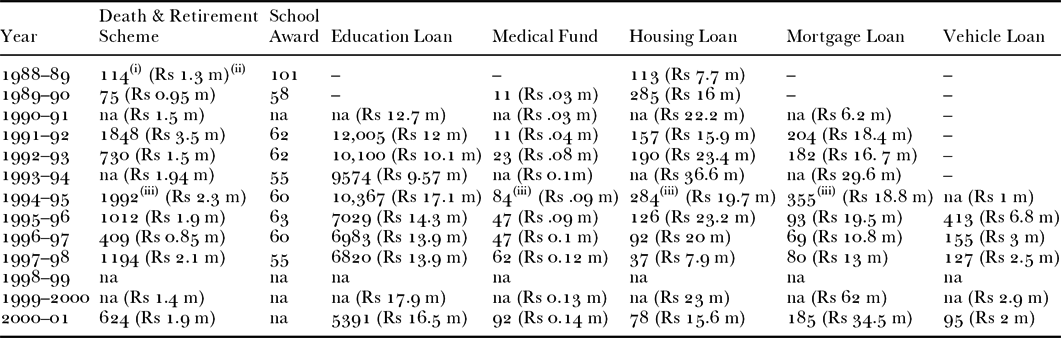
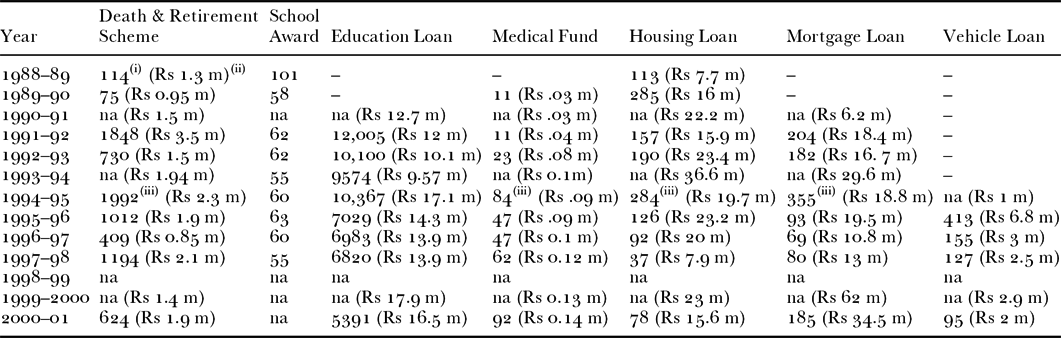
Despite such instances of abuse as well as workers’ enduring dependence on the neighbourhood moneylender, the usefulness of the cooperative to its members was undeniable (see Annex C). Just how phenomenally successful and central an institution it developed into can be measured by its evolution. Much to the disappointment of its union sponsors, initial response to the venture was extremely lukewarm. Disinclined to trust their money to the union, barely 297 workers joined the cooperative during the first year; however, in the face of its sound financial record, suspicion gradually melted away. In 1979–80, about 35 per cent of the total factory worker strength of 17,750 had become members. A decade later, this figure had climbed to 98 per cent, while the cooperative's paid-up share capital multiplied ten-fold to reach Rs 35.6 million.Footnote 110
What turned the tide decisively in its favour was its decision to lend a sum of Rs 600 to all members to reduce their financial hardship in the aftermath of a protracted strike and lockout that occurred in 1980–81. ‘This created confidence among workers that during difficult days the (cooperative) society would come to their rescue (sic).’Footnote 111 Seniority became the established norm for the granting of secured loans, the most common type provided by the cooperative, and procedures were made more transparent to eliminate opportunities for favouritism, an accusation levelled earlier against some officials. Such steps gave a further boost to worker participation. The cooperative's activities were overseen by a democratically elected committee of 18 worker directors who each served a five-year tenure.Footnote 112
As far as the ITI management was concerned, it adhered to a policy of benign non-interference, but signalled its backing for the institution by extending various facilities: recovery of employee contributions and loan repayments at source, administering certain loan schemes proposed by the cooperative, organization of elections, special paid leave for directors, and, most importantly, office premises. In 1989, it handed over to the cooperative a new, rent-free building located in the township, constructed at a cost of Rs 600,000.
Cooperative untainted by scams and scandals
To finance the expansion of its activities, the cooperative relied entirely on internal resources. Additional capital was generated at regular intervals through the introduction of fresh savings schemes to which all members were required to subscribe. Every month workers contributed a minimum of Rs 45 in subscriptions, the sum being directly deducted from their pay packets, though a large proportion was refunded with interest upon retirement or death. Attracted by the promise of higher rates of interest than the nationalized banks paid, workers also increasingly entrusted their entire savings to the cooperative. By the early 1990s, it boasted total assets of around Rs 200 million.Footnote 113
With its coffers constantly replenished, the cooperative was in a position to steadily expand its range of benefits (see Annex C).Footnote 114 A death and retirement plan, partially paid for by workers themselves, provided Rs 10,000 to the families of individuals who died in service and half that amount to those who retired. In a show of solidarity with employees who, having undergone major operations or suffering from chronic ailments, were forced to go on unpaid leave, the cooperative instituted a medical relief fund, donating up to Rs 5,000 to each beneficiary.Footnote 115 The most substantive financial benefit it offered, though, was a house-building loan. In an interesting reversal of roles, the cooperative offered to underwrite this scheme after the company, citing insufficient funds, had announced its cancellation.
Undergirded primarily by the distribution of hard or pecuniary benefits, the operations of the union-run welfare system shared much the same bureaucratic and impersonal traits as its company-sponsored counterpart. Because loans recoveries were automatically executed through paycheck deductions, the cooperative's default rates were extremely low. In 2000–01, bad or doubtful debts barely totalled Rs 30,000, an astonishingly small sum when set against the cooperative's turnover of Rs 499 million the same year.Footnote 116 To limit the scope for fraudulent practices, cash transactions were kept to the minimum, loopholes in the different schemes were speedily detected and plugged, and accounts were audited annually and verified by the membership. Administrative costs represented less than one per cent of turnover as cooperative officials and staff sought to practise the same virtues of thrift they preached to the membership. All these efforts did not go in vain: from 1978, the ITI cooperative systematically secured the top ‘A’ rating from the Karnataka state audit authorities.
The high standards of performance maintained by the organization throughout its existence thus underlined in no uncertain terms that, when given the chance, workers possessed sufficient skills to govern their affairs independently and competently. As one of the directors declared with justifiable pride, ‘People come from all over India to take our guidance on how to run a cooperative society properly.’Footnote 117 A potent symbol of the union's organizational acumen and resourcefulness, combined with the workers’ sense of reciprocity and desire for self-amelioration, the cooperative fully vindicated the faith members had placed in it, many of whom had turned over their life savings to its care.
Posting profits every year, it not only issued regular dividends to shareholders, initially averaging 9 per cent, and then 12 per cent,Footnote 118 it also earned an enviable reputation for financial rigour and good management. The vigilance exercised by the union leadership, apart from safeguarding the longevity of the institution, ensured that its functioning was neither compromised by financial wrongdoings nor by mismanagement. This was in stark contrast to the vast majority of cooperatives in the country, including one venture in ITI itself, which inevitably tended to be short-lived experiments, chronically in the red, and plagued by embezzlement, corruption, and other woes.Footnote 119
When we were registering the (cooperative) society in the beginning, one government official wanted a bribe of Rs 500 to process the papers quickly. I (Fernandes) said no . . . because if we pay a bribe to get something done, then our members will think that we will also be equally amenable to taking a bribe in order to do something. So we wanted to send a clear message to all our members that the society will be run on honest lines.Footnote 120
Not all however heard this ‘clear message’, for instances of irregularities did occasionally crop up. After a worker protested against having to repay a loan he had never taken, it was discovered that his signature had been forged by an official.Footnote 121 Allegations of bribe-taking also circulated against certain officials who helped workers cut through the thicket of government red tape throttling their house construction projects. Similarly, employees applying for housing loans in some cases knowingly submitted fake documents.
Nevertheless, on the whole the union cooperative remained free from any major controversy or scandal. Union executives and workers tended to generally attribute this fortunate state of affairs to the personal integrity of the leadership and Michael Fernandes, in particular, the union president and driving force behind the cooperative. A more satisfactory explanation could perhaps be found in the institutional checks and balances put into place by the leadership, which had the effect of considerably reducing the scope for corrupt practices and mismanagement. Moreover, these formalized safeguards presented the advantage of assuring the survival of the cooperative after the departure of its founders.
To what extent did the union credit cooperative society succeed in offsetting, at least partially, the effects of the cutbacks in welfare spending decided by ITI management from the year 2000 onwards? The data available only allow an indirect answer to this question. What is clear is that the departure of large numbers of workers from the Bangalore plant, following the introduction in 1991 of a voluntary retirement programme by the company in an effort to reduce labour costs, had a major impact on the cooperative.Footnote 122 While retired workers could in principle remain on its rolls, the decade 1990–91 to 2000–01 saw membership levels fall by practically half to 8,289 workers.Footnote 123 The erosion of its base obviously took a toll on the cooperative's financial results. After years of uninterrupted growth, in 2000–01 both profits and turnover registered a decline for the first time.
Other statistical details, however, reveal a fuzzier picture. An examination of the number of beneficiaries in 2000–01 of the various benefit and loan schemes offered by the cooperative shows a decrease in some areas and an increase in others compared with previous years. Given these contradictory patterns, drawing definitive conclusions one way or another about its influence becomes a difficult task. But it would be safe to assume that the steep drop in membership suffered by the cooperative could not but have sapped its strength and compromised future growth prospects even as its monetary clout assured it, at least in the short run, a dominant role in the overall welfare distribution system.Footnote 124
The foregoing discussion reveals certain parallels between the management and union-sponsored social security nets: in both cases, the precondition for their sustainability or viability was contingent on the exercise of monopoly power by ITI. The absence of competition not only guaranteed the financial resources underpinning corporate largesse, it also allowed for the creation of a large, stable, permanent, relatively well-paid, and unionized workforce. Without this solid base, the source of regular and ever-bigger cash inflows, it is open to question whether the credit cooperative society would have succeeded in becoming the key player that it did in the provisioning of social amenities at the ITI Bangalore plant. Thus, once deregulation inflicted a hammer blow on the entire business model upon which the company and, by extension, the union's fortunes rested, it was only a matter of time before this unique system of dual welfare coverage, where economic and social factors operated in a mutually reinforcing dynamic, began to unravel.
Workers devise informal welfare arrangements
Fortunate enough to be able to draw on assistance from two quarters, the company and the trade union, ITI employees sought to further protect themselves from the vicissitudes of life by throwing up various informal systems of risk-pooling to add to the institutionalized perks they received. Marcel van der Linden has described such autonomous, rank-and-file sponsored ventures as ‘directly democratic’ societies, since they typically strove to combine social insurance with sociability functions, in opposition to more institutionalized forms of welfare where little emphasis is placed on the cultural self-preservation of members.Footnote 125 Other scholars have drawn attention to the pedagogical function of mutual aid and insurance societies in nurturing a wide range of talents among workers and forging an awareness of common interests. E. P. Thompson, for instance, highlights the positive influence of mutual aid societies as much in teaching workers self-discipline and self-respect as in furthering a political consciousness rooted in community values.Footnote 126
It is not clear whether the different informal welfare arrangements that emerged in ITI had an equally stimulating effect, but they certainly gave workers an opportunity to exhibit their self-organizing capacities. Though the question of competing with the formalized benefit structure did not arise, these forms of mutualism also provided spaces to assert their autonomy, to provisionally ease the hold exercised by the company and the trade union over their everyday lives.Footnote 127 Just as they resisted moves to control other aspects of factory life, so too did workers place limits on the power of management and union officials to unilaterally regulate the distribution of welfare.
The most prevalent non-institutional benefit mechanism at ITI consisted of chit funds and mutual funds. Almost all the people I interviewed participated in one of these types of fund, or in both, notwithstanding the fact that company rules expressly prohibited employees from engaging in these activities inside the factory.
In times of need, such funds are very useful that is why I have joined. Suddenly you need some money, and you don't have any means. From these funds you can get money without any problem. Borrowing money from individuals is very embarrassing. In chit funds you are a member and have all rights to take the money. Neighbours will lend money only for emergency purposes, but not on a long term basis.Footnote 128
In a chit fund, a group of workers contributed a predetermined sum every month for a period of one year or more; the monthly collections were then auctioned to the winning bidder. At the end of the fund's term, the interest amounts were shared equally among members. Since the organizer assumed all risks, and in principle made good any losses out of his pocket, he was entitled to take one ‘chit’ without having to bid. The attraction of chit funds stemmed from the fact that,
you get a large sum of money on hand immediately, you pay relatively low interest, and no salary guarantees or surety have to be produced; there are no formalities . . . Last month I took home Rs 46,000, because I needed money for the marriage of my brother's daughter . . . On a previous occasion, I needed money to buy jewels for my wife . . .Footnote 129
In addition to marriages and other social obligations, the need to purchase a site or build a house was also a frequently cited reason for joining a chit fund. If some supplemented these amounts with borrowings from the union credit cooperative, others, encouraged by the absence of bureaucratic procedures, preferred to rely exclusively on informal mechanisms of this kind. With most funds comprising around 50 participants, linked through work affinities or residential ties, relatively large sums of money exchanged hands every month. This explains why certain fund organizers showed no hesitation in hiring thugs to rough up defaulters who had stopped contributing after taking home their ‘chit’. Members, though, were seldom able to resort to similar methods against unscrupulous fund organizers, and numerous stories of swindles circulated, prompting workers to label these ventures ‘cheat funds’:
There are so many cases of fraud with the organiser resigning from the company. You cannot complain to management because chits are against factory rules. If you are aggressive and keep harassing the organiser you can get back some money.Footnote 130
An equally popular and informal risk-pooling arrangement, but one fraught with fewer risks, was mutual benefit funds. Members’ interests were protected to a greater degree, essentially because these funds operated on a much more modest scale than chit funds. Entry was restricted to a small circle of people, rarely surpassing 20, who were co-opted and could personally vouchsafe for the integrity of one another, either because they worked in the same section or shared the same place of residence or belonged to the same linguistic group. Individual reputation was paramount:
Members are recruited by word of mouth. It is a matter of money. We can't trust or ask everybody . . . We ask those people whom we know well and to the extent we can know about their financial background. This we can find out through their salary slip, their activities, what they are doing . . . if they have loans.Footnote 131
Such ties of affinity also allowed members to exert pressure on those who lagged behind in their loan repayments. Reciprocal peer group social control constituted the principal recourse against prospective defaulters, though it did not always prove the most effective of weapons.
Members take a loan . . . and then say they have some problems and therefore cannot pay for some time. We can't do anything with these people. We have to call an emergency meeting. If it is a genuine case, then we will liquidate the amount and share the loss between the members.Footnote 132
The mutual funds were modelled along the lines of savings and loan schemes: members paid a monthly subscription and were eligible to borrow a specific amount whenever the need arose. Interest rates varied between 2 and 3 per cent a month, and loan repayments had to be completed by the end of the year. Certain funds lent to non-members as well, but charged higher interest. As a precautionary measure lending levels were kept deliberately low, never exceeding Rs 10,000. Participation in one fund was not deemed incompatible with membership of another. Quite a few workers interviewed belonged to at least two such ventures, so as to have both access to ready sources of cash in the event of an emergency and augment their savings.
A good illustration of the spirit of self-help, ingenuity, and enterprise animating workers, these funds also revealed their keen sense of organization. To ensure that the fund's business was efficiently conducted, members appointed a treasurer and rewarded him for his pains with a small fee. Accounts were presented at the end of the year and dividends accruing from interest earnings were distributed at a lunch or dinner party held at a city restaurant after which everybody went to the movies. While spouses also sometimes attended the festivities, these events normally remained a male province, offering members an occasion to indulge in the consumption of forbidden pleasures like meat and alcohol. A few funds marked their annual get-together by hosting picnics.
A second type of savings and loan scheme floated by employees, and one which attracted a fairly substantial membership as well, was a Diwali or firecracker fund. Members had to contribute a lump sum, varying typically between Rs 300–500, in the month following the festival (normally celebrated in mid-October or early November). This money was utilized to provide loans to both members and non-members. Then, just before Diwali, members received a gift, which either consisted of cash, precious coins, clothes or utensils, plus a big packet of firecrackers, whose total value exceeded their initial contribution.
An isolated, but even more striking initiative, was a newspaper and magazine fund started by a group of employees in the data processing department of the Bangalore factory in 1990, and which was still in existence a decade later. Monthly subscriptions went towards the purchase of English and Kannada newspapers and periodicals. Employees could take home periodicals for a couple of days but not newspapers. (The fact that these could only be read during working hours spoke abundantly of the leisurely pace of daily work routines.) For the benefit of wives, a few women's titles were also regularly bought.
Management officers get about five papers. But if I want to see the paper, I have to go to my superior and ask him. There is a log and I have to write my name. It is a kind of humiliation. Moreover, if we go daily and ask our superior for paper, it looks bad. So I decided to start the fund and asked those who were interested in the department to contact me . . . We keep a list as to who will get the magazine first . . . Usually, members respect the deadline (when borrowing a publication), but if they forget they are scolded by other members.Footnote 133
As the number of subscribers increased, the fund also began lending money to members and non-members, spending part of the interest payments on acquiring new publications.
True, employees invested considerable money and energy in elaborating strategies to protect themselves and their families against the vicissitudes of life. However, dispelling received wisdom about the ‘selfishness’ of the public sector labour aristocracy, they were also capable of showing generosity towards less privileged sections of the working masses. As early as in 1965, employees founded a welfare association called Aid the Ailing to assist the sick and disabled in Bangalore. Though financial and other constraints permitted it to operate only on a very small scale, the association's efforts were still laudable.
Once a week, volunteers from the company visited different hospitals across the city to attend to the needs of poor patients, supplying them with medicines, food and clothing, arranging medical tests and blood donations, and in some cases even paying for major operations.Footnote 134 The association also occasionally conducted health camps in local slums and nearby villages where people could receive free check-ups and medicines. Money to support its activities came from members’ subscriptions as well as donations from individuals and institutions like the ITI union cooperative and the ITI officers’ association. With the progressive decline in the size of the factory workforce from the early 1990s, the association began opening its doors to outsiders. But the bulk of the membership, numbering just under 1,100 in 1996, continued to be drawn from the company's ranks.Footnote 135
Overall, the advent of liberalization proved no less detrimental to the self-help schemes floated by workers than it did the company-funded welfare package, and, albeit to a lesser extent, the union credit cooperative society. As voluntary retirement began to deplete the ranks of the Bangalore plant workforce,Footnote 136 many of these rank-and-file initiatives seem to have progressively died away. Anxieties stemming from the financial ills of ITI meant that the energies channelled by workers into collective ventures driven by goals of mutualism were now redirected towards individual endeavours where self-interest predominated.
One could perhaps argue that the demise of these grassroots schemes at a time when management was taking the axe to its own welfare arrangements revealed that workers did not attach very great value or utility to them. They represented less an essential necessity, a lifeline indispensable to maintaining their everyday dignity, than ‘add-ons’ helping to ameliorate their material conditions and social status. Otherwise, workers might have been inclined to invest greater efforts in keeping these autonomous systems of risk-pooling alive.
Thus, besides affecting the more institutionalized forms of welfare provision, deregulation also jeopardized the informal ventures devised by the rank-and-file. In doing so, it threw into full relief the extent to which the viability of the overall social security net at ITI was dependent on the economic structures provided by monopoly access to the domestic market that the company enjoyed since Independence. Exclusive market power stood out as a crucial determinant for management in defining the terms and parameters of its benevolence. It proved equally important for the union and workers, as evidenced by the prosperity of the credit cooperative society and the proliferation of various self-help schemes.
Conclusion: Commonalities and divergences among state firms
Whether ITI has further curtailed the scope of welfare provisioning in more recent years is unclear. But when I briefly visited the Bangalore factory last in August 2007, I was told that one of the reasons behind then Chairman Y. K. Pandey's sacking was his failure to divest cash-draining social amenities like the hospital. Turnover had not stopped falling, even as losses continued to mount, having crossed the Rs 4,500 million mark, a stark sign that far from stabilizing, let alone registering an improvement, the company's situation had further deteriorated in the post-reform era. Pandey's efforts at downsizing, though, had proved more successful: between 2003 and 2007, staff strength in Bangalore contracted by more than half to 2,151 officers and non-officers out of a total company labour force of 13,415.Footnote 137 Factory personnel occupied no more than a third of the township's 1,700 houses, prompting management to cut its losses by renting vacant accommodation to employees from other public service organizations. Similar processes of ‘de-exclusivizing’ were also occurring at the ITI school and hospital, both of which had begun taking in outsiders.
Leaving aside the fallout from liberalization, four general concluding remarks are in order. First, the ITI example challenges the received view about the respective mutual obligations of employers and workers with regard to welfare arrangements. As with most aspects of the employment relationship, non-wage incentives are typically understood as constituting part of the overall exchange nexus. In return for loyalty, compliance, efficiency, and so forth on the part of the workforce, employers promise a more or less extensive package of benefits.
In the case of ITI, however, the protective safeguards were a unilateral concession put into place by a company attached to its reputation of a ‘model employer’. Employees and trade union representatives were required to make no reciprocal engagement to step up productivity or maintain tighter standards of labour discipline. The absence of reciprocity also posed few problems for management because a mixture of monopoly privileges and uninterrupted demand for its products helped to create an extremely favourable economic environment, whereby the rising costs of social entitlements could be absorbed with ease when they were not passed on to the customer in one form or the other.
Consequently, social amenities formed an integral and irrevocable part of the overall employment package. Along with job security, decent pay, relaxed work rhythms, and trade union representation, extra-wage perks defined the condition of public sector workers and explained why these jobs were the most desirable ones on the labour market. Furthermore, even after the company's financial position started worsening from the late 1990s onwards, it was forced to acknowledge the contractually binding nature of welfare arrangements. It could not act as it pleased, having to wait several years before it began eliminating various benefits, and even then not fully, as illustrated by the aborted reform of the medical insurance plan.
Second, as scholars have noted, no linear causal connections obtain between worker conflictuality or its absence and the effectiveness or not of corporate-sponsored welfare programmes.Footnote 138 Nevertheless, we still need to ask whether ITI management reaped in any way the benefits of its generosity, particularly in terms of labour peace. The answer is at best mixed. Very little industrial action marked the first two decades of the Bangalore factory's existence. During the heyday of its growth from 1968 to 1981, however, when investments in social programmes kept rising, it experienced unbroken turbulence and agitation stemming from both bread-and-butter grievances and the fight for occupational mobility. This was followed by a period of relative calm which could be attributed less to managerial policy orientations of any kind than the crushing defeat inflicted by the Indira Gandhi-led government on the trade union movement after workers in ITI and other Bangalore public sector plants went on strike in 1980–81 demanding higher wages.Footnote 139
Third, from the example of ITI it is possible to conclude that other large state enterprises, which likewise were cushioned against the rigours of competitive pressures, could equally afford to treat their workers with benevolence. Notwithstanding the paucity of research on this question, public sector steel plants like Bhilai and Rourkela readily assumed responsibility for the well-being of their personnel, as studies of these companies have shown.Footnote 140 What, however, distinguished welfare delivery at ITI from Bhilai, for instance, a company for which a fair amount of empirical evidence is available, was the more inclusive and egalitarian character of corporate policy measures. The explanation for this has less to do with a greater commitment to principles of social justice or a more acute sense of philanthropy on the part of ITI management than with differences in the composition of the two companies’ workforces.
Like Bhilai, in ITI too a sharp cleavage divided permanent workers from their casual counterparts, the section of the labour force most in need of managerial solicitude, but who were nevertheless excluded from the purview of the welfare programme. But unlike Bhilai, in ITI, as this research has already shown, the size of the contingent workforce was not only far smaller but also remained stationary even during the post-reform years, whereas management at the steel plant shed large numbers of permanent posts and replaced these with contract labourers.Footnote 141
The other distinguishing feature of welfare distribution at ITI was, of course, the involvement of the union-backed credit cooperative society. In contrast to Bhilai, the absence of multiple unionism not only foreclosed the possibility of opposition to ITI union's plans of inculcating the virtues of mutual assistance, it also guaranteed this initiative a highly inclusive character, one that would per se embrace the entire permanent workforce. This dual system of coverage, one funded by the company and the other by the trade union, with each reinforcing the other, was a defining, perhaps even singular, characteristic of social safety arrangements at ITI. True, management bore the brunt of the burden but there was nothing symbolic about the role played by the union.
The ‘commanding heights’ position occupied by public sector companies over the domestic economy thus assured them of the wherewithal to float generously endowed social security programmes. The ideological doctrine of the ‘model employer’ that state enterprises were directed to espouse did more than just march to the drumbeat of economic compulsions; in fact, it derived its driving force from the latter. Liberalization proved just how true this postulate was. Once the Indian state's deregulating drive exposed them to competition, big public enterprises like BhilaiFootnote 142 (not to speak of private firms such as Tatas)Footnote 143 imitated the example of ITI and promptly rolled up their welfare nets. In other words, as soon as the bedrock of monopoly profits started to crumble, the ideological discourse sustaining the distribution of welfare in the public sector since Independence also bubbled down the drain, taking with it the ‘model employer’ ideal.
Finally, historians have utilized the notion of paternalism as a convenient shorthand to encapsulate a raft of disparate practices rooted in different historical, organizational, and spatial settings. Besides tending to promote a simplistic top-to-bottom reading of an otherwise complex social process, we must also ask whether it can be used to describe social provisioning in all types of organizations subject to market discipline or only in private business ones.Footnote 144 To what extent is it pertinent to refer to welfare entitlements in public sector enterprises as paternalist? Given that ownership rights here are vested in the state, the nature of the social relations of production do not always bear straightforward comparison with those prevailing in private companies. Because public sector firms are often directed to pursue politically determined social objectives congruent with the state's embodiment of political legitimacy, some of the material advantages enjoyed by workers are less the outcome of collective bargaining or collective struggle than unilateral concessions by management.
Moreover, as this article has demonstrated (in line with the argument made by Patrick Joyce), bureaucratically organized and impersonally distributed social benefits stand at odds with the gift-counter gift exchange dynamic at the heart of paternalism.Footnote 145 Instituting formalized bureaucratic procedures can have the effect of transforming paternalist largesse offered at the discretion of employers often as a reward-and-sanction mechanism into de facto contractual rights, which acquire a strong measure of permanence even as they undercut the mutual bonds of personal obligation between employers and their workforce. All of this suggests the need when studying corporate welfare arrangements to restrict the compass of paternalism to specific well-bounded historical and organizational contexts.
List of welfare benefits at ITI Bangalore

Annual welfare expenditures at ITI Bangalore: 1968–69 to 2000–01(i)

ITI Bangalore Union Cooperative Welfare Benefits: 1988–89 to 2000–2001