Mixed ionic and electronic conducting perovskite-structured oxides have been extensively studied for application in oxygen separation devices and solid oxide fuel cells.Reference Sunarso, Baumann, Serra, Meulenberg, Liu, Lin and Diniz da Costa1 In fact, doped Ba0.5Sr0.5Co0.8Fe0.2O3-δ (BSCF) and La0.58Sr0.4Co0.2Fe0.8O3-δ (LSCF) are among the most promising oxygen-permeable membrane materials.Reference Cheng, Navrotsky, Zhou and Anderson2, Reference Buchler, Serra, Meulenberg, Sebold and Buchkremer3 The mechanical properties of BSCF and LSCF have been studied systematically, and at elevated temperatures, anomalies in the elastic behavior were observed for both materials.Reference Huang, Malzbender, Steinbrech, Grychtol, Schneider and Singheiser4, Reference Huang, Malzbender, Steinbrech and Singheiser5 In particular, the elastic anomaly of BSCF was attributed to a Co3+ spin transition.Reference Huang, Malzbender, Steinbrech, Grychtol, Schneider and Singheiser4
The elastic modulus that can be determined conveniently by resonance frequency analysis is directly coupled to the arrangement and interaction forces of atoms in the lattice. The internal friction is a measure of the damping of the resonance frequency of a material and has proved to be a nondestructive and sensitive means to assess the movement of defects and sometimes also reflects phase transitions in solids.Reference Zheng, Tang, Yang, Wang, Li, Li and Ku Transport6
For the two perovskites considered here, the transition metal ions (B) are located at the center of a cube, forming an octahedral BO6 with six nearest oxygen ions.Reference Bhalla, Guo and Roy7 The spin transition of Co3+ in BSCF has been reported in earlier report.Reference Huang, Malzbender, Steinbrech, Grychtol, Schneider and Singheiser4 Such a spin transition of the Co ion has been widely reported in LaCoO3Reference Radaelli and Cheong8 and La1-xSrxCoO3,Reference Ravindran, Korzhavyi, Fjellvag and Kjekshus9 while Fe ions normally exhibited an antiferromagnetic to paramagnetic transition in La1-xSrxFeO3.Reference Wu, Zuo, Li, Chen and Liu10 The magnetic aspects of spin transition phenomena can conveniently be confirmed by susceptibility measurements.Reference Radaelli and Cheong8, Reference Yamaguchi, Okimoto, Taniguchi and Tokura11 However, when magnetic ions are present in the perovskites, the effect of spin transition could be masked in a susceptibility measurement by these magnetic ions. In such cases, the internal friction analysis is an alternative and perhaps the only way to detect spin transitions.
BSCF and LSCF samples were produced by IEK-1 (Forschungszentrum Jülich GmbH, Jülich, Germany). The BSCF powders, supplied by Treibacher Industrie AG, Austria (Toronto, Canada), were uniaxially compacted with a pressure of 105 MPa and sintered at 1273 K for 12 h. The heating rate was 5 K/min and the cooling rate was 0.5 K/min. The Archimedes density of the as-received samples was determined to be 5.37 g/cm3 with a porosity of 4.5 vol%. The grain size determination was based on scanning electron microscopy (SEM). Assuming a spherical geometry, the average grain size of the equivalent diameter was 10.1 ± 4.3 μm.
The LSCF powders were synthesized by a spray-drying technique using aqueous solutions of appropriate quantities of nitrate salts. The powders were uniaxially compressed with a pressure of 120 MPa and sintered at 1473 K for 3 h. Heating and cooling rates were 0.5 K/min. The Archimedes density of the as-received samples was determined to be 5.81 g/cm3 with a porosity of 6 vol%. Again, the grain size determination was based on SEM. Assuming a spherical geometry, the average grain size of the equivalent diameter was 0.6 ± 0.2 μm.
The impulse excitation measurements were carried out with bar-shaped BSCF and LSCF specimens (∼30 mm × 3 mm × 3 mm) using a commercial GrindoSonic system (Belgium).Reference Swarnakar, Gimenez, Salehi, Vleugels and Van der Biest12 The samples and the detector were placed in the furnace of the system. The internal friction Q−1 and the elastic modulus E were determined in the temperature range ∼290–1223 K in air by analyzing the free specimen resonance and the decay of the resonance frequency (damping behavior). The vibration curves of the samples were recorded by an oscilloscope, and the amplitudes were directly obtained from the curve. The time interval between two nearest wave crests was then defined as the period of the vibration. The elastic modulus was determined as outlined in ASTM E1876-09. The internal friction Q−1 is given byReference Du, Sun, Jiang, Zeng and Yin13:

where n is the number of the vibration cycles, while its amplitude attenuates from A0 to An. The magnetic characteristics (i.e., susceptibility) and their temperature dependence were measured with a Quantum Design Physical Property Measurement System (PPMS; Quantum Design, San Diego, CA) using a heating rate of 2 K/min to confirm the spin state of Co3+.
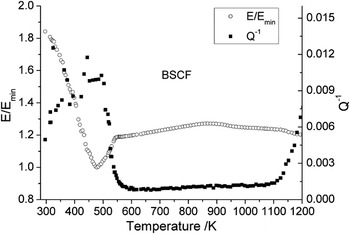
The internal friction results and the normalized elastic moduli of BSCF and LSCF as a function of temperature are shown in Figs. 1 and 2, respectively. The elastic modulus of BSCF decreases as the temperature is increased from room temperature (RT) to ∼480 K. After this minimum, it recovers to a stable value at ∼550 K. The elastic modulus then increases slightly up to ∼870 K, a small effect that could not be recognized in previous mechanical measurements.Reference Huang, Malzbender, Steinbrech and Singheiser5 The internal friction values scatter strongly from RT to ∼490 K, but nevertheless peak behavior can be observed at ∼490 K, which basically corresponds to the temperature at which the minimum occurs in the elastic modulus. Above this temperature, the internal friction decreases rapidly to a stable value at ∼560 K. The peak of the internal friction curve at ∼490 K supports the previous magnetic susceptibility measurements,Reference Huang, Malzbender, Steinbrech, Grychtol, Schneider and Singheiser4 where the elastic anomaly of BSCF has been attributed to the spin transition of Co3+.
Young’s modulus and internal friction of Ba0.5Sr0.5Co0.8Fe0.2O3-δ (BSCF) as a function of temperature.

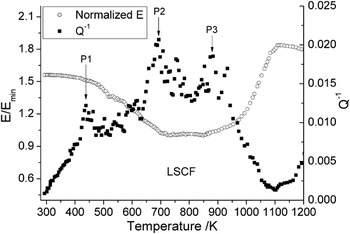
Young’s modulus and internal friction of La0.58Sr0.4Co0.2Fe0.8O3-δ (LSCF) as a function of temperature.

Similar to BSCF (Fig. 1), the elastic modulus of LSCF (Fig. 2) also exhibits an anomaly between 470 and 1110 K. The temperature range of the minimum is much larger compared with other materials,Reference Wu, Zuo, Li, Chen and Liu10 which might be an indication that more than one mechanism contributes to this anomaly. Although strong scatter of the internal friction values is present in the temperature range 400–950 K, three peaks P1, P2, and P3 in the internal friction curve can be recognized (Fig. 2). Interestingly, each peak corresponds to a change in the slope of the elastic modulus curve. Anomalies in elastic behavior as a function of temperature similar to those of BSCF and LSCF were reported for various perovskite materials and Y0.15Zr0.85O1.925.Reference Giraud and Canel14 The peaks in internal friction reflect lattice instability. Note that the mechanical anomalies also have implications for the use in complex systems. For example, the fracture stresses of BSCF and LSCF follow similar temperature dependence with even larger changes.Reference Huang, Malzbender, Steinbrech, Grychtol, Schneider and Singheiser4, Reference Huang, Malzbender, Steinbrech and Singheiser5
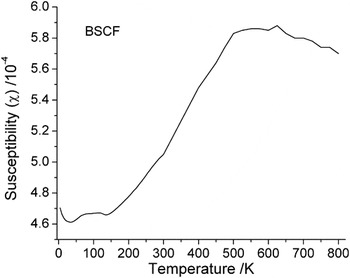
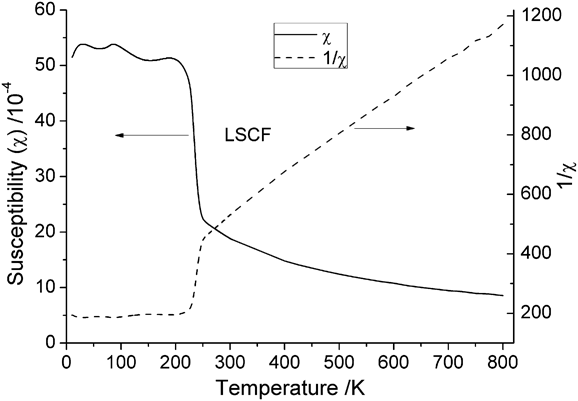
To further elucidate the underlying mechanisms, it is interesting to discuss the magnetic susceptibility of both perovskites. The temperature dependence of magnetic susceptibility (χ) for BSCF and LSCF is shown in Figs. 3 and 4, respectively. Due to the experimental limitations, only measurements up to 800 K have been performed.
Magnetic susceptibility of BSCF as a function of temperature in air. Data of BSCF above 300 K are taken from an earlier report.Reference Huang, Malzbender, Steinbrech, Grychtol, Schneider and Singheiser4

Magnetic susceptibility of LSCF as a function of temperature in air.
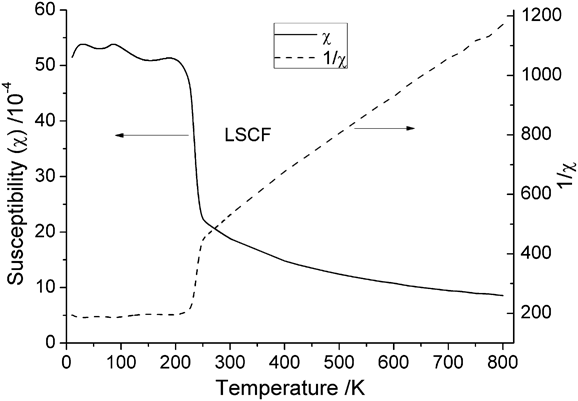
The magnetic susceptibility of BSCF shows a noticeable increase from ∼150–500 K due to an increasing number of magnetic moments in the higher spin state, i.e., a Co3+ spin transition. In contrast, the magnetic susceptibility of LSCF exhibits a higher value at low temperatures and decreases rapidly at ∼235 K. It further decreases slightly with increasing temperature after a slope change at ∼250 K. In Fig. 4, the inverse of susceptibility 1/χ was also plotted as a function of temperature. The fairly linear relation between 250 and 800 K proves that LSCF is in a paramagnetic state in this temperature range.
In addition, the magnetic hysteresis of LSCF was measured at 100 and 300 K. A wide hysteresis was observed at 100 K, but there was no hysteresis at 300 K, which allows us to conclude, in combination with the susceptibility curve in Fig. 4, that LSCF is in ferromagnetic state below ∼220 K and undergoes a transition from ferromagnetic to paramagnetic at ∼235 K.
In a qualitative argument focusing only on Co3+, the absence of a spin transition in LSCF could be due to the considerably lower content of Co ions. In fact, the magnetic susceptibility of BSCF (∼5 × 10⁻⁴–5.9 × 10⁻⁴) is mainly determined by Co3+, and the spin transition can be observed from respective measurements. In contrast, the magnetic susceptibility of LSCF (∼1 × 10⁻³–1.9 × 10⁻³) is much higher than that of BSCF, indicating the dominant role of La or Fe. Therefore, the spin transition of Co3+ in LSCF can be masked by the higher susceptibility of La or Fe. But it is not yet proven that a spin transition exists in LSCF. Thus, one should be very cautious when comparing LSCF with BSCF with respect to spin transitions. In fact, the measured temperature dependence of the elastic modulus of LSCF and the observed internal friction peaks only allow a preliminary explanation.
The increase of the elastic modulus from ∼973–1103 K can be attributed to a rhombohedral to cubic phase transition.Reference Huang, Malzbender, Steinbrech and Singheiser5 The peak P3 is assumed to reflect this transition. The relatively strong decrease from 450 to ∼670 K is assumed to reflect the prominent propensity of ferroelastic behavior of the rhombohedral phase in this temperature range. The internal friction peak P1 marks the effect. However, further investigations are necessary to confirm this hypothesis. Similarly, the origin of Peak P2 needs elaboration.
For BSCF, a minimum of the elastic modulus is observed around 480 K corresponding to a peak in the internal friction. The values of the internal friction scatter strongly below this peak temperature. The susceptibility of BSCF increases from 150–500 K, which is considered to be an indication of increasing magnetic moments based on a spin transition of Co3+. The elastic anomaly of BSCF is attributed to the rising spin transition and its saturation. An elastic anomaly is also observed in LSCF between 470 and 1113 K, and three peaks can be recognized in the internal friction. The peak P3 (973 K) is related to the rhombohedral–cubic phase transition. The origin of peak P2 (670 K) is not yet clear and P1 (450 K) is assumed to reflect lattice instabilities related to the ferroelastic behavior of the rhombohedral phase. The susceptibility measurements confirm that LSCF is in a ferromagnetic state below ∼220 K and undergoes a transition from ferromagnetic to paramagnetic at ∼235 K.
ACKNOWLEDGMENTS
The authors express their sincere gratitude to Dr. E. Kentzinger (IFF) for offering PPMS facility, Mr. J. Mönch for developing the impulse excitation set-up, and Ms. Y. Yao (IEK-2) for carrying out the measurements. The authors thank Dr. S. Bauman for the preparation of the perovskite materials.