


In today’s colloquial language, when a person is described as a “puppet” or an “automaton/robot,” it often signifies a mindless follower, a conformist, or an instrument of manipulation. The terms denote the lack of autonomy in thought or action, due either to an internal flaw (e.g., inability to think critically) or external oppression. Since a fully actualized human being is thought to be one who is capable of independent thought, self-determination, and self-direction, a person without those qualities is figuratively demoted to the status of an artificial simulacrum of a human, one that is made to follow the dictates of another through direct control (puppet) or internal design (automaton/robot). This was a part of a long-standing argument within Western intellectual discourse, one that is still very much alive today, on whether humanity can be explicated in terms of machinery (i.e., is a human being a machine? – If so, in what way, if not, why not?). In the Victorian period, for instance, Thomas Huxley’s depiction of people as “conscious automata” acting through the determinism of their biological impulses, in his 1874 essay “On the Hypothesis That Animals Are Automata,” proved to be highly controversial, provoking vociferous rebuttals by many, including the American psychologist and philosopher William James.1
In a previous work, I have traced the origin of the particularly negative meanings attached to the concept of the automaton to the late Enlightenment, when the self-moving machine came to be associated with a person incapable of reason, a victim of tyranny, or an oppressive social or political order.2 In that context, the automaton and the puppet were used interchangeably for metaphorical purposes. In this chapter, however, I will complicate the symbolic significances of the two objects by demonstrating that in the literary writings of the late eighteenth and nineteenth centuries, particularly in works associated with the Romantic movement, the puppet and the automaton not only held disparate meanings but they were sometimes contrasted with each other as representing diametrically opposed ideas. In general, the puppet was regarded in a positive light as a representation of a being that was in touch and acted in harmony with the supernatural forces of the universe.3 The automaton, on the other hand, was deployed negatively in the depiction either of people without autonomy or of devices that seemed to be controlled by dark and uncanny powers that were also associated with death. This contrast in the objects’ symbolic meanings in the nineteenth century has been overlooked in recent works dealing with the puppet that include the automaton in their discussion.4 This is due to the fact that from the late nineteenth century onward, the puppet and the automaton/robot came to denote, once again, the same negative concept of humanity without autonomy, the Romantic veneration of the puppet proving to be a short-lived phenomenon.
In this chapter, I will begin by providing a general explanation of this puppet/automaton divide in the era, based on the legacy of late Enlightenment thought and the worldview of nineteenth-century Romantic philosophy. That context will provide the background for the subsequent analyses of the most significant examples of the objects’ usage in the texts of the late eighteenth and nineteenth centuries.
In Goethe’s classic bildungsroman Wilhelm Meister’s Apprenticeship (1795–6), the title character, a young playwright and actor, explains that a crucial childhood experience led him to reject the bourgeois career laid out for him by his father in favor of the artistic life. This experience was a performance of puppets, first witnessed as part of a Christmas celebration. As he explains the effect of the repeated viewings of a play:
The first time I had the joy of surprise and astonishment; at the second performance I was intensely curious and observant. This time I wanted to find out exactly how everything was done. I had decided on that first evening that it couldn’t be the puppets themselves that were speaking, I had even suspected that they could not move by themselves. But why it was all so agreeable, and why the puppets themselves seemed to speak and move, and where the lights were, and the people who operated all this – these mysteries disturbed me so much that I wanted to be both among the enchanted and the enchanters, somehow secretly to have a hand in it, and that at the same time, as a spectator, be able to enjoy the pleasure of the illusion.5
Wilhelm’s subsequent examination of the workings of the puppets and the study of the play they performed led eventually to his embarking on the theatrical life.
In contrast to this laudatory description of the wondrous puppet performance that had such an inspirational impact on the character, Goethe’s contemporary, writer Jean Paul (Johann Paul Friedrich Richter), describes another performance of artificial simulacra of living beings in much darker terms in his story “Particulars of the Servant and Machine-Man” (1798).6 The narrator, a traveler to fantastic lands, describes a dystopian state on an island called Barataria where everything has been mechanized to the extent that its ruler, the Machine-King, is served by a letter-writing machine, a calculating machine, and even a chewing machine that softens his food for him.7 At a music concert put on by the monarch, a piece composed by a machine is played by automaton musicians. The performance gives the horrified visitor visions of further mechanization in which people’s body parts are replaced by artificial ones and animals by more automata. The story is a satire of an absolutist state in which controlled regulation by technological means has sapped the society and its people of their natural spontaneity, inspiration, and freedom.
Today’s interchangeability of the puppet and the automaton/robot as symbolic representations of a person lacking autonomy may be intuitive given the close resemblance of the two objects. As they are both artificial devices that imitate the appearance and actions of a living being, it may seem natural to regard them in terms of false or flawed humanity. Yet there is a crucial difference in the functioning of the two that Romantic writers of the nineteenth century pointed to as they endowed them with disparate and contradictory significances.
The puppet is an object that is directly manipulated by strings or hand, even when the means of that control is not clearly visible, so that even the child Wilhelm Meister was aware that the object was not really speaking and moving on its own. The automaton, on the other hand, is by definition a “self-mover,” from the Greek roots of the word, one that is capable of independent action through its internal mechanical makeup. A significant figurative use of this essential difference was made in the seventeenth century by Robert Boyle in his A Free Inquiry into the Vulgarly Received Notion of Nature (1686), which was written to popularize the worldview of the new mechanistic natural philosophy of which he was a central figure. In the work, he contrasted the old Aristotelian view of the world as a puppet that requires “the peculiar interposing of the artificer or any intelligent agent employed by him,” with the new model in which the world is a self-moving machine, an automaton, that does not require direct control.8
Given the fact, then, that the puppet is an object of apparent manipulation while the automaton is defined by its capacity to move itself, it may seem strange now that the two are used interchangeably to connote the lack of autonomy. Mark Seltzer has pointed to the oddity of the word automaton signifying both an object that is capable of moving independently as well as a person who is incapable of acting independently.9 That negative description of a human being as an automaton has its origin in the late Enlightenment rejection of mechanistic thought in philosophy, science, and medicine.
In the second half of the seventeenth century, there was a “mechanistic turn” in the intellectual world through which natural philosophers, like Boyle, described the world as a machine built by a mechanic God to run on its own, physiologists considered the human body to be an entity consisting of mechanically operating parts, and political thinkers asserted the view of the state as a machine to be run by an engineer ruler.10 By the middle of the eighteenth century, however, there was a backlash against mechanism, as natural philosophers and physiologists increasingly emphasized the role of a nonmechanical vital force, the presence of which distinguishes living entities from dead matter. In political thought as well, mechanistic views of government, society, and law came to be associated with tyrannical states and rulers. As a result, one can find countless examples in the writings of the period in which human beings are negatively described as automata, denoting mindless conformists, the ignorant, and the oppressed as well as the oppressors.11 To give some examples, Jean-Jacques Rousseau, in Emile (1762), contrasts the free “savage” who lives in harmony with nature with the peasant who toils in a society that has reduced him to a machine:
nothing is duller than the peasant and nothing sharper than a savage. What is the source of this difference? It is that the former, doing what he has himself done since his youth, works only by routine; and his life, almost an automaton’s, constantly busy with the same labors, habit, and obedience takes the place of reason for him.12
But it was not just the people who were rendered mechanical through oppression or lack of education who were described as automata. The privileged leading vacuous lives could receive the same treatment. As Denis Diderot describes the unnamed nobleman in his novel Jacques the Fatalist (1785):
He has very few ideas in his head at all. If he happens to say something sensible, it is from memory or inspiration. He has got eyes like you and me but most of the time you cannot be sure he is actually seeing anything. He does not sleep, but he is never really awake either. He just carried on existing simply because it is what he usually does. Our automaton carried straight on ahead.13
And Thomas Paine once characterized the king of a hereditary monarchy as “a sort of breathing automaton,”14 which was echoed in Maximilien Robespierre’s reference to the beheaded king of France as “that crowned automaton called Louis XVI.”15
Despite the conceptual difference between the puppet that is moved by another and the automaton that is self-moving, the fact that the latter is constructed to perform the same task over and over again, with no possibility of spontaneous action, was emphasized to make its symbolic significance the same as that of the puppet. During the controversy in the 1780s over the ideas of Franz Anton Mesmer, based on the notion of “animal magnetism” and the practice of hypnosis, one critic decried the worldview of mesmerism as one in which human beings are subject to control by supernatural forces, turning them into “real puppets, ignorant and utterly blind slaves.”16 In this quote, the writer could have conveyed the same exact idea by substituting the word “puppets” with “automata.”
Romantic writers of the nineteenth century inherited the late Enlightenment use of the automaton as a negative representation of flawed humanity without autonomy, but they transformed the significance of the puppet into a positive entity that is controlled by supernatural forces and has the capacity to ascend to the level of the sublime. The eighteenth-century theorists of the vital force either declined to speculate on its exact nature or considered it to be a materialist but nonmechanical force that is inherent in matter.17 Romantic natural philosophers, on the other hand, extended the notion to the metaphysical realm by defining it as a supernatural force that interposes itself on matter to enliven and transform it in a dialectical manner.18 In that worldview, the ideal state of being is not that of discrete autonomy but of harmony with such a force to achieve growth, transformation, and transcendence to a higher realm. The Romantic conception of genius consists of one who gains supreme powers of understanding and creativity through a particularly powerful connection to the supernatural.19
For the Romantics then, the puppet, with its apparent means of control (i.e., strings, or the hand inside it), did not represent an entity that is oppressed or utilized by another. It was seen, on the contrary, as an object acting in concert with transcendent forces. The actions of a puppet could even be a visual representation of a genius at work. As noted, the child Wilhelm Meister was aware that the puppets could not speak and move on their own, but this did not fill him with feelings of pity and contempt toward the hapless objects, as the notion of the automaton did for late Enlightenment writers. Rather, it produced a sense of wonder and curiosity about its actual workings in the child, making him want to become both “the enchanted and the enchanter.” In a sense, this is a representation of the Romantic thinker seeking to uncover and understand the supernatural forces at work in the natural world.
In the early Romantic novel Nightwatches (1805), published anonymously under the pseudonym of Bonaventura, a night watchman named Kreuzgang recalls a perilous moment when he once worked as a puppeteer. To calm down an audience that became overexcited by the beheading scene in the story of Judith and Holofernes, he had to explain the workings of the puppet: “Behold this wooden bloody king’s head that I here hold up high. It used, when it still sat on its stump, to be governed by this wire, my hand in turn governed the wire, and so forth into the realm of mystery where the governing power no longer can be determined.”20 In the earlier Enlightenment view, this notion of a puppet being controlled by a human who in turn is controlled by larger forces, could have been used to illustrate strict determinism in a mechanistic system with no room for free will. Romantic writers, on the other hand, utilized the image as a metaphor of a being in harmony with the forces of the “realm of mystery.”
The clearest expression of this puppet symbolism can be found in Heinrich von Kleist’s 1810 story “On the Marionette Theater.” Its narrator encounters a celebrated ballet dancer who has a penchant for watching performances of puppets. To the former’s surprise, he not only expresses great admiration for the movements of the objects, he goes so far as to assert that a puppet dancer can reach a level of perfection that a human one can never hope to achieve. He explains that the puppet has the advantage of not being subject to physical limitations (i.e., gravity) as well as mental impediments. The most beautiful and flawless movements are achieved not through conscious intention and effort but through letting oneself be moved by natural forces in a spontaneous manner. Human beings are capable of this only in rare moments of unselfconscious action as they are invariably hampered by their thoughts. Puppets, on the other hand, are literally mindless, and so are able to follow the dictates of their controller and the natural workings of its various parts’ capacity for movement without the intrusion of conscious will. As the dancer ultimately explicates in metaphysical terms:
We see that in the organic world, to the extent that reflection grows dimmer and weaker, the grace therein becomes more brilliant and powerful. Yet, just as the intersection of two lines on one side of a point suddenly appears again on the other side after passing through the infinite; or the image in a concave mirror, after receding into the infinite, suddenly resurfaces close before us – grace likewise reappears when knowledge has passed through the infinite, so that it appears simultaneously in the human body that has either none at all or else infinite consciousness – that is, in the puppet or in the god.21
In terms of Romantic natural philosophy, what the puppet has in common with a divine being is its capacity to embody forces beyond the material realm, free of impediments in the forms of both physical constraints and conscious thoughts.
In this story, the symbolic significance of the puppet is devoid of any negative connotation of oppression, ignorance, and manipulation, despite the object’s apparent means of control and lack of consciousness. In fact, those are the very characteristics that are emphasized in explaining its capacity for sublime movements. Its connection to larger forces is what frees it from the constraints of the material world, allowing it to transcend to a higher realm in a way that human beings can only hope to do in rare and brief moments of unconscious action. So the puppet, far from being a pitiful and contemptible representation of a human being devoid of autonomy, becomes an almost divine model to be admired and emulated in the search for perfection.
In direct and vivid contrast to this laudatory description of the puppet, the automaton appears in Romantic literature in a dark and uncanny manner. As previously mentioned, the Romantics inherited the late Enlightenment view of the object as a metaphor for humanity without autonomy, but they also added to it a sense of unsettling mystery about the exact nature of its workings. In the case of the puppet, the means of its control are apparent, and we admire the skill of the puppeteer in manipulating them. The automaton, on the other hand, hides the mechanisms of its actions from the viewer, making the means of its movements obscure and mysterious. As a thing, made of inert parts, which imitates the action of living beings, it ends up evoking death itself – or rather, a dead thing that comes alive to terrify and haunt.
As the master of uncanny fiction in German Romantic literature, E. T. A. Hoffmann wrote a number of stories featuring the automaton. The most famous is his 1816 work “The Sandman,” but two years earlier he published another entitled “The Automaton” that articulates the ideas discussed in this chapter. Two friends, Ludwig and Ferdinand, attend the performance of an automaton called “The Talking Turk.” The device is based on the real-life “Turk Chess Player” of Wolfgang von Kempelen that was first displayed in 1770 and had a long celebrated life in Europe and the United States before its destruction in a fire in 1854.22 While it had the appearance of an automaton in Turkish costume that played chess against human opponents on a board atop a box, it was actually a trick device with a player hidden inside it that manipulated the mechanical figure. In other words, the figure was a puppet with the means of its control hidden so that it appeared to be an automaton. In recent descriptions of the device, it has unfairly been described as a hoax and its inventor as a fraud, when there is little contemporary evidence to suggest that it was presented as an actual chess-playing machine or that its audience took it as such. Most people, with the possible exception of the most gullible, took it as a kind of a puzzle, or a dare to figure out how the illusion was being perpetrated.
Hoffmann takes the device of already uncertain nature and transforms it into an uncanny object in his story as the fictional version of it does not play chess at all but utters prophetic answers to viewers’ questions. At the outset, Ludwig expresses his aversion toward such a performance as it gives him “a horrible, eerie, shuddery feeling … the oppressive sense of being in the presence of something unnatural and gruesome; and what I detest most of all is the mechanical imitation of human emotions.”23 After Ferdinand has an unsettling exchange with the Talking Turk, the two friends almost frantically discuss whether the object operated through purely mechanical trickery or whether it employed some unnatural means. To satisfy their curiosity, they visit the home of Professor X____, the inventor of the automaton, who does not provide them with a satisfactory explanation of the device but instead gives them a demonstration of other automata that play musical instruments. After the two friends quickly take leave of the professor at the conclusion of the performance, Ludwig rails against what they had just been subjected to:
All that machine music … makes every bone in my body ache. I am sure I do not know when I shall get over it! The fact of any human being’s doing anything in association with those lifeless figures which counterfeit the appearance and movements of humanity has always, to me, something fearful, unnatural, I may say terrible about it. I suppose it would be possible, by means of certain mechanical arrangements inside it, to construct automata which would dance, and then to set them to dance with human beings, and twist and turn about in all sorts of figures; so that we should have a living man putting his arms about a lifeless partner of wood, and whirling round and round with her, or rather it. Could you look at such a sight, for an instance, without horror? At all events, all mechanical music seems monstrous and abominable to me …24
This leads to an extended discussion on the nature of music, specifically on why mechanical or artificial music is inferior to natural music. In line with Romantic natural philosophy and in agreement with Kleist’s discussion of dance, it is affirmed that the purest and the most transcendent music is produced not by means of deliberate thought and rational calculation but through harmony with natural forces. A musician, in order to achieve that state, should avoid performing in a mechanical manner, like the automata that Ludwig and Ferdinand had witnessed, but rather try to let go of one’s self-consciousness as much as possible, to be taken over by the spirit of the music itself. It is significant that toward the end of their discussion, they consider another artificial device that could achieve perfect harmony with the music of nature. While Ferdinand points to the Æolian harp, a stringed instrument designed to be played by the wind, Ludwig considers a grander version of it called the storm harp:
Every attempt … to tempt nature to give forth her tone is glorious, and highly worthy of attention. Only, it seems to me that as yet we have only offered her trifling toys, which she has often shattered to pieces in her indignation. A much grander ideas … was the “storm harp” which I have read of. It was made of thick cords of wire, which were stretched out at considerable distances apart, in the open country, and gave forth great, powerful chords when the wind smote them.25
What is important to note here is that while the Talking Turk automaton is abhorred as an uncanny device that elicits horror and the musical automata for producing the basest music through its mechanical function, the storm harp is praised in the same exact terms as Kleist’s puppet. The storm harp and the puppet are just as artificial as the automaton, but they are both designed to produce music and to move through the direct and unmediated control of natural forces. In other words, they are able to achieve sublime effects because they are free of the intrusion of human consciousness. So the automaton, embodying the qualities of the mechanical, is decried, while the storm harp is lauded, in similar terms as the puppet, as a device capable of channeling the essential vitality of the world.
Ludwig’s unsettling scenario of a human being dancing with an automaton is realized in Hoffmann’s story “The Sandman.” The uncanny encounter its protagonist Nathaniel has with a life-imitating machine is presaged by a strange memory from his childhood, of being caught while snooping on his father and a terrifying visitor named Coppelius:
Coppelius laughed shrilly and cried: “The boy can have his eyes then, and the use of them. But now let us observe the mechanism of the hands and feet.”
And with that he seized me so violently that my joints cracked, unscrewed my hands and feet, and fixed them on again now in this way, now in that.
“They don’t look right anywhere! Better where they are! The Old One knew what he was doing!” Coppelius lisped and hissed. But everything went dark around me, a sudden spasm shot through my frame – I felt nothing more.26
Whatever actual trauma Nathaniel experienced as a child, his mind and imagination expressed the terror and the helplessness he felt at the time in terms of being reduced to an automaton with removable parts that could be manipulated at will. So here, the automaton-man appears again as an image of a hapless human lacking power.
The central plot of the story involves Nathaniel falling in love with Olympia, the supposed daughter of a mysterious Italian scientist named Spalanzani. Despite the fact that she never speaks and is ice-cold to the touch, Nathaniel is captivated by her immaculate beauty, perfect dance movements, and flawless performance in singing and playing the piano. When a friend learns of his feelings toward her, he expresses surprise.
Do not take it ill, brother, but she has appeared to us in a strange way rigid and soulless. Her figure is well proportioned; so is her face – that is true! She might be called beautiful if her eyes were not so completely lifeless. I could even say sightless. She walks with a curiously measured gait; every movement seems as if controlled by clockwork. When she plays and sings it is with the unpleasant soulless regularity of machines, and she dances in the same way. We have come to find this Olympia quite uncanny … it seems to us that she is only acting like a living creature, and yet there is some reason for that which we cannot fathom.27
It is ultimately revealed that she is not a real woman at all but an automaton created by Spalanzani and another named Coppola, who might be the Coppelius who haunts Nathaniel’s childhood memory. The revelation causes Nathaniel to lose his mind, eventually committing suicide by jumping off a tower. The story ends with a brilliant and hilarious description of the consequence of the affair:
To be quite convinced that they were not in love with a wooden doll, many enamoured young men demanded that their ladies sing and dance in a less than perfect manner, that while being read to they should knit, sew, play with their puppy and so on, but above all that they should not merely listen but sometimes speak too, and in such a way that what they said gave evidence of some real thinking and feeling behind it. Many love-bonds grew more firmly tied under the regime; others on the contrary gently dissolved.28
Both Kleist’s puppet and Hoffmann’s automaton are capable of “perfection” in actions that human beings cannot achieve, but they are of diametrically opposed kinds. The flawless movements of the puppet are that of an entity in harmony with the forces of nature and supernatural vitality, an almost divine transcendence of the physical and mental impediments of the material world. The faultless performances of Olympia, on the other hand, are mechanical, regulated, and repetitive actions devoid of spirit, spontaneity, and life itself. The automaton is, in a sense, the dark and uncanny double of the puppet with its otherworldly perfection, pointing to the most debased and terrifying aspect of worldly existence – to, in fact, death itself. In that sense, one can go so far to claim that in the Romantic imagination, the difference in the symbolic significances of the puppet versus the automaton was between nothing less than life and death.
Yet another discussion of artificial simulacra of human beings can be found in George Sand’s 1859 novel The Snow Man in which the esthetic qualities of the puppet is explicitly contrasted to those of the automaton. The central character of Christiano Waldo is a famed performer of the puppet theater from Italy, who is in Sweden to put on a show for a local nobleman. In his picaresque description of his early life that led him to become a master puppeteer, he relates how he was in the employ of a cardinal in Naples as a household tutor until he ran afoul of the clergyman’s evil nephew, whom he ended up killing in a duel. He managed to avoid getting arrested by fleeing into the territory of the Papal States where he hid himself in a small village. Another trouble with the legal authority there compelled him to hide behind a puppet theater and participate in the performance. He became so fascinated with the puppets and the art of puppetry that he eventually became a master of the art who was sought after all over Europe. As he further elaborates on the details of his chosen profession, he explains the superiority of the type of puppets he employs, the burattino, a simple hand puppet with a head, over the more elaborate ones.
They are the classical, primitive marionettes; the best. The burattino is not the stiff, wooden fantoccio which, hung to the ceiling by strings, moves about without touching the ground, or else with a noise that is ridiculous and unnatural. The jointed marionette is much more scientific and complete, contains some really ingenious mechanism, that enables it to make very natural gestures and to assume graceful attitudes. With further improvements it could undoubtedly be constructed to imitate nature perfectly; but, on investigating the subject, I have asked myself what advantage art would derive from a theater of automata? The larger they were made, the more like human beings, the more disagreeable, and even frightful, the spectacles of such artificial actors would become.29
This is in agreement with Hoffmann’s descriptions of his uncanny automata, and the idea that even if an artificial object could be made to imitate the actions of a human being perfectly, it would elicit nothing but disgust and horror if it was achieved mechanically. The simple burattino could not possibly be mistaken for an actual living being, but that, ironically, is what makes it a more suitable instrument in conveying the sense of life:
I must positively prove to you the superiority of the burattino. I want to convince you that the instrument of the comic artist, in this elementary representation, is neither a machine, nor a puppet nor a doll; it is a living being … I insist upon it … and all the more because it has no body. The burattino has neither wheels, nor strings, no pulleys. It is a head, and nothing more; a head with expression and intelligence …30
Christiano’s ultimate explanation of how such a simple object could better represent the vitality of life and the full range of human emotions is in line with Kleist’s notion of the puppet dancer that obeys the forces of nature without the impediments of physical and mental limitations of humans. It is the very mechanisms of more elaborate puppets that make them unnatural and uncanny. A mere hand puppet, on the other hand, relays the will and the artistry of the puppeteer directly, through its unmediated obedience to its dictates:
If I were to show you the best German marionettes, all varnished and shining, covered with spangles, and moving by wheel-work, you could not help remembering that it is only a doll – a mere piece of machinery; while my burattino here, lithe and obedient to every motion of my fingers, comes and goes, salutes, turns its head, folds its arms, raises them towards heaven, expresses all manners of emotions, strikes a blow, beats upon the wall with joy or despair.… The fact is that the burattino is not an automaton, but a thing obedient to my caprice, my inspiration, my impulses; because all its motions are the results of ideas which spring up in my mind, or words which I furnish; in short, because it is myself; therefore, a living being and not a doll!31
This passage features the major themes that appeared in the previous depictions of the life-imitation devices – the overt opposition between the puppet and the automaton, the adulation of the former for its capacity to embody natural movements and sentiments, and the denigration of the latter for its unnatural mechanical workings, and the striking association of the puppet with life and the automaton, by implication, with death. And so the puppet emerges once again as the representation of an entity capable of transcendence through its capacity for harmonious connection to the higher forces that can endow dead matter with vital life.
In the middle of the nineteenth century, the worldview of Romantic philosophy began to be eclipsed by the new materialist science. Essential discoveries of the period, including the formulation of the laws of thermodynamics and the explication of electromagnetism, with the Victorian scientists William Thomson (Lord Kelvin) and James Clerk Maxwell as key figures, did away with the earlier notions of vital force and its interaction with matter in providing life and formation.32 With the decline of the ideas at the basis of the Romantic adoration of the puppet, the symbolic significance of the object as the representation of an entity in touch with supernatural forces became moribund. The 1874 novella “Paul the Puppeteer,” by the post-Romantic realist writer Theodor Storm, features a scene of childhood enchantment with a puppet show that echoes the scene from Goethe’s Wilhelm Meister.33 It does not, however, lead to the use of the object for metaphysical speculation, but rather to wistful nostalgia for a form of popular entertainment that has fallen into cultural insignificance.
It was in the following decade, however, that the single most famous puppet in fiction was introduced to European culture. One can regard Carlo Collodi’s 1883 novel Pinocchio as a late example of the nineteenth-century literary love affair with the puppet, one that was unfurled in the most extended narrative yet. While this work can indeed be placed in connection with the earlier works, its unique and unorthodox narrative complicates many of the Romantic notions and sentiments attached to the puppet, in some cases subverting them.
The first and possibly the most essential thing that needs to be pointed out is that while Pinocchio starts out as a piece of wood that is shaped to become a puppet, he actually becomes an automaton, not in the sense of a mechanical device but in the original Greek meaning of a self-mover. In fact, the story is not simply about an entity that goes through two stages of being, from a puppet to a human boy at the end, but rather three stages from a puppet to an automaton to a boy. Unlike the puppets praised by Goethe, Kleist, and Sand, Pinocchio defies his original purpose to be an object that is directly manipulated by a puppeteer. He does so by displaying autonomy and self-will. It is claimed throughout the narrative that his defiance is the source of all of his troubles as he refuses to obey Geppetto, his creator, skips school, and gets involved in misadventures in the company of such unsavory characters as the lame fox and the blind cat. So his story begins with his initial disobedience in refusing to act like a puppet, after which he is told repeatedly that if he wants to become a real boy he needs to become obedient and follow the rules of society. When he ultimately resolves to do so, he does become human and the narrative comes to an end. This follows the traditional storyline of the moralistic tale in which the protagonist falls from grace due to a failing and then goes through a series of tribulations until salvation is gained. Yet what prevents the novel from being read in such a simplistic manner is that Pinocchio is interesting precisely because he is a disobedient creature whose actions are unpredictable. That seems to originate from his nature as a liminal being, a self-moving and self-willed entity that has discarded its original design as a puppet but has not yet gained the status of a human boy. This differentiates Pinocchio from the previous puppets, which were praised for their mindless and unselfconscious obedience to the forces controlling them.
There is a passage in the novel that highlights this contrast in a particularly striking way, one that signals the end of the view of the puppet as an objecting signifying sublime transcendence. In one of the episodes in which Pinocchio skips school to have fun, he sells off his schoolbook to pay for entry into a puppet show. When the puppets there see Pinocchio, they engage in what Collodi calls a “small revolution” by interrupting their performance to greet their comrade, infuriating their human master.34 That night, when the master realizes that he does not have sufficient firewood to cook his dinner, he decides to use Pinocchio for the purpose. Pinocchio manages to save himself by pleading for his life and arousing his pity. When the master then decides to throw other puppets into the fire, Pinocchio intervenes and pleads again on their behalf, until the master resigns himself to eating his meat half-cooked.
While the performing puppets had one brief moment of defiance when they greeted Pinocchio, they otherwise appear to be obedient and utterly helpless before their master. They are portrayed as having consciousness as well as emotions, but they are incapable of resisting when the master means to use them as firewood. As they shake with fright in fear for their lives, it is the puppet-automaton hybrid that is Pinocchio who alone is capable of using his heartfelt speech to dissuade the master from his course.35 This is significant in that, in contrast to the positive depiction of puppets by earlier Romantics, they appear here as helpless and pitiful beings that are powerless under the oppression and violence of their master. Pinocchio’s actions are effective because he is not a true puppet, but a self-willed self-mover who is capable of self-assertion and the articulation of his feelings.
The story of Pinocchio and the complexity of his nature as a hybrid and liminal puppet-automaton provide a fitting coda to the earlier idealization of the puppet and denigration of the automaton in the Romantic imagination. From the late nineteenth century onward, the human as a puppet and the human as an automaton/robot came to have the same symbolic significance as a representation of a person lacking autonomy through an internal flaw or external oppression. With the decline of the Romantic worldview of supernatural forces acting upon the material world, the adoration of the puppet as an iconic symbol faded as well. The object then became relegated to that of controlled humanity, mindlessly following orders or fearfully obeying oppressors without the capacity to resist or free itself. Victorian writers, for instance, were particularly concerned with the idea of workers being reduced to machines in the industrial setting, toiling away at mindless repetitive labor in the factory, becoming both automata in their function and puppets in their submission to the system.36
And so the puppet took a glorious and beauteous flight into the realm of the supernatural for a time, only to descend back among mindless machines of conformism and subjugation.
“I never was born … nobody never made me.” So says Topsy, a “little negro girl” whose brief but memorable appearance in Harriet Beecher Stowe’s Uncle Tom’s Cabin (1852) began a long career as a symbol of automatism in American mass culture. Topsy is Augustine St. Clare’s “most recent purchase” for his slave estate in Louisiana. For St. Clare, Topsy is an amusing object lesson of racial difference that he uses to scandalize his cousin Miss Ophelia, a prim schoolmarm visiting from New England. To Ophelia, Topsy appears as “the blackest of her race,” a caricature that Stowe drew with tropes drawn straight from the minstrel show: “wooly hair,” a “heathenish” character, and animalistic gestures. For Stowe, however, Topsy was less an embodiment of natural racial difference than an artificial product of the slave system itself. Topsy is not a person but a thing. By severing the bond between parents and child, the slave market had reduced Black people to an abject state of natal alienation that abolitionists considered a moral scandal and that sociologist Orlando Patterson has likened to social death. When Ophelia quizzes Topsy about whether she knows her “Maker,” Topsy responds that she “never had no father or mother, nor nothin.” Because she was “raised by a speculator,” who “buys ’em up cheap,” Topsy can only answer Ophelia with a paradox. “I ’spect I grow’d,” she reasons. “Don’t think nobody never made me.”1
The “little negro girl” who just “grow’d” was an instant sensation across the Anglo-Atlantic world. As Uncle Tom’s Cabin became a bestselling novel in the United States and Great Britain, showmen, actors, toymakers, and a host of other cultural impresarios turned Topsy into a ubiquitous sight in burgeoning consumer markets. But while Stowe presented Topsy as a vivid demonstration of slavery’s inhumanity, the proliferation of Topsy in mass culture remade Stowe’s abolitionist melodrama into a racist farce. On the blackface minstrel stage and in magazine and book illustrations, Topsy became a stock caricature that construed African American girls as a kind of living toy.2 Topsy’s popularity in the mass consumer marketplace – especially as a plush rag doll – only grew in the fifty years that followed the abolition of slavery in the United States, as entrepreneurs capitalized on the racist reaction against Black freedom. By the turn of the century, Topsy was not only a toy for sale but a machine that made sales. To drum up business during the Easter shopping season, a trade journal for department store window dressers recommended adding a mechanical Topsy doll to storefront displays. “A cunning, comical little darkey girl,” the Topsy doll was both cheap ($6.50 each) and “catchy” due to her “[q]uick right and left eye movement, which runs for six hours with each winding.”3
This chapter examines how an abolitionist nightmare of slavery’s social death became a “catchy” display of artificial life. Topsy was conspicuous among the hundreds of racist playthings and mechanical spectacles that reanimated the figure of the Black slave in a variety of modern forms. In his study of blackface mechanical banks, literary theorist Bill Brown has explained the reappearance of the Black slave as an “uncanny” displacement of the social relations of capitalism: A specter of human commodification that haunted the formation of a mass consumer society where everything appeared up for sale.4 Topsy spoke to these anxieties and more; she came to symbolize the artificial world that had “grow’d” out of capitalism. Indeed, the very ubiquity of Topsy in everyday life made the character a handy metaphor for all manner of things that appeared to “grow” suddenly and massively without human agency and beyond social intervention. By the turn of the twentieth century, as literary historian Barbara Hochman shows, Topsy “ceased to be human at all” and instead was a nickname “applied indiscriminately to plants and trees, new towns, tiled roofs, musical instruments, the post office, the government of Chicago, the British Empire, modern battleships, and Thanksgiving Day.”5 Things that “jes grew” “like Topsy” included “the wild skyline of New York,” a Central Bank “colossus,” the “power” of the newly formed American Farm Bureau Federation, and the modern vogue for ragtime music.6
What was the difference between being born and being “grow’d”? The question was a critical one for Americans during the age of slave emancipation and their answers would rebound in the culture of automata into the twentieth century. According to the tenets of American liberalism, the difference between freedom and slavery was premised on an ironclad distinction between autonomy and automatism: Between being a self-possessed person and being a thing possessed by an alien force. Across the Anglo-Atlantic world, as cultural historians of technology have elaborated, the intensifying relation between people and machines was powerfully mediated through images of race and gender difference.7 Perhaps no mediation was more lucid than Stowe’s Topsy: the enslaved “little negro girl” a perfect opposite of the free white man. But, as historians of abolitionism and emancipation have stressed, the prospect of abolition made the liberal concept of freedom into an ideological problem.8 Not only would the emancipation and enfranchisement of millions of African Americans profoundly challenge the racial boundaries of freedom in the United States; the rhetoric of abolition belied heightening tensions between the social relations of industrial capitalism and the gender relations of the free Northern household. As capitalism began to take command of the nation’s political economy, Northerners saw the conceptual and material bases of white male independence erode as factory labor and market exchange appeared at once to emancipate women from the patriarchal bonds of the home while binding them to new forms of dependence. Proslavery writers did not hesitate to call attention to the social inequality bred in the Northern factory and city slum. But so too did Northern liberals and reformers see women loom operators and prostitutes as emblems of unfreedom in the supposedly free market society: women alienated from or alienating their capacity for sexual reproduction.9
Topsy shows how the problem of freedom intersected with the emerging problem of automation in American culture. In the social order of the Southern plantation economy, Black women and girls occupied the bottommost rung. As unfree workers and mothers, they were seen by slaveholders as mere vessels for economic production and biological reproduction, their “natural” labors valuable not only for picking cash crops but also for regenerating the captive labor force. Indeed, Black women would continue to play this symbolic role after abolition for white American consumers in the form of Aunt Jemima and other “mammy” caricatures.10 Topsy, however, points to the antislavery origins for the ideology of race and gender that would shape the modern culture of automata. For abolitionists, Topsy was not a productive mother but a motherless child, an alienated and alienating product of the trade in human commodities. It was this meaning that allowed Topsy to serve a different symbolic role in a burgeoning mass consumer society: a boundary marker between the autonomous and the automated, between free people who used machines and unfree people who were used by machines. As Topsy became a staple of media spectacles, toys, and demonstrations of the nation’s burgeoning technological capacity – up to and including Thomas Edison’s public electrocution of “Topsy” the elephant – so was the figure of an orphaned “little negro girl” recast as both victim and harbinger of technology run amok: neither “born” of natural processes nor “made” by human hands but “grow’d” out of alienating mechanical processes.
Of course, Topsy did not just “grow”; it took work to remake Topsy’s cultural value across time, space, and esthetic media – work undertaken largely by white and Black women. Stowe herself likely based her creation on handmade cloth dolls made by free and enslaved Black women that circulated in abolitionist homes and trade fairs. After abolition, Topsy became a product of and metaphor for new forms of factory and service work in the Northern consumer economy: “Topsy” was the name for machine-made dolls – often made with Southern cotton – and the shop girls who sold them in department stores. While Topsy may have clarified the difference between (white, male) autonomy and (Black, female) automation, in other words, it posed not only an analogy but a material relation between the unfree work of Black women in the Southern cotton economy and of white women in the Northern culture industries. Behind the fantasies of white bourgeois autonomy, as Edward Jones-Imhotep argues, lay the “ghosts” of the people who “needed to disappear for this definition of autonomy to work out in the messy world.”11 By exorcising Topsy’s “ghosts,” this chapter foregrounds the social conflict over the role of women’s work – and of Black women’s work in particular – in making a culture of automata in the long wake of slave emancipation.
*
From the beginning, Stowe envisioned Topsy as a living doll. After introducing the character as “one of the blackest of her race,” Stowe draws the reader’s attention to Topsy’s “round shining eyes, glittering as glass beads,” “the black, glassy eyes glitter[ing] with a kind of wicked drollery,” “eyes twinkling as she spoke.” What first appears as “something odd and goblin-like about her appearance,” Stowe further specifies as something machine-like. When St. Clare, her master, orders Topsy to “give us a song, now, and show us some of your dancing,” she obeys like “a dog” but also responds like a machine. Even for such an excessively melodramatic novel, the passage is remarkably unhinged:
the thing struck up, in a clear shrill voice, an odd negro melody to which she kept time with her hands and feet, spinning round, clapping her hands, knocking her knees together, in wild, fantastic sort of time, and producing in her throat all those odd guttural sounds which distinguish the native music of her race; and finally, turning a summerset or two, and giving a prolonged closing note, as odd and unearthly as a steam-whistle, she came suddenly down on the carpet, and stood with her hands folded, and a most sanctimonious expression of meekness and solemnity over her face, only broken by the cunning glances which she shot askance from the corners of her eyes.
Topsy turns on by her operator’s volition and turns off “suddenly” by returning to a state of perfect immobility; her spinning, clapping, knee-knocking, and summersaults follow a “fantastic sort of time”; she produces “odd” sounds that are both a natural expression “of her race” and as “unearthly as a steam whistle.” She is a “thing struck up,” her “cunning glances” revealing not quite a hidden humanity but rather the uncanniness of inhuman automation behind glass eyes.12
Literary historians have tended to read Topsy as a foil to little Eva, St. Clare’s daughter and symbol of white innocence, or the titular Uncle Tom, the saintly and martyred symbol of Black humanity. Performance studies scholars have traced Topsy to the blackface minstrel show; her “spinning,” her tumbling, and her “odd guttural sounds” were all in the “Jim Crow” line, as St. Clare puts it, as if confirming the blackface genealogy of Stowe’s own racial imagination.13 Yet Stowe’s depiction of Topsy as a “thing struck up” points to the ontological uncertainty at the core of the novel. Originally subtitled “The Man Who Was a Thing,” as Mark Seltzer reminds us, Uncle Tom’s Cabin is a novel that continually likens people to things and things to people throughout the narrative.14 What made Topsy so “odd” as a figure of racial sentimentalism was that she was not a person violently reduced to a subservient thing but a thing that erupts into uncontrollable life. For Stowe and her abolitionist readers, the presentation of a “little negro girl” as a “wild” animate object registered at once their hatred of slavery and their anxieties toward the status of white women under capitalism – an ambivalence fully embodied in a familiar object of American material culture: the Black rag doll.
Before being a character in Stowe’s novel, “topsy” was an informal name given to ragdolls made by enslaved women out of “negro cloth.” Black dollmakers were among the millions of enslaved men and women who planted, harvested, ginned, and baled the billions of dollars’ worth of cotton grown in the US South from about the 1790s to 1865. Enslaved Black workers were thus at the center of a booming transatlantic cotton economy that connected Southern plantations to textile mills in New England and Britain and then to consumers across the United States and Europe. The fruits of their labor traveled across networks of people, things, and machines, a political economy that subjected the hands of slaves to the machine discipline of the cotton gin and those of industrial wage workers to the mechanized loom.15 Textile mills in Massachusetts turned slave-produced cotton into cloth, the cheapest and coarsest of which was sold back to Southern planters as “negro cloth” to clothe their enslaved workforce. The cloth provided slaves a bare minimum covering that allowed them to work in the fields and therefore enabled their enslavers to continue to reap value from their enslaved workforce; both a product of and a medium for enslaved labor, “negro cloth” appeared in the textile marketplace at once as an essential and degraded racialized fabric.16
Enslaved women likely saw cotton very differently. In charge of turning a meager allotment of cloth into rough work clothing for fellow slaves, as well as of mending and tailoring the expensive store-bought clothing of their masters, domestic slaves would have recognized “negro cloth” for the social relations of domination it was designed to sustain. Yet they also used that cloth for more creative acts of self-expression and communal survival, if not resistance. With the waste materials generated from mending and making clothing, enslaved women made rag dolls – often embellished with buttons and wooden limbs – for their master’s children as well as for the children of the slave community. Along with straightforward Black cloth dolls, perhaps the most famous dolls made by enslaved women were two-headed “topsy-turvy” dolls: conjoined Black and white figures separated by a reversible skirt allowing the Black doll to transform into a white doll and vice versa. For white planters, such dolls may have flattered their self-image as benevolent fathers of their interracial “familia,” as proslavery ideologue George Fitzhugh described the plantation household, even as they ran their fields as factories and considered their slaves to be human machines.17 But as historians of material culture argue, the topsy-turvy rag dolls held more complex meanings for the Black women who made them. The racially reversible doll – both Black and white, as if each giving birth to the other – reflected the contradictory rules of racial intimacy and inequality of the plantation household: By feeding, clothing, nursing, and bearing children for the plantation “familia,” enslaved cooks, seamstresses, and nurses were forced to uphold the racial hierarchies of the plantation household while constantly crossing the boundaries of race through acts of intimacy and care.18 Hence, topsy-turvy dolls were more than representations of race relations; they expressed the duality of Black women’s work within slavery’s capitalism: at once the most degraded member of the plantation household and the most essential for reproducing the social and biological relations of the whole plantation system.19
Black rag dolls took on new meaning when they began to circulate in abolitionist circles and the consumer markets of the Northeast. We do not know exactly how or when slave-made Black cloth dolls came north, or when they got the name “topsy.” Some versions of them were perhaps made by free women of color in New England and Mid-Atlantic States where slavery had only recently been abolished. (Pennsylvania “hex” dolls share a similar form.) Black cloth dolls may have been as much a feature of middle-class homes in the North, made by Black seamstresses and nannies for their white wards. They might also have been brought or made by fugitive slaves who escaped slavery – with support from free people of color and white abolitionists – across the Mason–Dixon line. Harriet Jacobs, who fled her enslavement in North Carolina and came to New York City in 1842, made three Black cloth dolls as a gift to the Willis family of Rochester, New York, who secured her freedom in 1852. Harriet Beecher Stowe may have first seen such a doll at an antislavery bazaar in Boston, where Black cloth dolls were sold to raise funds for William Lloyd Garrison’s abolitionist newspaper, The Liberator.20 For abolitionists, white and Black, the Black cloth doll likely appealed not simply as a toy or even as a representation of Black identity but more particularly as a material demonstration of a key antislavery argument: Black women were not things but people who made things.
In the burgeoning consumer marketplace, Black cloth dolls lost their potentially antislavery meanings. Following the success of Uncle Tom’s Cabin, white entrepreneurs began to sell “Topsy” dolls in abolitionist bazaars not as demonstrations of Black women’s creativity but, as Teresa Goddu argues, as “thing[s] that could never be made fully human.”21 For white middle-class consumers, a material demonstration of Black women’s objecthood held particular value for the social relations of the Northern home. As early as 1831, publications such as Eliza Leslie’s American Girls Book printed general patterns that instructed young white middle-class girls to make Black cloth dolls for themselves, using inexpensive cloth and stuffing the dolls with rags or bran. It also taught children about the racial and gender relations of work in the bourgeois home. Out of white linen dolls “You may make a whole family … representing a mother and several children.” Leslie then added matter-of-factly: “A black one may then be added as a servant.” Rather than a symbol of Black humanity, in other words, the Black rag doll for “American girls” was an affirmation of Black subservience within the white home. Yet the doll did more than reflect the race relations of an idealized American family; it marked a critical difference between the work of an “added” Black doll and the agency of middle-class white girls who would have constructed it. Even as the American Girl’s Book stepped in to “occupy” the leisure time of white girlhood with “improving” pedagogical activities, “teach[ing] children expertness in cutting out and fixing, and neatness in sewing,” so did it register the rise of industrial capitalism that would challenge the gender relations of the bourgeois home and blur the ideological distinction between slavery and freedom.22
Behind the racialized fantasy of domestic homespun – secured symbolically and materially by Black women’s service work – lay deeper fears about the effects of industrial capitalism upon the gender relations of the home and the constitution of the white American girl. Looking at the textile mills popping up on bucolic New England rivers, transcendentalist philosopher Ralph Waldo Emerson saw the differences between slavery and freedom – and among women, slaves, and machines – dissolve before his eyes: “So [mill owners] buy slaves where the women will permit it; where they will not, they make the wind, the tide, the waterfall, the steam, the cloud, the lightening, do the work, by every art & device their cunningest brain can achieve.”23 Whereas Emerson saw women mill workers as interchangeable with things that could be either purchased on the market or made by “art & device” – slaves and machines – Stowe’s Topsy reaffirmed and heightened the racial difference between white girls who made dolls and “little negro girls” who were made.
Topsy’s meaning as a figure of inhuman automation becomes clear when compared to Stowe’s hero: the intelligent and light-skinned George Harris, a slave and mechanic who embodied the virtuous work ethic of a free laborer. Hired out by his master to a bagging factory, George proves his humanity by “invent[ing] a machine for the cleaning of the hemp” and therefore “displayed quite as much mechanical genius as Whitney’s cotton gin.” But George’s “mechanical genius” is precisely what makes him vulnerable in a slave system that prizes slaves not for their ability to wield machines but for their condition as machines. Jealous of his “intelligent chattel,” his master returns George to the drudgery of farm work. Rather than take higher compensation by continuing to rent George’s labor to a factory, the master seeks to enforce the labor relations of the plantation system: Slaves should not invent “machine[s] for saving work” because “They are all labor-saving machines themselves, every one of ‘em.” Although Stowe repeatedly insisted that the central violation of slavery was the turning of people into saleable things, she described George not simply as a “man [who] could not become a thing” but more particularly as a man who makes things – indeed a man who makes things (machines) that themselves make things (hemp bags).24
Although the two characters do not cross paths in the novel, George is in many ways Topsy’s doppelgänger: not a living thing but a creative person. Stowe deployed the figure of George as a part of the novel’s larger rhetoric, which not only attacks Southern slavery but also defends Northern freedom. Hardly a pastoral refuge, slavery reduces people to machines; and hardly a dark satanic mill, the factory awakens “mechanical genius” and the independent striving of wage-earning laborers, whatever their race. Although Stowe’s book would amount to a full-throated defense of neither Northern industrial capitalism nor Black membership to the ranks of American labor, George’s reversal illustrated the proper relations between man and machine that free labor nurtured and slavery corrupted: He stood for the difference between slaves as human machines and machines as substitutes for slaves.
The difference mattered as much to the intended readers of the American Girl’s Book as to the white male artisans who flocked to the minstrel show. Whereas George expresses the power of his mind over the machine, Topsy is mindless. In Key to Uncle Tom’s Cabin (1854), a supplementary volume that attested to the “truth of the work,” Stowe explained Topsy as a “character which may be found in the North as in the South,” a Black child “quick, active, subtle and ingenious” yet “devoid of principle and conscience,” the cause not of their race but of the slave system that “takes away every stimulant which God meant should operate healthfully on the human mind.”25 But whereas Stowe neatly plots George’s emancipation as a passage from slave labor to free labor, she shows Topsy transform from the antic mindlessness of slavery not to the “mechanical genius” of the creative artisan but into an object of “governance.” After a few lessons with Ophelia, Topsy becomes “smart and energetic in all manual operations” and able to stand still “like a black statue, … with hands decently folded, now.”26
With Topsy, Stowe turned the Black cloth doll inside out to reveal the social nightmares it contained. That Stowe could not imagine emancipation for Topsy – that she could only imagine a lifelike thing become thinglike person – recapitulated the contradictory meanings contained in the Black cloth doll: a material expression of Black creativity and care; and an alienated objectification of racial inferiority. Thus, Stowe’s Topsy foreshadowed the racial limits of liberal abolitionist thinking about slave emancipation (as a matter of governing – rather than enfranchising or empowering – formerly enslaved people) while casting the social relations of automation in American consumer capitalism as a problem of racial and gender discipline.
*
On the eve of the Civil War, Topsy condensed Northern anxieties toward Black autonomy and white automation into a single foil: Topsy an emblem at once of slavery’s social death and of capitalism’s artificial life. After watching a blackface performance of Uncle Tom’s Cabin at the National Theatre in Manhattan’s Lower East Side in the 1850s, the novelist Henry James recognized Topsy as a harbinger of a new age of machine-made modernity. Although James had been raised in a liberal Boston saturated with abolitionist political culture, he drew upon his memory of Topsy to mark the difference crucial to his literary art: the difference between artful mimetic representation and crude mechanical reproduction. In James’s scheme, Eva and Topsy were the two “opposed forces” of culture – an opposition between Matthew Arnold’s transcendent idea of culture and the debased popular culture of Barnum’s American Museum. In perceiving this contrast at the Tom show, James received one of his “earliest aesthetic seeds”: The “free play of mind” contrasted with the “crude scenic appeal,” and “the gravity, the tragedy, the drollery, the beauty, [with] the thing itself.” Whereas Eva’s performance stood for the marriage between “resembl[ance] or simulat[ion]” and genuine experience that made up “the thrill of aesthetic adventure,” “Topsy, the slave-girl,” played by white actor Caroline Howard in blackface, “bec[a]me for Anglo-Saxon millions the type of the absolute in the artless.”27
That James could remember Howard’s Topsy so vividly as the epitome of commercial “artlessness” when writing his memoirs in 1903 suggests both how fully the liberal spirit of abolitionism had come to embrace the racist reaction against slave emancipation – and how central the emblems of racial slavery had become to Northern consumer culture.28 James’s esthetic theory of racial and gender difference would be echoed by the leaders of consumer capitalism. Wherever a new technology of mechanical reproduction attempted to enter the mass consumer market, a new adaptation of Uncle Tom’s Cabin and a new incarnation of Topsy were sure to follow. In 1888, to take one mundane instance, a magic-lantern slideshow presentation of Uncle Tom’s Cabin made a custom slide for Topsy; the lifelike effects of the new form of visual representation were at once a demonstration of and enlivened by the slide’s rolling eyes.29
As slideshow Topsies dazzled audiences and mechanical Topsies enticed consumers through department store windows, human Topsies stood behind sales counters as “shop girls,” a growing cohort of young women who were leaving the home and its structure of paternal dependence for new employment opportunities in the burgeoning urban consumer economy. While shop girls constituted a cheap and interchangeable labor pool for store managers, they also appeared disturbingly rootless, transitory, and independent – a social dilemma familiar to readers of Theodore Dreiser’s Sister Carrie (1900) and of department store trade magazines. To describe their female employees, store managers likened young white shop girls to a familiar racialized symbol: “the salesforce [that] grows up like Topsy … neither born nor made.” Of course, the managers’ complaint did not mean to suggest that the salesforce should be emancipated. Worried that the department store system did not do enough to discipline their sales attendants, modern managers (not unlike Miss Ophelia) attempted to turn their employees into more effective agents of corporate will through intensive supervision and training programs.30 For the store managers, “Topsy” served as a placeholder to name a form of labor at once wholly novel and uncannily familiar: an automated workforce that playwright Karel Čapek would later liken to a “robot,” a derivation from the Czech word for feudal serf. In Čapek’s R.U.R. (1920), the robot was not a name for a mechanical man but rather a kind of artificial being, indistinguishable from a human being, which was designed for a life of forced labor. But whereas Čapek’s robots revolted against humanity, American department store managers used “Topsy” to describe the modernity of their feminized service workers and the systemic discipline required to govern them.31
While Topsy’s appearance in trade journals hearkened back to Stowe’s abolitionist novel, its meaning as an avatar of inhuman automatism was in turn reinforced by the Topsy dolls that would have been sold in the same department stores. In her chronicle of Black Dolls, collector and historian Myla Perkins shows how the circulation of “Topsy” cloth rag dolls as a mass-produced and heavily advertised consumer item kept pace with the growth of the toy industry from the 1880s to the 1930s. Whereas the prototypical Black rag dolls of the antebellum era had been handmade from refuse “negro cloth,” by the 1880s they had become a standard product for industrial toymakers in Boston, Philadelphia, and New York. By using lithographic presses to print “Topsy” patterns on precut fabric, cloth doll manufacturers at once capitalized on the commercial success of Stowe’s novel and automated what had once been the handicraft of enslaved Black women and remained a vital part of everyday material culture in the South. Despite the uniformity of Topsy pattern – wiry black hair, brightly colored calico dress – numerous patents competed in the marketplace. Doll designers such as Cecilia M. Smith, Ida A. Gutsell, and Grace Dayton claimed patents and sold designs to manufacturers such as Arnold Print Works, Art Fabric Mills, and the Cocheco Manufacturing Company.32
Topsy rag dolls, along with other dolls of “Negro” girls, capitalized on new trends in toy design and manufacturing. Dolls reflected the decentralized and highly competitive environment of a toy industry still in formation. A typical doll pattern may have been designed by an artist in Connecticut, manufactured by a print shop in Massachusetts, and distributed by a toy wholesaler in New York City. Printed in two pieces in color on cotton sheets for 12 to 20 cents per yard (two to eight dolls per yard), the doll’s final assembly was initially the responsibility of consumers, who sewed the pieces together and stuffed them with cotton or hair. But as doll design, printing, assembly, and distribution were consolidated more tightly into industrial processes, Topsy dolls entered the market pre-stuffed. Whereas in the antebellum era Black cloth dolls were sold as vessels for white girls to become creative homemakers and buttresses against industrialization, by the turn of the century they were a means to incorporate white girls into the capitalist economy as consumers of machine-made goods. And as mass-produced dolls became more generic, dollmakers promised ever more “natural” designs. In the patent for her Black “Alabama Indestructible Dolls,” shown at the St. Louis (1904) and Jamestown (1907) Expositions, designer Ella Smith described the machine process by which the doll’s face would be made to “conform to the contours of a human face.”33
As Miriam Formanek-Brunell argues, the fantasy of bourgeois white girlhood rested upon ethnic and class divisions of industrial toy production. While toy manufacturers provided commissions to independent white women toy designers, they in turn relied on the labor of working-class women, most of whom were recent immigrants from Southern and Eastern Europe.34 Importantly, the production process remained tied to the global trade in cotton. In a process “[e]ntrusted to a number of young women,” according to an article in Little Bouquet in June 1875, cloth dolls were filled with a mix of cotton and sawdust by hand, either in a workshop or in the home – cotton that was largely still grown in the US South and popularly racialized as a natural product of “Negro” labor.35 By 1917, the process had become mechanized, expanded to a mass scale, and taken over by male machine operators. “The cloth for the bodies of the dolls comes to the factory in bales,” reported Playthings, a trade journal of the booming toy industry:
Guided by a pattern laid off on the top of a pile of cloth 6 in. high, an operator cuts literally thousands of pairs of legs, arms, and bodies at one time by means of a motor-driven knife.… The parts are then sewed onto closed shapes for the arms, legs, and bodies on … motor-driven sewing machines which operate at the rate of 4,000 stitches per minute.
Missing in these accounts of automated cloth processing is the physical labor of the Black workers in the US South who still picked cotton by hand. No longer coarse “negro cloth” refashioned into handmade dolls, modern Black rag dolls were one among many products of an impersonal yet violent process of manufacture, finally stuffed with sawdust by a “sawdust-ramming machine.”36
The violence of racial and gender domination intrinsic to industrial capitalism saturated the cultural meaning of Topsy and the fantasies of white male autonomy it enabled. If dolls were generally meant to mystify labor processes with a “human face,” the black faces marked the Topsy doll and the “indestructible” Alabama Doll as objects for violence. That white girls were invited to destroy and mangle their Black dolls was well documented by the new field of childhood psychology, a playtime ritual of anti-Black animosity recapitulated on a spectacular scale. In one of his more notorious public stunts, Thomas Edison enticed crowds to witness the death of “Topsy,” a circus elephant that had trampled its trainer and was condemned to public execution at Luna Park in Coney Island. Filmed and distributed by Edison – as much to promote the “dangers” of Tesla’s scheme for domestic electrification as the novelty of Edison’s motion picture machines – Electrocuting an Elephant (1903) was seen by Americans in nickelodeons nationwide. The electrocution of Topsy can be seen as a corollary to the incredible efforts Edison expended to create and manufacture a talking doll for commercial sale: an “Eve” whose façade of innocent whiteness masked the “heavy industry” required to make it.37 By contrast, Topsy’s violent death was made not only palpable but attractive, as Jacqueline Goldsby suggests, because it made an unmistakable reference to anti-Black violence. White mobs lynched eighty-four Black citizens that year, each a spectacle of mass violence that entrepreneurs would exploit and reproduce in numerous forms of mass media: snapshots, postcards, cinema, and wax cylinder sound recordings. Whereas Topsy could serve as the symbolic victim of a corporate execution, the supposedly real sound of Black death helped make artificial devices come to life.38
*
The appearance of the phonograph as a racialized technology of sonic reproduction was anticipated in Stowe’s original depiction of Topsy: A “thing struck up,” the phonograph animated and was animated by an “odd,” “unearthly” sound of racialized automation. Yet, in its capacity to figure the Black body not only as a victim and agent of automation, Topsy had a minor afterlife in the theory and practice of what Louis Chude-Sokei calls the “technopoetics” of Black modernism. In his preface to The Book of Negro Poetry (1922), James Weldon Johnson drew on Stowe’s creation to describe the system of cultural production that made Black music a mass sensation. “Ragtime songs, like Topsy, ‘jes’ grew’.” For Johnson, as for Ishmael Reed in Mumbo Jumbo (1972), “Jes’ Grew” signified the Black cultural work that humanized and redeemed the artlessness of technological modernity in the long wake of abolition.39
Topsy was refashioned most daringly by Josephine Baker. In Chocolate Dandies (1924), Eubie Blake and Noble Sissle’s musical set on a Southern plantation featuring a cast of 125 Black performers, Baker played an aggressively caricatured Raggedy Ann doll – in effect recovering the popular white “rag” doll’s Black antecedent. In his review of the show, poet e. e. cummings cribbed directly from Stowe to describe Baker’s performance as an “incomparably fluid nightmare which crossed its eyes and warped its limbs in a purely unearthly manner.”40 The role of an animate Black clown at the end of the chorus line launched Baker to notoriety and global celebrity. Her lascivious pose as a doll on the cusp of animation was the beginning of her metamorphosis into a “machine that is in disorder,” as critic Ann Cheng writes, “a machine whose movements have exceeded its prescribed routine.”41
Baker’s performance is a coda to Topsy’s career in the culture of automata, a final reclamation of the Black cloth doll by a Black worker at the heart of the mass culture industry. Yet it is also a preface to the emergence of the cyborg, a being that Donna Haraway has imagined, like Topsy, as the “illegitimate offspring” of “racist, male-dominant capitalism.”42 For Baker enacted a future that Stowe described but dared not dream: a Black woman as a machine–human hybrid who does not resolve but transcends the dichotomy of autonomy and automation – of being born and being grown.
In an early review essay, “Woman in France” (1854), George Eliot suggests that the growth of journalism had suppressed individual communication, so that what was “once lavished prodigally in conversation, is reserved for the volume, or the ‘article’; and the effort is not to betray originality rather than to communicate it.” Drawing a parallel with the coming of the railways, which had led the old coach roads to fall into disuse, she turns to speculation as to what might happen if this tendency to “divert information from the channel of conversation into the channel of the Press” were to intensify. Such a possibility “makes us tremble lest some further development of the electric telegraph should reduce us to a society of mutes, or to a sort of insects [sic], communicating by ingenious antennae of our own invention.”1 This playful imagining (penned before the publication of Darwin’s Origin) envisages a novel form of evolution whereby the pressures exerted on social behavior and practices by new mechanized modes of communication, from the steam printing presses to the telegraph, would in turn create a new form of humanity, enhanced by insect-like powers. It is a short step from here to our own society, in which people go about their daily lives with their eyes locked on the new extension of the human body, the “ingenious antennae” encompassed in the cell phone, which supplants face-to-face and oral communication with the digital flow of information.
Eliot’s flight of fancy illustrates how engaged she was, from early on in her career, in possible futures, and intersections of animal, human, and technological life. Although she is known for setting her works in the recent past, allowing for reflective distance on the part of her narrator, such reflection flashes forward as well as back, most famously in the opening of Felix Holt (1866) where she returns again to the glories of the “old coach-roads,” contrasted this time with the fate of “Posterity” who may be “shot, like a bullet through a tube, by atmospheric pressure from Winchester to Newcastle.”2 Often taken as a humorous exaggeration of the speed of modern rail travel, the reference is in fact highly topical, relating to the creation by the London Pneumatic Despatch Company in 1863 of an underground pneumatic railway serving the Post Office (and thus a new technological version of the mail coach). On its opening in 1863, various scientific gentlemen could not resist taking a ride (although the open carts were only constructed for letters and parcels). A popular story circulated that a lady had “astonished all spectators” by being “shot the whole length of the tube, crinoline and all, without injury to person or petticoat.”3 A trial pneumatic railway for human passengers was subsequently constructed in 1864 at Crystal Palace in Sydenham, functioning as a major tourist attraction. It would seem from Eliot’s phraseology, however, that she has in mind that futuristic picture of the woman in the crinoline being shot through the tunnel, without the protective framework of a carriage, a humorous, prosthetic imagining of human enhancement that clearly resonated in Victorian culture.
In this chapter I explore Eliot’s imaginative engagement not merely with the science of the time, but also with the machines which were created to measure, extend, and amplify human senses and capabilities, many of which she personally viewed when accompanying G. H. Lewes on his tours of Continental and (to a lesser extent) British laboratories. In “Shadows of the Coming Race,” part of Eliot’s final work, Impressions of Theophrastus Such (1879), the fictionalized narrator speaks of his concerns regarding the growing power of machines, of “micrometers and thermopiles and tasimeters which deal physically with the invisible, the impalpable, and the unimaginable,” and of a “machine for drawing the right conclusion, which will doubtless by-and-by be improved into an automaton for finding true premises.”4 To our ears, the concerns appear highly prescient, yet the tenor of the discussion is very much of its time, whether Edward Bulwer-Lytton’s novel, The Coming Race (1872) from which Eliot takes her title, or Samuel Butler’s witty response to Darwinian theory, “Darwin among the Machines” (1863, and reworked in “The Book of the Machines” in Erewhon 1872), from which I take my own.5 This was the great age for the development of experimental physiology, and of the creation of “self-recording” machines that aimed to measure every aspect of human physiological life, including the processes of thought and the flows of emotion. The ambitions of current cognitive neuroscience are in many respects reworkings of these nineteenth-century investigations that similarly aimed to map all the processes of the human body and mind. Such work raised moral, ethical, and ontological queries, particularly with reference to the unstable boundaries between animal, human and machine life. T. H. Huxley’s iconoclastic essay of 1874, “On the Hypothesis that Animals are Automata, and its History,” deliberately provoked extensive social and scientific debate on the issues, which continued to resonate over the next decades. G. H. Lewes, working on The Physical Basis of Mind at the same time as Eliot wrote Daniel Deronda, included an extensive section on “Animal Automatism” as he sought to resolve some of the conundrums created by the development of physiological psychology, and the challenges thus posed for understandings of the processes of human consciousness and the formation of selfhood.6 I focus in this chapter on Eliot’s final two works, Daniel Deronda and Impressions of Theophrastus Such, which both, in their very different ways, seek to address this new world of physiological precision and measurement that unravels ideas of human exceptionalism.
As Jessica Riskin has shown, debates about agency and the boundaries between organic and inorganic life were not new in the nineteenth century but stretched back centuries.7 Nor were Huxley’s own arguments new in 1874. He had already made similar points four years previously, for example, in an article on Descartes’ Discourse on Method in the popular Macmillan’s Magazine, but this time he selected a deliberately provocative title, and ended with an excoriating attack on bishops and other members of the clergy who refused to accept his (and by implication, Darwin’s) theories that man was part of the animal kingdom and subject to the same physical laws. Following this logic, he concluded that “all states of consciousness in us, as in them [animals], are immediately caused by molecular changes of the brain-substance.”8 Dispensing with Descartes’ distinction between animal automata and humans endowed with consciousness and free will, he argues that what we call “volition” is never the cause of an act. We are, he concludes, “conscious automata,” with all acts of seeming volition subject to the wider laws of cause and effect which govern the natural world (577).9 Crude as Huxley’s arguments were, from a philosophical perspective, they nonetheless established the terms of ensuing debate, with most major figures in the field of physiological psychology wading in to outline where they stood on the question of human automatism (with much quibbling over the meanings of the term).10 The question of automata at this period thus went far beyond concerns about the developing power of machines, encompassing the rising sciences of physiological psychology and neurology, and attempts to track, explain, and measure the hidden movements of the mind.
George Eliot famously opens Daniel Deronda with a reflection on some of the limitations of “Science, the strict measurer.”11 Her text engages at a deep level with the sciences of neurological measurement, while also creating alternate forms for exploring unconscious movements of the mind. In the very first scene, we are introduced to ideas of automatic action. The “gas-poisoned absorption” of the gambling salon is scarcely broken by “an occasional monotone in French, such as might be expected to issue from an ingeniously constructed automaton” (5, 3–4). Sound is severed from agency, and personhood, with little to distinguish this live automaton from the crowds of “human beings” (as distinct from people) who gather around the tables. The whole scene is framed under a scientific gaze and in language that carries its own freight of repulsion, being designedly rebarbative and overly scientized. Early reviewers complained bitterly of the “portentously scientific” use of terms, from the “dynamic” (3) quality of Gwendolen’s glance, to the “epidermis” (4) that clothes the watching child.12 The latter usage, in place of the more straightforward “skin,” even attracted a skit in Fun in which “Our Own Flaneur” claims to have advised Eliot on her scientific language, noting that no one “can see the word epidermis without thinking of vivisection.”13
Behind the comic exaggeration in this item there was a serious point. Contemporary advances in neurophysiology were entirely dependent on vivisection, and the general reader would indeed have encountered references to slicing through the epidermis in press coverage of the fierce anti-vivisection campaigns at that time. G. H. Lewes was an active vivisector, and whilst Eliot was writing Daniel Deronda he was involved in the “long and arduous investigation[s]” and experimentation that underpinned his work for The Physical Basis of Mind.14 He also gave a very public defense of vivisection to the Royal Commission on the Practice of Subjecting Live Animals to Experiments for Scientific Purposes.15 While defending the need for such practices, he criticized unnecessary and ill-thought-through experiments, and noted that he worked primarily with frogs (and some rabbits and pigeons, although he claimed he could not bear to work with cats and dogs), and always under anesthetic. Oddly, as part of his evidence, he drew an extended comparison between vivisection and “the real torture inflicted upon authors by critics.”16 Given that his relationship with Eliot was well known, the observation would have summoned up for his audience an associated image of George Eliot herself as a tortured laboratory animal.17 Lewes’ aim was no doubt to normalize animal experimentation, and to bring it within the protective mantle of high culture, but the effect is to highlight the problematic boundaries between animal and human life, and that of civilization and barbarism, opened up by the rapid development of neurophysiology. Experimentation was not a distanced reality for Eliot, but part of her daily domestic life with Lewes, taking place in her home during the day, and replicated in their shared reading and discussions in the evenings. There has been a tendency in criticism to link her involvement with this side of Lewes’ work to their early days, recorded in Seaside Studies and her unpublished “Recollections” of their expeditions to Ilfracombe, the Scilly Isles, and Jersey, but her final works suggest, on the contrary, a deepening involvement in the world of physiological experiment.18
In the opening scene of Daniel Deronda the scientific gaze of the narrator is mirrored in the scrutiny that Daniel directs onto Gwendolen, although this time the object of the gaze is aware of the assessment – that he was “measuring her” and “examining her as a specimen of a lower order” – and adjusts her behavior accordingly, to disastrous effect (6). Objectivity is compromised in this unfortunate entanglement of scientist and experimental subject. Eliot records Gwendolen’s responses in physiological terms – the loss of blood to the lips, the growing heat in the “orbits of her eyes” (6). Her consciousness of “that man” watching her was “something like a pressure which begins to be torturing” (6). She determines not to “flinch,” but even after she has left the gaming table, she is still “wincing” under the effects of Deronda’s “measuring gaze” (6, 9). As Tiffany Watt Smith has shown, the vocabulary of flinching and wincing was very much that of animal experimentation of the period, both with regard to the animals’ responses and those of the scientists, who involuntarily recoiled from their own experimental practice.19 Gwendolen is doubly the subject of “experiments in life,” both of the author, and of Deronda, whose “torturing” gaze (6) anticipates the more malevolent torture she is to receive at the hands of Grandcourt.20 The whole opening scene is one that tests the boundaries of volition, the gamblers’ belief in their status as free agents, and their investment in personal “luck,” set against the oppressive force of habit and the “puerile stupidity of a dominant impulse” that turns the human into an automaton (7). As in animal experimentation they are anaesthetized, “as if they had all eaten of some root that for the time compelled the brains of each to the same narrow monotony of action” (5). Like the physiological psychologists with their precision instruments, Eliot focuses on minute divisions of time, not the billions of units employed in astronomy of her opening epigraph, but the fractions of a second of nerve impulse: “development and catastrophe can often be measured by nothing clumsier than the moment-hand” (7). Gwendolen’s interaction with Deronda, which is to alter her entire future, is a matter of “five seconds” (7).
In her exploration of the “unmapped country” (257) of Gwendolen’s psyche, Eliot highlights the play of muscles, nerves, and pulse, and the seemingly simultaneous operations of thoughts and impulses within the layers of the mind, contrasting the “clumsy necessities” of the outer world of action with the “subtler possibilities” of the world within, where “a moment is room wide enough for the loyal and mean desire, for the outlash of a murderous thought and the sharp backward stroke of repentance” (36). Her desire to capture and inscribe this inner world is also that of the physiological psychologists of the era who wished to explore, as Eliot puts it in Theophrastus Such, “the invisible, the impalpable, and the unimaginable.”21 In 1869, whilst on a trip to Florence, Eliot went with Lewes to see a demonstration at the laboratory of Moritz Schiff of “an instrument for measuring the rapidity of thought.”22 Although Lewes gives no further details, it would seem that this was a development of work by Franciscus Cornelis Donders at Utrecht, who had published the previous year a celebrated paper, “On the Speed of Psychological Processes,” and created a machine he christened the noematachograph (speed-of-thought writer).23 Schiff was a leading experimentalist, notorious at that time for his work on animals (due to a campaign in Florence led by Frances Power Cobbe), but on this occasion he would appear to have been using human subjects.24 Starting from the 1840s, with the invention by Charles Wheatstone of the chronoscope (time observer) and by Carl Ludwig of the kymograph (wave inscription), it became possible, due to further enhancements by Hermann von Helmholtz, to measure physiological processes to within a thousandth of a second, revolutionizing physiology and other scientific fields. Donders’ innovation was to measure not merely reflex actions, but the time the brain took to process a task, using a phonautograph that could record the voice, thus establishing a form of experimentation still in use in current neurolinguistics.25 Schiff himself added to this research in the year of Eliot’s visit by publishing pioneering research on temperature changes in the brain of animals during mental activity (using a far more invasive system than Donders, inserting a thermocouple into the brains of various mammals).26
The possibilities unleashed by what Étienne-Jules Marey called the “graphic method” were immense, and led to the invention of numerous other devices and amalgamations of instruments designed to capture the rapid processes of both body and mind. The graphic method, Marey argued, was able to capture “movements which are so light and fleeting, changes of condition so slow or so rapid, that they escape the senses.”27 The kymograph, with its rotating drum covered with blackened paper upon which a stylus could capture movements of the blood or muscles, was soon adapted for a range of measurements. All motion, Marey observed, “consists in a relation of space to time” and the curve inscribed by these graphic instruments “furnishes us with the double notion of time and space; it characterizes completely the act which it represents.”28 As applicable to astronomy as to physiology, these forms of instrument do away with “any intermediary between the act and its graphic expression.”29 They achieve, in other words, the supreme goal of the realist novel, a form of self-inscription of life, with no distortions. Marey even confers on graphic instruments human qualities: “Patient, conscientious, infallible, these instruments do what would be impossible to a legion of observers.”30 With her opening epigraph invoking time, space, and scientific measurement, in the heavens and in human life, Eliot sets her novel firmly within the framework of these scientific debates.
From the late 1860s onward, Lewes had become more and more interested in the workings of the human mind, and the interlinked domains of research on mental physiology and medical investigations of states of mental disorder. In 1870, during a trip to Berlin, he spent time at the Charité with Carl Westphal (who was to publish his pioneering work on agoraphobia the following year), taking extensive notes of the cases he observed of aphasia, hysteria, hallucinations, and other nervous disorders.31 Eliot was to meet many of the leading lights of German science during this trip. They moved onto Vienna, where Lewes had long discussions with the physiologist and director of the psychiatric asylum, Theodor Hermann Meynert, on the brain. He was clearly eager to pass on his findings to Eliot; he notes in his diary a couple of days later, “Lesson on the brain to Polly.”32 Eliot’s “lessons” were clearly not over since, shortly after they returned to England, they headed to Oxford where, she records, they had “an interesting morning with Dr Rolleston who dissected a brain for me.”33
Lewes’ interests in the physiological form of mental processes at this period were stimulated by his growing friendship with John Hughlings Jackson, one of the recognized founders of the modern field of neurophysiology who became a regular at the Priory from 1873.34 Jackson’s interests in aphasia and epilepsy, with their associated states of double consciousness, premonitions, and déjà vu (all of which figure in Daniel Deronda), are reflected in Lewes’ reading at this time, which includes numerous works on aphasia, in addition to other work by Jackson himself and by his colleague David Ferrier (whose experimental research on the brains of monkeys was subsequently to cause public outrage).35 For Jackson, mental states outside conscious control were forms of what he terms “mental automatism.”36 Lewes explores questions of mental automatism in a range of works, culminating in “Consciousness and Unconsciousness” in Mind (1877) and its more extended form in the section on “Animal Automatism” in The Physical Basis of Mind. Lewes’ work shows he was drawing on the most recently published research, not only in France and Germany but also Italy. He discusses, for example, the work of Schiff, and the “delicate instruments” which prove “that at the time a sensation is produced the temperature of the brain is raised.” He continues, “The same is true of ideation.”37 The work he is drawing on with reference to ideation is that of Angelo Mosso, of Turin, who had first trained with Schiff (and subsequently worked with Carl Ludwig in Leipzig and with Claude Bernard and Marey in Paris).
Mosso, Lewes observes, had “invented a method of registering the effect of thought on the circulation.”38 This was either the ergograph, devised by Mosso to measure fatigue (both muscular and mental), or the more advanced hydrosphygmograph, which, by immersing an arm in water and monitoring changes in volume, could thereby measure increases or decreases of the flow of blood, and hence the additional blood flowing to the brain under different tasks. It could also measure, as Lewes reports, the different degrees of intellectual effort expended in translating Greek or Latin. Lewes was fascinated by such devices, which brought the possibilities of measuring movements of the mind ever closer.39 With regard to the automatism debates, however, he remained resolutely agnostic, insisting that the dichotomy between mind and body was fundamentally misguided: “What is called the material process is simply the objective aspect of the subjective mental process.”40 He prefers instead a philosophy of Organicism, suggesting that “the organic phenomena grouped under the terms Life and Mind are activities not of any single element, in or out of the organism, but activities of the whole organism in correspondence with a physical and social medium.”41 As he argues at great length in The Physical Basis of Mind, there is no fundamental distinction between consciousness and subconscious or unconscious states or actions. In his favorite image, the mind is like a lake with various streams entering at different levels, mingling and altering the whole in constantly shifting patterns.42 Drawing on the work of Schiff and others, he insists that mind is not merely associated with the brain. Consciousness can also be found, he argues, in the spinal cord.43 Like his favorite philosopher, Spinoza, he challenges the mind–body dualism of Descartes.
The language of neurophysiology emerges repeatedly in Daniel Deronda, whether in the “dark rays” of Gwendolen’s unconscious thoughts, “doing their work invisibly in the broad light,” (512) or the reverse automatism of Klesmer’s piano playing, and the “imperious magic in his fingers that seemed to send a nerve-thrill through ivory key and wooden hammer, and compel the strings to make a quivering lingering speech for him” (40). The nervous energy of the player fuses human and machine into one living, and articulate, body. As a counterexample, Eliot offers the quick vignette (in relation to Grandcourt), of the navvy who, on waking from sleep, and “without malice heav[es] a stone to crush the life out of his still sleeping comrade,” an example of a form of automatic action that formed a staple in the neurophysiological literature of the time (266).44 Perhaps the most direct reference to neurophysiology is in the “Hand and Banner” scene, in which Deronda first learns of Mordecai’s visionary ideals. As Eliot famously remarked in a letter to her friend Barbara Bodichon, she meant “everything in the novel to be related to everything else there.”45 The foundation of the scene comes from Lewes’ account of meetings in his youth in a tavern in Red Lion Square with a group of students who were held spellbound by an impoverished Jewish watchmaker named Cohn, who introduced them to the philosophy of Spinoza.46 In keeping with Lewes’ and Spinoza’s refusal to accept boundaries between mind and body, Mordecai’s visionary idealism is framed in highly physiological terms, with images of thwarted energies, buried memories, and beating pulses. He is set in conversation with other voices, including the “laboratory assistant” Marrables, who suggests that ideas may spread in society, by “changing the distribution of gases … instruments are getting so fine now, men may come to register the spread of a theory by observed changes in the atmosphere and corresponding changes in the nerves” (487). As with Eliot’s other projections into the future, it is fleeting, but startling in its implications.
The fact that the observation is given to a laboratory assistant gives it a specificity that sets it apart, emerging as it is from a domain of scientific practice and work with instruments that were growing ever more precise in their measurements and capabilities. It is a speculation that emerges from the automatism debates, argued perhaps most elegantly by Eliot and Lewes’ close friend, the mathematician William Kingdon Clifford in his article “Body and Mind” (1874). To introduce ideas of the mind having its own will, or force, he argued, was to violate the laws of the conservation of energy. Any suggestion that physical laws were not continuous, and hence that we were not automata, was an “immoral doctrine” that would destroy any sense of human responsibility.47 As Stephen Jacyna has pointed out, Clifford followed Spinoza in “attributing the property of mind to external substance in general.”48 Marrables’ suggestion takes further the notion that consciousness is indivisible from the physical chemistry of the body, and imagines the exchange that takes place with the surrounding air as the body exhales breath and the nerves readjust to the stimulus of a new idea. Human life, Lewes insisted, was a continuous process of exchange between the organism and its medium. In Marrables’ observation, Lewes’ theories are teased out to an ultimate extreme, going beyond contemporary science but possibly not the range of the playful, speculative minds who assembled at the Priory.
With regard to chemistry, Eliot, on her trip to Oxford in 1870, had visited the chemical laboratory of Professor Benjamin Brodie, and been shown new techniques for measuring infinitesimal quantities. Brodie, a “highly philosophical chemist” had embarked in 1866 on his project of producing an “ideal chemistry,” a “Calculus of Chemical Operations,” grounded in Boolean logic and possibly influenced by Comtean theory.49 Given Eliot’s long-standing fascination with mathematics (she was to give instruction to Lewes so that he had sufficient grounding to tackle his work for the Problems of Life and Mind), she was no doubt attracted to Brodie’s proposals, or at least admiring of his ambition.50 What his work best illustrates however, like Marrables’ observation, is the ferment of excitement at the time, and belief in the possibilities of creating new models of understanding and measuring the hidden processes within mind and matter.
Although this world of measurement and machines that Eliot entered was largely dominated by men, there were exceptions. Phoebe Marks, for example, daughter of an impoverished Jewish watchmaker and partial model for Mirah, in a radical transmutation of identity became the famous electrical engineer, Hertha Ayrton (1824–1923), celebrated for her work on the electric arc and the motion of ripples in sand and water. Denied membership of the Royal Society due to her sex, Marks/Ayrton was the first woman to read a paper at the Society, and was awarded the prestigious Hughes medal in 1906 for outstanding contributions in the field of energy – rather a different future to that granted Mirah, meekly following Deronda in his voyage to the East. Eliot was fascinated by Marks, who was the protégé of her friend Barbara Bodichon, and she helped to fund her studies of mathematics at Girton. Whilst at the university Marks was to make her first contribution to the world of machines, inventing an early form of sphygmomanometer (a pulse reader, which also employed the “graphic method”).51 Mordecai, in the “fervour” of his “concentrated prevision” is compared to a scientific experimenter (460), but in this alternate, real-life version, it is Mirah who proves to be the scientist, entering boldly into this new world of self-recording machines.
Shadows of the Coming Race
Eliot’s preoccupation with machinic powers is given full imaginative projection in Impressions of Theophrastus Such (written between June and November 1878), where she extends her vision of alternative futures. The narrator presents himself, reluctantly, as very much a denizen of the modern world. Whilst he yearns for the pastoral landscapes of his childhood, his consciousness is now “chiefly of the busy, anxious, metropolitan sort.” He is thus “half-sleepless with eager thought and strife,” and he notes that “My system responds sensitively to the London weather-signs, political, social, literary.”52 He presents himself, in other words, as one of the new self-recording machines, measuring in his own body all the aspects of his new medium. In “Shadows of the Coming Race,” he projects such sensitivity into the future, arguing with his overly optimistic friend Trost that current developments will lead, in around a thousand years’ time, to a world where human life is subservient to, and indeed superseded by, the machine. Patient, methodical, and error-free, without the distractions of a “screaming consciousness,” machines will move out of human control and become “self-repairing and reproducing.”53 As in Butler’s imaginings, evolution will proceed by natural selection. While Butler, in true Darwinian fashion, depicted evidence of evolutionary reversion and rudimentary organs,54 Eliot for her part envisages machines reproducing “by some process of fission or budding” thus rendering human life redundant.55 Her narrator reproduces in parodic form the dire warnings of late Victorian degenerationist theory, predicting that in time “all but a few of the rare inventors, calculators, and speculators will have become pale, pulpy, and cretinous from fatty or other degeneration, and behold around them a scanty hydrocephalous offspring.”56 The observation anticipates the world of Wells’ Time Machine (1895) and its vision of dual forms of human degeneration with the Eloi and the Morlocks. Focus on the seeming-future orientation of Eliot’s essay distracts attention, however, from its very contemporary preoccupations.
Readings of “Shadows of the Coming Race” tend to stress the exaggerated nature of its scientific musings. Even Helen Small, in an excellent article that discusses in detail the “wondrously delicate machine for testing sovereigns” at the Bank of England mentioned in the essay, nonetheless sees the subsequent depiction of a machine for “drawing the right conclusions” as satiric, and Theophrastus’ science as “non-serious.”57 I would argue on the contrary that the essay is deeply embedded in the world of contemporary science, which offers Eliot new ways of thinking about “the invisible, the impalpable, and the unimaginable,”58 even whilst she might wish to distance herself from its apparatus and some of its practices. Her science is very up to date, giving a sense of immediacy to Theophrastus’ complaints for initial readers. His fears of “the shadow of the Coming Race” are stimulated by talk of
micrometers and thermopiles and tasimeters which deal physically with the invisible, the impalpable, and the unimaginable; of cunning wires and wheels and pointing needles which will register your and my quickness so as to exclude flattering opinion; of a machine for drawing the right conclusion, which will doubtless by-and-by be improved into an automaton for finding true premises; of a microphone which detects the cadence of the fly’s foot on the ceiling, and may be expected presently to discriminate the noises of our various follies as they soliloquise or converse in our brains.
While micrometers (which could measure down to a 500,000th of an inch and were used initially in astronomy) and thermopiles (for measuring minute quantities of radiant heat, deployed by Schiff and others in animal experimentation), had been around since the 1840s, tasimeters were introduced only in the summer of 1878, whilst Eliot was writing Impressions. An invention of Thomas Edison, the tasimeter employed the conductivity of carbon to measure minute variations of temperature, length, or moisture. Nature announced in great excitement in August 1878 that Edison proposed to use the device together with “delicate thermometers, barometers, and hygrometers” for extraordinary purposes: “He expects to indicate the heat of the stars and to weigh the light of the sun.”59 The magazine followed breathlessly that summer as the “unimaginable” came to pass. Astronomers from across the world converged on stations set up in Wyoming and Colorado to observe an eclipse of the sun. Edison, by attaching his tasimeter to a telescope, was able to measure heatwaves for the first time in the sun’s corona, thus introducing thermoelectric observation into astronomy.60 As with Eliot’s astronomical framing of Daniel Deronda, instruments of unbelievable delicacy were probing both the secrets of the stars and the hidden processes of thought.
The machine for measuring “your or my quickness” relates to the “machine for measuring the rapidity of thought” that Eliot had seen demonstrated in Schiff’s laboratory, while the “machine for drawing the right conclusion” is not, as many critics have assumed, a satirical absurdity, but rather the “logical piano” created by the political economist and general polymath William Stanley Jevons in 1870 (Figure 14.1).61
“The Logical Machine”

A forerunner of the modern computer, the machine was based on Boolean logical principles, and attracted considerable interest, not least from Lewes, who read the original paper presented to the Royal Society in 1870, and corresponded with Jevons about it.62 Jevons saw himself following through on the work of Charles Babbage, whose designs for an Analytical Engine in particular caught his imagination: “Mind thus seems able to impress some of its highest attributes upon matter, and to create its own rival in the wheels and levers of an insensible machine.”63 Whilst Babbage’s Analytical Engine worked with mathematics, Jevons sought to show that the processes of philosophical deduction could be accomplished by a machine. Like Babbage, who downplayed the significance of his creation, Jevons suggested that his machine was likely to be of little practical use, apart from the teaching of logic. Yet his own language reveals an excitement at a world opened up where the pure logical thinking of machines could help to correct the inaccuracies and faulty judgments holding sway in human interaction. In one of his letters to Lewes, Jevons argues that his machine, with its accumulating knowledge, would “resemble the mind of a pupil who was incapable of forgetting anything delivered to him or of reasoning wrongly from what he knew.”64
By the time Eliot wrote Impressions, the once-revered Jevons had tarnished his reputation for Eliot and Lewes and their circle by publishing a series of vitriolic articles in the Contemporary Review (December 1877–April 1878) outlining the failures of logic in John Stuart Mill’s work, and the dangers represented by the influential “sect” who continued to promulgate his ideas and philosophy.65 Lewes was particularly angered by this betrayal.66 It was as if Jevons had become his own “logical machine,” seeing it as his mission in life to crush those who failed to adhere to the strictest principles of logic, although the vehemence with which he pursued his targets suggests an emotional motivation and a “screaming consciousness” unbounded by the laws of rationality. Eliot’s Theophrastus humorously conjures up a future parliament of machines where the motions might be “infallible in logic,” but class hierarchies and personal motivations still play a role. In this scenario, “a remote descendant of the Voltaic family, might discharge a powerful current (entirely without animosity)” on a more upstart machine “belonging to the ancient edge-tool race which we already at Sheffield see paring thick iron as if it were mellow cheese,”67 Class warfare is played out between different generations of machines. The electrical precision instruments of the laboratory are set against the extraordinary industrial machines Eliot had witnessed on her trip to Sheffield ironworks in 1868 (she described them in letters as “stupendous” and “miraculous,” thoroughly seduced by their power).68 For all the layers of humor and satire in the essay, and Theophrastus’ exaggerated projections, the essay is nonetheless seeking to grapple with the implications of the development of new forms of self-acting, self-recording, and logical machines. The rise of the industrial machines of the North had displaced millions of workers from their employment and their homes; Eliot explores in this essay the potential forms of human–technological displacement to which this new generation of machines might give rise. “What demons so potent as molecular movements,” Theophrastus exclaims, as he outlines the future diminishing energies of the human race (141). As with James Clerk Maxwell and William Thomson’s hypothetical vision of a cricket-playing, sorting demon that might overturn the second law of thermodynamics, and thus the threat of entropy, Eliot is conducting her own playful thought experiment, as to what might occur once “self-repairing and reproducing machines arise.”69
In the initial list of machines that aroused Theophrastus’ anxieties, the final example was that of a microphone so sensitive it could capture the movement of a fly’s foot, and thus “may be expected presently to discriminate the noises of our various follies as they soliloquise or converse in our brains.” Once again Eliot is drawing on very recent science, the unveiling of David Edward Hughes’ discovery of what he termed a microphone, at the Royal Society on May 9, 1878. Such was the power of this instrument, Hughes argued, it could capture sounds “absolutely inaudible to the human ear,” thus “if a fly be confined under a table-glass, we can hear the fly walking with a peculiar tramp of its own.” Once connected to a telephone, the “beating of a pulse, the tick of a watch, the tramp of a fly” could be heard a hundred miles away from the source of the sound.70 The instrument, Hughes observed, could do for sound what the microscope had done for human vision.71 Eliot’s preoccupation with a realm beyond the reach of human senses, the “roar that lies on the other side of silence,” is given technological instantiation in a machine that might indeed hear “the grass grow and the squirrel’s heart beat.”72 In Impressions her concerns focus less on the extension of sympathy than the problems experienced by Latimer in The Lifted Veil, where his “preternatural sense of hearing” exposed him to the puerilities of other minds.73 Theophrastus’ anxieties focus conversely on the potential breaching of the body’s barriers by the new “delicate machines,” so that the workings of the mind are converted into audible sound, exposing the inner self to external scrutiny.
Hughes’ invention of the microphone was only one of the major technological advances in sound at that time. In March 1878, Eliot and Lewes had visited the offices of Bell telephone in London “to have the Telephone explained and demonstrated,” while in January that year, Eliot had closed a letter to Barbara Bodichon with musings on medicine, technology, and the voice.74 She reports that Lewes is buried in physiological periodicals, “and preoccupied with the case of a man who has an artificial larynx with which he talks very well. What do you say to the Phonograph, which can report gentlemen’s bad speeches with all their stammering?”75 The two are complementary versions of the recovery of lost speech, offering technological responses to the “other side of silence.” Edison had made his famous first recording, “Mary had a little lamb” on December 3, 1877, and filed for a patent for the phonograph on December 24, 1877, thus enabling the permanent capture of the voice for the first time. The day prior to Eliot’s letter, Lewes had attended a private demonstration of a patient who had had their larynx removed (due to cancer), and an artificial one inserted, made of vulcanized rubber (with tubes into which reeds could be inserted), enabling perfect, if monotonal speech.76 The Times reported that “The reeds are made of metal, vulcanite, ivory, horn etc, and the patient himself is fond of making reeds which give his voice new and surprising tones.”77 Not only has the patient become a cyborg, he has responded creatively to this new form of human enhancement, creating forms of music with his artificial larynx. As Lewes remarked in a letter to Bodichon, “What will science do next?”78
A preoccupation with sound, voice, and composition runs through “Shadows.” Ada Lovelace, who was the first to understand the true potential of Babbage’s Analytical Engine, suggested (correctly as it turns out) that the machine could be developed to write music. Theophrastus’ sparring partner Trost (or consolation, in German), does not go so far as to suggest the logical machine could write poetry, but he outlines a future where machines would enable humans to set their brains free “for the exquisite enjoyment of dealing with the exact sequences and high speculations supplied and prompted by the delicate machines which yield a response to the fixed stars, and give readings of the spiral vortices fundamentally concerned in the production of epic poems or great judicial harangues” (140).79 Delicate machines like Edison’s tasimeter, which could measure the heat of the sun, could equally be used to unveil the processes of mind that produce great poetry or the rhetorical flourishes of the courtroom. Although comic in depiction, Trost’s enthusiasm has parallels in today’s neuroscience, with the often extravagant claims as to what might be possible in understanding the neural processes of the mind.
Theophrastus responds with his degenerationist vision of the future. Eliot slyly uses here Herbert Spencer’s progressivist language of social improvement and adaptation – “the most persistent groups of movements and the most capable of incorporating new groups in harmonious relation” – to depict a world where the most adapted beings are the machines, who will evolve their own forms of communication or language, “without sensitive impression, without sensitive impulse: there may be, let us say, mute orations, mute rhapsodies, mute discussions, and no consciousness there even to enjoy the silence” (141, 142). Latimer’s desired state of freedom from the impingement of other minds has been achieved, but only with the sacrifice of human consciousness itself. The language returns us to Eliot’s early speculations in “Woman in France,” in which she envisaged further developments of the electric telegraph that, in enhancing the rush to journalism, might “reduce us to a society of mutes, or to a sort of insects, communicating by ingenious antennae of our own invention.”80 Impressions, like this earlier essay, is preoccupied by forms of communication and models of authorship, including the unsavory displays of delusion, rampant egoism, and intellectual vacuity skewered by Theophrastus in his various “characters.”81 Is muteness perhaps a state to be desired?82 At the end of her career, Eliot returns to her earlier preoccupation with the relationship between writing and technology, but this time informed by an engagement over two and a half decades with the “delicate machines” and technologies that sought to render visible and audible a world beyond human senses.
“Shadows of a Coming Race” ends abruptly, with Theophrastus disclaiming ownership of the views he expressed. He was, he suggests, undertaking an exercise in logic: “The supposition is logical…. It is well argued from the premises.” “Whose premises?” Trost angrily retorts (142). There is a subtle dig at Jevons here and the hubris involved in creating a Logical Machine, without reference to the complexities of human language and motivation: The “automaton for finding true premises” will remain a dream of the future.83 Yet the ideas explored in the essay were indeed “flying about in the air” (142) at the time, part of the ferment of excitement created by the new generation of machines, which could track the speed of human thought, or the tramping of a fly, penetrating the “roar that lies on the other side of silence” in ways that mirrored or indeed exceeded the possibilities open to the novelist. With the creation of “self-recording machines,” which, in the words of Marey, did away with “any intermediary between the act and its graphic expression,” the domain of the novelist was being encroached by the machine. Eliot was fascinated by these developments, and the possibilities machines offered of exploring a world beyond the human senses, troubling the boundaries between human, animal, and machine life, and indeed the role of an author in a world where machines could make their own transcriptions of everyday life.84 Impressions was written under difficult circumstances, with Lewes in a state of ill health. He was to die just nine days after the manuscript was delivered. According to Phoebe Marks/Hertha Ayrton, a grief-stricken Eliot spent her mornings doing conic sections, retreating into the consoling space of the silent language of mathematics.
The beginning of the scientific romance L’Ève future (1885–6), by Auguste, comte de Villiers de l’Isle-Adam, finds its protagonist, a fictionalized Thomas Edison, “in the darkest corner of his personal laboratory” in Menlo Park.1 “Seated in his American armchair, leaning on his elbow … with a cigar at his lips … a remote and vacant eye, his legs crossed, enveloped in his loose gown, already legendary, of black silk with a violet sash … lost in a profound reverie,” Edison laments the belatedness of his great invention, the phonograph.2 If only his device had been there to preserve the conversations of God and Adam in Eden, to record the Judgment of Paris, or even simply to set down the correct pronunciation of ancient names and languages. Alas, now these are nothing more than “dead voices, lost sounds, forgotten noises, vibrations lockstepping into the abyss … too distant to ever to be recaptured!”3 All of the nineteenth century’s great inscriptive media technologies should have arrived sooner: “photography too has come along very late,” he complains, launching into a litany of long-vanished sights.4
The tinfoil phonograph made the real Edison internationally famous, and his early demonstrations of it at the 1878 Exposition Universelle in Paris, where he won a gold medal, must have inspired Villiers to go to work that year on the tale he initially called L’Andréïde paradoxale d’Edison. A few years later, as L’Ève nouvelle, it would be partially serialized twice, petering out a few months before the actual Edison’s electric lights dazzled Paris at the first Exposition Internationale d’Électricité in 1881. But in a prefatory note to L’Ève future, Villiers assures readers that the Edison of his tale is “not the engineer, Mr. Edison, our contemporary” but rather a “personage” based on his “legend,” a figure who “belong[s] to the world of literature.”5 This literary Edison’s extended opening monologues establish him as less the inventor and businessman looking to the progress of technology than a figure haunted by loss and historical belatedness. The setting, the costume, the soliloquy, the elaborate catalogues of lost events: all of these demonstrate how Villiers has recast Edison as a decadent archetype. The striking transformation of the relentlessly entrepreneurial inventor into a solitary monologist filled with ennui will make sense, and will fit into a larger pattern of cultural and technical meaning, when L’Ève future moves on to the project that inspires this Edison and becomes the book’s donnée: using late nineteenth-century technologies to build what the novel calls an “Android” (Andréide), an artificial woman or female automaton, as a superior replacement for the biological original.
Decadence – as a movement, sensibility, or aesthetic – has always provoked questions of naming, definition, and scope, including the distinction or the putative schism between the symbolist and decadent movements of late nineteenth-century France. “The latest movement in European literature has been called by many names, none of them quite exact or comprehensive: Decadence, Symbolism, Impressionism,” notes Arthur Symons, its most important English explainer and exponent, in “The Decadent Movement in Literature” (1893).6 Yet when Symons revised and expanded his discussion into a book, it ultimately appeared under the refocused or bowdlerized title The Symbolist Movement in Literature (1899), with Symons now dismissing decadence as a distraction created by “young men” hoping to gain an unearned air of depravity in order to shock the bourgeoisie, a literary sideshow that took place while “something more serious was in preparation … Symbolism.”7
In France, Jean Moréas published a Symbolist Manifesto in Le Figaro (1886) that anticipated Symons’s attempt at distinction and dismissal. But to little avail; the terms decadent and symbolist have remained “hopelessly symbiotic.”8 In any case, Villiers had little fondness for such labels (or for Moréas).9 Yet by any name, the sensibility shared by Villiers and his great allies and contemporaries such as Stéphane Mallarmé or Joris-Karl Huysmans emphasizes the pursuit of the ideal, the cultivation of the outré – and often the confusion between them – as a means of rejecting the pedestrian realities of nineteenth-century culture. A loose collection of traits can characterize late nineteenth-century decadence as an aesthetic, a mood, or an epithet of condemnation by its detractors: a sense of modernity as belatedness, decline, or decay rather than as progress; the valuing of the artificial over the natural; an attraction to recondite subjects, sentiments, and language; a rococo elaborateness in style, typically expressed in extravagant descriptions; an attitude of willful perversity against the supposedly practical or normal; a self-consciousness that can slide into satire, parody, or burlesque – or which can make those modes hard to distinguish from sincerity.10 As L’Ève future confirms, to that standard list we should also add a misogynistic propensity to treat female bodies as preferred sites on which male writers and artists can display these attitudes.
This chapter begins by reading the novel’s gynoid project in light of both Huysmans’s À rebours (1884), the work that Symons called a “breviary” of the decadence, and classic nineteenth-century discussions of decadence by Symons and Paul Bourget.11 But I will also suggest how this work of decadent speculative fiction both clarifies and expands our sense of the contexts and scope of decadence, as well as taking its place in “the long history of imaginary beings.”12 For L’Ève future exemplifies the imaginative reach of the automaton into ideas about subjectivity and agency, a phenomenon I will call automacy. In the nineteenth and early twentieth centuries, the English word automacy functioned as an occasional synonym for related abstract nouns such as automatism and automaticity; the Oxford English Dictionary describes it as “now rare” and, appropriately for this chapter, “probably a borrowing from French.”13 More than its cognate expressions, automacy suggests oblique connections to intimacy and autonomy as well as to animacy, the term under which Mel Y. Chen has analyzed the interplay between the animate and inanimate in present-day productions of the human, including in the biopolitics of race, sexuality, and gender.14
Examining automacy in L’Ève future allows us to go beyond diagnosing decadence to analyze the critical work that decadent tropes, strategies, and attitudes could do.15 Moreover, I will suggest that the novel offers views of automacy that are particularly relevant in the early twenty-first century as we come to terms with our own digitally based autonomous entities.
Against Nature
The real Thomas Edison was so devoted to technological advancement as idea and practice that he would choose Progress as the working title of a speculative novel on which he briefly tried to collaborate in 1890. He was even more committed to the goal of business success, making an “early and much publicized vow (or pretense) to employ market viability as the only touchstone” for his work as an inventor.16 As the first artificial doppelgänger constructed by the text of L’Ève future, Villiers’s fictional Edison already represents the supplanting of that hardheaded, forward-looking real-life inventor with a different kind of modern cultural producer: the decadent artist, filled with the sense of apocalyptic “endism” that Elaine Showalter sees characterizing the fin of the nineteenth century.17 Perhaps, as Christine Ferguson has suggested, the late nineteenth-century “man of the laboratory” (in a then-contemporary phrase) was never far from the decadent artist pursuing hidden knowledge or recondite sensations regardless of morality or consequence.18 But reinventing the inventor allows Villiers to reconcile Edisonian energy with ennui, as his speeches recast epoch-making inventions as latecomers to a world whose greatest events lie in the past. In fact, with his florid verbal performances, which take up most of the text, this Edison resembles no artist so much as Villiers himself, notorious as an extravagant raconteur whose late-night talk at Parisian cafés far outpaced his slow, punctilious literary production.
The novel’s high-tech-meets-Huysmans setting reinforces the connections of invention to decadence. Indeed, Edison’s suburban laboratory and residence, where he seems to enjoy a solitude broken only by phone calls from his assistants or his young children and by the rare, favored visitor, at times recalls the most famous domicile in the decadent canon. At the beginning of Huysmans’s À rebours, its protagonist Jean Des Esseintes moves into an isolated house outside Paris that has been carefully adapted to suit his taste for refinement, fantasy, and isolation, as well as his disgust with everyday life in the late nineteenth century.19 Instead of a window revealing the world outside, his room has a porthole through which he can view an aquarium filled with “marvelous mechanical fish” swimming through “artificial sea-weed” – part of an elaborate set of props to help him make mental voyages without the inconvenience of actually going anywhere (Villiers’s Edison too will stay in place).20 Driven by “his love for artificiality,” Des Esseintes graduates from collecting fake flowers to seeking out real ones that look as synthetic as possible, although soon these too begin to pall.21
Des Esseintes would surely appreciate the underground bower Villiers’s Edison has built for the automaton Hadaly, in which a flock of artificial birds sing with “human voices and human laughter instead of the old-fashioned, meaningless song of the normal bird.”22 Even the plaintive voice of a real nightingale turns out to be technological; disguised as an artificial orchid, a loudspeaker repeats the last song of a dying bird as relayed from a phonograph playing miles away. In a burlesque of both the decadent cult of the artificial and the rising culture of invention, Edison’s multifunction flower outdoes any of Des Esseintes’s blossoms, not only playing birdsong and emitting artificial perfume but also functioning as a convenient electric lighter for cigars.23
Huysmans makes Des Esseintes an admirer of Villiers’s “singularly inventive and keenly bantering mind,” and especially of the works in which Villiers attacks “the whole order of contemporary and utilitarian ideas, the whole commercialized baseness of the age.”24 Villiers’s Edison would concur with Des Esseintes in finding “artifice … the final distinctive mark of man’s genius”:
Nature had had her day, as [Des Esseintes] put it.… Really, what dullness! …
There is not one of her inventions, no matter how subtle or imposing it may be, which human genius cannot create; no Fontainebleau forest, no moonlight which a scenic setting flooded with electricity cannot produce; no waterfall which hydraulics cannot imitate to perfection….
There can be no doubt about it: this eternal, driveling, old woman is no longer admired by true artists, and the moment has come to replace her by artifice.25
Edison proclaims that he would “like to be introduced to that great lady ‘Nature’ some day, because everybody talks about her and nobody has ever seen her!”26
As the language and images suggest, this is a gendered vision, posing the power of masculine creative “genius” (“du génie de l’homme”) against an aged female Nature who can no longer charm men. A final comparison in Huysmans jocularly reinforces the misogyny of this paradigm:
Closely observe that work of [Nature] which is considered the most exquisite, that creation of hers whose beauty is everywhere conceded the most perfect and original – woman. Has not man [l’homme] made, for his own use, an animated and artificial being which easily equals woman, from the point of view of plastic beauty? Is there a woman whose form is more dazzling, more splendid than the two locomotives that pass over the Northern Railroad lines?27
Villiers’s Edison doesn’t sing the praises of railway engines over women, but he will devise a different sort of “animated and artificial being” to surpass nature, an automaton explicitly intended to replace a living human woman.
Edison already has a prototype in preparation when his young friend, the English Lord Celian Ewald, arrives in a state of profound despair. Ewald says he has fallen in love with a beautiful would-be singer and actress named Alicia Clary – but only, it transpires, in love with her ravishing appearance, graceful movements, and marvelous voice, since in fact he cannot bear her words or sentiments. For Clary is a bourgeois Venus whose highest values are respectability, practicality, and what passes for conventional good sense, just the things to torment an aesthete, symbolist, or decadent. In Lord Ewald’s account, even her sins lack sublimity or conviction. Having ascertained that Alicia Clary’s middle-class uncouthness is no dissimulation but all too unalterably real, Ewald fantasizes about her death but – if only in order to avoid marring her physical beauty – has instead resorted to planning his own suicide. To save his friend, Edison proposes that they play God and Adam in this artificial garden, and complete the automaton by customizing it into a perfect double and improved version of Alicia Clary, a being of artificial flesh that will defy the not-so-great lady Nature altogether.28
Atomized Anatomies
With L’Ève future, Villiers makes the nineteenth-century scientific romance into a decadent production. Edison’s crafting of a bespoke gynoid involves not only golden phonographic cylinders and electrical wires but also gems on soft robotic flesh, the jeweled necklace and rings of semiprecious stones that will function as Hadaly’s control interfaces.29 Calling her opulent control ring a “wedding band,” Edison offers a concise image of marriage as male domination. But to add a little piquancy, Edison has also given Hadaly the ability to wield a deadly electric dagger without remorse; only a wand made of a special glass whose “formula was lost in the days of the emperor Nero” can disarm her.30 The android’s exotic name (Edison claims that “Hadaly” is Iranian for ideal); her sumptuous adornments; her lethal beauty; the invocation of lost knowledge and a debauched emperor, the last of a dynasty: All of these enrich the atmosphere of exoticism and louche excess.
But probably the most distinctive expressions of decadent automacy here are the novel’s dilatory narrative pacing and linguistic extravagance, especially the long pages of description dedicated to the android’s physical parts and to the copying techniques that will make her a dead ringer for Alicia Clary. After an extended description of Hadaly’s synthetic body comes an elaborate delineation of the multiplex reproduction of the real woman, both “pitched to an extremity of lyricism that borders on the pastiche,” as one critic notes.31 A sculptress will faithfully copy Alicia Clary’s exact dimensions and lineaments to duplicate them on Hadaly’s protean frame via “photo sculpture.”32 Eyes, hair, skin, wardrobe: All will be perfectly replicated. The original woman will be asked to practice scenes and speeches as if for a theatrical performance, as her voice and gestures are recorded onto golden cylinders for endless replay and remixing. She will be unknowingly anesthetized so that a dentist can copy the configuration of her teeth and mouth. Even her bathwater will be analyzed to create a custom scent for infusing into Hadaly. The focus on the olfactory – a primal, even animalistic sense nevertheless open to voluptuary refinement – offers a special whiff of decadence; Oscar Wilde’s Dorian Gray carefully studies perfumes, and Des Esseintes, a master of them, is notably alert to the stimulation offered by the natural or artificial scents of his lovers.33
The wry tone of Edison’s speeches about parts and processes does not obscure the seriousness of his and Villiers’s commitment to delineating them exhaustively. Such descriptions take up “three times the textual space of [Hadaly’s] actual participation in the novel’s plot,” including nearly the entirety of one of the novel’s six “books.”34 Modern invention and decadence alike can become lost in detail as they combine a fervor for description with sangfroid. Amid its catalogues of multisensory steps and sensuous components, the novel lingers over the especially striking or macabre (say, a jewelry box full of artificial eyeballs, their appearance as individualized as human eyes, thanks to “color photography”).35 Revealing how Hadaly’s frame and artificial skin allow not merely bodily gestures but also subtle movements according to the repertoire inscribed on her internal cylinders, Edison emphasizes not robotic regularity but a Paterian subtlety and receptivity:
The extremely fine nerve ends of those electric wires which pass through imperceptible openings in the plastic mediator reach far into the fibrous applications of this pseudo-flesh – over which the diaphanous membrane of the Epidermis is spread, and to which it is marvelously obedient. Carefully modulated electric currents animate these tiny particles of metal, and these impulses are translated into almost imperceptible movements according to the micrometric instructions of the central Cylinder.36
Displaying Hadaly also permits an extended show of baroque technical language. In L’Ève future, as in several of the best among Villiers’s Contes cruels (1883), technological conceits furnish witty shortcuts to critical themes as they mock the claims made on behalf of technomodernity. Here Edison’s discourse mimics the language and syntax found not only in technical documents such as patents but even in the popular accounts of inventions and technologies that were becoming a staple of late nineteenth-century print culture, the rhetoric used in breathless journalism or electrical expositions to promote the latest marvel.37 Such ostensibly concrete language can reach paradoxical heights of abstraction or opacity. As Edison points out to Ewald, describing the upper femurs of his future life partner, “the dimension of their diameters marked B – which corresponds to dimension A of the Android’s inner hip joint – is joined by a concave track of stainless steel, along which moves freely a crystal spheroid which is chiefly responsible for the action of walking.”38
Villiers was no literary technophile, no Jules Verne or H. G. Wells. Rather, the novel’s parade of such passages bespeaks a formal satisfaction in scientific-sounding words, phrases, and syntax for their own sake, as recombinant linguistic elements that – far from straighforwardly “enhanc[ing] verisimilitude” in the text – can as readily undermine as shore up any sense of reality.39 The literary pleasure of assembling fantasy descriptions out of technical-sounding language mirrors the perverse enjoyment Edison and the novel take in the work of “anatomy” and “dissect[ion]” – which here explicitly means piecing apart the psyches, attractions, and bodies of women, whether organic or synthetic.40 Going far beyond the poetic blazon tradition, with its stylized catalogues of facial features and body parts, this description makes “the female body … the site of an analytic, mapping onto its landscape a poetics and an epistemology with all the somber ceremony and perverse detail of fetishism.”41
The novel’s fetish for such description openly risks tedium – or does more than just risk it. “Many critics” have viewed these passages as “an outright narrative flaw.”42 For instance, a twentieth-century assessment of the novel complains that “substantially less description would have sufficed”: Such descriptive “excess has dilatorious consequences … [the] details become wearisome, the work heavy”; “the question of proportion must be raised.”43 With sequences such as the prolonged examinations of Hadaly’s innards, the novel tests its readers’ patience as Edison’s lectures and scalpel seem to test the durability of Ewald’s desire for a being whose inner workings have already been made so familiar. That desire at least endures; at the story’s climax, Ewald prepares to bid farewell to Alicia Clary but finds that her speech and manner have become so profound, poetic, and perfectly feminine that he comes to love her completely and to reject the idea of replacing her with a machine – only to discover that he has just fallen in love with Hadaly, exactly as planned.
The single-mindedness and monotony of the descriptive passages, along with their division according to Hadaly’s separate parts and systems, suggest how the text approaches them as ends in themselves, independent of the movement of the plot, the unity of the narrative, or the pleasure and patience of the reader. The entire scheme of the novel is salacious; to gratify his friend, Edison creates what is potentially a hyperrealistic automated sex doll.44 Yet although many of the descriptions of Hadaly’s parts focus on conventional erotic features of the human body – mouth, eyes, hair, skin, flesh, body scent – they are devised to elicit boredom and benumbment rather than titillation. We could call this phenomenon la description pour la description, the expression of a decadent narratology that’s similarly in evidence in the languors of À rebours or in Wilde’s famous homage to it, the slow and self-consciously gorgeous inventory of Dorian’s decadent preoccupations (fashion, mysticism, music, jewels, perfumes, and so on) in The Picture of Dorian Gray (1890/1).
Such instances of narrative distention or stoppage also bear out the celebrated “theorie de la décadence” offered by the poet, novelist, and critic Paul Bourget in 1881. As Havelock Ellis puts it, Bourget treats decadence as “the literary methods of a society which has reached its limits of expansion and maturity.”45 Bourget’s explanation of decadence draws on a Romantic sense of socioaesthetic organicism but argues that the social organism is now out of harmony at every level. As translated by Ellis, Bourget asserts that
A society should be like an organism. Like an organism, in fact, it may be resolved into a federation of smaller organisms, which may themselves be resolved into a federation of cells. The individual is the social cell. In order that the organism should perform its functions with energy it is necessary that the organisms composing it should perform their functions with energy, but with a subordinated energy, and in order that these lesser organisms should themselves perform their functions with energy, it is necessary that the cells comprising them should perform their functions with energy, but with a subordinated energy. If the energy of the cells becomes independent, the lesser organisms will likewise cease to subordinate their energy to the total energy and the anarchy which is established constitutes the decadence of the whole. The social organism does not escape this law and enters into decadence as soon as the individual life becomes exaggerated beneath the influence of acquired well-being, and of heredity. A similar law governs the development and decadence of that other organism which we call language. A style of decadence is one in which the unity of the book is decomposed to give place to the independence of the page, in which the page is decomposed to give place to the independence of the phrase, and the phrase to give place to the independence of the word.46
Bourget’s analysis has had an extensive afterlife in critical accounts of decadence and its legacies. For Philip Stephan, it clarifies the decadence/symbolism distinction as a question of foregrounding wholes or parts (“Symbolism … emphasises the aesthetic unity of a work of art, which decadence is willing to sacrifice for the sake of obtaining more striking effects in individual parts”).47 L’Ève future too solicits these questions of disjunction and unity, even beyond its lengthy anatomization of Hadaly. Most of the novel consists of speeches by Edison, interspersed with dialogue from Ewald, and is supposed to take place over the course of a single evening – yet the novel is nevertheless divided into nearly eighty named sections and half a dozen “books” with individual titles of their own.
Going beyond aesthetics, Regenia Gagnier has recently shown how Bourget’s theory connects decadence to the great nineteenth-century problem of the nature and extent of individualism.48 In Bourget’s account, decadence figures as both cause and effect of a nightmare of proliferating individuality that goes down to the smallest unit. Given Bourget’s vision of society, language, and books as organisms susceptible to decadence, it seems particularly striking that what sends L’Ève future into its most baroque hypertrophy of description is the chance to arrest the narrative and describe the components of an artificial organism using technobabble. Gagnier and Bourget prompt us to analyze decadence around the axes not merely of perversity, belatedness, or artificiality but also of individualism and interrelation. Hadaly’s implication in such questions supports this insight. For while the idea of an automaton might suggest a machine created to be independent, unitary, and self-sufficient, Hadaly’s decadent automacy turns out to challenge that model, offering a more complex and provocative way of imagining the agency and relationality of artificial entities.
The Soul of a New Machine
At times, that agency might seem in considerable doubt. “Never in the bazaars of Baghdad or Cordova was such a slave displayed before the caliphs!” exults Lord Ewald over his new mate. The comparison casts Hadaly as figure of exotic sexual availability and offers a gendered, orientalized variation on the fantasies of controlling labor and bodies that characterize the nineteenth century’s imagination of automata more broadly.49 Like Edison’s earlier claim that “the complexion of our Caucasian race” will be easy to reproduce in Hadaly’s artificial epidermis because it requires only gradations of “pale white and rose,” the passage incisively suggests the racial dimension of Hadaly’s automacy.50 Hadaly is created as not merely a synthetic female but a simulacrum of a fetishized whiteness whose manufactured purity, along with her electrical modernity and her programmed submission, presumably helps her outstrip even the caliph’s bazaar.
After cataloguing her parts and systems, after making her over as an electric doppelgänger, and after watching as his device goes live and successfully pairs with Lord Ewald, Edison finally “disconnect[s] Hadaly …, isolat[es] her” from his own laboratory network and prepares to send her off with his friend. Although he assures Ewald that Hadaly now “belongs” to him and “will respond only to the … rings and the necklace” that control her, he also suggests that permutations played on the speech and movements recorded from Alicia Clary, along with the encoding of several “major feminine types,” will permit her new owner to produce the bewitching impression of “limitless complexity.”51 Edison gives a special “Manuscript” to his friend: a user’s manual, the perfect wedding present.52 The automaton lies down in her “coffin” for a long journey to her lord’s English estate, and Lord Ewald is in control.53
Except that he isn’t. At the end of the tale, Edison reveals what the story has long hinted, that there is a ghost in the machine. Early on, seemingly as another exercise in misogyny and a testament to the power of artificial attractions, Edison has recited the story of Edward Anderson, a married man who ended up killing himself after falling for the counterfeit charms of a danseuse (wig, dentures, makeup, padding). Now Edison reveals that the soul of Anderson’s living but nearly catatonic widow can escape into Hadaly. The result is a fused being, an electrical entity animated by a spirit who calls herself Sowana and who is not equivalent to the traumatized woman, just as Hadaly is not identical to her tediously enumerated parts. “Not everything about this creature is an illusion!” insists Edison:
It really is an unknown creature, it actually is the ideal, in real truth it is Hadaly who has appeared to you, though behind these veils of electric machinery, beneath this silver armor which imitates a human woman. You must always recall that, though I know Mrs. Anderson, I swear to you on my soul that I do not know Sowana!54
The gender ideologies of decadence and of late nineteenth-century culture allow the female automaton to emerge as the collective expression and composite voice of a network or information system. Gagnier has identified a gendered dynamic at the fin de siècle and afterwards, in which decadent masculinity postulates an immured and solitary self, while women writers and aesthetes highlight individuals’ enmeshment in networks of relation.55 Moreover, Gagnier’s insight about gendered modes of individualism dovetails with Jill Galvan’s analysis of “feminine channeling” in the era, when women were seen as ideal mediums for psychic transmissions and information transfers alike, incipient components of both occult and technological networks.56
The story’s depictions of Hadaly’s words and behavior actually emphasize her relative automacy rather than any mechanical responses to the manipulation of her jewels. Perhaps with Sowana partially at the controls, it amounts to the same thing. Automacy becomes a mode of dynamic, collective agency between the spiritual and the material, the living and the nonliving – a model in keeping with decadence’s constitutive decay of boundaries and categories.57 Even Bourget’s theory about the pathology of modern individualism might be understood as describing a dynamic relationality; what he takes as decomposing unities might look from another perspective like an efflorescence of interaction or intra-action between energetic parts. During an era when network structures and electricity seemed to provide crucial links between organisms and machines as well as between matter and spirit, Hadaly offers a model for these relations.58
Moreover, Hadaly even claims that she (“they” might be more apt) has inspired Edison’s entire project in the first place, privately revealing to Lord Ewald that “while [Edison] thought he was acting of his own accord, he was also deeply, darkly obedient to me.”59 Indeed, she hints that she might have helped to direct Lord Ewald as well. The heroic masculine agency of the individual inventor, the solipsistic obsession of the lovelorn male aristocrat – even these turn out to be the expressions of complex interrelationship. At least in retrospect, the tale now becomes a story of multiplex agency and affect that deliberately aligns human psychology and the automacy of machines. Both appear more as emergent features of an entire system than as properties of individual, autonomous entities. The disclosure of Sowana’s integration with Hadaly works less to reassert a stable Cartesian dualism between mind and body than to make the split irrelevant. As a sleepwalking Mrs. Anderson was acting as the photo-sculptress for Alicia Clary’s body, the spirit Sowana was inspiring the singer’s voice and helping the golden cylinders preserve the perfect sounds.
“Villiers’s L’Eve future is haunted by disembodied voices,” observes Felicia Miller Frank.60 Arthur Symons wrote about decadence itself in parallel terms. Twice in his short essay on decadent literature, including as its conclusion, Symons hails the decadent “ideal” realized by Paul Verlaine: “to be a disembodied voice, and yet the voice of a human soul.”61 Precisely replayed, the phrase itself achieves a certain disembodiment. Named for the ideal, Hadaly reiterates the logic of the disembodied human voice, her phonographic lungs filled with artificial words once spoken as scripted speeches by Alicia Clary but now rendered responsive and real.62 If decadent authors aimed to counter “the petrifactions of written language” and to “return to the voice,” Villiers highlights the affiliation of this project with the history of sound reproduction.63 He also anticipates a future in which technology might produce artificial sounds that are better, even somehow truer, than their original. The vibrational patterns inscribed on a set of golden cylinders become the speech of a living soul, a disembodied voice reproduced as the auratic voice of Sowana.
That voice is not heard for long. Like many a heroine of decadence, Hadaly dies too soon. Along with Alicia Clary, she is destroyed in a shipboard fire as a desperate Lord Ewald tries to break into the burning cargo compartment to rescue his mechanical bride, while Mrs. Anderson’s broken heart has stopped even before the honeymooners leave Menlo Park. The elaborate construction of the android and of the tale only culminates in another version of decadent untimeliness and loss. Yet as Christine Ferguson has noted, decadent narratives may end with death not because their quests to unveil hidden truths or to dissolve the boundaries of identity are doomed to failure, but because they have succeeded.64
The real Edison also made notable experiments in intimate phonographic automacy, ventures that fell far short of Villiers’s fantasy and ended more ignominiously. Edison’s plans for his improved, wax-cylinder phonograph included the creation of talking dolls with recorded human voices. An entire building in his Phonograph Works became a doll factory filled with young women hired to warble children’s songs and nursery rhymes into cylinders all day, since the technology did not permit the use of master recordings. Edison hoped to produce five hundred dolls a day.65 But the wax melted, the phonographs’ mechanisms were delicate and easily broken, and when they did work, the dolls’ machinic replays of the voices of adult women workers seemed creepy rather than charming or comforting.66
In L’Ève future, Hadaly has no such problems, hoodwinking a captivated Lord Ewald. The novel’s Edison sets the stakes lower, proposing that with a little planning Ewald will be able to enjoy an infinite variety of engaging conversions with Hadaly simply by operating her jeweled control rings and necklace to elicit the responses he wants. But the novel finally “resists the reductionism that Edison posits,” and Hadaly’s automacy throws out the script.67 She so far exceeds Edison’s sock-puppet model of interactivity that she can readily triumph in an embodied, nineteenth-century version of the Turing test and pass for human before she confirms her identity as an artificial being.
In fact, the circulation of agency and affect in the novel suggests a preemptive critique or clarification of Alan Turing’s operational definition of artificial intelligence (AI) as the art of fooling us, an “imitation game.”68 As a work of decadent fiction that decomposes the putative boundaries of self and nonself, natural and artificial, autonomy and control, L’Ève future encourages us to contest the opposition between human and machine on which that test depends. For as Megan Ward has pointed out, the Turing test represents “a model for creating human-like subjectivity” as much as it does “a test of machine ability,” and in this model “seeming human” is a matter of “artifice.”69 The test views the possibilities of AI not in terms of particular technical innovations (Hadaly’s specs are irrelevant) but as “more complex … emerging from the interactions between” human beings and machines.70 The Turing test looks like a matter of the communication between discrete entities. But it is actually an exercise in relationality in which the tester and tested join a framework based on a shared sense of human behavior. Villiers suggests that the real issue is misrecognizing the nature of agency and automacy to begin with, as we marvel at the replay of shared patterns that satisfy our expectations.
This insight has become particularly necessary as AI technologies have grown in sophistication, pretension, and hype. Today, AI art generators literally draw from a vast array of digitized images by human artists; machine-learning and decision-making systems rewrite existing norms as algorithms; chatbots produce plausible babble by engaging in stochastic mimicry of previously written texts. This should make it less surprising when AI art yields stereotyped images, when ostensibly objective algorithms produce decisions that replicate persistent social biases, when a text generator spits back the commonplaces a user has asked for, or when a social media bot turns as combative or as racist as social media discourse can be. L’Ève future presents its own version of these paradigms. Lord Ewald falls in love with Hadaly when he notices with surprise that a being who seems to be Alicia Clary can now keep beautifully quiet, can be overcome with feminine sympathy for his masculine troubles, can shed a tear. The Turing game demands that its testing subject echo the examiner’s cultural expectations. However extraordinary her fashioning out of a mix of high technology, male desire, a woman’s words and image, and the astral projection of a cybersoul, there are only dark and scattered hints of what Hadaly might do beyond becoming an improved mate for a fastidious young aristocrat.
Automacy appears external and self-contained while nevertheless dispersing agency and incorporating social predilections and prejudices – indeed, while giving them the sheen of objectivity and allowing us to receive them as if we were hearing a disembodied voice that is also the voice of a human soul. Attracted to the artificial yet inclined to oscillate between enunciation and parody or critique, decadent writing turns out to offer an ideal medium for speculation about synthetic beings and intelligences. The decadent imagination, so conscious of the pleasures of elaborately arranging language at the expense of unity and meaning, can make us feel lost in technical details that prove as irrelevant to the story as they would be to the imitation game. A critical understanding of Hadaly as decadent AI allows us to recognize how we ask automata to reflect our own words and desires back to us, only to feel the perverse reassurance of surprise and discomfiture when they do – an amply decadent suite of affects. Perhaps some of that discomposure also stems from a deeper sense that our relationships with automata reflect the automacy within language, subjectivity, and the various other artifices we take to define the human.
Although he was no decadent artist, the real-life Thomas Edison also touched upon such possibilities, at least in frustrated jest. The failure of his own attempts at novel-writing inspired him to imagine a mechanized author, a kind of inversion of Villiers’s fictional inventor. As Edison abandoned collaborative work on the novel Progress, he groused to his would-be coauthor that “he would rather invent a dozen useful things, including a mechanical novelist who would turn out works of fiction when the machinery was set in motion, than go any further.”71
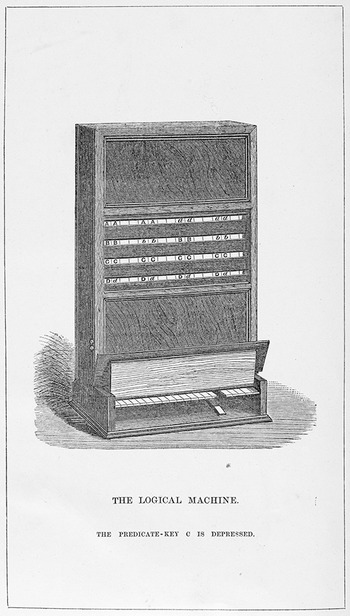

 Open access