Introduction
On 22 November 2018, on Saint Cecilia (the patroness of musicians) day, a group of Chilean musicians living in a dozen different countries released a video called ‘Arauco tiene músicos’ (Arauco has musicians), in response to the assassination of Camilo Catrillanca on 14 November by the Chilean police (CNN Chile 2018). With the video they wanted to express solidarity toward the indigenous people living in the Arauco province, southern Chile. Catrillanca's name adds to a list of Mapuche youth killed under the rule of democratic governments in the aftermath of Pinochet's dictatorship (1973–1990), as part of a long-lasting political conflict between the Chilean state and the Mapuche indigenous people.
In order to create their audiovisual response, these musicians go back to ‘Arauco tiene una pena’, one of the few well-known popular songs addressing the historical struggle of the Mapuche. This song was composed by Violeta Parra, a singer songwriter and visual artist whose work had a considerable impact on Chilean popular music during the second half of the century. ‘Arauco tiene una pena’'s first recording appeared in 1962. Parra's work was considered pivotal in providing a new representation of the people and for building a musical language informed by popular culture.
Although the conflict between the Chilean state and the Mapuche people is arguably one of the most notorious in national history, engaged popular artists have not systematically embraced the Mapuche cause. This article studies one of the rare cases of Chilean popular music which has effectively thematised Mapuche culture, observing how a prominent band inscribed in the New Song movement develops different strategies to include Mapuche sound. This is the case of Illapu.
Studies in Chilean New Song
Nueva Canción Chilena or Chilean New Song (CNS) is the name given to a musical movement developed in Chile since the mid-1960s. Two main characteristics are commonly attributed to it: political engagement and the modernisation of folklore. On the one hand, studies highlight the participation of its musicians in the political movement that pushed for and then led to important social transformations in Chilean society, namely through their support of socialist Salvador Allende's fourth presidential campaign and subsequent government (1970–1973), thus helping to bridge the artists’ militancy or individual sympathies with their participation in a broader political-cultural scene. On the other hand, CNS is known for creating songs whose lyrics gave a critical account of the socio-political reality of the country and the Latin American continent. One of the first written definitions of this artistic–political movement states: ‘As for the lyrics, the peculiarity of the Nueva Canción Chilena is clear. It translates or tries to interpret reality’ (Barraza Reference Barraza1972, p. 10).
More specifically, well-established scholars indicate that the soloists and ensembles that integrated the CNS were inspired by national and continental folklore, taking rhythms, forms and, most especially, vernacular instruments. The latter used to be tagged by folkloric studies and by music mediatised under labels such as ‘música típica’ and ‘neofolklore’. The CNS is therefore usually presented as the culmination of a teleological line of musical development, where folklore is progressively transformed into a more critical and creative style (González et al. Reference González, Ohlsen and Rolle2009). Neofolklore had already contributed with innovative arrangements and creative approaches, distancing itself from purely folkloric tradition. What the CNS added was an emphasis on lyrics that no longer described life in the countryside with bucolic nostalgia (Ramos Reference Ramos2011), but rather used the short duration of the songs to initially circulate discourses of protest and to then promote a ‘more just society’. While it is the case that an important amount of their songs did indeed address social issues, it is also true that other songs included various themes and instrumental pieces.
In musical terms, studies highlight two fundamental aspects. First the participation of composers formally trained through the creation of several of the most celebrated works and, in particular, the emergence of the popular cantata format. The cantata allowed for the assembly of large-scale works with a cross-cutting content, spun through interconnected narratives and musical numbers (Padilla Reference Padilla, Valjalo, Carrasco and Manns1985; Herrera Reference Herrera2011; Karmy Reference Karmy and Vila2014). Second, the CNS incorporated vernacular instruments detached from their traditional uses. This meant the creation of a sort of ‘Latin American orchestra’ resulting from the gathering of techniques and timbres of multiple origins (Gavagnin Reference Gavagnin1986).
Both of these characteristics (collaboration with academia and Latin American instrumentation) have been well-documented and established in the literature. However, other sonic aspects of the NCS also merit consideration while defining the movement. Although the ‘sound of the NCS’ has not yet been developed as a field of study in its own right, some timely research has contributed to discussions about Andean sounds in vocal arrangements (Jordán Reference Jordán, Palominos and Ramos2018), the uses of recording technology during the Popular Unity government (Figueroa and Osorio Reference Figueroa, Osorio, Palominos and Ramos2018), the sonic transformations of cueca in exile (Jordán Reference Jordán and Vila2014b), and the transphonographic relationships between Chilean recordings in Europe (Campos et al. Reference Campos, Jordán and Rodríguez2022).
Several of the CNS musicians were directly involved in the presidential campaign leading to Salvador Allende's election in 1970 and subsequently in the Unidad Popular leftist government (1970–1973). After the 1973 coup d’état that interrupted this government, thousands of people were exiled, among them some of the most prominent figures of the CNS, such as the groups Inti-Illimani and Quilapayún and the singer–songwriter Patricio Manns, to name a few. During the dictatorship (1973–1990), documents reflecting on the objectives and characteristics of the CNS proliferated. Most of these documents were elaborated from abroad (Fairley Reference Fairley1977; Largo Farías Reference Largo Farías1977; Rodríguez Reference Rodríguez2015), but some were also written and circulated in Chile (Torres Reference Torres1980). The first monographic articles on specific groups also appeared during the 1980s, such as the volume on the Karaxu ensemble in exile made by the British ethnomusicologist Jan Fairley (Reference Fairley1989). This study highlighted the performative strategies for staging music in a context of resistance to the dictatorship. Other publications of the period that contributed to the consolidation of nowadays conventional ideas about the CNS were compiled under the title Nueva Canción/Canto Nuevo (Padilla Reference Padilla, Valjalo, Carrasco and Manns1985). They dealt with the collaboration between the academic domain and the popular world, the relevance of the lyrics, the connection between urban music and folk music, among other constitutive elements of the movement and its continuation after the coup d’état: the Canto Nuevo.
The bibliography on the CNS is abundant and diverse, having found a remarkable impulse from the second decade of the 21st century. It is possible to find monographic studies on specific musicians such as Víctor Jara (Valdebenito Reference Valdebenito, Karmy and Farías2014; Rodríguez and Campos Reference Rodríguez and Campos2022; Navarro Reference Navarro2022). In addition, studies also address pivotal issues to the whole of the CNS movement, such as political engagement (McSherry Reference McSherry2015; Prom Reference Prom2018), gender identity (Party Reference Party2019) and the reception of the movement in different contexts and countries (Ramos Reference Ramos, Palominos and Ramos2018; Mamani Reference Mamani, Palominos and Ramos2018; Rodríguez Reference Rodríguez2015; Gavagnin Reference Gavagnin2021). The topic of ‘Latin Americanism’ as a territorial aesthetic horizon has recently been revisited from the perspective of transnationality (Gavagnin et al. Reference Gavagnin, Jordán and Rodríguez2022). The emergence of the notion of ‘Andean music’ in Europe and South America has been studied by highlighting the circulation of ideas, instruments and sound practices between the two continents (Ríos Reference Ríos2008; Gavagnin Reference Gavagnin2021; Rodríguez Reference Rodríguez2018b). This approach has complexified the characterisation of ‘Latin America’ and the very idea of the ‘Andes’.
Indigeneity in Chilean New Song
The concept of indigenismo designates a series of discourses about indigenous people by non-indigenous people, often advanced from a benevolent perspective about the contribution of indigenous peoples to national cultures. According to Estelle Tarica (Reference Tarica2016), indigenismo can be traced back to the 16th century when the priest Bartolomé de las Casas defended the human nature of the indigenous people. Then, during the 19th century, the romanticised indigenous of the colonial era was represented as part of the first nationalist discourses under the label of ‘indianismo’.Footnote 1 Indigenismo fully developed during the 20th century, especially, but not exclusively, in countries such as Mexico, Peru and Brazil. Native cultures were taken as ‘resources’ to build cultural images distanced from Europe, seeking to demonstrate the originality and independence of the young nations. At the same time, these discourses were useful for the elites to deal with the presence of ancestral cultures in the context of modernisation policies. As Tarica argues, ‘whether or not indigenismo became a matter of “official” state policy, indigenista thinkers were instrumental in placing the so-called “problem of the Indian” at the center of debates about modernisation and in making “the Indian” a core element of national identity’ (Tarica Reference Tarica2016).
Indigenismo was a cultural trend whose musical manifestations in Latin American music were abundant and diverse throughout the 20th century. In a broad sense, the conclusions reached by musicologist Gerard Béhague when he studied the composers Carlos Chávez (Mexico), Teodoro Valcárcel (Peru) and Heitor Villa-Lobos (Brazil) are valid to portray the scope of indigenismo in music written during the first half of the century: ‘the highly idealised conception of Indian culture adopted by these composers resulted in a pre-conceived mold that perpetuated blatant misunderstanding and misrepresentation in the name of artistic creation’ (Reference Béhague2006, pp. 30–31). For the case of Nicaragua, ethnomusicologist Amanda Minks recalls how national discourses ambivalently approach native traditions, relegating them to a lower position in the hierarchy of cultures, but at the same time using them as ‘a resource for expressing the unique heritage of the nation-state in its development towards modernisation’ (Minks Reference Minks2015, p. 142, my translation).
In Chile, indigenismo ranges from mystical depictions in operas to instrumental stylisation in various genres of popular music (González Reference González1993), as well as more well-documented compositions stemming from fieldwork. The image of the ancestral Indian firstly served to build conservative national narratives of bravery and heroism, such as the case of two operas composed in 1902: Caupolican (1902) by Remigio Acevedo and Lautaro by Eleonoro Ortiz de Zárate. Both are based in La araucana, an epic poem written by Alonso de Ercilla in 1569 that recounts the Arauco War during the Spanish conquest of Chile. These operas presented a prominent Mapuche warrior as their main character.Footnote 2 This same archetypal figure – the Mapuche warrior – functioned later as a motive for revolutionary projects developed in Latin America in the second half of the century. In musical terms, different local movements under the umbrella of Latin American New Song promoted an idealised form of the good savage, but equated this figure with the ‘peasant’. While in some Argentine musicians’ cases the resort to indigenismo overtly played on affirmative stereotypes, these must be read in relation to a national ‘nativist fever’ in the case of Atahualpa Yupanqui (Molinero and Vila Reference Molinero, Vila and Vila.2014) and with regards to strategies for internationalisation in the case of Mercedes Sosa (Karush Reference Karush2016).
Despite the fact that Andean-inspired music was a central component in the practice of many Chilean musicians, few studies have addressed the incidence of indigenismo in the CNS. Among the exceptions, we find a study on the reception of Andean music and the CNS in Italy, in which musicologist Stefano Gavagnin verbalises as ‘indigenismo’ a crucial aspect in the aesthetics of the movement, namely the gathering and arrangement of traditional indigenous songs, using instruments decontextualised from their original context (Gavagnin Reference Gavagnin, Regazzoni and Cecere2019a). Javier Rodríguez has also explored the problem of the configuration of an exotic image, by the ways of indigenismo, in his work on Violeta Parra, a singer–songwriter who, although not properly belonging to the CNS, is considered its indirect initiator.
On the other hand, Chilean New Song tended to include indigenous characters as representatives of an early stage of the working class, conceiving them as peasants and potential proletarians (Jordán Reference Jordán and Vila2014b). Despite being insufficient, the act of including indigenous elements (such as instruments, rhythms, and languages) in mestizo music was considered a form of legitimation of a cultural realm traditionally neglected by power structures. Typically, allusions to indigenous cultures unveil an idealisation of the Indian which operates through a double displacement: the indigenous individual is imagined as the inhabitant of distant territories and ancient times (Rodríguez Reference Rodríguez2018b), in such a way that s/he hardly becomes a subject of dialogue instead of an object of inspiration. This problematic treatment of the indigenous seems particularly intriguing when examining the work of musicians engaged with progressive politics during the Cold War era.
In the case of the Chilean New Song, indigenous people appear predominantly through Andean features, and more specifically via the invention of a continental image of the Andes by South American immigrants in Paris, as Fernando Ríos has rightfully pointed out (2008). According to Ríos, during the 1950s a synthetical idea of Andean music was created by Argentinians, Bolivians, Paraguayans and Peruvians living in France, building both on the musical practices of their respective nations, and on the circulation of exotic images about Latin America in Europe. In this context, producers and artists tend to collapse images from different indigenous peoples, creating a pan-indigenista expression.
This is exactly what has been proved by historian Javier Rodríguez in his examination of recordings made in 1956 by Violeta Parra for the label Le Chant du Monde, in France. Rhythms and melodies inspired in traditional criollo (of Iberian origin) music from central Chile, were portrayed within the frame of a transcontinental indianity referring both to the Mapuche (in the south) and to the Andes (in the north). This is apparent, for instance, in LP cover images which allude to the pre-hispanic cultures, the African presence and the archaic history in the continent, despite the fact that the music included in a specific LP might come from a totally different geographical and cultural zone (Rodríguez Reference Rodríguez2018a). However, beyond this exotic treatment of indigeneity produced in Paris, Violeta Parra herself carried out ethnographic research on Mapuche territory, and was thus able to incorporate several Mapuche musical traits in her own music. In their detailed study on this topic, Elisa Loncón, Paula Miranda and Alison Ramsay (Reference Loncón, Miranda and Ramsay2017) show that Parra studied both rhythmic–melodic elements and cosmological aspects of the ülkantun, that is, the Mapuche song. According to Loncón, Violeta Parra seems to achieve a synthesis of indigenous and criollo elements, in such a convincing manner that it becomes hard to identify what aspects of this synthesis correspond to her own invention. She considers that Violeta Parra acts as a bridge between Mapuche and Chilean cultures (Loncón Reference Loncón2017, p. 191). The Chilean New Song movement, conventionally considered as Violeta Parra's heir, scarcely includes any Mapuche references. Notable exceptions are Víctor Jara's ‘Angelita Huenumán’, also performed by Inti Illimani and Congreso, and covers of Violeta Parra's ‘Arauco tiene una pena’, by Los Jaivas or Inti-Illimani. Only recently, Víctor Navarro (Reference Navarro2022) has analysed the instrumental piece ‘Cai Cai Vilú’ by Víctor Jara, inspired by Mapuche cosmogony. Navarro highlights one of their most well-known mythical figures, through expressions of magical thinking.
The history of western occupation of the Wallmapu, the Mapuche territory, dates back to the Spanish colonisation during the 16th century, but deepens during the development of the Chilean republic (from 1810 to 1818), west of the Andes Mountains, and the Argentine republic (from 1816), to the east. In fact, in the case of Chile, after a series of wars against the Spanish crown, the Mapuche people had maintained their autonomous territory and a border had been established to delimit access from the north. It was with the Chilean expansionist occupation that in the middle of the 19th century this border was ignored. The Chilean State thus pushed further south the national border. It invaded the Province of Arauco in 1852 and deployed a military occupation since 1869. The war of resistance lasted until 1883, with emblematic uprisings in 1881. In the words of historian Igor Goicovic: ‘forced and subordinated integration, was the only alternative offered to the Mapuche by the State and Chilean society’ (2016, p. 32, my translation).
The Chilean occupation implied not only the killing of thousands of indigenous people, but also the usurpation of their communal lands through a series of fraudulent strategies, taking advantage of the lack of knowledge of the Spanish language and illiteracy (Correa Reference Correa2021). This usurpation of land unleashed one of the most serious problems involving the territory: dispossession, mistreatment and the interruption of cultural traditions. All these problems remain unresolved at the beginning of the 21st century.
During the 20th century, the Mapuche people developed different actions to confront assimilation. On the one hand, a group of organisations such as the Caupolican Society, then the Araucanian Federation and later the Araucanian Union, advocated access to the same rights as Chilean citizens, some of them taking representatives to parliament and participating in conventional political parties. In the second half of the century, organisations linked to the communist party (Asociación Indígena de Chile), to the Christian Democracy (Nueva Sociedad Lautaro Nueva Sociedad Araucana), and to the revolutionary left movement (Movimiento Campesino Revolucionario) emerged. These organisations ‘closely link the claims of the Mapuche people with the struggles and demands of Chilean society: agrarian reform, nationalisation of basic wealth, expansion of educational coverage, etc.’ (Goicovic Reference Goicovic and Pinto2016, p. 41).
In particular, the agrarian reform, which began in the 1960s and deepened during the Popular Unity government, stimulated the mobilisation of workers and the Mapuche people. Land occupation became widespread and, at the same time, confrontation between Mapuche and landowners increased. During the dictatorship, the military government restituted land to large landowners, parcelled up communal lands into individual plots, and auctioned off lands for logging. During the same period, Mapuche cultural centres were reactivated and cultural resistance to neoliberalism was promoted. With the first post-dictatorial governments, the demand for political recognition of indigenous peoples was established through the signing of the ILO Convention 169, and constitutional recognition began to be promoted. The demands that are still in force are concentrated on two aspects: the recognition of the pre-existence of indigenous peoples before the Spanish conquest and the creation of the Chilean State, and the implementation of land restitution and reparation policies. Jorge Pinto points out that ‘the Mapuche State-Mapuche people conflict also matured under the wing of the images that Mapuche and wingka [non-Mapuche] forged of the “other” in the twentieth century’ (Reference Pinto and Pinto2016, p. 53). Therefore, it is pertinent to review the ways in which music has participated in these representations.
This article aims to examine the presence of the Mapuche in the repertoire of a prominent band of engaged musicians: Illapu. I understand the concept of engaged music (música comprometida) in a broad sense, as the music through which Latin American artists expressed their support of leftwing politics, denounced the oppression of people and called for a struggle for freedom (Donas Reference Donas2015; Herrera Reference Herrera2011). The upshot of the unfair and uncomfortable general silence concerning the Mapuche CNS is a fragmentary approach to indigenous culture. This approach is developed from traditional indigenismo to a partial integration of Mapuche subjects. I also explore the hypothetical inclusion of Mapuche conceptions of sound. More specifically, this article examines different strategies through which the band Illapu, created in 1971 by Chileans from the north of the country and still active today, deals with the so-called conflict between the Chilean State and the Mapuche people. I argue that by incorporating first Mapuche instruments and rhythms (1970s); then adding engaged lyrics dealing with Mapuche history (1980s), and finally engaging with Mapuche listeners and artists (1990s to 2000s), Illapu participates in the transformation of the way in which indigeneity is conceived.
The mapuche in Illapu's songs
Illapu might be considered one of the most prominent bands of ‘engaged music’ over the past 50 years in Chile. Not only do they ‘portray’ social injustice through their lyrics, but these musicians have strongly built their musical personae on their profile as engaged artists. This is apparent, for instance, in a public interview given by Roberto Marquez, leader of the band, to the Australian press in 1997, as Judy Adamson recalls: ‘Marquez pins the band's initial popularity on being a group for the Chilean people. Illapu played concerts for the unemployed, helped the families of those who disappeared, and, of course, used metaphors constantly in their songs about freedom and justice’ (Adamson Reference Adamson1997, p. 11).
Illapu was formed in 1971 in Antofagasta, a city in northern Chile, by a group of brothers and their cousin, inspired by the format of NCS band Inti-Illimani as well as by folkloric music from Bolivia. Although this band is not part of the central or pioneering groups of the NCS, it is considered part of the movement (González Reference González2016), from the time of Salvador Allende's government with his coalition called Unidad Popular, then during the dictatorship in the resistance organisations and later in the international solidarity networks established in exile. Shortly after their formation, they moved to Santiago and reached great success in 1976 when their cover of ‘Candombe para José’ sold thousands of copies.Footnote 3 In a context in which playing Andean instruments was considered a political intervention (Jordán Reference Jordán2009), the censorship imposed by the 1973 coup d’état implied first a drop of public performances of New Song and folk bands following this music style. However, suddenly quenas, charangos and zampoñas were heard everywhere again through a phenomenon called ‘the Andean boom’ which took place in central Chile by the mid-1970s (González Reference González2015).
Although Illapu has been considered the youngest New Chilean Song group (Rodríguez Reference Rodríguez2015, p. 298) this band is mostly known under the label of Andean Music. As I explained earlier, this term has a complex history that goes beyond South American nations to include musical practices situated in central Europe. Several authors have shown the influence of French scenes in the construction of the international concept of Andean Music (Ríos Reference Ríos2008; Aravena-Décart Reference Aravena-Décart2011; Rodríguez Reference Rodríguez2018b).Footnote 4 Internationally promoted through networks of pop music, the sound of Andean music arrived in Chile to embody both a political meaning and a mass appeal (González Reference González2012). Nevertheless, when speaking of Illapu, the term ‘música andina’ exceeds this definition, since it also appeals to their biographical background. The musicians of Illapu were born and grew up in a city with a remarkable Aymara influence, as well as a strong relationship with Bolivian culture, given that it was a territory annexed by Chile after the Pacific War.Footnote 5 Insofar as the brothers of the Márquez family themselves embody a connection with the indigenous Andes they also articulate a singular sense of belonging when speaking of Andean music. In addition to this biographical connection, Andean music also refers to the repertoires Illapu plays, consisting of a variety of folk genres performed with singular references to musical practices from Andean fiestas (Jordán Reference Jordán, Palominos and Ramos2018). Finally, recalling the context of dictatorship, the term Andean music sometimes designates a kind of protest song of engaged music that was predominantly performed with Andean instruments.
As Jan Fairley (Reference Fairley1989) pointed out: the Andean component of the New Song project represented all indigenous American peoples in what is now called Latin America as imagined by the revolutionaries of the continent. All of these senses are combined in Illapu. In a way, the Andes function as a synecdoche of the indigenous, serving as a sign of the first peoples of the whole of America. However, as we will see below, this representation was nuanced by the incorporation of references to various peoples, where the Mapuche people found a specific place in the musical story that Illapu builds.
1. Tocata y fuga (Los mapuches)
The first appearance of the Mapuche people in Illapu's repertoire corresponds to a cover of Violeta Parra's ‘Tocata y fuga (Los mapuches)’. This is an instrumental composition made of two main sections, a toccata and a fugue, dubbed together ‘the Mapuche’. Its original version was recorded by Parra herself along with Gilbert Favre in Switzerland in 1966. Although this recording remained unpublished for a while, it is very likely that musicians from Illapu heard this piece played by José Miguel Camus with Los Curacas (1971). Favre's track corresponds to the broad notion of Andean music created in Europe, combining this time a quena (flute from the Peruvian and Bolivian Andes) and a bombo (from northern Argentina). Roughly speaking, the rhythmic pattern played with the bombo evokes a tribal dance, although there is little specifically Mapuche on it. Illapu's version, released in 1976 on the album Despedida del pueblo, exhibits a refined execution of the quena by José Miguel Márquez, including glissandi and a solid sound through the whole tessitura. As can be seen in Example 1, when repeating, Márquez transposes the main melodic idea one octave up, exploring the brighter zone of the quena. He also develops an ornamental gesture that is timidly played by Favre in his original version: it consists in adding a full ascending arpeggio to the concluding note of the melody, recalling a similar gesture made traditionally with the Mapuche trutruka (Mapuche horn).
Melodic transcriptions of José Miguel Márquez's quena

Bombo pattern ‘Arauco de pie’ (1978)

Bombo pattern ‘Arauco de pie’ (1988)

This composition figures in recent concerts by Illapu. It also functions as the opening of the commemorative DVD Illapu 33 (2005), in a montage with ‘Viaje a las raíces’ (Trip to the roots), an early video clip shot in 1975 featuring the members of Illapu visiting the desert town of Isluga. What is worth considering is the biographical connection between Illapu and the highlands of northern Chile and Bolivia, which entails a connection with indigeneity considered as an index of the Andes. Why, then, did they choose the ‘rare’ Mapuche melody to introduce this production? Most importantly, how do these images dialogue with the music? In fact, the first section of the piece, played solo by the quena, does not bear the Mapuche traces that one could observe in the second section, in which the bombo appears accelerating the tempo. Here, devoid of drums, the melody conveys a general sense of the Andes through the synecdoche of the flûte indienne (Ríos Reference Ríos2008). Inasmuch as any Mapuche connection is subsumed by a broader sense of ‘the indigenous’, this cover of Violeta Parra's piece corresponds to a typical treatment of indigeneity in early CNS productions, where the indigenous lacks its ethnic specificity and thus signals a general belonging to the native peoples of the Americas.
2. Arauco de Pie
In 1978, the band performed El Grito de la Raza, a conceptual work including 10 tracks plus spoken narration. The performance included composer and former Illapu member Osvaldo Torres, who left the band in 1977. The plot of this cantata (a sort of large format work extensively developed by CNS artists) is the history of the native nations of the continent and their first encounter with European colonisers. Although apparently similar to long multi-sectional works on indigenismo such as Canto General (Aparacoa 1975), a cantata composed over excerpts of Pablo Neruda's homonymous book, El Grito de la Raza entailed the recognition of a different position of its creator, Osvaldo Torres, who presented himself as an indigenous individual. This has been rightly observed by historian Bernardo Guerrero, when asserting that Torres writes in one of his songs ‘I come from the Puna I have something to say’ (Soy de la Puna, tengo que hablar), while Neruda writes ‘I come to speak for your dead mouth’ (Yo vengo a hablar por vuestra boca muerta) (Guerrero Reference Guerrero Jiménez2014).
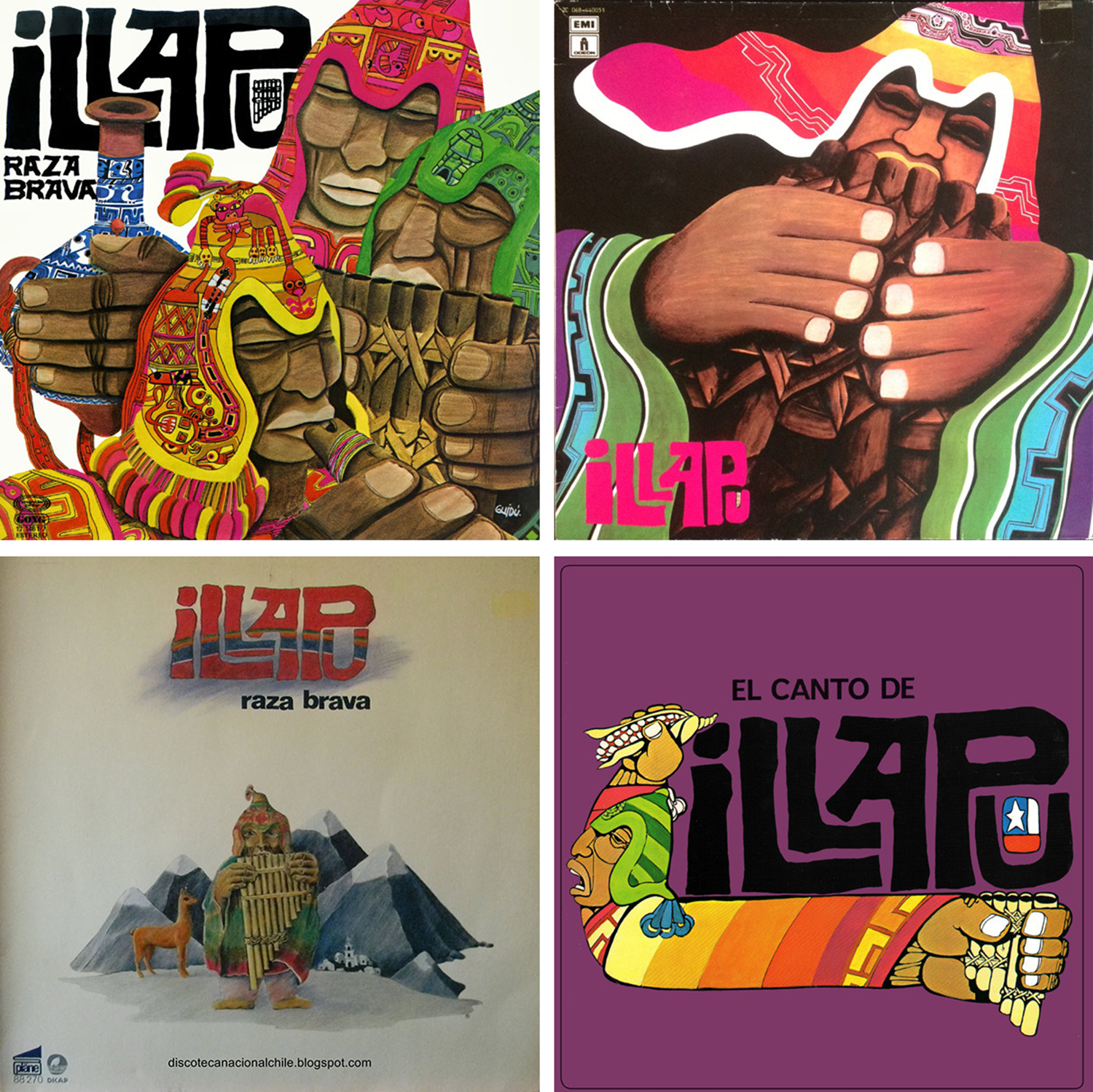
Although effectively recorded in Chile in the late 1970s, this recording was not released until 2001, after Illapu's return from exile. According to Roberto Márquez (interview with the author on 8 July 2020), the original tapes were sent to them while exiled in France, but the narrator's part was missing. Illapu kept the work unpublished until they returned to Chile, when they contacted Guillermo Durán to design the cover. Durán is the author of several cover designs of Illapu's discography. As can be seen in Figure 1, his covers usually represent Andean men playing panpipes, wearing chullo (local style of hat) and poncho (typical woven garment present in different areas of the Americas).

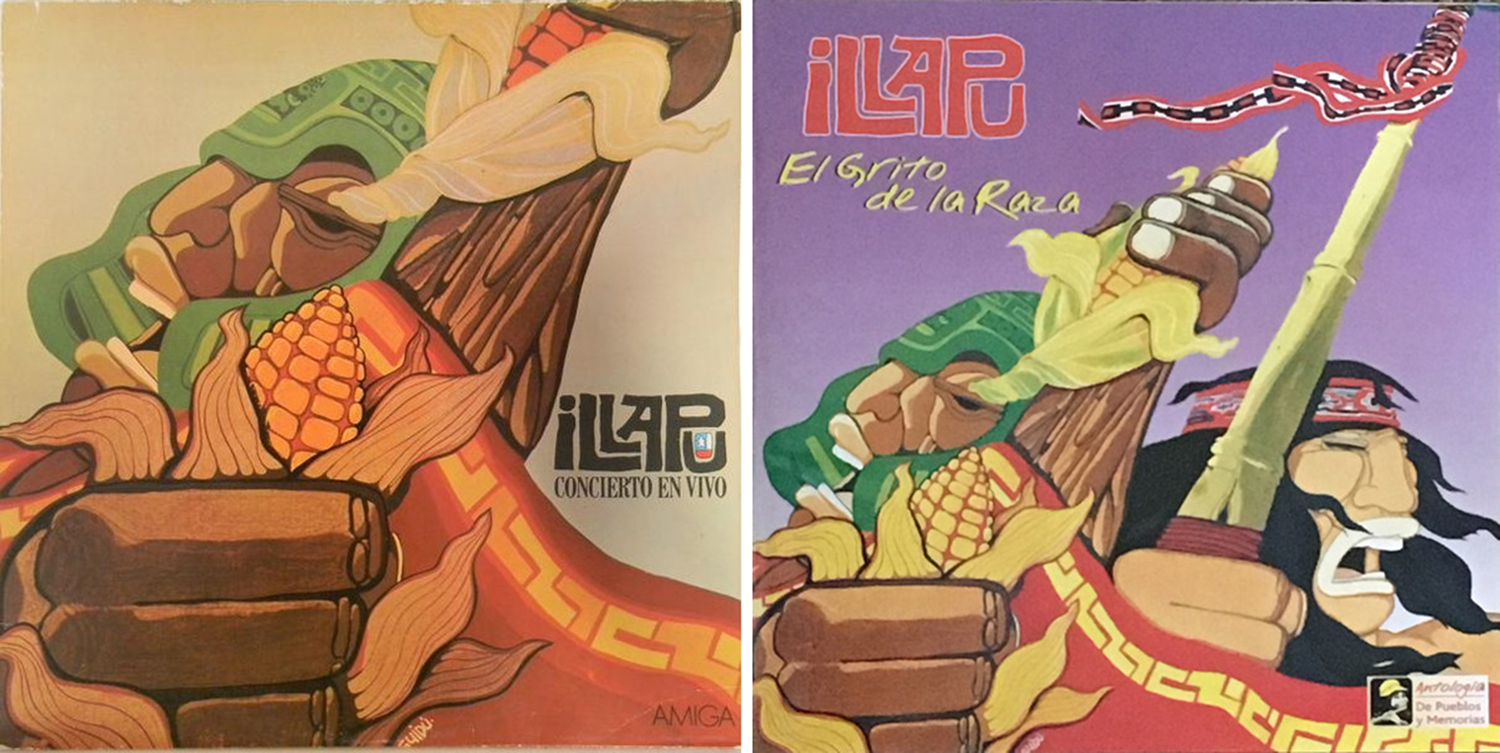
However, the cover of El Grito de la Raza, shown in Figure 2, is notably the only one in which a Mapuche person is clearly portrayed. In particular, the design for El Grito de la Raza, combines a drawing originally made for a live record published in the GDR in 1983 under the title Illapu Concierto en Vivo. As can be seen in the pictures, the original Andean character joins a Mapuche character; they both have similar phenotypic traits, the second one adds Mapuche paraphernalia: trarilonko (traditional headband) and a weño (Mapuche stick) carried by a dark-long-haired man.

This work adopts a tone that stresses a clear spirit of political struggle and cultural recognition. Each track depicts either a different event or a particular indigenous nation. The first track, ‘Canción del nuevo amanecer’ (Song of the new sunrise), provides a general picture of the indigenous peoples, naming some of the most emblematic of the continent, and then of the country: America was not alone/there was the Inca man/there was the Mayan man, the Aztec/working for hope/in the song of tomorrow//And Chile was not alone/there was the Araucanian/there was the Lican Antai, the Huilliche/working for hope/in the song of the morning//Here goes your time, our time/Entering like a gale/and the bloods come very close together/the cry is made to sing.Footnote 6 Here, the references to hope, morning and sunrise function as allegories on the aspired end of the dictatorship. In the same vein, the image of all the bloods converging into a singing cry both affirm the idealised mestizo subject of Latin Americanism, and portray the contemporary resistance to which this engaged music contributes.
The sixth track called ‘Arauco de Pie’ (Arauco stands up) refers to the Mapuche in a purely instrumental composition. In a similar vein to ‘Tocata y fuga’, this instrumental piece is composed of two contrasting sections. In the context of Illapu's style, the contrast between rhythms and textures throughout their repertoire has been observed as essential (Padilla Reference Padilla, Valjalo, Carrasco and Manns1985, p. 55). In this song, the first section also recalls the original version recorded by Violeta Parra. Once again, the main melody is carried out by flutes from the Andes (quena, quenacho, moxeño), while a rhythmic accompaniment leads to the next section. The change is abrupt. If at the beginning we find a rather nostalgic ambience, evoking from the present sweet ancient times, then the second section immerses the listener into a rite, surrounded by the ‘noisy’ sound of pifülkas (Mapuche one-note flutes characterised by multiphonics), presented in their typical dual pattern, alternating between two players. Additionally, the rhythm of the drums corresponds to the purrun, a traditional collective dance performed by turning around the ceremonial rewe. Here, resorting to ‘tribal’ sonorities, the music acts as an index of stereotypical sonic images of indigeneity, not that far from what Claudia Gorbman has observed as the clichés in the portrayal of ‘indians’ in Western filmography: prominence of a modal melody played by a flute, repetition of a tom-tom drum pattern, a basic two-note chords accompaniment (Gorbman Reference Gorbman, Born and Hesmondhalgh2000). However, more than a simple exotic depiction, the solemn tone of the whole work (emphasised by the narrator intervening between tracks) conveys a sense of dignity.
Combined with pieces on Diaguita and Kumza nations, ‘Arauco de Pie’ serves to present the Mapuche component of an imaginary common history of all the indigenous of the continent. However, beyond the integration of this piece in a pan-Latin-American narration, the band included ‘Arauco de Pie’ as a single track later in their 1988 album Para Seguir Viviendo. As we can see in the following excerpts, the second version presents a much more developed rhythmic accompaniment, which also provides a model for later renditions on Mapuche music.
Furthermore, the quena melody includes an ending note which recalls an idiomatic gesture of the trutruka consisting of adding a harmonic through a legato articulation, precisely after the last note of the melody.
Both versions of ‘Arauco de Pie’ were released during the dictatorship of Augusto Pinochet. The first public performance happened in Santiago in the context of the canto nuevo scene in a massive concert in Teatro Caupolican in 1977 (González Reference González2015). Later, this instrumental piece was recorded in exile in 1987, when Illapu resided in Mexico City and travelled to Belgium to record Para seguir viviendo. Framed in these political conditions, El Grito de la Raza functions not only as a regular indigenista narrative, but also as an allegory of dictatorship martyrs through the sublimation of mythical ‘indian’ heroes from colonial times. For instance, the first song states: In this context, the solemn sense of the narration that I commented above is transferred to the affective state of the resisting population, which denounces death and the disappeared by the military.
3. Bío Bío Sueño Azul
Almost 20 years passed before Illapu returned to the Mapuche. ‘Bío Bío Sueño Azul’ (Bio Bio Blue Dream) is the opening track of their 1998 album Morena Esperanza (Brown hope) in which, as Reyes Luciano Álvarez rightfully observed, Illapu returns to ‘ethnic sounds’ (Reference Álvarez2004, p. 146) after a decade where the band explored international pop sonorities. The timing was perfect. This song was released nearly a decade after the end of dictatorship. The aim was to support the rise of a political movement organised to resist the building of a hydroelectric complex and dam over a Mapuche cemetery in what became known as the ‘Ralco conflict’. According to historian Fernando Pairican (Reference Pairican2014), this conflict, along with the burning of a couple of trucks in Lumaco pertaining to the forestiers as an act of insurrection, marked the beginning of a distinctive stage in the Mapuche struggle. Pairican stresses the role of political organisations created by a generation of young Mapuche educated at universities. With the undeniable influence of previous generations of militants (mostly close to Marxism in ideological terms), this new generation of weichafe (warriors) promoted the occupation of ancestral land in order to recuperate them from established settlers. They also turned their attention and strength to cultural and political recognition, politicising cultural demands that until then were considered of secondary importance when compared with problems such as poverty and social justice. These demands of cultural recognition problematise the attribution of a relevant place for Mapuche culture as part of the ‘folklore’ of the Chilean nation.
I suggest that this transformation of the way of conceiving the Mapuche culture as a critical aspect of political contestation had an impact on the music performed in support of this indigenous people. More specifically, Illapu progressively moves away from folklorising gestures that were exclusively based on integrating sonic elements typical of the culture into the repertoire of popular songs, in order to give space to the indigenous people's own voices.
For this song, Illapu worked with a poem written by Mapuche poet Elicura Chihuailaf. The poem depicts the situation of the Bío Bío River which is in danger of intervention by developers. The poet himself recorded a voice over with the original stanzas created in mapuzugun, the Mapuche language: Elel mu kechi malall, wiño petu ñi kuyfimogen/Feypi Willi Kvrvf ñi Pvllv mogeley tati/Iñchiñ ñi kom pu che, ñi pu wenvy, mvlfen ñl mogen. This section translates from the Spanish version into English as follows: No dams, let the flowery freedom return/Thus says the spirit of the south wind that does not perish/For they are my people, my friends, the dew of life! Under this embellished form, it is the spirit of the south wind's voice, which, personified, opposes the dam. This voice is in turn the voice of the people, of friends, of life itself.Footnote 7 In this way, the poem puts forward a claim pertaining to the ‘ancestors’, which expresses not only the current discontent, but a discomfort that evokes their enemies present and past. This is expressed in the refrain (sung in Spanish): Bío Bío, blue dream of my ancestors/and I am the one who comes to touch/your heart to see if it grows/the total fight/to our enemies.Footnote 8
This might be one of the earliest samples of mapuzugun present in Chilean (mestizo) popular music. Virtually reaching mass audiences, the use of mapuzugun appears through a ‘postvernacular mode’ (Erez and Karkabi, Reference Erez and Karkabi2019) which does not necessarily seek the full understanding of a semantic message by non-native audiences, but points to a symbolic presence embodied by the sound of language itself. In addition, this collaboration arguably opens a practice that will become customary in Illapu performances, which consist in inviting Mapuche artists to perform live, as we will see in the next section.
‘Bío Bío Sueño Azul’ appears as a hinge between traditional strategies of representing the indigenous and the integration of Mapuche subjects: lyrics originally conceived in mapuzugun and the featuring of Elicura Chihuailaf were combined with an instrumental opening whose melody is clearly a reminiscence of ‘Arauco de Pie’, played this time with moxeño, a flute from the Andes. The trutruka (Mapuche horn) plays a prominent role in the arrangement, while Andean instruments come on and off. The beat in 6/8 clearly recalls, again, the dance of purrun. Although the release of ‘Bío-Bío Sueño Azul’ implies a significant turn in the portrayal of the Mapuche situation, the reception did not necessarily emphasise the indigenous content of the song but its environmental connotations especially for international media, as can be seen in an article published by Billboard in which it is described as ‘a song about the exploitation of ecologically sensitive land in southern Chile’ (Pride Reference Pride1998, p. 119). Touring in Montreal, Illapu's director Roberto Márquez explained that in the album Morena Esperanza, in which ‘Bío-Bío Sueño Azul’ appears: ‘We speak about daily life, about things that affect ordinary people. (…) We speak about native groups that are not really being respected. We speak about intergenerational problems between parents and children’ (Feist Reference Feist1998). This quote shows how Illapu's position vis-à-vis the Mapuche intertwines with their progressive views inspired by what the people struggle for on a daily basis.
From the 2000s onwards, the Mapuche struggle has reached wider acknowledgement from Chilean society. Cultural expressions such as the historical image of longko Pascual Coña, Mapuche chief, has circulated through diverse urban spaces via cinematic images, drawings and stencils (Alvarado Reference Alvarado2006), while one of the Mapuche flags called wenufoye has been adopted by activists for different progressive and radical causes. The public circulation of Mapuche images and sound arguably reflects a relevant change in the cultural context. However, the process of massification of Mapuche images that progressively have become part of Chile's culture, has not implied an acceptance of their historical demands by State agencies or public opinion. This has meant the country has rejected, de facto, demands such as the recovery of ancestral land, cultural recognition and political autonomy. Nevertheless, the spread of their symbols has made it possible to identify the uniqueness of their cause and their struggles, disputing and breaking the tendency present in Chile's national culture to homogenise the peoples living within the country. This recognition was clearly expressed in the discussions around plurinationality that took place while drafting a new constitution proposal, which had as its leader the intellectual Elisa Loncón.Footnote 9
Musically speaking, in the case of Illapu, the three pieces examined so far show a progressive shift from purely representational strategies to the inclusion of Mapuche subjects as legitimate creators. This perspective is fully accomplished in Illapu's cover of ‘Nuestro Mensaje’, our next and last example.
4. Nuestro Mensaje
The song ‘Nuestro Mensaje’ was composed by the Argentine band Che Joven. Brothers Pablo and Marino Coliqueo, of Mapuche descent, created Che Joven in 1995 borrowing instruments such as trompe, kultrun, trutruka from their elders’ culture. They felt that their ancestors became involved in their music while at the same time the audiences could perceive their ‘color’ and ‘the landscape [they] kept inside’ (Rosario 12 2016, p. 2016, my translation). Playing in a well-established rock format based on vocals, guitar, bass and drums, the Coliqueo brothers perform rock music with discernible traits of folk metal and grunge. ‘Nuestro Mensaje’ is a song dedicated to Matías Catrileo, a Mapuche youth killed by the Chilean police in 2008. Before Che Joven recorded his own studio version in 2015, Argentine folk singer Bruno Arias released a cover of ‘Nuestro Mensaje’ in Reference Arias2012. Illapu learned the song through this last version.
Illapu included a version of ‘Nuestro Mensaje’ in their album Con Sentido y Razón (2014), whose set list is completely formed by covers of Latin American songs. The band's director, Roberto Márquez, justified the selection of ‘Nuestro Mensaje’ stressing that ‘this beautiful song, built on Marino Coliqueo's Mapuche cosmovision, allowed us to get inside the Mapuche spirituality, of which the music is its most remarkable expression’ (Vitale, Reference Vitale2015, my translation). They also included this song in their line-up for prominent shows, such as their participation in Festival del Huaso, in the city of Olmué, in February 2019; or their monumental concert at Teatro Caupolicán, in Santiago, in August 2015, where Illapu invited Mapuche singer Daniela Millaleo to join in their performance of ‘Nuestro Mensaje’.
In Illapu's cover, the band deploys a different strategy compared with the earlier pieces analysed. The recurrent Andean rhythms present in most of the Illapu repertoire are replaced here by a beat virtually inspired in Caribbean music (specifically expressed through the syncopation of the main melody), bringing to mind revolutionary songs of cantautores (such as Cuban Silvio Rodríguez and Pablo Milanés). This rhythmic choice helps to place the Mapuche issue in the realm of protest songs, sharing codes with other emblematic songs that oppose oppression. In this way, the ancestral image, conventionalised by indigenism, is attenuated in that it is placed side by side with other contemporary struggles. Harmony is also distinctive, as are melodic motives, which recall power metal. Nevertheless, Illapu puts into place their characteristic disposition of voices seeking to produce a shiny timbre in the endings of important stanzas (Jordán Reference Jordán, Palominos and Ramos2018).
Compared with other pieces played by Illapu, this cover makes apparent a different way of engaging with the Mapuche struggle. Here, the lyrics portray the story of the young weichafe (warrior) Matías Catrileo killed by the police. An excerpt of the lyrics shows several elements that seem relevant to note, besides the explicit mention of Catrileo's death in Gulu Mapu, the Mapuche territory on the Chilean side. Our peñi Matías Catrileo/gulu mapu, his life for the snowdrifts/spat with his throat the fire/that burned the lie//May we be united in the desire to go against the kingdom/the rifle that continues to annihilate/entering my house, raping,/killing with greed, its anger.Footnote 10 Referring to the kingdom (el reino), the narrator expresses the persistence of a colonial order, where the republican Chilean society has reproduced the processes of subjugation towards the Mapuche and their land. Current Mapuche researchers (Alvarado Lincopi Reference Alvarado Lincopi2021; Antileo and Alvarado Lincopi Reference Antileo and Alvarado Lincopi2023) underline the continuity of this repressive order by symbolically speaking of the city of Santiago as the ‘capital del reyno’, with the colonial spelling. In addition, the song reiterates, as a refrain, the phrase ‘Our land is life’, indicating on the same plane of importance the violence on the human body and the violence on the ñuke mapu, the Mother Earth.
The main singer performs with a combative expression, typical of songs pertaining to Illapu's repertoire, that denounces social injustice. Distancing from archaic views of ‘indian’ culture, ‘Nuestro Mensaje’ awakens a necessary recognition of Mapuche people as contemporaneous political subjects. Although ‘Bío Bío Sueño Azul’ features the recorded spoken voice of Mapuche poet Eilicura Chihuailaf, the environmental appeal of that song was considerably enhanced by the stereotypical idea of indigenous culture as ‘natural’, in such a way that the content of the lyrics could easily combine with images that could function as indices of the indigenous at any place and time.
Illapu's ‘Nuestro Mensaje’ refers to the Mapuche only via traditional Mapuche instruments, skipping tribal rhythmic patterns and modal melodies as exotic devices. Yet what is perhaps more significant is that this cover also works with recorded samples issued from Mapuche contexts. This is expressed through two different strategies. First, a group of people yelling, together with the sound of Mapuche instruments (drums, pifülkas and trutrukas), are presented at the opening section. In a different manner when compared with ‘Arauco de Pie’ and ‘Bío Bío Sueño Azul’ (both songs in which the Mapuche ritual is evoked by the quotation of abstract parameters (Lacasse Reference Lacasse2006) such as melodies and rhythmic figures), ‘Nuestro Mensaje’ includes a trace of the Mapuche themselves in what seems to be a political rally. Besides this realistic effect, the sample brings to the fore a particular ‘acoustic ecology’, to follow Cárcamo-Huechante (Reference Cárcamo-Huechante2014). According to him, the Mapuche language, mapuzugun, identifies the language with the earth, in such a way that ‘it overcomes anthropocentric logics to express instead a territory of extensive and multiple resonances: it is the phonetics of a world inhabited by beings that whisper, murmur, speak, cry, sob, and sing’ (Cárcamo-Huechante Reference Cárcamo-Huechante2014, p. 228, my translation). In the same vein, acknowledging a singular acoustic sensorium, José Pérez de Arce (Reference Pérez de Arce2007) stresses the integration of a plethora of elements that compose a complex soundscape in Mapuche practices. For Illapu's endeavours, this way of conceiving the sounding environment entails going beyond the simple addition of musical sounds (as we have seen in the three previous songs with instruments and motifs). Rather, Illapu now adapts a sonorous aesthetic that disrupts the conventional stylisation of indigenous sounds. Inasmuch as recent Mapuche cultural demands call for the ceasing of folklorisation carried out by Chilean agents (Paillalef Reference Paillalef2018), it becomes crucial to develop strategies to deal with sound without resorting to the colonisation of indigenous acoustics, as Cárcamo-Huechante warns (2014).
A second use of sampling is also worth observing. At the end of the song, a new sample is heard. This time it corresponds to a recording of voices that announce the murder of Matías Catrileo. These voices are probably well-known to the Chilean and Mapuche audiences, because they were extensively broadcast by the media when Catrileo died. The sample brings back a live register of Catrileo's peñi (friends) desperately calling to denounce the killing and to prevent the seizing of the body by the police. The sample is harsh. The precarious quality that reveals its authenticity seems to be exaggerated in the studio through sound filtering. The result is hyperreal. However, one should not interpret this use of sampling in a purely effectist way. Although the sound quality seems to be altered, the mix with music is rough, as if it was not carefully created in a studio. The effect recalls what Serge Lacasse has dubbed cophonography (Lacasse Reference Lacasse, Burns and Lacasse2018), a concept referring to the co-presence of two recordings running parallel to each other. In the Chilean New Song repertoire, we can trace a similar strategy employed by Quilapayún with Fidel Castro's speech. The band released in 1971 the song ‘Declaración de la Habana’, based on Castro's speech delivered on 2 February 1962. Researchers Eileen Karmy and Natália Schmiedecke describe Quilapayún recording stressing the two sound materials functioning in parallel: ‘The voices of the ensemble sing above the words of Fidel, and fragments are interspersed in which the voice of the Cuban leader predominates, while in others it is almost inaudible under the voices of Quilapayún’ (Reference Karmy and Schmiedecke2020, my translation). Gerardo Figueroa and Javier Osorio (Reference Figueroa, Osorio, Palominos and Ramos2018) have also recently shown how this track with a combination of music and speech pertains to the exemplary explorations in technology by New Song artists, attesting to their interest in avant-garde practices. Forty years later, however, I suggest that the gesture by Illapu seeks to produce an uncomfortable listening, in terms of awakening a feeling of unease. Illapu seems to disrupt the fiction by introducing a piece of our reality so as to break the apparent autonomy of the song vis-à-vis its narrated world.
In terms of the role of technology, the analysis of the two more recent songs performed by Illapu – ‘Bío Bío Sueño Azul’ and ‘Nuestro Mensaje’ – suggests that sampling procedures can serve to integrate Mapuche ways of conceiving sound and soundscape, in addition to broadening the tools available for sonic representation. As a whole, the examination of this selection of four songs performed by Illapu at different moments reveals, first, the transformation not only of the way Chileans imagine the Mapuche, but also the very way of embodying a Mapuche political subjectivity. Second, changes in musical procedures also inform about new ways of building political legitimacy among engaged artists belonging to different nations.
Illapu as (brown) exemplary agents
Although Chilean New Song and similar Latin American musical projects which hoisted a clear political engagement have been extensively studied, most of the literature offers an affirmative narrative which favours militant perspectives (see McSherry Reference McSherry2015) and neglects a critical perspective. Musically speaking, we lack a critical understanding of the specific collecting procedures that New Song musicians developed in order to include popular repertoires and practices from different regions of the continent. This is particularly important with regard to the presence of indigenous songs, whose origins have been imagined and promoted as ‘authentic’, or publicly misunderstood as results of ethnographic fieldwork. In the same vein, we still lack a deeper understanding of the diverse mechanisms through which such repertoires have been transformed and adapted to the scene, although some useful work has been done considering performance (González Reference González2012) and recording practices. In terms of the political activism associated with New Song musicians, the relationship between militancy and creations is usually taken for granted, with scarce research devoted to reflect on the singular political meanings of some of the practices involved.
In the case of the Mapuche sounds and images present across Illapu's discography, a careful listening and analysis of the songs reveal, on the one hand, the persistence of strategies related to indigenismo; but, on the other, the inclusion of indigenous elements and, most importantly, indigenous subjects. That is why it is relevant to hear anthropologist Héctor Nahuelpán (Reference Nahuelpán2013) when he denounces the usual role assigned to indigenous individuals and particularly the Mapuche in the context of social research. According to him, the indigenous/Mapuche is consistently tackled as a research object. Whenever they emerge as a subject of enunciation – for instance as part of the indigenous intellectual production – the non-indigenous intellectual field relegates their discourses again to the category of objects, favouring discursive meta-analysis, instead of engaging in dialogue with indigenous subjects. Nahuelpán connects these practices with extractivist logics. His sharp critique aims at colonial expressions that seem pervasive in academic spaces, which become particularly delicate when they touch upon research and creative topics that project an emancipatory appearance but that fail in their contribution to undermine the power structures they denounce.Footnote 11
With this warning in mind, the inclusion of indigenous musical elements and knowledge by the New Song musicians needs to be considered, by paying attention to how such inclusion intertwined with their own political positions. On the one hand, many New Song musicians openly expressed their viewpoints, as they also participated in several campaigns, calls to action and political activities, on a national and international level. After the dictatorship, Illapu and other musicians continued to publicly voice their progressive ideas. On the other hand, beyond their individual positioning, popular musicians act as ‘exemplary agents’, inasmuch as they are perceived simultaneously as ordinary people and exceptionally ‘marvellous’ ones, carrying the wage of ‘showing what life could be like “if only”’ (Toynbee Reference Toynbee2000, p. ix). In this sense, their position as public figures helps to contest common sense, embodying an exemplary discourse that their followers can respect and, eventually, share.
In his recent article on Mapuche metal (Reference Rekedal2019), ethnomusicologist Jacob Rekedal argues that Mapuche artists such as Pewmayén and Weichafe Newen have been recently stretching the gap between traditional communal music and urban popular music, particularly through the production of pop genres such as hip hop and metal with a recognisable Mapuche signature. The features through which these Mapuche artists intend to do so coincide with something that philologists, folklorists and ethnomusicologists had identified in traditional practices: the presence of Mapuche instruments (such as trutruka, trompe and pifülkas), and the resort to purrun rhythms. On the side of Chilean mestizo popular music, all the songs discussed in this paper appeal to such typical features. To some extent, then, there is nothing new in Illapu's featuring of Mapuche elements. In fact, the persistence of the same kind of representation could be interrogated in terms of cultural appropriation or at least of expressing a patronising tone towards indigenous people. However, so far, I have explored some music strategies employed by Illapu to renew the treatment of the Mapuche in Chilean popular music, thus transforming their aesthetic devices while at the same time building legitimacy through the incorporation of a whole soundscape that highlights Mapuche agents.
In his ethnography on recent Mapuche popular music, Jacob Rekedal acknowledges the favourable reception that Illapu's performances on Mapuche subjects have found. In his words:
Illapu's own record of participation in the protest song movement, and their exile under Pinochet, not to mention they are superb musicians, lent them the credibility to stage such a performance. Having said this, ‘Homenaje a Matías Catrileo’ [‘Nuestro Mensaje’] reminds that nueva canción and folklore are brimming with musicalised political postures that can be mobilised (or not) at the will of the performers. (Reference Rekedal2015, p. 268 footnote 100)
Instead of ‘representing’ the Mapuche cause in Chilean platforms, what Illapu has been doing over the last decades is demonstrating an identification toward these people, as they appear through some of their more emblematic socio-political demands. In October 2019, after massive protests began in Chile, Illapu's director Roberto Márquez said to the press ‘If the Mapuche flags are present in all the protests it is because there is an identification [on the part of the Chilean people] with the brave [Mapuche] people who have resisted for centuries’ (quoted in Yasinsky Reference Yasinsky2019, my translation).
How to escape the acoustic colonisation of which Cárcamo-Huechante warns? How can Illapu, a band composed of musicians from northern Chile, legitimately support the Mapuche people and voice their struggle? I am not entitled to fully answer these political questions, but I am interested in observing the support that Mapuche individuals express toward Illapu. It is not only that a straightforward political commitment of these musicians plays favourably to make their engagement respectable, but, more importantly perhaps, what seems to be crucial is the voicing of their own morenidad (brownness), as María Fernanda Cáceres Ayala (Reference Cáceres Ayala2012) has rightfully pointed out in her essay-review of the album Morena Esperanza. For the album launch, Roberto Márquez expressed his ideas about brownness to the press. He observed that for Chilean people it is hard to recognise themselves as brown. He urged Chileans ‘to think in [their] deepest idiosyncrasy’ in order to understand the mistreatment of rapa nui, aymara and mapuche people, ‘all foreigners in their own land’ (La Nación September 2009, my translation).
This positioning as brown subjects enables the articulation of analogies between different marginalised groups, without resorting to uniformation. Along these same lines, ethnomusicologist Joshua Tucker has observed similar processes in 21st century musical productions in Peru. For instance, popular music band Uchpa justifies its adoption of blues sonorities by referring to the imagined affinity between the Andean subject and the African American subject, both marginalised in their respective societies (Tucker Reference Tucker2011, p. 402). Similarly, among young popular musicians who play Chilean urban cueca, there is a case of affective identification that connects an imagination of the idealised Chilean popular subject (roto chileno) and the arabic-andalusian subject (Jordán Reference Jordán2016). This identification has been characterised as an expression of ‘horizontal orientalism’ (Sánchez Reference Sánchez2001) in which subjects who identify with brownness connect with an imaginary ‘other’ whose position is analogous to their own. These cases describe recent popular music scenes where brownness is recast, in Peru and Chile. Both cases show how identification and legitimation operate regardless of genealogies, privileging instead affective proximities as well as political affinities. In Illapu's approach to the Mapuche, I contend that brownness helps to produce performative alliances which become consolidated through music and social action. At the same time, while the strategies deployed by a New Song band like Illapu open up spaces of collaboration, indigenous musicians and artists, such as those studied by Rekedal, progressively gain public attention. In order to understand these indigenous agencies and actions for self-representation, it seems useful to take into account Fiorella Montero-Díaz's (Reference Montero-Díaz2018) interrogation of contemporary racial imageries based on popular music fusion in Peru. She contends that recognition of the indigenous Andean ‘as a modern and competent individual, rather than a backward “authentic” museum piece’ might be a first step to fruitful interracial, interethnic and interclass relations. I contend that cultural recognition and visibility/audibility of Mapuche subjects through music made in collaboration with Chilean musicians might be an important intercultural space for building solidarity and pointing to social justice.
Conclusion
As a band historically connected to the New Song movement, Illapu's approach to Mapuche culture demands a careful examination of the ways in which indigenous music is handled, imagined and performed by engaged artists. What this article discusses is the specific approach of the Mapuche in Illapu; a more general and comparative perspective on indigenista representations of the Chilean New Song, as well as its potential gestures of intercultural dialogue, would merit a separate study. For Illapu, I assert that the transformation of their creative procedures deploys in parallel with the emergence of a public distinctly identifiable political Mapuche subject. This means that, on the one hand, Illapu stands out, from the beginning of their career, for they represent Mapuche elements through typical indigenista strategies: inclusion of traditional rhythmic patterns and instruments, as well as lyrics allusive to indigenous history. This is apparent in the cover of Violeta Parra's ‘Tocata y fuga’, for which Illapu introduced a purrun rhythmic pattern along with some melodic gestures played by the quena that recall the sound of trutruka. The same strategies appear in Illapu's second version of ‘Arauco de Pie’. The latter song also expresses indigenismo under the shape of a heroic narrative told in the cantata El Grito de la Raza, the larger work to which ‘Arauco de Pie’ pertains. This work presents a brave Mapuche warrior from past colonial times, a figure that enables inspirational approaches without ensuring a contemporary acknowledgment of indigenous existence. This seems to be the most common treatment of the indigenous by CNS musicians.
On the other hand, more singularly, Illapu recast its interest in Mapuche culture through the establishment of a dialogue with Mapuche artists; a turning point that coincides with a political period that historian Fernando Pairican (Reference Pairican2014) has called ‘mapuchisation’ of social demands. In fact, the irruption of the Mapuche political subject into the Chilean public sphere in the post-dictatorship era, entails listening to their voices. Illapu's song about Ralco, written in tandem with Mapuche poet Elicura Chihuailaf, resets the possibilities of collaboration and solidarity from Chilean popular musicians vis-à-vis indigenous people. ‘Bío Bío Sueño Azul’ deploys the sound of mapuzugun through mainstream broadcasting companies in an unfamiliar way for Chilean and international audiences. Unable to understand the meanings of the words pronounced by the poet, the very sound of the Mapuche shifts the perception of their culture. This sound recognises the Mapuche as contemporaneous agents. By the same token, a series of collaborations with the Mapuche undermine the remainders of a representational indigenism in order to allow for the full emergence of the living indigenous subject. Finally, the cover of ‘Nuestro Mensaje’, a song written by Mapuche musicians from Argentina, in which the assassination of a Mapuche weichafe is narrated, embraces rock sonorities as well as a sense of collectivity built through sonic textures. Illapu's approach to Mapuche music thus shows a development related to political awareness.
It is clear that Illapu's credibility lays on the band's constant participation in community-based events as well as the dissemination of social demands in mainstream venues such as municipal theaters and important stages like the Festival de Viña del Mar. Thus, their exercise as ‘exemplary agents’ has enabled their voicing of Mapuche struggles – and even Illapu's hoisting of Mapuche flags – without any prominent opposition from indigenous organisations. More than being armoured against critiques, a perception of ‘fidelity’ spread through audiences –which identify affectively or genealogically with indigeneity/brownness – help Illapu to sustain a public image distanced from discussions about cultural appropriation.
Nevertheless, a critical examination of the New Song's endeavours that involve the promotion of indigenous narratives needs to address the different agencies and power structures at stake. For this debate, it is crucial to consider the musicians’ political activism, inasmuch as their aesthetic decisions are informed by and consolidated through their social actions. Following Nahuelpán, one must interrogate the effectiveness of artistic works for dismantling the conditions of injustice under which many indigenous peoples live, and not only for denouncing such conditions. That is why a critical analysis of creative processes must take into account discourses and performances beyond the scene. More particularly, one must pay attention to the establishment of collaborative projects where the indigenous subjects effectively perform as ‘interlocutors of equal stature’ (Tucker Reference Tucker2011, p. 395) and not only as inspirational objects. Certainly, it is expected from engaged musicians like Illapu that they behave as exemplary agents, that they ‘make a difference, in the shape of different songs, sounds and styles’ (Toynbee Reference Toynbee2000, p. x).
Acknowledgements
I thank Leandro Gallardo and Dylan Valderrama for their help with music transcriptions. I am also grateful to Javier Rodríguez and Andrea Salazar for reading and commenting earlier versions of this article. This work was funded by ANID – Millennium Science Initiative Program-NCS2022_016. This article has been written in the frame of the project Más que gritos y susurros: Voces de la música popular en Chile (ANID FONDECYT 11190558).