








1 Introduction
One of the most classical topics of differential geometry is the investigation of specific classes of surfaces. Examples include Lagrange, Weierstrass, and Riemann’s works on minimal surfaces; Hilbert’s work on constant negative Gauss curvature surfaces; and Hopf’s work on global geometry of constant mean curvature surfaces. The study of such surfaces not only produces many important results but also leads to the development of new methods, which have great influence both on geometry and on other fields of mathematics like analysis and PDE.
Since Gauss introduced the “Gauss map” for surfaces, the interaction between surfaces and their Gauss maps has played an important role in the study of surfaces; see, for example, [Reference Ruh and Vilms33]. Kenmotsu’s classical work on surfaces with prescribed nonvanishing (generally, also nonconstant) mean curvature and their Gauss map [Reference Kenmotsu20] led to a new direction in geometry. A different, but related topic was investigated in a series of papers by Hoffman and Osserman [Reference Hoffman and Osserman19] on surfaces in
 $\mathbb{R}^{n}$
, and similarly by Weiner [Reference Weiner37, Reference Weiner38].
In the study of the conformal geometry of surfaces, the conformal Gauss map plays an important role [Reference Blaschke2, Reference Bryant3, Reference Ejiri15, Reference Rigoli31]. So it is natural to investigate what kind of maps can be the conformal Gauss map of a surface in
 $S^{n+2}$
. This is in particular an important problem concerning Willmore surfaces. A Willmore surface in
 $S^{n+2}$
is a critical surface of the Willmore functional
 $$\begin{eqnarray}\int _{M}(|\vec{H}|^{2}-K+1)\text{d}M,\end{eqnarray}$$
with
 $\vec{H}$
and
 $K$
being the mean curvature vector and the Gauss curvature, respectively. The Willmore functional can be considered to be the bending energy of a closed surface, while the bending energy of a rod has elastic curves as solutions to the variational problem. The latter situation was investigated by Germain already in 1821.
It is well known that the Willmore functional is invariant under conformal transformations of
 $S^{n+2},$
[Reference Blaschke2], which makes the study of this problem more difficult. The study of the Willmore functional and of Willmore surfaces has led to progress in several directions of geometry and analysis. For example, Li–Yau [Reference Li and Yau22] introduced the concept of “conformal volume” and gave a partial proof of the Willmore conjecture. Later, Simon [Reference Simon34] and Marques–Neves [Reference Marques and Neves28] applied geometric measure theory to study the Willmore functional, which led to Marques–Neves’s proof of the Willmore conjecture in
 $S^{3}$
[Reference Marques and Neves28, Reference Simon34]. Analytical methods developed, for example, by Kuwert–Schätzle [Reference Kuwert and Schätzle21] and Rivière [Reference Rivière32], for the discussion of the Willmore functional and Willmore surfaces also make important contributions to the study of Willmore surfaces as well as the field of geometric analysis and PDE. These examples show how the study of Willmore surfaces influences the development of geometry and analysis, which also explains our interest in this topic.
Due to the work of Blaschke [Reference Blaschke2], Bryant [Reference Bryant3], Ejiri [Reference Ejiri15], and Rigoli [Reference Rigoli31], a Ruh–Villms type classical result was established, namely that a conformal immersion is Willmore if and only if its conformal Gauss map is harmonic. Concerning Willmore surfaces, it is a natural and interesting geometric question of what kind of harmonic maps can be realized as the conformal Gauss map of some Willmore surface. This is in fact an essential problem when one wants to use the loop group method of integrable systems theory [Reference Dorfmeister, Pedit and Wu11] since this method studies Willmore surfaces in terms of conformal Gauss maps. In spite of much work on Willmore surfaces, independent of the work on the Willmore conjecture, and from many different points of view (see, e.g., [Reference Bernard and Rivière1, Reference Bryant3, Reference Ejiri15, Reference Hélein16, Reference Kuwert and Schätzle21, Reference Marques and Neves28, Reference Rivière32]), the question just stated above has not been solved.
In this note, we give an answer to this question.
A surface
 $y$
in
 $S^{n+2}$
has a mean curvature 2-sphere at each point. The conformal Gauss map
 $Gr_{y}$
maps each point to the oriented mean curvature 2-sphere at this point. Since in conformal geometry, an oriented 2-sphere of
 $S^{n+2}$
is identified with an oriented 4-dimensional Lorentzian subspace of the oriented (
 $n+4$
)-dimensional Lorentz–Minkowski space
 $\mathbb{R}_{1}^{n+4}$
(see for example, [Reference Burstall, Pedit and Pinkall5, Reference Hertrich17]),
 $Gr_{y}$
can be also viewed as a map into
 $Gr_{3,1}(\mathbb{R}_{1}^{n+4})=SO^{+}(1,n+3)/SO^{+}(1,3)\times SO(n)$
. Here by
 $SO^{+}(1,n+3)$
we denote the connected component of the special linear isometry group of
 $\mathbb{R}_{1}^{n+4}$
, which contains the identity element. Here “
 $+$
” comes from the fact that
 $SO^{+}(1,n+3)$
preserves the forward light cone.
To obtain the characterization of all harmonic maps that are the conformal Gauss map of some Willmore surface, we have two things to do:
-
(1) From a Willmore surface to its harmonic conformal Gauss map (the simple direction). We first derive a description of the Maurer–Cartan form
 $\unicode[STIX]{x1D6FC}$
of a natural frame associated with the conformal Gauss map of a conformal surface in
$S^{n+2}$
. This yields a very specific structure of the matrices occurring (see Theorem 2.2). We also show that, conversely, given a conformal map into
$SO^{+}(1,n+3)/SO^{+}(1,3)\times SO(n)$
, which has a frame whose Maurer–Cartan form has the mentioned specific form, then it is the conformal Gauss map of a conformal immersion. This result seems to be new to the best of the knowledge of these authors.
Moreover, from Theorem 2.2, one obtains
$B_{1}^{t}I_{1,3}B_{1}=0$
, or equivalently, the linear map
$\mathfrak{B}$
satisfies
$\mathfrak{B}^{2}|_{V^{\bot }}\equiv 0,$
where
$\mathfrak{B}(X)=F\unicode[STIX]{x1D6FC}_{\mathfrak{p}}^{\prime }(\frac{\unicode[STIX]{x2202}}{\unicode[STIX]{x2202}z})F^{-1}X$
(see (2.13) for more details). From this it is already clear that only special conformally harmonic maps can be the conformal Gauss maps of Willmore surfaces. These special conformally harmonic maps will be called “strongly conformally harmonic maps.” The equation
$B_{1}^{t}I_{1,3}B_{1}=0$
and the equation
$\mathfrak{B}^{2}|_{V^{\bot }}\equiv 0$
both use in some sense coordinates. These equations can be derived from some coordinate-free expression
${\mathcal{B}}(X,\tilde{X})=F\unicode[STIX]{x1D6FC}_{\mathfrak{p}}(\tilde{X})F^{-1}X$
, where
$\tilde{X}\in \unicode[STIX]{x1D6E4}(TM)$
. Note that
${\mathcal{B}}$
can be viewed as the generalized Weingarten map [Reference Lü and Wang23]. For our purposes, it will be most convenient to use coordinates and frames to carry out concrete computations. Note that frames are the crucial tool of the DPW method (see [Reference Dorfmeister, Pedit and Wu11]) which will be used to construct explicit examples and to characterize special surfaces.Footnote
1
-
(2) From a harmonic map to a Willmore surface, where it is possible (the difficult direction). In this procedure, one starts from some harmonic map and chooses a moving frame. If this frame has a Maurer–Cartan that has the special form described in Theorem 2.2, then this theorem already ensures that the given map is the conformal Gauss map of some conformal immersion. But there are many different frames (all gauge equivalent though), and therefore the form of the Maurer–Cartan form depends on the choice of frame (i.e., gauge). In particular, the special form of the Maurer–Cartan form as stated in Theorem 2.2 is not a gauge invariant criterion on the map, which makes it difficult to be checked and the geometric meaning is unclear. Further observation makes us realize that the restricted nilpotency condition
$\mathfrak{B}^{2}|_{V^{\bot }}\equiv 0$
plays an important role. For a harmonic map
$f$
, whose frame satisfies the restricted nilpotency condition, we show in Theorem 3.11 that it always induces a map
$y:U\rightarrow S^{n+2}$
such that, up to a change of orientation, either
$y$
is a Willmore surface on an open dense subset of
$M$
and
$f$
its oriented conformal Gauss map or
$y$
degenerates to a point.Footnote
2
For the case that
$y$
is nondegenerate on an open dense set, we show that if
$f$
is the oriented conformal Gauss map of
$y$
, then this already implies the unique global existence (see Theorem 3.17 for more details).











This paper is organized as follows. In Section 2, we recall the moving frame treatment of Willmore surfaces, following the method of [Reference Burstall, Pedit and Pinkall5], relating a Willmore surface to its conformal Gauss map. We also briefly compare our treatment with Hélein’s framework [Reference Hélein16]. Then we introduce the basic facts about harmonic maps and apply them, in Section 3, to describe the conformal Gauss maps (see Theorems 3.11 and 3.17). Appendix A ends this paper with a technical proof of Theorem 3.4.
2 Conformal surfaces in
$S^{n+2}$

We will use the elegant treatment of the conformal geometry of surfaces in
 $S^{n+2}$
presented in [Reference Burstall, Pedit and Pinkall5] and then describe these surfaces by using the Maurer–Cartan form of some lift.
2.1 Conformal surface theory in the projective light cone model
Let
 $\mathbb{R}_{1}^{n+4}$
denote the Minkowski space, that is, we consider
 $\mathbb{R}^{n+4}$
equipped with the Lorentzian metric
 $$\begin{eqnarray}{<}x,y>=-x_{0}y_{0}+\mathop{\sum }_{j=1}^{n+3}x_{j}y_{j}=x^{t}I_{1,n+3}y,\quad I_{1,n+3}=\text{diag}(-1,1,\ldots ,1).\end{eqnarray}$$
Let
 ${\mathcal{C}}_{+}^{n+3}=\{x\in \mathbb{R}_{1}^{n+4}|<x,x>=0,x_{0}>0\}$
denote the forward light cone of
 $\mathbb{R}_{1}^{n+4}$
. It is easy to see that the projective light cone
 $Q^{n+2}=\{[x]\in \mathbb{R}P^{n+3}~|~x\in {\mathcal{C}}_{+}^{n+3}\}$
with the induced conformal metric is conformally equivalent to
 $S^{n+2}$
. Moreover, the conformal group of
 $Q^{n+2}$
is exactly the projectivized orthogonal group
 $O(1,n+3)/\{\pm 1\}$
of
 $\mathbb{R}_{1}^{n+4}$
acting on
 $Q^{n+2}$
by
 $T([x])=[Tx],\,\,~T\in O(1,n+3).$
Let
 $y:M\rightarrow S^{n+2}$
be a conformal immersion from a Riemann surface
 $M$
. Let
 $U\subset M$
be a contractible open subset. A local lift of
 $y$
is a map
 $Y:U\rightarrow {\mathcal{C}}_{+}^{n+3}$
such that
 $\unicode[STIX]{x1D70B}\circ Y=y$
. Two different local lifts differ by a scaling; thus they induce the same conformal metric on
 $M$
. Here we call
 $y$
a conformal immersion if
 $\langle Y_{z},Y_{z}\rangle =0$
and
 $\langle Y_{z},Y_{\bar{z}}\rangle >0$
for any local lift
 $Y$
and any complex coordinate
 $z$
on
 $M$
. Noticing
 $\langle Y,Y_{z\bar{z}}\rangle =-\langle Y_{z},Y_{\bar{z}}\rangle <0$
, we see that
 $$\begin{eqnarray}\displaystyle V=\text{Span}_{\mathbb{R}}\{Y,\text{Re}Y_{z},\text{Im}Y_{z},Y_{z\bar{z}}\} & & \displaystyle\end{eqnarray}$$
is an oriented rank-4 Lorentzian sub-bundle over
 $U$
, and there is a natural decomposition of the oriented trivial bundle
 $U\times \mathbb{R}_{1}^{n+4}=V\oplus V^{\bot }$
, where
 $V^{\bot }$
is the orthogonal complement of
 $V$
with an induced natural orientation. Note that both,
 $V$
and
 $V^{\bot }$
, are independent of the choice of
 $Y$
and
 $z$
, and therefore are conformally invariant. In fact, we obtain a global conformally invariant bundle decomposition
 $M\times \mathbb{R}_{1}^{n+4}=V\oplus V^{\bot }$
. For any
 $p\in M$
, we denote by
 $V_{p}$
the fiber of
 $V$
at
 $p$
. And the complexifications of
 $V$
and
 $V^{\bot }$
are denoted by
 $V_{\mathbb{C}}$
and
 $V_{\mathbb{C}}^{\bot }$
, respectively. Since
 $Y$
takes values in the forward light cone
 ${\mathcal{C}}_{+}^{n+3}$
, we focus on conformal transformations that are contained in
 $SO^{+}(1,n+3)$
.
Fixing a local coordinate
 $z$
on
 $U$
, there exists a unique local lift
 $Y$
in
 ${\mathcal{C}}^{n+3}$
satisfying
 $|\text{d}Y|^{2}=|\text{d}z|^{2}$
, that is,
 $\langle Y_{z},Y_{\bar{z}}\rangle =\frac{1}{2}$
. Such a lift
 $Y$
is called the canonical lift with respect to
 $z$
. Given a canonical lift
 $Y$
, we choose the frame
 $\{Y,Y_{z},Y_{\bar{z}},N\}$
of
 $V_{\mathbb{C}}$
, where
 $N$
is the uniquely determined section of
 $V$
over
 $U$
satisfying
 $$\begin{eqnarray}\displaystyle \langle N,Y_{z}\rangle =\langle N,Y_{\bar{z}}\rangle =\langle N,N\rangle =0,\langle N,Y\rangle =-1. & & \displaystyle\end{eqnarray}$$
Note that
 $N$
lies in the forward light cone
 ${\mathcal{C}}_{+}^{n+3}$
and that
 $N\equiv 2Y_{z\bar{z}}\!\!\hspace{0.6em}{\rm mod}\hspace{0.2em}Y$
holds.
Next we define the conformal Gauss map of
 $y$
.
Definition 2.1. [Reference Bryant3, Reference Burstall, Pedit and Pinkall5, Reference Ejiri15, Reference Ma26]
Let
 $y:M\rightarrow S^{n+2}$
be a conformal immersion from a Riemann surface
 $M$
. The conformal Gauss map of
 $y$
is defined by
 $$\begin{eqnarray}\displaystyle \begin{array}{@{}ccccc@{}}Gr: & M & \rightarrow & Gr_{1,3}(\mathbb{R}_{1}^{n+4}) & =SO^{+}(1,n+3)/SO^{+}(1,3)\times SO(n)\\ \ & p\in M & \mapsto & V_{p}. & \\ \end{array} & & \displaystyle\end{eqnarray}$$
Here
 $V_{p}$
is the 4-dimensional Lorentzian subspace oriented by a basis
 $\{Y,N,Y_{u},Y_{v}\}$
.
The orientation of
 $V$
implies that
 $Gr$
maps to the symmetric space
 $SO^{+}(1,n+3)/SO^{+}(1,3)\times SO(n)$
instead of
 $SO^{+}(1,n+3)/S(O^{+}(1,3)\times O(n))$
, which is usually used in the literature. Note also that
 $Gr$
depends on the conformal immersion
 $y$
as well as the chosen complex structure of the Riemann surface
 $M$
. We will therefore sometimes write
 $Gr=Gr_{y}$
to emphasize this.
Given a (local) canonical lift
 $Y$
, we note that
 $Y_{zz}$
is orthogonal to
 $Y$
,
 $Y_{z}$
, and
 $Y_{\bar{z}}$
. Therefore there exist a complex valued function
 $s$
and a section
 $\unicode[STIX]{x1D705}\in \unicode[STIX]{x1D6E4}(V_{\mathbb{C}}^{\bot })$
such that
 $$\begin{eqnarray}\displaystyle Y_{zz}=-\frac{s}{2}Y+\unicode[STIX]{x1D705}. & & \displaystyle\end{eqnarray}$$
This defines two basic invariants of
 $y$
:
 $\unicode[STIX]{x1D705}$
, the conformal Hopf differential of
 $y$
;
 $s$
, the Schwarzian of
 $y$
. Clearly,
 $\unicode[STIX]{x1D705}$
and
 $s$
depend on the coordinate
 $z$
(see [Reference Burstall, Pedit and Pinkall5, Reference Ma26]). Let
 $D$
denote the
 $V_{\mathbb{C}}^{\bot }$
part of the natural connection of
 $\mathbb{C}^{n+4}$
. Then for any section
 $\unicode[STIX]{x1D713}\in \unicode[STIX]{x1D6E4}(V_{\mathbb{C}}^{\bot })$
of the normal bundle
 $V_{\mathbb{C}}^{\bot }$
and any (local) canonical lift
 $Y$
of some conformal immersion
 $y$
into
 $S^{n+2}$
, we obtain the structure equations [Reference Burstall, Pedit and Pinkall5, Reference Ma24]:
 $$\begin{eqnarray}\displaystyle \left\{\begin{array}{@{}l@{}}Y_{zz}=-\frac{s}{2}Y+\unicode[STIX]{x1D705},\\ Y_{z\bar{z}}=-\langle \unicode[STIX]{x1D705},\bar{\unicode[STIX]{x1D705}}\rangle Y+\frac{1}{2}N,\\ N_{z}=-2\langle \unicode[STIX]{x1D705},\bar{\unicode[STIX]{x1D705}}\rangle Y_{z}-sY_{\bar{z}}+2D_{\bar{z}}\unicode[STIX]{x1D705},\\ \unicode[STIX]{x1D713}_{z}=D_{z}\unicode[STIX]{x1D713}+2\langle \unicode[STIX]{x1D713},D_{\bar{z}}\unicode[STIX]{x1D705}\rangle Y-2\langle \unicode[STIX]{x1D713},\unicode[STIX]{x1D705}\rangle Y_{\bar{z}}.\end{array}\right. & & \displaystyle\end{eqnarray}$$
For these structure equations, the integrability conditions are the conformal Gauss, Codazzi, and Ricci equations, respectively [Reference Burstall, Pedit and Pinkall5, Reference Ma24]:
 $$\begin{eqnarray}\displaystyle \left\{\begin{array}{@{}l@{}}\frac{1}{2}s_{\bar{z}}=3\langle \unicode[STIX]{x1D705},D_{z}\bar{\unicode[STIX]{x1D705}}\rangle +\langle D_{z}\unicode[STIX]{x1D705},\bar{\unicode[STIX]{x1D705}}\rangle ,\\ \text{Im}(D_{\bar{z}}D_{\bar{z}}\unicode[STIX]{x1D705}+\frac{\bar{s}}{2}\unicode[STIX]{x1D705})=0,\\ R_{\bar{z}z}^{D}=D_{\bar{z}}D_{z}\unicode[STIX]{x1D713}-D_{z}D_{\bar{z}}\unicode[STIX]{x1D713}=2\langle \unicode[STIX]{x1D713},\unicode[STIX]{x1D705}\rangle \bar{\unicode[STIX]{x1D705}}-2\langle \unicode[STIX]{x1D713},\bar{\unicode[STIX]{x1D705}}\rangle \unicode[STIX]{x1D705}.\end{array}\right. & & \displaystyle\end{eqnarray}$$
Choosing an oriented orthonormal frame
 $\{\unicode[STIX]{x1D713}_{j},j=1,\ldots ,n\}$
of the normal bundle
 $V^{\bot }$
over
 $U$
, we can write the normal connection as
 $D_{z}\unicode[STIX]{x1D713}_{j}=\sum _{l=1}^{n}b_{jl}\unicode[STIX]{x1D713}_{l}$
with
 $b_{jl}+b_{lj}=0.$
Then, the conformal Hopf differential
 $\unicode[STIX]{x1D705}$
and its derivative
 $D_{\bar{z}}\unicode[STIX]{x1D705}$
are of the form
 $$\begin{eqnarray}\displaystyle \unicode[STIX]{x1D705}=\mathop{\sum }_{j=1}^{n}k_{j}\unicode[STIX]{x1D713}_{j},\quad D_{\bar{z}}\unicode[STIX]{x1D705}=\mathop{\sum }_{j=1}^{n}\unicode[STIX]{x1D6FD}_{j}\unicode[STIX]{x1D713}_{j},\quad with\unicode[STIX]{x1D6FD}_{j}=k_{j\bar{z}}-\mathop{\sum }_{j=1}^{n}\bar{b}_{jl}k_{l},~j=1,\ldots ,n. & & \displaystyle\end{eqnarray}$$
Finally, put
 $\unicode[STIX]{x1D719}_{1}=\frac{1}{\sqrt{2}}(Y+N),~\unicode[STIX]{x1D719}_{2}=\frac{1}{\sqrt{2}}(-Y+N),~\unicode[STIX]{x1D719}_{3}=Y_{z}+Y_{\bar{z}},~\unicode[STIX]{x1D719}_{4}=i(Y_{z}-Y_{\bar{z}}),~k=\sqrt{\sum _{j=1}^{n}|k_{j}|^{2}},$
and set
 $$\begin{eqnarray}\displaystyle F:=\left(\unicode[STIX]{x1D719}_{1},\unicode[STIX]{x1D719}_{2},\unicode[STIX]{x1D719}_{3},\unicode[STIX]{x1D719}_{4},\unicode[STIX]{x1D713}_{1},\ldots ,\unicode[STIX]{x1D713}_{n}\right). & & \displaystyle\end{eqnarray}$$
Note that
 $F$
is a frame of the conformal Gauss map
 $Gr$
. From the above computation, we obtain directly (here
 $I_{1,3}=diag(-1,1,1,1)$
) the following theorem.
Theorem 2.2.
-
(1) Let
$y:M\rightarrow S^{n+2}$
be a conformal immersion and
$Y$
its canonical lift over the open contractible set
$U\subset M$
. Then the frame
$F$
attains values in
$SO^{+}(1,n+3)$
, and the Maurer–Cartan form
$\unicode[STIX]{x1D6FC}=F^{-1}\text{d}F$
of
$F$
is of the form with
$$\begin{eqnarray}\unicode[STIX]{x1D6FC}=\left(\begin{array}{@{}cc@{}}A_{1} & B_{1}\\ B_{2} & A_{2}\\ \end{array}\right)\text{d}z+\left(\begin{array}{@{}cc@{}}\bar{A}_{1} & \bar{B}_{1}\\ \bar{B}_{2} & \bar{A}_{2}\\ \end{array}\right)\text{d}\bar{z},\end{eqnarray}$$
(2.9)
$$\begin{eqnarray}\displaystyle & \displaystyle A_{1}=\left(\begin{array}{@{}cccc@{}}0 & 0 & s_{1} & s_{2}\\ 0 & 0 & s_{3} & s_{4}\\ s_{1} & -s_{3} & 0 & 0\\ s_{2} & -s_{4} & 0 & 0\end{array}\right),\qquad A_{2}=\left(\begin{array}{@{}ccc@{}}b_{11} & \cdots \, & b_{n1}\\ \vdots & \vdots & \vdots \\ b_{1n} & \cdots \, & b_{nn}\\ \end{array}\right), & \displaystyle\end{eqnarray}$$
(2.10)
$$\begin{eqnarray}\displaystyle & \displaystyle \left\{\begin{array}{@{}l@{}}s_{1}={\displaystyle \frac{1}{2\sqrt{2}}}(1-s-2k^{2}),\qquad s_{2}=-{\displaystyle \frac{i}{2\sqrt{2}}}(1+s-2k^{2}),\\[10.0pt] s_{3}={\displaystyle \frac{1}{2\sqrt{2}}}(1+s+2k^{2}),\qquad s_{4}=-{\displaystyle \frac{i}{2\sqrt{2}}}(1-s+2k^{2}),\end{array}\right. & \displaystyle\end{eqnarray}$$
(2.11)
$$\begin{eqnarray}\displaystyle & \displaystyle B_{1}=\left(\begin{array}{@{}ccc@{}}\sqrt{2}\unicode[STIX]{x1D6FD}_{1} & \cdots \, & \sqrt{2}\unicode[STIX]{x1D6FD}_{n}\\[5.0pt] -\sqrt{2}\unicode[STIX]{x1D6FD}_{1} & \cdots \, & -\sqrt{2}\unicode[STIX]{x1D6FD}_{n}\\[5.0pt] -k_{1} & \cdots \, & -k_{n}\\[5.0pt] -ik_{1} & \cdots \, & -ik_{n}\\ \end{array}\right),\qquad B_{2}=-B_{1}^{t}I_{1,3}. & \displaystyle\end{eqnarray}$$
-
(2) Conversely, assume we have a conformal map
$f:U\rightarrow SO^{+}(1,n+3)/SO^{+}(1,3)\times SO(n)$
. If it has some frame
$F=(\unicode[STIX]{x1D719}_{1},\ldots ,\unicode[STIX]{x1D719}_{4},\unicode[STIX]{x1D713}_{1},\ldots ,\unicode[STIX]{x1D713}_{n+4}):U\rightarrow SO^{+}(1,n+3)$
such that the Maurer–Cartan form
$\unicode[STIX]{x1D6FC}=F^{-1}\text{d}F$
of
$F$
is of the above form, then (2.12)is a conformal immersion from
$$\begin{eqnarray}\displaystyle y=\unicode[STIX]{x1D70B}_{0}(F)=:\left[(\unicode[STIX]{x1D719}_{1}-\unicode[STIX]{x1D719}_{2})\right] & & \displaystyle\end{eqnarray}$$
$U$
into
$S^{n+2}$
with
$f$
being its conformal Gauss map.






Remark 2.3.
-
(1) There are two conditions in the above theorem for
$f$
to be the conformal Gauss map of some surface
$y$
, that is,
$B_{1}$
being a special form and
$A_{1}$
being a special form at the same time. For Willmore surfaces, or equivalently, for
$f$
being harmonic, we will show that the restriction on
$B_{1}$
is enough, except the degenerate case. -
(2) As we have seen in Theorem 2.2, the form of the Maurer–Cartan characterizes conformal maps, and therefore this form is of great importance. In particular,
holds. From this, one sees that for any point in
$$\begin{eqnarray}B_{1}^{t}I_{1,3}B_{1}=0\end{eqnarray}$$
$M$
, the rank of
$B_{1}$
is at most 2. The case
$B_{1}\equiv 0$
is equivalent to
$y$
being conformally equivalent to a round sphere. For the nontrivial case,
$B_{1}\neq 0$
, a detailed discussion will be given in Theorem 3.11.
-
(3) Theorem 2.2 shows that the conformal Gauss map of a conformal surface determines this surface by a simple computation, without any integration or differentiation. This is different not only from the case of CMC surfaces in
$\mathbb{R}^{3}$
[Reference Dorfmeister, Pedit and Wu11], where a Sym–Bobenko formula is needed to get the surface from its Gauss map, but also from the case of minimal surfaces in some
$\mathbb{R}^{m}$
, where the Gauss map is not enough to determine the surface. We would like to add that a similar situation occurs in many other integrable surface classes, like in the case of minimal Lagrangian surfaces in
$\mathbb{C}P^{2}$
.


Definition 2.4. For a conformal map
 $f:M\rightarrow SO^{+}(1,n+3)/SO^{+}(1,3)\times SO(n)$
, we define the linear map
 $\mathfrak{B}$
as follows:
 $$\begin{eqnarray}\displaystyle \begin{array}{@{}cccc@{}}\mathfrak{B}: & \mathbb{R}_{1}^{n+4} & \rightarrow & \mathbb{R}_{1}^{n+4}\\[5.0pt] \ & X & \mapsto & F\unicode[STIX]{x1D6FC}_{\mathfrak{p}}^{\prime }(\frac{\unicode[STIX]{x2202}}{\unicode[STIX]{x2202}z})F^{-1}X.\end{array} & & \displaystyle\end{eqnarray}$$
It is straightforward to see that
 $\mathfrak{B}$
is well defined, that is, independent of the choice of the frame
 $F$
.
Remark 2.5.
-
(1) Note that
$\mathfrak{B}(V_{\mathbb{C}})=\unicode[STIX]{x2202}f$
if we use the notion
$\unicode[STIX]{x2202}f$
as Chern and Wolfson defined in [Reference Chern and Wolfson10]. -
(2) In [Reference Hitchin18], Hitchin introduced the idea of decomposing
$\text{d}$
into the connection part and a nilpotent linear map. Here
$\mathfrak{B}$
is the linear map in this sense. Note that the same idea is also used in the definition of
$\unicode[STIX]{x1D6FD}$
in [Reference Burstall and Rawnsley6] if one uses
$\unicode[STIX]{x1D6FD}$
acting on a section as in [Reference Burstall and Rawnsley6, Proposition 1.1].


Using the fact that
 $\unicode[STIX]{x1D6FC}_{\mathfrak{p}}^{\prime }(\frac{\unicode[STIX]{x2202}}{\unicode[STIX]{x2202}z})=\left(\!\begin{smallmatrix}0 & B_{1}\\ -B_{1}^{t}I_{1,3} & 0\\ \end{smallmatrix}\!\right),$
we obtain immediately the following corollary.
Corollary 2.6.
-
(1)
$\mathfrak{B}(V_{\mathbb{C}})\subset V_{\mathbb{C}}^{\bot }$
,
$\mathfrak{B}(V_{\mathbb{C}}^{\bot })\subset V_{\mathbb{C}}$
. -
(2) The linear map
$\mathfrak{B}$
satisfies the “restricted nilpotency condition” (2.14)if and only if the Maurer–Cartan form of
$$\begin{eqnarray}\displaystyle \mathfrak{B}^{2}|_{V^{\bot }}=0 & & \displaystyle\end{eqnarray}$$
$f$
satisfies
$$\begin{eqnarray}B_{1}^{t}I_{1,3}B_{1}=0.\end{eqnarray}$$


2.2 Willmore surfaces and harmonicity
The conformal Hopf differential
 $\unicode[STIX]{x1D705}$
plays an important role in the investigation of Willmore surfaces. A direct computation using (2.5) shows that the conformal Gauss map
 $Gr$
induces a conformally invariant (possibly degenerate) metric
 $$\begin{eqnarray}g:={\textstyle \frac{1}{4}}\langle \text{d}G,\text{d}G\rangle =\langle \unicode[STIX]{x1D705},\bar{\unicode[STIX]{x1D705}}\rangle |\text{d}z|^{2}\end{eqnarray}$$
globally on
 $M$
(see [Reference Burstall, Pedit and Pinkall5]). Note that this metric degenerates at umbilical points of
 $y$
, which are by definition the points where
 $\unicode[STIX]{x1D705}$
vanishes.
Definition 2.7. [Reference Burstall, Pedit and Pinkall5, Reference Ma24]
The Willmore functional of
 $y$
is defined as four times the area of M with respect to the metric above:
 $$\begin{eqnarray}\displaystyle W(y):=2i\int _{M}\langle \unicode[STIX]{x1D705},\bar{\unicode[STIX]{x1D705}}\rangle \text{d}z\wedge \text{d}\bar{z}. & & \displaystyle\end{eqnarray}$$
An immersed surface
 $y:M\rightarrow S^{n+2}$
is called a Willmore surface if it is a critical point of the Willmore functional with respect to any variation (with compact support) of
 $y$
.
Note that the above definition of the Willmore functional coincides with the usual definition (see [Reference Burstall, Pedit and Pinkall5, Reference Ma and Wang27]). It is well known that Willmore surfaces are characterized as follows [Reference Bryant3, Reference Burstall, Pedit and Pinkall5, Reference Ejiri15, Reference Rigoli31, Reference Wang35].
Theorem 2.8. For a conformal immersion
 $y:M\rightarrow S^{n+2}$
, the following three conditions are equivalent:
-
(1)
$y$
is Willmore. -
(2) The conformal Gauss map
$Gr_{y}$
is a conformally harmonic map into
$G_{3,1}(\mathbb{R}_{1}^{n+3})$
. -
(3) The conformal Hopf differential
$\unicode[STIX]{x1D705}$
of
$y$
satisfies the “Willmore condition”: (2.16)for any contractible chart of
$$\begin{eqnarray}\displaystyle D_{\bar{z}}D_{\bar{z}}\unicode[STIX]{x1D705}+\frac{\bar{s}}{2}\unicode[STIX]{x1D705}=0 & & \displaystyle\end{eqnarray}$$
$M$
.


Now we introduce the notion of the so-called dual Willmore surface, which is of essential importance in Bryant’s and Ejiri’s description of Willmore 2-spheres.
Definition 2.9. ([Reference Bryant3], [Reference Ejiri15, page 399])
Let
 $y:M\rightarrow S^{n+2}$
be a Willmore surface with
 $M_{0}$
the set of umbilical points and with
 $Gr$
its conformal Gauss map. A conformal map
 ${\hat{y}}:M\setminus M_{0}\rightarrow S^{n+2}$
that does not coincide with
 $y$
is called a “dual surface” of
 $y$
if either
 ${\hat{y}}$
reduces to a point or on an open dense subset of
 $M\setminus M_{0}$
, the map
 ${\hat{y}}$
is an immersion and the conformal Gauss map
 $Gr_{{\hat{y}}}$
of
 ${\hat{y}}$
spans at all points the same subspace as
 $Gr_{y}$
(clearly, then
 ${\hat{y}}$
is also a Willmore surface).
There exist many Willmore surfaces [Reference Bryant3, Reference Ejiri15, Reference Ma25] that admit dual Willmore surfaces. In general, a Willmore surface may not admit a dual surface. For the discussion of Willmore surfaces admitting a dual surface, Ejiri [Reference Ejiri15] introduced the so-called S-Willmore surfaces. It is convenient to define S-Willmore surfaces here as follows (see also [Reference Ma25]).
Definition 2.10. [Reference Ejiri15]
A Willmore immersion
 $y:M\rightarrow S^{n+2}$
is called an S-Willmore surface if on any open subset
 $U$
, away from the umbilical points, the conformal Hopf differential
 $\unicode[STIX]{x1D705}$
of
 $y$
satisfies
 $D_{\bar{z}}\unicode[STIX]{x1D705}||\unicode[STIX]{x1D705}$
, that is,
 $D_{\bar{z}}\unicode[STIX]{x1D705}+\frac{\bar{\unicode[STIX]{x1D707}}}{2}\unicode[STIX]{x1D705}=0$
for some
 $\unicode[STIX]{x1D707}:U\rightarrow \mathbb{C}$
.
Corollary 2.11. Let
 $y$
be a Willmore surface that is not totally umbilical. Then
 $y$
is S-Willmore if and only if the (maximal) rank of
 $B_{1}$
in Theorem 2.2 is
 $1$
.
Theorem 2.12.
-
(1) [Reference Bryant3], [Reference Ejiri15, Theorem 7.1] A (nontotally umbilical) Willmore surface
$y$
is S-Willmore if and only if it has a unique dual (Willmore) surface
${\hat{y}}$
on
$M\setminus M_{0}$
. Moreover, if
$y$
is S-Willmore, the dual map
${\hat{y}}$
can be extended to
$M$
. -
(2) [Reference Ma26, Theorem 2.9] If the dual surface
${\hat{y}}$
of
$y$
is immersed at
$p\in M$
, then
$Gr_{{\hat{y}}}(p)$
spans the same subspace as
$Gr_{y}(p)$
, but its orientation is opposite to the one of
$Gr_{y}(p)$
. -
(3) [Reference Ejiri15, Reference Ma26] If two Willmore surfaces
$y$
and
${\tilde{y}}$
share the same oriented conformal Gauss map, then
$y={\tilde{y}}$
.


Proof. The result of (3) is not presented explicitly in [Reference Ejiri15, Reference Ma26]. So we give a proof as follows. If
 $y$
is non-S-Willmore, then the mean curvature 2-sphere congruence of
 $y$
envelops only one surface
 $y$
by [Reference Ejiri15, Lemmas 1.3 and 3.1] or [Reference Ma26, Proposition 2.12]. Since
 $y$
and
 ${\tilde{y}}$
share the same conformal Gauss map, we have
 $y={\tilde{y}}$
. If
 $y$
is S-Willmore, then (2) of this theorem says that
 $y={\tilde{y}}$
.◻
We will say “the conformal Gauss map contains a constant light-like vector
 $Y_{0}$
” if there exists a nonzero constant light-like vector
 $Y_{0}$
in
 $\mathbb{R}_{1}^{n+4}$
satisfying
 $Y_{0}\in V_{p}$
for all
 $p\in M$
. Then a well-known fact states (one can find a proof in [Reference Ma and Wang27, p. 1573]) (similar ideas are also used in [Reference Hélein16, pp. 378–379]) the following.
Theorem 2.13. A Willmore surface
 $y$
is conformally equivalent to a minimal surface in
 $R^{n+2}$
if and only if its conformal Gauss map
 $Gr$
contains a constant light-like vector.
There exist Willmore surfaces that fail to be immersions at some points. To include surfaces of this type, we introduce the notion of Willmore maps and strong Willmore maps.
Definition 2.14. A smooth map
 $y$
from a Riemann surface
 $M$
to
 $S^{n+2}$
is called a Willmore map if it is a conformal Willmore immersion on an open dense subset
 $\hat{M}$
of
 $M$
. If
 $\hat{M}$
is maximal, then the points in
 $M_{0}=M\backslash \hat{M}$
are called branch points of
 $y$
, at which points
 $y$
fails to be an immersion. Moreover,
 $y$
is called a strong Willmore map if it is a Willmore map and if the conformal Gauss map
 $Gr:\hat{M}\rightarrow SO^{+}(1,n+3)/SO^{+}(1,3)\times SO(n)$
of
 $y$
can be extended smoothly (and hence real analytically) to
 $M$
.
Remark 2.15. It is an interesting (open) problem that under which conditions a Willmore map will be a strong Willmore map.
Example 2.16.
-
(1) Let
$x:\hat{M}\rightarrow \mathbb{R}^{n}$
be a complete minimal surface with finitely many ends
$\{p_{1},\ldots ,p_{r}\}$
. By the inverse of the stereographic projection,
$x$
becomes a smooth map
$y$
from a compact Riemann surface
$M=\hat{M}\cup \{p_{1},\ldots ,p_{r}\}$
to
$S^{n}$
. If all the ends of
$x$
are embedded planar ends,
$y$
will be a Willmore immersion [Reference Bryant3]. If some planar ends
$\{p_{j_{1}},\ldots ,p_{j_{t}}\}$
fail to be embedded,
$y$
will be a strong Willmore map with branch points
$\{p_{j_{1}},\ldots ,p_{j_{t}}\}$
. If some ends
$\{\tilde{p}_{1},\ldots ,\tilde{p}_{l}\}$
fail to be planar,
$y$
will be a Willmore map with branch points
$\{\tilde{p}_{1},\ldots ,\tilde{p}_{l}\}$
with its conformal Gauss map having no definition on these ends. -
(2) It is well known that all minimal surfaces in Riemannian space forms can be considered to be Willmore surfaces in some
$S^{m}$
[Reference Bryant3, Reference Weiner37]. These surfaces are basic examples of Willmore surfaces. Moreover, they are S-Willmore surfaces; see [Reference Ejiri15, Reference Ma26]. -
(3) The first nonminimal Willmore surface was given by Ejiri in [Reference Ejiri14]. This non-S-Willmore Willmore surface is a homogeneous torus in
$S^{5}$
. Later, using the Hopf bundle, Pinkall produced a family of nonminimal Willmore tori in
$S^{3}$
via elastic curves [Reference Pinkall30].





Remark 2.17. (Hélein and Ma’s harmonic maps)
In [Reference Hélein16], Hélein extended the treatment of Bryant [Reference Bryant3] to deal with Willmore surfaces in
 $S^{3}$
by using a loop group method [Reference Dorfmeister, Pedit and Wu11]. He used two kinds of harmonic maps: the conformal Gauss map and the ones he called “roughly harmonic maps.” In terms of the notation used here, for a Willmore immersion
 $y$
in
 $S^{3}$
with a local lift
 $Y$
, choose
 ${\hat{Y}}\in \unicode[STIX]{x1D6E4}(V)$
such that
 $\langle {\hat{Y}},{\hat{Y}}\rangle =0,$
and
 $\langle Y,{\hat{Y}}\rangle =-1.$
Then Hélein’s roughly harmonic map is defined by
 $$\begin{eqnarray}\displaystyle \mathfrak{H}=Y\wedge {\hat{Y}}:M\rightarrow Gr_{1,1}(R_{1}^{5}). & & \displaystyle\end{eqnarray}$$
The reason for the name “roughly harmonic” is that although
 $\mathfrak{H}$
may not be harmonic in general, it really provides another family of flat connections (see [Reference Hélein16, (36) p. 350] for details). If one assumes furthermore that
 ${\hat{Y}}$
satisfies in any local coordinate
 $$\begin{eqnarray}\displaystyle {\hat{Y}}_{z}\in Span_{\mathbb{C}}\{{\hat{Y}},Y,Y_{z}\}\qquad \text{mod}\qquad V_{\mathbb{C}}^{\bot }, & & \displaystyle\end{eqnarray}$$
 $\mathfrak{H}$
will be a harmonic map. Especially, for a Willmore surface
 $y$
in
 $S^{3}$
, there always exists a dual surface (recall Definition 2.9 or see [Reference Bryant3]). When
 ${\hat{Y}}$
is chosen as the lift of the dual surface
 ${\hat{y}}$
of
 $y$
, one obtains an interesting harmonic map connecting the original surface and its dual surface. It is straightforward to generalize Hélein’s notion of roughly harmonic maps to the case of Willmore immersions into
 $S^{n+2}$
since the definition above does not involve the codimensional information. Such natural generalizations following Hélein have been worked out in [Reference Xia and Shen39], by using the treatment of [Reference Wang35] on Willmore submanifolds.
In a different development, in [Reference Ma24], Ma considered the generalization of the notion of a dual surface for a Willmore surface
 $y$
in
 $S^{n+2}$
. Let
 ${\hat{Y}}\in \unicode[STIX]{x1D6E4}(V)$
with
 $\langle {\hat{Y}},{\hat{Y}}\rangle =0,$
and
 $\langle Y,{\hat{Y}}\rangle =-1.$
Ma found that if
 ${\hat{Y}}$
satisfies in any local coordinate
 $$\begin{eqnarray}\displaystyle \begin{array}{@{}c@{}}{\hat{Y}}_{z}\in Span_{\mathbb{C}}\{{\hat{Y}},Y,Y_{z}\}\,\text{mod}\,V_{\mathbb{C}}^{\bot }\qquad and\qquad \langle {\hat{Y}}_{z},{\hat{Y}}_{z}\rangle =0,\end{array} & & \displaystyle\end{eqnarray}$$
then
 $[{\hat{Y}}]$
is a new Willmore surface (which may degenerate to a point; see [Reference Ma24]). In this case,
 $[{\hat{Y}}]$
is called “an adjoint surface” of
 $y$
. Different from dual surfaces, the adjoint surface
 $[{\hat{Y}}]$
is in general not unique (a detailed discussion on this can be found in [Reference Ma24]). Moreover, Ma showed that for an adjoint surface
 $[{\hat{Y}}]$
, the map
 $\mathfrak{H}=Y\wedge {\hat{Y}}:M\rightarrow Gr_{1,1}(R_{1}^{n+3})$
is a conformal harmonic map. Obviously, this harmonic map defined by Ma is just a special case of Hélein’s harmonic maps used in [Reference Hélein16], [Reference Xia and Shen39], but it may be a particularly natural case (see [Reference Hélein16]).
Note that for Hélein’s harmonic map as well as for Ma’s adjoint surfaces, it is usually not possible to prove global existence since the solution of equation (2.18) may have singularities. To be concrete, first note that (2.18) is exactly the Riccati equation
 $$\begin{eqnarray}\unicode[STIX]{x1D707}_{z}-\frac{\unicode[STIX]{x1D707}^{2}}{2}-s=0.\end{eqnarray}$$
Note that for S-Willmore surfaces,
 $\unicode[STIX]{x1D707}$
may take the value
 $\infty$
at some points. Therefore, using the expression of the dual surface (see [Reference Ma24]), at the points where
 $\unicode[STIX]{x1D707}$
approaches
 $\infty$
, we have
 $[{\hat{Y}}]=[Y]$
. This implies that the 2-dimensional Lorentzian subspace
 $\text{Span}_{\mathbb{R}}\{Y,{\hat{Y}}\}$
defined by
 $Y$
and
 ${\hat{Y}}$
reduces to a 1-dimensional light-like line at these points. It remains unknown how to deal with the global properties for this kind of harmonic maps by using Hélein’s approach. This is one of the reasons why we use the conformal Gauss map to study Willmore surfaces although the computations using Hélein’s harmonic map would perhaps be somewhat easier.
3 Conformally harmonic maps into
$SO^{+}(1,n+3)/SO^{+}(1,3)\times SO(n)$

In this section, we first review the basic description of harmonic maps. Then we apply it to the harmonic maps into
 $SO^{+}(1,n+3)/SO^{+}(1,3)\times SO(n)$
. Since not every such conformally harmonic map is the conformal Gauss map of some strong Willmore map, we give a necessary and sufficient condition for a conformally harmonic map to be the conformal Gauss map of a strong Willmore map.
3.1 Harmonic maps into the symmetric space G/K
Let
 $N=G/K$
be a symmetric space with involution
 $\unicode[STIX]{x1D70E}:G\rightarrow G$
such that
 $G^{\unicode[STIX]{x1D70E}}\supset K\supset (G^{\unicode[STIX]{x1D70E}})_{0}$
. Let
 $\unicode[STIX]{x1D70B}:G\rightarrow G/K$
denote the projection of
 $G$
onto
 $G/K$
. Let
 $\mathfrak{g}$
and
 $\mathfrak{k}$
denote the Lie algebras of
 $G$
and
 $K$
, respectively. The involution
 $\unicode[STIX]{x1D70E}$
induces the Cartan decomposition
 $\mathfrak{g}=\mathfrak{k}\oplus \mathfrak{p},$
with
 $[\mathfrak{k},\mathfrak{k}]\subset \mathfrak{k},~[\mathfrak{k},\mathfrak{p}]\subset \mathfrak{p}$
and
 $[\mathfrak{p},\mathfrak{p}]\subset \mathfrak{k}.$
Let
 $f:M\rightarrow G/K$
be a conformally harmonic map from a connected Riemann surface
 $M$
. Let
 $U\subset M$
be an open contractible subset. Then there exists a frame
 $F:U\rightarrow G$
such that
 $f=\unicode[STIX]{x1D70B}\circ F$
on
 $U$
. Let
 $\unicode[STIX]{x1D6FC}$
denote the Maurer–Cartan form of
 $F$
. Then
 $\unicode[STIX]{x1D6FC}$
satisfies the Maurer–Cartan equation and altogether we have
 $F^{-1}\text{d}F=\unicode[STIX]{x1D6FC},$
with
 $\text{d}\unicode[STIX]{x1D6FC}+\frac{1}{2}[\unicode[STIX]{x1D6FC}\wedge \unicode[STIX]{x1D6FC}]=0.$
Decomposing
 $\unicode[STIX]{x1D6FC}$
with respect to
 $\mathfrak{g}=\mathfrak{k}\oplus \mathfrak{p}$
, we obtain
 $$\begin{eqnarray}\unicode[STIX]{x1D6FC}=\unicode[STIX]{x1D6FC}_{\mathfrak{k}}+\unicode[STIX]{x1D6FC}_{\mathfrak{p}},\quad with\unicode[STIX]{x1D6FC}_{\mathfrak{k}}\in \unicode[STIX]{x1D6E4}(\mathfrak{k}\otimes T^{\ast }M),\quad \unicode[STIX]{x1D6FC}_{\mathfrak{ p}}\in \unicode[STIX]{x1D6E4}(\mathfrak{p}\otimes T^{\ast }M).\end{eqnarray}$$
Next we decompose
 $\unicode[STIX]{x1D6FC}_{\mathfrak{p}}$
further into the
 $(1,0)$
-part
 $\unicode[STIX]{x1D6FC}_{\mathfrak{p}}^{\prime }$
and the
 $(0,1)$
-part
 $\unicode[STIX]{x1D6FC}_{\mathfrak{p}}^{\prime \prime }$
, and set
 $$\begin{eqnarray}\displaystyle \unicode[STIX]{x1D6FC}_{\unicode[STIX]{x1D706}}=\unicode[STIX]{x1D706}^{-1}\unicode[STIX]{x1D6FC}_{\mathfrak{p}}^{\prime }+\unicode[STIX]{x1D6FC}_{\mathfrak{k}}+\unicode[STIX]{x1D706}\unicode[STIX]{x1D6FC}_{\mathfrak{p}}^{\prime \prime },\quad \unicode[STIX]{x1D706}\in S^{1}. & & \displaystyle\end{eqnarray}$$
Lemma 3.1. [Reference Dorfmeister, Pedit and Wu11]
The map
 $f:M\rightarrow G/K$
is harmonic if and only if
 $$\begin{eqnarray}\displaystyle d\unicode[STIX]{x1D6FC}_{\unicode[STIX]{x1D706}}+{\textstyle \frac{1}{2}}[\unicode[STIX]{x1D6FC}_{\unicode[STIX]{x1D706}}\wedge \unicode[STIX]{x1D6FC}_{\unicode[STIX]{x1D706}}]=0,\quad forall~\unicode[STIX]{x1D706}\in S^{1}. & & \displaystyle\end{eqnarray}$$
Definition 3.2. Let
 $f:M\rightarrow G/K$
be harmonic and
 $\unicode[STIX]{x1D6FC}_{\unicode[STIX]{x1D706}}$
the differential one-form defined above. Since
 $\unicode[STIX]{x1D6FC}_{\unicode[STIX]{x1D706}}$
satisfies the integrability condition (3.2), we consider the equation
 $$\begin{eqnarray}\left\{\begin{array}{@{}l@{}}\text{d}F(z,\unicode[STIX]{x1D706})=F(z,\unicode[STIX]{x1D706})\unicode[STIX]{x1D6FC}_{\unicode[STIX]{x1D706}},\\ F(z_{0},\unicode[STIX]{x1D706})=\mathbf{e}\\ \end{array}\right.\end{eqnarray}$$
on any contractible open subset
 $U\subset M$
, where
 $z_{0}$
is a fixed base point on
 $U$
and
 $\mathbf{e}$
is the identity element in
 $G$
. The map
 $F(z,\unicode[STIX]{x1D706})$
is called the extended frame of the harmonic map
 $f$
normalized at the base point
 $z=z_{0}$
. Note that
 $F$
satisfies
 $F(z,\unicode[STIX]{x1D706}=1)=F(z)$
.
Consider
 $TM^{\mathbb{C}}=T^{\prime }M\oplus T^{\prime \prime }M$
and write
 $\text{d}=\unicode[STIX]{x2202}+\bar{\unicode[STIX]{x2202}}$
. Then Lemma 3.1 can be restated as the following.
Lemma 3.3. [Reference Dorfmeister, Pedit and Wu11]
The map
 $f:M\rightarrow G/K$
is harmonic if and only if
 $$\begin{eqnarray}\displaystyle \left\{\begin{array}{@{}l@{}}\text{d}\unicode[STIX]{x1D6FC}_{\mathfrak{k}}+\frac{1}{2}[\unicode[STIX]{x1D6FC}_{\mathfrak{k}}\wedge \unicode[STIX]{x1D6FC}_{\mathfrak{k}}]+\frac{1}{2}[\unicode[STIX]{x1D6FC}_{\mathfrak{p}}\wedge \unicode[STIX]{x1D6FC}_{\mathfrak{p}}]=0,\\[5.0pt] \bar{\unicode[STIX]{x2202}}\unicode[STIX]{x1D6FC}_{\mathfrak{p}}^{\prime }+[\unicode[STIX]{x1D6FC}_{\mathfrak{k}}\wedge \unicode[STIX]{x1D6FC}_{\mathfrak{p}}^{\prime }]=0.\end{array}\right. & & \displaystyle\end{eqnarray}$$
3.2 Harmonic maps into
$SO^{+}(1,n+3)/SO^{+}(1,3)\times SO(n)$

Let us consider again
 $\mathbb{R}_{1}^{n+4}$
, with the metric introduced in Section 2 and the group
 $SO^{+}(1,n+3)$
together with its Lie algebra
 $$\begin{eqnarray}\displaystyle \mathfrak{so}(1,n+3)=\mathfrak{g}=\{X\in gl(n+4,\mathbb{R})|X^{t}I_{1,n+3}+I_{1,n+3}X=0\}. & & \displaystyle\end{eqnarray}$$
Here
 $I_{1,n+3}=diag(-1,1,\ldots ,1).$
Consider the involution
 $$\begin{eqnarray}\begin{array}{@{}ccc@{}}\unicode[STIX]{x1D70E}:SO^{+}(1,n+3) & \rightarrow & SO^{+}(1,n+3)\\ A & \mapsto & D^{-1}AD,\end{array}\end{eqnarray}$$
with
 $$\begin{eqnarray}D=\left(\begin{array}{@{}cc@{}}-I_{4} & 0\\ 0 & I_{n}\\ \end{array}\right),\end{eqnarray}$$
where
 $I_{k}$
denotes the
 $k\times k$
identity matrix. Then the fixed point group
 $SO^{+}(1,n+3)^{\unicode[STIX]{x1D70E}}$
of
 $\unicode[STIX]{x1D70E}$
contains
 $SO^{+}(1,3)\times SO(n)$
, where
 $SO^{+}(1,3)$
denotes the connected component of
 $SO(1,3)$
containing
 $I$
. Moreover we have
 $SO^{+}(1,n+3)^{\unicode[STIX]{x1D70E}}\supset SO^{+}(1,3)\times SO(n)=(SO^{+}(1,n+3)^{\unicode[STIX]{x1D70E}})^{0}$
, where the superscript
 $0$
denotes the connected component containing the identity element. On the Lie algebra level, we obtain
 $$\begin{eqnarray}\displaystyle \mathfrak{g} & = & \displaystyle \left\{\left(\begin{array}{@{}cc@{}}A_{1} & B_{1}\\ -B_{1}^{t}I_{1,3} & A_{2}\end{array}\right)|A_{1}^{t}I_{1,3}+I_{1,3}A_{1}=0,A_{2}+A_{2}^{t}=0\right\},\nonumber\\ \displaystyle \mathfrak{k} & = & \displaystyle \left\{\left(\begin{array}{@{}cc@{}}A_{1} & 0\\ 0 & A_{2}\end{array}\right)|A_{1}^{t}I_{1,3}+I_{1,3}A_{1}=0,A_{2}+A_{2}^{t}=0\right\},\qquad \mathfrak{p}=\left\{\left(\begin{array}{@{}cc@{}}0 & B_{1}\\ -B_{1}^{t}I_{1,3} & 0\end{array}\right)\right\}.\nonumber\end{eqnarray}$$
Now let
 $f:M\rightarrow SO^{+}(1,n+3)/SO^{+}(1,3)\times SO(n)$
be a harmonic map with local frame
 $F:U\rightarrow SO^{+}(1,n+3)$
and Maurer–Cartan form
 $\unicode[STIX]{x1D6FC}$
on some contractible open subset
 $U$
of
 $M$
. Let
 $z$
be a local complex coordinate on
 $U$
. Writing
 $$\begin{eqnarray}\displaystyle \unicode[STIX]{x1D6FC}_{\mathfrak{k}}^{\prime }=\left(\begin{array}{@{}cc@{}}A_{1} & 0\\ 0 & A_{2}\\ \end{array}\right)\text{d}z\qquad and\qquad \unicode[STIX]{x1D6FC}_{\mathfrak{p}}^{\prime }=\left(\begin{array}{@{}cc@{}}0 & B_{1}\\ -B_{1}^{t}I_{1,3} & 0\\ \end{array}\right)\text{d}z, & & \displaystyle\end{eqnarray}$$
the harmonic map equations can be rephrased equivalently in the form
 $$\begin{eqnarray}\displaystyle \left\{\begin{array}{@{}l@{}}Im\left(A_{1\bar{z}}+\bar{A}_{1}A_{1}-\bar{B}_{1}B_{1}^{t}I_{1,3}\right)=0,\\ Im\left(A_{2\bar{z}}+\bar{A}_{2}A_{2}-\bar{B}_{1}^{t}I_{1,3}B_{1}\right)=0,\\ B_{1\bar{z}}+\bar{A}_{1}B_{1}-B_{1}\bar{A}_{2}=0.\end{array}\right. & & \displaystyle\end{eqnarray}$$
In Section 2, we have seen that the Maurer–Cartan form of the frame associated with a Willmore surface in
 $S^{n+2}$
has a very special form. Fortunately, it is easy to detect when such a special form can be obtained by gauging. A crucial part of our paper is the following result.
Theorem 3.4. Let
 $B_{1}$
, as in (3.6), be part of the Maurer–Cartan form of some nonconstant harmonic map, which is defined on the open, contractible Riemann surface
 $U$
. Then
 $$\begin{eqnarray}\displaystyle B_{1}^{t}I_{1,3}B_{1}=0 & & \displaystyle\end{eqnarray}$$
if and only if there exists a real analytic map
 $\mathbb{A}:U\rightarrow SO^{+}(1,3)$
such that on
 $U$
 $$\begin{eqnarray}\displaystyle \qquad \mathbb{A}B_{1}=\left(\begin{array}{@{}ccc@{}}\sqrt{2}\unicode[STIX]{x1D6FD}_{1} & \cdots \, & \sqrt{2}\unicode[STIX]{x1D6FD}_{n}\\ -\sqrt{2}\unicode[STIX]{x1D6FD}_{1} & \cdots \, & -\sqrt{2}\unicode[STIX]{x1D6FD}_{n}\\ -k_{1} & \cdots \, & -k_{n}\\ -ik_{1} & \cdots \, & -ik_{n}\\ \end{array}\right)\qquad or\qquad \mathbb{A}B_{1}=\left(\begin{array}{@{}ccc@{}}\sqrt{2}\unicode[STIX]{x1D6FD}_{1} & \cdots \, & \sqrt{2}\unicode[STIX]{x1D6FD}_{n}\\ -\sqrt{2}\unicode[STIX]{x1D6FD}_{1} & \cdots \, & -\sqrt{2}\unicode[STIX]{x1D6FD}_{n}\\ -k_{1} & \cdots \, & -k_{n}\\ ik_{1} & \cdots \, & ik_{n}\\ \end{array}\right). & & \displaystyle\end{eqnarray}$$
Proof. See Appendix A. ◻
Remark 3.5. Recall from (2.7) that
 $k_{j}\equiv 0$
for all
 $j$
on an open subset implies
 $\unicode[STIX]{x1D705}=0$
, and hence the surface and its whole associated family is totally umbilical. In particular, such surfaces have
 $B_{1}\equiv 0$
and thus describe surfaces conformally equivalent to a round sphere. Such surfaces are trivial and therefore will not be considered.
Lemma 3.6. Let
 $f:U\rightarrow SO^{+}(1,n+3)/SO^{+}(1,3)\times SO(n)$
be a nonconstant harmonic map on a contractible open Riemann surface
 $U$
with two frames
 $F,~\hat{F}:U\rightarrow SO^{+}(1,n+3)$
and Maurer–Cartan forms
 $\unicode[STIX]{x1D6FC},\hat{\unicode[STIX]{x1D6FC}}$
. Using a local complex coordinate
 $z$
on
 $U$
, we write
 $$\begin{eqnarray}\unicode[STIX]{x1D6FC}_{\mathfrak{p}}^{\prime }=\left(\begin{array}{@{}cc@{}}0 & B_{1}\\ -B_{1}^{t}I_{1,3} & 0\\ \end{array}\right)\text{d}z,\qquad \hat{\unicode[STIX]{x1D6FC}}_{\mathfrak{p}}^{\prime }=\left(\begin{array}{@{}cc@{}}0 & \hat{B}_{1}\\ -\hat{B}_{1}^{t}I_{1,3} & 0\\ \end{array}\right)\text{d}z.\end{eqnarray}$$
Then
-
(1)
$B_{1}^{t}I_{1,3}B_{1}=0$
if and only if
$\hat{B}_{1}^{t}I_{1,3}\hat{B}_{1}=0$
; -
(2)
$\bar{B}_{1}^{t}I_{1,3}B_{1}=0$
if and only if
$\bar{\hat{B}}_{1}^{t}I_{1,3}\hat{B}_{1}=0.$


Proof. Since
 $F$
and
 $\hat{F}$
are lifts of the same harmonic map
 $f$
, there exists
 $F_{0}=diag(F_{01},F_{02}):U\rightarrow SO^{+}(1,3)\times SO(n)$
such that
 $\hat{F}=F\cdot F_{0}$
. Then
 $\hat{\unicode[STIX]{x1D6FC}}=F_{0}^{-1}\unicode[STIX]{x1D6FC}F_{0}+F_{0}^{-1}\text{d}F_{0}$
, yielding
 $\hat{B}_{1}=F_{01}^{-1}B_{1}F_{02}$
. So
 $\hat{B}_{1}^{t}I_{1,3}\hat{B}_{1}=F_{02}^{-1}B_{1}^{t}F_{01}^{-1,t}I_{1,3}F_{01}^{-1}B_{1}F_{02}=F_{02}^{-1}B_{1}^{t}I_{1,3}B_{1}F_{02}.$
The last statement comes from the fact that
 $F_{01}$
and
 $F_{02}$
are real matrices.◻
Definition 3.7. Let
 $f:M\rightarrow SO^{+}(1,n+3)/SO^{+}(1,3)\times SO(n)$
be a harmonic map. We call
 $f$
a strongly conformally harmonic map if for any point
 $p\in M$
, there exist a neighborhood
 $U_{p}$
of
 $p$
and a frame
 $F$
(with Maurer–Cartan form
 $\unicode[STIX]{x1D6FC}$
) of
 $y$
on
 $U_{p}$
satisfying
 $$\begin{eqnarray}\displaystyle B_{1}^{t}I_{1,3}B_{1}=0,~where~\unicode[STIX]{x1D6FC}_{\mathfrak{p}}^{\prime }=\left(\begin{array}{@{}cc@{}}0 & B_{1}\\ -B_{1}^{t}I_{1,3} & 0\\ \end{array}\right)\text{d}z. & & \displaystyle\end{eqnarray}$$
Remark 3.8.
-
(1) Note that for a harmonic map to be conformally harmonic, one only needs
But this follows immediately from the condition on
$$\begin{eqnarray}\left\langle \unicode[STIX]{x1D6FC}_{\mathfrak{p}}^{\prime }\left(\frac{\unicode[STIX]{x2202}}{\unicode[STIX]{x2202}z}\right),\unicode[STIX]{x1D6FC}_{\mathfrak{p}}^{\prime }\left(\frac{\unicode[STIX]{x2202}}{\unicode[STIX]{x2202}z}\right)\right\rangle =tr\left(\unicode[STIX]{x1D6FC}_{\mathfrak{p}}^{\prime }\left(\frac{\unicode[STIX]{x2202}}{\unicode[STIX]{x2202}z}\right)\right)^{2}=0.\end{eqnarray}$$
$B_{1}$
we have assumed. The same condition now shows that
$f$
even is strongly conformally harmonic.
-
(2) It is well known that the conformal Gauss map of a conformal immersion in
$S^{n+2}$
is geometrically its mean curvature 2-sphere congruence and the immersion is an enveloping surface of the mean curvature 2-sphere congruence. See, for example, [Reference Bryant3, Reference Burstall, Pedit and Pinkall5, Reference Ejiri15, Reference Ma26].Viewing the conformal Gauss map of a conformal Willmore immersion, one obtains a special sphere congruence satisfying the property of being “strongly conformally harmonic.” Starting, conversely, from a conformally harmonic map into
$SO^{+}(1,n+3)/SO^{+}(1,3)\times SO(n)$
, that is, a harmonic sphere congruence, the condition of being “strongly conformally harmonic” is a necessary condition for the existence of a (necessarily) Willmore surface enveloped by these spheres. It turns out that this necessary condition is “almost” sufficientFootnote
3
. In fact, this is condition is sufficient if the surface is allowed to degenerate to a point. Details about this can be found in Theorem 3.11 and the subsequent text.



Applying to Willmore surfaces, we derive in view of equation (2.11) immediately the following corollary.
Corollary 3.9. The conformal Gauss map of a strong Willmore map is a strongly conformally harmonic map.
Theorem 3.10. Let
 $U$
be a contractible open Riemann surface with local complex coordinate
 $z$
. Let
 $f:U\rightarrow SO^{+}(1,n+3)/SO^{+}(1,3)\times SO(n)$
be a strongly conformally harmonic map with frame
 $F$
, Maurer–Cartan form
 $\unicode[STIX]{x1D6FC}$
, and the (1,2) blocked part
 $B_{1}$
of
 $\unicode[STIX]{x1D6FC}_{\mathfrak{p}}(\frac{\unicode[STIX]{x2202}}{\unicode[STIX]{x2202}z})$
as above. Then
 $B_{1}$
has, after some gauge or a gauge and a change of orientation on
 $U$
if necessary, the form
 $$\begin{eqnarray}\displaystyle B_{1}=\left(\begin{array}{@{}ccc@{}}\sqrt{2}\unicode[STIX]{x1D6FD}_{1} & \cdots \, & \sqrt{2}\unicode[STIX]{x1D6FD}_{n}\\ -\sqrt{2}\unicode[STIX]{x1D6FD}_{1} & \cdots \, & -\sqrt{2}\unicode[STIX]{x1D6FD}_{n}\\ -k_{1} & \cdots \, & -k_{n}\\ -ik_{1} & \cdots \, & -ik_{n}\\ \end{array}\right). & & \displaystyle\end{eqnarray}$$
Proof. The conformal harmonicity of
 $f$
ensures that
 $B_{1}$
is a real analytic matrix function [Reference Eells and Sampson13, Reference Kuwert and Schätzle21]. By Theorem 3.4, there exists
 $A:U\rightarrow SO^{+}(1,3)$
such that
 $$\begin{eqnarray}AB_{1}=\left(\begin{array}{@{}ccc@{}}\sqrt{2}\unicode[STIX]{x1D6FD}_{1} & \cdots \, & \sqrt{2}\unicode[STIX]{x1D6FD}_{n}\\ -\sqrt{2}\unicode[STIX]{x1D6FD}_{1} & \cdots \, & -\sqrt{2}\unicode[STIX]{x1D6FD}_{n}\\ -k_{1} & \cdots \, & -k_{n}\\ -ik_{1} & \cdots \, & -ik_{n}\\ \end{array}\right)\qquad or\qquad AB_{1}=\left(\begin{array}{@{}ccc@{}}\sqrt{2}\unicode[STIX]{x1D6FD}_{1} & \cdots \, & \sqrt{2}\unicode[STIX]{x1D6FD}_{n}\\ -\sqrt{2}\unicode[STIX]{x1D6FD}_{1} & \cdots \, & -\sqrt{2}\unicode[STIX]{x1D6FD}_{n}\\ -k_{1} & \cdots \, & -k_{n}\\ ik_{1} & \cdots \, & ik_{n}\\ \end{array}\right)\quad onU.\end{eqnarray}$$
For the first case, setting
 $\hat{F}=F\cdot diag(A,I_{n})$
, we obtain
 $\hat{B}_{1}=AB_{1}$
on
 $U$
. For the second case, setting
 $w=\bar{z}$
induces an opposite orientation on
 $U$
and
 $U$
is also a Riemann surface for this new coordinate. Now
 $A\bar{B}_{1}$
is of the desired form.◻
Identify
 $f(p)$
with
 $V_{p}$
,
 $p\in M$
, where
 $V_{p}$
is the oriented Lorentzian 4-subspace of
 $\mathbb{R}_{1}^{n+4}$
. Similar to Theorem 2.13, we will say that
 $f$
contains a constant light-like vector
 $Y_{0}$
if there exists a nonzero constant light-like vector
 $Y_{0}$
in
 $\mathbb{R}_{1}^{n+4}$
satisfying
 $Y_{0}\in V_{p}$
for all
 $p\in M$
.
Theorem 3.11. Let
 $U$
be a contractible open Riemann surface with complex coordinate
 $z$
. Let
 $f:U\rightarrow SO^{+}(1,n+3)/SO^{+}(1,3)\times SO(n)$
be a harmonic map with frame
 $F=(e_{0},\hat{e}_{0},e_{1},e_{2},\unicode[STIX]{x1D713}_{1},\ldots ,\unicode[STIX]{x1D713}_{n}):U\rightarrow SO^{+}(1,n+3)$
, Maurer–Cartan form
 $\unicode[STIX]{x1D6FC}$
, and the
 $(1,2)-$
block
 $B_{1}$
of
 $\unicode[STIX]{x1D6FC}_{\mathfrak{p}}(\frac{\unicode[STIX]{x2202}}{\unicode[STIX]{x2202}z})$
occurring in (3.6). Assume moreover that
 $f$
is a strongly conformally harmonic map on
 $U$
, that is,
 $B_{1}^{t}I_{1,3}B_{1}=0$
. Then without loss of generality,
 $B_{1}$
has the form (3.11) on
 $U$
, after a change of orientation of
 $U$
if necessary. Writing the
 $(1,1)-$
block
 $A_{1}$
of
 $\unicode[STIX]{x1D6FC}_{\mathfrak{k}}(\frac{\unicode[STIX]{x2202}}{\unicode[STIX]{x2202}z})$
occurring in (3.6) in the form
 $$\begin{eqnarray}\displaystyle A_{1}=\left(\begin{array}{@{}cccc@{}}0 & a_{12} & a_{13} & a_{14}\\ a_{12} & 0 & a_{23} & a_{24}\\ a_{13} & -a_{23} & 0 & a_{34}\\ a_{14} & -a_{24} & -a_{34} & 0\\ \end{array}\right), & & \displaystyle\end{eqnarray}$$
we distinguish two cases:
-
(a)
$a_{13}+a_{23}\not \equiv 0$
on
$U$
: In this case, there exists an open dense subset
$U\backslash U_{0}$
such that
$a_{13}+a_{23}\neq 0$
on
$U\backslash U_{0}$
and
$a_{13}+a_{23}=0$
on
$U_{0}$
. And
$f$
is the conformal Gauss map of the unique Willmore surface
$y=[e_{0}-\hat{e}_{0}]:U\setminus U_{0}\rightarrow S^{n+2}$
. Moreover,
$y$
has a conformal extension to
$U$
, but is not an immersion on
$U_{0}$
.-
(1) If the maximal rank of
$B_{1}$
is
$2$
,
$y$
is not S-Willmore. -
(2) If the maximal rank of
$B_{1}$
is
$1$
, then
$y$
is S-Willmore on
$U\setminus U_{0}$
. Moreover, its dual surface
${\hat{y}}$
has a conformal extension to
$U$
, and after changing the orientation of
$U$
,
$f$
will be the conformal Gauss map of the dual surface
${\hat{y}}$
on the points where
${\hat{y}}$
is immersed.
-
-
(b)
$a_{13}+a_{23}\equiv 0$
on
$U$
: In this case,
$f$
contains a constant light-like vector.-
(1) If the maximal rank of
$B_{1}$
is
$2$
, then
$f$
cannot (even locally) be the conformal Gauss map of any Willmore map. -
(2) If the maximal rank of
$B_{1}$
is
$1$
,
$f$
belongs to one of the following two cases:-
(i) There exists some open and dense subset
$U^{\ast }$
of
$U$
such that
$f$
is the conformal Gauss map of some uniquely determined Willmore surface
$y^{\ast }:U^{\ast }\rightarrow S^{n+2}$
, either for
$U$
with the given complex structure or the conjugate complex structure. Moreover,
$y^{\ast }$
is conformally equivalent to a minimal surface in
$R^{n+2}$
, and
$y^{\ast }$
can be extended smoothly to
$U$
. The conformal map
$y^{\ast }$
may be branched or unbranched on
$U\setminus U^{\ast }$
. -
(ii)
$f$
reduces to a conformally harmonic map into
$SO^{+}(1,n+1)/SO^{+}(1,1)\times SO(n)$
or into
$SO(n+2)/SO(2)\times SO(n)$
, considered as natural submanifolds of
$SO^{+}(1,n+3)/SO^{+}(1,3)\times SO(n)$
. In this case,
$f$
is not (even locally) the conformal Gauss map of a Willmore map.
-
-









Proof. As remarked above, the condition on
 $B_{1}$
implies that
 $f$
is a conformally harmonic, even strongly conformally harmonic map. Moreover, by Theorems 3.4 and 3.10, we can assume without loss of generality (after changing the complex structure of
 $U$
, if necessary) that
 $B_{1}$
has the form of (3.11). The proof of parts (a) and (b) is based on an evaluation of the third of the harmonic map equations (3.7). Writing this equation in terms of matrix entries, we obtain:
 $$\begin{eqnarray}\displaystyle & & \displaystyle \unicode[STIX]{x1D6FD}_{j\bar{z}}-\bar{a}_{12}\unicode[STIX]{x1D6FD}_{j}-\frac{\sqrt{2}}{2}(\bar{a}_{13}+i\bar{a}_{14})k_{j}-\mathop{\sum }_{l=1}^{n}\unicode[STIX]{x1D6FD}_{l}\bar{b}_{lj}=0\end{eqnarray}$$
 $$\begin{eqnarray}\displaystyle & & \displaystyle -\unicode[STIX]{x1D6FD}_{j\bar{z}}+\bar{a}_{12}\unicode[STIX]{x1D6FD}_{j}-\frac{\sqrt{2}}{2}(\bar{a}_{23}+i\bar{a}_{24})k_{j}+\mathop{\sum }_{l=1}^{n}\unicode[STIX]{x1D6FD}_{l}\bar{b}_{lj}=0,\end{eqnarray}$$
 $$\begin{eqnarray}\displaystyle & & \displaystyle -k_{j\bar{z}}+\sqrt{2}(\bar{a}_{13}+\bar{a}_{23})\unicode[STIX]{x1D6FD}_{j}-i\bar{a}_{34}k_{j}+\mathop{\sum }_{l=1}^{n}k_{l}\bar{b}_{lj}=0,\end{eqnarray}$$
 $$\begin{eqnarray}\displaystyle & & \displaystyle -ik_{j\bar{z}}+\sqrt{2}(\bar{a}_{14}+\bar{a}_{24})\unicode[STIX]{x1D6FD}_{j}+\bar{a}_{34}k_{j}+i\mathop{\sum }_{l=1}^{n}k_{l}\bar{b}_{lj}=0,\quad j=1,\ldots ,n.\end{eqnarray}$$
 $+$
(3.13b
) and (3.13c
)
 $+i\cdot$
(3.13b
), one obtains
 $$\begin{eqnarray}(a_{13}+a_{23}-i(a_{14}+a_{24}))\bar{k}_{j}=(a_{13}+a_{23}-i(a_{14}+a_{24}))\bar{\unicode[STIX]{x1D6FD}}_{j}=0,~j=1,\ldots ,n.\end{eqnarray}$$
Since
 $f$
is nonconstant, not all the
 $\unicode[STIX]{x1D6FD}_{j}$
and all the
 $k_{j}$
vanish, and we infer
 $$\begin{eqnarray}\displaystyle a_{13}+a_{23}=i(a_{14}+a_{24}). & & \displaystyle\end{eqnarray}$$
Recall that
 $F=(e_{0},\hat{e}_{0},e_{1},e_{2},\unicode[STIX]{x1D713}_{1},\ldots ,\unicode[STIX]{x1D713}_{n})$
. Set
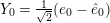 $Y_{0}=\frac{1}{\sqrt{2}}(e_{0}-\hat{e}_{0})$
and
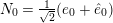 $N_{0}=\frac{1}{\sqrt{2}}(e_{0}+\hat{e}_{0})$
. We have
 $$\begin{eqnarray}\displaystyle \left\{\begin{array}{@{}l@{}}e_{0z}=a_{12}\hat{e}_{0}+a_{13}e_{1}+a_{14}e_{2}+\sqrt{2}\displaystyle \mathop{\sum }_{1\leqslant j\leqslant n}\unicode[STIX]{x1D6FD}_{j}\unicode[STIX]{x1D713}_{j},\\ \hat{e}_{0z}=a_{12}e_{0}-a_{23}e_{1}-a_{24}e_{2}+\sqrt{2}\displaystyle \mathop{\sum }_{1\leqslant j\leqslant n}\unicode[STIX]{x1D6FD}_{j}\unicode[STIX]{x1D713}_{j},\\ e_{1z}=a_{13}e_{0}+a_{23}\hat{e}_{0}-a_{34}e_{2}+\displaystyle \mathop{\sum }_{1\leqslant j\leqslant n}k_{j}\unicode[STIX]{x1D713}_{j},\\ e_{2z}=a_{14}e_{0}+a_{24}\hat{e}_{0}+a_{34}e_{1}+\displaystyle \mathop{\sum }_{1\leqslant j\leqslant n}ik_{j}\unicode[STIX]{x1D713}_{j}.\\ \end{array}\right. & & \displaystyle\end{eqnarray}$$
Then
 $$\begin{eqnarray}Y_{0z}=\frac{1}{\sqrt{2}}(e_{0}-\hat{e}_{0})_{z}=-a_{12}Y_{0}+\frac{1}{\sqrt{2}}(a_{13}+a_{23})(e_{1}-ie_{2})\end{eqnarray}$$
follows. Now there are two possibilities:
Case (a):
 $a_{13}+a_{23}$
does not vanish identically on
 $U$
. Since
 $a_{13}+a_{23}$
is real analytic, there exists some subset
 $U_{0}$
of
 $U$
satisfying the first part of the claim. In this case, one verifies directly that
 $[Y_{0}]$
is conformal from
 $U$
to
 $S^{n+2}$
and a conformal immersion from
 $U\setminus U_{0}$
into
 $S^{n+2}$
.
Calculating
 $$\begin{eqnarray}Y_{0z\bar{z}}=|a_{13}+a_{23}|^{2}N_{0}\hspace{0.6em}{\rm mod}\hspace{0.2em}\{Y_{0},e_{1},e_{2}\}\end{eqnarray}$$
shows that
 $f$
is the harmonic conformal Gauss map of
 $[Y_{0}]$
on
 $U\setminus U_{0}$
. As a consequence,
 $[Y_{0}]$
is a Willmore surface on
 $U\setminus U_{0}$
.
The claims involving the S-Willmore condition follow from Corollary 2.11. So we only need to consider Case (a2). By Theorem 2.12, the dual surface
 ${\hat{y}}$
of
 $[Y_{0}]$
is defined on
 $U\setminus U_{0}$
and has
 $f$
as its conformal Gauss map if we change the complex structure of
 $U$
, if
 ${\hat{y}}$
is immersed on an open dense subset of
 $U\setminus U_{0}$
.
It remains to prove in this case that
 ${\hat{y}}$
extends real analytically to all of
 $U$
. By Theorem 2.12,
 ${\hat{y}}$
is defined on
 $U\setminus U_{0}$
. To extend
 ${\hat{y}}$
to
 $U$
, consider a lift
 ${\hat{Y}}$
of
 ${\hat{y}}$
. Then
 ${\hat{Y}}=a_{0}Y_{0}+{\check{a}}_{0}N_{0}+a_{1}e_{1}+a_{2}e_{2}$
for some real valued functions defined on
 $U\setminus U_{0}$
. Since
 ${\hat{Y}}$
is not always a multiple of
 $Y_{0}$
, it follows that
 $Y_{0}$
and
 ${\hat{Y}}$
are linearly independent on some open (and dense) subset
 $U^{\prime }(\subset U\setminus U_{0})$
of
 $U$
, and
 ${\check{a}}_{0}\neq 0$
on
 $U^{\prime }$
follows. We can thus consider
 $\frac{1}{{\check{a}}_{0}}{\hat{Y}}$
on
 $U^{\prime }$
. Hence we can assume without loss of generality that
 ${\hat{Y}}$
is of the form
 $$\begin{eqnarray}\displaystyle {\hat{Y}}=N_{0}+\unicode[STIX]{x1D707}_{1}e_{1}-\unicode[STIX]{x1D707}_{2}e_{2}+{\textstyle \frac{1}{2}}|\unicode[STIX]{x1D707}|^{2}Y_{0} & & \displaystyle\end{eqnarray}$$
on
 $U^{\prime }$
, with
 $\unicode[STIX]{x1D707}=\unicode[STIX]{x1D707}_{1}+i\unicode[STIX]{x1D707}_{2}$
a real analytic complex valued function. Using (3.15), we obtain
 $$\begin{eqnarray}\displaystyle {\hat{Y}}_{z}=\mathop{\sum }_{j}^{n}(2\unicode[STIX]{x1D6FD}_{j}+\bar{\unicode[STIX]{x1D707}}k_{j})\unicode[STIX]{x1D713}_{j}\hspace{0.6em}{\rm mod}\hspace{0.2em}\{e_{0},\hat{e}_{0},e_{1},e_{2}\}onU^{\prime }. & & \displaystyle\end{eqnarray}$$
Now the duality condition implies
 ${\hat{Y}}_{z}=0\hspace{0.6em}{\rm mod}\hspace{0.2em}\{e_{0},\hat{e}_{0},e_{1},e_{2}\},$
whence
 $\unicode[STIX]{x1D707}$
is the solution to the equations
 $\unicode[STIX]{x1D6FD}_{j}=-\frac{\bar{\unicode[STIX]{x1D707}}}{2}k_{j},~j=1,2,\ldots ,n$
on
 $U^{\prime }$
.
To extend
 ${\hat{Y}}$
, all we need to do is to extend the definition of
 $\unicode[STIX]{x1D707}$
real analytically to
 $U$
. To extend
 $\unicode[STIX]{x1D707}$
, we only need to show that
 $\unicode[STIX]{x1D707}$
has a well-defined (finite or infinite) limit at all points
 $U^{\ast }\subset U$
where
 $\sum |k_{j}|^{2}$
vanishes. From Corollary A.2 in Appendix A, we know
 $B_{1}=h_{0}\tilde{B}_{1}$
with
 $\tilde{B}_{1}$
never vanishing on
 $U$
. So for every
 $p\in U^{\ast }$
, there exists some
 $j$
such that
 $\unicode[STIX]{x1D6FD}_{j}=h_{0}\tilde{\unicode[STIX]{x1D6FD}}_{j},~k_{j}=h_{0}\tilde{k}_{j}$
with
 $|\tilde{\unicode[STIX]{x1D6FD}}_{j}(p)|^{2}+|\tilde{k}_{j}(p)|^{2}\neq 0$
. If
 $\tilde{k}_{j}(p)\neq 0$
, then the limit
 $\lim _{\tilde{p}\rightarrow p}\frac{\unicode[STIX]{x1D6FD}_{j}}{k_{j}}=\frac{\tilde{\unicode[STIX]{x1D6FD}_{j}}}{\tilde{k}_{j}}$
exists, is finite, and the quotient function is real analytic in a neighborhood of
 $p$
. In this case, we can define
 $[{\hat{Y}}]$
also by (3.16). If
 $\tilde{k}_{j}=0$
, then
 $\tilde{\unicode[STIX]{x1D6FD}}_{j}\neq 0$
and the inverse of the limit is real analytic in a neighborhood of
 $p$
. Then we consider (locally)
 $\tilde{{\hat{Y}}}=\frac{1}{|\unicode[STIX]{x1D707}|^{2}}{\hat{Y}}$
. By the argument just given,
 $\tilde{{\hat{Y}}}$
is well defined and real analytic in a (possibly small) neighborhood
 $U_{p}$
of
 $p\in U$
and
 $[\tilde{{\hat{Y}}}]=[{\hat{Y}}]={\hat{y}}$
holds on
 $U_{p}\cap U^{\prime }$
.
Case (b):
 $a_{13}+a_{23}=0$
on
 $U$
. Then we obtain
 $Y_{0z}=-a_{12}Y_{0}.$
By scaling, we may assume that
 $Y_{0z}=0$
holds. Hence we can assume without loss of generality
 $a_{12}=0$
on
 $U$
.
(b1): Let us assume that the strongly conformally harmonic map
 $f$
is the conformal Gauss map of some conformal immersion
 $\check{y}:U^{\prime }\rightarrow S^{n+2},$
where
 $U^{\prime }$
is some (possibly small) open subset of
 $U$
. In this case, the canonical lift
 $\check{Y}$
of
 $\check{y}$
satisfies (with
 $z=u+iv$
)
 $$\begin{eqnarray}\displaystyle f=Span_{\mathbb{R}}\{\check{Y},\check{Y}_{u},\check{Y}_{v},\check{Y}_{z\bar{z}}\}=Span_{\mathbb{R}}\{e_{0},\hat{e}_{0},e_{1},e_{2}\}=Span_{\mathbb{R}}\{Y_{0},N_{0},e_{1},e_{2}\}. & & \displaystyle\end{eqnarray}$$
Thus similar to the discussions above, we can thus assume that a lift
 $Y_{\unicode[STIX]{x1D707}}$
of
 $\check{y}$
is of the form
 $$\begin{eqnarray}\displaystyle Y_{\unicode[STIX]{x1D707}}=N_{0}+\unicode[STIX]{x1D707}_{1}e_{1}-\unicode[STIX]{x1D707}_{2}e_{2}+{\textstyle \frac{1}{2}}|\unicode[STIX]{x1D707}|^{2}Y_{0} & & \displaystyle\end{eqnarray}$$
with
 $\unicode[STIX]{x1D707}=\unicode[STIX]{x1D707}_{1}+i\unicode[STIX]{x1D707}_{2}$
a real analytic complex valued function defined on an open and dense subset
 $U^{\prime \prime }$
of
 $U$
. Then, since
 $[Y_{\unicode[STIX]{x1D707}}]=\check{y}$
is a conformal surface with a conformal Gauss map
 $f$
, we know that
 $Y_{\unicode[STIX]{x1D707}}$
satisfies
 $$\begin{eqnarray}\displaystyle Y_{\unicode[STIX]{x1D707}z}\in Span_{\mathbb{C}}\{e_{0},\hat{e}_{0},e_{1},e_{2}\}. & & \displaystyle\end{eqnarray}$$
Using (3.15), we obtain
 $$\begin{eqnarray}\displaystyle Y_{\unicode[STIX]{x1D707}z}=\mathop{\sum }_{j}^{n}(2\unicode[STIX]{x1D6FD}_{j}+\bar{\unicode[STIX]{x1D707}}k_{j})\unicode[STIX]{x1D713}_{j}\hspace{0.6em}{\rm mod}\hspace{0.2em}\{e_{0},\hat{e}_{0},e_{1},e_{2}\}onU^{\prime \prime }. & & \displaystyle\end{eqnarray}$$
Now the last two equations imply
 $Y_{\unicode[STIX]{x1D707}z}=0\hspace{0.6em}{\rm mod}\hspace{0.2em}\{e_{0},\hat{e}_{0},e_{1},e_{2}\},$
whence
 $\unicode[STIX]{x1D6FD}_{j}=-\frac{\bar{\unicode[STIX]{x1D707}}}{2}k_{j},~j=1,2,\ldots ,n$
on
 $U^{\prime \prime }$
. From this, we infer that on
 $U^{\prime \prime }$
we have rank
 $B_{1}\leqslant 1$
, and since
 $B_{1}$
is real analytic, we obtain
 $rank(B_{1})\leqslant 1$
on
 $U$
and the claim follows.
(b2): Let us assume now that the maximal rank of
 $B_{1}$
is
 $1$
. We distinguish two cases according to the vanishing or not of
 $\sum |k_{j}|^{2}$
on
 $U$
.
Case (b2.a):
 $\sum |k_{j}|^{2}\neq 0$
and rank
 $(B_{1})=1$
on the open and dense subset
 $U^{\sharp }$
of
 $U$
. Note that these conditions imply
 $\unicode[STIX]{x1D6FD}_{j}=-\frac{\bar{\unicode[STIX]{x1D707}}}{2}k_{j},j=1,\ldots n$
on
 $U^{\sharp }$
for some function
 $\unicode[STIX]{x1D707}$
on the open (and dense) subset
 $U^{\sharp }$
of
 $U$
. Now we consider
 $Y_{\unicode[STIX]{x1D707}}$
of the form (3.19) with this
 $\unicode[STIX]{x1D707}$
. We will show that it satisfies
 $Y_{\unicode[STIX]{x1D707}},~Y_{\unicode[STIX]{x1D707}z},~Y_{\unicode[STIX]{x1D707}z\bar{z}}\in Span_{\mathbb{C}}\{e_{0},\hat{e}_{0},e_{1},e_{2}\}.$
It will turn out to be convenient to rewrite
 $Y_{\unicode[STIX]{x1D707}}$
in the form
 $$\begin{eqnarray}\displaystyle Y_{\unicode[STIX]{x1D707}}=N_{0}+\unicode[STIX]{x1D707}_{1}e_{1}-\unicode[STIX]{x1D707}_{2}e_{2}+\frac{|\unicode[STIX]{x1D707}|^{2}}{2}Y_{0}=N_{0}+\bar{\unicode[STIX]{x1D707}}P+\unicode[STIX]{x1D707}\bar{P}+\frac{|\unicode[STIX]{x1D707}|^{2}}{2}Y_{0}, & & \displaystyle\end{eqnarray}$$
with
 $\unicode[STIX]{x1D707}=\unicode[STIX]{x1D707}_{1}+i\unicode[STIX]{x1D707}_{2}$
and
 $~P=\frac{1}{2}(e_{1}-ie_{2})$
. Note that for
 $Y_{\unicode[STIX]{x1D707}}$
, equation (3.21) holds. Substituting
 $\unicode[STIX]{x1D6FD}_{j}=-\frac{\bar{\unicode[STIX]{x1D707}}}{2}k_{j}$
into expression (3.21) for
 $Y_{\unicode[STIX]{x1D707}z}$
, we obtain
 $Y_{\unicode[STIX]{x1D707}u},Y_{\unicode[STIX]{x1D707}v}\in Span_{\mathbb{R}}\{e_{0},\hat{e}_{0},e_{1},e_{2}\}$
.
Moreover, using
 $P_{\bar{z}}=-i\bar{a}_{34}P+\frac{1}{2}(\bar{a}_{13}-i\bar{a}_{14})Y_{0},$
which follows from
 $\text{d}F=F\unicode[STIX]{x1D6FC}$
together with the special values for the entries of
 $\unicode[STIX]{x1D6FC}$
in the case under discussion, one derives
 $Y_{\unicode[STIX]{x1D707}z\bar{z}}\in Span_{\mathbb{R}}\{e_{0},\hat{e}_{0},e_{1},e_{2}\}.$
Thus we have shown that for the light-like vector
 $Y_{\unicode[STIX]{x1D707}}$
, the relation
 $Y_{\unicode[STIX]{x1D707}},~Y_{\unicode[STIX]{x1D707}z},~Y_{\unicode[STIX]{x1D707}z\bar{z}}\in Span_{\mathbb{C}}\{e_{0},\hat{e}_{0},e_{1},e_{2}\}$
holds.
Next we want to determine when the map
 $Y_{\unicode[STIX]{x1D707}}$
comes from some conformal map into
 $S^{n+2}$
. It is easy to verify that
 $y^{\ast }=[Y_{\unicode[STIX]{x1D707}}]$
is a conformal (whence Willmore) surface with its conformal Gauss map spanning the same vector space as
 $f$
if and only if
 $Y_{\unicode[STIX]{x1D707}}$
satisfies
 $$\begin{eqnarray}\displaystyle Y_{\unicode[STIX]{x1D707}},~Y_{\unicode[STIX]{x1D707}z},~Y_{\unicode[STIX]{x1D707}z\bar{z}}\in Span_{\mathbb{C}}\{e_{0},\hat{e}_{0},e_{1},e_{2}\},\quad \langle Y_{\unicode[STIX]{x1D707}z},Y_{\unicode[STIX]{x1D707}z}\rangle =0,\quad \langle Y_{\unicode[STIX]{x1D707}z},Y_{\unicode[STIX]{x1D707}\bar{z}}\rangle >0. & & \displaystyle\end{eqnarray}$$
We have shown above that the first three conditions are satisfied for
 $Y_{\unicode[STIX]{x1D707}}$
. To verify the fourth condition, we evaluate the harmonicity condition for
 $f$
. Substituting
 $\unicode[STIX]{x1D6FD}_{j}=-\frac{\bar{\unicode[STIX]{x1D707}}}{2}k_{j}$
into the first equation of (3.13) and using
 $a_{13}+a_{23}=0$
,
 $a_{12}=0$
, and the third equation of (3.13), we derive
 $\unicode[STIX]{x1D707}_{z}+\sqrt{2}(a_{13}-ia_{14})+ia_{34}\unicode[STIX]{x1D707}=0$
on
 $U^{\sharp }$
.
Next we observe that the derivative of
 $Y_{\unicode[STIX]{x1D707}}$
also satisfies
 $$\begin{eqnarray}\displaystyle Y_{\unicode[STIX]{x1D707}z}=(\cdots \,)P+(\cdots \,)Y_{0}+(\unicode[STIX]{x1D707}_{z}+\sqrt{2}(a_{13}-ia_{14})+ia_{34}\unicode[STIX]{x1D707})\bar{P}=(\cdots \,)P+(\cdots \,)Y_{0}, & & \displaystyle\end{eqnarray}$$
whence
 $\langle Y_{\unicode[STIX]{x1D707}z},Y_{\unicode[STIX]{x1D707}z}\rangle =0$
follows.
As a consequence, the only condition to decide whether
 $f$
corresponds to a conformal immersion or not is whether we can satisfy
 $\langle Y_{\unicode[STIX]{x1D707}z},Y_{\unicode[STIX]{x1D707}\bar{z}}\rangle >0$
or not.
This naturally leads to the two cases listed in the theorem.
Case (i). There exists an open and dense subset
 $U^{\ast }\subset U^{\sharp }\subset U$
, where
 $\langle Y_{\unicode[STIX]{x1D707}z},Y_{\unicode[STIX]{x1D707}\bar{z}}\rangle >0$
holds. Then, for every
 $z\in U^{\ast }$
, the subspace spanned by
 $f(z,\bar{z})$
coincides with the one of
 $Gr_{y^{\ast }}(z,\bar{z})$
. Hence either
 $f(z,\bar{z})=Gr_{y^{\ast }}(z,\bar{z})$
on
 $U^{\ast }$
or
 $f(z,\bar{z})$
spans the same subspace as
 $Gr_{y^{\ast }}(z,\bar{z})$
and has an orientation that is opposite to the one of
 $Gr_{y^{\ast }}(z,\bar{z})$
. In the latter case, this just says that after a change of complex structure of
 $U$
, the conformal Gauss map of
 $y^{\ast }$
coincides with
 $f$
. Moreover, since
 $f$
and hence
 $Gr_{y^{\ast }}$
contain the light-like vector
 $Y_{0}$
, by the stereographic projection with respect to
 $Y_{0}$
,
 $[Y_{\unicode[STIX]{x1D707}}]$
becomes a minimal surface in
 $R^{n+2}$
[Reference Bryant3, Reference Ejiri15, Reference Ma and Wang27].
To extend
 $y^{\ast }=[Y_{\unicode[STIX]{x1D707}}]$
to
 $U$
, we need only to show that
 $\unicode[STIX]{x1D707}$
has a well-defined (finite or infinite) limit at all points where
 $\sum |k_{j}|^{2}$
vanishes. The argument for this is very similar to the argument given in Case
 $(a2)$
.
From Corollary A.2 in Appendix A, we know
 $B_{1}=h_{0}\tilde{B}_{1}$
with
 $\tilde{B}_{1}$
never vanishing on
 $U$
. So for every
 $p\in U\backslash U^{\sharp }$
, there exists some
 $j$
such that
 $\unicode[STIX]{x1D6FD}_{j}=h_{0}\tilde{\unicode[STIX]{x1D6FD}}_{j},~k_{j}=h_{0}\tilde{k}_{j}$
with
 $|\tilde{\unicode[STIX]{x1D6FD}}_{j}(p)|^{2}+|\tilde{k}_{j}(p)|^{2}\neq 0$
. If
 $\tilde{k}_{j}(p)\neq 0$
, then the limit
 $\lim _{\tilde{p}\rightarrow p}\frac{\unicode[STIX]{x1D6FD}_{j}}{k_{j}}=\frac{\tilde{\unicode[STIX]{x1D6FD}_{j}}}{\tilde{k}_{j}}$
exists, is finite, and the quotient function is real analytic in a neighborhood of
 $p$
. In this case, we can define
 $[Y_{\unicode[STIX]{x1D707}}]$
also by (3.22). If
 $\tilde{k}_{j}=0$
, then
 $\tilde{\unicode[STIX]{x1D6FD}}_{j}\neq 0$
and the inverse of the limit is real analytic in a neighborhood of
 $p$
. Then we consider (locally)
 ${\tilde{Y}}_{\unicode[STIX]{x1D707}}=\frac{1}{|\unicode[STIX]{x1D707}|^{2}}Y_{\unicode[STIX]{x1D707}}$
. By the argument just given,
 ${\tilde{Y}}_{\unicode[STIX]{x1D707}}$
is well defined and real analytic in a (possibly small) neighborhood
 $U_{p}$
of
 $p\in U$
and
 $[{\tilde{Y}}_{\unicode[STIX]{x1D707}}]=[Y_{\unicode[STIX]{x1D707}}]=y^{\ast }$
holds on
 $U_{p}\cap U^{\sharp }$
.
Case (ii). If
 $\langle Y_{\unicode[STIX]{x1D707}z},Y_{\unicode[STIX]{x1D707}\bar{z}}\rangle =0$
on
 $U$
, then
 $Y_{\unicode[STIX]{x1D707}}$
is another constant light-like vector of
 $f$
, linearly independent from
 $Y_{0}$
. So
 $Y_{0}$
and
 $Y_{\unicode[STIX]{x1D707}}$
span a constant, real, 2-dimensional Lorentzian subspace. Let
 $\{\tilde{e}_{0},\tilde{\hat{e}}_{0}\}$
be a Euclidean oriented orthonormal basis of it and let
 $\{\tilde{e}_{0},\tilde{\hat{e}}_{0},\tilde{e}_{1},\tilde{e}_{2}\}$
be an oriented orthonormal basis of
 $\text{Span}_{\mathbb{R}}\{e_{0},\hat{e}_{0},e_{1},e_{2}\}$
. Since
 $\{e_{0},\hat{e}_{0}\}$
and
 $\{\tilde{e}_{0},\tilde{\hat{e}}_{0}\}$
span 2-dimensional Lorentzian subspaces and
 $\{e_{1},e_{2}\}$
and
 $\tilde{e}_{1},\tilde{e_{2}}$
span Euclidean subspaces, there exists a transformation in
 $SO^{+}(1,3)$
, which maps the first basis onto the second one in the given order. Then the lift
 $\tilde{F}(z,\bar{z})=(\tilde{e}_{0},\tilde{\hat{e}}_{0},\tilde{e}_{1},\tilde{e}_{2},\unicode[STIX]{x1D713}_{1},\ldots ,\unicode[STIX]{x1D713}_{n})$
reduces to a map into
 $SO(n+2)\subset SO^{+}(1,n+3)$
, that is,
 $f$
reduces to a harmonic map into
 $SO(n+2)/SO(2)\times SO(n)\subset SO^{+}(1,n+3)/SO^{+}(1,3)\times SO(n)$
.
Case
 $(b2.b)$
:
 $\sum |k_{j}|^{2}\equiv 0$
. In this case, the integrability condition of
 $\unicode[STIX]{x1D6FC}$
implies, in view of the vanishing of both sides on (3.23), that the submatrix of
 $\unicode[STIX]{x1D6FC}$
with entries
 $33,34,43,44$
is integrable. Hence, after gauging
 $\unicode[STIX]{x1D6FC}$
by some matrix in
 $SO(2)$
, we can assume without loss of generality that
 $a_{34}=0$
holds. Hence we obtain
 $e_{1z}=\sqrt{2}a_{13}Y_{0}$
and
 $~e_{2z}=\sqrt{2}a_{14}Y_{0}.$
Since
 $Y_{0z}=0$
, similarly after gauging
 $\unicode[STIX]{x1D6FC}$
by some matrix in
 $SO^{+}(1,3)$
, we can assume without loss of generality that
 $a_{13}=a_{14}=0$
holds, that is,
 $e_{1}$
and
 $e_{2}$
are constant. Hence
 $f$
reduces to a map into
 $SO^{+}(1,n+1)/SO^{+}(1,1)\times SO(n)\subset SO^{+}(1,n+3)/SO^{+}(1,3)\times SO(n)$
.◻
Remark 3.12. Note that the proof of Theorem 3.11 shows how one can construct a Willmore surface from a strongly conformally harmonic map
 $f:U\rightarrow SO^{+}(1,n+3)/SO^{+}(1,3)\times SO(n)$
or prove that
 $f$
is not the conformal Gauss map of any conformal map
 $y:U\rightarrow S^{n+2}$
(or in other words,
 $f$
is the “conformal Gauss map” of a constant map
 $[Y]$
if we still call
 $f$
the “conformal Gauss map” of
 $[Y]$
when
 $[Y]$
reduces to a point):
-
(1) Step 1: Choose any frame
$~\tilde{F}:U\rightarrow SO^{+}(1,n+3)$
. -
(2) Step 2: Choose a gauge
$A:U\rightarrow SO^{+}(1,3)\times SO(n)$
such that the Maurer–Cartan form
$\unicode[STIX]{x1D6FC}=F^{-1}\text{d}F$
of the new frame
$F=\tilde{F}A$
has the form as stated in (3.11). For this we may need to change the complex structure on
$U$
. Write
$F=(e_{0},\hat{e}_{0},e_{1},e_{2},\unicode[STIX]{x1D713}_{1},\ldots ,\unicode[STIX]{x1D713}_{n})$
as in the theorem and set
$Y_{0}=\frac{1}{\sqrt{2}}(e_{0}-\hat{e}_{0}).$
Then in the proof above, one shows (3.25)So
$$\begin{eqnarray}\displaystyle Y_{0z}=\frac{1}{\sqrt{2}}(e_{0}-\hat{e}_{0})_{z}=-a_{12}Y_{0}+\frac{1}{\sqrt{2}}(a_{13}+a_{23})(e_{1}-ie_{2}). & & \displaystyle\end{eqnarray}$$
$[Y_{0}]$
is constant if and only if
$a_{13}+a_{23}\equiv 0$
if and only if the frame
$F$
is in Case (b).
-
(3) Step 3: Consider the function
$h=a_{13}+a_{23}:U\rightarrow \mathbb{C}$
.-
(a) Step 3a:
$h\not \equiv 0$
on
$U$
:Then
$f$
is the (harmonic) oriented conformal Gauss map of the conformal map
$y=[Y_{0}]=[e_{0}-\hat{e}_{0}]:\hat{U} \rightarrow S^{n+2}$
. It turns out that this is the generic case; see below. -
(b) Step 3b:
$h\equiv 0$
on
$U$
:If the maximal rank of
$B_{1}$
is 2, then
$f$
is not (even locally) the conformal Gauss map of any conformal immersion.If the maximal rank of
$B_{1}$
is 1, consider the function
$p=\sum _{j=1}^{n}|k|^{2}:U\rightarrow \mathbb{R}_{{\geqslant}0}$
. If
$p\equiv 0$
on
$U$
, then
$f$
is not (even locally) the conformal Gauss map of any conformal immersion. If
$p\not \equiv 0$
on
$U$
, we can only obtain (possibly only after changing the complex structure on U) Willmore surfaces in
$S^{n+2}$
that are conformal to minimal surfaces in
$\mathbb{R}^{n+2}$
. If we are not interested in minimal surfaces in
$\mathbb{R}^{n+2},$
then we are done. Otherwise, let
$\unicode[STIX]{x1D707}=-\frac{2\bar{\unicode[STIX]{x1D6FD}}_{j}}{\bar{k}_{j}}$
on the points
$\bar{k}_{j}\neq 0$
. With such a function
$\unicode[STIX]{x1D707}$
, we consider
$Y_{\unicode[STIX]{x1D707}}$
as in (3.19). The stereographic projection of
$Y_{\unicode[STIX]{x1D707}}$
with center
$Y_{0}$
yields a minimal surface in
$\mathbb{R}^{n+2}$
.
-





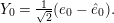











Remark 3.13.
-
(1) Note that if
$rankB_{1}=2$
, there is a unique gauge of the frame such that Theorem 3.4 holds. Correspondingly, there is a unique map
$[Y_{0}]$
associated with
$f$
. If
$rankB_{1}=1$
, there are two different kinds of gauges of the frame
$F$
such that Theorem 3.4 holds. Consequently, there are two different projections from
$F$
to
$S^{n+2}$
, giving a pair of Willmore surfaces dual to each other in general. This reinterprets the duality theorem of Willmore surfaces due to Blaschke [Reference Blaschke2], Bryant [Reference Bryant3], and Ejiri [Reference Ejiri15]. -
(2) When we begin with the harmonic map
$f$
, then one of the associated Willmore maps
$[Y_{0}]=[e_{0}-\hat{e}_{0}]$
may degenerate to a point. If
$rankB_{1}=2$
, then we will obtain no Willmore surface associated with
$f$
. If
$rankB_{1}=1$
, there is another Willmore map
$[{\hat{Y}}_{0}]$
associated with
$f$
. If
$[{\hat{Y}}_{0}]$
does not degenerate to a point, it is conformally equivalent to a minimal surface in
$\mathbb{R}^{n+2}$
. This is exactly how minimal surfaces in
$\mathbb{R}^{n+2}$
occur in the classification of Willmore 2-spheres in
$S^{3}$
by Bryant [Reference Bryant3] and the classification of Willmore 2-spheres with dual surfaces in
$S^{n+2}$
by Ejiri [Reference Ejiri15]. We refer the reader to the corollary below for a description of minimal surfaces in
$\mathbb{R}^{n+2}$
in terms of
$f$
. -
(3) It turns out that the associated Willmore map/maps being nondegenerate is the generic case and of most interest in the loop group approach. Moreover, if one uses the loop group formalism to produce all strongly conformally harmonic maps
$f$
, one can recognize immediately by looking at the “normalized potential” if the associated harmonic map has a constant light-like vector. It is one of the main results of [Reference Wang36] to show how these exceptional normalized potentials looks like. Excluding this exceptional case, all other normalized potentials yield harmonic maps with frames belonging to the case of the associated Willmore map/maps being nondegenerate. Since minimal surfaces in
$\mathbb{R}^{n+2}$
can be well investigated in a simpler way, we will be primarily interested in the conformally harmonic maps with nondegenerate associated Willmore map/maps. -
(4) It is in general very hard to detect whether
$y$
is immersed or branched at some point from the behavior of
$f$
. It will be an interesting question to discuss the immersion property of
$y$
in terms of
$f$
.


Considering the nondegenerate case, we have the following theorem.
Theorem 3.14. Let
 $f$
be a strongly conformally harmonic map as in Theorem 3.11. Assume that
 $f$
does not contain any constant light-like vector (so
 $f$
belongs to Case (
 $a$
)).
-
(1) If
$rankB_{1}=2$
, then there exists a unique Willmore map
$y:U\rightarrow S^{n+2}$
, which is not an S-Willmore map, such that
$y$
is immersed on
$U\setminus U_{0}$
and has
$f$
as its conformal Gauss map. -
(2) If
$rankB_{1}=1$
, then there exists a pair of S-Willmore maps
$y,{\hat{y}}:U\rightarrow S^{n+2}$
, which are dual to each other and such that-
(i) on an open dense subset of
$U$
,
$y$
is immersed and
$f$
is its conformal Gauss map; -
(ii) on an open dense subset of
$U$
,
${\hat{y}}$
is immersed and
$f$
is its conformal Gauss map after a change of the orientation of
$U$
.
-





Ejiri’s Willmore torus in
 $S^{5}$
[Reference Ejiri14] provides an example for Case (1), and Veronese spheres in
 $S^{2m}$
[Reference Montiel29] provide examples for Case (2).
We have characterizations of minimal surfaces in
 $\mathbb{R}^{n+2}$
(the degenerate case) as follows.
Corollary 3.15. Let
 $f$
be a strongly conformally harmonic map as in Theorem 3.11.
-
(1) If
$f$
belongs to Case (a) as well as to Case (b), then possibly after changing the complex structure of
$U$
,
$f$
is the conformal Gauss map of some minimal surface in
$R^{n+2}$
(after putting
$R^{n+2}$
conformally into
$S^{n+2}$
) and vice versa. -
(2) If
$f$
contains a constant light-like vector, then either
$f$
does not correspond to any Willmore map or
$f$
corresponds to a Willmore map, which is conformally equivalent to a minimal surface into
$\mathbb{R}^{n+2}$
(possibly after changing the orientation of
$U$
).


By Theorems 2.12 and 3.11, we have the following.
Lemma 3.16. Let
 $f$
be a strongly conformally harmonic map as in Theorem 3.11. Fix the orientation of the contractible open set
 $U$
. Then
-
(1) either
$f$
is not the conformal Gauss map of any conformal map on any open subset of
$U$
; -
(2) or there exists a unique Willmore map
$y:U\rightarrow S^{n+2}$
such that
$f$
is the oriented conformal Gauss map of
$y$
on an open dense subset of
$U$
.


Proof. Case (3) of Theorem 2.12 gives the unique corresponding between
 $y$
and
 $f$
and Theorem 3.11 says that either
 $y$
reduces to a point or
 $y$
is an immersion on an open dense subset, which is exactly the lemma.◻
Since any two points of a surface
 $M$
are contained in a contractible open subset of
 $M$
, the corollary yields straightforwardly the following
Theorem 3.17. Let
 $f:M\rightarrow SO^{+}(1,n+3)/SO^{+}(1,3)\times SO(n)$
be a nonconstant strongly conformally harmonic map from a connected Riemann surface
 $M$
. If on a contractible open subset
 $U\subset M$
,
 $f$
is the oriented conformal Gauss map of some Willmore immersion
 $y:U\rightarrow S^{n+2}$
, then there exists a unique conformal (Willmore) map
 $y:M\rightarrow S^{n+2}$
such that
 $f$
is the oriented conformal Gauss map of
 $y$
on an open dense subset
 $M_{1}$
of
 $M$
and
 ${\tilde{y}}|_{U}=y$
.
Acknowledgments
This work was started when the second author visited the Department of Mathematics of Technische Universität München and the Department of Mathematics of Tuebingen University. He would like to express his sincere gratitude for both the hospitality and financial support. The second author is thankful to Professor Changping Wang and Xiang Ma for their suggestions and encouragement. The second author was partly supported by Project 11971107 of NSFC. The authors are thankful to the referee for helpful remarks and suggestions improving the paper.
Added in Proof: After the submission of this paper, F. Burstall posted the paper “On Conformal Gauss maps”, arXiv:1904.02574. The paper was published in Bull. Lond. Math. Soc. 51 (2019) 989–994.
Appendix A. Proof of Theorem 3.4
Let
 $U$
be a contractible open subset of some Riemann surface
 $M$
. Then the Maurer–Cartan form of any strongly conformally harmonic map
 $f:M\rightarrow G/K$
is real analytic on
 $U$
. Moreover, the matrix
 $B_{1}$
in (3.6) satisfies
 $B_{1}^{t}I_{1,3}B_{1}=0$
by Definition 3.7. In particular, the columns of
 $B_{1}$
are orthogonal complex null vectors relative to the quadratic form defined by
 $I_{1,3}$
. Our goal is to find a simple canonical form of
 $B_{1}.$
The first case to consider is, where
 $B_{1}$
consists of one column. It is easy to verify that every nonvanishing fixed complex null vector
 $b\in \mathbb{C}^{4}$
can be mapped by
 $SO^{+}(1,3)$
into the space
 $$\begin{eqnarray}{\mathcal{N}}=\mathbb{C}(1,-1,0,0)^{t}\qquad orinto\qquad {\mathcal{N}}_{\pm }=\mathbb{C}(0,0,1,\pm i)^{t}\end{eqnarray}$$
according to whether the real part of
 $b$
is light-like (possibly including
 $0$
) or space-like, respectively. For a real analytic complex valued null vector function
 $b$
, it is not possible, in general, to map
 $b$
by some real analytic matrix function
 $A\in SO^{+}(1,3)$
into one of these spaces only. But if
 $B_{1}=b$
corresponds to a nontrivial strongly conformally harmonic map, then one can map
 $b$
into the sum
 ${\mathcal{N}}\oplus {\mathcal{N}}_{+}$
or into
 ${\mathcal{N}}\oplus {\mathcal{N}}_{-}$
.
We start by proving the desired result in the case where
 $b$
never vanishes on
 $U$
.
Lemma A.1. Let
 $U$
be a contractible open subset of
 $\mathbb{C}$
, and let
 $b:U\rightarrow \mathbb{C}_{1}^{4}\backslash \{0\}$
be a real analytic null vector. Then there exists a real analytic map
 $A:U\rightarrow SO^{+}(1,3)$
such that the function
 $Ab$
is contained in
 ${\mathcal{N}}\oplus {\mathcal{N}}_{+}$
, that is,
 $Ab$
has the form
 $(p,-p,q,iq)^{t}$
.
Proof. The proof is particularly easy if one realizes
 $\mathbb{C}^{4}\cong \text{Mat}(2,\mathbb{C})$
with quadratic form
 $$\begin{eqnarray}\langle X,X^{\prime }\rangle =X_{11}X_{22}^{\prime }-X_{12}X_{21}^{\prime }+X_{22}X_{11}^{\prime }-X_{21}X_{12}^{\prime }.\end{eqnarray}$$
In this realization, the nonvanishing complex null vectors are exactly all matrices of rank 1, that is, all nonvanishing matrices of determinant
 $0$
. As real form, we choose
 $\mathbb{R}_{1}^{4}\cong \text{Herm}(2,\mathbb{C})$
, the space of
 $2\times 2$
complex Hermitian matrices.
The group
 $SO(4,\mathbb{C})\cong (SL(2,\mathbb{C})\times SL(2,\mathbb{C}))/\{\pm I\}$
acts on
 $\text{Mat}(2,\mathbb{C})$
by
 $(g,h).X=gXh^{-1}$
. Then
 $SO^{+}(1,3)\cong SL(2,\mathbb{C})/\{\pm I\}$
acts by
 $g.X=gX\bar{g}^{t}$
.
In the spirit of what was said before the statement of the lemma, we want to transform any real analytic map
 $X$
defined in
 $U$
with values in
 $\text{Mat}(2,\mathbb{C})$
into the complex space
 $\mathbb{C}E_{11}\oplus \mathbb{C}E_{21}$
by the operation
 $X\rightarrow gX\bar{g}^{t}$
, where
 $g\in SL(2,\mathbb{C})$
is defined on
 $U$
and real analytic.
Now it is an easy exercise to verify that for any
 $z_{0}\in U$
there is a matrix function,
 $q_{\unicode[STIX]{x1D6FF}}$
, defined on some open neighborhood
 $U_{\unicode[STIX]{x1D6FF}}\subset U$
of
 $z_{0}$
such that
 $X\bar{g}_{\unicode[STIX]{x1D6FF}}^{t}$
has on
 $U_{\unicode[STIX]{x1D6FF}}$
an identically vanishing second column, if
 $det(X)\equiv 0$
on
 $U$
. Of course, then also
 $g_{\unicode[STIX]{x1D6FF}}X\bar{g}_{\unicode[STIX]{x1D6FF}}^{t}$
has an identically vanishing second column.
Next we consider
 $h_{\unicode[STIX]{x1D6FC}\unicode[STIX]{x1D6FD}}=q_{\unicode[STIX]{x1D6FC}}q_{\unicode[STIX]{x1D6FD}}^{-1}$
. These matrix functions are defined on
 $U_{\unicode[STIX]{x1D6FC}}\cap U_{\unicode[STIX]{x1D6FD}}$
and form a cocycle relative to the covering given by the
 $U_{\unicode[STIX]{x1D6FF}}$
. Moreover, this cocycle consists of upper triangular matrices of determinant
 $1$
. Therefore, since
 $U$
is contractible, this cocycle is a coboundary. Therefore there exist upper triangular matrices
 $h_{\unicode[STIX]{x1D6FF}}$
of determinant
 $1$
and defined on
 $U_{\unicode[STIX]{x1D6FF}}$
satisfying
 $q_{\unicode[STIX]{x1D6FC}}q_{\unicode[STIX]{x1D6FD}}^{-1}=h_{\unicode[STIX]{x1D6FC}}h_{\unicode[STIX]{x1D6FD}}^{-1}$
. As a consequence,
 $g=h_{\unicode[STIX]{x1D6FC}}^{-1}q_{\unicode[STIX]{x1D6FC}}$
is defined on
 $U$
and the second column of
 $gX\bar{g}^{t}$
vanishes identically on
 $U$
.◻
Now it is fairly straightforward to prove Theorem 3.4. If the maximal rank of
 $B_{1}$
is
 $1$
, then the argument would be easy, if all columns of
 $B_{1}$
would be real analytic multiples of one of the columns, say, the first column of
 $B_{1}$
. The actual argument follows in a sense the same idea, but is a bit more sophisticated. If the maximal rank of
 $B_{1}$
is
 $2$
, then in the complex vector space spanned by two generically linearly independent columns of
 $B_{1}$
one constructs a real vector, which then implies quite directly what we want in view of the condition
 $B_{1}^{t}I_{1,3}B_{1}=0$
.
Proof of Theorem 3.4.
First, we mention some result that is true for all harmonic maps into a symmetric space, namely that any such harmonic map can be constructed by the loop group method from “holomorphic potentials.” The proof is as in [Reference Dorfmeister, Pedit and Wu11] and is not related in any way to the specific properties of conformally harmonic maps that we investigate.
Therefore, let us consider the holomorphic potential of the harmonic map
 $f$
(for a discussion, we refer the reader to [Reference Dorfmeister, Pedit and Wu11, Reference Dorfmeister and Wang12]). Let
 $$\begin{eqnarray}\displaystyle \unicode[STIX]{x1D709}=(\unicode[STIX]{x1D706}^{-1}\unicode[STIX]{x1D709}_{-1}+\mathop{\sum }_{j\geqslant 0}\unicode[STIX]{x1D706}^{j}\unicode[STIX]{x1D709}_{j})\text{d}z,~with~\unicode[STIX]{x1D709}_{-1}=\left(\begin{array}{@{}cc@{}}0 & R_{1}\\ -R_{1}^{t}I_{1,3} & 0\\ \end{array}\right), & & \displaystyle\end{eqnarray}$$
be the corresponding holomorphic potential on
 $U$
. Then there exist some real analytic matrices
 $S_{1}\in SO^{+}(1,3,\mathbb{C})$
and
 $S_{2}\in SO(n,\mathbb{C})$
such that
 $B_{1}=S_{1}R_{1}S_{2}$
holds.
Our claim is equivalent to that there exists some real analytic matrix function
 $A:U\rightarrow SO^{+}(1,3)$
such that
 $AB_{1}$
has the form desired.
It is easy to see that it suffices to prove this special form for
 $Q_{1}=S_{1}R_{1}$
. Let us write
 $Q_{1}$
as a matrix of column vectors,
 $Q_{1}=(q_{1},\ldots ,q_{n}).$
Since we assume without loss of generality
 $B_{1}\neq 0,$
also
 $Q_{1}\neq 0.$
Hence one of the columns of
 $Q_{1}$
does not vanish. Let us assume without loss of generality that the first column
 $q_{1}$
of
 $Q_{1}$
does not vanish identically. Then the corresponding first column
 $r_{1}$
of
 $R_{1}$
does not vanish identically. Since
 $r_{1}$
is holomorphic, one can factor out some holomorphic (product) function
 $h_{1}$
such that
 $r_{1}=h_{1}\hat{r}_{1}$
, where
 $\hat{r}_{1}$
is holomorphic and never vanishes on
 $U$
. As a consequence,
 $q_{1}=h_{1}\hat{q}_{1}$
, where the globally defined and real analytic map
 $\hat{q}_{1}$
never vanishes.
From Lemma A.1, we obtain now that there exists some real analytic matrix function
 $A:U\rightarrow SO^{+}(1,3)$
such that
 $A\hat{q}_{1}$
has the desired form
 $$\begin{eqnarray}A\hat{q}_{1}=aE_{11}+bE_{21}.\end{eqnarray}$$
Hence also
 $Aq_{1}=h_{1}A\hat{q}_{1}$
has the desired form.
Let us assume next that
 $B_{1}$
has maximal rank
 $1$
. Then we claim that each column of
 $Q_{1}$
is a multiple of
 $\hat{q}_{1}$
and this multiple is holomorphic on
 $U$
. As a consequence,
 $AB_{1}$
has the desired form.
To prove the claim above, note that the relation between
 $AS_{1}r_{1}$
and
 $AS_{1}r_{j}$
can already be found between
 $r_{1}$
and
 $r_{j}$
. By the argument above, we can write
 $r_{1}=h_{1}\hat{r}_{1}$
and
 $r_{j}=h_{j}\hat{r}_{j}$
with
 $\hat{r_{1}}$
and
 $\hat{r}_{j}$
never vanishing on
 $U$
. Let
 $U^{\prime }$
denote the discrete subset of points in
 $U$
, where none of the occurring, not identically vanishing, functions/vector entries vanish. On this set one can show that an entry of
 $\hat{r}_{1}$
does not vanish identically if and only if the corresponding entry of
 $\hat{r}_{j}$
does not vanish identically. Now it is easy to verify that
 $\hat{r}_{j}$
is a holomorphic multiple of
 $\hat{r}_{1}$
, whence the statement above.
Next let us assume that the maximal rank of
 $B_{1}$
is
 $2$
. In this case, we apply the argument given above for
 $q_{1}$
to each column of
 $B_{1}$
, that is, we write
 $q_{j}=h_{j}\hat{q}_{j}$
, where
 $\hat{q}_{j}$
never vanishes on
 $U$
. Note, the case
 $q_{j}\equiv 0$
corresponds to
 $h_{j}\equiv 0$
and
 $\hat{q}_{j}=\text{const}\neq 0$
. We will also assume without loss of generality that the second column of
 $B_{1}$
does not vanish identically. Hence
 $\hat{q}_{1}$
and
 $\hat{q}_{2}$
never vanish on
 $U$
and are linearly independent on an open and dense subset
 $\tilde{U}$
of
 $U$
.
For the following argument, we realize again
 $\mathbb{C}^{4}$
by
 $\text{Mat}(2,\mathbb{C})$
. As before, we can apply the theorem above to
 $\hat{q}_{1}$
and can assume without loss of generality that
 $\hat{q}_{1}$
is a
 $2\times 2$
matrix for which the second column is
 $0$
. We will use the notation
 $\hat{q}_{1}=aE_{11}+bE_{21}$
and note that by assumption
 $|a|^{2}+|b|^{2}$
never vanishes on
 $U$
.
If
 $ab\equiv 0$
, then
 $a\equiv 0$
or
 $b\equiv 0$
on
 $U$
. The nilpotency condition
 $L^{t}I_{1,3}L=0$
for
 $Q_{1}=S_{1}R_{1}$
implies that the claim of the theorem holds, after one more (constant) gauging if necessary.
If
 $ab\neq 0$
, then after applying a constant
 $SL(2,\mathbb{C})$
matrix, if necessary, we can assume without loss of generality that
 $a\neq 0$
and
 $b\neq 0$
on the open and dense subset
 $\tilde{U}$
of
 $U$
.
In this case, using that
 $\hat{q}_{1}$
and
 $\hat{q}_{2}$
are perpendicular to each other and to themselves, it is straightforward to see by a computation on
 $\tilde{U}$
that
 $\hat{q}_{2}$
is either of the form
 $\hat{a}E_{11}+\hat{b}E_{21}$
, or of the form
 $$\begin{eqnarray}\hat{a}(aE_{11}+bE_{21})+\hat{b}(aE_{12}+bE_{22})with\hat{b}\neq 0,\end{eqnarray}$$
where the coefficient functions are real analytic on
 $\tilde{U}$
. For the first case, we are done since the coefficients clearly extend to functions defined on
 $U$
.
In the second case, one can show by a simple computation that the complex vector space spanned by
 $\hat{q}_{1}$
and
 $\hat{q}_{2}$
contains the Hermitian matrix
 $$\begin{eqnarray}w_{1}=|a|^{2}E_{11}+\bar{a}bE_{21}+a\bar{b}E_{12}|b|^{2}.\end{eqnarray}$$
Clearly, this matrix is defined on all of
 $U$
. Moreover, the
 $SL(2,\mathbb{C})$
matrix
 $g=c_{0}(\bar{b}E_{11}-aE_{12}+\bar{a}E_{21}+bE_{22})$
, with
 $c_{0}=1/\sqrt{|a|^{2}+|b|^{2}}$
, is a real analytic function on
 $U$
, which transforms
 $w_{1}$
into the matrix
 $w_{2}=(|a|^{2}+|b|^{2})E_{11}.$
As a consequence, after this transformation, the complex vector space spanned by
 $q_{1}$
and
 $q_{2}$
contains the constant matrix function
 $q_{0}=E_{11}$
.
By the construction carried out so far, the vectors
 $\{q_{0},q_{1},\ldots ,q_{m}\}$
all are perpendicular to each other and to themselves. In particular,
 $\langle q_{0},q_{j}\rangle =0$
and
 $\langle q_{j},q_{j}\rangle =0$
for
 $j>0$
implies by a straightforward computation that each of the matrices
 $q_{j},j>0,$
has a vanishing second column or a vanishing second row. But the relation
 $\langle q_{1},q_{k}\rangle =0,k>1,$
implies that all
 $q_{k}$
have the same type as
 $q_{1}$
. Hence all
 $q_{j},j\geqslant 1,$
are contained in either
 ${\mathcal{N}}\oplus {\mathcal{N}}_{+}$
or
 ${\mathcal{N}}\oplus {\mathcal{N}}_{-}$
.◻
Corollary A.2. Let
 $h_{0}$
denote the greatest common divisor of the holomorphic functions
 $h_{j},j=1,\ldots ,n,$
defined in the proof above; then
 $B_{1}=h_{0}\hat{B}_{1}$
and
 $\hat{B}_{1}(z)\neq 0$
for all
 $z\in U$
.



