Chinese leaders in the reform era have increasingly used the target-based responsibility system (mubiao zerenzhi 目标责任制, hereafter TRS), a performance measurement system designed with distinctive Chinese characteristics, to monitor and manage local officials' implementation of crucial party-state policies. Over the past three decades, the system has been implemented in different forms in local governments nationwide. By linking the career prospects of local cadres to their achievement of required policy goals, the TRS has substantially influenced the behaviour of massive numbers of local cadres.
Notwithstanding the success of the TRS in strengthening local policy compliance, its implementation has unintended consequences.Footnote 1 Perhaps the most serious consequence is widespread gaming behaviour, defined in this paper as “the deliberate manipulation of performance measures to secure strategic advantage in evaluation,”Footnote 2 which the TRS elicits in local officials striving to hit performance targets at any cost. For example, it is a “longstanding and widely acknowledged problem” that Chinese local officials fabricate key statistical data in order to accomplish their economic tasks.Footnote 3 In many reported cases, the gap between artificial and actual figures is staggering.Footnote 4 The high levels of data fabrication in local areas have led to widespread doubt about the credibility of official statistics and concern regarding the consequences of using these data in policymaking.Footnote 5
The phenomenon of gaming the TRS is not new: a growing number of studies have observed and documented it over the past two decades. The majority of the studies on the performance evaluation system in Chinese local government focus on explaining how the TRS is used to build the party-state's capacity for monitoring and controlling local cadres and touch on the unintended consequences of the TRS in local implementation. Several note, for example, that the TRS presents a moral hazard that leads to behavioural deviation, such as selective policy implementation, information falsification, output distortion, concealment of flaws and presentation of one's own work in a positive light.Footnote 6
Some studies examine the institutional rationale of gaming under the TRS more closely. A widely held viewpoint is that the TRS creates a high-pressure environment in which local cadres are pushed to achieve state policy targets assigned by their higher-ups.Footnote 7 At the centre of this system are powerful incentives that penalize and reward cadres for their failure or success in achieving the targets. The TRS thus creates two types of incentives for gaming. On the one hand, it introduces performance competition among local officials, which leads to a “tournament for promotion” and consequently a disincentive to report statistical data accurately if the numbers are negative.Footnote 8 On the other hand, it encourages local officials at different levels to form strategic alliances and collude with one another in developing coping strategies that sidetrack or sabotage the state policies. As state policy targets often fail to take into account unique and differing circumstances in various localities, the need to reach an equilibrium between what the upper levels require and what lower levels can actually deliver provides a catalyst for this collusion.Footnote 9
It should be noted that gaming is not unique to China. It appeared in major Western countries when target-based performance evaluation systems were implemented as a key component of new public management reforms during the past three decades. In a study of organizational cheating in public schools in the United States, Bohte and Meier identify three major forms of organizational cheating, namely, cutting corners, lying and biasing samples.Footnote 10 Bevan and Hood examine three types of gaming strategies in the English public health care system, including ratchet effects, threshold effects and output distortions.Footnote 11 In another article, Hood outlines four types of gaming in relation to the English performance target system by distinguishing whether output remains essentially unchanged or alters, and by distinguishing whether data are creatively interpreted or invented.Footnote 12 More recently, Zoe Radnor carries forward Hood's ideas and develops a typology of organizational gaming, using evidence mainly from the United Kingdom. Her typology distinguishes four types of gaming – muddling, massaging, manoeuvring and manipulating – based on the level and impact of the gaming.Footnote 13
These studies make it clear that gaming is not monolithic: it has different symptoms, causes and implications. How gaming is expressed hinges on motives and opportunities that vary in each evaluation system, and different gaming strategies affect the public interest to different degrees. To unravel the complexity of gaming, it is first useful to catalogue what is known about gaming in each specific context. Therefore, to gain a better understanding of gaming in China, it is necessary to examine the concrete strategies local cadres employ and the reasons why they use those strategies.
This study attempts a closer analysis of the interaction between contexts, incentives, strategies and outcomes of gaming in the TRS. It investigates the following questions. What gaming strategies do Chinese local officials employ? Data fabrication is a typical form of gaming under the TRS, but it is often used together with other types of strategies. Which other strategies are used, and why? Why do local officials fabricate data outright in some cases but not in others? Since data fabrication is more likely than some other gaming strategies to harm the public welfare, under what conditions are local officials more likely to put target fulfilment before public welfare?
This study argues that, given the complex nature of gaming, neither dismissing gaming as an inconsequential by-product of the TRS on the one hand, nor claiming that gaming negates the benefits of the TRS on the other, are useful responses. A more nuanced evaluation, which examines the nature and especially the implications of different types of gaming, is called for. To understand fully the cost of implementing the TRS and mitigating the negative effects of gaming, the study endeavours to learn what leads to the type of gaming that seriously erodes the integrity of the civil service, degrades the quality of the information available for decision making, and jeopardizes the image and robustness of the party-state. This type of gaming is referred to as “pernicious gaming,” as opposed to less-damaging “benign gaming.”
This study contributes to extant studies in two ways. First, it develops a typology of gaming that differentiates between benign and pernicious gaming. Some gaming behaviour is benign: it does not substantially impede the accomplishment of intended performance results. However, gaming is pernicious when it involves the deliberate manipulation of activities or performance data to conceal the gap between actual work accomplished and reported results. Depending on whether officials intend to sacrifice the public interest for target fulfilment and personal gains, pernicious gaming is further categorized into two types, namely, coping compliance and malicious deviance.
Second, this study uses an in-depth case study to conduct an empirical investigation of the drivers of pernicious gaming in a local context, especially the worst sort of pernicious gaming (malicious deviance), which involves deliberately prioritizing meeting targets ahead of public welfare. It finds that the distinct design of the TRS in the locality – the combination of numerical, result-oriented targets imposed from above and high-powered incentives for hitting targets – gives rise to dilemmas that induce pernicious gaming. Given a strong motivation to reach the over-stretched, often conflicting, and sometimes out-of-control targets, local officials are inclined to manipulate their activities or performance data to fake achievements on the measured dimensions whenever they have a chance to do so. In addition, the implementation of the TRS induces competition with peers and collusion with those higher up, which further stimulates local officials to misrepresent their performance, regardless of the impacts on the public interest.
Benign or Pernicious? A Typology of Gaming in the TRS
The TRS took shape in the late 1980s, and since then has been gradually implemented nationwide, with extended coverage to local governments at all levels in 2006.Footnote 14 In essence, it offers high-powered incentives to motivate local officials to accomplish centrally allocated policy targets. This set-up compels lower-level officials to adjust their policy priorities and allocate fiscal resources in line with the preferences of the higher-ups, and ultimately, with the governing goals of the party-state.Footnote 15 Within three decades, the TRS had become a powerful and expedient “baton” that the Chinese reformers relied on to direct the policy behaviour of local officials. As new socio-economic problems intensified, the reformers revised and prioritized the policy objectives they set for the evaluation of local officials, and used the prioritized performance targets as a means of guiding local policy implementation. Local officials who were found wanting were penalized for their unsatisfactory performance.
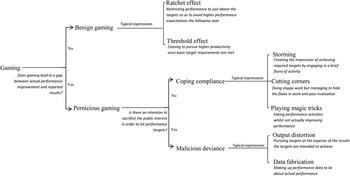
To cope with their TRS assessments, local officials have employed various gaming strategies. Figure 1 provides a typology of these different gaming strategies. It first distinguishes benign gaming from pernicious gaming according to whether the gaming behaviour leads to a gap between actual performance improvement and the reported results. In other words, the gaming is considered benign if the expected performance improvement is actually achieved and honestly reported, but pernicious if the claims made in reported results do not accurately reflect actual performance improvement or regression.
A Typology of Gaming in China's Target-based Performance Measurement System

This typology draws on extensive evidence collected from various sources, including news reports, journal articles and the author's face-to-face interviews with 34 officials in Guangdong and Shaanxi provinces between 2010 and 2013.Footnote 16 It shows that gaming is not a sporadic, occasional or locally specific phenomenon. However, owing to space constraints, only one example is used to illustrate each type of gaming in the following sections.
Two typical expressions of benign gaming are the ratchet effect and the threshold effect. The ratchet effect pertains to the efforts of local officials not to exceed required performance targets by too much – even if they could easily do so – because they know that their targets for the subsequent year will be set on the basis of their accomplishments in the current year. For example, in 2010, officials in a county in Shaanxi province were confident that they could achieve their targets for local budget revenue income. Afraid that they would be assigned a more difficult target if their performance that year was exceptionally good, the county authorities did not collect revenues from their industrial enterprises in September and October.Footnote 17
The threshold effect comes into play with “a uniform output target applied to all organizations … [which] … gives no incentives to excellence and may indeed encourage top performers to reduce the quality or quantity of their performance to just what the target basically requires.”Footnote 18 For example, in 2002, the Guangdong Provincial People's Court launched a system of indicators to monitor the performance of local courts. These targets are uniformly applied when assessing the performance of local courts, whose duties, manpower and number of cases received each year vary greatly. One interviewee indicated that some courts were capable of even better performance, and would have performed better if held to a higher standard such as their past performance. Under the new evaluation system, by contrast, these courts felt little incentive to exceed the uniformly applied targets, which they could achieve easily.Footnote 19
In both examples of benign gaming, although local officials adopt strategic behaviour to cope with the evaluation system, performance improvement does occur as required by the targets, and there is no fabrication of data to exaggerate improvements. Nevertheless, even benign gaming is undesirable because performance does not improve as much as possible, and agreed-upon targets demotivate outstanding performers.
Pernicious Gaming
This paper concentrates on pernicious gaming, which is very different from benign gaming. One way to describe this behaviour is to say that the local officials are “hitting the target and missing the point.” In other words, desired performance improvement or other desired outcomes are only partially achieved or are not achieved at all. The consequences of pernicious gaming are serious: the loss of reliable information for decision making, inappropriate use of public resources and even harm to the public interest. Figure 1 differentiates two types of pernicious gaming based on whether or not there is an intention to sacrifice the public interest in order to hit targets.
Coping compliance
Coping compliance is the lesser of the two evils when it comes to pernicious gaming. It means that local officials develop inventive ways to fake achievements in order to accomplish required targets.
One example of this type of gaming is “storming,” in which local officials engage in a wild flurry of activity (a storm) to make a show of meeting targets that in reality they have not met. A widely reported case occurred in Fang county 房县 in Hubei province in 1998. The county had been assigned the task of building a “model base of a million sheep for sale” in one of its townships. Since the base had not managed to raise anywhere near the number of sheep required, the county officials borrowed as many sheep as possible from local households. When the provincial officials toured the area, they saw a remarkable scene: sheep crowded along both sides of the highway as the officials passed by. The county also used this strategy to “complete” another project that year. Both local projects were funded, and the county officials were promoted before the media reported the true picture in 1999.Footnote 20
A second way in which local officials demonstrate coping compliance behaviour is by cutting corners: they do sloppy work or fail to complete their task, but manage to cover up these flaws and dodge a poor evaluation. Because of loopholes in performance evaluation, particularly the problem of goal ambiguity, local officials can reach targets in an opportunistic way. For example, in 2011, the central government planned to build a total of 36 million units of affordable housing within five years to help make it possible for middle- and low-income citizens to buy their own apartments. Accordingly, the Ministry of Housing and Urban–Rural Development established a policy objective of “building 10 million new [affordable] apartments by the end of 2011.”Footnote 21 This target was disaggregated and allocated down the administrative hierarchy. However, a reporter from the Beijing News found that in Hubei province, no actual new housing was built on one of the construction sites of this project. Instead, the company responsible for construction, with the consent of district officials, rented an old student residence and simply erected a new sign in front of the building that read “public rental housing,” thus pretending to have accomplished part of their required task. At several other construction sites randomly selected by the reporter, the situation was even worse. Projects were considered completed even though they just consisted of huge excavation pits at the sites.Footnote 22 Similar coping strategies were also found in several cities in Guangdong province.Footnote 23
A third type of creative compliance is “playing magic tricks.” This involves completely faking the accomplishment of tasks set as performance indicators when no actual improvement of performance occurs. For example, in 2010, Yiliang county 宜良县 in Yunnan province was required to clean up private tombs situated alongside major transportation lines and in living, tourism, and water and cultural-relic protection areas. The purpose was to improve the ecological environment and living standards in the area. The county thus made it its target to clean up all the tombs in the vicinity by year-end. The target stipulated that “only trees were to be seen in the neighbourhood,” so township and village officials instructed villagers to hide the tombs with trees, and threatened the demolition of the tombs if the villagers did not comply. However, most villagers refused to cooperate with this policy, in part because they could afford neither a place in a public cemetery nor sufficient trees to hide the tombs, but mainly because they received no compensation for cleaning up the tomb areas. Faced with this situation, some township and village officials instructed peasants to paint the tombs green – a much less expensive course of action. When viewed from a certain distance, this gave the appearance that the mission was completed: most of the stipulated areas became green.Footnote 24 It was discovered that local officials in many other localities in Shaanxi, Gansu and Yunnan provinces had also adopted this strategy and faked forestation efforts by painting mountain areas green.Footnote 25
Malicious deviance
The second type of pernicious gaming is malicious deviance. This is when the public interest is sacrificed for target fulfilment and personal gain. When local officials use this gaming strategy, they are fully aware of the adverse effects of their actions but go ahead anyway in order to survive or to excel in their performance appraisal.
In general, there are two types of malicious deviance: output distortion and data fabrication. Output distortion is the manipulation of activities to realize output targets, conducted in the full knowledge that gains will be made at the cost of desired outcomes. Output distortion in agricultural and industrial production in the 1990s has been mentioned in a few studies.Footnote 26 More recently, electricity conservation drives (lazha xiandian 拉闸限电) have led to cases of output distortion, as local officials have switched off electricity in order to meet energy and emissions reduction targets. In 2006, China's leaders established a target for energy saving and emissions reduction, stipulating that, by the end of 2010, China would reduce its energy consumption per unit GDP by 20 per cent and emissions of major pollutants by 10 per cent. In the last quarter of 2010, many industrial localities, including Hebei, Shanghai, Jiangsu and Zhejiang, were struggling to keep their electricity use within the required level. As a last resort, local officials chose the drastic strategy of switching off the electricity supply to cut down on usage.Footnote 27 One news report shows that in Anping county 安平县 (Hebei province), electricity to all government organizations, enterprises, social institutes, public utilities and residents' households had been switched off for 22 hours every three days since 3 September 2010, causing serious disruption to residents and businesses.Footnote 28
The second type of malicious deviance, data fabrication, refers to the outright falsification of performance data to hide genuine accomplishments. Data fabrication harms the public interest less visibly than output distortion, yet its consequences can still be very serious. For example, citizens' interests will be greatly impaired if higher-level authorities promulgate an important public policy based on inaccurate information reported by their subordinates.
Data fabrication is probably the most prevalent strategy adopted by Chinese local officials at all levels. A number of news reports and studies have recorded the extent and severity of this type of gaming.Footnote 29 A recent case in point is China's GDP statistics. In 2009, the Hong Kong Apple Daily reported that the sum of the GDP of China's 31 provinces and autonomous regions for the first half of the year reached 15.38 trillion yuan. This figure far exceeded the number calculated by China's National Bureau of Statistics from its own sources in the meantime (13.98 trillion yuan).Footnote 30 The 1.4 trillion yuan gap (10 per cent) was much bigger than the rate caused by normal statistical error (around 2 per cent). The cause of this huge discrepancy is widely believed to be the false reporting of GDP growth on the part of local officials. The situation became even worse in the following years. In 2010, the gap between the sum of local GDP (43.27 trillion yuan) and the figure released by the National Bureau of Statistics (39.80 trillion yuan) grew to 3.5 trillion yuan. The gap grew to 4.8 trillion yuan in 2011, 5.7 trillion yuan in 2012, and 6.6 trillion yuan in 2013.Footnote 31
Drivers of Pernicious Gaming: A Case Study of a Chinese County
Why has implementation of the TRS led to endemic pernicious gaming behaviour on the part of local officials in China? I adopted a detailed case study approach to look deeply into this issue, as gaming is a mixture of opportunities and motivations that need to be understood in context. From 2010 to 2013, I conducted field research in an inland county (hereafter referred to as Z county), which is located in the central part of China and is administered by Xi'an city, Shaanxi province. During my field trips, I conducted in-depth interviews with a total of 12 local officials. These officials were selected because they could offer crucial information on the implementation of the TRS, the process of gaming, and the reliability of reported data. They included township Party secretaries and other leading cadres who were major players within the TRS, staff members of statistical bureaus in charge of collecting raw performance data in townships, and officials in organizations that were responsible for conducting performance monitoring in the county.
Explicit performance incentives: a tempting environment for pernicious gaming
The design of the TRS in Z county is typical of those being implemented by many other Chinese local governments.Footnote 32 Each year, the county receives policy directives from Xi'an city and disaggregates them into performance targets. The county Party committee and county government then sign performance contracts with each of their subordinate organizations. The contracts, updated on an annual basis, delineate each subordinate organization's performance targets, specify the way in which performance will be measured for each target, and name rewards and punishments for achieving or failing to achieve the target. Local organizations are required to report their progress towards accomplishing the assigned targets on a regular basis. In the year-end evaluation, each organization's performance in meeting their targets is graded and ranked in a league table. The leadership of each organization is held responsible for the fulfilment of the performance contract.
The TRS in Z County adopts two methods to motivate local officials to meet their targets. First, it develops numerical, result-oriented performance measures for most allocated targets. In 2010, the county assigned the township 28 targets in six performance categories, namely, economic growth, social development, people's lives, social order, Party building, and resources and environment. These targets are assessed by 85 indicators. Around 70 per cent of these indicators (59 out of 85) are precise and quantified. The rest are mainly for work that is hard to define in numerical terms, such as the 15 indicators for the eight targets on Party-building work. The situation is approximately the same in all townships administered by the county. Most quantified targets are measures of the results of local officials' work rather than of how local officials achieve these tasks, for example, “attract 2.5 million yuan foreign investment.”Footnote 33 Such performance measures clearly place less emphasis on monitoring the process of how targets are met.
The second method is to link target fulfilment to township officials' career prospects and bonuses. In 2010, there were four grades a township could receive: “outstanding,” “good,” “satisfactory” and “unsatisfactory.” The county Party committee uses the results of this evaluation in its investigation, assessment and handling of township leadership officials. Only officials from townships graded “outstanding” (normally around one-third of all townships) are qualified to receive a grade of “outstanding” in their personal annual evaluation. Such a grade is an important, though not decisive, factor in the appointment and promotion of township officials.Footnote 34 A good ranking also brings bonuses to both local leadership corps and the remaining officials in the rewarded townships. Nonetheless, the symbolic value of the bonus, that is, the title of “outstanding,” is more attractive than the material one.Footnote 35
Leadership officials from townships that are graded ”unsatisfactory” must submit a report to the county authorities giving reasons for their unsatisfactory performance together with a plan of how they will improve their performance. If the township's grade does not improve in the following year, then the leadership corps of the township is “adjusted” – the township leaders might be demoted, transferred or even, in extreme situations, removed. In addition, if a township fails one of the compulsory targets with veto power, it receives a zero for that target, which normally drops the township's composite score to the bottom of the league table. With such a low ranking, township leadership officials not only lose the opportunity to collect any awards, their career prospects are also in jeopardy.Footnote 36
The combination of numerical targets and high-powered incentives in performance evaluation has created a tempting environment for gaming. Interviewees identified several pernicious gaming strategies that, at least to the best of their knowledge, are widely used to cope with the allocated targets. For example, one township Party secretary described the way he had cut corners to cope with the family planning target, a compulsory target with veto power. In 2010, the city assigned three major family planning targets to Z county, which were then disaggregated into 10 county-assessed targets accompanied by 33 indicators, including the rate of women receiving contraceptives, the sex ratio at birth, the establishment of family planning model villages, and the like. To ensure target accomplishment, the county established inspection teams to conduct “random” (budingqi 不定期) and “irregular” (buda zhaohu 不打招呼) spot-checks to see how well townships were carrying out the family planning policies.
The inspection teams often had a tight schedule that prohibited them from conducting thorough investigations. In 2012, the county established seven inspection teams to check townships' family planning work. The seven teams were scheduled to visit 52 sample villages in the 22 townships within five days. That meant that the inspection officers could stay for no longer than one day in each township.Footnote 37 A township Party secretary described how the township coped with this situation:
When the inspection teams were coming to inspect our family planning work, their drivers or our own informants would usually give us their schedules beforehand. We then arranged to have the households that had had extra births leave and lock up their doors. If the inspection teams planned to visit no more than 10 households during their short stay, our strategy was to invite them for lunch after they completed the first four or five. After serving them a big meal, their time was up. In this way, we could easily deal with the inspection.
Local officials often use a mix of different types of pernicious gaming strategies to muddle through their assessments. In the above case, the Party secretary also fabricated data on the township's achievements in controlling the sex ratio. In 2010, his township was required to limit the sex ratio of new births to below 115. An internal investigation by the county population and family planning bureau showed that the sex ratio in this township in the first half of 2010 ranged between 213 and 233.Footnote 38 However, in the mid-year work summary the township submitted to higher-level authorities, it reported that the ratio was limited to fewer than 113 for that period. To account for this data gap, the township Party secretary argued that, “family planning is the most difficult work for grassroots government. How is it possible for us [local officials] to control the gender ratio? We have no choice but to cook up a [more acceptable] figure.”Footnote 39
Stimulus for malicious deviance: three dilemmas
The argument of the township Party secretary raises a related, critical question: why do local officials turn to malicious deviance strategies sometimes but not at other times? My research shows that the implementation of the TRS in Z county has created three dilemmas, and these dilemmas play a key role in driving local officials to adopt malicious deviance strategies and sacrifice the public interest in order to hit their targets.
First dilemma: allocated targets are often at odds with the situation on the ground
While local differences are taken into consideration in the process of disaggregating and allocating performance targets down the administrative hierarchy, targets are generally established and distributed in accordance with higher-level policy preferences and needs. Hence, in Z county as elsewhere, it is sometimes not feasible for the county authorities to tailor those targets to the particular features and conditions of each and every township. In some cases, achieving the allocated targets can be as difficult as “fitting square pegs into round holes,” but lower-level officials have only a limited ability to bargain with their superiors on the targets. This problem is more prominent in cases where the targets are directly assigned from the centre or developed strictly according to a mathematic formula, such as the fatality indicators in ensuring workplace safety.Footnote 40 In those cases, lower-level officials are left with no other option than to circumvent the targets.
Several township Party secretaries indicated that receiving unrealistic targets was the key reason they turned to malicious deviance gaming strategies. To circumvent such targets, they have to falsify data and/or distort outputs. One official in Guangdong province frankly acknowledged that he falsified performance data “whenever possible,” which implies that it is not always possible to do so.Footnote 41 When it is too risky to engage in data fabrication, output distortion is more likely to occur. For example, in the case of electricity conservation drives, switching off electricity is more feasible than outright falsifying electricity usage data that are monitored through an internet-based system nationwide.
One township Party secretary shared his experience of fabricating data in order to meet an unrealistic target on managing the local labour economy. In 2009, when the global economy was in recession, a large number of peasant workers lost their jobs in cities and returned to their home villages. The central government believed that these unemployed peasant workers posed a potential threat to social stability, and it therefore required local governments at all levels to deal with this problem.Footnote 42 In this context, Shaanxi province required its local governments to take up the task of “transferring employment of rural labour,” that is, seeing to it that a certain portion of their rural labour force became employed elsewhere – an important performance indicator in their evaluations.Footnote 43
In Z county, each township was assigned a target of transferring a certain number of rural labourers to employment elsewhere. The target given to X township was 7,300 people. However, compared with other townships, a peculiar condition of X township was that it had a strong local industry raising lacebark pine, and labour was in high demand. Most peasants could easily make an annual income of around 300,000–400,000 yuan per mu 亩 growing lacebark pine. Given this extraordinarily lucrative industry, few peasants in this township wanted to leave. In fact, the township needed to import labour from elsewhere to support the industry. The township leaders thus falsified the number of labourers it exported, claiming it was 7,800 people when the real number was around 2,000.Footnote 44 When discussing the situation during an interview, the Party secretary made the following complaint:
If I want to receive a grade of “outstanding” in the year-end evaluation, I must report that I met this target. The national policy per se is good. It is good for localities that do not develop their own industry. In those places, peasants can make more money by working in cities. However, the target-based evaluation should not use a one-size-fits-all (yidaoqie 一刀切) approach. In our township, we need to import, rather than export, labour. We have to be dishonest in our report, otherwise we will fail to support the national policy.Footnote 45
Second dilemma: the TRS establishes collective performance competition and collusion with no effective means of detecting and penalizing dishonest performance reports
Authorities of Z county rank the performance of its lower-level organizations by comparing how well each organization achieved the same targets. As mentioned above, in 2010, all townships were evaluated in terms of how well they met 28 targets. Each target was given a weight in a 110-point scheme. A township's overall score was calculated by adding up its scores for each of the targets. Then, the county authorities ranked the composite scores of all the townships in a league table.Footnote 46 When the year-end evaluation was completed, the county shared the rankings with all subordinate organizations.Footnote 47
The competition introduced by the league table pushes some township leaders to inflate their performance figures. Three other factors add extra incentive for such behaviour. First, dishonest reporting of performance data is difficult to detect and penalize because the county lacks an effective monitoring mechanism. For example, the county statistical bureau uses just one method to calculate the county's agricultural output, namely, statistical sampling. That is, it collects data from randomly selected townships to estimate the county's overall situation. County authorities rarely make any effort to verify the reported figures for pigs, cows, sheep, chickens and the like actually stocked in the villages. Under these circumstances, township officials face little risk of being penalized for fabricating figures, whilst the benefit of doing so is huge.
Second, the ranking process is secretive. The county government always chooses to make public only the townships' ranking position, but not their actual performance scores. In other words, township officials have no idea what figures their peers are reporting to the county. In my fieldwork, there is not much evidence that township leaders exchange information with one another on the figures they will report. The competition among them introduced by the TRS is likely to discourage them from sharing such information. In other words, they know their colleagues are likely to cheat, but they don't know how exactly others will cook up the data. Township leaders might get this information through informal ways such as friendship, and one interviewee acknowledged that he had a rough sense of how a few other townships would normally report their performance.Footnote 48 How frequently these information-gathering strategies are employed and how effective they are remains to be empirically tested.
All the figures and final scores in the league table are kept for internal use by county authorities only. Several Party secretaries admitted that if they could see the data, they would be able to tell more accurately whether or not other officials were misrepresenting their accomplishments. Under the current ranking system, they feel pressure to inflate their figures because of a general suspicion that leaders in other townships are already doing so – a suspicion which, in the absence of the actual figures, they have no way of dispelling.Footnote 49 Inflation of performance data is an unspoken collective action and a hidden norm, engaged in by most, if not all, township cadres, they said. One interviewee used a metaphor to express his perception:
The year-end evaluation is like taking an examination. Because there is no invigilator, everyone else is going to cheat. If one chooses not to cheat, the chance is that one will get a lower score. Under these circumstances, wouldn't you cheat? Wouldn't you be foolish if you still tried to be honest when everyone else was cheating?Footnote 50
Third, the tacit consent of the county leaders has encouraged township officials to game and cheat. In fact, the county officials are in much the same situation with regard to their own superiors. The counties have no strong incentive to curb this gaming behaviour because their own performance results are likewise ranked in a league table, the results of which are arrived at behind closed doors by the city authorities. Because the townships' reported performance will affect the ranking position of the county, county officials may do nothing to stop gaming and, in some cases, may actually instruct their subordinates to inflate data. In 2008, the Party secretary of F township in Z county accompanied some county officials to the vegetable base built in his township. During the tour, one of the county leadership officials asked him about the per capita peasant income that year. He replied that the figure was around 6,500 yuan. The county leader then said, “With such a good vegetable crop, I think that the figure should be no less than 7,500 yuan.” The Party secretary fully understood what the county leader was communicating and stated in the annual performance report that the per capita peasant income in that year had reached 7,800 yuan, while the real number was actually roughly 6,000 yuan.Footnote 51
Third dilemma: local officials must sometimes fulfil conflicting targets
When the county authorities distribute performance targets to their subordinates, they usually pay scant attention to how compatible the targets are. It is inevitable that the accomplishment of some targets may interfere with the fulfilment of others. A typical case in Z county is the conflict between economic development and land use. To promote economic growth, local officials use farming land to construct industrial parks, new highways and other infrastructure needed to sustain economic growth. As a result, the amount of land set aside for agricultural use has been shrinking. However, local officials are also measured by how well they enhance agricultural output and by their maintenance of a target amount of land in agricultural production. Because targets become more demanding every year, it becomes more and more difficult, if not impossible, to accomplish these conflict-prone targets.
Under this circumstance, cooking up data ends up being the most expedient way for local officials to pass the evaluation. In 2010, for example, Z county was required to maintain 691,300 mu of land under cultivation. The county reported that the area of land under cultivation was over 900,000 mu, but the real figure was less than 670,000 mu. The county also reported that it had 877,300 mu given over to grain cultivation, 352,635 mu to fruit, 81,662 mu to vegetables, and 53,000 mu to flowers and nursery stock. If the total area under cultivation is taken by adding these figures, it comes to 1,364,597 mu – far higher than the 900,000 mu reported.Footnote 52 The discrepancy between these reported figures heavily suggests that local officials have fabricated data to meet evaluation requirements.
Conclusion
This article argues that not all gaming is the same and that different types of gaming behaviour should be treated differently. It discusses the distinction between pernicious gaming and benign gaming and particularly looks into the institutional rationale for pernicious gaming under the TRS. Several points can be drawn from this study. First, gaming is inherent in any target-based performance measurement system, and therefore it is an inevitable cost of implementing such systems. Bevan and Hood argue that to maintain the legitimacy of governance-by-targets regimes, it is important to control gaming at an acceptably low level.Footnote 53 According to this study, that means efforts should focus on mitigating the negative consequences of malicious deviance rather than on trying to eradicate gaming entirely.
Second, what drives local officials from benign to malicious gaming is the predicament their TRS assessment presents. As the three dilemmas make clear, allocated targets are not always tailored to local situations; they can be unrealistic, contradictory and impossible to comply with. Under such circumstances, if local officials fail to meet the targets and honestly report that fact, they and their township will suffer the consequence of a low position in the annual evaluations relative to their colleagues. If, on the other hand, they distort their activities or cook up acceptable performance data, they are unlikely to be caught and punished, and they are more likely to benefit from receiving a good performance score. As such, it is only natural to assume that local officials, as rational beings, will engage in malicious deviance even though they know very well that they are putting their self-interest ahead of the public interest.
However, it is difficult to generalize about how local officials choose between different pernicious gaming strategies. The choice often depends on the content of the targets, a locality's own conditions for gaming, and even the personal preferences of individual officials. What we know is that data fabrication is not always the best option, although it is probably the most convenient way to cope with the assessments. Output distortion is likely to happen when data fabrication is easily discovered or target accomplishment has to be tangible (i.e. construction of infrastructure).
Third, this study finds that a very troubling result of implementing the TRS is that lower-level cadres have come to view pernicious gaming as a natural part of their work life. This mindset seriously erodes the integrity and service ethos of the Party's cadre corps. Even while acknowledging that their gaming behaviour was unethical, local officials appeared to consider it a logical and reasonable response to the demands placed on them. This was particularly the case when the gaming became a collective action that most, if not all, of their colleagues engaged in, and when their superiors turned a blind eye to it or even encouraged it.
Nevertheless, the fact that the TRS instigates pernicious gaming does not completely negate its value. Göbel points out that the implementation of policy steering instruments such as the TRS produces both “pioneers” who are eager to support the policy and “resisters” who are reluctant to comply with it. The pioneers contribute to policy innovations and local experimentation, which play a role as important as the resisters' gaming strategies in shaping policy outcomes.Footnote 54 Indeed, pioneers' innovations may explain why the TRS has been so successfully institutionalized in local governments even though it is likely that the national leaders are aware of the gaming and collusion the TRS elicits.
Finally, we may ask whether all gaming is bad. This study shows that when targets imposed from above are at odds with the local situation, pernicious gaming, especially coping compliance strategies, may harm public interest less than if local officials faithfully comply with these targets. Additionally, local resistance to policy compliance provides important feedback to the policymakers at upper levels and may induce them to re-formulate and fine-tune policies that are not working.Footnote 55 In this regard, pernicious gaming, especially when it becomes a collective or collusive action, could unwittingly act as “a corrective and countervailing force” to remedy the problems caused by an opaque, centralized and arbitrary target-setting system.Footnote 56
The limitations of this study must be acknowledged. In order to explain the rationale of pernicious gaming in its context, this study focuses on a single case study. This method inevitably limits the representativeness of its findings; we cannot necessarily extrapolate the conclusions to a more general pattern of motivation for pernicious gaming in other Chinese localities. Nevertheless, this study aims to provide a means of distinguishing the two kinds of gaming and to call for more attention to their different implications. It shows the importance of adopting a more nuanced approach to examining complex social phenomena such as gaming. It endeavours to provide an empirical understanding of gaming, which I argue is necessary before we can productively theorize on the phenomenon. Meanwhile, this study leaves many interesting questions unaddressed. The scope and pattern of gaming, especially how they vary across localities, timelines and policy areas, are two such areas that need to be explored by future studies.