I have just turned ten, and I am sitting on my father's cardboard suitcase because a month before, on February 19, 1942, President Roosevelt had signed Executive Order 9066. My mother explained that now we had to go somewhere inland to a camp. . . . I was so excited; how could I sit still? I'd never ridden a train. Boy Scouts and Girl Scouts camped in tents, built fires, roasted hot dogs, and told ghost stories after dark.
—Lily Yuriko Nakai HaveyFootnote 1
I remember after we got out of camp . . . many years later we got a house in a predominantly white area in Los Angeles. Around June these kids asked enthusiastically, “Oh, we're going to summer camp. Don't you just love camp?” I looked at them somewhat perplexed and said, “Yah, I like camp.” The only camp I knew was the relocation camp. Little did I know they are talking about being in the mountains, swimming, and crafts.
Dr. Miyuki YoshikamiFootnote 2
Once upon a time, not long ago or far away, the United States government imprisoned as many as 120,000 Japanese Americans because of what was later officially deemed “race prejudice, war hysteria, and failure of political leadership.”Footnote 3 Of those forcibly relocated to the ten War Relocation Authority (WRA) Incarceration Camps, many for four years, approximately two-thirds were American-born citizens, and half of those were children. Surrounded by barbed wire fences secured by armed guards and searchlights, youth at “camp” progressed toward adulthood, pledging allegiance, practicing jitterbug moves for future dates, and joining the Boy and Girl Scouts. Incarcerated youth also joined thousands of other Obon dancers to honor their ancestors under starry desert skies. The combination of three elements—the artificial segregation of Japanese Americans in the camps, an ongoing organic transmission of Japanese heritage from first generation issei to second generation nisei, and the surrounding European and African American cultures—created an unrepeatable musical phenomenon.Footnote 4 Years later as adults, the small and dwindling diasporic community of second generation nisei have disproportionately expanded musical culture in the United States.
This essay is both a narrative of innocents caught up in a terrible injustice and a cautionary tale of home front xenophobia that has motivated former detainees to participate in public art and education as remembrance. The personal stories of three former “enemy aliens” demonstrate how fragile youthful memories, trauma, and the sonic experience of the incarceration camps shaped their artistic futures.Footnote 5 Rather than a comprehensive catalogue of music and dance in the various facilities, we glimpse musicking in the camps through the eyes and ears of two pianists and a koto player. Keiko “Kay” Haga Grantham, Lily Yuriko Nakai Havey, and Dr. Miyuki Kagawa Yoshikami were age fifteen, ten, and three, respectively, when forcibly removed from their homes. Maturing through her teenage years into young adulthood, Grantham gained professional skills as a musician during this ordeal, teaching younger students like Havey, accompanying, and performing in ensembles. In turn, Havey taught piano to younger children and played in ensembles while participating in informal musicking. Yoshikami's artistic life was indelibly shaped when she first heard the koto, not accessible on the family farm, and subliminally learned its repertoire by listening (kiki oboe) to her sisters’ lessons.
The wartime treatment of Japanese Americans provides a study of human experience in relationship to art. Incarcerated nisei suffered a cataclysm in their lives, one that accelerated their transformation and intensified musical culture.Footnote 6 The adult artistry of Havey, Grantham, and Yoshikami was directly shaped by their imprisonment as minority female children and youth.Footnote 7 As an adult, Havey recognized characteristics of post-traumatic stress disorder (PTSD) in her discomfort with “confined spaces—being boxed in—bright lights, and loud noises.”Footnote 8 Breaking from the Japanese community's collective silence of shame, she infuses her “creative memoir,” Gasa Gasa Girl Goes to Camp: A Nisei Youth Behind a World War II Fence (2014), with beautiful prose, family photographs, and her own watercolor paintings to depict “a child's fears and longings and an adult's attempt to recover some of what was lost during those years.”Footnote 9 For Grantham, like Havey, music has “been healing and cathartic”: “I feel very fortunate to have enjoyed life this long, even with its ups and downs. So many people say that they suffer depression. I can say that I do not, and I attribute it to my life-long participation in things musical. I recommend it to everyone.”Footnote 10 A much younger child during the experience, Yoshikami initially felt differently: “In some ways it was fun, a lot of kids. I thought I grew up . . . unscarred.”Footnote 11 Yet the process of writing to her Congressional representative for redress caused her to reconsider its impact not only for herself, but also for her issei parents, who were stripped of their livelihood: “It's a wonder more people didn't go crazy. . . . All the ideals that you learned about American freedom, equality of races, my parents’ hopes for their children. All of a sudden you are slapped and kicked by being thrown into camp. It's just a very, very . . . awful thing that happened.”Footnote 12
For many nisei, sound was power. Whether as youth or today's adults, these nisei employed sound and movement to create a socially cohesive community, assert their bicultural affiliations and contest sociopolitical identities forced on them.Footnote 13 Nisei forged a cultural hybridity that honors the Japanese heritage of their first generation issei parents while advancing the American mainstreams of jazz, popular, and art music. This article explores two paradoxes of the nisei's dual enculturation. First, nisei participated in Japanese traditional art forms in surprising numbers such that, counterintuitively, Japanese traditional arts flourished in the hostile institution of the camps. Following their resettlement out of camp, some nisei maintained these practices, thereby increasing transculturalism in American music. Second, while providing a vital link in the transmission of Japanese arts, nisei also avidly performed, created, and listened to European American classical music, white popular music including swing, and black jazz. Synthesizing musical streams, they asserted their dual cultural commitment to seemingly incompatible traditional Japanese culture and home front patriotic American principles.Footnote 14
“Temporary Assembly Centers”: Trauma and Solace
For Japanese American families perceived as sharing the face of the enemy, the bombing of Pearl Harbor literally changed life overnight. Male issei community leaders, including Grantham's father, were arrested by the FBI beginning on the night of the Pearl Harbor attack.Footnote 15 On 19 February 1942, President Roosevelt signed Executive Order 9066, authorizing the forced removal of Japanese Americans from West Coast military areas. As a result, Japanese Americans from diverse regional and socioeconomic communities were imprisoned together, creating an artificial racial majority.Footnote 16 In some areas families had fewer than ten days to dismantle their homes and businesses. All were given orders to pack only what they could carry to undisclosed locations in radically different climates. As with other aspects of their lives, the resultant camp soundscape simultaneously reflected and differed from that of their prior musical communities.
Like other children of immigrants, nisei youth were both embedded in, and yet distinct from, the European American mainstream. Even prior to camp, their musical biculturality was characterized by dual assimilation into white popular and art music alongside their issei parents’ Japanese musical traditions. For example, Havey attended the Los Angeles Japanese School as a Saturday student, experiencing a significant second-language learning gap in comparison to others students studying Japanese in daily after-school classes.Footnote 17 Simultaneously, Havey studied piano with Miss Wilker for two years prior to incarceration. As with other American children her age, her lessons were dominated by scales, Beethoven's Für Elise, a first recital with a paralyzing memory lapse, and an incessantly ticking metronome that reminded her of a hypnotist's swinging pendulum.Footnote 18
In Gardena, about twenty miles from Havey's home in Hollywood, Grantham's early musical education reflected California's music diversity: She requested piano lessons at age seven despite neither parent having played an instrument. Her father liked to sing Spanish songs such as “La paloma” and “El rancho grande” at parties, and her mother taught her Japanese children's songs and “a few well-loved” standards such as “Kojo No Tsuki.”Footnote 19 The war put an end to the fifteen-year-old's piano lessons with Ivy Goade, a University of Southern California faculty member, with whom Grantham had studied since she was eight.Footnote 20
The piano on which Havey practiced, abandoned in the move to camp, had been purchased on an installment plan from money her mother scrimped to save. The metronome and The Scribner Radio Music Library scores, also bought in installments, were brought to camp despite the severe luggage restrictions.Footnote 21 Yet the greatest loss for the Nakai family was not the small bungalow and its contents in the “poor section” of Hollywood, but the sense of family, home, and rituals as her parents’ relationship became “fractured beyond repair.”Footnote 22 On moving day, Havey, now identified by the number 18286 stamped on luggage and tags, joined a bewildering crush of “black-haired people” in the first of four years of interminable lines. Rather than the promised train ride and imagined mountains, trees, and tents for camping, when she disembarked from the bus at Santa Anita “Temporary Assembly Center” in her Sunday-best dress, she found herself surrounded by armed soldiers lining the barbed wire fence that encircled “row after row of black shacks.”Footnote 23 The seventeen “Temporary Assembly Centers” had been hastily constructed, many at fair grounds or racetracks with horse stalls repurposed as “apartments” to hold the evicted Japanese Americans. Family 18286 was directed past the communal restrooms and lingering stench of horse manure to their new residence in Barrack 34, Room 6, Avenue N.
The kids’ soundscapes of the “Temporary Assembly Centers” echoed with disruption, impermanence, and American nationalism. “Glutted with idle time,” school-age children were corralled onto bleachers in the sweltering heat to complete the lost end of the school term.Footnote 24 Every day “the stadium echoed with a mob of voices” pledging allegiance, hands over their hearts, to a government “for which it stands” that had “herded [them] into” camps.Footnote 25 Older teenaged and college-aged nisei were the first to reorganize musically in the “Temporary Assembly Centers.” In addition to staying in touch with “hep” music from the “outside,” weekly Saturday night swing dances, sponsored by nisei groups such as the Entertainment and Morale Committee, filled endless time and lifted spirits. George Yoshida, a member of the Music Makers swing band at Poston Incarceration Camp I recalled:
In camp, I discovered others who were very much interested in [jazz]. As a matter of fact, . . . at Santa Anita, where there were large groups of kids from L.A., they had a dance band at the assembly center, organized and going strong. They even had . . . jazz concerts at night, playing records, of course, and . . . discussed jazz artists at that time who were very outstanding. And it was kind of neat. . . . It made me feel good when I . . . realized . . . that among the Nisei, there was a small group of people who are very progressive, very much into music, enjoyed swing, jazz, . . . and, of course, classical music, too.Footnote 26
Yoshida's references to swing, jazz, and classical music demonstrate the continuity of nisei participation in European, Anglo, and African American music from pre-incarceration through the Temporary Assembly Centers.
Nisei participation in Japanese traditional arts with issei masters conversely decreased in the Temporary Assembly Centers before increasing beyond pre-incarceration levels in the WRA camps. Issei, master sensei among them, had borne the psychological brunt of their eviction, experiencing severe loss that manifested itself musically into solo instruments (shakuhachi bamboo flute, for example) being played for personal consolation and solace. Pragmatically, the extremely cramped, makeshift living spaces hampered lessons at Assembly Centers, while governmental initiatives targeted at issei prohibited Japanese materials. Thus, in the Assembly Centers, issei employed two of the three music-making strategies, identified by Susan M. Asai, “to claim a cultural space” in “a nation that racially marginalized them.”Footnote 27 While they played and sang “for comfort and familiarity” for themselves, they promoted participation in Western art music as an “acculturative strategy” for their children.
War Relocation Authority Incarceration Camps: Soundscapes and Musical Traditions
Nisei music making would be uprooted two more times—into the long-term WRA Internment Camps and across the United States through Resettlement programs. While 80 percent of incarcerees were moved en masse from Assembly Centers to WRA camps, this was not the case with Yoshikami or Grantham. Yoshikami's family (number 41777) was assembled and held until Resettlement at Poston Incarceration Camp, located in the inhospitable lower Sonoran desert of southwestern Arizona, near the California border.Footnote 28 Grantham's mother and five children (number 02096) were assembled directly at Manzanar Incarceration Camp, located in east-central California at the foot of the Sierra Nevada mountains.Footnote 29 It would take two years before Grantham's family was reunited with her father, incarcerated in the Department of Justice system since his arrest by the FBI, at Crystal City [Texas] Internment Camp.Footnote 30 In comparison to the “Temporary Assembly Centers,” Japanese traditional music and dance flourished as life became more normalized in the WRA Incarceration Camps. Underutilized at camp, issei who had previously struggled on a daily basis to establish themselves and their families in the United States suddenly found themselves with unprecedented “leisure” time in which they could also study traditional Japanese arts, some for the first time since childhood in Japan.
After six months of “temporary” in the Assembly Center, Havey “finally got [her] train ride,” not as a camper, but as one of the “prisoners” being moved inland to Amache (or Granada) Incarceration Camp.Footnote 31 Typical of the other WRA camps studied here, Amache was located in southeastern Colorado, fifteen miles west of the Kansas border and only just outside the 160–kilometer radius from the Dust Bowl's epicenter.Footnote 32 Like most of the ten WRA Incarceration camps, Amache's soundscape consisted of an urban sound environment superimposed on the natural sound ecology of an arid desert. Although the Dust Bowl was officially declared over in 1939, Havey remembered Amache's persistent dust storms with the ears of an aspiring musician and later with an artist's ability to give it voice: “A roiling brown cloud whooshed across the [window] pane, eclipsing the barrack only a few yards away. . . . Sand rasped against the windows, sounding like mice scratching for shelter.”Footnote 33
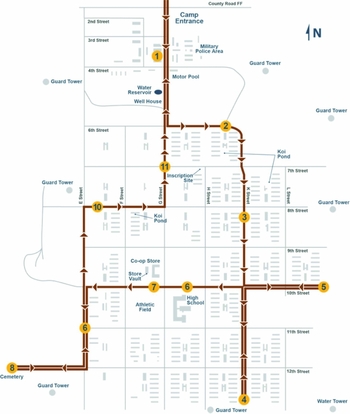
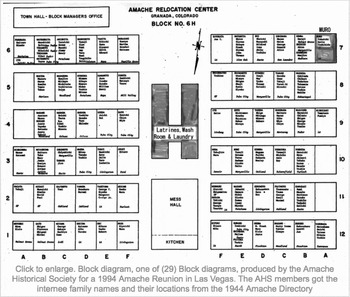
Amache's daily human soundscape with its cacophony “of rhythms and tones” wafting through the flimsily constructed urban structures was likely heard as an aural trauma that contributed to Havey's PTSD response to noise.Footnote 34 Three times a day mess hall bells competed with each other: “Clang, clang, ding, ding, bong ka-ching.” After dark the “searchlight blinked across the window . . . over and over. I closed my eyes. The rhythm flickered against my eyelids . . . light, dark, light, dark. The beat went on and on.”Footnote 35 The Nakai family's new residence at Block 9L, Building 9, Apartment C, was located on the far eastern edge of the residential section, closest to the armed military guards, searchlight, and barbed wire fence (Figure 1). In layout, Amache's residential barracks resembled a combination of World War II prison and military compounds, all of which were densely populated and had central communal facilities (Figure 2). The WRA's standards for detainees’ housing, camp food, and monthly salaries were “deliberately set lower than the minimum . . . for American GIs.”Footnote 36
Amache Residential Area Map, Amache Preservation Society, “Driving Tour Map and Podcasts,” Amache.org, 2012, http://www.amache.org/driving-tour-map-podcasts/.

Amache Block 6H map, in Gary T. Ono, “Jack Muro, The Underground Photographer of Amache,” Discover Nikkei, http://www.discovernikkei.org/en/journal/2013/5/13/jack-muro/. Used by permission of the Amache Preservation Society.

After three-and-a-half years of incarceration, almost a third of Havey's life, Amache's soundscape became routine.Footnote 37 In her family barrack, she participated vicariously in the camp's teenage musicking of her brother Sumiya, two years her senior. A member of Boy Scout Troop 179, he “diligently” practiced on a trumpet donated by Quakers or the Salvation Army, so he could play taps in the Bugle Corps.Footnote 38 She also learned jazz standards like “Blue Skies” and “Deep Purple” through Sumiya, who bought sheet music at the drug store in Granada once travel restrictions were eased.Footnote 39 “Forbidden to [attend] socials as sixth- and seventh-graders,” Havey and her friends “practiced the jitterbug and the two step so we wouldn't look like fools when we were finally invited to dances” featuring Amache's Music Makers swing band.Footnote 40
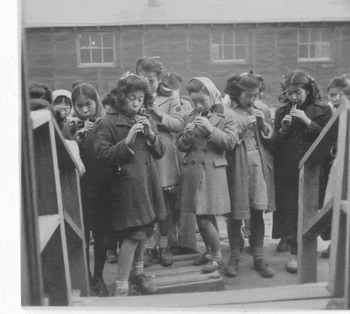
Havey co-created temporary musicking communities with others, sometimes lasting only the length of a game. Because radios had been banned and phonographs rare, even older youth participated in “old-fashioned” games that were painfully ordinary except for their adaptation to the camp setting. Girls jumped rope in the barracks’ shade or played jacks on the cool floor of the communal laundry room. Elementary students were encouraged to take “enrichment classes” to fill the summer doldrums. (Havey took up sewing and playing the tonette; Figure 3.Footnote 41 ) She and her friends chanted “Annie, Annie Over,” tossing a ball over the gabled roof of the barrack, then breaking into a variation of chase and tag.Footnote 42 Played at dusk when summer heat broke, the game took on its own camp accent: “The muted light created a sinister mood as if we were chanting a spell, attempting to raise dead spirits. . . . I tossed the ball. It swished, then tapped down the other side of the roof: koton, koton . . . ton . . . ton . . . t; ‘t . . . to . . . rise . . . up, up from your grave. . . .’”Footnote 43
Girls playing tonettes outside barracks, Wing Luke Museum of the Asian Pacific American Experience, 2010. Used by permission. http://db.wingluke.org/document.php?cat=photographs&id=1992.041.004.076.

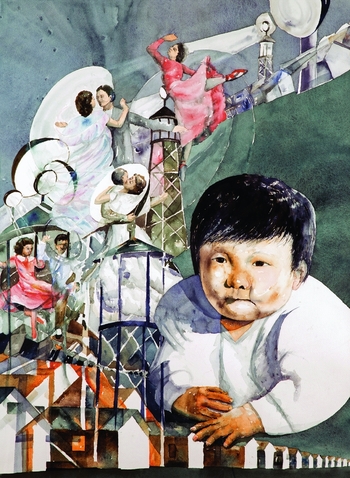
Saturday night movies, approved by the WRA and screened in alternating mess halls, were a means of disseminating popular music and dance. Most importantly, they provided temporary escape from the realities of detainment: “Sometimes we walked to the next block, 9K, sometimes to our own. We screamed, as expected of us, when Frank Sinatra or Bing Crosby crooned ‘I'll Be Around’ and ‘White Christmas,’ then giggled in embarrassment, hoping we hadn't been too loud. . . . I swirled with Fred Astaire and Ginger Rogers and tap-danced with Ann Miller and Eleanor Powell. I escaped into their fantasy lives for two hours and their memory lingered into the next day.”Footnote 44 Turning to watercolors in her fifties to deal with the trauma of her adolescent years, Havey painted And We Danced with Fred and Ginger, a “fantasy depiction” in which she asserted agency by replacing “Fred and Ginger with Nisei dancers” (Figure 4).Footnote 45
Lily Yuriko Nakai Havey, And We Danced with Fred and Ginger, Center for Documentary Expression and Art, Salt Lake City, UT. Used by permission. http://www.lilyyurikohavey.com/#!gallery/c1hof.

A transnational and hybridized soundscape emitted from the mess halls during seasonal celebrations. For example, Havey's fifth-grade class went “‘a-caroling’” among the barracks in the cold, a completely foreign experience for a Buddhist girl from Los Angeles.Footnote 46 Bing Crosby's “creamy voice crooning ‘White Christmas,’” twisted green and red crepe paper streamers, and a “scrawny tree” decorated with origami cranes, transformed the mess hall for Christmas.Footnote 47 During traditional Japanese New Year's celebrations, an antiphonal soundscape ensued as men and women gathered around a hollowed tree trunk to pound rice into mochi cakes: men pounded (“Pettanko, uuh, pettanko. Thump, uuh, thump. Thump, uuh, thump”), women folded the scalding mound (‘Ya!’”), and “some men, slightly drunk, hopped about in a dance.”Footnote 48
In Amache, the chanting of scriptures (sutras) marking formal occasions such as funerals, wafted from the Buddhist temples in Blocks 7G and 12G, just as hymns did from the Protestant churches. Susan M. Asai documents the coexistence of these religious soundscapes both in Japan prior to issei emigration and subsequently in the United States. Around the turn of the twentieth century, issei formed fukuinkai—women's groups—that in Christian churches included gospel singing societies that contributed to a pro-Western agenda of assimilation into American society. Concurrently from 1898, Buddhist missionaries established congregations with their distinct musical practices that would be transplanted into the camp soundscape: “Nichiren Buddhist churches featured traditional chanting and drums, while Japanese court music ensembles sometimes accompanied Buddhist rituals and services. Other Buddhist churches, however, promoted congregational singing of Buddhist hymns . . . in emulating Christian churches.”Footnote 49
Drawing thousands of issei and nisei participants and spectators in individual WRA camps, Obon was “the highlight of the summer.”Footnote 50 Obon, the traditional summer celebration honoring ancestors, arrived in the United States with the first Buddhist missionaries.Footnote 51 Yoshikami recalls practicing “the folk dance almost every other night. And we had a lot of fun . . . with the moon out, the sky out, and so warm, dancing to all this Obon odori (dance) music. It was a very memorable time.”Footnote 52 Havey observed that the immense acoustic space of the camp changed not only the sound, but also the experience of Obon music. “The music drifted into the vast emptiness and faded gently . . . so gently, spiraling into the hollow spaces above. This music would surely tremble into the heavens, touch souls, and soothe troubled ghosts still haunting us. Oooeeu . . . e . . . yoh, it lamented. We danced in the desert, kicking up puffs of dust . . . step, step, back . . . step, step, back. . . . Ban, ban. Ban, ban. Oooouuue . . . eeeee.”Footnote 53
The WRA camps provided not only leisure time, but also proximity to masters of traditional Japanese arts. For example, at Poston, agricultural families from the California central valley, including Yoshikami's, were intermixed with those from urban enclaves (nihonmachi), such as Los Angeles’ Little Tokyo with its vibrant artistic network of master sensei. Prior to incarceration, lessons with master sensei were limited by financial and time constraints or the belief in the functionality of music for purposes such as improving a marriage resume. According to Yoshikami, her parents, “prosperous farmers,” “weren't even thinking of koto lessons for the kids.”Footnote 54 Given the governmental luggage restrictions, it is remarkable that many issei and nisei transported instruments and formal dance accouterment for continued study at camp. Some families had their koto sent to camp. In other cases, practice koto, strings, and plectra were constructed from salvaged materials. “Somehow or another we got a practice koto and a beautifully decorated heirloom koto” that Yoshikami's family brought back from camp after their release.Footnote 55
Significantly for Yoshikami's future artistic career, she absorbed koto from listening and watching her elder sisters’ lessons. Yoshikami's memory of Poston III includes “a lot of Japanese kids,” who “would all play with each other, and then the kids would fight, and the parents would fight.”Footnote 56 Yoshikami's mother was determined first to keep her two eldest daughters busy and to avoid “a row” with other parents, and second, to prepare them to make a livelihood “in case your husbands get killed.” She “thought, [the eldest] one could make a living as a seamstress, the [second] being a musician.” Both ended up taking koto lessons when “the oldest sister liked music, and my second sister had a talent for sewing.” Yoshikami's sisters were “basically the only kids” taking lessons from the koto sensei: “she already had about forty adult students because they had nothing do to [in camp].” Unlike Havey, who found dancing to be a “trial,” with toes “imprisoned in the two-toed tabi and stiff, cardboardlike zori,” Yoshikami, the third daughter, wanted to take up buyo dance because it “looked so pretty.”Footnote 57 Unfortunately, she was “too young” and the buyo sensei already “had too many students.”
Yoshikami's koto lessons had little in common with Havey's piano study. While Havey mastered abstract technique exercises from Hanon's Virtuoso Pianist and juvenile pedagogical compositions such as Beethoven's Für Elise, the novice student of Japanese arts learns the “basics” of form and technique in the same repertoire performed by masters and their advanced students. The beginning student naturally learns these compositions at a slower pace with many repetitions of smaller sections. Disseminated alongside the Japanese music and dance repertoire is the traditional iemoto (master teacher–student) relationship with its emphasis on oral-kinesthetic pedagogy. Transmission in the iemoto system strengthens the student's bond to the sensei, whose embodied artistic knowledge becomes the “text.” The obligation to honor one's artistic elders is inseparable from the “school's” hierarchical structures and frequent chauvinistic preferences in repertoire style. While an outsider sees primarily similarities between “schools” and “styles” of traditional Japanese arts, an insider chauvinistically prefers the defining differences. Thus, the iemoto structure resembles an artistic family tree with generations of students in relationship to the master and his or her most senior students.
Sports and Recreation Departments, run primarily by older nisei, coordinated musical ensembles and individual lessons on Western classical instruments. At Amache, Havey not only participated in formal music programs at both the elementary and high schools but took private piano lessons from an older nisei, Mary Watanabe, on the camp's two dilapidated upright pianos, instruments probably donated by religious groups.Footnote 58 Camp positively shaped Havey's professional trajectory when Watanabe asked Havey to instruct some of the beginning pianists. A parent of one of Havey's students noted that if it were not for camp, her daughter “‘would probably never have had piano lessons. We thought music was a frill. Strange, isn't it, how things turn out?’”Footnote 59
Musical opportunities as a high school student at Manzanar and as a high school graduate at Crystal City, also positively shaped Grantham's future career as a collaborative pianist. Grantham accompanied singers and instrumentalists and taught lessons in the Manzanar Music Hall on one of the four pianos supplied by the WRA. Demand for piano lessons was so high both there and at Crystal City [Texas] Internment Camp, where she later taught, that the number of students had to be limited, even with twenty-minute lessons.Footnote 60 It was not unusual for a camp to boast an orchestra, however the professionalism and purpose of the orchestra at Crystal City differed from those at the WRA camps. A Department of Justice, “family camp,” Crystal City held not only Japanese Americans, but German Americans, German and Italian nationals, and Latin Americans of Japanese and German descent. Grantham regularly crossed from the quarters for the people of Japanese descent to the “German side” of camp, where she played piano with the orchestra, accompanied their concertmaster and singers, and performed with a trio at the Vaterland Café.Footnote 61
State-accredited schools in each camp contributed to a relative daily normalcy. The schools were subject to the same music requirements as the state's system on the “outside.”Footnote 62 At Crystal City, Grantham became the first- to eighth-grade music teacher and assistant to the first- and second-grade teacher at Federal Elementary School.Footnote 63 At Amache, Havey was one of only two elementary students invited to join the upper school orchestra. She explained that the musicians “didn't have much experience,” so the orchestra learned “all the usual pieces . . . no difficult pieces. I remember the military songs—‘Hall of Montezuma,’ ‘Anchors Aweigh.’”Footnote 64 Even at the time, Havey found the patriotic homage to the government that had imprisoned them “ironic.”
Already highly valued by the issei hoping for a better life for their children, both academic and artistic education took on a different urgency in the camp environment. For the issei, education, unlike material possessions of which they had just been stripped, could not be taken away.Footnote 65 Because of the emphasis on education, the dedication of Amache's new high school in April 1943 was an especially prominent community event.Footnote 66 To Havey's disappointment, the high school band was chosen to play, rather than her orchestra. Nevertheless, Havey recalled how “The Boy Scout troop marched in smartly, raised the flag, and led us in the Pledge of Allegiance. . . . People were beaming proudly. Perhaps the school symbolized a new beginning, a chance for that ‘three-times-better-than-whites’ education.”Footnote 67
While the war crisis disrupted the world order, incarceration provided possible alternatives to the jobs ordinarily available to Japanese Americans due to discrimination: gardener, grocer, domestic, and migrant agricultural/cannery worker. Grantham's professional music teaching and accompanying would lead to a dual career as a college music librarian and collaborative pianist. Havey's advancing piano lessons prepared her for graduate study in piano, funded by a scholarship. Similarly, Yoshikami's exposure to a master koto sensei led to an academic and artistic career centered around the koto. The experiences of these three women testify to the depth of student and professional musicking in both the Japanese and European classical arts.
Ballad for Americans: Musical Americanism and the Future
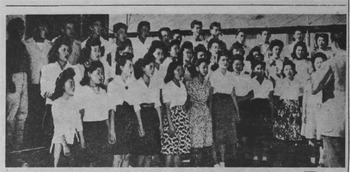
Musical Americanism of the sort common at Amache was heard on a much larger scale when performed at the 1943 commencement concert for the first graduating class of Manzanar High School. In this setting, Ballad for Americans (1939), a patriotic cantata by Earl Robinson and John Latouche, performed by the Manzanar High School choir with a singing narrator and conducted by music educator Louis (Lou) Frizzell, can be read as resistance to incarceration.Footnote 68 It has been called the “‘unofficial anthem’ of the Popular Front social movement”: originally written for the Federal Theatre Project production Sing for Your Supper (24 April 1939), it was performed sixty times before the FTP was suspended two months later.Footnote 69 Like the Popular Front and writers such as Louis Adamic, the Ballad promoted a pluralistic America through “a paradoxical synthesis of . . . pride in ethnic heritage and identity combined with an assertive Americanism and a popular internationalism.”Footnote 70 Thus, the Ballad’s malleable meanings allowed nisei at Manzanar to construct hybrid identities that simultaneously resisted the injustice of incarceration and envisioned belonging in a pluralistic America that welcomed their cultural heritage.Footnote 71
Frizzell programmed Ballad for Americans to be prominently featured on Music Night (24 and 25 June 1943) and at the outdoor commencement concert (3 July 1943).Footnote 72 Only twenty-three years old, Frizzell, a Caucasian, arrived at Manzanar in 1942 with an “abundance” of pedagogical theory, having received his music degree from U.C.L.A. six months earlier.Footnote 73 He had given the incarceration “little thought,” having had no nisei friends. Camp changed Frizzell as much as he changed it for his students: “Finding a few good friends among the Nisei made all the difference, made me ready to be hurt and grow a little from the discomfort of it.”Footnote 74 For their part, former students, including Grantham, remember that the “talented” Frizzell “really loved us” and gave them “life in camp.”Footnote 75 He obtained instruments, wrote music for his students about camp life, and got “young people to do things that they never would have done, had they lived outside of camp.” Originally known as “‘Frizzell's Folly,’” the forty-one-member choir included nonsingers recruited by “sheer bullying” from study hall.Footnote 76
When performed by nisei detainees at commencement, the cumulative effect of Ballad for Americans, with its proclamations of an inclusive America, greatly exceeded the work's aesthetic value and the modest capabilities of the Manzanar High choir. In each of the Ballad's four historical episodes—the American Revolution, the growth of the Union, the Civil War, and the Industrial Revolution—the chorus with increasing insistency questions the narrator, “Who are you anyway, Mister?”Footnote 77 The declamatory text was ideal for the inexperienced choir. The narrator, scored for baritone, is revealed over the course of the piece to be the personification of a pluralistic, non-elitist America. When the scheduled soloist became unavailable, Frizzell sang the solo while still facing the choir as he conducted (Figure 5).Footnote 78 The narrator's repeated vision of a pluralistic America, as sung by Frizzell, must have resonated with his incarcerated nisei students: “We nobodies who are anybody believe it. / We anybodies who are everybody have no doubts.”
Louis Frizzell conducting Ballad for Americans. Grantham is at the far right in the front row partially obscured by his shoulder. “Manzanar Goes to School,” Manzanar Free Press, 10 September 1943, 12, http://archive.densho.org/main.aspx.

The inclusive (for the time) America promoted in Ballad for Americans must have been particularly empowering, even to European American administrators, staff, and public relations guests in the commencement audience: “[Narrator] Am I an American? I'm just an Irish, Jewish, Italian, / French and English, Spanish, Russian, Chinese, Polish, / Scotch, Hungarian, Swedish, Finnish, Greek and Turk and Czech.”Footnote 79 Following the narrator's proclamation, “And that ain't all,” a similarly expanded list of Judeo-Christian denominations is recited.Footnote 80 Much like the text of Ballad for Americans, Class President Yoshiaki Nakayama's valedictory speech, “The Problem of Minority Groups,” stressed solidarity between Japanese Americans, a “tiny portion of the total minority groups in this country,” and other “racial, religious, . . . political, economic, or social minorities.” Nakayama offered a wartime plea that the “present young generation. . .be ambassadors of good will . . . building up friendships and understanding between racial groups, and perhaps a lasting peace to this trouble world.”Footnote 81
By its wartime performance at Manzanar, the Ballad’s malleable message had accrued layers of seemingly contradictory meanings depending on the performance and audience: blackness, whiteness, Popular Front ideals, and even Communism.Footnote 82 Since 1939, Ballad for Americans had been indelibly linked with Paul Robeson's distinctive baritone voice through his performance on CBS radio (The Pursuit of Happiness, 5 November 1939, repeated on New Year's Eve 1939) and his subsequent Victor Recording. Lisa Barg compellingly analyzes the tie between Robeson as a radical black intellectual, a movie actor, his embodied blackness as a vocalist, and the internationalist stance of Ballad for Americans.Footnote 83 Thus by wartime, Robeson allied the Ballad with the Double V struggle for African American civil rights.Footnote 84 By extension, Japanese Americans unlawfully incarcerated by racist European Americans may well have found an obvious parallel to African American slavery in the concluding line of the Civil War episode: “A man in white skin can never be free while his black brother is in slavery.”Footnote 85 When sung by nisei denied their civil liberties, the Ballad’s “mighty fine” quotations from the Declaration of Independence read as potent protest: “We hold these truths to be self-evident, that all men are created equal. / That they are endowed by their creator with certain inalienable rights. / That among these rights are Life, Yes sir!, Liberty, That's right! / And the pursuit of happiness.”
The Ballad’s association with African American struggles for civil rights paradoxically coexisted alongside its use as an anthem by the unmarked white cultural mainstream gearing up for involvement in World War II. Bing Crosby recorded it for Decca on 6 July 1940 with the Ken Darby Singers and the Decca Concert Orchestra, conducted by Victor Young.Footnote 86 It was further allied with the unmarked white home front as the finale of MGM's movie Born to Sing (1942) with Douglas McPhail as soloist. The whiteness of Born to Sing was heightened by stereotypical portrayals of the racial other: Ben Carter as Eight-ball, two black youths tap dancing, and Busby Berkeley's choreography of white couples performing the conga in Carmen Miranda styled costumes to the lyrics “there's nothing wrong-a with the conga.”Footnote 87 In the face of the Ballad’s assertive patriotism associated with the European American mainstream and the condescension of American “others” in this recent film, the nisei singers could position themselves as non-other, loyal Americans, contesting their treatment as “enemy aliens.”Footnote 88
The Ballad’s text must have buoyed nisei graduates facing a second traumatic resettlement, this time away from camp. On 1 April 1943, three months before commencement and a mere fourteen months after President Roosevelt had issued Executive Order 9066, the federal government announced an official resettlement program. Resettlement was promoted as a “long-range program of rehabilitating the evacuees into the main stream of normal American life. . .when all loyal individual[s] are again accepted into the American society and permitted to share the common lot of a common man.”Footnote 89 An example of Popular Front “people's music,” the Ballad offers a relatively non-elitist list of professions (“Engineer, musician, street cleaner, carpenter, teacher . . . farmer . . . Factory worker . . . Truck driver . . . Miner, seamstress, [and] ditchdigger”) and validates of all workers (“I am the ‘etceteras’ and the ‘and so forths’ that do the work”). In his valedictory speech, Roy Toda called graduation the “beginning of many forks” in their previously shared “road of life” as students parted for “different professions and types of work in various sections of this broad nation.”Footnote 90 Toda's speech expressed hope in the face of Resettlement and an immediate future with limited career possibilities due to white racism.
Similarly, in his commencement address on “relocation and Americanism,” Manzanar Project Director Ralph P. Merritt referred to the upcoming Resettlement, asking the audience to “keep the faith,” asserting “that the country needed and wanted the ‘God-given talents of those of Japanese ancestry for work, for family loyalty, for the creation of the beautiful.’”Footnote 91 He addressed “those who asked why the barbed wire, the towers, and the soldiers,” explaining that “the final word on American race relations has not yet been stated” and quoting the last stanza of Ballad for Americans (“Our country's strong, our country's young, / And her greatest songs are still unsung”). As valedictorian Roy Toda put it, the graduates would be the “builders and molders of the future world [able to] face reality, be willing to meet the problems created by the war, and seek to make a better, saner, and a more peaceful world.”Footnote 92
At Manzanar, Ballad for Americans was unquestionably presented and heard as political by Frizzell, his choir, the speakers, and an audience including not only Japanese American detainees, but European American administrators and guests as well. Grantham, a member of the choir and its accompanist, may have been referring to the latter group when she noted, “There may have been a few who were uncomfortable with the text under the circumstances, however, I did not hear any negativity.”Footnote 93 Grantham identified the commencement performance of Ballad for Americans as the musical highlight of her camp experience. “Working on and performing Ballad for Americans would have been exciting and enjoyable at the high school back home, but doing this piece in Manzanar gave it greater significance. We considered it quite an accomplishment.”Footnote 94 For Grantham, the incarceration setting enhanced the composition's meaning: “The choir members and other nisei felt the weight of the lyrics that we were singing in the Ballad. There were issei in the audience. Most of them would have been proud of the message of the Ballad.” According to Frizzell, the audience response was extraordinary: “The applause was thunderous. When I turned, most of the audience was on its feet and a few were in tears. . . . Still the applause and shouting continued.”Footnote 95
Frizzell contended that the chorus's repeated questions of the narrator and the “glowing compassion of the answers” were “full of such special meaning for this choir, for this audience in this hall, in this spot in the desert. . . . My singers . . . not only wanted to sing this ballad; they had to sing it.”Footnote 96 The shifting nexus of meanings provided by Ballad for Americans’ paradoxical text, evidenced in its performance history of resistance and unity, supported nisei aspirations for a congenial future in which they could both maintain their cultural identity and contribute meaningfully to an inclusive America. In essence, following Resettlement, many nisei would continue the cultural vision their issei parents perceived as having failed: to educate mainstream America about their proud Japanese heritage through the traditional arts, thereby gaining a cultural space within the broader social landscape.Footnote 97
Broadening the American Soundscape
Today as adults, the relatively small and shrinking diasporic community of former detainees has disproportionately broadened both the sound and scope of American music making. Following the upheaval of resettlement out of camp, Grantham, Havey, Yoshida, and Yoshikami further developed the hybrid cultural identities they had established during incarceration, quietly forging paths for Japanese Americans at the intersection of arts and education. Following the war, Havey attended the New England Conservatory of Music on a piano scholarship, later teaching high school English and creative writing before authoring her award-winning Gasa Gasa Girl Goes to Camp. Havey's watercolors such as And We Danced with Fred and Ginger document her childhood incarceration, while stained glass pieces such as Red Calligraphy reflect her study of Japanese calligraphy begun at the Los Angeles Japanese School. Similarly, upon college graduation, Grantham enhanced the visibility of Japanese Americans in academic and professional art music as an accompanist and music librarian at El Camino College, a position she held until retirement. She was also a sought after collaborative pianist by vocalists such as operatic mezzo-soprano Eva Gustavson. Yoshida (1922–2014), who found a community of jazz aficionados in camp, maintained a vibrant fascination with ongoing developments in jazz, popular, and art music, typifying the hybrid cultural identity of incarcerated nisei. Founder with Mark Izu of the J-Town Jazz Ensemble and director of the Nikkei Music History Project for the National Japanese American Historical Society, he documented the ongoing presence of Japanese Americans in jazz in Reminiscing in Swing Time: Japanese Americans and American Popular Music, 1925–1960.Footnote 98
Significantly, Yoshikami's participation in the iemoto system and her dissemination of the traditional koto repertoire reflect the adaptations to the American musical context that she and her sensei, Chihoko Nakashima, have made.Footnote 99 Following camp, the Nakashimas returned to Los Angeles, establishing a Chinese chop suey restaurant and a year later Kawafuku, “a fancy authentic Japanese restaurant,” where the Yoshikami sisters took lessons before customers arrived. While Nakashima was Yoshikami's only sensei until the mid-1950s, she later studied under a second koto teacher, Kimio Eto, who specialized in the more modern Miyagi style.Footnote 100 This was an unusual opportunity because historically under the iemoto system, one rarely changes sensei and styles, given the student's responsibility to the first teacher and her or his school. Yoshikami's elder sister, Sanaye Kagawa, further adapted the iemoto system, teaching koto at the University of California at Los Angeles in the early 1960s. Availability of trained artist–teachers such as Yoshikami and Sanaye Kagawa contributed to emerging ethnomusicology programs and dissemination of repertoires outside of the European American art tradition in university curricula.
Currently a long-term resident of the Washington, D.C. metropolitan area, Yoshikami created her niche on the East Coast by performing and teaching koto as a way to educate outsiders about traditional Japanese art and culture. Her pedagogy follows traditional Japanese oral transmission with accessible repertoire, including “Sakura,” to introduce koto basics.Footnote 101 Given that “ninety-five percent of playing the koto” includes the simultaneous singing of esoteric Japanese texts being accompanied, even with those unfamiliar with the Japanese language or koto repertoire rise to the challenge. In part, her pedagogy is an outgrowth of childhood experience in Japanese language schools where age, skill level, and educational material were frequently mismatched: “When you are in American third grade you are reading the first grade Japanese reader, and in junior high, the fourth grade reader.”Footnote 102
Today, the remarkable community of nisei, most now in their seventies to nineties, offers a “personal journey of remembering,” with its multiple ways to heal, share, and recapture lost memory.Footnote 103 Like other nisei, Yoshikami and Havey have traveled to Japan to further explore their Japanese heritage and arts. Following such a trip in 1980 with her mother to meet her uncle and pay respects at family graves, Havey concluded, “I understood what my mother had said so many years before in camp: yes, I was American, but I was also Japanese. I, too, had come home. At last.”Footnote 104 Yoshikami acknowledged a similar point of view: “I would consider myself American. I just happen to have a background in Japanese and Japanese things.”Footnote 105
As is the case with humans in trauma, some transcend, while others are defeated. It is a remarkable testimony to the Japanese American community that these former “enemy alien” youth continue to transform the trauma of incarceration into ethnic pride, evidenced in their unprecedented legal struggles for redress, culminating in the Civil Liberties Act of 1988. Many former detainees share art and educate the public about the traumatic experience of their childhood and youth in hopes that their deprivation of personal civil liberties will not be repeated, even amidst heated national debates on immigration and terrorism. In the process of educating those outside the Japanese American community, they honor their issei parents, who built a life in the United States on behalf of the welfare of their children, only to have it stripped away. Through their arts and educational outreach, they give eyes and ears to the bleak chapter in American history that they survived. As a result, transcultural American music is richer as the nisei make meaning of their bicultural American and Japanese heritage.