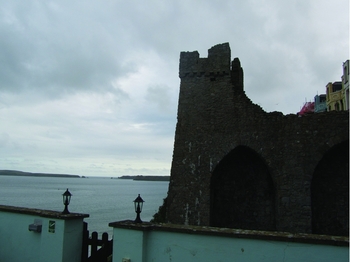
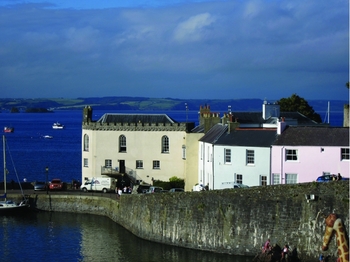
In one of the houses perched on the cliff . . . we resided, during our pleasant stay at Tenby . . . so near as to be almost part of the dwelling is the old square tower [Belmont Tower, see Figures 1 and 7] – one of the seaward defences of the town. Hence there is a wide-spread and very beautiful view: immediately underneath, at the foot of that huge rock, the firm sand extends to St. Catherine's Isle, seen to great advantage from this point, in combination with Castle Hill. Immediately fronting us is Caldy Island . . . From the higher rooms of the house, or from the summit of the tower, a fine view is obtained of Giltar Point, and, further off, ‘Proud Giltar’, one of the most picturesque of all the sea cliffs of the district; while in the extreme distance is seen the land that encircles Carmarthen Bay, and, on clear days, Lundy Island and the coast of Devonshire. It is difficult, indeed, to find anywhere a prospect at once so extensive, and so beautiful, as that we obtain from this house . . . From this tower, gentle reader, we have watched (as you may, and, we hope, will), at all hours of the day, the thousand things that make a sea-side dwelling a supreme delight . . . The sands were alive always. When the tide was full in the contrast between the foam, and cliffs up which it dashed, was a glorious sight for the artist; and, when the tide turned, it seemed as if its halt was stayed by the horizon. Beneath, upon the hard sands, were troops of laughing children, tripping ladies . . . and gentlemen with telescopes, or opera-glasses, phaetons and horses, ‘promenading’. The sands are alive with company.Footnote 1
Belmont Tower with Caldey Island (left) and St Margaret's Island and Giltar Point (right) in the distance, 2012. Taken from the Imperial Hotel, the site of the Halls's accommodation (Belmont House) while in Tenby (Peter Borsay)

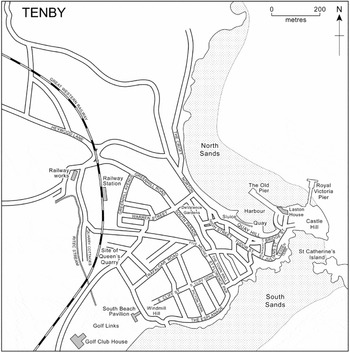
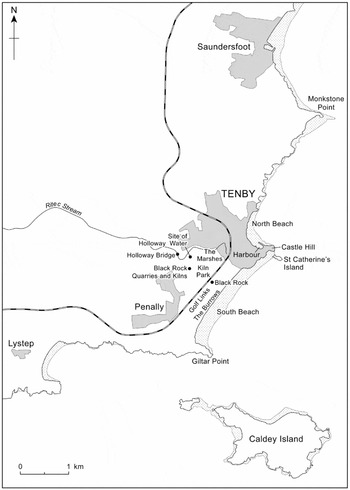
In this account of a visit to Victorian Tenby, Mr and Mrs Hall make clear the importance of the view from their lodgings. The mixture of environmental and human elements, the detailed identification of places, the calculated shifts from foreground to background, the liberal sprinkling of aesthetic judgements, all suggest a carefully calculated analysis of a scene that for them is freighted with meaning. The view, spontaneous and ‘natural’ as it may appear, is as carefully crafted an object as any luxury item of material culture. And, as we know today, there is a real market value to the visual. In a resort hotel, a room with a view will cost more than one without, a property facing the sea more than one hidden in a side street. When and why did views come to have a value? From what did their value derive, and how was it achieved? How important was the process of visualisation to the development of the seaside resort? To answer these questions a range of approaches is necessary. The first part of this paper will examine consumerism, the rise of tourism and the seaside resort, and the role of the ‘tourist gaze’; the second part the seaside and visual culture; and the third and fourth parts the two types of visualisation present at the seaside, environmental and social. In these final sections, Tenby in West Wales will be taken as a case-study (see Figures 2 and 3).Footnote 2 Sea bathing may already have been underway there as early as the 1760s, though serious investment in the resort's infrastructure seems to have taken place from the early nineteenth century. In these early years, Tenby was a highly fashionable watering place. The coming of the railways in the 1860s widened the social profile of its clientele, though up until the First World War it continued to sell itself as an exclusive resort and service what was probably a predominantly middle-class clientele.Footnote 3
Map of Tenby, c. 1940 (Peter Borsay and Antony Smith)

Map of Tenby and surrounding area, 2010 (Peter Borsay and Antony Smith)

Tourism, the seaside and the tourist gaze
Though it may now seem over-dramatic to talk, as some historians have, of the ‘birth of a consumer society’, and of a ‘consumer revolution’ in eighteenth-century BritainFootnote 4 – ignoring important elements of economic change in the medieval and early modern eras – it is clear that the period witnessed a gear change in the nature of the consumer economy. Maxine Berg has referred to a ‘reconfiguration of consumption from needs to desires’, and of a ‘product revolution’, in which the objects of consumption were ‘the material products of enlightenment and modernity, of fashion and global commerce’.Footnote 5 What characterised these new products was the balance of their cultural as opposed to their utilitarian content. Most of their value derived not so much from what they did in practical terms as from their psychological impact in delivering culturally mediated experiences; for example, aesthetic goods like politeness and beauty, or social goods like fashion and status. Growing personal disposable income was the engine driving change. It was this that provided the surplus wealth that could be invested in luxury and semi-luxury products. One social group particularly identified with the expansion in disposable income is the burgeoning middling order, who, as John Styles has argued, ‘shared an aspiration to a genteel way of life that found much of its expression in owning, using and displaying the right goods. It was they, above all, who sustained that growing multitude of manufactures producing the high design objects that comprised the essential props of gentility.’Footnote 6 In this new world of goods, historians have tended to place the emphasis upon items of material culture such as fine chinaware, metalwork, furniture and dress. However, non-material forms of cultural expression were just as much economic products and objects of luxury expenditure as material goods. In particular, high-status commercialised leisure – which often provided the context in which luxury materials goods could be displayed – was expanding rapidly in the eighteenth century, with the growth of assemblies, theatre, concerts, book shops, clubs and various sports. Much of this was based in towns, and the century also witnessed the rise and development of a category of urban settlements – spas and seaside resorts – specialising in the provision of leisure and health.Footnote 7
The modern spa, offering commercialised medical water treatment to well-off society, first emerged in Britain in the later Tudor and early Stuart period. Growth would seem to have halted during the Civil War years, before the later seventeenth and early eighteenth centuries see the proliferation of new springs and consolidation of existing ones. Health remained an important function of these settlements but it became clear that the provision of leisure services was an increasingly important part of their business. It was during this period that Bath and Tunbridge Wells developed into the principal fashionable resorts in Britain.Footnote 8 The leading spa in the north of England was Scarborough. There, the spa house was located on the beach beneath the cliffs. At some point – certainly by 1735 when John Setterington's ‘Perspective Draught of the Ancient Town, Castle, Harbour and Spaw of Scarborough’ shows naked swimmers and a bathing machine adjacent to the spa – the town also became home to sea bathing.Footnote 9 This heralded the emergence of a new and highly innovative form of watering place, with no real historical precedent, the seaside resort. Despite Scarborough's early incursion into the field the first concentration of resorts developed in the south-east, particularly on the Sussex and Kent coasts, responding to the market demand generated by London, a metropolis of half a million people by 1700, and almost a million by 1800. During the later eighteenth and early nineteenth centuries, the net began to spread much wider, embracing the coasts of the south-west of England, Wales and East Anglia.Footnote 10
Many of these later resorts were located in remote parts of the coastline, requiring an extensive journey to access them for visitors coming from the populous London, south-east and midlands of England. It was not uncommon to incorporate resorts in the itineraries of those undertaking tours around Britain. Recreational travel or tourism developed on a significant scale from the later seventeenth century. The most prestigious and expensive form of this was the Grand Tour, involving an extended visit to continental Europe, with key destinations Paris and Rome, and by the later eighteenth century a route which incorporated the Alps. Less investigated by historians, but widely undertaken by the better off, was the British tour. This was not just a scaled-down, less-expensive and less time-consuming version of the European tour. Getting to know the various parts of Britain was considered an important part of the education of elite men and women, and travellers were expected to keep an account of what they observed. This helped structure perceptions in a way that influenced observations at the time and later in a process that stimulated and cumulatively refined the mind of the observer.Footnote 11
The personal diaries composed during these tours were sometimes accompanied by drawings, and, together with the growing guide literature to service the market in travel, are among the earliest manifestation of what John Urry has called the ‘tourist gaze’, a way of looking
directed to features of landscape and townscape which separate them off from everyday experience . . . [there is] a much greater sensitivity to visual elements . . . than is normally found in everyday life. People linger over such a gaze which is then normally visually objectified or captured through postcards, films, models and so on. These enable the gaze to be endlessly reproduced and recaptured.Footnote 12
Visualisation is at the core of this experience and seaside resorts were saturated with visually stimulating phenomena. Two types of visualisation are at work here: environmental and social. Resorts encouraged an acute engagement with the natural and built environment through consumption of ‘views’ of sea, beach, sky, cliffs, rocks, greenery, boats, piers, pavilions, hotels and such like. Resorts also developed rich audience-orientated entertainments, such as beach theatre and shows. But visitors themselves were also part of the social theatre, engaging in intensive observation of each other and themselves – what Peter De Bola writing about the clientele of Vauxhall Gardens has called ‘autovoyeurism’ – in a context that encouraged high levels of personal and group performance and display.Footnote 13
The tourist gaze, in its environmental or social form, was at the heart of resort life, and developed as an economic good in its own right. The seaside view had a value and was as much a part of the consumer revolution as material goods. It also spawned an expanding visual culture of drawings, paintings and photographs that was fundamental to the process of visualisation.
The seaside and the visual
Visual culture, the creation and consumption of representations of people and landscape, underwent major changes during the course of the eighteenth and nineteenth centuries that impacted on the process of visualisation itself. First, there was an aesthetic shift towards the incorporation, alongside portraiture and history painting, of landscape, topography and natural forms, and with it the picturesque and sublime, into the body of high-status art. It was a process reflected in the kudos attached to the works of the seventeenth-century French artist Claude Lorraine, in the growing importance of landscape elements in the work of native painters like Richard Wilson, John Constable and Joseph Mallord William Turner and in the rise of landscape gardening as a form of art. Second, there was the development of illustrative material which focused on social and political observation and commentary, sometimes deploying humour and techniques not associated with ‘high’ art, reflected in the satirical work of figures like William Hogarth and Thomas Rowlandson, and later in Punch cartoons and in postcards. Third, there was the accelerating technological developments in printmaking, the so-called ‘industrialisation of art’, which meant that visual images could be reproduced many times, individually and in books and magazines, permitting competitive pricing and widespread dissemination both socially and geographically. Fourth, there was the introduction of photography from the 1840s, and roll film and ‘pocket’ cameras from the 1880s, with the potential this provided for the accurate, instantaneously produced, endlessly reproduced images by professionals and amateurs.Footnote 14
These developments in the forms and commodification of visual culture ran parallel with the rise and maturation of the seaside resort. Indeed, the two fed off each other. With the new significance given to ‘nature’, the sea and coastline – which previously had been perceived in negative terms, a dangerous place only to be visited out of economic necessity, a location to avoid rather than seek out – provided artists with a huge, largely unexplored, and inherently dramatic landscape resource to investigate the picturesque and sublime.Footnote 15 At the same time the beach and promenade also offered rich pickings for artists engaged in depicting humans and their social interaction. The result was, as Christiana Payne has shown, a surge of interest in painting sea and coastline. Resorts and their vicinities became an important focus of attention for major and minor artists, many of whom specialised in coastal views and visited particular resorts on a regular basis to gather material to supply a growing market.Footnote 16 Some artists resided (permanently or for a portion of each year) in popular resorts to service this market, such as Anthony Vandyke Copley Fielding (1787–1855), Richard Henry Nibbs (1816–93), W. J. Leathem (fl.1840–55) and W. E. Bates (1812–72) in Brighton and Hove.Footnote 17 As early as 1800, it could be claimed that ‘what gives the schools, at Brighton, a decided advantage, is, the number of capital masters in music, drawing, painting, dancing, &c. &c. who are settled in the town’.Footnote 18 By the later part of the nineteenth century, artists’ colonies were emerging in some of the smaller, remoter and more ‘untouched’ coastal settlements, such as Walberswick in Suffolk and Newlyn and St Ives in Cornwall.Footnote 19 Accessing the paintings to view and/or purchase was important if the new visual culture was to impact on visitors’ sensibilities. Many resorts contained stationers and booksellers where paintings and prints could be purchased.Footnote 20 In about 1800, the London printseller John Wallis sent his son to the up-and-coming exclusive resort of Sidmouth in South Devon to open a sea-front shop selling topographical material.Footnote 21 In 1851, a group of Brighton artists formed the Brighton and Hove Fine Art Society, and used space in the Royal Pavilion (acquired by the Brighton town commissioners from the crown estate in the previous year for £53,000) to mount an annual exhibition. Money from the entrance fee was directed to purchase paintings by local artists, including Nibbs and Leathem, which were used to form the basis of a permanent town collection. Additional display space was provided in 1873, when a new Museum, Art Gallery and Library was opened in the converted Dome (former royal stables, also acquired from the crown estate), which contained one of the first purpose-built municipal picture galleries in the country. Within the first decade it attracted 800,000 visitors.Footnote 22
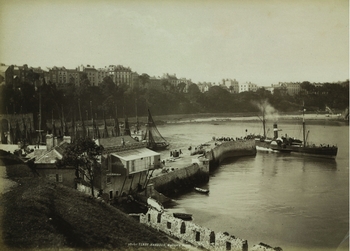
Photography was custom built to meet the needs of resorts and their clientele. In the period before the First World War, eight different professional photographers have been identified operating out of permanent or seasonal studios in Tenby. This excludes individual peripatetic photographers and large-scale businesses like that of Francis Frith making an occasional visit to collect material. The most important early resident practitioner in Tenby was Charles Smith Allen (1831–97), a native of Rugely in Staffordshire attracted, like several of the town's photographers, by the business opportunities (see Figure 4).Footnote 23 As with Tenby, Worthing and its local area supported a corpus of professional photographers, who from the 1870s were producing single view cartes de visite, albums and stereoscopic cards of the resort. In neighbouring Brighton everything would have been on a grander scale; a directory of 1886 lists thirty-two photographers working in the town.Footnote 24 Photography, once cards without the pre-paid printed stamp (1894), of a larger size (1899) and with full-sided images (1902) were permitted, greatly added to the appeal of the postcard. Its ‘golden age’ has been dated 1902–18 and it became the form of resort communication par excellence, with its ideal combination of the visual image and brief textual message.Footnote 25 Not that the photographic in any way forced out the handcrafted image on cards, with the prolific Alfred Quinton (1853–1934) producing his popular picturesque views, primarily for the Kent firm of J. R. Salmon, and the rise of the comic seaside postcard.Footnote 26 Photography also widened the range of options in guide literature, which by the late nineteenth century was expanding enormously, both in terms of volume and variety. Illustrative material had of course long been included in topographical works. This is a reminder both of the fact that written text was frequently used to create visual images for readers, and therefore was critical to the visualisation process, and of the way visual images regularly interacted with printed text in a way which modified the meaning of both.
Environmental visualisation
Visitors went to the seaside to immerse themselves in the environment. They could do this by physical activities, such as bathing and walking, but above all engagement with the environment was a visual exercise. The grandest form of this was the panoramic view, such as that described by the Halls, with its elevated perspective, broad sweep, carefully modulated sense of foreground and background and rich mixture of elements. For those visiting Tenby, this began with their first sight of the town and its setting, a rite of passage, primed by the guidebooks, engendering a frisson of excitement as travellers were made aware that they had entered a visually rich space in which they expected to be stimulated by, and for their part to be highly receptive to, the scenes before them. Philip Gosse recorded how in 1854 ‘our eyes were enchanted by the noble view that . . . burst upon us, of the harbour of Tenby, the Bay of Caermarthen, and the North Cliffe’, echoing the sentiments of a tourist of almost a century earlier who commended how ‘on the rising of a Hill, the Prospect of the Channel opens . . . very Beautifull, the worms head on one side, a most bold headland, & the Rocks off Tenby with Caldy Island make Carmarthen or Burrey Bay’.Footnote 27 What added to the impact of the prospect on approaching the town was the contrast with the countryside on the road from Carmarthen, described as ‘very ugly’, ‘none of its striking bold features’, the ‘whole road is uninteresting’.Footnote 28 In the 1830s, Charles Norris complained that the recently constructed new road into Tenby, ‘excavated at enormous expense’, failed to afford ‘the traveller a single glimpse of the fine expanse of Carmarthen Bay, the rocky promontories . . . and beautiful crescent-like swell of the Peninsular of Tenby . . . this ill-contrived approach exhibits it as a town of very common place pretensions’.Footnote 29 His anxieties were unfounded, as later accounts of those entering the town demonstrate, but his comments show how important the first sighting of the town was felt to be in setting up expectations.
Once settled in the town the visitor could enjoy the spectacular views from the elevated natural platform on which Tenby sat, instructed by one of the many accounts in the guide literature. Early on, Gosse provides extensive panoramic descriptions from the garden of his lodgings overlooking Castle Beach, and from the summit of the adjacent St Catherine's Island; later, he adds an account of the view from the Croft and North Cliff.Footnote 30 The early panoramas share some of the elements of the Halls’ account of six years later, taken from a similar location. This reflects a process by which certain views and viewpoints, by repetition in the guide literature and visual representations, become iconicised. The more a particular view is described, celebrated and circulated, the more embedded it becomes in the visual imagination of the resort and its visitors. Fred Gray has argued that ‘postcards were particularly significant in establishing and developing the image of a place, helping determine the essential resort sites and sights’.Footnote 31 Gosse's later panorama parallels a series of paintings of the view of the town from North Cliff, beginning with W. Golding's oil of 1799 (see Figure 5), followed by J. Storer's view of 1810, Edmund ‘Waterfall’ (so-called because of his fondness for depicting water features) Gill's oil of 1843 and A. R. Quinton's postcard illustration of the early twentieth century.
Tenby harbour showing studio (centre) of Charles Smith Allen, cantilevered off the upper floor of the Bath House (Tenby Museum)

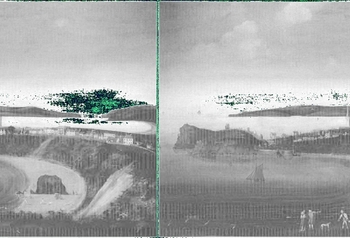
Tenby from the North Cliff, W. Golding, oil painting, 1799 (Tenby Museum)

Alongside the panoramic perspective are accounts of particular landscape elements such as rocks, cliffs, caverns, trees and of course the sea. Some of these descriptions adopt a language imbued with drama. Later eighteenth-century accounts of Tenby refer to the ‘caverns of immense magnitude’ at the bottom of the Castle Hill, and the ‘large dens or fissures . . . made in many places [in St Catherine's rock] by the persevering percussion of the Ocean’.Footnote 32 Gosse's detailed depictions of the cliff formations at Monkstone Point and especially Giltar Point – ‘a truly magnificent precipice of grey limestone nearly two hundred feet high, with the strata perpendicular’ – echo those of travellers to many resorts, particularly ones located on rocky coastlines, such as Lynton and Ilfracombe, the latter presenting to the Rev John Swete in 1789 ‘a scene extremely romantic, of wild mishapen rocks, towering to the skies’.Footnote 33
Gosse draws explicit parallels between the natural landscape at Giltar and Lydstep and the medieval abbey and castle that he had recently been visiting at Lamphey and Pembroke; ‘the stratification is absolutely perpendicular . . . taking the appearance at every turn of enormous towers, castles and abbeys . . . Probably the associations of yesterday's excursion had something to do with all this . . . but how grander was the masonry of nature than anything we saw yesterday!’Footnote 34 The perception of a resort would be filtered through a single visual imagination, in which human and natural forms would be fused together, even if the latter was taken to have priority. Undoubtedly one of Tenby's primary assets, though in other respects this might be seen as a distinct disadvantage, was its rich and decaying historic fabric, which included a castle and extensive fortifications, evocatively depicted in Charles Norris's Etchings of Tenby (1812). All three of Wales's earliest resorts, Aberystwyth, Swansea and Tenby, were medieval towns and possessed ruinated castles that appealed to the gothic taste of visitors. Many resorts contained, within their boundaries or immediate vicinities, a built heritage to whose presence and appearance tourists could be alerted. The Pictorial Guide to Yarmouth (1860) drew attention to the considerable surviving pieces of the medieval fortifications and religious fabric, while in 1850 it was claimed of Whitby that ‘irregular terraces . . . give to this part [the east side] of the town, an exceedingly romantic appearance . . . the effect being further increased by the venerable church of St. Mary and the time worn ruins of the Abbey, which crown the summit’.Footnote 35 However, it would be wrong to give the impression that visualising the built human environment was simply about antiquities. Modernity was also celebrated, in guides and postcards, with good reason since resorts were important sites of architectural innovation and cutting-edge engineering in areas such as church building, residential terraces, sea defences, promenades, piers, hotels and winter gardens. Moreover, during the interwar years, the seaside became an important site of modernist architecture, literature and art.Footnote 36
Resorts had long been receptive to new tastes and fashions. Much of this goes back to the invention of the picturesque in the eighteenth century. For our purposes, the key figure is William Gilpin, and the location not the sea but the limestone gorge of the lower Wye Valley. Gilpin was not the inventor of the idea of the picturesque, whose origins date back at least to the early eighteenth century and the development of landscape gardening in Britain.Footnote 37 However, his Observation on the River Wye, compiled during a tour in 1770 but not published until 1783 – it had gone into five editions before 1800, and spawned a glut of similar guides – was to prove critical in codifying and popularising the idea.Footnote 38 He opens his text by claiming that ‘the following little work proposes a new object of pursuit; that of examining the face of a country by the rules of picturesque beauty . . . not the offspring of theory, but . . . taken immediately from the scenes of nature as they arise’. In non-emotive practical language, he described how ‘the most perfect river-views . . . are composed of four grand parts: the area, which is the river itself; the two side-screens, which are the opposite banks, and lead the perspective; and the front-screen, which points out the winding of the river’. He goes on to describe how variation is built into this framework, in particular by the introduction of ‘ornaments’, which he lists under four heads ‘ground, wood, rocks, and buildings’, each of which he describes in detail.Footnote 39 Gilpin provided the ordinary tourist, not steeped in high theory and possessing limited technical abilities, with a toolkit for how to observe the environment and, for those so inclined, to capture a representation of it. It was this approach, transferred to the highly receptive environment of the sea shore, which underpinned the construction and commodification of the coastal ‘view’. Significantly, Gosse, on his rail journey to Tenby in the 1860s, observed from his carriage window ‘the rocky cliffs of Chepstow; the grand isolated masses which rise from the edge of the rails, alternately hiding and revealing the picturesque Wye’.Footnote 40 Accounts of seaside views in diaries and guidebooks are peppered with references to the ‘picturesque’ and allied aesthetic sentiments such as the ‘romantic’ and the ‘sublime’. Tenby was declared a ‘situation . . . more romantic and interesting that that of either Aberystwid or Swansea’ (1803), said to contain ‘fragments of singular and most picturesque architecture’ (1832) and to be a place where ‘picturesque rocks fringed the bay on either side’ (1863).Footnote 41 In a similar vein, the ‘view’ from the Cobb at Lyme Regis was said to be ‘uncommonly fine and romantic . . . The whole of this scenery was an intermixture of the Picturesque and Romantic’ (1794).Footnote 42 For some tourists, painting and drawing were holiday pastimes, but the artist's perspective was one all visitors were encouraged to adopt, as, for example, when a Tenby guide of 1863 suggested that the ‘grandeur and sublimity’ of the scene on a wind-swept ‘walk to Proud Giltar . . . can never be forgotten, and would form a most magnificent storm subject for the canvass of Backhuysen’ (the seventeenth-century Dutch marine painter).Footnote 43 Such comments were of course geared to a knowledgeable and aspiring clientele, but we should be wary of dismissing the concept and aesthetic of the ‘view’ as entirely an elite commodity. The notion of the picturesque might have been developed as a pastime of the well off, but the importance of pictorial views in railway posters and popular postcards (including many produced by artists despite the existence of photography), and the choice of groups of workers, such as those from Swindon's GWR works, of scenic if small resorts like Tenby and St Ives for their annual holiday, suggests a deeper permeation of the idea.Footnote 44
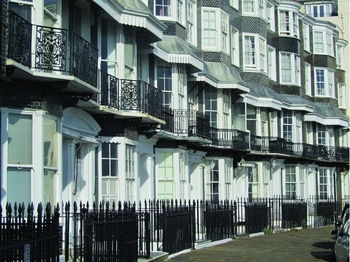
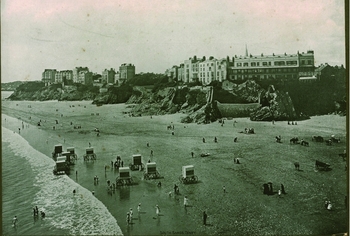
Obtaining a view depends upon tourists accessing a viewpoint or platform from which to observe the scene before them. One characteristic of a successful resort was the possession of a landscape naturally sculpted to provide effective observation points. The situation of Tenby upon a large rock projecting into the sea, connected to which was the smaller Castle Hill from which could be obtained a 360 degree panoramic perspective, and the further presence of lofty cliffs in close proximity, gave the town considerable advantages as a location in this respect. However, what was critical in realising this natural potential was the way that Tenby and other resorts were engineered to maximise their visual assets. Traditionally, the architecture of coastal settlements had eschewed exposure to the sea, huddling in thoroughfares and narrow lanes away from the water's edge (as, for example, at Brighton), or literally turning its back on the sea (as in the waterside rows of cottages at Fowey and Appledore). The last thing on the mind of those dwelling on the coast was a room with a view. This configuration of the built environment was to be reversed with the rise of the seaside resort and the picturesque. Seafront locations were now treated as premium real estate and their role as viewing boxes exploited. Where possible the multi-dwelling multi-storey classical terrace pioneered in London, with its extensive array of perfectly proportioned windows, and the crescent developed in Bath specifically to capture views of the surrounding countryside, was imported. The ‘earliest unified architectural composition among Brighton's terraces . . . and the earliest demonstration of a sympathy with the sea’ was the Royal Crescent (1799–1802, see Figure 6). The idea was copied by many smaller resorts like Teignmouth (Den Crescent 1826), Hayling (Norfolk Crescent c. 1825), Ilfracombe (Hillsborough Terrace c. 1835), and has its parallels in Tenby with the Croft (1830s) and Lexden Terrace (1843, see Figure 7).Footnote 45
The Royal Crescent (built 1799–1802) Brighton, 2012 (Peter Borsay)

South Sands, Tenby, from St Catherine's Island. Lexden Terrace is far right, Belmont Tower far left (Tenby Museum)

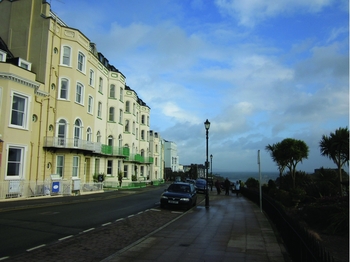
During the first half of the nineteenth century, Tenby's rocky circumference became lined with tall residential and hotel accommodation enjoying extensive sea views. However, the south-western portion of the promontory on which the town was situated remained largely unbuilt upon. With the arrival of the railway in the 1860s, this extensive area was opened up for development, its premier feature being the Esplanade (see Figure 8), a promenade with tall lodging houses and hotels, and a spectacular prospect across to Caldey Island, Giltar Point and beyond. The value of a room with a view was well understood by developers, proprietors and visitors. When the new project was being considered, one guidebook could write of ‘magnificent sites for building purposes along the South Cliff [which] might be profitably converted into terraces of stately residence . . . this beautiful spot . . . having a sea view of unsurpassed extent and beauty’.Footnote 46 Building to capture a view was very much in the mind of John Nash and his client Sir Uvedale Price, like Gilpin one of the key oracles of the picturesque movement, when they built the triangular Castle House (1791–4) perched on the foreshore at Aberystwyth, with one room skewed to catch a view of the dramatic rocky prominence of Constitution Hill and the coast beyond.Footnote 47 Less exalted holidaymakers were equally conscious that part of what they were purchasing when choosing a place of residence was the prospect from their window. The adverts for seaside hotels that sandwich the text in many guides are replete with references to sea views; for example one guide of 1896 contained notices for the Barmouth Hotel, ‘most pleasantly situated overlooking the Estuary of the Mawddach . . . [which] commands extensive views of the far-famed Cader Range’, the Royal Castle, Lynton, which ‘commands uninterrupted views of the Valleys of the East and West Lynn, the Welsh Coast, and the far-famed Valley of Rocks’, the Ilfracombe Hotel, ‘the principal and only hotel facing the sea’ and Skelmerdale House, Folkestone, ‘absolutely facing the sea’.Footnote 48 One guest of the White Lion Hotel in Tenby in 1831 observed that ‘we have a sea view, which none of the Coburg [sic] rooms enjoy, or at least if at all but a slight peep’, which sits oddly with a nineteenth-century trade card for the Cobourg which ‘humbly solicits and hopes that from the Sea Prospects it commands . . . it will merit a continuance of public support’.Footnote 49Caveat Emptor!
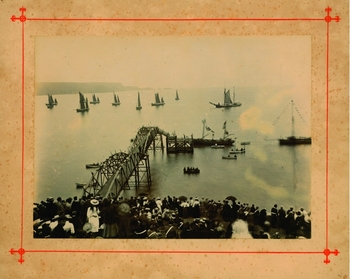
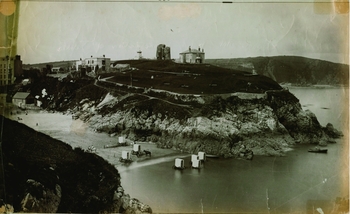
Engineering a resort to deliver views went beyond provision of residential accommodation. The Croft and the Esplanade at Tenby were also public promenades. The genesis of this type of space can be found in the fashionable walks constructed in spas and county towns from the seventeenth century, where even from this early stage a prospect of the countryside was considered an important asset.Footnote 50 When compared with inland watering places, resorts started with some considerable advantages. There was the presence of the beach as a walking area, and of structures, such as quays, jetties, piers and sea defences, which though built to protect the town and service its commerce, were also excellent vantage points, adjacent to or projecting into the sea, which could easily be appropriated and adapted to the purposes of polite perambulation. The sinuous Cobb at Lyme Regis is among the most celebrated examples, not least because of its appearance as a promenade in Jane Austen's Persuasion (1818), but it was commonplace for resorts to integrate structures of this type into the leisure facilities available. At Tenby, the earliest bath house of the 1780s was located in a converted chapel on the stone pier which formed part of the harbour, while the elegant new bath house of 1810 lay close by, and included ‘bed-rooms . . . for invalids and a handsome Coffee-room . . . commanding a delightful view of the harbour, shipping, &c.’ (see Figure 9).Footnote 51 In 1834, it was claimed that ‘the Cobb [at Lyme], as a promenade, is allowed to be unrivalled, excepting by the chain-pier at Brighton’. Piers, plunging deep into the sea, came to characterise the viewing potential of seaside architecture, and their numbers proliferated as they became a hallmark building for any aspiring resort.Footnote 52 Tenby never quite made a full-blown pier, though there were plans in the 1890s to build one which got as far as a prospectus, conjectural drawing and the claim that ‘the pier thus built out from a promontory between two beautiful Bays, cannot fail to become a popular Promenade from which the most charming views of any coast scenery in the United Kingdom will be obtained.’ In the end the town had to settle for a much less impressive pier-cum-landing-stage (the Royal Victoria Pier), first opened in 1897 (see Figure 10), which nonetheless proved a popular location for fishing and a measure of promenading.Footnote 53 Both the built and conjectural piers projected from the Castle Hill (see Figure 11), described in 1864 as
The Esplanade, Tenby, 2010 (Peter Borsay)

The Bath House (1810), Tenby, 2010 (Peter Borsay)

The opening of Royal Victoria Pier in 1897, Tenby (Tenby Museum)

Castle Hill, Tenby, before the construction of Jubilee Bandstand in 1897 (Tenby Museum)

a bold promontory of rock . . . surrounded by the sea at high water, with the exception of a narrow neck by which it is connected with the mainland. Its grassy slopes, well kept pathways, and seats for the accommodation of visitors, together with the picturesque ruins of the summit, and rugged cliffs at its base, unite their attractions to form a promenade which we are not aware any other watering-place excels.
In 1908, it was considered the ‘favourite promenade’ of Tenby, enabling ‘visitors to combine sea breezes and a fine seascape to perfection’.Footnote 54 On a clear day, it is possible from the walks on Castle Hill to catch a sight, across the Bristol Channel, of the lofty cliffs of the North Devon coast. Cut precipitously into one of these as early as 1817 was the vertiginous North Walk, ‘considered one of finest cliff walks in England’. This connected Lynton to the primeval looking Valley of Rocks, guarded over by Castle Rock, ‘which rears its perpendicular peak hundreds of feet above the blue waters of the Bristol Channel, the view from the summit being magnificent’. Fortunately for visitors, ‘steps of rock cut in a winding path make it easily accessible’.Footnote 55 Landscaping natural features in this way to provide a viewing platform was part and parcel of resort engineering, as was the provision of sea front promenades (frequently as part of a wider project of sea defences), costly and controversial as this may be with curmudgeonly rate payers.Footnote 56 Promenades and piers, and the views which they shaped, were simply an essential part of a resort's infrastructure.
Social visualisation
Promenades were of course about more than just viewing the natural landscape; they were also – and for many holiday makers this may be as if not more important than the wonders of nature – for ogling each other. Social visualisation, though less explicitly addressed than environmental visualisation in the guide literature, was just as structured and rule-driven. Much of the coding and practice here was formulated on the promenades of later Stuart and Georgian towns, which were constructed as spaces of intensive display and observation.Footnote 57 The purpose of these walks was to provide highly public spaces in which to show off, social network, acquire status and pursue sexual and marital partners. There is little reason to believe that the Victorian seaside promenades served fundamentally different functions, though patterns of behaviour and observation would have been modified to meet the practices and aspirations of the widening class profile of visitors. One space which had no direct antecedent in the Georgian spa was the beach. Judging by visual and written accounts, a more informal regime may have operated and have been one of the attractions of the seaside resort over the spa. The Halls’ account of the beach at Tenby, occupied by ‘troops of laughing children, tripping ladies . . . and gentlemen with telescopes’, or Gosse's description of the way the ‘sands are seen to advantage. The gay dresses and many-hued parasols of the ladies are dotting them over by scores; little boys and girls are scampering hither and thither, picking up shells and sea-weeds, throwing pebbles into the sea’, suggests something more relaxed, both in terms of behaviour and visualisation, than the promenade.Footnote 58 The ‘phenomenal success’ of William Powell Frith's almost anarchic depiction of Ramsgate Sands (1854) points to the extent to which such a perception of the beach had embedded itself in the visual imagination.Footnote 59
It is tempting to see the beach as the carnivalesque counterpart to the orderly promenade. This was reinforced by the presence on the sands of a variety of entertainers such as Punch and Judy men, minstrels and pierrots. Yet ways of looking were regulated on the beach as elsewhere. Before the twentieth century and the arrival of the cult of the sun, the problem was not exposed bodies on the beach but in the water. The bathing machine, still being widely used in the early twentieth century, was invented in part to conceal female bathers from the gaze of male voyeurs. In Tenby, as in many Victorian resorts, rules existed governing bathing practices. A guide of the 1860s reported that ‘bathing from the rocks or beach, instead of a machine, is not permitted during the day; persons who commit the impropriety, outrage the laws of decency, infringe the By-laws of the town, and may be punished for the offence’. Those who wished to bathe from the rocks or beach had to do so at the extremities of the town's sands, and only between 8 pm and 8 am, while ‘those who prefer a deep sea swim may hire a boat for the purpose, but must, in that case, row seawards to the distance of two hundred yards from any of the promenades or beaches’.Footnote 60 Formal attempts to control visual practices seem to have been a relatively recent innovation. In 1800, it was reported in The Observer that ‘the indecency of numerous naked men bathing in the sea close to the ladies’ bathing machines, and under the windows of the principal houses at most of the watering places, has long been complained of, but in general has not been . . . redressed’, and one contributor to a family diary kept of a visit to Ramsgate in 1828 recorded ‘directly after breakfast we sallied down to the beach which was crowded with males & females to see one another bathe’.Footnote 61 In all likelihood, the regulations introduced simply added to the sexual frisson already surrounding the beach and encouraged male (and female) display and voyeurism, the latter satirised – but also to a degree celebrated – in sketches by artists like Thomas Rowlandson, and in early postcards.Footnote 62 Moreover, by the early twentieth century it is clear that regulation was breaking down. In 1912, a Tenby bathing machine proprietor complained ‘it is really disgraceful to see adults on the beach in an almost nude state when I am renting the machines to them at such a small cost’, while five years later the deputy town clerk of Aberystwyth, in response to an enquiry from the town clerk at Tenby, admitted that ‘our last Bathing Byelaws were made in 1884 and are now to a very great extent obsolete’.Footnote 63 Not that we should assume that visual practices became any less structured. Perception of the body, as much as that of the landscape, depends upon culturally determined ‘criteria and conventions’.Footnote 64
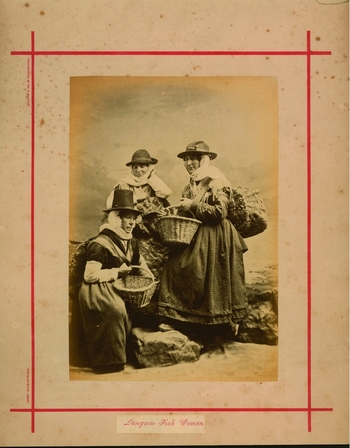
The visitors did not confine the process of social visualisation to themselves; they also drew the indigenous population into their field of vision. One tourist in the late eighteenth century recorded how in the environs of Tenby ‘I embraced the opportunity . . . of mingling familiarly among the lower classes of the people; and was of course repeatedly delighted with that simplicity of manners, that happiness in poverty, which appears so conspicuously among the poor Welch people.’Footnote 65 A guide of the 1860s advocated using the newly established rail line at Tenby to take an excursion into the countryside, ‘the peasantry and native are invariably civil to strangers . . . It is by such methods only that strangers meet with the peasantry whose peculiarities of dialect are correctly and amusingly noticed in Purnell's “Englishery of Pembrokeshire”.’Footnote 66 The local population were being observed in much the same way as a piece of landscape or an old building, something that adds to the quaintness and pictorial quality of the scene. In 1863, one account of a holiday in Tenby refers to a shrimper, ‘often a Welsh girl, with her flannel dress tucked up above her knees, wading through the flood and pushing her net before her’ as ‘a picturesque sight’.Footnote 67 There is evidence here of the growing Victorian interest in a mixture of rural primitivism and social realism, in which peasant workers are observed as a survival of a pre-industrial, pre-urban world. In the case of coastal settlements, the place of the peasantry is taken by fisherfolk.Footnote 68 The choice by a number of painters to form ‘colonies’ in small fishing towns and villages, such as Newlyn and St Ives, reflects these trends. The decline of the indigenous fishing fleet in Tenby in the early nineteenth century might have ruled the town out for such treatment, were it not for the fleet's revival in the later part of the century. The fishermen and their families crowded into the small cottages and narrow lanes around the harbour, and they and their boats became a favourite subject for photographers, in particular Charles Smith Allen whose studio overlooked the harbour (see Figure 4).Footnote 69 One particular subject of attention was the Llangwm fisherwoman (see Figure 12). Hailing from a small fishing village on the Daugleddau waterway inland of Milford Haven, she sold her wares in Tenby. Dressed in traditional Welsh costume, and carrying her distinctive creel of oysters, she was painted (1880) by William Powell Frith and captured by Allen and many other photographers, as well as earning a description in the guidebooks:
Langwm fisherwoman, photographed by Charles Allen Smith (1831–97) (Tenby Museum)

The Langwm fisherwomen are natives of a village of that name . . . and are of a race peculiar to that place. They dredge for oysters . . . first tying their petticoats round their legs so as to resemble Turkish trousers, and afterwards carry the oysters in a ‘creel’, as shown in the illustration, to market, bringing some of them to Tenby . . . The Langwm people universally inter-marry, and thus the peculiarities of their race are perpetuated.Footnote 70
This is an account shot through with ambivalence. The ‘authenticity’ and primitive virtues of these hard-working women are extolled. But the references to orientalism, race and inter-marriage suggest a form of social visualisation, derived from contemporary notions of imperialism and social Darwinism, that challenged the genetic credentials of the fisherwomen and their community.
Conclusion
The expansion in consumption that marked the British economy in the eighteenth and nineteenth centuries was based not only on a growth in the range and volume of material goods, but also of less tangible, experientially and culturally rich goods such as leisure and tourism. Underpinning the latter of these, and of key importance in the rise of the seaside resort, was the process of visualisation, with a transformation of what John Berger has called ‘ways of seeing’.Footnote 71 The ‘tourist gaze’, and with it the room with a view, became a commodity in its own right. Changes in material culture were of course required to facilitate alterations in perception. Visual culture had a material dimension, which underwent transformations in content and reproductive potential, and the built environment of resorts had to be ‘engineered’ to deliver views. However, it is valuable, at least as a heuristic device, to recognise that the visual experience was a commodity in its own right; otherwise the holidaymaker would be content to make do with a room without a view. Two types of visual experience have been suggested in this paper, environmental and social. The one built on a surge of interest in the natural world, and on new ways of perceiving and capturing this, such as the picturesque; the other drew on continuing and changing patterns of social interaction. Throughout the paper there have been allusions to the deeper meaning and function of the visual experience at the seaside, and much more could be said about this in areas such as the gothic experience, religious sentiments, popular science, status and class relations, family life, national identities and empire. At the most basic level, it would be helpful to analyse the relationship between large-scale industrialisation and urbanisation, the rise of seaside resort, and new ‘ways of seeing’. Because resorts were invariably also sites of commerce and industry, and some resorts became large towns in their own right, the relationship was far more complex and entangled than might at first seem.Footnote 72 For the purposes of this paper, however, the key point has been to establish that the visual mattered, and that a room with a view – as every hotelier understood – had a value. In 1909, the aggrieved proprietor of 4 Esplanade at Tenby complained to the council that having generously ‘handed over’ land in front of his property to the town, ‘there are [now] 5 deck chairs placed within the limits of the land . . . which I consider obstruct the view from my lower windows & I shall be much obliged if you will give orders for their removal’.Footnote 73