Introduction
Gastropod opercula are hard structures carried on the dorsal surface of the foot and associated with the shell aperture (Checa and Jiménez-Jiménez, Reference Checa and Jimenéz-Jimenéz1998). Oriostoma is one of few lower Paleozoic gastropods known to have a calcified operculum (Boucot and Poinar, Reference Boucot and Poinar2010, table 33). Gubanov and Yochelson (Reference Gubanov and Yochelson1994) divided opercula into three types: concentric, multispiral, and paucispiral. Checa and Jiménez-Jiménez (Reference Checa and Jimenéz-Jimenéz1998) refined the classification into flexicaudent spiral opercula, rigicaudent spiral opercula, and rigicaudent concentric opercula. All Oriostoma opercula are multispiral on the exterior. Gastropods with the operculum preserved in place within the aperture are rare but may be useful for classification. Gubanov and Yochelson (Reference Gubanov and Yochelson1994, p. 488) illustrated a paucispiral operculum in place in their Silurian Australonema varvarae from Siberia and distinguished it from Oriostoma primarily on the form of the operculum. Yochelson (Reference Yochelson, Gray and Boucot1979) also demonstrated how opercula can be of paleobiogeographic significance.
Eight Oriostoma with an in situ operculum have previously been illustrated by Lindström (Reference Lindström1884, pl. 17, figs.11, 24), Boucot et al. (Reference Boucot, Johnson, Harper and Walmsley1967, pl. 16, figs. 15, 16) from New Brunswick, Canada, and Forney et al. (Reference Forney, Boucot, Rohr, Boucot, Berry and Gray1981, fig. 5–3) from Quebec, Canada. Two operculate Oriostoma are illustrated by Peel (Reference Peel2015, fig 1A–I) from the English Midlands. The specimen illustrated by Peel (Reference Peel1984, text-fig. 1E, F, Reference Peel and Murray1985, pl. 6.6.33, Reference Peel2015, fig. 1J, K) is the same as Lindström's (Reference Lindström1884, pl. 17, fig. 24) from the Wenlockian of Gotland, Sweden. Several specimens with opercula from the Silurian of Bohemia were illustrated by Perner (Reference Perner1903, pl. 78, figs. 23, 24, pl. 79, figs. 16, 18). “Polytropis” potens Perner, Reference Perner1903 (pl. 80, figs. 23, 31) may be Oriostoma, but it is an internal mold with no ornament preserved. The specimen from Indiana described herein is the first reported occurrence of an Oriostoma with an in situ operculum from the United States.
Materials and methods
Locality information
The single specimen of Oriostoma was collected by Earl Boone in 1966 from the Laurel Limestone along US Hwy 50, 2.1 km east of Nebraska, in southeastern Indiana (UTM 16S, 635344E, 4325233N). The specimen resided in the Indiana University Stratigraphy Collections until Donald E. Hattin, recognizing its significance, loaned the specimen to Wahlman for study several years ago. The nonsilicified gastropod is in a light tan-gray, fine-grained, slightly dolomitic packstone to grainstone with fine skelmolds. There are no other macrofossils recognizable in the small rock sample, and we have no further information on the field occurrence.
Repository and institutional abbreviation
The figured specimen is deposited with locality data in the Indiana University Paleontology Collections (IUPC), Department of Geological Sciences, Indiana University, Bloomington, Indiana, USA, and is assigned IUPC number 101101.
Systematic paleontology
Order Euomphalina de Koninck, Reference de Koninck1881
Superfamily Oriostomatoidea Wenz, Reference Wenz1938
Family Oriostomatidae Koken, Reference Koken1896
Genus Oriostoma Munier-Chalmas, Reference Munier-Chalmas1876
Type species
Oriostoma barrandei Munier-Chalmas, Reference Munier-Chalmas1876 (p. 103). Lower Devonian, Rennes, France.
Oriostoma globosum (von Schlotheim, Reference von Schlotheim1820)
Figure 1
- Reference von Schlotheim1820
Trochilites globosus von Schlotheim, p. 162.
- Reference Hall1843
Euomphalus sulcatus; Hall, p. 18, fig. 4, p. 138.
- Reference Whitfield1878
Euomphalus macrolineatus; Whitfield, p. 82.
- Reference Lindström1884
Oriostoma globosum; Lindström, p. 160, pl. 17, figs. 24, 25, 29–31, pl. 18, fig. 24, pl. 20, fig. 16.
- Reference Kindle1904
Oriostoma huntingtonensis; Kindle, p. 463, 465, pl. 14, figs. 9, 15.
- Reference Donald1905
?Polytropina globose; Donald, p. 576, pl. 37, fig. 16.
- Reference Cumings and Shrock1928
Poleumita huntingtonensis; Cumings and Shrock, p. 99.
- Reference Shaver1974
Poleumita huntingtonensis; Shaver, p. 312.
- 1980
Oriostoma cf. O. huntingtonensis; Indiana University Paleontology Seminar, p. 121.
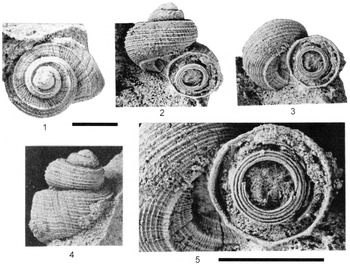
Oriostoma globosum (von Schlotheim, Reference von Schlotheim1820) from the Silurian-age (Wenlockian) Laurel Limestone, southeastern Indiana, Indiana University Paleontology Collection specimen IUPC 101101: (1) apical view with upper flattened shoulder bordered by strong cord; (2) apertural view of partial operculum in place; (3) oblique umbilical view with strong cord around base; (4) side view of prosocline growth lines and slight loosening of the coil; (5) detailed view of incomplete, counterclockwise, multispiral operculum. Scale bars = 1 cm.

Holotype
Unnumbered shell lost or destroyed. Silurian, Gotland, Sweden (von Schlotheim, Reference von Schlotheim1820, p. 162).
Occurrence
The specimen described herein is from the Laurel Limestone. The Laurel Limestone is considered to be of Wenlockian age (late Sheinwoodian to early Homerian; Brett et al., Reference Brett, Dattilo, McLaughlin, Schramm, Thomka and Cramer2012).
Description
Shell turbiniform, 22.7 mm high, 21.5 mm wide, apical angle 85°, widely umbilicate, slight loosening of the coils with growth. Somewhat flattened dorsal and ventral shelves on whorls separated from rounded lateral whorl by sharp keels, particularly the ventral keel. Revolving ridges stronger than growth lines, which cross the former obliquely forming an angular reticulate pattern of ornament. Nodes often developed where lines cross, giving the revolving ridges a jagged appearance. Aperture circular, planar, inclined 35° to the axis of coiling with flat shelves preserved at the top and bottom. Outermost and center of the operculum are not preserved, but preserved portion of the outer surface appears nearly planar with fine, counterclockwise spiral ornament. Inner surface unknown.
Material
Indiana University IUPC number 101101.
Remarks.—The weak shelf-like structure just inside the aperture may be a seal for the operculum when retracted. All known in-place Oriostoma opercula are slightly convex and shield shaped. Many free opercula have the same shape. Thick, bullet-shaped opercula are also known (Lindström, Reference Lindström1884, p. 165, pl. 17, figs. 32–38, 47), but they have not been shown to belong to Oriostoma.
Lindström (Reference Lindström1884), Knight (Reference Knight1941), and Peel (Reference Peel2015) observed that species of Oriostoma are variable even within the same bed. Thus, it seems likely that the more than 60 named species (http://fossilworks.org/) may include many synonyms.
Kindle (Reference Kindle1904, pl. 14, figs. 9, 14, 15) described five incomplete specimens of Oriostoma huntingtonensis from Silurian dolomitic limestone in quarries at Huntington, Indiana. He noted that the wide, open umbilicus is surrounded by a strong keel like our specimen, and the apical angle is similar. Multispiral opercula also occurred at the same locality (Kindle, Reference Kindle1904). Some authors of studies on Silurian strata and reefs in Indiana have listed this species as Poleumita huntingtonensis (e.g., Cumings and Shrock, Reference Cumings and Shrock1928; Shaver, Reference Shaver1974). Kindle (Reference Kindle1904) originally described Oriostoma huntingtonensis from the so-called Huntington Formation in northern Indiana. Cummings and Shrock (Reference Cumings and Shrock1928, p. 99) referred to the taxon as Poleumita huntingtonensis and cited it as characteristic of the Huntington Formation. Later, Pinsak and Shaver (Reference Pinsak and Shaver1964) and Shaver et al. (Reference Shaver, Ault, Burger, Carr and Droste1986) changed the name of that unit to the Huntington Lithofacies, which is the reefal facies of the thick Wabash Formation (Wenlockian–Ludovian–Pridolian) across northern Indiana. Pinsak and Shaver (Reference Pinsak and Shaver1964) and Shaver et al. (Reference Shaver, Ault, Burger, Carr and Droste1986) also transferred the Laurel Limestone to be a member of the Salamonie Formation (Wenlockian). Shaver (Reference Shaver1974, p. 312) listed Poleumita huntingtonensis as occurring in the upper Salamonie Formation (Wenlockian) just below the Waldron Shale, which is similar to the occurrence of the specimen described herein, and in the Liston Creek Limestone Member of the Wabash Formation (Ludlovian–Pridolian) in northern Indiana (e.g., Kindle, Reference Kindle1904). The Indiana University Paleontology Seminar (1980, p. 121) cited Oriostoma cf. O. huntingtonensis from the Delphi reef complex in northern Indiana, which ranges from the Salamonie Formation up through the Liston Creek Member of the Wabash Formation. Lindström (Reference Lindström1884) described O. globosum from the Wenlock–Ludlow of Gotland, including two specimens (Lindström, Reference Lindström1884, pl. 17, figs. 11, 24) with opercula in place. He noted a great deal of variation, especially in the sculpture of the revolving keels, even within the same specimen, but most have a strong keel around the umbilicus. Since O. globosum is widespread in North America and Europe, we concur with Fossilworks (http://fossilworks.org/) that O. huntingtonensis is probably a synonym of O. globosum.
Conclusions
The specimen discussed herein is one of only nine specimens of in situ Oriostoma opercula that have been illustrated, and it is the first from the United States. O. huntingtonensis is slightly younger, and it is the only other illustrated occurrence of the genus in the Silurian of Indiana. It is considered a synonym of O. globosum.
Acknowledgments
We thank J. Barrick (Texas Tech University) for information on conodont-based age of the Laurel Limestone. J. Peel and J. Ebbestad provided many helpful suggestions to improve the manuscript.