The history of money, as money itself, is continuously recast according to the current standard.Footnote 1 Until it was closed by Richard Nixon in 1971, it was through the gold window that most historians looked upon previous centuries as a sequence of trials and errors that prefigured and prepared the eventual establishing of the metal standard. Over the last 35 years, as the temporary suspension of convertibility has turned permanent, it has gradually inspired a different history – or rather heraldry – of European money, tracing the genealogy of the fiat money rule.Footnote 2
The Renaissance, rich in variety as in number of monetary means, provides ample support to either standpoint, depending on how the scale is oriented. What both perspectives share is the idea that, from the confusion of the Dark Ages to the rationalisation of the Enlightenment, the issue of money was still the object of theoretical debate and practical indecision, oscillating between intrinsic and extrinsic value, before it was eventually settled on either side.
This article suggests that the oscillation was not a defect, but a structural feature of a coherent monetary system; that, unlike the regimes to follow, the monetary system of Renaissance Europe was deliberately characterised, not by one, but by two different standards; and that those standards were not alternative, but complementary.
The article starts with a broad outline of what is normally considered the most permanent and pervasive form of monetary disorder in western Europe throughout the late medieval and early modern period: the debasement of the coinage. Section II will then describe the mechanics of monetary alterations as the levers of a peculiar form of monetary policy, imbued with additional freedom compared to more modern forms, and equally capable of being managed or mismanaged. Section III will suggest that the whole system, and its apparently awkward articulations, may have been deliberately designed to ensure complementarity between domestic and foreign trade.
I
The European monetary system had its own renaissance. In the middle of the thirteenth century, minting of gold was resumed, with the production by leading commercial states of large coins of extreme fineness. The West had ceased to mint gold after the last solidi aurei of the late Empire. And these had probably disappeared from circulation when the Holy Roman Empire, at the end of the ninth century, issued the last coins of good silver in an attempt to provide a single monetary system for a unified Europe. As the Empire was disrupted, so the coinage was fragmented and deteriorated. By the late twelfth century, all European states had their own pennies, varying widely in fineness and weight, with only one thing in common: a meagre content of silver, averaging 90 per cent less than the Carolingian denarius.
Nonetheless, Charlemagne did leave Europe a ‘monetary bequest’, by establishing a system of account that survived until very recently. As a measure of value, the penny (denarius), together with its multiples, the shilling (solidus) of twelve pennies and the pound (libra) of twenty shillings, continued to be used throughout the Continent until the introduction of the decimal system by Napoleon, and in the United Kingdom down to 1971. The pound originally corresponded to a pound of silver, and the shilling was incidentally equal to the value of the old Roman solidus. However, these units of account soon ceased to correspond either to a given amount of gold or to a given coin, as the penny coin retained its value of one penny unit, even as it lost weight and fineness.
The monetary renaissance began, at the dawn of the thirteenth century, by incorporating in real coins what the previous, Carolingian renaissance had conceived as pure units of account. First, the shilling appeared in the form of large silver coins issued almost simultaneously, around 1220, by the great commercial centres of northern Italy: at the date of their first issue, these grossi were valued at exactly 12 pennies.Footnote 3 Then, in 1252, the pound took the form of the pure gold coins of Florence and Genoa, initially valued at 20 shillings.Footnote 4 The sudden identification of each unit of account with a given coin, of a given metal, of a given weight and fineness, might appear retrospectively to anticipate the principles on which the future metal standard was to be based five centuries laterFootnote 5… yet it didn't last quite that long.
In fact, the Renaissance retained at least part of its medieval heritage: the debasement of small coins. These continued to be issued with an ever declining content of pure metal, while preserving their original denomination in the unit of account. Consequently, the new large coins of gold and silver, fixed in weight and fineness, had to be immediately enhanced in terms of the unit of account, thus decoupling from the pound and shilling.
Hence, the Renaissance shared with the Dark Ages the circulation of ‘black money’, continuously subject to debasements, while it shared with the Enlightenment the circulation of ‘white money’ and pure gold coins, with a stable metal content. However, it was not just a transitional phase. For over five centuries these two distinct monetary circuits operated side by side. What I shall argue here is that this did not occur by fault or chance, but as the result of deliberate decisions and according to the rules of the monetary regime peculiar to this period. The Renaissance had its own monetary system.
The distinction between unit of account and medium of exchange is widely acknowledged as the distinctive feature of premodern monetary systems. Throughout the Middle Ages, and for gold and silver coins until the French Revolution, coins never bore an inscription of their value.Footnote 6 According to Einaudi, the immaterial unit of account, not inscribed on any coin and in variable relationship to most of them, was the fulcrum of a ‘system of imaginary money’, ruling throughout Europe for a thousand years, from Charlemagne to Napoleon.Footnote 7 On the contrary, Spufford considers ‘imaginary money’ a misnomer, since he assumes ‘as axiomatic’ that it is always possible to detect the real coin to which each system of account was attached. He regards it as ‘a system of counting coins, rather than a system of money. A shilling meant a dozen coins, and a pound meant a score of dozens.’Footnote 8
Indeed, this may have been true until the thirteenth century. However, as noted above, large silver and gold coins had to be unpegged from the shilling and the pound shortly after they were first issued. As a consequence, the money of account was not a way of counting, but a way of evaluating large coins. The relationship between unit of account and large coins was not fixed, but variable. Hence, in the case of large coins, the distinction between unit of account and medium of exchange was not merely conceptual, but operational.
This doesn't mean that money of account was merely ‘imaginary’ money, since it continued to be based on coined pennies. On the other hand, since pennies did not have a fixed content of precious metal, the unit of account that they incorporated wasn't even strictly ‘material’. It was not a metal standard but, as this article will argue, a standard it was.
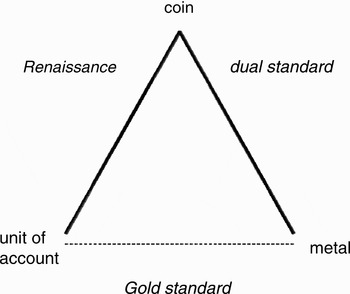
A monetary standard is a measure of value. A measure of value is something that remains fixed in its value, in order to allow all other things to change, or to be commensurately exchanged. Throughout the Renaissance, small coins tended to have a fixed relation to the money of account, regardless of their metal content. In this sense, they may be said to have incorporated the money of account. On the other hand, large coins had a variable value in terms of the money of account, in consideration of their (relatively) stable metal content. Hence, we may attempt a first, still rather formal, sketch of the double-sided architecture of the Renaissance standard: on one side, a relationship between unit of account and (small) coin, fixed by civil law; on the other side, a relationship between (large) coin and metal, stabilised in view of the certainty of international settlements; and never, on either side, that fixed parity between unit and metal that would only later prevail as the unique, national and international, gold standard (Figure 1).
The Renaissance dual standard

Variance has the capacity of striking the mind and marking the memory more vividly than permanence. Thus debasements have attracted the attention of contemporaries and historians as the prevalent feature of medieval money. Why did debasements systematically and pervasively occur until the eventual establishment of fixed metal standards? This indeed is the principal explicandum of this period of monetary history. Was it merely the result of blind forces, in need of enlightenment, or was it the outcome of deliberate decisions, in view of a less visible principle of stability, on which the institutional framework of medieval money was based?
Debasement affected, in different degrees, yet without exception, all silver coins of all European states throughout the whole Renaissance. By contrast, gold coins remained remarkably stable, in both weight and fineness, even for centuries. The florin, the first gold coin to be minted again in the Occident, in 1252, was struck out of pure gold throughout its existence down to the sixteenth century, and suffered only minor adjustments in weight – upwards by 1 per cent. The other gold coin that rivalled the florin as a medium of international payment, the Venetian ducat, was first minted in 1284 and, for over five and a half centuries, held a constant weight of 3.56 grams and constant fineness of 24 carats.Footnote 9 Gold was indeed a standard, well before the establishment of the international gold standard.
From this perspective, debasements may be regarded not as a defective but rather as an additional feature of the monetary system that preceded the gold standard, since debasement of silver coins clearly did not undermine the soundness of gold coins. This was achieved thanks to the money of account, which allowed monetary authorities to regulate the value of coins in order to reflect their relative metal content.Footnote 10 If silver coins were debased, maintaining their nominal value in terms of the money of account, the nominal value of sound gold coins could be raised accordingly. The secular increase of the florin's value throughout all major commercial centres of Europe provides a measure, if rough and indirect, of the debasement of their silver coins, corresponding to their respective units of account.
Thanks to the keystone of Renaissance monetary architecture, the distinction between unit of account and medium of exchange, debasements of petty coinage for local use could occur without altering the means for international settlements.Footnote 11 This does not, however, explain why they should occur at all. However, before turning to the possible explanations, it is necessary to take a closer look at the various patterns of debasement across Europe.
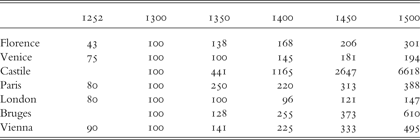
Table 1 provides a broad picture of long-term monetary alterations in different countries. The indexes measure the variation, with respect to the year 1300, of the value of the Florentine florin in terms of local units of account. Given the stable metal content of this coin over the whole period, an enhancement of the florin corresponds to a reduction in the metal parity of the unit of account, reflecting a debasement of the local coin in which it was incorporated. What is most striking is the great disparity between the English sterling, which lost 32 per cent of its metal parity, and the Castilian maravedis, which suffered a loss of over 98 per cent. However impressive the differences may appear, they must not overshadow the fact that all silver currencies, even the most stable, were subject to continual debasement with respect to gold coins.Footnote 12 Debasement was a general and permanent phenomenon. Not debasement in itself, but its general and permanent character, is the fact that demands explanation.
Value of the Florentine florin in local money of account 1252–1500 (index numbers base year 1300 = 100)
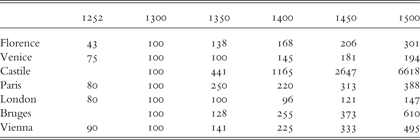
Source: Extrapolations from Spufford, Money, Table 1.
There is a further difference between the stories of single states, which is not revealed in Table 1. Recording only long-term trends, it doesn't show the short-term fluctuations, due to extreme debasements, that affected certain countries at certain periods, usually of conflict or civil war. It is these episodes that have led historians to analyse and criticise the practice of debasement. Yet, this ‘conjunctural’ resort to debasement, as a source of extraordinary revenue in case of war, cannot be used to explain the ‘structural’ nature of the phenomenon. And the structural character of war cannot be invoked as an explanation, as even a rough comparison between France and England will show.
After the period of sound money established by Saint Louis, French coinage suffered severe and frequent debasements until the mid fourteenth century. Philip IV was pictured by Dante in Hell for having repeatedly used this method to finance his wars. In 1296, he managed to raise his income by 20 per cent, by debasing the livres parisis. Two years later, a similar operation granted him proceeds exceeding annual revenue from other sources. The same practice was exploited also by Philip VI, during the first phase of the Hundred Years War. Debasements came to an end, at least temporarily, only after the Traicte des Monnoies, in which Oresme denounced them as an abuse of power, was adopted as a guideline of sound policy. In the meantime, the livre had lost over 60 per cent of its metal parity in only 50 years.Footnote 13
English money tells a rather different story, although it often served to fight the same wars, and not without success. In England, large silver coins were represented by groats, first issued by Edward I in 1279 at the standard sterling rate of 0.925 and a weight of 5.77 grams. Fineness remained unaltered, whilst weight declined to 3.11 grams by the time of Henry VII, with a debasement of less than one half over two centuries. The small coinage showed the same pattern: the fineness of pennies had been fixed at sterling in 1156, and their weight declined only gradually over the following centuries, from the original 1.46 g. (in 1156) to 1.44 g. (in 1279) to 0.97 g. (1412–64) to 0.78 g. (1464–1526), corresponding to a debasement of less than 50 per cent over almost four centuries.Footnote 14
What appears from these examples is the distinction between conjunctural and structural debasements. Conjunctural debasements consisted of sharp reductions in weight and/or fineness, often repeated at brief intervals, with the purpose of providing extra revenue to support wars; and, indeed, they appeared occasionally to serve this purpose quite well, as in France in the first half of the fourteenth century, in Flanders in the second half of the fifteenth century, and in Castille throughout. Structural debasements consisted of rather milder, and more evenly distributed, debasements, occurring at the rhythm of approximately one every generation, in Flanders, or even one every two generations, in England.Footnote 15 This sort of debasement was the true permanent and general feature of silver coinage throughout the Renaissance.
This is how monetary alterations occurred de facto, and before we can even suggest an explanation for their meaning and purpose, we must consider the peculiar regime under which they operated de jure.
II
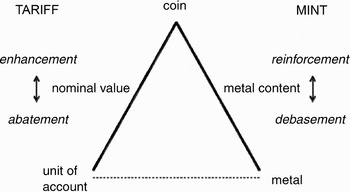
The institutional framework of Renaissance money provided the prince with what we might call, in modern financial jargon, two levers of monetary policy. Through the mint, he defined the metal content of all different types of coins he issued by setting their weight and fineness. The first lever thus controlled the coin–metal relationship. Through the tariff, he proclaimed the legal value of those coins in terms of the state's unit of account. Hence, the second lever managed the relationship between money of account and effective money. The two levers and their interaction produced two different kinds of monetary alterations (Figure 2).
The levers of Renaissance monetary policy

The first kind, debasements, consisted of reducing the metal content of new coins by reducing their fineness and/or weight. This allowed the mint to strike a greater number of coins from the same quantity of fine metal. The holders of old (strong) currency, by bringing it to the mint, could therefore receive a higher amount of new (weak) currency in exchange, even while the prince retained part of the metal. This could serve to cover the expenses of coinage (brassage) and, possibly, to provide an extra profit to the prince (seigniorage). The latter case, in particular, consisting of sharp debasements for fiscal purposes, has been the object of general condemnation, by both contemporaries and historians. It was considered a subtle, and hence arbitrary, form of taxation, and a source of inflationary pressures, causing unpredictable and inequitable alterations in the distribution of income and wealth.
The tariff was a royal decree, fixing the value at which all coins circulating in a state were to be spent and accepted in payment for goods and services and in discharge of debts. All prices, contracts and accounts were denominated in the local unit of account. Through the tariff all coins (even foreign coins) were made acceptable in payment, according to a precise measure that the authority itself was entitled to fix and vary from time to time. An increase of the tariff value was called enhancement (and a reduction, abatement). This second sort of mutation was generally considered a legitimate exercise of authority by contemporaries, and has been criticised only retrospectively since the eighteenth century as a purely nominal variation that was to be eventually matched by proportionate changes in prices, while causing disorders in the time-span required for the adjustment.
Historians have condemned all monetary mutations indiscriminately, not only because they produced similar damages, but also because they usually occurred together, debasements of small coins being coupled to enhancements of large coins. The very possibility of these alterations should not be too rapidly described as a ‘scourge’ in medieval economies. As with any instrument, these levers were not in themselves the problem, but their use could be benign or malign,Footnote 16 according to whether they actually served the purpose for which they were designed. We will consider them in succession, to assess whether they were put to appropriate use, from which of course it was always possible to depart in the direction of a misuse, or an outright abuse, producing the disorders thus rightly deplored.
Let us consider first debasement. In monetary historiography the concept of debasement is often associated with the (purportedly) more straightforward notion of inflation. However, the endeavour of understanding the old in the light of the new, in this as in other cases, is a source of misunderstanding. Debasement is not an old-fashioned version of inflation. The two words indicate two different phenomena, the immediate effects of which are, in one respect, diametrically opposed. Inflation implies a tax on the holders of monetary assets. On the contrary, through debasement, the holders of coins reap a gain, at least in the short term. Indeed, when they turn in their old coins, they receive an amount of new ones, which, although weaker than the old, have a higher value.Footnote 17 And the higher value corresponds to a higher purchasing power, at least until prices have increased more than proportionally. Hence, no one loses what the prince gains through debasement. The loss only comes if and when prices eventually rise.Footnote 18
This raises another reason why debasement and inflation are often associated. It is frequently assumed that ‘prices always tended to rise in periods of debasement’.Footnote 19 Indeed, there are many contemporary lamentations over a rise in prices following debasement.Footnote 20 However, the correlation between debasement and inflation is not a law of general validity, but ought to be restricted: inflation and debasement rates may follow the same long-term trend when it is the (gold) coins for international trade that are being debased;Footnote 21 when, instead, debasement affects (silver) coinage for local use, prices may sometimes be found to respond in the short-run, but seldom in the long-run.
Indeed, in England, throughout the entire Renaissance, there appears to be no convincing correlation between debasement and inflation. Between 1300 and 1470, whilst the sterling was debased by over 20 per cent, prices didn't rise at all, but even slightly declined.Footnote 22 Conversely, ‘the rise in prices during the sixteenth century was far higher than can be allowed for by the reductions and debasements of the currency … Prices rose more sharply than can be explained by debasement, continued to rise after debasement had ceased, and did not rise equally for all goods.’Footnote 23 Even assuming a purely quantitative approach and denying any relevance to abstract units of account, David Ricardo drew the same conclusion: ‘In the history of British coinage we find, accordingly, that the currency was never depreciated in the same proportion that it was debased.’Footnote 24
It is conjunctural debasements, in this perspective, that deserve to be regarded as an abuse and as a disturbance to the distributive balance of exchanges.Footnote 25 What about structural debasements? What was the purpose they were intended to serve, and how did they serve it? A common explanation refers to the need to accommodate the wear of currency through use. However, this has been estimated at around 50 per cent over 200 years,Footnote 26 while debasement of English silver coins was less than 50 per cent over four centuries (see Table 1). Hence, debasement was not sufficient to compensate the mint for the costs of issuing a currency that was still better than that used in circulation.Footnote 27
An alternative way to carry out recoinage without loss, or even at a considerable profit, consisted in charging mintage fees.Footnote 28 However, these would imply a cost to those who took the old money to the mint to be recoined. Perhaps, then, debasements appeared as a means to repair the currency, ‘without any apparent loss to the holder or the state’.Footnote 29 In other words, debasements could be a manner of distributing, among the users, the costs of issuing and maintaining a sound currency within the state. This would lead to the startling conclusion that money ought to be debased in order to be sound, that the only sound currency was a debased currency!
How are we to understand this apparent paradox? Is it possible that it provides the true explanation for debasements? In what sense is a debased currency a sound currency? Recoinage provides the opportunity for repairing old coins, worn by use. A recoinage, carried out with a moderate debasement, gives back to the coins the original precision of the engraving, the original clarity of the symbol, if not the original quantity of metal. This is perhaps a hint of what truly makes even ‘black money’ money. The debasement restores coins in their essential function: to circulate. What the holders lose is what they may not have, as money: a quantity of metal.
Hence, structural debasements were a way not just of financing recoinage, but of reminding the people, one generation after the other, that money required maintenance, and that this implied a cost: that money had to be first taken, in order for money to be given. And, responding to the calling in of money at the mint, the people would discover that, although a little metal was taken from their coins, nothing was taken from their money, since the new coins had the same value as the old. Indeed, as will be argued more extensively below, in a period of persistent metal shortage, structural debasement could be the only way to offset deflationary pressures, preserving the nominal value of small change and keeping it in circulation.Footnote 30 Thus, small coins could maintain their value, regardless of their metal content. Even more, they could be regarded themselves as the measure of value, mensura rerum venalium.Footnote 31
Let us now turn to enhancement. The money of account is often considered merely as a ‘common denominator’, used to express and compare the value of coins struck at different fineness or weight or even from different metals, and to trace the variation of that value over time.Footnote 32 What is commonly overlooked is that money of account did not determine only the relative values of different coins, but their absolute values, and hence the overall value of money. An abatement of circulating money, such as the ‘devaluation’ of old base coin in England in the summer of 1551, instantly decreased the value, in terms of the unit of account, of circulating coinage. What occurred in England perhaps once in four centuries corresponded to a normal regulatory procedure in other European kingdoms, where the value of coins could vary even several times in a month.Footnote 33
Thus, the true purpose of enhancements might have been to facilitate, in conjunction with structural debasements, regulation of the quantity of money according to the needs of domestic trade.Footnote 34 Of course, the increase in the quantity of money through enhancement was only in nominal terms and only for the domestic economy. This, however, did not necessarily imply inflation. It might in fact have been intended to counteract a possible deflation ensuing from the structural shortage of bullion throughout the commercial revolution.Footnote 35 In general, the possibility of enhancing the money left local authorities free from the ‘golden fetters’ that would later tie the national monetary policy to the international balance of trade under the monometallic standard.
Under the gold standard, in fact, according to the fluid mechanics of currency first described by Hume, a balance of payments deficit implied an outflow of gold, and hence a reduction of the domestic money supply, inducing deflation.Footnote 36 The relatively stable supply of gold set a limit to the growth of international trade, whilst competition for the distribution of a limited stock of gold set national interests against one another.Footnote 37
Within the system of imaginary money, the international constraint only concerned the bimetallic ratio. National authorities were forced to align tariffs to the relative price of metals prevailing on international markets, if they did not wish to suffer a loss of one metal (it is to be noted, always in favour of another). However, what is normally overlooked is that they remained free to set the relationship between all metal coins and the unit of account at the level that best suited the needs of domestic circulation, in order to maintain price stability within the country.
Small coins were spent according to their legal value, fixed in terms of the unit of account.Footnote 38 Hence there was always the possibility for monetary authorities to provide a sufficient quantity of ‘subsidiary coinage’ by reducing its metal content or raising its value. Metal shortage didn't necessarily imply deflation. Throughout the Middle Ages, the amount of monetary transactions, especially within domestic economies, was never determined by a mere fluctuation of bullion.Footnote 39 Lacking silver for subsidiary coinage, it could be ‘subsidised’ by copper, and copper by lead or iron, and small coins by jettons and other token coins.Footnote 40
In all these cases, the degree of freedom for monetary policy was based on the difference between the material of which the coins were made (their metal content) and the unit of account by which they were evaluated (their legal value). And the goal, to which this freedom was to respond, lay in setting the relationship between the two at the level most appropriate to domestic trade. The dual standard allowed this goal to be attained, without having to renounce the principle of sound money for use in international settlements.
The degree of freedom may be intended literally in algebraic terms: the market only set relative values, specifically between different metals; the monetary authority remained free to set the absolute value of all metals in terms of the unit of account. There was no competition, but indeed complementarity, between the laws of the prince and the laws of international markets. What the prince could regulate was the proportion between the unit of account and the weight of pure metal, which in the nineteenth-century gold standard was deemed to be immutably set by a supposed law of nature.
Monetary authorities had an instrument for accommodating any variation in the volume of transactions with an adequate variation in the quantity of money, in order to avoid price fluctuations. And it was, indeed, a rather more direct and efficient instrument than the very loose levers through which modern central banks can only indirectly influence the quantity of money, through bank rate changes and open market operations. However, the tariff was not just an instrument to counterbalance pressures on prices ex post, but to offset them ex ante. By being entrusted with setting the legal value of coins, the prince was committed to the task of providing, not a response to external market forces, but the necessary measure and reference for the operation of those forces. Only in this sense was money of account a ‘common denominator’: that in the name of which exchanges were carried out within a state or community.
III
A major challenge in monetary history may have been ‘to learn how to keep coins of different denominations and coins of different metals in concurrent circulation’.Footnote 41 However, pace the modern dogma of monetary uniformity, ‘concurrence’ does not necessarily mean ‘confluence’.Footnote 42 Different coins may be designed for the very purpose of flowing in separate, yet communicating streams.Footnote 43 The coexistence of different coins need not be in the form of competition or of substitutability between them.Footnote 44
This brief overview has offered several elements to question the idea of a natural tendency of monetary systems to evolve towards a progressive homogenisation, suggesting the possibility that different currencies remain side by side, even for centuries, in an outright complementary currency system. This section will outline the main features of the system prevailing in Renaissance Europe, particularly monetary alterations, and will suggest the purposes for which they might have been designed.
The first purpose had to do with articulating internal and external money. The return of gold and silver in the European monetary system was not merely a matter of metals. Different metals were used to make different kinds of coins. And each kind corresponded to a different sphere of exchange.
Small coins, or ‘black money’, consisted of coinage where silver represented only a minor part of the alloy, less than half, the greater part being of base metal, usually copper. These coins were used for retail payments, usually involving a direct transaction between producer and consumer, within rural or urban markets. Small change was often lacking, due to the high minting costs in proportion to their value. Until the seventeenth century, the general problem was the lack of subsidiary coin, not its abundance. The shortage of silver may have been a further cause of the systematic debasement of small coins. As we have seen, small coins were subject to a progressive loss of weight and/or fineness in all European states throughout the Renaissance, while they maintained a fixed value in terms of money of account.
Gold coins were first struck by the great commercial cities of Italy, with the purpose of providing a means of payment for long-distance trade throughout Europe and beyond. And they served this purpose well, for over five centuries. Even large silver coins, known as ‘white money’ for their high content of pure silver, were used for international settlements, in concurrence with gold coins; but they also intervened in large domestic transactions, especially for the payment of wholesale purchases between merchants and for the collection of taxation by the state. Both gold and silver coins had a relatively stable content of pure metal, while their legal value was subject to adjustments, according to the debasement of small coins.Footnote 45 Hence, although the types of coins were three with respect to the metal, they were two with respect to the functions and functioning: internal money and external money.Footnote 46
The double standard, in turn, was established possibly with a view to a second purpose, related to balancing domestic and foreign trade. The distinction between internal and external money didn't depend on the location of the mint that issued the currency. A Florentine coin was external money even for Florence, since it was intended for foreign trade. The distinctive feature lies in the destination, not the origin. It corresponds to the distinction between tradable and non-tradable goods. Indeed, internal and external money were intended to serve the needs of two separate, yet communicating, circuits represented by domestic and foreign trade. And the purpose of monetary alterations was to regulate the relationship between internal and external money, in order to assure the balance of both, according to different principles.Footnote 47
The principle of equilibrium within the domestic economy was distribution. Subsidiary coinage served the purpose of distribution. Perhaps this is the reason why it was called moneta divisionale in Italian and Scheidemünze in German. Small change was used for everyday purchases, starting from bread. In Florence in the fifteenth century, one quattrino corresponded to the standard price of a loaf of bread. And the size of the loaf, as elsewhere, increased or diminished in inverse proportion to the price of grain. Another use of black money was alms-giving. In France, the denier parisis was consequently nicknamed ‘denier de l'aumosnerie’.Footnote 48 All these uses hint to the distributive nature of small change, and provide a further explanation for the irrelevance of its content in precious metal. It was not made to be kept, but to circulate; hence, it was not important for it to be precious. In transactions among members of the same community, the part reserved to each was to be determined with reference to the community as a whole, according to the principle of distributive justice. Labour earned its penny, and the penny earned its loaf of bread; and there was no assurance that it would be of the same weight as last year, since this depended on the abundance of the harvest. An important part of distribution involved, hence, relationships with the countryside.
What little money the peasants used was large money. It was the large silver coins that served the purpose of large payments for seasonal exchanges between town and country. The only money needed by the rural population was external money. This does not mean, however, that the rural economy was a natural economy. Far from not being used, money was indeed used there as a true currency, i.e. as something made to circulate and not to be kept, as ‘a mere intermediary, without significance in itself, which flows from one hand to another, is received and is dispensed, and disappears when its work is done from the sum of [the people's] wealth’.Footnote 49 In fact, money appeared in the countryside at the time of harvesting of the crops, and it rapidly disappeared again, as it was used to purchase goods from the city, and to pay taxes and rents. Except for limited rural areas around the great cities of northern Italy and the southern Netherlands, there was hardly any money circulating in the country throughout the year, except around Michaelmas. This changed only gradually, starting from the fifteenth century.Footnote 50
White money was external money for the city, which used it for trade with other cities of the same region and for seasonal exchanges with the countryside. In the broader perspective of the monetary region, normally coextensive to the borders of the state, white money was internal money. And gold coin provided the medium of payment for interregional long-distance trade, even beyond the frontiers of Christendom. In this case, the intrinsic value was important, since it was the only warrant for the equity of the transaction. In transactions among merchants, which by definition did not belong to the same community, the parties had to exchange goods of equal value, according to the principle of commutative justice. The precious metal in the large coins, of established weight and fineness, provided the necessary counterpart for dispatching an order of precious merchandise. However, even in this case, money was not meant to be kept, but only to facilitate the circulation of goods. A confirmation of this is given by the peculiar form of money that the Renaissance merchant-bankers developed from the twelfth century: the bill of exchange. These were letters of credit, issued in payment for a transaction, and then circulated among merchants, thanks to their greater convenience and security compared to specie transfers – yet not indefinitely. All bills of exchange were either compensated or paid out, once every three months, at the seasonal clearing fairs. It was expressly prohibited, until the end of the sixteenth century, to carry over credits or debts from one fair to the other.Footnote 51 The balance of international trade, cleared through the mechanism of Lyon fairs, required each merchant, and hence each state, to clear their accounts.
Thus, each exchange circuit had not only its proper form of money, but also its proper form of clearing system, from rural mutual credit to trans-European fairs. Beyond the differences, all types of money had one thing in common: they were made, and managed, in order to circulate continuously. And it was the function of the money of account, the true arbiter of the system, to evaluate all types of currencies, so as to avoid their systematic accumulation.
The third purpose of the system, therefore, might have been to ensure a disinterest in money. Precious metal can be hoarded without suffering decay. According to an established view, it was this special property of precious metals that made them appropriate for making money. The establishment of this view (to which Locke contributed with a passage from his second Treatise on Government) was contemporary to the establishment of money as a store of value, in the form of the metal standard, with the Great Recoinage of 1696 (to which Locke contributed through his controversy with Lowndes). However, before this crucial turn in monetary history, which put an end to the regime of the Renaissance, money did not operate as a store of value.
Of course, there were treasures and treasuries. Yet, precious metals appeared in their vaults predominantly in the form of ingots or plate. And even when it was gold or silver coins that were stored away, what was actually guarded was the metal, not the money. If hoarded metal, in coin or specie, was ever to return to circulation, it had to be turned back into money, by passing through the institutional standards of monetary authority: the mint and/or the tariff. Plate had to be melted, recoined and evaluated. But even coins, previously hoarded, could only be reintroduced into circulation at the value fixed by the tariff currently enforced. What was stored, in either case, was the metal, not its value. And the value, being fixed by authority, could be changed. Hence, metal, either coined or not coined, could not be a store of value.
At the same time, by altering the tariff, the prince varied the metal equivalent of all credits and debts. An enhancement would thus cause, simultaneously, an increase in the value of all metal hoards and a proportionate decrease in the metal equivalent of all credits and debts. This was the reason why the receivers of rents (such as the nobility supported by Oresme) were fiercely opposed to enhancements. Vested interests have often constituted a hindrance to the appreciation of the institutional feature of money, represented by the articulation between unit of account and medium of exchange.
In the monetary regime of the Renaissance, effective money, of any kind, existed only in relation to the money of account. Money of account was the measure in which all debts and contracts were denominated. Effective monies were the means by which those debts and contracts were to be legally discharged. The relation between effective monies and the money of account was established by authority, through the tariff. It was the task of the authority not only to enforce the payment of debts and contracts, but also to determine what, and in what measure, was to be delivered as a lawful discharge.Footnote 52 The authority was thus entrusted with the magistracy of making debts payable, avoiding the accumulation of monetary assets that were not considered part of the sum of wealth.
IV
The distinctive feature of Renaissance money – in significant contrast with all later systems, commodity and fiat money alike – was that the unit of account and medium of exchange were not identified. It was a prerogative of monetary sovereignty to set the value of coins in terms of the unit of account. And it was the responsibility of monetary sovereignty to adjust those values from time to time, in order to keep coins circulating as a medium of exchange, rather than accumulating as a store of wealth, providing domestic trade with a sufficient medium of exchange, without altering international commitments. The complementarity between internal and external money relied on a more radical complementarity between money and goods, in a way that deserves further investigation.Footnote 53