Introduction
Food is a primary requirement for existence of all organisms, though its availability is seldom constant in natural environments. The frequency and magnitude of food resource supply varies, resulting in the alternations of low and high resource availability (Rosenzweig Reference Rosenzweig1995; Ostfeld and Keesing Reference Ostfeld and Keesing2000). A specific kind of variation in food availability, termed as “resource pulses”, i.e., “ephemeral events of resource superabundance” (Yang Reference Yang2004; Holt Reference Holt2008), is known to produce drastic changes in resource use. As a result, vital rates and population dynamics of both primary and secondary consumers are known to be strongly influenced by resource fluctuations (Ostfeld and Keesing Reference Ostfeld and Keesing2000; Bieber and Ruf Reference Bieber and Ruf2005), since fluctuations in prey resource significantly affect their growth and development.
One of the most common resource pulses observed in agro-ecosystems is that of aphid pests (Hemiptera: Aphididae), characterised by their bust and boom populations (Dixon Reference Dixon2000; Hodek et al. Reference Hodek, Van, Emden and Honek2012). Amongst aphid predators, Coccinellidae (Coleoptera) are the most common with immense biological control potential owing to their higher predation attributes (Hodek and Honek Reference Hodek and Honek1996; Kumar et al. Reference Kumar, Pandey, Mishra and Omkar.2013). Although the predation attributes of coccinellids on aphid prey have been assessed earlier; but these have been under constant trophic resources (Mishra et al. Reference Mishra, Kumar, Shahid, Singh and Omkar.2011, Reference Mishra, Omkar, Kumar and Pandey2012; Kumar et al. Reference Kumar, Pandey, Mishra and Omkar.2013, Reference Kumar, Bista, Mishra and Omkar.2014a; Bista and Omkar Reference Bista and Omkar.2014; Keshavarz et al. Reference Keshavarz, Seiedy and Allahyari2015; Rakhshan and Ahmad Reference Rakhshan and Ahmad2015). Also, the predatory responses of coccinellids to varying, usually increasing prey densities, have been assessed using functional and/or numerical response experimental designs (Kumar et al. Reference Kumar, Mishra and Omkar.2014b; Behnazar and Madadi Reference Behnazar and Madadi2015; Chaudhary et al. Reference Chaudhary, Kumar, Mishra and Omkar.2015; Siddiqui et al. Reference Siddiqui, Omkar, Paul and Mishra2015). However, the effect of resource fluctuation on predation aspects (consumption rate, conversion efficiency, and growth rate), is underinvestigated. This is despite the important role of predation in shaping community structure (Hiltunen and Laakso Reference Hiltunen and Laakso2013) and the major role of prey density in influencing rate of resource use by predators (Ives et al. Reference Ives, Kareiva and Perry1993; Francis et al. Reference Francis, Haubruge, Defrance and Gaspar2000; Lee and Kang Reference Lee and Kang2004; Seagraves Reference Seagraves2009).
A few studies on Hippodamia convergens Guérin-Méneville (Coleoptera: Coccinellidae) (Phoofolo et al. Reference Phoofolo, Giles and Elliott2007) and Harmonia axyridis (Pallas) (Coleoptera: Coccinellidae) (Dmitriew and Rowe Reference Dmitriew and Rowe2007; Dmitriew et al. Reference Dmitriew, Carroll and Rowe2009) have investigated the effect of resource fluctuation on either developmental duration and/or growth rate. Dixon and Guo (Reference Dixon and Guo1993) studied the effect of resource fluctuation on the oviposition behaviour of Coccinella septempunctata (Linnaeus) (Coleoptera: Coccinellidae). Yet other studies have established the role of cannibalism in countering the effect of resource fluctuation on growth rate of the coccinellids (Schellhorn and Andow Reference Schellhorn and Andow1999b; Wagner et al. Reference Wagner, Glover, Moseley and Moore1999; Snyder et al. Reference Synder, Joseph, Preziosi and Moore2000). An isolated study on Adalia bipunctata (Linnaeus) (Coleoptera: Coccinellidae) larvae has revealed higher food conversion rates under resource fluctuation conditions (Schüder et al. Reference Schüder, Hommes and Larink2004).
Thus, in the present study we have investigated the effect of aphid resource fluctuation (pea aphid, Acyrthosiphon pisum (Harris); Hemiptera: Aphididae) on the predatory attributes of two sympatric aphidophagous coccinellids, Menochilus sexmaculatus (Fabricius) and Propylea dissecta (Mulsant). For this we have abruptly changed the predators from their rearing density of scarce prey to optimal and abundant prey supply and vice versa; and observed the effect of sudden change of prey fluctuations on consumption rate, conversion efficiency, and growth rates. It was assumed that the larvae reared on scarce prey would have better predation and growth rates as well as conversion efficiencies on optimal and abundant prey supply than in the reverse scenario. Therefore, the study would not only provide information on the behaviour of concerned predators in relation to their feeding, but would also help in assessing their energy budget for various biological activities. The study would also facilitate the mass multiplication of these coccinellids for augmentative biocontrol of aphid pests.
Materials and methods
Stock maintenance
Adult males and females of M. sexmaculatus (Ms) and P. dissecta (Pd) were collected from the agricultural fields of Lucknow, India (26°50'N, 80°54'E) and paired randomly in plastic Petri dishes (9.0×1.5 cm2). They were reared under constant abiotic conditions (27±2 °C; 65±5% relative humidity; 14:10 light:dark hours) in Environmental Test Chambers (Yorco B.O.D. Super Deluxe, York Scientific Industries Pvt. Limited, Ghaziabad, India) on daily replenished supply of A. pisum reared on broad bean, Vicia faba Linnaeus (Fabaceae) in a polyhouse. The eggs laid were collected every 24 hours and subsequent first instars were used for further experimentation.
Experimental design
Our experiments were divided into two parts. The first part considered the optimisation of different food conditions for life stages of both the coccinellid species. The second part of the experiment evaluated the predatory attributes (consumption rate, conversion efficiency, and growth rate) of the two most voracious predatory stages of coccinellids (fourth instars and 10-day-old virgin females; Mishra et al. Reference Mishra, Omkar, Kumar and Pandey2012), under fluctuating prey conditions. The unmated females were selected because: (i) they do not lay eggs and reduce errors due to variations in reproductive performance of coccinellids (Omkar et al. Reference Omkar, Mishra, Kumar, Singh and Pandey2014); (ii) mated females might consume their own eggs resulting in a reduced consumption of prey and would thus provide an unrealistic estimate of number of prey that can be consumed; and (iii) unmated females are more voracious than mated females (Rhamhalinghan Reference Rhamahalinghan1987).
Optimisation experiment
Individual fourth instars were provided aphid biomass ranging from 1 to 20 mg (i.e., 1, 2, 5, 10, 15, and 20 mg) intermediate (second and third) instars of A. pisum for 24 hours in five replicates (biomass measured using Sartorius Weighing Balance BSA 124 S-CW, 0.01 mg precision, Goettingen, Germany). The minimum biomass at which no aphid was left and the larvae survived was referred to as scarce condition. The minimum biomass at which aphids were left (1.00±0.50 mg) in some replicates and the larvae survived was referred to as optimal condition. The replicates in which a minimum biomass of 4.00±1.00 mg was left were referred to as abundant condition. Scarce, optimal, and abundant biomasses for both coccinellid species were 2, 10, and 15 mg of aphid per larva per day, respectively.
Evaluation of predatory attributes
The first instars of M. sexmaculatus and P. dissecta were individually reared under scarce (n=60 per coccinellid species), optimal (n=60 per coccinellid species), and abundant (n=60 per coccinellid species) prey supply up to third instar under abiotic conditions similar to that of stock culture. After instars moulted to fourth instars, they were weighed prior to the experiment. Mortality of larval instars was observed under scarce prey supply, i.e., 20 larvae of M. sexmaculatus and 30 larvae of P. dissecta died before reaching the fourth instars stage when 60 first instars per coccinellid species were reared on the scarce prey supply; and more first instars per coccinellid species were added to the experimental setup from the stock culture to equalise the sample size.
The fourth instars from each prey supply were divided into three groups of 10 each and shifted to scarce, optimal, or abundant prey conditions under the above abiotic conditions. These conditions were maintained for 24 hours. After 24 hours, larvae and prey left were weighed in each Petri dish. Thereafter, the food of the larvae was switched back to their respective rearing conditions.
The same experiment was replicated for 10-day-old unmated adult females from each prey supply. They were divided into three groups of 10 each and shifted to scarce, optimal, or abundant prey conditions under the above abiotic conditions. Rest of the experimental protocol remained the same as above. The females were weighed before and after the experiment and the biomass of aphids left after 24 hours was also recorded.
The natural reduction in aphid biomass in the absence of predators, if any, was analysed by keeping 2, 10, and 15 mg of aphids, in five replicates each, under similar abiotic conditions for 24 hours and reweighed. Thus, the average loss in aphid biomass, if any, was determined. Using the average loss in aphid biomass in absence of predators, the loss in biomass of the remaining aphid prey left by the individual predator (larva/adult) after 24 hours was determined (using unitary method of mathematics). Now this value was deducted from the aphid biomass consumed by that predator after 24 hours to obtain the actual consumption rate of the predator.
Consumption rate, conversion efficiency, and growth rate of the fourth instars and the adult females were calculated using the following formulae:
 $$\eqalignno{ & {\rm Consumption}\,\,{\rm rate}\,({\rm mg/day})\,({\rm modified}\,{\rm after}\,{\rm Lucas}\cret\,al.\,{\rm 2}00{\rm 4})= {\rm aphid}\,\,{\rm biomass}\,{\rm \,consumed}\,\cr {\rm by}\,{\rm larva}/{\rm adult}\,{\rm during}\,{\rm 24}\,{\rm hours} $$
 $$\eqalignno{{\rm Conversion}\,{\rm efficiency}\:{\rm \,(modified}\,{\rm after}\,{\rm Dixon}\,{\rm 2}000{\rm )}\cr={\displaystyle{{\rm Increase}\,{\rm in}\,{\rm larval}/{\rm adult}\,{\rm biomass }\,({\rm mg})\atop\:{\rm after}\,{\rm }24\,{\rm hours }} \over {\displaystyle{\rm Aphid}\,{\rm biomass }\,({\rm mg})\:\,{\rm consumed}\atop\,\displaystyle{\rm during}\,24\,{\rm hours }}}$$
 $$\eqalignno{ \rm Growth\, rate\:(day^{{{\minus}1}} )\:\,(modified\,after\,\cr\rm Waldbauer\,1968;\,Ramdev\,and\,Rao\,1979) \cr={{\displaystyle{\rm Increase}\,{\rm in}\,{\rm larval}/{\rm adult}\,{\rm biomass}\:\,({\rm mg})\:\atop{\displaystyle\rm after}\,\displaystyle\,24\,{\rm hours }} \over \displaystyle \rm {Mean\,body\,biomass\:\,(mg) \,of\,\atop larva/adult\,after\,24\,hours}}$$
Where, mean body biomass is average of the initial (prior to experimentation) and final (after experimentation) biomass.
Statistical analysis
The distributions of data sets obtained in this study were checked for normality using the Kolmogorov-Smirnoff test. Means were separated using Tukey’s test when data were normally distributed and variances were homogeneous (Bartlett’s test for equal variances). Data that were obtained from each predatory stage per coccinellid species were individually subjected to two-way analysis of variance (ANOVA) with consumption rate, conversion efficiency, and growth rate as dependent variables; and rearing and experimental prey conditions as the independent variables, followed by Tukey’s post-hoc comparison of means. All statistical analyses were performed using MINITAB 16 (Minitab Inc., State College, Pennsylvania, United States of America).
Results
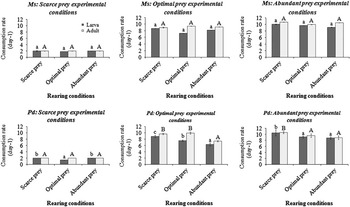
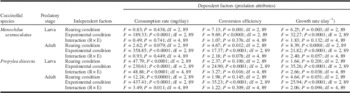
Two-way ANOVA revealed significant influence of the experimental condition on the consumption rate of larval (fourth instars) and adult (adult female) stages of M. sexmaculatus. However, neither the rearing condition nor the interaction between the experimental and rearing conditions significantly affected the consumption rates of the fourth instars and the adult females (Table 1). Comparison of means showed that rearing conditions (scarce, optimal, or abundant) of fourth instars and adult females of M. sexmaculatus did not influence the consumption rates. Consumption rates were highest under experimental abundant conditions and lowest on experimental scarce conditions, regardless of the rearing prey conditions. Consumption rates did not differ within an experimental condition for the three rearing conditions (Fig. 1). On the other hand, significant influence of rearing and experimental conditions, and their interaction was observed on the consumption rates of both predatory stages of P. dissecta (Table 1). Both, fourth instars and adult females of P. dissecta had higher consumption rates when reared on scarce prey and lower on the optimal and/or abundant prey, in each experimental condition. Comparison of each rearing condition on all three experimental conditions, revealed that, both stages consumed most under abundant prey experimental condition and lowest on scarce prey experimental condition (Supplementary Table 1).
Consumption rates of fourth instars and adult females of Menochilus sexmaculatus and Propylea dissecta when raised on the three rearing conditions but tested on single experimental condition.

Results of two-way ANOVA showing the effects of rearing (R) and experimental (E) conditions on predation attributes of fourth instar and adult female stages of Menochilus sexmaculatus and Propylea dissecta (F values are significant at P<0.05).

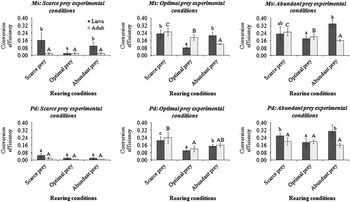
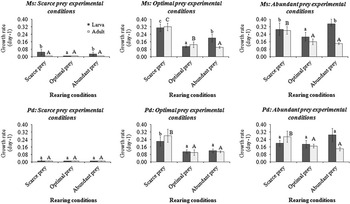
Further, two-way ANOVA exposed that the conversion efficiency and the growth rate of larval and adult stages of M. sexmaculatus were significantly influenced by both the rearing and the experimental conditions, but not by their interaction (Table 1). Conversion efficiency and growth rate of both predatory stages, were higher for those reared on scarce and abundant prey conditions than on optimal prey conditions; regardless, of the experimental condition (Figs. 2, 3). Amongst all three experimental conditions, the highest conversion efficiencies and growth rates of both stages were observed in abundant prey condition and lowest on scarce prey, for all three rearing densities (Supplementary Table 1). In case of P. dissecta, analysis revealed that conversion efficiency and growth rate of larvae of P. dissecta were significantly affected by the experimental prey condition, and the interaction between the rearing and experimental prey conditions, but insignificantly by the rearing prey condition. However, in adult females both these parameters were significantly influenced by experimental condition, but not by rearing condition and the interaction between the two (Table 1). Under each experimental condition, conversion efficiencies and growth rates were highest for those predatory stages that had been reared under scarce prey condition and lowest for those reared on optimal prey condition (Figs. 2, 3). However, both predatory stages of P. dissecta had highest conversion efficiencies and growth rates on abundant prey experimental condition and lowest on scarce prey experimental condition, regardless of rearing conditions.
Conversion efficiencies of fourth instars and adult females of Menochilus sexmaculatus and Propylea dissecta when raised on the three rearing conditions but tested on single experimental condition.

Growth rates of fourth instars and adult females of Menochilus sexmaculatus and Propylea dissecta when raised on the three rearing conditions but tested on single experimental condition.

Adults had higher consumption rate than larvae within each experimental condition, irrespective of the rearing condition, but conversion efficiency and growth rate was similar (Figs. 1–3). Comparison within each rearing condition regardless of experimental condition revealed that larval stage of both coccinellids had higher conversion efficiency and growth rate; while the adults had higher consumption rate (Supplementary Table 1).
Between species, consumption rate, conversion efficiency, and growth rate did not differ with rearing conditions within each experimental condition (Figs. 1–3). However, consumption rates, conversion efficiencies, and growth rates of M. sexmaculatus were higher when comparisons were made between the three experimental conditions, when rearing conditions were same (Supplementary Table 1).
Discussion
In the present study, prey consumption rates of larvae (fourth instars) and adults (females) of M. sexmaculatus were not affected by rearing conditions, but were substantially influenced by the experimental conditions when there were fluctuations in prey availability. Despite being reared on scarce, optimal, and abundant prey, larvae/adults consumed equivalent prey biomass when abruptly switched over to one of the three experimental conditions. However, amongst the three experimental conditions, consumption rates of larvae/adults were lowest on scarce prey and highest on abundant prey.
In general, coccinellids have suboptimal and optimal predation rates when reared consistently on scarce and abundant prey (Hodek et al. Reference Hodek, Van, Emden and Honek2012; Bista and Omkar Reference Bista and Omkar.2014). However, constancy in consumption rates of predatory stages of M. sexmaculatus under the three rearing conditions and variability under the experimental conditions suggest that these stages possibly change their consumption rates according to immediate prey conditions as in case of sudden fluctuations in prey resource availability. Therefore, despite being raised on varying rearing conditions, M. sexmaculatus individuals probably exhibit suboptimal consumption rates on scarce prey while optimal consumption under experimental conditions with abundant prey. Such an advantage possibly provides the predatory stages of M. sexmaculatus a better compensatory ability to overcome prey resource fluctuation.
The coccinellid stages from all rearing conditions, consumed least under experimental scarce prey conditions. While under experimental conditions of optimal and abundant prey, higher consumption rate possibly allows the predatory stages to consume prey biomass maximally and enhance their development and reproduction, respectively; as also reported earlier (Schüder et al. Reference Schüder, Hommes and Larink2004; Agarwala et al. Reference Agarwala, Yasuda and Sato2008; Atlihan and Guldal Reference Atlihan and Guldal2009; Omkar et al. Reference Omkar, Sahu and Kumar2010; Maurice and Ashwani Reference Maurice and Ashwani2011; Bista and Omkar Reference Bista and Omkar.2014).
Moreover, substantial influence of rearing and experimental conditions on conversion efficiency and growth rate of larvae and adults of M. sexmaculatus further substantiate that despite having suboptimal consumption rates when reared on scarce prey, larvae/adults of M. sexmaculatus compensate for a shortage of food by converting and using higher prey biomass than usual when suddenly encountering optimal/abundant (experimental) prey resource. Possibly, increase in conversion efficiency and growth rate under prey scarce condition are amongst the several mechanisms displayed by coccinellids to overcome the shortage of trophic resource, as reported earlier by Schüder et al. (Reference Schüder, Hommes and Larink2004) in the larvae of Adalia bipunctata.
Further, under prey resource fluctuations both the rearing and the experimental conditions substantially influenced the prey consumption rates of larvae/adults of P. dissecta. When tested on three experimental conditions, larvae and adults of P. dissecta that were raised on scare prey rearing condition showed higher consumption rate, conversion efficiency, and growth rate than those reared on optimal/abundant prey rearing conditions; so as to compensate for a shortage of food during their early phases of development.
In comparison to larvae/adults of P. dissecta, higher consumption rates, conversion efficiencies, and growth rates of M. sexmaculatus larvae/adults under the three experimental conditions may possibly be owing to certain intrinsic advantages possessed by the former to maintain its stable coexistence. Since prey consumption and use of an insect predator depends on its ability to digest the consumed prey (Isikber and Copland Reference Isikber and Copland2001); it therefore appears that M. sexmaculatus has higher prey digestive abilities than P. dissecta, owing to which former consumes and uses the prey faster than the latter. Many earlier studies have also reported higher conversion efficiencies and growth rates of M. sexmaculatus over P. dissecta when fed on a constant biomass of A. pisum, Aphis craccivora Koch, and Liphaphis erysimi (Kaltenbach) (Mishra et al. Reference Mishra, Kumar, Shahid, Singh and Omkar.2011, Reference Mishra, Omkar, Kumar and Pandey2012; Kumar et al. Reference Kumar, Pandey, Mishra and Omkar.2013). However, no study has evaluated the time taken to digest, use, and assimilate food in coccinellids. Moreover, the intrinsic advantages of M. sexmaculatus in terms of higher reproductive performance over the other co-existing coccinellids have been reported earlier by Omkar et al. (Reference Omkar, Mishra, Srivastava, Gupta and Singh2005).
Larvae of both coccinellids had higher conversion efficiencies and growth rates; while the adults had higher consumption rates at all experimental conditions. Higher conversion efficiency and growth rate of larvae over adult females have also been reported earlier, but on a constant prey resource (Mishra et al. Reference Mishra, Kumar, Shahid, Singh and Omkar.2011; Kumar et al. Reference Kumar, Pandey, Mishra and Omkar.2013). Similarly, Kӧhler et al. (Reference Kӧhler, Brodhun and Schäller1987) reported higher conversion efficiencies for the nymphs of central European grasshoppers than the adults. However, in comparison to fourth instars, the higher consumption rates of adult females may be ascribed to their high energy requirements for gonadal development and sexual maturity, since quantity of food influences the rates of development, reproductive output, and the fitness (Barros-Bellanda and Zucoloto Reference Barros-Bellanda and Zucoloto2002; Karsai and Hunt Reference Karsai and Hunt2002; Moreau et al. Reference Moreau, Berney and Thiery2006; Chaudhary et al. Reference Chaudhary, Kumar, Mishra and Omkar.2015; Keshavarz et al. Reference Keshavarz, Seiedy and Allahyari2015; Rakhshan and Ahmad Reference Rakhshan and Ahmad2015).
The results of this study suggest that M. sexmaculatus is a better predator than P. dissecta. It has the potential to establish itself earlier in an area of introduction due to its better consumption and use of prey resources. Further, it has a better compensatory ability to overcome the prey resource fluctuation. However, in order to make such conclusions further field based studies are needed.
Acknowledgements
Desh Deepak Chaudhary thankful to Department of Science and Technology, New Delhi for the Innovation in Science Pursuit for Inspired Research (INSPIRE) fellowship. Other authors express their thanks to the Department of Higher Education, Government of Uttar Pradesh for financial assistance under Centre of Excellence programme.
Supplementary Material
To view supplementary material for this article, please visit http://dx.doi.org/10.4039/tce.2015.73