Introduction
Acute acoustic trauma is caused by exposure to an intense noise, whose level exceeds the ‘elastic limit’ of the peripheral auditory mechanism.Reference Roberto and Zito1 Intense noise comprises a combination of energies from acoustic and pressure waves at high intensities, which causes damage to the organ of Corti in the cochlea. In order to prevent acute acoustic trauma, the US Occupational Safety and Health Administration recommends avoiding exposure to impact noise exceeding 140 dB; they consider this the ‘hearing safe’ threshold. When someone is exposed to intense noise exceeding 140 dB, hearing damage and impairment may occur. The degree and duration of this impairment can differ with: personal sensitivity, the intensity of said noise, the duration of exposure, and the presence or absence of genetic polymorphisms.Reference Yong and Wang2,Reference Lin, Wu, Shih, Tsai, Sun and Ma3
In the military environment, there is a lot of continuous high-intensity noise, both during training and in operational situations. The emitted peak sound pressure level of the different types of weapons used in the military range from 151 dB (.22 LR pistols) to 163.1 dB (.30-06 rifles), all of which, notably, exceed the ‘hearing safe’ thresholds.Reference Yong and Wang2,Reference Wells, Seelig, Ryan, Jones, Hooper and Jacobson4 Noise from weapons, therefore, can affect the individual's peripheral auditory system. In some cases, even a single exposure to these explosive noises can cause acute acoustic trauma.
Prevention and early identification remain the best methods to minimise audiometric sequelae following acute acoustic trauma in military personnel. The post-exposure treatment for acute acoustic trauma suggested by the US military involves removing the patient from the noise hazard and keeping them in an effectively quiet environment (ambient levels of 70 dB or less) for 21 days.Reference Flottorp5
The efficacy of steroid therapy on patients with acute acoustic trauma has also been reported. Although one study observed limited benefits of steroid use,Reference Remenschneider, Lookabaugh, Aliphas, Brodsky, Devaiah and Dagher6 the effects of either oral or systemic steroid administration in patients with acute acoustic trauma have been well described.Reference Bonfort, Billot, Trendel, Salf, Lindas and Barberot7–Reference Psillas, Pavlidis, Karvelis, Kekes, Vital and Constantinidis11 However, there are no definite guidelines in terms of the most adequate steroid regimens for acute acoustic trauma. This study aimed to elucidate the benefits of oral steroids and the effects of differing dosages on hearing improvement in acute acoustic trauma cases.
Materials and methods
Participants
In this retrospective study, we reviewed patients who were treated with oral steroids, for acute acoustic trauma caused by gunshot noise exposure, at two military hospitals from 1 January 2015 to 31 December 2017. In order to ensure an adequate sample size, we included eight patients who were enrolled in our previous study.Reference Chang, Bang, Jeong and Lee9 The inclusion and exclusion criteria are shown in Table 1.
Inclusion and exclusion criteria

PTA = pure tone average
A total of 29 patients met our inclusion and exclusion criteria. The eligible patients, all of whom were male and in their twenties, had presented with unilateral sudden hearing loss after gunshot noise exposure. All patients were diagnosed through physical examination, pure tone audiometry and a review of their noise exposure history. None were diagnosed with any medical conditions.
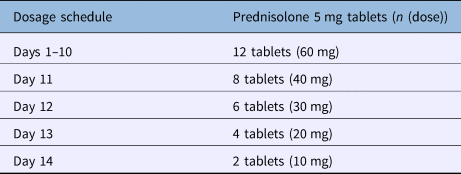
The patients were sorted into two groups depending on the type of oral steroid regimen received. Group 1 (n = 21) received a 14-day course of treatment: 60 mg prednisolone daily for 10 days, tapering off over days 11–14 (Table 2). Group 2 (n = 8) received prednisolone for a total of 10 days as opposed to 14 days: 60 mg for 5 days, tapering down each day for the remainder (Table 3). Therefore, the total amount of prednisolone given in group 2 was less than that given in group 1. All patients tolerated the regimen with no adverse effects. Patients who visited the hospitals between January and December 2017 received 60 mg prednisolone daily for 10 days, tapering off over days 11–14; the others had a shorter period of treatment, with a lower total dose.
Group 1 regimen for acute acoustic trauma

Group 2 regimen for acute acoustic trauma

Outcome evaluation
All patients were evaluated using pure tone audiometry on their initial visit and again one month after commencing treatment. Pure tone air conduction audiometry was performed using a Grason-Stadler GSI 61™ audiometer with Telephonics® TDH-50P headphones in a sound-isolated booth. The air conduction pure tone thresholds were obtained at 0.25, 0.5, 1.0, 2.0, 4.0 and 8.0 kHz. The same test protocol was used in every audiometric test. Pure tone averages (PTAs) at 2.0, 4.0, and 8.0 kHz were calculated to assess hearing outcomes in the high-frequency range. We defined hearing gain as follows: hearing gain (dB) = initial PTA − final PTA.
Statistical analysis
In order to determine differences in the baseline characteristics of the two treatment groups, the Mann–Whitney U test and Fisher's exact test were performed. The Wilcoxon signed-rank sum test was performed to compare the pure tone thresholds before and after treatment, both for the whole study population and for the two groups.
Multivariable linear regression analysis was performed to determine the factors associated with hearing gain in the enrolled patients. The type of oral steroid regimen, pre-treatment PTA and treatment onset time (number of days after noise exposure) were assumed to be possible associated factors. The unstandardised co-efficient (B) and 95 per cent confidence interval are presented. A two-sided p-value of less than 0.05 was considered statistically significant. All data were analysed with SPSS statistical software, version 20.0 (SPSS, Chicago, Illinois, USA).
Results
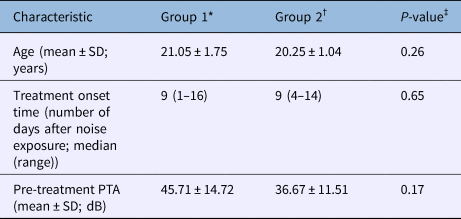
The data for 29 patients were collected and reviewed. The mean age (± standard deviation) of the study population was 20.83 ± 1.61 years. The average time from noise exposure to treatment onset was 8.48 ± 4.53 days. The mean age, treatment onset time (number of days after noise exposure) and pre-treatment PTA did not differ significantly between the two groups (Table 4).
Baseline characteristics of study groups

*n = 21; †n = 8. ‡Mann–Whitney U test. SD = standard deviation; PTA = pure tone averages at 2, 4, and 8 kHz
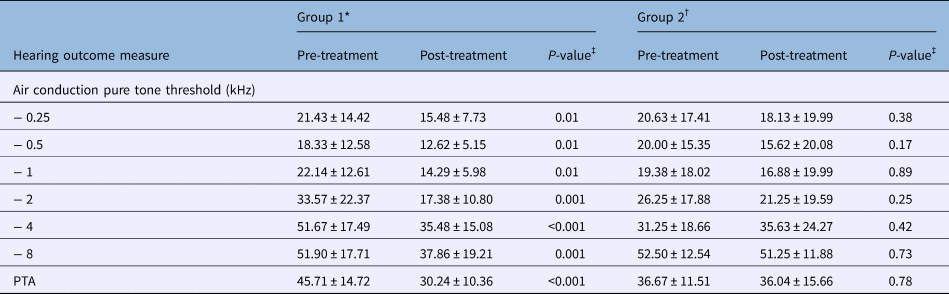
The hearing improvements in group 1 (14 days’ treatment) and group 2 (10 days’ treatment) are shown in Table 5 and Figure 1. In group 1, the post-treatment hearing threshold across all frequencies showed a significant improvement (p < 0.05), whereas group 2 did not show a significant improvement in all frequencies.
Treatment outcome comparison between study groups

Data represent mean (± standard deviation) hearing loss, in decibels, unless indicated otherwise. *n = 21; †n = 8. ‡Wilcoxon signed-rank sum test. PTA = pure tone averages at 2, 4, and 8 kHz
Mean hearing levels following acute acoustic trauma according to the oral steroid regimen. (a) Group 1 (14-day course of treatment): 60 mg prednisolone daily for 10 days, tapering off over days 11–14. (b) Group 2 (10-day course of treatment): 60 mg for 5 days, tapering down each day for the remainder. PTA = pure tone average

A multivariable linear regression analysis was performed, considering hearing gain as a dependent, continuous variable. Pre-treatment PTA and the type of steroid regimen used had significant associations with the degree of hearing gain (R2 = 0.51, p < 0.001). The regression co-efficient of pre-treatment PTA was 0.45 (p = 0.004). Group 1 showed significant improvement in the degree of hearing gain compared to group 2 (unstandardised regression co-efficient = 9.90, p = 0.03). The results of the multivariable linear regression analysis are shown in Table 6.
Multivariable linear regression analysis results, with hearing gain as dependent variable

CI = confidence interval; PTA = pure tone averages at 2, 4, and 8 kHz
Discussion
Numerous studies have been conducted to determine how to minimise and treat the effects of traumatic blast injury to the ear. Whilst the evidence is still evolving and guideline recommendations are not yet clearly defined, the administration of steroids is considered the appropriate treatment for patients with acute acoustic trauma. However, there exists no definite consensus on the precise role of steroids in acute acoustic trauma or on an adequate treatment regimen.
Some studies describe the use of oral steroids, whereas others advocate the efficacy of systemic steroids. In Remenschneider and colleagues’ study, a 14-day course of 60 mg/day of oral steroids was prescribed followed by a 5-day taper in eight patients, and a 5-day course (also 60 mg/day) was prescribed in one patient.Reference Remenschneider, Lookabaugh, Aliphas, Brodsky, Devaiah and Dagher6 In a study by Yehudai et al., prednisone at 1 mg/kg/day (maximal dose of 60 mg/day) was administered for 7–10 days.Reference Yehudai, Fink, Shpriz and Marom8 In Chang and colleagues’ studies, prednisolone at 1 mg/kg/day (maximal dose of 60 mg/day) was administered for 10 days, with 4 tapering days.Reference Chang, Bang, Jeong and Lee9,Reference Chang, Bang, Choi, Kim and Lee12 Harada et al. prescribed 60 mg/day of prednisolone and failed to achieve a significant result on logistic regression analyses of hearing recovery prediction.Reference Harada, Shiraishi and Kato10 Bonfort et al.Reference Bonfort, Billot, Trendel, Salf, Lindas and Barberot7 used intravenous methylprednisolone, whilst Psillas et al.Reference Psillas, Pavlidis, Karvelis, Kekes, Vital and Constantinidis11 reported a treatment regimen consisting of a prednisolone ampoule (25 mg) administered intravenously, three times per day and then tapered over 10 days.
Considering that acute acoustic trauma sequelae remain a key burden in the military community, especially in young soldiers, an appropriate steroid treatment regimen following acute acoustic trauma is of clinical importance. Although several studies have investigated the effects of steroids on acute acoustic trauma, it is difficult to suggest a proper administration route or the best dosage. The present study assessed the benefits of oral steroid administration in acute acoustic trauma patients. We observed a significant hearing improvement across the entire frequency range. This result advances and reinforces previous studies that revealed the positive effects of oral steroids in acute acoustic trauma patients.Reference Yehudai, Fink, Shpriz and Marom8,Reference Chang, Bang, Jeong and Lee9
In addition, the present study compared the treatment benefits depending on the type of oral steroid regimen used. In group 1, the 14-day treatment group, there was an additional hearing improvement of 9.90 dB (unstandardised regression co-efficient). In contrast to group 1, group 2 (10-day treatment group) did not show any hearing improvement during the observation period. To our knowledge, this is the first study to compare the effects of different oral steroid regimens in the treatment of acute acoustic trauma. Based on this result, we advocate the clinical significance of a high dose of prednisolone (60 mg per day) for 10 days, tapering off over 4 days when orally administered.
This study also demonstrated the association between the initial hearing level and potential hearing recovery by performing a multivariable linear regression analysis. The unstandardised regression co-efficient for the association between the initial hearing level and the hearing gain was 0.45. In other words, because the association ratio was less than 1, the worse the initial hearing loss, the lower the degree of hearing gain we could expect. This finding is consistent with the results from one study showing that a hearing loss average exceeding 40 dB led to significantly higher rates of audiometric sequelae.Reference Bonfort, Billot, Trendel, Salf, Lindas and Barberot7 Together with our previous studies, which addressed the additional benefits of concurrent administration of intratympanic steroid injections with oral steroids,Reference Chang, Bang, Jeong and Lee9,Reference Zhou, Zheng, Zheng, Zhou, Zhu and Zhang13 these results can be considered when choosing comprehensive treatments for patients presenting with more severe hearing loss.
This study has several limitations. First, the sample size in each group was small. The sample number in group 2 (patients treated with a lower total dose of prednisolone over a shorter period) in particular may affect the statistical power of this study. Second, there may be some selection bias in play, as the choice of treatment regimen was in the hands of the treating otolaryngologists. Although there is no definitive treatment regimen or any studies comparing different oral steroid regimens, and there were no significant differences in baseline characteristics between this study's two groups, the treating otolaryngologists may have decided to treat patients presenting with less severe hearing loss with shorter, reduced doses. This selection bias should be kept in mind when interpreting the results. In addition, there may be other confounding factors that are not yet known and which have not been assessed either in this study or in previous studies, such as genetic polymorphismsReference Lin, Wu, Shih, Tsai, Sun and Ma3 or a previous history of noise exposure.Reference Maassen, Babisch, Bachmann, Ising, Lehnert and Plath14
However, this is the first study assessing the different effects of oral steroid dose on hearing improvement in acute acoustic trauma. All patients were the same gender and of similar age, and none had reported any previous history of disease. This may reduce the effects of other confounding factors not addressed in this study. Further evaluations with large sample size studies are strongly recommended to demonstrate the most adequate oral steroid regimen.
The administration of steroids remains a promising treatment method for patients with acute acoustic trauma. In this study, after comparing the differing benefits based on dose, we suggest a higher dose of prednisolone – 60 mg per day for 10 days, and tapering off over the remaining 4 days – for the best chance of hearing recovery following acute acoustic trauma. Further evaluation is required to confirm the efficacy of the oral steroid regimens observed here.
• This study explored the best steroid treatment option for hearing recovery following acute acoustic trauma
• A regimen of 60 mg prednisolone per day for 10 days, tapering off over the remaining 4 days, is recommended
Competing interests
None declared