INTRODUCTION
Estimation of variance components (VCs) has long been important in animal breeding. Accurate estimates of VCs are important because prediction error variances for predicted random effects (e.g. breeding values) increase as differences between estimated and true values of VC increase (Schaeffer Reference Schaeffer1984). Genetic parameters are based on (co) VCs, which must be accurately estimated. Therefore, improved methodologies for estimation of these components are constantly evolving. The Gibbs sampling (GS) algorithm (Magnabosco et al. Reference Magnabosco, Lôbo and Famula2000) enables estimation of random samples of parameter estimates based on a given data set, by generating posterior distributions of parameter values that are proportional to the product of the parameter probabilities and the observation probabilities.
Sheep production constitutes the most important part of the Iranian livestock industry and a total of approximately 50 million sheep with more than 20 breeds and sub-breeds are produced in Iran. Sheep contribute more than 0·42 of about 293 million kg annual meat production in Iran (Vatankhah et al. Reference Vatankhah, Moradi Sharebabak, Nejati Javarami, Miraei-Ashtiani, Vaez Torshizi, Nikkhah, Vaez, Miraei-Ashtiani, Nejati-Javaremi and Moradi2004).
Early growth of farm animals is determined not only by the genetic merit for growth but also by maternal genetic and permanent environmental effects. Hence, to achieve optimum genetic progress in a selection programme, both the direct and maternal genetic components should be taken into account, especially if there is an antagonistic relationship between them. Studies on various sheep breeds have shown that both direct and maternal genetic influences are important for lamb growth (Maria et al. Reference Maria, Boldman and van Vleck1993; Ligda et al. Reference Ligda, Gabriilidis, Papadopoulos and Georgoudis2000). Possibilities for simultaneous improvement in growth traits and litter size (LS) are dependent on the genetic correlation between the traits. Numerous studies have evaluated genetic parameters for growth traits in sheep (Tosh & Kemp Reference Tosh and Kemp1994; Neser et al. Reference Neser, Erasmus and van Wyk2001), but there are few studies describing genetic correlation between growth and reproduction traits for meat sheep breeds. It appears that no genetic correlation between body weight and reproduction traits have been published for Moghani sheep and only a few studies have been conducted for the estimation of genetic parameters of growth traits in this breed (Rashidi et al. Reference Rashidi, Shahrodi, Nikkhah and Asghari1998; Shodja et al. Reference Shodja, Nosrati, Alijani and Pirani2006). Therefore, the objective of the present study was to estimate the heritability of body weight at different ages, LS, as well as the genetic correlations between these traits.
MATERIALS AND METHODS
Animals and management
The Moghani sheep breed, numbering about 5·5 million, is one of the most important meat breeds among Iranian sheep. They are well known for their large size, tolerance to climatic changes and capability to produce heavy lambs (Shodja et al. Reference Shodja, Nosrati, Alijani and Pirani2006). The breed is fat-tailed, its coat colour is predominantly white and its face, legs and feet are brown. In this breed, both sexes are polled. A breeding station was established in 1952 in the Ardebil province of Iran in order to improve genetically the performance of Moghani sheep, through identifying the best rams and distributing them to the commercial flocks. There was a controlled mating system so that the identity of the sire and dam of each lamb were known. Ewe lambs and ram lambs were bred at 18 months of age. Rams were used for only 1 year and ewes were used for up to 6 years. Lambs were weaned at 120 days of age. Male and female lambs were herded in separate flocks from 6 months of age onwards. Selection took place in July and was based primarily on general appearance and colour. Body weight at birth, weaning and at higher ages were sometimes considered as criteria in selection of replacements.
Data set
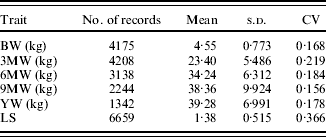
The data set and pedigree information used in the current study were obtained from the Breeding Station of Moghani sheep (in Ardebil province, Iran) from 1987 to 2005. The data were screened several times and defective and doubtful data were deleted. The traits included were: birth weight (BW), 3 months weight (3MW), 6 months weight (6MW), 9 months weight (9MW), yearling weight (YW) and LS. LS was defined as the number of lambs born alive per ewe mated (i.e. LS was a trait of the ewe). LS is a complex trait that involves several sub-traits, such as ovulation rate, embryo survival and uterine capacity. The characteristics of the data used in the analyses are presented in Table 1. In addition, the number of animals (in total), inbred animals (inbred animals have a non-zero probability of inheriting the same gene variant from each parent, identical by descent from a common ancestor within the recorded pedigree), sires, dams, base animals and non-base animals in the pedigree lines of Moghani sheep were 8494, 1060, 625, 2828, 1835 and 6659, respectively.
Characteristics of data set
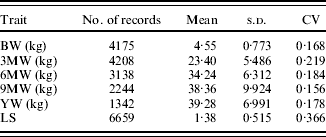
BW, birth weight; 3MW, 3 months weight; 6MW, 6 months weight; 9MW, 9 months weight; YW, yearling weight; LS, litter size; s.d., standard deviation; CV, Coefficient of variation.
Statistical models of genetic analysis
The choice of fixed effects to be considered was made after testing whether the effects were statistically significant with a linear fixed effects model analysed with procedure GLM of SAS (SAS 2002). Level of significance for the inclusion of effects into the model of analysis was declared at P<0·05. The final model included the fixed class effects of year-season (78 levels), sex of lamb and parity of dam, LS (in the model of analysis for body weights), the linear covariate effect of age of dam (2–7 years old), additive direct genetic effect of animal, maternal genetic effect of the dam and maternal permanent environmental effect. The final univariate animal model fitted for the genetic analysis of body weights and the underlying distribution of the LS of Moghani sheep was as follows:

where y is an N×1 vector of records, b denotes the fixed effects in the model with association matrix X, a is the vector of direct genetic effects with the incidence matrix Za, m is the vector of maternal genetic effects with the incidence matrix Zm, c is the vector of permanent maternal environmental effects with the incidence matrix Zc, and e denotes the vector of residual (temporary environmental) effects.
From a Bayesian perspective, it was assumed that prior distributions for additive direct and maternal effects were multivariate normal distribution with mean 0 and variance Aσa2 and Aσm2, respectively, where A is the additive numerator relationship matrix and σa2 and σm2 are additive direct and maternal variances, respectively. Permanent environmental effects of the dam and residual effects were assumed to be multivariate normally distributed with mean 0 and variances Idσpe2 and Inσe2, respectively, where Id and In are identity matrices with orders equal to the number of dams and individual records, respectively and σpe2 and σe2 are maternal permanent environmental and residual variances, respectively. Additionally, maternal across-year repeatability for ewe performance, t m=(1/4)h 2+m 2+c 2+mhr am, was calculated (Notter & Hough Reference Notter and Hough1997). Heritability of the total additive genetic contribution to a maternally influenced trait was calculated according to the following equation (Willham Reference Willham1972) to estimate the expected response to phenotypic selection:
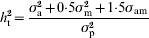
In addition, the repeatability was calculated using the following formula:

For body weight traits, the permanent environmental effect presumably describes the litter VC, and the repeatability describes the correlation between twins. For LS, the permanent environmental effect describes the correlation between years for LS for the same ewe.
The incidences of triplets and quadruplets were so low (<0·08) that records from lambs born in triplet and quadruplet litters were discarded. Therefore, the response of LS was modelled with the following distribution:
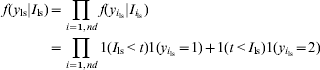
where t is threshold that defines the two categories of response, nd is the total number of data points and I ls is the underlying distribution of the LS. The prior distribution of t was assumed to be fixed. Bivariate or pair-wise analyses were carried out for every pair of the traits. The models applied in pair-wise analyses were those fitted for each of the underlying traits in the univariate analyses.
The prior distribution for the genetic, residual and permanent environmental covariance matrices is assumed to be an inverted Wishart distribution. The parameters needed are shape and scale parameters for inverted Wishart variables. The shape parameter corresponds to the degree of freedom parameter for the corresponding Wishart distribution. For a proper prior distribution, the shape parameter must be at least two more than the order of the covariance matrix. A proper prior using an inverse Wishart distribution with minimum shape parameter was adopted in order to ensure posterior propriety. Due to lack of prior knowledge about the vector of fixed effects an improper flat prior of uniform distribution was assigned to b: P (b)~constant. Marginal posterior distributions of parameters and VCs of the traits were estimated using the Multiple Trait Gibbs Sampling for Animal Models (MTGSAM) program (Van Tassell & Van Vleck Reference Van Tassell and Van Vleck1995). At first, MTGSAM was run separately for the traits of body weight and LS, then, the linear–linear bivariate models of MTGSAM for the body weights at different ages and the linear-threshold bivariate models between the traits of body weight and LS were run. In the binary threshold model analysis by the MTGSAM program, the identifiability of the model is ensured by fixing the values for the thresholds and the residual variances to values of zero and one, respectively. LS was considered as a threshold trait with one threshold and two categories.
The Gibbsit program of Raftery & Lewis (Reference Raftery, Lewis, Gilks, Richardson and Spiegelhalter1996) was used to evaluate the length of the burn-in period and thinning interval needed to obtain stationary chains of independent samples and to estimate the total number of Gibbs samples required. Therefore, the Gibbs sampler was run for 150 000 rounds, with the first 20 000 rounds being discarded as a warming-up period. A thinning interval of 100 rounds was used to retain sampled values that reduced lag correlation among thinned samples. The posterior means of VCs were calculated and those of expected values for heritabilities and correlations.
RESULTS
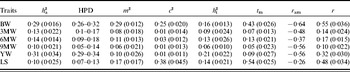
The posterior means of VCs, repeatabilities and heritabilities for direct genetic, maternal genetic and permanent maternal environmental effects of body weight at different ages and LS obtained from the univariate model of analysis are shown in Table 2. Direct heritability estimates for BW, 3MW, 6MW, 9MW, YW and LS were 0.29, 0·13, 0·14, 0·10, 0·31 and 0·10, respectively. Maternal and direct heritability estimates for BW were similar and relative to additive genetic effects, maternal permanent environmental effects had more considerable effect on BW and LS than other traits. In addition, the 95% highest posterior density regions (HPD) for direct heritability estimates are shown in Table 2. It is important to note that the variation range of HPDs of the heritability estimates is located at the region greater than zero. Hence, the probability of obtaining a zero estimate for these parameters was almost null.
The posterior mean of direct genetic, maternal genetic, permanent maternal environmental heritabilities and repeatabilities for body weights and LS of Moghani sheep obtained by the univariate models of analysis (posterior standard deviations (PSD) of marginal posterior distribution of estimates are in brackets)

BW, birth weight; 3MW, 3 months weight; 6MW, 6 months weight; 9MW, 9 months weight; YW, yearling weight; LS, litter size; h a2, direct heritability; m 2, maternal heritability; c 2, ratio of maternal permanent environmental effect; h t2, total heritability; t m, maternal across-year repeatability; r am, correlation between direct additive genetic effect and maternal genetic effect; r, repeatability; σa2, direct additive genetic variance; σpe2, maternal permanent environmental effect; σe2, residual variance; σp2, phenotype variance; σm2, maternal genetic variance; HPD, highest posterior density at 95% for direct heritability estimates.
The repeatability estimates for BW, 3MW, 6MW, YW and LS were higher than heritability, while for 9MW this estimate was equal to direct heritability estimate. There was significant common environmental effect for growth trait. The reported estimates of total heritability (h t2) and maternal repeatability (t m) for BW (h t2=0.16, t m=0·43) and LS (h t2=0·14, t m=0·54) indicate that a response to phenotypic selection can be expected for these traits and the medium to high estimates of total heritability (h t2) and maternal repeatability (t m) for 6MW (h t2=0·13, t m=0·13) and YW (h t2=0·21, t m=0·09) suggest the existence of scope of genetic improvement for these traits.
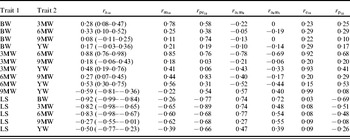
Estimates of direct genetic, maternal genetic, common maternal environmental genetic, phenotypic and environmental correlation between body weight traits at different ages and LS are shown in Table 3. All the phenotypic correlation estimates among body weight traits at different ages were positive and changed from 0.08 for 9MW–YW to 0·68 for 3MW–9MW. However, the estimates of phenotypic correlations between LS and body weights were negative and ranged from −0·69 for LS–BW to −0·08 for LS–9MW. A moderate negative direct genetic correlation has been estimated for 9MW–YW, but the estimates of direct genetic correlation between other body weight traits were positive and ranged from 0·08 for BW–9MW to 0·88 for 3MW–6MW. Positive estimates of genetic correlation indicate that selection on one trait could result in correlated response to other traits, but there were medium to high negative direct genetic correlations between body weights at different ages and LS, ranging from −0·92 for LS–BW to −0·28 for LS–9MW. The highest estimates of environmental correlations between body weights were for 9MW–YW (0·99) and 3MW–YW (0·93) and there were low and positive environmental correlations between LS and body weights at different ages, ranging from 0·03 to 0·09. Also, the lowest maternal genetic correlation between body weight traits was −0·22 for 9MW–YW and the highest was 0·85 for 3MW–6MW. The maternal genetic correlations between LS and body weights were negative and ranging from −0·65 for LS–3MW to −0·26 for LS–BW. Estimates of correlations between direct genetic effect of 9MW and maternal genetic effect of YW, and also, between direct genetic effect of YW and maternal genetic effect of 9MW were positive and moderate. On the other hand, the estimates of correlations between direct genetic effect of 3MW and maternal genetic effect of BW, and also, between direct genetic effect of 9MW and maternal genetic effect of BW were zero. All of the genetic correlations between direct and maternal effects of LS and body weight traits were positive and moderate (Table 3).
The posterior mean of phenotypic, direct genetic (HPD of estimates are in brackets), maternal genetic, permanent maternal environmental and residual correlations between studied traits

 , posterior mean of direct genetic correlation between traits 1 and 2;
 , posterior mean of maternal genetic correlation between traits 1 and 2;
 , posterior mean of maternal permanent environmental correlation between traits 1 and 2;
 , posterior mean of residual correlation between traits 1 and 2;
 , posterior mean of phenotypic correlation between traits 1 and 2;
 , posterior mean of correlation between direct genetic effect of trait 1 and maternal genetic effect of trait 2;
 , posterior mean of correlation between direct genetic effect of trait 2 and maternal genetic effect of trait 1.
DISCUSSION
Knowledge of the heritability and genetic relationship between traits is required for planning an efficient breeding system and development of effective genetic evaluation. The current estimates of genetic parameters for Moghani sheep could be used for designing future selection schemes and constructing a selection index for this breed of sheep. From the HPDs of the heritability estimates, it can be concluded that the implementation of a selection breeding strategy using body weight traits or LS is a reasonable strategy to improve growth and reproductive performance of the Moghani breed.
The repeatability estimates indicated that BW, 3MW, 6MW, YW and LS traits were influenced by permanent environmental effects and, to improve these traits, one could improve environmental effects initially. The permanent environmental effect (c 2) due to the dam can be ascribed to uterine environment effects, multiple birth influences on milk yield, feeding level at late gestation and maternal behaviour of the ewe (Maria et al. Reference Maria, Boldman and van Vleck1993; Snyman et al. Reference Snyman, Erasmus, van Wyk and Olivier1995). The high magnitude of the maternal additive genetic effects and maternal permanent environmental effects for BW and LS will mean that ignoring them in a selection model will bias upwards the estimates of direct heritability (Snyman et al. Reference Snyman, Erasmus, van Wyk and Olivier1995).
The direct additive heritability estimate (0·29) of BW in the present study is medium and within the range reported by other authors in the recent research. The range of direct heritability estimates for BW in literature varies substantially from 0·04 (Maria et al. Reference Maria, Boldman and van Vleck1993) to 0·46 (Gizaw et al. Reference Gizaw, Lemma, Komen and Van Arendonk2007). The magnitude of the maternal heritability estimate of BW (0·29) in the present research was equal to the direct heritability and was within the range of those reported from 0·09 by Snyman et al. (Reference Snyman, Erasmus, van Wyk and Olivier1995) to 0·59 by El Fadilli et al. (Reference El Fadilli, Michaux, Detilleux and Leroy2000). The maternal heritability was higher for BW than other body weight traits due to increasing the dependence of lambs on milk. In other words, maternal genetic effects generally are important for measurements of weight at younger ages. Estimates for direct and maternal heritabilities for weaning weight in the present study (h d2=0·13, m 2=0·08) were lower than the estimates of 0·22 and 0·11, respectively, reported for Targhee (Hanford et al. Reference Hanford, Van Vleck and Snowder2003) and Rambouillet (Hanford et al. Reference Hanford, Van Vleck and Snowder2005), but were in accordance with the estimates of 0·16 and 0·08 reported for Columbia (Hanford et al. Reference Hanford, Van Vleck and Snowder2002). In the present study, the estimate of c 2 for 3MW was 0·01, i.e. lower than those in the in literature (0·04–0·20 for weaning weight).
Toe et al. (Reference Toe, Rege, Mukasa-Mugerwa, Tembely, Anindo, Baker and Lahlou-Kassi2000) estimated heritabilities of 0·16±0·15 from direct–maternal animal model and 0·22±0·17 from a sire model for 6MW in Menz ram lambs. Miraei-Ashtiani et al. (Reference Miraei-Ashtiani, Seyedalian and Moradi Shahrbabak2007) reported the direct and maternal heritability estimates of 0·49 and 0·11 for 6MW in Sangsari sheep. The estimate of maternal heritability for 6MW in this study (0·11) was similar to that reported by Miraei-Ashtiani et al. (Reference Miraei-Ashtiani, Seyedalian and Moradi Shahrbabak2007) in Sangsari sheep. A low direct heritability estimate of 0·10 was found for 9MW in the present study, possibly due to the low plane of nutrition, poor quality of the pasture at the sheep breeding station and harsh climatic conditions, especially in this stage of the growth period, suggesting that this environment is not favourable for the expression of genetic potential of Moghani lambs. The direct heritability estimate found in the current study corresponds to that of 0·08 reported by Miraei-Ashtiani et al. (Reference Miraei-Ashtiani, Seyedalian and Moradi Shahrbabak2007) in Sangsari lambs but is lower than that of 0·59 reported by Snyman et al. (Reference Snyman, Erasmus, van Wyk and Olivier1995) in Afrino sheep. Estimates of direct heritability for YW (0·31) obtained in the present study were within the range from 0·10 (Miraei-Ashtiani et al. Reference Miraei-Ashtiani, Seyedalian and Moradi Shahrbabak2007) to 0·58 (Snyman et al. Reference Snyman, Erasmus, van Wyk and Olivier1995) and correspond to 0·33 reported by Abegaz et al. (Reference Abegaz, Van Wyk and Olivier2005) in Horro sheep.
As the age of the lamb increases, the environmental relationship between individual traits and maternal potentials (i.e. milk production and its composition, nursing ability, etc.) from birth to weaning and subsequently will gradually decrease. Thus, a higher heritability estimate for body weight at older ages might be expected.
The heritability estimate for LS is similar to some earlier reports in the literature (Rosati et al. Reference Rosati, Mousa, Van Vleck and Young2002). Therefore there is the possibility, albeit small, for improving genetically the incidence of multiple births in Moghani sheep. The estimates of direct heritability for prolificacy and lamb weight traits in the literature have ranged from 0·03 to 0·18 for LS at birth (Ligda et al. Reference Ligda, Gabriilidis, Papadopoulos and Georgoudis2000; Hanford et al. Reference Hanford, Van Vleck and Snowder2003).
The probable reasons for the low values of the estimated heritability of 3MW, 6MW and 9MW might reflect the effects of variation in environmental and nutritional conditions of the range, herd movement, harsh climatic conditions and herd management, on animal performance. In general, several factors including breed of the animal, genetic variation within the population, management and environmental conditions, the method of estimating parameter, would have affected the differences between estimations.
Except for LS, estimates of total heritability (h t2) were lower than the estimates of additive direct heritability for body weights at different ages. Neser et al. (Reference Neser, Erasmus and van Wyk2001) reported the total heritability in Dorper sheep for BW, 42-day weight and 100-day weight were 0·21, 0·17 and 0·13, respectively. The total heritability estimate for BW in the present study was 0·16 and lower than the estimate of Neser et al. (Reference Neser, Erasmus and van Wyk2001) for BW.
The direct maternal genetic correlations for body weights at different ages were negative and ranged from −0·37 to −0·64; this estimate for LS was also negative (−0·26). It has been shown that a negative genetic correlation between direct and maternal genetic effects might be a product of both existing genetic antagonism as well as the sire by year interaction and can be influenced by data structure (Maniatis & Pollott Reference Maniatis and Pollott2003). Tosh & Kemp (Reference Tosh and Kemp1994) suggested that the antagonism between the effects of an individual's genes for growth and those of its dam for a maternal ability might be due to natural selection for an intermediate optimum.
The environmental correlation between the body weight traits in the present study indicated the improvement of environmental conditions in the early stage of growth traits could have positive effects in the later stage. Rashidi et al. (Reference Rashidi, Mokhtari, Safi Jahanshahi and Mohammad Abadi2008) reported that the estimate of correlation between maternal genetic effects of BW with direct effects of 3MW was positive and 0·02 in Kermani sheep which is similar to the result of the current study. Maxa et al. (Reference Maxa, Norberg, Berg and Milerski2007) reported the genetic correlation between LS and maternal genetic effects on BW were positive and favourable in Danish Texel, Shropshire, Oxford Down and Suffolk. The report of Maxa et al. (Reference Maxa, Norberg, Berg and Milerski2007) is consistent with the results of the current study. However, contrary to the results of the current study, Maxa et al. (Reference Maxa, Norberg, Berg and Milerski2007) reported that the direct genetic correlations between BW and LS were positive and ranging from 0·02 to 0·14, except for Oxford Down (−0·11). Bromley et al. (Reference Bromley, Snowder and Van Vleck2000) reported direct genetic correlations between BW and LS in the range from −0·01 to 0·26. The genetic correlations between the maternal genetic effect on BW and LS ranged from 0·16 for Texel to 0·56 for Oxford Down (Bromley et al. Reference Bromley, Snowder and Van Vleck2000). Furthermore, negative estimates of genetic correlations between maternal genetic effect of BW and direct genetic effect of LS at birth were reported by Bromley et al. (Reference Bromley, Snowder and Van Vleck2000). The negative direct genetic correlation obtained in the present study between body weight traits and LS indicate that selection for increased LS in Moghani sheep will have a negative genetic effect on body weights, and vice versa. In the current study, the estimate of direct genetic correlation between BW and 3MW was 0·28 and within the range (0·16–0·82) compiled by Safari & Fogarty (Reference Safari and Fogarty2003) between BW and weaning weight measured between 100 and 120 days and was consistent with the report of Neser et al. (Reference Neser, Erasmus and van Wyk2001) for Dorper sheep. The estimate of maternal genetic correlation between BW and weaning weight in the present study was in the range (0·49–0·93) compiled by Safari & Fogarty (Reference Safari and Fogarty2003). In the current study, the positive permanent maternal environmental correlations between body weights, especially for 6MW–9MW, 3MW–6MW, BW–9MW, BW–3MW and 9MW–YW, could be due to a carry-over effect. The medium to high negative estimates of direct maternal correlations for body weight traits or LS suggest that it would be difficult to jointly improve direct and maternal growth ability for Moghani sheep.
CONCLUSIONS
Current estimates of genetic parameters for body weight traits and LS in Moghani sheep were in the range of estimated values in the literature and could be utilized in designing selection programmes and constructing selection indices for this breed. Improvement of body weights of Moghani sheep seems feasible in selection programmes. YW and BW had the highest estimates of direct heritability compared to the other body weight traits of Moghani sheep, but results revealed that there was a negative genetic correlation between YW and 9MW and selection for YW may result in a negative indirect effect on 9MW. On the other hand, although there were positive genetic correlations between BW and other body weight traits, but selection on BW should be relaxed in order to prevent unfavourable consequences of increasing BW. Regarding the moderate to high genetic correlations between 3MW and other body weight traits, especially 6MW, in designing future selection programmes for this breed, genetic improvement in 3MW should be one of the main components of selection goals.
The authors wish to thank two anonymous reviewers for their constructive comments on the earlier versions of this manuscript.