Staphylococcus aureus bacteremia (SAB) yields significant morbidity, with mortality up to 40%.Reference Fries, Licitra and Crespo1-Reference Tissot, Calandra and Prod’hom3 Standardized approaches mitigate potentially devastating outcomes associated with SAB including endocarditis, endophthalmitis, metastatic spread, epidural or brain abscesses, and death. Due to high propensity for metastatic infection, management and treatment of SAB differs from other bloodstream infections requiring more extensive diagnostic evaluation and longer duration of therapy.Reference Rasmussen, Host and Arpi4-Reference Liu, Bayer and Cosgrove7 Prior literature demonstrates the benefit of evidence-based SAB bundles and treatment algorithms that optimize appropriate clinical management, patient outcomes, and mortality.Reference Wenzler, Wang and Goff8-Reference Nguyen, Gandhi and Chenoweth13 Common SAB bundle components include repeat blood cultures, source control, echocardiography, guideline-directed treatment durations, route of administration, and targeted regimen based on methicillin susceptibility.Reference Nagao, Yamamoto and Matsumura10
Infectious diseases (ID) consultation is not universally requested for SAB despite evidence demonstrating superior outcomes.Reference Fries, Licitra and Crespo1-Reference Tissot, Calandra and Prod’hom3,Reference Martin, Harris, Brooks, Main and Mertz14-Reference Buehrle, Pisano, Han and Pettit16 Many institutions have shown significant improvements in SAB bundle compliance as well as decreases in in-hospital mortality and all-cause mortality at 30 days following implementation of mandatory ID consultation for SAB.Reference Tissot, Calandra and Prod’hom3,Reference Martin, Harris, Brooks, Main and Mertz14,Reference Gancher, Maslak, Lustgarten, Schultz and Ingilizova17 Data on multidisciplinary antimicrobial stewardship (AS) strategies in SAB patients are limited, but they show improved bundle compliance and increased ID consultation after the implementation of pharmacist-driven processes.Reference Wenzler, Wang and Goff8,Reference Smith, Frens, Snider and Claeys18
In this study, we evaluated the impact of a pharmacist-driven SAB bundle with sequential escalation for nonresponse supported at the highest ranks of leadership in the absence of required ID consultation, and we compared the process measures before and after implementation.
Methods
A 2-part retrospective cohort study conducted at Vanderbilt University Hospital, an 834-bed major academic tertiary care adult hospital, analyzed a pharmacist-driven evidence-based SAB safety algorithm implemented in November 2015. The institutional review board approved this study. The SAB safety algorithm (Appendix A online) included repeat blood cultures until documented clearance, echocardiography, removal of indwelling central venous catheter (CVC) if present, treatment duration ≥ 14 days for complicated infections, and targeted IV therapy.Reference Nagao, Yamamoto and Matsumura10 Optimal antimicrobial therapy consisted of cefazolin or nafcillin for methicillin-susceptible S. aureus (MSSA) (or vancomycin in the setting of a severe β-lactam allergy) or vancomycin (with trough goals of 15–20 µg/mL), daptomycin, or ceftaroline for methicillin-resistant S. aureus (MRSA). Suboptimal antimicrobial treatment included IV antimicrobial therapy active against the pathogen but not meeting the optimal definition. Inappropriate therapy included oral antimicrobials or the absence of antimicrobial therapy. Sentri7, a clinical decision support electronic system, identified patients aged ≥18 years with documented SAB regardless of source of infection through real-time, automatic notification to the AS pharmacist once blood culture text results were updated to contain “Staphylococcus aureus.” The AS pharmacist then followed patients daily to provide bundle recommendations directly to the medical team and to ensure completion. Stepwise escalation to involve the physician director of the Vanderbilt AS program (ASP) and, if necessary, the chief of staff in situations of continued nonacceptance was built into the safety algorithm and was supported by the highest ranks of leadership. A single AS pharmacist reviewed and managed the SAB algorithm in addition to continued management of all ASP activities present prior to its implementation.
This study consisted of 2 separate analyses. In part A, we evaluated the overall characteristics and interventions of the AS pharmacist-directed SAB algorithm surveillance beginning 2 months after implementation: January 1, 2016, to August 31, 2017. The secondary objectives were to describe the number of escalations required and to identify “good saves” (ie, potentially major adverse events [AEs] averted with substantive impact on patient care).
In part B, we conducted a before-and-after analysis of 200 total patients, comparing bundle compliance and process measures before (May 2015 to September 2015) and after (January 2016 to May 2016) implementation. Patients who transitioned to palliative care were excluded from part B because their physicians were less likely to pursue all bundle components.Reference Nagao, Yamamoto and Matsumura10,Reference Bai, Showler and Burry15 The secondary objectives in part B were to compare total and individual bundle-component compliance, ID consultation prevalence, time to ID consultation, and time to optimal antibiotics before and after the intervention.
Total compliance with the algorithm included completion of all bundle components: repeat blood cultures until documented negative, removal of CVC if present, transthoracic OR transesophageal echocardiogram, and optimal antimicrobial regimen and duration (as defined above).
Data collected from each patient’s medical record included demographic data, presence and time of ID consultation, culture and susceptibilities, presence of CVC, echocardiography, antimicrobial treatment characteristics based on time of initial SAB identification, AS pharmacist interventions with acceptance rate, and episodes requiring escalation to the AS physician or chief of staff. Interventions were categorized by type and included each specific bundle component as well as escalation, de-escalation, or initiation of antimicrobials; recommendation of ID consultation; extending duration; or other prevention of a major AE (ie, a “good save”). A secure RedCap database held all data.Reference Harris, Taylor, Thielke, Payne, Gonzalez and Conde19
In our analysis, we utilized SPSS version 25 software (IBM, Armonk, NY), and we included the Fischer exact test or the χ2 test for categorical data, the Student t test for parametric continuous data, and the Mann-Whitney U test for on nonparametric continuous data with an alpha level of 0.05 for statistical significance.
Results
Part A: Descriptive analysis of SAB safety algorithm
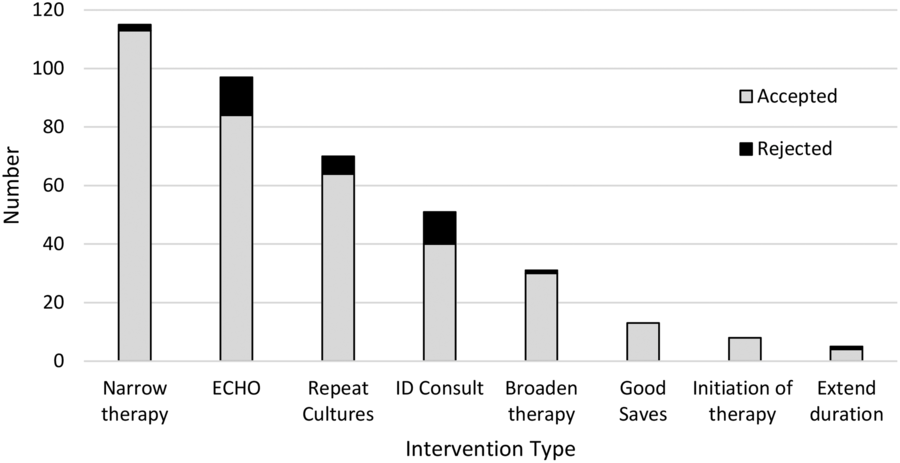
Of the 501 patients identified with SAB bacteremia, the AS pharmacist reviewed 416 patients (83%), with a total of 391 interventions. Overall, 91% of all interventions were accepted; the most common intervention was narrowing therapy (n = 115) (Fig. 1). We identified 3 episodes (0.7% of reviewed patients) in which escalation to ASP physician director was required at the following points in the algorithm: obtain echocardiography, persistent bacteremia not on IV therapy, and oral therapy without echography or repeat blood cultures. No cases required chief of staff escalation. Moreover, 85% of patients had an ID consultation at any time, 43% of patients had an ID consultation at the time of culture positivity. Of the 488 patients who underwent echocardiogram, 51 (10.4%) were identified as having endocarditis.
Frequency of accepted and rejected interventions made by antimicrobial stewardship pharmacists since the implementation of the Staphylococcus aureus bacteremia (SAB) safety algorithm. Good saves (n = 20) included prevention of discharge on oral antibiotics (n = 7), initiation of therapy for outpatient (n = 4), identification of endocarditis by way of ECHO prior to ID consultation (n = 3), removal of PICC (n = 3), and dose–drug optimization (n = 3). Note. ECHO, echocardiography; ID, infectious diseases.

Good saves
Antibiotic stewardship pharmacist interventions included 20 potentially major AEs averted (ie, “good saves”) in patients without an ID consultation at the time of the intervention (Fig. 1). Moreover, 7 such interventions prevented patients from discharge on oral antibiotics, and 1 intervention specifically prevented discharge on oral sulfamethoxazole/trimethoprim in a patient with MRSA bacteremia with no repeat cultures or echocardiography performed. Another patient with persistent MRSA bacteremia was changed from oral linezolid to IV vancomycin. In 4 cases, the AS pharmacist prompted initiation of antibiotic therapy for SAB in outpatients not receiving antimicrobial therapy. Finally, the AS pharmacist recommendations for echocardiography resulted in an endocarditis diagnosis in 3 cases in which ID consultants were not yet involved, dramatically altering the overall treatment duration and therapeutic approach. Additional interventions not otherwise described included discontinuation of CVC with persistent bacteremia (n = 3) and dose or drug optimization outside of standard escalation or de-escalation (n = 3).
Part B: Pre–post analysis of SAB safety algorithm compliance
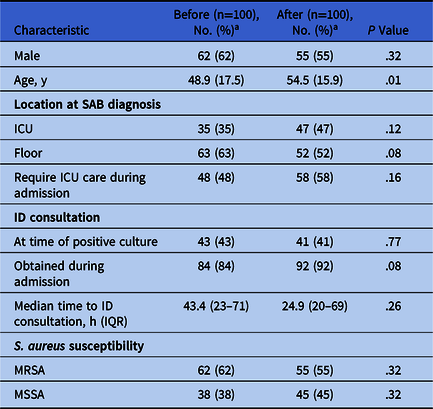
No statistically significant between-period differences were detected in intensive care unit (ICU) admission at time of SAB identification, ICU level of care during admission, or S. aureus susceptibility (MRSA vs. MSSA), although the age of patients was older after the bundle was implemented (P = .01) (Table 1). After bundle implementation, we observed a non–statistically significant increase in ID consultations (from 84% to 92%; P = .08) and a reduction in median time to ID consultation from SAB notification (from 43.4 to 24.9 hours; P = .26).
Demographics of Patients in Before-and-After Analyses

Note. ICU, intensive care unit; ID, infectious diseases; IQR, interquartile range; MSSA, methicillin-sensitive Staphylococcus aureus; MRSA, methicillin-resistant Staphylococcus aureus.
a Data are presented as number (%) or mean (standard deviation).
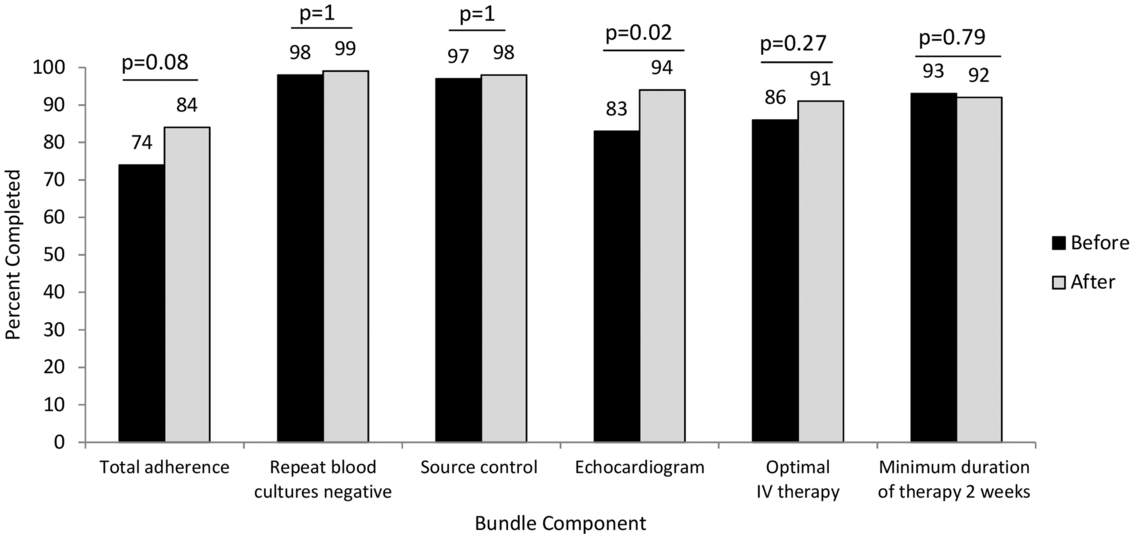
Compliance with specific bundle components is shown in Figure 2. We observed a statistically significant increase in the number of echocardiograms obtained (from 83% to 94%; P = .02), with no between-group difference in obtaining a transesophageal echocardiogram (34% vs 40%; P = .36). We detected no difference in mean number of bundle components between the 2 groups (4.57 vs 4.75; P = .14). Total compliance to all components increased by 10% after implementation of the SAB algorithm, but this difference was not statistically significant (74% vs 84%; P = .08).
Bundle compliance before and after the implementation of the pharmacist-driven Staphylococcus aureus bacteremia (SAB) algorithm.

Treatment characteristics
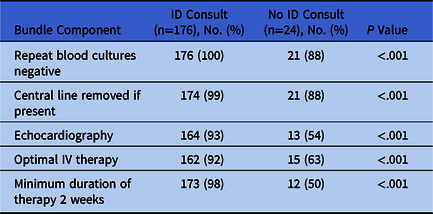
Receipt of optimal antibiotics (86% vs 91% respectively; P = .27) and median time to optimal antibiotics (data not shown) were not significantly different before compared to after algorithm implementation. Rates of suboptimal therapy decreased significantly after implementation of the algorithm: 10/100 (10%) vs 3/100 (3%), P=0.045. We observed no difference in rates of inappropriate therapy between groups (data not shown). In patients with MSSA bacteremia, we detected a trend toward shorter time to appropriate antibiotics after bundle implementation (30.5 vs 27.2 hours; P = .08). There were no differences in bundle compliance or treatment characteristics in patients without an ID consultation obtained during admission before and after implementation (data not shown). However, when evaluating all patients (before and after implementation), all bundle components were obtained significantly more frequently in those who received ID consultation (Table 2).
Bundle Compliance in Patients with Infectious Diseases Consultation Compared to Those Without

Note. ID, infectious diseases; IV, intravenous.
Discussion
Our analysis shows the volume and type of interventions associated with a pharmacist-driven real-time SAB safety algorithm within a single academic medical center. Pharmacist-driven SAB algorithm implementation was associated with a statistically significant increase in echocardiography as well as a significant decrease in patients receiving suboptimal antimicrobial therapy for SAB. Additionally, the interventions prompted by the algorithm led to a trend toward higher total bundle compliance and ID consultation. Although the quantity of SAB patients was high over the study period, this study included SAB patients that would not have been eligible for inclusion in previously published prospective, randomized controlled trials with more stringent exclusion criteria (eg, complicated SAB). Furthermore, AS pharmacist interventions accounted for 20 “good saves” that may have prevented significant AEs and poor patient outcomes, including preventing discharge on oral antibiotics for 7 patients and 3 early diagnoses of endocarditis by prompting echocardiography prior to ID consultation. These findings have resulted in an effective mandate for ID consultation at this institution since project completion.
Previous studies have established the benefit of each component included in this evidence-based bundle and ID consultation on outcomes, including improved patient mortality.Reference Fries, Licitra and Crespo1,Reference Vogel, Schmitz and Hagel2,Reference Lopez-Cortes, Del Toro and Galvez-Acebal9,Reference Nagao, Yamamoto and Matsumura10,Reference Borde, Batin and Rieg12,Reference Nagao, Iinuma and Saito20 With this study, we build upon the literature demonstrating importance of core diagnostic and therapeutic approaches for SAB by highlighting an important and novel pharmacist-led intervention with escalation for nonacceptance. Our results demonstrate improvement in bundle compliance driven by AS pharmacist intervention, requiring rare escalation to the AS physician director (<1%) and never necessitating subsequent elevation to higher leadership. In cases requiring AS pharmacy intervention as well as those necessitating escalation, communication between an AS team member and a provider discussing rationale behind recommendations served as a concise educational opportunity and enhanced provider relationships, which would have likely been less impactful in a fully automated system. This study has demonstrated the impact of a pharmacy-directed SAB safety algorithm in the absence of mandatory ID consultation and may offer guidance and framework to institutions with limited AS or ID resources by delegating surveillance to the AS pharmacy team in conjunction with appropriate leadership support.
In this study, we have quantified interventions and have described “good saves,” but this study was limited in measuring patient outcomes because it was not the primary aim of the study. However, numerous robust studies have demonstrated the impact of the components included in the evidence-based bundle on outcomes. The AS pharmacist was able to review only 83% of patients with SAB, and most of those not reviewed were discharged when pharmacy review was not available (eg, weekends, vacation, or illness) highlighting the limitations of (1) having a single AS pharmacist responsible without dedicated coverage and (2) electronic decision support systems not accounting for discharged patients. Wenzler et alReference Wenzler, Wang and Goff8 described the benefits of utilizing pharmacists without AS focus to monitor adherence to SAB algorithms, which may be a strategy for optimizing this process. While only 91% of all interventions were accepted in the descriptive analysis portion of this study, the most commonly rejected interventions included recommending ID consultation and extending duration of therapy, which were not necessarily mandatory based on the bundle utilized, but rather at the clinical discretion of the AS pharmacist. In contrast to the before-and-after analysis, palliative care patients were not excluded from the descriptive analysis and may have introduced additional reasons for nonacceptance without associated escalation steps.
Additional limitations of this study include its retrospective nature and the inability to reach statistical significance with limited power. However, while incremental improvement in bundle compliance may be challenged for overall clinical impact, the impact of a potential AE for this lethal infection cannot be underestimated for a patient for whom a “good save” was reported.
Our findings do not suggest that AS pharmacist intervention should replace ID consultation for SAB, which often requires complex clinical evaluation and monitoring, especially for the diagnosis of endocarditis. However, they do suggest that an independent pharmacist-driven SAB safety algorithm with leadership support can optimize bundle adherence and often lead to high yield “good saves” prior to, or in the absence of, ID assessment. This bundle can provide a critical safety net for patients in hospitals without mandatory ID consultation for SAB, limited ID staffing, or limited AS resources.
Supplementary material
To view supplementary material for this article, please visit https://doi.org/10.1017/ice.2020.143
Acknowledgments
None.
Financial support
No financial support was provided relevant to this article.
Conflicts of interest
All authors report no conflicts of interest relevant to this article.