I. INTRODUCTION
Recent advancements in organic electronics systems, such as flexible electronic circuits, displays, sensors, thin-film transistors, and thin-film organic photovoltaic devices, are in demand for the development of new high-performance organic materials with properties comparable to those of existing electronic materials.Reference Biederman and Slavínská1–Reference Song, Wang, Li, Sun, Jian, Teng and Zhang6 Radio frequency (rf) plasma-enhanced chemical vapor deposition (PECVD) is commonly used for fabrication of such materials to be applied in the microelectronic industry, because they allow deposition of organic compounds that do not contain functionalities associated with conventional polymerization (such as C=C unsaturationReference Hiratsuka and Karube7) on a variety of low-cost substrates, including glass, plastic, metal foils, etc.Reference Denes and Manolache2, Reference Forrest3 Thin films manufactured by means of rf PECVD exhibit high spatial uniformity and adhesion to the substrate and possess smooth and pinhole-free surfaces.Reference Kim, Cho, Han, Hong, Kim, Yang and Boo8, Reference Sajeev, Mathai, Saravanan, Ashokan, Venkatachalam and Anantharaman9 In addition, the conditions of nonequilibrium plasma techniques allow for the formation of chemically functionalized polymer thin films that retain some of the original functionalities and structure of the monomer while taking advantage of inherent properties of the substrates.Reference Shi5, Reference Yasuda10
In the process of PECVD, the gas-phase and surface-related plasma reactions are influenced by a number of conditions, such as the nature of the plasma, the mode of transferring energy from the generator into the reaction chamber, the geometry of the chamber, and the deposition conditions; for example, monomer flow, pressure, nature of the substrate and its temperature, and the input power. In the course of plasma-enhanced synthesis, the monomer is dissociated with the degree of dissociation closely related to the input power applied.Reference Yasuda and Hsu11 Concurrently, there is a recombination process taking place inside and outside of the plasma region.Reference Biederman and Osada12 Monomers that possess functionalities associated with conventional polymerization (such as unsaturation) will undergo a more complex recombination process that will combine the conventional polymerization with fragment-recombination mechanisms triggered by the plasma-created and surface-attached active species, ions, and free radicals. The resultant polymer will have chemical and physical properties notably different compared to its precursor.Reference Denes and Manolache2, Reference Shi5, Reference Yasuda10
Recently, fabrication of a novel organic polymer material, polyterpenol, from nonsynthetic terpinen-4-ol was reported.Reference Bazaka and Jacob13 The optical and physical properties of the material were promising, with refractive index and extinction coefficient at 500 nm of 1.55 and 0.0007, respectively. Films fabricated from terpinen-4-ol were characterized by a very smooth, defect-free surface, high chemical inertness and thermal stability, and transparency across the visible wavelength range, and hence can find potential applications in organic optoelectronics as encapsulating layers for circuitry. Polyterpenol was also incorporated as an insulating interlayer into the pentacene-based organic field-effect transistor (OFET), which resulted in a significant shift in the threshold voltage and enhanced effective mobility attributed to lower charge accumulation on the pentacene-gate insulator interface. The inclusion of polyterpenol as a gate insulating material also improved the switching property of the pentacene-based OFET.Reference Jacob, Bazaka, Weis, Taguchi, Manaka and Iwamoto14 Thus, polyterpenol has been shown to be an appropriate insulating material to enhance OFET output characteristics and hence is a prospective candidate for full flexible organic electronic circuits. Polyterpenol thin film coatings deposited on glass substrates have also been demonstrated to prevent adhesion and subsequent biofilm formation by selected human pathogenic bacteria, Pseudomonas aeruginosa, and hence can be potentially applied as antibacterial and antifouling coatings for indwelling medical devices and contact lenses.Reference Bazaka, Jacob, Truong, Wang, Pushpamali, Wang, Ellis, Berndt, Crawford and Ivanova15
To be considered for a given application, a material should possess a certain combination of properties. For instance, to serve as a protective coating for organic electronic devices, materials of high optical transparency, chemical stability, and mechanical hardness may be desired. Similarly, materials used within an electronic device will be largely guided by its conducting, semiconducting or insulating nature, and such physical properties as film uniformity and surface morphology. When choosing fabrication conditions to tailor for one particular property, it is therefore important to understand how these conditions will affect other properties of the material. In this study, the influence of rf deposition power on the optical, chemical, and physical properties of polyterpenol thin films is investigated.
II. EXPERIMENTAL
Polyterpenol thin films were fabricated from nonsynthetic terpinen-4-ol monomer sourced from Australian Botanical Products (Hallam, Victoria, Australia). The polymer thin films were manufactured at rf input powers of 10, 15, 25, 50, 75, and 100 W on a number of substrates, including glass and KBr disks. The details for the substrate cleaning and deposition procedures are described elsewhere.Reference Jacob, Easton, Woods and Berndt16 Briefly, the thoroughly cleaned and dried glass substrates are placed into the custom manufactured deposition chamber, which is subsequently flushed with argon to produce an oxygen-free substrate surface. The chamber is then evacuated to achieve pressure of 50 mTorr. The monomer vapor is gradually released into the chamber at the rate of 2 cm3/min. The deposition is performed at room temperature and pressure of 200 mTorr.
The optical constants, thickness, and roughness of the polyterpenol film were estimated from Ψ and Δ ellipsometric data collected for ϕ = 55°, 60°, and 65° angles of incidence over the 200–1000-nm wavelength range using a variable angle spectroscopic ellipsometer (model M-2000, J.A. Woollam Co., Inc., Lincoln, NE). Ultraviolet-visible (UV-vis) (Avantes AvaSpec 2048 UV-vis spectrometer, Broomfield, CO) estimates of film thickness were used as the initial input to aid the fitting of the ellipsometric data. The optical band gap of the polymer thin films were determined by fitting the Tauc-Lorenz oscillator model to the ellipsometric data (Ψ, Δ). Absorption coefficient data from the modeling of optical constants (n, k) and UV-vis absorbance data provided complimentary estimations of the optical gap. Following the Tauc power law that determines the optical energy gap in amorphous materials due to the band-to-band transitions, a number of possible values for n were tested.Reference Tauc, Menth and Wood17 The results were plotted in the y axes and energy hv in the x axes and the optical band gap value was estimated by extrapolating the linear section of the curve to the abscissa, with the intercept representing the value of interest. Fourier transform infrared (FTIR) spectra of polyterpenol films and terpinen-4-ol monomer were acquired using a Nicolet Maxim FTIR spectrometer(Thermo Electron Scientific Instruments LLC, Madison, WI). For every sample, 32 scans were collected in transmission mode over the region of 4000–400 cm−1 at a resolution of ~2 cm−1. Background was measured prior to the measurements of the film samples to account for CO2 and H2O present in the air. Sessile drop water contact-angle studies were performed using a KSV 101 system (KSV Instruments Ltd, Helsinki, Finland). Images were recorded for 30 s at 1 s interval and image processing software was used to establish the contact angle by fitting the Young–Laplace equation to the measured drop profile. Thin film samples were scanned using a NT-MDT atomic force microscope (AFM NT-MDT Co, Zelenograd, Moscow, Russia) in semicontact (tapping) mode. The scan sizes of 1 μm × 1 μm, 10 μm × 10 μm, and 100 μm × 100 μm were used to quantify surface roughness and identify presence of defects. For nanoindentation analysis a Triboscope indenter system (Hysitron Inc., Minneapolis, MN) was used with a Berkovich indenter (70.3° equivalent semi-opening angle). Typical loads used in the indentation ranged from 100 to 700 μN with fixed loading time. The loading rate varied from 20 to 140 μN s.
III. RESULTS AND DISCUSSION
It is well accepted that the extent to which the chemical structure of the polymer differs from the one of the monomer is correlated with the power level used during the deposition. The degree of monomer fragmentation is determined to a large extent by the intensity of the plasma field, with the higher bond dissociation corresponding to the increased magnitude of the rf energy input.Reference Zhao, Wang, Zhang and Mao18 Furthermore, there is an increase in temperature of the substrate associated with higher applied power. According to Lopez et el.,Reference Lopez and Ratner19 lowering the substrate temperature encourages condensation and adsorption of nonexcited gaseous species and subsequent incorporation of an increased number of nonfragmented molecules or slightly fragmented precursors in the growth region of the film. This process of integration of these large fragments is driven by the reactive species that arise as a result of plasma field. In addition, in line with a competitive ablation-polymerization concept proposed by Yasuda, the respective rates for ablation and polymerization may have differing temperature dependencies and therefore it is possible lower temperatures may result in a reduction of energetic particle damage.Reference Casserly and Gleason20 Hence, by choosing appropriate rf power conditions, polymer films with material properties tailored to the desired application can be manufactured.
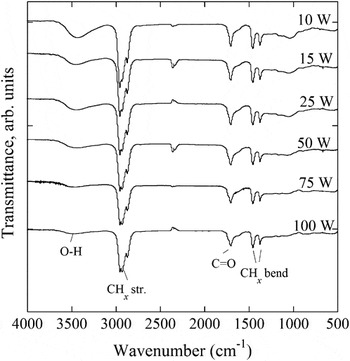
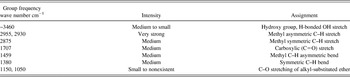
The bonding state of the plasma polymerized thin films was analyzed by FTIR absorption over a range of 4000–500 cm−1, as demonstrated in Fig. 1, with the absorption frequencies summarized in Table I. Compared to the spectrum for the monomer (not shown here), the number of absorption frequencies decreased significantly upon application of the plasma field, particularly in the fingerprint region of the spectrum (1500 cm−1 and below). Infrared bands associated with C=C–H unsaturation and observed between 3150 and 3000 completely disappeared even at the lowest of the deposition powers (10 W), which can be explained by C=C having the lowest value of dissociation energy among the bonds of the monomer. Bands at 1150 and 1050 cm−1 were characteristic of C–O stretching of alkyl-substituted ether. A peak at 1707 cm−1, which was not found on the monomer spectrum indicated the presence of a carbonyl group (C=O stretch). From Fig. 1, the absorptions corresponding to methyl C–H asymmetric and symmetric stretching (around 2955, 2930, and 2875 cm−1) and bending (around 1459 and 1380 cm−1) showed diminution in magnitude with higher input rf power. Similarly, there was a substantial reduction in H-bonded O–H stretch-related band magnitude with an increase in deposition power. The absorption peaks at ~2400 cm−1 are associated with incomplete removal of CO2 from the spectrum and are not pertaining to the polymer film itself.
IR spectra of polyterpenol films fabricated at varied rf power levels.

Group frequencies for polyterpenol films.

Dissociation of the terpinen-4-ol monomer is electron-generated rather than a result of thermal excitation or direct chemical reaction. Therefore, the nature of the chemically reactive species that engage in polymerization and film formation is strongly dependent on the input rf power. Considering the bond orders for terpinene-4-ol molecule, C(6)–OH and C(6)–C(7) bonds are likely to dissociate first to form reactive fragments, and C(3)=C(4) double bond is likely to undergo saturation to produce single bonded C(3)–C(4). Increasing rf power, and hence the energy of the plasma field to which the monomer is exposed, will allow for dissociation of higher energy bonds and hence increase the resultant fragmentation of the precursor molecule. Furthermore, the temperature of the substrate will also increase, and as such will influence the recombination process taking place within and outside of the plasma region. Consequently, polymers fabricated at higher input power will bare less resemblance to the original molecule, and possess a higher proportion of free radicals within the polymer framework compared to polymers fabricated at lower powers. On the other hand, recombination of plasma-created species generated at rf energy just sufficient enough to initiate dissociation will be more comparable to conventional polymerization. In such polymers, more of the structure and functionalities of the monomer is preserved because of the combination of weakly ionized plasmas and relatively low substrate temperature.
Because the intensity and the frequency at which a chemical bond absorbs IR radiation varies depending on its environment, namely the type of neighboring atoms and the presence of conjugation, the respective absorption peaks on the spectra for terpinene-4-ol monomer and polyterpenol films may differ in terms of their position and intensity. Similarly, broadening of the peaks is influenced by the density of a compound, or, more precisely, the extent of molecular contact between individual molecules. For example, in the case of O–H absorption, the individual molecules of the hydroxyl-containing compound will be characterized by a slightly different extent of hydrogen bonding hence giving rise to a broader O–H peak representing an average of these slightly dissimilar absorptions.
In general, polymer materials containing a large portion of C=C, C=O, and –OH groups are characterized by a high-dielectric constant because of their high polarizability, with polarizability of C=C being larger than that of C=O or –OH.Reference Miller21 However, as both carbon-oxygen and oxygen-hydrogen bonds are polar due to oxygen being more electronegative than either of the two, polymer structures containing these functionalities are likely to be less chemically and mechanically stable compared to hydrocarbon polymers. Indeed, previous works showed that polyterpenol films deposited at lower rf power to be softer and less stable when in contact with common processing solvents, such as acetone and alcohol. Higher applied rf power results in the reduction in or complete disappearance of such moieties, as clearly seen in IR spectra, rendering polyterpenol more conductive.
It is clear from the IR results that application of the rf plasma field resulted in terpinen-4-ol ionization, where certain bond structures dissociated (such as C=C bond) while others emerged (e.g., C=O group). Polyterpenol materials were identified to be predominantly hydrocarbon dense, with oxygen-containing groups being present within the structure in the form of alcohol and carbonyl groups. These results are in agreement with x-ray photoelectron and Raman spectroscopy studies of polyterpenol reported elsewhere. The study found that carbon and oxygen dominated the surface of the polyterpenol films (up to 99 at.%), with Si, Zn, and N present in trace amounts (below 1%). An increase in deposition power from 25 to 100 W resulted in a significant reduction in oxygen content (from 22.8 to 12.2%) and concomitant increase in the carbon fraction (from 76.0 to 87.1%).
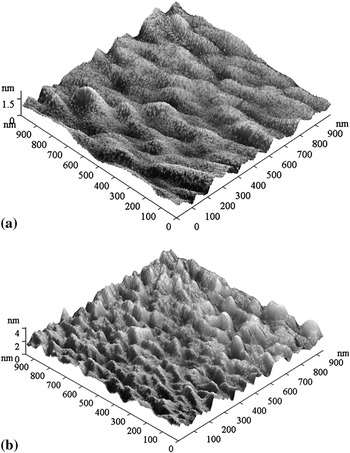
Typical surface morphology of polyterpenol thin films deposited at different rf powers is illustrated in Fig. 2. Independent of deposition power, polyterpenol samples were found to be smooth, uniform, and pinhole free, suggesting the polymerization occurred predominantly on the surface of the glass substrate rather than in the gas phase.Reference Hu, Zhao, Uddin and Lee22 There was a subtle change in surface topography of the samples with films manufactured at lower rf powers displaying broader, more rounded peaks and troughs, whereas samples deposited at higher rf powers exhibited narrower, sharper peaks. The number of peaks was also affected with a higher number of peaks corresponding to higher deposition power. These observations were confirmed through surface skewness R skw and coefficient of kurtosis R kur, which increased for samples deposited at higher rf power, although the increase was not statistically significant (p > 0.05). For every polyterpenol film independent of deposition power, surface skewness (R skw) was found to be more than 0 and coefficient of kurtosis (R kur) less than three. Such values for R skw and R kur indicate a disproportionate number of peaks pertinent to the polyterpenol surfaces and a well spread out height distribution, respectively. Samples deposited at lower rf powers, e.g., 10 W, were characterized by slightly higher values of average (R a) and root mean square (R q) surface roughness parameters and the maximum peak height (R max) compared to higher rf power films, i.e., 100 W; R a reduced from 0.4 to 0.33 nm, R q from 0.53 to 0.51 nm, and R max decreased from 5.4 to 5.1 nm. However, the statistical analysis of the R a and R q data collected for the polyterpenol films concluded that there was no significant difference between these parameters for the films deposited at different input powers (p > 0.05).
AFM images of polyterpenol films fabricated at (a) 15 W and (b) 100 W, scan size 1 × 1 μm.

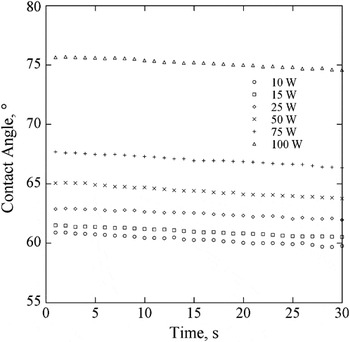
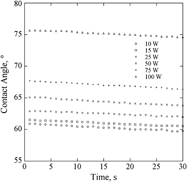
The water contact angle increased for samples deposited at higher rf power, as demonstrated in Fig. 3, from 62° to 76° for 10 and 100 W, respectively. Linear fit to the data had R2 = 0.99, and the rate of change was in the vicinity of 0.02°·s−1 compared to 0.2°·s−1 for poly(acrylic acid) and therefore it was unlikely swelling or reorientation of polar groups taking place at the liquid–solid interface.Reference Alexander and Duc23 Films became more hydrophobic as the rf power increased, due to the decrease in oxygen-containing functional groups and increase in cross-linking,Reference Takeda, Yamamoto, Hayasaka and Matsumoto24 as demonstrated through FTIR analysis. The contact angle is known to be influenced by the chemical composition, homogeneity, and the morphology of the solid surface. Although films deposited at higher rf power were smoother compared to their low power counterparts, the difference was not statistically significant and hence is unlikely to be the major determinant in the increase of contact angle. A significant decrease in the oxygen containing moieties under increased deposition power conditions, illustrated by a decrease in the magnitude of C– –O/C=O and *O– –C=O bond peaks, at binding energy (BE) of ~532 eV and *O– –C=O at BE of ~533 eV, respectively, and an increase in relative concentrations of C–C/C–H bonding environment at BE of ~285 eV, indicates that a change in chemical composition of polyterpenol is responsible for the increase in the water contact angle.
Water contact angle as a function of time for polyterpenol thin films deposited at different rf power levels.

Polymers with higher hydrocarbon content are likely to be more stable when in contact with solvents compared to oxygen-rich polymers, and therefore are suitable for applications where solvent stability is required, such as thermally degradable sacrificial materials in integrated circuit fabrication where a wet etching procedure is used. On the other hand, more wettable polymer surfaces are desirable if the material is used as a bioactive coating, as such materials are generally better tolerated by the human body.Reference Annarelli, Fornazero, Cohen, Bert and Besse25
Ellipsometric studies of the polyterpenol films indicated a decrease in deposition rate from 38.2 to 19.8 nm/min for 10 and 100 W rf power settings, respectively; however, there was no effect on the surface roughness, which was determined to be ∼0.3 nm of the sample films and was in agreement with estimates from the AFM analysis. Following Yasuda’s competitive ablation-polymerization concept, the process of ablation is likely to be much more prominent in the case of a higher applied plasma field compared to lower powers where, according to Lopez et al.Reference Lopez and Ratner19 the process is dominated by polymerization. Furthermore, the reduction in film thickness can be attributed to a suspected increase in film density and degree of cross-link. This is also likely to be responsible for the increase in hardness, from 0.34 GPa for 15 W to 0.51 GPa for 100 W.
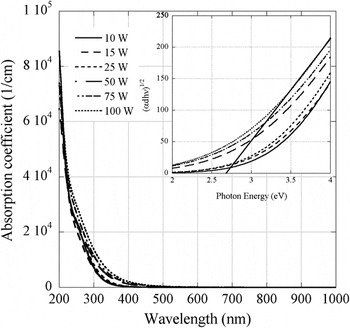
Optical absorption in solids takes place through a range of mechanisms in all of which the photon energy is absorbed by either lattice or by electrons where the transferred energy is conserved.Reference Eraiah and Bhat26 Photon absorption excites the electrons from a filled band to an empty band resulting in a noticeable increase in the absorption coefficient α(ν). The fundamental absorption edge is the onset of this rapid change in the absorption coefficient and the optical band gap E g is the corresponding energy. Several values of n were examined to understand the nature of transition with n = 2 offering the best fit, an indicator of indirect transitions taking place in the polyterpenol sample.Reference Sajeev, Mathai, Saravanan, Ashokan, Venkatachalam and Anantharaman9, Reference Bazaka and Jacob13 For amorphous materials, the frequently chosen n value of 2 is indicating a parabolic function for the density of states distribution.Reference Mujahid, Srivastava, Gupta and Avasthi27, Reference Tyczkowski and Ledzion28 A high degree of disorder characteristic of plasma polymers means the value of the optical gap will diverge from the energy gap value by the width of the range of localized states in the valence and conduction band.Reference Basa29, Reference Davis and Mott30
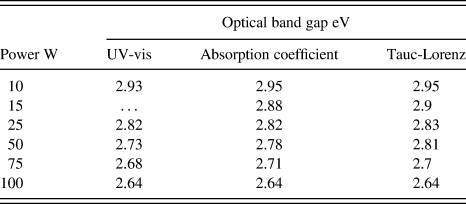
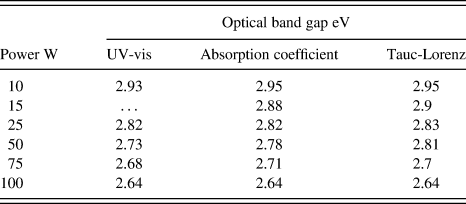
Optical band gap values were derived as presented in Fig. 4.The results showed consistency between estimation methods and are outlined in Table II. The optical band gap decreased with an increase in rf deposition power. Oppedisano et al.Reference Oppedisano and Tagliaferro31 suggested a decreasing trend of the optical gap in amorphous carbon-based materials is due to increasing sp 2 carbon content and varying hydrogen content. The optical band gap values changed from 2.93 eV for 10 W to 2.64 eV for 100 W, falling within the semiconducting region of E g. Hence, it is possible to control the optical band gap of the polymer film by selecting an appropriate rf input power in the process of film deposition.
Absorption coefficient of polyterpenol thin films fabricated at different rf input power.

Comparison of optical band gap estimates for polyterpenol films fabricated at varied rf input powers determined using UV-vis data, absorption coefficient data from the modeling of optical constants (n, k), and by fitting a Tauc-Lorenz oscillator model to the ellipsometric data (Ψ, Δ).
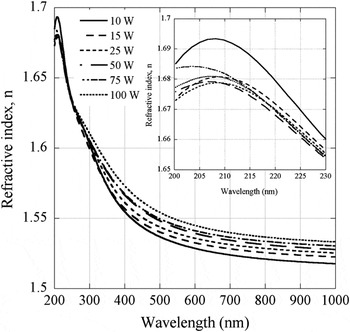
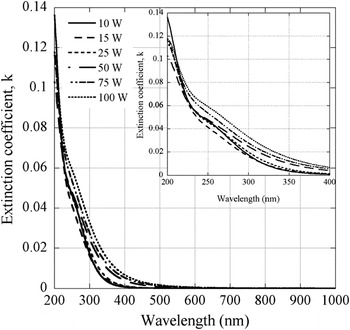
Figures 5 and 6 show the effect of deposition power on the refractive index and extinction coefficient profiles of polyterpenol films. The overall shape of the curves was similar across all the samples. Below 250 nm, higher values of refractive index n corresponded to the lowest level of rf power, which can be explained by the lower level of confidence pertinent to this region. However, above 250 nm, an increase in rf input power resulted in higher refractive index n values for the polymer. At 500 nm, the refractive index increased from 1.537 for 10 W to 1.544 for 25 W to 1.554 for 100 W. Similarly, the extinction coefficient values seemed to increase with higher rf power, with the exception of values corresponding to 10 W polymer samples. For all thin film samples, the magnitude of extinction coefficient k approached zero above 650 nm. Mean square error value varied slightly with the amount and quality of the data available, and the precision with which the chosen model described the film sample; Mstandard errorvalues of below 3 were obtained in the modeling process. It is therefore possible to control the values of optical indices n and k by manipulating the power of the excitation signal during the deposition process. A brief summary of material properties of polyterpenol thin films deposited at a range of rf input powers is presented in Table III.
Refractive indices of polyterpenol thin films manufactured at different rf powers as a function of wavelength.

Extinction coefficient of polyterpenol thin films fabricated at various rf powers as a function of wavelength.

Summary of properties of polyterpenol thin film samples deposited as a function of rf input power.

Transmission spectra for the thin films were similar in shape and diverged slightly in the lower wavelength region (300–500 nm), which was consistent with k profiles for these film samples; otherwise, the transmission spectra curves were similar in shape indicating the rf deposition power had no significant effect on the transparency of the resulting polymer. Hence, by controlling the magnitude of the excitation signal, it is possible to manufacture coatings with different surfaces and chemical and physical properties while maintaining the transparency of the films. As previously discussed, polyterpenol samples deposited at 100 W displayed the highest hardness and chemical and thermal stability,Reference Bazaka and Jacob32 and as such can be successfully used as protective transparent coatings in organic optoelectronics. Films deposited at 10 W, however, have shown the most biological activity due to preservation of original monomer functional groups,Reference Bazaka, Jacob, Truong, Wang, Pushpamali, Wang, Ellis, Berndt, Crawford and Ivanova15 and therefore can be applied as transparent antibacterial and antifouling layers in intraocular contact lenses.
IV. CONCLUSION
Exposure to rf plasma field notably altered the chemical structure of the monomer, with polymer films retaining only some of the original monomer functionalities. Lower rf deposition powers favored preservation of the high polarizability moieties, such as the hydroxy group, and therefore was found to be more appropriate for fabrication of insulating films. The optical band gap values declined with an increase in rf deposition power, from 2.95 eV for 10 W to 2.64 eV for 100 W, while the refractive index increased slightly. Films deposited at higher rf power were found to be harder due to the increase in the density and degree of cross-linking within the polymer thin film. Films also became less hydrophilic as the deposition power increased due to the reduction in the oxygen-containing functionalities. However, rf power had no significant effect on polyterpenol roughness or transparency, with all the samples characterized as smooth, defect-free, homogenous transparent films. Hence, rf power can be used as an effective control for fabrication of smooth and transparent organic polymer films with desired surface, chemical and physical properties with intended applications in electronics and biotechnology.
ACKNOWLEDGMENTS
The authors are grateful for the financial support obtained from Rural Industries Research and Development Corporation (RIRDC). We are also thankful to the Advanced Analytical Centre (AAC) at JCU for the access to AFM and nanoindentation systems. KB is grateful for the Australian Postgraduate Award (APA) and Australian Institute of Nuclear Science and Engineering (AINSE) scholarships.