Background
ASPs have been part of the healthcare landscape for more than a quarter century, and their ideal structure and function have been described in detail; however, their legal implications remain largely unexamined.Reference Barlam, Cosgrove and Abbo1 As a result, many ASPs are concerned about their liability to patients whom they neither see nor examine. Although there is little case law to guide interpretation of risk for ASPs, it is possible that by their involvement in patient care, ASPs put themselves at risk of litigation if they make errors that lead to patient harm. Because there is little available legal guidance in the area of antibiotic stewardship, the goal of this article is to outline suggested practices surrounding core areas among ASPs. The goal of this document is not to provide strict legal guidance for ASPs but to provide strategies to address common concerns and perceptions surrounding the legal implications of ASPs with the goal of improving the structure and function of ASPs as well as the services they provide to patients.
Methods
Survey
To understand concerns around the legal implications of ASP structure, interventions, and documentation, we first conducted a multicenter, cross-sectional survey of healthcare professionals who direct ASPs (Supplemental Material 1 online). The survey was not intended to provide an accurate characterization of all ASPs across the country but to identify areas of concern and vulnerability. Therefore, results of the survey should be interpreted only in this context. The survey was administered utilizing the Society of Healthcare Epidemiology of America (SHEA) Research Network as well as a national pediatric antibiotic stewardship listserv. The survey was anonymous, but unique identification codes were assigned to avoid duplicate survey entries. The Institutional Review Board at the University of Pennsylvania deemed the survey exempt from approval.
Existing case law and antibiotic stewardship
To render opinions on potential legal implications of antibiotic stewardship, 3 authors with legal backgrounds (M.N., G.M., and E.K.) searched existing case law and legal treatises for precedent and/or discussion on the legal implications of antibiotic stewardship via Thompson Reuters Westlaw. Inasmuch as there was no applicable legal precedent, the authors extrapolated from existing medical professional liability legal concepts and precedent. The authors also drew on the medical professional liability litigation experience of one of the authors (M.N.). Because this article was not based on medical peer-reviewed literature, it should not be viewed as a systematic review or as prescriptive of specific courses of action. The suggestions made in the article are the opinions of the authors and their interpretation of existing legal concepts and precedents. The approach and soundness of reasoning supporting these opinions were peer-reviewed by 2 independent medical professional liability attorneys and a retired judge and revised iteratively based on their commentary.
Survey results
Of the 90 providers who received the survey through the SHEA Research Network, 68 completed the survey, for a response rate of 76%. Of the 76 providers who received the survey through the pediatric antibiotic stewardship listserv, 47 completed the survey, for a response rate of 62%. Demographics of the survey respondents are detailed in Supplemental Material 2 (online). Specific results of the survey are discussed in corresponding sections.
General principles of liability
Liability is the legal responsibility for one’s actions or omissions. The failure of a person or group to meet that responsibility creates potential legal liability.2 In both the search of existing case law and survey results, there have been no reported lawsuits or claims specifically involving ASPs. Despite the lack of case law in this domain, it is useful to consider whether potential liability exists for ASPs.
Although the law of the state where providers practice governs requirements for establishing medical professional liability, the elements of such a claim are fairly uniform: (1) the healthcare provider owed a duty to a patient; (2) that duty was breached; (3) the breach of duty caused harm; and (4) damages were incurred as a result of the harm.Reference Lee and Lindahl3 For both physicians and allied health professionals, such as nurse practitioners, physician assistants, and pharmacists, the same framework applies. However, there are 2 major differences between physician and allied health professional liability. First, the standard of care is sometimes adjusted to account for differences in training and scope of practice for allied health professionals, although in some jurisdictions it is not. Second, in some settings and jurisdictions, allied health professionals practice under the supervision of a physician or healthcare institution, giving rise to supervisory liability.Reference Lee and Lindahl3-Reference Hansen-Turton, Ware and McClellan5
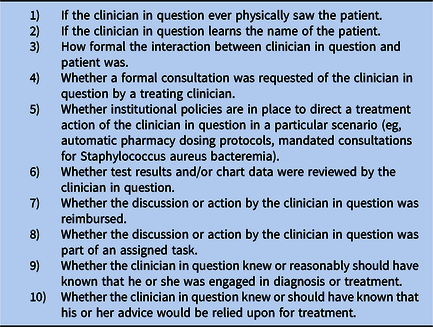
The threshold requirement for establishing liability is the existence of a duty between healthcare provider and patient.Reference Lee and Lindahl3 A duty will arise if there is an express or implied provider–patient relationship.Reference Lee and Lindahl3 Examples of express provider–patient relationships include a surgeon who performs surgery or a physician who examines a patient and makes treatment recommendations. An implied relationship can be established if there is an affirmative act demonstrating intent to be specifically involved in a patient’s care. For instance, when a pathologist who has never met a patient reviews a surgical specimen and renders a diagnosis, an implied provider–patient relationship is established.6 In general, when a nontreating clinician does not physically meet a patient or directly engage in care, courts may consider several factors in determining whether duty to a patient exists (Table 1).Reference Lee and Lindahl3,Reference Rigelhaupt7
Factors Courts May Consider to Determine Whether a Duty to a Patient Exists

In the context of ASPs, depending upon the jurisdiction and circumstances, a duty of care to the patient may be found. Factors weighing in favor of a duty include the review of patient-specific data, suggestions made to the primary team, or approving or rejecting requests for antibiotics. Weighing against a duty is lack of interaction with the patient, lack of involvement as a clinical care team member, and lack of billing for services.
When a direct question is posed to ASP personnel, commonly known as a “curbside consult,” in which a colleague requests input on a particular clinical presentation or condition without reference to the specific patient, duty is less clear. A provider–patient relationship typically will not be recognized when a provider simply provides a curbside consult. However, specific state law should be consulted because this informal type of consultation may indeed establish a duty depending upon the specific circumstances.6
In addition, at least one court has found a physician–patient relationship is not a necessary element of a professional negligence claim.6 In this case, a hospitalist determined a patient about whom he received a call from an outside provider did not require admission. The Supreme Court of Minnesota held that the physician owed a duty of care to the patient. The court reasoned that the physician was acting in a professional capacity, that it was reasonably foreseeable that the outside provider would rely on the physician’s decision, and that a breach of the standard of care could result in harm to the patient. A very similar case could be made for some ASP activities.
Existing regulatory landscape and antibiotic stewardship
Many regulations are being enacted to persuade healthcare facilities to develop formal ASPs. The Centers for Medicare and Medicaid Services (CMS) issued a final rule that went into effect in November 2016 requiring long-term care facilities to implement ASPs as a condition of participation and a final rule that went into effect in September 2019 for hospitals, critical access hospitals, and certain dialysis facilities.8,9 Additionally, the Joint Commission issued an antibiotic stewardship standard requiring hospitals, critical access hospitals, and nursing care centers to implement ASPs that went into effect as of January 1, 2017, and a standard that required ambulatory facilities to implement antibiotic stewardship as of January 1, 2020.10,11
Given the impact ASPs have on improving patient outcomes, patient safety, and public health, an argument can be made that some form of statutory or common law protection from malpractice liability is indicated. For example, in the context of vaccines, the federal government has insulated the industry from liability claims in the interest of promoting vaccine development. Specifically, the National Childhood Vaccine Injury Act of 1986 established the National Vaccine Injury Compensation Program, through which the federal government compensates individuals who have suffered serious injuries as a result of certain vaccines.12 The program was established to ensure that vaccination rates would not be dramatically reduced in response to increases in vaccine-related malpractice actions, and, therefore, to prevent an increase in the spread of many preventable diseases. ASPs share many of these characteristics because serious negative effects on public health may result from decreases in program participation or implementation in an effort to avoid potential malpractice liability. However, no specific legislation exists to protect antibiotic stewardship activities at this time.
Current federal law, as well as the law of many states, provides certain forms of protection to quality improvement activities. The Patient Safety and Quality Improvement Act of 2005 shields “patient safety work product” from discovery and use as evidence in federal and state civil proceedings, among other confidentiality protections.13,14 However, “patient safety work product” is narrowly defined as stemming from patient safety organizations, which are bodies that meet specific requirements and are certified under statute. Antibiotic stewardship teams do not fit into the act’s current conceptualization of “patient safety activities.”13,14
Although ASPs may not be protected expressly, federal law, national guidelines, mandates, and regulations confirm the importance of the programs to improving patient outcomes and improving public health, and they provide incontrovertible justification for the existence of ASPs. Therefore, any liability claim should be seen in the context of these benefits, but they do not insulate ASPs from liability.
Documentation of ASP interventions
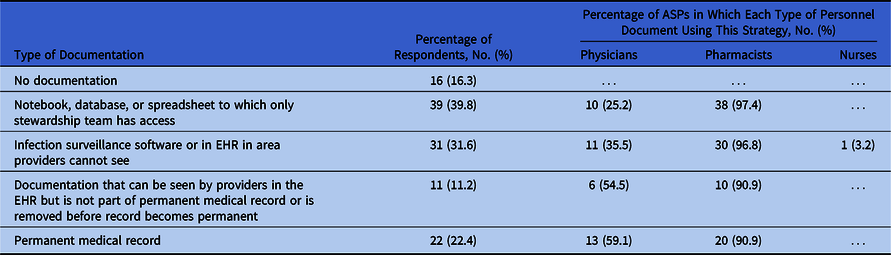
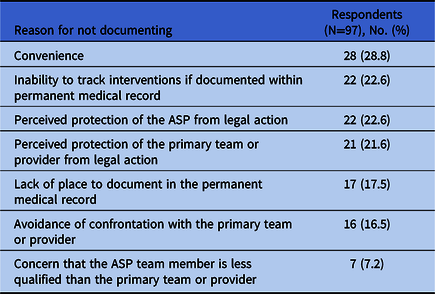
Documentation practices of survey respondents are shown in Table 2. Only 22% of survey respondents document ASP interventions in the permanent medical record, and 16% of survey respondents do not document interventions at all. Most ASPs document in an area that is inaccessible to treating teams and/or is not permanent: 40% of ASPs record their interventions in an internal database only accessible to the ASP; 32% use infectious surveillance software or an area of the electronic health record (EHR) that other providers cannot see; and 11% use an area of the EHR that is removed or otherwise does not become part of the patient’s permanent chart. Reasons for not documenting in the permanent medical record are listed in Table 3. Comfort in documentation may vary based on the clinical scenario, communication, and ASP personnel training (Supplemental Material 3 online).
Documentation Practices of Survey Respondents (Categories are not Mutually Exclusive)

Note. ASP, anti biotic stewardship program; EHR, electronic health record.
Reasons Why ASPs That Do Not Document in the Permanent Medical Record Do Not Document in the Permanent Medical Record (Categories are not Mutually Exclusive)

Note. ASP, antibiotic stewardship program.
The issue of whether and how to document ASP recommendations is not as straightforward as in other healthcare contexts. On one hand, documentation adds another task to ASPs grappling with limited resources, especially in situations where the ASP team members do not usually interface with charting systems. Further, ASP documentation may result in exposure for the ASP team and for clinical team members who do not follow ASP recommendations.
On the other hand, several factors suggest that ASPs should document recommendations in the permanent medical record for both improved patient care and medical-legal considerations. Although not documenting in the permanent medical record may initially mask ASP involvement, it will not insulate the ASP or clinical team from exposure in the context of litigation and may make defense of a claim substantially more difficult. Despite the added burden of documentation, documentation can eliminate misunderstandings about the reasoning behind ASP recommendations. Thorough documentation also provides an opportunity to clarify the ASP team’s role and the limitation of available clinical data. Lack of documentation can make it more difficult to establish the ASP team’s reasoning to defend recommendations during litigation.15 Without any documentation, whether it is in the EHR or in another system, the record of the ASP’s actions is based on the treating teams and ASP members’ recollections, sometimes years after the events in question.
If an ASP decides to document recommendations in the permanent EHR, personnel should eliminate any ambiguity about the ASP team’s role and the basis for its recommendations while being sensitive to the treating team’s role. There should be clear designation that documentation is from the ASP and is not a formal infectious diseases (ID) consultation. The ASP likewise should specify what data were reviewed. Documentation should clearly state the ASP team’s recommendations and the reasoning to support those recommendations. The ASP team should also be sensitive to how recommendations are phrased. For instance, documenting that “it is recommended that the antibiotic be changed to vancomycin given the results of the culture and sensitivities” is preferred over “the patient has been on the incorrect antibiotic for the past ten days and should be switched to vancomycin.”
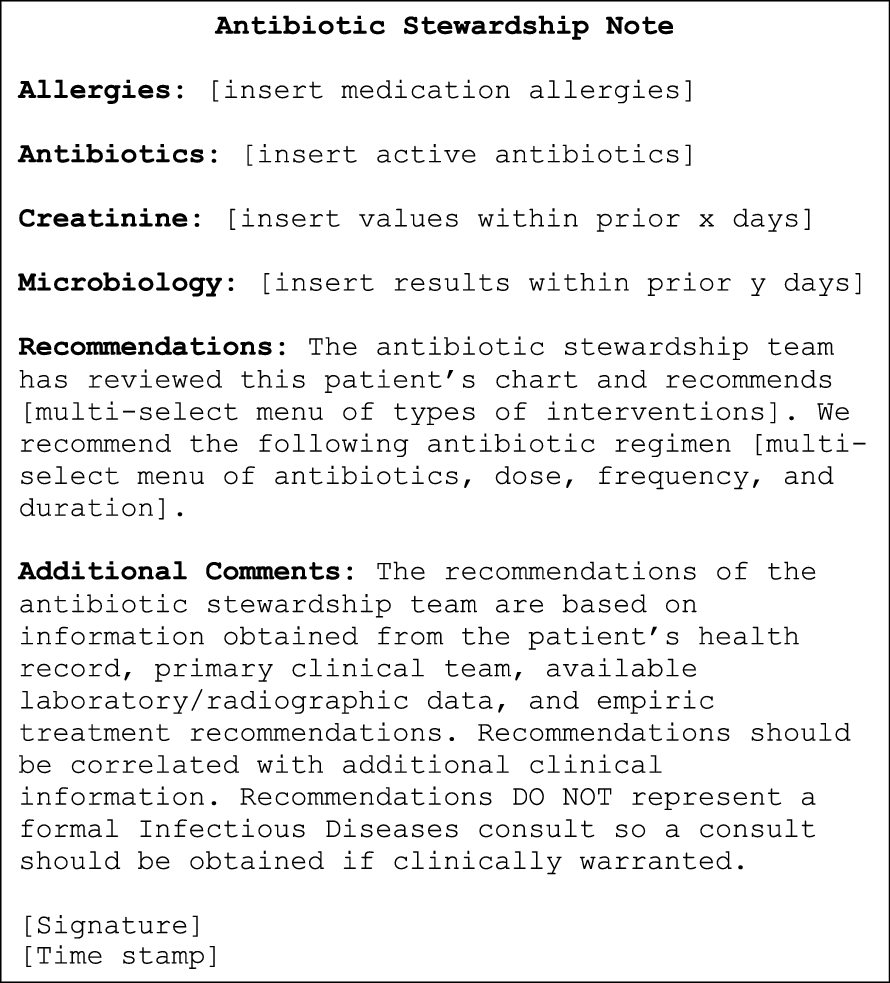
To facilitate ASP documentation, consideration should be given to developing a documentation template that does the following: (1) describes clearly the team’s role and source of patient information; (2) prompts inquiry about pertinent data that may impact recommendations such as medication allergies, creatinine clearance, microbiology results, and concomitant medications; and (3) includes a disclaimer that the ASP team’s recommendations do not constitute a formal ID consult and that a formal consultation should be sought if clinically warranted (Fig. 1). The decision about how the ASP team should document recommendations should be made in consultation with institutional risk management experts.
A template for an ASP note that can be adapted to common EHR systems.

Use of disclaimers in ASP documentation
If ASP personnel document recommendations in the permanent medical record, disclaimers could play a role in limiting ASP liability on the issues of duty and standard of care. Courts have recognized a limited duty of care between physicians and patients in certain circumstances, such as an insurance examination.Reference Rigelhaupt7 However, some courts impose a full duty of care in these circumstances.Reference Rigelhaupt7 In this context, disclosure of the limitations of the encounter is routinely documented to limit potential liability. On the standard of care, if ASPs are considered medical specialists, distinct from ID physicians or other practitioners, then ASPs could argue their actions should be judged according to ASP standards.
Although disclaimers may quell anxieties surrounding potential liability and communicate important information, they do not completely insulate against the creation of duty. For instance, describing recommendations as optional would likely not sway liability analysis because even formal consultant recommendations are optional to a primary medical team. In addition, primary medical teams failing to heed ASP’s advice may be subject to a heightened, specialist standard of care. Nonetheless, the disclaimer can clarify the role of the ASP, its limited review of clinical data, and the major differences between the ASP and an infectious diseases consultation. Wherever clinical practice and the courts settle on this question, ASP team members should be cognizant of the factual circumstances surrounding their patient relationships.
Clinical training of ASP personnel
As stewardship is implemented more widely, ASPs may include personnel from various disciplines. To address limited staffing resources, many state legislatures and licensing boards have authorized creation of collaborative practice agreements, which outline the scope of practice of allied health professionals.Reference Van Beek16-19 These agreements include the types of clinical problems that may be managed, medications that may be prescribed, and supervision required. Often, these agreements must be filed with and approved by the particular state board overseeing the allied health professional, and those respective state boards provide guidance on what such agreements can encompass.
Given the complexities and variations by state, ASPs should consult with legal counsel and credentialing bodies to ensure all ASP personnel are appropriately credentialed and collaborative practice agreements appropriately executed in applicable situations. The Joint Commission’s Antimicrobial Stewardship Standard provides flexibility for the type of providers that work as ASP personnel and adjusts for resource limitations. Furthermore, the multidisciplinary aspect of ASPs means that expertise can come from different disciplines and no specific type of training is required. However, hospital credentialing should take into account potential ASP members’ training as well as post-training experience in the field. Regardless of duty, ASP personnel should make recommendations in accordance with their licensure and scope of practice as well as their training and experience as enforced by hospital policies, state licensure boards, and legal precedent when applicable.
Telestewardship
Telestewardship programs perform stewardship through electronic means by personnel who are mostly offsite. With mounting pressure on hospitals and health systems to implement ASPs, there likely will be increased demand for telestewardship. Recognizing the challenges, the Joint Commission has acknowledged telehealth practitioners are acceptable members of ASPs.20
If the telestewardship team is located outside the state of the participating hospital, the team members may be required to be licensed in both states. Some states may permit special licenses for telehealth providers.Reference Wibberley21,Reference Kepler and McGinty22 Although some states have explicitly clarified a physician–patient relationship can be established through a telemedicine interaction, others have found no duty exists in certain limited interactions.Reference Wibberley21 Others have left the issue open, which requires institutions to extrapolate the potential duty and standard of care questions based on cases involving curbside or telephone consultations.Reference Wibberley21
Telemedicine providers should ensure their liability insurance coverage extends to this activity and determine whether they need to be credentialed at healthcare institutions where they are providing telemedicine services. Many professional liability policies explicitly limit coverage to a particular state or exclude certain activities so additional coverage may be needed. In addition, telestewardship personnel and the hospital receiving their services should ensure compliance with applicable regulations, particularly the Healthcare Insurance Portability and Accountability Act requirements surrounding sharing of electronic personal health information. It is advisable to have a Business Associate Agreement in place detailing how patients’ records and information will be transmitted, utilized, and stored and how documentation will occur.
Clinical practice guidelines
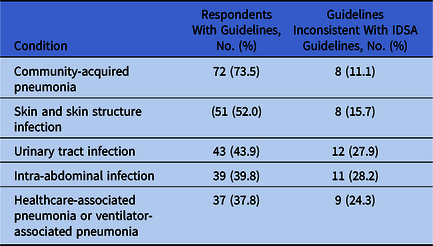
Clinical practice guidelines summarize, with respect to certain conditions or medical issues, what is generally considered the best course of action, but these guidelines vary widely in both scope and quality. Guidelines may not be appropriate for certain patient populations, geographic locations, and healthcare facilities. For example, resistance patterns or distributions of pathogens may vary in different settings; therefore, adapted guidelines may be necessary.Reference Barlam, Cosgrove and Abbo1 In fact, 18% of all respondents have at least one local guideline that deviates from national guidelines. Table 4 reviews respondents’ guidelines and whether they deviate from Infectious Diseases Society of America guidelines.
Guideline and Pathways for Selected Conditions Among Survey Respondents (n=98)

Note. IDSA, Infectious Diseases Society of America.
Clinical guidelines may impact the potential liability of ASPs because they may be presented as evidence of the standard of care in given situations. In medical malpractice actions, plaintiffs must prove defendant clinicians breached the duty owed to patients by failing to provide the applicable standard of care.Reference Lee and Lindahl3 Courts have permitted evidence of clinical practice guidelines to be used for various purposes in medical malpractice cases.23 A jury may consider guidelines as evidence of the appropriate standard in the context of expert testimony.23 Courts also may allow clinical practice guidelines to create a rebuttable presumption of the standard of care. A clinical guideline’s source may affect its impact on the standard of care question. For instance, if the guideline is developed by a defendant institution itself, the argument may be more compelling that the local guideline constitutes the applicable standard of care in a particular case than the national society guidelines. Of course, guidelines, unlike policies, are not mandatory. Thus, a deviation from a guideline, properly supported and preferably in writing, may be appropriate.
Although courts have yet to contemplate this precise issue, current law addressing the role of clinical practice guidelines in the courtroom, as well as the proper application of a national standard of care, provides reassurance.Reference Mello24,Reference Grosso25 Courts and legal scholars do not advocate strict synonymy between clinical practice guidelines and standards of care, allowing for exceptions in specific circumstances.Reference Mello24-26 Therefore, it is unlikely that defendants would be automatically bound by clinical practice guidelines.
This concept has been endorsed by courts applying the Two Schools of Thought Doctrine, which provides where competent medical authority is divided, a physician will not be held liable for having followed a treatment course advocated by a considerable number of reputable and respected physicians.27 Regarding antibiotic stewardship, the Centers for Disease Control and Prevention (CDC) and professional societies have identified key approaches for improving antibiotic use, including implementation of facility-specific antibiotic guidelines.Reference Barlam, Cosgrove and Abbo1,28-Reference Freifeld, Bow and Sepkowitz30 They recommend that both national guidelines and local susceptibilities inform antibiotic selection.
The fact that certain antibiotics are inappropriate to prescribe in certain localities represents a compelling circumstance to which actions must be tailored. As the Pennsylvania Superior Court has stated, “The standard of care in medical malpractice actions is first and foremost what is reasonable under the circumstances.”31
Antibiotic stop orders
Antibiotic stewardship programs may have a role in stopping antibiotics either indirectly by creating automatic stop orders (ASOs) or directly by issuing manual stop orders. In the case of ASOs, ASPs commonly implement a protocol by which antibiotics automatically expire after a certain amount of time. With a manual stop order, the ASP team member manually discontinues an antibiotic order because the team believes it is inappropriate.
Automatic stop orders
may have benefits such as decreasing inappropriate antibiotic therapy, adverse events, and unnecessary expenditures, but they pose a risk of inadvertently discontinuing necessary antibiotics if prescribers forget to reorder them or to request permission for continuation.Reference Durbin, Lapidas and Goldman32-Reference Evans, Millheim and Rapp35 Regarding liability, ASOs can be protective for clinicians in limiting side effects by helping to guide appropriate treatment durations. They have been widely used with pain control and opioids, but cases of ASOs resulting in malpractice liability have been reported. Nonetheless, clinicians can be held liable for failing to follow up and monitor the effects of a discontinued drug, especially if they are forewarned the drug will be stopped.Reference Speiser, Krause and Gans4,Reference Dreschsler36-Reference Leahy38 Just as hospitals can be held liable for providing ineffective staff or poor equipment, if a hospital fails to provide a warning before antibiotics stop via ASOs, it likewise can be exposed to liability.Reference Speiser, Krause and Gans4,Reference Dreschsler36-39 The role of ASOs to decrease adverse events and unnecessary antibiotic use is important, but safeguards should be put into place to notify prescribers when antibiotics are stopped to prevent inadvertent discontinuation.
If an ASP manually stops antibiotics, best practices would require a warning after discussion with the treating clinician. However, once ASPs actively discontinue an order, they have directly participated in patient treatment, which weighs heavily in favor of finding a duty on the ASP itself and counsels heavily for ASP documentation in the permanent EHR.
Effective communication and documentation strategies in specific scenarios
When ASP personnel make recommendations based on inaccurately presented information
Occasionally, there is tension between the prior authorization requirements for certain antibiotics and the desire of prescribers for access to these antibiotics. Some prescribers may misrepresent clinical information to access antibiotics.Reference LaRosa, Fishman and Landis40 Inaccuracy of data can affect decisions and is associated with inappropriate ASP recommendations.Reference LaRosa, Fishman and Landis40
In determining liability, assuming ASPs are found to owe a duty to the patient, courts usually are willing to consider the specific circumstances involved.Reference Pegalis41-Reference Handelman43 On one hand, healthcare practitioners are obligated to gather information necessary to address a particular clinical problem. On the other hand, courts are more likely to hold the recipient not accountable for inaccurately transmitted information if a recipient is not directly involved in patient care and has difficulty verifying the information. However, it will be difficult for an ASP to disclaim awareness when its personnel have access to prominently displayed and easily accessible information, such as allergies, when making recommendations. Likewise, situations such as late hours and offsite location may not provide a defense against liability where information that is critical to making a stewardship decisions is not obtained. Indeed, as ASPs become more commonplace, a standard will likely emerge on the balance between ability to trust information from the treating team and the need to conduct independent verification.
The balance will likely be different depending on the exact ASP structure and the type of intervention, which also affects the likelihood of finding a duty. Missed data will require a case-by-case analysis. Meanwhile, good documentation delineating the clinical information considered will serve as a useful record of the ASP’s reasoning. Likewise, using disclaimers in ASP documentation to communicate the ASP’s limited role and data considered may not only limit potential liability but also in prompt action by the clinical team when required.
When ASP personnel miss information
In the era of increased EHR utilization, there is an increasing amount of information readily available to the ASP team. However, it can be challenging to determine which information is important without clinical context. Therefore, the stewardship team may miss important information whether it is undocumented or underdocumented by the patient care team, overlooked by the ASP team, or misinterpreted by the ASP team.
Courts charge providers with gathering information needed to inform treatment recommendations and decisions. However, as ASPs become more widely implemented, the standard of care will likely involve consensus on how much information is required for an intervention.Reference Pegalis41-Reference Handelman43 For instance, consultants are often not held accountable for complete knowledge of a patient’s chart, but some courts have charged them with gathering the critical data required for the requested consultation.Reference Miller44 At least ASPs likely will be charged with knowing the pertinent clinical data including relevant cultures, antibiotic susceptibilities, and allergies. To ensure these pieces of information are consistently considered, they can be coded into a template for ASP documentation.
When the clinical team does not accept ASP recommendations
In some situations, the stewardship team may make recommendations, but the clinical team may not accept them. If a patient experiences harm, the clinical team could be placed in a challenging situation, as they acted contrary to expert recommendations. Concerning liability, the clinical team should be wary of disregarding an ASP’s recommendations. A generalist who engages in an area where a specialist has opined is subject to the specialist’s standard of care.Reference Ey45 Even if the ASP’s recommendations were not formally placed in the chart, any record relating to the ASP’s recommendations and communications would be subject to discovery in a lawsuit. Where the ASP decides to intervene, a disclaimer stating the treating team should correlate their recommendation with the clinical situation, similar to when radiologists and pathologists suggest clinical correlation, could help insulate the treating team from liability if other clinical information warrants a different treatment course. Regardless, best practices in communication should be used so the ASP and treating clinicians achieve agreement on treatment strategy whenever possible.
When ASP recommendations are incorrect
Stewardship recommendations are often based on a combination of local guidelines, national guidelines, local susceptibility patterns, and expert opinion as well as pertinent clinical data. However, there may be clinical situations where a result is not anticipated. A situation could also arise where an ASP member makes a recommendation that deviates from an accepted standard of care. It is possible the team may follow these recommendations, resulting in harm to the patient.
Provided a duty is found, an error by the ASP team integrating clinical information could lead to liability for the ASP, its members, and the hospital sponsoring the ASP. In this case, ASPs, like individual clinicians, may be held liable when they have the relevant information but make a mistake that deviates from the standard practice in their individual professions or in the ASP itself. Of course, not every mistake constitutes a deviation from the standard of care or causes injury, but it can lead to inquiry. As in other areas of medicine, the tools developed to reduce mistakes and liability, such as checklists and standard operating procedures, are equally applicable to ASPs.
Conclusions
The approaches discussed previously represent general guidance on antibiotic stewardship practices. Specific healthcare facility policies and ASP operations should be discussed with legal counsel and risk management personnel at individual institutions to create a customized strategy consistent with local law. Nonetheless, ASPs should develop in conjunction with hospital administration, treating teams, pharmacy staff, and other stakeholders: (1) protocols to communicate and resolve differences with treating teams or other stakeholders; (2) documentation to provide the basis of recommendations as well as preserve the record of ASP involvement; and (3) standards for credentialing ASP team members based on experience or formal training whether ASP personnel are onsite or working remotely.
Many factors weigh for or against different approaches to ASP documentation, credentialing, guidelines, and activities. When considering these approaches, ASPs should not overlook the principle that their work has consistently led to improved patient safety and outcomes and that their involvement should continue to expand throughout various healthcare settings. Likewise, safeguards for these programs should not be viewed as restricting these activities. Many of these safeguards, such as developing templates that integrate key pieces of clinical information, may provide more efficient and consistent approaches. Regardless of specific circumstances, considering the best practices for program structure, interventions, and documentation is essential not only for risk mitigation, but also to optimize the quality of antibiotic prescribing and patient care.
Supplementary material
To view supplementary material for this article, please visit https://doi.org/10.1017/ice.2020.89
Acknowledgments
The authors thank Valerie Deloney and the SHEA Research Network for their assistance in administration of the survey. The authors acknowledge James A. Young (Christie & Young, PC, Philadelphia, PA), Daniel F. Ryan, III (O’Brien & Ryan, LLP, Plymouth Meeting, PA), and Judge Sandra Mazer Moss (Retired, Philadelphia Court of Common Pleas, Civil Trial Division, Philadelphia, PA; Dispute Resolution Institute, Philadelphia, PA) for their expertise in providing legal peer review for this article.
Financial support
No financial support was provided relevant to this article.
Conflicts of interest
All authors report no conflicts of interest relevant to this article.