

The research relating to the relationship between working memory (WM) and academic achievement continues to develop. Although the conceptual understanding of WM is not new (Baddeley, Reference Baddeley2003; Baddeley & Hitch, Reference Baddeley, Hitch and Bower1974), it has only recently been applied to classroom settings. WM refers to the ability to hold and manipulate information over short periods of time (Gathercole & Alloway, Reference Gathercole and Alloway2008). The functioning of WM has variously been described as a bottleneck for learning (Gathercole, Alloway, Willis, & Adams, Reference Gathercole, Alloway, Willis and Adams2006), a conduit to academic learning (Gathercole, Lamont, & Alloway, Reference Gathercole, Lamont, Alloway, Pickering and Phye2006), and a mental workspace to store information (Baddeley & Hitch, Reference Baddeley2003; Gathercole & Alloway, Reference Gathercole and Alloway2008). It appears to be vital for learning, and is linked to children's academic underachievement and difficulties in learning.
Students can display insight into their WM failures. For example, in a study by Gathercole, Lamont et al. (Reference Gathercole, Alloway, Willis and Adams2006), a student who received a long series of instructions from the teacher and was unable to complete the task, stated she ‘told me a lot and I forgot’ (p. 234). With students presenting this level of insight, it seems a natural progression for students to have supported access to WM strategies, which they can utilise to improve learning outcomes. Students require opportunities to overcome individual WM difficulties (Maehler & Schuchardt, Reference Maehler and Schuchardt2011), to be engaged at different levels (St. Clair-Thompson, Reference St Clair-Thompson2011), and to be provided with a learner-sensitive approach that takes into account their specific learning needs, and provides multiple instructions, when appropriate, to improve achievement (Hopkins & Lawson, Reference Hopkins, Lawson and Mitel2006).
Alloway and Gathercole (Reference Alloway and Gathercole2006) suggested that it may be advantageous to reduce WM demands in the classroom by using strategies, such as brief and simple instructions, breaking instructions into smaller steps, frequent repetition of instruction, providing reminders for crucial information, and asking the student to verbally repeat instructions. In essence, the teacher provides memory support in a seamless way, embedded within the lesson. Focusing on whole-class program means specific students are not stigmatised, maintaining their motivation and engagement (Wass, Scerif, & Johnson, Reference Wass, Scerif and Johnson2012). Students benefit from a WM system that is efficient and flexible (Andersson, Reference Andersson2008). Class-wide strategies are important, as the effective use of WM becomes critical as the complexity of content and instruction increases throughout schooling, usually coupled with a reduction in learning supports, such as concrete resources (Alloway, Gathercole, Kirkwood, & Elliott, Reference Alloway, Gathercole, Kirkwood and Elliott2009).
Given that WM problems can remain undetected or misattributed to poor behaviour or motivation (Gathercole & Alloway, Reference Gathercole and Alloway2008; Gathercole, Lamont et al., Reference Gathercole, Lamont, Alloway, Pickering and Phye2006), assisting teachers to recognise WM difficulties is important. This improved understanding may result in higher-quality learning and academic progress, especially in relation to avoiding overloading students with instructions and demands in the classroom. Alloway, Doherty-Sneddon, and Forbes’ (Reference Alloway, Doherty-Sneddon and Forbes2012) study indicated that teacher awareness of WM was low and teachers lacked an understanding of effective strategies to address WM. Research supporting these findings (Gathercole, Lamont et al., Reference Gathercole, Lamont, Alloway, Pickering and Phye2006) found that teachers easily confused WM failures with basic attention problems or with more pervasive cognitive impairments. Therefore, it is imperative that teachers, especially in the early years, have a clear understanding of characteristics of WM, and appropriate strategies to increase learning outcomes.
There is growing support for the view that low WM skills present a high risk factor for educational underachievement across the primary school years, and may underlie many difficulties in learning (Alloway et al., Reference Alloway, Gathercole, Kirkwood and Elliott2009), mathematics (Geary, Hoard, & Hamson, Reference Geary, Hoard and Hamson1999; Swanson & Sachse-Lee, Reference Swanson and Sachse-Lee2001), problem-solving (Swanson, Reference Swanson2011; Swanson & Beebe-Frankenberger, Reference Swanson and Beebe-Frankenberger2004), spelling (Alloway et al., Reference Alloway, Gathercole, Adams, Willis, Eaglen and Lamont2005), and specific reading disorders (Schuchardt, Maehler, & Hasselhorn, Reference Schuchardt, Maehler and Hasselhorn2008). Research has highlighted that WM is a robust predictor of academic achievement in a multitude of areas (Swanson & Alloway, Reference Swanson, Alloway, Harris and Graham2012), with an association between WM and learning difficulties occurring independently of intelligence level (Maehler & Schuchardt, Reference Maehler and Schuchardt2011).
WM failures in the classroom may impact classroom behaviour and may result from and also lead to frustration (Alloway et al., Reference Alloway, Doherty-Sneddon and Forbes2012). Aronen, Vuontela, Steenari, Salmi, and Carlson (Reference Aronen, Vuontela, Steenari, Salmi and Carlson2005) found that students with lower WM functioning tended to display a greater frequency of attention difficulties at school. Alloway et al. (Reference Alloway, Gathercole, Kirkwood and Elliott2009) found that classroom teachers perceived children with low WM as displaying: inattention, poor attention span, high distractibility, forgetfulness, failure to remember instructions, careless mistakes, difficulty solving problems, and failure to complete tasks. What is important about this newly emerging research for educators in schools is that WM functioning is closely linked to a student's learning outcomes 6 years later, such that WM functioning at the commencement of formal schooling is a stronger predictor of academic success than intelligence (Alloway & Alloway, Reference Alloway and Alloway2010). Deficits in WM can precede learning challenges in the classroom (Alloway et al., Reference Alloway, Gathercole, Adams, Willis, Eaglen and Lamont2005; Roberts et al., Reference Roberts, Quach, Gold, Anderson, Rickards, Mensah, Ainley, Gathercole and Wake2011), and educators should act to identify students with WM difficulties, and to intervene to bridge the learning-achievement gap with peers.
Approaches to overcoming WM difficulties have been researched, such as direct training involving computer programs such as CogMed (Klingberg et al., Reference Klingberg, Fernell, Olesen, Johnson, Gustafsson, Dahlstrom and Westerberg2005). Witt (Reference Witt2011) found that a targeted external program, focusing on children's WM and encouraging self-monitoring, led to improvements in mathematical performance. However, questions have been raised about the extent to which external training can help children progress educationally (Elliot, Gathercole, Alloway, Holmes, & Kirkwood, Reference Elliot, Gathercole, Alloway, Holmes and Kirkwood2010). Limited evidence exists about transfer effects of WM training to areas of learning not directly related to the intervention (Alloway, Reference Alloway2012), although some research has suggested that younger individuals may experience transfer effects (Wass et al., Reference Wass, Scerif and Johnson2012). The identification of strategies that will be effective in closing the gap at school level requires further research.
It is important for students to identify and support their own learning needs and select from a suite of self-help strategies to re-engage within lessons. In addition, regular periods of practice are required in the context of simple activities (Alloway & Gathercole, Reference Alloway and Gathercole2006). Limits to WM need to be regularly monitored to improve students’ learning and capacity to develop automated schemas (Sweller, Reference Sweller and Mayer2005). With teachers providing greater focus on, or attempting to draw links with familiar knowledge stores, some WM limits may be mitigated.
Mental imagery is one strategy that can be utilised to support WM (Woolley & Hay, Reference Woolley, Hay, Knight and Scott2004). Woolley (Reference Woolley2010) asserted that mental imagery skills do need to be practised to become automated responses incorporated into a student's learning. Another strategy that has been found to improve WM functioning is rehearsal, where students repeat information in their mind, with young children benefitting from memory training in rehearsal strategies, as they are less likely to spontaneously use these until the age of seven (St Clair-Thompson, Stevens, Hunt, & Bolder, Reference St Clair-Thompson, Stevens, Hunt and Bolder2010). Rehearsal appears to be an effective strategy; it is relatively easy for children to learn, and not cognitively demanding (Turley-Ames & Whitfield, Reference Turley-Ames and Whitfield2003).
The target population of the current study, middle primary school, presents as a critical junction in students’ educational progress in developing self-managed learning, self-reflection and self-regulation, all of which involve working memory and key elements of executive functioning including controlling attention, self-regulation, problem solving, reasoning, and planning.
Helping teachers identify students with WM difficulties is a key element underpinning the present study by providing:
1. psycho-education about the nature of WM difficulties;
2. strategies to try;
3. supporting resources;
4. co-planning of lessons to create high interest for students; and
5. explicit instructions to students to use strategies.
The aim of the present study was to determine if a class teacher providing WM strategies, named Memory Mates, to students would increase on-task behaviour; more specifically, persevering with mathematical tasks, sustaining attention, and independently utilising self-help strategies. Research has consistently indicated a strong positive relationship between on-task behaviours, and academic engagement and achievement, with students demonstrating greater participation in class, being attentive, interested and invested in their learning (Greenwood, Horton, & Utley, Reference Greenwood, Horton and Utley2002; Marks, Reference Marks2000). A secondary aim was to determine if the classroom teacher was able to identify WM overload, and to adjust lesson content and delivery accordingly.
Method
Participants
The participants were four Year 3 students (three boys, one girl; mean age 8.5 years) in a primary school in a large metropolitan city in New South Wales, Australia. The participants were selected based on the class teacher's ratings with the adapted Working Memory Rating Scale (Alloway, Gathercole, & Kirkwood, Reference Alloway, Gathercole and Kirkwood2008); and parental permission was gained for a target group of four students.
Materials
A checklist was adapted from the Working Memory Rating Scale (Alloway et al., Reference Alloway, Gathercole and Kirkwood2008) and contained 12 items based on characteristics of children with poor WM (Gathercole & Alloway, Reference Gathercole and Alloway2008). Time-sampling was undertaken during target lessons, measuring on-task and off-task behaviour; thus, a measure of academic engagement, following the specifications described by Glynn, Thomas, and Wotherspoon (Reference Glynn, Thomas and Wotherspoon1978). Inter-observer reliability was 100%.
A set of visual prompt cards, outlining attention and WM strategies in card format, with an appropriate pictorial symbol, was provided. The visual prompt cards were finalised based on student feedback, and encompassed eight strategies:
1. Listen: Listen to the teacher instruction.
2. Download: Put the teacher information into your brain.
3. Self-talk: Say it to myself again.
4. Picture it: Create a picture of the activity in your mind.
5. Use memory aides: What things can you do to help remember?
6. Memory coach: Talk to your memory coach about the activity.
7. Time check: How fast am I going?
8. Forgotten? Look, re-read, ask your memory coach, ask the teacher.
Procedure
The class teacher was provided with verbal and written information about WM, including a definition, typical WM failures and classroom strategies. The prompt cards were shown to the whole class and explained in detail with instructions given for their use. In addition they were prominently displayed in the classroom.
Four mathematics lessons were jointly planned with the school counsellor for implementation of the WM intervention. Initially, the school counsellor delivered one sample lesson to the class describing WM and strategies that could be used to help remember information and teacher instructions. Each child was given the name of a peer to be their ‘memory coach’ to seek out first for help if they forgot any information, rather than asking the teacher.
The teacher delivered the lessons, initially using verbal instructions and questioning. In the second part of the lesson, students completed the worksheets or tasks. Before students returned to their desk, the school counsellor coached all the children in the eight WM strategies, reminding them to use them during the lesson. WM strategies continued to be referred to throughout the duration of the lesson by the teacher, and were also displayed in the classroom.
At the end of each session, students were asked whether they had used each of the WM strategies, with the four target children having their frequency data recorded. The next day the number of mathematical problems answered correctly was tallied from the target students’ exercise books, and the researchers checked the work and recorded the marks.
At the completion of the final lesson, the teacher and target students completed questionnaires about the usefulness of WM strategies. Parents were phoned to discuss the results, the intervention strategies and their observations.
Results
Figure 1 shows the on-task for individual students indicating how often they were appropriately engaged in the lesson. On-task behaviour in the baseline data phase prior to intervention was at a mean level of 64% for the four target students over 2 days. The baseline data for off-task behaviours was categorised as inappropriate verbalisations, small and large movements, staring fixedly away from the centre, and inappropriate noise. Over the intervention phase in weeks 2 to 4, the target students’ mean on-task behaviour was 80%, and 100%.
Student frequency of on-task behaviour.

An increase was noted between the mean number of problems solved correctly and written in the exercise book before the intervention (49%) compared with during the intervention (85% to 100%).
Despite some variability in reporting which strategies were used in each lesson, individual students used at least three, and often more WM strategies during each lesson (Figure 2).
Students’ self-reported use of WM strategies.
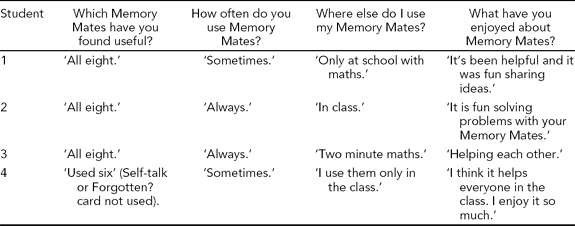
After lesson 4, students completed a questionnaire indicating which WM strategies they found useful. They responded on a Likert scale (always, often, sometimes or never); two of the target students said always and two said sometimes. Three of the four students used all eight strategies. Overall, students made positive comments about the program, emphasising that it was fun and they liked helping each other. These comments are illustrated in columns 3 and 4 of Table 1.
Students’ Comments
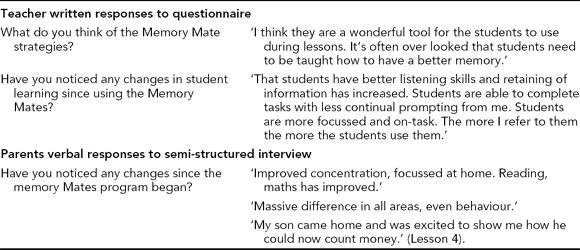
The classroom teacher and the parents provided positive comments relating to improvement in memory, listening, retention and focus. Examples of these comments are illustrated in Table 2.
Teacher and Parents’ Comments
Discussion
This small-scale study investigated the impact of attention and WM strategies for a Year 3 class over four lessons. The eight strategies were embedded in everyday mathematics lessons. Overall, there was an increase to 100% in the final two lessons in the on-task behaviour of participants. Both students and the teacher provided positive comments about the effectiveness of the strategies.
The results of this study demonstrate that students who regularly used WM strategies within target lessons displayed an increase in the amount of time they spent on-task, indicating improved attention and learning. Each student reported using the WM strategies during all four lessons, and finding them helpful. The associated improvements in on-task behaviour and academic outcomes suggest that participants were more engaged in their learning during target lessons. These findings support Alloway and Gathercole's (Reference Alloway and Gathercole2006) assertions that students benefit from access to self-help strategies supporting learning needs. They also highlight the need to practise strategies to support WM regularly during classroom lessons (Woolley, Reference Woolley2010).
The classroom teacher commented that the more she referred to the strategies, the more the students appeared to use them. After gaining a greater understanding of WM and its impact on learning, the teacher recognised that the explicit teaching of these strategies was important.
A secondary aim was to determine whether the teacher could identify WM difficulties and overload in students, and subsequently adjust lesson content and delivery for these students. The teacher effectively identified four students with WM difficulties and modified lesson content and delivery to address this. The teacher's comments confirmed that, with time and practice, the teacher can slowly be removed as the primary strategy. Instead of students using the teacher first when difficulties arise, they were able to select from a suite of self-help strategies to support WM independently. The teacher played a critical role in regularly delivering WM strategies, monitoring WM overloads, and adjusting lesson delivery accordingly, while enabling students to increase their level of self-direction and apply strategies that, over time and with practice, become automated schemas (Sweller, Reference Sweller and Mayer2005).
However, for this approach to be effective, and implemented by teachers, it is important that the strategies can be readily embedded at natural points during the lesson, without excessively impacting time spent on lesson planning and sequencing. The simplicity of these strategies was an intentional aspect of the study, both for teachers in terms of practicality of implementation, and for students, in terms of ease of understanding and application.
The findings suggest the potential for a class-wide intervention, with a control group, identifying students at risk of academic underachievement and assisting them during regular classroom lessons to improve their WM. Further research could also include the collection of treatment integrity data.
Classroom teachers play a crucial role in supporting students with WM difficulties (Aronen et al., Reference Aronen, Vuontela, Steenari, Salmi and Carlson2005; Gathercole & Alloway, Reference Alloway, Gathercole and Kirkwood2008). Furthermore, increasing teachers’ understanding of WM supports them in identifying students with WM difficulties rather than misattributing their issues as behavioural difficulties (Alloway et al., Reference Alloway, Doherty-Sneddon and Forbes2012). This small-scale study produced some encouraging results and highlights the need for further research to determine the impact that WM strategies have on students’ learning.