The early modern era witnessed the formation across Europe of centralized states that captured increasing shares of resources as taxes. Those states that were able to establish and implement a more efficient and centralized system of taxation not only benefited from greater capacity to deal with domestic challenges, they also enjoyed greater military success in the international arena. They were also able to shield their economies better from the large fiscal shocks created by the wars by better managing their borrowing and avoiding fiscally motivated currency debasements. Not all states achieved fiscal centralization, however, and among those that did, its timing and extent varied significantly. As a result, there emerged, by the second half of the eighteenth century, glaring differences between the fiscal and military capacities of states that were able to collect more revenue and those that could not.Footnote 1
The centralization of revenue collection as a fiscal phenomenon and in the broader context of state consolidation has been investigated primarily with evidence from European states. In this article, we examine the same process with evidence from the finances of the Ottoman state, which was at once part of the European state system but which also inherited institutional elements from the Middle Eastern and Central Asian traditions. Specifically, we examine the tax revenue series of the Ottoman central administration for the sixteenth to nineteenth centuries, review the fiscal and military institutions, and discuss the relationship between fiscal performance, institutional changes, and economic development.
To investigate the Ottoman fiscal performance over time and in the context of other major European states, we make use of annual cash revenue series of the central treasury measured in tons of silver based on the “ex-post” budgets from the early sixteenth century until World War I.Footnote 2 The key pattern that emerges from these series is low and fluctuating central revenues without an upward trend in the early modern centuries followed by rapid gains in the nineteenth century. Ottoman central revenues were only marginally higher in the 1780s in comparison to the 1560s. In contrast, they increased by more than fifteenfold between the 1780s and World War I. We also construct estimates of per capita tax revenues in grams of silver and adjust for changes in prices and incomes. The basic pattern that Ottoman administration achieved enduring fiscal gains only in the nineteenth century remains robust when these alternative measures of central fiscal capacity are used.
We also compare annual Ottoman central revenues with those of England, France, the Dutch Republic, Spain, Venice, Austrian monarchy, Prussia, Poland, and Russia. Revenue series for these polities point to gains in centralized fiscal capacity earlier than the Ottomans, dating back to sixteenth and seventeenth centuries for Western Europe and eighteenth century for Central and Eastern Europe. By the eighteenth century, especially the second half of that century, a large gap had emerged between the per capita and total revenues of most European states and those of the Ottomans. As most of these revenues were spent on warfare, this growing fiscal gap was accompanied by the deterioration of Ottoman military performance against its European neighbors, the Austrian monarchy and Russia. On the other side of the same coin, one might argue that the sharp fiscal gains of the nineteenth century contributed to the survival of the Ottoman Empire until World War I.
There were many reasons for the low levels of revenues and fiscal centralization of the Ottomans during the early modern era. Difficult terrain, vast distances to the capital, and low urbanization rates made tax collection much more difficult in comparison to the smaller and more urbanized Western European polities. Another possible explanation for the differences in per capita taxes is the differences and changes in per capita income levels. Higher levels of per capita income made it easier to collect more taxes, not only in absolute terms, but also as a percentage of per capita income. However, per capita income differences between the Ottomans and European countries remained limited until the nineteenth century, with the exceptions of Britain and the Dutch Republic. Secondly, most European countries were able to achieve significant increases in per capita tax revenues with little or no increase in per capita income during the early modern era.Footnote 3 In other words, per capita tax revenues increased not so much because per capita incomes increased, but more importantly because administrations achieved the capacity to extract and collect at the center greater shares of a polity's income as taxes.
The growing extractive capacity of central administrations, in turn, relates to intrastate politics and the relationship between administrations and other stakeholders in taxation. Early modern states could not employ bureaucracies that functioned based on written regulations, evaluated on merit and receiving fixed wages.Footnote 4 Instead, in assessing, collecting, and spending taxes, administrations relied on a range of functionaries, officials, corporations, councils, assemblies, and tax farmers. These intermediaries also took part in the military apparatus and were often major wealth holders in the polity. Due to their role in fiscal and military apparatus, the intermediaries influenced the size and incidence of the tax burden and captured a significant portion of tax revenue at the cost of the central treasury through temporary assignments, long-term alienation, or embezzlement.Footnote 5 Accordingly, there was a close relationship between levels of central revenue and the changes in the terms of intermediation.Footnote 6
There is an extensive body of literature that identifies the introduction of credible constraints on executive authority as the critical juncture in domestic politics and fiscal consolidation. This argument holds that representative regimes were able to apply taxes to broader sections of the economy and collect more taxes because the representative bodies helped negotiate and sanction fiscal demands in return for limits on the power of the monarch on the use of funds, especially during periods of fiscal crises. It has also been argued in this context that the power of the so-called absolutist states was not absolute at all. These regimes retained the control of expenditures, but struggled to collect taxes without such deals with local elites who controlled large segments of the economy and were able to limit the administration's access to funds.Footnote 7
In contrast, the literature on military revolution and fiscal military states emphasized the role of changes in military technology and related organizational innovations in driving fiscal and coercive centralization.Footnote 8 While the relative importance and exact sequencing of the innovations is a matter of dispute, this literature has argued that improvements in firearms and artillery technologies as well as gains in discipline, drill, and tactical capacity of troops favored centralization of military force and led to massive expansion of centrally administrated and provisioned infantry units at the expense of decentralized production of cavalry. The monopolization of military force was delayed in Eastern Europe because until the modern era, cavalry was the only effective defense against recurring attacks of horse riding archers of the Central Asian steppe.Footnote 9 The rise of central armies and the centralization of finances were closely connected because centrally administrated troops consumed the bulk of the tax revenues and in turn proved instrumental in eliminating domestic fiscal and judicial fragmentation.
For six centuries until World War I, the Ottoman Empire stood at the crossroads of intercontinental trade, stretching from the Balkans and the Black Sea region through Anatolia, Syria, Mesopotamia, and the Gulf to Egypt and most of the North African coast. The economic institutions and policies of this agrarian empire were shaped to a large degree by the priorities and interests of a central administration. Until recently, Ottoman historiography had depicted an empire in decline after the sixteenth century. In contrast, a growing body of literature has been arguing that the Ottoman state and society showed considerable ability to reorganize as a way of adapting to changing circumstances in Eurasia in the early modern era, well before the nineteenth-century reforms known as Tanzimat or “reordering.”Footnote 10 While pragmatism, flexibility, and selective institutional change were traits that enabled the Ottomans to retain power until the modern era, limitations of these traits need to be equally emphasized. Institutional change did not apply equally to all areas of Ottoman economic life. Not all types of institutions were affected to the same degree by these changes. Equally important, pragmatism, flexibility, and selective institutional change by the central bureaucracy were often not sufficient for reaching its objectives, as we will discuss below.
In Ottoman historiography, state finances and intrastate politics have been studied primarily through a periodization based on centralization and decentralization. The sixteenth century is generally regarded as the period when the power of the central administration was at its peak. In this period, the fiscal apparatus distinguished between revenue sources allocated to the central treasury for provisioning of the standing army and particularly the elite infantry (janissaries), on the one hand, and the sources allocated to prebendal timar system for the upkeep of provincial cavalry, on the other. In the seventeenth and eighteenth centuries, the growing demands of warfare and particularly the need to provision an increasing number of infantry units induced the administration to adopt a series of ad hoc fiscal innovations to increase the cash revenues of the central treasury. This period is characterized as politically decentralized because of the rise of urban notables in the provinces that served as tax intermediaries and also formed their own armed retinues. The notables mobilized troops in support of administration's military endeavors, but these troops were often ineffective in battle. Occasionally, they also came into violent conflict with the administration and rival notables.
Despite the central administration's frequent attempts at fiscal innovation, central revenues remained low during the seventeenth and eighteenth centuries not because of low tax rates or inability to collect taxes but because a large part, more than half according to most observers, of the gross tax receipts were retained by various intermediaries, most importantly the urban elites in the provinces. With their local networks and military forces, the urban elites were often able to frustrate the efforts of the central administration to raise additional revenue. When taxes and various forms of domestic borrowing were not sufficient to meet the demands of war, the central administration made use of currency debasements to generate additional revenues.
Growing fiscal and military disparities against the European states to the west and north placed enormous pressures on the Ottoman state, its finances, and the economy especially during the second half of the eighteenth century. As military defeats began to cast doubt on the ability of the Ottoman state to survive, the central administration supported by some elites embarked on a major drive of military reform during the reign of Selim III (1789–1807). The movement gained momentum after the abolition of the janissaries in the second quarter of the nineteenth century and the Ottoman state was able to bring about significant fiscal centralization and large increases in revenues until World War I.
In the Ottoman centralization, formal representative institutions played a limited role. An Ottoman parliament was not established until after the Young Turk Tevolution of 1908, with the exception of a brief interlude in 1876/77. The timing of institutional changes and the revenue series suggest, instead, that Ottoman fiscal consolidation was achieved primarily through the adoption of modern military techniques and modes of administrative organization and other new technologies such as railroads, which helped reduce the large shares of the intermediaries in the tax collection process.
We begin below with an overview of the evolution of Ottoman fiscal institutions until 1780. We will then analyze the revenues of Ottoman central administrations and compare them with those of other European states in the early modern era. We will also discuss Ottoman centralization and examine the rise in Ottoman central revenues during the nineteenth century and briefly compare that with trends across Europe before we summarize our conclusions.
WARS, FISCAL PRESSURES, AND THE EVOLUTION OF OTTOMAN FISCAL INSTITUTIONS
Through the early modern period, a key distinction for Ottoman revenue sources were between those allocated to the accounts of the central treasury (Hazine-i Amire) and those allocated to provincial functionaries through the prebendal timar system.Footnote 11 The revenue sources to central treasury were ordinary and extraordinary monetary taxes collected through a range of mechanisms. Mukataa or tax farming system was employed for the collection of monetary taxes in the urban areas including custom dues and commercial taxes, income from monopolies such as mints, saltworks, and mines, and agricultural dues from certain regions. Avariz were extraordinary war taxes on households collected in kind and increasingly in cash by apportioning the demands of the state amongst taxpayers at the local level.Footnote 12Cizye was a monetary head tax payable by non-Muslim subjects of the empire. It was directly administered by the central administration, based on surveys specifically kept for the purpose, but the administration also resorted to lump sum bargains at a discount with local religious leaders. These revenues to the central treasury were primarily spent on administrative expenses and on the provisioning and pay of the central standing army.
The revenue sources allocated to the prebendal timar system were primarily rural and agricultural dues.Footnote 13Since Ottoman lands and population were considered the sultan's patrimony,Footnote 14 the peasants owed land rent, taxes, labor dues, and other fees designated in kind and in cash.Footnote 15Provincial functionaries of the state, sipahis, collected these dues and spent to equip and prepare a designated number of cavalrymen for military campaigns and other administrative tasks. This practice of linking cavalrymen to rural sources of revenue was not peculiar to the Ottomans and had its precedents in iqta system of the Seljuks and pronia system of the Byzantines. Its usefulness lay in discarding the need to circulate resources through the whole fiscal complex in an era with limited monetization and the ease of replication after territorial conquests.Footnote 16In addition to these regular taxes, the Ottoman government made use of extraordinary taxes on households called avariz, which were levied irregularly in times of war and collected in kind and increasingly in cash by apportioning the demands of the state amongst tax payers at the local level. The avariz, which became increasingly more regular during the seventeenth century, was quite similar to taille personelle in ancien régime France.Footnote 17
Since a large part of the tax revenues were spent for military purposes, Ottoman state finances came under heavy pressure during periods of war. These periods of fiscal duress were often the key periods when the Ottomans changed or modified their fiscal institutions or adopted entirely new institutions for tax collection, domestic borrowing, or new revenue. The historical literature identifies two major periods for Ottoman state finances during the early modern centuries. The first was the long period of centralization that began in the middle of the fifteenth century and lasted until the end of the sixteenth century, when the central administration's share in total tax revenues tended to increase. The second period began around the turn of the seventeenth century and lasted until the end of the eighteenth century. As the power of the central administration declined, various groups, especially the notables in the provinces, began to control an increasing share of the tax revenues at the expense of the central administration.
One key period in the development of Ottoman state finances was the reign of Mehmed II (1444 and 1451–1481) who successfully built up an emerging state dependent upon the goodwill and manpower of the rural aristocracy into an expanding empire with a large army and specialized central institutions. A number of harsh measures were used during this process. In addition to higher taxes, state monopolies were established in such basic commodities as salt, soap, and candle wax. Land and other properties in the hands of private owners or pious foundations were confiscated. As a result, the central administration began to control a larger share of the resources and revenues at the expense of the provinces. The treasury also benefited from the territorial conquests of the period and the extraction of onetime or annual tributes from vassal states.
The reign of Mehmed II was also a period of frequent and fiscally motivated currency debasements. The silver content of the akçe had changed very little from the 1320s until the 1440s. During the next four decades, however, its silver content was reduced by a total of 30 percent through debasements undertaken roughly every ten years.Footnote 18These harsh fiscal measures and strong doses of interventionism encountered strong discontent. Nonetheless, Mehmed II continued with these policies until the end of his reign through a combination of increased power at the center and the success of his military campaigns, which provided considerable gains to many of the groups involved. After his death, his son, Bayezid II, was forced to seek reconciliation with those groups that his father alienated during his long and forceful reign. In addition, he ended the policy of periodic debasements. During the following century, state finances remained strong thanks to the revenues obtained through rapid territorial expansion. Nonetheless, there are examples of short-term borrowing by the state during the sixteenth century. These services usually earned the financiers, mostly Jews and Greeks, the inside track for the most lucrative tax farming contracts.Footnote 19
The Ottoman cavalry began to lose their effectiveness in the second half of the sixteenth century in the wars against the Habsburgs, who brought large numbers of infantry with firearms to the battlefield. As the Ottomans recognized the need to maintain larger permanent armies at the expense of the cavalry from the provinces, pressures increased for higher revenues at the center. The timar system soon began to be abandoned in favor of tax farming arrangements in which individuals possessing liquid capital assets made cash payments to the central administration in return for the right to farm the taxes of a given region or fiscal unit for a fixed period, typically for one year.Footnote 20
Further deterioration of state finances during the seventeenth century increased the dependence of the central administration on the tax farming system for the purposes of domestic borrowing. Duration of the tax farming contracts was increased to three years or even longer. The central administration also began to demand an increasingly higher fraction of the auction price of the contract in advance.Footnote 21Methods of collection of the irregular avariz taxes also went through a process of decentralization during the seventeenth century. The central administration increasingly turned to local notables with firsthand knowledge of local conditions and local influence in both the imposition and collection of these taxes.Footnote 22
The central administration's pragmatic yet ad hoc responses to fiscal demands and emergencies created by the wars led to the formation of a new stratum of local notables (ayan) with local knowledge and ties in the later decades of the seventeenth century and during the eighteenth century. These families rose from the ranks of administrative and military officials, judges, religious scholars, and local merchants. They lived in urban centers, accumulated large supplies of cash, engaged in trade and credit operations in addition to tax farming, but had limited involvement in the reorganization of and investment in agriculture and the other economic activities they taxed. The central administration's financial transactions with these local elites often went beyond collection of taxes and entailed provisions of emergency funds that allowed it to finance fluctuations in revenue needs. In the eighteenth century, the central administration also delegated to the local notables the duty to maintain public order and asked them to join wars with their retinues.Footnote 23
The last decades of the seventeenth century were an especially difficult period for state finances. Following the unsuccessful siege of Vienna in 1683, the Ottomans lost a good deal of territory and retreated during an extended period of wars against an alliance of European powers, the Habsburgs, Poles, and Russians. Not surprisingly, these pressures led to a period of major fiscal reforms, changes in fiscal institutions, and the introduction of new taxes and revenue-increasing measures.
One new institution introduced as part of the fiscal reforms at the end of the seventeenth century was the malikane system in which the revenue source began to be farmed out on a lifetime basis in return for a large initial payment to be followed by specified flows of annual payments.Footnote 24One rationale often offered for this system was that by extending terms of contracts, the state hoped that tax farmers might take better care of the tax source, most importantly the peasant producers, and try to achieve long-term increases in production. In fact, the malikane allowed the state to use tax revenues as collateral and borrow on a longer-term basis.
With the extension of terms and the introduction of larger advance payments, long-term financing of the malikane contracts assumed an even greater importance. Behind the individual that bid in the tax farming auctions, there often existed a partnership including the non-Muslim financiers as well as the agents organizing the tax collection process itself often by dividing the initial contract into smaller pieces and finding subcontractors.Footnote 25Over the course of the eighteenth century, some 1,000 to 2,000 Istanbul-based individuals, together with some 5,000 to 10,000 individuals based in the provinces, as well as innumerable contractors, agents, financiers, accountants, and managers came to control an important share of the state's revenues. Many elites in the provinces were able to acquire and pass from one generation to the next small- and medium-sized malikane shares on villages as long as they retained favor with local administrators or their Istanbul sponsors. For both the well-connected individuals in the capital city and those in the provinces, getting a piece of government tax revenues became an activity more lucrative than investing in agriculture, trade, or manufacturing.Footnote 26
In the longer term, however, the malikane system did not fulfill the expectations of the central administration. It actually led to a decline in state revenues because of the inability of the state to regain control of its revenue sources after the death of the individuals who had purchased them.Footnote 27The central administration began to experiment with other methods for tax collection and domestic borrowing as state finances came under further pressure from the 1770s onwards. After the end of the war of 1768–1774, which had dramatically exposed the military as well as fiscal weaknesses of the Ottoman system, the government introduced a new and related instrument of long-term domestic borrowing called esham. In this system, the annual net revenues from tax source were specified in nominal terms. This amount was divided into a large number of shares which were sold to the public for the lifetime of the buyers. The annual revenues of the source continued to be collected by the tax farmers.Footnote 28As the linkage between the annual government payments and the underlying revenues of the tax source weakened, the esham increasingly resembled a life term annuity quite popular in many European countries at the time.Footnote 29
EVIDENCE FROM THE OTTOMAN BUDGETS, 1523–1788
The previous section emphasized the importance of wars and the fiscal pressures they generated, the willingness of the Ottomans to experiment with and embrace changes in their fiscal institutions in response, and the greater role played in tax collection by rising groups of intermediaries after the sixteenth century. In this section and the next, we will try to assess the outcome of these efforts by analyzing the long-term trends in the revenues of the Ottoman central administration based on the evidence provided by the Ottoman budgets themselves. The Ottoman central administration prepared many “ex-post budgets” in the early modern era. These documents itemized and recorded the cash receipts of the central treasury as well as its expenditures. A recent project has brought together all of the more than forty such documents that have been located to date in the Ottoman archives for the period 1523 to 1788.Footnote 30
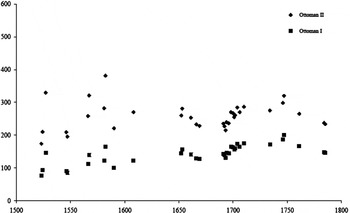
Ottoman budgets present central revenues and expenditures in current akçes. In order to facilitate intertemporal and intercountry comparisons, we converted all monetary magnitudes to tons or grams of silver by multiplying the revenues in current akçes by its silver content.Footnote 31 In Figures 1, 2, and 3, we present two revenue series. The first series named Ottoman I refers to the cash receipts of the central administration in Istanbul, or the central treasury. The second series named Ottoman II includes, in addition to the cash receipts, the receipts of the central administration through the timar system in the form of cavalrymen and other auxiliary troop contributions in the military campaigns. Because a significant part of Ottoman military forces were supplied by the provinces until the nineteenth century, Ottoman II series provides a more realistic, yet imprecise measure of Ottoman military capability. It has been estimated that the cash equivalent of the tax revenues collected by the cavalrymen exceeded by far the cash receipts of the central treasury during the sixteenth century.Footnote 32After the timar system began to be replaced by the central administration in the seventeenth century in favor of a larger central army permanently stationed in the capital and other urban areas, its contribution began to decline. For this later period, we included in the Ottoman II series some allowance for the soldiers the provincial notables provided to the army. We estimate the share of these and other indirect contributions declined to less than 30 percent of total revenues of the central administration by the end of the eighteenth century.Footnote 33We will not use Series II in comparisons with European countries, but present it nonetheless to show that our results do not change much by the inclusion of these indirect revenues.
REVENUES OF THE OTTOMAN CENTRAL ADMINISTRATION (in tons of silver)

REVENUES PER CAPITA OF THE OTTOMAN CENTRAL ADMINISTRATION (in grams of silver)

TAX REVENUES PER CAPITA/DAILY WAGE OF UNSKILLED WORKERS

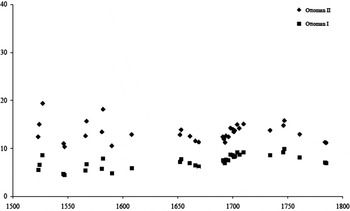
In Figure 2, we present the per capita tax revenues of the Ottoman central administration obtained by dividing the total revenues in tons of silver by the population of the empire. For the purposes of this exercise, we have decided to exclude all the autonomous or semiautonomous territories such as Crimea, Hungary, Wallachia, and Moldavia (present-day Romania), the Maghreb, that is, present day Libya, Tunis, and Algeria, and those regions of the Arabian Peninsula at least nominally controlled by the Ottoman government. For the most part, these territories did not send any tax revenues to the central treasury. This leaves us with the present-day Balkans, present-day Turkey, greater Syria, and present-day Iraq and Egypt. Since total population of these latter areas fluctuated narrowly between 19 and 22 million from 1550 to 1800, long-term trends in per capita revenues of the central administration are very similar to those presented in tons of silver.Footnote 34
Figures 1 and 2 indicate that the cash receipts of the Ottoman central administration, expressed in both tons of silver and also per capita terms and whether adjusted for silver inflation or not, increased until the third quarter of the sixteenth century.Footnote 35In many respects, the latter period represents the peak of Ottoman fiscal power and centralization in the early modern era. The revenues of the central administration tended to decline from the fourth quarter of the sixteenth century until the end of the seventeenth century despite the attempts to collect a higher share of its tax revenues in cash and directly at the center, as a large part of the revenues began to be retained by various intermediaries. In response to both the growing fiscal pressures and military defeats, the Ottoman government undertook major fiscal reforms at the end of the seventeenth century and these efforts succeeded in raising revenues significantly during the first half of the eighteenth century. Revenues of the central administration declined once again during the second half of the eighteenth century, certainly until the 1780s for which we have evidence from the budget documents. Perhaps more important than these medium-term trends, however, was the absence of a long-term upward trend in both per capita and total revenues during the early modern centuries as a whole. Figures 1 and 2 make clear that per capita and total Ottoman revenues during the eighteenth century were not any higher than those in the sixteenth century. As we will emphasize in the next section, while Ottoman per capita and total revenues may have been comparable to those in other parts of Europe during the sixteenth century, both the per capita and total revenues of the Ottoman central administration appeared low in comparison to many others across Europe by the second half of the eighteenth century.
Another indicator that would enable us to gain further insights into the revenue collection capacity of the central government would have been to compare per capita revenues with some indicator of incomes, preferably average incomes. Unfortunately, our estimates of per capita incomes or per capita GDP in the early modern era are available only for a few benchmark years and even those are subject to some not insignificant margin of error. These admittedly crude estimates suggest that in the core areas of the empire, direct cash receipts of the Ottoman government, that is, the series Ottoman I in Figures 1 and 2, probably remained below 4 percent of GDP during the early modern era. We similarly estimate that total revenues of the central administration including the monetary values of cavalry holders’ service, that is the series Ottoman II in Figures 1 and 2 probably remained below 6 percent of GDP during the these centuries. Equally important, these ratios were lower in the second half of the eighteenth century in comparison to the second half of the sixteenth century.Footnote 36
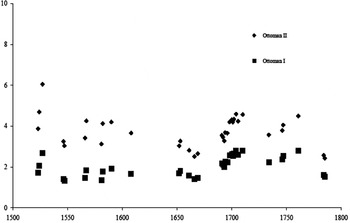
In contrast to estimates of GDP, data for the daily wages of construction workers in the urban centers, especially in the leading urban centers, are much more abundant and much more reliable both for the Ottoman Empire and other European countries. For this reason, we chose to follow the recent lead of other economic historians of the early modern era and calculated the annual per capita tax revenues of the central administration as a multiple of the daily wages of unskilled construction workers in the capital city. Daily wages in Istanbul were quite comparable to those in other urban centers such as Edirne, Bursa, Belgrade, Salonika, Jerusalem, and others until the nineteenth century.Footnote 37The series presented in Figure 3 indicate that the basic trend in the tax revenues of the Ottoman central administration during the early modern era was also horizontal. Equally importantly, they show very clearly that the Ottoman government's capacity to collect taxes remained strikingly low. Annual per capita cash revenues of the central administration did not exceed three days of wages of an unskilled construction worker in Istanbul and remained below two days of wages for most of this period. Even when we include indirect revenues such as the contributions of timar and other soldiers in military campaigns, per capita revenues of the central administration rarely exceeded four days of wages in any given year.
It is not easy to estimate the total tax burden and the shares of various intermediaries in the Ottoman fiscal system. The basic difficulty is that the comprehensive records for the provinces are not available, and it is not clear whether all exactions were recorded in a standard fashion in the first place. The few available estimates and accounts of taxation in individual regions suggest that the tax burden increased after the sixteenth century, but the amount retained by the rising provincial elites also rose, resulting in the observed pattern of stagnant revenues for the center. It has been estimated that the share of Ottoman central treasury's revenue in the total burden on taxpayers declined from 46 percent in 1527/28 to 25 percent in 1661/62.Footnote 38 The decline in central treasury's share might have been more dramatic than these figures suggest, because the seventeenth century also witnessed an increase in illegal and thus unrecorded exactions by provincial notables. Estimates by Mehmet Genç for the eighteenth century suggest that approximately two-thirds of the net tax revenues, that is, of gross tax collections minus expenses, went to the tax farmers, financiers, and high-level bureaucrats who divided up the large tax farms amongst themselves in the capital city. Only one-third of the net receipts ended in the central treasury.Footnote 39 It is thus clear that the inability to keep a tight rein on the amounts retained by these intermediaries limited the effectiveness of Ottoman fiscal reforms during the seventeenth and eighteenth centuries.
COMPARISONS WITH OTHER EUROPEAN STATES IN THE EARLY MODERN ERA
This section compares the revenues of the Ottoman central administration in the early modern era with those of the leading European states, England, France, the Dutch Republic, Spain, Venice, Austria, Prussia, Poland, and Russia. For each polity, the series for the net receipts of the central treasury was converted to tons of silver by multiplying it with the silver content of the unit of account. It should be emphasized again that we are focusing in this study on the process of fiscal centralization and the tax receipts that reached the central treasury. Tax receipts that remained in the hands of local groups or bodies varied a good deal across Europe including the Ottoman Empire. Some of these revenues were spent by local bodies for civilian and military purposes, but they remain outside the purpose and focus of the present study. We have taken great care to apply similar definitions of revenue to all the states, but the limitations imposed by the variations in accounting procedures and fiscal structures should be kept in mind.
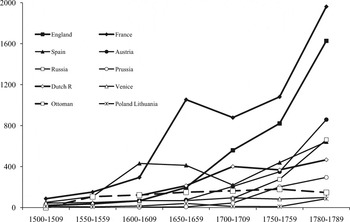
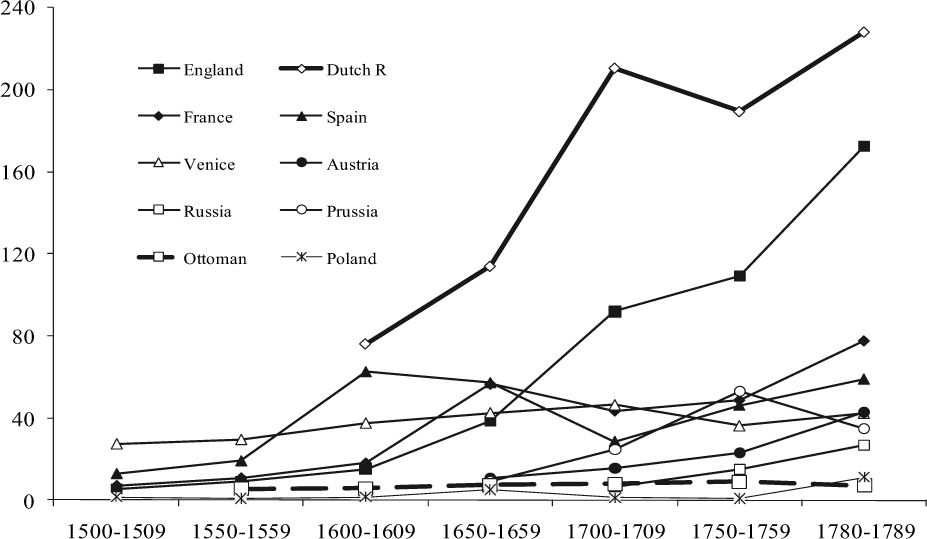
Figures 4 and 5 present total revenues of the leading European states, including the Ottoman Empire, during the early modern era. A number of interesting patterns emerge from these figures. The revenue of the Ottoman central administration was comparable to those of large European states during the sixteenth century. In fact, Ottoman revenue was greater than all European states except France and Spain. This pattern is consistent with Ottoman military power vis á vis the leading European states as the Ottomans did quite well militarily during the sixteenth century. Per capita tax revenues of the Ottoman central administration were comparable with those of larger European states, but was below those of city states such as Venice and Holland in the sixteenth century.
ANNUAL REVENUES OF EUROPEAN STATES (10-year averages in tons of silver)

ANNUAL REVENUES PER CAPITA (10-year averages in grams of silver)
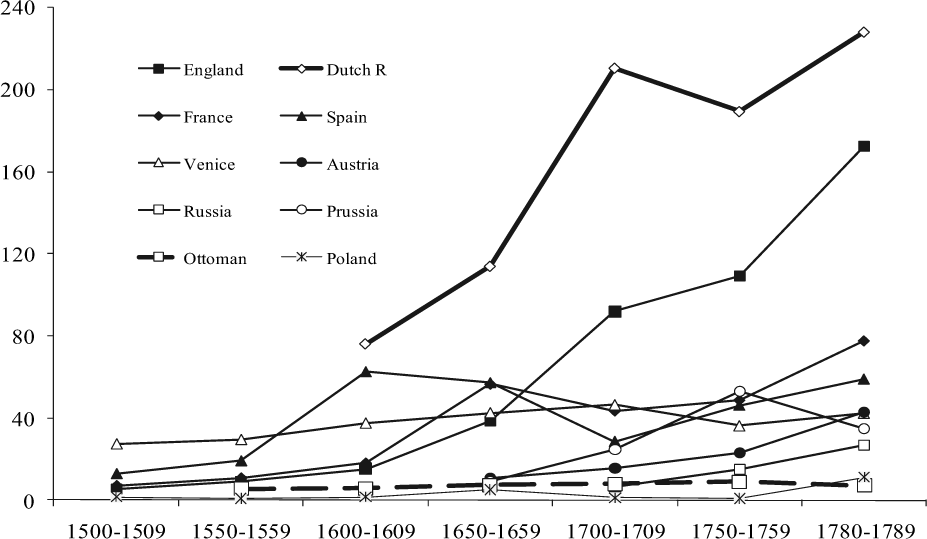
Figures 4 and 5 make clear that revenues of most European states increased sharply during the seventeenth and especially the eighteenth centuries. Most striking in this respect were England and Holland, but others including Austria and Russia also experienced significant increases in tax revenues. At a time when the Ottoman central administration was struggling with the adverse effects of political and fiscal decentralization, these large increases in revenues across Europe led to the emergence of large differences in state revenues between the Ottomans and most European states. These differences reached their peak, in most cases, during the second half of the eighteenth century when the revenues not only of the more successful and more powerful states in Western Europe, but also those in Central and Eastern Europe such as Austrian monarchy and Russia with which the Ottomans engaged militarily increased sharply.
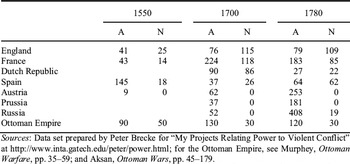
As Table 1 makes clear, while the sizes of armies were rising across Europe especially during the eighteenth century, the Ottomans remained mostly outside this trend. This long-term shift in the fiscal and military balance of power is consistent with what happened in the battlefield. After a long period of territorial expansion into Europe, the Ottomans began to be matched by the Habsburgs by the end of the sixteenth century. Nonetheless, they were able to make another major attempt at Vienna towards the end of the seventeenth century only to be defeated by a large coalition of Central and Eastern European states. Thanks in large part due to the fiscal reforms that show very clearly in our revenue series, the Ottomans were then able to hold their own militarily against Austria, Venice, and Russia during the first half of the eighteenth century. As the fiscal gap widened further during the second half of the eighteenth century, however, Ottoman military performance began to falter. They were defeated in most of the wars that took place in the late eighteenth and early nineteenth centuries against Austria and Russia. The literature on military history recognizes the fiscal constraints but emphasizes more the gaps in military organization and technology between the two sides and the lack of discipline amongst the Ottoman soldiers to explain the Ottoman defeats. We would argue that the low fiscal capacity of the Ottoman central administration especially during the eighteenth century should be seen as a major cause of the differences military technology as well as the absence of discipline amongst the janissaries as the latter were often poorly equipped and rarely paid in full or on time.Footnote 40
SIZES OF ARMIES AND NAVIES OF DIFFERENT COUNTRIES, 1550–1780

Sources:
Data set prepared by Peter Brecke for “My Projects Relating Power to Violent Conflict” at http://www.inta.gatech.edu/peter/power.html; for the Ottoman Empire, see Murphey, Ottoman Warfare, pp. 35–59; and Aksan, Ottoman Wars, pp. 45–179.
WHY DID OTTOMAN CENTRAL REVENUES LAG IN THE EARLY MODERN ERA?
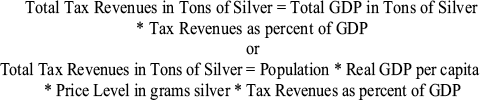
As equations 1A and 1B suggest, the emerging differences in tax revenues measured in tons of silver between the Ottoman Empire and other European states during the early modern era can be analyzed under four headings. One important cause was the significant differences in population trends. The population of the Ottoman Empire changed very little from the middle of the sixteenth century until the end of the eighteenth century. This is the case even if we exclude those areas that seceded from the Ottoman Empire and limit our intertemporal comparisons to areas within the same borders. In contrast, population in most European countries that are included in our comparisons increased sharply during the early modern centuries, doubling or more than doubling in many cases.Footnote 41
Another cause for the emerging differences in total revenues in tons of silver was the changing price levels in terms of silver. In the late fifteenth and early sixteenth centuries, before the impact of the price revolution began to be felt in Europe and the Near East, price levels in southern Europe and the Ottoman Empire were higher than those in the rest of Europe. During the next three centuries, however, price levels in northwestern and more generally Western Europe, measured in silver terms, increased much more as rising incomes and wages pulled up the prices of services and other nontradable goods. As a result, price levels measured in silver terms in northwestern Europe were twice as high as those in the Ottoman Empire and in Italy by the second half of the eighteenth century.Footnote 42With a higher price level in silver terms, states tended to collect more taxes measured in tons of silver. However, even though there was a common market for mercenaries in Europe, it is reasonable to assume it cost more in northwestern and more generally in Western Europe to buy the same basket of military goods including soldiers and equipment. In other words, this component of the growing difference in tax revenues did not necessarily translate into differences in military power.
Equation 1B suggests another potential cause of the growing differences in revenues was the differences in GDP per capita. Per capita GDP and incomes were rising rapidly in England and the Dutch Republic during the seventeenth and eighteenth centuries. By the second half of the eighteenth century, per capita GDP and incomes in these countries were approximately double those in the Ottoman Empire. In contrast, however, per capita GDP in the rest of the continent did not show any strong trend during the early modern era, rising to some extent in Western Europe but probably declining in southern Europe, especially in Italy. As a result, differences in terms of GDP per capita between the latter countries and the Ottoman Empire remained relatively limited until the nineteenth century.Footnote 43
The first three causes of the emerging differences in tax revenues cited above, population, the price level, and real GDP per capita are all, by definition, components of nominal GDP. In other words, one basic reason for the emerging differences in total revenues between the Ottomans, on the one hand, and most of the continental European countries, on the other, was the growing differences in nominal GDP. Of these three components, changes in population and the price level contributed more to the growing differences in total tax revenues than did the changes in the level of GDP per capita, except for England and the Dutch Republic, where increases in the GDP per capita were also significant.
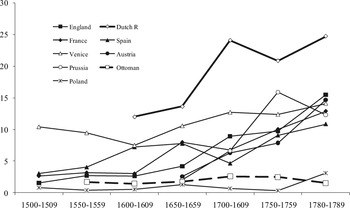
The final cause of the emerging differences in revenues was the rapidly growing differences in tax revenues of the central administrations as a percent of GDP or total income. Our calculations, again subject to some degree of error due to the shortcomings of the existing GDP per capita estimates for the early modern era, suggest that share of tax revenues of the central administration as a percent of GDP or total incomes rose in most of the European countries from less than 5 percent in the sixteenth century to a range between 5 and 10 percent and in a small number of cases that include Britain and the Netherlands to more than 10 percent by the 1780s.Footnote 44A more reliable way to measure the differences in the capacity of states to collect tax revenues or the tax burden of the population would be to compare the per capita tax revenues of the states with the daily wages of unskilled workers. Figure 3 above suggested that the ratio of per capita tax revenues of the Ottoman central administration to daily wages of unskilled construction workers remained low during the early modern centuries. In sharp contrast, Figure 6 makes clear the same ratio rose significantly in most European countries during the early modern era. Figure 6 indicates further that the differences between the Ottoman Empire and most other European states in this respect widened substantially during the eighteenth century.
ANNUAL REVENUE PER CAPITA/DAILY URBAN WAGE (10-year averages)

Increases in the revenue over GDP ratios and in the revenues per capita over the daily wage ratios in many European countries despite the limited increases in per capita real GDPs during the early modern era suggest that the increases in the fiscal capabilities of centralized administrations preceded the rapid economic growth of the nineteenth century. One determinant of an administration's fiscal capacity was the size of money stock and degree of monetization.Footnote 45Monetization was a necessary condition for centralizing finances, because it allowed transferring revenues to the political center, paying a standing central army or mercenaries in cash, investing in military technologies and training, and if necessary, redistributing the funds around the country. Had it not been for a thirty-threefold increase in the silver coinage in the Old World between 1500 and 1800, centralization of European fiscal systems might not have occurred.Footnote 46 Within Europe, however, there was a lag in increases in per capita money stock as one moved from west to east. In the Ottoman case, the trajectory of monetary system mimics that of the administration's political fortunes. Ottoman money stock is estimated at 1000–1500 tons of silver at the end of fifteenth century.Footnote 47France's money stock at the same period was around 700 tons, implying a roughly similar per capita money stock.Footnote 48Money economy spread in the Ottoman countryside in the sixteenth century, but the trend was reversed in the seventeenth century. It is conjectured that due to trade deficit with the east, Ottoman economy did not accumulate American silver, the administration found it difficult to locate silver supplies, and the number of mints decreased from more than forty in the sixteenth century to a few in the seventeenth century. The Ottoman administration also contrasted with most European states by not adopting mercantilism, though it is difficult to ascertain the policy's exact impact on the monetary breakdown. It is reasonable to assume, however, that the breakdown of monetary system hampered Ottoman administration's attempt to monetize tax collection through tax farming.
Moreover, a significant part of the rise in the central revenues over GDP ratios was due to centralization of taxes rather than increases in the tax burden per se. As a case in point, the eighteenth-century increase in English revenue over GDP ratio occurred simultaneously with consolidation of around 90 percent of the gross tax revenue at the central treasury. Consolidation was achieved by the reforms after 1660, including unification of tax administration under the Treasury Board, abolition of tax farming, and centralization of upkeep of armed forces.Footnote 49 In ancien régime France, in contrast, it is estimated that only 40 percent of the gross tax collection made it to the central treasury.Footnote 50
If it is indeed the centralization of fiscal administration that drove the gains in revenues, comparing the figures across polities should help identify underlying determinants. A visible pattern is that small, densely populated and urbanized polities, such as England, Venice, and the Dutch Republic, had higher per capita revenues than large territorial states such as the Ottomans. As distances from the capital cities increased, the logistics of transferring the tax extraction to the center and back became more difficult, and a larger share of the gross tax revenue was spent without entering the central coffers and budgets. In fact, in larger polities, the great share of the revenues were extracted from core provinces, such as Castile in Spain, pays d’Election in France, and Anatolia and Balkans in the Ottomans, and outer regions contributed smaller amounts sporadically. A survey of the polities also suggests territorial empires tended to have larger agrarian sectors, which were harder to monitor and hence necessitated elaborate tax apparatuses with multiple layers of intermediation that resulted in lower net revenues to the center.
Another major determinant of the fiscal capacity of the states was politics and the institutional framework that governed the relationship between the central administrations and tax intermediaries. All across Europe, tax collection depended on politics, on the bargains reached between the central governments and various social groups, and the institutions that emerged during that process. It has been argued that parliamentary or representative regimes were able to apply taxes to broader sections of the economy and collect more taxes because the representative bodies helped negotiate and sanction fiscal demands in return for limits on the power of the monarch, especially during periods of fiscal crises.Footnote 51However, it is not easy to identify simple patterns that characterized the relations between the central administrations and the provincial elites during the early modern era.
The historiography of the seventeenth and eighteenth centuries has argued that the challenges Ottoman central administration faced on fiscal and military fronts were related to the absence of monopolization and centralization of military forces.Footnote 52Instead, along with their growing role in tax farming contracts and allocation of extraordinary avariz taxes, major ayan families in different parts of the empire formed their own retinues with firearms. These forces played an essential role in enforcing tax collection at the local level and also provided leverage for the ayan when they bargained with the central administration over tax contracts and for privileges in exchange for joining the army during periods of war and suppressing local banditry. As the ayan families remained financially dependent on their role in the tax apparatus, the central administration was careful to foster rival families in each region competing for contracts and assignments. Hence the histories of individual ayan families point to episodes of rewards and promotion alternating with confiscation of estates and executions justified as punishments for war profiteering and failure to fulfill obligations.Footnote 53 The Ottoman pattern of control over provincial violence through negotiated, selective, and short-term co-optation of an evolving array semiautonomous military formations and contractors contrasts with the European pattern particularly from mid-seventeenth century on. Following continent-wide depredations in the first half of that century, military contractors and entrepreneurs who had previously recruited troops began to be phased out and small-scale warfare on a local or regional level was replaced by large-scale international wars across Europe.Footnote 54 This contrast suggests the set of technological and organization challenges on the path from the elite infantry and prebendal cavalry to mass conscription might have played a major role in delaying Ottoman fiscal centralization.
The Ottoman administration and provincial notables often cooperated in tax collection and military service during the seventeenth and eighteenth centuries, but without a long-term, credible, and stable political deal with well-defined obligations and privileges. Such a deal called Sened-i Ittifak (Document of Alliance) was signed only in 1808 during a severe political crisis that threatened the survival of the empire, but it did not remain in effect for long as the many sides chose not to honor it. In the absence of such a deal, the central administration had severe difficulties in ensuring a steady supply of tax revenues and this problem turned into a severe crisis during the period of wars and internal rebellions, and nationalist uprisings that lasted from the 1760s to the 1830s. While fiscally successful European states were able to deal better with the large fiscal shocks created by the wars by managing their public debt and avoiding debasements, the series of wars, internal rebellions and nationalist uprisings created very serious problems for the Ottoman central administration. It was forced not only to resort to frequent debasements during these difficult decades but also employ practices such as extraordinary taxes, fiscally motivated local monopolies on domestic and external trade, and expropriations of the wealth of former state officials. Perhaps even more important, was the decline in internal security as well as external security. All of these led to a macroeconomic and institutional environment that was highly unfavorable for long-term economic development.Footnote 55
MODERN ERA REFORMS, FISCAL CENTRALIZATION, AND EVIDENCE FROM OTTOMAN BUDGETS, 1800–1914
As military defeats and territorial losses escalated, the Ottoman central administration struggled to implement a series of centralizing reforms in the military, administrative, and fiscal areas. Not surprisingly, these efforts began during the reign of Selim III (1789–1808), when the revenues of the central administration in tons of silver and in inflation adjusted terms reached their low point but progress was limited especially due to the opposition of the janissaries. His successor, Mahmud II (1808–1839), continued with the reforms especially after he defeated the janissaries in 1826 and revoked the remaining timars in 1831. The reign of Mahmud II was a particularly difficult period for the central administration. While it was able to suppress the various uprisings of notables in both the Balkans and Anatolia, the Serbian and Greek revolutions led to the secession of these territories from the empire. Much more costly to the state finances than any of these was a series of wars against Russia, Iran, and Egypt. As the size of the new army (Nizam-i Cedid) rose from a mere 2,000 around the turn of the century to 120,000 in the late 1830s, pressures on state finances increased.Footnote 56 About half of the budget expenditures were allocated for military spending from the late eighteenth until the 1840s; this share was considerably higher during periods of war.Footnote 57 The first modern Ottoman census and cadastral survey in 1831 closely followed the foundation of the new army and was motivated by the need to raise manpower and money for the new army.
As the reform movement began to spread beyond the military arena in the 1820s, to administration, justice, and education, demands for resources increased as well. From the 1760s Ottoman state finances began to experience large budget deficits which reached their peak during the wars of the 1820s and 1830s. In response, the state attempted to eliminate the intermediaries or at least sharply reduce their power and control of resources both in the capital and the provinces, made use of various forms of internal borrowing, and when short-term fiscal pressures mounted especially during periods of war, resorted to debasements. The highest rates of debasement and inflation in Ottoman history took place during the reign of the centralizing and reformist sultan, Mahmud II. The silver content of the Ottoman kurush or piaster declined by more than 80 percent from 1808 to 1839. The exchange rate of the kurush against the British pound sterling declined from 18 in 1808 to 110 per pound in 1844. Consumer prices increased by more than fivefold during the same period.Footnote 58
A number of scholars have identified Mahmud II's reforms as an example of “defensive modernization” and have noted the parallels between them and Petrine reforms in Russia and Meiji Restoration in Japan. These comparisons point out that all of these reforms were motivated primarily by military defeats and territorial losses and hence at their heart lay the drive to acquire and mobilize the means of war for survival and defense against aggression from outside.Footnote 59
In the longer term, the reforms helped the central government. Especially after the abolition of the janissaries, it began to move against the provincial notables and their fiscal power. As part of the Tanzimat reforms of 1839, the central administration attempted to abolish the tax farming system altogether and collect agricultural taxes directly. In the absence of a strong provincial organization, however, central revenues collapsed and the tax farmers had to be brought back. Nonetheless, the central administration succeeded in wresting greater control of the tax collection process and sharply increasing its revenues. The deal signed between the center and the provincial elites in 1808 was never put into effect and the power of the latter declined steadily during the nineteenth century. The first Ottoman parliament where the provincial elites were represented was opened in 1876 but lasted little more than a year. The parliament and empire wide elections returned only after the Young Turk Revolution of 1908. During the second half of the century, when the central administration pushed to increase its revenues further, tax collectors were often met with opposition in the countryside and security forces were often called in to deal with the resistance.Footnote 60
Around mid-century, the financing of the budget deficits reached a new phase. Under the fiscal pressures created by the Crimean War, the Ottoman government began to borrow in the European financial markets in 1854. After two decades of rapid borrowing the proceeds of which were used mostly for military expenditures, the government was forced to declare a moratorium in debt payments in 1876. After a prolonged period of negotiations and in return for a 50 percent reduction on the outstanding nominal debt, the government agreed in 1881 to cede large segments of its revenue sources to the Ottoman Public Debt Administration (OPDA) to be developed for the purposes of future debt payments. The OPDA remained in place until World War I.
Ottoman budget documents do not exist from the end of the 1780s to the end of the 1830s. This is perhaps not surprising as this was a period of rapid and far-reaching institutional changes for Ottoman state finances. As part of the centralization efforts, the multi-treasuries and budgets of the earlier era were gradually dissolved for the single budget system. Revenues of the central administration rose as many of the revenue sources were incorporated in the central budgets.
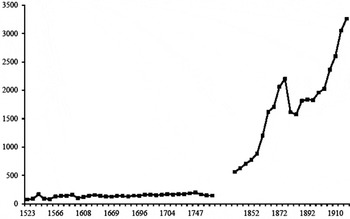
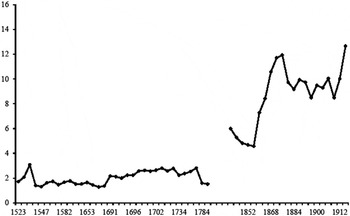
For the period from the 1840s to World War I, all of the ex-post Ottoman budgetary documents have been collected and published in a recent volume by Tevfik Güran.Footnote 61 For these Ottoman budgets too, we converted all revenues given in kurushes into tons of silver. Figure 7 presents revenues of the Ottoman central administration during the nineteenth century in tons of silver and Figure 8 presents per capita revenues as a multiple of the daily wage of unskilled construction workers in the capital city. These series show unequivocally that the centralizing reforms that began at the end of the eighteenth century and continued until World War I, led to large increases in the revenues of the central administration.Footnote 62
OTTOMAN ANNUAL REVENUES (in tons of silver)

ANNUAL REVENUES PER CAPITA/DAILY WAGES IN ISTANBUL

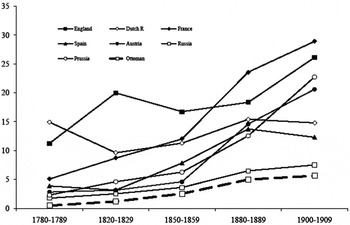
This sharp rise in revenues during the nineteenth century in many ways reflected an attempt at catching up for the Ottoman central administration. Since most European states had experienced significant increases in revenues during the early modern era, especially during the eighteenth century when the Ottoman revenues were in fact declining, the trends summarized in Figures 7 and 8 reflect the results of delayed political and fiscal centralization for the Ottomans. This rise in revenues undoubtedly helped the Ottoman government to improve its military capabilities and keep the empire together until World War I. The revenues of many European states also continued to rise during the nineteenth century, however. This was not so much or only because of continued fiscal centralization and the rise in the revenues/GDP or revenues per capita/daily wages ratios, but also because of the onset of rapid economic growth and increases in GDP per capita as well as in population and total GDP. Countries in Western Europe such as Great Britain and the Netherlands who had experienced the greatest degree of fiscal centralization before the nineteenth century witnessed a decline in the revenues/GDP or revenues per capita/daily wages ratios but their per capita revenues continued to rise thanks to rapid economic growth. On the other hand, countries with lower levels of fiscal centralization before the nineteenth century, not only France, Spain, and Portugal but also Austria, Russia, and Italy experienced large increases in per capita revenues due to continued fiscal centralization and even more due to economic growth.Footnote 63 As a result, even though it experienced significant fiscal centralization, the fiscal and military capacities of the Ottoman government continued to lag behind most European states until World War I (see Figure 9).Footnote 64
ANNUAL REVENUE PER CAPITA (in grams of gold)

CONCLUSION
The evolution of Ottoman tax collection institutions during the early modern centuries illustrates, on the one hand, the willingness and capacity of the Ottomans to reorganize in response to the emergencies created by wars and other fiscal pressures. The pragmatism and flexibility exhibited during this process also provides important clues for understanding the longevity of the empire as well as the key position of the central bureaucracy until the end. On the other hand, however, despite all efforts of the Ottoman central administration, not only its revenues remained low in absolute terms but the gap between the Ottomans and most European states increased dramatically during the early modern era, especially during the eighteenth century, as revealed by our study.
Undoubtedly, a significant part of these large differences in tax revenues were due to higher rates of population growth, monetization, and urbanization in other parts of Europe, especially in Western Europe, which made it easier for the central administrations to collect taxes. In fact, it can be argued that it is not appropriate to compare the per capita tax revenues of central administrations in highly urbanized, monetized, and geographically compact polities in Western Europe with those of the Ottoman Empire, which was much more rural and covered a much larger and diverse geography. However, these basic and important causes can not account for all of the large differences in per capita tax revenues of central administrations. The differences were also due to the fact that a large part of the tax collections in the Ottoman Empire were retained by the various intermediaries and never reached the central treasury. Even though the central administration and provincial notables often cooperated in tax collection and military service, a long-term, credible, and stable political deal with well-defined obligations and privileges was not put into effect until the nineteenth century.
The growing fiscal and military disparities against the European states to the west and north placed enormous pressures on the Ottoman state, its finances, and the economy. The fiscal difficulties of the central administration forced it not only to resort to frequent debasements, but also employ practices such as extraordinary taxes and expropriations of the wealth of former state officials. Perhaps even more important, was the decline in internal security as well as external security due to the fiscal difficulties of the government. All of these led to an institutional environment that became distinctly less for long-term economic development for large parts of the seventeenth and eighteenth centuries. We believe that the recent historiography of the Ottoman Empire in the early modern era has not paid sufficient attention to these fiscal issues. The grand alliance between the central government and the ayan in the provinces has been hailed as the key to the unity of the empire, but the fiscal, military, and economic consequences of the surrender of large revenues to the intermediaries have not been fully understood or appreciated.
During the nineteenth century, with the support of new military and transportation technologies, the Ottoman state embarked on a large centralization drive that succeeded in sharply raising its revenues. This was achieved not so much by reaching a deal with the notables in the provinces, but by reducing their share of the tax revenues with the help of the military and other technologies of the nineteenth century. Higher revenues enabled the Ottomans to improve their military performance, but state finances remained the Achilles’ heel of the Ottoman state until World War I.
Examining Ottoman state finances in the early modern era within a European framework has provided important insights not only into the Ottoman case, but also the emergence of centralized states across Europe. Study of the Ottoman case confirms that the rise of more centralized and bigger states intensified the interstate rivalry and put additional pressure on all states across Europe. Not all were able to respond, at least not quickly, however, as revealed by the military defeats the Ottomans endured especially between the 1760s and the 1830s. On the other hand, the Ottomans’ ability to undertake the centralizing reforms and raise their revenues during the nineteenth century should also remind us that other countries in Europe, Austria, Prussia, Russia, and others were able to respond to these pressures, but often with a lag. In other words, while fiscal centralization began in Western Europe during the sixteenth and seventeenth centuries, the response to it elsewhere in the continent did not arrive until the eighteenth or nineteenth centuries.