Striving for Universal Health Coverage Amid Diminishing Donor Funds
Located on the Gulf of Guinea in West Africa, Ghana is a lower-middle income country with a population of about 30 million people. GDP per capita (PPP) is $4,604 with 5.9 percent GDP spent on health (2015 (1)). Ghana was one of the few African countries to enact legislation and earmark significant funding to establish Universal Health Coverage (UHC) (Reference Saleh2;Reference Schieber, Cashin, Saleh and Lavado3). Under the direction of the Ministry of Health (MoH), the health system was re-orientated from one underpinned by a model funded by general tax revenue to a social insurance-based system when they established the National Health Insurance Scheme (NHIS) in 2003 (administered by the National Health Insurance Authority, NHIA) (Reference Wang, Otoo and Dsane-Selby4).
The NHIS comprises a vast network of 165 district offices, 3,000 branch staff, 11.2 million members, and around 4,000 health care providers (Reference Wang, Otoo and Dsane-Selby4). The NHIS offers a comprehensive healthcare package to all registered residents of Ghana and covers inpatient and outpatient care, medicines, and diagnostics (Reference Wang, Otoo and Dsane-Selby4). These services were available to 40 percent of the population in 2014 but has stayed relatively flat since that time. About two in three members are under 18 years of age (45.4 percent) and in the informal workforce (29.8 percent). The NHIS is mainly funded from four sources: (i) the National Health Insurance Levy which is a 2.5 percent levy on goods and services subject to value added tax (VAT); (ii) Social Security and National Insurance Trust contributions (2.5 percent per month) by formal workforce employees and the self-employed; (iii) return on National Health Insurance Fund investments; and (iv) premiums paid by informal workforce subscribers (5). Notably, the government allocation complements the funding of the scheme.
Ghana has increased locally-committed public funds for health as external donor funds have fallen steeply in recent years—from US$ 360.48 million in 2005 to US$ 178.93 million in 2010—following the country's attainment of middle-income status (5). According to National Health Accounts of 2015 (published July 2017), 25 percent of total health expenditure was provided by external (development partner) funding sources (6). The sustainability of funding the NHIS is vital, particularly in light of the goal of achieving UHC. The NHIS has been regularly in deficit despite government efforts to curb expenditure through rationalizing spending decisions (5). This could be due to a misalignment between the financing structure of the scheme and the scope of the benefit package offered, leading to increased expenditure over time. Almost half (46 percent) of claims are spent on medicines, possibly reflecting inappropriate prescribing, polypharmacy, and an inefficient supply chain. The two highest expenditure medicine classes in NHIS medicines claims expenditure are antibiotics and antihypertensives (~60 percent) (Reference Merriman, Wilkerson, Heath, Kelly and Eghan7).
Given this disproportionate level of spending on medicines, health technology assessment (HTA) could have an important role in supporting resource allocation decisions in the face of highly constrained budgets, as commonly found in LMIC settings (Reference Chalkidou, Glassman and Marten8). HTA is a multi-disciplinary policy research process which uses explicit methods to assess the value of a health technology throughout its lifecycle. Indeed, the Ghanaian Ministry of Health (MoH) has recently strengthened HTA-based decision making focusing on a priority disease, namely hypertension (Reference Chalkidou, Lord and Gad9). This paper aims to provide a perspective on the ongoing implementation of HTA in Ghana, with a focus on the policy and procedural implications of Ghana's first HTA pilot study comparing medicines to treat hypertension.
Not Just a Technical Exercise: Emphasizing People and Relationships
HTA is a decision-making tool that is widely used internationally to inform resource allocation decisions and increase the value of discretionary healthcare expenditures (Reference Chalkidou and Culyer10;Reference Wilkinson, Sculpher and Claxton11). In the Ghanaian context, HTA is seen as a means of enhancing the value of domestic resources deployed for health, and an important component for achieving UHC (Reference Chalkidou, Lord and Gad9). Nevertheless, there are important technical and non-technical challenges that need to be overcome for HTA to be used at scale in any decision-making. Although there have been several attempts to introduce HTA in sub-Saharan Africa, HTA institutionalization—involving a sustainable mechanism for incorporating evidence into policy emphasizing the establishment of clear methods and procedures—has not yet been fully established in the region (Reference Doherty, Wilkinson, Edoka and Hofman12).
Although acknowledging that there is a critical level of domestic expertise and data availability (Reference Downey, Rao and Guiness13) required for any credible HTA process and that these barriers may be particularly challenging in the LMIC context (Reference MacQuilkan, Baker and Downey14), difficult decisions still need to be made regardless of the suitability and comprehensiveness of the underlying evidence base. HTA can be used to support decision making if conducted in a way that is regarded as both politically, socially, and ethically legitimate. It therefore requires three components: identifying key actors and stakeholders that need to be involved; clearly articulating the procedural rules and methods that define the framework for the conduct of HTA; and describing the responsibilities of participating organizations in implementing HTA evidence into policy. This is HTA institutionalization and, in brief, highlights the importance of well-defined processes, effective relationships among those involved in delivering HTA assessments and appraising evidence, and using such evidence to enact policy and behavior change (Reference Li, Ruiz, Culyer, Chalkidou and Hofman15).
The MoH, supported by the International Decision Support Initiative (iDSI), initiated a HTA study in 2016 to examine the cost-effectiveness of medicines to treat hypertension (Reference Chalkidou, Lord and Gad9). The group adapted a model originally used to develop a UK guideline with the UK team leading the technical capacity building. An important feature of the engagement was the pivotal role of the Technical Working Group. The membership included key Ghanaian stakeholders: policy makers from the MoH, NHIA; academics; clinicians; and representatives of non-government organizations (Reference Chalkidou, Lord and Gad9). The group identified the topic, formulated the pertinent policy questions, and provided guidance throughout to support the partnership between government and academia. These strong and mutually respectful relationships were the key ingredients in creating demand for the HTA work and developing future technical capacity (Reference Lopert16).
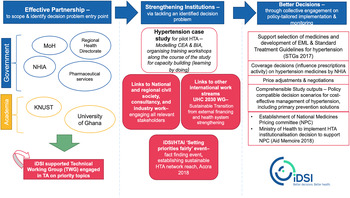
The broad approach to strengthening HTA in Ghana through this pilot follows the iDSI's Theory of Change framework (Figure 1) (Reference Lloyd, Gleed and Wallach17), which highlights the important role of partnerships in the institutionalization process. The framework outlines how iDSI can work collaboratively with partners to achieve better decisions to improve health outcomes. The framework includes details on a range of activities relevant to building locally legitimate relationships for priority setting. These include: establishing links and partnerships with country institutions; increasing political buy-in and building capacity for evidence informed priority setting; and strengthening institutions by working collaboratively across a number of stakeholders to target key policy issues by adopting “a learning by doing approach” (Figure 1) (Reference Lloyd, Gleed and Wallach17).
iDSI's Theory of Change—schematic for HTA positioning approach in Ghana and sub-Saharan Africa.

Undertaking HTA to Identify Data and Skills Gaps—and Build Future Technical Capacity for HTA
The cooperation among the Ghanaian stakeholders was crucial given the challenges on all aspects of HTA capacity in Ghana. The Ghana HTA work revealed systemic issues affecting the whole Ghanaian healthcare ecosystem, as well as technical issues relating to data gaps such as incidence of disease or costs of disease conditions. Such understanding can drive policy-relevant research and identify health system-strengthening activities, such as improvement in collecting and using routine health system data (Reference Downey, Rao and Guiness13), to support HTA-informed decision making. The role of domestic academic and research partners in HTA institutionalization is particularly important.
Academics and researchers can provide valuable contributions in three main areas: capacity building; research; and knowledge sharing. First, academics can build capacity by training future health services research proponents to lead HTA projects and manage the process. This can occur via medium-term training such as graduate curricula (e.g., Master of Economics, Master of Public Health (18)) and research students (MPhil and PhD). Academic staff can facilitate short-course training in HTA for selected audiences (e.g., MoH, private sector, NGOs, policy makers) to improve the understanding and the interpretation of HTA results (including epidemiology and systematic reviews). These courses could be conducted as online webinars, live virtual sessions, and through other emerging uses of communications technology and platforms (e.g., Cochrane Collaboration) to reduce the resource burden associated with live, in-person training.
Second, the academic sector can serve as the key community to generate (and critique) HTA evidence for policy making. They bring the academic rigor and independence to facilitate confidence in the technical products. Effective collaboration with government is necessary to identify and prioritize interventions (Reference Liu, Shi and Pong19). Researchers can help to source grants and funds (in collaboration with MoH and external partners) to undertake policy-relevant research (e.g., generating population tariffs to support the use of generic preference-based quality of life instruments). Finally, academics can broker ways of sharing knowledge via credible peer-reviewed publications (alongside accessible reports in the ‘gray’ literature) and disseminate HTA-related work at conferences and local meetings. These activities can further strengthen collaborations across institutions and further build research capacity among partners in Ghana.
Acknowledging the common challenges and opportunities in building multi-stakeholder and multidisciplinary relationships in support of HTA, the TWG participated in the National Health Summits in 2017 and 2018 and presented the results of the pilot HTA (2017) (Reference Chalkidou, Lord and Gad9). In addition, iDSI and Health Technology Assessment International (HTAi) jointly organized a multi-stakeholder summit titled Setting Priorities Fairly: Sustainable Policies for Effective Resource Allocation in Africa (Reference Chalkidou and Gutiérrez-Ibarluzea20). The meeting, held under the auspices of the Ghanaian MoH, aimed to raise awareness of the potential of using HTA in decisions about healthcare resource allocation and to build regional and international collaborative networks for HTA capacity building in Ghana and sub-Saharan African (SSA) (Reference Chalkidou and Gutiérrez-Ibarluzea20).
Conclusion – Taking HTA Institutionalization Forward in Ghana
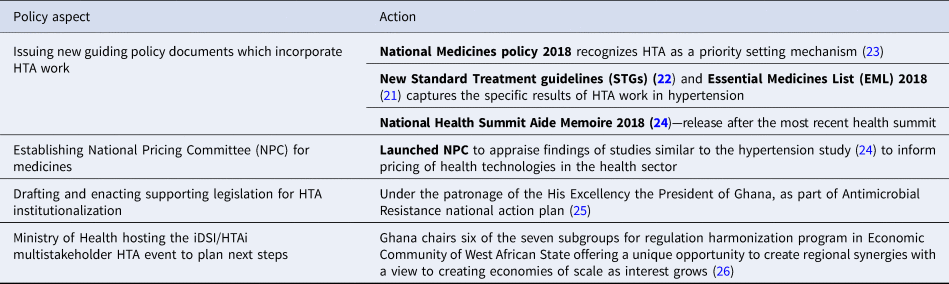
The Government of Ghana has outlined a vision to institutionalize HTA as a key mechanism to support UHC, with a focus on using HTA evidence to inform policy in the form of the essential medicines list (21), standard treatment guidelines (STG) (22) and the national medicines policy (23). The Government has committed to support health policy making through effective use of robust scientific evidence, along with a fair, transparent appraisal process, to support health system priority setting decisions. The country is adopting strategies to fully integrate HTA within existing and developing decision making mechanisms (24), has established a National Medicines Pricing Committee, and has modified the most recent STGs to consider the cost-effectiveness of antihypertensive medicines based on the HTA study (Reference Chalkidou, Lord and Gad9, 22). The Government is planning the necessary regulatory and structural reforms, initially as part of the strategy to address antimicrobial resistance, through rational use of medicines, informed by HTA. There have been recent capacity building activities (MoH staff training on HTA) and plans to develop a Ghana HTA model for diabetes. Key policy areas that required legislation had to be identified before the Medicines Policy was approved by the Cabinet in 2017; HTA was one of those key areas. Ghana is keen to legislate HTA institutionalization, and the MoH is willing to work with key stakeholders for that goal (Table 1).
Summary of Policy Impact of Ghana HTA Pilot Study

Finally, with collaborations at the national, regional, and international levels, iDSI intends to build on current achievements and plan the next steps in the region. The iDSI team is mapping the HTA national capacities (technical, data, organizational, etc.) and reviewing the published literature within the SSA region to derive a more focused and current overview of HTA capacities, updating information available in the World Health Organization (WHO) global mapping survey of HTA in 2015 (27). This is coupled with taking an inclusive view of the full range of relevant stakeholders, including the life sciences industry, civil society organizations, and others (Reference Lopert16). We are expanding our collaboration with HTAi, WHO, PATH/ADP, Strategic Purchasing Africa Resource Centre (SPARC), Clinton Health Access Initiative (CHAI), Norwegian Institute of Public Health (NIPH), and other entities subsequent to rich discussions and contributions of global experts at the HTAi Vancouver 2018 symposium and the HTAi/iDSI SETTING PRIORITIES FAIRLY event held in Accra (September 2018) (Reference Chalkidou and Gutiérrez-Ibarluzea20). These relationships are the central pillar to successfully engage and coordinate activities to support the goal of UHC in the region. The HTA work revealed systemic issues, hence the need to consider the whole ecosystem. HTA can be used as a tool to solve issues whereas guiding existing institutional structures and harnessing growing political support. Economic evaluations of health interventions are not just an ICER (incremental cost-effectiveness ratio) value; HTA can instill discipline (e.g., standard treatment guidelines and EML committee) and encourage interdisciplinary collaboration.
Acknowledgments
This work was produced as part of the International Decision Support Initiative (www.idsihealth.org), a global initiative to support countries to get the most from every dollar they spend on health. This work was funded with support from the Bill & Melinda Gates Foundation, the UK Department for International Development, and the Rockefeller Foundation.