Implications
Using concentrate-based pellets, which include up to 25% of ground barley straw, instead of giving concentrate and straw separately, is a suitable way of feeding lambs, thus allowing automatic feed delivery and reducing labour and storage costs. These systems are still liable to cause ruminal acidosis if compared with alfalfa-based diets, although none of them seem to cause serious problems to animal health on top of all of this in young fattening lambs.
Introduction
Traditional fattening systems for lambs in Mediterranean countries are based on an ad libitum supply of concentrates generally supplemented with cereal straw in separate feeding troughs (Joy et al., Reference Joy, Ripoll and Delfa2008; Rodríguez et al., Reference Rodríguez, Bodas, Prieto, Landa, Mantecón and Giráldez2008). However, concentrate pellets are being used more often nowadays in order to make feedlot feeding management easier. The traditional system, which allows the animals to maximise their growth potential, is not devoid of problems, subacute acidosis being the most common. Concentrate diets lead to subacute ruminal acidosis by increasing volatile fatty acid (VFA) production in the rumen and the proportion of propionate and lactate, thus decreasing rumen pH (Enemark et al., Reference Enemark, Jorgensen and Enemark2002; Bodas et al., Reference Bodas, Giráldez, López, Rodríguez and Mantecón2007; Enemark, Reference Enemark2008). These circumstances may entail a drop in blood pH and deplete blood base excess (Brossard et al., Reference Brossard, Martin and Michalet-Doreau2003). In this sense, if animal health is threatened by a disease (as in the case of rumen acidosis), the risk of associated disorders increases (e.g. parakeratosis-rumenitis, liver abscesses, laminitis) (Penner et al., Reference Penner, Steele, Aschenbach and McBride2011) and blood cell counts, especially leucocyte counts, and their response to stimuli (lipopolysaccharide (LPS), endotoxins) can be modified, thereby compromising the animal’s immune response (Penner et al., Reference Penner, Steele, Aschenbach and McBride2011; Ceroni et al., Reference Ceroni, Turmalaj, Lika and Duro2012).
Forage intake could be increased by including barley straw in the concentrate pellet (thus forming a total mixed ration, TMR), which could help animals to raise rumen pH to some extent without compromising animal performance. However, the effect of forage on rumen pH depends, to a great extent, on forage particle size, this being particularly small in concentrate pellet-based diets, where the barley straw is almost ground. As a result, using pelleted diets may have no positive effects on rumen physiology, the consequences for animal health being even more detrimental than those from the traditional feeding system due to a decrease in physically effective fibre contents (Zhao et al., Reference Zhao, Zhan, Xu and Yao2011). So far, the best strategy to promote optimal rumen fermentation is the use of forage-based rations, although it is known that the feed-to-gain ratio and average daily gain may be worsened as compared with concentrate-based rations (Carrasco et al., Reference Carrasco, Ripoll, Sanz, Álvarez-Rodríguez, Panea, Revilla and Joy2009b; Tufarelli et al., Reference Tufarelli, Khan and Laudadio2011). In a previous work, Blanco et al. (Reference Blanco, Bodas, Prieto, Andrés, López and Giráldez2014) showed that it is possible to fatten light lambs on a TMR pellet including ground barley straw and enhance animal performance without modifying meat characteristics compared with the traditional feeding system for these animals in Mediterranean countries, based on concentrate and long-form barley supplied separately. However, despite the improvements achieved when some of the above-mentioned strategies are applied to concentrate-fed lambs, there is a scarcity of data showing their impact on rumen physiology and health when compared with animals receiving forage-based diets (Álvarez-Rodríguez et al., Reference Álvarez-Rodríguez, Sanz, Ripoll-Bosch and Joy2010 and Reference Álvarez-Rodríguez, Monleón, Sanz, Badiola and Joy2012).
Therefore, the objective of this study was to evaluate the effect of feeding system: barley straw in long form and concentrate pellets in separate troughs (Control), ad libitum alfalfa supplemented with concentrate in separate troughs (Alfalfa) or including various levels of ground barley straw in concentrate pellets (B05, B15 and B25 for 50, 150 and 250 g barley straw/kg), on rumen characteristics and fermentation, acid-base status, blood cell counts and cytokine production in fattening lambs; feed intake, growth rate and weight of digestive tract and contents are also considered.
Material and methods
Animals and diets
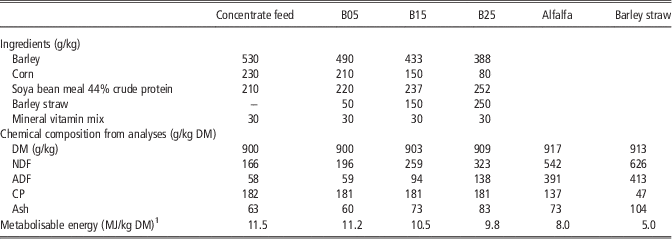
Fifty male Merino lambs (6–8-week old and mean BW 14.1±0.17 kg at the beginning of the experiment) were used in this study and managed as described elsewhere (Blanco et al., Reference Blanco, Bodas, Prieto, Andrés, López and Giráldez2014). Each lamb was housed in an sawdust bedded individual pen during the whole experimental period and, after randomisation on the basis of BW, assigned to one of five experimental diets (n=10): Control (conventional system: barley straw in long form (>25 mm) and concentrate pellet in separate feeding troughs), B05 (concentrate-based TMR pellet including 50-g ground barley straw/kg), B15 (concentrate-based TMR pellet including 150-g ground barley straw/kg), B25 (concentrate-based TMR pellet including 250-g ground barley straw/kg) and Alfalfa (restricted concentrate pellets plus ad libitum alfalfa hay). Alfalfa lambs received 17 g/kg LBW of concentrate pellet and alfalfa hay ad libitum to keep a minimum supply of long-form forage of 50% (this group was included to obtain data from animals fed on a forage-based diet). The rest of the lambs were fed the corresponding experimental diets ad libitum (TMR pellets), fresh drinking water being always available. The ingredients and chemical composition of the feeds are shown in Table 1. The amount of feed offered was adjusted daily on the basis of the previous day’s intake, allowing refusals of ca. 200 g/kg feed offered. Samples of the feeds offered and orts were collected daily and pooled in weekly composites for each animal analysed for dry matter (DM) content.
Experimental feeds: ingredients and chemical composition

DM=dry matter; CP=crude protein.
1 Calculated from feed composition tables (De Blas et al., Reference De Blas, Mateos and García-Rebollar2010).
All handling practices followed the recommendations of Directive 2010/63/EU of the European Parliament and of the Council on the Protection of Animals Used for Scientific Purposes, and all of the animals used were able to see and hear the other lambs.
Blood sampling
Blood samples from all the animals were obtained from the jugular vein early in the morning, before feeding time (0800 h) on day 15 of the experimental period (∼18 kg live weight (LW)), and again at the same time on the day each animal was slaughtered (27 kg LW). Blood was collected into 5 ml vacutainers containing lithium heparin tubes (for blood gas analyses, peripheral blood mononuclear cell (PBMC) separation and cytokine assay) and EDTA (for blood cell count analysis).
PBMC separation and cytokine assay
Blood was mixed with 30 ml of phosphate-buffered saline (PBS) and then PBMC were obtained by centrifuging the cells over Lymphoprep (Axis-Shield Diagnostics Ltd, Dundee, Scotland, UK). The PBMC recovered were washed three times in Hank’s balanced salt solution (Sigma-Aldrich, Irvine, Scotland, UK) and resuspended in complete medium constituted of RPMI 1640 (Lonza Group Ltd, Basel, Switzerland) with 10% FCS (Lonza Group Ltd) and 1% antibiotic–antimycotic solution (Santa Cruz Biotechnology, Heidelberg, Germany). PBMC were counted with an automated cell counter (BioRad Laboratories, Richmond, CA, USA) and 1×10⁶ cells/ml were added to each well of a 24-well plate. Cells were stimulated in duplicate with Concanavalin A (ConA) at 10 μg/ml, or with 25 μl of complete medium as control (PBS). Cultures were incubated at 37°C in 5% CO2 for 72 h. In addition, supernatants were collected, centrifuged and stored at −20°C until cytokine quantification.
Interferon-gamma (IFN-γ) and interleukin 4 (IL-4) productions were measured in culture supernatants by sandwich ELISAs. For IFN-γ, a commercially available kit was used (AbD Serotec) and for IL-4 an in-house ELISA using commercially available monoclonal antibodies (mAbs) raised against bovine IL-4 (mAb CC313 and CC314 mAb clones, AbD Serotec, Kidlington, UK). The IL-4 mAbs have been shown to be species cross-reactive for sheep and the ELISA protocol followed has been described in full by Hope et al. (Reference Hope, Kwong, Thom, Sopp, Mwangi, Brown, Palmer, Wattegedera, Entrican and Howard2005). The results for each animal were expressed as the optical density ratio between stimulation with ConA or PBS and with complete medium only.
Blood gases, acid-base and haematological variables
Blood samples for acid-base variables were assayed an hour after being sampled in a Stat Profile pHOx Plus blood analyser (Nova Biomedical, Waltham, MA, USA) for pH, bicarbonate (HCO3 −), CO2 pressure (pCO2), anion Gap, total CO2 (tCO2), and Na, K and Cl concentrations.
Blood samples for red blood cell (RBC) and white blood cell (WBC) counts (leucocytes, lymphocytes, monocytes and granulocytes), packed cell volume and haemoglobin were assayed in an electronic cell counter (Cell Analyzer CA530, Medonic, Bromma, Sweden).
Rumen samples and digestive tract characteristics
BW was recorded twice a week, before the morning feeding, until the lambs reached the intended slaughter BW (27 kg BW). Once each animal was slaughtered (27 kg BW) and the white offal was obtained, full and empty weight of the reticulum–rumen–omasum and abomasum–intestine portions was recorded (Blanco et al., Reference Blanco, Bodas, Prieto, Andrés, López and Giráldez2014). Afterwards, rumen fluid samples from each animal were collected, strained through two layers of cheesecloth, and pH was determined immediately. Then, two square samples of 3×3 cm from two locations on the ruminal wall (posterior part of dorsal sac and anterior part of ventral sac) were placed into histological cassettes, washed under tap water and then fixed by immersion in 10% buffered formalin for 1 week. Gross digital pictures of the ruminal mucosa were taken to measure the colour of the ruminal epithelium as an indicator of the degree of keratinisation (Benavides et al., Reference Benavides, Martínez-Valladares, Tejido, Giráldez, Bodas, Prieto, Pérez and Andrés2013). Pictures of all the samples were taken with the same camera (Nikon D100; Nikon, Tokyo, Japan), where focus, lens aperture and exposure time were set to manual, adjusted on the first sample and then kept unchanged until all the pictures were taken. During the whole process, the camera was attached to a stand with tungsten incandescent bulbs for illumination; the position of the camera and the bulbs remained unchanged for all the pictures.
Once downloaded into the computer, a 1×1-cm representative area of the region of interest located over a representative area of each sample of ruminal epithelium was selected and the ruminal papillae within this area were counted. The picture was then converted to grey scale and the mean grey value, ranging from 0 to 256, where 0 is black and 256 is white, of the selected region of interest was measured. A mean value was obtained for the two areas studied from each rumen. All these operations were performed with ImageJ 1.43 software (Rasband, W.S., ImageJ, U. S. National Institutes of Health, Bethesda, Maryland, USA).
Feed analysis
Feed samples were assayed to determine DM, ash, crude protein (Association of Official Analytical Chemists, 2003), NDF and ADF (Van Soest et al., Reference Van Soest, Robertson and Lewis1991).
Calculations and statistical analysis
Average daily weight gain was estimated as the regression coefficient (slope) of BW against time using the REG procedure in the SAS package (SAS Institute Inc., Cary, NC, USA). Feed to gain ratio was estimated by regression as the inverse of the slope of BW against cumulative feed intake. All the data obtained were subjected to one-way ANOVA with the diet as the fixed effect and the animal as the random effect, using the MIXED procedure of SAS. The level of significance was determined at P<0.05 and means were separated using the least significant difference procedure; a trend towards significance was declared when P<0.10.
Results
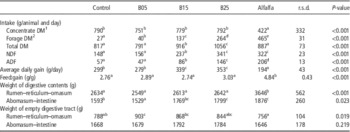
Mean values of feed intake, growth rate, feed conversion and weight of digestive tract and contents are shown in Table 2. Alfalfa-fed lambs had the highest forage and lowest concentrate and total feed intake (P<0.001). Forage intake increased with the level of barley straw included in the TMR pellet (P<0.001), whereas concentrate intake (proportion of TMR that is not forage) remained constant for Control, B05, B15 and B25 lambs. NDF and ADF intake increased with the level of forage ingested, B25 and alfalfa lambs showing the highest values and Control and B05 lambs having the lowest fibre intakes (P<0.001). Alfalfa lambs had the lowest growth rate, whereas B15 and B25 lambs showed higher daily gains than Control and B05 animals (P<0.001). Alfalfa-fed lambs showed higher feed to gain ratio than the rest of lambs (P<0.001). Animals in the Alfalfa group had the greatest rumen contents weight (P<0.001) and the lowest empty rumen weight (P<0.05). The highest weight of abomasums+intestine contents was shown by alfalfa and B25-fed lambs, whereas B05 lambs had the lowest values (P<0.05). No differences were observed in empty abomasum+intestine weight (P>0.10).
Effect of feeding concentrate and barley straw separately (Control), a TMR with 50, 150 and 250 g barley straw per kg (B05, B15 and B25, respectively) or ad libitum alfalfa supplemented with concentrate (Alfalfa) on feed intake, growth rate and weight of digestive tract and contents

TMR=total mixed ration; DM=dry matter; r.s.d.=residual standard deviation.
1 Concentrate: supplied in the feeding trough (Control and Alfalfa lambs) or the portion of TMR that is not barley straw (B05, B15 and B25 lambs).
2 Forage intake measured as straw (Control lambs) or alfalfa (Alfalfa lambs) ingested from the feeding trough, or calculated from TMR composition (B05, B15 and B25 lambs).
a,b,c,d,eMeans in the same row with different superscripts differ significantly (P<0.05).
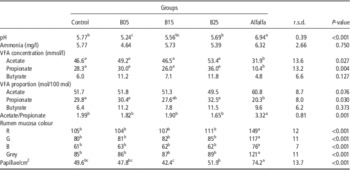
Table 3 shows the effects of diet on ruminal characteristics. Alfalfa lambs had the highest rumen pH values, followed by Control, B25 and B15 lambs; B05 animals showed the lowest rumen pH values (P<0.05). There were no differences in ammonia concentration. Total VFA concentration was lower in the Alfalfa group compared with the rest of the lambs, as were individual fatty acid concentrations (except butyrate; P<0.05). However, rumen samples from Alfalfa lambs tended to have the highest proportion of acetate (P<0.10) and the lowest proportion of propionate (P<0.05), thus raising the acetate to propionate ratio compared with the other groups (P<0.01).
Effect of feeding concentrate and barley straw separately (Control), a TMR with 50, 150 and 250 g barley straw per kg (B05, B15 and B25, respectively) or ad libitum alfalfa supplemented with concentrate (Alfalfa) on ruminal characteristics

TMR=total mixed ration; VFA=volatile fatty acids; r.s.d.=residual standard deviation.
a,b,cMeans in the same row with different superscripts differ significantly (P<0.05).
The highest counts of papillae were observed for Alfalfa lambs, followed by B25, Control and B05 lambs, with B15 animals showing the lowest counts (P<0.001). Regarding rumen mucosa colour, animals receiving alfalfa were clearly different from the others, showing the greatest grey, red, green and blue values (P<0.001).
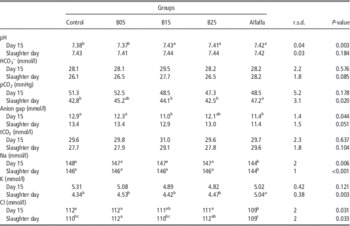
Mean values of parameters related to blood gases are shown in Table 4. B15, B25 and Alfalfa lambs had the highest pH values on day 15, although these differences had disappeared by the day of slaughter. Animals in the Alfalfa group tended to have higher HCO3 − values on day of slaughter (P<0.10) and had significantly (P<0.05) higher pCO2 values on day of slaughter than lambs in the other groups, whereas anion gap values showed the opposite trend (the lowest values for Alfalfa lambs). Na and Cl concentrations were always lower for Alfalfa than for the rest of the groups (P<0.001), whereas K concentration was the highest for Alfalfa lambs (P<0.001).
Effect of feeding concentrate and barley straw separately (Control), a TMR with 50, 150 and 250 g barley straw per kg (B05, B15 and B25, respectively) or ad libitum alfalfa supplemented with concentrate (Alfalfa) on blood gases and ions on day 15 and at the end of fattening period (final, ∼27 kg LBW)

TMR=total mixed ration; LBW=live BW; r.s.d.=residual standard deviation.
a,b,cMeans in the same row with different superscripts differ significantly (P<0.05).
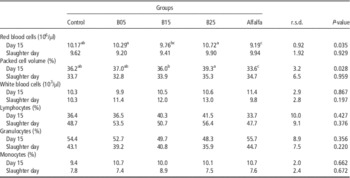
The type of diet consumed by the animals did not affect WBC counts (P>0.10), as can be seen in Table 5. However, RBC counts and packed cell volume were lower for alfalfa-fed lambs on day 15 of the experiment.
Effect of feeding concentrate and barley straw separately (Control), a TMR with 50, 150 and 250 g barley straw per kg (B05, B15 and B25, respectively) or ad libitum alfalfa supplemented with concentrate (Alfalfa) on blood cells counts on day 15 and at the end of fattening period (final, ∼27 kg LBW)

TMR=total mixed ration; LBW=live BW; r.s.d.=residual standard deviation.
a,b,cMeans in the same row with different superscripts differ significantly (P<0.05).
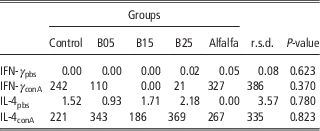
No effects were observed on IFN-γ or IL-4 production depending on the type of diet offered to the animals (P>0.10; Table 6).
Effect of feeding concentrate and barley straw separately (Control), a TMR with 50, 150 and 250 g barley straw per kg (B05, B15 and B25, respectively) or ad libitum alfalfa supplemented with concentrate (Alfalfa) on ratios of IFN-γ and IL-4 production (pg/ml) by peripheral blood mononuclear cells stimulated either with PBS (IFN-γ pbs and IL-4pbs) or concanavalin A (IFN-γ con and IL-4con)

TMR=total mixed ration; interferon-gamma=IFN-γ; IL-4=interleukin-4; PBS=phosphate-buffered saline; r.s.d.=residual standard deviation.
Discussion
Feed intake and animal performance
Feed intake increased with the proportion of barley straw in the TMR, with animals fed on TMR diets showing values for average daily gain and feed-to-gain ratio similar to or better than animals fed the control (traditional, concentrate and forage supplied separately) diet. However, alfalfa-fed lambs (which can be considered as a positive control for animal health and welfare) had lower growth rates and higher feed-to-gain ratios than animals in the other groups. These differences are on account of the higher fibre and lower protein and energy intakes in alfalfa-fed lambs as compared with concentrate-fed animals, in agreement with Carrasco et al. (Reference Carrasco, Panea, Ripoll, Sanz and Joy2009a and 2009b), Papi et al. (Reference Papi, Mostafa-Tehrani, Amanlou and Memarian2011) and Tufarelli et al. (Reference Tufarelli, Khan and Laudadio2011).
Digestive tract characteristics
The high weight of rumen contents observed in animals receiving the alfalfa diet is mainly due to the composition of the DM intake, which was rich in fibre. This determines a slow fermentation rate and, therefore, low passage rate (Ndlovu and Buchanan-Smith, Reference Ndlovu and Buchanan-Smith1985; Poore et al., Reference Poore, Moore and Swingle1990; Carro et al., Reference Carro, Valdés, Ranilla and González2000). As a consequence, feed requires more time to be digested, staying longer in the digestive tract (especially in the rumen) and filling it. In fact, the fermentation pattern is different depending upon the diet, as is rumen pH, which is increased in response to forage intake (Carro et al., Reference Carro, Valdés, Ranilla and González2000), especially if it is alfalfa (Ha et al., Reference Ha, Emerick and Embry1983), as observed in our study. In the case of alfalfa-fed lambs, its intrinsic buffering capacity (Giger-Reverdin et al., Reference Giger-Reverdin, Duvaux-Ponter, Sauvant, Martin, Nunes do Prado and Müller2002), together with its coarse structural fibre that stimulates ruminative chewing and salivation, increases rumen buffering capacity (Mirzaei-Aghsaghali et al., Reference Mirzaei-Aghsaghali, Maheri-Sis, Mirza-Aghazadeh, Safaei and Aghajanzadeh-Golshani2008). Within the other groups, Control and B25 had the highest pH values and B05 the lowest. Control group lambs had free access to barley straw and, although they had low forage intake (around 5%), it was in the long form, whose fibre effect is high (Allen, Reference Allen1997). Moreover, barley straw intake in Control lambs could be associated not with concentrate intake, but with the moments at which pH was lowest (between 3 and 6 h after intake; Brossard et al., Reference Brossard, Martin and Michalet-Doreau2003). Therefore, these animals could regulate rumen pH by ingesting forage in a long form (Allen, Reference Allen1997). Regarding B25 lambs, although they had a relatively high fibre intake, similar to Alfalfa lambs, the small particle size, together with their high concentrate (rapidly fermentable) intake, reduced saliva production and buffering capacity, thus promoting lower pH than the alfalfa diet. The animals with the highest concentrate and lowest long forage intake, B05 lambs, had the lowest rumen pH.
According to the pH profile found in the rumen, fermentation pattern and VFA concentration were different for animals receiving concentrate than for alfalfa-fed lambs. Forage-based diets are associated with slow fermentation rates, low VFA production, high proportions of acetate and valerate and high acetate to propionate ratios in the rumen (Carro et al., Reference Carro, Valdés, Ranilla and González2000), as observed in this experiment. At the opposite end of the scale, animals receiving concentrate-based diets with up to 25% ground barley straw have a high concentration of VFA, which is related to faster fermentation rate, high acid (mainly propionic) production and total acid load and, therefore low rumen pH (Bodas et al., Reference Bodas, Giráldez, López, Rodríguez and Mantecón2007). Likewise, the type and amount of feed fermented in the rumen and the fermentation rate profile are some of the factors that influence the development of the rumen wall in the early stages. Thus, increased VFA concentration would determine further development of rumen mucosa, which could have led to a heavier empty rumen for concentrate-fed animals as compared with those receiving alfalfa (Baldwin, Reference Baldwin1999; Baldwin et al., Reference Baldwin, El-Kadi, McLeod, Connor and Bequette2007).
On the other hand, the heavy rumens observed in concentrate-fed animals (regardless of the amount of straw included in the TMR) could also be caused by the stimulant effect that feeding concentrate has on ruminal development (Odongo et al., Reference Odongo, AlZahal, Lindinger, Duffield, Valdes, Terrell and McBride2006). However, it must be borne in mind that the rumen wall undergoes structural changes in response to the inflammation process (rumenitis and parakeratosis) associated with high acid load and low pH (Krehbiel et al., Reference Krehbiel, Britton, Harmon, Wester and Stock1995; Steele et al., Reference Steele, AlZahal, Hook, Croom and McBride2009 and Reference Steele, Croom, Kahler, AlZahal, Hook, Plaizier and McBride2011).
The changes occurring in rumen fermentation and dynamics eventually reflect in the state of the mucosa. Thus, in response to acidosis, the rate of metabolism and proliferation of stratified squamous epithelium increase dramatically, resulting in premature transition of cells into the keratinous layer, a condition known as parakeratosis (Kleen et al., Reference Kleen, Hooijer, Rehage and Noordhuizen2003; Steele et al., Reference Steele, Croom, Kahler, AlZahal, Hook, Plaizier and McBride2011; Plaizier et al., Reference Plaizier, Khafipour, Li, Gozho and Krause2012). All animals that received any type of concentrate had a darker colour than those fed on alfalfa. In the table, high values are positive indicators of lightness, whereas lower values indicate darker colours. Parakeratosis processes are associated with a darkening and hardening of the rumen mucosa, because of the low pH and the high concentrations of AGV. In contrast, alfalfa induces lighter brown epithelium colour than concentrate feed, which turned darker and grey (Álvarez-Rodríguez et al., Reference Álvarez-Rodríguez, Monleón, Sanz, Badiola and Joy2012).
Regarding papillae counts, this parameter was significantly higher in the animals receiving alfalfa, with no differences between the other groups. Although earlier work has shown that concentrate diets with high grain content markedly increase the number and size of ruminal papillae in lambs (Odongo et al., Reference Odongo, AlZahal, Lindinger, Duffield, Valdes, Terrell and McBride2006), the underlying mechanisms of the dietary energy-dependent physiologic, biochemical and histological alterations in the rumen epithelium are not known. Conversely, recent work carried out with lambs fed hay or concentrate diets suggests that forage supply did not affect papillae height or width but reduced the surface area of the papillae (Álvarez-Rodríguez et al., Reference Álvarez-Rodríguez, Monleón, Sanz, Badiola and Joy2012). In any case, the parakeratosis process together with the increased rumen osmolality can result in rapid influx of water from the blood circulation into rumen epithelial cells and into the rumen, causing swelling and rupturing of rumen papilla (Owens et al., Reference Owens, Secrist, Hill and Gill1998; Plaizier et al., Reference Plaizier, Khafipour, Li, Gozho and Krause2012), thus reducing their numbers.
Consequently, although including up to 25% barley straw in the TMR for fattening lambs improves feed intake and animal performance (Blanco et al., Reference Blanco, Bodas, Prieto, Andrés, López and Giráldez2014), it does not seem to promote a rumen as healthy as including 50% alfalfa hay in the diet.
Acid-base blood parameters
Alfalfa is rich in potassium, and its administration in large amounts has been associated with increases in K and reduced levels of Na and Cl blood concentrations (Kume et al., Reference Kume, Toharmat, Ridla, Nonaka, Oshita, Nakamura, Yamada and Ternouth2004). In our experiment, animals receiving the alfalfa diet experienced an increase in K and a decrease in Na and Cl, changes that became more noticeable by the end of the fattening period, when the lambs had the highest alfalfa intakes. Although the modifications in the concentrations of these ions accounted for the decrease in anion gap observed for alfalfa-fed lambs, it must be highlighted that substantial increases in this parameter usually indicate the presence of a metabolic acidosis (Emmett and Narins, Reference Emmett and Narins1977; Odongo et al., Reference Odongo, AlZahal, Lindinger, Duffield, Valdes, Terrell and McBride2006).
Changes in rumen pH may cause changes in blood base excess and blood pH. Albeit all values observed in this experiment were within the normal range, Alfalfa lambs had significantly higher blood pH values than the rest of the animals by mid-fattening period, but these differences were not maintained until the end of the period. This perhaps could be related to increased keratinisation of ruminal mucosa or its development in the final stages of the fattening period, which may reduce acid absorption from the rumen (Krehbiel et al., Reference Krehbiel, Britton, Harmon, Wester and Stock1995; Kleen et al., Reference Kleen, Hooijer, Rehage and Noordhuizen2003). Therefore, the development of parakeratosis as a result of a chemical injury, such as that caused by acidosis, may protect the animals against a continuous drop in blood pH. This does not mean that nutrient (VFA) absorption from the rumen is impaired, but only reduced as compared with the initial stages, when the mucosa is probably not as yet thickened (as in animals receiving alfalfa). As a matter of fact, the lower HCO3 − and pCO2 values observed in concentrate-fed compared with alfalfa-fed lambs indicate that excess base (reserve) in the blood that helps to maintain blood pH is also delivered to the rumen, thus leading to an exhaustion of the reserves (Brossard et al., Reference Brossard, Martin and Michalet-Doreau2003; Ceroni et al., Reference Ceroni, Turmalaj, Lika and Duro2012). Moreover, the long-term effect of an acidogenic diet on the alkaline reserves of the blood requires a longer recovery period than that required for rumen parameters (Brossard et al., Reference Brossard, Martin and Michalet-Doreau2003). It is important to say that no clinical signs of acidosis were observed, which suggests the lambs likely did not experience discomfort attributable to the diets (Commun et al., Reference Commun, Mialon, Martin, Baumont and Veissier2009). It is noteworthy, however, that the B15 group showed the best HCO3 − values after the alfalfa animals by the end of the fattening period, thus indicating a better state of alkaline reserves.
Blood cell counts
Recent works have suggested that some blood parameters such as WBC counts could serve as early indicators of subacute ruminal acidosis in dairy cows without the need to sample rumen fluid (Ceroni et al., Reference Ceroni, Turmalaj, Lika and Duro2012). It has been reported that RBC could increase in animals under acidosis challenge as a compensational response against the slow reduction in haematocrit (Ceroni et al., Reference Ceroni, Turmalaj, Lika and Duro2012). However, in opposition to these findings, the increase in RBC in concentrate-fed animals on day 15 of the experiment was accompanied by an increase in packed cell volume, probably as a consequence of the increase in osmolarity.
Several studies have shown that inducing acidosis by conducting a nutritional challenge based on feeding excessively high grain diets increases LPS endotoxin in the rumen of cattle, and this LPS, after digestive tract epithelial barrier failure, may be translocated into the blood stream or the lymphatic system, where it can interact with mononuclear cells, endothelial and smooth muscle cells, polymor–phonuclear granulocytes and thrombocytes and stimulate the production of pro-inflammatory mediators such as cytokines (Plaizier et al., Reference Plaizier, Khafipour, Li, Gozho and Krause2012). In addition, low extracellular pH and certain organic acids have been shown to activate cellular and humoral components of the immune system and exert pro-inflammatory effects (Kellum et al., Reference Kellum, Song and Li2004; Danscher et al., Reference Danscher, Thoefner, Heegaard, Ekstrøm and Jacobsen2011), and as such these factors could have contributed to the inflammatory response. In a study carried out involving healthy humans, higher serum anion gap and lower bicarbonate levels were associated with increased WBC and concentration of the major acute phase protein C-reactive protein (Farwell and Taylor, Reference Farwell and Taylor2010). Different organic acids have been suggested to exert different effects on cytokine expression (Kellum et al., Reference Kellum, Song and Li2004; Danscher et al., Reference Danscher, Thoefner, Heegaard, Ekstrøm and Jacobsen2011). Nevertheless, in the current study, neither WBC nor cytokines were either raised in response to concentrate feeding or decreased in response to forage feeding. Although LPS was not measured here, the concentrations of LPS in rumens from animals under acidosis challenge, as well as pH, vary considerably among studies (see extensive review by Plaizier et al., Reference Plaizier, Khafipour, Li, Gozho and Krause2012).
It can be concluded that traditional feeding system (based on supplying the concentrate and barley straw separately) or including up to 25% ground barley straw in the concentrate-based TMR for fattening lambs imply a notable rumen pH depression and evident rumen wall damage when compared with alfalfa-fed animals. These changes, which affect to some extent the blood’s acid-base status, seem to be insufficiently severe to threaten animal health and compromise their immune response.
Acknowledgements
Financial support received from the Spanish Ministry of Science and Innovation, Project AGL2010-19094. Carolina Blanco is supported by a contract for young researchers (Council of Castile and León and European Social Fund). Raúl Bodas and Nuria Prieto had a JAE-Doc contract under the programme ‘Junta para la Ampliación de Estudios’ (CSIC-European Social Fund). Sean Wattegedera is funded by The Scottish Government Rural & Environment Science & Analytical Services (RESAS) division and through ‘The route to identification of immunological correlates of protection in ruminants’, Industrial Partnership Award funded by BBSRC (grant numbers BB/I019863/1; BB/I020519/1) with the support of AbD Serotec, a Bio-Rad Company.
Conflicts of Interest
The authors declare no conflicts of interest.