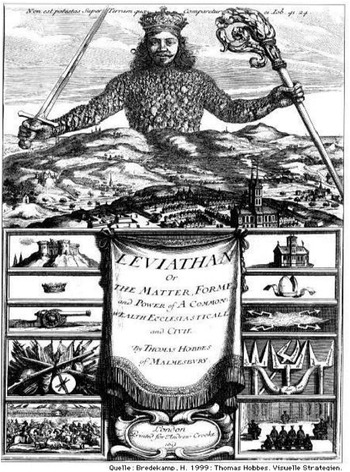
The frontispiece of Leviathan is a visual advertisement for Hobbes's political theory and, specifically, his ideal form of political rule (Fig. 1).Footnote 1 Its iconography crystallizes Hobbes's notion that a successful political regime must of necessity rest upon the principle of absolute sovereignty. Unsurprisingly, then, the frontispiece has been the subject of much scholarly scrutiny and commentary.Footnote 2 The origins of its design and its political, cultural, and ideological significance have garnered a multitude of illuminating and often competing interpretations. Yet the gendered nature of the frontispiece has only infrequently been remarked upon, let alone explored systematically.Footnote 3 In this article, then, I seek to attend to this neglected dimension of this image of political power. Moreover, analysis of this aspect of the frontispiece encourages the continued exploration of the question of gender in Hobbes's political philosophy. This has been the focus of particular interest, for good reason, for many feminist scholars in past decades. Hobbes says relatively little directly about women and does not appear concerned about their status in society; yet what he does say is, in many ways, remarkable. Some of his pronouncements about the nature of women, relations between the sexes, family structure, patriarchal hierarchies, and rule undermine the predictable sexist views of virtually all of his contemporary commentators. For example, Hobbes's presocial state of nature is peopled by radically equal women and men. He also appears to eschew seventeenth-century platitudes about women's place in the domestic sphere, conventional sexual mores, and the inevitability of the patriarchal family.
However, there is no consensus as to the significance of Hobbes's view of gender. Broadly conceived, two competing assessments of his work circulate among feminist theorists. On the one hand, some scholars reject the notion—to varying degrees and in differing ways—that Hobbes's thought represents something novel and radical with regard to women. Indeed, by these lights, he is entirely representative of a masculinist, Western tradition albeit in a modern guise: atomistic, individualistic, competitive, and hostile to women's interests. On the other hand are theorists who detect—to varying degrees and in differing ways—some type of promise for women in Hobbes's work in terms of the Western political tradition broadly and social contract theory in particular. I see my analysis as fitting into this second approach.
I consider, then, the gendered dimensions of the frontispiece through the prism of these two divergent feminist approaches to Hobbes's political philosophy. I begin by taking the depiction of the Sovereign in the frontispiece “at face value,” arguing that its surface qualities seem decidedly coded as traditionally masculine. In this context I present and examine the insights in Janice Richardson's article, “Hobbes’ Frontispiece: Authorship, Subordination and Contract,” as she offers a rare gendered analysis of the frontispiece (Richardson Reference Richardson2016). Richardson's analysis accords with that of feminist theorists who view Hobbes as a decidedly masculinist thinker.
I then build on Richardson's observations but nonetheless question whether the image decisively reinforces patriarchal norms to the extent she suggests. In contrast to Richardson, I do not read the frontispiece as entirely “closed” with regard to women. To this end, I investigate the frontispiece alongside chapter 24 of Hobbes's Leviathan, “Of the Nutrition, and Procreation of a Common-wealth,” the sole chapter that deals with the processes of economic life (Hobbes Reference Hobbes and Tuck2002). I argue that this perspective is particularly illuminating (in relation to Richardson's argument and more generally) as it throws into relief the extent to which the image of the sovereign in the frontispiece is not simply a picture of sovereign, male power but rather relies heavily upon associations with both male and female qualities and powers. In particular, reading the image through the lens of the economy indicates that women may be present in Hobbes's social contract theory, in civil society. That is to say, they are not entirely necessarily absent/absorbed in their husbands’ or sovereigns’ bodies.
Next, I interrogate the extent to which this bold masculinity is a more superficial feature of the frontispiece. That is to say, the sovereign's body (and so his right to power) may not be as unambiguously male as it may, at first blush, appear. I briefly indicate that this blending of gender codes and cues is of a piece with analyses of the gendered coding of monarchs in the early modern period. I refer to some aspects of the “prosthetic” and anxious nature of masculinity in the early modern era. I uncover, finally, through this analysis of the frontispiece from the vantage point of gender and the economy, not a static image of unwavering male power but rather one of an ambiguously-sexed creature teeming with life, contradictions, and complexity worthy of continued examination. In this way, then, probing the gendered aspects of the frontispiece underscores the potential feminist intimations in Hobbes's work.
Feminist Appraisals of Hobbes's Political Philosophy: Enemy or Ally?
Feminist scholars, for good reason, have carefully scrutinized Hobbes's thought. The bulk of his commentary concerning women is to be found in his description of the state of nature. It is here that Hobbes makes remarks that have drawn the attention of feminist thinkers. To cite but a few examples, he stands out as a rare theorist in the Western tradition who explicitly describes women as beings who are naturally equal to men. He posits original maternal dominion in the state of nature. As Hobbes states, “In the condition of meer Nature, where there are no Matrimoniall laws, it cannot be known who is the Father, unlesse it be declared by the Mother: and therefore the right of Dominion over the Child dependeth on her will, and is consequently hers” (Hobbes Reference Hobbes and Tuck2002, 140). Further, he appears to regard the character of social relations between women and men as socially constructed and conventional. For example, in his discussion of the origins of paternal power, he comments, “whereas some have attributed the Dominion to the Man onely, as being of the more excellent Sex; they misreckon in it. For there is not always that difference of strength, or prudence between the man and the woman, as that the right can be determined without War” (139). Even in civil society (wherein he thinks most societies will be patriarchal), Hobbes allows for hereditary sovereignty to be vested in female rulers. The issue, for him, is customary practice, not adherence to some preordained, natural patriarchal order. He writes, “Where the Custome is, that the next of the Male Kindred succeedeth, there also the right of Succession is in the next of the Kindred Male. . . And so it is if the Custome were to advance the Female” (137). And in another more pointed formulation, Hobbes says that “Man may be male and female, Authority is not” (Ng Reference Ng, Hirschmann and Wright2012, 84). On this point, Quentin Skinner insists that Hobbes's general conception of sovereignty is entirely gender-neutral as it is grounded in his theory of representation whereby the sovereign is an abstracted creation of the people via the social contract. As he states, “we must be careful not to suppose that the person of the state is male or female. The sovereign will be male or female, but the state is neither” (Hirschmann and Wright Reference Hirschmann, Wright, Hirschmann and Wright2012, 27). In addition to these unorthodox views in a seventeenth-century context, Hobbes seems rather blasé about “natural” or “good” types of sexual activity. Indeed, Susanne Sreedhar contends that Hobbes may be seen as “rejecting the naturalness and goodness of three of the structuring pillars of heteronormativity: (1) heterosexuality, (2) monogamy, and (3) lifelong partnership. Homosexuality, multiple partners, and temporary arrangements are equally as valid as heterosexual, monogamous, lifelong partnership” (Sreedhar Reference Sreedhar, Hirschmann and Wright2012b, 266–67).Footnote 4
Yet much in Hobbes is clearly problematic. Joanne Wright neatly identifies a key indication that Hobbes's theory is far from unequivocally full of feminist insight and promise when she remarks, “Once the social contract is made, his provocative vision of gender relations recedes into the background, and he falls back on customary arguments about men being more suited than women to form a commonwealth” (Wright Reference Wright2004, 77–78). What, then, is the connection, if there is one, between the “radical” comments Hobbes makes concerning women in the state of nature and his complacent and/or sexist ones about women in civil society? On this question feminist commentators may be seen to adopt two generally divergent positions.
Feminist scholars such as Christine Di Stefano, Susan Moller Okin, Diana Coole, Eva Odzuck, and Carole Pateman find little or no critical edge with regard to gender relations in Hobbes's political philosophy. According to di Stefano, Hobbesian man “bears the tell-tale signs of a modern masculinity in extremis: identity through opposition, denial of reciprocity, repudiation of the (m)other in oneself and in relation to oneself, a constitutional inability and/or refusal to recognize the ambivalence of identity in relation to others” (Di Stefano Reference Di Stefano1991, 104). Okin finds little of feminist merit in Hobbes and contends that he holds that women are categorically inferior to men (Okin Reference Okin1979, 199). Coole concludes that “although Hobbes's materialist logic is sexually neutral, we might ask whether the human nature that he describes is as universal as he believes. . . [although his] ascription of a nature common to both sexes is an advance, what he accredits them with is a peculiarly male psyche: aggressive, competitive and egoistic” (Coole Reference Coole1988, 75). Odzuck similarly finds Hobbes's theory to be problematic and discriminatory because he accepts “the logic of power as a normative premise” (Odzuck Reference Odzuck and Lloyd2019, 240). For these theorists, then, Hobbes does not present a resource for gender critique; rather, he is a pivotal figure in the inauguration of the reign of self-actualized, isolated, competitive modern persons (that is, males).
However, Pateman's root-and-branch critique of social contract is, arguably, the most sweeping, devastating, and influential of all those analyses that condemn Hobbes as a masculinist thinker.Footnote 5 According to Pateman, modern patriarchy is based upon a fraternal pact that binds all men together in the mutual domination of women. The specific purpose of the contract is to consolidate “the law of male sex-right,” which ensures men's access to women's bodies. As she writes, “conjugal power is not paternal, but part of masculine sex-right, the power that men exercise as men, not as fathers” (Pateman Reference Pateman1988, 22). Contract theory is precisely “the means through which modern patriarchy is constituted” (2). But conjugal power based on original acts of conquest (that is, the sexual contract) is systematically hidden within social contract theory with its language of universal equality and natural rights. Indeed, Pateman contends that Hobbes's contract theory uncovers the actual sexual contract that underpins women's oppression and that is suppressed in the accounts of all other contractarians (such as Locke, Rousseau, and Kant). Pateman's assessment is that “Hobbes was too revealing about the civil order to become a founding father of modern patriarchy” (44). If Hobbes's theory has a virtue, for Pateman, it is simply his blunt acknowledgment of this fact. Any semblance of a “radical” edge with regard to women in his theory stems from his brutal honesty about the construction of modernity on the (hidden and violent) sexual conquest and subordination of women. So, on this account, Hobbes promotes a new, albeit disguised form of patriarchal power that haunts all of modernity. Any of his seemingly “radical” comments are undermined by his overall project. Moreover, from this vantage point, Wright's observation that Hobbes's “provocative vision” of gender relations fades with his depiction of civil society is rather misguided insofar as the seeming critical edge of his theory never actually existed. In this sense, Hobbes must be seen as an enemy, not an ally, of women.
Pateman's position has been groundbreaking, garnering much praise and influence. Nonetheless, various arguments have been presented to challenge its far-reaching claims concerning contract theory as such but also her specific interpretation of Hobbes with regard to women. For example, Jane Jacquette defends Hobbes's contractualism on the grounds that its initially egalitarian view of the state of nature challenges conventional views of women as irrational, excessively emotional, and consequently unfit to engage in contractual relations. She argues, “Hobbes aligns his theory of contract to a theory of individualism that is radically egalitarian, challenging all claims of ‘natural’ dominance. . . the hypocrisy of actual contracts only serves to make the ideal of contract that much more compelling” (Jacquette Reference Jacquette and Smith1998, 214–15). This radical promise is retrievable precisely because Hobbes takes women to be rational, autonomous subjects.Footnote 6
Joanne Wright, despite her concerns regarding his intent, determines Hobbes to be a theorist who “effectively disrupted gender norms, opening a space in which gender relations could be dramatically—if briefly—reconceived” (Wright Reference Wright2004, 77). According to Wright, Hobbes's sexual politics are at the heart of his larger political/philosophical project, which is to explicate the rational-scientific basis of state theory and political practice. She writes:
his highly contentious reconfiguration of gender should be understood as centrally important to the justification of his political theory, for it is this argument that allows him to combat the theory that all political power is derived from Adam, and that both fatherly and kingly rule are natural and God-given. . . . In the end, Hobbes posits the consensual nature of familial and political relations, and in the process presents a provocative account of original political right. (87)
Thus, his positing of equality between men and women in the state of nature “disrupts the conventional view that women are the lesser sex as dictated by nature [and] implies that the power relationship of dominance and submission between men and women is one that must be decided by battle, which. . . bears the marks of convention rather than nature” (88).Footnote 7 “[P]ositing maternal dominion is the final step to rationalizing every human relationship, making every relationship the product of artifice not nature” (95).
Sreedhar echoes this approach. On balance, she finds Hobbes's political philosophy to encompass “a thesis about gender egalitarianism, which commits him to anti-essentialism about gender (i.e., the denial that there is any such thing as a woman's ‘nature’ or ‘essence’) and to gender conventionalism (i.e., the thesis that gender expression and gender roles are largely a result of structural social forces and conditions). One could see these views as protofeminist, in a certain sense” (Sreedhar Reference Sreedhar2012a, 773). Further, S. A. Lloyd finds Hobbes's political philosophy to be neutral with regard to women. She finds that “nothing in Hobbes's theory necessitates the subjection of women. . . . A mixed-gender but matriarchal society would, in fact, be the more natural story for Hobbes to have told” (Lloyd Reference Lloyd, Hirschmann and Wright2012, 58).
Reading the frontispiece through the prism of feminist approaches to Hobbes, we can, as we interpret the image, find both versions of Hobbes: the enemy and the ally. In a sense, the frontispiece may be seen to crystallize the gender conundrum in Hobbes's work. The image of the sovereign may be read as male, indeed, ultra-male. But it is also possible to read this ultra-male coded image as containing a complex amalgam of male- and female-coded traits that disrupts this surface. The frontispiece, then, represents a Hobbes who simultaneously depicts a “radical” notion of women in the state of nature but then seems to abandon this perspective as his theory shifts to the harsh reality of civil society. However, I argue that there are identifiable traces of this critique to be found. Thus, the frontispiece (and Hobbes's theory more generally) is potentially more open than closed to feminist concerns, as his harshest critics contend. However, it should be stressed that he is an ally who should be approached critically and skeptically.
The Sovereign Strides Forth: The Frontispiece as a Picture of Male Power
The famous “speaking picture” that graces the frontispiece of Leviathan is, at first glance, among many other things, an image of an idealized and unmistakably male figure of an absolute sovereign. He embodies masculine power with his large, muscular torso that looms over town and countryside. He has resplendent hair, mustache, and goatee, and he stares out implacably at the viewer/reader. The monarch holds symbols of military and religious might, the sword in one hand, the crozier in the other; and he wears a magnificent crown. The vast sphere of his power is further conveyed in the bottom half of the frontispiece. Two panels, notably separated by an ornate theatrical curtain that bears the full title of the book and the name of its author, depict the symbols of the sovereign's spiritual and temporal powers. His worldly powers, pictured on the left panel in descending order, are a castle, crown, cannon, weapons of war, and a battlefield, and the right panel pictures a church, miter, the lightning of excommunication, symbols of logic, and a court of inquisition. The sovereign oversees (literally, in the image) and, crucially, controls these twin sources of potential human allegiance and conflict into one overwhelming and unified force. A banner above the sovereign's image on the frontispiece underscores his singular position in the body politic with a quotation from the Book of Job referring to the great sea monster, Leviathan: “Upon the earth there is not his like.” The Book of Job describes the monster in more detail: “Sharp stones are under him: he spreadeth sharp pointed things upon the mire. He maketh the deep to boil like a pot: he maketh the sea like a pot of ointment. He maketh a path to shine after him; one would think the deep to be hoary. Upon earth there is not his like, who is made without fear. He beholdeth all high things: he is a king over all the children of pride” (Job 41: 30–34 King James). Hobbes's sovereign, then, is akin to and embodies the characteristics of this immense and terrifying creature and his prodigious power. Moreover, his right to this power appears to be partly conditioned by his masculinity, given that he is necessarily a “king over all the children of pride.” This links his kingship to a magnificent type of fatherhood. His subjects are positioned as children in the face of his power as state patriarch.
The figure depicted also appears like a great sun over the horizon, filling the sky. Hobbes explicitly draws out this analogy of sovereign as sun in the written text of Leviathan:
And, as the Power, so also the Honour of the Soveraign, ought to be greater, than that of any, or all the Subjects. For in the Soveraignty is the fountain of Honour. The dignities of Lord, Earle, Duke, and Prince are his Creatures. As in the presence of the Master, the Servants are all equall, and without any honour at all; So are the Subjects, in the presence of the Soveraign. And though they shine some more, some lesse, when they are out of his sight; yet in his presence, they shine no more than the Starres in the presence of the Sun. (Hobbes Reference Hobbes and Tuck2002, 128)
The connection of the sovereign to the sun may also be seen to underscore the masculine character of power, since the attribution of masculinity to the sun and femininity to the moon was commonplace in early modern England. Indeed, Susan Mendelson and Patricia Crawford note the richness of these associations in relation to gender in that “the sun and the moon as symbols of male and female domains were taken to embody a whole range of beliefs about female defect: male and female roles were correlated respectively with light and darkness, good and evil, reason and ignorance, the ‘public’ domain and politics and the ‘private domain of the household’” (Mendelson and Crawford Reference Mendelson and Patricia1998, 72).Footnote 8 Hobbes's mortal sun god, from this perspective, is a fully visible and ultramale figure who at once embodies, oversees, and dominates all of the people and territory he surveys.
Yet upon closer inspection, the king's body is not entirely his own given that his torso and arms are curiously comprised of the tiny bodies of hundreds (300+) of persons (Bredekamp Reference Bredekamp and Springborg2007, 38). A full range of subjects appear to be present in the sovereign's body: women, men, children, adults, soldiers, and civilians (Skinner Reference Skinner2008, 191). Most of them have their backs to the viewer/reader and gaze upwards at the sovereign. It would seem that they are positioned to be reverent, obedient, and silent subjects. The sovereign stares ahead, not even acknowledging them. In this sense the sovereign appears to fail to communicate with the people; he is indifferent to them and is figuratively silent. And it may be seen in the written text that this silence (that most traditionally female virtue) is appropriated and transformed by the sovereign into a great power. As Hobbes declares in Leviathan, “In cases where the Sovereign has prescribed no rule, there the Subject hath the Liberty to do, or forebeare, according to his own discretion. And therefore such Liberty is in some places more, and in some lesse; and in some times more, in other times lesse, according they that have Soveraignty shall think most convenient” (Hobbes Reference Hobbes and Tuck2002, 152). The silence of this king may be deafening as it delineates the parameters of his people's liberties (with the exception of the sole right of nature, self-preservation). What is not expressly forbidden is permitted. Even his silence, then, on this reading, may be understood to be a masculine exercise of power as it can be withdrawn and impinge upon the people's spheres of action.
The visual composition of the people in the sovereign's body further bolsters the aura of the masculine power of the sovereign insofar as, collectively, the people appear to form a type of armor on his body. As Christopher Pye comments, “The populace appear like a coat of mail on the king's obscured body, yet, shading into a continuum with the king's face and hands, they equally seem to constitute his body; like the scales of Leviathan in Job, the body politic is at once an integral part of the king's body proper and serves to conceal and protect it” (Pye Reference Pye1984, 101).Footnote 9 This armor may be viewed either as a coat of mail or scaled armor. In either case, this is the garb of a (typically) male warrior. Moreover, it accords with another aspect of the description of the creature Leviathan in Job: “His scales are his pride, shut up together as with a close seal” (Job 41: 15). The effect of the image of the armor embedded on the sovereign body is to underscore his masculine power. It signals vividly that he is a battle-ready warrior permanently poised to engage in war, a sphere of action perhaps most suitable for men. Indeed, despite Hobbes's seeming indifference to the sex of monarchs in civil society, he does indicate that direct male heirs will most likely be preferred on the grounds that “men, are naturally fitter than women, for actions of labour and danger” (Hobbes Reference Hobbes and Tuck2002, 137).
The sword the sovereign prominently wields in the image additionally reinforces this coding of the sovereign as a male warrior. Here Will Fisher's notion of what he terms the “prosthetic parts” that served visually to craft masculinity in the early modern era is apt. As he writes, “Sex was materialized through an array of features and prosthetic parts,” and these parts “would have to include the beard and the genitals, but would also have to include clothing, the hair, the tongue, and weapons such as swords or daggers. . .” (Fisher Reference Fisher2001, 157). The sovereign's great sword seems to signal his male right to bear arms.
Fisher explores in detail the ways in which facial hair, which figures importantly in the frontispiece, was implicated in “materializing masculinity.” Portraits, he notes, provide a record of the importance of facial hair as a sign of maleness as it was pervasive in portraits of adult men (158). Facial hair on a man conveys a cluster of prized male attributes: virility, strength, social position, and reproductive potency (172–73). Indeed, some medical commentators, in keeping with humoral theory, which imagined the humors of men to be hot and dry and those of women cold and moist, linked male facial hair directly to the production of semen and “figured as a kind of seminal excrement,” given that “all hair was thought to be an ‘excremental’ residue left by ‘fumosities’ as they passed out of the pores of the body” (174). As Fisher comments, “the growth of facial hair was insistently mapped onto social roles like soldier and father, and. . . those roles were in turn linked to having a beard” (175). Jennifer Jordan also underscores the social and political implications of this medical theory:
Men were able to grow beards and women were not precisely because the strength of the male seed was greater than that of the female. The natural strength of the male seed therefore furthered the concept of the natural superiority of men and added weight to the justification of patriarchal authority. Linked to sexual maturity, the beard provided visual evidence of the strength, vigour and virility afforded to the sexually mature male as opposed to women and boys. (Jordan Reference Jordan, Fisher and Toulalan2011, 36)
Consequently, the luxuriant hairiness of the sovereign in the frontispiece may be seen to work as a visual marker of his regal, male, and patriarchal authority. His hirsute appearance reinforces all of these signals of masculine power.
In all of these ways, then—associated with the sun, armor-clad, hirsute, sword- and crozier- wielding—details of the image of the sovereign all seem to work “masterfully” to exhibit his masculine power. In addition to the celebration and elevation of the power of the sovereign, the frontispiece encapsulates Hobbes's solution, a social contract, which is essential to escape the dire condition of the state of nature. The necessary standpoints of both the subjects and sovereign in Hobbes's contractualism are conveyed visually in the frontispiece; in the written text, Hobbes describes the social contract: “The only way to erect such a Common Power. . . is to conferre all their power and strength upon one Man, or upon one Assembly of men, that may reduce all their Wills, by plurality of voice, unto one Will” (Hobbes Reference Hobbes and Tuck2002, 120). In this contract, the sovereign subsumes all of these beings, since “In him consisteth the Essence of the Commonwealth, which. . . is One Person, of whose Acts a great Multitude, by mutuall Covenants one with another, have made themselves every one the Author, to the end he may use the strength and means of them all, as he shall think expedient, for their Peace and Common Defence” (121). Lest there be any doubt about his extraordinary powers, Hobbes remarks, “This is the Generation of that great LEVIATHAN, or rather (to speake more reverently) of that Mortall God, to which wee owe under the Immortal God, our peace and defence” (120). Consequently, in the image, the bodies of the subjects/citizens comprise and fill up the body of the sovereign. This “great Multitude” both reveres and animates the “One Person” who allows for the peace and stability of the body politic over which he reigns.
The passionate elements in the human personality that constantly threaten to fracture the body politic and undermine the sovereign are shown in the frontispiece to exist in both the spiritual and worldly realms: arcane religious disputes, over-mighty lords, armaments, and so on. As long as the sovereign dominates the commonwealth and keeps his proud and fractious children in check, peace will prevail. But his absence is an ever-present threat that would signal disaster. In the text of Leviathan, Hobbes's thought experiment, the state of nature, may be seen as a word-picture working in conjunction with the frontispiece and designed to conjure in the reader the horror of life without the great sovereign-father. The state of nature is a war of all against all: life is full of anxiety, fear, and violent confrontations. All types of knowledge disappear: agriculture, building technologies, navigation, calendars, and timekeeping, and all arts and letters: all of the peace and plenty depicted in the top half of the frontispiece disappear in the state of nature. The only conclusion possible is that human life without a mighty sovereign is “solitary, poore, nasty, brutish, and short” (89). As Skinner succinctly puts it, the frontispiece strives to present “the state as a terrifying and at the same time a protective force” (Skinner Reference Skinner2008, 198). The reverence the sovereign inspires is precisely because the people recognize the grim consequences should he perish.
Thomas Hobbes (1651). Leviathan Or The Matter, Forme, and Power of A Common-wealth Ecclesiasticall and Civil, London, frontispiece.

The sovereign, Hobbes's written text will reveal, makes all laws, controls and embodies military might, distributes property and honors to all subjects/citizens, dispenses justice, inflicts punishment, determines the tenets of the state religion, and the parameters of acceptable public speech. He presents as an alpha male, a mortal and jealous god who brooks no competitors in his domain. He guards his power and honor and protects his realm comprised of his subjects: women, children, and all lesser males. He inspires awe and fear as a great lawmaker, patriarch, protector, and life-giver. At first glance, then, it seems that the frontispiece and the text of Leviathan work to announce and reinforce the sovereign's power not only as a constructed, political power but, centrally, as a male power.
The Male Sovereign Gives Birth
The significance of the gender coding of this Mortall God in the frontispiece, as indicated above, has received relatively little scholarly or critical attention. A notable exception to this neglect is the careful analysis Janice Richardson offers in “Hobbes's Frontispiece: Authorship, Subordination and Contract” (Richardson Reference Richardson2016).Footnote 10 Her focus is on the question of the gender of the subjects/citizens who densely populate the body of the sovereign and the implications that may be drawn from this in relation to Hobbes's political philosophy and, particularly, the nature of modern contractualism. She notes that this issue has garnered remarkably little attention, particularly given the many careful scholarly analyses of the frontispiece. Richardson observes that commentators either ignore or elide the issue and potential significance of the sex of the figures in the sovereign's body. As she observes: “Curiously, despite. . . attention to the minutiae of the image, no writer seems to have discussed in detail the sex of the figures contained within the Leviathan's body and the implications of their sex” (Richardson Reference Richardson2016, 66). For Richardson, and in accord with Pateman's perspective, this gendered lens provides invaluable insight into the nature of the social contract, drawing attention to the types of sexed persons who are sanctioned to participate in the social contract that inaugurates Hobbes's state. Specifically, she investigates whether male and female persons are deemed to be social and political equals and so able to enter jointly into a contract of this nature. In her view, the frontispiece offers a dramatic enactment of the link between seemingly neutral contracts and subordination, which are characteristic of a modernity that masks and so keeps hidden structural relations of oppression. Indeed, Richardson concludes that “Hobbes’ stark depiction of the subsumption of the individuals into one body illustrates for us that, in modernity, it is through contract that relations of subordination are both created and managed” (79). Moreover, it is an image “of domination so great, that it is envisaged as one body that can absorb others” (64). This absorption of others effectively renders some subjects, notably all women, invisible in the public sphere wherein the Sovereign's law becomes dominant.
Richardson argues that the peopled interior space of the sovereign presents “a vivid portrayal of a ‘persona covert,’ akin to a feme covert, a wife characterized in common law as subsumed into her husband's legal and political identity so much so as to be metaphorically ‘covered’ by his body. In Hobbes's frontispiece the sovereign's enormous body covers his subjects, who are contained within its boundaries” (64). Richardson draws a connection between the sovereign's body enclosing and containing those of others and a female body gestating a fetus in what she refers to as “a placental economy” (64). Richardson contends that although no women are directly depicted in the frontispiece, nevertheless they are present. That is to say, they are unseen but present insofar as “they are in the Sovereign's body but hidden, having already been ‘covered’ (or represented) by the men's bodies. Hence men are already personae covert but women are doubly so, being contained both within the husband's body and in turn that of the Leviathan” (68). So, the sovereign's type of pregnancy does not in any way mimic or honor a biologically female type of pregnancy. Consequently, the sovereign's pregnant body overwhelms and consumes rather than nurtures those within the bounds of his body. Richardson sees, then, in the image an iteration of a familiar trope of patrogenesis in the tradition of Western political philosophy: a creation myth founded on the male appropriation of the power to give birth physically. She writes:
A curious reversal occurs in this picture of domination that portrays one or more bodies that become subsumed into the one body of Leviathan, which is also an enactment of the birth of the Sovereign and of civil society. The theoretical birth is the reverse of actual birth—the only physical occasion when one body becomes two or more. It is a fantasy about human bodies within human bodies—and of birth—from a philosophical tradition that fails to think philosophically about the material possibility (as opposed to the associated sentimentality) of this occurring. From this perspective, the frontispiece portrays the secularization of another birth fantasy; that of Adam giving birth to Eve. (69)
Richardson makes a powerful point here with regard to the notion of a male creation story. The sovereign does, on this reading, appropriate a female function and seems to transform it into an exclusively male power.
The Sovereign's Gender-Bending
However, in my view, the notion of the pregnant sovereign serves to disrupt gender norms as much, if not more, than it reaffirms them and undermines the stability of his masculine persona. Most obviously, his paternal body is simultaneously maternal. It shelters the people, his/her metaphorical children, in the manner of a pregnant female body, which holds, nurtures, and protects a gestating fetus. Yet this pregnant father will not deliver on the specific promise of a female body: to reproduce corporeal, human individuals. This male-female pregnancy operates on different principles. It delivers into the world a type of collective person in a process of a theoretical birth, as Richardson terms it—a body politic. But this father is also a type of mother. The sovereign is simultaneously an alpha male and alpha female who is capable of giving birth to an entire society. And, in order to do so, the sovereign also incorporates and so legitimates the traditionally female virtues of nurture and care. In this light, Richardson's analysis downplays the gender ambiguity of the frontispiece.
Moreover, if we read the image alongside Hobbes's account of the economy in chapter 24 of Leviathan, “Of the Nutrition, and Procreation of a Common-wealth,” the complex character of the sovereign's gestational body may be more fully appreciated. A focus on the frontispiece through the prism of Hobbes's economic insights allows for a reading other than that of the subsumption of all of the people into relations of subordination to emerge. I argue that the sovereign's body provides the container or framework (by dint of the social contract) that allows for the activation of the laboring activity of the people. Specifically, the sovereign dictates the initial division of property rights, of mine and thine. This foundational power to assert the existence of the parameters of private property rights is, for Hobbes, essential for the creation of a peaceable commonwealth, for without such rights, people would be ensnared in endless conflicts and disputes. It is a formidable power, and, as Hobbes makes clear, it belongs only to the sovereign. All laws concerning economic activity, such as the division of all property and all terms of internal and external trade are set by the sovereign. Hobbes writes, “Seeing therefore the Introduction of Propriety is an effect of Common-wealth. . . it is that act onely of the Soveraign. . .” (Hobbes Reference Hobbes and Tuck2002, 171). He continues, “It belongeth to the Common-wealth, (that is to say, to the Soveraign,) to appoint in what manner, all kinds of contract between Subjects, (as buying, selling, exchanging, borrowing, lending, letting, and take to hire,) are to bee made; and by what words, and signes they shall be understood for valid,” and “it belongeth to the Common-wealth (that is, to the Soveraign only,) to approve, or disapprove both of the places, and the matter of forraign Traffique” (173–74). Hobbes makes clear that the sovereign's guiding principle will be to ensure that the economy contributes to the creation of peace and collective well-being, as he comments, “the Soveraign assigneth to every man a portion, according as he, and not according as any Subject, or any number of them, shall judge agreeable to Equity, and the Common Good” (171). This framing power of the sovereign vis à vis the economy and the goal of peace and well-being may be understood to evince concurrently paternal and maternal powers. On the one hand, the sovereign's container-body represents his (male-coded) rulemaking and disciplinary powers. On the other hand, and simultaneously, this container-body may be seen to create a (female-coded) nurturing, gestational space that offers safety and prosperity for the people in this placental economy.
Furthermore, it must be emphasized that these (albeit awesome) paternal and maternal sovereign powers do not position the people contained in her/his body as passive, dominated, and dependent, as Richardson's reading implies. On the contrary, Hobbes's economic theory underscores the extent to which the people are dynamic and creative social agents. The sovereign sets the framework in which economy activity may take place and so protects the people. But it is the people themselves who actively bring to life and perpetuate the sovereign body and the body politic itself.Footnote 11 Viewed from the prism of the economy, then, the frontispiece is not a static image but one teeming with the complex productive and reproductive activity of its ruler and inhabitants. The sovereign certainly provides the institutional framework in which economic activity takes place. The people must therefore honor and obey the sovereign's authority. However, they also perform all of the laboring activity that sustains and nourishes all things, that is to say, gives life itself to the Commonwealth. In addition, the notion that the people's role is merely to be adoring, passive, and obedient subjects is belied by this focus on the economy. Here Mark Reinhardt's observation that the figures depicted in the image of the sovereign's body do not uniformly gaze up adoringly at the ruler or stand united as one undifferentiated mass (as is accepted as a truism in most scholarly commentary) is pertinent. Reinhardt suggests that the frontispiece rather depicts unruly—not blandly obedient—subjects, some of whom jostle with one another and turn away from the sovereign (Reinhardt Reference Reinhardt2015, 4–13). In a similar vein, recognizing the people in the sovereign's body as economic actors enables us to see them as creative, active, and laboring subjects with life projects and aims entirely distinct from those of the sovereign.
It is just such a vision of the people that we can garner from Hobbes's description of the economy, which he views as a vibrant web of life-sustaining activity in which the human and natural worlds readily intermingle. He writes:
The NUTRITION of a Common-wealth consisteth, in the Plenty, and Distribution of Materials conducing to Life: In Concoction, or Preparation; and (when concocted) in the Conveyance of it, by convenient conduits, to the Publique use.
As for the Plenty of Matter, it is a thing limited by Nature, to those commodities, which from (the two breasts of our common Mother) Land, and Sea, God usually either freely giveth, or for labour selleth to man-kind. (Hobbes Reference Hobbes and Tuck2002, 170)
Hobbes makes clear those things that nourish the Commonwealth, the “Plenty of Matter”—animals, vegetables, and minerals—require human labor to make them accessible for use. They may be “in or neer to the face of the Earth; so as there needeth no more but the labour, and industry of receiving them. Insomuch as Plenty dependeth (next to God's favour) merely on the labour and industry of men” (170). The social enterprise of human labor transforms these gifts of the common mother (land and sea) into commodities that are traded and circulated in either local or foreign territory. It must also be stressed that it is necessarily both women and men who engage in all of the multifarious economic activity required for a healthy Commonwealth—as women's labor has always been integral to each and every society—including that of early modern England. Not only is it a common mother who provides the bounty of the natural world on which people work but that work, by definition, mobilizes the productive and reproductive labor of women as well as that of men. In Hobbes's view, then, the economy functions to provide the necessities of life, plentifully, as goods are harvested, created, prepared, and shifted around the nation and to trading partners. The resources available to the people depend upon nature's bounty, which Hobbes imagines to be a fruitful great mother whose two breasts are the land and the sea. Some commodities from these breasts are readily available for use. Here one pictures, for instance, fresh water from lakes, rivers, and streams; fruit from bushes and trees; crops from the earth; timber from forests. Most commodities require the active intervention of the laboring activity of the people to shape them into useful things. To name but a few: fishing, farming, mining, constructing houses, churches, palaces, making cloth, tailoring clothes, cobbling shoes, and concocting medicines. Here we must also add that to “create” the people themselves—as active economic and political subjects—necessarily involves massive amounts of reproductive labor: the bearing, rearing, and educating of children and shepherding them into adulthood. All of these multifaceted enterprises will unavoidably be undertaken by the people in the sovereign's body—otherwise neither the sovereign nor the people can exist.
Further, Hobbes's vision of the economy is one in which all of these people, as economic actors, are imbedded in and part of the natural world. The sovereign may be seen to provide but one (albeit crucial) part of the requirements necessary for an economically successful state. Hobbes's picture of the economy entails constant interaction between the abundant goods given to humanity by the common mother earth and active, laboring human beings. Paul Christensen rightly emphasizes the connection between Hobbes's materialist ontology and his conception of the economy. Christensen argues that Hobbes contributes to “a physiologically based psychology and a physiological economics” in which “human nature is not given but shaped through experience, education, and experiment. In Hobbes's metaphor of the artificer, humans not only construct their commonwealths and produce the terms of a commodious existence, they also fashion themselves. Humans are producers” (Christensen Reference Christensen1989, 708).Footnote 12 The success of any society, in Hobbes's view, is intimately tied to the level of human productive capacity that is, in turn, dependent upon the level of development of philosophy. The gift philosophy gives to humanity is that it allows for technological and scientific innovation that then improves the material condition of humanity. In De Corpore, Hobbes elucidates this connection between philosophy and material advances:
The end or scope of philosophy is that we may make use to our benefit of effects formerly seen; or that, by application of bodies to one another, we may produce the like effects of those we conceive in our mind, as far forth as matter, strength, and industry, will permit, for the commodity of life. . . But what the utility of philosophy is, especially of natural philosophy and geometry, will be best understood by reckoning up the chief commodities of which mankind is capable, and by comparing the manner of life of such as enjoy them, with that of others which want the same. Now, the greatest commodities of mankind are the arts; namely, of measuring matter and motion: of moving ponderous bodies; of architecture; of navigation; of making instruments for all uses; of calculating the celestial motions, the aspects of the stars, and the parts of time; of geography, &c. These benefits are enjoyed by almost all the people of Europe, by most of those of Asia, and by some of Africa: but the Americans, and they that live near the Poles, do totally want them. But why? Have they sharper wits than these? Have not all men one kind of the soul, and the same faculties of mind? What, then, makes this difference, except philosophy? Philosophy, therefore is the cause of all these benefits. (Hobbes, Reference Hobbes and Gaskin1999 189–90)Footnote 13
The sense that economic activity undergirded by correct philosophical principles is life-sustaining, organic, and inherently human is underscored in Hobbes's view of money. Money, for Hobbes, performs a crucial function in the economy. It is a “concoction” or reduction of all commodities into one universal equivalent form (to use Marx's term). Money, in the form of, for example, gold and silver, allows for the ready movement of commodities within and between nations, freedom of movement for individuals, and the possibility of a future-oriented economy. As Hobbes writes in Leviathan, “This ‘concoction’” is “the means of which measures, all commodities. Moveable, and Immoveable, are made to accompany a man, to all places of his resort, within and without the place of his ordinary residence; and the same passeth from Man to Man, within the Common-wealth; and goes round about, Nourishing (as it passeth) every part thereof” (Hobbes Reference Hobbes and Tuck2002, 174). The money commodity is so essential to all economic functions that Hobbes (putting his friend William Harvey's discovery of the circulation of the blood to use) likens it to the blood of the commonwealth. He writes that money is “as it were the Sanguification of the Common-wealth: For naturall Bloud is in like manner made of the fruits of the Earth; and circulating, nourisheth by the way, every Member of the Body of Man” (174). Money flows through the veins of the commonwealth and it is gathered and directed toward public use by two means: “One, that Conveyeth it to the Publique Coffers; The other, that Issueth the same out againe for publique payments. Of the first sort, are Collectors, Receivers, and Treasurers; of the second are the Treasurers againe, and the Officers appointed for payment of severall publique or private Ministers” (175). Hobbes then compares the workings of this “Artificiall Man” (a body politic) to that of a “natural Man,” “whose Veins receiving the Bloud from the severall Parts of the Body, carry it to the Heart; where being made Vitall, the Heart by the Arteries sends it out again, to enliven, and enable for motion all the Members of the same” (175).
Hobbes's use of the metaphor of money as blood would, in the seventeenth-century context, evoke many associations. Blood was, imaginatively, tied to multiple notions. Life itself and health were tied to the flow of blood. Bonds of kinship, paternity, and nation were evoked as well as the idea of sacrifice and martyrdom, centrally through the figure of Christ. For our purposes, most important are the ways in which blood was imagined in scientific and popular discourses in relation to male and female bodies and the mechanics of reproductive processes.Footnote 14 In terms of gendered meanings, blood had associations with both sexes. Certainly, the image of money as blood enhances Richardson's notion of the sovereign's manifesting a (female-coded) “placental economy.” This money, or blood, as in a human placenta, connects and sustains all of the people pictured in the sovereign's body and intensifies the sense that not only are the sovereign and the people connected, but the people themselves are interconnected. They are, from this vantage point, mutually interdependent beings, in the same protective physical organism (the sovereign's container-body) rather than (as may first appear) atomistic individuals. The “placental economy” depicted in the frontispiece evokes strong associations with various other processes of the female body such as menstruation, pregnancy, and parturition. Money as blood coursing through the commonwealth could symbolically be seen as performing the function of the placenta—bringing sustenance via blood to the commonwealth.
However, blood in humoral theory also had powerful associations with male bodies and masculinity. Both sexes were understood to produce reproductive “seed” from blood. However, men's “hotter” bodies created sperm from blood while women's “cooler” bodies transformed blood into fluids such as menstrual blood, placental blood, and milk during lactation (Crawford Reference Crawford2014, 19–53). Blood, then, was understood to manifest differently in male and female bodies but, of course, the male forms of blood excrescences were deemed superior to those of women as they were more fully and correctly formed. Consequently, the notion of blood for men had powerful associations with their potency in reproduction. As Crawford remarks, “‘Good blood’. . . was both a substance and a symbol, tying together consanguinity, property, honour, social status and parenthood. . . . In early modern times, becoming the father of a legitimate child enhanced a man's status with his kin and neighbours: it demonstrated that he was a complete man, blessed by God” (113). The depiction of money as the blood of the commonwealth thus suggests male and female variants of blood—the female placental blood and the male's semen—as integral to the sovereign's body and the body politic, contributing to the mixed gender symbols in the image.
Another dimension of the “placental economy” of the sovereign's body is that, as with a female pregnancy, it may exceed its own boundaries. Just as the reproducing female body may create new, separate human beings, so too may the sovereign body create one or many new bodies politic. As Hobbes makes clear, a productive and successful commonwealth may break away from the sovereign's container-body and reproduce itself in new locations. The people—under the aegis of the state—may find new territories to inhabit either by institution (populate uninhabited lands) or acquisition (conquest, colonization). As Hobbes comments, “The Procreation, or Children of a Common-wealth, are those we call Plantations, or Colonies; which are numbers of men sent out from the Common-wealth, under a conductor, or Governour, to inhabit a Forraign Country, either formerly voyd of Inhabitants, or made voyd then, by warre” (Hobbes Reference Hobbes and Tuck2002, 175). Once a colony is established—by institution or acquisition—the new inhabitants may choose to remain under the orbit of the commonwealth or seek independence. Hobbes describes these options in the language of familial dynamics as he imagines the founders of new commonwealths as children leaving the sovereign's body to seek independence and gain autonomy from the body of their mother/father. As evident in the following passage, Hobbes blends the maternal and paternal roles of the sovereign: “And when a Colony is settled, they are either a Common-wealth of themselves, discharged of their subjection to their Soveraign that sent them. . . in which case the Common-wealth from which they went was called their Metropolis, or Mother, and requires no more of them, then Fathers require of the Children, whom they emancipate, and make free from their domestique government, which is Honour, and Friendship” (175).Footnote 15 Thus, the mother-father sovereign melds the reproductive capacities of both sexes and creates independent offspring in the form of new societies and colonies.
Seen through the prism of Hobbes's materialist and “physiological economics,” then, Richardson's notion that the sovereign's internal structure is a type of “placental economy” is intensified and seems entirely apt. However, as I have argued, the productive and reproductive economy of the body politic expresses and harnesses an amalgam of male- and female-coded capacities. Thus the assertive maleness of the sovereign recedes as the containing and nurturing functions of his/her pregnant body are acknowledged. In this sense, the male sovereign becomes a fertile and generative female sovereign. Moreover, the ambiguously gendered figure is enveloped by land and sea imagined as the nurturing breasts of a common earth and sea mother. The land of the sovereign's kingdom that lies before him/her change into parts of a female body, as does the sea that lies behind him. Thus, the sovereign is enveloped by the female figure. This, arguably at least on the visual plane, undermines his claim to total dominance of all that he surveys, to his status as a distinctly male Mortall God. Rather, the sovereign's existence depends upon the economic activity of the men, women, and children whom he holds in his body as well as the fruits of the (maternal) land and sea. The sovereign mother-father from this vantage point appears to be dependent upon his/her subjects and the (maternal) land and sea.
The Indistinct Masculinity of the Sovereign
Thus if we attend to Hobbes's words about the economy carefully and then turn back to the frontispiece, a remarkable transformation takes place. The central, hypermasculine figure of the sovereign begins to diminish dramatically in importance. The land and sea, the mother's breasts, precisely envelop his entire body. The land and sea are no longer a mere backdrop for his assertive male persona. They represent the vital, life-giving resources of the natural world that sustain all of the people—including the sovereign. The people—and the sovereign—depend upon the bounty of the common mother. Seen from this vantage point, then, the sovereign shrinks to a more inconsequential figure, a simple container of sorts. On the one hand, the breasts of the common mother dominate him physically from all sides. On the other hand, his body is full of busy, vibrant persons engaged in life-sustaining economic activity. Certainly, the sovereign provides the civil peace by dint of the social contract that allows for the pursuit of human contentment. But, arguably, this role of a facilitator is far from the initial impression of an omnipotent father. Moreover, this economic activity necessarily involves the cooperation of human beings with one another and with the common mother and the natural resources she provides. Again, the sovereign provides the framework (social peace) while the people creatively interacting with nature (literally) do all of the work. He is also a fragile and dependent creature insofar as he is actually an amalgam of all of the powers of those who populate his body. In a sense he is a mere container, a vessel that holds his people and enables them to engage in all of their life-sustaining activities. It is they who bring him to life and give him life. It is they who inaugurate him into being via the social contract. Moreover, the political process that gives birth to the Sovereign is underpinned by the complex of myriad specifically economic processes as well—which Hobbes interestingly codes in gendered terms; this coding is marked by a fluidity of gendered positions and terms.
On this reading, then, the sovereign is neither male nor female but a complex amalgam of the traditionally coded traits of both genders. His masculinity, which, on first viewing and reading seems so certain, dissolves into ambiguity when examined more closely. This gender ambiguity should perhaps be expected insofar as it accords with scholarly commentary concerning the various forms of the presentation of monarchs in the early modern era. For example, Cynthia Herrup argues that gender-blending was quite typical in various forms of the presentation of monarchs in the early modern period.Footnote 16 On Herrup's account, just as monarchs were imagined as inhabiting not only two bodies, the natural and the political, so too were they imagined to inhabit two genders. She contends, “To rule well required traits associated with both the masculine and the feminine: kings had to be both unyielding and tender, both economical and bountiful with words and goods, and both courageous and peace loving. Kings male and female were supposed to nurture their subjects, to act as scripture said, as ‘nursing fathers’” (Herrup Reference Herrup2006, 498). However, it was a difficult and anxiety-ridden process to attain a correct balance between perceived male and female traits and behaviors.Footnote 17 As Herrup comments, “Kingship and gender were both sites of considerable anxiety in early modern English society. Both reflected the belief that the ‘natural’ hierarchy—men over women, kings over commoners—was necessary to ensure good order; both reflected as well the fear that such hierarchies were extremely fragile. . .” (496–97). There was a persistent preference for all that was deemed to be male, but this preference was always in considerable measure tinged with anxiety because of the one-sex model of gender that dominated medical thinking and the cultural imagination.Footnote 18 The male body was understood as the paradigmatic body; the female body was a less perfect and (with regard to reproductive organs) “inverted” version of the male. This meant the constant possibility of slippage between the two poles. This required, certainly in the case of rulers, constant vigilance about the possibility of displaying and embracing excessively female attributes. The right balance was to be sought.
Furthermore, all of the visual markers of masculinity so seemingly confidently on display in the frontispiece could also be sites of anxiety. On this point, Fisher's notion of “the prosthetic nature of early modern masculinity” is once again useful to underscore how all of the overt signals of masculinity were malleable and dependent upon variables and circumstances other than a biologically fixed maleness. Age, social status, state of health, inherited traits, personal preferences and tastes could shift and shape overt signs of masculinity. Luxuriant hair, as noted above, was a recognizable sign of male potency and beauty. But if a man styled, curled, or cut his hair in not quite the right way, it could tip the balance of his persona toward frivolity, vanity, and effeminacy (Fisher Reference Fisher2001, 168–72; Jordan Reference Jordan, Fisher and Toulalan2011, 31–36). If hair could come and go, could not the same principle apply to the gender the hair designated? Unsurprisingly, then, the loss of hair and baldness was one persistent threat to the image of masculinity. As Anu Korhonen writes, “male physiology, maturity, and virility all had their bodily manifestation in abundant hair, be it beards, body hair, or head hair” (Korhonen Reference Korhonen2010, 388). “[B]aldness could be seen as an instance of dematerializing masculinity” (372). Baldness was mainly seen as a male phenomenon and so connected to masculinity. It did have connections to wisdom and a fragile masculinity and could signal declining virility and power. Similarly, the clean-shaven face of a man could indicate a loss of true masculine power. As Fisher writes, “A man who shaves quite literally becomes ‘lesse man’ or even a ‘woman.’ This was no idle threat in a culture in which differences between the sexes were sometimes seen as a matter of degree, and sexual transformations were imagined as a distinct possibility” (Fisher Reference Fisher2001, 168).Footnote 19
Similarly, the sword wielded so confidently in the frontispiece had its associations with male military might, yet it could also evoke anxiety. As Jordan comments, “Weapons, such as daggers, pistols, even cannon, but most often swords, are utilized throughout the entire long seventeenth century as markers of sex. . . . The problem with indicating sex by the carrying of a weapon is that this distinction is easily blurred, making weapons a truly ‘prosthetic’ marker of sex” (Jordan Reference Jordan, Fisher and Toulalan2011, 37).Footnote 20 Swords, then, could be carried by any person, not just male persons, giving rise to the notion that a male and his prosthetic parts could be shifted about and reconfigured, most alarmingly, into a female.
The frontispiece of Leviathan, as I have argued, provides a telling instance of the instability of the understanding and presentation of gender in Hobbes's work. Gender ambiguity is fully on display in Leviathan's frontispiece. This, as I have argued, accords with those feminist readings of his political philosophy that emphasize its openings and possibilities.
Acknowledgments
Many thanks to Malcolm Bird, Shadia Drury, and Allen Mills for reading an earlier draft of this article and to the anonymous reviewers of this journal for their immensely helpful comments.
Joanne Boucher is Professor in the Department of Political Science at the University of Winnipeg. She teaches political theory. Her research interests are in early modern political thought, feminist theory, and the politics of reproduction. j.boucher@uwinnipeg.ca