Introduction
In referring to the East India Company as an experimental community, I mean first that the company represented a new type of community, and second that it was a community that was actively involved in experimentation. As Huw Bowen points out, the EIC was in fact several different entities over time. The first charter was granted by Elizabeth I in 1600 to ‘The Company of Merchants of London trading into the East Indies’. The early ventures were funded individually until 1613, after which three joint stocks were established before the first permanent joint stock was created by Cromwell in 1657 and confirmed by Charles II after the Restoration. Two rival companies existed from 1698, being gradually merged into the United Company between 1702 and 1709. Between 1756 and 1765, military advances in Bengal enabled the EIC to acquire significant territory in India. This led to attempts by the British government to regulate the company's affairs during the 1770s and 1780s. Finally, prompted by pressure from other groups of traders, the company lost many of its monopolistic rights over trade between 1793 and 1833. For the last twenty-five years of the company's existence, from 1833 until 1858, it held a purely military and administrative role in India.Footnote 1
The form of the chartered company had been used to organize overseas trade and settlement since the founding of the Muscovy Company in the 1550s. The Levant Company, the Guinea Company and other similar entities also preceded and prefigured the EIC, which was founded by royal charter in 1600. What was unique to the EIC was the scale of the exercise, both in terms of the geographical reach of the company and in terms of the land, wealth and manpower that was encompassed by or flowed through company settlements by the mid-eighteenth century. The company experimented constantly with its own form: advancing and withdrawing its settlements abroad according to political circumstances in Asia and circulating people, plants and techniques between them.Footnote 2 As a node within the company network, London was shaped by the company's operations abroad just as the settlements were shaped by decisions in the metropole. This meant that the company had far-reaching impacts on London's development between 1600 and 1800.
The language of experimentation appears throughout the EIC records: from an early stage, company servants were enjoined to collect and experiment with – or ‘make trial with’ – plants, animals, instruments and people, and rewarded for observations of the world around them, natural and man-made. The company cast its net wide for new products – from edible birds’ nests to erotic paintingsFootnote 3 – and those who could identify them were rewarded with preferment within the official hierarchy of the EIC and patronage from the informal social circles that underlay it. In search of such rewards, EIC servants at all levels sent to London a range of writings ranging from notes, journals and account books to full-scale dictionaries, maps and natural histories. They also sent specimens, animal, vegetable and mineral, and man-made objects, rare and quotidian. The information gathered aided in further investigations of possible territories and products. This process can be traced back to the earliest days of the company, when Richard Hakluyt (1552–1616), followed by Samuel Purchas (1577–1626), began compiling information on EIC voyages,Footnote 4 and it continued to form the basis of the EIC's knowledge culture until the beginning of the nineteenth century.
In referring to the EIC as an experimental community I am taking a broad view of the concept of experimentation, not confining it to experiments conducted and witnessed in confined spaces like the meeting places of the Royal Society. In fact, the Royal Society themselves did not limit their activities to this type of experimentation. Prominent members of the Royal Society, including Newton and Boyle, were involved in distributing questionnaires to travellers globally, using their responses to construct models of the world, from plotting tides to understanding magnetic variation.Footnote 5 In its key aim of improving English trades and manufactures, the Royal Society experimented (with variable success) with introducing techniques gathered from reports of foreign industries.Footnote 6 Thus amassing information by travelling or corresponding with travellers and overseas residents was key to building models and theories and to practical experimentation. Bruno Latour pointed to this when outlining his concept of a ‘centre of calculation’, which begins with the example of the eighteenth-century voyage of La Pérouse and its information-gathering activities.Footnote 7 The EIC can certainly be described as a centre of calculation in the sense that it kept meticulous records of its voyages and settlements and intervened from a distance on the basis of the knowledge thus amassed. K.N. Chaudhuri describes in detail how knowledge was fed into the decision-making process of the EIC's Court of Directors.Footnote 8
While drawing on the models of Latour and Chaudhuri to explain the EIC's aims in gathering and utilizing information, it is important to emphasize that the company was often responding to rather than controlling events in their Asian settlements. The royal charters the EIC received in London meant that in theory it held state-like powers abroad – including powers to erect fortified settlements and make war.Footnote 9 Beyond London, the EIC was granted rights to settle and trade by virtue of a network of agreements with Asian rulers, which they often combined with the use of military force to break into and attempt to dominate local circuits of trade.Footnote 10 Despite these powers, as Colin Newbury and others have noted, in most of their Asian settlements the EIC remained in a situation of dependency on Asian rulers, brokers and financiers until the end of the eighteenth century.Footnote 11 The company settlements, stretching at their greatest extent from St Helena in the South Atlantic to the trading stations or ‘factories’ in East Asia, formed a vast network which was shaped and reshaped according to factors including prevailing winds, trading connections, the customs and policies of the various states and polities in whose territories it operated, and the shifting inter-Asian and European demand for particular items of trade. The London directors intervened in each settlement with varying success by dispatching to them instructions, objects (from items of trade to firearms) and people.Footnote 12
If we accept that the EIC's processes of information gathering, intervention and feedback can be classed as a type of experimentation, the question remains: are these processes necessarily related to natural philosophy and mechanical knowledge, or should they be classed instead as experiments in political economy? In fact, early modern thinkers considered these categories to be closely connected. As Philip Stern and Carl Wennerlind point out, by the mid-seventeenth century, Samuel Hartlib (1600–1662) and his circle, drawing on Francis Bacon's earlier work, ‘viewed natural philosophy and political economy as inseparable forms of knowledge essential to the improvement process’.Footnote 13 As Noah Moxham highlights, Sprat's History of the Royal Society emphasizes the importance of its London location because of the opportunity afforded to the society for direct connections with mercantile entities.Footnote 14 In the eighteenth century, Daniel Defoe (1660–1731) stressed that a combination of trade and learning was vital to national success.Footnote 15 Larry Stewart states, ‘The assertion of an essential interaction between traders and financiers on the one hand and scholars and natural philosophers on the other, in both Restoration and post-Revolutionary London, was as important as it was obvious to contemporaries.’Footnote 16
Many of these previous contributions approach the question of the connections between natural philosophy and trade by noting the usefulness to natural philosophers of tapping into overseas networks. Here, I aim to show why natural knowledge and artificial practice were useful to trading communities. The straightforward answer is that the EIC's trade was built on natural products: including textiles, saltpetre, tea and opium. Each time the company evolved to embrace a new product in response to challenges it faced in England (and later Britain), it had to engage with the potential product as a natural entity. Company members needed to understand how to test the soil to see if it contained sufficient nitrates for producing saltpetre, at what altitudes the tea shrub might flourish, and exactly how to make incisions in an opium poppy to gather its juice. Therefore, a sustained enquiry into natural resources that could be produced or exploited in the settlements and technical knowledge that could be transferred to or from them were essential. Much of this information was gained from people within the company settlements, from saltpetre and opium producers in Bihar to Chinese workers taking passage on EIC ships. However, the company also relied on London networks of natural philosophers and scholars to help them codify this knowledge in ways that could be transferred and applied to other settlements.
The East India Company in London
On 21 January 1697, around five thousand weavers, including men, women and young apprentices, marched through the streets of London. They reached Parliament and there demanded that a bill banning the wearing of Asian silks and printed calicoes should be passed. Leaving Westminster, they marched to Craven House in Leadenhall Street, the EIC headquarters, and broke down the outer doors before being dispersed by the Lord Mayor and the ‘trained bands’ (a volunteer militia including many EIC employees). The bill was finally dismissed by Parliament in March, whereupon a group of weavers attacked the houses of two EIC governors, George Bohun and Sir Josiah Child. The trained bands returned and killed two weavers before the crowds were dispersed.Footnote 17 The weavers’ protests were eventually heeded and a series of regulations and sumptuary laws passed between 1700 and 1720 restricted the EIC's textile imports.Footnote 18
As the attack on East India House demonstrates, the EIC headquarters had become a recognizable site of power in seventeenth-century London. As Robert Brenner notes, the EIC, along with the closely related Levant Company, had displaced the Merchant Adventurers as the most powerful mercantile group in London by the mid-seventeenth century.Footnote 19 The crucial difference between the ‘East India–Levant combine’ and the Merchant Adventurers was that the former concentrated on imports as opposed to exports (aside from re-exports to other parts of Europe). The EIC merchants maintained their pre-eminent position in London until the first quarter of the nineteenth century.Footnote 20 Company elites often became Members of Parliament and bought their way into the ranks of the landed gentry. This pattern is observable from the time of Josiah Child, an influential EIC governor during the 1680s, who rose from humble origins to a seat in Parliament and a knighthood.Footnote 21 It persisted up until the late eighteenth century, by which time members of the EIC formed a distinct – if sometimes divided – group in Parliament.Footnote 22
The company had moved to Craven House in 1648 and a facade depicting the company's ships at sea was added in 1661, as Samuel Pepys recorded in his diary.Footnote 23 Craven House was an attraction for foreign visitors to the capital, including a member of the Medici family, who was brought in the 1660s to see the collection of ‘curiosities’, animal, vegetable and mineral, housed there.Footnote 24 As Margaret Makepeace has shown, the EIC's presence in Leadenhall Street gradually changed the physical make-up of the district. The company rented or bought premises around Leadenhall Street, Tower Hill and New Street to store and sell both company commodities and those brought back as officially sanctioned private trade. One result was that the area was transformed into one dedicated to commerce. The EIC's large warehouses dominated the area and streets were added or altered to fit the company's needs.Footnote 25 Further east, the company's use of Blackwall Yard from 1614 swelled the size of communities around Poplar. During the eighteenth century, the company built new docks and warehouses at several locations along the Thames.Footnote 26
The EIC was a major employer in London and beyond. Huw Bowen estimates that, by 1800, the EIC employed, directly and indirectly, around 55,000 private individuals supplying goods and services, of whom 30,000 were based in London and 25,000 in the provinces.Footnote 27 The warehouses alone employed approximately four thousand people by 1802.Footnote 28 From the seventeenth century onwards, the EIC's presence in East London also contributed to the slow transformation of London into a multicultural city. Lascars, sailors from Asia, arrived on returning EIC ships whose original crews had been depleted by high mortality rates. Lascars, who were prevented by shipping rules from crewing departing ships, often settled around the docks and intermarried with the local population, becoming a visible section of the area's population.Footnote 29 The lascars were isolated representatives in London of the multi-ethnic communities that inhabited the EIC's Asian settlements and were crucial to the company's trade.
As well as reshaping the physical city, the EIC's trade reshaped British tastes and even bodies in terms of the foods, beverages, and medicines people consumed, their clothes and their furniture. By the late seventeenth century, wealthy visitors to London could sample tea from china cups or buy a volume of exotic travels from one of the booksellers who clustered around St Paul's Churchyard. The company's warehouses fed the eighteenth-century ‘rise of the shop’, including developments in shop design, display and marketing.Footnote 30 Specialist grocers, apothecary's shops and retailers of textiles and clothing all sold company goods. The EIC's imports of textiles fed a developing sense of fashion and, as a result, novelty and cheapness were valued. As prices fell, once-rare novelties like tea became staples of British life. As Chris Nierstrasz notes, both textiles and tea were central to the emergence of a consumer society in Britain.Footnote 31
Following the lead of Kathleen Wilson and others, ‘new imperial histories’ have insisted that the metropole was shaped as much by the colonies as vice versa.Footnote 32 While this observation has usually been applied to the later period of empire, it holds for the earlier period as well. As Ellis, Coulton and Mauger note in the famous case of tea, it ‘was not merely an object of exchange and consumption but a colonizer of tastes and a transformer of its drinkers’.Footnote 33 Such alterations in taste were essential if new imports like tea were to become popular. Thus the transformation of London into a cosmopolitan city was not a by-product of the company's trade but was necessary for its success. As Margot Finn and Kate Smith have demonstrated, this transformation was not confined to London, but spread to the provinces, through country houses, whose inhabitants often had deep connections with the EIC and who were leaders in taste.Footnote 34
Thus the EIC not only exploited London's potential, but transformed parts of the metropole to meet its needs. As Nierstrasz argues, as the domestic industry evolved to meet the standards of imported Indian textiles, the company's imports were eventually the catalyst for the Industrial Revolution that would transform London completely.Footnote 35 However, as the weavers’ riots remind us, this process of transformation was far from uncontested. The key objection to the EIC was precisely the focus on imports that Brenner identifies. As is well known, this was the source of criticism from contemporaries who believed that the drain of bullion to the East was harmful to the national interest. There was also a moral dimension to this critique: foreign goods were thought to undermine not only national finances and industries, but also the national character. This feeling lay at the heart of the antipathy to ‘nabobs’, or those who became wealthy in the company's settlements, a sentiment that reached a peak between the mid- and late eighteenth century.Footnote 36 These men were accused of importing Asian habits and modes of government, including ‘oriental despotism’.Footnote 37 In the next sections, I will argue that despite these attacks the EIC managed to retain its primacy in London partly by drawing on support – moral, intellectual and financial – from the overlapping circles of people in early modern London who were interested in both exotic objects and natural knowledge.
Natural networks
The EIC both drew on and helped develop two aspects of London's identity that emerged from the 1600s onwards. First, the capital was involved in financing and sponsoring voyages of discovery, international trade and settler colonies aboard. The voyages fed the taste for exotic novelties and information in the capital. Second, the mutual development of cultures of natural-philosophical knowledge and technical innovation in the capital was explicitly tied to aims of increasing commerce and improving manufactures. Company servants in London formed formal and informal networks of exchange with institutions and individuals who were part of these overlapping spheres of interest. These included practitioners of medicine, natural philosophers, botanists and collectors.
Apothecaries were among those who retailed company products: mainly multi-functional drugs used in medicine, dyeing and industry.Footnote 38 As Patrick Wallis has shown, drugs from the East as well as the West Indies formed a significant percentage of medicines consumed in early modern Britain, with an ‘explosion’ of supply in the seventeenth century and slow growth over the eighteenth. Some were available to the majority of the population by the end of the period.Footnote 39 ‘Drugs’ were a component of the company's trade from as early as 1615, when the company offered for sale the Indian soap nut as ‘a drugge unknown here’.Footnote 40 After 1765, drugs were housed in a specially constructed warehouse at Cooper’s Row.Footnote 41 Although the detailed drug registers have not survived, some indication of the range of drugs the EIC supplied to Britain can be gained from other documents. For example, in a collection of statutes from 1786, the company listed thirteen medicinal ‘simples’ and eleven manufactured or compound medicines, including a number of oils produced from spices.Footnote 42
The EIC both supplied drugs and raw plant materials to London apothecaries and bought compound and chemical medicines from them. In seventeenth- and eighteenth-century London, most apothecaries belonged to the Society of Apothecaries, which received its royal charter in 1617. As Anna Simmons demonstrates, the knowledge culture of the Society of Apothecaries was oriented towards foreign trade from as early as the 1630s. In the eighteenth century, the EIC alternated between ordering the medicine chests it supplied to ships’ surgeons from the society and procuring them from independent apothecaries. A formal relationship was established in 1766, when the EIC awarded the Society of Apothecaries a contract to supply all their presidencies with medicine chests. Company representatives noted that, although their prices exceeded those of other suppliers, their chests were of better quality.Footnote 43 The EIC's army was also supplied by the society by the early nineteenth century.
Early contacts between the EIC and apothecaries more often operated at the level of informal contacts through social networks. Because of the importance of the EIC as a supplier of drugs, apothecaries were often closely connected to the company, investing in voyages and sometimes acting as supercargoes, men employed by the owners of a ship to oversee sales. Some company surgeons in Asia maintained links with apothecaries whom they supplied privately with drugs. For example, in the late seventeenth century, Edward Bulkley, surgeon at Madras, supplied medical drugs directly to his brother-in-law, an apothecary in Bread Street.Footnote 44 On occasion, apothecaries provided advice about how to identify and assess drugs from the Indies. For example, early eighteenth-century instructions from two London apothecaries describe how to identify the best tamarind, bezoar stones and Tonkin musk by touch, sight and smell.Footnote 45
The EIC maintained links with other organizations involved in medicine in the capital. In the early days, this included the Company of Barber Surgeons. From around 1614 until 1643, EIC surgeons were selected by Surgeon-General John Woodall. These men were often Woodall's own apprentices. They generally began as ship's surgeons, some progressing to become factory surgeons.Footnote 46 In 1617, Woodall produced a guidebook for company surgeons, The Surgion's Mate.Footnote 47 As the company grew in wealth and influence, they were able to recruit surgeons who had more advanced medical training. By the end of the seventeenth century, the EIC was employing men able to prescribe medicines as well as perform surgery.Footnote 48 By the mid-eighteenth century, some EIC surgeons had completed medical and botanical studies at university, often at the University of Edinburgh's medical school.Footnote 49 By virtue of their training, company surgeons were often important informants for natural philosophers and many maintained links of patronage with scholars in London, Edinburgh and elsewhere.
The best-known institution for knowledge making in seventeenth- and eighteenth-century London is the Royal Society. From its founding in 1660, the Royal Society maintained both formal and informal relations with the East India Company. The Royal Society both invested financially in the EIC and elected many company servants as fellows.Footnote 50 Well-known fellows of the Royal Society, from Robert Boyle to Hans Sloane to Joseph Banks, acted as advisers to the EIC. Boyle advised the EIC on matters of religion and funded translations of Scripture into Malay.Footnote 51 In turn, Boyle drew on the EIC's collections, including visiting East India House to examine a pile of uncut diamonds when researching gemstones.Footnote 52 James Delbourgo has demonstrated the depth of Hans Sloane's connections with the EIC. These helped Sloane accumulate the huge collection of natural and human objects that would eventually form the basis of the British Museum's collection.Footnote 53 The company settlements helped Joseph Banks provision Kew Gardens, as well as enabling the collection of breadfruit from the Pacific for the West Indies.Footnote 54 In return, Banks provided support for the Calcutta botanical gardens and other botanical endeavours.Footnote 55
Occasionally, members of the Royal Society travelled on EIC ships. An early example of this is Edmond Halley's voyage to St Helena in 1676. Halley built a small observatory on the island with the aim of cataloguing the southern stars and observing the transit of Mercury. Despite poor weather, Halley determined the position of 341 stars, which were incorporated into John Flamsteed's Historia coelestis of 1725. He also inspired the effort to observe the transit of Venus in 1761, with the aim of determining the parallax of the Sun and hence the distance between Sun and Earth. Few other members of the Royal Society followed his example. Nonetheless, by equipping travellers with appropriate instruments and providing instructions in the art of observations during travel,Footnote 56 the Royal Society succeeded in collecting geographical information from across the world, resulting in more accurate maps. Some, like Halley's own Atlas Maritimus & Commercialis, were explicitly aimed at facilitating commercial and colonial expansion.Footnote 57
Eventually, London's specialist shops offered products that enabled the EIC's enterprise, including navigational instruments. As Deborah Harkness notes, Elizabethan England was thronged with instrument-makers, many of them from continental Europe. At this stage, many of the more complex instruments, including watches, clocks and equinoctial dials, were beyond the financial reach of merchants.Footnote 58 Nonetheless, the high value placed on these instruments inspired further innovation and competition. Specialist workshops had sprung up in London by the mid-seventeenth century, crafting astronomical and mathematical instruments. As James Bennett notes, many of these shops also served as spaces for public displays of new technologies.Footnote 59 From around 1780, EIC officers began to purchase chronometers made by John Arnold and Thomas Earnshaw for their voyages around the Cape of Good Hope.Footnote 60 Marine chronometers finally became regularly used on voyages after the 1820s.
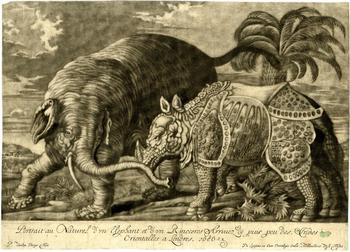
As exotic commodities appeared in London's shops, exotic animals and plants began to fill its gardens and menageries. Animals and plants often arrived as gifts but they were also sold, and in fact the lines between collecting and commerce were blurred in the early modern world.Footnote 61 The EIC occasionally facilitated the arrival of large live animals in London, like the elephant that arrived in 1675 along with an embassy from Java to the English king. The elephant attracted much admiration and was described in a pamphlet as well as becoming the subject of a political satire.Footnote 62 In 1684, John Evelyn wrote that a rhinoceros, ‘or unicorn’, had arrived in London.Footnote 63 According to the librarian and scholar Thomas Smith, the rhinoceros was finally sold at auction for over £3,000.Footnote 64 By 1686, the rhinoceros was being displayed for tuppence per view. These two animals were depicted together in a mezzotint published in Holland (Figure 1). Curiously, the depiction of the rhinoceros seems to draw more on Dürer's famous image than on the live creature.Footnote 65 More often, the EIC ships brought smaller animals back to London. As Foster notes, a 1607 request by the Earl of Salisbury for ‘parrats, munkies, and marmasitts’ prompted the EIC to issue orders on the third voyage to bring back any ‘straundge beasts and fowles that you esteem rare and delightful’.Footnote 66 The instruction was repeated on subsequent voyages and the creatures were to be gifted to the king and nobles. After the Restoration, Charles II was a particularly keen recipient of exotic animals, having an aviary laid out in St James's Park.Footnote 67 Such exotic gifts, along with the hefty loans English monarchs received from the EIC, were part of the exchange of favours that aided the renewal of the EIC's royal charters. The EIC also supplied animals, including English greyhounds, to their Asian patrons.Footnote 68
Jan Griffier after Francis Barlow, ‘A true representation of the Rhinocerus and Elephant lately brought from the East-Indies to London, drawn after the life, and curiously engraven in Mezzo Tinto, printed upon a large sheet of paper. Sold by Pierce Tempest at the Eagle & Child in the Strand over against Somerset House, 1685’. © 2019, the Trustees of the British Museum.

The British craze for exotic animals was not limited to the nobility. Before the first zoos began in the nineteenth century, exotic animals were displayed to the public first in social spaces like coffee houses and taverns, and later in menageries. Joshua Brookes's ‘Oriental menagerie’, began in the 1750s in Gray's Inn Road, Holborn, and extended in 1765 to premises on New Road on Tottenham Court. Here, birds and animals including antelopes, lions and monkeys were bought and exchanged.Footnote 69 Menageries also toured the country. According to Christopher Plumb, exotic animals were so common that it was normal to hear the roaring of lions and tigers when walking London's streets. The EIC was by no means the only importer of exotic animals; for example, the popular canaries brought to England from the beginning of the eighteenth century came from the Spanish Canary Islands, while the giant cassowaries that attracted admiration in Georgian England were imported from the Dutch East Indies. Similarly, London was not unique in being filled with exotic animals during the eighteenth century. Nonetheless, just as London was coming to predominate among European cities, with a population of 900,000 by the late eighteenth century, the EIC began to outstrip European competitors in terms of the quantity of goods it imported, and re-exported, by the same period.Footnote 70
Exotic plants also began to fill the gardens of London. The Society of Apothecaries’ Chelsea Physic Garden, begun in 1673, preceded Kew as a place for experimenting with growing exotic plants. By the 1720s, the garden was cultivating pineapples, coconuts, fig trees, guavas, mangoes, tea plants and Arabian jasmine. The membership of the later Society of Apothecaries overlapped with that of the Royal Society: John Houghton, Samuel Doody and James Petiver were apothecaries and fellows of the Royal Society. Many seventeenth-century apothecaries were expert botanists, most famously John Parkinson, author of Theatrum Botanicum (1640). Botanical as well as medical networks linked the EIC with the Society of Apothecaries. Notably, James Petiver corresponded extensively with company servants, procuring large collections of plants from the East Indies as well as other parts of the world.Footnote 71 On a visit to Hampton Court in 1690, Hans Sloane listed aloes, ginger and coconut palms among plants from the East and West Indies growing in the greenhouses. Greenhouses were developed in the late seventeenth century and enabled exotic plants to survive.Footnote 72 The Royal Botanical Gardens at Kew were begun in 1759 and, as Richard Drayton has shown, Joseph Banks transformed it into what he called the ‘great botanical exchange house for the empire’.Footnote 73 According to Richard Grove, it was the EIC surgeon and naturalist Patrick Russell who first convinced botanists in Britain of the possibility of a network of naturalists reporting back to Kew.Footnote 74 Kew's imperial network of plant exchange became a facilitator of British colonialism.Footnote 75 Again, the EIC territories were by no means the only imperial possessions involved in such exchanges, but they became central to them, especially after the loss of the American colonies and, hence, many of the natural commodities formerly produced there.
Scholarly attention to exotic plants and animals was not clearly distinguished from the popular entertainments in menageries and ale houses. Rather, elite involvement with these same materials helped raise them above the status of mere novelties. For instance, dissections of exotic animals were commonly undertaken by London anatomists and surgeons, including George and John Hunter. The latter's collection formed the basis of the museum of the Royal College of Surgeons.Footnote 76 The social networks that the EIC developed in London with scholars like Boyle, Sloane, Hunter, Banks and others helped grant legitimacy to the objects and animals that the EIC imported, demonstrating through their engagement that such things could aid in the improvement of knowledge and, potentially, benefit the nation. In the next section I will examine how the EIC drew on these same networks to transform natural objects into profitable commodities.
Natural knowledge and company commodities
Three of the most famous commodities that the EIC imported to London were saltpetre, opium and tea. The company's efforts to dominate the trade in these products were intertwined with efforts to understand the natural products and the process of transforming them into commodities. In each case, company servants first drew on local knowledge, and second collaborated with London-based natural philosophers in their efforts to understand the commodities. While the scope of both the EIC's investigations and their collaborations was wide-ranging, I have chosen to focus on the EIC's most famous commodities here to show that rather than being peripheral to the company's interests, investigations in natural philosophy were central to the continued success of their trade.
Saltpetre – the mineral form of potassium nitrate – is used in making gunpowder. As David Cressy points out, saltpetre was a precious and scarce resource in early modern Europe. The EIC had begun to supply England with saltpetre from India in 1624 and Josiah Child used this as a key justification for his claim that support for the EIC's trade was in the national interest.Footnote 77 After exploring various saltpetre markets in India, the EIC – like the Dutch East India Company (the Vereenigde Oostindische Compagnie or VOC) – focused from the 1650s on the areas around Patna in modern Bihar. Because unrefined saltpetre meant increased freight charges, both the VOC and the EIC ran saltpetre refineries near the sites of production: the Dutch in Chapra and the English in Singhee and Patna.Footnote 78 Initially, refining by evaporation was done in the Indian style, using earthenware vessels, but both companies began using copper vessels from the early 1650s.Footnote 79 The EIC's early investigations into saltpetre manufacture coincided with interest among London's natural philosophers, who believed salt and particularly volatile salts to be connected to natural phenomena such as volcanos, tides and plant respiration.Footnote 80 Saltpetre is derived from nitrate-rich soil but, ignorant of the chemical process of nitrification, Robert Boyle and his contemporaries were unsure whether it was mined or grown.Footnote 81 The Royal Society, concerned as they were to demonstrate their utility to the nation, also had a more practical interest in understanding how saltpetre was produced. Therefore they made efforts to collect and publish information on the subject. Extracts relating to the production of saltpetre in the Mughal Empire from the collection of travel narratives by Melchisédech Thévenot appeared in the very first issue of the Philosophical Transactions, published in 1665–1666.Footnote 82
The EIC's seventeenth-century Patna factory competed with the VOC and paid tributes to local rulers for access to saltpetre. The trade was often disrupted by warfare, droughts or floods. Therefore the EIC directors were not content to trade saltpetre, but wished either to control the areas in which it was produced or to find new sources of saltpetre in areas under their control. In 1683, the EIC directors wrote to their agents at St Helena that having ‘discoursed with many persons’, they suspected that saltpetre production might be possible on the island. Instructions follow for how to ‘make trial of the earth’ to test whether it contained sufficient nitre to produce saltpetre. The method they describe involves putting a pound of earth into a vessel with fresh water, letting it settle, and then pouring off ‘or decanting, as the Chymists call it’, the clean water and boiling it until nothing but wet salt remains. This should be placed on a board with holes in it and ‘the salt useless water will run through and leave the Petre upon the Board which you may afterwards weigh, and if you find that out of a pound of Earth that you have an ounce of Petre the Earth is very good’. The company's letter goes on to describe the method of saltpetre production used in England, but also remarks that given the scarcity of wood on the island, it would be preferable to use the cheaper method, of which ‘wee have been informed by the people of Pattana [Patna] upon the River Ganges in the East Indies’. It then gives a detailed description of the frames and cisterns used in extracting saltpetre from the ground in India.Footnote 83 This experiment was probably a failure, given that St Helena lacked the humid, monsoon-governed climate of Bihar. Nonetheless, these early instructions demonstrate both an engagement with experimental methods and a willingness to combine Asian and European methods of producing a commodity.
Reports from Patna filtered back to the Royal Society, who discussed saltpetre production in India in several meetings during the 1690s, where they noted the effects of the habitual flooding (as a result of the monsoon) on enabling saltpetre production. In 1698, the society prevailed upon a Dr Norris, who had offered them his services, to inquire further into the subject.Footnote 84 Thus the interests of the EIC converged with those of natural philosophers around saltpetre, leading to a gradual increase in understanding of the environmental factors affecting its production. By the eighteenth century, Britain relied on Indian saltpetre, sourced overwhelmingly from the area around Patna. However, until the 1750s, the trade was firmly controlled by Indian producers and middlemen. This situation changed dramatically after 1757, when Mir Jafar, their ally and then ruler of Bengal, granted the EIC a perpetual monopoly on saltpetre production. After assuming control of the region, the Patna factory invested directly in the saltpetre works.Footnote 85 The Patna factory also supplied both saltpetre and opium to the VOC, ending a long-term struggle for access between the two companies.Footnote 86 The supply of Indian saltpetre to Britain had far-reaching implications for the military revolution in Europe, for the outcome of conflicts like the Seven Years War, and for the transition towards British colonial rule in India.Footnote 87
Patna was also the centre of the opium trade from India to South East Asia and China. As early at 1599, John Chamberlain and Richard Hakluyt had identified opium as a potential commodity for the EIC.Footnote 88 The early eighteenth-century traveller Alexander Hamilton, after noting the English and Dutch factories’ involvement in the silk and saltpetre trade, commented that ‘it produces also so much opium that it serves all the Countries in India with that commodity’.Footnote 89 Nevertheless, the opium trade had largely been left to private traders during the seventeenth and early eighteenth centuries. The EIC began to take a direct interest in opium cultivation from the 1750s, in competition with the Dutch and French, and Mir Jafar's 1765 grant to the EIC included the poppy-producing areas of Patna. According to Ramchand Pandit, a contemporary observer, private English traders compelled growers to accept low prices for opium during the 1760s using gomasthas, local agents who often employed force.Footnote 90
In 1773, James Kerr produced a detailed report into the cultivation of opium in Bihar.Footnote 91 Kerr had been appointed assistant surgeon in Bengal in 1770, was promoted to surgeon in 1778, and died in Calcutta in 1782. He seems to have been confident in his abilities and keen for advancement, complaining in around 1778 that the head surgeon in Bengal ‘could not have passed as a surgeon's mate in Surgeon's Hall’ and also that he had been paid less than a ‘black slave boy called Nicholas’, a former dresser (of wounds) who had been rewarded with the pay of an assistant surgeon.Footnote 92 Kerr apparently wrote his report on his own initiative and likely in the hope that it would be noticed and rewarded. He had also apparently originally intended to present the paper to the Society for the Encouragement of Arts, Manufactures & Commerce (now best known as the Royal Society of Arts), but saw fit to submit it to the EIC first. The papers were channelled through John Fothergill (1712–1780), an English medic and botanist who had studied medicine at the University of Edinburgh. According to a 1776 postscript by Kerr, Fothergill mislaid the papers and did not immediately present them to the EIC as intended, although it is possible that Kerr or Fothergill reported his findings verbally in Calcutta or London. In any case, the EIC adopted the policy that Kerr recommended in 1773, shortly after he produced the report.Footnote 93
Kerr's report provides an interesting example of natural-philosophical enquiry explicitly geared toward enhancing the company's trade and supporting its monopoly. He begins with an assessment of the soils, which are clay, rich in calcium carbonate (‘calcearious salts’), and which contain on the surface nitrates as well as sodium (‘natrum’ and ‘alimentary salts’) and sulphate of lime. He then describes in detail the irrigation of the ploughed and harrowed fields, the sowing of the poppy seeds in October and November and the methods of fertilizing and watering them. Finally, he describes how to make incisions in the ripe capsules of the poppies and scrape off the juice and dry and mould it into small globular cakes. Kerr notes the common practice of adulterating the opium with cow dung and other substances that are kept secret. Kerr reports that six hundred thousand pounds’ weight is annually shipped to ‘China and the Eastern Islands’ (presumably South East Asia), where it sold for two to six Spanish dollars per pound.
While omitting to mention the abuses of private English traders directly, Kerr notes that the producers reap little benefit from these high prices, adding, ‘This may seem incredible to those who have not Considered what Monopolies can Produce’. In his letter to the company, he urges the company to monopolize opium, fixing a reasonable price for the producers, ensuring that it is pure and burning all bad opium. He argues that the production of opium could thereby be increased fiftyfold. Kerr describes the medical uses of poppy seeds and opium in Indian medicine, noting the use of the former as a cooling remedy and the latter as a cordial and to help cure swollen testicles, ‘for which purpose it is not inferiour to any European Prescription’. He also discusses opium addiction, noting that it ‘Emaciates the Person, and a Languid Stupifaction appears in his Countenance’. Finally, he notes that in the famine of 1770, ‘it was purchased by the unhappy Sufferers at Exorbitant Prices to allay the Cravings of Hunger and to Banish the dreadful Prospect of Death’. Kerr also turned this into an argument for the company to establish a monopoly over opium, arguing that, because of their ability to regulate prices, monopolies were particularly justified in cases of ‘noxious’ (potentially harmful) luxuries.
Like saltpetre, opium was of great interest to natural philosophers in Britain. The Royal Society received reports of opium use during the seventeenth century, including Edward Smythe's account of a day spent in Turkey with a habitual user of opium.Footnote 94 During the early nineteenth century, the Society for the Encouragement of Arts, Manufactures & Commerce – the intended audience for Kerr's report – offered prizes for the successful introduction of the opium poppy to Britain.Footnote 95 This society, founded in 1754, had offered from the outset financial incentives to domesticate a range of exotic plants including madder (a red dye) and rhubarb (then widely used in medicine).Footnote 96 While several growers of opium in Britain claimed that the opium they produced equalled that of imported opium,Footnote 97 the need for British-grown opium was probably overcome by the low prices at which the EIC sold Indian opium by the nineteenth century.
By the nineteenth century, the EIC was using the Chinese demand for Indian opium to combat the problem of the drain of bullion to China in exchange for the tea that was so greatly in demand in Britain. In 1664, tea was served to Charles II by EIC agents. In the mid-seventeenth century, tea was an expensive luxury considered to have medicinal benefits.Footnote 98 The EIC had established some short-lived and mainly unsuccessful settlements in China during the late seventeenth century but, during the eighteenth century, the Canton system enabled regular access to the commodity, which was by then in great demand in Britain. Tea imports rose particularly swiftly after 1748 and again after 1767.Footnote 99 By the end of the eighteenth century, all sectors of British society drank tea. However, the EIC did not have a firm grasp on tea as a commodity until they could produce (rather than merely trade) it. Throughout much of the eighteenth century, the price of EIC tea in Britain was undercut by smugglers.Footnote 100
Before the discovery in 1823 by Robert Bruce that tea grew in Assam, the EIC was interested in whether it was possible to transplant the tea shrub to parts of the East Indies under British control. In 1788, the naturalist and explorer Joseph Banks, then president of the Royal Society, advised the EIC directors about the climates and latitudes in India where tea might be produced. As a first step, he advised, tea plants should be brought to the recently established botanical gardens in Calcutta along with any Chinese labourers from Hunan Province who could be induced to board EIC ships departing from Canton.Footnote 101 In his advice, Banks drew on the description of Japanese and Chinese tea given by the seventeenth-century travellers Engelbert Kaempfer and Jean Baptiste du Halde.Footnote 102 He also referred to an account by a company surgeon, James Cunningham, of the tea plant, published in the Royal Society's journal Philosophical Transactions in 1702.Footnote 103 James Cunningham's original report had been sent to James Petiver, an apothecary and member of the Royal Society. Cunningham also sent specimens of prepared tea leaves to London, which entered Hans Sloane's collections.Footnote 104 Cunningham had been crucial in solving a problem that had puzzled Europeans: whether all the sorts of tea they received were derived from the same shrub.Footnote 105 Despite the various sources of information Banks drew on, how tea was prepared remained a mystery to eighteenth-century Europeans. As Banks wrote to Macartney,
Their very Tea depends upon a Chemical Process we are unable to imitate, which takes from the Leaves of the Plant not only an unpleasant taste, but as Kaempfer tells us, a deleterious Quality, & substitutes in its Room a flavor agreable to all Palates, leaving just enough of the Poison to afford possibly the most exhilarating medicine we possess.Footnote 106
Banks's advice highlights, first, how crucial mobilizing natural knowledge was for the company. Second, it shows how the EIC relied on experts like Banks and institutions like the Royal Society to preserve, publish and reutilize the knowledge that their servants gathered. Finally, it demonstrates the EIC's need to acquire plants along with knowledge about how to cultivate them and transform them into commodities. Following Banks's advice, 272 tea plants arrived from Canton in 1790. Their cultivation did not translate immediately into tea plantations in India, as Banks had hoped.Footnote 107 Nonetheless, some other similar projects did come to fruition. Banks refers in his letter to the success of individuals in cultivating indigo in India, a key aim since West Indian sources of indigo had been disrupted after American independence. Under William Roxburgh's stewardship, the Calcutta botanical garden succeeded in producing and distributing plants including Cerulean indigo as well as teak seed, Bengal hemp, Virginia tobacco and Arabia coffee by 1793. Indigo began to be produced as a cash crop in Bengal by the 1790s.Footnote 108
Tea, opium and saltpetre are among the best-known commodities in which the EIC dealt. In each case, the EIC depended on its employees in the settlements to mine local knowledge and turn it to making a profit, often in consultation with natural philosophers based in London. While some of these experiments – many begun in the seventeenth century – remained unsuccessful in the eighteenth century, others succeeded. All laid the foundations for the nineteenth-century British domination of the means of production of, as well as the trade in, these commodities. In 1848, the EIC made another attempt to transplant tea plants from China to India, employing Robert Fortune, FRS and curator of Chelsea Physic Garden. Fortune successfully transplanted the tea plants using Wardian cases, miniature greenhouses devised by Nathaniel Bagshaw Ward, also a master apothecary.Footnote 109 As this example shows, by the nineteenth century, the EIC was able to employ, on a formal basis, a range of experts to advise them and to conduct surveys covering everything from mapping to botany to mineralogy. The period of informal exchanges between the EIC, natural philosophers and technical experts like apothecaries and instrument-makers provided an important basis for these later collaborations.
Conclusions
In her recent work on the EIC's nineteenth-century museum, Jessica Ratcliff argues that the company played an important role in furnishing the ‘stuff of science’, fuelling the demand for data from new empirical sciences including geology, palaeontology, meteorology, oceanography and physical botany. East India House on Leadenhall Street, she argues, functioned as a ‘sorting house or sieve’, channelling objects and information to several other institutions in London and beyond, where they formed the basis for research.Footnote 110 The company's nineteenth-century museum aimed to centralize and bureaucratize the flow of information from the settlements. This was part of the wider drive on the part of the EIC and the British state to assert greater control over the Asian settlements and to reverse British dependence on Asian manufactures.
Early incarnations of the EIC were as different from the nineteenth-century company as nineteenth-century science was from seventeenth-century natural philosophy. During the seventeenth and eighteenth centuries, the creation of knowledge within the EIC resembled the creation of wealth from private trade. Much of it remained in the Asian settlements while that which returned to London did so through individuals and their social networks. Nonetheless, during the seventeenth and eighteenth centuries, the company settlements were major sources of raw data for a range of knowledge-making activities in London, from investigations in chemistry, to geography, botany and medicine. In turn, the company relied on a network of informants in London, as well as in its Asian settlements, to provide them with information that could help them transform natural products into profitable commodities.
Using a broad definition of experimentalism, I have argued here for a basic continuity within the knowledge culture of the EIC throughout the seventeenth and eighteenth centuries. This contrasts with the traditional claim that the EIC began to take an interest in scholarly endeavour only after it became the ruler of parts of India from the 1770s onwards. P.J. Marshall's work on Warren Hastings (governor or governor general of Bengal from 1772 to 1785) provides an example of this assumption. Marshall demonstrates that Hastings laid the ground for a range of scholarly work within the EIC, including geographical, linguistic and botanical enquiries. However, Marshall argues that fifteen years before the Asiatic Society's founding in 1784 it would have been difficult to find any members of EIC with significant interest in their surroundings.Footnote 111 Using three examples relating to its best-known products, I have shown here that the EIC was invested in natural philosophy and technical knowledge from an early stage. In the case of saltpetre, the EIC directors were instructing its St Helena factory to conduct experiments informed by both South Asian knowledge and contemporary European chemical ideas as early as the 1680s. Joseph Banks's advice to the company about growing tea relied on the information gathered in the early eighteenth century by the surgeon James Cunningham. Therefore not only did seventeenth- and early eighteenth-century investigations prefigure later enquiries, they also often directly informed them. In their investigations into the natural products that formed the basis of their trade, the EIC relied on networks of people with natural-philosophical and technical knowledge in London and beyond. The mutually reinforcing networks the EIC created in London aided their claims to be benefiting the nation through the goods and information they imported to the capital.