

Introduction
Criminology as a discipline plays a vital role in understanding, preventing and addressing crime in society (Aborisade Reference Aborisade2016; Blaustein et al. Reference Blaustein, Pino, Fitz-Gibbon and White2018). In Nigeria, criminology has evolved in response to the country’s unique socio-political, economic and cultural realities, shaping its approach to crime control, criminal justice policies and law enforcement practices (Mai-Bornu Reference Mai-Bornu2024; Raufu et al. Reference Raufu, Tsado, Mendie and Ben-Edet2024). However, the discipline faces significant challenges, including inadequate institutional support, limited empirical research and the marginalization of indigenous criminological perspectives in policy formulation (Aborisade Reference Aborisade, Liadi and Busari2022a; Reference Aborisade, Wallace, Berlin and Das2022b; Aborisade and Adedayo Reference Aborisade and Adedayo2018; Daukere et al. Reference Daukere, Dankani, Yahaya, Sulaiman, Olaniyi and Eniolorunda2023). These challenges have implications for Nigeria’s ability to align its criminological approaches with the global objectives of the United Nations Sustainable Development Goals (UN SDGs), particularly Goal 16 (Peace, Justice and Strong Institutions), which emphasizes the promotion of peaceful and inclusive societies, access to justice and the establishment of effective institutions.
The UN SDGs framework presents both challenges and opportunities for Nigerian criminology. While issues such as insecurity, organized crime, police brutality and weak judicial processes hinder progress towards sustainable development, there are also opportunities for criminologists to contribute to policy reforms, community-based interventions and evidence-based crime-prevention strategies. Additionally, advancements in technology, international collaborations and the growing recognition of indigenous knowledge systems provide new directions for criminological research and practice in Nigeria.
This article examines the intersection between Nigerian criminology and the UN SDGs, analysing the barriers to effective implementation, the potential for criminological scholarship to drive sustainable crime prevention, and the strategic directions necessary to enhance the discipline’s impact. By critically engaging with policy frameworks, criminological theories and empirical data, the paper explores how Nigerian criminology can contribute to the broader discourse on justice, security and development in the country.
The UN Sustainable Development Goals: An Overview
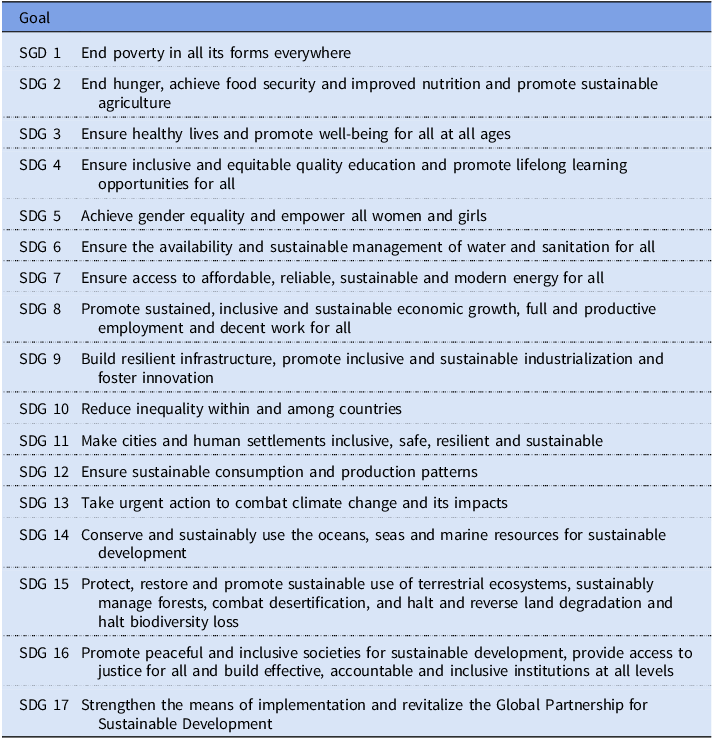
In September 2015, the UN General Assembly adopted the 2030 Agenda for Sustainable Development, which consists of 17 SDGs (see Table 1).
Sustainable Development Goals (SDGs)

The UN SDGs serve as a blueprint for achieving a better and more sustainable future by addressing critical global challenges, including poverty, inequality, climate change, environmental degradation, peace and justice. The SDGs build upon the success of the Millennium Development Goals while expanding their focus to include economic growth, social inclusion and environmental sustainability (Mensah Reference Mensah2019; Mishra et al. Reference Mishra, Desul, Guimarães Santos, Mishra, Kamal, Goswami, Mukalazi Kalumba, Biswal, Marques da Silva, Costa dos Santos and Baral.2024; Yumnam, Gyanendra, and Singh Reference Yumnam, Gyanendra and Singh2024). Each goal has specific targets and indicators designed to measure progress, with the ultimate aim of promoting prosperity while ensuring the well-being of people and the planet.
The SDGs are universal, integrated and indivisible, meaning that they apply to all countries and recognize the interconnectedness of development issues. For example, ending hunger (Goal 2) is closely linked to climate action (Goal 13) and responsible consumption (Goal 12). Achieving gender equality (Goal 5) also enhances economic growth (Goal 8) and reduces inequalities (Goal 10). To facilitate progress, the SDGs emphasize partnerships (Goal 17), encouraging collaboration among governments, private sectors, civil society and international organizations. While significant strides have been made, challenges remain, and continued commitment is needed to accelerate progress toward these ambitious targets by 2030.
The SDGs are deeply connected to crime and security, as achieving sustainable development requires reducing violence, strengthening justice systems and promoting the rule of law (Blaustein et al. Reference Blaustein, Pino, Fitz-Gibbon and White2018; Peacock Reference Peacock2021; Redo Reference Redo2018). SDG 16: Peace, Justice and Strong Institutions specifically addresses crime prevention, access to justice and institutional accountability, recognizing that security and stability are essential for sustainable progress. Other SDGs also contribute to crime reduction by tackling its root causes – SDG 1 (No Poverty) and SDG 4 (Quality Education) help prevent criminal behaviour by addressing economic hardship and improving educational opportunities. At the same time, SDG 5 (Gender Equality) combats gender-based violence and human trafficking.
Criminology and criminologists play a crucial role in ensuring the actualization of these goals by studying crime patterns, analysing the effectiveness of crime-prevention strategies, and developing policies that promote justice and security. Through evidence-based research, advocacy and collaboration with law enforcement and policymakers, criminologists help design crime-reduction strategies that align with the SDGs, ensuring that security and justice remain integral to global development efforts. This article examines the role of criminology in advancing SDG-related crime-prevention and security initiatives within the Nigerian context, highlighting the challenges, opportunities and policy implications for achieving sustainable peace and justice.
Theoretical Background
The intersection of Nigerian criminology and the UN SDGs can be analysed through multiple criminological and development-related theoretical frameworks. This article adopts an integrative theoretical approach by drawing insights from Strain and Routine Activity theories, and critical criminology, among others, to examine the challenges, opportunities and future directions for criminology in Nigeria within the context of sustainable development.
Merton’s Strain Theory (Reference Merton1938) and Agnew’s General Strain Theory (Reference Agnew1992) both explain how strain or pressure can lead individuals to engage in criminal behaviour, but they differ in scope and focus. Robert Merton’s Strain Theory argues that crime arises when there is a disjunction between culturally approved goals (such as financial success) and the legitimate means available to achieve them. He identified five adaptations to strain: conformity; innovation; ritualism; retreatism; and rebellion, with innovation being most associated with crime, as individuals turn to illegitimate means to achieve success when blocked by structural barriers. In contrast, Robert Agnew’s General Strain Theory (GST) expands on Merton’s ideas by considering a broader range of strains beyond economic limitations. Agnew identifies three major sources of strain: failure to achieve positively valued goals; loss of valued possessions or relationships; and exposure to negative stimuli (such as abuse or discrimination). He argues that strains increase the likelihood of crime, especially when they generate negative emotions like anger and frustration, and when individuals lack coping mechanisms. While Merton’s theory focuses on societal structures, Agnew’s GST emphasizes individual experiences and emotions, making it more applicable to diverse forms of criminal behaviour, including violent and juvenile delinquency.
The two theories provide an explanatory framework for crime in Nigeria, particularly in the context of unmet socio-economic expectations, unemployment and corruption. Many individuals in Nigeria face limited access to legitimate means of achieving economic success, leading to criminal adaptations such as fraud (e.g. cybercrime), violent crime and organized crime (Aborisade Reference Aborisade2017; Anam et al. Reference Anam, Ijim, Ironbar, Otu, Duke and Eba2024). Addressing these structural strains through policies aligned with the UN SDGs, such as fostering economic inclusion (Goal 10: Reduced Inequalities) and strengthening institutions (Goal 16: Peace, Justice and Strong Institutions), can reduce crime rates and promote sustainable social order.
Critical criminology is a perspective that challenges traditional understandings of crime by emphasizing the role of power, inequality and social structures in shaping both criminal behaviour and the justice system (Cao Reference Cao2003; Woods Reference Woods2013). Rooted in Marxist, feminist, postmodern and critical race theories, it argues that crime is not merely a result of individual choices but is deeply influenced by structural inequalities, such as poverty, discrimination and political oppression (Meyer Reference Meyer2014). Critical criminologists contend that laws and legal institutions often serve the interests of the powerful while marginalizing vulnerable groups, leading to issues like racial profiling, mass incarceration and economic exploitation (Akbar Reference Akbar2018; Bell Reference Bell2021). This approach seeks to expose how social injustices contribute to crime and advocates for transformative solutions, including decriminalization, restorative justice and community-led initiatives. In Nigeria, critical criminology is particularly relevant for analysing issues such as police brutality, corruption, gender-based violence and economic crimes, highlighting the need for systemic reforms that promote justice and equality in the criminal justice system (Aborisade Reference Aborisade2017; Aborisade and Obileye 2017).
Critical criminology, particularly post-colonial and Southern criminology perspectives, provides a lens to critique the Eurocentric nature of criminological theories and justice policies imposed on Nigeria (Daukere et al. Reference Daukere, Dankani, Yahaya, Sulaiman, Olaniyi and Eniolorunda2023; Mai-Bornu Reference Mai-Bornu2024). Western-centric crime-control models often fail to consider Nigeria’s unique sociocultural realities, leading to ineffective justice policies (Aborisade Reference Aborisade, Aderinto, Tade and Ojedokun2022c). The UN SDGs framework calls for inclusive and context-specific approaches, reinforcing the need for indigenous criminological knowledge, traditional justice mechanisms and restorative justice practices (Peacock Reference Peacock2021; Redo Reference Redo2018). By integrating these perspectives, Nigerian criminology can offer localized solutions to crime that align with sustainable development principles.
The integration of these criminological theories with the UN SDGs suggests that addressing crime in Nigeria requires a multi-faceted approach that goes beyond punitive measures. Instead, a shift towards crime prevention through social development, institutional capacity building and inclusive governance can create a more sustainable and effective crime-control framework. This theoretical foundation provides a roadmap for exploring how Nigerian criminology can evolve to better align with global SDGs, overcoming existing challenges while leveraging new opportunities for policy and practice.
Crime, Criminal Justice in Nigeria and Sustainable Development
Crime and criminal justice are critical factors influencing Nigeria’s ability to achieve sustainable development. High crime rates, weak law enforcement, judicial inefficiencies and systemic corruption undermine security, economic growth and social stability – key components of the UN SDGs, particularly Goal 16. Addressing crime and strengthening criminal justice institutions are essential for ensuring a just, inclusive and development-oriented society.
Crime Trends and Patterns in Nigeria
Nigeria is confronted with a wide array of criminal activities that present formidable obstacles to sustainable development (Oni Reference Oni2022; Raufu et al. Reference Raufu, Tsado, Mendie and Ben-Edet2024). These crimes span from street-level offences and cyber-related crimes to complex organized criminal operations and terrorism. Violent crimes such as armed robbery, kidnapping for ransom, murder and domestic violence remain persistent threats to public safety (Adenuga, Aborisade, and Atere Reference Adenuga, Richard and Atere.2024; Badiora and Aborisade Reference Badiora and Aborisade2024; Ebobo, Aborisade, and Atere Reference Ebobo, Aborisade and Atere2024). Cybercrime and financial fraud, manifested in forms like online scams (popularly known as “Yahoo Yahoo”), identity theft and money laundering, continue to destabilize the economy and tarnish Nigeria’s international reputation (Aborisade Reference Aborisade2023). Organized crime further complicates the security landscape, with human trafficking, drug and arms smuggling, and cult-related violence undermining community stability and law enforcement initiatives (Adenuga et al. Reference Adenuga, Richard and Atere.2024; Badiora and Aborisade Reference Badiora and Aborisade2024; Mai-Bornu Reference Mai-Bornu2024). In addition, terrorism and insurgency, particularly from groups like Boko Haram and the Islamic State West Africa Province (ISWAP), have led to widespread displacement, economic disruptions and chronic insecurity, especially in the northeastern region of the country (Badiora and Aborisade Reference Badiora and Aborisade2024). Corruption and white-collar crime, including embezzlement, bribery and fraudulent contracting, also play a significant role in weakening governance structures, discouraging investment and deepening poverty (Aborisade Reference Aborisade2017). Collectively, these criminal patterns impede Nigeria’s efforts to achieve several SDGs, notably SDG 8 on decent work and economic growth, SDG 11 on sustainable cities and communities, and SDG 16 on peace, justice and strong institutions.
The Criminal Justice System
Nigeria’s criminal justice system is composed of three main components: law enforcement agencies; the judiciary; and correctional institutions. Despite this structure, various systemic inefficiencies continue to limit the system’s effectiveness and its potential contribution to sustainable development. Law enforcement and policing are primarily handled by the Nigerian Police Force (NPF), which operates alongside other key security agencies such as the Department of State Services (DSS), the Nigeria Security and Civil Defence Corps (NSCDC) and the Economic and Financial Crimes Commission (EFCC). Together, these bodies are tasked with maintaining law and order, investigating crimes and upholding national security. However, their performance is hindered by several persistent challenges. One major issue is police brutality and the widespread violation of human rights (Aborisade and Fayemi Reference Aborisade and Fayemi2015; Aborisade and Obileye 2017). Incidents involving extrajudicial killings, unlawful detentions and extortion have significantly eroded public trust in the police (Oni Reference Oni2022). These grievances came to a head during the #EndSARS protests in 2020, which drew national and international attention to police misconduct and impunity.
In addition to these concerns, the NPF suffers from chronic underfunding and inadequate training (Oni Reference Oni2022). Many officers are ill-equipped to handle modern crime due to a lack of forensic tools, technological resources and professional development. This shortfall severely limits their ability to investigate complex cases and deliver justice (Aborisade and Ogunyemi 2025). Corruption is another significant issue troubling law enforcement. Accusations of bribery, manipulation of case outcomes and selective application of justice are prevalent, further undermining the credibility of security institutions (Aborisade and Fayemi Reference Aborisade and Fayemi2015; Oni Reference Oni2022). These structural and operational weaknesses not only hinder effective crime prevention and conflict resolution but also obstruct Nigeria’s progress toward achieving SDG 16.6, which calls for the development of effective, accountable and transparent institutions at all levels.
Nigeria’s judicial system, which includes the Supreme Court, Court of Appeal, Federal and State High Courts, Magistrate Courts and Customary Courts, is responsible for interpreting laws and delivering justice. Despite this comprehensive structure, the system faces several challenges that limit its effectiveness and accessibility. One of the most pressing issues is the widespread delay in case resolution, largely due to an overburdened court system (Aborisade Reference Aborisade, Liadi and Busari2022a, Reference Aborisade, Aderinto, Tade and Ojedokun2022c; Ukati Reference Ukati2024). Many legal matters drag on for years, creating significant backlogs and delaying justice for victims and defendants alike. This slow pace discourages citizens from pursuing legal redress and undermines confidence in the system’s ability to deliver fair and timely outcomes.
Corruption and political interference further compromise the credibility of the judiciary (Aborisade Reference Aborisade, Aderinto, Tade and Ojedokun2022c; Ukati Reference Ukati2024). Instances where political or financial interests influence judges or prosecutors raise serious concerns about the impartiality of court decisions and the integrity of the legal process. Additionally, access to legal representation remains limited, especially for poor and marginalized individuals (Ukati Reference Ukati2024). The scarcity of affordable legal aid services means that many people are unable to defend their rights or navigate complex legal procedures, effectively excluding them from the justice system. These obstacles weaken the rule of law and hinder Nigeria’s ability to fulfill SDG 16.3, which emphasizes the promotion of justice and equal access to legal remedies for all citizens.
Nigeria’s correctional institutions, which include prisons and juvenile detention centres, face numerous structural and operational challenges that significantly hinder their effectiveness (Aborisade Reference Aborisade, Aderinto, Tade and Ojedokun2022c; Adetona Reference Adetona2024). Overcrowding is a persistent issue, with many facilities operating far beyond their intended capacity. This not only creates inhumane living conditions but also poses serious health risks and leads to frequent violations of inmates’ human rights (Aborisade Reference Aborisade2019; Joseph et al. Reference Joseph, Femi, Arisukwu Ogadimma, Oluwakemisola, Akintoyese and Joseph2021). Another major concern is the high rate of pretrial detention. A significant proportion of the prison population consists of individuals who have not been convicted but are held for extended periods while awaiting trial. Some detainees spend years behind bars without formal charges or court judgments, highlighting severe inefficiencies in the justice process (Joseph et al. Reference Joseph, Femi, Arisukwu Ogadimma, Oluwakemisola, Akintoyese and Joseph2021). In addition, the correctional system lacks adequate rehabilitation and reintegration programmes. There are limited opportunities for vocational training, education or psychological support, making it difficult for inmates to acquire the skills needed to reintegrate into society after release successfully (Adetona Reference Adetona2024). This lack of support contributes to high rates of reoffending and perpetuates a cycle of crime and incarceration. The failure of the correctional system to rehabilitate offenders and facilitate their return to society undermines broader efforts to strengthen the rule of law and reduce social inequalities (Joseph et al. Reference Joseph, Femi, Arisukwu Ogadimma, Oluwakemisola, Akintoyese and Joseph2021). It poses a serious barrier to achieving SDG 16.3, which promotes access to justice for all, and SDG 10, which seeks to reduce inequalities within societies.
Overall, the persistent inefficiencies in Nigeria’s crime-control mechanisms and criminal justice system have profound and wide-ranging effects on the country’s pursuit of sustainable development (Anam et al. Reference Anam, Ijim, Ironbar, Otu, Duke and Eba2024; Daukere et al. Reference Daukere, Dankani, Yahaya, Sulaiman, Olaniyi and Eniolorunda2023; Mensah Reference Mensah2019). Economically, high levels of crime deter foreign investment, elevate the cost of doing business and lead to capital flight, all of which hamper economic growth and limit progress toward SDG 8, which promotes decent work and economic prosperity. Socially, widespread insecurity contributes to population displacement, disrupts access to education and deepens poverty (Aborisade Reference Aborisade, Liadi and Busari2022a; Daukere et al. Reference Daukere, Dankani, Yahaya, Sulaiman, Olaniyi and Eniolorunda2023). These challenges make it increasingly difficult for Nigeria to meet the targets of SDG 1 on eradicating poverty and SDG 4 on ensuring inclusive and equitable quality education. From a governance perspective, corruption and dysfunction within law enforcement and the judiciary erode democratic institutions and public confidence. This weakens the foundations of justice and accountability, directly impeding efforts to achieve SDG 16, which aims to foster peaceful, just and inclusive societies supported by strong institutions.
Criminology and the UN SDGs in Nigeria: The Challenges
Despite its relevance to promoting sustainable development, Nigerian criminology faces several institutional, theoretical, practical and socio-political challenges that hinder its alignment with the UN SDGs. These challenges affect the discipline’s ability to contribute effectively to crime prevention, justice reforms and security policies necessary for achieving SDG 16 (Peace, Justice and Strong Institutions) and other related goals.
Weak Institutional Frameworks and Policy Gaps
Nigeria’s criminology faces significant challenges due to weak institutional frameworks and policy gaps that hinder its integration into national crime-prevention and justice reforms. One major issue is the lack of evidence-based policymaking, as crime-control strategies are often developed without sufficient reliance on criminological research (Aborisade Reference Aborisade, Aderinto, Tade and Ojedokun2022c; Tiwa Reference Tiwa2024). This results in reactive and punitive approaches that fail to address the root causes of crime, such as poverty, unemployment and social inequality. Additionally, the country’s legal frameworks remain inconsistent and outdated, failing to incorporate criminological insights into national security strategies (Ukati Reference Ukati2024). As a result, crime-prevention policies lack coherence, and efforts to implement modern approaches, such as restorative justice or community-based crime prevention, are largely absent. These institutional weaknesses hinder the development of long-term solutions that align with the UN SDGs, particularly SDG 16, which emphasizes the promotion of peace, justice and strong institutions.
Another critical challenge is the poor collaboration between criminologists, law enforcement agencies and policymakers, which limits the practical application of criminological knowledge (Aborisade Reference Aborisade, Aderinto, Tade and Ojedokun2022c). Criminological research remains largely confined to academic circles, with little translation into real-world crime-control strategies (Ashby Reference Ashby2020). Law enforcement agencies and policymakers often overlook criminological insights, resulting in a disconnect between research and policy implementation. Furthermore, bureaucratic inefficiencies, corruption and inadequate funding undermine the execution of crime-prevention initiatives, making them ineffective (Aborisade Reference Aborisade, Aderinto, Tade and Ojedokun2022c; Tiwa Reference Tiwa2024). Corruption within law enforcement and judicial institutions undermines public trust and fosters selective enforcement, thereby eroding the credibility of the justice system (Aborisade and Fayemi Reference Aborisade and Fayemi2015; Oni Reference Oni2022). These challenges contribute to rising crime rates and social instability, creating an environment where crime-control measures fail to produce meaningful, sustainable outcomes. Without addressing these institutional and policy-related barriers, Nigeria’s criminal justice system will continue to struggle in achieving crime reduction and sustainable development.
Underfunding and Limited Research Support
Underfunding and limited research support remain significant barriers to the advancement of criminology in Nigeria, hindering the discipline’s ability to make meaningful contributions to crime prevention and justice (Aborisade Reference Aborisade, Liadi and Busari2022a, Reference Aborisade, Aderinto, Tade and Ojedokun2022c; Daukere et al. Reference Daukere, Dankani, Yahaya, Sulaiman, Olaniyi and Eniolorunda2023; Mai-Bornu Reference Mai-Bornu2024). Criminological research is critically underfunded, with minimal government support, limited research grants and inadequate institutional resources reforms (Raufu et al. Reference Raufu, Tsado, Mendie and Ben-Edet2024). As a result, criminologists struggle to conduct large-scale empirical studies on crime trends, victimization patterns and policing strategies. The lack of well-funded research initiatives hinders scholars’ ability to generate data-driven insights that can inform policy reforms (Mai-Bornu Reference Mai-Bornu2024; Raufu et al. Reference Raufu, Tsado, Mendie and Ben-Edet2024). Moreover, the lack of institutional investment in criminology has led to outdated curricula, insufficient training opportunities, and limited access to advanced research tools and methodologies, further reducing the discipline’s relevance in shaping crime-control strategies.
Beyond limiting empirical research, inadequate funding also impedes the development of localized criminological theories that reflect Nigeria’s unique socio-political realities (Aborisade Reference Aborisade, Liadi and Busari2022a; Daukere et al. Reference Daukere, Dankani, Yahaya, Sulaiman, Olaniyi and Eniolorunda2023). Many criminological frameworks applied in Nigeria are adapted from Western contexts, often failing to capture the complexities of crime in an environment shaped by cultural, economic and political factors distinct from those in developed nations (Anam et al. Reference Anam, Ijim, Ironbar, Otu, Duke and Eba2024; Daukere et al. Reference Daukere, Dankani, Yahaya, Sulaiman, Olaniyi and Eniolorunda2023; Mai-Bornu Reference Mai-Bornu2024). Without resources for in-depth studies, criminologists are unable to engage in comparative criminological research that benchmarks Nigeria’s crime challenges and intervention strategies against global best practices (Raufu et al. Reference Raufu, Tsado, Mendie and Ben-Edet2024; Ukati Reference Ukati2024). The marginalization of criminology in national development planning undermines its role in informing evidence-based policies for crime prevention, justice administration and law enforcement. Until significant investments are made in criminological research and infrastructure, the discipline will continue to struggle in influencing meaningful policy changes that align with the UN SDGs, particularly SDG 16, which emphasizes peace, justice and strong institutions.
Theoretical and Epistemological Marginalization
Theoretical and epistemological marginalization presents a critical challenge to the development of criminology in Nigeria, as the discipline remains heavily influenced by Western theoretical models that do not always align with the country’s unique crime and justice realities (Anam et al. Reference Anam, Ijim, Ironbar, Otu, Duke and Eba2024; Daukere et al. Reference Daukere, Dankani, Yahaya, Sulaiman, Olaniyi and Eniolorunda2023; Mai-Bornu Reference Mai-Bornu2024). The overreliance on Eurocentric criminological frameworks limits scholars’ ability to develop localized theories that accurately reflect Nigeria’s social, political and economic conditions. Many dominant criminological theories were formulated in Western contexts with different historical and structural crime dynamics, making them inadequate in explaining the patterns of crime and criminal behaviour in Nigeria. This results in a gap between academic criminology and the lived realities of crime and justice in the country, weakening the discipline’s relevance in policy formulation and crime-control strategies.
Additionally, Nigerian criminology has largely neglected traditional justice systems, such as community-based conflict resolution mechanisms and indigenous policing methods that have historically played vital roles in maintaining order (Aborisade Reference Aborisade, Aderinto, Tade and Ojedokun2022c; Daukere et al. Reference Daukere, Dankani, Yahaya, Sulaiman, Olaniyi and Eniolorunda2023). The marginalization of African and post-colonial criminological perspectives has led to a lack of theoretical originality, preventing the development of criminological models that reflect Nigeria’s diverse legal cultures, customary laws and informal justice mechanisms (Anam et al. Reference Anam, Ijim, Ironbar, Otu, Duke and Eba2024; Mai-Bornu Reference Mai-Bornu2024). This epistemological gap limits the discipline’s ability to contribute effectively to the UN SDGs, particularly SDG 16.3, which emphasizes the promotion of inclusive and culturally relevant justice systems. Without a more contextually grounded criminology that integrates indigenous perspectives and post-colonial critiques, Nigerian criminology will continue to struggle in influencing sustainable crime-prevention strategies and justice reforms.
Socio-economic Inequalities and Crime-Control Challenges
Socio-economic inequalities remain a fundamental driver of crime and insecurity in Nigeria; however, criminology in the country has struggled to engage meaningfully with policies that address these root causes (Anam et al. Reference Anam, Ijim, Ironbar, Otu, Duke and Eba2024; Oduwole and Aborisade Reference Oduwole and Aborisade2023). High levels of unemployment, poverty and economic disparity contribute to various forms of criminal activity, including cybercrime, kidnapping, terrorism and police brutality. However, crime-prevention efforts remain largely reactive, focusing on law enforcement crackdowns rather than addressing the economic conditions that push individuals toward criminal behaviour (Aborisade Reference Aborisade, Wallace, Berlin and Das2022b). Nigerian criminology has not been effectively integrated into broader economic policies, preventing the development of crime-prevention strategies rooted in financial inclusion (Raufu et al. Reference Raufu, Tsado, Mendie and Ben-Edet2024). This disconnect limits the discipline’s contribution to SDGs such as SDG 1 (No Poverty) and SDG 8 (Decent Work and Economic Growth), which emphasize the role of economic empowerment in reducing crime.
Another major challenge is the limited emphasis on rehabilitative and restorative justice models, which could reduce recidivism and promote social inclusion for offenders (Adetona Reference Adetona2024). Instead of prioritizing crime prevention through social development, the criminal justice system largely focuses on punitive measures that do little to address the underlying socio-economic factors driving crime (Anam et al. Reference Anam, Ijim, Ironbar, Otu, Duke and Eba2024; Daukere et al. Reference Daukere, Dankani, Yahaya, Sulaiman, Olaniyi and Eniolorunda2023). Furthermore, Nigerian criminology has yet to establish strong multi-disciplinary collaborations with economists, social workers and urban planners – key stakeholders in creating crime prevention through social development frameworks. Without such an integrated approach, crime-control strategies will remain fragmented, failing to incorporate crucial social and economic reforms that could lead to long-term crime reduction and sustainable security. Addressing these gaps requires a shift toward policies that view crime prevention as an integral part of economic and social development rather than solely a matter of law enforcement.
Corruption, Police Brutality and Weak Criminal Justice Institutions
Corruption, police brutality and weak criminal justice institutions present severe obstacles to the role of criminology in fostering strong and accountable governance in Nigeria. Systemic corruption pervades law enforcement agencies, undermining public trust and weakening efforts toward sustainable crime prevention (Aborisade and Fayemi Reference Aborisade and Fayemi2015; Aborisade and Obileye 2017; Daukere et al. Reference Daukere, Dankani, Yahaya, Sulaiman, Olaniyi and Eniolorunda2023). The NPF, often accused of excessive use of force, human rights abuses and extortion, faces widespread legitimacy crises, making community cooperation in crime control difficult. These issues are exacerbated by a judicial system plagued by inefficiencies such as case backlogs, wrongful convictions and barriers to justice for marginalized groups (Adetona Reference Adetona2024). Rather than serving as an impartial mechanism for maintaining order and enforcing the law, the criminal justice system is often perceived as a tool for the powerful, failing to uphold the principles of fairness and accountability central to SDG 16.6, which calls for effective, transparent and accountable institutions.
Political interference further weakens the independence of law enforcement and judicial institutions, making it difficult to implement criminological recommendations that could enhance crime control and justice administration (Akbar Reference Akbar2018; Ashby Reference Ashby2020; Blaustein et al. Reference Blaustein, Pino, Fitz-Gibbon and White2018). High-profile cases of political figures influencing criminal investigations, shielding corrupt officials from prosecution or using security agencies to suppress dissent highlight the extent to which governance failures impact crime-prevention efforts (Mai-Bornu Reference Mai-Bornu2024). These institutional shortcomings limit criminology’s capacity to shape policy reforms, as research-driven strategies often clash with the interests of those benefiting from the status quo. Without systemic reforms to curb corruption, ensure judicial independence and rebuild public trust in law enforcement, Nigeria’s criminology will struggle to contribute meaningfully to SDG-related justice and security reforms, leaving crime-control efforts ineffective and unsustainable.
Limited Application of Technology in Crime Prevention
The limited application of technology in crime prevention remains a critical challenge for Nigerian criminology, as the country has yet to fully embrace global advancements in digital policing, artificial intelligence and predictive analytics (Aborisade Reference Aborisade, Wallace, Berlin and Das2022b; Mai-Bornu Reference Mai-Bornu2024). Crime-prevention efforts continue to rely on traditional methods, with minimal investment in digital forensics, crime data analysis and intelligence-driven policing (Daukere et al. Reference Daukere, Dankani, Yahaya, Sulaiman, Olaniyi and Eniolorunda2023). This technological gap hampers the ability of law enforcement agencies to monitor crime trends, identify emerging threats and implement proactive strategies. The absence of integrated crime databases and analytical tools further weakens coordination between security agencies, making it difficult to track criminal networks and patterns effectively (Oni Reference Oni2022; Raufu et al. Reference Raufu, Tsado, Mendie and Ben-Edet2024). In comparison to global best practices, where biometric surveillance, facial recognition and predictive analytics play a central role in crime control, Nigeria’s reliance on outdated methods limits the efficiency of its policing strategies and crime-prevention initiatives.
Furthermore, the inadequate use of surveillance technologies such as body cameras, crime mapping and closed-circuit television (CCTV) systems weakens transparency and accountability within law enforcement agencies (Oni Reference Oni2022; Tiwa Reference Tiwa2024). The absence of these tools has contributed to cases of police misconduct, extrajudicial killings and human rights abuses, as officers operate with little oversight. Additionally, privacy and ethical concerns regarding data-driven policing have sparked legal and policy debates over mass surveillance, particularly in contexts where governance structures lack robust data protection laws (Ashby Reference Ashby2020; Blaustein et al. Reference Blaustein, Pino, Fitz-Gibbon and White2018). The failure to integrate technology into crime prevention not only limits the impact of Nigerian criminology on criminal justice reform but also hinders progress toward SDGs, such as SDG 9 (Industry, Innovation and Infrastructure) and SDG 16 (Peace, Justice and Strong Institutions). Without significant investment in technological infrastructure and digital capacity-building for law enforcement agencies, Nigeria’s crime-prevention strategies will remain ineffective, reactive and disconnected from global trends in criminology and policing.
Insufficient Public Awareness and Community Engagement
Insufficient public awareness and weak community engagement in crime prevention remain critical challenges for Nigerian criminology, limiting its ability to foster inclusive security strategies (Oni Reference Oni2022; Raufu et al. Reference Raufu, Tsado, Mendie and Ben-Edet2024). A deep-seated mistrust between communities and law enforcement discourages crime reporting and cooperation, as many citizens fear victimization or retribution from corrupt police officers. Incidents of police brutality, extortion and excessive force have further strained community–police relations, leading to a reluctance among the public to share intelligence or participate in crime-prevention initiatives (Aborisade and Obileye 2017; Ukati Reference Ukati2024). This disconnect undermines the potential effectiveness of community policing and other collaborative crime-control strategies, which have been successfully implemented in other countries. Without active public involvement, crime prevention remains primarily a law enforcement function rather than a shared societal responsibility, making it difficult to develop holistic approaches that address both the causes and consequences of crime.
Additionally, weak community-based crime-prevention initiatives limit opportunities for grassroots participation in security efforts (Mai-Bornu Reference Mai-Bornu2024). Despite evidence showing that community-led interventions, such as neighbourhood watch programmes, youth engagement initiatives and local dispute resolution mechanisms, can significantly reduce crime rates, they remain underdeveloped and underfunded in Nigeria (Oni Reference Oni2022). Furthermore, the failure to incorporate indigenous knowledge and traditional security practices into modern crime-prevention strategies diminishes the role of local stakeholders in shaping effective responses to crime (Aborisade Reference Aborisade, Liadi and Busari2022a; Daukere et al. Reference Daukere, Dankani, Yahaya, Sulaiman, Olaniyi and Eniolorunda2023). Traditional justice systems, informal security networks and customary conflict resolution methods have long played vital roles in maintaining social order, yet they are often sidelined in formal criminological discourse. This exclusion weakens efforts to align crime-control measures with SDG 11 (Sustainable Cities and Communities), which emphasizes inclusive, participatory approaches to urban safety and community resilience. Strengthening public awareness and community engagement in crime prevention requires a fundamental shift toward trust-building, grassroots involvement and the integration of indigenous security knowledge into formal crime-control frameworks.
Opportunities at the Intersection of Nigerian Criminology and the SDGs
The intersection between Nigerian criminology and the UN SDGs presents vast opportunities for both scholarly engagement and practical interventions. Criminologists in Nigeria are uniquely positioned to contribute to sustainable development through research, policy advocacy and community-based initiatives that align with the SDGs.
Crime prevention closely aligns with SDG 16: Peace, Justice and Strong Institutions, resonating with the fundamental focus of criminology. In Nigeria, criminologists play a vital role in promoting this agenda. They can conduct thorough research to identify the root causes of violence, corruption and insecurity, generating evidence-based insights for effective interventions. Furthermore, criminologists can assess reforms in the justice sector and advocate for rights-based approaches to policing that emphasize accountability and transparency. By engaging in policy discussions on matters like police reform, access to justice and community safety, Nigerian criminologists can influence both national and local strategies aimed at reducing crime, fortifying institutions and rebuilding public confidence in the justice system.
Second, empowering youth through education is key to achieving SDG 4: Quality Education, especially in Nigeria, where many crimes are committed by youth and often arise from unemployment, insufficient education and social exclusion. Criminologists can significantly contribute by creating diversion and rehabilitation programmes specifically designed for at-risk youth, while also investigating the link between school dropout rates and criminal behaviour. Furthermore, they can enhance the integration of life-skills training within correctional facilities to support rehabilitation and reintegration. These initiatives create pathways for collaboration with non-governmental organizations and educational ministries to establish preventative and reformative systems that tackle the underlying causes of youth involvement in crime.
Third, economic marginalization and inequality are key factors driving crime in Nigeria, highlighting the relevance of SDG 1 (No Poverty), SDG 8 (Decent Work and Economic Growth) and SDG 10 (Reduced Inequalities) to criminological studies. Nigerian criminologists can play a vital role by exploring the socio-economic factors behind crimes like kidnapping, cybercrime and armed robbery, thereby enhancing the understanding of how poverty and exclusion incite criminal behaviour. They should also develop targeted job-creation strategies for at-risk communities while investigating the relationship between informal economic activities and crime. By doing so, criminologists can effectively shape economic policies and social initiatives aimed at crime prevention, promoting economic inclusion and fostering long-term social stability.
Fourth, environmental crimes like illegal mining, oil theft and extensive ecological harm are increasingly urgent matters in Nigeria, entangled with complex, often transnational, criminal networks (Raufu et al. Reference Raufu, Tsado, Mendie and Ben-Edet2024; Tiwa Reference Tiwa2024). These issues are closely linked to SDG 13 (Climate Action) and SDG 15 (Life on Land), creating an important arena for Nigerian criminologists to delve into the developing field of green criminology. By investigating environmental harm, criminologists can offer critical insights into the origins and impacts of eco-crimes, while also partnering with ecological agencies to better investigate and combat these offences. Furthermore, understanding how environmental injustice fuels local conflicts can enhance the creation of fairer and more sustainable policy responses. This domain allows Nigerian criminologists to lead innovative research and practices that hold both national importance and global implications.
Fifth, criminology significantly contributes to achieving SDG 3: Good Health and Well-being, especially by tackling issues like drug addiction, mental health problems in correctional facilities and violence related to health. Criminologists in Nigeria can help by studying patterns of substance abuse and crafting interventions that prioritize public health over punitive measures. Additionally, they can assess the conditions of prison health systems, particularly focusing on the availability of mental health care for inmates, while promoting restorative justice frameworks for drug-related crimes. These actions open avenues for collaboration with health organizations, the National Drug Law Enforcement Agency (NDLEA) and other partners to create connected and compassionate strategies addressing the health aspects of crime and justice.
Sixth, Nigeria’s swift digital growth has created significant opportunities. However, this expansion has also resulted in an increase in cybercrime, highlighting the importance of SDG 9: Industry, Innovation and Infrastructure in current criminological discussions. Nigerian criminologists are uniquely positioned to lead research on new cybercrime patterns and to develop preventive strategies that encourage digital literacy and responsible online behaviour. They can partner with law enforcement agencies to improve forensic and cybersecurity training, ensuring that officers are prepared to effectively tackle technology-related crimes. Additionally, criminologists can advocate for the ethical use of technology in crime prevention and surveillance. This intersection of criminology and innovation offers an important chance to connect law enforcement with the technology community, promoting safer and more accountable digital spaces.
Seventh, criminologists play a vital role in promoting SDG 5: Gender Equality, especially in tackling gender-based violence and enhancing institutional responses to these crimes. By analysing victimization trends among women and girls, criminologists can reveal essential insights into the frequency and effects of offences like rape, domestic violence and sextortion. They also assess the effectiveness of law enforcement agencies in managing these cases, pinpointing weaknesses in the system and suggesting improvements. Training law enforcement on gender sensitivity and victim support is another significant area where criminologists can ensure victims receive the support and justice they need. This endeavour presents a valuable opportunity to foster gender-responsive policy development and advocacy that promotes equality and protects women’s rights nationally.
Urban safety is crucial for sustainable cities, which highlights the significance of SDG 11: Sustainable Cities and Communities in criminological efforts in Nigeria. Criminologists in Nigeria can enhance community policing models that build trust and foster collaboration between law enforcement and residents. They can also investigate urban crime patterns, including cultism, street crime and the behaviours of area boys, yielding important information for prevention strategies. By supporting local crime mapping and targeted interventions, they can identify crime hotspots and drive focused action. These initiatives provide an avenue to integrate criminological research with city planning and urban safety efforts, directly supporting urban development objectives aimed at creating safer and more resilient communities.
Nigerian criminology encompasses more than just crime analysis; it aims to foster safer, equitable and resilient communities. Criminologists have the opportunity to incorporate the SDGs into their curricula and research, aligning their efforts with worldwide development aims. Moreover, they can make a significant impact on policy changes and legal reforms to enhance justice and sustainable development. By collaborating across disciplines with development agencies, civil society and international organizations, criminologists can contribute to holistic strategies for preventing crime and enhancing societal welfare.
Nigerian Criminology and the SDGs: Key Directions
To effectively leverage opportunities in Nigerian criminology for advancing the UN SDGs, several actionable steps are required. A primary focus is on curriculum reform, which entails explicitly incorporating the SDGs into criminology and criminal justice education and training. By embedding these global objectives into academic programmes, criminologists can prepare students and professionals with the knowledge and skills necessary to tackle modern crime challenges while promoting sustainable development.
An essential step involves embracing data-driven methods. It is vital to enhance the collection and analysis of crime data in accordance with SDG indicators, especially those pertaining to SDG 16 (Peace, Justice and Strong Institutions). This process consists of obtaining information on crime rates, the performance of the justice system and social equity, then leveraging these data to inform policy and practice. By positioning criminological research in alignment with these indicators, criminologists can assist in monitoring progress toward key development objectives and strengthen the evidence base for crime prevention. Engaging in fieldwork presents another important opportunity. By involving students and researchers in community crime audits, victim-support efforts and peacebuilding initiatives, they gain practical experience that directly benefits local communities. This hands-on approach strengthens the ties between criminology and the communities it serves, helping to create relevant solutions to crime and social unrest.
Engaging with policy is crucial for converting criminological insights into practical recommendations for policymakers and practitioners. Criminologists need to take part in policy dialogues to ensure their research influences both national and local directives. By delivering evidence-driven perspectives on crime trends and reforms in the justice system, they can help craft policies that correspond with the SDGs and facilitate enduring social change. Finally, securing funding and grants is vital for advancing criminological research and fostering social innovation. Leveraging global funding sources aligned with the SDGs can provide the essential financial backing to carry out significant research and introduce initiatives that tackle the underlying causes of crime. Through these funding avenues, criminologists can enhance their efforts in areas such as crime prevention, community safety and reforming the justice system, ultimately propelling progress toward the SDGs.
Conclusion
Nigerian criminology is at a crucial juncture. By aligning with the UN SDGs, it gains a framework for academic relevance and societal influence, while also urging criminologists to actively participate in creating a more just, peaceful and equitable society. The field must adopt interdisciplinary, culturally aware and locally tailored strategies to tackle Nigeria’s distinct criminal justice issues. Collaborative efforts among criminologists, policymakers, law enforcement and civil society can lead to meaningful solutions for persistent challenges like poverty, inequality, gender-based violence and urban crime in Nigeria. This alignment provides a clear route to enhancing the effectiveness of criminological research and practice, ensuring alignment with the larger objectives of sustainable development.
The future of criminology in Nigeria hinges on its capacity to connect theoretical concepts with practical application while promoting the SDGs. Criminologists play a vital role in forming policies, shaping public perceptions and offering evidence-based solutions to crime and justice issues. By incorporating SDGs into criminology education, adopting data-informed strategies and engaging with communities and policymakers directly, they can aid in fostering safer and more resilient societies. As they pursue justice reform and back development efforts, they will contribute to creating a Nigeria that embodies the principles of peace, equality and social inclusion for all citizens.
Availability of supporting data
The datasets generated and analysed during the study are available from the corresponding author on request. However, due to ethical restrictions by the approving Board, we are unable to share the raw data publicly.
Competing interests
The author declares no conflict or competing interest that could influence the research report.
Richard A. Aborisade, PhD, is a Professor of Criminology and Victimology at the Department of Sociology, Faculty of Social Sciences, Olabisi Onabanjo University, Ago-Iwoye, Ogun State. He received his doctorate from the University of Ibadan, Nigeria. He also holds an MBA in Information Technology from Coventry University, United Kingdom. His works on policing as a theme include: policing twenty-first century Nigeria; policing and human rights; police abuse of sex workers and female arrestees; treatment of female crime suspects by female police officers; police corruption; police perception of criminals’ use of juju (black magic); and police enforcement of COVID-19 measures in Nigeria. Articles from these works have featured in both local and international journals. He is the author of Crime and Delinquency: A Sociological Introduction, published by Ibadan University Press.