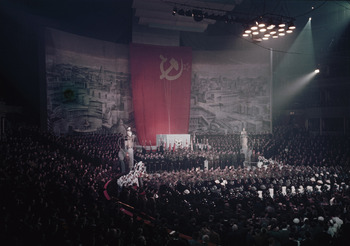
In 1943, Britain had been at war with Nazi Germany for over three years. The USSR had become a rather unlikely British ally in 1941, and after two years of brutal conflict had begun to gain an advantage against German troops, who were demoralized by the fierce Russian winter and a lack of supplies. With this as a backdrop, on 21 February 1943, more than two thousand participants performed a large-scale pageant called Salute to the Red Army at the Royal Albert Hall in London to commemorate Red Army Day and celebrate the Soviet–British alliance against Nazi aggression.Footnote 1 British cities such as Cardiff, Manchester, and Bristol also honored Britain's Russian allies with marches, rallies, and other celebrations. The pageant was London's contribution to these nationwide festivities. Although the audience at the Royal Albert Hall event comprised selected and invited guests, enormous crowds attended other regional events, as did prominent military dignitaries, members of local councils, local members of Parliament, and Russian military guests.Footnote 2 This multicity event is one demonstration of how the extremes of war produce unlikely bedfellows.
At the time, many spectators heralded Salute to the Red Army as a tremendous aesthetic and political achievement. For example, prominent socialite Edwina Mountbatten claimed that “it was a magnificent sight and all present were very thrilled and stirred.”Footnote 3 The performance was organized by Basil Dean, a theatre practitioner with some forty years' experience as an actor (most noticeably with Annie Horniman's acclaimed Gaiety Theatre in Manchester, coincidentally the training ground for future Salute to the Red Army performer, Sybil Thorndike) and as a producer in London's West End. In 1939 he became the director general of the Entertainments National Service Association (ENSA), an organization that produced theatrical work for the troops. In an April 1939 pamphlet, Dean wrote that “we must dedicate the Theatre to the National Service without delay.”Footnote 4 Like the United Services Organizations (USO) in the United States, ENSA responded to this perceived need. Dean saw ENSA as the beginning of a national theatre and wanted it to be “a living organism, fashioned to serve the entertainment needs of the whole nation.”Footnote 5 Even though ENSA successfully produced theatre all over the world, it experienced many difficulties, not least because of a shortage of actors and the financial restrictions of wartime. There was also the inevitable question of who was in charge of the organization: was it primarily a collection of artists or a department of the government?
Throughout the twentieth century, this question about government-supported theatre had occupied both artists and officials. In the United States, the Federal Theatre Project (FTP), for example, provided roles for unemployed artists and educated audiences about issues such as monopolies of power companies (Power; 1937) or the plight of struggling farmers (Triple-A Plowed Under; 1936). In Russia, Vsevelod Meyerhold's brand of constructivist theatre, which combined comedic slapstick, disciplined biomechanics, and a celebration of the Revolution, initially appealed to Bolshevik authorities. However, governments influenced the fate of both of these theatrical innovations: Congress withdrew funding from the FTP after four years in response to criticism by conservatives who were upset by the left-wing politics of many of the project's productions, and Joseph Stalin suppressed avant-garde art, including Meyerhold's theatre, in favor of socialist realism.Footnote 6 While the British government continued to support ENSA during the war, Dean and his compatriots found themselves caught in a bind: art first or politics?
Although Salute to the Red Army grappled with this question, there is no doubt that it can be read as British government propaganda. The Ministry of Information commissioned the piece, approaching Dean in January 1943 (barely a month before the eventual production) with only vague ideas about what the potential performance would look like.Footnote 7 After Dean presented an initial plan, the ministry entrusted the whole event to him. The Ministry of Information expressed delight at the eventual outcome. Minister of Information Brendan Bracken wrote to Dean, “I hope you will accept my thanks on behalf of the Government for the admirable way in which you and your staff carried out this heavy assignment.”Footnote 8 Representatives of the armed forces, too, seemed wholeheartedly supportive. High-ranking officials wrote to congratulate Dean: “I realise what a short time you had in which to prepare and I think it was nothing short of miraculous that there should have been no hitch of any kind.”Footnote 9 As a large-scale political war pageant in the heart of the theatre establishment, Salute to the Red Army marked a significant contribution to British theatre history, one that deserves recognition and reassessment. It can be read alongside a number of other overlooked World War II pageants, including An Agreement of the People (1942) and Alliance for Victory (1943).Footnote 10
Most of all, this pageant stands out as an example of government-endorsed agitprop, a form not typically encouraged by the British political establishment.Footnote 11 While governments in the United States and Russia had backed this sort of politically engaged theatrical experimentation in earlier decades, the British government did not support it until World War II. However, not everyone in the government supported this endeavor. Indeed, many MPs were understandably concerned about a performance that so unequivocally championed Communist Russia. This tension erupted when officials in the Ministry of Information saw the script. They felt that it was too celebratory, too uncritically supportive of Britain's Russian allies. In fact, while the changes to the script are difficult to interpret because we do not have a recording of the full performance, Dean certainly, albeit reluctantly, made changes to meet the government's approval.Footnote 12
The centrality of Dean's contribution to this performance links it to a range of avant-garde Russian experiments. It was both a culmination of his personal interest in Russia and a remarkable moment of government-supported agitprop pageantry. This article examines Dean as a vital figure in the British avant-garde that was emerging during the war years and analyzes Salute to the Red Army in that context.Footnote 13 Though this theatrical event advocated cross-nation solidarity and (in keeping with the agitprop style) attempted to create a bond between actor and audience, my analysis casts doubt on its efficacy, as evidenced by Dean's own disappointment with the effect of the pageant.
1926: Traveling through Russia
The relationships between British and Russian theatre artists were particularly strong in the early decades of the twentieth century, and in recent years a considerable amount of scholarship has detailed specific connections.Footnote 14 In the introduction to his edited collection Russians in Britain, Jonathan Pitches lists numerous reasons why the history of Russian theatre in Britain needs to be addressed. The most important for my argument is the final point: the study of Russo-British theatrical transmission “suggests an alternative mapping of theatre traditions in the UK from the 1920s to today.”Footnote 15 I would add that navigating the relationship between Russian and British theatre enables us to examine the relationship between actor and audience, the methods used to create a sense of solidarity that would last long after the performance had ended.
The creation of a proletarian audience was a decisive characteristic of postrevolutionary Soviet theatre. With notable exceptions, Britain was largely dominated by a mainstream and resolutely middle-class theatre scene. In contrast, in Russia, “theatrical performances occupied an unusually important role in the lives of the people.”Footnote 16 Although methods of training actors and innovative set designs in Russia influenced many British practitioners, many more admired the way the Russian theatre engaged its audience. André van Gyseghem, a founding member of the British political group Unity Theatre, described the changes he saw in Soviet theatre during his trips to Russia in the 1930s: “Here was a tremendous feeling, a desire to bridge the gulfs of differences between the artist and his audience.”Footnote 17 Van Gyseghem's opinion was similar to that of many British practitioners who were searching for new methods to revolutionize the moribund British stage.
Although Dean admired the Russian focus on actor–audience interaction, he is rarely mentioned in scholarly examinations of Russo-British cultural exchange in the decades before the war. If he is mentioned at all, he appears on the page as a rather mainstream West End producer. However, Dean's career suggests that he was committed to engaging with audiences in new ways. He never shied away from risks and was often at the forefront of avant-garde experimentation. For example, in 1923 Dean produced the first British version of James Elroy Flecker's remarkable play Hassan, using dance choreography from Michel Fokine and music from Frederick Delius.Footnote 18 That same year he presented Karel Čapek's R.U.R., the play that introduced the word “robot” into the English language. In 1939, he took on the challenge of producing J. B. Priestley's peculiarly expressionistic rendering of “a life history in reverse order,” Johnson over Jordan, which, Dean surmised, would “give me a chance to resume my experiments in new production methods.”Footnote 19 He collaborated with Edward Craig, son of the influential theatre designer Edward Gordon Craig, to create a symbolist setting using drapes and cycloramas. In addition, as the head of ENSA, Dean was one of the first to advocate a national theatre.
Dean was one of a number of British theatre practitioners who traveled to the newly established USSR in the 1920s, where he eagerly witnessed the burgeoning theatre scene. Perhaps the best known of these sojourners was author and theatre critic Huntly Carter, who made a number of journeys to Russia during this period. He wrote, “There exists a New Spirit (in the sense of purpose or function) in the Theatre. . . . There exists a theatre and a mass of work conceived in this spirit. It is to be found in Russia.”Footnote 20 He mentioned Dean's Russian-influenced aesthetic: “Mr. Basil Dean appears to be searching for a new and more fluid technique.”Footnote 21 The British-based Workers' Theatre Movement (WTM) also enjoyed a number of direct links with Russia. Two WTM companies, the Red Players and the Red Front, attended the 1933 International Worker's Theatre Olympiad in Moscow, although by then Russian theatre had begun to turn its back on declamatory agitprop. The judges of the Olympiad concluded that “the performance of the two groups show that the English groups have concretely understood their political tasks. But as a result of their political underestimation of the artistic elements, they are unable fully to carry them out.”Footnote 22 In the early 1930s, Ewan MacColl and Joan Littlewood, cofounders of what later became the celebrated Theatre Workshop, also planned a trip to Russia, where they intended to train at the Moscow School of Cinema and Theatre. Despite many eventful months of waiting for visas in London, the trip never occurred, and the two went back to Manchester to bring a new group of actors together, using the techniques of Stanislavsky, Vakhtangov, and Meyerhold.Footnote 23 In addition, Herbert Marshall, who trained at the Higher Film Institute in Moscow in the 1930s, returned to Britain in 1937 to work with Unity Theatre on a production of Nikolai Pogodin's Aristocrats.Footnote 24 Later he wrote The Pictorial History of the Russian Theatre (1977), a lavishly illustrated book with a particular focus on 1900–40, which he described as the source of the “most interesting experimental artistic and stylistic material.”Footnote 25 Despite the fact that British practitioners had different backgrounds from their Russian counterparts, it is clear that the Russian stage inspired many of them. Indeed, “there is a significant and surprisingly continuous relationship between the actor-training traditions of twentieth-century Russia and the British theatre tradition.”Footnote 26 This includes two Russian émigrés who worked in the British theatre, Theodore Komisarjevsky and Michael Chekhov, figures who had considerable influence over the British dramatic scene—the former through his twenty years of theatrical output across Britain (including his innovative Shakespeare productions in Stratford) and the latter through his residency at Dartington.Footnote 27
Dean's intention to go to Russia can be seen in 1913 correspondence with Michael Lykiardopulos, then secretary of the Moscow Art Theatre.Footnote 28 While Dean sought advice from Lykiardopulos, the Russian expressed interest in Dean's ongoing work in the United Kingdom and asked about acquiring a book on the repertory movement in the English theatre.Footnote 29 This was not simply a case of Dean approaching Lykiardopulos to ask for his help; rather, it was an exchange in which Lykiardopulos seemed to be equally interested in Dean's work.
Dean postponed his trip to Russia for several years, during which time he cofounded the ReandeaN theatre company with Alec Rea (1919) and produced a number of important plays, including the celebrated version of Flecker's Hassan. In 1926, he thought again about his proposed trip to Russia and began communication with Dmitri Bogomoloff, a diplomat from the Russian Embassy in London. He made his intention clear in a letter of 7 January 1926:
I would like very much to have the pleasure of calling upon you one day soon to ask your advice with reference to the visit to Moscow that I desire to make to see the theatres there.Footnote 30
He followed this up with letters confirming the arrangements. Just before leaving for Russia, Dean proclaimed the following during an address to the Nottinghamshire Playgoers Club:
The most active work in the theatre is being done in the two countries at the opposite poles of circumstance so far as the great War is concerned, the one country almost untouched by it, the other dragged into the dust by Famine and Revolution: America and Russia. As I am just about to visit the latter country at the invitation of the theatrical artists there I feel I should say little about but this I will say—on all sides I hear and from the premier of the Moscow Art Theatre Musical Studio which I heard recently in New York, I am convinced that work of great value is being done in the Russian Theatre and I am determined that such knowledge as I can glean over there shall be placed at the service of our theatre as soon as possible.Footnote 31
Dean clearly admired the Russian stage and intended to carry Russian techniques back to Britain.
Later that year Dean traveled to Russia with his wife, Lady Mercy, and his designer, George Harris. Overall, this trip energized and inspired the British producer:
The infinite variety of the productions, the astonishing range and power of performers, the bold designs, enthusiasm, experiment, passionate acceptance of the immature, equally passionate rejection of the obvious, the endless discussions and probings and heart searchings over endless cups of tea; the whole mad whirl of those astonishing days in Moscow left me with but one impression—vitality. When considering an art is there need to say more than that? Vitality!Footnote 32
He witnessed a range of performances, some that he admired unreservedly and others that he found troubling either aesthetically or politically.Footnote 33
While in the Soviet Union, Dean met Minister of Education Anatoly Lunacharsky and, although Dean referred to the Minister's plays as rather dull, he reveled in the fact that 90 percent of Russians attended the theatre, or so the minister claimed.Footnote 34 Meyerhold is another figure about whom Dean had a divided opinion. Dean visited Meyerhold's theatre and was struck by the absence of typical theatre trappings: “no curtains, no draperies or scenery of any kind.” He described the effect as unusually “theatrical.”Footnote 35 Meyerhold invited Dean to meet him the next day. Dean recalled his “fanatical eye and an eager impulsive way of talking.”Footnote 36
However, Dean maintained that “the theories of Meyerhold the great Communist producer are just so much sophistry. In an hour's conference with him we were enabled to reduce his position to so much chop logic.”Footnote 37 However, he could not (and indeed did not want to) fault Meyerhold's passion for the stage and for creating new ways of connecting actors and the audience. Meyerhold's theatre may not have been to Dean's taste, but he certainly contributed to Dean's sense of vitality in the Russian theatre. Actually, Dean's reservations about Meyerhold's ideas seem a little unfair. He presumed that Meyerhold was more concerned with politics than with aesthetics, but while it is true that Meyerhold infused his work with a revolutionary fervor, this did not necessarily detract from his art. Indeed, in the same year Dean traveled to Russia, Meyerhold staged an imaginative reworking of Nikolai Gogol's The Government Inspector that featured a “complex, colourful dynamic composition, reproducing the majesty of the Russian Empire style” and focused on the “expressive potential of the art of acting.”Footnote 38 Dean's reservations about Meyerhold's polemic theatre seemed to overlook the latter's considerable aesthetic visions and experiments.
As might be expected from a man who rejected what he considered to be “all sorts of nonsensical theories that have nothing whatever to do with art,”Footnote 39 Dean had great admiration for Konstantin Stanislavsky, whom he regretfully noted was sidelined in this battle for artistic self-determination. Stanislavsky invited him to the Opera Studio to see the first act of Nikolai Rimsky-Korsakov's Tsar's Bride. Dean felt that Stanislavsky's students performed the piece in the tradition of the Moscow Arts Theatre (MAT), “simply and truthfully.”Footnote 40 Dean also visited the MAT to see a production of The Cherry Orchard, later referring to the experience as the “greatest treat of all.”Footnote 41 One of the most memorable performances Dean saw at the MAT was a version of Shakespeare's Twelfth Night. The company changed the end of the play because, in a revolutionary state led by the proletariat, the steward could not be defeated.Footnote 42 Dean had a signed photograph of Stanislavsky, whom he called “the great father of modern Russian theatre.”Footnote 43 He greatly admired Stanislavsky's book My Life in Art and recommended it to American patron of the arts Otto Kahn in March 1926, just after he returned from Moscow.Footnote 44
Dean reserved his most fulsome praise for director Alexander Tairov. The two men seemed to get on rather well; on a photograph of himself, Tairov wrote “Dear Mr Dean, you will always be heartily welcomed at the Kamerny theater by your highly esteeming A. Tairov.”Footnote 45 By far the greatest number of surviving photographs from this trip depict Tairov's theatre. These include images from Eugene O'Neill's The Hairy Ape, which was performed during the 1926 season.Footnote 46 Dean proclaimed Tairov's production “thrilling . . . realism and expressionism successfully combined.”Footnote 47 The set, which was designed in a broadly constructivist style by the Stenberg brothers, was a gleaming silver ship atop a dark, cramped hold that was illuminated by the glaring fires of the engines.Footnote 48 The production used mime to present the difference between the rich, who idly promenaded on deck, and the stokers, whose movements “demonstrated the inhuman exertion of muscular, sweaty bodies.”Footnote 49
Dean particularly admired the Kamerny Theatre's commitment to placing the figure of the actor at the very center of the theatrical experience through the use of masks or acrobatic movement. Although Tairov welcomed the Revolution, his theatre was far less overtly political than Meyerhold's and appealed more to Dean.Footnote 50 He was also the Soviet director who did the most to bring Western (both European and U.S.) plays into the Russian repertoire: “the champion of O'Neill and serious American drama in Europe.”Footnote 51 This must have appealed to Dean, who struggled with his limited knowledge of Russian language and culture.Footnote 52
Dean also approved of the Jewish theatres in Moscow, especially the work of Alexander Granovsky, Marc Chagall, and Solomon Rabinovich (aka Sholom Aleichem), apparently because of their focus on the body and movement. In an article he wrote about his trip that was published in The Sphere in August 1926, he referred specifically to the “two remarkable Jewish theatres in Moscow. At the Jewish Kamerny Theatre, under the leadership of Granovsky, the most modern variants of age-old Jewish legends are performed upon frankly constructivist principles. All actors appear to be gymnasts and pantomimists of no mean ability.”Footnote 53 Dean was not able to meet Granovsky because the latter was ill, and in November 1926, Granovsky wrote to express his regret that they had not had an opportunity to become acquainted.Footnote 54 Dean particularly enjoyed Granovsky's mix of modern methods (constructivism and gymnastics) and older forms (Jewish legends and pantomime movements). He also admired the centrality of the bodies, facial expressions (whether masked or not), and speech patterns of actors. In an address four years earlier at the Victoria and Albert Museum, Dean had stated that “the thing we need more urgently than anything else is the return of the actor to the theatre.”Footnote 55 It was not that the theatre had disposed of the actor entirely, of course, but that, in Dean's view, the fashion for spectacular sets, atmospheric music, and other trappings of the theatrical experience overshadowed the figure of the actor. It seemed that in the Russian theatre he found a model worth celebrating.
By the time Dean returned from Russia, he had developed a greater appreciation of Russian theatre, although his admiration was not unequivocal. The rejection of aesthetic quality in favor of what he saw as propaganda concerned him. And yet even then, Dean saw the benefits of the “machine-artists,” as he called them:
The vogue of the machine-artists of Russia may pass, but they will not be without lasting influence. For one thing, these artists are helping to free the imaginations of the producers as well as of the actors. They are teaching the actor that his body can be made even fuller use of than is the present habit.Footnote 56
At the end of his article for The Sphere, Dean connected all he had seen and experienced to the problems in the English theatre as he perceived them:
The spectacle of a number of English actors being plastic in a Noel Coward drawing room in [sic] unlike to do more than excite ridicule. On the other hand it is conceivable that the stage of Drury Lane filled with actors, trained in a new school of vigorous gymnastic movement, performing evolutions suggestive of the battle scenes in “Henry V” might be an invigorating experience for even the most jaded West End playgoer.Footnote 57
Dean's conviction that the old and the new might be regarded as complementary rather than antagonistic was demonstrated by his suggestion that Shakespeare might be rejuvenated by Soviet Russian techniques. In addition, Dean prophesied that revolutionizing the stage by setting the dexterous actor at its center would bring a change in the actor–audience relationship; spectators would no longer be “jaded” onlookers but would become inspired, “invigorated” coproducers of meaning. As Dean reflected on his travels, he continued to compare the vitality of the Russian stage with the moribund performances he found on his return to England. So much did Dean enjoy his trip that he hinted to a friend in Moscow in February 1927 that he would return to Russia at the earliest opportunity.Footnote 58
Salute to the Red Army: Constructivist Pageants
By 1943, Dean's Russian journeys were a distant memory and both countries were experiencing the trials of another world war. And yet at the Royal Albert Hall, a production connected to ENSA's groundbreaking work depicted a fascinating reflection of his experiences in Russia. Salute to the Red Army could be regarded as a later working out of the Russian techniques he had so admired (and, interestingly, some of those he had criticized) in the 1920s. In fact, this piece more closely resembled the constructivist experiments of Meyerhold than the dance-oriented storytelling of Tairov or Granovsky. Salute to the Red Army amounted to a political pageant that used agitprop declamation—or, as the playtext suggested, “staccato commentary”Footnote 59—as its primary method of dialogue. It promoted a clear agenda that attempted to encourage a spirit of solidarity between stage and auditorium, participant and spectator. In this sense, it sought to fulfill the original goals of agitprop theatre.
At the same time, Dean's production must also be read through a long tradition of British pageants going as far back as the medieval religious plays, the Elizabethan court pageants, and the Great Exhibition of 1851. One could even locate the Thames Diamond Jubilee Pageant of 2012 for Queen Elizabeth in this genealogy.
Dean's Salute to the Red Army was clearly seen as part of this tradition; when organizers discussed the possibility of a pageant for the Festival of Britain of 1951, they mentioned Dean as the potential director. Conservative MP (and theatre critic) Beverley Baxter reminded Deputy Prime Minister Herbert Morrison that Salute to the Red Army had been “quite superbly done.”Footnote 60 Dean's pageant seemed to capture both the political sloganizing of Russian mass performances and the celebratory patriotism of local pageants. Just as in Granovsky's Jewish theatre, older and newer forms complemented one another. Both influences transformed the actor–audience relationship as spectators became participants, either as fellow instigators of revolution (in agitprop) or as members of a celebratory community (in pageants).
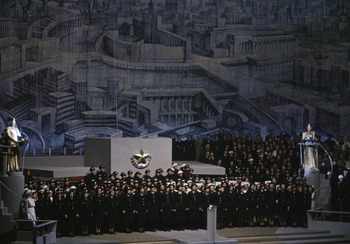
Salute to the Red Army featured a specially commissioned ode by poet Louis MacNeice. The cast included Sybil Thorndike, Laurence Olivier, John Gielgud, and Ralph Richardson. The pageant lasted two hours with no interval, “so as not to interrupt the mounting climax.”Footnote 61 Sections of the music were composed by Alan Rawsthorne, William Walton, and Arnold Bax. It was performed by the BBC Symphony, the London Philharmonic, the Royal Choral Society, and a collection of armed forces bands organized by Malcolm Sargent. The production, which took place at the Royal Albert Hall, had all the appearance of being a fairly mainstream establishment theatrical event, at least at first. However, from the opening set it was clear that Salute to the Red Army could challenge British culture, both aesthetically and politically. The enormous backcloth (120 feet by 60 feet), which was designed by artist Denis Wreford, presented a quasi-constructivist vision of “Stalingrad or other modern Russian city.”Footnote 62 Instead of the colorful domes of Moscow or the Winter Palace of St. Petersburg, Wreford's artwork presented an image of Stalingrad, a site of heavy industry rather than historical beauty, an urban space at the very epicenter of the struggle against the Nazis (Figures 1, 2). Just weeks before the pageant was performed, the Red Army had finally won the months-long Battle of Stalingrad. This victory halted Germany's attempt to capture Stalingrad and was one of the most important victories of the war. In choosing Stalingrad, Dean celebrated modern Russia, advocating solidarity between the Allies.
Massed workers from the war effort in front of Denis Wreford's impression of Stalingrad. Salute to the Red Army, 1943. Cat. no. TR706. Used by permission of the Imperial War Museum.

Nurses take to the stage. Salute to the Red Army, 1943. Cat. no. TR703. Used by permission of the Imperial War Museum.

The play began, in typical agitprop style, with an Announcer directly addressing the spectators:
We are here to salute the Red Army. The Soviet Union and Britain today are allies. . . . What concerns us is Today, but we will begin further back. Russia today is resisting the invader. She has beaten the invader before. She beat Napoleon in Eighteen-Twelve. She beat the Germans in the Middle Ages.Footnote 63
From the opening speech, which was delivered in declamatory style rather like the deliveries of early twentieth-century Russian Blue Blouse agitprop companies,Footnote 64 the goals became clear: to tell a story with modern relevance, to assure the spectators of Russia's previous successes in resisting invaders, and, most of all, to create a powerful sense of solidarity between the British and Russian populations. The script briefly described Russian history up to the Nazi invasion and informed spectators that although the Germans (symbolically represented throughout the pageant by a Nazi Figure character) had been confident of victory in Russia, they gradually realized their predicament as the Russian resistance persisted even as the bleak winter of 1942–3 set in.
Two plinths stood on either side of the stage on which the two major declamatory figures, Spokesman and Spokeswoman (Ralph Richardson and Sybil Thorndike), with “gold costumes and gilded faces,” stood.Footnote 65 From atop the plinths they described the triumphs and defeats of the Allies until the Russian victory at Stalingrad. At the moment that victory was described, “the light on the Nazi Figure [was] switched off suddenly, symbolising the extinction of the Sixth Army.”Footnote 66 The plinths were faintly reminiscent of minister's pulpits (see Figure 2), but they also evoked Meyerhold's earlier set innovations. Toward the end of the pageant, MacNeice's ode encouraged the British audience to support the Soviet army that had won this first victory of the war for the Allies: “Our eyes look East / To where our comrades fight / Their Battle with the Beast / That rages day and night.”Footnote 67 At the end of the performance, Secretary of State for Foreign Affairs Anthony Eden addressed the assembly. His final sentence was an appeal to the audience: “I ask you all to stand and pay a silent tribute to the glorious dead of the Red Army.”Footnote 68 The performance concluded with a Red Army soldier appearing in front of a vast hammer and sickle flag, the official emblem of the Red Army (see Figure 1). In a slightly jarring musical juxtaposition, the audience and cast sang the “Internationale” and then “God Save the King,” the British national anthem.Footnote 69
By 1943, workers' agitprop theatre had been performed in Britain by radical theatre groups such as the WTM, Unity Theatre, and Littlewood and MacColl's Theatre Workshop.Footnote 70 British agitprop sometimes drew on the Living Newspaper style of theatrical presentation, a subgenre of agitprop that presented a range of stories using “a collection of facts, newspaper reports, statistics, [and] extracts from book[s]” in a format that drew upon a synthesis of methods of transmitting content used in newspapers, plays, and films.Footnote 71Salute to the Red Army stands apart from this type of theatre, both because of the year of production (much later than most agitprop experimentation in Britain) and the fact that it was backed by the British government (though agitprop theatre was not backed by the U.K. government in the 1930s, unlike in the United States and the Soviet Union).
Solidarity—with Russia and across various components of British society—was a firm focus of the pageant. This was evident in the composition of the pageant participants. More than two thousand people had a direct role in the performance, “representatives of every facet of the war effort.”Footnote 72 Service personnel participated alongside well-known performers and political figures, and illustrious guests were in the audience. The content of the pageant also emphasized solidarity. For example, one section began with a traditional Russian folk song, “Song of the Volga Boatmen,” followed by Welsh factory workers singing two Welsh folk songs, “All through the Night” and “David of the White Rock.” In Section 6, the Announcer reflected, “We too can remember peace. English, Scots, Welsh and Northern Irish—not so long ago our way of life was peaceful. We worked the work of peace. We sang the songs of peace. The traditional songs of our people. Songs in English . . . in Gaelic . . . in Welsh.”Footnote 73 The episode asked for international solidarity but also demanded national unity, a purposeful and simplistic blurring of the barriers between the various areas of the British Isles. It also appealed directly to spectators, resembling a proclamation from The Communist Manifesto: “Workers of the World Unite! You have nothing to lose but your chains!” This idea resonated powerfully with Anthony Eden's closing words (fragments of which are available on the surviving British Pathé film), which called on the Allies to work toward a “final victory that will be won together.”Footnote 74 Noticeably, however, the international solidarity the pageant promoted rested on a Russian folk song that came from the era before the Bolshevik Revolution. Although this music might have evoked a general sense of worldwide unity, it was carefully chosen to allay the fears of the British government that the performance might advocate political accord too strongly. It promoted cooperation with Russia rather than with Soviet Russia.
Despite the focus on the time before Bolshevism, Dean remained committed to worker solidarity (at least in the extant script). He embraced the differences between Russian and British workers instead of ignoring them. Each major occupation was mentioned by name, from fishermen to post office workers, from employees of the national fire service to the “distributors of food.”Footnote 75 Women workers were prominent in this list, not simply those who waited for their husbands to return home from the war but also those who worked in the Land Army or built aircraft or served as nurses (see Figure 2). Edward Elgar's “To Women,” a song associated primarily with World War I, was also played. Thus, women retained a prominent role in this relationship of solidarity, as the script of the pageant indicates:
Some of them [women] fight like men as guerrillas, paratroops and pilots,
But all have a fighting spirit;
This is a woman's war and a man's! I therefore call upon all the women of Britain to greet their sisters, the women of Russia, and to greet their brothers in the Red Army.Footnote 76
The music of the pageant created a sense of atmosphere and made a particular political comment. While the Spokesman was discussing the travels of members of the merchant marine to Russia to distribute supplies, the orchestra and chorus performed an excerpt from Vaughan Williams's A Sea Symphony. This music had a programmatic function, but because it was by an eminent British composer, it also was a statement of national pride in the arts of Great Britain. Russian music appeared too. While an actor portraying a news reader for Radio Moscow triumphantly narrated the events of the Battle of Stalingrad—“The Red Army defended it, / They beat you when you defended it. / Now the Red Army is attacking”Footnote 77—the orchestra played the opening bars of Dmitri Shostakovich's Leningrad Symphony, a piece the composer created as a statement of protest against Nazi totalitarianism. In using symphonies so intertwined with national identity, the pageant maintained a certain sense of cultural difference while simultaneously advocating solidarity.
In typical Living Newspaper style, participants mimicked speech patterns regularly used by potential audience members when they performed dialogue. The most noticeable of these episodes drew upon the Living Newspaper tradition in its use of the Newsboy character, a recurrent figure in early twentieth-century documentary theatre. Four British characters took a copy of the newspaper the Newsboy offered and began a conversation about their Russian allies, during which they expressed some doubt that the Red Army would achieve victory. The Spokesman's rebuke—“Have you gone soft? The Red Army is not soft!”Footnote 78—directly challenged any in the audience who might have doubted the abilities of their allies. But even in this almost naturalistic dialogue sequence, the play used visual symbols. For example, the newspapers the individuals held had swastikas on the back page. After the Spokesman pushed the British characters to reassess their opinion about the Red Army, they turned the newspapers around to reveal “a large red star on a white background.”Footnote 79
While in Russia, Dean most appreciated theatre that focused on the body of the actor and its movements, such as Tairov's marionette-styled actors or the pantomimic clowning of Granovsky's theatre troupe. The movement of performers was a vital element in Salute to the Red Army, as a Lieutenant Peacock noted in a letter to Dean the day after the pageant was performed:
It was a magnificent piece of production from every point of view and I was particularly impressed by the opening fanfares, the lighting and the ease which great bodies of men and women were moved and grouped.Footnote 80
Organizing such a large body of people proved difficult. Dean mentioned it in the stage directions as “quite an undertaking in terms of movement.”Footnote 81 It was necessary to determine where each of the several thousands of participants should stand and consider the process by which they would reach their respective positions. Everything had to be carefully timed. At yet it all seemed to work beautifully, at least in the scenes shown in the Pathé film. The final sequence, performed as an excerpt from the Leningrad Symphony was played, required all the groups to come together in the stage space while Scottish pipers marched onstage followed by “British, Dominion and Colonial flags which are grouped in a body in the centre.”Footnote 82 As with the earlier description of the British Isles, colonies were clearly implicated in this show of solidarity. The physical organization of such a large body of people no doubt compelled Dean to carefully consider movement on the stage. The surviving film shows the participants arriving on stage in lines, the movements as disciplined and unified as one would expect from military troops. But they also resembled the choreographed movements of what Dean referred to as the “machine-artists” of Russian theatre, particularly the biomechanics of Meyerhold.Footnote 83 The successful coordination of the movement of so many people was an impressive sight that was clearly designed to elicit a sense of pride, patriotism, and confidence.
Pageants for the People
Mounting a large-scale pageant with just over a month's preparation time was a monumental achievement. It is a fascinating contribution to British theatre history. While its aesthetic influence is difficult to discern, those who saw it were still praising it as late as 1949. For example, in that year Beverley Baxter wrote to Herbert Morrison that “in my opinion Basil Dean is the best pageant director in the country,” because of the success of Salute to the Red Army.Footnote 84 Dean referred to Salute to the Red Army as “theatre magic”: “The audience sat spellbound for several seconds after it was all over. I sat in my control box completely overcome by the magic we had created.”Footnote 85 However, once the excitement died down, Dean became rather unenthusiastic about it:
The whole audience rises. Portly mayors and dignified civil servants clap and cheer and wave their programmes. The effect is overwhelming. Too bad that the general public had not been allowed to see it. . . . As I drove away from the Albert Hall with my small daughter, the cheers of the audience still ringing in my ears, I felt like a child that had lost a precious toy.Footnote 86
Dean was clearly sad that his exciting pageant experiment had come to an end but his comment also pointed to an issue that continued to concern Dean throughout his theatrical career: the engagement of an audience. And his comments in response to Salute to the Red Army can be read through the lens of his admiration for Russia. After his 1926 visit he wrote:
The Bolsheviks have instinctively recognized the need of providing some sort of outlet for the people. For all their repression of ideas, faiths and creeds that do not coincide with their own it has yet been found necessary to give the population places of general assembly where their minds and hearts can be lifted in a sort of warmth of emotion amidst all the hardships.Footnote 87
In the midst of a different type of hardship, Dean thought of a potential audience who could be challenged and entertained by the theatre. Though Salute to the Red Army was aesthetically impressive and politically charged, it did not engage the people as theatre had in 1920s Russia. Indeed, it could not do so because the audience comprised British and Russian officials who had been handpicked by the British government. The “actors” in the arena did not speak directly to an immediate audience of their peers. Instead, the “working people of Britain” had access to the performance only through BBC Radio or through snippets on a newsreel. The government isolated the performance still further by refusing to promote it. Fearing a breach in security, the prime minister banned any publicity in advance of the pageant. Moscow Radio did announce the upcoming performance (and gave the date and place of performance), but by and large this grand spectacle occurred with very little public fanfare. Although the government's reason for limiting the audience was cloaked in worries about security, the real reason may have been more political. Theatre studies scholar Steve Nicholson goes so far as to say that “the Government . . . contrived to direct and limit the potential impact of the performance.”Footnote 88 This analysis has merit: only participants and guests witnessed this reverent eulogy to Soviet success. The working men and women who were so valorized in the pageant and who might have been influenced by this celebration of Communism were deliberately excluded from the event. Indeed, in many ways, one could claim that the defining legacy of this production was its lack of influence. This was a disappointing and rather surprising outcome: the major performers were well known, it was presented in the heart of Britain's cultural center, and the pageant was effulgent and vibrant. The ambivalence of British authorities about promoting support for Communism is the key to the legacy of this grand-scale production.
By consenting to the government's insistence that the general population be excluded from the audience, Dean contributed to the exclusivity and hierarchical nature of the enterprise. He clearly found the absence of a broad audience disheartening. However, the contemporaneous Russian scene provided little that might have comforted him. Whereas in 1926 Dean could see many exciting, audience-focused Russian performances, by 1943, Stalin was using Russian theatre as part of a program of nationwide indoctrination, both aesthetically and politically. Although a new Soviet theatre continued to focus on the audience, it now conveyed a rather dull propaganda instead of an experimental joie de vivre. A saddened Dean wrote that “the once virile and enlightened Theatres of Russia and Germany and other countries have gone out like doused candles. They have been savagely seized upon and used as the servants of Force and Unreason.”Footnote 89
At the same time that Salute to the Red Army exhibited all the vibrancy of the Soviet stage of the early twentieth century, it also honored the exploits of a regime that was despotic. Indeed, while the performance took place in London, Stalin was forcibly displacing a large proportion of the Soviet population.Footnote 90 In many ways, therefore, this performance was a reimagining of a Russian aesthetic that had vanished. As Dean realized after the fact, for all its vibrancy, Salute to the Red Army was a work about loss and absence: workers were excluded, and the British government exercised a degree of control in the execution and presentation of the pageant. Inadvertently, Dean had created a reminder of a Russia whose aesthetic experimentalism and hopeful revolutionary fervor had already disappeared.