INTRODUCTION
The majority of studies that have demonstrated the influence of exotic plant invasions on native plant abundance and diversity (Braithwaite et al. Reference BRAITHWAITE, LONSDALE and ESTBERGS1989, Kennedy et al. Reference KENNEDY, NAEEM, HOWE, KNOPS, TILMAN and REICH2002, Miller & Gorchov Reference MILLER and GORCHOV2004, Prasad Reference PRASAD2010, Ramaswami & Sukumar Reference RAMASWAMI and SUKUMAR2011, Stinson et al. Reference STINSON, CAMPBELL, POWELL, WOLFE, CALLAWAY, THELEN, HALLETT, PRATI and KLIRONOMOS2006) are site-level experiments that measured responses of native plants to the presence or removal of exotic plants. These experiments did not take into account the influence of important environmental predictors of native understorey plant abundance such as rainfall, topography, disturbance and tree density. While the information generated by these experiments is important for understanding localized effects of exotic plants, they may inadequately represent overall patterns of influence particularly in spatially heterogeneous systems wherein these influences vary across the landscape. Here I describe landscape-scale relationships between the exotic woody shrub Lantana camara Linn. (Verbenaceae) and native forest understorey vegetation, in a tropical mixed (dry and moist) deciduous forest in southern India, after accounting for underlying environmental influences.
The primary objective of the study was to describe variation in native vegetation along a gradient of L. camara abundance (0 to >4 kg m−2 dry above-ground biomass), across a forest landscape, after accounting for environmental influences including rainfall, topography, fire and tree density. Lantana camara removal experiments in this forest have shown that whereas the densities of tree seedlings (<50 cm height) and native herbs and shrubs are higher under moderate levels of L. camara (<4 kg m−2), tree saplings (>50 cm height, <15 cm gbh) are altogether absent (Prasad Reference PRASAD2010). Based on these findings, as well as other studies that document the adverse effects of L. camara on native plant abundance and diversity (Bhatt et al. Reference BHATT, RAWAT and SINGH1994, Day et al. Reference DAY, WILEY, PLAYFORD and ZALUCKI2003, Fensham et al. Reference FENSHAM, FAIRFAX and CANNELL1994, Lamb Reference LAMB, Goudberg, Bonnell and Benzaken1991, Sharma & Raghubanshi Reference SHARMA and RAGHUBANSHI2007), I predicted that, after accounting for the influence of rainfall, terrain slope, altitude, fire frequency and tree density, (1) tree seedling density as well as native herb and shrub density would increase along a gradient of increasing L. camara abundance up to a point and then either decrease or remain constant (owing to light limitation; Ramaswami & Sukumar Reference RAMASWAMI and SUKUMAR2011), (2) tree sapling density as well as standing (unconsumed) volume of grass would decrease with increase in L. camara biomass, and (3) the species richness of tree seedlings, tree saplings and herbs and shrubs would decrease as L. camara increased.
The secondary objective was to identify environmental factors that are correlated with L. camara abundance across the landscape. Based on the known facilitation of L. camara invasion by disturbances such as fire (Duggin & Gentle Reference DUGGIN and GENTLE1998), and clearing (Croat Reference CROAT1978, Prasad Reference PRASAD2009a), it was predicted that L. camara abundance would be positively related to fire frequency, but negatively related to tree density. Because little has been reported on the role of rainfall and topography in influencing L. camara invasion, no predictions were made with respect to these factors.
STUDY SPECIES
Lantana camara, introduced to India from the Neotropics as an ornamental plant (Anonymous 1895, Hakimuddin Reference HAKIMUDDIN1929), is one of the most widespread terrestrial invasive species in India today (Hiremath & Sundaram Reference HIREMATH and SUNDARAM2005), and is listed by IUCN as one of the world's 100 most invasive species (Lowe et al. Reference LOWE, BROWNE, BOUDJELAS and DE POORTER2004). It can grow in a variety of forms, from dense thickets, to short, widely spaced bushes, to lianas growing up to 20 m into the canopy (Hiremath & Sundaram Reference HIREMATH and SUNDARAM2005). It grows in areas ranging from 250 to 2900 mm of average annual rainfall, but is also very drought-resistant. It rarely invades undisturbed, closed-canopy forest but thrives along roads and clearings (Croat Reference CROAT1978, Prasad Reference PRASAD2009a), and its spread is closely tied to forest disturbances such as fire and logging (Croat Reference CROAT1978, Duggin & Gentle Reference DUGGIN and GENTLE1998, Kodandapani et al. Reference KODANDAPANI, COCHRANE and SUKUMAR2004). It produces large numbers of bird-dispersed seeds (Swarbrick et al. Reference SWARBRICK, WILLSON and HANNAN-JONES1995) that germinate rapidly (Sastry & Kavathekar Reference SASTRY and KAVATHEKAR1990). Lantana camara can dominate the understorey in invaded forests (Day et al. Reference DAY, WILEY, PLAYFORD and ZALUCKI2003, Lamb Reference LAMB, Goudberg, Bonnell and Benzaken1991) blocking natural succession (Lamb Reference LAMB, Goudberg, Bonnell and Benzaken1991), reducing biodiversity (Fensham et al. Reference FENSHAM, FAIRFAX and CANNELL1994, Kumar & Rohatgi Reference KUMAR and ROHATGI1999) and greatly altering fire regimes (Hiremath & Sundaram Reference HIREMATH and SUNDARAM2005), by increasing fuel loads (Fensham et al. Reference FENSHAM, FAIRFAX and CANNELL1994). Lantana camara is widespread and abundant in southern Indian tropical deciduous forests including Bandipur Tiger Reserve (Mehta et al. Reference MEHTA, SULLIVAN, WALTER, KRISHNASWAMY and DEGLORIA2008).
STUDY AREA
The study was carried out in Bandipur Tiger Reserve (BTR; 880 km2; 11°57′N, 76°12′E–11°35′N, 76°51′E), a tropical mixed deciduous forest in southern India. The terrain is undulating but not broken up by ridges or deep valleys. BTR is flanked by similar tropical mixed deciduous forest to the west and south. However, its northern boundary separates the forest from agricultural and pastoral land, and human settlements. Forest that adjoins the boundary with human land-use experiences livestock grazing and fuel-wood harvest up to a distance of 5 km from the boundary (Madhusudan Reference MADHUSUDAN2004). BTR has neither settlements within it, nor clearings from logging. The BTR landscape is accessible by narrow roads or jeep tracks (3–5 m wide) used for patrolling and forest management, and in some areas tourism.
BTR has two distinct seasons – dry (January–May), during which trees shed leaves, and forest fires are common, and wet (June–December), during which BTR receives most of its rain. BTR encompasses the regional east–west rainfall gradient (approximately 900–1600 mm average annual rainfall respectively), along which vegetation type varies. In the east, the forest understorey is dominated by the tall grass Themeda cymbaria Hack. and thorny shrubs such as Ziziphus spp., Canthium spp. and Randia spp., and the overstorey is sparse and open, and dominated by Anogeissus latifolia Wall. and Randia dumetorum Retz. Further west, trees such as A. latifolia, Tectona grandis L. and Terminalia spp. (T. alata Dietr., T. bellerica Roxb., T. chebula Retz. and T. paniculata Roth.) become dominant, and the native understorey contains Indigofera pulchella Roxb., Helicteres isora L. and Grewia hirsuta Vahl shrub species in addition to the dominant tall grass. At the western end of BTR, although the dry-forest species A. latifolia, T. grandis and Terminalia spp. continue to be predominant, moist-forest species such as Mitragyna parvifolia Roxb., Schleichera oleosa Oken and Pterocarpus marsupium Roxb. occur more frequently. The tree layer is generally a single layer with either a grass- or L. camara-dominated understorey. Other exotic plants including Eupatorium odoratum L., Ageratum conyzoides L. and Parthenium hysterophorus L. also occur across BTR.
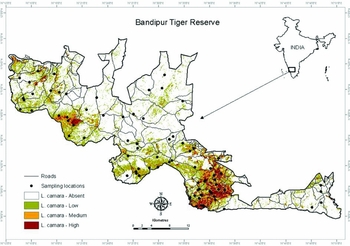
Lantana camara occurs across the landscape in patches that range in abundance from 0 to > 4 kg m−2 (dry above-ground biomass) (Prasad Reference PRASAD2009b); swathes of forest are currently uninvaded (Figure 1) but the exotic shrub appears to be rapidly spreading (pers. obs.), being facilitated by fire and clearing which are widespread. Although in a few places it is present as lianas creeping up trees, in BTR L. camara grows most commonly as either individual bushes or as intertwined thickets that average (± 1 SE) 191 ± 9 cm in height (ranging from 34 to 400 cm). Lantana camara thickets that exceed 2 kg m−2 biomass form a ceiling of tangled branches that is 50–100 cm above the ground (A. E. Prasad, unpubl. data), even though the maximum height of the plant can be over 200 cm higher than this ceiling. Its rainfall gradient, vegetation types and L. camara biomass gradient make BTR an appropriate tropical deciduous forest system within which to describe landscape-scale variation in native vegetation vis-à-vis exotic plant invasion.
Lantana camara abundance and native plant abundance and richness were sampled in plots at 80 locations distributed across the L. camara denseness categories – Absent, Low, Medium, and High – in Bandipur Tiger Reserve, southern India. These locations spanned gradients of rainfall, topography and tree density, but were located at least 5 km from the northern boundary of BTR so as to preclude the influence of livestock, fuel-wood harvest and other human forest resource use.

METHODS
Sampling design
During a previous study, a categorical L. camara abundance map of BTR was developed (A. E. Prasad & M. D. Madhusudan, unpubl. data). The ground assessment of L. camara abundance for this map was derived from a visual eight-point classification of ‘denseness’, ranging from ‘absent’ (class 0), to ‘very dense’ (class 7), which was based on the concentration of stems within the range of vision of an observer looking at a thicket. Thus, areas with no L. camara were assigned class 0 – ‘absent’, thickets with the lowest stem concentration (L. camara was present but the viewer could clearly see through the thicket to what was on the other side) were placed in class 1 – ‘very sparse’, thickets with the highest stem concentration (the stems were tightly packed within the range of the vision, and the viewer could not see what was on the other side of the thicket) were placed in class 7 – ‘very dense’, and so on. The reliability of this subjective visual scale, developed for ease of L. camara abundance classification across the landscape, was verified by comparing ‘denseness’ categories to actual dry above-ground biomass (absent – 0 kg m−2 to very dense – >4 kg m−2; R2 = 0.912, P < 0.001). This visual eight-point classification was used in combination with data from satellite imagery to make a predictive map of L. camara abundance across the BTR landscape (A. E. Prasad & M. D. Madhusudan, unpubl. data).
For the present study, this L. camara abundance map was used to locate sampling plots. Following a stratified-random design, and using a random point assignment function in ArcGIS 3.2 (ESRI, Redlands, CA, USA), 10 sampling locations were placed at random within each of the eight L. camara ‘denseness’ classes which were distributed across BTR (Figure 1; in this figure the eight ‘denseness’ classes are collapsed into four, in order to make the classes easier to distinguish on the map). Owing to the patchy distribution of L. camara, plots in some denseness classes were located closer to each other than others. The locations were random with respect to rainfall, topography and tree density, because they were distributed across the landscape, and spanned these gradients, but were placed at least 5 km from the northern boundary (adjoining agricultural land) in order to preclude the influence of livestock and other human activity on the study variables.
Data collection
At each location (n = 80) forest vegetation was sampled within a set of nested plots: (1) 10-m-radius plot: trees (having gbh >15 cm) – all individuals were counted, their approximate height was estimated, and their gbh was measured. (2) 5-m-radius plot nested concentrically within the 10-m plot: tree saplings, herbs and shrubs – number, species and height of tree saplings (>50 cm height, <15 cm gbh) and native herb and shrub species were noted. (3) Four 1 × 1-m square plots randomly located within the 5-m-radius plot: tree seedlings, grass and L. camara – number, species and height of tree seedlings were measured, and grass volume was calculated by multiplying area covered by grass with mean grass height (derived from grass height taken from the four corners and centre of plots). Dry L. camara biomass was also measured by cutting all above-ground L. camara within the bounds of the plot, and air-drying it for 90 d; hereafter all references to L. camara abundance or biomass imply dry above-ground biomass. Oven-drying a subsample for 24 h after air-drying for 90 d did not result in a decrease in biomass; because air-drying was more convenient in the field, the remaining samples were air-dried.
Lantana camara abundance was measured as biomass because thickets are extremely dense making the counting of individual stems not only tedious but also fraught with error. Individuals often coppice and intertwine with neighbouring individuals making distinction nearly impossible. Therefore, biomass, estimated as the dry weight of all above-ground L. camara within the bounds of a 1 × 1-m plot, was chosen as the best, i.e. most accurate as well as relatively easy to measure, representation of L. camara abundance. All field data collection was carried out between April and June 2008, just before the onset of the monsoon.
Average annual rainfall for each location was obtained from a rainfall raster (resolution c. 920 × 920 m), and average altitude and slope were obtained from a Digital Elevation Model (resolution c. 90 × 90 m) of the study area. From MODIS Web Fire Mapper (Justice et al. Reference JUSTICE, GIGLIO, KORONTZI, OWENS, MORISETTE, ROY, DESCLOITRES, ALLEAUME, PETITCOLIN and KAUFMAN2002) locations of fire occurrence in BTR in each year between 2000 and 2007 (data were available for only these years) were identified; these fire locations were the centroids of 1-km pixels wherein a fire was active during a satellite overpass. These locations gave no information on fire extent, severity or duration. Therefore, fire frequency associated with each sampling location was calculated as the number of years in which a fire occurred within a 710-m radius of the location. This distance of 710 m was chosen because it approximates the farthest possible straight-line distance between a fire centroid and any location within a 1-km pixel (i.e. half the diagonal of a 1 × 1-km pixel). Fire frequency ranged between zero (no fire in the last 7 y) to a maximum of three (no location was associated with more than three fire events in the last 7 y). ArcGIS 3.2 (ESRI, Redlands, CA, USA) was used for obtaining GIS data on rainfall, topography and fire frequency.
Statistical analyses
The first part of the analysis consisted of identifying environmental factors (from a suite consisting of rainfall, altitude, slope, fire frequency and tree density (individuals per plot)) that best explained landscape-scale variation in L. camara biomass using a multiple regression, in which the explanatory variables were added sequentially.
The second part of the analysis consisted of using similar multiple regressions to determine the variation in the abundance and species richness of native understorey plants (tree seedlings, tree saplings, herbs and shrubs, and grass) accounted for by spatially varying environmental factors (tree density, rainfall, slope, altitude and fire frequency). From these multiple regressions, the residuals of the response variables were extracted in order to obtain variation in native vegetation unaccounted for by environmental variables.
For both the first and second part of the analysis, linear models were used for continuous response variables (such as L. camara biomass and grass volume) and generalized linear models (GLM) with Poisson distribution (McCullagh & Nelder Reference MCCULLAGH and NELDER1989) for count variables (densities and species richness). For overdispersed data (Φ > 1), a quasi-likelihood approach was used to correct for overdispersion (Crawley Reference CRAWLEY2007, Nelder & Wedderburn Reference NELDER and WEDDERBURN1972).
In the third and final part of the analysis, linear models were used to determine whether residual variation in native vegetation variables was correlated with variation in L. camara biomass. Whereas n = 80 for all other native vegetation variables, n = 77 for sapling density and species richness, as three outlying data points were excluded from the original 80 plots, and n = 70 for sapling height because seven plots had no saplings. The statistical programming language R (version 2.6.1; http://www.R-project.org) was used for conducting the regressions.
RESULTS
Landscape-scale factors influencing Lantana camara abundance
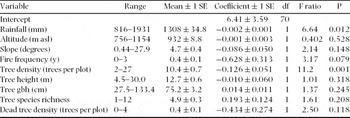
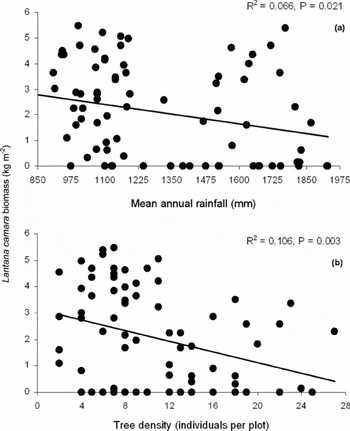
Dry above-ground biomass of L. camara ranged between 0 and 5.46 kg m−2, with a mean biomass of 2.09 ± 0.2 kg m−2. Variation in L. camara biomass across the BTR landscape was explained by all environmental variables when taken together (Multiple R2 = 0.300, Adjusted R2 = 0.211, F9, 70 = 3.34, P = 0.002). Further, individual environmental variables that significantly explained variation in L. camara biomass were rainfall and tree density (Table 1, Figure 2).
Relationships between Lantana camara biomass (dry, above-ground; kg m−2) and various landscape-scale environmental variables (as described by a multiple regression), based on data collected from plots (four 1 × 1-m square plots for L. camara nested within 10-m-radius plots for environmental variables) in 80 locations distributed across approximately 800 km2 of tropical mixed (dry and moist) deciduous forest in Bandipur Tiger Reserve, southern India.

The relationship between Lantana camara biomass (kg m−2) and tree density (individuals per 10-m-radius plot) (a), and mean annual rainfall (mm) (b), as described by data from 80 plots distributed across areas varying in L. camara biomass, but random with respect to rainfall and tree density.

Landscape-scale relationships between Lantana camara abundance and native plants
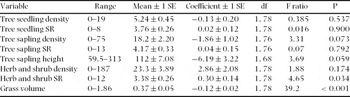
Tree seedlings. Variation in native tree seedling density was significantly explained by rainfall (coefficient = −0.004 ± 0.001, F1, 78 = 7.48, P = 0.008), slope (coefficient = −0.167 ± 0.111, F1, 76 = 6.00, P = 0.017), tree density (coefficient = 0.028 ± 0.074, F1, 74 = 4.36, P = 0.040) and tree sapling density (coefficient = 0.071 ± 0.017, F1, 73 = 16.9, P < 0.001). After accounting for the influence of all environmental variables, tree seedling density (residual) was not related to L. camara biomass (Table 2). Tree seedling species richness was also explained by rainfall (coefficient = −0.002 ± 0.001, F1, 78 = 6.85, P = 0.011), slope (coefficient = −0.123 ± 0.066, F1, 76 = 5.26, P = 0.025), tree density (coefficient = 0.065 ± 0.044, F1, 74 = 8.41, P = 0.005), and sapling density (coefficient = 0.026 ± 0.010, F1, 73 = 7.52, P = 0.008). After accounting for the influence of all environmental variables, tree seedling species richness (residual) was not related to L. camara biomass (Table 2).
Relationships between residuals (after accounting for the influence of environmental factors including rainfall, topography and tree density) of native plant abundance – density in individuals per plot (5-m radius for tree saplings, herbs and shrubs, and 1 × 1-m plots for tree seedlings and grass), and volume in m3 m−2, height (cm) and species richness SR (number of species per plot) and Lantana camara biomass (dry above-ground; kg m−2) based on data from 80 locations distributed across approximately 800 km2 of tropical mixed (dry and moist) deciduous forest in Bandipur Tiger Reserve, southern India.

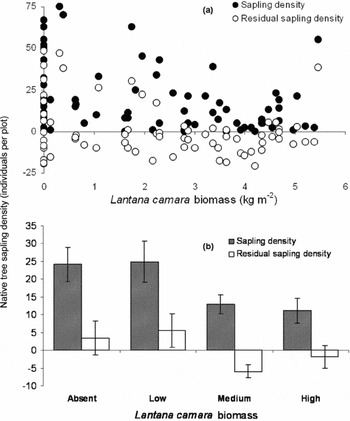
Tree saplings. Native tree sapling density was best explained by altitude (coefficient = −0.063 ± 0.031, F1, 74 = 8.40, P = 0.005), and tree density (coefficient = 1.29 ± 0.339, F1, 71 = 14.5, P < 0.001). The final regression suggested that residual sapling density was not related to L. camara biomass (Table 2, Figure 3a). However, since both the scatter plot (Figure 3a) and the results of the regression (Table 2) suggested that there was a negative trend in the relationship between L. camara and sapling density, an analysis of variance (ANOVA) was performed with L. camara biomass class (absent = 0, 0 < low ≤ 2, 2 < medium ≤ 4, and high > 4 kg m−2) as the independent variable and residual sapling density as the dependent variable (n = 77) to determine whether high L. camara biomass had lower sapling density than any or all the other abundance classes, after accounting for environmental influences. The ANOVA showed that L. camara biomass class did have an overall negative effect on residual sapling density (F1, 75 = 5.61, P = 0.021), with lower density under medium and high levels of L. camara invasion, than under absent and low levels (Figure 3b).
The relationship between the abundance of native tree saplings and Lantana camara invasion as depicted by a regression between sapling density (individuals per 5-m-radius circular plot) as well as residual tree sapling density (after accounting for environmental influences) and L. camara abundance (dry above-ground biomass in kg m−2), (a), and a comparison of mean (± 1 SE) sapling density and residual sapling density across four levels of L. camara abundance – Absent (0 kg m−2), Low (> 0 and ≤ 2 kg m−2), Medium (< 2 and ≤ 4 kg m−2), and High (> 4 kg m−2) (b) – as measured at 80 locations in a tropical mixed deciduous forest in southern India.

Sapling height was related to altitude (coefficient = −0.212 ± 0.114, F1, 67 = 4.22, P = 0.044) but none of the other environmental variables. Furthermore, residual sapling height was not related to L. camara biomass (Table 2). Tree sapling richness was best explained by tree density (coefficient = 0.272 ± 0.048, F1, 71 = 31.6, P < 0.001). After the influence of environmental variables was accounted for, however, tree sapling richness was not related to L. camara biomass (Table 2).
Herbs and shrubs. Neither density nor species richness of native herbs and shrubs was significantly explained by any individual environmental variable. After accounting for the variation explained by all environmental variables, whereas density was not related to L. camara biomass (Table 2), the species richness of native herbs and shrubs was positively related to it (coefficient = 0.30 ± 0.14, F1, 78 = 4.66, P = 0.034).
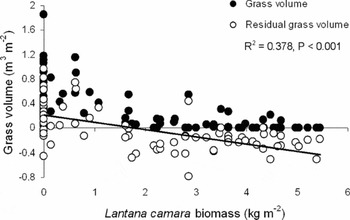
Grass. Mean grass volume was explained by terrain slope (coefficient = 0.038 ± 0.012, F1, 76 = 10.1, P = 0.002), as well as tree density (coefficient = 0.016 ± 0.008, F1, 74 = 4.63, P = 0.035). After accounting for these and the other environmental factors, residual grass volume was negatively related to L. camara biomass (coefficient = −0.12 ± 0.02, F1, 78 = 39.2, P < 0.001; Figure 4).
Variation in grass abundance (m3 m−2) and residual grass abundance (after accounting for environmental influences) along an increasing gradient of Lantana camara abundance (dry above-ground biomass in kg m−2).

DISCUSSION
Landscape-scale factors influencing Lantana camara abundance
The negative relationship between L. camara and tree density (Figure 1) may be attributed to the known propensity of L. camara for colonizing clearings, and logged or disturbed forest, both in its native (T. Croat, pers. comm.) as well as exotic habitat (Duggin & Gentle Reference DUGGIN and GENTLE1998). Decrease in tree density may indicate an agent of disturbance capable of disrupting native plant communities and increasing invasibility (Hobbs Reference HOBBS, Drake, Mooney, di Castri, Groves, Kruger, Rejmanek and Williamson1989). Lower tree density also suggests greater canopy openness and hence greater light availability for rapid secondary succession (Laurance et al. Reference LAURANCE, FERREIRA, RANKIN-DE MERONA, LAURANCE and LOVEJOY1998), which can be dominated by exotic plants (Duggin & Gentle Reference DUGGIN and GENTLE1998). In these forests, the most common agent of tree community disturbance is clearing for the creation and maintenance of roads, fire breaks, waterholes and salt licks which are associated with greater tree death and lower tree densities (Prasad Reference PRASAD2009a).
Decrease in L. camara with increase in rainfall cannot be explained given our present understanding of the drivers of L. camara invasion. However, two hypotheses might potentially explain this phenomenon. (1) Shade hypothesis: greater rainfall results in higher tree density (and thereby likely greater canopy cover), which is known to shade out L. camara (Duggin & Gentle Reference DUGGIN and GENTLE1998). In this study, tree density was used as a surrogate for shade, and canopy cover was not explicitly quantified. The above-described negative relationship between tree density and L. camara abundance, however, supports the notion that greater tree density, arising from greater precipitation, is associated with lower L. camara abundance. (2) Soil moisture hypothesis: areas with higher rainfall may have higher soil moisture, which has been shown to influence L. camara invasion (soil moisture in excess of 25% supported little to no L. camara in a tropical dry deciduous forest in central India; Sharma & Raghubanshi Reference SHARMA and RAGHUBANSHI2010).
In this study, fire frequency (number of fire occurrences within a 710-m radius of a plot set over a 7-y period), did not appear to have an effect on the abundance of L. camara. It is widely believed that fire is one of the agents responsible for ‘opening up’ the native understorey to L. camara invasion (Hiremath & Sundaram Reference HIREMATH and SUNDARAM2005). Local indigenous communities, in BTR as well as nearby invaded dry forests, assert that management-related changes in fire regimes may have increased the intensity, duration and spread of fires which facilitated L. camara invasion, thereby setting up a positive fire–L. camara cycle (Hiremath & Sundaram Reference HIREMATH and SUNDARAM2005). This ‘fire-Lantana’ hypothesis (sensu Hiremath & Sundaram Reference HIREMATH and SUNDARAM2005) could not be tested with this dataset because the only data available on fire in BTR were the MODIS data (Justice et al. Reference JUSTICE, GIGLIO, KORONTZI, OWENS, MORISETTE, ROY, DESCLOITRES, ALLEAUME, PETITCOLIN and KAUFMAN2002) which did not provide any information on the duration, intensity or spatial extent of fires.
Landscape-scale relationships between Lantana camara abundance and native vegetation
Tree seedlings. The notion that greater seedling survival under shrubs, including L. camara, is due to reduced herbivory (Prasad Reference PRASAD2010), is a phenomenon that has been documented elsewhere as well (Garcia & Obeso Reference GARCIA and OBESO2003, Gorchov & Trisel Reference GORCHOV and TRISEL2003, Holl Reference HOLL2002). Thus, low-moderate levels of L. camara (< 4 kg m−2) can support higher tree seedling densities than the absence of L. camara (0 kg m−2). However, these data did not support this expectation – tree seedling densities were similar across different levels of L. camara abundance. The uniform low density of seedlings across L. camara abundance levels may be because data were collected in the dry season during which seedling densities are known to be the lowest in the year (B. Sundaram & and A. Hiremath; unpubl. data, Prasad Reference PRASAD2010). Data from other seasonal dry forests have also shown that tree seedling germination is strongly seasonal with a peak in density in the rainy season, and low densities throughout the rest of the year (Lieberman & Li Reference LIEBERMAN and LI1992, McLaren & McDonald Reference MCLAREN and MCDONALD2003). In other words, the limitation of tree seedling density by rainfall in the dry season likely eclipses the effect of L. camara. Data from different seasons in the year, when seedlings are not limited by rainfall, may be required to determine whether tree seedling density is related to L. camara abundance across a heterogeneous forest landscape.
Tree saplings. Although the mechanism underlying the difference in native tree sapling density between absent-low and medium-high levels of L. camara biomass is yet to be experimentally elucidated, I suggest a probable process. Lantana camara is known to grow in disturbed areas such as along clearings and in canopy gaps (Croat Reference CROAT1978, Prasad Reference PRASAD2009a), where conditions are suited to the recruitment of native successional species as well (Laurance et al. Reference LAURANCE, FERREIRA, RANKIN-DE MERONA, LAURANCE and LOVEJOY1998). Thus, although these invaded habitats, at the time of pre-invasion disturbance, must have been good sites for tree regeneration with potential for high sapling density, L. camara probably colonized these sites, from extant seed banks, and grew to thicket size faster than native tree seeds could eventually give rise to saplings. Subsequently, these thickets prevented further recruitment of saplings from the seedling stage, as seen in this study, resulting in low sapling densities.
The negative relationship between tree regeneration and L. camara has been reported from studies in other habitats as well (e.g. Australian rain forest, Fensham et al. Reference FENSHAM, FAIRFAX and CANNELL1994, Lamb Reference LAMB, Goudberg, Bonnell and Benzaken1991; dry forests of the Himalayan foothills, Sharma & Raghubanshi Reference SHARMA and RAGHUBANSHI2007). In dense thickets, L. camara branches form a mat-like canopy, at a height of 50–100 cm above the ground, which can be an impenetrable ceiling for vegetation recruiting beneath it. Further, low-light conditions beneath dense L. camara thickets (Ramaswami & Sukumar Reference RAMASWAMI and SUKUMAR2011, pers. obs.) may explain why tree seedlings rarely grow into higher stages of regeneration. Decreased seedling growth due to light limitation beneath a fern understorey has been reported from a mixed hardwood forest in North America (George & Bazzaz Reference GEORGE and BAZZAZ1999). Thus, the transition of seedlings (< 50 cm) into saplings (> 50 cm and < 15 cm gbh), under a physical barrier or shade is probably restricted. Comparatively, the native tall grass understorey likely poses less of a light or physical barrier to the growth of native seedlings into saplings.
The lack of trend in sapling height with respect to L. camara suggests that although few individuals are able to grow into saplings under this exotic shrub, the ones that do are no longer limited by it and can attain a range of heights. Thus, recruitment into the sapling class may be the limiting step in the process of tree regeneration in L. camara-invaded deciduous forests.
Herbs and shrubs. Native herbs and shrubs are generally not abundant even in uninvaded forest understorey, which is tall-grass dominated, except in certain areas (pers. obs.). Thus, it appears that when L. camara heavily invades the understorey (> 4 kg m−2), it replaces grass, and reduces tree regeneration, but has little effect on native herbs and shrubs which persist sparsely, as in the pre-invasion grass-dominated understorey. Additionally, moderately dense L. camara thickets (2–4 kg m−2) are able to support higher densities of native understorey plants beneath them than L. camara-free forest, probably because they are protected from ungulate herbivory by the thorny branches of L. camara (Prasad Reference PRASAD2010).
However, herb and shrub species richness was positively related to L. camara abundance, a phenomenon which cannot be explained currently given our limited understanding of the ecology of these species. One possible explanation is an adaptation of the diversity-invasion paradigm that suggests that sites with the highest native plant diversity are often the most ‘invasible’, because the same environmental conditions that promote native diversity may also favour increased exotic diversity (Levine Reference LEVINE2000, Stohlgren et al. Reference STOHLGREN, BINKLEY, CHONG, KALKHAN, SCHELL, BULL, OTSUKI, NEWMAN, BASHKIN and SON1999) unless exotic species differ strongly from native species (Rejmanek Reference REJMANEK, Drake, Mooney, di Castri, Groves, Kruger, Rejmanek and Williamson1989). Although the paradigm uses the term ‘invasibility’ as related to the number of invasive species, if it were adapted to include the abundance of invasive species, it could explain the pattern documented by this study – sites with high native plant richness may be conducive for L. camara invasion.
Grass. These data suggest that, in this tropical deciduous forest, grass and L. camara are almost mutually exclusive. Further, anecdotal information from indigenous communities indicates that several tracts of forest which are now under dense L. camara, with little or no grass left in the understorey, were, at one time, tall-grass dominated. The strong negative relationship between L. camara and grass volume could be either because the absence of grass (e.g. resulting from intense fires) promotes L. camara invasion or because L. camara suppresses grass or both. Experimental studies are needed to clarify the nature and directionality of the negative L. camara–grass relationship. Either way, regardless of the underlying process, the exclusion of grass from these forests, where it is the dominant understorey plant, could have major implications for this ecosystem. Firstly, the replacement of quick-burning and low-fuel grasses by dense, woody, flammable thickets of L. camara, which has been shown to change fire regimes, by increasing fire frequency (Tireman Reference TIREMAN1916), can greatly increase the intensity and duration of forest fires (pers. obs.). Secondly, whereas T. cymbaria tall grass is easy to pass through, and poses no hindrance for animal movement, despite being over 2 m tall in places, L. camara commonly grows in impenetrable thickets obstructing movement for even the largest wild herbivores, which appear to use invaded habitats significantly less than grassy L. camara-free forest (Prasad Reference PRASAD2009b). Thirdly, the replacement of grass by an unpalatable, toxic (Sharma et al. Reference SHARMA, MAKKAR and DAWRA1988), woody plant potentially deprives herbivores of crucial forage. Particularly, large mammalian grazers, such as gaur Bos gaurus (Smith, 1827) and chital Axis axis (Erxleben, 1777), and mixed feeders like elephant Elephas maximus (Linnaeus, 1758), could be impacted by forage scarcity arising from grass decline.
Gaps in the study – questions for future research
While this study is unique in its explicit incorporation of environmental influences in the description of relationships between exotic and native forest plants, it does have drawbacks that need to be acknowledged and addressed in future work. Because the data presented here are from surveys which highlight correlations, it is not possible to attribute the decline of native vegetation forms to the exotic plant. Nevertheless, these correlations illuminate an important phenomenon, separate from environmental influences, which may be associated with landscape-scale tropical deciduous forest degradation. They also raise important questions and highlight new research priorities with regard to plant invasions and biodiversity conservation in tropical dry forests including: (1) Canopy openness which has been shown to be strongly linked to L. camara abundance (with greater levels of invasion in low to moderately open canopy forest; Duggin & Gentle Reference DUGGIN and GENTLE1998, Sharma & Raghubanshi Reference SHARMA and RAGHUBANSHI2010) was not measured here and is an important factor to explicitly consider in future work. (2) Native plant communities are also shaped by edaphic factors which were omitted from this study. The influence of soil properties, including soil moisture, on native plant abundance and richness and L. camara abundance, as well as allelopathic pathways of influence of L. camara on native plants must be understood. (3) More explicit information on fire – intensity, duration and extent (area) – a widely acknowledged potential driver of L. camara invasion (Duggin & Gentle Reference DUGGIN and GENTLE1998, Hiremath & Sundaram Reference HIREMATH and SUNDARAM2005) is likely to shed much-needed light on L. camara ecology and spread. The fire data used here have proven insufficient to draw satisfactory conclusions regarding fire's influence on L. camara and native plants. (4) Experimental work, in plots distributed across rainfall, topography and tree density gradients, on mechanisms underlying the correlations reported here is the necessary next step to better understanding L. camara invasion in this landscape.
ACKNOWLEDGEMENTS
I thank the Karnataka Forest Department for research permits, and Save the Tiger Fund (National Fish and Wildlife Foundation, USA), and the Rufford Foundation for Nature Conservation (UK) for grants which supported this work. I am grateful to J. K. Sidda, K. Suresha, K. Mara, J. K. Bomma, K. Murthy, J. K. Kala, and J. K. Madha for field assistance. I thank M. D. Madhusudan for his advice regarding the design and implementation of the study. Input from W. M. Shields, D. A. Frank, D. J. Leopold, J. P. Gibbs, J. S. Turner, M. Dovciak, S. Bagchi, A. Hiremath, and anonymous reviewers of earlier drafts helped improve this manuscript.