


Introduction
Why would actors that use security framing to elevate an urgent issue later seek to soften, narrow, or recalibrate that framing, even when the underlying threat remains acute? This question matters because securitization is usually understood as a powerful agenda-setting move. By presenting an issue as an existential threat, actors can raise political salience, mobilize audiences and resources, and justify urgent action.Footnote 1 For weaker or vulnerable actors, security language can be especially useful: it can secure recognition from more powerful states and institutions. Yet the same move may also create new vulnerabilities. Once an issue becomes salient as security, it may attract stronger external actors whose strategic priorities, institutional practices, and geopolitical rivalries reshape the issue in ways that weaken the agenda control of those who originally raised it.
Recent developments in Pacific climate diplomacy illustrate this puzzle. Pacific Island Countries (PICs), acting individually and collectively through the Pacific Islands Forum (PIF), have long framed climate change as an existential issue of security, survival, and justice.Footnote 2 The 2018 Boe Declaration described climate change as the region’s ‘single greatest threat’ to the livelihoods, security, and wellbeing of Pacific peoples.Footnote 3 This was a major regional securitizing move: it placed climate change at the center of the Pacific security agenda and embedded it in a broadened conception of regional security. Yet subsequent Pacific diplomacy did not simply deepen climate securitization. The 2025 Blue Pacific Ocean of Peace Declaration, adopted in Honiara, recasts regional order through the language of peace, dialogue, sovereignty, stewardship, mutual respect, and Pacific-led governance.Footnote 4 At the same time, Pacific leaders advanced the Pacific Resilience Facility (PRF) as a Pacific-owned and Pacific-led mechanism for climate and disaster resilience finance. The puzzle, therefore, is not why Pacific actors stopped seeing climate change as dangerous. They did not. The puzzle is why they began to recalibrate the security framing of climate change while the threat remained severe.
This article develops a theory of strategic desecuritization under asymmetry to explain this dynamic. We argue that securitizing moves can generate both security opportunities and security traps. They create opportunities by raising salience, securing recognition, and attracting resources. But under conditions of power asymmetry and geopolitical competition, they can also generate traps by drawing in stronger external actors whose security logics reshape governance and erode the initiating actors’ control over how the issue is governed. Strategic desecuritization emerges as a response to this dilemma. It is not a denial of danger or a return to routine politics. It is a deliberate strategy through which weaker actors seek to preserve urgency while narrowing security framing, limiting external strategic intrusion, and reasserting authority over issue governance.Footnote 5
The article makes three contributions. First, it refines securitization theory by distinguishing securitizing moves, full securitization, and security effects.Footnote 6 The argument does not require the claim that Pacific climate politics achieved full Copenhagen-style securitization through extraordinary measures. It focuses instead on consequential security effects: heightened salience, institutional attention, external engagement, and changes in the terms of governance.Footnote 7 Second, it reconceptualizes desecuritization as a strategic practice under asymmetry, building on but moving beyond accounts that emphasize its normative, democratic, or procedural dimensions.Footnote 8 Third, it shows that strategic desecuritization is institutional as well as discursive: weaker actors may seek not only to change the language of security, but also to build alternative institutions that redirect governance toward civilian, cooperative, regional, or locally controlled frameworks.Footnote 9
The article also speaks to debates on environmental and climate security. Critical scholarship has long shown that climate securitization is politically ambivalent: it can elevate neglected harms and create pressure for action, but it can also privilege emergency logics, state-centered authority, militarized responses, and governance practices poorly suited to the diffuse, long-term, and justice-laden character of ecological harm.Footnote 10 Recent work on Pacific regionalism further shows that Pacific actors actively shape, contest, and localize security narratives rather than passively absorbing external agendas.Footnote 11 This article connects these insights by specifying how security framing may become politically costly for weaker actors and by identifying strategic desecuritization as one response to those costs.
Empirically, the article illustrates the argument through a plausibility probe of Pacific climate diplomacy. The Pacific case is not treated as a definitive test of the theory. Rather, it examines whether the proposed sequence is empirically plausible by tracing publicly observable shifts in regional discourse, external engagement, agenda-control concerns, and institutional design. The analysis focuses on the trajectory from the Boe Declaration to the Blue Pacific Ocean of Peace Declaration and the PRF.
The article proceeds in four sections. The first clarifies the conceptual foundations of the argument, distinguishing securitizing moves from full securitization, security opportunities from security traps, and normative from strategic desecuritization. The second develops the five-step mechanism linking securitizing moves, external entry, embedded security logics, loss of agenda control, and strategic desecuritization through discursive recalibration and institutional substitution. The third illustrates the mechanism through Pacific climate diplomacy. The conclusion discusses broader implications for securitization theory, weak-actor agency, environmental security, and global governance.
Conceptual foundations: securitizing moves, security traps, and strategic desecuritization
The theory developed here rests on three conceptual distinctions: between securitizing moves and full securitization, between security opportunities and security traps, and between normative and strategic desecuritization. These distinctions are necessary because the argument does not require a claim of full Copenhagen-style securitization. It focuses instead on securitizing moves that generate consequential security effects: heightened salience, institutional attention, external engagement, and changes in the terms of governance.
The argument speaks primarily to securitization theory, but it draws selectively on different strands of the literature. From the Copenhagen School, it takes the importance of securitizing moves, audience resonance, and desecuritization as a movement away from emergency politics.Footnote 12 From the Paris School, it takes the insight that security is reproduced through practices, bureaucratic routines, professional fields, and institutionalized governance rather than speech acts alone.Footnote 13 From critical and emancipatory approaches, including the Welsh/Aberystwyth tradition, it takes seriously the question of whose security and agency are advanced or constrained by security politics.Footnote 14 The contribution is not to adjudicate among these traditions, but to connect their insights through a specific problem: how weaker actors respond when their own securitizing moves generate security effects that empower stronger external actors.
Securitizing moves and full securitization
The first distinction is between securitizing moves and full securitization. A securitizing move is a discursive act through which an actor presents an issue as an existential, urgent, or exceptional security threat. Full securitization, in the stricter Copenhagen School sense, requires more than such a move: it requires audience acceptance and the legitimation of exceptional or extraordinary measures.Footnote 15 Security effects occupy an intermediate position. A securitizing move need not fully shift an issue into exceptional politics in order to transform a policy landscape. It can also alter the political status of an issue more incrementally by raising salience, attracting institutional attention, mobilizing external actors, or shifting the terms of everyday governance.Footnote 16
This distinction is central to the Pacific case. The argument does not claim that PICs achieved full Copenhagen-style securitization of climate change. The 2018 Boe Declaration is better understood as a successful regional securitizing move with significant security effects: it placed climate change at the center of the Pacific regional security agenda, raised the visibility of Pacific climate vulnerability, and contributed to intensified external engagement. Boe built on and reinforced a broader Pacific and small-island diplomatic effort to internationalize climate change as a security concern, including Tuvalu’s intervention in the UN Security Council’s 2007 debate on ‘Energy, Security and Climate’ and the 2009 General Assembly resolution on the possible security implications of climate change.Footnote 17 The mechanism theorized here begins at this point: when a securitizing move alters the diplomatic agenda and attracts more powerful external actors, even if it does not generate classic domestic emergency measures.
From security opportunity to security trap
Securitizing moves can create opportunities. For weaker actors, security framing may be one of the few available means of gaining recognition from more powerful states and international organizations. By presenting an issue as urgent or existential, weak and vulnerable actors can increase visibility, generate moral pressure, mobilize diplomatic support, and improve access to resources. In this sense, securitizing moves can generate a security opportunity: they raise issue salience and expand the range of actors willing to engage. This opportunity logic is consistent with work on small-state and weak-actor agency, which shows how vulnerability can be converted into diplomatic leverage through coalition-building, norm entrepreneurship, and institutional entrepreneurship.Footnote 18
Climate politics illustrates both the value and the risk of this strategy. PICs and other small island states face severe material vulnerability but limited structural power. Framing climate change as a security issue can transform climate vulnerability from a distant environmental concern into an urgent matter of survival, justice, and international responsibility.Footnote 19 At the same time, climate-security scholarship has long warned that securitization can privilege emergency logics, state-centered authority, militarized responses, risk management, and exclusionary narratives that may sit uneasily with climate justice and ecological security.Footnote 20
This ambivalence is especially consequential for weaker actors. Security framing can elevate neglected harms and create pressure for action, but it can also reshape the field of response in ways that privilege particular actors, instruments, and institutional logics. The same move that raises salience may attract actors with greater material capabilities, broader strategic interests, and stronger institutional repertoires. In contexts of geopolitical competition, security-framed issues are especially likely to be read through strategic lenses and connected to influence, access, infrastructure, military presence, or rivalry management.
A security trap arises when the opportunity created by a securitizing move is offset by the loss of agenda control that follows from external entry. More precisely, a security trap occurs when a securitizing move, initially adopted to enhance political leverage, attracts more powerful external actors whose security logics reshape the issue in ways that constrain the autonomy and objectives of the initiating actors. The trap is not external involvement as such. External support may be necessary and desirable. The trap arises when external involvement changes who defines the problem, which solutions become legitimate, and which institutions govern the issue. This is a question of power as much as discourse: agenda control can shift through funding, expertise, institutional rules, professional practices, and the ability of stronger actors to define legitimate forms of governance.Footnote 21
This argument should not be read as a general claim that securitization is always harmful. Nor does it assume that external actors necessarily intend to undermine weak actors’ autonomy. What appears as an undesired consequence for weaker initiating actors may be an intended or acceptable outcome for more powerful external actors. The asymmetry is precisely the point: the same process can generate recognition and resources for weaker actors while creating opportunities for stronger actors to reshape the governance environment. Security traps are therefore best understood as asymmetric second-order effects of successful securitizing moves.
The distinction between security opportunity and security trap explains why weaker actors may initially securitize and later recalibrate. The benefits of securitization – attention, recognition, and resources – are visible and immediate. The costs – agenda displacement, strategic overlay, and institutional dependence – are uncertain and often emerge over time. Strategic desecuritization is therefore not evidence that the original securitizing move was irrational. Rather, it is an adaptive response to the changing political effects of that move under asymmetry.
Normative and strategic desecuritization
Desecuritization has often been discussed as a normative or procedural project. In the Copenhagen School, it refers to moving issues out of emergency politics and back into ordinary political contestation.Footnote 22 Normative accounts ask whether desecuritization can reduce exceptionalism, protect democratic politics, and avoid the exclusionary or coercive effects of security discourse.Footnote 23 Subsequent work complicates this view by showing that desecuritization is neither simple nor uniformly emancipatory. It may involve management rather than resolution, contextual reframing rather than depoliticization, or the redistribution of insecurity across actors and sites.Footnote 24
This article does not claim that existing scholarship ignores strategy. Securitization and desecuritization research already recognizes that actors may use security and desecuritizing language tactically, that desecuritization can be contested, and that movement out of security can take multiple forms.Footnote 25 Nor does the article suggest that normativity is irrelevant. Work on the ethics of securitization rightly asks when securitization is justified, when it is harmful, and whose security it serves.Footnote 26 The contribution here is more specific: it identifies a mechanism through which prior securitizing moves can themselves generate incentives for strategic desecuritization under asymmetry.
Strategic desecuritization is defined here as a deliberate discursive and institutional strategy through which weaker actors reduce, narrow, or recalibrate the salience of security framing in order to limit external security-driven intervention and reassert control over issue governance. It is strategic in three senses: it is motivated by practical concerns over authority and agenda control; it is relational, emerging in response to more powerful external actors; and it is institutional as well as discursive, seeking to alter not only how an issue is described but also the organizational channels through which it is governed.
Strategic desecuritization differs from several adjacent concepts. It is not failed securitization, because it follows securitizing moves that have already generated meaningful salience effects. It is not ordinary issue reframing, because it is triggered by the political costs of security framing under asymmetry. It is not necessarily depoliticization, because the issue may remain urgent, contested, and highly political. Nor is it simply normative desecuritization, because its primary purpose is not to return to idealized normal politics, but to rebalance authority over the governance of a still-dangerous issue.
This distinction is especially important for issues such as climate change, where the danger may remain acute even when actors seek to recalibrate security language. Strategic desecuritization does not require actors to deny the seriousness of a threat or reduce international attention to it. Rather, weaker actors may seek to preserve urgency while shifting the governing logic away from military, geopolitical, or externally dominated security frames and toward civilian, developmental, legal, ecological, or locally controlled institutions. Strategic desecuritization is therefore not an exit from politics. It is a struggle over the terms of political authority.
This logic clarifies the role of institutional substitution. If securitization operates not only through speech but also through practices, bureaucratic routines, funding channels, professional networks, and institutional arrangements, then it cannot be merely rhetorical.Footnote 27 Institutional substitution refers to the creation, strengthening, or redirection of governance arrangements away from security-dominated or externally controlled mechanisms and toward civilian, cooperative, regional, or locally accountable institutions. Without such institutional traction, discursive recalibration may remain symbolic; with it, weaker actors can more credibly reshape the terms of external engagement.
These distinctions set up the mechanism developed in the next section. Securitizing moves can create opportunities by raising salience, but under asymmetry those opportunities may become traps if external actors embed security logics and shift agenda control away from the initiators. Strategic desecuritization emerges as one way weaker actors seek to mitigate that trap.
A five-step mechanism: from security opportunity to strategic desecuritization
The transition from a securitizing move to strategic desecuritization unfolds through a conditional five-step mechanism. The mechanism is not a universal sequence that follows all forms of security framing. It identifies a narrower pathway through which securitizing moves by weaker actors first generate salience, then attract more powerful external actors, and eventually create incentives for recalibration when external security logics begin to constrain agenda control.
The five steps are: first, a securitizing move increases salience; second, salience attracts powerful external actors; third, external actors embed security logics into governance; fourth, agenda control shifts away from the initiating actors; and fifth, weaker actors respond through strategic desecuritization. The mechanism explains how security framing can move from opportunity to trap, and why desecuritization may become a strategy of agency rather than a sign that the original threat has declined.
First, a securitizing move increases salience. When a securitizing move resonates with relevant audiences, framing an issue as existential or urgent can elevate its priority on domestic and international agendas. The mechanism does not require full Copenhagen-style securitization or the legitimation of extraordinary measures. It requires only that security framing generate consequential security effects: heightened salience, institutional attention, actor mobilization, or changes in the terms of political engagement.
This first step explains why weaker actors may choose security framing despite possible downstream risks. Securitizing moves can help them overcome neglect, secure recognition, mobilize resources, and dramatize collective action problems. The mechanism applies only to moves that generate meaningful salience effects. A security trap does not arise from speech alone; it arises when security speech changes the political environment sufficiently to attract stronger actors and reorganize governance. The post-9/11 elevation of terrorism and the widespread emergency language of the COVID-19 pandemic illustrate how security framing can reorder policy priorities and institutional attention beyond the initiating actors.Footnote 28
Second, salience induces entry by powerful external actors. Once an issue becomes salient in security terms, it becomes more attractive to powerful states, international organizations, security professionals, donors, and other institutional actors. Their entry may be motivated by strategic interests, reputational concerns, humanitarian commitments, bureaucratic incentives, or institutional mandates.Footnote 29 At this stage, securitization creates a security opportunity: it expands the set of actors willing to devote attention and resources to the issue.
Yet external entry also changes the structure of the issue area. Stronger actors rarely enter as neutral providers of resources. They bring their own priorities, threat perceptions, institutional cultures, and preferred policy instruments. Once an issue becomes internationally salient as security, it can become available for reinterpretation by actors with greater material capabilities and broader strategic agendas. Following 9/11, the United States expanded its global counterterrorism footprint, especially in Afghanistan and other strategically significant theatres. Similarly, the framing of piracy off the Horn of Africa as a major security threat led to multinational naval deployments, including the North Atlantic Treaty Organization and the European Union (EU) missions, as well as independent operations by China, India, and Russia.Footnote 30 For weaker initiating actors, this is the first point at which opportunity can begin to turn into vulnerability: the same salience that attracts recognition, funding, and diplomatic support can also open the issue to external reinterpretation.
Third, external actors embed security logics into governance. Once powerful actors enter a salient issue area, they often operationalize it through familiar security instruments, including military deployments, defense cooperation, intelligence sharing, policing, border control, surveillance technologies, strategic infrastructure, sanctions, or security-linked development assistance. This is where the Paris School’s insight is especially useful: security does not operate only through dramatic speech acts; it becomes embedded in practices, professional routines, bureaucratic fields, technologies, and institutional arrangements.Footnote 31 External actors may therefore transform an issue not by changing its label, but by governing it through security practices. The U.S.-led ‘Global War on Terror’ exemplifies this dynamic: counterterrorism became deeply intertwined with military operations, intelligence cooperation, and security assistance.Footnote 32 Anti-piracy efforts in the Gulf of Aden similarly evolved into sustained naval patrol regimes, embedding military logic into what was also a governance and development problem.Footnote 33
This step is central to the security trap. The issue does not simply receive more attention; it becomes governed differently. Instruments associated with security actors begin to structure the range of imaginable and legitimate responses. Problems that might otherwise be addressed through civilian, developmental, legal, ecological, or regional mechanisms become increasingly organized through strategic or coercive logics. From the standpoint of powerful external actors, this may be intentional and consistent with national interest. From the standpoint of weaker initiating actors, however, it may be an undesired second-order consequence of earlier security framing.
Fourth, agenda control shifts away from initiating actors. As security logics become institutionalized, governance authority may gradually shift from the original securitizing actors to powerful external actors and international bureaucracies. This does not necessarily mean that weaker actors lose formal sovereignty. Rather, it means that their practical control over problem definition, policy sequencing, institutional design, and partnership terms becomes constrained. This pattern is consistent with broader accounts of asymmetric governance, in which formal authority may remain intact while substantive control is redistributed through institutional rules, funding structures, expertise, and external conditionalities.Footnote 34
This is the point at which a security opportunity becomes a security trap. The initiating actors may still benefit from attention and resources, but they no longer fully control the terms on which the issue is governed. The trap is therefore not external involvement as such. It is the combination of external entry, embedded security logics, and declining agenda control under asymmetry. Afghanistan after 2001 illustrates the broader dynamic: reconstruction and state-building agendas were formally organized around Afghan sovereignty but were heavily shaped by donor priorities, security imperatives, and external intervention.Footnote 35
Fifth, loss of agenda control generates incentives for strategic desecuritization. When weaker actors perceive that security framing has begun to erode their control over the issue, they have incentives to recalibrate. Strategic desecuritization does not mean that the threat has disappeared. Nor does it necessarily mean depoliticizing the issue or returning it to routine administration. Rather, it means narrowing, softening, or redirecting security framing in order to limit external security-driven intervention and reclaim authority over governance.
Strategic desecuritization operates through two mutually reinforcing strategies. The first is discursive recalibration. Actors reduce the salience of expansive security language by shifting from the vocabulary of existential threat, emergency, and danger toward vocabularies of cooperation, resilience, stewardship, legality, development, or peace. This move does not deny the severity of the threat. It changes the political grammar through which the threat is governed. In this respect, strategic desecuritization builds on work showing that desecuritization may involve management, reframing, or contextual transformation rather than a simple return to normal politics.Footnote 36
The second strategy is institutional substitution. Weaker actors develop, strengthen, or redirect governance arrangements away from security-dominated or externally controlled mechanisms and toward civilian, multilateral, regional, or locally accountable institutions. Institutional substitution is essential because security logics are not sustained by discourse alone. They are sustained through organizations, funding channels, professional networks, and policy instruments. If actors wish to reduce the grip of security logic, they must also build alternative institutional pathways.Footnote 37 In this sense, strategic desecuritization is not merely rhetorical. It is an institutional strategy aimed at rebalancing authority and restoring agenda control.
Taken together, the five-step mechanism identifies a paradox in the politics of securitization. Security framing can be an effective short-term strategy for weaker actors seeking recognition, salience, and support. Yet under asymmetry, the same strategy can attract stronger actors, embed security logics, and shift control away from the original initiators. Strategic desecuritization emerges as a response to this paradox. It allows weaker actors to preserve the urgency generated by earlier securitizing moves while reducing the autonomy-eroding consequences of externalized security governance.
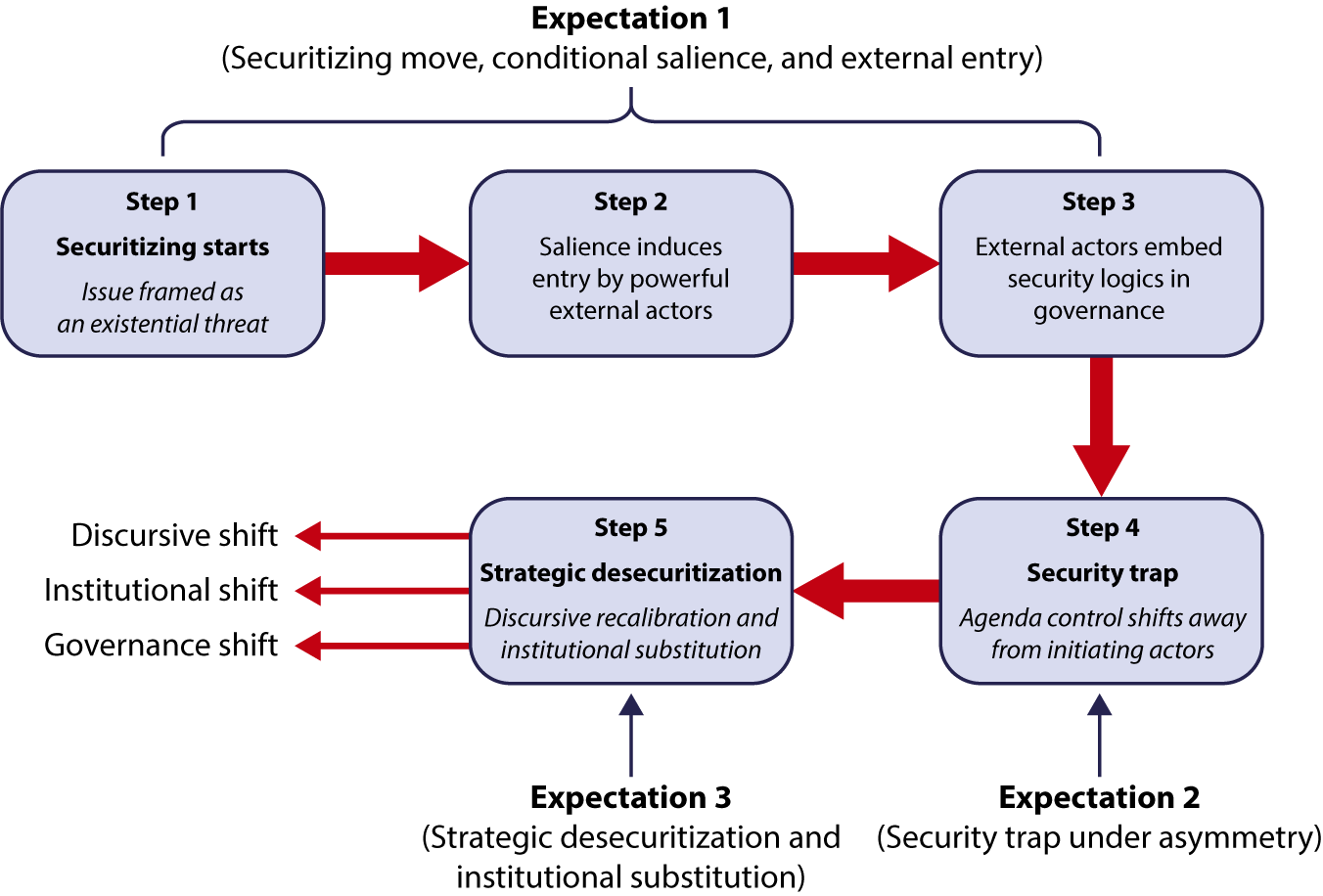
For analytical purposes, the mechanism generates three expectations. These are not hypotheses for definitive testing in a single case. Rather, they specify observable implications that should be visible if the mechanism is empirically plausible. The expectations capture the central transformations in the causal process: conditional salience and external entry following a securitizing move, the emergence of a security trap under asymmetry, and the strategic response of desecuritization. Figure 1 summarizes these relationships.
From security trap to strategic desecuritization: a five-step mechanism and three expectations.

Figure 1. Long description
The flowchart consists of five numbered boxes connected by red arrows.
At the top, a bracket spans Steps 1 through 3 labeled Expectation 1 (Securitizing move, conditional salience, and external entry).
Step 1: Securitizing starts. The text below states: Issue framed as an existential threat. A red arrow points right to Step 2.
Step 2: Salience induces entry by powerful external actors. A red arrow points right to Step 3.
Step 3: External actors embed security logics in governance. A red arrow points down to Step 4.
Step 4: Security trap. The text below states: Agenda control shifts away from initiating actors. An arrow from below points to this box labeled Expectation 2 (Security trap under asymmetry). A red arrow points left to Step 5.
Step 5: Strategic desecuritization. The text below states: Discursive recalibration and institutional substitution. An arrow from below points to this box labeled Expectation 3 (Strategic desecuritization and institutional substitution).
From the left side of Step 5, three red arrows point further left to three final outcomes: Discursive shift, Institutional shift, and Governance shift.
Expectation 1: Conditional Salience and External Entry. When a securitizing move successfully raises issue salience beyond the initiating actors, engagement by more powerful external actors should become more likely.
Expectation 2: Security Trap under Asymmetry. Under conditions of pronounced power asymmetry, external entry into a salient security-framed issue should be associated with the embedding of security-oriented logics into governance, a shift in agenda control away from initiating actors, and the emergence of a security trap that constrains their autonomy.
Expectation 3: Strategic Desecuritization and Institutional Substitution. When weaker actors perceive that a security trap is eroding agenda control, and when viable alternative institutional pathways exist, they should have incentives to reduce or recalibrate security framing and promote alternative institutions that replace, bypass, or dilute security-dominated governance structures with civilian, cooperative, regional, or locally controlled frameworks.
These expectations imply three observable shifts associated with strategic desecuritization. First, there should be a discursive shift. The language of emergency and existential threat should be supplemented, narrowed, or partially displaced by cooperative, technical, legal, developmental, or stewardship-oriented vocabularies such as resilience, peace, sustainability, dialogue, or regional ownership. This does not require the disappearance of security language. Strategic desecuritization is often partial and selective. The key indicator is a recalibration in the dominant framing of the issue.
Second, there should be an institutional shift. Governance arrangements should move away from security-dominated, bilateral, or externally driven mechanisms and toward civilian, multilateral, regional, or locally controlled institutional pathways. This is the institutional substitution component of the theory. Rather than merely reforming existing institutions, weaker actors create, strengthen, or redirect alternative institutions that dilute external control and re-anchor governance in locally preferred structures.
Third, there should be a governance shift. The terms of external involvement should become more explicitly conditioned by local or regional priorities. This does not require the withdrawal of external actors, nor does it imply that weaker actors achieve full autonomy. Rather, it involves a restructuring of roles in which outside actors are expected to support, align with, or operate through institutions and agendas defined by the initiating actors. Strategic desecuritization is therefore best understood as an effort to rebalance governance authority rather than eliminate external engagement.
The argument applies under specific scope conditions. The mechanism is most likely to operate when four conditions are present: the securitizing move resonates beyond the initiating actor and raises issue salience; the issue is transboundary or geopolitically relevant enough to attract external involvement; there is pronounced power asymmetry between the initiating actors and the actors entering the issue area; and governance can plausibly be redirected through alternative civilian, regional, legal, or multilateral institutions. Climate governance is one such domain, but similar dynamics may arise in health security, migration governance, maritime governance, cyber and infrastructure politics, disaster response, or development finance.
The relevant actors are weaker states, small-state coalitions, regional organizations, and vulnerable communities that initiate or endorse security framing but lack the material or institutional capacity to control stronger external actors once they enter. Conversely, the argument is less applicable where initiating actors are themselves powerful, where securitization reinforces rather than undermines their control, where external involvement remains limited or nonintrusive, or where viable institutional alternatives are absent. The framework should therefore be understood as a conditional theory of a subset of securitization processes. It does not claim that securitization always produces traps or that desecuritization always restores autonomy. It claims that under identifiable conditions of asymmetry, successful securitizing moves can create incentives for weaker actors to strategically recalibrate security framing and substitute institutions in order to regain agenda control.
Plausibility probe: Pacific diplomacy from security opportunity to strategic desecuritization
Research design
This section illustrates the theory through a plausibility probe of Pacific climate diplomacy. It does not offer a definitive test of the mechanism or claim that the Pacific case establishes its general validity. Rather, it examines whether the observable sequence theorized above appears in the case; whether a major regional securitizing move generated security effects; whether those effects coincided with expanded external engagement under asymmetry; whether concerns over agenda control became more visible; and whether Pacific actors subsequently pursued discursive recalibration and institutional substitution.
This design follows a mechanism-centered logic of theory building. It assesses whether public documents, official declarations, and institutional developments are consistent with the theory’s expectations.Footnote 38 Because the analysis focuses on publicly observable shifts in discourse, agenda control, and institutional design, it does not claim to establish the private intentions of Pacific policymakers. Interviews with officials, diplomats, and regional policy practitioners would be valuable for future research, particularly for assessing how policymakers themselves understand the relationship between securitization, agenda control, and strategic desecuritization.
The Pacific is analytically useful for three reasons. First, PICs, acting individually and collectively through the PIF, have long framed climate change as an existential issue of security, survival, and justice.Footnote 39 Second, the region is marked by pronounced power asymmetry: PICs possess significant diplomatic agency but limited material capacity relative to major external partners. Third, the region has become increasingly crowded geopolitically, as Australia, New Zealand, the United States, China, Japan, the EU, and other partners have deepened engagement in the context of strategic competition.Footnote 40
The analysis treats the 2018 Boe Declaration not as conclusive evidence of full Copenhagen-style securitization, but as a successful regional securitizing move with significant security effects. Boe elevated climate change within regional security discourse, strengthened its agenda-setting power, and linked climate vulnerability to a broader regional security environment. The analysis then traces whether this move was followed by intensified external involvement, growing concern over agenda control, and efforts to recalibrate regional diplomacy through the 2025 Blue Pacific Ocean of Peace Declaration and the PRF. The purpose is to demonstrate causal plausibility and analytical leverage, not to establish a monocausal explanation of Pacific regional change.
Climate diplomacy in the Blue Pacific
The trajectory from the 2018 Boe Declaration to the 2025 Blue Pacific Ocean of Peace Declaration provides a useful plausibility probe for the theory. In Boe, Pacific leaders placed climate change at the center of the regional security agenda. Seven years later in Honiara, they did not abandon the urgency of climate change, but recast regional order through the language of peace, stewardship, sovereignty, dialogue, and Pacific-led governance. At the same time, they advanced institutional alternatives such as the PRF. This trajectory is consistent with the article’s central claim: strategic desecuritization does not deny the threat; it recalibrates the governance logic attached to that threat.
Expectation 1: Conditional salience and external entry
The first theoretical expectation is that when a securitizing move successfully raises issue salience beyond the initiating actors, engagement by more powerful external actors should become more likely.
The Pacific case provides evidence consistent with this expectation. The Boe Declaration stated that ‘climate change remains the single greatest threat to the livelihoods, security and wellbeing of the peoples of the Pacific.’Footnote 41 This statement matters not because it proves full securitization in the strict Copenhagen sense, but because it constituted a major regional securitizing move. It placed climate change at the center of the Pacific security agenda and linked it to a broadened conception of security that included human security, environmental and resource security, transnational crime, and cybersecurity. Boe therefore produced security effects: it raised the political status of climate change, anchored it in regional security discourse, and made it harder for external partners to treat Pacific climate vulnerability as a secondary development issue.
Boe also located this climate-security claim within a changing strategic environment. The declaration referred to ‘a dynamic geopolitical environment leading to an increasingly crowded and complex region.’Footnote 42 The combination is analytically important. Pacific leaders elevated climate change as the region’s ‘single greatest threat’ while also acknowledging growing exposure to external competition. The result was a security opportunity: security framing strengthened the diplomatic force of Pacific climate claims and increased pressure on external actors to respond.
After Boe, climate diplomacy became increasingly entangled with renewed great-power engagement. Australia’s Pacific Step-up presented the Pacific as a central strategic priority and combined climate resilience with broader infrastructure, development, and security engagement.Footnote 43 The United States also deepened its regional engagement. The 2022 Declaration on U.S.-Pacific Partnership identified the climate crisis as the ‘highest priority’ of the partnership and echoed Pacific language that climate change remained the ‘single greatest existential threat’ to Pacific peoples.Footnote 44 The 2023 U.S.-PIF leaders’ meeting further institutionalized renewed American engagement.Footnote 45 China likewise expanded its climate-linked regional presence, including through the China-Pacific Island Countries Climate Change Cooperation Center and related South–South cooperation initiatives.Footnote 46
These developments should not be read as monocausal effects of Boe. Great-power interest in the Pacific was already increasing for broader geopolitical reasons. The theory does not require the claim that Pacific securitizing moves alone caused external entry. It expects that successful security framing increases salience and creates stronger incentives for external actors to engage. The Pacific case fits this expectation: after Boe, climate diplomacy became increasingly linked to intensified external engagement, and major powers increasingly framed their regional policies around climate, resilience, infrastructure, and security.
Expectation 2: Security trap under asymmetry
The second theoretical expectation is that, under conditions of pronounced asymmetry, external entry into a salient security-framed issue should be associated with the embedding of security-oriented logics into governance, a shift in agenda control away from initiating actors, and the emergence of a security trap.
The Pacific evidence is consistent with this expectation, though the pattern is emerging rather than complete. Boe already hinted at the underlying dilemma by linking climate securitization to a more ‘crowded and complex’ regional environment.Footnote 47 By 2025, Pacific leaders and institutions were more explicit about the pressures created by external engagement. The 54th Pacific Islands Forum Leaders Communiqué referred to the ‘convergence of climate impacts, geopolitical competition, economic fragility, and social pressures.’Footnote 48 It stressed that partnerships should remain aligned with Forum decisions and the 2050 Strategy for the Blue Pacific Continent, noted pressures created by an ‘increasingly crowded international engagement calendar,’ and reaffirmed the need for a ‘credible, coordinated, and aligned’ Pacific regional voice.Footnote 49 These formulations suggest that external engagement was no longer understood simply as additional support. It had become a governance problem: how could Pacific actors retain control over priorities, sequencing, and partnership terms in a crowded strategic environment?
The concern about strategic overlay is clearer in the 2025 Forum Economic Ministers Meeting Final Outcomes Document. Ministers noted comments from the Cook Islands about a ‘growing regional security narrative’ concerning dual-use strategic infrastructure, research, technical assistance, and ICT, which ‘can at times take on an exclusionary character.’ They further emphasized that any regional framework on dual-use issues should avoid ‘contributing to the targeting of host countries in any conflict scenario.’Footnote 50 This is precisely the kind of concern captured by the security trap concept: security framing can attract resources and attention, but it can also pull issues into strategic competition and expose weaker actors to new vulnerabilities.
The Australia-Tuvalu Falepili Union Treaty illustrates this dilemma in concrete form. The Treaty responded to Tuvalu’s climate vulnerability, including mobility and human security concerns. Yet it also required mutual agreement with Australia before Tuvalu could enter into third-party arrangements on security and defense-related matters.Footnote 51 This example should not be overstated. It does not prove that Australia captured Tuvalu’s agenda, nor that Pacific climate diplomacy as a whole has been subordinated to an external power. The treaty may provide important benefits for Tuvalu, including mobility pathways and security assurances. But it shows how climate vulnerability, mobility, and sovereignty can become linked to restrictive security arrangements under asymmetry. It therefore illustrates the boundary between security opportunity and security trap: external support may be valuable, but it can also constrain future strategic choice.
Taken together, these developments suggest that external engagement in Pacific climate governance has not remained politically neutral. Climate-related assistance, infrastructure, mobility, resilience, and security cooperation increasingly intersect with wider geopolitical concerns. For Pacific actors, the issue is not whether external engagement is necessary; it clearly is. The issue is whether such engagement remains aligned with Pacific-defined priorities or begins to reshape the regional agenda through security-oriented logics. By 2024–2025, Pacific documents increasingly framed this as a problem of agenda control, making the security trap a plausible interpretation of the evolving regional context.
Expectation 3: Strategic desecuritization and institutional substitution
The third theoretical expectation is that when weaker actors perceive that a security trap is eroding agenda control, and when alternative institutional pathways are available, they should have incentives to recalibrate security framing and promote institutions that re-anchor governance in civilian, cooperative, regional, or locally controlled frameworks.
The Pacific response between 2024 and 2025 is consistent with this pattern. Pacific leaders did not abandon the existential significance of climate change. Instead, they recalibrated the broader security grammar of regional diplomacy. At the 2024 Forum Foreign Ministers Meeting, ministers welcomed Fiji’s presentation of the Ocean of Peace concept, noted its alignment with the 2050 Strategy for the Blue Pacific Continent, the Boe Declaration, and the Biketawa Declaration, and agreed to develop a draft declaration for leaders’ consideration in 2025.Footnote 52 This process indicates that the Ocean of Peace was not an abrupt rhetorical gesture. It was developed as a regional diplomatic framework linking peace, security, sovereignty, and Pacific-led governance. It also built on the 2050 Strategy, which had already framed regionalism around collective political agency, oceanic stewardship, and Pacific-defined development priorities. The 2025 declaration should therefore be read not as a rejection of Boe’s climate-security framing, but as a recalibration of that framing within a longer Pacific-led effort to define regional order on its own terms.
The process culminated in the 2025 Blue Pacific Ocean of Peace Declaration adopted in Honiara. The declaration grounds regional order in the Pacific Way and emphasizes peace, dialogue, sovereignty, mutual respect, and collective stewardship. It presents the Ocean of Peace as an expression of a distinctly Pacific worldview and stresses that Pacific priorities should be defined ‘on our terms.’Footnote 53 This language does not simply replace ‘security’ with ‘peace.’ It redefines the political terms of regional security. It seeks to reduce the strategic attractiveness of the Pacific as a site of rivalry and to recenter agency in Pacific institutions and practices.
At the same time, the Ocean of Peace framework did not downgrade climate urgency. The broader 2025 Forum meeting continued to identify climate change as the region’s ‘single greatest threat.’Footnote 54 This coexistence of threat language and peace language is central to the argument. Strategic desecuritization is partial and selective. Pacific leaders did not deny the existential character of climate change; they narrowed the security logic attached to regional governance. They sought to preserve urgency while resisting the translation of climate vulnerability into externalized strategic competition.
This discursive recalibration was accompanied by institutional substitution. The establishment of the PRF provides the clearest example. Forum documents describe the PRF as a Pacific-led, member-owned financing mechanism designed to support community resilience, adaptation, preparedness, and disaster response through regionally governed channels.Footnote 55 As a grant-financing institution rooted in regional ownership, the PRF offers an alternative to externally designed and potentially security-inflected bilateral channels of climate finance.
The PRF is not evidence of completed autonomy. It depends on external contributions and therefore remains exposed to donor influence. At the 2025 Forum Leaders’ Meeting, the PRF had attracted substantial pledges from multiple external partners, including Australia, Saudi Arabia, the United States, Japan, and China.Footnote 56 But this is precisely why institutional design matters. The PRF does not remove external actors from climate finance; it mediates their contributions through a Pacific-owned institutional framework. It begins to redirect external support through a civilian, regional, and resilience-oriented mechanism rather than leaving climate governance to fragmented bilateral arrangements more vulnerable to strategic conditionality.
The combination of the Ocean of Peace and the PRF therefore supports the third expectation. Pacific actors responded to a crowded and increasingly security-inflected regional environment not by reducing the urgency of climate action, but by reshaping the discursive and institutional context in which external engagement occurs. The Ocean of Peace recalibrated the regional narrative around peace, sovereignty, stewardship, and Pacific-led governance. The PRF provided institutional substance by creating a regionally controlled channel for climate and disaster resilience finance. Together, they illustrate strategic desecuritization as both discursive recalibration and institutional substitution.
Taken together, the Pacific case reveals the three observable shifts associated with strategic desecuritization anticipated by the theory. Discursively, existential threat language remained present but was increasingly accompanied by the vocabulary of peace, stewardship, dialogue, sovereignty, and the Pacific Way. Institutionally, Pacific actors strengthened regional and civilian pathways, most notably through the PRF. In governance terms, Forum documents placed renewed emphasis on Pacific-led agenda setting, partner alignment, and regional ownership. These shifts suggest that strategic desecuritization in the Pacific is not a retreat from climate urgency. It is an effort to govern the political consequences of earlier security framing.
Alternative explanations
Several alternative explanations could account for the observed shift toward the Ocean of Peace and Pacific-led institutional arrangements. The evidence does not eliminate these alternatives, but the strategic desecuritization argument accounts for the full pattern more effectively. The first alternative is threat reduction. Pacific leaders may have shifted away from expansive security language because climate change became less urgent or because other issues displaced it. This explanation is not persuasive. The underlying material threat has not receded. The IPCC finds with high confidence that small islands face increasing risks from sea-level rise, storm surge, coastal erosion, drought, tropical cyclones, coral bleaching, and changing precipitation patterns.Footnote 57 Moreover, Pacific leaders continued to identify climate change as the region’s single greatest threat even as they advanced the Ocean of Peace framework.Footnote 58 A threat-reduction account would predict declining attention and weaker institutional responses. Instead, climate remained highly salient and new institutions such as the PRF were strengthened.
The second alternative is normative evolution. Pacific actors may have moved toward peace and stewardship language because they increasingly preferred cooperative, non-exceptionalist, or Pacific Way forms of regional politics. This explanation captures an important part of the story. The Pacific Way, regional consensus, stewardship, and oceanic identity are meaningful normative frameworks. However, a purely normative account struggles to explain the timing of the shift. These norms long predate the 2024–2025 Ocean of Peace turn. What requires explanation is why they were elevated precisely when official Forum documents were also warning of geopolitical competition, crowded engagement, dual-use infrastructure concerns, and a growing regional security narrative.Footnote 59 Strategic desecuritization does not reject the normative account; it explains why these norms became strategically salient in this context.
The third alternative is external pressure or strategic accommodation. Pacific leaders may have softened security language because major powers preferred less confrontational rhetoric. This explanation is incomplete. If the shift were merely a response to external pressure, one would expect rhetorical moderation without parallel institution-building. Yet the Ocean of Peace was accompanied by the PRF, a Pacific-led financing mechanism designed to strengthen regional control over resilience finance. This pattern suggests agency rather than passive accommodation. Pacific actors were not simply moderating language to satisfy external partners; they were constructing institutional pathways through which external support could be mediated on Pacific terms.
The fourth alternative is diplomatic branding. The Ocean of Peace may be read as a symbolic narrative designed to improve regional cohesion or international visibility rather than as a strategic response to the security trap. This interpretation is plausible but partial. Strategic narratives matter because they organize expectations, define legitimate conduct, and shape the terms of external engagement. The Ocean of Peace becomes theoretically significant not because it is rhetorically novel, but because it appears alongside institutional efforts to strengthen Pacific-led governance and explicit concerns about geopolitical crowding. Branding alone cannot explain the coupling of discursive recalibration with institutional substitution.
Each alternative captures part of the empirical picture, but none explains the full pattern. Threat reduction cannot account for the persistence of existential climate language. Normative evolution cannot explain why peace and stewardship language became more salient amid explicit concerns about geopolitical crowding and dual-use infrastructure. External pressure cannot explain the construction of Pacific-led institutional mechanisms. Diplomatic branding cannot explain the coupling of narrative recalibration with institutional substitution. The strategic desecuritization argument better accounts for the sequence: prior securitization created salience and opportunity; external engagement under asymmetry generated agenda-control concerns; and Pacific actors responded by recalibrating discourse and strengthening institutions designed to preserve urgency while reclaiming authority.
The Ocean of Peace should not be treated as conclusive evidence of successful desecuritization. It is better understood as an unfolding attempt at strategic desecuritization.Footnote 60 The declaration continues to coexist with official statements identifying climate change as the region’s single greatest threat. The PRF remains dependent on external pledges. Major powers may endorse Pacific-led language rhetorically while continuing to pursue strategic interests in practice.Footnote 61 Whether the Ocean of Peace and the PRF can generate durable constraints on external behavior remains an open empirical question. This uncertainty reinforces the value of the plausibility-probe design: the Pacific case illustrates the mechanism, but future research should investigate whether strategic desecuritization succeeds, fails, or becomes appropriated by the very external actors it seeks to manage.
Conclusion: strategic desecuritization and the politics of agenda control
This article has developed a theory of strategic desecuritization under asymmetry. It began with a puzzle: why would actors who use security framing to elevate an urgent issue later seek to narrow or recalibrate that framing, even when the underlying threat remains acute? The answer advanced here is that securitizing moves can generate both security opportunities and security traps. They create opportunities by raising issue salience, securing recognition, and attracting resources. Yet under conditions of power asymmetry and external receptivity, the same moves can also attract stronger actors whose security logics reshape governance and weaken the agenda control of those who initially raised the issue. Strategic desecuritization emerges as a response to this dilemma: not a denial of danger, but an effort to preserve urgency while reclaiming authority over how that danger is governed.
The Pacific case illustrates this dynamic. The 2018 Boe Declaration constituted a major regional securitizing move by placing climate change at the center of Pacific security discourse and identifying it as the single greatest threat to the livelihoods, security, and wellbeing of Pacific peoples. Yet subsequent Pacific diplomacy did not simply deepen security framing. In the context of geopolitical crowding and growing concern about strategic overlay, Pacific leaders increasingly emphasized peace, stewardship, sovereignty, dialogue, and Pacific-led governance. The 2025 Blue Pacific Ocean of Peace Declaration and the PRF are therefore best understood not as evidence that climate change had become less threatening, but as attempts to recalibrate the terms of climate governance. They seek to preserve the urgency generated by earlier security framing while redirecting external engagement through a more regional, civilian, and Pacific-owned institutional architecture.
The central theoretical implication is that securitization should not be understood only in terms of success or failure, nor desecuritization only as a return to normal politics. Many securitizing moves generate intermediate security effects: they raise salience, reshape institutional attention, and alter the terms of governance without necessarily producing full Copenhagen-style exceptionalism. These effects matter because they can change who enters an issue area, which instruments become legitimate, and who gains practical authority over governance. The concept of a security trap captures the point at which the benefits of salience are offset by the costs of externalized governance.
The article also reframes desecuritization as a practice of agency under constraint. Weaker actors may recalibrate security language not because the underlying threat has disappeared, and not simply because they reject security discourse on normative grounds, but because security framing has begun to empower stronger external actors and constrain local or regional agenda control. Strategic desecuritization is therefore partial, selective, and institutional. It narrows or redirects security framing while promoting alternative governance pathways that can dilute external control. Institutional substitution is central to this process: by strengthening civilian, multilateral, regional, or locally accountable institutions, weaker actors can attempt to redirect external support without rejecting it altogether.
This argument has particular significance for environmental and climate security debates. Critical scholarship has long warned that environmental securitization may privilege emergency logics, state-centered authority, and militarized responses poorly suited to long-term ecological harm. The Pacific case adds an important political insight: actors exposed to these risks may themselves respond by shifting from expansive security framing toward languages of peace, stewardship, resilience, and regional ownership. This does not make climate change less dangerous. It changes the terms through which danger is governed. Strategic desecuritization therefore connects normative critiques of environmental securitization to a broader theory of political adaptation under asymmetry.
The scope of the argument is deliberately limited. The theory does not claim that securitizing moves always generate security traps, nor that desecuritization always restores autonomy. Security framing may remain a valuable opportunity when it increases recognition and resources without significantly eroding agenda control. The security trap is most likely when the issue is transboundary or geopolitically salient, when external actors possess far greater material and institutional capacity, and when viable alternative institutions exist through which weaker actors can attempt to re-anchor governance. Under these conditions, strategic desecuritization becomes a plausible response to the second-order effects of earlier security framing.
The Pacific case is therefore best understood as a plausibility probe rather than a definitive test. It shows that the proposed sequence is empirically plausible: a regional securitizing move raised salience; external engagement intensified in a crowded and competitive geopolitical environment; concerns about agenda control became increasingly visible; and Pacific actors responded through discursive recalibration and institutional substitution. Public documents and institutional developments cannot fully reveal policymakers’ private motivations, and future research should complement this analysis with interviews, archival work, and comparative case studies. The Ocean of Peace and the PRF should also be treated as unfolding efforts rather than completed successes. Their long-term effect will depend on whether external partners align their practices with Pacific-led frameworks or merely endorse Pacific language while continuing to pursue strategic competition through other channels.
Beyond the Pacific, the framework may travel to issue areas where weaker actors face serious threats but risk losing control once those threats become security-framed. Similar dynamics may arise in global health, migration governance, maritime security, cyber governance, infrastructure politics, disaster response, or development finance. In each domain, securitizing moves may attract recognition and resources, but they may also invite stronger actors whose security practices reshape the issue in ways that constrain local authority. Future research should examine when weaker actors attempt strategic desecuritization, when such efforts succeed or fail, and how outcomes vary across issue areas, institutional settings, and degrees of power asymmetry.
The broader lesson is that the politics of security does not end once an issue is framed as a threat. It continues through struggles over how security is governed, who defines legitimate intervention, and whether those most affected retain control over the agenda. Weaker actors may retreat from expansive security language not because they are safer, but because security itself has become politically risky. Strategic desecuritization captures this effort to preserve urgency while limiting capture. In an era of great-power rivalry and increasingly securitized global governance, understanding this politics of strategic recalibration is essential for explaining how vulnerable actors defend autonomy without abandoning the seriousness of the threats they face.
Acknowledgments
Kai He gratefully acknowledges Sarina Theys and the Konrad-Adenauer-Stiftung (KAS) for the invitation to participate in the workshop ‘Climate Change as a Security Threat: Resilience and Adaptation,’ held at the University of the South Pacific (USP), Suva, Fiji, on 2–6 June 2026. The authors thank the three anonymous reviewers for their constructive comments and suggestions and acknowledge support from the Australian Research Council (DP230102158).

 Open access

