Introduction
The woolly mammoth (Mammuthus primigenius), the woolly rhinoceros (Coelodonta antiquitis) and the tundra musk-ox (Ovibos moschatus) are some of the most famous ice age mammals. Their thick and warm wool made them well adapted to ice age conditions. Like many other members of the late Quaternary megafauna, the woolly rhinoceros became extinct at the last termination, at around 14 000 years ago (Stuart and Lister Reference Stuart and Lister2012). In contrast, the woolly mammoth and tundra musk-ox survived in northern refugia. The last mammoths survived on Wrangel Island where the species was exterminated around 4000 years ago probably because of the arrival of hunters (Vartanyan and others Reference Vartanyan, Arslanov, Tertychnaya and Chernov1995). The tundra musk-ox survived in northern Russia, Alaska, Canada and Greenland until the late Holocene, but in the last few centuries it was exterminated over wide areas, and in the 1930s the status of the species was considered vulnerable (Lent Reference Lent1999). However, it survived in northern Canada and north and northeast Greenland, and over the past decades it has been successfully re-introduced to many parts of its former range.
A number of extinct musk-ox species have been described, including Staudinger's musk-ox (Praeovibos priscus), Soergel's musk-ox (Soergelia spp.) and the helmeted musk-ox Bootherium bombifrons (Crégut-Bonnoure Reference Crégut-Bonnoure1984). The only musk-ox species surviving today is the tundra musk-ox (Ovibos moschatus), hereafter simply the musk-ox. This is also the only species that has been reported from the Quaternary of Greenland, and all fossil finds from Greenland can be referred to this species from the morphology of the skull.
The musk-ox is a fascinating, archaic-looking gregarious herbivorous mammal. Its main natural predators are wolves, and if attacked musk-oxen will usually stand their ground and try to scoop up attacking wolves with their curved horns. They will also stand their ground if attacked by man, and hence can be easily killed by rifles. In the early part of the last century, the geographical range of the musk-ox became smaller and smaller due to hunting. North-western Canada was colonised by musk-oxen during the Holocene, and it migrated to north Greenland during the mid-Holocene, around 4500–5000 cal. years BP (Bennike and Andreasen Reference Bennike and Andreasen2005b; Campos and others Reference Briner, Håkansson and Bennike2010). Recently, the species has been re-introduced to many parts of its former range, and also to some regions such as West Greenland where it never occurred naturally (Lent Reference Lent1999). Fossil finds of musk-oxen in deposits from the last glacial stage show that the species was widespread in Europe, Asia and North America, both south of the large ice sheets and in Beringia as well as in eastern Russia (Campos and others Reference Campos, Willerslev, Sher, Orlando, Axelsson, Tikhonov, Aaris-Sørensen, Greenwood, Kahlke, Kosintsev, Krakhmalnaya, Kuznetsova, Lemey, MacPhee, Norris, Shepherd, Suchard, Zazula, Shapiro and Gilbert2010).
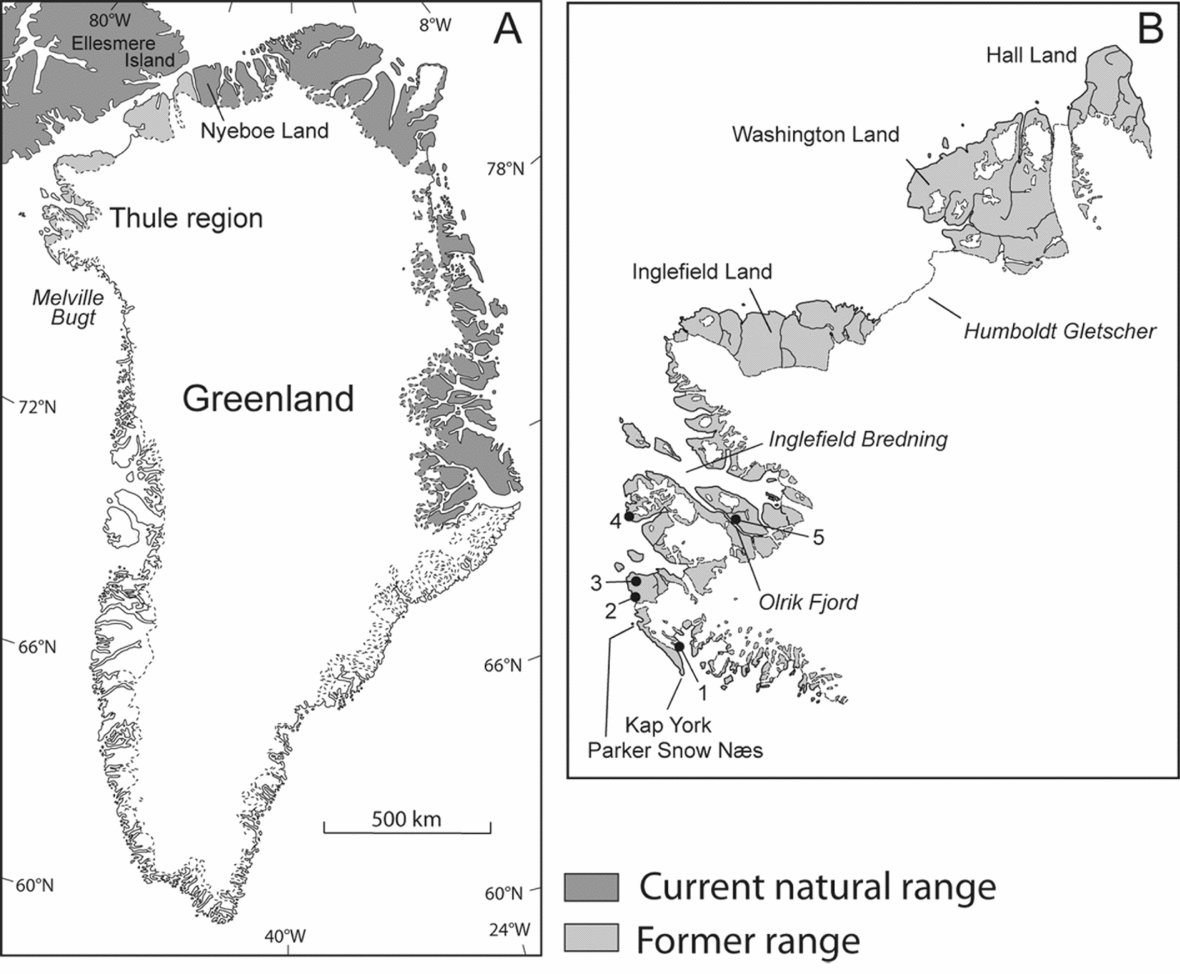
There are no records of musk-ox from the Thule region from historical times (Winge Reference Winge1902). However, several musk-ox bones were picked up by members of the Peary Expedition in 1894 in the northern part of the Thule region according to Ohlin (Reference Ohlin1895). Rasmussen (Reference Rasmussen1921) mentioned that musk-ox bones can be found in the area from Kap York to Parker Snow Næs, and are common in the land areas around Olrik Fjord and Inglefield Bredning (Fig. 1). Sand (Reference Sand, Freuchen, Mathiassen and Birket-Smith1935) mentioned that musk-ox was exterminated in that area in the distant past, but reported that bones are found at many sites near the ruins of winter houses in the region, and Jensen (Reference Jensen1930) also mentioned that musk-ox bones are common in middens near Thule. According to Peter Freuchen who had an intimate knowledge of the area and the people, the local hunters had no record of having hunted musk-ox in the Thule region (Freuchen Reference Freuchen1911). Vibe (Reference Vibe1967) mentioned that he knew of three musk-ox skulls from the region.
(A). Map of Greenland and parts of Ellesmere Island in Canada showing modern natural and former range of the musk-ox. In recent time, it has been introduced and re-introduced to a number of sites in west and northwest Greenland. The map is schematic and only shows a few of the numerous local ice caps and glaciers. (B). Map of northwest Greenland showing the location of dated finds presented in Table 1 and the location of place names mentioned in the text.

Three radiocarbon ages from the Thule region were presented by Bennike and Andreasen (2006). In connection with that study, we tried to locate musk-ox bones from the region in the collections of the Zoological Museum in Copenhagen, but we could only find a single cranium. Two more radiocarbon ages were reported from an archaeological site in the region (Gulløv Reference Gulløv2008). In the summer of 2011 the author conducted a study of interglacial and Holocene marine deposits in the Olrik Fjord area, and in connection with this work it was found that musk-ox bones were fairly common in the area. A total of eight samples collected in the area have been dated.
In Inglefield Land, north of the Thule region, the species was probably exterminated around AD 1850–1860, according to information provided by local hunters to some of the early explorers of the region (Kane Reference Kane1856; Hayes Reference Hayes1867). Two skulls were found in southwestern Inglefield Land in 1875 during the British Arctic Expedition (Feilden Reference Feilden1877), but their ages are unknown. Radiocarbon ages of musk-ox bones from Inglefield Land were reported to fall in two groups, one from 0 to 400 cal. years BP and the other from 800 to 1700 cal. years BP (Bennike and Andreasen 2006). However, new ages reported by Darwent and others (Reference Darwent, Darwent, LeMoine and Lange2007) and by LeMoine and Darwent (Reference LeMoine and Darwent2010) have filled this gap.
Still farther north, in Washington Land north of Humboldt Gletscher, musk-ox bones have been dated to between 0 and 3400 cal. years BP (Bennike Reference Bennike2002; Bennike and Andreasen 2006). There are no records of live animals from Washington Land, but the youngest ages show that musk-oxen died out fairly recently, perhaps at the same time as in Inglefield Land.
In Hall Land, members of the United States North Polar Expedition shot 26 musk-oxen in 1871–1873 (Bessels Reference Bessels1879), and in 1876 one was shot by members of the British Arctic Expedition (Feilden Reference Feilden1877). Since then no musk-oxen have been reported from Hall Land (Bennike and others Reference Bennike, Higgins and Kelly1989). The present day natural geographical range of the musk-ox in Greenland extends from Nyeboe Land in central north Greenland to central east Greenland (Fig. 1). Over the last decades, beginning in the 1960s, musk-ox have been artificially introduced to a number of sites in west Greenland where it did not occur previously, and re-introduced to northwest Greenland. The species thrives in these regions, and is expanding its range in spite of being hunted.
The aim of this paper is to report on eight new radiocarbon dated finds of musk-ox from the Thule region. The finds add to our knowledge of the history of the Greenland vertebrate fauna, which was reviewed by Bennike (Reference Bennike1997). More specifically, it contributes to our understanding of the history of the musk-ox in the eastern Arctic (Darwent and Darwent Reference Darwent, Darwent, Lyman and Cannon2004).
Material and methods
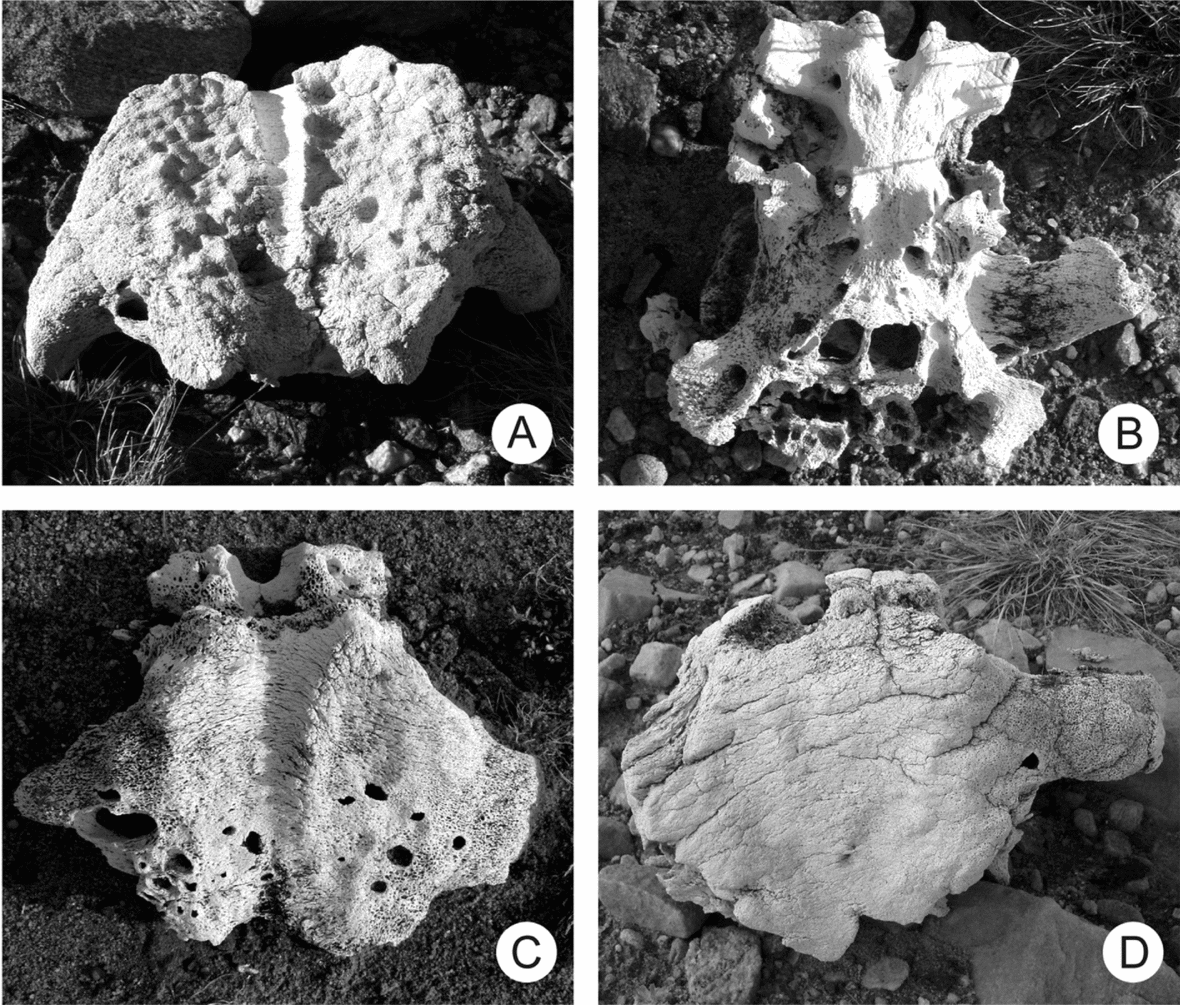
In 2011, several trips on foot were made in an area north of Olrik Fjord, and several musk-ox remains were found in lowland areas, at altitudes between 6 and 148 metres above sea level. A single traverse was made at higher elevations, but without finding musk-ox remains, reflecting the fact that plant life is richest close to sea level. Most of the remains located were cranial fragments, but some limb bones, a few vertebrae and a single pelvic bone were also found. All of them were heavily eroded and weathered and looked ‘old’ (Fig. 2). None of the more fragile bones, such as ribs or mandibles, were seen, and only the basal parts of the horn cores were preserved, and no remains of the outer hollow horny sheath of the horns were found. Most of the cranial fragments have distinct medial grooves and represent adult males (Fig. 2A), but in a few specimens the medial groove is indistinct due to erosion (Fig. 2D). However, these cranial fragments are robust and heavily ossified and also represent males, the skulls of which are much more robust and ossified than those from females. No cranial fragments of young animals or females were found. Olrik Fjord is known for strong winds, and wind driven sand and ice crystals have undoubtedly contributed to erosion of the finds.
Some examples of dated musk-ox Ovibos moschatus finds from the Olrik Fjord area in the Thule region. A. Dorsal view of cranial fragment (Z.M.K. 206/2012, dated to 795–963 cal. years BP). The distinct median groove between the massive hornbases is characteristic of an adult male. The width is 30 cm. B. Ventral view of cranial fragment (Z.M.K. 209/2012, dated to 969–1171 cal. years BP). C. Dorsal view of cranial fragment (Z.M.K. 211/2012, dated to 981–1183 cal. years BP). The width is 23 cm. D. Dorsal view of cranial fragment (Z.M.K. 213/2012, dated to 2103–2326 cal. years BP). This specimen is the oldest dated in this study and also the most weathered. The width is 30 cm.
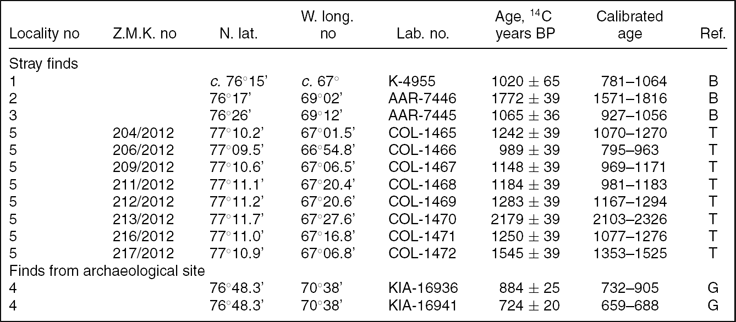
In the field, sub-samples were taken from selected finds, and eight of these were selected for age determination. Seven of them represent cranial fragments, and one (Z.M.K. 216/2012) was a large fragment of the distal part of a left humerus. The Z.M.K. numbers are the accession numbers of the Zoological Museum, University of Copenhagen, where the collection is deposited. Some of the most weathered and some of the more fresh looking bones were selected for dating in order to span as wide a potential chronological range as possible. The age determinations were carried on the collagen fraction of the bones, and have been corrected for isotopic fractionation by normalising to a δ13C value of –25‰ PDB. The new age determinations were carried out at Cologne University (Table 1). Previous age determinations from the region were carried out at the former radiocarbon dating laboratory at the National Museum in Copenhagen, Denmark (marked K in Table 1), at the AMS laboratory, Institute of Physics and Astronomy, Aarhus University, Denmark (AAR) and at the Leibniz-Labor, Christian Albrechts Universität in Kiel, Germany (KIA). The K-number is a conventional age, and the others are accelerator mass spectrometry (AMS) ages. Calibration is according to the INTCAL09 data set (Stuiver Reference Stuiver and Reimer1993; Stuiver and others Reference Stuiver, Reimer, Bard, Beck, Burr, Hughen, Kromer, McCormac, Plicht and Spurk1998) and the ages have been calibrated to calendar years BP (before present = AD 1950).
Radiocarbon ages of collagen from musk-ox bones from the Thule region. Z.M.K. 216/2012 is a humerus, the rest are skulls
References
B = Bennike and Andreasen Reference Bennike and Andreasen2005
T = This study
G = Gulløv Reference Gulløv2008
Results and discussion
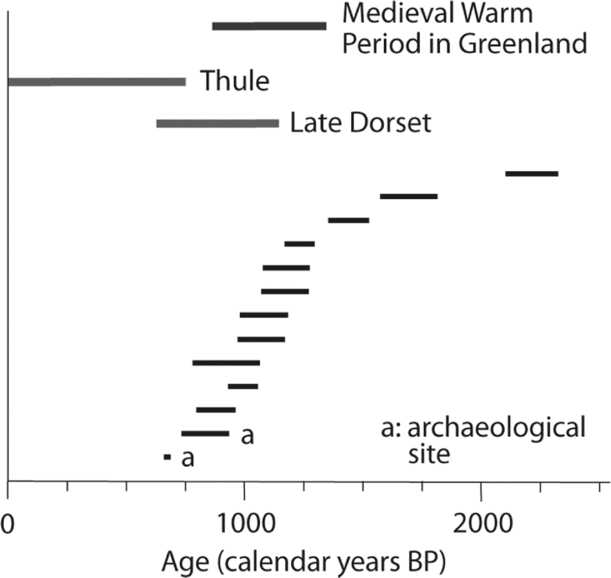
The oldest age is around 2200 cal. years BP and this pushes the first documented presence of the species in the region ca. 500 years back in time. However, this is probably only a minimum age for the immigration of musk-ox to this part of Greenland. When compared with the archaeological history, it appears that the musk-ox arrived in the Thule region at a time when it was uninhabited by humans (Fig. 3).
Diagram showing the temporal distribution of dated musk-ox finds from the Thule region. The diagram also shows the duration of the youngest cultures in the Thule region, and the timing of the peak of the Medieval Warm Period in Greenland according to Dahl-Jensen and others (Reference Dahl-Jensen, Mosegaard, Gundestrup, Clow, Johnsen, Hansen and Balling1998). Details of the dated finds are provided in Table 1.
Most of the dated finds yielded ages between 800 and 1200 cal. years BP and it is possible that the local musk-ox population reached a maximum at this time. As the Thule region was probably uninhabited (Fig. 2), the musk-ox population may have benefited from the lack of hunting. However, the population may also have benefited from relatively warm summers during the Medieval Warm Period, which was characterised by warm summers in the North Atlantic region (Bradley and others Reference Bradley, Hughes and Diaz2003). In northwest Europe this warm period is often dated at AD 950 to 1250. In Greenland its effect is clearly recorded in the δ18O record from the Camp Century ice core (Dansgaard Reference Dansgaard2004: 58) from northwest Greenland and from modelling of past temperatures from bore hole temperatures (Dahl-Jensen Reference Dahl-Jensen, Mosegaard, Gundestrup, Clow, Johnsen, Hansen and Balling1998). Mean annual temperatures were above –31°C in central Greenland from 850 to 1350 BP according to Dahl-Jensen (Reference Dahl-Jensen, Mosegaard, Gundestrup, Clow, Johnsen, Hansen and Balling1998; Fig. 3) and it is possible that the Medieval Warm Period peaked somewhat later in Greenland than in northwest Europe.
Although the musk-ox is adapted to low temperatures, the species would undoubtedly have benefited from a warmer climate that would lead to enhanced plant growth both directly and indirectly from higher temperatures, higher summer precipitation and increased melting of snow and ice. The animals that have been transferred from northeast Greenland to west Greenland, where the summer temperatures are higher and the vegetation richer are also bigger and produce more calves (Olesen and others Reference Olesen, Thing and Aastrup1994).
In Inglefield Land the musk-ox was commonly hunted by Late Dorset people from around 650 to 1500 years BP (Appelt and Gulløv Reference Appelt and Gulløv1999; Bennike and Andreasen Reference Bennike and Andreasen2005), and the population may also have peaked in this region during the Medieval Warm Period. In both the Thule region and in Inglefield Land, the musk-ox co-existed with Late Dorset people for centuries (Fig. 3).
The two youngest reported ages from the Thule region come from an archaeological site belonging to an early phase of the Thule culture. The youngest age is around 670 cal. years BP (Gulløv Reference Gulløv2008; Table 1). There appears to be no information as to whether musk-ox bones occur in younger ruins in the Thule region, but none of the stray finds from the Olrik Fjord area look young.
It is likely that the musk-ox population declined following the Medieval Warm Period. However, the disappearance of the species from the Thule region may have occurred at the same time as the Thule people arrived, and it is possible that the species, perhaps already under pressure, was exterminated by them. The Thule region is characterised by only small ice-free areas, and the highly mobile Thule people with their dog sledges and skin boats may have hunted the species to local extinction. Ruins from the Thule culture are common and widespread in the Thule region (Holtved Reference Holtved1944), and in 2011 many ruins of winter houses and tent rings were observed north of Olrik Fjord. It is likely that the human population was much smaller during Late Dorset time than during the occupation by the Thule people, judging from the number of ruins from these cultures.
It is difficult to understand how hunters could kill musk-oxen before guns were available. It is doubtful if musk-oxen could be hunted with bow and arrow, instead the hunters probably had to use lances and spears, at least if hunting adult animals. The animals could only be approached closely if attacked by dogs at the same time. Nevertheless, it must have been extremely dangerous to kill musk-oxen. However, until rifles were introduced, the hunters in the Thule region also killed polar bears with lances, and Steensby (Reference Steensby1910) mentioned that some of the hunters in the region had terrible scars on their bodies as a result of wounds from the claws of bears. It is clear from the archaeological record that musk-ox hunting has been common in north and northeast Greenland for millennia (Gulløv Reference Gulløv2004). With respect to the people living in the Thule region, Steensby mentioned that they are ‘very fond of musk-ox flesh and fat’ and that musk-ox hunting ‘is a special attraction for them’ (Steensby Reference Steensby1910: 397, 400). In the early part of the 1900s hunters travelled to Ellesmere Island to hunt musk-ox, a tradition that was started by the polar explorers Robert E. Peary and Frederick A. Cook.
The musk-ox never colonised west Greenland, probably because it was unable to cross the Melville Bugt region (Vibe Reference Vibe1967). Melville Bugt is heavily glaciated, with only a narrow strip of small ice-free islands, semi-nunataks and nunataks between the margin of the inland ice and the sea. Numerous calving tide-water glaciers separate the land areas. No doubt this region is a major barrier to musk-ox dispersal to west Greenland from the north if musk-oxen had arrived in northwest Greenland in the early or mid-Holocene, the situation would have been somewhat different, because the glacier cover has increased markedly over subsequent millennium (Kelly Reference Kelly1980; Weidick Reference Weidick1984, Reference Weidick1996; Bennike Reference Bennike2008; Briner and others in press). However, the dates from the Thule region show that the species did not arrive until the Late Holocene, when conditions approached present day conditions.
If the musk-ox arrived in Inglefield Land from Washington Land, it would have had to cross the 100 km wide Humboldt Gletscher, or the sea ice in front of the glacier. It is perhaps more likely that the species crossed over to Inglefield Land from Ellesmere Island, where the shortest distance across the sea is around 45 km and in winter, the area is covered by sea ice.
Conclusions
It is concluded that the musk-ox colonised the Thule region in northwest Greenland in the late Holocene, at a time when the region was probably uninhabited. The size of the musk-ox population in the region probably peaked during the Medieval Warm Period, due to richer vegetation and low hunting pressure by the Late Dorset people. The species was probably exterminated in the region shortly after the arrival of the Thule people. Musk-ox did not colonise west Greenland due to the barrier of a glaciated Melville Bugt, their late arrival in northwest Greenland and hunting by the Thule people.
Acknowledgements
The age determinations were carried out by Dr. Janet Rethemeyer, Institut für Geologie und Mineralogie, University of Cologne, Germany. The identification of Z.M.K. 216/2012 was kindly confirmed by Kristian Gregersen, the Zoological Museum, Copenhagen University. Dr Tony Stuart is thanked for constructive comments that helped to improve the manuscript