Introduction
Planning is a higher order process which involves the preparation and representation of ordered sequences of actions to achieve specified goals (Morris and Ward, Reference Morris and Ward2005). Planning impairment in schizophrenia has been demonstrated across a range of neuropsychological procedures, is present in first episode and high risk populations (e.g., Andreasen et al., Reference Andreasen, Rezai, Alliger, Swayze, Flaum, Kirchner and O'Leary1992; Elliott, McKenna, Robbins, & Sahakian, Reference Elliott, McKenna, Robbins and Sahakian1998; Jogems-Kosterman, Hulstijn, Wezenberg, & van Hoof, Reference Jogems-Kosterman, Hulstijn, Wezenberg and van Hoof2006; Joyce et al., Reference Joyce, Hutton, Mutsatsa, Gibbins, Webb, Paul and Barnes2002; Leeson, Robbins, et al., Reference Leeson, Robbins, Franklin, Harrison, Harrison, Ron and Joyce2009a; Leeson et al., Reference Leeson, Barnes, Harrison, Matheson, Harrison, Mutsatsa and Joyce2010; Levaux et al., Reference Levaux, Ptovin, Sepehry, Sablier, Mendrek and Stip2007; Marczewski, Van der Linden, & Laroi, Reference Marczewski, Van der Linden and Laroi2001; McIntosh, Harrison, Forrester, Lawrie, & Johnstone, Reference McIntosh, Harrison, Forrester, Lawrie and Johnstone2005; Morris, Rushe, Woodruffe, & Murray, Reference Morris, Rushe, Woodruffe and Murray1995; O'Connor et al., Reference O'Connor, Harris, McIntosh, Owens, Lawrie and Johnstone2009; Tyson, Laws, Roberts, & Mortimer, Reference Tyson, Laws, Roberts and Mortimer2004; Wang et al., Reference Wang, Vassos, Deng, Ma, Hu, Murray and Li2010), may be consistent over time (Tyson et al., 2004) and may be part of the general pattern of executive dysfunction that is targeted for neurorehabilitation (e.g., Greenwood, Morris, Sigmundsson, Landau, & Wykes, Reference Greenwood, Morris, Sigmundsson, Landau and Wykes2008; Wykes et al., Reference Wykes, Reeder, Landau, Everitt, Knapp, Patel and Romeo2007). Specifying more clearly the nature of planning impairments, and their relationship to real world functional difficulties that co-occur with these symptom clusters may provide important information to help both the assessment and remediation of the cognitive impairments in schizophrenia.
Understanding planning impairment in schizophrenia has to take into account theoretical models and empirical studies which suggest that syndromes or symptoms within schizophrenia are associated with different types of executive dysfunction (Frith, Reference Frith1992; McGrath, Reference McGrath1991; Greenwood et al., Reference Greenwood, Morris, Sigmundsson, Landau and Wykes2008). In theoretical models of schizophrenia, psychomotor poverty, which encompasses negative symptoms of flat affect and alogia, may reflect a more general poverty of willed actions (Frith, Reference Frith1992). The primary impairment is predicted to lie within the formation and initiation of a plan to guide intentional behavior so that goal-directed activity is absent. In contrast, disorganization symptoms encompass formal thought disorder and poverty of content of speech (Liddle, 1987a). The disorganization syndrome is also predicted to associate with planning deficits, given the notion that this symptom type is explained by an absence of willed intentions and a loss of communication goals (Frith, Reference Frith1992). Aspects of disorganization, including poverty of content of speech, derailment and incoherence are argued to derive from poor plan formation, as well as lower-order abnormalities which affect plan execution, such as the inhibition of stimulus-driven (habitual) behavior and the monitoring of the relationship between the plan and intended output (McGrath, Reference McGrath1991). Evidence linking the symptom clusters to particular types of executive function comes from the finding of an association between the profile of executive function and symptom type in schizophrenia (see Greenwood et al., Reference Greenwood, Morris, Sigmundsson, Landau and Wykes2008).
Studies of planning in schizophrenia have tended to use tasks that are variants of the Tower of Hanoi (TOH) procedure, including the Tower of London (TOL) and the Stockings of Cambridge (SoC). These demonstrate associations between planning performance and either negative symptoms or both positive and negative symptoms. The most consistent association has been between negative symptoms and poor planning, plan generation, plan execution, or slowed planning (Jogems-Kosterman, Zitman, Van Hoof, & Hulstijn, Reference Jogems-Kosterman, Zitman, Van Hoof and Hulstijn2001; Lanser, Berger, Ellenbroek, Cools, &, Zitman, Reference Lanser, Berger, Ellenbroek, Cools and Zitman2002; Morris et al., Reference Morris, Rushe, Woodruffe and Murray1995; Poole, Ober, Shenaut, & Vinogradov, Reference Poole, Ober, Shenaut and Vinogradov1999), although Leeson, Barnes, Hutton, Ron, and Joyce (Reference Leeson, Barnes, Hutton, Ron and Joyce2009) found that poor planning at first episode was associated with disorganization symptoms at one year. Increasing the demands on planning leads to faster responding with disorganization symptoms but slower responding in relation to psychomotor poverty symptoms (Jogems-Kosterman et al., Reference Jogems-Kosterman, Hulstijn, Wezenberg and van Hoof2006). No studies have directly demonstrated a distinction in planning deficits per se in different syndromes and few have compared psychomotor poverty and disorganization.
Tasks such as the TOH, TOL, and SoC have the advantage that they can be designed to test different ability levels and also are “well defined” in that they have a simple state space, with limited procedures used in planning to transform material from one state to another (Greeno, Reference Greeno and Estes1978; Morris, Kotitsa, & Bramham, Reference Morris, Kotitsa, Bramham, Morris and Ward2005). However, a criticism of this approach is that the problems are somewhat removed from planning “in the real world” where the solutions may be more open ended and require more flexible judgment (Morris and Ward, Reference Morris and Ward2005). Hence, there is the need to consider alternative procedures that may more accurately mimic “real world” planning requirements (Burgess and Simons, Reference Burgess, Simons, Halligan and Wade2005). Although both psychomotor poverty and disorganization symptoms are associated with poor real life functioning, it is cognition that has been proposed to predict this more directly (Green, Reference Green1996). Prouteau et al. (Reference Prouteau, Verdoux, Briand, Lesage, Lalonde, Nicole and Stip2005), for example, found that performance on the SoC at baseline was predictive of 15–16 month social competence outcomes following a rehabilitation program. If cognitive impairments in plan formation and execution underlie psychomotor poverty and disorganization symptoms, they may also underlie problems in day-to-day functioning. Zalla and colleagues (Zalla, Posada, Franck, Georgieff, & Sirigu, Reference Zalla, Posada, Franck, Georgieff and Sirigu2001) have demonstrated that impairments in plan organization and sequencing in schizophrenia are accentuated by increased novelty and distracters, which are common in day to day life.
To our knowledge there have been no studies that have compared standard experimental tasks such as the TOL, with real life analogue procedures. Hence, the current study investigates the nature of the planning impairment in schizophrenia comparing the pattern of impairment measured using a standard problem solving procedure based on the TOL, with an analogue task simulating real world planning. Additionally, given the issues of symptom specificity, this study explores the association between planning deficits and the two main symptom clusters in schizophrenia associated with poor executive function, namely psychomotor poverty and disorganization syndromes (Donohoe and Robertson, Reference Donohoe and Robertson2003).
It was predicted that planning impairments would remain after controlling for general intellectual function, but differ between refined symptom groups, with poor plan initiation in psychomotor poverty leading to longer initial planning times, and poor plan execution in disorganization leading to greater inefficiency. Furthermore, the study explored whether these relationships were consistent between the TOL and the real world analogue.
Method
Participants
Fifty-nine participants with Diagnostic and Statistical Manual of Mental Disorders—Fourth Edition (DSM-IV) schizophrenia were recruited from within an inner-city population, either hospitalized (acute or longer-term rehabilitation) or local mental health service outpatients. Twenty-eight healthy controls were recruited from local employment centers and hospital staff. All participants satisfied general inclusion criteria and were aged 18–65, with screening premorbid IQ estimate over 70, using the National Adult Reading Test-Restandardized (Nelson and Willison, Reference Nelson and Willison1991), had English as a first language, no neurological problems or history of head injury, and no current substance abuse. Ethical approval was obtained, with written informed consent before data collection. The 28 controls were screened by self-report for past mental health problems and contact with psychiatric services and had no psychiatric history.
The schizophrenia participants were assessed with the SAPS and SANS (Andreasen, Reference Andreasen1984a and Reference Andreasenb) and were subdivided into 30 participants with psychomotor poverty symptoms (PPS) and 29 with disorganization symptoms (DS). Syndrome groupings were based on Liddle's (Reference Liddle1987a) criteria, the psychomotor poverty syndrome comprising poverty of speech, decreased spontaneous movement and blunt affect, and the disorganization syndrome, formal thought disorder, inappropriate affect and poverty of content of speech. Sampling was purposive for marked psychomotor poverty and disorganization symptoms. Other negative symptoms were excluded from syndrome classification as they associate with both DS and PPS (presented separately as general negative symptoms in Table 1).
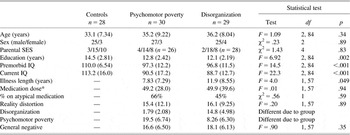
Socio-demographic and clinical characteristics of participants (mean (standard deviation))

*Converted to a standard total percentage of the maximum recommended dose (Maudsley and Bethlem Prescribing Guidelines 1996).
PPS was defined as having at least one core symptom of alogia (excluding poverty of content of speech) or flat affect (summed symptom score of at least 6) and one other negative symptom (summed symptom score of at least 3). DS was defined as having a summed score of at least 8 from the subscales of formal thought disorder, inappropriate affect and poverty of content of speech. Comparisons between acute and chronic schizophrenia are beyond the scope of the current paper (but see Greenwood et al., Reference Greenwood, Morris, Sigmundsson, Landau and Wykes2008).
Inclusion was defined according to an arbitrary cut-off for a single syndrome but participants with sub-threshold symptoms of other syndromes were not excluded as these mixed symptom cases are likely to comprise the more common presentation (Walker and Lewine, Reference Walker and Lewine1988; Strauss, Reference Strauss1993). Seven participants clearly satisfied criteria for DS but were close to criterion for PPS and were placed in the former group. One participant clearly satisfied criteria for PPS but was close to the criterion level for DS and was placed in the PPS group. Thirteen people who were part of the wider study of chronicity and symptoms, did not meet criteria for either symptom group and were excluded.
Measures
Demographics
Socio-economic status was classified by father's occupation at birth according to the “Standard Occupational Classification” (Office of Population Consensus’ and Surveys, HMSO, 1991). Levels 1 and 2 (professional and managerial) and Levels 4 and 5 (part and unskilled) were collapsed for analysis and compared to Level 3 (skilled). The groups were matched on socio-economic status following Keefe's (Reference Keefe1995) notion that it is the most optimal demographic matching variable for schizophrenia, due to the effects of the illness on an individual's own IQ, education and socio-economic status (see the Discussion section for consideration of matching variables and intelligence).
General Intellectual Function
Current IQ was assessed using a short-form Wechsler Adult Intelligence Scale—Revised (WAIS-R) (Canavan, Dunn, & McMillan, Reference Canavan, Dunn and McMillan1986). Premorbid IQ was also estimated using the National Adult Reading Test—Revised (NART-R) (Nelson and Willison, Reference Nelson and Willison1991).
Planning Function
Planning was assessed using two tasks:
1) The Computerised Tower of London Test (TOL) (Morris et al., Reference Morris, Rushe, Woodruffe and Murray1995; Rushe et al., Reference Rushe, Morris, Miotto, Feigenbaum, Woodruff and Murray1999; Toulopoulou, Morris, Rabe-Hesketh, & Murray, Reference Toulopoulou, Morris, Rabe-Hesketh and Murray2003; Kravariti, Morris, Rabe-Hesketh, Murray, & Frangou, Reference Kravariti, Morris, Rabe-Hesketh, Murray and Frangou2003, Reference Kravariti, Morris, Rabe-Hesketh, Murray and Frangou2007; Young, Morris, Toone, & Tyson, Reference Young, Morris, Toone and Tyson2007). This is a touch sensitive screen computerized version of the test originally devised by Shallice (Reference Shallice1982), known to be sensitive to frontal lobe damage. Two arrangements of colored discs are presented at the top and bottom of the screen. The bottom discs have to be moved to match the upper static arrangement. The participant touches a chosen disc followed by the desired next location. Problems can be completed in a minimum of either three, four, or five moves, with four problems at each difficulty level (the original problems used by Shallice, Reference Shallice1982). Participants should plan their move sequence before starting in order to complete the problem in the minimum number of moves. After completion of the problems, there is a motor control condition in which the same move sequences that they had executed previously have to be made simply by copying sequences of moves, one move at a time, made by the top arrangement.
Two measures of accuracy were used, namely, Planning Accuracy, the total number of problems completed in exactly the minimum moves necessary, and Planning Efficiency, the mean number of moves above the minimum that were taken to solve each problem. Two speed of response measures were used, namely Mean Planning Time, the time taken between presenting the problem and the first response, and Subsequent Problem Solving Time, the time from the first response to completion. These times were adjusted to control for motor speed by subtracting the equivalent response times from the motor control.
2) The Virtual Planning Test (VIP) (Miotto and Morris, Reference Miotto and Morris1998; Miotto, Evans, de Lucia, & Scaff, Reference Miotto, Evans, de Lucia and Scaff2009; Morris et al., Reference Morris, Kotitsa, Bramham, Morris and Ward2005; Philips, MacLeod, & Kliegel, Reference Philips, MacLeod, Kliegel, Morris and Ward2005; O'Neil-Pirozzi and Goldstein, Reference O'Neil-Pirozzi and Goldstein2005). This task has established sensitivity to frontal lobe damage, head injury and aging effects. It simulates real world planning and is presented in the form of a 4-day board-game style diary-planning task in which the overall goal of the task is to prepare for a weekend visit to a relative for their birthday party. There are four activities to be planned for each day, two in the morning and two in the afternoon, totalling 16 activities which would be selected from an activity board of 28 activities. Each activity is printed on a card and selection is signified by moving a card from the activity board to the diary board.
Various constraints are built into the task such that planning is required. Once the activities for a particular day are chosen the participant cannot go back on their selection, with each consecutive day being completed in sequence. Additionally, whereas some activities can be done on their own, others have to be grouped together in sequence to achieve a particular larger goal, comprising two or three activities. Also, some activities have to be scheduled to be completed at a specific time within the 4 days.
The participant is provided with a list of tasks to complete, some with single and others involving multiple activities. The activity board contains a further 12 distracter activities that were not on the task list, with the aim that if the participant is planning appropriately from the task list, these will not be selected. To illustrate the material used, a two-activity task was “choose a birthday present for your relative” and “wrap up the present on Thursday morning” (the second of these activities was thus also time-specific). Distracters included for example, “buy a bottle of wine for the party”, “go for a walk with a friend”, and “stay in and listen to music”. The comments of healthy controls demonstrate they treat the tasks as equivalent to first person real-world planning.
Two main accuracy measures were taken, Planning accuracy, the proportion of target activities that were selected correctly at or by the correct time; and Planning Efficiency, the proportion of distracter items chosen. An additional measure, Omission Ratio was the proportion of errors that were omissions rather than misplacement errors, where misplacement was defined as incorrect placement of an activity that had to be done by or at a particular time or that had to be completed in sequence (two- or three-part activities). A higher probability of omission errors suggested being distracted by other activities. Speed measures were also taken. The Planning Time was the time from the start of the task to the first move and the Subsequent Execution Time which incorporates planning efficiency was the time from the first move to the completion of the task. Memory for the task activity requirements was assessed immediately following the task using a combination of recall, forced choice and recognition formats.
Statistical Analyses
Group differences in demographic and clinical variables were investigated using one-way analyses of variance or χ 2 tests (for gender, socio-economic status group, non-completers, and atypical medication use).
All planning outcomes were analyzed with linear mixed models, except real world planning time and subsequent execution time, which did not include repeated measures and so were analyzed with one-way ANOVAs and ANCOVAs. In each linear mixed model analysis, the factor of interest, group, constituted a between-subject factor. Within-subject factors comprised task complexity (three, four, or five move tasks, or one, two, or three part tasks), as appropriate in each task, and schema type and time specificity in the real world task. In total, there were two factors in the TOL task (Group × complexity) and four (Group, complexity, schema, and time) or three (for efficiency, as complexity was not a factor) in the VIP task.
Participants were included as a random effect to encompass the correlations as a result of participant characteristics between repeated measures, which were the three levels of complexity, (three, four, or five move tasks) in TOL and the 16 activities in the Real World Task. An α level of .05 was used for all main effects and interactions. Bonferroni corrections were employed to adjust relevant pairwise post hoc tests for multiple comparisons. An α level of either .025 for two comparisons or .016 for three comparisons was used.
To explore the influence of intelligence on performance, analyses were conducted first with no IQ covariates to determine the current planning function for a representative schizophrenia population. Second, current IQ was included as a covariate, given its potential to fluctuate with the disease process and to covary with executive function (Laws, Reference Laws1999) to determine the specificity of planning impairments over and above current general intellectual impairment in schizophrenia.
Computerized TOL
Group differences in Planning Accuracy, Planning Efficiency, Mean Planning Time and Subsequent Problem Solving Time and their association with task complexity (three, four, or five move tasks) were investigated using linear mixed models analyses for continuous outcomes in SPSS (Version 12.0). The assumption of a normal distribution in these analyses was reasonable for all outcomes, except for the three-move problems on the Planning Accuracy measure, which were excluded from the analysis because of floor effects in all groups.
Virtual planning test
Group differences in Planning Accuracy, Planning Efficiency, the Omission Ratio, and their association with Task Complexity were investigated using generalized linear mixed models for multiple binary (non-continuous) outcomes in STATA (version 5.0). The memory error score was also included as an additional covariate.
The effects of the within-subject factors and the interactions with group were investigated with Wald tests. More specifically logistic regression models with random effects for subject effects across the repeated measures were assumed, and fitted by maximum likelihood methods following the algorithm proposed by Schall (Reference Schall1991). The effects were thus assessed on a transformed logit scale (logit(prob.) = ln(prob./(1−prob.))) and were entered hierarchically: covariates were entered first; main effects of group and within-subject factors (task complexity, schema type, and time specificity) were entered second; followed by second order and then third order interactions. This meant that when assessing their significance, effects were adjusted for other effects of the same and lower orders (two-way interactions were adjusted for other two-way interactions and main effects but not for higher three-way interaction effects). The specific effects of individual factors and their interactions could thus be investigated. The comparisons of interest were the main effects of groups and interactions of group by within-subject factor. Only significant effects were investigated further, while non-significant ones were removed from the model. Predicted means on the logit-scale and confidence intervals for pairwise differences on this scale were back transformed onto the original probability scale to provide post hoc pairwise comparisons.
Results
Demographics
The results of socio-demographic and clinical characteristic analyses are presented in Table 1. The groups were reasonably balanced for age, sex and parental socio-economic status. The schizophrenia groups had significantly fewer years of education, as well as lower estimated pre-morbid and current IQ compared to healthy controls. The disorganization group showed poorer IQ than the PPS group. There were no differences between the groups on any other demographic measure with the exception of those symptom measures which differed due to grouping, and illness duration, which was significantly shorter in the PPS group compared to the disorganization group. General negative symptoms (avolition-apathy, anhedonia, and inattention), consistent with Liddle's earlier findings (Reference Liddle1987a), were equivalent in the two syndromes, with a (non-significant) higher mean score in the disorganization group.
All participants were administered the TOL task and 27 PPS and 25 DS participants were administered the real life task. A proportion started but did not complete the tasks, and their data was excluded from the analyses. This included three PPS and one DS participant for the TOL task and one PPS and six DS participants for the real life planning task. For the latter, the difference in drop out was statistically significant (Fisher's exact test: p = .046) and seems likely to reflect an inability of DS participants to complete the real life task. The six DS participants had a marginally lower mean current IQ (mean FIQ = 87.33) and a higher mean level of disorganization (mean disorganization score = 17.83) compared to the remainder of the disorganization group. There was no other missing data, with the exception of one disorganization participant who did not complete the VIP memory test and whose data were excluded from the relevant analyses.
Planning Results
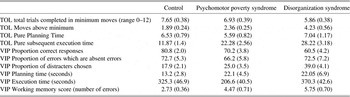
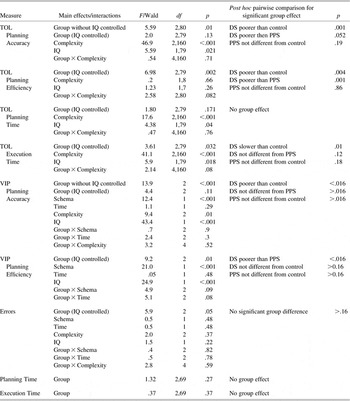
Means and standard errors for the planning tasks in each group are presented in Table 2. The main results for the planning analyses are presented in Table 3. An initial data analysis was followed by one that controlled for current IQ. If these analyses produced the same findings then only the second analyses, controlling for current IQ, were presented. To facilitate comparisons between the experimental and real life planning tasks, the results for the approximately equivalent primary measures of Planning Accuracy and Planning Efficiency are presented together across the two tasks, followed by presentation of the subsidiary measures.
Planning untransformed means and standard errors for the Tower of London (TOL) and Virtual Planning (VIP) measures

Note. TOL = Tower of London test; VIP = Virtual Planning test.
Results of planning analyses for the Tower of London (TOL) and Virtual Planning (VIP) tasks

Note. All analyses are reported after controlling for IQ, except where IQ impacted on results, in which case both analyses are presented. Interactions and post hoc comparisons are presented for group only. All p values should be compared to p = .016 for three comparisons. DS = disorganization; PPS = Psychomotor Poverty.
Planning Accuracy
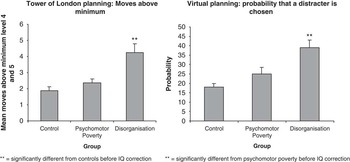
Figure 1 shows the results for planning accuracy. There was a main effect of group, reflecting poorer performance compared to controls in the DS group on both the TOL and the VIP. This disappeared when IQ was controlled in the analysis. There was a significant main effect of task complexity in each task.
Planning Accuracy: Total number of perfect solutions (completed in the minimum number of moves) on the Tower of London test compared to the probability that activities were chosen correctly in the Real World Planning task (not adjusted for IQ).

Planning Efficiency
Figure 2 shows the planning efficiency results. The groups differed significantly for both tasks with the DS showing poorer performance compared to the controls and the PPS. When IQ was controlled for in the analysis on the TOL, the deficit in the DS group remained. Neither the main effect of task complexity nor the interaction of task complexity with group was significant. For the VIP, the DS group were poorer than the controls, but after controlling for IQ this effect was not significant.
Planning Efficiency: Mean number of moves above minimum on the Tower of London test compared to predicted probability that distracters were chosen in the Real World Planning task (not adjusted for IQ).

The Proportion of Omission Errors
The main effect of group was significant but with no other within-subject effects or interactions. Post hoc analyses of the group effect revealed no significant differences between groups but the highest probability of omission errors was in the disorganization group. WAIS IQ contributed independently to the error pattern (Wald test = 4.7; df = 1; p = .03) and there was a trend for an independent contribution also from memory (Wald test = 3.6; df = 1; p = .057). No group effect remained after controlling for IQ and memory (Wald test = 3.8; df = 2; p = .15).
Planning and Subsequent Execution Time
Planning time did not differ between the groups on either task. On the TOL, which incorporated three within-subject complexity levels, there was no interaction of group with complexity level but the effect of complexity was significant with all groups taking longer to plan the harder levels.
In relation to the subsequent execution times, there was a significant main effect of group only in the TOL as well as a main effect of level but no interaction. Post hoc tests revealed longer execution times in the DS compared to controls across all levels and longer execution times in the two more demanding complexity levels compared to the simpler level with effects remaining after IQ was controlled.
Memory and Real Life Planning
The VIP test included a detailed set of task instructions and incorporated memory tests to control for difficulties in remembering the instructions when completing the task. All the instructions and materials are in front of the person and they are cued by a cue card of their goals. The requirement to hold the instructions and task activities on-line while completing the task, creates a memory load and so memory for this information was explored further and was controlled in the analysis.
Memory for the task instructions differed significantly by group (F(2,69) = 6.3; p = .003) and post hoc tests revealed significantly poorer memory in the disorganization group compared to controls (p < .016), although this was no longer significant after IQ was controlled.
Real life planning accuracy was no longer impaired after controlling either for current IQ (see Table 3) or memory (Wald test = 3.1; df = 2; p = .21) or both (Wald test = 2.2; df = 2; p = .33). Memory (Wald test = 19.2; df = 1; p < .001) and IQ (Wald test = 13.2; df = 1; p < .001) each contributed significantly and independently to planning accuracy.
When IQ and memory were entered into the VIP efficiency analysis, only memory errors contributed independently to the probability of choosing distracters (Wald test = 33.8, df = 1, p < .001), and the group effect remained a trend (Wald test = 5.7; df = 2; p = .057).
Discussion
In summary, planning impairment was found in patients with the disorganization syndrome but not with PPS symptoms on the TOL, with both fewer problems solved in the minimum number of moves (accuracy) and higher mean moves to solve particular problems (efficiency). In the VIP, it was found for the degree to which activities were selected correctly at or by the right time (accuracy), the proportion of distracter items wrongly selected (efficiency) and the tendency to omit rather than misplace required activities. After controlling for IQ, the deficit in the disorganization group only remained significant for the TOL efficiency measure. Neither group showed reduced planning times, but the disorganization group, once started, took longer to subsequently complete the TOL, this finding being consistent with the pattern of responding in chronic schizophrenia as a whole (Joyce et al., Reference Joyce, Hutton, Mutsatsa, Gibbins, Webb, Paul and Barnes2002). Taken together this study replicates the finding of TOL impairment in schizophrenia, but demonstrates a specific link to the disorganization symptom grouping. When levels of current intelligence are taken into account, however, it suggests at first that there is no reduction in the ability to plan a series of events in a task that is more akin to real life. It seems likely, however, that the deficit on the real life VIP task in the DS group is masked to some extent by the fact that a significant number of this group (6/25) were unable to complete the test. Real life planning may thus be impaired to some extent in this group.
When interpreting the difference between the DS and PPS groups, it should be considered that symptom profiles have previously been associated, both empirically and theoretically, with the pattern of neuropsychological impairment (Greenwood et al., Reference Greenwood, Morris, Sigmundsson, Landau and Wykes2008; Hill, Ragland, Gur, & Gur, Reference Hill, Ragland, Gur and Gur2002; Kremen, Seidman, Faraone, Toomey, & Tsuang, Reference Kremen, Seidman, Faraone, Toomey and Tsuang2004; Liddle, Reference Liddle1987a and Reference Liddleb). It should also be noted that impaired lower-order cognitive processes may contribute to planning impairment, for example, deficits in initiation (Badcock, Michiel, & Rock, Reference Badcock, Michiel and Rock2005), inhibition (Jogems-Kosterman et al., Reference Jogems-Kosterman, Hulstijn, Wezenberg and van Hoof2006; Miyake et al., Reference Miyake, Friedman, Emerson, Witzki, Howerter and Wager2000), working memory (Badcock et al., Reference Badcock, Michiel and Rock2005; Pantelis et al., Reference Pantelis, Barnes, Nelson, Tanner, Weatherley, Owen and Robbins1997), and resource allocation (van Beilen, van Zomeren, van den Bosch, Withaar, & Bouma, Reference van Beilen, van Zomeren, van den Bosch, Withaar and Bouma2005). Both symptom groupings have been linked to impairment in executive functioning. For example, Frith (Reference Frith1992) proposed that disorganization symptoms result from impaired inhibition of habitual responses, in the context of plans having to be constructed, maintained and implemented using working memory. TOL performance has not been specifically investigated in relation to disorganization, and it is possible that previous associations between poor planning and negative symptoms have been driven by other associated symptoms and impairments. It is also possible that the inhibition and working memory demands relating, in particular, to the TOL task elicit the impairment, as the person has to consider various solutions to the problems, select the most efficient solution within the state space and maintain this to completion. In terms of particular neuropsychological symptoms, disorganization has been associated with impaired working memory and inhibition as well as verbal initiation, discourse planning, and monitoring and attention (Greenwood et al., Reference Greenwood, Morris, Sigmundsson, Landau and Wykes2008; Harvey, Earle-Boyer, & Levinson, Reference Harvey, Earle-Boyer and Levinson1988; Hoffman, Stopek, & Andreasen, Reference Hoffman, Stopek and Andreasen1986; Liddle & Morris, Reference Liddle and Morris1991) and these factors may all contribute to poor planning ability. In contrast, Frith (Reference Frith1992) has proposed that PPS results from deficits in the initiation of activities due to a lack of initiation of plans. A third symptom feature, reality distortion, was not considered here, despite being part of Frith's model and Liddle's classification, and linked to self monitoring, monitoring of others intentions and specifically with theory of mind dysfunction. This is because of the known lack of relationship with executive functions, and is supported by a recent meta-analysis that revealed association between executive function and PPS and disorganization but no association with reality distortion (see Dibben, Rice, Laws, & McKenna, Reference Dibben, Rice, Laws and McKenna2009).
A characteristic of both the planning tasks is that they are structured procedures and not open ended. In the case of the TOL task, the permutations of positions are specified by the constrained problem state space. In the VIP, the activities are provided for the participant and do not have to be generated. Hence, both tasks may rely less on initiating activity. The VIP, as a measure of real life planning, while moving closer to an ecologically valid real life task clearly still conforms to a controlled experimental paradigm. It is not the same as a direct assessment of functional capacity in real life in which novelty and distraction might predominate such that even greater impairments in planning initiation, accuracy and efficiency might occur. Further research could be conducted in which everyday problems are specified and the participant has to generate the actions in order to plan their sequence of activities. Indeed theories of planning that incorporate the idea of generation of schemas, such as the Supervisory System Model (Burgess, Reference Burgess and Rabbitt1997; Evans, Reference Evans, Oddy and Worthington2009; Shallice, Reference Shallice, Stuss and Knight2002; Shallice and Burgess, Reference Shallice and Burgess1996) may be of relevance in understanding the different planning impairments in different symptom groups in schizophrenia. Additionally, Grafman, Spector, and Rattermann (Reference Grafman, Spector, Rattermann, Morris and Ward2005) argue that everyday planning involves the formation of structured event complexes that guide the processes involved in plan implementation, and incorporate frontal lobe function. Schizophrenia, and particularly disorganization symptoms, have been associated with impairments in semantic structure and function and these are needed for making sense of and using verbally presented and constructed goals. Opposing theoretical models have proposed that the core cognitive impairment in the disorganization syndrome lies within the semantic system (e.g., Goldberg et al., Reference Goldberg, Aloia, Gourovitch, Missar, Pickar and Weinberger1998; Goldberg, Dodge, Aloia, Egan, & Weinberger, Reference Goldberg, Dodge, Aloia, Egan and Weinberger2000) or within the planning system and related executive function sub-components of editing, monitoring, inhibition, and working memory (e.g., Frith, Reference Frith1992; McGrath, Reference McGrath1991). Further research is required to clarify this issue.
The deficit on the TOL task remained after the lower IQ in this group was taken into account, and represents another indicator of plan inefficiency. Specificity of planning impairment has been questioned due to correlation with IQ and while some studies have found that planning impairments are highly significant after IQ is controlled, suggestive of planning as a separable impairment (Wang et al., Reference Wang, Vassos, Deng, Ma, Hu, Murray and Li2010), others have not (Joyce et al., Reference Joyce, Hutton, Mutsatsa, Gibbins, Webb, Paul and Barnes2002; Joyce and Roiser, Reference Joyce and Roiser2007; Laws, Reference Laws1999; Leeson, Barnes et al., Reference Leeson, Barnes, Hutton, Ron and Joyce2009; Leeson et al., Reference Leeson, Barnes, Harrison, Matheson, Harrison, Mutsatsa and Joyce2010). Studies matching for current IQ and finding no planning impairments have often included first episode individuals with intact IQ. Kravariti et al. (Reference Kravariti, Morgan, Fearon, Zanelli, Lappin, Dazzan and Reichenberg2009), proposed that the normal relationship between IQ and cognitive impairment breaks down in those with greater intellectual dysfunction. In our study, groups were not matched for IQ as both low pre-morbid IQ and IQ decline are common in schizophrenia (David, Malmberg, Brandt, Allebeck, & Lewis, Reference David, Malmberg, Brandt, Allebeck and Lewis1997; Goldberg et al., Reference Goldberg, Gold, Greenberg, Griffin, Schulz, Pickar and Weinberger1993). Matching for IQ can lead to a “matching fallacy” whereby patients are matched to healthy controls but then outperform them on other measures and are no longer representative of the general schizophrenia population (Kremen et al., Reference Kremen, Seidman, Faraone, Pepple, Lyons and Tsuang1996; Meehl, Reference Meehl, Radner and Winokur1970). Our analyses were conducted first with no IQ covariates, to determine the current planning function for a representative schizophrenia population, and then with current IQ as a covariate to explore the specificity of planning impairments, over and above current general intellectual impairment, given the covariation of IQ with both the condition and the executive profile (Laws, Reference Laws1999). Estimated premorbid IQ was not controlled as it is likely to be influenced by individual differences in both the condition and the secondary consequences (lowered educational level and Socio-Economic-Status and social underachievement) that are specific to schizophrenia (Jones et al., Reference Jones, Bebbington, Foerster, Lewis, Murray, Russell and Wilkins1993; O'Carroll et al., Reference O'Carroll, Walker, Duncan, Murray, Blackwood, Ebmeir and Goodwin1992).
In conclusion, the results of this study support inefficiencies in planning over and above reduction in general cognition that are specific to the disorganization syndrome. These inefficiencies are not conclusively found in a test of real life planning, beyond the effects of reduced intelligence, and are not found in the PPS syndrome and some of the reasons for this are discussed. Impairments in planning are important targets for future intervention programs, since programs which target these impairments in people with disorganization symptoms may have the greatest chance of success in promoting generalization to the real world.
Acknowledgments
This study was supported by a PhD Studentship from the Medical Research Council. No conflicts of interest exist.