INTRODUCTION
It is well established that conditions experienced during pre- and post-natal development are a critical determinant of performance throughout life (Lindstrom, Reference Lindstrom1999). However, whilst the influence of environmental conditions and maternal effects on traits such as survival and reproductive performance are well documented (e.g. Marshall and Uller, Reference Marshall and Uller2007), less is known about the long-term effects of pre- and immediately post-natal conditions on immune function, particularly in natural populations. In this paper, we identify associations between maternal effects and early-life performance and parasite resistance throughout life, and investigate how these may shape individual trajectories of parasite resistance in an unmanaged population of Soay sheep (Ovis aries).
Maternal effects may be defined as influences of the maternal phenotype on that of her offspring, in addition to the direct effects of her genes (Rasanen and Kruuk, Reference Rasanen and Kruuk2007). Maternal effects include traits expressed by the mother herself, such as weight, age, and litter or brood size, but may also include offspring traits such as birth weight. Maternal effects are a key determinant of offspring immunocompetence during early life, and transfer of maternal antibodies plays a key role in priming the neonatal immune system for infection (Carlier and Truyens, Reference Carlier and Truyens1995), but how this relates to ecological factors is unclear (Grindstaff et al. Reference Grindstaff, Brodie and Ketterson2003). Transfer of antibodies in ungulates is through colostrum during the neonate's first few suckling bouts (e.g. Pfeffer et al. Reference Pfeffer, Shaw, Green and Phegan2005), while there is apparently no pre-natal transfer via the placenta unless the placenta is in some way damaged (e.g. Gabriël et al. Reference Gabriël, Geldhof, Phiri, Cornillie, Goddeeris and Vercruysse2005).
As well as affecting neonatal immunocompetence and fitness, maternal effects and conditions experienced during development can be associated with immunocompetence after maturity (Reid et al. Reference Reid, Arcese, Keller and Hasselquist2006), and the influence of early-life variables on performance may even last until the terminal stages of life and affect the rate of senescence. Harsh environmental conditions during development may accelerate senescence in reproductive performance (Nussey et al. Reference Nussey, Kruuk, Morris and Clutton-Brock2007), as may high reproductive effort in early life (Nussey et al. Reference Nussey, Kruuk, Donald, Fowlie and Clutton-Brock2006). However, whether early-life conditions affect adult immunocompetence and immunosenescence has not yet, to our knowledge, been investigated.
The free-living population of Soay sheep on the island of Hirta, St Kilda, NW Scotland, presents an opportunity to investigate associations between maternal effects and early-life performance and parasite resistance. Individuals may live to extreme old ages: up to 8 or 9 years in males and into the early teens in females, facilitating study of life-history strategy and ageing. Previous work has demonstrated the importance of maternal effects in this population. Birth weight is a major determinant of fitness, being positively associated with both neonatal survival (Clutton-Brock et al. Reference Clutton-Brock, Price, Albon and Jewell1992) and lifetime breeding success (Wilson et al. Reference Wilson, Pilkington, Pemberton, Coltman, Overall, Byrne and Kruuk2005a). Lambs born to middle-aged mothers are heavier than those born to young or old mothers (Lindstrom et al. Reference Lindstrom, Coulson, Kruuk, Forchhammer, Coltman and Clutton-Brock2002), and thus maternal age can have a profound impact upon lamb fitness, with middle-aged females raising offspring most successfully. In addition to extensive life-history data, the Soay sheep project has collected data on parasite infection since 1988, with 14 helminth parasite species recorded (Wilson et al. Reference Wilson, Grenfell, Pilkington, Boyd, Gulland, Clutton-Brock and Pemberton2004). The most prevalent species are the gastrointestinal strongyle nematodes Teladorsagia circumcincta, Trichostrongylus axei and Trichostrongylus vitrinus (Craig et al. Reference Craig, Pilkington and Pemberton2006). Strongyles may have a major impact on individual fitness in this population, since they are negatively associated with survival of lambs and yearlings (Gulland, Reference Gulland1992), and it has been shown that susceptibility to infection and mortality is potentially associated with inbreeding (Coltman et al. Reference Coltman, Pilkington, Smith and Pemberton1999). A negative association between both strongyle count and adult body weight has also been demonstrated (Coltman et al. Reference Coltman, Pilkington, Kruuk, Wilson and Pemberton2001a; Craig et al. Reference Craig, Tempest, Pilkington and Pemberton2008), although there is no detectable association between parasite infection and adult survival (Craig et al. Reference Craig, Jones, Pilkington and Pemberton2009). The relationship between immunological parameters and actual parasite numbers in such populations is far from clear, although there is evidence that parasite-specific IgA is negatively correlated with worm numbers or fecundity in both domestic (Henderson and Stear, Reference Henderson and Stear2006) and free-living (Coltman et al. Reference Coltman, Wilson, Pilkington, Stear and Pemberton2001b) sheep populations, and so there is some empirical basis for the assumption that parasite load is negatively associated with immunocompetence. Quantitative genetic analyses have shown a substantial contribution of maternal genetic effects to parasite resistance in both domesticated (Stear et al. Reference Stear, Boag, Cattadori and Murphy2009) and unmanaged (Coltman et al. Reference Coltman, Pilkington, Kruuk, Wilson and Pemberton2001a) populations of sheep. The observation of a decline in the magnitude of these associations with age (Bishop et al. Reference Bishop, Birden, McKellar, Park and Stear1996) is consistent with analyses of maternal effects on other traits (e.g. Wilson et al. Reference Wilson, Kruuk and Coltman2005b).
In this study, we investigate associations between maternal effects and early-life variables on a measure of parasite resistance in juvenile and adult sheep, with 2 major aims. Firstly, we test for associations between maternal traits and parasite resistance in young sheep, and assess the degree to which these associations persist into later life and affect ageing. We predict that traits positively associated with juvenile performance, such as large size, good condition, small natal litter size, and prime maternal age, will be associated with higher parasite resistance in young sheep. We also predict that the strength of these associations will be lower in adults than in young sheep. Secondly, we aim to investigate the associations between early-life levels of parasite resistance and reproduction, and parasite resistance in later life. We predict that parasite resistance in early life will be positively associated with that in late life, and that high early reproductive effort will be associated with reduced parasite resistance in late life.
MATERIALS AND METHODS
Study population
The Soay sheep population inhabiting the Village Bay area of the island of Hirta in the St Kilda archipelago, NW Scotland (57°49′N 08°34′W), has been the subject of an individual-based study since 1985, which has collected data on births, deaths, morphometrics, reproductive performance, environmental variation, and parasite infection (Clutton-Brock and Pemberton, Reference Clutton-Brock, Pemberton, Clutton-Brock and Pemberton2004). Data on infection with gastrointestinal strongyle helminths, the group of parasites which are most significantly associated with fitness in the population, are collected in the form of faecal egg counts (FECs). In our data set, and from here onwards, ‘strongyle FEC’ refers to a mixed species count comprising Teladorsagia circumcincta, Trichostrongylus axei, Trichostrongylus vitrinus, Chabertia ovina, Bunostomum trigonocephalum, and Strongyloides papillosus (Wilson et al. Reference Wilson, Grenfell, Pilkington, Boyd, Gulland, Clutton-Brock and Pemberton2004). Despite changes in the species composition of the strongyle FEC between seasons and with age, the first 3 species on the above list constitute the vast majority of adult strongyles (Craig et al. Reference Craig, Pilkington and Pemberton2006). The McMaster egg-counting technique has been shown to be a good index of actual parasite burden in Soay sheep, both on St Kilda and elsewhere (Wilson et al. Reference Wilson, Grenfell, Pilkington, Boyd, Gulland, Clutton-Brock and Pemberton2004). We present here analyses of associations between maternal effects and early-life performance and strongyle FEC at different stages throughout the lifespan.
Data and variables
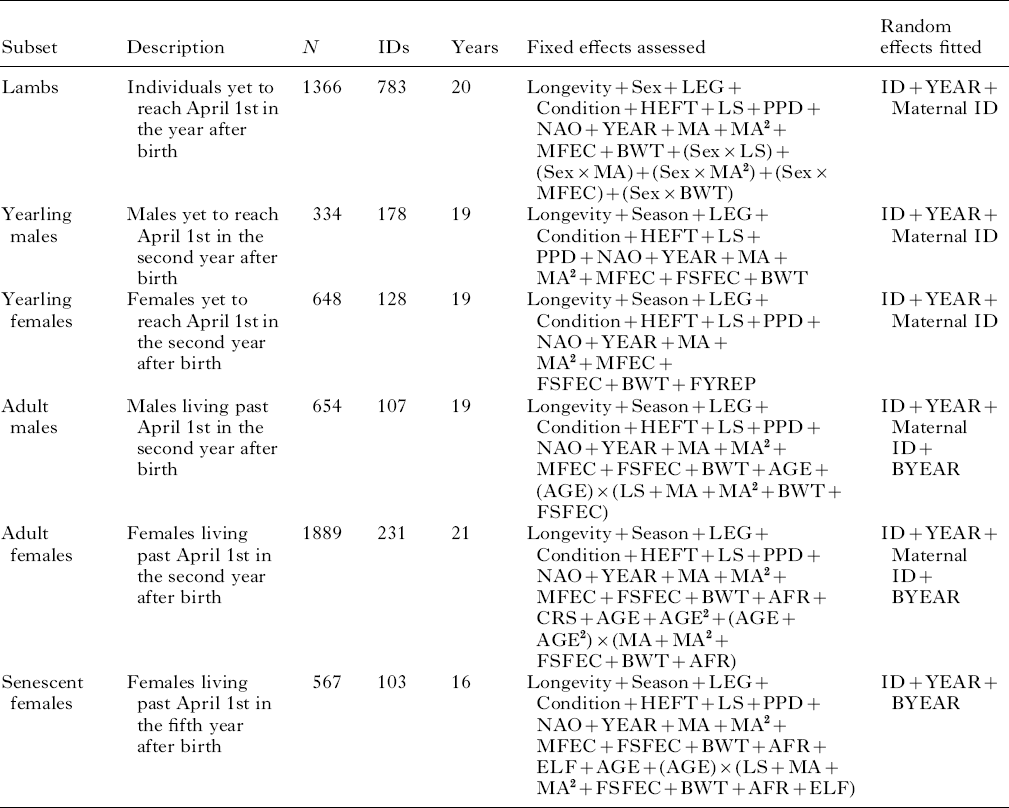
To perform our analyses effectively, we separated individuals into 6 different age and sex subsets. Table 1 defines the 6 subsets, indicates the structure of the data in each, and gives the structure of initial models used to analyse each subset. Our first subset consisted of lambs, and since the amount and distribution of data for males and females are comparable, we analysed the sexes together. In subsequent analyses of older individuals, we analysed the sexes separately because of differences in the distribution of FEC between the sexes, and disparities in the data structure and the variables of interest. The splitting of our data set into subsets may result in an increase in the type II error rate (falsely accepting the null hypothesis of no association), but we feel the subdivisions enhance our ability to investigate our questions of interest. All sheep in our data set had died and so had ones for which we had complete life-history data.
Summary of the six age and sex subsets which were analysed
(In each case the response variable is strongyle FEC. The table contains a definition of the criteria for inclusion in each subset, the data structure of each subset, and the fixed and random effects included in initial GLMMs in each subset. N, number of observations; IDs, number of individuals; Years, number of years.)

Population variables
The population is characterized by fluctuating environmental conditions, which have the potential to influence individual performance and levels of parasitism (Clutton-Brock et al. Reference Clutton-Brock, Stevenson, Marrow, MacColl, Houston and McNamara1996; Wilson et al. Reference Wilson, Grenfell, Pilkington, Boyd, Gulland, Clutton-Brock and Pemberton2004). We included the following environmental variables in all models. (i) Prior population density (PPD). The Village Bay total population size in August of the year prior to faecal sampling was included as a covariate. (ii) Winter North Atlantic Oscillation (NAO). We included the mean NAO index (Lisbon-Reykjavik) for December-March in the winter prior to sampling, providing a large-scale measure of global climatic conditions. (iii) Temporal trends (YEAR). To test for any trend in FEC over the study period, year of sampling was included as a fixed-effect covariate. (iv) Natal heft (HEFT). The Village Bay population may be divided into 3 units, or hefts, which differ in survival, recruitment and dispersal rates, probably due to variation in habitat quality (Coulson et al. Reference Coulson, Albon, Pilkington and Clutton-Brock1999). We included natal heft as a fixed factor with 3 levels to test for any differences in FEC between sheep born in different areas. (v) Season. The peri-parturient rise (PPR), an increase in parasite burden in mothers around the time of offspring birth, occurs with a peak on the day of parturition, which occurs in April and May (Wilson et al. Reference Wilson, Grenfell, Pilkington, Boyd, Gulland, Clutton-Brock and Pemberton2004). Where relevant, we included season as a factor with 2 levels, (1) Lambing (April and May) and (2) Other (all other months). Note that seasonality is not relevant for lambs, since faeces only contain strongyle eggs at around 45 days at the earliest (Wilson et al. Reference Wilson, Grenfell, Pilkington, Boyd, Gulland, Clutton-Brock and Pemberton2004), and so no counts from lambs are collected during April and May.
Individual variables
(i) Sex. Male sheep generally experience higher parasite burdens than females in this population (Wilson et al. Reference Wilson, Grenfell, Pilkington, Boyd, Gulland, Clutton-Brock and Pemberton2004) and so in lambs, where we analysed the sexes together, sex was included as a fixed factor with 2 levels. (ii) Foreleg length (LEG) and condition. We included LEG as a measure of skeletal body size. We estimated body condition as residuals of a regression of body mass on leg length, to give a measure independent of skeletal size (foreleg length and condition correlation test.=0·000±0·146). All measurements were taken in August of the year of faecal sampling. (iii) Age at sampling (AGE). Adult sheep show an increase in parasite burden as they age, which is exacerbated by experience of poor winter conditions (Hayward et al. Reference Hayward, Wilson, Pilkington, Pemberton and Kruuk2009) and so, where relevant, we included age and its quadratic. (iv) Longevity. Including longevity in models tests for a positive association between lifespan and the trait of interest, and also accounts to some extent for selective disappearance of individuals of different lifespan when analysing ageing (Nussey et al. Reference Nussey, Coulson, Festa-Bianchet and Gaillard2008). A significant effect of age in the presence of longevity would suggest that the association of the response variable with age is important even after accounting for the fact that individuals sampled at high ages may represent a special subset of the population. In all models presented below, the significance of other terms in the model was not affected by removal or addition of longevity.
Maternal effects
Here we introduce maternal traits that may be associated with offspring FEC. (i) Natal litter size (LS). Sheep are born in a litter of either 1 or 2, and we included the litter size into which an individual was born as a fixed-effect factor with 2 levels. (ii) Birth weight (BWT). We included BWT as a fixed-effect covariate. In the study population, 95% of individuals are captured within a week of birth, although they are rarely captured on the day of birth. Since lambs gain weight very quickly during these first few days, we corrected for age at capture by performing a regression of birth weight on capture age in days, and used the residuals of birth weight as our explanatory variable. (iii) Maternal age (MA). Linear (MA) and quadratic (MA2) terms were included in all models. (iv) Maternal Faecal Egg Count (MFEC). We included MFEC collected the August before lamb birth to assess the correlation between FEC in mother and offspring. Including MFEC in models of adult FEC caused model instability, and so we excluded MFEC from analysis of adult sheep.
Early-life performance
As well as potential maternal effects, we considered a number of variables measured during the early part of life that could influence FEC in adults. (i) First summer FEC (FSFEC). FEC has been shown to be repeatable within individuals (Wilson et al. Reference Wilson, Grenfell, Pilkington, Boyd, Gulland, Clutton-Brock and Pemberton2004), and so we may predict that individuals with high FEC in early life would have high FEC later on in life. For yearlings and older classes, we tested the associations between FEC collected during the first summer (around 4 months of age) as a covariate on later measures of FEC. (ii) First year reproduction (FYREP). For female yearlings, we included a binary factor indicating whether or not females attempted to reproduce in their first spring: depending on environmental conditions, 20–80% of females give birth at an age of 12 months (Clutton-Brock et al. Reference Clutton-Brock, Pemberton, Clutton-Brock and Pemberton2004). (iii) Cumulative reproductive success (CRS). In analysis of adult females, we included the total number of lambs produced by a female from birth until sampling (CRS) as a covariate, in order to test for a correlation between total reproductive effort and FEC. (iv) Early-life fecundity (ELF) and age at first reproduction (AFR). As discussed above, early-life reproductive performance is associated with later-life performance, and so we tested for an association with late-life FEC in senescent females by summing the number of offspring produced until the age of 5 (ELF). To control for the fact that this may depend upon the timing of the first reproductive event, we included AFR as a fixed-effect factor, with females making their initial breeding attempt at the age of 1, 2, or older.
Statistical analysis
To investigate the response of FEC in associations with maternal and early-life performance in sheep of different age and sex classes, we used generalized linear mixed-effects models (GLMMs). All analyses were performed in GenStat 11th Edition (VSN International). To account for the high overdispersion in our FEC data, we used penalized quasi-likelihood estimation and a negative binomial error structure. The negative binomial is characterized by the mean μ, variance σ2, and aggregation parameter k, which was calculated separately for all subsets (k=μ2/σ2−μ). We used a log link function, and the dispersion parameter was estimated separately for each model, and we used the conditional fitting method of Schall (Reference Schall1991).
In our longitudinal study, individuals may be sampled repeatedly within years, and across multiple years throughout their lives. In order to account for the non-independence of samples taken from the same individual and in the same year, we included individual identity (ID) and year of sampling (YEAR) as random factors. Similarly, individuals born to the same mother are non-independent, and so maternal identity was included as a random effect in all models. Finally, in analyses of adults, we also included a random effect of birth year (BYEAR) to account to some extent for the between-cohort differences in conditions seen across years in the population. In lambs, birth year and year of sampling are equal, and in yearlings they are confounded, and so we did not include BYEAR in these models.
Table 1 summarizes the data structure of each age and sex subset, and indicates which of the above variables was included in the initial model used to analyse variables associated with strongyle FEC. As well as main effects, we tested for the impact of maternal effects and early-life performance on ageing rates by adding interactions between age and early-life variables of interest. Initial models were simplified by progressively removing non-significant terms in the order of least significance. The significance of each term was assessed as when added last to the model, using conditional P values calculated from Wald statistics associated with the appropriate degrees of freedom. Wald tests are an approximation of the likelihood ratio test (LRT), and although Wald tests do make stronger assumptions, this may not be as much of a problem when assessing fixed effects (Bolker et al. Reference Bolker, Brooks, Clark, Geange, Poulsen, Stevens and White2009). The LRT is also more unreliable for small to moderate sample sizes (Pinheiro and Bates, Reference Pinheiro and Bates2000), and is not appropriate when using quasi-likelihood estimation as we do here (Bolker et al. Reference Bolker, Brooks, Clark, Geange, Poulsen, Stevens and White2009).
RESULTS
Lamb faecal egg count
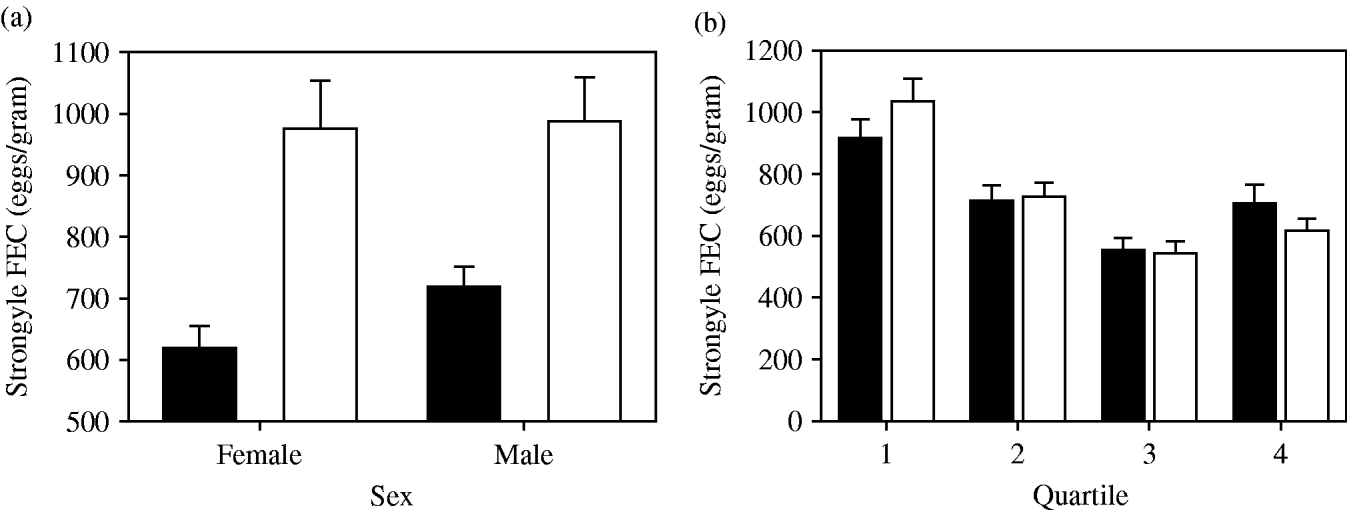
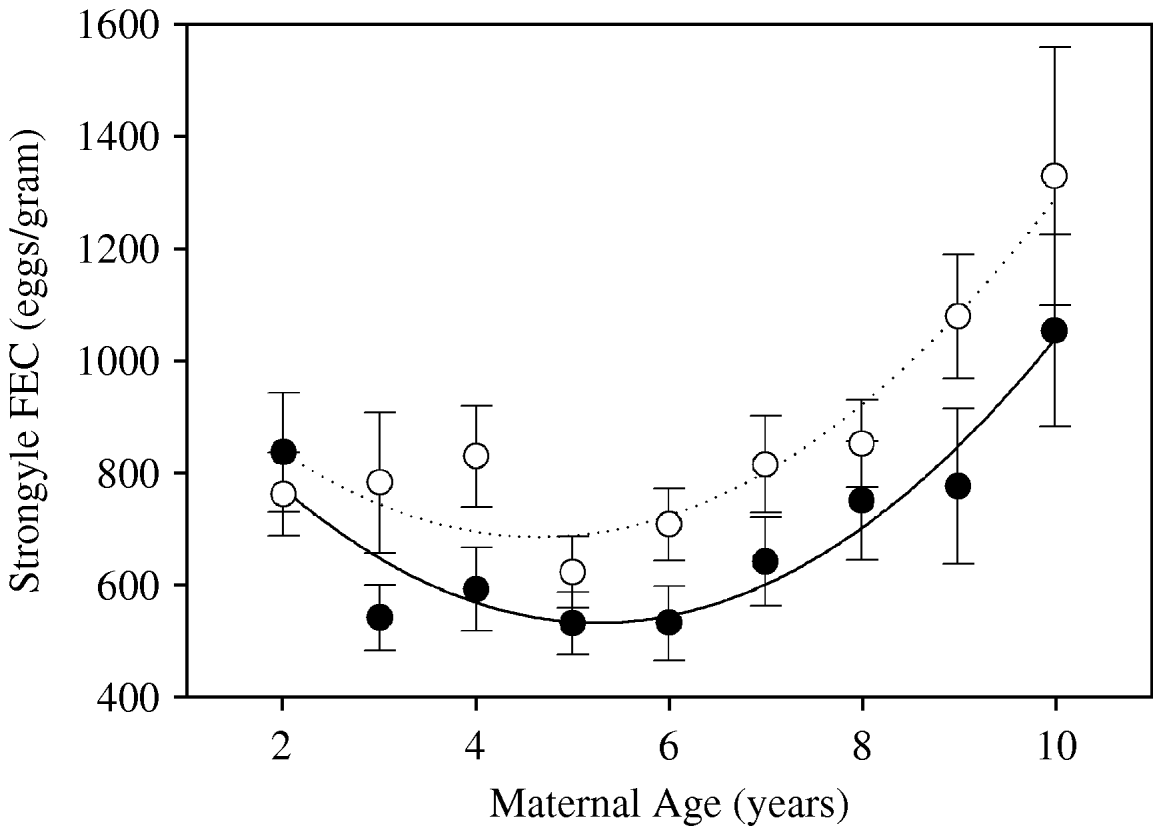
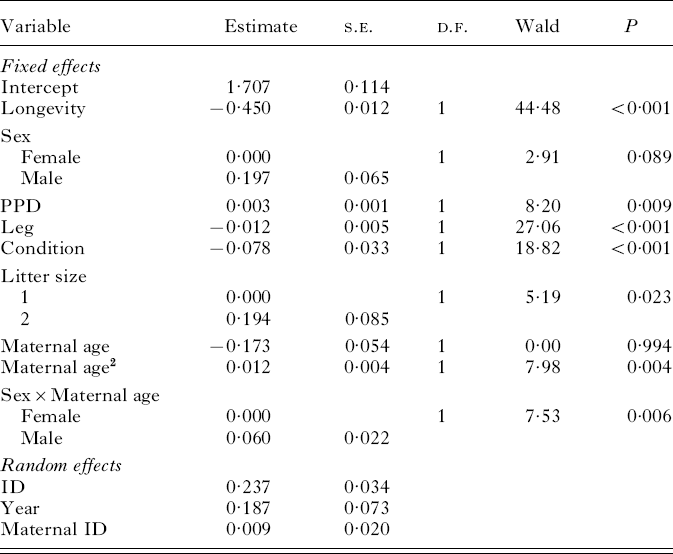
A number of maternal effects were associated with lamb FEC in the manner we predicted in the Introduction (Table 2). The strong negative association between FEC and longevity suggests that even in early life, individuals that are ultimately long-lived had significantly lower levels of parasite infection as lambs. This appears to be largely due to selective mortality of individuals experiencing higher FEC in early life, since on restricting analysis to lambs surviving into adulthood the parameter estimate becomes marginally non-significant (est.=−0·033±0·22, Wald=3·64, d.f.=1, P=0·058). The marginally non-significant association with sex indicated that male lambs had a tendency to have higher FEC than female lambs (Fig. 1a), and a positive association with PPD suggested that FEC in lambs was higher when the previous winter's population was larger. Both LEG and condition were negatively associated with FEC (Fig. 1b), indicating that larger lambs and lambs in better condition experienced lower parasite burdens, but there was no association with BWT (est.=0·028±0·050, Wald=0·31, d.f.=1, P=0·576). We detected a positive association with litter size (Fig. 1a), indicating that twins had higher strongyle FEC in their first summer than singletons. The association between the quadratic of maternal age and FEC suggested that lambs born to middle-aged mothers had the lowest FEC, and that those born to younger and older mothers had higher FEC (Fig. 2). The significant interaction between maternal age and sex indicated that the increase in FEC in lambs with mother's age was greater in male lambs than in females (Fig. 2). We detected no relationship between MFEC and lamb FEC (est.=−0·000048±0·000290, Wald=0·03, d.f.=1, P=0·868).
Variables significantly associated with FEC in lambs. (a) Singleton lambs (filled bars) have lower FEC than twins (open bars) but males and females do not differ significantly and there is no interaction. (b) FEC is negatively correlated with leg length (filled bars) and body condition (open bars), divided into quartiles. Bars indicate means of raw data ±1 s.e.

The significant main effect of maternal age on lamb FEC for each sex. The significant interaction between maternal age and sex on FEC in lambs shows that FEC in male lambs (open symbols, dotted line) increases more rapidly with maternal age than does that of female lambs (filled symbols, solid line). Points indicate means of raw data ±1 s.e.

Results from the final GLMM analysing strongyle FEC in lambs, showing aspects of maternal phenotype and early-life performance that explain significant variation in sheep of both sexes yet to reach their first winter
(See Table 1 for details of data distribution and sample sizes.)

Yearling faecal egg counts
In male yearlings, only season was associated with FEC, with sheep suffering from higher FEC during Lambing (Other est.=−1·174±0·127, Wald=85·43, d.f.=1, P=<0·001). We found no relationship between longevity, PPD, NAO, LEG, condition, BWT, LS, MA, MA2, MFEC, or FSFEC and FEC (P=>0·100). Female yearlings also experienced higher FEC during Lambing (Other est.=−1·726±0·101, Wald=295·05, d.f.=1, P=<0·001). Both LEG (est.=−0·037±0·008, Wald=20·67, d.f.=1, P=<0·001) and condition (est.=−0·407±0·096, Wald=17·81, d.f.=1, P=<0·001) were negatively associated with FEC in female yearlings, but we found no associations with longevity, BWT, LS, MA, MA2, MFEC, FSFEC, or FYREP (P=>0·100).
Adult male faecal egg counts
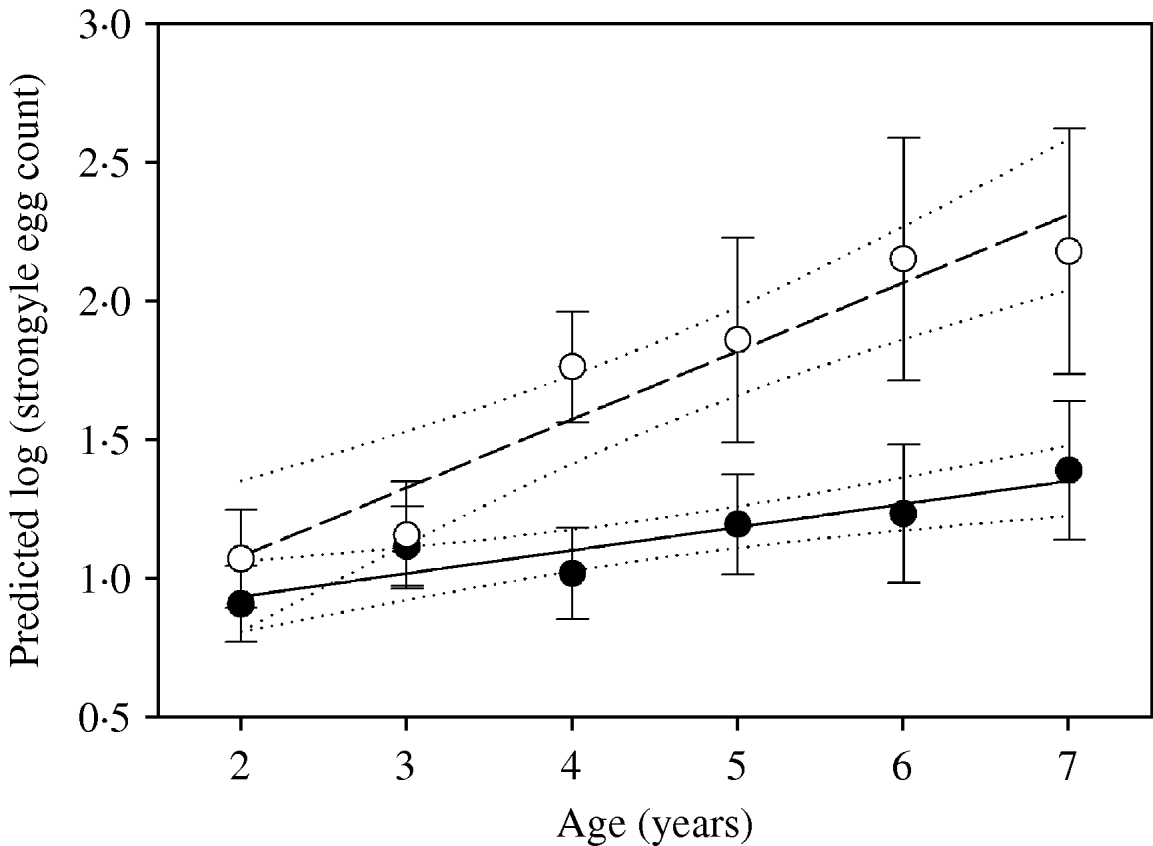
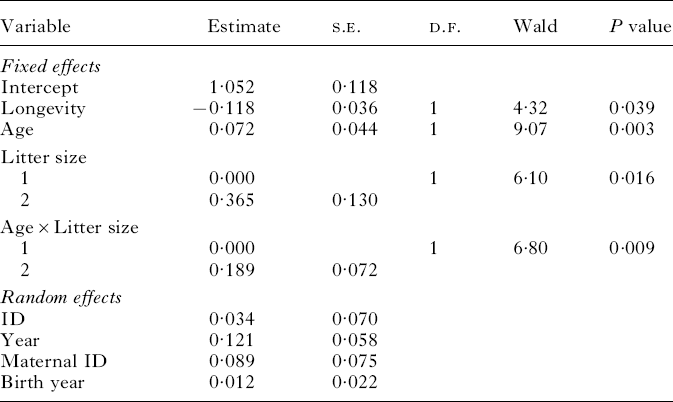
The results for adult male FEC suggested that natal litter size was the only maternal effect with a strong association with FEC (Table 3). As in lambs, longevity was negatively associated with FEC. The positive relationship between age and FEC confirms previous findings which have shown that male Soay sheep experience increasing FEC from the start of adulthood at age 2 years (Hayward et al. Reference Hayward, Wilson, Pilkington, Pemberton and Kruuk2009). The association with LS showed that adult males born as twins have higher FEC than those born as singletons, and there was a significant interaction between age and twin status, indicating that males born as twins showed a faster increase in FEC with age than those born as singletons (Fig. 3). We detected no association between FEC and LEG, body condition, BWT, LS, MFEC, or FSFEC (P>0·200), and a marginally non-significant association with MA2 (est.=0·019±0·011, Wald=0·077, d.f.=1, P=0·077).
Adult males born as twins (open symbols, dashed line) show a more rapid increase in FEC with age than those born as singletons (filled symbols, solid line). Dotted lines indicate 95% confidence intervals. Plot shows predicted means ±1 s.e. from the final adult male model.

Results from the final GLMM analysing strongyle FEC in adult males, showing aspects of maternal phenotype and early-life performance that explain significant variation in FEC of male sheep that have survived at least two winters
(See Table 1 for details of data distribution and sample size.)

Adult female faecal egg counts
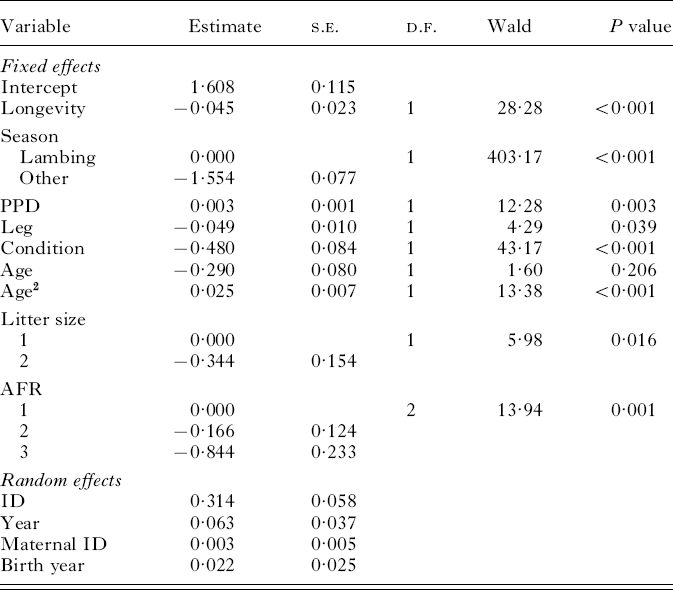
The final model suggested that both maternal effects and early-life performance were associated with strongyle FEC in adult females (Table 4). We found a negative association with longevity, and found that females experienced higher FEC during the lambing season and following years of higher population density. As seen in lambs and female yearlings, LEG and body condition were both negatively associated with FEC. As expected, FEC was a quadratic function of age, with the model predicting the lowest FEC in middle-aged females. In contrast to the findings in lambs and adult males, and having controlled for LEG and condition, adult females born as twins had significantly lower FEC than those born as singletons. Finally, the association with AFR suggested that females which began reproduction early had higher FEC than those which deferred reproduction until their second or third year.
Results from the final GLMM analysing strongyle FEC in adult females, showing aspects of maternal phenotype and early-life performance that explain significant variation in FEC in females that have survived at least two winters
(See Table 1 for details of data distribution and sample size.)

Senescent female faecal egg counts
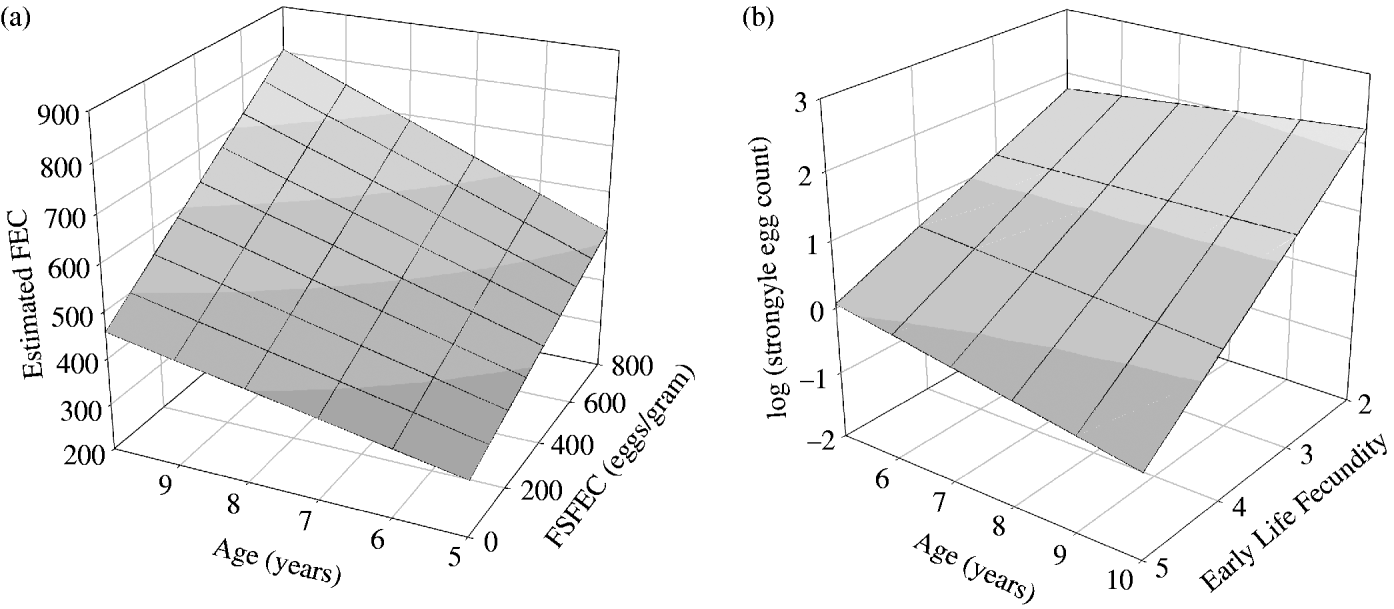
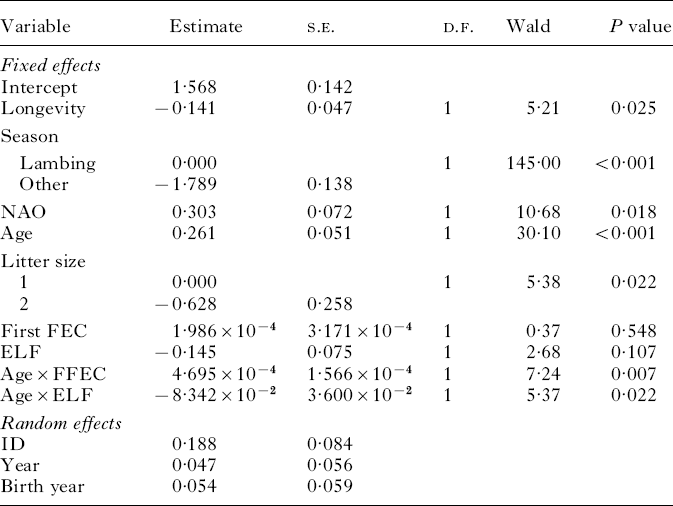
Strongyle FEC in senescent females was associated with maternal effects, and results also suggested that changes in FEC with age were dependent upon early-life performance (Table 5). FEC in senescent females was lower in sheep that were ultimately longer-lived, was higher during the lambing season, and showed a linear increase with age. As seen in adult females, senescent females born as twins experienced lower FEC than those born as singletons. Though neither of the main effects of FSFEC or ELF were significant, both interactions with age were. The interaction between age and FSFEC suggested that older females that experienced heavier infections in early life showed a faster increase in FEC as they aged in later life (Fig. 4a). The interaction between age and ELF predicted that females with low reproductive performance experienced an increase in FEC with age in late life, while sheep with high performance in early life showed a decrease in FEC with age (Fig. 4b).
Model predictions of early-life variables associated with age-specific changes in FEC in senescent females. (a) Senescent females which experience high FEC in their first summer are predicted to experience a more rapid increase in FEC in late life than those experiencing low FEC in early life. (b) Females with high fecundity in early life are predicted to show decreasing FEC in later life, while those with low fecundity show increasing FEC. Note that axes have been pivoted to view the data most effectively, and that as a result, Age increases from right to left in (a), but from left to right in (b).

Results from the final GLMM analysing strongyle FEC in ‘senescent’ females, showing aspects of maternal phenotype and early-life performance that explain significant variation in FEC in females which have survived five winters and are considered to be of ‘prime age’ or older
(See Table 1 for details of data distribution and sample size.)

DISCUSSION
In this paper we have presented results showing significant associations between maternal effects and early-life performance and a measure of parasite infection in an unmanaged mammal population. In particular, we have shown that these associations are present not only immediately after birth and during early development, but may persist for many years into an individual's life. Below, we describe the associations found, suggest interpretations for them and highlight areas worthy of further investigation.
Maternal effects
Our results demonstrate that aspects of maternal phenotype are associated with FEC across the life history of individuals.
Natal litter size
Natal litter size influenced FEC in all age and sex classes with the exception of yearlings. Lambs born as twins exhibited higher FEC than those born as singletons, a result consistent with the lower lifetime fitness of twins, which is largely due to their lower birth weight (Wilson et al. Reference Wilson, Pilkington, Pemberton, Coltman, Overall, Byrne and Kruuk2005a), and increased first winter mortality (Clutton-Brock et al. Reference Clutton-Brock, Price, Albon and Jewell1992; Jones et al. Reference Jones, Crawley, Pilkington and Pemberton2005). Given the possible increase in type I error rate potentially caused by multiple testing due to splitting the data and despite a sample size of 1366, we note that caution may be attached to a P-value of 0·023. However, the relatively large parameter estimate suggests that the result is of biological significance. A potential explanation for this result is that twins receive less nourishment from their mother, since prolonged suckling provides enhanced parasite resistance in lambs, possibly due to a positive effect on weight gain (Iposu et al. Reference Iposu, McAnulty, Greer, Xie, Green, Stankiewicz and Sykes2008). However, by conditioning on LEG and body condition, we can be confident that the higher FEC in twins is not simply due to their being smaller or in worse condition (although this may also be relevant), but to some additional factor. Higher reproductive effort in mothers of twins may result in higher maternal susceptibility to parasites, and so lambs born as twins may therefore inhabit a more infective immediate environment. Alternatively, maternal care not related to provisioning of nutrients may be implicated, since producing twins is costly, particularly when environmental conditions are poor (Clutton-Brock et al. Reference Clutton-Brock, Stevenson, Marrow, MacColl, Houston and McNamara1996). Immunosuppression during pregnancy is required to avoid the mounting of an immune response against a female's own offspring (Theodorou et al. Reference Theodorou, Fragou, Chronopoulou, Kominakis, Rogdakis and Politis2007), and so this, coupled with the demands of raising two lambs, may mean that mothers of twins are poorer at providing protective antibodies (e.g. Pfeffer et al. Reference Pfeffer, Shaw, Green and Phegan2005). It has been shown in domesticated sheep that lambs of larger litters have lower serum immunoglobulin levels, and that immunoglobulin concentration is positively associated with lamb fitness (Christley et al. Reference Christley, Morgan, Parkin and French2003). The behaviour of the lamb itself may also be implicated, since lambs of larger litters are slower to stand and suckle (Dwyer and Morgan, Reference Dwyer and Morgan2006), and so may consume less colostrum (Nowak and Poindron, Reference Nowak and Poindron2006) which is only available for a short period. This result was replicated in adult males, in which we also found a more pronounced increase in FEC with age in males born as twins, and a less pronounced increase with age in singletons, even after correcting for LEG and condition. A P-value of 0·016 with a sample size of 654 may be a cause for caution in interpreting this, although a large parameter estimate of 0·365 and a highly significant interaction with age adds confidence to our conclusion that this association persists until long after sheep are under direct influence of their mother.
The results from adult and senescent females provide further evidence for a persistent correlation between litter size and adult FEC, but in the opposite direction to that in males and lambs, suggesting that females born as twins actually show lower FEC than those born as singletons. This is a surprising result, since individuals born into larger litters are commonly observed to be lighter at birth, which has been shown to translate into reduced lifetime fitness (e.g. Wilson et al. Reference Wilson, Pilkington, Pemberton, Coltman, Overall, Byrne and Kruuk2005a). It is possible that females born as singletons enjoy greater reproductive success, and trade this off against reduced immune investment. However, we found no association between FEC and CRS, suggesting that sustained reproductive investment over time is uncorrelated with FEC. The association also persists if longevity is removed from the model (twin est.=−0·309±0·155, Wald=4·89, d.f.=1, P=0·028), indicating that the correlation is not due to the selective survival of twins with high parasite resistance; the association also persists if LEG and condition are removed from the model. Female twins may be of lower fitness than singletons, and so may opt to invest in parasite resistance and survival rather than reproduction, which may explain their lower FEC. This observation will not hold true in lambs, since there is no investment in reproduction and so this trade-off is not necessary. Male adults may be expected to invest less in maintenance than females and to invest heavily in weight gain to enhance reproductive success, potentially explaining why this may not be observed in adult males. However, investigating this possibility is beyond the scope of the current work.
Maternal age
In our analyses of lamb FEC, we showed that lambs of middle-aged females have lower FEC than lambs of younger and older mothers. If younger and older mothers are less able to provide nutrition to lambs, their lambs may begin grazing earlier than lambs of prime-aged ewes, ingest parasite larvae at an earlier age, and thus experience elevated FEC. However, since lambs may nibble grass from as early as the first week of life, it is difficult to discern when grass makes up a significant proportion of a lamb's diet. It may be that, as has been shown previously (Hayward et al. Reference Hayward, Wilson, Pilkington, Pemberton and Kruuk2009), prime-aged females have lower FEC, and so their lambs may enjoy the benefit of being raised in a less infectious immediate environment, whereas older and younger females have higher FECs and hence lambs developing in infective environments. However, splitting this relationship by sex, we found that the increase in FEC with increasing maternal age was greater in male lambs. It has been shown that rearing male lambs is more costly in terms of survival in years of high mortality (Clutton-Brock et al. Reference Clutton-Brock, Stevenson, Marrow, MacColl, Houston and McNamara1996) and that reproductive costs are higher in the youngest and oldest sheep (Tavecchia et al. Reference Tavecchia, Coulson, Morgan, Pemberton, Pilkington, Gulland and Clutton-Brock2005). Thus, an alternative explanation is that younger and especially older females may be unable to provide as well for their demanding male lambs, and so those lambs experience higher FEC. Since LEG and condition are accounted for, this result, coupled with the associations with litter size we have found, are consistent with limitations on post-natal provisioning of antibodies leading to lower parasite resistance and higher FEC.
Birth weight
We found no association between FEC and BWT in any subset of the population. To investigate whether this was due to the association with current condition masking an association with BWT, we repeated all analyses without LEG and condition. In yearlings and adults of both sexes, and in senescent females, BWT was still non-significant when LEG and condition were excluded from the model (P=>0·170 in all cases), but in lambs, there was a significant association with BWT (est.=0·068 ±0·034, Wald=8·76, d.f.=1, P=0·003). It therefore appears that current condition is more important than size at birth in all age and sex subsets. Many previous studies have identified positive correlations between body size or condition and parasite resistance (e.g. Coltman et al. Reference Coltman, Pilkington, Kruuk, Wilson and Pemberton2001a). The relationship between condition and parasite infection is likely to exhibit positive feedback, with poor condition increasing susceptibility to infection, which further reduces condition through reduced nutrient assimilation and voluntary reduction in food intake (Stear et al. Reference Stear, Bishop, Henderson and Scott2003).
Maternal FEC
We also found no association between maternal FEC and that of their lambs. This is somewhat surprising, given that previous studies have reported a low but significant heritability for FEC in this population (Coltman et al. Reference Coltman, Pilkington, Kruuk, Wilson and Pemberton2001a, Robinson et al. Reference Robinson, Wilson, Pilkington, Clutton-Brock, Pemberton and Kruuk2009). However, we did not have previous August FEC for even half of the mothers, and so possibly lacked the power to detect any such associations. Dividing our data into subsets reduced our effective sample size further, and potentially increased the type II error rate.
Early-life performance
Reproduction
The negative relationship between immunity and reproductive effort is well documented (Lochmillar and Deerenberg, Reference Lochmillar and Deerenberg2000). However, it is also true that traits more generally associated with reproductive performance such as body size are positively associated with parasite resistance (Coltman et al. Reference Coltman, Pilkington, Kruuk, Wilson and Pemberton2001a; Robinson et al. Reference Robinson, Wilson, Pilkington, Clutton-Brock, Pemberton and Kruuk2009). A lack of any association between FYREP and FEC in female yearlings provides no support that, in this instance, young sheep pay a cost of reproduction in terms of increased parasite load. However, the periparturient rise associated with reproduction peaks on the day of lambing (Wilson et al. Reference Wilson, Grenfell, Pilkington, Boyd, Gulland, Clutton-Brock and Pemberton2004), and by the time the majority of faecal samples are collected, in August, females have weaned their offspring (Clutton-Brock, Reference Clutton-Brock, Clutton-Brock and Pemberton2004).
In adult females we found a negative association between FEC and AFR, suggesting that sheep that commence reproduction in their first year have higher FEC than those which begin in their second year, while sheep which reproduce for the first time in their third year have the lowest FEC. Life-history trade-offs between early- and late-life variables have been widely demonstrated (e.g. Nussey et al. Reference Nussey, Kruuk, Donald, Fowlie and Clutton-Brock2006), and it may be that sheep which reproduce earlier trade-off parasite resistance in adulthood for immediate reproductive investment. Parasite resistance may be another of the many factors that influence variation in reproductive strategies of individuals in this population (Stevenson et al. Reference Stevenson, Marrow, Preston, Pemberton, Wilson, Clutton-Brock and Pemberton2004).
In senescent females we found no correlation between ELF and FEC. However, we did find a significant interaction between age and ELF which indicated that sheep with high reproductive output during the first 5 years of life experienced a decrease in FEC with age, while those which reproduced less experienced an increase. This suggests a positive association between reproductive performance and parasite resistance, and is consistent with our previous findings (Hayward et al. Reference Hayward, Wilson, Pilkington, Pemberton and Kruuk2009), since sheep which are fecund in early life are likely to have been in good condition or to have experienced favourable environments, and so may age more healthily than less fecund individuals in poorer condition. The variety of associations between reproductive parameters and FEC indicate that the relationship between reproductive investment and parasite resistance may be extremely complex.
Parasite resistance
Also somewhat surprising is the lack of any association between first summer FEC and subsequent FEC in either yearlings or adults, since the repeatability of FEC across all ages is around 0·58 in females and around 0·42 in males (Wilson et al. Reference Wilson, Grenfell, Pilkington, Boyd, Gulland, Clutton-Brock and Pemberton2004). However, it could be that much of the repeatability is due to differences in traits such as body size and condition. Although we failed to find any association between adult FEC and first summer FEC in senescent females, we found a significant interaction with age, consistent with a more rapid increase in FEC with age in individuals which experienced higher FEC in their first summer than those which experienced lower FEC. This is an interesting result in the light of previous work, which has shown that the late-life increase in FEC with age in adult females is accelerated in those females which have experienced higher environmental stress over their lives (Hayward et al. Reference Hayward, Wilson, Pilkington, Pemberton and Kruuk2009). It is thus possible that the damaging effects of parasites experienced earlier in life, or the exhaustion of T cell repertoires due to previous infections, could potentially accelerate the ageing process (Gruver et al. Reference Gruver, Hudson and Sempowski2007). However, the lack of any such association in adult females makes drawing firm conclusions from this impossible, especially since the comparison is being made between two measures of FEC collected 5 or more years apart.
Conclusions
In this study we have shown that aspects of maternal phenotype and early-life performance are associated with parasite infection levels in young sheep, and that these associations may persist throughout life. A criticism which may be levelled at these results is the splitting of the data into subsets, which could potentially increase the type I error rate (false positives) through multiple testing, and the type II error rate (false negatives) through reducing the amount of data analysed. We believe that analysing the data in this way has allowed us to effectively address our aims, and note that the majority of our results are highly significant and thus robust. As we predicted, traits positively associated with other aspects of lamb fitness were also positively associated with lamb parasite resistance. In particular, low FEC was associated with middle-aged mothers and low natal litter size. These associations persisted even when conditioned on body size and condition effects, results which are consistent with an influence of maternal provisioning not related to nutrition on offspring FEC. As predicted, the strength of these associations with maternal phenotype weakened with offspring age, and only litter size was associated with FEC in adult sheep. Again, as predicted, we found some evidence for a positive association between early life levels of parasite infection and adult FEC, and a negative association between early life fecundity and adult FEC in senescent females. Both of these results are consistent with a positive correlation between early life and adult fitness, but a negative association between AFR and adult FEC in adult females suggests a trade-off. These results are in line with the complex nature of the relationship between parasite resistance and other life-history traits. An interesting avenue of future research in natural systems would be to relate maternal antibody levels to those in offspring and to offspring parasite infection and survival, and to investigate associations with the ensuing offspring life-history. Bringing together immunological and ecological research in this manner would represent a crucial step in our understanding of immunosenescence and parasite ecology in naturally-regulated populations.
ACKNOWLEDGEMENTS
We thank the National Trust for Scotland and Scottish Natural Heritage for permission to work on St Kilda, and the Royal Artillery Range (Hebrides), and QinetiQ for logistical support. We thank Dan Nussey, Alastair Wilson, Desiree Allen and Emma Cunningham for discussion, and two anonymous referees for comments on a previous version of the manuscript. We also thank the many previous members of the St Kilda Soay sheep project and all the volunteers who have collected field data, and T. H. Clutton-Brock who conceived the project.
FINANCIAL SUPPORT
The long-term data collection on St Kilda has been funded by the Natural Environment Research Council, the Wellcome Trust, the Biotechnology and Biological Sciences Research Council, and the Royal Society, through grants to T.H. C.-B., J.M.P., L.E.B.K., B.T. Grenfell, M. J. Crawley, T. Coulson, and S. Albon. This work presented here was funded by a Biotechnology and Biological Sciences Research studentship to A.D.H., supervised by L.E.B.K. who is supported by the Royal Society.