Most scholars of pre-Hispanic central Mexico consider religion to have been one of the major structuring frameworks within which social practices and transformations were realized. It is somewhat surprising therefore how little we understand the origins of the Classic-period religious system centered on the city of Teotihuacan and the potential continuities in religious beliefs and practices that may have extended from the Formative period to the Spanish Conquest. In the three decades since the publication of a seminal volume edited by H.B. Nicholson (Reference Nicholson and Nicholson1976), titled Origins of Religious Art and Iconography in Preclassic Mesoamerica, little new archaeological data relevant to these issues have made their way to press.
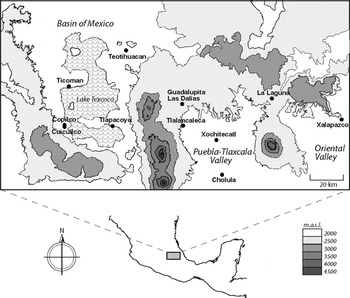
This study is intended to advance current understanding of early central Mexican religious practices and the origins of the Classic-period pantheon by reporting on the discovery of two styles of effigy vessels depicting what appear to be renditions of the Old God of Fire and the Storm God. The effigies originated from Middle to Terminal Formative-period domestic contexts at La Laguna, a midsize regional center in northern Tlaxcala. Stylistically similar examples from contemporaneous sites in central Mexico are assembled to demonstrate that the region's inhabitants were increasingly integrated in their religious practices and that renditions of these two deities were manipulated in domestic contexts across the settlement and socioeconomic spectrum during the Middle to Terminal Formative period (Figure 1). An important distinction in the representations and corresponding ritual practices of the two deities was further elaborated at Teotihuacan, where the Old God remained primarily in the domestic sphere while the Storm God was venerated in domestic contexts but was also central to public rituals conducted by state rulers.
Eastern central Mexico depicting sites mentioned in the text.

DIVINE EFFIGIES AND RITUAL PRACTICES
This study focuses on effigy vessels dating to between circa 600 b.c. and a.d. 100 that depict representations of deities recognizable from later central Mexican societies of circa a.d. 100–1521 (Figure 2). I use the term effigy vessel broadly to denote the depiction of an animate being on a container or receptacle. Following this definition, effigy vessels were present in much earlier central Mexican ceramic assemblages, circa 1300 b.c. The early villagers of the Puebla-Tlaxcala region primarily used zoomorphic effigy vessels, possibly depicting an opossum, as incense burners until the latter part of the first millennium b.c. (García Cook Reference García Cook and Sabloff1981; see also López Austin Reference López Austin1993). A different form of incense burner, depicting an elderly male, became part of ritual practices in Puebla-Tlaxcala as early as 600 b.c. This personage is identifiable as the Old God of Fire, and was similarly depicted on effigy incense burners, usually called braziers, in Classic-period Teotihuacan. The Storm God is the second deity who began to be depicted on effigy vessels during this period. He is depicted on jars designed to hold liquids and on ceramic objects that may correspond to the lids of censers, used for burning incense, or small masks to be worn during ritual dances or processions. Both effigy forms of the Storm God are described in this study; however, only the censer-lid or mask type has been found at La Laguna.
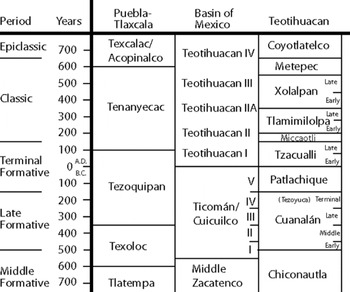
Ceramic phases for northern Puebla-Tlaxcala, the Basin of Mexico, and Teotihuacan during the periods discussed in the text.

In focusing on effigy vessels, I emphasize the ritual practices involving these artifacts as the means by which religious understandings were created, perpetuated, and transformed. This approach follows Catherine Bell (Reference Bell1992, Reference Bell1997) in emphasizing what people do in rituals as the critical component to forming what they think about them, or how they conceptualize their individual relationships to the natural and supernatural forces associated with the rituals they perform. “In this view, ritual is more complex than the mere communication of meanings and values; it is a set of activities that construct particular types of meanings and values in specific ways” (Bell Reference Bell1997:82).
The perspectives of Roy Rappaport are also incorporated into this study. Rappaport (Reference Rappaport1975, Reference Rappaport1979:173–221) interpreted ritual practices and performances as simultaneously involving themes of social contract, moral structure, sacredness, divinity, and creation in ways that integrate disparate groups of people. Similar perspectives extend back most notably to Émile Durkheim (Reference Durkheim1912), but are more compelling when, as in Rappaport, they recognize ritual practices as potential settings for both the expression of social solidarity and the legitimization of social inequality (e.g., Beezley et al. Reference Beezley, Martin, French, Beezley, Martin and French1994; Giddens Reference Giddens1979:92–113). Such an understanding is central to contemporary agent-based models regarding the role of moralistic norms in the evolution of large-scale human cooperation (Axelrod Reference Axelrod1986; Boyd and Richerson Reference Boyd and Richerson1992; Richerson et al. Reference Richerson, Boyd, Henrich and Hammerstein2003). These researchers accentuate ritual activities that communicate moral sentiments as potentially integrative mechanisms that foster cooperation and coordination among self-interested and competitive individuals, provided that breeching such norms is socially costly. Archaeologists have been investigating the social roles of integrative rituals for decades (Drennan Reference Drennan and Flannery1976; Hegmon Reference Hegmon, Lipe and Hegmon1989) and recently have begun to incorporate agent-based evolutionary models more explicitly (Stanish and Haley Reference Stanish, Haley, Vaughn, Ogburn and Conlee2005).
The evolution of widespread religious institutions likely involved integrative notions of collective moral norms as well as divisive legitimizations of social asymmetries. These contradictory dimensions of religious institutions were constructed through ritual practices involving widely shared, but contested, conceptualizations of how ritual objects should be manipulated by specific individuals within built environments structured by ritual architecture. This perspective is especially relevant to investigations of the proto-urban period in central Mexico, when communities in the Basin of Mexico and the Puebla-Tlaxcala region began showing heightened economic integration centuries before the political integration of the Teotihuacan state (Carballo et al. Reference Carballo, Carballo and Neff2007). In this study, I suggest that the inhabitants of the two areas also showed heightened religious integration during the period.
LA LAGUNA, TLAXCALA, AND THE LATE FORMATIVE PROTO-URBAN CENTRAL MEXICAN SOCIAL LANDSCAPE
The La Laguna archaeological site is located in the northeastern corner of the Puebla-Tlaxcala region on the former hacienda of the same name. The site was first documented in archaeological literature by Dean Snow (Reference Snow1966, Reference Snow1969), who recorded it as the largest Formative-period center in his 1,500 km2 survey area, covering portions of central and northern Tlaxcala. La Laguna was also included in the survey of northern Tlaxcala directed by Ángel García-Cook (Reference García Cook and Sabloff1981), and was documented as the largest Texoloc- and Tezoquipan-phase (600 b.c.–a.d. 100) center in this 2,000 km2 survey area (Merino Carrión Reference Merino and Leonor1989; for recent chronological revisions see Lesure et al. Reference Lesure, Borejsza, Carballo, Frederick, Popper and Wake2006)
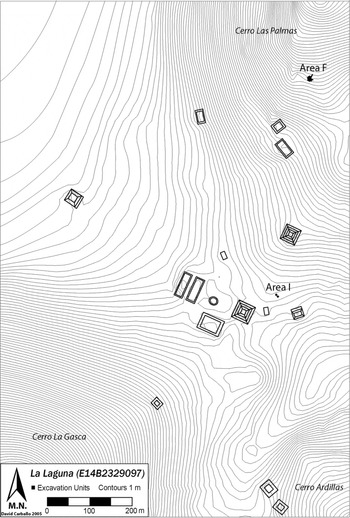
The first excavations at La Laguna were undertaken as part of the University of California, Los Angeles (UCLA), Formative Project in the Apizaco region, directed by Richard Lesure and involving Aleksander Borejsza (2003–2004) and the author (2004) as field directors. The materials discussed in this article were excavated during the 2005 season of the Proyecto Arqueológico La Laguna, under the direction of the author. The Formative occupation of the site covers approximately 100 ha, centered on a ceremonial core consisting of masonry temple platforms and a central plaza (Figure 3). Recent radiocarbon dates obtained by Lesure and Borejsza show a bimodal distribution for the Formative occupation of the site, with features dug into tepetate (sterile substrate) spanning approximately 600–400 b.c. and features close to the surface dating to circa 100 b.c.–a.d. 100. Either the site was temporarily abandoned during the early Late Formative period or areas of the site excavated thus far witnessed significant remodification episodes, leaving preserved pit features associated with only the earliest and latest levels of occupation.
La Laguna, Tlaxcala, depicting excavation Areas F and I. Architectural reconstructions are projected based on the dimensions of mounds visible from the surface. Surface visibility is limited, however, by the site's location in the saddle of three hills, where colluvial deposits cover most domestic structures.

Based on these attributes, La Laguna may be identified as the largest Late to Terminal Formative regional center in northern Tlaxcala, yet it is significantly smaller than contemporaneous centers in southern Puebla-Tlaxcala and the Basin of Mexico. In southern Puebla-Tlaxcala, Tlalancaleca and Xochitecatl were considerably larger in population and monumental construction, as, most likely, was Cholula (García Cook Reference García Cook and Sabloff1981; Plunket and Uruñuela Reference Plunket and Uruñuela2005; Serra Puche Reference Serra Puche1998). Occupation at Tlalancaleca covered 700 ha, likely corresponding to more than 10,000 inhabitants (García Cook Reference García Cook and Sabloff1981:252). Cuicuilco and Tlapacoya were primary centers earlier in the Basin of Mexico sequence, superseded by Teotihuacan at its end (Barba de Piña Chán Reference Barba de Piña Chán1956; Niederberger Reference Niederberger, Clark and Pye2000; Sanders et al. Reference Sanders, Parsons and Santley1979). Cuicuilco and Patlachique-phase Teotihuacan housed populations in the tens of thousands. La Laguna was of a similar size to Guadalupita las Dalias, also in northern Puebla-Tlaxcala (García Cook and Rodríguez Reference García Cook and Rodríguez1975), and both sites may be considered representative of an intermediate tier in the regional settlement hierarchies of Late Formative central Mexico, smaller than the largest sites but larger than the abundant villages of the period. The effigy vessels discussed in this article have been recovered from all three tiers within this hierarchy.
EARLY DEPICTIONS OF THE OLD GOD OF FIRE AND STORM GOD IN CENTRAL MEXICAN EFFIGY VESSELS
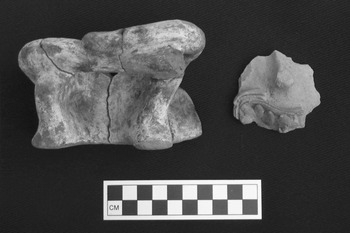
Scholars agree almost unanimously that the antecedents of the Aztec Storm God (Tlaloc) and Fire God(s) (Huehueteotl, the Old God, and/or Xiuhtecuhtli, the Lord of Fire) were present in Teotihuacano religion (Gamio Reference Gamio1922; López Austin and López Luján Reference López Luján and Carrasco2001; Millon and Drewitt Reference Millon and Drewitt1961; Pasztory Reference Pasztory1997; von Winning Reference von Winning1987). However, there is currently less consensus regarding how far back into the Formative period these deities extend. Figure 4 depicts two ceramic artifacts recovered from Late Formative-period domestic contexts at La Laguna. They share the general characteristic of being parts of effigy vessels that were used in ritual activities; one depicts a seated figure attached to an incense burner, and the other depicts an anthropomorphic face with an up-curving mouth full of sharp teeth. I argue that the iconographic attributes of these pieces are consistent with their being predecessors of well-known incarnations from Classic- and Postclassic-period pantheons. I avoid using Nahuatl names in referring to them so as not to implicate the suite of attributes associated with them during the Postclassic and Colonial periods.
Ceramic artifacts from La Laguna, including the Old God effigy (left), and Storm God effigy (right).

The Old God of Fire
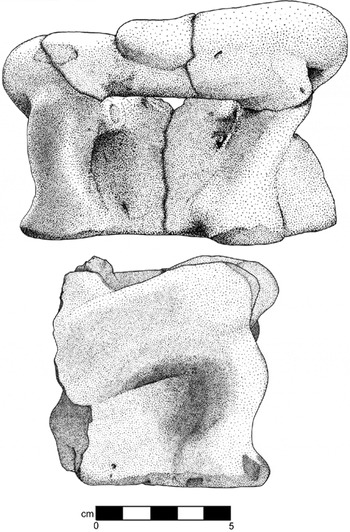
Figure 5 depicts the proposed Old God of Fire incense burner from La Laguna. Its incomplete fragments were recovered from the center of the site (labeled excavation Area I in Figure 3) associated with a late Tezoquipan occupation surface, dated elsewhere at the site to between circa 100 b.c. and a.d. 100. This layer covered a re-deposited burial and two shallow trash-pit features in four adjacent excavation units. The fragments were located 4 m northwest of a series of insubstantial stone walls that I interpret as corresponding to the patio of an upper-status household, based on the presence of domestic features and refuse, and of higher quantities of fine personal ornamentation and non-local resources than have been encountered in other domestic areas.
Brazier fragment depicting the Old God of Fire from La Laguna excavation Area I, viewed from the front and side.

The ceramic fragments correspond to an anthropomorphic figure attached to the cylindrical base of a whitewashed, pedestaled incense burner, usually called braziers in central Mexico. Such braziers without attached figures, and with vented composite-silhouette receptacles, first date to the Middle Formative period in Tlaxcala (Serra Puche et al. Reference Serra Puche, Arce and Mendoza2004). Simpler out-slanting receptacle fragments from similar braziers were also encountered in Area I; however, none can be connected to the attached figure, and it is possible that they correspond to undecorated braziers or that their bases and attached figures were discarded elsewhere.
The La Laguna figure is seated with his legs drawn up and with crossed arms resting on flexed knees. The position was often associated with authority in Mesoamerica, and the Aztecs depicted a number of male deities in this fashion, including both fire gods: the Old God (Huehueteotl) and the (Turquoise) Lord of Fire (Xiuhtecuhtli) (López Luján Reference López Luján1994:171–298, Reference López Austin and López Luján2001; Matos Moctezuma Reference Matos Moctezuma1988:85–121; Pasztory Reference Pasztory1983:222–227). At least seven other comparable figures have been reported from Middle to Terminal Formative-period contexts in central Mexico and identified by their excavators as depicting the Old God. These include examples from Tlalancaleca (García Cook Reference García Cook and Sabloff1981:Figures 8-4, 8-5), Copilco (Gamio Reference Gamio1920:Figure 8, Reference Gamio1922:Plate IIIb), and Ticoman (Vaillant Reference Vaillant1931:Plates LXXIXc, LXXXIX), as well as two examples each from Xalapazco (Seler Reference Seler1915:Plate LXVIa, Figures 1, 3; see also Taube Reference Taube2004:Figure 47) and Cuicuilco (Cummings Reference Cummings1923:210). Beatriz Barba de Piña Chán (Reference Barba de Piña Chán1956:37) reported a piece from Tlatilco that appears to be an old-man effigy in the naturalistic style of other well-known effigy vessels from the site, such as the acrobatic figures, but lacks the seated posture and large brazier receptacle characteristic of later Old God effigies (see Piña Chán Reference Piña Chán, Ekholm and Bernal1971:Figure 6e).
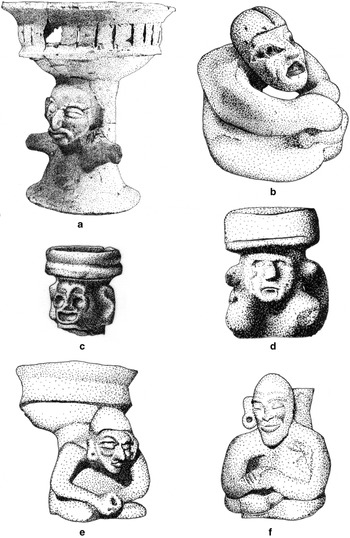
The previously reported depictions of the Old God share many attributes, but are stylistically heterogeneous in certain respects. The example from Tlalancaleca consists of a male head and two nubbin arms emanating from the pedestal of the burner (Figure 6a). García Cook and Beatriz Leonor Merino Carrión (Reference García Cook, Carrión, Puche and Cáceres1988:287) described the piece as white-slipped with traces of red and yellow pigment, and Raziel Morza (Reference Morza, Cook and Carrión1996 [1975]:290) noted that it was discovered in a stratigraphic pit associated with the early Texoloc phase. The open arms and lack of depiction of a torso separates the Tlalancaleca brazier from the others. The absence of a torso makes it impossible to determine whether the individual is seated or standing, although the latter appears more likely because of the height of the head and hands relative to the base of the pedestal. A standing figure would also differ from the other reported examples.
Formative-period Old God braziers from: (a) Tlancaleca (based on García Cook Reference García Cook and Sabloff1981:Figure 8–4); (b) Copilco (based on Gamio Reference Gamio1920:Figure 8); (c) Ticoman (based on Vaillant Reference Vaillant1931:Plate LXXIXc); (d) Xalapazco (based on Nicholson Reference Nicholson, Ekholm and Bernal1971:Figure 6); (e–f) Cuicuilco (based on von Winning Reference von Winning and Nicholson1976:Figure 3).

The figure from Copilco (Figure 6b) differs from the others in not being attached to a brazier; nevertheless, it was identified by Manuel Gamio (Reference Gamio1920, Reference Gamio1922) as the Old God of Fire. It is a hunched male seated cross-legged with his arms crossed and resting on his knees. The individual's upper back is unnaturally flattened, which may indicate that a receptacle once rested on his back, possibly supported by three or four companion figures. George Vaillant (Reference Vaillant1931:307) suggested a Middle Zacatenco-phase designation for the piece, which would make it roughly contemporaneous with the example from Tlalancaleca.
Three examples made of stone, rather than clay, include the figure from Ticoman and the two figures from Xalapazco (Figures 6c and 6d). The Ticoman figure was identified as the Old/Fire God by Vaillant (Reference Vaillant1931:307–309) because of the receptacle attached to its head, which was burned in its interior. The figure represents an incomplete specimen, broken at the neck, and was encountered above a floor level in a domestic context. Vaillant compared the piece to the stone examples from Xalapazco and suggested a Ticoman-phase designation for all of them (see also Nicholson Reference Nicholson, Ekholm and Bernal1971:96).
The figures from Cuicuilco differ from each other but share the general characteristics of depicting a male seated cross-legged with arms resting on the inner knees and hands clasped in front. The individual depicted in Figure 6e is smaller but attached to a larger brazier than the individual depicted in Figure 6f, and its composite-silhouette form is similar to the example from Tlalancaleca but without vents. García Cook (Reference García Cook and Sabloff1981:250) reported the existence of other, unillustrated examples from Puebla-Tlaxcala, considering them the antecedents of the types found at Cuicuilco. He also noted that the early examples from Puebla-Tlaxcala emphasize the brazier more than the figure and that the pattern is reversed at Cuicuilco.
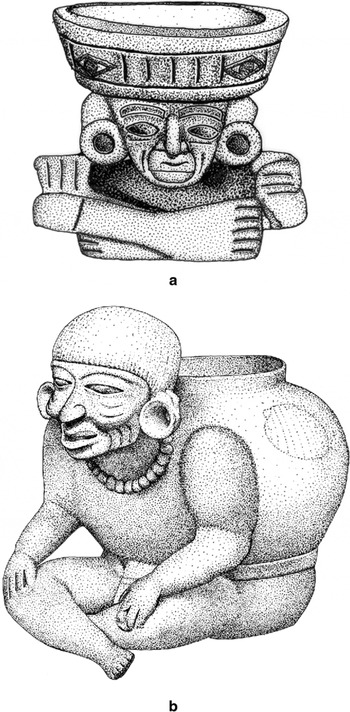
Examples of the Old God from Teotihuacan were primarily sculpted from stone and are larger than the Late Formative stone specimens, often measuring between 20 cm and 50 cm (Figure 7a). Ceramic effigies continued to be produced, however (Figure 7b). The Teotihuacano Old God was usually depicted sitting cross-legged with his arms resting on his thighs and his hands on his knees. In the examples made of stone, his left fist is clenched while his right remains open, with palm facing up. In the ceramic vessel illustrated in Figure 7b, his hands rest on his knees. Although it depicts a younger individual, an almost identical piece excavated from Kaminaljuyu is on display at the Museo Nacional de Arqueología in Guatemala City. The receptacles of both effigy vessels were incised with representations of shells, which were elements of dress associated with Xiuhtecuhtli-Huehueteotl by the Aztec (Sahagún Reference Sahagún, Anderson and Dibble1970:30).
Teotihuacano Old God vessels: (a) stone brazier in Natural History Museum of Los Angeles County (based on Berrin and Pasztory Reference Berrin and Pasztory1993:175); (b) Thin Orange vessel from the National Museum of the American Indian, Smithsonian Institution (based on Berrin and Pasztory Reference Berrin and Pasztory1993:88).

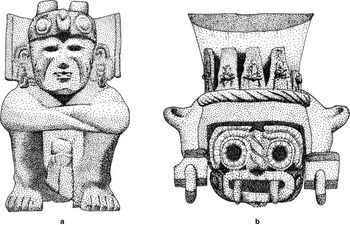
The Teotihuacano and Aztec Old/Fire Gods were conceptualized as an old man, a precedent that exists in certain Formative examples. While there is nothing on the La Laguna, Ticoman, or Xalapazco examples to identify their age or gender, the other examples have discernible wrinkles on their faces and appear male. The advanced age of the Copilco figure is denoted by his few remaining teeth, a representation that is continued at Teotihuacan and in Aztec Xiuhtecuhtli-Huehueteotl stone statues found at the Templo Mayor (Figure 8a), which, unlike their Formative predecessors, were clearly part of public ritual practices (López Luján Reference López Luján1989, Reference López Luján1994, Reference López Luján, Bray and Manzanilla1999, Reference López Austin and López Luján2001; Matos Moctezuma Reference Matos Moctezuma2002).
Aztec effigies of the Old God of Fire and Storm God: (a) Xiuhtecuhtli-Huehueteotl sculpture from Templo Mayor offering in Stage IVb, ca. a.d. 1469 (based on photograph by Leonardo López Luján); (b) Tlaloc pot from Templo Mayor Offering 56 (based on Solis and Leyenaar Reference Solis and Leyenaar2002:197, Figure 142).

Ear spools adorn the Teotihuacano depictions of the Old God, and the ceramic example illustrated in Figure 7b also wears a bead necklace. The simplicity of his adornments contrasts sharply with most depictions of deities in Teotihuacan art, who usually wear elaborate regalia that include feathered headdresses and intricate textiles. A conscientious effort may have been made by Teotihuacano artisans to retain subtle references to the social rank of the Old God, employing the posture and simple ornamentation of the Formative period without elaborating on them much further. As Esther Pasztory (Reference Pasztory1997:165) has suggested, the Old God may have been conceptualized as mortal, or more mortal, than other deities at Teotihuacan. Alternatively, the simple ornamentation may support her interpretation of the effigy vessels as purposeful efforts to maintain continuity in popular ritual (Pasztory Reference Pasztory and Berlo1992:297, Reference Pasztory1997:162–166). George Cowgill (Reference Cowgill1997:141) has convincingly argued that any continuity in the deity at Teotihuacan seems more likely to have been perpetuated within the domestic sphere, without significant involvement of state leaders.
Of the depictions of the Formative Old God, the two from Cuicuilco clearly wear ear spools, but the others do not appear to. The brazier from Tlalancaleca and the stone examples have unnaturally large ears that could represent adornments, but none are perforated. The figure from Copilco clearly does not wear ear spools. Nevertheless, the stylistic continuity between Formative- and Classic-period vessel form and figure posture is strong, and trends in depicting age and social rank at Cuicuilco were transferred directly to Teotihuacano artistic canons.
In addition to the stylistic continuities in the Old God of Fire from the Formative period to the Classic period, indicating continuities in his conceptualization, there is further continuity in how he formed part of central Mexican religious practices, serving as an effigy incense burner in domestic rituals (Cowgill Reference Cowgill, Elena and Gallut2002; Manzanilla Reference Manzanilla and Plunket2002; Sanders Reference Sanders1994:42–49). I contend that the second form of continuity is as meaningful, or more, to investigations of the origins of central Mexican religion than the first. The Old God developed his Classic-period associations with the hearth and household through religious practices involving burning materials, likely incense, in the brazier on his head or back. While pan-Mesoamerican conceptualizations of an anthropomorphized fire deity may have been represented in different media by earlier cultures (Taube Reference Taube2004:98, 102–104), central Mexican societies formalized a particular conceptualization and set of practices related to a distinctly central Mexican Old God of Fire, beginning as early as circa 600 b.c. His prevalence on braziers in domestic contexts at sites along the settlement spectrum demonstrates increasing regional integration in the ideology and ritual activities associated with him on the part of Middle to Terminal Formative central Mexican communities.
The Storm God
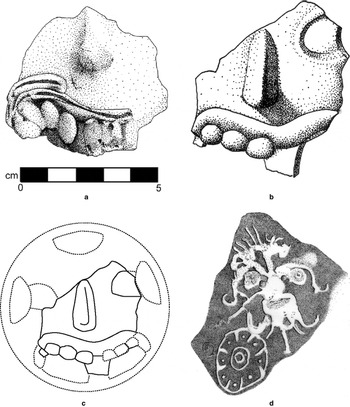
Figure 9a depicts the proposed Storm God effigy from La Laguna. The fragment was recovered from a domestic context on the periphery of the site, labeled excavation Area F on Figure 3. It was within an anthropogenic stratum directly above the mouth of a bell-shaped pit excavated into tepetate. The pit feature dates to the earliest occupation surface of the site (ca. 600–400 b.c.). Three smaller fragments with the noses and mouths of similar pieces were recovered from other Formative contexts in both excavation Areas F and I. I interpret the Area F house platform that the Figure 9a artifact was deposited beside as a lower-status residence, based on its positioning near the periphery of the community and the lower incidence of nonlocal materials and fine personal ornaments in its associated assemblages.
Formative-period depictions of the Storm God: (a) censer-lid or mask fragment from La Laguna excavation Area F; (b–c) almost identical censer-lid or mask fragment from Ticoman and Vaillant's extrapolation for its complete form (based on Vaillant Reference Vaillant1931:393, Plate LXXIX e–f); (d) petroglyph on monolith from Tlalancaleca (based on García Cook Reference García Cook and Sabloff1981:Figure 8–12).

The distinctive features of the face are a mustache-like upper lip and a mouth that curls up at the corners and is full of sharp teeth, both with remnants of black paint. These attributes are commonly cited as attributes of the Storm God (Miller and Taube Reference Miller and Taube1993:162, 166; Pasztory Reference Pasztory1974:3; von Winning Reference von Winning and Nicholson1976:150). The iconic goggles often associated with the central Mexican Storm God were, in fact, depicted on a number of other personages at Teotihuacan. More important, the ceramic effigy vessels depicting the Storm God at Teotihuacan (called “Tlaloc” pots) usually do not wear goggles, making this attribute nonessential for his identification.
The Storm God appeared on a much more diverse set of material media than the Old God during the Formative and Classic periods (see Taube Reference Taube and Guthrie1995 for an overview that includes regions outside of central Mexico). Most relevant to this discussion are the effigy vessels depicting his toothy grin or snarl. An almost identical piece to the one discovered at La Laguna was documented at Ticoman by Vaillant (Figure 9b). Vaillant (Reference Vaillant1931:393, Plates LXVIII, LXXIXe–f) identified the vessel fragment as an effigy of the Storm God and interpreted it as part of a censer lid based on its being concave, possessing regularly spaced holes that may have served as vents, and evidence of burning in its interior. His extrapolation for the form of a completed piece is depicted in Figure 9c. The excavation context at the base of a late wall in a residential area led Vaillant (Reference Vaillant1931:371) to date the piece to later in the Ticoman sequence.
The stylistic similarity between the La Laguna and Ticoman fragments is remarkable, with only subtle differences in the La Laguna example, including its incised upper lip and sharper teeth. The similarities are indicative of a strong shared conceptualization of this form of Storm God effigy in central Mexico during the Late to Terminal Formative periods. Unified norms regarding appropriate domestic ritual practices involving the effigies are likely to have existed, as well. Such practices may have involved burning, as Vaillant proposed; however, it would be desirable to have a larger sample that includes more complete specimens to verify the idea. Alternative possibilities for their usage include serving as decorations on water jars or as ritual masks. As masks, such pieces would not cover a person's face, but they are consistent with the size of ceramic masks that Kent Flannery (Reference Flannery and Flannery1976) interpreted as functioning in inter-household or sodality rituals in Formative-period Oaxaca. They would also relate to conceptualizations of Mesoamerican and Southwestern rain deities as masked beings, as is suggested by Polly Schaafsma and Karl Taube (Reference Schaafsma, Taube and Quilter2006).
Storm God effigy braziers were part of Classic-period material culture, including a Teotihuacan-style example from a Metepec-phase context at Xochitecatl (Dumond Reference Dumond, Cook, Carrión, Escandón, Spranz, Dumond and Hilbert1997 [1978]:Figure 28). Nevertheless, effigy vessels intended to hold water played a more central role in Teotihuacano religion. Water would more likely be the basic element most closely associated with the Storm God, rather than fire, the basic element associated with the Old God (López Luján Reference López Luján, Bray and Manzanilla1999). Pre-Hispanic central Mexican art often communicated multiple meanings simultaneously, however, and deities were not conceptualized as single fundamental elements (López Austin Reference López Austin1983). It is possible that the Formative-period Storm God was also associated with fire through lightning, as was the case at Teotihuacan and as was true of other Mesoamerican civilizations (Marcus Reference Marcus, Flannery and Marcus1983; Taube Reference Taube1986, Reference Taube1988:115), and/or through the rain-bringing smoke emanating from the cigars of his cave-dwelling attendants, as the Aztec believed of the Tlaloque (Klein Reference Klein1980:174).
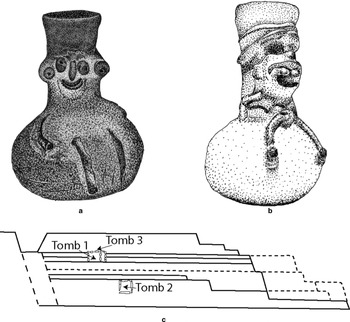
Direct predecessors of the Classic-period Storm God effigy pots were discovered at Tlapacoya (Barba de Piña Chán Reference Barba de Piña Chán1956, Reference Barba de Piña Chán, Montes and Zúñiga2002). Five polished black jars with elongated vertical necks, called botellones in central Mexico, were recovered in the three rock-lined burial offerings within Mound 1, the main temple platform of the site. Barba de Piña Chán (Reference Barba de Piña Chán1956:Plates 15, 18, Photographs 4, 17, Reference Solis and Leyenaar2002:38; Piña Chán Reference Piña Chán, Ekholm and Bernal1971:Figure 10a) designated the jars from Tombs 1 and 3 as Late Formative-period forerunners of Tlaloc, or the Tlaloque, but was rightly more cautious with the jars from Tomb 2. All three pieces were intended to hold liquid, probably water, and they all have the head of the figure attached to the elongated neck of the vessel, with the torso rendered following the contours of the globular body. However, while the examples from Tombs 1 and 3 have exaggerated mouths—one also bearing sharp teeth (Figure 10b)—the examples from Tomb 2 possess fully human attributes (see also Ochoa Castillo and Orueta Reference Ochoa Castillo and Orueta1994:236, 264–267).
Formative-period effigy vessels and Mound 1 at Tlapacoya: (a) earlier effigy form similar to those from Tlalilco and Tomb 2 in Tlapacoya's Mound 1 (based on Serra Puche Reference Serra Puche1993:32); (b) later, Storm God, effigy form from Tomb 3 in Tlapacoya's Mound 1 (based on Piña Chán Reference Piña Chán, Ekholm and Bernal1971:Figure 10a); (c) Mound 1 at Tlapacoya, showing construction phases and Tombs 1–3 (based on Barba de Piña Chán Reference Barba de Piña Chán1956:Map 8).

A precedent for polished-black anthropomorphic effigy jars without exaggerated mouths or sharp teeth exists at Tlatilco (Piña Chán Reference Piña Chán1958; Serra Puche Reference Serra Puche1993:32). The general continuity in vessel type and form is strongly suggestive of an evolution of the identifiable Storm God pots from anthropomorphic effigies lacking the distinguishing facial characteristics of the later deity (Figure 10a). The most compelling line of evidence regarding continuity, however, is their deposition as part of the dedicatory offering complexes within the nucleus of Mound 1 at Tlapacoya. Whereas Tomb 2, containing the anthropomorphic jar, was made to consecrate the earliest construction phase of the monument, Tombs 1 and 3, containing the discernible early Storm God pots, consecrated the later construction phase (Figure 10c; Barba de Piña Chán Reference Barba de Piña Chán1956:78–80, Map 8, Reference Solis and Leyenaar2002:33). At Tlapacoya, then, the identifiable central Mexican Storm God was, or the precursors of the Tlaloque were, substituted in a social context of nearly identical ritual practices involving an anthropomorphic effigy vessel lacking the diagnostic mouth attributes, deposited to consecrate an earlier phase of the same ritual structure.
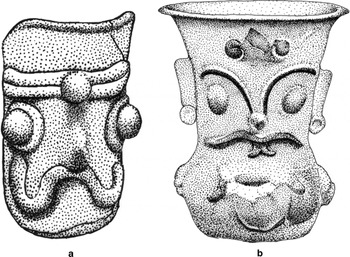
Sonia Bracamones Quintana (Reference Bracamones Quintana2002) has assembled an extensive treatment of 98 Teotihuacan Storm God pots. She demonstrates that four to six variants of the vessel form served a central role in rituals at multiple levels of the Teotihuacano social hierarchy, including in the dedicatory offerings commissioned by state leaders in the major temples of the city and as domestic burial offerings for non-elites living in the apartment compounds surrounding the ceremonial core (see also Cowgill Reference Cowgill, Elena and Gallut2002; Manzanilla Reference Manzanilla and Plunket2002). Storm God pots were also deposited in smaller temple complexes (Cook de Leonard Reference Cook de Leonard, Ekholm and Bernal1971:191). The earliest complete example yet recovered from Teotihuacan was deposited in the Sun Pyramid during the Tzacualli phase (Millon and Drewitt Reference Millon and Drewitt1961:Figure 5). This example possesses an up-curving mouth with no visible teeth and bulbous eyes (Figure 11a). Examples from the Miccaotli phase onward continue with bulbous, or disc, eyes but also usually depict teeth (Figure 11b). Relatively few examples of Storm God pots from Teotihuacan show any features that could be construed as goggles (Bracamontes Quintana Reference Solis and Leyenaar2002:104).
Teotihuacano Storm God vessels: (a) from Sun Pyramid (based on Berrin and Pasztory Reference Berrin and Pasztory1993:241, Figure 117); (b) in site museum (based on Matos Moctezuma Reference Matos Moctezuma1995:118).

Although Teotihuacano Storm God effigy vessels were used in domestic rituals, the deity was unmistakably connected to the state religious system and public rituals (Manzanilla Reference Manzanilla1996, Reference Manzanilla and Plunket2002). The Storm God was iconic of the Teotihuacan polity in the Classic-period Maya Lowlands (Fash and Fash Reference Fash, Fash, Carrasco, Jones and Sessions2000), and Tlaloc pots were central to Aztec dedicatory rituals at the Templo Mayor (Figure 8b; López Luján Reference López Luján1994, Reference López Luján and Aranda1997, Reference López Luján, Bray and Manzanilla1999). Unlike the Old God of Fire, the Storm God apparently was important in the public sphere of central Mexican polities prior to Teotihuacan, as well. The dedicatory offerings within Mound 1 at Tlapacoya, discussed earlier, are clear predecessors to similar ritual practices undertaken within the pyramids of Teotihuacan and at the Aztec Templo Mayor, all of them involving Storm God effigy vessels. In addition, García Cook (Reference García Cook and Sabloff1981:252–254, Figure 8-12) illustrated a Storm God petroglyph, featuring sharp teeth and large disc eyes, on a monolith at Tlalancaleca associated with talud-tablero temples dating from the late Texoloc phase (Figure 9c) (see also García Moll Reference García Moll1976). The talud-tablero architectural style also became iconic of Teotihuacan but has well-documented roots in Late Formative Puebla-Tlaxcala (see also Plunket and Uruñuela Reference Plunket, Uruñuela, Elena and Galliut2002a, Reference Plunket and Uruñuela2005). Public water rituals were prevalent in central Mexico during the Late Formative period (Barba de Piña Chán Reference Barba de Piña Chán, Montes and Zúñiga2002; Manzanilla Reference Manzanilla, Carrasco, Jones and Sessions2000:92–95), and it is likely that the conceptualizations of the Storm God by the inhabitants of the region involved, and were shaped by, rituals in both the domestic and public spheres.
DISCUSSION
The origin and evolution of the central Mexican Old God of Fire and Storm God illustrate how ritual practices shape religious beliefs in ways that generate change or perpetuate continuity in how individuals conceptualize their relationships with divine forces. Among the categories of ritual action outlined by Bell, the Formative-period effigy vessels depicting the Old God and Storm God appear to best conform with having been manipulated in rites of exchange and communion (Bell Reference Bell1997:108–114). Such ritual practices entail actions that “praise, please, and placate divine power, or they may involve an explicit exchange by which human beings provide sustenance to divine power in return for divine contributions to human well-being” (Bell Reference Bell1997:108). They often involve anthropomorphized depictions of the deities to enforce reciprocal obligations between practitioner and deity through the attentive care given to the effigy representation.
The archaeological contexts of Formative-period Old God of Fire effigy vessels indicate that rituals involving burning materials in their receptacles were undertaken across a large portion of central Mexico—spanning at least from the Oriental Valley to the southwestern Basin of Mexico—at large, intermediate, and small communities and by households along the socioeconomic spectrum. Such rituals would have been socially integrative, as the rapidly expanding populations of the Late Formative were increasingly united concerning the proper deities, vessels, and associated practices for domestic rituals. The confluence of form and function in Old God braziers highlights the importance of conventionality in ritual practice as a purposefully alternative form of deferential communication, intended to access alternative forms of meaning and understanding (Bloch Reference Bloch2005). The formal Old God brazier conventions supplanted earlier variants, such as the zoomorphic braziers of Puebla-Tlaxcala, during a period that witnessed the evolution of larger-scale social institutions and greater economic interconnectivity. Unity in belief and practice concerning the Old God and the meaning of his associated ritual practices would promote solidarity by fostering sentiments of trust in increased entanglements of mutual dependence (e.g., Richerson et al. Reference Richerson, Boyd, Henrich and Hammerstein2003). This important social role appears to have changed little during the Classic period, possibly having been consciously preserved by Teotihuacanos.
In contrast, Storm God effigy vessels were manipulated in rituals at multiple scales of inclusiveness at Teotihuacan, including in both private and public settings. They were integral to burial rituals at low-status households, as well as in the sacrificial dedicatory offerings undertaken by state politico-religious leaders at the monumental temple complexes of the city's ceremonial core (Sugiyama Reference Sugiyama, Hendon and Joyce2004). It would be possible also to interpret such practices as relating to rites of exchange and communion and as being socially integrative in various respects. Nonetheless, public state rituals involving the Storm God at Teotihuacan visibly accentuated differences in social power through their practice on these elevated, monumental stages. Performed in this context, they match the criteria of political rituals as “ceremonial practices that specifically construct, display, and promote the power of political institutions” (Bell Reference Bell1997:128).
The religious systems of complex societies are composed of certain suites of ritual practices that encourage social integration and others that promote social differentiation. The co-occurrence of both categories of practices is characteristic of societies without coercive state institutions (e.g., Knight Reference Knight1986), as well as of highly centralized polities such as Teotihuacan. It is apparent that integrative and divisive practices already existed in the religious systems of central Mexican societies prior to Teotihuacan, with rituals relating to water figuring prominently in the public sphere (Manzanilla Reference Manzanilla, Carrasco, Jones and Sessions2000; Serra Puche and Palavicini Beltrán Reference Serra Puche and Beltrán1996) and rituals related to fire, including volcano altars at Tetimpa (Plunket and Uruñuela Reference Plunket, Uruñuela and Plunket2002b), figuring more prominently in the domestic sphere. Although the more public or private associations with these elements is not as evident among the Aztec—who practiced the very public New Fire ceremony and made both Xiuhtecuhtli-Huehueteotl and Tlaloc central to Templo Mayor dedicatory offerings—their duality and complementarity was elaborated in public expressions of cosmology (López Luján Reference López Luján, Bray and Manzanilla1999).
The central Mexican Storm God was given his identifiable Classic-period form within a Formative-period context of ceramic effigies used in household rituals, as well as in dedicatory offerings that consecrated major public ritual structures and as freestanding art displayed in public ritual spaces. Formative-period veneration of the Storm God would have encouraged solidarity in certain practices, but it also would have provided an arena within which social power was contested, with practitioners potentially drawing from conceptualizations first developed in the domestic sphere to advance political agendas in the public sphere (cf. Lucero Reference Lucero2003). Within the context of these social practices, political aspirants could espouse collective and differentiating ideologies simultaneously.
CONCLUSION
In assembling examples of Formative-period effigy vessels from central Mexico, this study has demonstrated that earlier articulations of the Classic-period Old God of Fire and Storm God were ritually manipulated in domestic contexts spanning a large geographic area by individuals representing households of differing social statuses. As a community of religious practice, the inhabitants of the Basin of Mexico and the Puebla-Tlaxcala region became progressively more integrated during this period (ca. 600 b.c.–a.d. 100). The origins of these members of the central Mexican pantheon lie within a social milieu of accelerating integration and differentiation. Formative ritual practices involving the Old God played a socially integrative role; those involving the Storm God were more varied, occupying both the domestic and public spheres. These trends continued in Classic-period Teotihuacan, when central Mexico was largely unified politically. Teotihuacano religion was a dynamic system that transformed significantly over seven centuries, yet certain fundamental elements of that system originated in the centuries preceding the foundation of the city and developed through more incremental processes while others were deliberately chosen by individuals to reinforce continuities with the past. The deities remained central to the Aztec pantheon, where they represented an essential dualism in the order of the world.
Acknowledgments
I thank the Foundation for the Advancement for Mesoamerican Studies, Inc. (FAMSI), for supporting Proyecto Arqueológico La Laguna excavations in 2005 and the Consejo de Arqueología of the Instituto Nacional de Antropología e Historia, México, for authorizing them. Aleksander Borejsza, Jennifer Carballo, Cecelia Klein, Richard Lesure, and Leonardo López Luján graciously read earlier versions of the manuscript and provided insightful comments to strengthen it. I also thank John Clark, Karl Taube, and an anonymous reviewer for their input. Any inaccuracies in interpretation remain my own. Jennifer Salazar's skilled hand inked the artifact illustrations. López Luján kindly provided the photograph used for the illustration in Figure 9c. I am grateful to the De Haro González family for their immense hospitality at La Laguna.