Introduction
Social isolation is a social and public health problem that affects people of all ages, especially older adults in industrialised countries (Dickens et al. Reference Dickens, Richards, Greaves and Campbell2011; Findlay Reference Findlay2003; Social Care Institute for Excellence 2012). Older people are more vulnerable to problems of social isolation compared to younger cohorts because of their limited mobility, decreasing social networks due to death of their partner(s) and peers, and changes in their social roles due to retirement and loss of income (Social Care Institute for Excellence 2012; Wilson and Moulton Reference Wilson and Moulton2010).
Previous research has identified an association between social isolation, loneliness and health (Cacioppo et al. Reference Cacioppo, Ernst, Burleson, McClintock, Malarkey, Hawkley, Kowalewski, Paulsen, Hobson, Hugdahl, Spiegel and Berntson2000, Reference Cacioppo, Hawkley, Crawford, Ernst, Burleson and Kowalewski2002; Caspi et al. Reference Caspi, Harrington, Moffitt, Milne and Poulton2006; Victor, Burholt and Martin Reference Victor, Burholt and Martin2012), social isolation and poor physical health (Cornwell and Waite Reference Cornwell and Waite2009; Victor, Burholt and Martin Reference Victor, Burholt and Martin2012), disease (Cacioppo, Hawkley and Thisted Reference Cacioppo, Hawkley and Thisted2010; Hawkley et al. Reference Hawkley, Masi, Berry and Cacioppo2006), poor quality of life (Hawton et al. Reference Hawton, Green, Dickens, Richards, Taylor, Edwards, Greaves and Campbell2010), increased blood pressure (Hawkley et al. Reference Hawkley, Thisted, Masi and Cacioppo2010), high mortality (Holt-Lunstad, Smith and Layton Reference Holt-Lunstad, Smith and Layton2010; Shankar, McMunn and Banks Reference Shankar, McMunn and Banks2011), depression (Cacioppo et al. Reference Cacioppo, Hughes, Waite, Hawkley and Thisted2006) and suicidal thought (Goldsmith et al. Reference Goldsmith, Pellmar, Kleinman and Bunney2002). By contrast, social interaction is associated with lower mortality (Suzman Reference Suzman2009), and better health and wellbeing (Berkman et al. Reference Berkman, Glass, Brissette and Seeman2000; Victor et al. Reference Victor, Scambler, Bond and Bowling2000). Further, several meta-analysis and systematic reviews in recent years show the severity and urgency of the issues (Cattan et al. Reference Cattan, White, Bond and Learmouth2005; Dickens et al. Reference Dickens, Richards, Greaves and Campbell2011; Masi et al. Reference Masi, Chen, Hawkley and Cacioppo2010). However, the majority of research has focused on only a single factor of social isolation in one population, younger Whites in particular. Moreover, the association of single or multiple factors of social isolation on minority older populations is not known.
This study examines the relationships between social isolation and health outcomes in Black, White and Hispanic older men and women. This relationship is a critical topic because it addresses how various factors of social isolation may impact elders’ health differently in relation to their race and ethnicity. As the growing ageing population becomes more diverse globally, it is important from both a policy and practice perspective to understand how social isolation impacts not only older Whites, but also older minorities (Cattan et al. Reference Cattan, White, Bond and Learmouth2005; Cohen Reference Cohen2004; Hogan, Linden and Najarian Reference Hogan, Linden and Najarian2002).
Literature review
Social isolation is an objective measure that is highly associated with the subjective concept of loneliness (Victor et al. Reference Victor, Scambler, Bond and Bowling2000) and defined as a deprivation of social contacts (Biordi and Nicholson Reference Biordi, Nicholson, Larsen and Lubkin2008), whereas loneliness is people's subjective feelings of isolation (Andersson Reference Andersson1998) and disconnectedness (Hawkley et al. Reference Hawkley, Masi, Berry and Cacioppo2006). However, researchers often use the terms social isolation and loneliness interchangeably (Cattan et al. Reference Cattan, White, Bond and Learmouth2005; Dickens et al. Reference Dickens, Richards, Greaves and Campbell2011). A large body of empirical research has indicated a strong negative association between social isolation and loneliness and physical and mental health of people of all ages, and identified social isolation as a risk factor for health problems (Caspi et al. Reference Caspi, Harrington, Moffitt, Milne and Poulton2006; Victor, Burholt and Martin Reference Victor, Burholt and Martin2012). Conversely, other studies have found that positive human relations and social interaction are predictors of good health, longevity, lower mortality, cognitive functioning, and delayed onset of cognitive impairment and dementia (Suzman Reference Suzman2009). In terms of physical health, Caspi et al. (Reference Caspi, Harrington, Moffitt, Milne and Poulton2006) tested the cumulative effects of social isolation among 810 young adults (26 years old) who were ‘lonely’ in their childhood through young adulthood. The results showed strong evidence linking childhood social isolation to poor adult health (e.g. coronary artery diseases with cardiovascular risk factors), which was independent of other well-established childhood risk factors for poor adult health.
Strong associations have been identified among social isolation and loneliness with emotional and cognitive outcomes as well. The three-year longitudinal population-based study of Cacioppo et al. (Reference Cacioppo, Hughes, Waite, Hawkley and Thisted2006) of 50–67-years-olds in the United States of America (USA) revealed a strong and apparently reciprocal association between loneliness and depressive symptoms, after controlling for demographic variables. Moreover, social isolation and loneliness, especially among older adults, are shown to be associated with high suicide risks (Goldsmith et al. Reference Goldsmith, Pellmar, Kleinman and Bunney2002). Impaired cognitive performance and cognitive decline are found to be accelerated over time by loneliness among older people. For example, a study by Gow et al. (Reference Gow, Pattie, Whiteman, Whalley and Deary2007) in the United Kingdom (UK) assessed the mental ability of 87,500 11-year-old children. Approximately 500 people at the age of 79 were recruited from this sample of 87,500 individuals and tested again on their cognitive ageing, social, psychological and physical factors. Individuals who reported higher initial loneliness had poorer cognitive function at age 79. Another example of a ten-year longitudinal study in Finland by Tilvis et al. (Reference Tilvis, Kahonen-Vare, Jolkkonen, Valvanne, Pitkala and Standberg2004) compared the effects of magnitude of loneliness among the Finish old-old (75–85-year-olds) on their cognitive functioning. They found that the cognitive level of those with higher risk of social isolation decreased more than that of older people who were less at risk of social isolation. In the four-year follow-up study of Wilson et al. (Reference Wilson, Krueger, Arnold, Schneider, Kelly, Barnes, Tang and Bennett2007) in the USA, older people with high risk of loneliness showed a faster decline in their cognitive performance than older people with low risk of loneliness. Moreover, older people who were in the top deciles of loneliness scores were 2.1 times more likely to develop Alzheimer's disease compared to those in the bottom deciles.
In terms of loneliness only, a few studies have shown variations of levels of loneliness across populations in varied age groups in different countries. For example, Rokach et al. (Reference Rokach, Orzeck, Cripps, Lacković-Grgin and Penezić2001) examined Croatian and Canadian adults, while the studies of Rokach and Bauer (Reference Rokach and Bauer2004) and Rokach, Bauer and Orzech (Reference Rokach, Bauer and Orzech2003) were based on Czech and Canadian adults and youth, respectively. Rokach, Orzeck and Neto (Reference Rokach, Orzeck and Neto2004) compared Portuguese and Canadian older adults while Fokkema, de Jong Gierveld and Dykstra (Reference Fokkema, de Jong Gierveld and Dykstra2012) and Yang and Victor (Reference Yang and Victor2011) studied older adults from 14 and 25 European nations, respectively. Across these studies, cultural background by ethnic groups affected the experience of loneliness. Other researchers have focused on immigrant adults and elders: Indian elder immigrant women in Canada (Choudhry Reference Choudhry2001), Korean older immigrant women in the USA (Kim Reference Kim1999; Lee Reference Lee2007), Caribbean immigrant adults in the USA (Livingstone et al. Reference Livingstone, Neita, Rivere and Livingstone2007), Jewish immigrant adults in Israel (Ponizovsky and Ritsner Reference Ponizovsky and Ritsner2004), Turkish older immigrants in Germany (Fokkema and Naderi Reference Fokkema and Naderi2013), and adult and older immigrants from various countries to the USA and UK, respectively (Treas and Mazumdar Reference Treas and Mazumdar2002; Victor, Burholt and Martin Reference Victor, Burholt and Martin2012). Regardless of the race/ethnicity of migrant groups, immigrants, especially older immigrants, have demonstrated higher levels of loneliness compared to the general population of the host countries. It appears that growing old in a foreign land made migrant populations more vulnerable to loneliness because of different cultural norms and values from their home countries, limited social network size and relationships, and for some, experiences of discrimination and racism (Victor, Burholt and Martin Reference Victor, Burholt and Martin2012).
Research specifically on social isolation only, however, has been very limited, and only a few studies have examined racial and ethnic differences. Tomaka, Thompson and Palacios (Reference Tomaka, Thompson and Palacios2006) analysed the relationships among social isolation and loneliness with health outcomes in a randomly selected sample of 755 older adults in New Mexico in the USA (ages between 60 and 92) and compared similarities and differences of White (N=543) and Hispanic elders (N=174). The Hispanic sample, compared with the White sample, experienced more negative effects of perceived social isolation on their disease outcomes. In the study of Locher et al. (Reference Locher, Ritchie, Roth, Baker, Bodner and Allman2005) of social isolation and nutrition risk in Black and White men and women (65+ years) in the USA, limited independent life-space due to mobility challenges (as a social isolation indicator) was found to be a nutrition risk factor. Another social isolation indicator – not having transportation – was also associated with higher nutritional risk among Black women and White men. Although the study's sample size was large (N=1,000), the sample was regionally restricted to five Alabama counties in the USA; therefore, generalisability is problematic.
One of the most influential studies of social isolation only, conducted by Cornwell and Waite (Reference Cornwell and Waite2009), combined multiple commonly used social isolation indicators and created two scales: perceived isolation (e.g. feelings of lack of companionship, left out) and social disconnectedness (e.g. network size, number of friends and frequency of socialisation). Using a nationally representative sample of community-residing older adults in the USA, they tested the relationships between these two dimensions of social isolation and older adults’ health, and found distinct but independent associations. However, their study failed to examine any similarities and differences across racial and ethnic groups. Previous research conducted globally has found that different associations between ‘loneliness’ and health have indeed existed across racial and ethnic groups of older people. Given the similarities of concept of loneliness and social isolation and building on Cornwell and Waite's work, this study aimed to explore the following research questions: what are the associated patterns of dimensions of social isolation on health? (RQ1); what are the associated patterns of dimensions of social isolation on health for racial and ethnic groups of older adults separately? (RQ2); and do the overall associated patterns of social isolation on health differ across racial and ethnic groups of older adults? (RQ3).
Methods
Data-set and respondents
This study is a descriptive, correlational design based on the data drawn from the 2005–06 first wave of the longitudinal study of the National Social Life, Health and Aging Project (NSHAP). The NSHAP is a population-based study in the USA and consists of a nationally representative sample of 3,005 community-dwelling adults (1,455 male; 1,550 female) aged from 57 to 85. The sample was selected from a multi-stage, stratified area probability design, building on the sample of the 2004 Health and Retirement Study (HRS) conducted in the USA. The HRS over-sampled by gender and race and ethnicity (i.e. men and Blacks and Hispanics) (Shiovitz-Ezra and Leitsch Reference Shiovitz-Ezra and Leitsch2010), and the NSHAP retained the same design, adding an over-sample by age (O'Muircheartaigh, Eckman and Smith Reference O'Muircheartaigh, Eckman and Smith2009). Thus, the selection of NSHAP study participants is well balanced across age and gender, with over-sampled sizes of African American and Hispanics (O'Muircheartaigh, Eckman and Smith Reference O'Muircheartaigh, Eckman and Smith2009). In addition, to avoid threatening ‘the basis of inference from the collected survey data to the population’, an adjustment to the weights was made to account for non-response (O'Muircheartaigh, Eckman and Smith Reference O'Muircheartaigh, Eckman and Smith2009: i17). The overall sample of the NSHAP is 70 per cent White. Due to the small sizes of sub-groups such as Asian/Pacific Islanders and American Indian/Alaska Natives, 82 samples were excluded; thus, the present study focused on non-Hispanic Blacks, non-Hispanic Whites and Hispanics only. The final unweighted sample sizes are 2,110 Whites, 509 Blacks and 304 Hispanics.
The NSHAP data-set consists of: (a) an in-person questionnaire; (b) biomeasure collection; and (c) a supplemental self-administered questionnaire. Topics of the two-hour face-to-face interview questionnaire included: (a) demographic characteristics; (b) social networks; (c) social and cultural activity; (d) physical and mental health including cognition; (e) wellbeing; (f) illness; (g) medications and alternative therapies; (h) history of partnerships; and (i) patient–physician communication. At the end of the in-person interview, respondents were given a supplemental questionnaire asking about their social relationships, activities, care-giving, attitudes, life experiences and health. In-person interviews and the leave-behind questionnaires to be mailed in were conducted during 2005 and 2006, and their response rates were 75.5 and 84.0 per cent, respectively.
Measures
This study uses the same measures and constructs of Cornwell and Waite (Reference Cornwell and Waite2009), except for the race and ethnicity variables. Demographic measures for this study include age groups (6=57–64; 7=65–74; 8=75–85), gender (1=male), marital status (1=married or partnered), education (1=attended college), and race and ethnicity (1=White; 2=Black; 3=Hispanic).
Replicating Cornwell and Waite's study, social isolation is comprised of two dimensions: perceived isolation and social disconnectedness. The nine-item perceived isolation scale assesses respondents’ feelings of loneliness (eigenvalue=2.02) and lack of perceived social support (eigenvalue=1.20), accounting for approximately 46 per cent of the variance (Cornwell and Waite Reference Cornwell and Waite2009). Loneliness is measured by the frequency of feelings of (a) a lack of companionship; (b) being left out; and (c) being isolated from others (1=never, 2=sometimes, 3=often). Perceived social support is measured by the frequency of ‘opening up to your’ (a) family members, (b) friends, (c) spouse/partner; and the frequency of ‘relying on your’ (d) family member, (e) friends, (f) spouse/partner (1=often, 2=sometimes, 3=never). Each perceived isolation item is standardised (mean=0, standard deviation (SD)=1) which allows negative values. After taking average scores, a possible range of values was between −0.98 and 3.59 and its weighted mean and SD were 0.02 and 0.59, respectively. The scale has acceptable internal consistency (Cronbach's alpha of 0.68).
The eight-item social disconnectedness scale assesses respondents’ social network characteristics (eigenvalue=2.75), social participation (eigenvalue=1.55), accounting for 54 per cent of the variance (Cornwell and Waite Reference Cornwell and Waite2009), and number of friends. Social network is measured by (a) social network size (range 0–5, 6 or more); (b) number of social network relationship types (1=spouse/ex-spouse, 2=parent/parent-in-law, 3=child/step-child, 4=brother or sister/other relatives, 5=friend/neighbour/co-worker/minister/other); (c) proportion of social network members in the household (range 0=do not live with, 1=live with); and (d) average frequency of interaction (talk) with network members (range 0=no contact, 1=every day). Social participation is measured by the frequency of (a) attending meetings of organised group; (b) getting together socially with friends and relatives; and (c) volunteering (0=never, 1=less than once a year, 2=once or twice a year, 3=several times a year, 4=once a month, 5=every week, 6=several times a week), and the number of friends of each respondent (0=none, 1=1 friend, 2=2–3 friends, 3=4–9 friends, 4=10–20 friends, 5=20+ friends). Again, these eight items are standardised and their scores are averaged. The final scores are reversed in order to measure ‘disconnectedness’ rather than ‘connectedness’. The possible scores ranged from 0 to 6, and the observed range was from −1.14 to 2.16, with weighted mean=0.005 and SD=0.44. The internal consistency of this scale shows a Cronbach's alpha of 0.62. Higher scores of both scales mean that respondents experience more perceived isolation or social disconnectedness.
Health is measured by respondents’ self-reported physical and mental health conditions. A single question each was asked for physical and mental health: ‘Would you say your health is excellent, very good, good, fair or poor?’ for physical health; and ‘What about your emotional or mental health? Is it excellent, very good, good, fair or poor?’ for mental health. They each are rated by the five-point health conditions (1=poor, 2=fair, 3=good, 4=very good, 5=excellent). These measures have been widely used in population-based research and are known to be reliable across age, gender, and racial and ethnic groups (Chandola and Jenkinson Reference Chandola and Jenkinson2000; Finch et al. Reference Finch, Hummer, Reindl and Vega2002). Due to small counts of certain categories such as poor (e.g. White=25; Black=20; Hispanic=7) in mental health, five categories were amalgamated to a binary variable: ‘poor/fair’ and ‘good to excellent’ categories.
Analysis
Dependent variables in this secondary data analysis are physical and mental health whereas perceived isolation and social disconnectedness are independent variables. Age groups, gender, marital status, education, and race and ethnicity are control variables and covariates in the model.
The following analyses were performed: what are the associated patterns of dimensions of social isolation on health? (RQ1); what are the associated patterns of dimensions of social isolation on health for racial and ethnic groups of older adults separately? (RQ2); and do the overall associated patterns of social isolation on health differ across racial and ethnic groups of older adults? (RQ3)
• RQ1: Stepwise logistic regression analyses were first run examining all variables for the full sample for physical (Table 3) and mental health (Table 5) outcomes separately. Model 1 was carried out with race/ethnicity variables. Model 2 included socio-demographic variables (i.e. age group, gender, marital/partnered status, education attainment) and Model 3 added the variables of perceived isolation and social disconnectedness.
• RQ2: Two sets of three logistic regression analyses were run examining all variables separately by race and ethnicity for physical (Table 4) and mental health (Table 6) outcomes.
• RQ3: Two sets of logistic regressions with interaction terms (i.e. perceived isolation×race/ethnicity, social disconnectedness×race/ethnicity) were run examining all variables for physical (Table 3, Model 4) and mental health (Table 5, Model 4) outcomes.
The NSHAP sampling design requires the use of weights in the statistical analyses in order to perform unbiased estimates of the population (O'Muircheartaigh, Eckman and Smith Reference O'Muircheartaigh, Eckman and Smith2009). Therefore, a statistical program, SAS version 9.3, was used to conduct analyses. SAS's PROC SURVEY LOGISTIC procedure allows analyses of multi-level survey data with cluster, weight and stratum variables. Thus, all the results presented in this paper are weighted estimates unless stated otherwise.
Human subjects
All the original data were gathered under protocols approved by the Social and Behavioral Sciences Institutional Review Board at the University of Chicago and the National Opinion Research Center Institutional Review Board. All participants were assured confidentiality in the consent forms and by the interviewers. The NSHAP also had a Certificate of Confidentiality from the National Institute of Aging.
For this particular study, only secondary analyses were conducted on existing data from the NSHAP study and no new data were collected. However, the use of the NSHAP data-set requires approval from the Institutional Review Board due to the contextual nature of the data-set. Institutional Review Board approval from the Human Subjects Division of the researcher's affiliated university was obtained.
Results
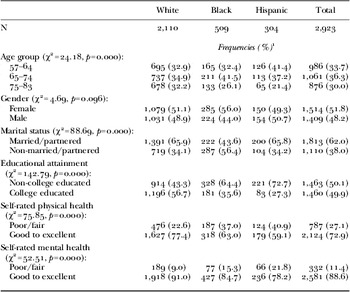
A total of 2,923 respondents (White=2110, Black=509, Hispanic=304) are included in these analyses. Sample characteristics are summarised in Table 1. Age groups among Whites are almost evenly distributed, but Blacks have more respondents in the 65–74 age group, while there are more Hispanics in the 57–64 age group. Marital/partnered status of White and Hispanic groups is identical, with almost 66 per cent belonging to the married/partnered group, while only 44 per cent of Black older adults are married/partnered. In terms of educational attainment, there are significant differences among racial and ethnic groups. Almost all White respondents (86%) have completed high school, compared to only 40 per cent of Hispanic respondents and 59 per cent of Black respondents. For self-rated physical health, there are significant differences among racial and ethnic groups (χ2 (degrees of freedom (df)=2)=75.85; p=0.000). White older adults rated their physical health the highest among these three groups, with over 77 per cent reporting good health, while 63 per cent of Black and 59 per cent of Hispanic elders report their physical health as good. With regards to mental health, a significant difference is again found across groups (χ2 (df=2)=52.51; p=0.000). Whites rate themselves the highest, with 91 per cent reporting their mental health as good. A similar trend can be seen with 85 per cent of Black older adults rating their mental health as good. Hispanic older adults appear to indicate their mental health to be the worst, with only 78 per cent rating their mental health as good.
Sample characteristics by race and ethnicity

Note: 1. Unweighted.
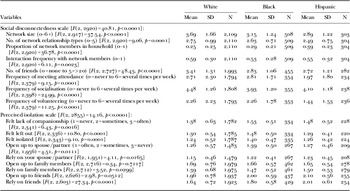
Table 2 shows the results of multivariate analysis of variance (MANOVA) tests presenting the observed summary of social disconnectedness and perceived isolation scale items across racial and ethnic groups. In terms of the social disconnectedness scale, all variables are significantly different at the p<0.05 level among Whites, Blacks and Hispanics. White older adults, compared to other counterparts, have a larger network size (Black and Hispanic, p<0.0001), number of network relationship types (Black, p=0.0357; Hispanic, p=0.0001), number of friends (Black and Hispanic, p<0.0001) and more chances of socialisation (Black, p<0.0001; Hispanic, p=0.0002). Hispanic older adults appear to attend organised meetings and volunteer significantly less compared to Whites (p<0.0001) and Blacks (p=0.0002). But Hispanics share their residence with the largest proportion of network members among the three groups (p<0.0001). There are no significant differences on frequencies of meeting attendance and volunteering between Whites and Blacks. Differences between Blacks’ and Hispanics’ network size, number of network relationship types, number of friends, frequencies of network member interaction, and socialisation are found to be non-significant.
Observed summary of social disconnectedness and perceived isolation scale items by racial/ethnic group

Note: SD: standard deviation.
For the perceived isolation scale, all items except ‘opening up to’ family members and friends have significant differences at the p<0.05 level across these three groups. White elders tend to rely on their spouse/partner and friends more than their Black (p=0.00337 and p=0.0004, respectively) and Hispanic (p=0.0360 and p<0.0001, respectively) counterparts. Blacks appear to feel lack of companionship more than Whites (p=0.0015), and left out and isolated more than Whites (p<0.0001) and Hispanics (p=0.0008 and p=0.0122, respectively). Blacks do not seem to be open to their spouse/partners as much as their White (p=0.0027) and Hispanic (p=0.0455) counterparts. There are no significant differences about feelings of lack of companionship, being left out and isolation between White and Hispanic older adults. No significant differences are found in terms of frequencies of opening up and relying on their family members among the three racial and ethnic groups.
Association of social isolation and physical health
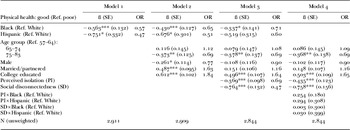
To answer RQ1 (what are the associated patterns of dimensions of social isolation on health?), logistic regressions with the full sample, including comparisons of racial and ethnic groups predicting physical health outcomes, were first run and shown in Table 3. Black and Hispanic groups were compared with White as a reference group.
Results of logistic regression of self-rated physical health on social isolation and covariates

Notes: Ref.: reference category. SE: standard error. OR: odds ratio.
Significance levels: * p<0.05, ** p<0.01, *** p<0.001 (two-tailed tests).
Model 1 represents significant associations between race/ethnicity and self-rated physical health. Black older adults are significantly less physically healthy compared to White counterparts (p<0.001) as is the case for Hispanics (p<0.05). Adding socio-demographic characteristics to the model (Model 2), racial/ethnic differences in self-rated physical health still exist for both Black (p<0.001) and Hispanic (p<0.05) groups. Being older (75–83 versus 57–64) seems to be negatively associated with physical health (p<0.01); however, being married/partnered and higher educational attainment (college educated versus non-college educated) are significantly positively associated with better physical health (p<0.001).
Model 3 considers two dimensions of social isolation – perceived isolation and social disconnectedness – together. Again, being in the older age cohort is significantly negatively associated with physical health outcomes (p<0.001), while college education is positively associated with older adults’ physical health (p<0.001), when controlling for all other variables. Gender and marital/partnered status no longer seem to have any significant association with physical health. For the outcomes of physical health across racial and ethnic groups, Black older adults are 0.71 times less likely (p<0.05) than their White counterparts to rate their physical health as good as opposed to poor, controlling for all other covariates. Ratings of physical health by Hispanic older adults are not different from those of Whites. Model 3 shows that both perceived isolation and social disconnectedness dimensions are significantly negatively associated with physical health outcomes of older adults overall (p<0.001). Older Americans who experience perceived isolation are 0.69 times less likely to rate their health as good compared to those who do not feel perceived isolation. Socially disconnected older Americans are 0.47 times less likely to consider themselves healthy compared to socially connected counterparts, controlling for all other covariates.
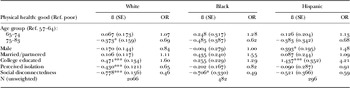
Table 4 is drawn from the results of logistic regression analyses of self-rated physical health and answers RQ2 (what are the associated patterns of dimensions of social isolation on physical health of racial and ethnic groups of older adults separately?). Among White older adults, both perceived isolation and social disconnectedness are associated with poorer health (p<0.001). White older adults who experience perceived isolation, compared to Whites who do not experience perceived isolation, are 0.65 times less likely to rate their health as good. Similarly, socially disconnected White older adults, compared to socially connected Whites, are 0.46 times less likely to consider their health good, net of all socio-demographic variables. This pattern means that the more a person is socially isolated, the less likely they are to report good health. In addition, college completion is positively associated with good physical health (p<0.001) while being in an older age group (75–83 versus 57–64) is associated with poorer physical health (p<0.05).
Results of logistic regression of self-rated physical health on social isolation and covariates by racial and ethnic group

Notes: Ref.: reference category. SE: standard error. OR: odds ratio.
Significance levels: * p<0.05, *** p<0.001 (two-tailed tests).
For Black older adults, perceived isolation does not appear to have any significant association with their physical health. However, social disconnectedness is negatively associated with their physical health (p<0.05). The odds of rating health as good are 0.5 times less likely among socially disconnected Black older adults compared to socially connected counterparts, controlling for all other covariates.
Among Hispanics, there is no significant association between either of the social isolation dimensions and physical health. However, being male and college educated has significant positive associations with good physical health outcomes. Hispanic older men compared to Hispanic older women are nearly 1.5 times more likely to rate their health as good (p<0.05). College-educated Hispanic older adults are 4.2 times more likely to rate their physical health as good compared to non-college-educated Hispanic counterparts, net of all other variables (p<0.001). Again, being married/partnered appears to have no significant relationship to the physical health outcomes of any of these three groups of older adults.
Association of social isolation and mental health
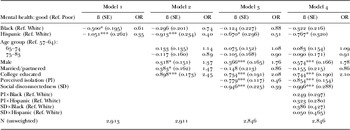
Different sets of logistic regression models on mental health were run to examine RQ1. Again, different patterns are found in terms of mental health of older White, Black and Hispanic Americans (Table 5). Similar to the case of physical health, significant negative associations are found in self-rated mental health between Whites and Blacks (p<0.05) and Hispanics (p<0.001) (Model 1). Some socio-demographic factors in Model 2, such as male gender (p<0.05), being married/partnered (p<0.05) and having higher educational attainment (p<0.001), are positively associated with better mental health. Hispanic older adults compared to White counterparts still self-rate their mental health significantly negative (p<0.001), while Black older adults no longer show any significant differences with Whites. On Model 3, which considers both dimensions of social isolation – perceived isolation and social disconnectedness – age groups as well as marital/partnered status do not seem to be related to mental health among these three groups of Americans. However, when controlling for all other variables, gender is still related to the mental health outcomes. Men, compared to women, are nearly 1.8 times more likely to rate their mental health as good as opposed to poor (p<0.001). Again, college education, net of all other variables, is significantly positively associated with mental health outcomes (p<0.001). Compared to the outcome of physical health (1.6 times), there is an even greater difference on mental health between the people with college education and those without (nearly 2.1 times). In terms of mental health outcomes across racial and ethnic groups, no significant differences are found between Blacks and Whites. However, Hispanic older adults, compared to Whites, are about 0.5 times less likely to report good mental health, net of all other variables in the model. With regard to the social isolation dimensions, both perceived isolation and social disconnectedness are significantly negatively associated with the mental health outcomes of this sample of older Americans. The odds of rating mental health as good are 0.46 times less likely among those older Americans who experience perceived isolation compared to those who do not. Socially disconnected older Americans are 0.39 times less likely to rate their mental health as good compared to socially connected older Americans in this sample.
Results of logistic regression of self-rated mental health on social isolation and covariates

Notes: Ref.: reference category. SE: standard error. OR: odds ratio.
Significance levels: * p<0.05, *** p<0.001 (two-tailed tests).
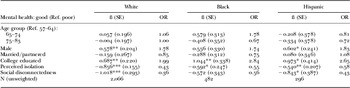
When looking at racial and ethnic groups separately (RQ2) (Table 6), male gender has a positive association with mental health among White and Hispanic older adults, controlling for all other variables, as do perceived isolation and social disconnectedness. The odds of White and Hispanic older male's self-rated mental health being good compared to poor are about 1.8 times more likely than White (p<0.01) and Hispanic (p<0.05) older females, controlling for all other covariates. With regards to college education, all three groups of college-educated older Americans show significantly higher odds of positive association with their self-rated mental health (e.g. nearly 2.0 times of White; 2.7 times of Hispanic; and 2.8 times of Black), net of all other variables.
Results of logistic regression of self-rated mental health on social isolation and covariates by racial and ethnic group

Notes: Ref.: reference category. SE: standard error. OR: odds ratio.
Significance levels: * p<0.05, ** p<0.01, *** p<0.001 (two-tailed tests).
In terms of social isolation dimensions, all three groups show a significantly negative association of perceived isolation on their mental health outcomes. As the perceived isolation unit increases, the odds of reporting self-rated mental health as good compared to poor among White older adults are 0.42 times less likely, followed by Black 0.55 times and Hispanic 0.58 times, when controlling for all other variables. Similar patterns can be found in relation to social disconnectedness. The association between social disconnectedness and self-rated mental health among Black older Americans is not significant, but is statistically significant among White (p<0.001) and Hispanic older adults (p<0.05). A one-unit increase of social disconnectedness is associated with approximately 0.36 times for Whites and 0.43 times for Hispanics lower odds of reporting their mental health as good compared to poor, controlling for all other variables.
Lastly, RQ3 (do the overall associated patterns of social isolation on health differ across racial and ethnic groups of older adults?), was examined. Two sets of logistic regressions with interaction terms were run for physical and mental health outcomes. No significant differences in any models were identified (Table 3, Model 4 for physical health; Table 5, Model 4 for mental health). Thus, the overall associated patterns were found to be similar across these three racial and ethnic groups of elder Americans. Although different patterns of the relationship between social isolation and health were found among White, Black and Hispanic older adults, net of other variables in the models, overall social isolation affects the three racial/ethnic groups similarly.
Discussion
The present study explored the associations of two dimensions of social isolation and physical and mental health of a nationally representative sample of White, Black and Hispanic older Americans. This study found negative associations between both dimensions of social isolation (i.e. perceived isolation and social disconnectedness) and health outcomes for the combined racial/ethnic group; however, different patterns of association were found across racial and ethnic groups of older Americans.
Black older adults reported worse physical health than Whites; however, there seemed to be no association between perceived isolation and their physical health, but significant association between social disconnectedness and physical health. Compared to Whites, Black older adults tend to share their residence with extended family members and non-kin. Despite these greater residential kinship ties, their network size, network range and number of friends appear to be much smaller (Table 2). This may mean that they have fewer socialising opportunities compared to Whites, and in particular have the least chance to interact with network members among the three groups (Pinquart and Sörensen Reference Pinquart and Sörensen2001). This difference may be due to their cumulative experiences of socio-economic disadvantage, discrimination (Myers and Hwang Reference Myers, Hwang, Anderson, Bulatao and Cohen2004; Victor, Burholt and Martin Reference Victor, Burholt and Martin2012) and lack of reliable transportation, all of which limit their access to resources outside extended family (Locher et al. Reference Locher, Ritchie, Roth, Baker, Bodner and Allman2005). They tend to attend organised meetings such as religious services and volunteer as often as White counterparts (Myers and Hwang Reference Myers, Hwang, Anderson, Bulatao and Cohen2004) (Table 2); however, it is possible that their social contacts may be limited to church-related activities and thus result in a smaller network size. Their shared living conditions, as well as the importance of extended kin, may leave them less time for other social contacts, and thus, could contribute to their feeling socially isolated.
In terms of mental as compared to physical health, all analyses identified patterns of negative associations across racial and ethnic groups. For Black older adults, their self-rated mental health was significantly poorer than Whites but better than Hispanics. Contrary to physical health outcomes, the perceived isolation dimension of social isolation showed a significant negative association with Blacks’ mental health. Again, despite their shared living conditions, compared to White elders, Blacks tend to feel a lack of companionship, left out and isolated (Table 2), a pattern that was also found in Peek and O'Neill's study (Reference Peek and O'Neill2001). Moreover, 56 per cent of Blacks are not married/partnered compared to 34 per cent of Whites and Hispanics (Table 1). If Black elders are sharing their residences with children and grandchildren, but have no similar age cohort such as spouses/partners with whom to share their feelings, they may feel disconnected from the larger community. Although Black older adults are open and share their concerns with their family members and friends as often as Whites, they are significantly less likely to rely on their friends (Table 2). This pattern is similar to that found by Ajrouch, Antonucci and Janevic (Reference Ajrouch, Antonucci and Janevic2001) where Black older adults compared to White counterparts tend to have more frequent contact with smaller networks and their primary sources of support appear to be limited to their family members.
Hispanic older adults, similar to Black counterparts, reported poorer physical health compared to Whites, but none of the social isolation dimensions were found to be significantly related to their physical health outcomes. This may be due to their younger age compared to Whites and Blacks in this study sample. Tomaka, Thompson and Palacios (Reference Tomaka, Thompson and Palacios2006) found that Hispanics tend to have a larger family size and to share their residence with extended family members and friends. This study sample shows a similar pattern, with Hispanic older adults more often living with their network members compared to Whites and Blacks (Table 2). This pattern suggests that they are more likely to be surrounded by other people and to have greater opportunities to connect with outside resources.
In the case of Hispanics, their self-rated mental health outcomes were significantly negative compared to Whites, and all dimensions of social isolation showed significantly negative associations with their mental health. This result is somewhat congruent with previous research that Hispanics generally are healthier than Whites, but rate their health lower than Whites (National Research Council Reference Anderson and Bulatao2004). Hispanic older adults appear to be less likely to live alone compared to White and Black counterparts, and less likely to rely on their spouse/partner and family members than Whites (Table 2). They also seem to be significantly less likely to rely on their friends compared to White and Black older adults (Table 2). Thus, similar to Blacks, their support system appears to be often limited (Tomaka, Thompson and Palacios Reference Tomaka, Thompson and Palacios2006). Studies internationally show that regardless of race and ethnicity, older migrants’ immigration status and their acculturation levels can negatively affect their mental health (Ajrouch Reference Ajrouch2005, Reference Ajrouch2007, Reference Ajrouch2008; Emami et al. Reference Emami, Torres, Lipson and Ekman2000; Fokkema and Naderi Reference Fokkema and Naderi2013; Treas and Mazumdar Reference Treas and Mazumdar2002; Vega and Lopez Reference Vega and Lopez2001; Victor, Burholt and Martin Reference Victor, Burholt and Martin2012; Yang and Victor Reference Yang and Victor2011). It may be that having to learn a new language and a new culture, living in a new location with new people and eating unfamiliar food negatively affects their physical and mental health (Fokkema and Naderi Reference Fokkema and Naderi2013; Myers and Hwang Reference Myers, Hwang, Anderson, Bulatao and Cohen2004). Even when Hispanic elders are surrounded by their kin, compared to the condition in their homeland, their social network sizes may be smaller and more attenuated (Ajrounch Reference Ajrouch2008; Fokkema and Naderi Reference Fokkema and Naderi2013; Myers and Hwang, Reference Myers, Hwang, Anderson, Bulatao and Cohen2004; Victor, Burholt and Martin Reference Victor, Burholt and Martin2012). Additionally, physical relocation has placed them into unfamiliar areas where they may not have easy access to outside resources and their native language, thereby losing some of their autonomy (Vega and Lopez Reference Vega and Lopez2001). Unfortunately, the NSHAP does not supply information on respondents’ immigration status and generation; thus, measurement and assessment of respondents’ acculturation are not possible. However, it is highly plausible that these factors may complicate the life condition of older Hispanics and negatively affect their health and level of stress (Fokkema and Naderi Reference Fokkema and Naderi2013; Myers and Hwang Reference Myers, Hwang, Anderson, Bulatao and Cohen2004; Treas and Mazumdar Reference Treas and Mazumdar2002). This factor could be important to consider when examining mental health among minority older people in future surveys.
Lastly, the situation of White older adults is noteworthy. They self-reported the best physical and mental health among these three racial and ethnic groups (Table 1). They scored highest on all socio-demographic characteristics (Table 1). Additionally, their social networks appeared to be larger and their social support systems including friends to be stronger than Blacks and Hispanics (Table 2). However, they showed significant negative associations with both dimensions of social isolation and their physical and mental health outcomes. This may be because of the differences in how they express their assessment about their life circumstances (Myers and Hwang Reference Myers, Hwang, Anderson, Bulatao and Cohen2004). Since the health survey questions were self-rated measures, differences of reporting may influence these results. Types of network relationships could be other reasons for the negative associations and health. Having a large network does not mean all the relationships are positive and beneficial. Conversely, negative social relationships, including spousal/partnered relationships, can be harmful to people's physical and mental health (Antonucci, Lansford and Akiyama Reference Antonucci, Lansford and Akiyama2001; Fuller-Iglesias, Sellars and Antonucci Reference Fuller-Iglesias, Sellars and Antonucci2008; Holt-Lunstad, Smith and Layton Reference Holt-Lunstad, Smith and Layton2010), and a major source of worries, conflicts and disappointment (Seeman Reference Seeman2000). Therefore, not only the quantity of network members, but also the quality of network relationships should be measured (Holt-Lunstad, Smith and Layton Reference Holt-Lunstad, Smith and Layton2010; Nicholson Reference Nicholson2012).
Although patterns of health outcomes differed across Black, Hispanic and White older Americans, the overall association of social isolation and health seems to be similar across these three groups, as shown by the results of the interaction terms between social isolation and race/ethnicity. In other words, the observed differences in health patterns between Black, Hispanic and White older adults cannot be attributable to differences in social isolation. This suggests that other factors not captured in this study, such as immigration status, immigration generation, acculturation levels, and types and quality of network relationships, might be contributing factors to the differences in health outcome patterns. For example, as previously mentioned, older immigrants’ feelings of isolation and loneliness, especially among first-generation older immigrants compared to not only local native residents, but also immigrants with multiple generations in the host country, are well documented (Ajrouch Reference Ajrouch2005, Reference Ajrouch2007, Reference Ajrouch2008; Choudhry Reference Choudhry2001; Emami et al. Reference Emami, Torres, Lipson and Ekman2000; Fokkema and Naderi Reference Fokkema and Naderi2013; Kim Reference Kim1999; Lee Reference Lee2007; Livingston et al. Reference Livingstone, Neita, Rivere and Livingstone2007; Ponizovsky and Ritsner Reference Ponizovsky and Ritsner2004; Treas and Mazumdar Reference Treas and Mazumdar2002; Victor, Burholt and Martin Reference Victor, Burholt and Martin2012). These studies revealed that this pattern was seen regardless of racial and ethnic groups and host countries, and appear to have negative associations with elders’ physical and mental health. Thus, isolation seems to be detrimental to the health of older adults internationally.
This study had several limitations. Because it is based on a secondary data analysis, available samples, sizes and measurements are limited. For example, the sample sizes of Asian/Pacific Islanders and American Indian/Alaska Natives are 36 and 22, respectively. Therefore, they are too small to be considered. A second limitation is the cross-sectional nature of the data. Although it is plausible to argue the direction of the results in relation to the association of social isolation and health, the positive and negative health patterns found in this study need to be interpreted with caution. Longitudinal observations may be necessary to determine how perceived isolation and social disconnectedness may relate to and influence each other, and thus, how these dimensions affect long-term consequences. For further study, additional covariates such as the number of chronic conditions, including depressive symptoms, and health insurance information could be included and controlled for in order to identify more specific associations with social isolation. Lastly, as previously mentioned, measurements such as immigration status, immigration generation and acculturation levels are completely missing in the survey.
Practice implications
Despite some study limitations, several implications for practice can be proposed. Although social isolation interventions are not yet well developed (Nicholson Reference Nicholson2012), some educational and social activity group interventions have been found to be effective in lessening social isolation (Cattan et al. Reference Cattan, White, Bond and Learmouth2005). Referring older people to local or ethnic-specific senior centres, if available, can be one way to widen their social networks, since many senior centres provide age and culturally relevant educational and recreational activities.
For those older people who are unable to participate in outside activities on a regular basis, family members, neighbours as well as health-care professionals can be key to preventing and reducing social isolation. Bilingual and bicultural health-care professionals are in a critical position to reach out and monitor older adults’ well-being, especially during doctor's visits. Bilingual and bicultural social workers in ethnic communities can play vital roles when visiting older individuals at home as well. By building rapport with minority elders, they may be able to assess and screen their risk of social isolation. Volunteers, acting as friendly visitors from the same racial and ethnic groups and speaking the elder's language, can enhance older people’ sense of belonging, monitor their physical and mental wellbeing, and alleviate some aspects of social isolation. Unfortunately, there are limited numbers of bilingual and bicultural health-care professionals and volunteers (Leong and Lau Reference Leong and Lau2001; Vega and Lopez Reference Vega and Lopez2001).
Conclusion
This study shows that social isolation negatively affects both physical and mental health among non-Hispanic Black, non-Hispanic White and Hispanic older adults, with different patterns of associations found across these racial and ethnic groups. As recognised globally, social isolation is a social and public health problem (Bernard Reference Bernard2013; Social Care Institute for Excellence 2012). These findings that social isolation has negative associations with health across racial and ethnic groups suggest the need to examine these relationships inclusive of all racial and ethnic groups of older adults. Furthermore, as shown in studies of loneliness conducted in other countries, it is plausible that different dimensions of social isolation affect various racial and ethnic groups of older people differently across a wide range of countries. Thus, additional research should be encouraged on the issues of social isolation in later life among various racial and ethnic groups across a wide range of cultures and countries (Victor et al. Reference Victor, Scambler, Bond and Bowling2000). Furthermore, considering the increasing diversity of older immigrant populations in various parts of the world and the large number of sub-groups within racial and ethnic groups, research is also needed on within-group differences. Ethnically appropriate methodologies and ethnically specific measures for different racial and ethnic sub-groups are essential (Myers and Hwang Reference Myers, Hwang, Anderson, Bulatao and Cohen2004; National Research Council Reference Anderson and Bulatao2004; Treas and Mazumdar Reference Treas and Mazumdar2002; Victor, Burholt and Martin Reference Victor, Burholt and Martin2012; Yang and Victor Reference Yang and Victor2011) in order to foster the development of culturally and ethnically informed practice to promote older people's physical and mental health.
Acknowledgements
This project was made possible by the National Center for Advancing Translational Sciences, National Institutes of Health (NIH), through grants TL1 RR025016 and TL1 TR000422. The content is solely the responsibility of the author and does not necessarily represent the official views of the NIH.