At harvest and milling time in September, sugar overflows in Escalante City, on the central Visayan island of Negros in the Philippines. The tiempo muerto (dead season) is over and there are jobs to be had in the fields, in the mills, at the ports. The sugar will find its way to America and the rest of the world and into our food and drink, even back to Negros, in the sugared drink the workers will buy from the local store if they can afford it. Every September, bodies, too, overflow in Escalante, as the company Teatro Obrero (Workers’ Theatre) stages its annual re-enactment of a massacre of protesters that took place in 1985. Visitors join in, becoming sugar workers in the general strike of 1985, battling the water cannon and tear gas, living through the carnage, or ‘dying’ like the twenty who did die. Bodies pile up on the massacre site on the day of commemoration. The sound of gunfire and terror wash over my skin as I watch the spectacle. Rage overflows, thick, like burnt sugar.
My intention in this article is to look at the re-enactment theatre of Teatro Obrero in the context of the sugar workers’ movement, the sugar industry in Negros and the global trade in sugar. I ask why the re-enactment was made in the first place and why it has been tenaciously performed every year since the first performance. I attempt to understand such fidelity by looking at the material conditions of the sugar workers in Negros, in response to which Teatro Obrero was established in the late 1970s and is sustained to this day. I ask about the politics of this response, examining the group's overt links to a rich tradition of political theatre practice in and beyond the Philippines. I have immersed myself in the re-enactment events of 2015, 2016 and 2017, a method of enquiry critically informing my investigation, but also directing me toward specific trajectories of thinking through the event. In asking why the re-enactment continues, I go beyond some obvious answers and attempt to understand the repeated performance through some parallels that can be drawn between the 1985–6 and the 2016–17 events. The Escalante story begins with the 1985 massacre and the first re-enactment staged in 1986, and it ends, for this telling, in an expanded event in 2016 and its repetition in 2017. The beginning is set at the tail end of the Marcos dictatorial regime and the euphoric victory of the EDSA ‘people power’ revolution. The ending has as its background the sociopolitical situation that developed in 2016–17 under the regime of President Rodrigo Duterte. Both moments are marked by blood: the 1985 massacre perpetrated by state-supported forces and, more recently, the extra-judicial killings (EJKs) associated with the state's Oplan Tokhang campaign against illegal drugs.Footnote 1 By juxtaposing the history of the sugar industry in Negros and the rise of the hacenderos as native elite with the Escalante story, I provide the socio-economic and political context and material conditions of the re-enactment. In so doing, I situate the story in a longer history and identify the deeper structures of the farm workers’ oppression. My objective in thinking through this history is to seek the logic of the repeated re-enactments, which I suspect may be shown as a persistent and faithful response to persistent and insidious forms of enslavement and human degradation: what Toto Patuigas, massacre survivor and Negros Federation of Sugar Workers leader, has described as ‘the absence of justice and significant change [in the sugar workers’ conditions] in the past and at present’.Footnote 2 Perhaps the logic of repetition is the same logic that compels my repeated return to the Escalante massacre and its re-enactment, and that gets restaged in my writing as a co-performative response. The politics of this co-performance, my response as scholar and academic whose backstory intersects with the Escalante story, is also in question, so that the process of thinking through becomes interlaced with the empirical work in the investigation of the outdatedness of political theatre practice in the context of Escalante.Footnote 3
The Escalante story
The setting of the Escalante story is Negros Island in central Philippines, the group of islands called the Visayas. Divided into two provinces, Negros Oriental and Negros Occidental, the island contains many sugar farms called haciendas owned by rich landowners whose forebears settled the land after arriving mainly from the neighbouring island of Panay during the early nineteenth century. Escalante in Negros Occidental is one of the towns built up from the sugar trade.
By 1985, when the massacre in Escalante took place, repressive conditions had been in place under President Ferdinand Marcos for thirteen years; the situation had not changed despite the official ‘lifting’ of martial law in 1981. Negros was suffering the aftermath of the collapse of the sugar industry due to the end, in 1974, of a US quota system that had previously ensured markets for Negros sugar, compounded by Marcos's alleged plunder of the industry under martial law through the operations of the Philippine Sugar Commission (PHILSUCOM) and the National Sugar Trading Corporation (NASUTRA).Footnote 4 As Violeta Lopez-Gonzaga writes in The Sociopolitics of Sugar, ‘the crisis in the sugar industry [affected] almost 90% of the estimated 439,000 sugar workers’, and the displacement caused by loss of jobs in the sugar farms increased rural migration to the urban centres by 16 per cent. She draws on data from a Human Rights Commission report ‘disclosing numerous violations of human rights against the agricultural poor’ in Negros, and documenting the planters’ use of ‘hired goons to silence the legitimate grievances of their workers’. The report also mentions ‘the growing strength of the insurgents’, referring to the Communist New People's Army.Footnote 5 The displacement of the workers was causing massive poverty, with children suffering from malnutrition.Footnote 6 As Bishop Fortich of the diocese described it during the papal visit of 1981, the immiseration of the sugar workers, combined with an upsurge of armed revolution on the island and union organizing in the sugar farms and mills, had, by the early 1980s, turned the island into a veritable ‘social volcano’.Footnote 7 This formed the situation that eventually exploded in the Escalante protests and violent state backlash in September 1985. Five months later, in February 1986, Marcos was ousted by the EDSA ‘people power’ revolution.
The Escalante march of 20 September 1985 was part of a coordinated welgang bayan (people's strike) against the Marcos dictatorship. The national context of the 1985 protests was the political situation that developed in the aftermath of the 1983 assassination of Benigno S. Aquino Jr, which had sparked massive demonstrations and mobilizations of all kinds and finally drew the ranks of the middle classes into active involvement in the movement against tyranny. By 1985, this situation had worsened to bursting point. Led by broad coalitions of people's organizations, the welgang bayan was held in major sites across the country, with stoppage of work and public transport as key components of activities that would culminate on 21 September, the thirteenth anniversary of the declaration of martial law in 1972. In northern Negros, the strike paralysed public transport, suspended classes in public and private schools, and closed down many business establishments. The protesters were farm workers from the sugar haciendas in the towns of Escalante, Sagay, Cadiz, San Carlos, Toboso and Calatrava, joined by students, teachers, lawyers, priests, nuns, seminarians and religious laypeople. They congregated in Escalante from 18 September, forming two assembly and barricade points. The intention was to build up to a total barricade of the national highway by 21 September. But it was not to be, because on 20 September the protesters who had amassed in front of the Escalante town hall were fired on by government troops and twenty people died. What follows is an account of the massacre given by Eddie and Alma Villalon, who were organizers of the protest action in 1985:
Many soldiers were deployed in the area, in full battle gear including high-powered firearms. Firetrucks arrived with CHDF [Civilian Home Defense Force] personnel aboard. To relieve their tension, the people started clapping and shouting: ‘Makibaka! Huwag matakot!’, ‘Militarisasyon labanan!’ (Let's fight, don't be afraid! Resist militarization!)
The firetrucks began to pump water at the protesters, but ran out of water. Then the CHDF men started firing tear gas canisters into the crowd. One canister fell near Juvelyn Jaravelo, a young woman who was in the front ranks, and she picked it up and threw it back. At that point the CHDF began shooting, and Jaravelo was the first to be hit. Suddenly, the machine gun mounted on the rooftop of the municipal hall [was] also spitting out automatic fire. People were running in all directions, while others linked arms and stayed put. Many bodies were lying on the ground.
After the shooting stopped, more troops arrived and encircled the survivors, who thought they were sure to die. But a door suddenly opened in the market, and everyone rushed inside, making their way to safety in the town convent. From there they saw how the CHDF were firing more bullets at the wounded lying everywhere, still alive.
Fifteen people died instantly.Footnote 8
This is the Escalante massacre that Teatro Obrero re-enacted in 1986, one year after the violent event, and which they continued to commemorate every year thereafter. The 2017 re-enactment was the thirty-second. Faithfully, every year, as they did in 1985, people from Escalante's neighbouring towns of Sagay, Cadiz, San Carlos, Toboso and Calatrava gather in Escalante and restage the violent dispersal. The protesters assemble in Sagay, Toboso and Calatrava, forming three marching groups, and walk for two to three hours to Escalante, dramatically converging to form a single body of marchers carrying torches, placards, flags and banners when they reach the town centre in the early evening of 19 September. This ‘pre-event’ concludes at the town plaza, where a monument now stands in honour of the victims of the massacre. A ‘tribute to the martyrs’ ritual is held, followed by a programme of protest songs and ‘cultural numbers’ performed by Teatro Obrero and members of the Negros Federation of Sugar Workers from the various towns. The next day, 20 September, they hold a memorial Mass for the dead at the Mt Carmel Church, where many of the protesters sought shelter in 1985. At noon they begin the march to the massacre site.
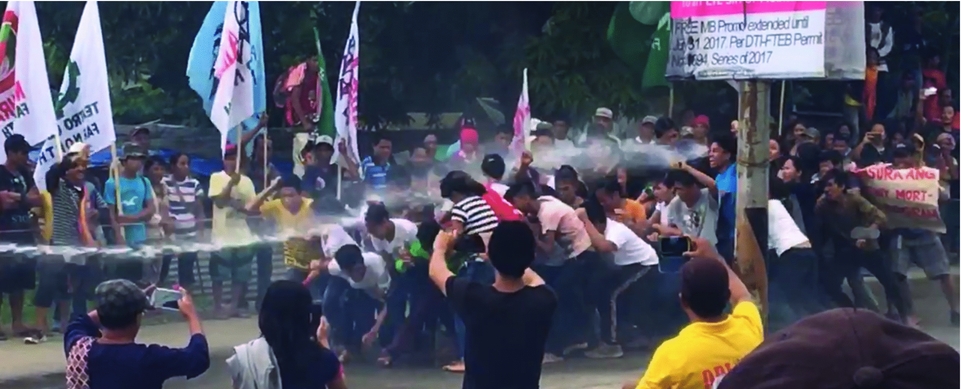
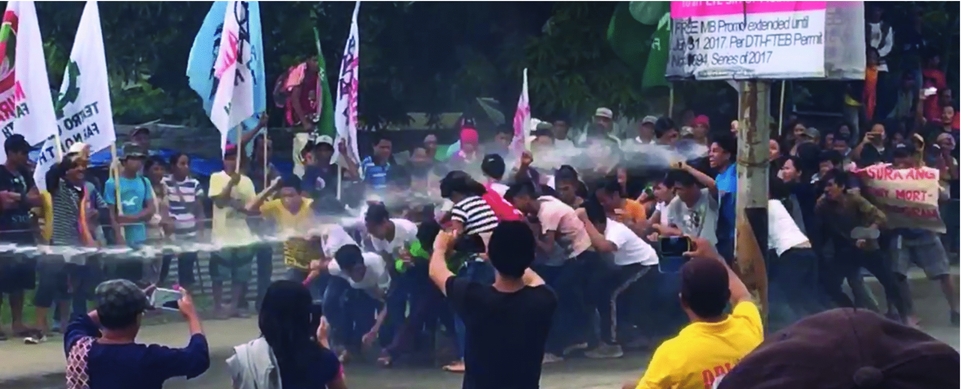
From where I stand on one side of the road in front of the Escalante city hall, the massacre site, I hear the march long before it arrives. The protesters shout their militant calls of 1985: ‘Bugas, bugas, hindi armas!’ (‘Rice, rice, not arms!’); ‘Makibaka! Huwag matakot!’ (‘Struggle! Do not be afraid!’); ‘Militarisasyon labanan!’ ‘(Resist militarization!’); or ‘Marcos: Hitler, diktador, tuta’ (‘Marcos is Hitler, a dictator, and a dog [of the imperialists]’). The stage of the re-enactment drama is set, with an audience already gathered, many of them local residents of Escalante, but joined by visitors, including media with big cameras. The fire truck has arrived, its siren screaming, and is now positioned on one end of the road. Teatro Obrero's team of ‘backstage’ hands and sound crew are assembled close to the truck and the actors playing the paramilitary forces are positioned on and just beyond the ‘stage’, ready to do their ‘job’. When the marchers arrive, many of them spread out on both sides of the road, swelling the ranks of the audience, while the actors of Teatro Obrero march on toward the fire truck, which opens ‘fire’ on the marchers. The strong force of the water cannon stops the protesters in their tracks, scattering them, throwing them to the ground. The din of the siren mixed with the marchers’ cries drowns all other sound. Suddenly, the truck runs out of water and the protesters get back to their feet, cheering. Actors playing the police then start throwing canisters of ‘tear gas’ and again the marchers scatter, scrambling for safety. But one of the canisters does not fire. Dreadful silence follows as everyone waits. A young woman gets to her feet, picks up the canister and throws it back at the police forces. This is Juvelyn Jaravelo in the accounts. Another round of cheering is heard from the marchers as they also get to their feet and reassemble with renewed energy. But here the real horror starts. The cheers become screams and howling as the sound of ‘automatic rifle fire’ rings out and ‘Juvelyn Jaravelo’ is first to be ‘hit’. The sound crew to my right have ignited powerful firecrackers to produce the sound of a machine gun that in 1985 was positioned on the roof of the municipal hall. Uniformed ‘government troops’ have attacked, training their wooden ‘rifles’ on the marchers. The marchers run for cover, but many fall to the ground screaming, moaning or grunting in pain. Sounds of death and terror ring out. When the ‘firing’ stops, bodies lie on top of one another on the massacre ground. Two children enter the scene looking for their parents, as those who escaped death among the protesters begin to move, looking for their companions. The final scene is played in silence as the bodies of the dead and wounded are carried aloft in a procession to the memorial monument and laid on the ground. The survivors huddle beside the ‘dead’ bodies, their own bodies smeared with dirt and blood and crumpling in defeat, their arms trembling, shock and tears on their faces. In 2016, this scene was especially poignant, because Teatro Obrero actors were joined by visitors from theatre groups in Luzon and elsewhere in the Visayas who participated for the first time in this real-time experience of an actual march and facing the onslaught of the water cannon and violent dispersal and the resulting ‘deaths’ of comrades.
If the re-enactment were to be viewed strictly as theatrical performance, the foregoing is the ‘theatre-text’ culled from the survivors’ and Teatro Obrero's collective memory of the actual event, which has been passed on from one generation of actors and directors to the next. But it is apparent that it is more than theatrical performance for the re-enactors and their ‘audience’ who come to stand in solidarity and co-perform with them. Watching from the sidelines of the massacre site, I heard sounds of mourning, sounds of anguish, sounds of anger from the procession of the ‘dead’ and ‘wounded’ and also from audience members standing beside me, many of them members of the survivors’ association, MARTYR: Mothers and Relatives against Tyranny and Repression.
Why do they do it? What is the point of the yearly re-enactments? More than thirty years have passed and the survivors of the massacre have grown old – many of them do not even perform anymore. The young actors of Teatro Obrero did not experience the massacre first-hand, although they grew up watching the re-enactments held annually. One reason that the re-enactment endures is because it is sustained by left-wing political leaders. Even for a passing visitor, this is apparent, because the commemoration does not stop with the performance. There are activities organized around it, like the concluding programme in 2016 and 2017 where ‘mass leaders’ of various groups from other parts of the country spoke of the grave issues of inequality and injustice committed against the ‘basic masses’ and called for militant action to redress these wrongs. In 2016 the finale was a community singing of the Tagalog version of the Internationale.
More remarkable than its affiliation with the left, however, is the thirty-two years (and counting) of unswerving fidelity to what Teatro Obrero started in 1986, as well as the re-enactors’ fidelity to agitprop aesthetics. They sing the same protest songs and chant the same slogans from 1985. Such fidelity is also embodied in the intergenerational mix of young actors working with older ones in the staging of the repeated action, while others watch from the sidelines. Many of these spectators, also young and old activists, had taken their turn playing a marcher, dying comrade or a brutish state policeman at some point in their lives.Footnote 9
The longue durée of Escalante
The first re-enactment on the anniversary of the massacre in 1986 was a call for justice and indemnification for the victims. Activities organized by MARTYR included the tolling of the church bells all week from 12 to 20 September at 1 p.m. (the hour of the massacre), and a motorcade from Bacolod City, a hundred kilometres west of Escalante on the national highway. There were twenty-kilometre torch parades from Toboso and Sagay towns that ended in an all-night programme at the Escalante town plaza. Masses were also held in Bacolod and Escalante. A gathering of relatives and friends of the victims was held on 14 September in Dumaguete, the capital city of the neighbouring province of Negros Oriental. At this event, a fact-finding committee revealed who was ‘indictable’ for the atrocity, ‘including the then mayor of Escalante and some military personnel of Marcos and his political ally Armando Gustilo’, a sugar planter, congressman since 1963, and the provincial governor of Negros Occidental in 1985.Footnote 10 Capping all these activities of commemoration was the re-enactment of the massacre on 20 September right where it had happened the previous year.
At the time of the first anniversary, Marcos had already been deposed and hopes for justice were high as the euphoria of that moment in February 1986 still lingered. Indeed, steps were taken by subsequent governments from the time of Corazon Aquino toward payment of financial indemnification for the victims of the Marcos regime. But it was only in 2013 that a law was passed (Republic Act 10368) and ten billion Philippine pesos (P10 billion) (approximately US$200 million) were allocated for the purpose. The source of the funds would be the ‘$680 million (roughly P30.8 billion) of ill-gotten wealth returned to the Philippine Treasury from Marcos’ Swiss deposits’.Footnote 11 The Escalante victims formed one small part of the fifteen thousand cases of human rights violations identified by the Commission on Human Rights as having taken place under Marcos. They would have to first prove their claim for the indemnification according to a verification points system set by the commission, whereby ‘victims who died or who disappeared and are still missing shall be given 10 points’ (Section 19), but they have had to compete with thousands of other claimants, including fake ones, before they can receive any of it.Footnote 12 The process has been tedious, frustrating and painful; many of the relatives despair of ever receiving anything.Footnote 13 This is an ongoing struggle that the group MARTYR is committed to pursuing for its members.
Armando Gustilo died in the US in 1986. He was never arrested or tried for his alleged crime. Forty-five persons were charged with murder but only three policemen were convicted, serving seventeen years in prison.Footnote 14 But the struggle for justice and indemnification did not end with Gustilo's death or the indictment of the policemen. For the members of MARTYR and for Teatro Obrero, the purpose of repeating the re-enactments year after year is more than just the punishment of the perpetrators of the 1985 atrocity. It is also about more than reparation for the plunder of Ferdinand Marcos and his crony Roberto S. Benedicto, whom the planters blame for the Negros sugar crisis of the early 1980s and for the decline of the sugar industry and its consequent effects on the workers. It is for long-term justice in the form of ‘genuine’ agrarian reform and an egalitarian society that would bring about lasting change from more than two centuries of oppression of the sugar workers of Negros. This is not just another aspiration for change that might not come. The persistence of the re-enactment compels apprehension of a historical moment made alive again, here, now, as an effort perhaps to communicate the long past of the Escalante story embedded in the material conditions of its sugar context. To this I now turn as I attempt to ‘historicise the contemporary’, as Agamben bids us, ‘by seeing . . . through the lens of “disjunction” and “anachronism”’ and in so doing ‘co-compose this gesture’.Footnote 15
Sugar as a cash crop was once at the centre of the issue and practice of slavery during the eighteenth century, when ‘slave-produced sugar became a staple in the diet’ of Europe and America.Footnote 16 This history has parallels with and connections to Philippine sugar labour and the oppression of resident and migrant farm workers by the elite sugar farmers and their foreign partners. John Larkin astutely observes that in the Philippines the production of commercial sugar for export during the early part of the nineteenth century ‘brought the Philippines into direct contact with the outside world . . . had adverse effects on economic development, led to wide, harsh social and economic cleavages among the Filipino people, and skewed political power in the archipelago, in colonial times and later’.Footnote 17 The equivalents of the Caribbean plantations in the Philippines were the haciendas, big tracts of land acquired and converted into sugar farms by moneyed families who wanted to take advantage of the sugar boom. Writing about the Iloilo zarzuela, a dramatic form with text and music appropriated from the Spanish tradition, Doreen Fernandez notes that from 1775 to 1779, the Philippines was already ‘the largest exporter of sugar in all Asia’, benefiting the elites who invested in sugar and bringing in so much wealth that it made possible the formation of elite leisure habits that included the writing and production of zarzuelas.Footnote 18 By the mid-1800s the sugar was being exported to other foreign markets such as Australia, loaded on cargo ships owned by British, Dutch, American and German traders.Footnote 19
It was around this time that many families from the urban centre of Iloilo in neighboring Panay island transferred to Negros and set up the large haciendas – la immigracion Ilonga. ‘Towns were formed, churches built, and mills established by “insurales de Jaro y Molo” who moved their work to Negros’.Footnote 20 These were the ‘upper crust’ or ‘old money’ of Ilonggo society who first built their fortunes on Panay's weaving industry and sought to maintain their economic ascendancy by investing in sugar when the textile trade was already failing.Footnote 21 With the sugar boom, ‘Negros plantations came to resemble, in many respects, those of the American antebellum South and the late eighteenth and early nineteenth century West Indies: worlds unto themselves, with the hacendero the unchallenged master’.Footnote 22
In a 2012 documentary film on the sugar industry of Negros, one of the planters interviewed speaks of the high hacendero lifestyle that she enjoyed growing up: houses in Manila and Baguio, travel abroad, the latest model of the best car brands, parties and so on.Footnote 23 On the wide gap between the hacendero and his workers, the film-maker Jay Abello, son of an hacendero, has this to say:
I had conflicting thoughts about the poverty [of the sugar workers]. I thought, was this some form of modern slavery? If we treated them like family like we always say, then why was I sleeping in a bed with a mattress in a room with air-conditioning, while they slept on bamboo slats in a nipa hut? Why would I see the same people I grew up with as a kid still poor twenty years or so later? It's as if nothing has changed with them.Footnote 24
Indeed. We are counting centuries here, not just years.
For both migrant (sacada) and resident farm workers (dumaan) of Negros, the line – nothing has changed – is repeated by Abello in 2012 and by Teatro Obrero during our meetings in 2015–17. The words of John Paul II when he visited in 1981 still ring true today: ‘Injustice reigns when some groups hold most of the wealth and power, while large strata of the population cannot decently provide for the livelihood of their families’.Footnote 25
According to a report of the Philippine Centre for Investigative Journalism (PCIJ) in 2014, the 300,000 sugar workers in Negros could expect a maximum daily wage of 255 Philippine pesos (five US dollars) if they were plantation workers or 245 Philippine pesos for those in non-plantations. This was during the harvesting and milling season. However, during the tiempo muerto (dead season) that usually starts during Lent in March or April and extends to August, when all work in the haciendas stops as the cane grows, wages can drop to less than a dollar a day, barely enough to buy a kilo of rice.Footnote 26 Because of the low pay even during the regular work season, the workers are perpetually in debt.
But, as Filipino economist Bernardo Villegas says in Abello's film, ‘the wages can't be raised’ because then it would be ‘a problem for the world economy’.Footnote 27 The Philippines is still among the top twenty world producers of sugar from sugar cane, ranking twelfth in 2013.Footnote 28 What hope do the Negros planters have for the Philippine sugar industry? They have to take care of their own interests. If they raise wages, the cost of production would increase and they would lose any competitive edge they still have over Thai sugar, Thailand being the Philippines’ biggest competitor in Asia. ‘We are capitalists’, says one hacendero. ‘The sacadas [migrant sugar workers] are not exploited – they're just poor people’, says another.Footnote 29
A key point here is the conundrum of the continuing feudal system of the hacienda melded with the capitalist bent of the planters. While in some respects the hacienda system has changed significantly – for instance, hacenderos do not provide housing for their dumaan or resident workers ‘from birth to grave’ any more – the culture of patronage is still well and truly alive, with invisible ties that bind the dumaan and sacada to their inday and nonoy (affectionate names used to address the hacendero, their spouse and their children). The hacendero and their family may provide for the dumaan and sacada or do them favours, and even name their children, but they also forever think of the workers as inferiors and as receivers of beneficence and charity, or as infants who need the care and guidance of elders.Footnote 30 This shows the strong grip of feudal culture with the peasant caught fast in the vice of dependency on their lord. The PCIJ report remarks that such ties have made politicians from the hacendero clans ‘perennial winners of local elective positions to this day’ – the so-called ‘sugar bloc’ delivers ‘either campaign funds or votes, or both. Indeed, aside from sugar, some scholars say packing votes for their favored politicians has become a second cash crop in Negros where “hacienda politics” rule’.Footnote 31 And yet the hacenderos argue as ‘capitalists’ who naturally have to make a profit, while the poor workers live as they do because they are poor. That is the way of the world, the statement seems to be saying. The confidence with which it is said suggests the hacendero’s power and contentment with the status quo.
In his 2012 film, Abello speaks of efforts by some benevolent hacenderos to help augment the workers’ incomes by establishing social enterprises or setting up scholarships for the children of the workers. My view is that such initiatives are new forms of the patron's ‘care’, expressed in new terminology similar to ‘corporate social responsibility’ used by capitalists in the twenty-first century. However, these have not changed the basic social and political contexts and structures that gave rise to the protests at Escalante in 1985 and which continue to fuel contemporary fidelities to old conceptions of oppressions and their redress. In Filomeno V. Aguilar Jr's account, such fidelities, distinct and removed from the loyalty of the dumaans to the amo, came about at last when unionism came to Negros, and by the early 1980s it had become a strong force against the hacenderos.Footnote 32 The formation and activities of Teatro Obrero and the repeated re-enactment of the massacre illustrate just how powerful this force of resistance turned out to be.
Radical theatre from then to now
Teatro Obrero declares that what they do is ‘political theatre’, an assertion of a history tied to the story of the Negros farm workers from colonial times to the present, and tied to the story of revolutionary leaders like Papa Isio staged by Teatro Obrero during the 2016 Tanghal Festival.Footnote 33 But what is known as radical theatre work in Negros can be traced to the early 1970s. Rosario Cruz-Lucero gives an account of this history, tracing the formation of Teatro Obrero to groups organized in 1970 by politicized students in Bacolod, the capital city of Negros Occidental.Footnote 34 But Teatro Obrero became active only in 1981, when a strike erupted at the Central Azucarera de La Carlota. By the early 1980s the repressive machinery of martial law declared by Marcos in 1972 could no longer contain the resurging protest galvanized by the workers’ strike.Footnote 35 The ‘social volcano’ had erupted and would reach its climax in the general ‘people's strike’ and state response of 1985.
As I have written elsewhere, the aesthetic lineage of Teatro Obrero's re-enactment is that of Philippine protest theatre.Footnote 36 This means pre-martial law ‘proletarian theatre’ and the way it resurfaced in the early 1980s when the anti-dictatorship movement against Marcos reached its zenith. The body stances and movements of Philippine protest theatre developed over time as groups performed mostly in outdoor protest actions. This is street theatre performed with ‘fists and red flags, cries against imperialism, dictatorship, feudalism, and bureaucrat capitalism’.Footnote 37 This is ‘Philippine political theatre at its feistiest, as it had evolved from seditious theatre, contact with European and Asian political theatre, and the actual and theatrical experience of the First Quarter Storm [of 1970]’.Footnote 38 Bienvenido Lumbera describes this theatre as having emerged from the influence of the Chinese Cultural Revolution in the 1960s, through both Mao Zedong's Yenan Forum document of 1942 and the subsequent writings of artists and theorists led by Mao's wife Jiang Qing – this latter marking a period of praxis – ‘putting into practice of ideas based on the Yenan Forum during the decade of the ’60s, which was dubbed “The Great Proletarian Cultural Revolution”, the historic event in China that coincided with the period of the rise of activism in the Philippines’.Footnote 39
Teatro Obrero's actors performing in 2017 moved in the way they were trained in the workshops of the Philippine Educational Theatre Association (PETA), exhibiting stances akin to those observed in Chinese political theatre. The ‘Escam’ re-enactment was being staged the same way it was performed in 1986. The question is, why has Teatro Obrero not changed its performance style? It might be said that the group has not grown and is stuck in outmoded presentation styles learned long ago. Moreover, the passage of thirty-two years has also radically changed things even among ‘progressive’ artists. After the EDSA revolution, and with the restoration of democratic processes, the theatre, in Manila at least, adapted to the times. The strong anti-dictatorship styles softened as groups like PETA moved towards ‘allied drama/theatre’ or ‘theatre in education’; that is, issue-based and sector-focused. And so seeing Teatro Obrero's re-enactment in 2015 for the first time for me was like a throwback experience to thirty years before. But it was a jarring throwback that compelled me to rethink the idea of outmodedness.
Teatro Obrero's fidelity to the aesthetics of protest theatre as they learned it in the 1980s might be thought anachronistic, but it can also be seen as the faithful redoing of a time that is past but is not yet over. Thinking of this act as ‘anachronistic’ devalues what the group declares it is doing. It is also perhaps ignorant of the history of activist theatre as it developed in Escalante and the Philippines and the persistence of the same contexts that birthed this theatre. More to the point, the performance enacts what it seeks to accomplish: to repeat the experience so they do not forget. As Rebecca Schneider writes in her book on practices of re-enactment, Performing Remains, ‘An action repeated again and again and again, however fractured or partial or incomplete, has a kind of staying power – persists through time – and even, in a sense, serves as a fleshy kind of “document” of its own recurrence’, the re-enactment serving as ‘a vital mode of collective social remembering’.Footnote 40 Joseph Roach also talks about kinaesthetic memory, the way collective memory is embedded in the body – ‘expressive movements or mnemonic reserves [and] patterned movements made and remembered by bodies’ repeated in and through performance so that it ‘persists through time’ – so that ‘the dead stay among us so that we will not forget’.Footnote 41 The Escalante re-enactors remember through performance, because remembering, persisting in the memory, and the specific way that they do so refuel their energy to keep up the struggle for the long haul. The underlying militant commitment to continue the fight has been firm and was further strengthened with the acts of solidarity expressed in 2016 and 2017 by groups outside Escalante.
I take my own engagement with Teatro Obrero and their re-enactment theatre to testify to this. In April 2015, I went to Escalante with a group of travelling researchers and artists for the Fluid States project of Performance Studies international.Footnote 42 We travelled to all the major islands of the Visayas and in Negros we were treated to an out-of-time re-enactment of the Escalante massacre.Footnote 43 In September 2015 I went back to Escalante to witness the actual re-enactment and the activities that have been built around it. In September 2016, as chair of my country's national committee on dramatic arts, I worked with Teatro Obrero and theatre leaders of Negros to bring the tenth annual Tanghal university theatre festival to Escalante.Footnote 44 The festival programme consisted of community immersion and workshops during the day and performances at night from 15 to 20 September. The festival delegates accompanied Teatro Obrero in their ‘community-hopping’ or visits to the farm workers’ communities, participated in their ‘economic activities’ or work in the farms, including their karga-tapas work or the labour of cutting the cane, stacking it in piles, and loading it onto the trucks that would transport the cane to the mills. Some groups conducted theatre workshops. All 250 delegates then rehearsed the re-enactment with Teatro Obrero on 19 September and performed with them on 20 September. Alongside all this, a parallel ‘people's summit on culture and the arts’ was happening. Teatro Obrero co-organized the summit with the network of activist theatre and other artists’ groups in the country, who also had spots in the performance programme every evening. The summit participants further infused a radical edge to the programme. The performances of the summit delegates stood out for their outspokenness, the use of red flags, clenched fists and chanting of slogans against ‘imperialism, feudalism, and bureaucrat capitalism’, the three evils being fought by a national democratic protracted struggle that has been going on for more than forty-eight years in both the open mass movement and the armed guerilla zones. The time span of this struggle is even longer, including the Escalante massacre and the re-enactments, manifesting perhaps the necessarily longue durée of the struggle for radical social change and therefore the need for persistence. For Teatro Obrero, the presence of like-minded groups and supporters at their ‘Escam’ commemoration was a much-awaited event, but for the young festival delegates who experienced the activist atmosphere for the first time, it must have been greatly disturbing. The plight of the sugar cane workers in Negros was highlighted in plays like Tiempos Muertos (Dead Season), which showed vignettes of workers’ stories during the dead season, mainly using dance, movement and poetry.Footnote 45 Other pieces were on the struggles of historical figures of the revolution against colonialism in the Visayas, like Dagohoy and Papa Isio, both of whom were religious leaders who took up arms and rallied the people to fight the colonizers.Footnote 46
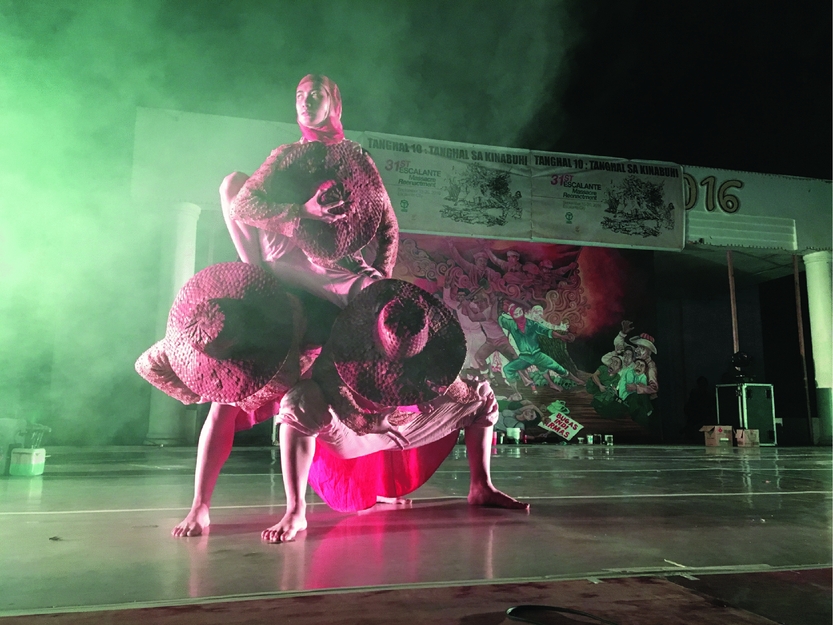
Artists from the group Dance Pull performing in solidarity with Escalante during the concert organized by the Cultural Center of the Philippines on 19 September 2016. Photograph by Jazmin Llana.
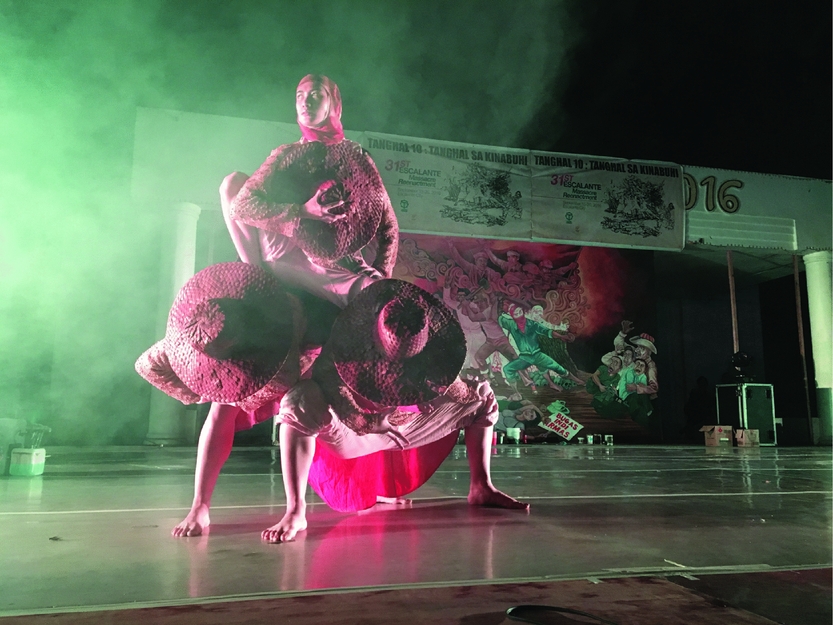
The performance of the re-enactment on 20 September 2016 was a feat like no other for Teatro Obrero, having the visitors arm to arm with them in the march, their voices amplifying the militant chants, their bodies surging forward together against the water cannon and slamming against the hard pavement when the ‘firing’ began, ‘dying’ or crawling ‘wounded’, reliving the horror of 1985. It was the first time since they started the re-enactment that this had happened and the expression of co-performative support was a victory for their cause. For the visitors, the re-enactment was a shock, the Escalante story unfolding again, this time with them in it, becoming a corporeal encounter with real physical pain and sweat and tears, an experience of awe at the unwavering presence and determination of the Escalante folk who would see this through year in, year out. The goodbyes afterwards were emotional, extended, noisy. Everyone was in high spirits, the visitors promising to return and join again.
Earlier that year and prior to the 2016 performance, a new political situation had come about, which the summit on people's culture and arts held in Escalante was organized to address. In May, the nation had elected a new president, Rodrigo Duterte, who defeated all other candidates by a huge margin. He was said to be the candidate of the masses because he spoke like them and thought like them and championed their causes during the electoral campaign. He had the support of the dominant Philippine left, as seen in the appointment, when he became president, of several left-associated personalities to important positions such those of labour secretary and social welfare secretary. Peace talks with the Communist rebels of the New People's Army were reopened. At the summit on people's culture and arts, the general attitude was of optimism that change was finally coming and the revolutionary forces could start working with the new government in instituting major reforms. I had a chance to speak with leaders of the summit who expressed positive expectations for peace and substantial change under Duterte. The national democratic struggle has been going on for more than four decades. The comrades have fought long and hard and many are dead, while thousands more innocent lives have been lost, collateral damage in the war for radical social change. With Duterte in power, there was a chance of getting ‘peace based on justice’ and ‘meaningful change’ at last, and they wanted to take that chance. It is probably this hope translated into a sense of confidence in the new regime that made the 2016 re-enactment brazenly, openly, ‘red’, demonstrated in the singing of the Internationale and songs extolling the armed struggle carried out by the Bagong Hukbong Bayan (New People's Army) and the leadership of the Partido (Communist Party of the Philippines).
By the time of the 2017 re-enactment, however, the tenor had become drastically different. The Duterte regime replaced what in 1985 was the rehimeng US–Marcos (US–Marcos regime) and later terms similarly used for post-EDSA presidents of the republic: Corazon Aquino, Fidel Ramos, Joseph Ejercito Estrada, Gloria Macapagal Arroyo and Benigno Aquino III. Rodrigo Duterte is now deemed by many of his former supporters on the left to be in collusion with ‘US imperialism, feudalism, and bureaucrat capitalism’. Listening to the speeches of ‘mass leaders’ at the re-enactment programme, I had a strong sense of how the wind had shifted from 2016, altering voice, stance and attitude: Duterte's posturing against the US has turned out to be just what it is, posturing, a performance in a game of geopolitics, with China as a bit player in Duterte's drama. While this particular actor on the nation's stage of performative politics has been too erratic and unreliable, with his on-now–off-next-time pronouncements about the peace process and most other things, he has proven to be an enemy of the radical resisters, and now he is also an enemy of the common people, who have been the most victimized in the campaign against illegal drugs.Footnote 47 As with Marcos before him, there are calls for Duterte to be held accountable for the spate of extra-judicial killings which, in the span of less than one year, have outnumbered the total number of dead as a result of martial law during the time of Marcos. It is worth pointing out that the Tangis ng Asukal photo book containing this testimonial was published after the event of the 2016 re-enactment and distributed at the 2017 re-enactment. In the texts accompanying the photographs, the reader is told in no uncertain terms: ‘The Escalante massacre is one of the most horrifying and bloodiest events under Martial Law wrought by the US–Marcos regime in the island of Negros’.Footnote 48 The publication is ‘a cry for justice’ undertaken ‘[lest] it be forgotten and buried in the dustbin of history, that ferocious human rights violation in Escalante and especially their martyrs who shed/offered their lives in pursuit of freedom from the fetters of martial rule have to be immortalized’.Footnote 49 In the course of Duterte's first year as president, it has become obvious to the Escalante re-enactors and their supporters, myself included, that justice will not be forthcoming under this administration.
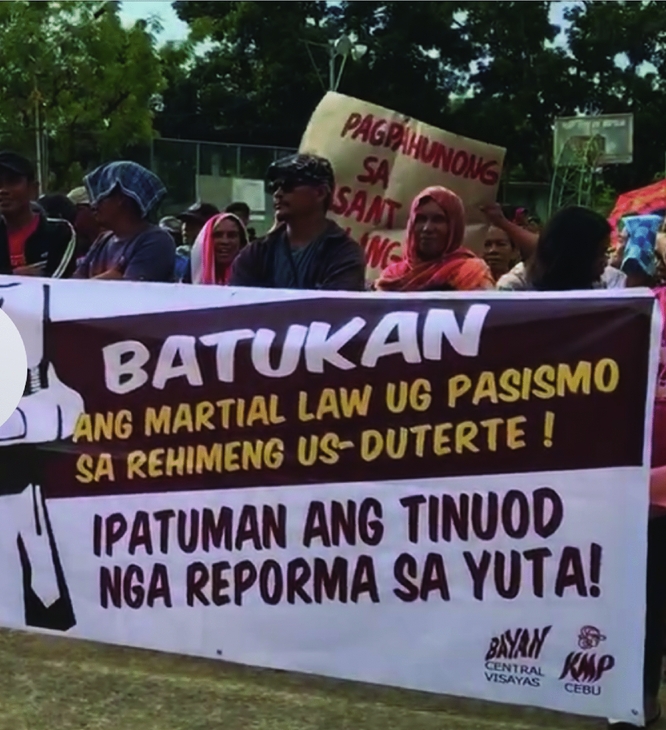
In fact, the opposite has happened, because the spectre of dictatorship has appeared in the shape of the new president, who has threatened to declare a ‘revolutionary government’ – that is to say, a suspension of the writ of habeas corpus and the common freedoms enjoyed in a democracy; in other words, martial law. And the fear is real, because in fact martial law was declared in the southern Philippine island of Mindanao on 24 May 2017 and will prevail there for another year, allegedly because of the threat of terrorism.Footnote 50 And so the cry in 2017 was clear, as expressed in a banner prominently displayed at the re-enactment site: ‘Condemn strongman rule and defend the people's rights against repression’.
Battling the water cannon at the thirty-second year of the re-enactment, 20 September 2017. Photograph by Jazmin Llana.
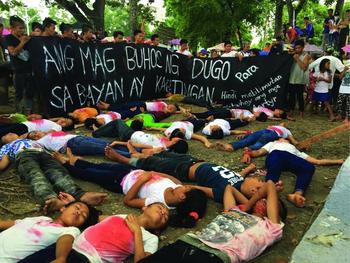
The bodies are laid on the ground in front of the memorial monument with the backdrop saying, ‘To shed blood for the nation is an act of valour that will never be forgotten’, 20 September 2017. Photograph by Jazmin Llana.

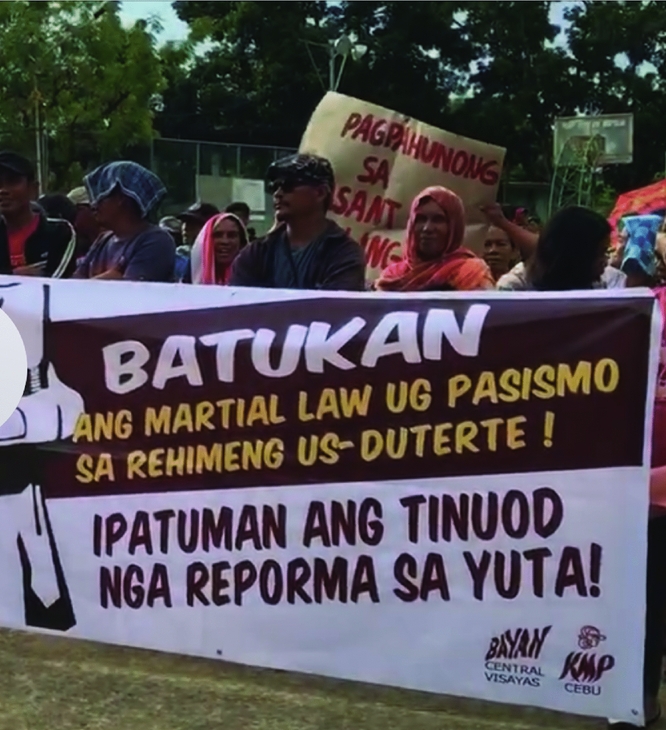
One of many protest banners in 2017 condemning martial law and fascism perpetrated by President Rodrigo Duterte, who is now associated with US imperialism. Photograph by Jazmin Llana.
Out of time in faith
The first re-enactment of the massacre at the first anniversary in 1986 can be understood in terms of trauma: the victims were compelled to return to and re-enact the traumatic experience, and in doing so to start the process of healing. And so for the survivors of the Escalante massacre, it may be said that the first re-enactment was a way forward. It was an event after the real event staged not only to honour those who lost their lives but also for the Escalante protesters to have a clear view of what had happened, to articulate the experience in terms they could control via theatre. At that time, in 1986, only a few months after Marcos was ousted, hopes were high that justice would soon be served. As it turned out, such hopes were a product of what, in another context, Lauren Berlant has called ‘cruel optimism’ for ‘change that is not going to come’, which characterized many of the initiatives after the EDSA ‘people power’ uprising.Footnote 51 The group MARTYR has first-hand proof of this in relation to their claim for indemnification. Perhaps it is with this in mind that the Escalante re-enactment carried forward to its thirty-second year in 2017 can be understood in the terms of a testimonial quoted in the Tangis ng Asukal photo book: ‘After the massacre, many said that it is only revolutionary justice that can bring justice to the victims. The state is inherently violent and therefore it is only right that we continue the struggle.’Footnote 52
Moving now into the present, might we say that the 2017 re-enactment is to 2016 what the 1986 first re-enactment was to the 1985 ‘real’ event? For both times, the earlier year saw the unfolding of ‘real’ events – the 1985 massacre and the 2016 solidarity with the Escalante re-enactment – and the later year was the repetition or re-staging of the event ‘after the event’. At both times, there was hope for justice and social change – with EDSA and the fall of Marcos in 1986, with Duterte and the potential of working with the new government in 2016 – that came to nothing. The 2017 re-enactment was smaller, simpler, muted almost. Teatro Obrero and the Negros Federation of Sugar Workers aimed to continue what they were able to accomplish in 2016, but resources were limited and only a few who were present in 2016 were able to come back. Instead of the Tanghal festival that took place at another city, a ‘mural festival’ was held. Visual artists, some of whom were active in the 1985 protest, came to Escalante to conduct a workshop and produce politically themed murals, in the vein of the 1985 iconic mural that was reproduced in 2016 and displayed again during the 2017 re-enactment. The repetition was poignant in the ways I have described above, coping with yet another dashed hope, another form of trauma in the continuing bigger story of Escalante sugar workers.
For Teatro Obrero, and for those who choose to join them at the commemoration each passing year, there is no question of stopping. The long history of oppression and violence is fought with an enduring resistance that stops and reclaims time – stopping the oppressive labour at the sugar farms literally by gathering in Escalante for the re-enactment and getting some of the hacenderos and the local governments to fund expenses and include the re-enactment in the city's calendar. The question then is always how to get to the next performance, which will certainly happen as a form of militant commitment to an idea that has never faded in their consciousness. The re-enactment has in fact become like a standing resource to deal with a new situation. If the 1986 re-enactment re-energized the survivors and made them look ahead and move forward, the 2017 re-enactment was a rearticulation of the resolve to continue despite, and all the more because of, recent disappointment, to say the least, in the Duterte presidency. And it is an occasion for intergenerational reinvigoration, with the older activists drawing on it to persist in the struggle, as much as the younger ones become steadfast advocates for the causes advanced by the event of re-enactment: human rights, ‘genuine’ agrarian reform, the fight against repression – and, yes, perhaps, the struggle against ‘imperialism, feudalism and bureaucrat capitalism’, repeated each year in the slogans chanted. The theatre has not changed because the social conditions of its instantiation have not changed. Perhaps the sameness of the re-enactment, the persistence of the agitprop aesthetics of Teatro Obrero, can be understood as a resource to bolster flagging spirits in the face of the long and trying fight for justice. This is theatre as politics in action. As the author Walter A. Davis puts it, speaking of the ‘traumatizing and questioning power of theatre’, politics ‘is precisely what emerges when a trauma is sustained, so that radical contingency gives birth to new possibilities’.Footnote 53 The new possibilities have not unfolded yet for Escalante, but Teatro Obrero looks toward the future even as it restages the past.