IntroductionFootnote 1
This symposium focuses on judicial politics at the micro level. Its aim is to shed light on justice in action, drawing on an ethnographic approach to explore the routine decision-making practices of judges and other legal actors, and to study their interactions with citizens and politicians. Each article is based on close observation of the interactions between legal professionals and administrative actors who are at the frontline in local and lower courts. By examining a variety of jurisdictions around the globe, the articles in this symposium offer fresh insight into “judicial politics on the ground.”
What is New about Judicial Politics “On the Ground”?
Literature on the judicialization of politics—“the process by which courts and judges come to make or increasingly dominate the making of public policies that had been previously made … by other governmental agencies, especially legislatures and executives” (Moustafa Reference Moustafa2007, 26–27)—mainly adopts a macro and top-down approach. It tends to concentrate on higher court rulings (Baum Reference Baum1997, 148; McGuire Reference McGuire2012) and constitutional review, often focusing on the values influencing the judges' decisions (Tata Reference Tata2007, 427; Fielding Reference Fielding2011, 97). The most common topics of inquiry are transformations to the status of law and redefinitions to the balance of power between the legislature, the executive, and the judiciary (Baum, Reference Baum1997; Commaille and Dumoulin Reference Commaille and Dumoulin2009). The processes driving the increased role of courts in making public policy tend to be theorized along four main lines: the globalization of judicial issues, reinforced by the establishment of supranational regional entities; demand for judicial review of political disputes; public policy analysis; and collective initiatives to acquire new judicially enforceable rights. Most scholarship on judicial politics has focused on democracies, although recent scholarship has considered the role of judicial institutions for authoritarian regimes (Ginsburg and Moustafa Reference Ginsburg and Moustafa2008).
This symposium presents an alternative perspective to emphasize “how much [courts] are like other political actors” (Shapiro Reference Shapiro1981, 1). Our bottom-up approach examines judicial politics from the perspective of the daily interactions between legal professionals (judges, barristers, and case managers), those appearing in the courts (defendants, plaintiffs, etc.), and administrative agents (who may or may not have legal training, depending on the country in question). So, the crux of these articles is an examination of legal and administrative practices and dynamics between those working in the system and where these practices and dynamics provide the underpinning for the elaboration of judicial politics.
This perspective is based on in-depth ethnographic surveys showing how the justice system actually functions and how cases are adjudicated. This special issue thus sheds light on what Flemming, Nardulli, and Eisenstein (Reference Flemming, Nardulli and Eisenstein1992, 3) call “judgecraft,” that is, “how … judges go about their tasks in the courtroom,” but without being limited to this (see also Mack and Anleu Reference Mack and Anleu2007; Moorhead and Cowan Reference Moorhead and Cowan2007; Hutton Reference Hutton, Hondeghem, Rousseaux and Schoenaers2016). The articles thereby examine various dimensions of judicial politics on the ground—including the most proactive aspects as illustrated in reforms and their effects. They also explore the militant positions and innovative judicial practices a judge may deem socially desirable, as well as less visible aspects of judicial politics relating to work routines, the embedded ethos, the independence accorded to judges, and the autonomy and discretion characterizing professions (Freidson Reference Freidson2001) and street-level bureaucracies (Lipsky Reference Lipsky2010).
These articles employ “on the ground” observation as their starting point for analyzing interactions within courts at the micro-political level, in conjunction with macro-political dynamics and conflicts (public policy and debates about justice, state reforms, etc.). By focusing on the practices of legal professionals and ordinary people involved in the courts, this symposium seeks to show how judicialization processes operate at the micro level. This approach differs markedly from those that have long dominated judicial politics studies based on behavioral theories of judicial decision making and modeling (be it denominated legal, attitudinal, or rational choice) (Spaeth Reference Spaeth, Caldeira, Daniel Kelemen and Whittington2008). This approach departs from the normative and prescriptive tones found in mainstream literature on judicialization (as noted by Hirschl Reference Hirschl2004) by focusing on studying justice in action.
This symposium draws on the multifaceted tradition within the social sciences of micro-logical analysis of the state (Barrera Reference Barrera2009; Latour Reference Latour2009; Bernstein and Mertz Reference Bernstein and Mertz2011; Baczko Reference Baczko2013; Lavanchy Reference Lavanchy2013; Aymes, Gourisse, and Massicard Reference Aymes, Gourisse and Massicard2015) in order to examine the relationship between the judiciary and politics. Bazcko, for instance, shows how within the context of the civil war in Afghanistan since 2001, the Taliban's claim to control the state—despite being “just one politico-military player among others” (2013, 104)—is related to the jurisdictional network they set up in various regions. The goal of this symposium is to bring out the heuristic aspects of combining these approaches.
Judicial politics on the ground uses different scales of analysis, moving from the local to the national—and in some cases to the international. They combine qualitative, fine-grained local analyses of the concrete organizational settings in which the activities of legal and administrative professionals and those appearing in court occur. At the same time, they take into account the legal, professional, and cultural dynamics.
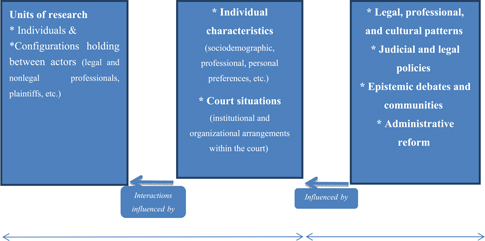
From the perspective of judicial politics on the ground, these articles analyze local actions at the individual level, with an eye to understanding individual behaviors conjointly with collective actions (see Figure 1). These interactions are influenced by the individual characteristics of local actors, such as their sociodemographic profile, their professional backgrounds, and their beliefs and values. The institutional and organizational setup within courts can also have an impact on judicial practices and strategies, including such characteristics as their size and type, their specialization and style of leadership, the division of labor between and among professional groups, their workload and the degree of control they have over it, and their resources. Interactions within courts and the links to politics are also determined at the national and international levels by the dominant features of the judicial system, where these include the legal tradition, the varying levels of fragmentation and hierarchy, the influence of legal professional associations, the balance of power between professional groups and between the polity and the judiciary, judicial and legal policies, epistemic debates and communities, administrative reforms to the state, and the general economic and social context.
The Analytic Framework

From a methodological point of view, focusing on judicial politics on the ground implies a qualitative research design grounded at least partly in observation and interview, and, for historical case studies, on discourse analysis rooted in a close reading of textual sources. This can be combined with the study of documents, videos, or quantitative data (systematic case analyses). But studying micro politics in conjunction with the macro dynamics of change does not imply the need to adopt any specific theoretical perspective; depending on the case under study, the authors draw on the sociology or social history of justice and law, the sociology of professions, and public policy analysis.
Findings
This analytical framework allows us to take into account diverse situations across countries and over time, and to consider variations that may arise between individuals within the same court setting. This makes it possible to appreciate the diverse forms that judicial politics can take. Each article places the observed practices within the perspective of larger dynamics of change. Castellano and Travers examine attempts to reduce crime and recidivism, Gonzalez Le Saux examines interactions between lawyers and society, and Hersant and Biland and Steinmetz examine administrative reform programs inspired at least in part by the principles behind “new public management.” Each systematically applies a comparative approach, comparing courts, judicial systems at the national or interstate level, or single judicial systems across time.
Ursula Castellano adopts an ethnographic approach to judicial behavior in the context of “uncommon justice”: in this instance, mental health courts in the United States. Her article presents findings from sixteen months of ethnographic research conducted in four US mental health courts between 2007 and 2011, focusing specifically on judicial responses to noncompliance with treatment. Her approach differs from most research into mental health courts, which focuses on whether these courts reduce recidivism. Instead, she examines the uses of and limitations on judicial discretion in these alternative courts.
Max Travers provides a case study of bail decision making in a lower criminal court in Tasmania, Australia. By evaluating these courts as political organizations—as unique institutions facing challenges within a given local political and institutional context—he demonstrates the value of the concept of “micro politics” to the study of criminal courts. Travers combines ideas and methods from two traditions that rarely come into contact: ethnomethodology and political science research that studies courts by using ethnographic and quantitative methods to focus on political activity and organizational change. The article illuminates political influences on the courts, recent organizational changes, and efforts to include pretrial services within the judicial process.
Marianne Gonzalez Le Saux examines the Chilean Legal Aid Service between 1930 and 1960. Drawing on archival research, she argues that its structure reflected attempts by social workers and lawyers to modify their professional identities in light of the expansion of the welfare state. Lawyers and social workers, by collaborating in this service, helped shape the judicial politics of the period by stressing the need to improve access to justice for the poor. They established specific mechanisms to deliver this service, for instance, by promoting conciliation and compromise over contentious judicial actions. Gonzalez Le Saux shows how gender dynamics between legal professionals and social workers in their everyday interactions within legal aid offices affects poor people's access to the justice system.
The article by Jeanne Hersant focuses on the effects of the Criminal Procedure Reform (CPR, 2000–2005) on the lower courts in Chile. Drawing on three months of observation in an inquisitorial court and in-depth interviews with court clerks and magistrates from before and after the reforms, she analyzes how the CPR transformed a criminal justice system that had widely been regarded as corrupt and inefficient. In both the pre- and postreform systems, actors extrinsic to the formal legal process—here the actuarios forming the judicial street-level bureaucracy—played an important role in justice making. The article shows how macro-political dynamics—both democratization processes and the introduction of management standards shaping the work of administrative departments—translate at the micro-political level of interactions between actors in the lower courts.
Emilie Biland and Hélène Steinmetz employ a cross-national ethnography of family courts in France and Quebec to examine how street-level bureaucracy relates to the judiciary. They propose a “micro-international comparison” based on observations of hearings conducted over several months, interviews with professionals, and analysis of judicial records. By focusing on actions at the micro level—day-to-day routines and encounters with the parties—they show that the accuracy of the street-level bureaucracy framework depends on professional and cultural patterns, particularly assumptions about the role of judges, which take on different form in the two countries.
Martina Kolanoski analyzes a civil proceeding for compensation brought by victims of a 2009 German-led military airstrike in Afghanistan. The court treated military video material recorded during the “Kunduz airstrike” as crucial evidence. The key question was whether the “infrared dots” were to be interpreted as “possible Talibans” or “possible civilians.” This article makes a contribution to our understanding of the judicialization of politics by bringing out the political stakes involved, for the airstrike demolished the official narrative according to which the German operation in Afghanistan was not in fact a “combat” mission but one of “stabilization.” Kolanoski examines the court's decision within its procedural context, using ethnographic field notes of the court hearing as well as legal documents to reconstruct how certain kinds of judicial categorization work were undertaken as the proceedings unfolded. The trans-sequential perspective she upholds on membership categorization analysis provides a way of thinking about how moral, political, and legal discourses are interconnected.
Each of the articles in this symposium examines judicial politics on the ground by drawing on ethnographic approaches that are attentive to the social and political stakes of judicial practices. This approach makes it possible to shed new light on how the justice system in all its variety and complexity—hearings relating to marital conflict and divorce, judicial regulation of various forms of “insanity,” the consumption of illegal drugs, combating minor delinquency, and the routine conflict resolution of low-level disputes more generally, as well as military combat in a foreign country—is shaped by its interaction with the political sphere.