1. Introduction
Before economists and sociologists came up with their own definitions of the term ‘capital’, it was commonly understood as money invested in businesses by their owners or shareholders, and it continues to be understood this way in everyday business practice and common parlance. In this view, capital is specific to capitalism with its profit-oriented enterprises. Hodgson (Reference Hodgson2014) argues that economists have disregarded the nature of capital as a historically specific feature of capitalism by employing a notion of capital that refers to physical activities related to the production process rather than to acquisitive activities of business enterprises. In this way, they have shuttered a promising way of understanding the system we actually live in. He suggests a return to the business usage of the term capital which was dominant in economics in the time before Adam Smith. Hodgson (Reference Hodgson2015) and Deakin et al. (Reference Deakin, Gindis, Hodgson and Huang2016) show that similar terminological differences also apply to the definitions of money, property rights, the firm, and other institutions. Economists have divested these institutions of their concrete, historical role and instead defined them as universal phenomena. In this way, they hampered the proper analysis of capitalism. This paper takes up Hodgson's (Reference Hodgson2014) challenge and develops a historically specific theory of capital. In this, it exploits Austrian capital theory that, perhaps surprisingly, is able to contribute several useful elements and arguments. After some reinterpretation, it becomes obvious that the Austrian capital theory is consistent with the business notion of capital and therefore conforms to Hodgson's demand in many ways.
The argument is linked to recent findings by Braun (Reference Braun2015a) and Braun et al. (Reference Braun, Lewin and Cachanosky2016) who show that Austrian School economists developed two different bodies of capital theory. The better known one defines capital as a factor of production and concentrates on the physical activities of roundabout production processes that are common to all economic systems. In this paper, the term ‘Austrian theory of capital’ only applies to this theory. Capital in this sense will be called ‘physical capital’ whenever the possibility of confusion arises. It consists of concrete and heterogeneous capital goods – which is nothing but an alternate expression for production goods.
The second and less well-known theory of capital by Austrian school economists, however, constitutes an appropriate starting point for a historically specific theory. It concerns itself with the organisation of the economic system called capitalism. Capital is not considered to be a production factor, but a sum of money invested in business enterprises. It is regarded as the central tool of the economic calculations by profit-oriented enterprises. This theory explains how the invisible hand arranges for profit-oriented enterprises to organise the allocation of resources in the market economy according to consumer demand. It will be called the ‘historically specific theory of capital’. Capital in this sense is simply money invested in business assets and will sometimes also be called ‘business capital’.
A deeper analysis will bring to light that the Austrian theory of (physical) capital can be subsumed under the theory of business capital and, in this capacity, helps to shed further light on specific characteristics of capitalism.
Section 2 develops the basic structure of a historically specific theory of capital. Section 'Capital according to the mature Carl Menger and Ludwig von Mises' presents the unnoticed historical approach to capital taken by some members of the Austrian School (e.g., Menger, Reference Menger1888; Mises, Reference Mises1922, Reference Mises1949) that resulted in a rudimentary theory of capital. Section 'A historically specific theory of capital' elaborates on these beginnings and shows that a theory that is based on the historically specific concept of capital would work out the implications of the Marxian formula Money − Commodity − Money' for the allocation of scarce resources in the market economy. In Section 3, the Austrian theory of capital as developed by Menger (Reference Menger1871), Böhm-Bawerk (Reference Böhm-Bawerk1889), Strigl (Reference Strigl and Hülsmann1934), Hayek (Reference Hayek1941), Lachmann (Reference Lachmann1978), Rothbard (Reference Rothbard2009), Lewin (Reference Lewin2011), Garrison (Reference Garrison2001) and Huerta de Soto (Reference Huerta de Soto2006) is reinterpreted. The main purpose of the section is to show that the Austrian theory of capital, if interpreted correctly, does not collide with the historically specific notion of capital but actually complements it. Section 'The fundamental heterogeneity of capital' demonstrates that even those authors who stress the heterogeneity of physical capital in the production process most vigorously, especially Lachmann (Reference Lachmann1978) and Lewin (Reference Lewin2011), are in the end concerned with the question as to how the heterogeneous capital goods are actually organised and ordered in capitalism by businesses calculating in money terms. In section 'Capital in the Austrian theory of the business cycle', a similar argument is made for the cases where the Austrian capital theory is used as an element of the Austrian theory of the business cycle. This business cycle theory, if expounded consistently, deals with the way the monetary calculations of enterprises are distorted by changes in the rate of interest, not with the production process as such.
Section 4 finally covers the relationship between the historically specific theory of capital, developed in this paper, and the neoclassical equilibrium approach to capital. In contrast to the latter, the former does not ignore the processes that bring equilibrium about and therefore helps to shed light on the working of capitalism. This section also points to where Austrian economists, despite their explicit rejection of equilibrium analysis, fall back to the neoclassical approach to capital.
2. A historically specific approach to capital and capital theory
Capital according to the mature Carl Menger and Ludwig von Mises
By and large, the Austrian school of economics considers economics to be based on the study of universal and ahistorical laws (Hülsmann, Reference Hülsmann and von Mises2003; Mises, Reference Mises1949; Rothbard, Reference Rothbard2009). The Austrian theory of capital reflects this mindset. Capital is considered to be a notion that describes features of the production process as such, independent of the prevalent economic system (Endres and Harper, Reference Endres and Harper2011: 367, 380). Accordingly, the basics of capital theory are sometimes expounded by means of a fictional isolated person – Robinson Crusoe – because this allows for a pure and undisrupted analysis of production (e.g., Böhm-Bawerk, Reference Böhm-Bawerk1889: 101 ff.; Huerta de Soto, Reference Huerta de Soto2006: 274 ff.; Rothbard, Reference Rothbard2009: 47 ff.).
Hodgson (Reference Hodgson2014: 1070), in his critique of economists’ handling of capital, attacks such ahistorical approaches to capital as illusionary (see Hodgson, Reference Hodgson2001 for a more general critique). Capital is ‘historically specific’ to capitalism and must be analysed as such because only in this way can important features of this economic system be grasped (Hodgson, Reference Hodgson2014: 1070). Strangely, there is a string of literature within the Austrian school that is perfectly in line with Hodgson's point of view on the matter. It also endorses the confinement of the term capital to, in the words of Hodgson (Reference Hodgson2014: 1065), ‘money advanced by owners or shareholders to establish a business’.
Within the Austrian School, this view can be traced back to Carl Menger. In a long and rather unnoticed essay on the theory of capital, Menger (Reference Menger1888) recanted what he had said in his Principles (Menger, Reference Menger1871) about the role of capital theory in economics (Braun, Reference Braun2015a). Similarly to Hodgson (Reference Hodgson2014), he criticised his fellow economists for creating artificial definitions of capital only because it dovetailed into their personal vision of the task of economics. In respect of the Austrian theory of capital as expounded by himself in his Principles and elaborated on by Böhm-Bawerk (Reference Böhm-Bawerk1889), he declared that the division of goods into production goods and consumption goods, important as it may be, cannot serve as a basis for the definition of capital and therefore cannot be used as a foundation of a theory of capital. Menger argued that every household produces output and, in this, employs and combines intermediate goods or produced means of production (like flour, sugar, mixers and ovens). It would be a terminological confusion, however, to call these things ‘capital’, like many Austrian school economists do. A theory of capital must not deal with households but with the phenomenon that is actually and in reality called capital (see Braun, Reference Braun2015a: 85 f.; Menger, Reference Menger1888: 10). As for entrepreneurs and lawyers, according to Menger (Reference Menger1888: 37), only sums of money dedicated to the acquisition of income are denoted by this word. Of course, Menger's (Reference Menger1888: 40) real-life oriented notion of capital does not only comprise concrete pieces of money but
all assets of a business, of whichever technical nature they may be, in so far as their monetary value is the object of our economic calculations, i.e., when they calculatorily constitute sums of money for us that are dedicated to the acquisition of income.
The exact reasons for Menger's change of heart are unknown. In any case, he made an important concession to economists of the German historical school who, it should be added, welcomed this step by their principal opponent in the Methodenstreit (Braun, Reference Braun, Bylund and Howden2015b: 78f.).
Of all people, Mises (Reference Mises1922, Reference Mises1949), the most explicit advocate of an economics based on a universal and ahistorical theory of human action, followed Menger (Reference Menger1888) and elaborated on the historically specific capital concept as found in actual business life. He even criticised those economists who try to explain capital theory by means of Robinson Crusoe because he thought an understanding of the role of capital would be impossible under these conditions. An analysis of capital presupposes the historically specific framework of capitalism, characterised by profit-oriented enterprises.
Some economists concluded therefrom that ‘capital’ is a category of all human production, that it is present in every thinkable system of the conduct of production processes–i.e., no less in Robinson Crusoe's involuntary hermitage than in a socialist society–and that it does not depend upon the practice of monetary calculation. This is, however, a confusion. (Mises, Reference Mises1949: 261 f.)
Capital, for Mises, is a device that stems from and belongs to financial accounting of businesses under conditions of capitalism. For him, the term ‘capital’ does not signify anything peculiar attaching to the production process as such. It belongs to the sphere of acquisition, but not to the sphere of production (Mises, Reference Mises1949: 261). His notion of capital comprises everything that is employed in the acquisition of income by enterprises and therefore appears on a balance sheet. It does not only include means of production, however defined, but also consumption goods, claims, receivables, cash or ‘whatever’ (Mises, Reference Mises1949: 262). Accordingly, there is no theory of physical capital as an element or factor in the production process. There is rather a theory of capitalism. For him, the existence of financial accounting on the basis of (business) capital invested in an enterprise is the defining characteristic of this economic system. Capital is ‘the fundamental notion of economic calculation’ that is the foremost mental tool used in the conduct of affairs in the market economy (Mises, Reference Mises1949: 260).
Some might question why later Austrian economists did not follow Mises and Menger but stuck to the physical capital concept. First, as Braun et al. (Reference Braun, Lewin and Cachanosky2016) point out, only a charitable reading of Mises (Reference Mises1949) makes his approach to capital appear consistent. It was shown above that he rejects the idea that capital is part of Robinson Crusoe's world. Yet, in other places, Mises (Reference Mises1949: 512; 500) treats capital as a category of human action and as a universal and ahistorical concept that does exist in Crusoe's world. Second, the main reason why later Austrians did not adopt Mises's and Menger's approach probably accounts also for Mises's apparent or actual inconsistency: it seems difficult to reconcile the historically specific approach to capital with the overall method of Austrian economics. In a nutshell, Mises and his followers try to deduce their system of economics from the concept of individual human action. They start from the premise that all relevant economic categories are inherent in human action as such, irrespective of the historical or institutional background. It is easy to see that the concept of physical capital goods can be integrated into the universal means – end framework of human action. These goods are simply means that have been produced previously. The stick that Robinson breaks from a tree and uses for catching fish can be interpreted as a capital good without difficulty. It is difficult to argue, however, that the business capital concept is inherent in human action. It rather depends on the institutional framework of capitalism, a legal system that allows for private property and free contract, the existence of money and money prices, the methods of financial accounting and economic calculation, etc.
Although Austrian economists are well aware of these institutions, especially in their political writings, they seem to be reluctant to admit that a central economic term – capital – is a result of a certain institutional framework and not inherent in human action. What this would imply is that capital is a phenomenon that falls outside the range of their basic method.
In short, to implement the business capital concept into Austrian economics has tricky methodological implications. Already Stolzmann (Reference Stolzmann1909: 338) noticed that Menger's business capital concept must be seen as a ‘heresy’ from the Austrian point of view and that Menger (Reference Menger1888) ‘stands out from the plains of pure economic analysis as an unmotivated rock’. From this perspective, it becomes at least understandable why Austrian economists tend to overlook the innovations by Menger and Mises on capital.
It must be added that the following attempt to create the framework for a historically specific theory of capital does not delve into the methodological problems that might evolve for Austrian economists if they tried to implement this approach into their system.
A historically specific theory of capital
To build a theory of capital based on this historically specific notion of capital, as Hodgson (Reference Hodgson2014) notes, had been the goal of members of the German historical school (e.g., Albert Schäffle) and the economists of the old American institutionalism (e.g., Thorstein Veblen). So far, however, there are only rudiments of such a theory. Similar to Hodgson (Reference Hodgson2014), Menger's (Reference Menger1888) principle concern was to demonstrate that economists made a wrong turn when they dismissed the common parlance meaning of capital and instead focussed on physical properties of the production process. In contrast, Mises (Reference Mises1922, Reference Mises1949) goes at least some steps towards a historically specific theory of capital. He does not explicitly say so, but his famous argument concerning the impossibility of economic calculation under socialism provides a hint as to what a historically specific theory of capital could look like. He argues that financial accounting based on business capital is an indispensable tool when it comes to the allocation and distribution of resources in an economy. Socialism, which has to do without private ownership of the means of production and, therefore, also must sacrifice the concepts of (business) capital and financial accounting, cannot rationally appraise the value of the production factors. Without such an appraisal, production must necessarily result in chaos (Mises, Reference Mises1922). As an interesting side note that illuminates the continuity between Mises's argument against socialism and the historical approach to economics, it must be added that traces of this argument can already be found in Albert Schäffle, a German economist of the historical school (Braun, Reference Braun, Bylund and Howden2015b; Hodgson, Reference Hodgson, Vint, Metcalfe and Kurz2010), and also in Max Weber (Reference Weber1922: 73) who stressed that when it comes to comparing different production processes that employ diverse means of production, calculation in kind encounters unsolvable difficulties that cause no problem at all when monetary costs are used for calculation.
A more elaborate historically specific theory of capital that expands upon Mises's thoughts would analyse the function of economic calculation based on business capital in the coordination of plans and the allocation of resources in capitalism. It would not deal with the production process as such but, generally, would concern itself with the allocation and distribution of goods and resources by a system of profit-oriented enterprises.
When it comes to grasp the research object of such a historically specific capital theory, one has to define the problem it is concerned with and to pose the question it tries to answer. The problem is the complexity of the physical movements of goods and persons in the context of the production process. A myriad of plans and objects have to be coordinated rationally, according to certain principles. The question then becomes how the movements of goods are actually motivated and organised in our present economic system, i.e., capitalism.
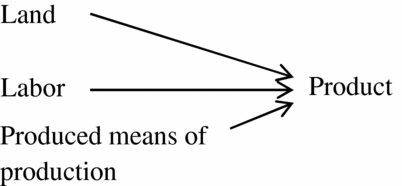
In the language of economics, the problem – the physical movements of goods and persons – can be formulated in the following way: ‘Producers’ have to combine the factors of production (i.e., land, labour and produced means of production), in order to put out a product (Figure 1). They have to physically rearrange factors and refine, transform or even destroy goods in the production of their final output.
The technical process of production.

In order to do so, producers need to make numerous decisions. What product is to be produced, what factor combination should be chosen, how is the product to be allocated among the factors, and so on and so forth. These decisions become quite complicated as soon as production is not from hand to mouth, but involves a longer period of time and several intermediate stages. In modern production processes, millions of different goods have to be combined before the final output is available. Think only of the production of an automobile from the mine and the rubber tree plantation to the final car. Many of the goods that are employed at the intermediate stages might also be used in different proportions or even transferred to other production processes. The corresponding decisions the substitutable nature of input factors creates are not trivial and constitute an enormous economic problem.
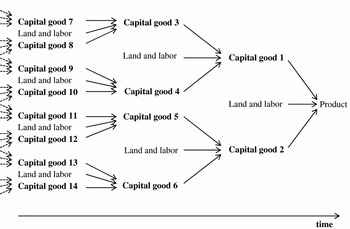
By means of the structure of production (Figure 2), it is possible to depict the complexities that are involved even in the production of only one single product. The complexity of this figure would be multiplied, of course, if it also took into account the existence of several products and the fact that a lot of factors are multi-specific and can be employed in several production plans. Nonetheless, it gives a good idea as to the problem that has to be solved by anyone who wishes to produce goods more ambitiously than is possible by only simplistic production methods.
The structure of production.

The said problem – the historically specific theory of capital is concerned with, it must be added – is a universal and ahistorical one. The necessity of coordinating input factors in the production process appears in all eras of history and in all economic systems. Remember that the ‘capital goods’ in Figure 2 relate to physical capital, which exists in all economic systems, and do not bear a direct relationship to the historically specific term ‘business capital’ that covers business assets only, not all capital goods. As will be shown later, it is characteristic of the Austrian theory of (physical) capital that it supposes the universal and ahistorical features of the structure of production to be not only the problem, but the be-all and end-all of capital theory. It is for this reason that Hayek (Reference Hayek1935a: 40, 95) calls this structure the ‘capital structure’ pure and simple.
For the historically specific capital theory, the technical details of the production process only constitute the problem. It is the same in all economic systems and it has to be solved in all of them. The motivation behind those who provide for the solution, however, varies widely. Robinson Crusoe produces in order to provide for his subsistence. A socialist planning board might produce because it wants to achieve socio-political goals (e.g., to improve the overall education level or to win an arms race). The question the historically specific theory of capital asks is: Who are the people or institutions that combine the different input factors in capitalism, how do they do it, and why? Here, it becomes understandable why it can be called a theory of ‘capital’ at all. In capitalism the technical production process is embedded in the acquisitive activities of profit-oriented enterprises. The latter do not combine production factors for the sake of producing output, but for the sake of yielding profit on their business capital. What marks the success for the acting entities is not the technical relationship between inputs and output, but the ratio between money invested in inputs – business capital – and money acquired by selling the output.
In a sense, the research object of the historically specific theory of capital is the process Karl Marx has described in his famous formula:
 $$\begin{equation*}
\textit{Money} - \textit{Commodity} - \textit{Money}'
\end{equation*}$$
This basic Marxian formula can be extended, following Zwiedineck-Südenhorst (Reference Zwiedineck-Südenhorst1930: 1069), in order to depict better what is at issue, namely the monetary considerations of the enterprise that frame the production process in capitalism.
As Figure 3 shows, entrepreneurs are not primarily interested in the production process as such, but only in the success of the monetary activities that accompany and surround it. The economy's resources are nothing but commodities to them: means to the end of monetary profit. Business capital is the central element of the institution of financial accounting that entrepreneurs apply in order to see whether and in how far the money they have invested in their business yields profit. It is, in other words, part of the solution of capitalism to the problem posed above. A theory of capital which is based on the historically specific definition of capital is concerned with the ways in which resources and factors are allocated by profit-oriented enterprises in capitalism. It tries to explain how (and to what extent) the complicated relationships depicted in Figure 2 can actually be arranged by entrepreneurs who are not interested in the success of the production process, but only in their capital profit (Figure 3). How are enterprises able to dovetail their actions and how far are they motivated to satisfy consumer demand despite their orientation towards monetary profit? The next section will show that the Austrian theory of (physical) capital can help in the further development of this approach.
The acquisitive rationale behind production in capitalism.

3. The Austrian theory of capital reinterpreted
The research object of Austrian capital theory
It is difficult to determine the research object of the Austrian theory of capital. The problems it deals with are, of course, the same as those described in section 'A historically specific theory of capital' and depicted in Figure 2: the structure of production consisting of a myriad of heterogeneous and specific (or at least multi-specific) capital goods and the difficulty of coordinating them (see, e.g., Foss and Klein, Reference Foss and Klein2013). But in the questions the Austrian economists ask in light of these problems, physical capital does not seem to play any role.
When it came to building a positive theory of capital, Austrian authors did not provide a theory of the material structure of production. Rather, this concept only served as a building block for different theories. Böhm-Bawerk (Reference Böhm-Bawerk1889), for example, erected the whole edifice of roundabout ways of production and their intermediate stages for his explanation of the existence of interest. His was not a theory of physical capital, but a theory of interest. Likewise, Hayek (Reference Hayek1935a) elaborated on the structure of production because he needed it for his explanation of the business cycle. Last but not least, Lachmann (Reference Lachmann1978) substantially expanded on Böhm-Bawerk's and Hayek's exposition on the structure of heterogeneous capital goods in order to construct a theory of entrepreneurship.
In short, the problem – the complexities of the structure of production – has been covered widely by those authors who said they were working on an Austrian capital theory, but their research object was not the production structure but either the interest phenomenon, the trade cycle, or entrepreneurship. There is no theory of physical capital in the Austrian writings.
However, it can be shown that there is a theory of capital contained in the writings of these authors nonetheless. It is the historically specific theory of capital as presented in section 'A historically specific theory of capital'. Both the Austrian theory of the business cycle and Lachmann's theory of entrepreneurship presuppose the acquisitive activities of profit-oriented enterprises calculating in money. (Böhm-Bawerk's theory of interest will not be covered here because it has long been abandoned and is only of historic interest.) The corresponding discussions of these activities give some indication of how the complexities of the structure of production are actually dealt with in capitalism and constitute valuable though unconscious contributions to the historically specific theory of capital.
The fundamental heterogeneity of capital
Lachmann (Reference Lachmann1978) is the author who is most serious about the complexities of the structure of production. He stresses the heterogeneity of physical capital not only in relation to successive stages of production, as Menger (Reference Menger1871) has done, but he denies any possibility to systematically categorise, measure, or aggregate capital goods (Lachmann, Reference Lachmann1978: 2). He concentrates on what can be called the fundamental heterogeneity of capital goods, and therefore, as against other Austrian economists (Hagemann, Reference Hagemann, Eatwell, Milgate and Newman1990: 125 f.), he comes close to the position taken by Cambridge (UK) in the Cambridge capital controversies (Harcourt, Reference Harcourt1972). Lachmann and his followers speak of the ‘structure of capital’ in order to stress the complexity and immeasurability of the total of capital goods. His focus on this structure is the reason why Lachmann categorically rejects the practice of some economists to orient their discussion of capital toward the practice of entrepreneurs who evaluate their assets homogeneously in terms of money (Braun, Reference Braun2014: 99 f.).
Despite his explicit rejection of the business view of capital, and despite his constant emphasis on the heterogeneity of capital goods, Lachmann's (Reference Lachmann1978) discussion nonetheless contains an important contribution to the historically specific theory of capital. The point is that the heterogeneous capital structure itself is not the research object, but only serves as the statement of the problem for a theory of the entrepreneur. The main focus of this literature is on the question as to how order is brought into the apparent chaos of the myriad of specific or at best multi-specific capital goods. Lachmann's (Reference Lachmann1978: xv, emphasis added) book is explicitly ‘devoted to the exploration of the problems of the order of capital’. After all, the heterogeneous capital goods must be combined by someone into (hopefully) successful production plans, and this someone is the entrepreneur.
For most purposes capital goods have to be used jointly. Complementarity is of the essence of capital use. But the heterogeneous capital resources do not lend themselves to combination in any arbitrary fashion. For any given number of them only certain modes of complementarity are technically possible, and only a few of these are economically significant. It is among the latter that the entrepreneur has to find the ‘optimum combination’. (Lachmann, Reference Lachmann1978: 3, emphasis removed)
According to Lachmann (Reference Lachmann1978: 16), the ‘true function of the entrepreneur’ must remain hidden as long as ‘we disregard the heterogeneity of capital’ (see also Foss and Klein, Reference Foss and Klein2013).
To repeat, the role of the heterogeneity of physical capital is not the object of cognition of this approach; its role is rather the statement of the problem. The theory itself is about the way this problem is solved by the entrepreneur whose task it is to bring order into the chaos via consistent and successful production plans. In this regard, Lewin's (Reference Lewin2011) elaboration of Lachmann's approach is revealing. According to him, what makes it possible for entrepreneurs to make production plans comprising numerous heterogeneous capital goods is a combination of the market process and the institutions of money and financial accounting. The market provides entrepreneurs with prices which serve as an input for entrepreneurial calculations:
Planning within firms proceeds against the necessary backdrop of the market. Planning within firms can occur precisely because ‘the market’ furnishes it with the necessary prices for the factor inputs that would be absent in a fullblown state ownership situation. (Lewin, Reference Lewin2011: 179, emphasis in original)
Based on these prices, the institution of monetary calculation allows entrepreneurs to calculate retrospective and prospective profits. The calculation of profits, Lewin (Reference Lewin2011: 180) states, is ‘indispensable in that it provides the basis for discrimination between viable and non-viable production projects’.
The approach is not concerned with the heterogeneity of capital goods as such but, to the contrary, with the way these goods are made homogeneous so that entrepreneurs can make the calculations their production plans are based on. What is called ‘homogeneity’ here must be carefully distinguished from the physical homogeneity of capital goods that is assumed by the neoclassical approach to capital theory discussed in section 'Limits of the neoclassical approach'. In Lachmann's approach, capital goods must be homogeneous only in the sense of being commensurate in relation to the goal of the entrepreneur, namely earning monetary profit. Without rendering capital goods commensurate in this sense – by focussing on their actual or expected money prices – it would be difficult, if not impossible, to combine them in a meaningful way.
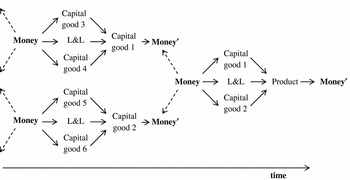
The homogenisation of capital goods and all other factors of production is depicted in Figure 4. The figure contains the schematic representations of the acquisitive activities of three enterprises. One enterprise produces the (final) product. Its input consists in land and labour (L&L) and two produced means of production, capital goods 1 and 2. Its main purpose is, however, to make money, that is, to arrange it so that its money revenue (money′) is larger than its money investments (money). The two capital goods it employs each stem from another enterprise. For these two enterprises, the capital goods 1 and 2 are their respective outputs. Their inputs consist of land and labour and two different capital goods of higher order. The ultimate purpose of these enterprises is also to earn profit.
The structure of production in capitalism.

The point is that the plans and actions of the involved enterprises are connected via money prices and money payments. As the dashed arrows show, the enterprises which produce the capital goods 1 and 2 depend, in their acquisitive activities, on the payments by another enterprise which employs these capital goods as inputs. In the same way, the producers of the capital goods 3 to 6, who are not depicted in the figure, depend on the purchases by the producers of the capital goods 1 and 2 in their acquisitive activities.
It is through these money payments between the enterprises that the heterogeneity of capital goods is made manageable in capitalism. The revenues that capital goods allow for in relation to their monetary costs provide the criterion for the inclusion or exclusion of capital goods in production. In principle, those that can be or are expected to be sold for more money than they cost tend to be produced; others that do not meet this criterion tend to be abandoned.
Prices, together with the institution of financial accounting, direct the allocation of goods and resources in capitalism. On the one hand, the competition between all enterprises provides for a tendency towards uniform money prices that can be employed in business calculations. On the other hand, within the individual enterprise, the profitability of the different possibilities is determined by financial accounting based on these prices. Monetary profits and losses serve as a signal as to where business capital might be invested or withdrawn and therefore where output might be increased or decreased.
Figure 4 also illustrates how enterprises are led, as if by an invisible hand, to fulfil the wishes of consumers. Although they are only interested in their monetary profit, in the end all their activities are oriented towards effective consumer demand that appears as the ultimate money′ payment on the right of Figure 4 (Weber, Reference Weber1922: 66). The enterprise which produces the final product will obviously orient its investments – and therefore the payments for its inputs – by this expected consumer spending. In this way, it transfers consumer demand to the more upstream enterprises. It is in the interest of these enterprises to produce those capital goods that serve as inputs for the more downstream enterprise which directly supplies goods and services according to consumer demand. In so far and as long as this system works well, the consumers direct the production process because it is they who provide the ultimate incentive for production by means of exercising their demand.
Capital in the Austrian theory of the business cycle
The most prominent instance where the Austrian theory of capital with its emphasis on the heterogeneity of physical capital and the structure of production is employed is the Austrian theory of the business cycle (Erlei, Reference Erlei2012; Huerta de Soto, Reference Huerta de Soto2006). Yet, it can be shown that the role of the heterogeneous structure of capital goods in this theory is only to state the problem. In the end, the Austrian theory of the business cycle is not concerned with the structure of production as such, but with the way the banking system influences the monetary calculations of business enterprises. As it thus reveals important features of the organisation of capitalism, it contributes to the historically specific theory of capital.
The Austrian theory of the business cycle consists of two elements. The first is the distinction, introduced by Wicksell (Reference Wicksell1898), between the monetary rate of interest, which is determined by the banking system via the production and intermediation of money loans, and the natural rate of interest, which is determined by aggregated savings in the economy. The second element of the theory is the structure of production as developed by the ‘Austrian theory of capital’ (Lewin and Cachanosky, Reference Lewin and Cachanosky2016). Following Mises (Reference Mises1912), it is argued that the business cycle results when the banking system (either narrowly defined as the central bank or generally defined as including fractional-reserve private banks) decreases the monetary rate of interest below the natural rate. More roundabout methods of production are adopted, thus increasing the number of intermediate stages in the production process. According to the Austrian business cycle theory, these changes in the structure of production can only be short term. As long as savings have not increased, the natural rate of interest must remain high, thus ultimately provoking a rise of the monetary rate of interest again. The consequent shortening of the production structure and the abandonment of the additional intermediate stages, it is argued, cannot be done without grave disruptions. Many of the newly produced capital goods are specific and cannot be put into different uses without a loss in value. The results include bankruptcies, pessimistic expectations and a faltering economy.
The historical specificity of the Austrian theory of the business cycle itself is obvious and out of question. The ‘culprit’ it identifies is the banking system, an institution specific to capitalism, which ignores the natural rate of interest and sets the monetary rate on the credit market according to different considerations, thus creating problems in the structure of production. It is important to note, however, that the concept of the structure of production, in the way it is employed in the Austrian business cycle theory, is also not universal and can be shown to be closely related to the capital concept used in business practice. The monetary rate of interest does not have a direct effect on the structure of production as such, viz. the structure of all existing capital goods, understood as produced means of production. It only influences those kinds of actions that actually factor in this interest rate, that is, those that are oriented towards monetary magnitudes and that, in addition, allow for the rate of interest. This basically applies to businesses employing monetary calculation and, to a much lesser degree, to consumers who plan to buy durable consumption goods like an automobile on credit. In no way can it be said that all existing capital goods are affected by a decrease in interest. Most production processes that occur in private households, like the installation of a wildlife garden or the baking of a cake, obviously consist in several stages and comprise several capital goods, but they are not directly affected by the rate of interest. By and large, it is only the sphere of business and monetary calculation in capitalism that is affected by it.
The ‘capital structure’ Austrian authors implicitly have in mind when they speak of the influence of the rate of interest on the length of production and the number of stages is not the structure of physical capital. Many capital goods do not have a market value and are not subject to monetary calculation. In reality, the Austrian theory of the business cycle is a theory of the way changes to the rate of interest affect the structure of those goods that appear on the balance sheet of businesses and are therefore subject to monetary calculations. In other words, it only deals with those goods that, according to the view of Menger (Reference Menger1888) and Mises (Reference Mises1949), comprise business capital.
That the focus of the Austrian theory of the business cycle is on monetary calculation, and not on the structure of physical capital as such, can best be seen in Mises's (Reference Mises1949: 550, emphases added) exposition of the influence of the rate of interest:
A drop in the gross market rate of interest affects the entrepreneur's calculation concerning the chances of the profitability of projects considered. Along with the prices of the material factors of production, wage rates, and the anticipated future prices of the products, interest rates are items that enter into the planning businessman's calculation. The result of this calculation shows the businessman whether or not a definite project will pay. It shows him what investments can be made under the given state of the ratio in the public's valuation of future goods as against present goods.
Mises clearly does not deal with the whole structure of all capital goods, but only focusses on those actions accompanied by monetary calculations. Accordingly, an unsustainable boom, caused by a drop of the monetary rate of interest below the natural rate, is characterised by a falsification of entrepreneurial calculations. These distorted calculations
make some projects appear profitable and realizable which a correct calculation, based on an interest rate not manipulated by credit expansion, would have shown as unrealizable. Entrepreneurs embark upon the execution of such projects. Business activities are stimulated. (Mises, Reference Mises1949: 550)
Once applied to the analysis of the business cycle, the Austrian concept of the structure of capital as consisting of several consecutive stages is not a structure of ‘production’ any longer, but a structure of businesses strung together – a structure of business capital. The time aspect in the Austrian theory of the business cycle does not relate to the length of the period of physical production, but to the period of monetary investment.
It is business capital that is affected by the rate of interest, not any technical considerations of production. And the problem at the turning point of the business cycle is not a technical one, i.e., merely about the wrong combination of production goods, but is related to the difficulty of entrepreneurs to pull their business capital out of investments that prove to be unprofitable after an increase of the monetary rate of interest. Even if the technical problems of the wrong combination of capital goods could be solved, e.g., because all capital goods that had been produced during the boom phase were sold cheaply to other entrepreneurs and were therefore not lost to the production process, there could still be a recession. After all, the businesses selling the capital goods might make considerable losses due to decreased prices, implying loan defaults, bankruptcies, lay-offs or a generally negative business climate. The Austrian theory of the business cycle, in short, builds upon a historically specific theory of (business) capital, but not upon the Austrian theory of (physical) capital. It explains how the plans and calculations of entrepreneurs are manipulated by changes in the monetary rate of interest.
4. Capital and equilibrium
Limits of the neoclassical approach
A historically specific theory of capital inspired by the Austrian school focusses on the way profit-oriented enterprises organise the allocation of goods and resources in capitalism. It analyses how the complexities of modern-day production processes with their myriad of complementary capital goods are dealt with by businesses and works out the implications and problems of this organisation. One major issue is the relationship between acquisition and production. How does the homogeneity of money figures that entrepreneurs employ in their acquisitive plans connect to the unquestionable heterogeneity of the capital goods in production that these monetary figures depict?
The differentiation between acquisition and production distinguishes this theory from the neoclassical approach to capital. The homogeneity of the money figures on the level of acquisition that is important to such a historically specific theory is not due to the assumption of equilibrium, but simply to the existence of money prices. It is real-life homogeneity, so to speak. It does not imply any homogeneity on the level of production, but rather explains the principle according to which the production process is conducted.
In neoclassical economics, in contrast, production and acquisition, the two different levels of analysis, are not separated but are amalgamated by means of the vague term ‘value’. As equilibrium conditions are assumed, the asset values are presumed known and take on a sort of objective character. The value of assets corresponds to their marginal productivity, and therefore it signifies both their price and their technical importance to the production process. Capital understood in this way, i.e., as the value of capital goods, can take on the ‘double meaning of money or goods’ (Hodgson, Reference Hodgson2014: 1067). By concentrating on the value of capital goods, the neoclassical approach assumes homogeneity not only on the level of acquisition with its input and output prices, but also on the level of production. The famous K in the neoclassical production function is supposed to capture the amount of the production factor capital, of physical capital. It is assumed that the heterogeneous capital goods, and not only their prices, can be summed to a meaningful result.
The neoclassical approach to capital assumes that the valuation process has already been accomplished. It does not explain how assets come to be valued originally according to their marginal product. In this, an elaborated historically specific theory of capital would provide the necessary tools. In capitalism, inputs and outputs are interrelated by entrepreneurs who are guided by price signals. In their efforts to maximise their monetary profits, they aim to benefit from the spread between input and output prices. Therefore, money tends to be invested where this spread appears to be wide enough to be worth the risk. In other words, business capital flows to those industries and businesses where it yields the largest profit. Competition among entrepreneurs brings about a tendency for price spreads to diminish. The prices of the factors of production are bid up and the prices of the output are bid down until, in the hypothetical state of equilibrium, the factor prices sum up to the price of the product. A historically specific theory of capital is able to describe and analyse the market process that results – or tends to result – in marginal productivity prices, and can therefore also formulate positions concerning endogenous and exogenous misdirections of this process which lead to disequilibrium prices.
The issue of ‘fair’ asset valuation
Although sections 'The fundamental heterogeneity of capital' and 'Capital in the Austrian theory of the business cycle' have shown how the two levels – acquisition and production – can easily be separated in some prominent applications of Austrian capital theory, the discussion thus far does not imply that the whole Austrian approach to capital can be wrapped up in a historically specific theory of capital without difficulties. There are instances where the two levels – business capital and physical capital – are intermingled and it is rather complicated to divide them.
A very important instance where Austrians do not stick to the differentiation between acquisition and production is their position on the valuation of business assets in accounting. Many Austrian economists urge businesses to put ‘values’ into their balances – either market values or present values. In this way, they adopt some of the ambiguity of the neoclassical equilibrium concept of capital. Outside of an equilibrium framework, the term ‘value of a good’ does not signify a magnitude that is cast in stone – the relevant data may change permanently and unpredictably. Approaches who demand balance sheet figures to provide a fair view of asset values assume that the valuation of the assets can be or has already been achieved, rendering unnecessary any process whose task might be to bring these values about and, by implication, any theory that might want to analyse this process.
Surprisingly, many Austrian school economists, despite their emphatic insistence on the importance of the market process as opposed to market equilibrium, basically reject the traditional valuation principles which were oriented towards historical costs, not towards ‘values’ of any kind. Next to Hayek (Reference Hayek1935b: 275 f.) and Fetter (Reference Fetter1937: 9), especially Mises, who otherwise vehemently rejected the neoclassical restriction to equilibrium in favour of a process-oriented view of the market (Kirzner, Reference Kirzner1997: 61 f.), holds a rather neoclassical view of the way assets should be valued.
In balance sheets and in profit-and-loss statements, [. . .] it is necessary to enter the estimated money equivalent of all assets and liabilities other than cash. These items should be appraised according to the prices at which they could probably be sold in the future or, as is especially the case with equipment for production processes, in reference to the prices to be expected in the sale of merchandise manufactured with their aid. (Mises, Reference Mises1949: 213 f., emphases added)
According to this, not the monetary costs of the assets, which can be verified unambiguously, but their values are supposed to be the basis of entrepreneurial calculation. As the emphasised words indicate, this procedure involves a tremendous amount of uncertainty and can therefore only lead to fair values if equilibrium conditions are assumed. To be sure, Mises neither argue that we are actually in equilibrium nor that asset values could ever be estimated correctly. However, by dismissing historical costs and leaning onto valuations, he joins those authors who want businesses to calculate their profits not on the basis of realised transactions, but on estimations of the future (Braun, Reference Braun2016). Such a demand only makes sense if it is assumed that the estimations are accurate.
Mises's position is all the more surprising as it was he who stressed the importance of financial accounting most vigorously within the Austrian school. Correctly estimated or ‘fair’ asset values are, if anything, the outcome of the market process which is oriented by financial accounting. By urging businesses to put these values onto the balance sheet, Mises assumes that they can be known in advance. In other words, he assumes implicitly that equilibrium conditions prevail, which implies that financial accounting becomes meaningless. His endorsement of a variant of fair value accounting simply means that he devalued the institution of financial accounting after he had postulated its central role in the market economy.
5. Conclusion
The purpose of this paper was twofold. First, it took up Hodgson's (Reference Hodgson2014) demand for a return to the historically specific concept of business capital and indicated how a corresponding capital theory would look like. Such a theory, it has been argued, would start from the complexities of the modern-day production processes with their myriad of heterogeneous capital goods and illustrate how and how far profit-oriented enterprises succeed in their coordination. In this, it would focus on the role of the institutions of economic calculation in capitalism, especially financial accounting, which homogenise the heterogeneous capital goods by concentrating on their money prices. Second, the paper made the case for a reinterpretation of the Austrian theory of capital. As soon as the statement of the problem and the corresponding theories are separated in the Austrian discussions, it becomes obvious that the latter contain several valuable elements that can be exploited by a historically specific theory of capital. This result was especially important as the Austrian theory of capital is generally considered to be universal and ahistorical.
It might be added that, on a meta level, the present paper can be considered as an attempt to associate different heterodox approaches to economics, or at least to capital theory. Most heterodox schools are united in their opposition to several aspects of the mainstream neoclassical approach. However, there do not seem to be many positive points of contact between these schools. Perhaps this paper is able to indicate how these differences can be overcome and cross-pollination can occur. The Austrian and the historical school were once known for their fundamental opposition. Nonetheless, they can be shown, after some reinterpretation, to dovetail in the construction of a theory of capital that analyses important processes of capitalism.
Acknowledgements
The author thanks professors Mathias Erlei and Geoffrey M. Hodgson for their helpful comments on an earlier version of this paper.